Antique Peepshow with Six Hand-Colored Engraved Layers — Courtly Garden (No. 1)
Held in major public collections — the Cooper Hewitt, V&A, the Met, MSU Libraries, and Deventer Museums — and a documented forerunner of the 19th-century Dean & Son peepshow books.
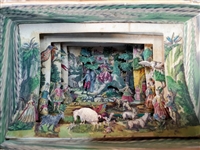
Put one eye to the peephole and a flat stack of paper becomes a palace garden you could walk into — six hand-colored engraved layers, cut away and spaced to fake a hundred feet of topiary avenue inside a box the size of your hand. This is hand-cranked virtual reality from a century before the medium had a name, and the story it carries is its own provenance.
The story
The record is precise about what we know and what we don't. This peepshow is unsigned. The seller at vintagepopupbooks.com attributes it to one of two Augsburg, Germany copperplate engravers and print-publishers — Martin Engelbrecht (1684–1753/1756) or Georg Balthasar Probst (1732–1801) — and dates it ca. 1750–1830. The form decides the lean: six hand-colored engraved cut-out layers depicting a courtly palace garden match documented Engelbrecht 'perspective theatres' most closely. Engelbrecht began producing these perspective theatres in 1730, and the closest documented sibling — the six-layer 'Garden Scene with Dancers' now at the Cooper Hewitt, Smithsonian Design Museum (acc. SIL39088014946875) — is dated ca. 1740.\n\nVerified: the form is regarded as the earliest paper theater in history and the direct forerunner of the 19th-century Dean & Son peepshow books (Fine Books & Collections, 'The Miniature Theaters of Martin Engelbrecht'). Engelbrecht's was a known, finite enterprise, not an anonymous trade output — 'From holograph numbering to the rear of each card, we know that Engelbrecht created at least forty-one sets,' each typically five to eight sheets. He also reportedly held a singular market position: per Planting Diaries and MSU Libraries, he was the only publisher granted royal permission to publish these miniature scenes, with no competing publishing house.\n\nThe individual hands belong to the shop, not to any one engraver on this object. For the documented sets, Engelbrecht's Augsburg studio employed staff engravers and artists on the peepshow series, including Jeremias Wachsmuth and Johann David Nessenthaler (per Planting Diaries). Because this example is unsigned, no individual hand is documented for it — only the workshop tradition it plainly belongs to. Today that tradition is held in major public collections: the Cooper Hewitt and Smithsonian Institution Libraries, the Victoria & Albert Museum, the Metropolitan Museum of Art, MSU Libraries, and the Deventer Museums in the Netherlands. A restored Engelbrecht garden tunnel book was exhibited in the Smithsonian's 2010 'Paper Engineering: Fold, Pull, Pop, and Turn' show at the National Museum of American History. That is the company this little box keeps.
What makes this one special
What sets it apart is that the depth is built entirely from flat paper. Six hand-colored engraved layers, each with portions cut away, are stacked at intervals inside the showbox so a single eye at the peephole reads a baroque palace garden as a deep, walk-into tableau of aristocratic promenaders, topiary avenues, statues, and fountains. The Cooper Hewitt describes a near-identical sibling exactly: 'a set of six hand-colored etched prints on light gray laid paper, with sections carefully cut out to create a perspective view when the prints are arranged in a viewing box.'\n\nThe structure is a true concertina. As the V&A puts it, 'the peepshow looks like a stretched-out concertina when open but when closed, you would never guess the wonders it contains.' The Smithsonian Libraries describe the mechanism: tunnel books are 'engineered like an accordion, with the two boards pulling apart and the illustrated panels lined up and viewed through a front peep-hole.'\n\nCrucially, the depth is engineered, not even. The front face and first panels sit much farther apart than the rest, while the rear panels crowd together — and that exaggerated, uneven recession is what makes a shallow box read as a long garden avenue. The whole idea is lifted from the stage: the layered construction was 'inspired by Baroque stage sets where the decor was painted onto a series of parallel planes' (V&A), so each cut-out layer is, quite literally, a painted stage flat. Period boxes were even lit through side slits so candlelight could rake across the scene. It is, in effect, hand-cranked virtual reality from a century before the medium had a name.
Why people love it
Collectors love this object because the provenance is the prize: an unsigned shop piece that nonetheless sits in the direct lineage of the earliest paper theaters in history, held alongside named examples at the Cooper Hewitt, the V&A, the Met, and the Smithsonian Libraries. The appeal is twofold — the engineering wonder of six flat sheets resolving into a deep palace-garden tableau, and the documentary thread back to Augsburg's copperplate trade. People who love it tend to love it the way they love the institutions that keep its siblings: the receipts are the romance. The museum descriptions below say it plainly.
“This colorful and intricately cut paper work, called a peep-show or tunnel book, consists of a set of six hand-colored etched prints on light gray laid paper, with sections carefully cut out to create a perspective view when the prints are arranged in a viewing box.”— Cooper Hewitt, Smithsonian Design Museum — object record, 'Paper Construction, Garden Scene with Dancers' (Martin Engelbrecht, ca. 1740)
“Tunnel books or peep shows are a series of cut-paper panels placed one behind the other, creating the illusion of depth and perspective. Often, these are engineered like an accordion, with the two boards pulling apart and the illustrated panels lined up and viewed through a front peep-hole or viewer.”— Smithsonian Libraries — 'The Dance of the Tunnel Book,' Paper Engineering exhibition
“the peepshow looks like a stretched-out concertina when open but when closed, you would never guess the wonders it contains.”— Victoria & Albert Museum — 'Paper peepshows'
“The layered structure of the peepshow was inspired by Baroque stage sets where the decor was painted onto a series of parallel planes.”— Victoria & Albert Museum — 'Paper peepshows'
“From holograph numbering to the rear of each card, we know that Engelbrecht created at least forty-one sets.”— Fine Books & Collections — 'The Miniature Theaters of Martin Engelbrecht'
Tips & little secrets
- Open it by the boards, never the layers. Draw the front and back boards apart gently and let the concertina extend on its own; the cut-paper scenic layers are the fragile part and should never bear handling pressure.
- Honor the uneven spacing. Period peepshows space the front panels far apart and crowd the rear ones — that is what builds the illusion of a deep garden walk. Don't redistribute the gaps to look 'even'; you'd flatten the very effect the maker engineered.
- Light it from the side, softly. Original boxes were lit through side slits so candlelight raked across the scene. Recreate that with a cool, low-heat raking light from one side rather than a hot bulb or direct sun.
- Keep it out of direct sunlight and away from humidity. Hand coloring on laid paper fades and cockles; a stable, dim, dry spot protects both the color and the cut paper.
- View it as intended — one eye, at the peephole, box on a level surface. The perspective only resolves correctly from the front aperture; that single viewpoint is the whole design.
The honest verdict
- Provenance you can trace: an unsigned shop piece in the direct lineage of the earliest paper theaters in history, with named siblings at the Cooper Hewitt, V&A, the Met, and Smithsonian Libraries.
- A genuine optical marvel — six hand-colored engraved layers resolving into a deep baroque garden through a single peephole, the depth engineered through deliberately uneven spacing.
- A complete, well-preserved survival of an extremely fragile form, with all scenic layers reported intact and vibrant original hand coloring.
- Unsigned. The maker attribution — Engelbrecht or Probst — is the dealer's, not a manufacturer's mark or a holograph number on the cards, so the specific hand will likely never be documented for this example.
- Extreme fragility is intrinsic to the form. Hand-colored cut-paper layers on laid paper are vulnerable to light, humidity, and handling; survival of all six scenic layers intact is exactly why a piece like this is called rare.
Honest verdict: this is a documentary object first and a decorative one second, and that is the right way to want it. The receipt — unsigned, but in the exact tradition of the earliest paper theaters in history, with named siblings in the world's great design collections — is what you are acquiring, alongside a real and durable optical delight. Go in clear-eyed that the maker line is an attribution by form, not a signature, and that the fragility is permanent. For anyone drawn to paper engineering, theater history, or the long prehistory of immersive media, a complete, intact six-layer survival is the genuine article: a tiny baroque stage that still does its trick three centuries on.
Worth it for the provenance and the optical marvel together — you're buying a documented place in the lineage of the earliest paper theaters, not just a pretty box.
- The maker attribution is the seller's, not a signed or holograph-numbered identification: 'This object is unsigned and has no maker's marketing text; the maker attribution is the dealer's, not a manufacturer's claim.' Treat 'possibly Engelbrecht or Probst' as an informed attribution by form, not a documented authorship. — vintagepopupbooks.com — seller copy / object listing
- Scale sets this shop example apart from the named museum pieces. The documented Engelbrecht garden plates at the Cooper Hewitt run far larger — roughly 17 x 20 cm each — while this peepshow's cards are about 90 x 140 mm in a box near 150 x 100 mm; a smaller, more modest object than the institutional comparanda. — Cooper Hewitt object record vs. seller dimensions
The questions everyone asks
Made by Germany, ca. 1750-1830; possibly Martin Engelbrecht or G.B. Probst. Prices and stock shift, so we re-check often — the button takes you straight to the maker.
Researched + written by Margo, 2026-06-11. 7 sources on file.
![[2,3]](/images/paper/tauba-auerbach-2-3/g0.jpg)