Tatebanko Great Wave Paper Diorama (Hokusai)
Modern revival of a near-extinct Edo-period craft; no awards or limited-edition status documented — a mass-market kit, in print for well over a decade.
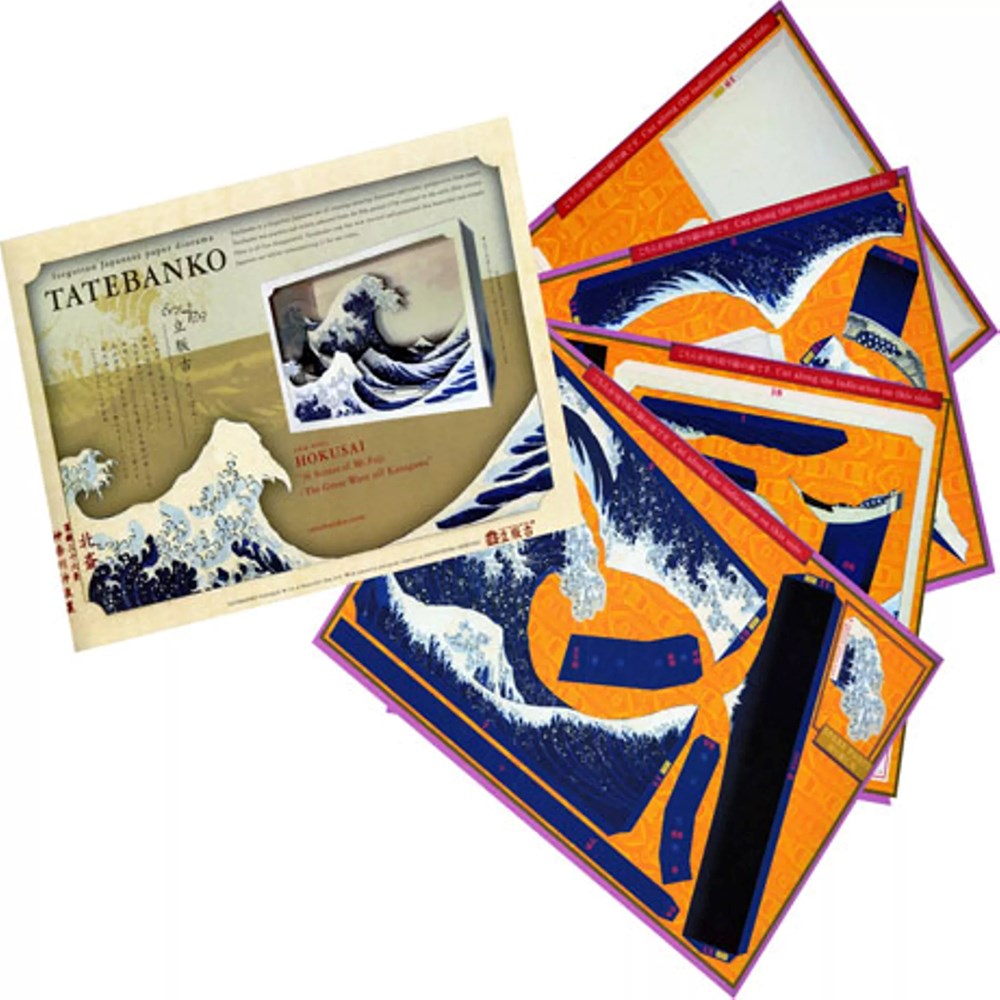
Hokusai's most famous wave was never meant to stay flat. Here it rises off the page in receding paper planes — a 19th-century woodblock image you assemble, then look into.
The story
To understand this object, begin with the word. *Tatebanko* (立版古) — also called *kumiage-e* (組上げ絵), "assembled pictures" — is the Edo-period Japanese art of building a layered diorama from a single printed sheet: cutting elements free, scoring and folding them, and gluing them onto a paper base to form a scene with depth. It belonged to the family of *omocha-e*, the toy-prints, and it flourished from the 17th century into the early twentieth before it all but vanished. As the kit's own product copy puts it, "Tatebanko is the forgotten Japanese art of creating amazing dioramas and scenic perspectives from paper." The form carries a notable lineage. The historical master Katsushika Hokusai himself designed cut-out paper dioramas among his toy-prints, and the Museum of Fine Arts, Boston — which holds the largest collection of Hokusai outside Japan — has shown his diorama work. Understand the distinction plainly: it is the art form and the artist that carry the museum pedigree, not this modern kit. The kit is a reproduction. It translates Hokusai's woodblock print "The Great Wave off Kanagawa" (Kanagawa-oki Nami-ura), designed around the 1830s, into standing paper. The maker is the Japanese paper-craft group It's a Beautiful Day, described repeatedly as the group leading the tatebanko revival; in some markets the kits carry the "noted*" label. The design is house-designed — no individual contemporary paper-engineer is credited in any published source, and I will not invent one. It is printed in Japan, with metallic accents, and it sits within a wider series: as one chronicler observed, the line offers "a snowy scene representing a painting by the master Hiroshige or in a version of Hokusai's wave." The earliest press coverage dates to around 2007; the Great Wave design has remained in print and distribution for well over a decade since. The teaching here is simple: a forgotten craft does not die so long as a maker keeps cutting paper in its name.
What makes this one special
First, the terms, set side by side. *Origami* folds and does not cut. *Kirigami* cuts and does not build outward. *Tatebanko* does something else entirely: it cuts multiple printed elements from the sheet, then scores, folds, and glues them onto a paper base so they stand as stacked planes. Its nearest cousin is not the single pop-up that springs from one fold, but the peep-show — the tunnel-book — a scene you look into rather than at. That is what sets this object apart. The Great Wave kit arrives flat, as A4 sheets of printed punch-out and cut-out pieces. You free each element, fold along its scored lines, and fix it to the base in sequence. As the printed lesson frames it, the kit is "a mini lesson on Tatebanko, the forgotten Edo-era Japanese art of creating perspectives from paper." Assembled, it stands roughly seven and a half inches wide, three and a half inches deep, and just under five inches tall — small enough for a shelf, deep enough to hold a horizon. What makes it remarkable is the translation. Hokusai's print is flat — a single woodblock plane from the 1830s. The kit pulls that image apart into depth: the great clawed wave in the foreground, the slim boats caught in the mid-ground, and Mount Fuji small and still in the distance. Hidden surprises and metallic accents catch the light as you tilt it. A Japanese retailer's line on the wider series holds true here: these kits "revive the elegant tradition 17th century Japanese tradition with works of framed Japanese and European artists. Beautifully designed, easy to assemble to create a stunningly detailed diorama. Printed in Japan." The distilled teaching: depth is not drawn here — it is built, one standing layer at a time, until a flat wave learns to break.
Why people love it
Collectors return to this object for two reasons that rarely meet in one small kit: a serious craft heritage and an undemanding hand. Those who chronicle design objects placed it among genuine cultural recoveries, noting that it is "designed and printed in Japan by It's a Beautiful Day (the group leading the Tatebanko revival), the kits feature metallic accents and hidden surprises." That phrase — the group leading the revival — is what gives the object its weight. You are not assembling a souvenir; you are handling a living thread of a near-extinct form. And yet the build asks little: the elements are pre-printed, the folds are scored, and the published descriptions consistently call it easy to assemble. The pleasure is in watching a flat famous image stand up into depth under your own hands.
“Tatebanko is the forgotten Japanese art of creating amazing dioramas and scenic perspectives from paper.”— Better Living Through Design (quoting the kit's own product copy)
“Designed and printed in Japan by It's a Beautiful Day (the group leading the Tatebanko revival), the kits feature metallic accents and hidden surprises.”— Cool Hunting
“a mini lesson on Tatebanko, the forgotten Edo-era Japanese art of creating perspectives from paper”— Cool Hunting
“a snowy scene representing a painting by the master Hiroshige or in a version of Hokusai's wave”— Cool Hunting
“These Tatebanko kits revive the elegant tradition 17th century Japanese tradition with works of framed Japanese and European artists. Beautifully designed, easy to assemble to create a stunningly detailed diorama. Printed in Japan.”— Fred Aldous (UK retailer product page)
Tips & little secrets
- Work on a clean, flat surface in good light, and free every element from the sheet before you glue anything — knowing all the pieces first prevents a wrong fold midway through the build.
- Score along the printed fold lines before folding. A light pass with a bone folder or the back of a knife gives the paper a crisp, intentional crease and keeps the standing planes square.
- Use glue sparingly. Apply small amounts to the tabs only; excess glue cockles the paper and dulls the metallic accents. Let each layer set before adding the next so the planes hold their depth.
- Respect the stacking order — assemble from the back plane (Mount Fuji and the distant horizon) forward to the great wave, so each layer sits behind the one in front and the perspective reads true.
- Display it head-on at eye level, lit from the front or side so the metallic accents catch and the layered shadows give the wave its depth. Keep it out of direct sun and away from damp, as printed paper fades and warps.
The honest verdict
- Revives a near-extinct Edo-period craft from the group leading the tatebanko revival, with the museum-grade pedigree of Hokusai's source form behind it
- Translates a flat, world-famous woodblock image into genuine built depth — foreground wave, mid-ground boats, distant Fuji — small enough for any shelf
- Printed in Japan with metallic accents and hidden surprises; described across sources as beautifully designed and easy to assemble
- It is a reproduction kit, not a limited edition or accessioned artwork — no awards or numbered editions are documented, and the museum pedigree belongs to the art form and the artist, not this kit
- As a printed-paper object it is inherently delicate: it demands careful gluing, a steady hand, and protection from sun and damp once displayed
An honest and quietly rewarding object. It does not pretend to be fine art — it is a mass-market paper kit — but it carries something better than pretense: a real connection to a forgotten Edo craft, executed cleanly and printed in Japan by the group that revived it. Build it with patience and you hold a small, accurate lesson in how the Japanese masters made a flat image breathe.
Worth it for anyone drawn to Japanese craft, Hokusai, or paper engineering who wants a genuine tatebanko built by their own hands — not a trinket, but a lesson you can display.
- Per the editor's product copy as relayed by the design blog, the kit is praised as good value with lasting appeal: "incredibly affordable" and they "will give enjoyment long after assembly," pitched for gift lists. (Note: this is positive vendor-adjacent framing, not an independent critique.) — Better Living Through Design
- Caveat on verifiability: Amazon listing and customer-review pages for the kit (ASIN B004T17YZU) could not be retrieved directly, so no customer-review wording is quoted here. Search snippets suggested reviewers found assembly straightforward but flagged thin/flimsy card stock; that wording is unverified and intentionally omitted. — Amazon listing (noted* Paper Diorama Kit – Tatebanko: Hokusai, ASIN B004T17YZU) — could not be fetched
The questions everyone asks
Made by It's a Beautiful Day (Tatebanko); after Katsushika Hokusai. Prices and stock shift, so we re-check often — the button takes you straight to the maker.
Heartfelt disclosure: an enchanted link may earn the cabinet a small commission, at no cost to you — and it never changes what we recommend. As an Amazon Associate, Puzzlewick earns from qualifying purchases.
Researched + written by Kenji, 2026-06-11. 4 sources on file.
![[2,3]](/images/paper/tauba-auerbach-2-3/g0.jpg)