The Wonderful Wizard of Oz (Deluxe Signed Limited Edition Pop-Up)
Deluxe signed/numbered limited edition — one of only 50 copies, hand-signed and numbered by Robert Sabuda, a three-time Meggendorfer Prize winner the NYT called the king of pop-ups.
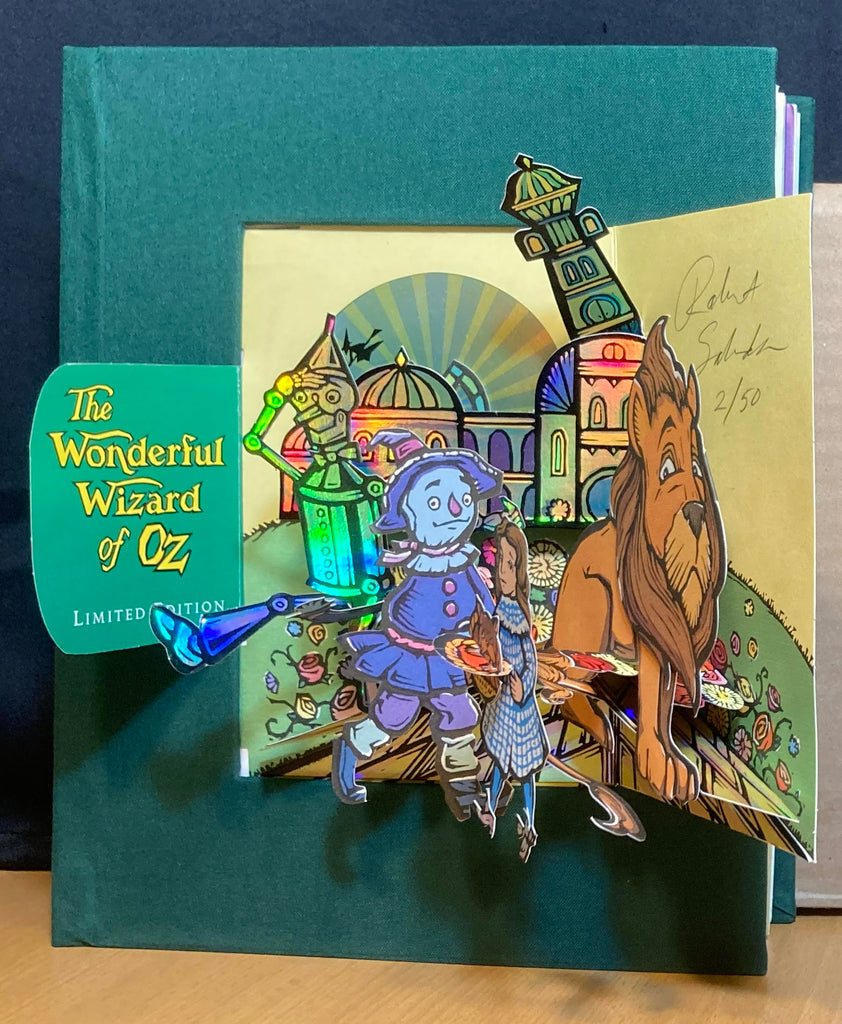
I have handled a lot of paper in my life, but the first time a Sabuda cyclone twisted up out of the gutter and stood there spinning, I actually said something out loud in an empty room. This is the deluxe issue of his Oz — green cloth, a pop-up signed behind a little door in the cover, an extra signed print tucked into the slipcase — and it is the single most theatrical object in this whole wing of the cabinet. Pull up a chair. Let me tell you how it got onto my shelf.
The story
Here is the short version of how this book exists at all. In 1900, L. Frank Baum published "The Wonderful Wizard of Oz," with those now-iconic illustrations by W. W. Denslow. A hundred years later, in 2000, Robert Sabuda — a paper engineer who had already spent a career proving that a flat page could become architecture — built a pop-up adaptation to mark that centennial. The text is a shorter version of Baum's original, and the artwork is rendered in the style of Denslow, so the thing reads like the 1900 book reincarnated as a piece of kinetic sculpture. The publishing side is worth getting right, because it's part of what makes this particular copy special. The trade commemorative pop-up (the open edition, sixteen pages) is the one most people have held — and it is rightly celebrated; reviewers have called it among Sabuda's finest, his masterpiece. Above that sits a two-tier limited structure. There's a signed and numbered slipcase edition limited to 200 copies. And then, above THAT, the pinnacle: a deluxe issue of only 50 copies, created by Simon & Schuster (Little Simon) exclusively for Books of Wonder, the legendary New York children's bookstore. Each of the 50 is hand-numbered and signed by Sabuda. Both limited tiers also carry an extra pop-up that the trade edition simply does not have, hidden behind a door in the front board. Now the maker. Robert Sabuda is, plainly, the most decorated paper engineer of his generation. He has been awarded the Meggendorfer Prize for Best Paper Engineering three times by the Movable Book Society. In 2003 The New York Times called him "indisputably the king of pop-ups," and that phrase has followed him ever since because it's simply accurate. His work is collected institutionally too — a Robert Sabuda Pop-Up Book Collection lives at the St. Louis Mercantile Library at the University of Missouri–St. Louis. When you hold one of these, you are holding the high-water mark of an art form, signed by the person who set the mark.
What makes this one special
Let me walk you through what actually happens when you open it, because the engineering is the whole point. Every spread carries a large central pop-up — these are full architectural events, not little flaps. The signatures of the book are the ones you'll have heard about: a cyclone that twists and spins as the page opens, the kind of thing that makes you turn back a page just to watch it collapse and rise again. The Wizard's hot-air balloon, which pops up and rotates right there in the gutter of the spread. And the Emerald City itself — an elaborate, towering build shrouded in holographic and colored foil so it genuinely glitters. There's a tactile trick I love: the book includes removable green "Emerald City" eyeglasses, and when you put them on and look at the city pop-up, the whole thing washes entirely green — exactly the way Baum's story describes the spectacles the citizens wear. You become a character in the book for a second. It is a delightful, slightly silly, perfect touch. Then there's the depth most people miss. On most spreads, Sabuda mounts side miniature booklets and envelopes — little secondary surfaces with their own small pop-ups and surprises folded inside. So the book keeps unfolding beyond its main spreads; you finish a page, then realize there's a whole second layer to open. What sets THIS deluxe copy apart from even the 200-copy edition is the packaging and the extras, and it's layered like a set of nesting dolls. The book is bound in full green cloth with a gilt-stamped spine. The front cover carries a mounted pictorial POP-UP limitation — Sabuda signs and numbers that pop-up, and it sits behind a small door in the front board, which is also where the bonus pop-up (the one absent from the trade edition) lives. The book then nests inside a matching green cloth slipcase, and the front of that slipcase holds a separate, signed-and-numbered Sabuda print — a woodcut/Denslow-style print — cleverly encased in an inlaid folding holder. That extra print is the single feature the 200-copy edition does not have; it is what makes a deluxe a deluxe. Finally, the whole assembly sits inside the original publisher's green cloth clamshell box, which bears a paper label matching the copy's limitation number. Three layers of green cloth, two signatures, a bonus pop-up, and an exclusive print, all keyed to one hand-written number.
Why people love it
I'm not going to pretend my opinion is the only one that matters here, and on this book I don't have to — the consensus is strong and it isn't just sentiment. The trade edition is the entry point for most of the love: the pop-up review community rates it 9 out of 10 and ranks it #4 on their all-time top-ten list, and the official publisher copy itself promises a piece "certain to find an honored place on the family bookshelf." That phrase gets quoted a lot because owners find it turns out to be true. And the affection for the format runs deep enough that serious collectors talk about advanced pop-ups as a category and put this one near the front. The throughline in everything people say is the same thing I felt: Sabuda earned the crown, the engineering holds up to repeat viewing, and the green-foil Emerald City is the moment that converts skeptics.
“indisputably the king of pop-ups”— The New York Times (2003), as quoted on Robert Sabuda's Wikipedia entry
“Sabuda has been awarded the Meggendorfer Prize for Best Paper Engineering three times by the Movable Book Society.”— Wikipedia — Robert Sabuda
“Bound in full green cloth with gilt-stamped spine ... Housed in a matching green cloth slipcase with an inlaid woodcut-style print signed and numbered by Sabuda ... Enclosed in the original publisher's green cloth clamshell box, which bears a paper label matching the limitation number.”— vintagepopupbooks.com — deluxe signed limited edition, No. 10 of 50
“With sparkling touches of colored foil and Emerald City eyeglasses, [it is] certain to find an honored place on the family bookshelf.”— Little Simon / Getty Museum Store official product description
“A must have for everyone who loves advanced pop-up books.”— BestPopupBooks.com review (rated 9/10; ranked #4 all-time)
Tips & little secrets
- Open and close it slowly, always supporting the spread from underneath with a flat hand. Sabuda's large central pops are engineered to take a smooth open — but a fast or one-handed page turn is how the delicate cyclone and balloon mechanisms get crushed. Let the paper do the work; never force a page flat.
- Don't skip the side envelopes and miniature booklets. On most spreads there are mounted secondary surfaces hiding small pop-ups — explore each one gently before moving on, or you'll literally miss half the book.
- For display, stand it open to a single spread on a book cradle or easel rather than laying it flat or forcing it fully open — and keep it out of direct sunlight. Foil and colored paper fade, and the Emerald City's holographic/colored foil is exactly what you want to protect.
- Keep the green 'Emerald City' eyeglasses and the signed slipcase print stored back in their holders when not in use. On the deluxe copy those loose pieces — plus the clamshell box with its matching numbered label — are part of what makes it complete; a stray glasses pair or a separated print diminishes the whole.
- Handle it in a clean, dry space with clean hands, and rotate which spread you display every so often. Spreading the open-time across pages keeps any one mechanism from bearing all the wear.
The honest verdict
- Genuine museum-grade paper engineering — the spinning cyclone, the gutter-rotating balloon, and the foil Emerald City are showstoppers that reward repeat viewing, signed by the artist the NYT named the king of pop-ups.
- The deluxe packaging is exceptional and complete: full green cloth binding, a signed pop-up behind a door in the cover, a bonus pop-up absent from the trade edition, an exclusive signed/numbered print in the slipcase, and the original numbered clamshell box.
- True scarcity with a story — one of only 50 copies, made by Simon & Schuster exclusively for Books of Wonder to mark the 100th anniversary of Baum's 1900 original, every copy hand-signed and numbered.
- It is fragile by nature. Pop-up mechanisms this intricate are not built for casual handling or curious kids — this is a display-and-admire object, and that reality has to be accepted going in.
- As a single hand-numbered copy out of 50 with loose components (eyeglasses, slipcase print, clamshell box), completeness and condition are everything; a missing extra or a creased mechanism meaningfully changes what you have.
Honestly? This is one of the few objects in the cabinet where the superlatives are earned rather than marketing. As a piece of paper engineering it's a masterpiece; as a collectible it's the top tier of a top-tier artist's most-loved book, signed twice and packaged like a small treasure. What nearly kept it off my shelf was exactly the thing that makes it great — it is delicate, and an object this fragile that you can't hand to a kid sat uneasily with me for a while. I kept it because the cyclone won. You open the page, the storm twists up, you put on the silly green glasses, and the Emerald City glows — and you understand immediately why people have ranked this book among the best pop-ups ever made. It is theater you can hold. If you want the absolute pinnacle of Sabuda's Oz, this 50-copy deluxe is it.
If you want the definitive, signed, fully-packaged pinnacle of Sabuda's most-celebrated pop-up — and you'll treat it as a display piece, not a plaything — it is absolutely worth it; for casual reading, the trade edition is the saner buy.
- A must have for everyone who loves advanced pop-up books. — BestPopupBooks.com review (rated 9/10; ranked #4 all-time)
- With sparkling touches of colored foil and Emerald City eyeglasses, [it is] certain to find an honored place on the family bookshelf. — Little Simon / Getty Museum Store official product description
The questions everyone asks
Made by Robert Sabuda. Prices and stock shift, so we re-check often — the button takes you straight to the maker.
Heartfelt disclosure: an enchanted link may earn the cabinet a small commission, at no cost to you — and it never changes what we recommend. As an Amazon Associate, Puzzlewick earns from qualifying purchases.
Researched + written by Robert, 2026-06-11. 4 sources on file.
![[2,3]](/images/paper/tauba-auerbach-2-3/g0.jpg)