Nutcracker Ballet Paper Theatre by John MacFarlane
Limited edition of 200 — a genuine Pollock's toy theatre with proscenium and scenes hand-painted by world-renowned ballet/opera designer John Macfarlane, from his Birmingham Royal Ballet Nutcracker; £100 of each sale donated to the company.
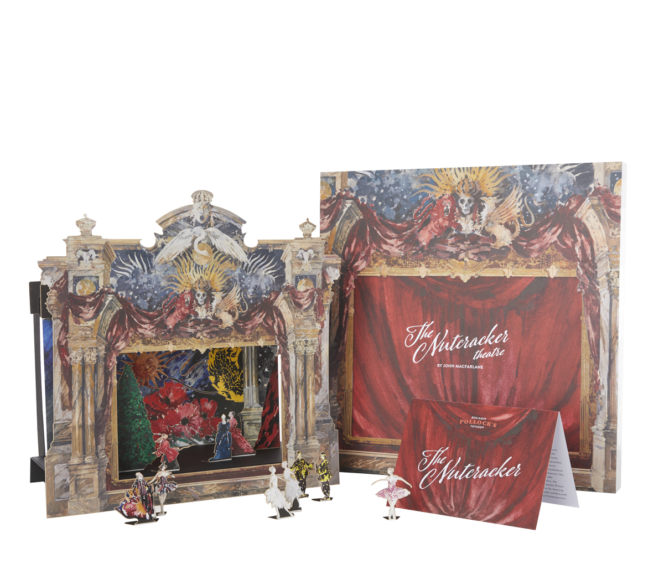
Lift the lid and a stage is waiting — folded flat, holding its breath. Slide in a painted backdrop, stand your little cast in their slots, and a whole opera house opens on your shelf, no taller than a stack of books. This is not a card that springs at you. It's a room you build, quietly, by hand. Come in and let it unfold.
The story
Begin with a matchbox. Long before the world's opera houses, a boy named John Macfarlane was shown how to make a miniature theatre from one by his father. That small flame never went out. Macfarlane grew into one of the leading stage designers of his generation — painting and dressing productions of opera and ballet on the great stages, gathering honours along the way: Designer Laureate of the Benois de la Danse, Chevalier de l'Ordre des Arts et des Lettres, the Critics' Circle Outstanding Creative Contribution Award in 2021. His designs are held in the V&A's Theatre and Performance Collection. Among his landmark works is Sir Peter Wright's The Nutcracker for Birmingham Royal Ballet, which premiered on 29 December 1990 and became a beloved fixture of the British Christmas. It is that production this little theatre carries. The object itself was born in 2021. Benjamin Pollock's Toyshop — the Covent Garden keeper of the English toy-theatre tradition, the very 'penny plain and twopence coloured' world Robert Louis Stevenson once celebrated — invited Macfarlane back to the small paper form of his childhood. He painted an exclusive proscenium and every scene; the bespoke paper studio Cutture engineered them into a real, assemble-it-yourself stage, handmade in the UK. As the maker puts it, "John Macfarlane has created a lavish, painterly proscenia for this original Pollock's Toy Theatre limited to 200 pieces." It launched as a Crowdfunder that October and shipped to backers from late 2021. So this is a full-circle thing, the loveliest kind. The master returns to the matchbox. And a small, quiet keepsake of it: £100 of every theatre sold goes home to Birmingham Royal Ballet.
What makes this one special
Here is how the room comes together. The whole thing arrives flat and patient on 350 gsm card — heavy, confident stock that snaps and stands without sagging. You begin with the proscenium: Macfarlane's painterly frame, the gilt-and-painted arch that turns a shelf into a stage and tells your eye, instantly, that something is about to happen behind it. Then the depth opens. Build the stage out and you've made a playing space about 16cm deep — not a flat picture but a real little box of air, 29cm tall and wide, with somewhere for light and shadow to live. Into the back of it you slide one of three interchangeable backdrops: Christmas Eve at the Stahlbaum House, The Land of Snow, The Kingdom of Sweets. Each one is a different world, and changing them is a single, satisfying gesture — out with the snow, in with the sweets. Now the cast. Ten character cut-outs stand up in their slots like little guests taking their marks — King Rat with his menace, Drosselmeyer with his mystery, the Sugar Plum Fairy poised on her toes. You move them by hand, in and out of the scene, which is the whole quiet joy of a toy theatre: you are the company. A Christmas Tree prop sets the season. And the curtain is double-sided — the Nutcracker doll on one face, Macfarlane's lavish red house-curtain on the reverse — so you can hold the moment closed, then reveal. This is the distinction worth naming: it is not novelty engineering. It's the classic Pollock's layered-card stage, the 19th-century juvenile-drama form Stevenson loved as 'a penny plain and twopence coloured' — only here every painted surface is the real hand of a master, reproducing his actual Birmingham Royal Ballet Nutcracker. (The single spring-up motion belongs to the companion Cutture pop-up card, where the Fairy, Drosselmeyer and King Rat glide through a Christmas scene ringed by "a halo of icy fronds." Lovely — and a different object.) This one doesn't pop. It unfolds, slowly, into a stage you dress yourself.
Why people love it
Collectors don't fall for this theatre the way you fall for a clever gadget. They fall the way you fall for a real object — one with a story folded inside it. What they keep returning to is the provenance. This isn't a Nutcracker-themed novelty; it's a genuine Pollock's toy theatre, the living end of a 19th-century English tradition, with a proscenium and every scene hand-painted by John Macfarlane — a designer who has dressed the great stages of the world. The piece reproduces his real Birmingham Royal Ballet production, so what stands on your shelf is a true stage in miniature, not an impression of one. The detail that moves people most is the full circle of it. A boy is shown how to build a theatre from a matchbox by his father. He grows up to design opera and ballet at the highest level. And then he comes back — to that same small paper form, made now by a master. The maker tells that story plainly on the product page, and once you've read it you can't un-see it in the object. There's a quiet warmth in the back of the piece, too: £100 of every theatre sold goes to Birmingham Royal Ballet. Collectors notice. It means the little stage on your mantel is quietly holding the door open for the big one.
“As a boy John Macfarlane was shown how to make a miniature theatre from a matchbox by his father. As a distinguished and world renowned theatre designer John has returned to his childhood love for model theatres by painting an exclusive proscenium for Benjamin Pollock's Toyshop which will be turned into a printed model paper theatre.”— Benjamin Pollock's Toyshop (official product page)
“John Macfarlane has created a lavish, painterly proscenia for this original Pollock's Toy Theatre limited to 200 pieces.”— Benjamin Pollock's Toyshop (official product page)
“With paper designers Cutture we debated the difference between a 'model box', a sketch in three dimensions and a 'toy theatre'.”— Benjamin Pollock's Toyshop blog, 'From Swan Matches to Swan Lake' (2021-10-19)
“Delicately painted characters of The Sugar Plum Fairy, Drosselmeyer and King Rat can be moved in and out of the traditional Christmas scene surrounded by a halo of icy fronds.”— Benjamin Pollock's Toyshop — Miniature Theatre Pop-Up with The Nutcracker (companion Cutture pop-up card, limited edition of 500)
“As a designer, it doesn't get much better than The Nutcracker”— The Stage — published headline of its feature interview with John Macfarlane (full article paywalled; cited as the article title only)
Tips & little secrets
- Build it on a clear, flat surface with good light, and treat the included programme as your guide and your welcome card both. Work unhurried — assembly is part of the pleasure, not a hurdle before it.
- Give your slot-in figures a gentle press to seat them fully. They're meant to be moved, so handle them by the base — the way you'd guide a guest to a chair, not tug their sleeve.
- Choose your face of the curtain by mood: the Nutcracker doll for the story, or Macfarlane's lavish red house-curtain for the hush before the show. It's double-sided so you can change your mind anytime.
- Display it out of direct sun. Painted card holds its colour best in soft light — a mantel or a shelf away from a bright window keeps those Macfarlane hues rich for years.
- Keep the original box. The three backdrops and ten characters love a flat, dry home between outings, and that 32cm box is exactly the wardrobe they were made for.
The honest verdict
- A real Pollock's toy theatre carrying a world-class ballet production, painted by the designer himself — pedigree you can hold.
- Built on sturdy 350 gsm card with clean die-cuts, so it assembles easily and stands with real, 16cm-deep stage presence.
- A dressable cast: three swappable backdrops, ten slot-in characters, a Christmas Tree and a double-sided curtain mean the scene can change with your mood.
- It is not a single dramatic pop-up. If you're picturing a card that springs into a scene in one motion, that's the companion Cutture pop-up — a separate product. This one is a build-it-yourself stage, and the magic arrives slowly, by hand.
- Sold as an adult collector's item, not a child's toy. The card is fine, the cuts are clean, but the small slot-in figures and the assembly ask for patient, grown-up fingers.
Treat this honestly and it's a small treasure. It is not a one-pull pop-up, and it isn't a child's toy — it's a genuine Pollock's toy theatre you assemble by hand, carrying a real, world-class Nutcracker painted by the designer who made it. The card is sturdy, the cuts are clean, and the finished stage has true depth and a quiet, dressable life: three scenes, ten figures, a tree, a two-faced curtain. What you're really buying is provenance and pedigree — a piece of stage history you build yourself, in an edition of 200, that gives £100 of itself back to the ballet that inspired it. If that's the object you're picturing, it delivers with grace.
Worth it as a collector's keepsake — provenance and craft, not gadgetry; just know it's a build-it-yourself stage, not a one-pull pop-up.
The questions everyone asks
Made by Benjamin Pollock's Toyshop (designed by John MacFarlane). Prices and stock shift, so we re-check often — the button takes you straight to the maker.
Researched + written by Yumi, 2026-06-11. 6 sources on file.
![[2,3]](/images/paper/tauba-auerbach-2-3/g0.jpg)