Snow Queen Paper Theatre by Kate Baylay
The first title in Benjamin Pollock's Toyshop's line of modern illustrated fairytale paper theatres; no numbered limited edition or design award is documented.
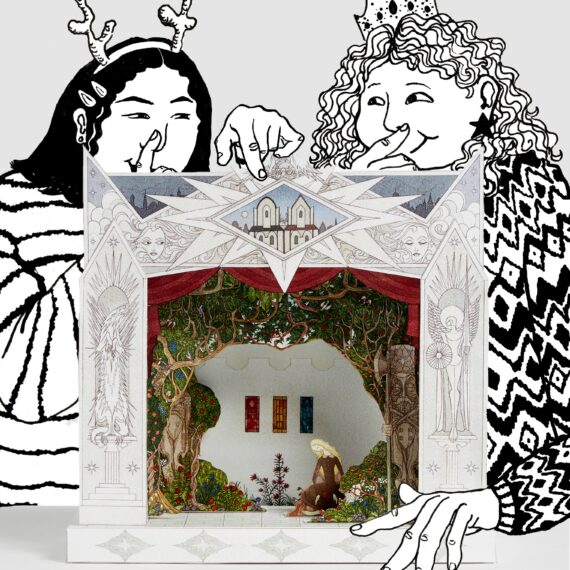
Open the folder, and a frozen kingdom is waiting to be assembled. Six flat sheets at first — then, sheet by sheet, a little theatre stands up under your hands. You score, you fold, you cut, and a stage appears with Gerda and Kay ready to step onto it. This is not a pop-up that springs at you. It is slower, and lovelier: a paper room you build, then light from within with a story.
The story
Benjamin Pollock's Toyshop sits in Covent Garden, London, the keeper of a very old craft. It is heir to the Victorian Pollock's toy-theatre tradition — the penny-plain, tuppence-coloured paper stages children once cut out and performed on at home. So when this little guest arrived, it came carrying centuries. In the summer of 2014 the shop announced it: "The Snow Queen Theatre - A paper model to make by artist Kate Baylay for Pollock's Toyshop. Available to pre-order now. In the shop and to mail from next week." By that October, Baylay posted the finished model on her own blog — "A model to cut out and make published by Benjamin Pollock's Toyshop." The maker calls it "the inaugural creation in the Benjamin Pollock's Toyshop line of modern-day illustrated fairytale paper theatres also known as toy theatres." The first of its kind, in other words. And the artist is the heart of it. Kate Baylay is, in the shop's words, "a book illustrator whose dark but decorative pictures of fairy tales are inspired by the 'Golden Age' of illustration" — the lineage of Kay Nielsen and the great fairy-tale illustrators. That same hand has been commissioned for Fendi's 90th-birthday 'Fairytale' collection and for The Folio Society. The tale itself is older still: Hans Christian Andersen's 'The Snow Queen,' first published in Denmark in 1844, the story Disney's 'Frozen' later drew upon. Here it folds down to A4 sheets and a stage you raise yourself.
What makes this one special
Here is what sets this little guest apart. It marries a centuries-old British toy-theatre format with a thoroughly modern art-deco hand. It does not spring open like a pop-up — instead, you make it. In the maker's own words, "the 6 x A4 sheets include characters and scene changes. Build by scoring, folding, and cutting with a craft knife, following instructions in the booklet with a story synopsis. Enclosed within a stunning folder, this is the inaugural creation in the Benjamin Pollock's Toyshop line of modern-day illustrated fairytale paper theatres." So the craft is the unfolding: six A4 card sheets become a free-standing proscenium stage, and then Gerda, Kay and the Snow Queen step on as cut-out figures while you swap the painted backdrops to move the story from scene to scene. You are not turning a page. You are setting a stage, and then performing on it. Kate Baylay's dark-but-decorative artwork — that Golden-Age, Kay Nielsen lineage — is what turns an assembly kit into something you keep in the light.
Why people love it
Here is what comes through, again and again: this is a paper object adults keep for themselves. The maker says so plainly, and the people who build it agree. It is the first in Pollock's line of modern illustrated fairytale theatres, so it carries a little "I was here at the start" pride. Builders linger over the art-deco line work, the frozen-kingdom palette, the way Gerda and Kay slot onto a stage you cut with your own hands. And there is the lineage to love, too: Kate Baylay's Golden-Age, Kay Nielsen-touched style is the same sensibility commissioned by Fendi and The Folio Society. So when people fall for this one, they are falling for a craft kit that becomes a display piece — something built slowly on a winter evening and then kept on the shelf like a tiny lit window.
“With its breathtaking art-deco inspired imagery by contemporary illustrator, Kate Baylay, our Snow Queen Paper Theatre is enormously popular. Loved by adults and children alike. Journey to the frozen kingdom of the Snow Queen with Gerda and Kay.”— Benjamin Pollock's Toyshop — product page
“Kate Baylay is a book illustrator whose dark but decorative pictures of fairy tales are inspired by the 'Golden Age' of illustration.”— Benjamin Pollock's Toyshop — Kate Baylay illustrator page
“A model to cut out and make published by Benjamin Pollock's Toyshop”— Kate Baylay Illustration blog — 'The Snow Queen Theatre', 2 October 2014
Tips & little secrets
- Treat the cutting as the gentle heart of the evening. The maker's instruction is 'scoring, folding, and cutting with a craft knife' — so work on a self-healing mat, keep a fresh sharp blade, and run a metal straightedge along every edge. Clean cuts make a clean little theatre.
- Score before you fold. Run the back of the blade or a bone folder along each crease first; 300gsm card folds crisp and square when it is scored, and crumples when it is not. Let the booklet's synopsis tell you which sheet is which before you commit a cut.
- Keep the characters and scene-change pieces in a shallow tray as you free them, so Gerda, Kay and the Snow Queen don't wander off the table. They are small guests; give them somewhere to wait.
- Give it a window of its own to live in. Finished, it stands about 24.5 cm high by 25 cm wide and 10 cm deep — slim enough for a shelf or mantel, and loveliest somewhere a lamp can pour a little warm light into the proscenium at dusk.
- Build with a steady hand, and lend one to a younger maker. The knife-work suits ages 12 and up; a child can place the characters and swap the backdrops while a grown-up handles the blade, and the staging becomes the shared part.
The honest verdict
- A genuine piece of British toy-theatre heritage you build with your own hands — Pollock's Covent Garden lineage, made for a winter evening at the table.
- Kate Baylay's art-deco, Golden-Age artwork is the draw — the same illustrator's hand commissioned by Fendi and The Folio Society — so the finished stage reads as a display piece, not a toy you pack away.
- Everything is in the folder: six A4 sheets on sturdy 300gsm card with characters and scene changes, plus a booklet with the story synopsis to guide each step.
- It is not a pop-up. Nothing springs open on its own — this is a build-it-yourself stage you score, fold and cut by hand, so set aside a quiet evening rather than expecting an instant reveal.
- A craft knife does the real work, which is why the maker suggests ages 12 and up; younger builders will need a grown-up's steady hand at the cutting mat.
An honest one: buy this for the building and the keeping, not for a quick magic trick. There is no spring-loaded reveal — the wonder is slower, earned with a craft knife and a quiet hour. What you end up with is rare, though: a real piece of Pollock's toy-theatre heritage, dressed in Kate Baylay's art-deco line work, the very first title in the shop's modern fairytale-theatre line. Build it well and it stops being a kit and becomes a tiny lit stage you'll want on the shelf. For anyone who loves paper craft, fairy tales, or the Golden-Age illustrators, it is a gentle, lasting delight.
Worth it if you love the slow craft of building paper by hand and want a fairy-tale display piece to keep — less so if you expected a pop-up's instant unfolding.
The questions everyone asks
Made by Benjamin Pollock's Toyshop (illustrated by Kate Baylay). Prices and stock shift, so we re-check often — the button takes you straight to the maker.
Researched + written by Yumi, 2026-06-11. 4 sources on file.
![[2,3]](/images/paper/tauba-auerbach-2-3/g0.jpg)