Keyboard Kat
In print and not limited — a standalone Rob Ives download/kit, free to robives.com members, that spread through the papercraft community and got adopted as a 4.5-hour teaching build at Make Nashville (2016).
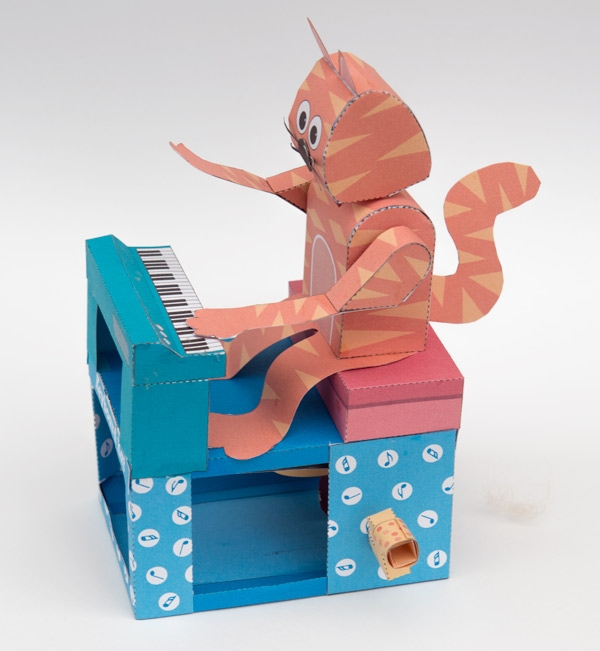
A cat that hammers a keyboard from flat card, coins, and paper straps — turn the crank and a whole syncopated piano number runs on cams. Here's where it earns it, and where it makes you sweat.
The story
Keyboard Kat is the work of Rob Ives, the British paper engineer who has been cutting and gluing card models into motion for over 20 years from his base in Cumbria, UK. Ives (born Harrogate, 1962) is a former math and science teacher turned self-published automata designer — also the author of the book "Paper Automata: Four Working Models to Cut Out and Glue Together" — and that teacher's instinct runs straight through this design. He prototyped Keyboard Kat in spring 2016, blogging the working model on 21 April 2016, with the downloadable kit dated that May. The brief was pure internet-era whimsy: in Ives' own words it was "Inspired by all the piano playing cats on the internet." Read: the Keyboard Cat meme, rendered in 230gsm card and a hand crank. It isn't a one-off or a museum piece — it's an open, in-print kit that became a community fixture partly because Ives makes the parts free to his members and Patrons, and partly because it teaches so well: it ran as a public build workshop at Make Nashville on 25 September 2016, used to walk all-ages makers through "the basics of mechanical movement." As the workshop write-up put it, "Cams have been around for hundreds of years. They are the main mechanical principal behind self-writing, self-drawing, and music-playing automata such as the one featured in the movie Hugo." That's the lineage Keyboard Kat plugs into — centuries-old camshaft engineering, scaled down to a desktop cat.
What makes this one special
The charm is in the mechanism, not the cat. The drivetrain is a hand-cranked square camshaft — one single-lobe cam plus paired double-lobe cams set 90 degrees apart — turning weighted cam-followers hidden down in the base. Here's the clever fold: each arm is moved by a PULL on a flexible paper strap, not a rigid push-rod. Ives' own logic, and it's the part that made me sit up: "Two weighted cam follower in the base, one for each arm. When the cam is in the down position it will pull the arms upwards. When the cam follower is lifted the weight of the arm drops the arms back down again." And the design payoff: "Because the arm is operated with a pull rather than a push I can use a simple strap to operate the arms rather than having to make a rigid push rod." That's a genuinely elegant constraint — a paper strap can only ever pull, never push, so the whole motion is engineered around gravity doing the return stroke. The arms fall back under a small coin counterweight, a roughly 20mm / 4g UK penny tucked into each follower. The 90-degree offset on the cams is what sells it: the two paws strike the keyboard out of phase while the head nods along, so you get a syncopated little performance — offset rhythm, not two paws thudding in unison — out of nothing but flat card, two coins, and a strap.
Why people love it
What the papercraft and maker crowd latches onto is exactly that pull-strap-and-coin trick — it's the kind of mechanism people screenshot and pass around, because it teaches a real engineering idea (a cam, a follower, a gravity return) in an object a kid can crank. It traveled on two rails: Ives handing the parts free to members and Patrons, and educators putting it in front of beginners. The Make Nashville workshop framed it as an entry point to cams and levers, and the line that keeps getting quoted — about cams being the principle behind the self-drawing automata "featured in the movie Hugo" — is why people feel they're building something with a real pedigree rather than a novelty.
“Turn the handle and the cat tickles the ivories whilst nodding along to the beat!”— Rob Ives — official Keyboard Kat project/kit page, robives.com
“Inspired by all the piano playing cats on the internet.”— Rob Ives — 'Keyboard Playing Kat' development blog post, robives.com
“Two weighted cam follower in the base, one for each arm. When the cam is in the down position it will pull the arms upwards. When the cam follower is lifted the weight of the arm drops the arms back down again.”— Rob Ives — 'Keyboard Playing Kat' development blog post, robives.com
“Because the arm is operated with a pull rather than a push I can use a simple strap to operate the arms rather than having to make a rigid push rod.”— Rob Ives — 'Keyboard Playing Kat' development blog post, robives.com
“Cams have been around for hundreds of years. They are the main mechanical principal behind self-writing, self-drawing, and music-playing automata such as the one featured in the movie Hugo.”— Tony Youngblood — Make Nashville 'Keyboard Kat Papercraft Automata' workshop write-up
Tips & little secrets
- Print onto thin CARD, not paper — Ives specifies around 230gsm / 67lb. Too light and the cams flex; too heavy and the small tabs won't fold clean.
- Let the ink dry completely before you touch it, then prep in strict order: score every dotted and dashed fold line first, then cut the interior holes, then cut the parts free. Score-before-cut is what stops the little tabs tearing off.
- Have your counterweight coins ready before assembly — roughly 20mm / 4g coins (Ives uses UK pennies), two of them, one per arm follower. The nod-and-play motion literally depends on the arms falling back under that weight, so don't skip them or substitute something lighter.
- It's a hand-cranked desk display piece in a box. Set it where the crank can swing freely, and turn the handle at a steady, gentle pace — the offset paw-and-head rhythm only reads if you let it run, not if you force it.
- Beginner-friendly but fiddly. Budget a few hours (the guided workshop allotted 4.5), and give younger makers a hand on the small straps and cam-followers — those are the parts where a build goes wrong.
The honest verdict
- The mechanism is the payoff: a real hand-cranked camshaft with a 90-degree offset, so the paws and head actually move in syncopation rather than in lockstep.
- Elegant engineering economy — the pull-strap-plus-coin return means no rigid push-rods to fabricate, which is both smarter and more forgiving to build in paper.
- Genuinely educational and accessible: workshop-proven as an all-ages intro to cams and levers, finishable as a working model inside a single sitting.
- Fiddly assembly with real tolerance demands — the straps and cam-followers are small, and a sloppy cut or under-scored fold will cost you the motion. Plan on a few hours and steady hands.
- It needs supplies the kit doesn't give you: the right card stock (around 230gsm) and two small coins for counterweights, both of which have to be sorted before you start or the build stalls.
Lead with the flaw: this is a patient build, not a quick win — small straps, small followers, real cut-and-score tolerance, and a parts list that quietly assumes you'll supply your own card and coins. Earn the trust back with the engineering, though, and Keyboard Kat is one of the most satisfying paper objects of its class. The pull-strap mechanism is a textbook bit of constraint-driven design (a paper strip can only pull, so gravity is conscripted to do the return — that's the part that delights), and the 90-degree cam offset turns two paws and a head into an actual little performance instead of a gimmick. As a teaching piece it's near-ideal: it makes a centuries-old mechanical principle legible in an afternoon. Go in expecting craft, not convenience, and it delivers exactly what it promises — a cat that tickles the ivories and nods to the beat, running on nothing but card, two coins, and a clever fold.
Worth it if you want a hand-cranked automaton that teaches a real mechanism — patience and a couple of coins required, charm guaranteed.
- Framed as an accessible teaching piece rather than an advanced build: the Make Nashville workshop required 'No prior class experience' and welcomed 'all ages... though students 11 and younger should have an adult to assist them,' with a completed working automaton finished inside the 4.5-hour session — positioning Keyboard Kat as a beginner-friendly intro to cams and levers. — Tony Youngblood — Make Nashville workshop listing
The questions everyone asks
Made by Rob Ives. Prices and stock shift, so we re-check often — the button takes you straight to the maker.
Researched + written by Dax, 2026-06-11. 3 sources on file.
![[2,3]](/images/paper/tauba-auerbach-2-3/g0.jpg)