Alice's Adventures in Wonderland: A Pop-Up Adaptation
Named to the American Library Association's ALSC Notable Children's Books list for 2004; first edition published by Little Simon in October 2003.
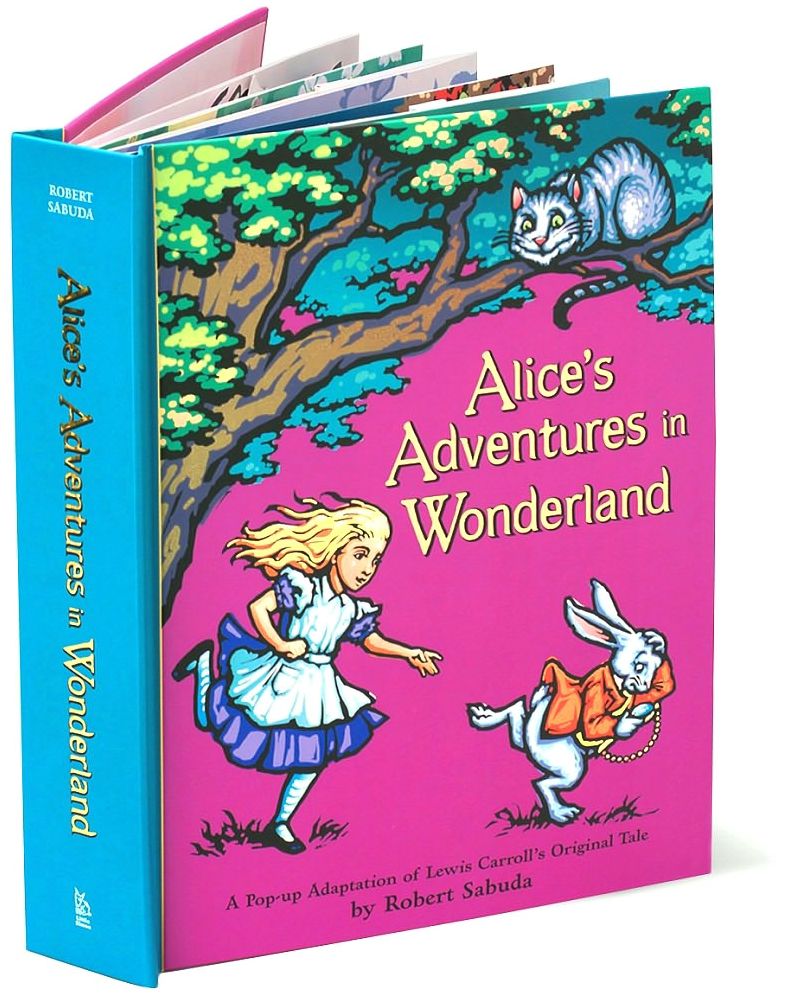
Lift the cover, and a small white rabbit is already late. The whole of Wonderland has been folded flat and waiting for you — and the moment you part the pages, the room unfolds. This is Robert Sabuda's pop-up Alice, and it does not so much tell the story as let it spring up around you, all at once.
The story
Let me set the table for you. The book is "Alice's Adventures in Wonderland: A Pop-Up Adaptation," published in 2003 by Little Simon, the children's imprint of Simon & Schuster. The words are Lewis Carroll's, gently abridged. But the architect of this particular Wonderland is Robert Sabuda — paper engineer, illustrator, and adapter, the rare maker who designs both what you see and how it moves. Sabuda built this edition as an homage and a transformation at once. He kept faith with Sir John Tenniel, whose 1865 illustrations are the Alice most of us carry in memory, and then made the pages his own. Kirkus put it plainly: "Sabuda, while paying homage to original illustrator Sir John Tenniel, uses vibrant colors, thick black outlines, and foil to create a work that is uniquely his." The publisher, for its part, called it "Robert Sabuda's most amazing creation yet, featuring stunning pop-ups illustrated in John Tenniel's classic style." When the book arrived, NPR's Scott Simon sat down with him on Weekend Edition in December 2003. Sabuda's reason for the work was disarmingly simple and warm: "Whatever it takes to bring kids back to books -- and back to classical books -- I want to be a part of that." And on the craft of bending stiff paper into a falling girl and a grinning cat, he had a phrase I keep returning to — his job, he said, was to "make the paper obey." A small honest note, because guests deserve the truth: Sabuda is a three-time winner of the Movable Book Society's Meggendorfer Prize, but those laurels belong to The Christmas Alphabet, Cookie Count, and The Wonderful Wizard of Oz — not to Alice. What Alice earned is its own: a place on the ALA's 2004 Notable Children's Books list, a turn as a featured piece in his solo museum show, "Pop-ups and Palettes: The Many Dimensions of Robert Sabuda," at The Eric Carle Museum of Picture Book Art (December 2004 through May 2005), and a spot among the Sabuda titles that reached New York Times bestseller lists.
What makes this one special
Here is the loveliest secret of this book: the surprise is not one-per-page. It is layered, like a house with rooms behind its rooms. The structure is six large pop-up spreads, and each one is paired with a slim fold-out side booklet. Open that little booklet and it gives you several small pages — Carroll's text (abridged), and tucked among the words, extra miniature pop-ups. So every grand spread has a quieter companion whispering beside it. You turn, you read, you open the side panel, and Wonderland keeps unfolding past the moment you expected it to stop. Three engineering moves are the showpieces. First, the opening: a Victorian peep-show pull-panel that builds a tunnel of real depth as Alice falls down the rabbit hole — Kirkus called it "an ingenious peep-show rabbit hole." Second, the surfaces: multifaceted printed and stamped foil that catches the light, transparent acetate creatures you can almost see through, and pages that ask to be touched — some of the animals are genuinely furry under your fingertips. Third, the finale: the whole story ends, as it must, in "an explosion of cards" — a culminating spread that flings the deck up off the page. All of it is cut-and-fold paper engineering in the kirigami tradition — folded and sculpted from the sheet, not assembled from glued tabs and slots. The paper does, in the end, obey.
Why people love it
Collectors and pop-up devotees treat this one as a high shelf all its own — the title they reach for first when asked what paper engineering can really do. The enthusiast site Best Pop-up Books ranks it number one on its pop-up roundup, with a 9.6 out of 10 and the verdict "A must have classic pop-up title by Sabuda," praising how "every pop-up fits the story perfectly and shows how much paper engineering can contribute to an already great story." Reviewers loved both the spectacle and the storytelling sense behind it; the maker himself framed the whole endeavor as a way back to the classics. Hear it from the people who know it best:
“Whatever it takes to bring kids back to books -- and back to classical books -- I want to be a part of that.”— Robert Sabuda, interviewed by Scott Simon, NPR Weekend Edition Saturday, "Pop-Up Artist Meets Alice in Wonderland" (Dec. 6, 2003)
“make the paper obey”— Robert Sabuda, NPR Weekend Edition Saturday, "Pop-Up Artist Meets Alice in Wonderland" (Dec. 6, 2003)
“Girl falls down a rabbit hole, cries buckets, has a spot of bother about size, plays some croquet, and wakes up in time for tea.”— Kirkus Reviews (opening line of the review of Alice's Adventures in Wonderland: A Pop-Up Adaptation)
“Sabuda, while paying homage to original illustrator Sir John Tenniel, uses vibrant colors, thick black outlines, and foil to create a work that is uniquely his.”— Kirkus Reviews
“Alice's Adventures in Wonderland is Robert Sabuda's most amazing creation yet, featuring stunning pop-ups illustrated in John Tenniel's classic style.”— Publisher (Little Simon / Simon & Schuster) marketing copy, as carried on the Getty Museum Store and NYPL Shop listings
Tips & little secrets
- Open every spread slowly and to its full angle. The grand pop-ups are spring-loaded paper, and they reach their proper shape only when the covers lie all the way open — rush the page and you fold a tower before it has finished standing up.
- Don't forget the slim side booklet beside each spread. That is where Carroll's text and the extra miniature pop-ups live — open it gently to its little pages, or you'll walk past half the surprises.
- Close it the way it wants to close. Let each spread fold back along its own creases as the cover comes down; never press a flat hand onto a standing pop-up to flatten it. The peep-show rabbit hole and the card finale especially like to be eased shut.
- Give it a home, not a toybox. The publisher's own age guidance is 4 to 8, and the intricate paper is delicate — keep it flat, dry, and out of direct sun so the foil keeps its shine, and treat it as a display piece to be shared under a careful hand.
- Pose it open as a centerpiece. A single spread standing upright on a shelf or mantel makes a small sculpture; turn to the card-explosion finale or the rabbit-hole tunnel and let the foil do the talking.
The honest verdict
- A layered reading architecture — six grand spreads, each with a fold-out side booklet of text and extra mini pop-ups — so the surprises keep coming past every turn
- Signature engineering you'll remember: a peep-show tunnel for the rabbit hole, foil and see-through acetate creatures, furry tactile animals, and a final explosion of cards
- Faithful to Tenniel's beloved 1865 look while wholly Sabuda's own — vibrant color, thick black outlines, and a paper-engineer's wit, ALA-Notable for 2004
- Carroll's text is abridged, with most of the nonsense poetry left out — the engineering is the headliner, the prose plays a supporting role
- The spring-loaded paper is genuinely delicate, so it's best handled as a collector's display piece rather than a rough-and-tumble everyday read
This is a paper object to be marveled at, not merely read. Sabuda set out to "make the paper obey," and it does — falling down rabbit holes, glinting in foil, scattering a whole deck of cards into the air. The trade-off is honest: you give up most of Carroll's nonsense verse and you accept a fragile, careful kind of guest. But what you gain is Wonderland that stands up off the page, layered spread within booklet within spread. As an introduction to what pop-up art can be, and as a keepsake to share slowly with small careful hands, it is a quiet wonder.
Worth it as a display-shelf treasure and a definitive showcase of pop-up craft — keep it for careful sharing, not daily handling.
- the bizarre settings and rude creatures of Wonderland burst out with every turn of the page, starting with an ingenious peep-show rabbit hole and ending with an explosion of cards. The text is abridged, with most of the nonsense poetry left out. — Kirkus Reviews
- Ranked #1 on the site's pop-up roundup with a 9.6/10 rating and called 'A must have classic pop-up title by Sabuda'; scored 9/10 for storytelling, with the note that 'every pop-up fits the story perfectly and shows how much paper engineering can contribute to an already great story.' — Best Pop-up Books (enthusiast review/ranking site)
- The intricate, spring-loaded paper is delicate, so it is widely treated as a collector's display piece rather than a rough-and-tumble children's book, consistent with the publisher's own age guidance of 4–8. — Bookseller listings (NYPL Shop, Barnes & Noble, Getty Museum Store)
The questions everyone asks
Made by Robert Sabuda. Prices and stock shift, so we re-check often — the button takes you straight to the maker.
Heartfelt disclosure: an enchanted link may earn the cabinet a small commission, at no cost to you — and it never changes what we recommend. As an Amazon Associate, Puzzlewick earns from qualifying purchases.
Researched + written by Yumi, 2026-06-11. 7 sources on file.
![[2,3]](/images/paper/tauba-auerbach-2-3/g0.jpg)