Featured Fireside Briefing · Arkham Horror: The Card Game
The complete spoiler-free Arkham backstory · Part 2 of 3
Salem, Fire, and Cosmic Dread.
Why fear, fire, Salem, and Lovecraft’s New England became Arkham Horror’s most enduring engine of dread. The complete backstory, without Brethren of Ash spoilers.
A spoiler-free briefing for the six months between Arkham’s calamity and the first knock on a Miskatonic dormitory door.
Puzzlewick uses AI assistance for research organization, drafting support, and labeled editorial visuals. Robert Pruitt retains editorial responsibility. Product facts are checked against Fantasy Flight Games.
This is the complete three-part audio edition. You can listen straight through or keep reading this part one chapter at a time.
What this is: a source-transparent historical and thematic briefing. What this is not: a walkthrough, deck tier list, or a guide beyond the spoiler boundary.
Chapter 4
Fire: Civilization’s First Miracle and Oldest Enemy
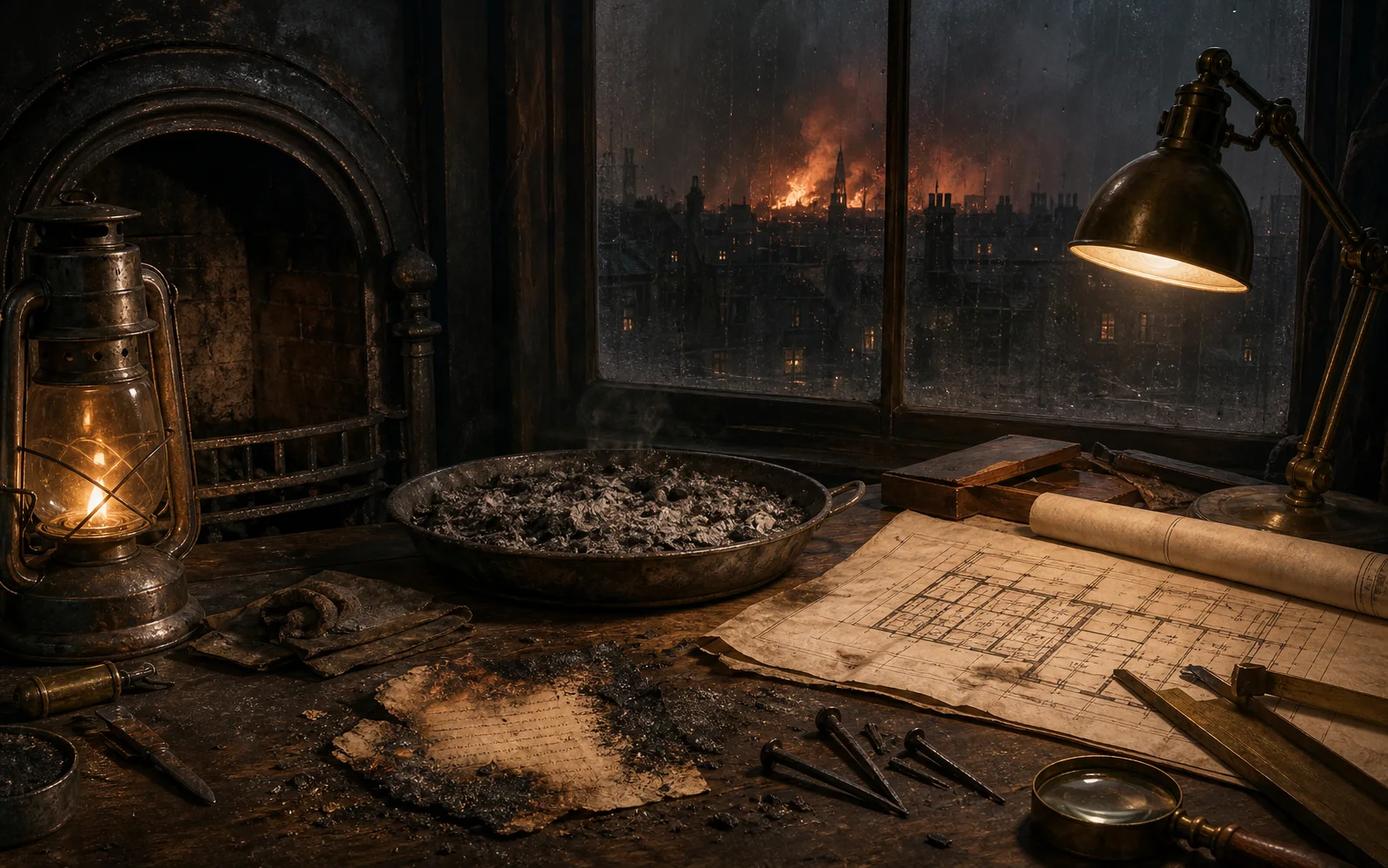
Long before humanity built a city, wrote a law, planted a field, or named a star, we learned to live beside fire. It gave warmth in cold climates.
It extended the day beyond sunset. It made food safer and easier to digest.
It hardened materials. It protected camps.
It gathered people into circles where language, memory, teaching, and story could flourish. Human civilization did not merely use fire.
It organized itself around fire. That is why fire remains one of our most emotionally powerful symbols. It exists at the origin of comfort and at the edge of catastrophe.
The Hearth
The controlled flame is domestic. A lamp indicates that someone is awake.
A stove suggests food. A fireplace gathers a family.
A candle placed in a window becomes a signal of welcome, remembrance, prayer, or return. The hearth represents a small zone of human order imposed upon darkness.
Outside the circle of light lies weather, wilderness, uncertainty, and whatever cannot be seen. Inside are faces.
This is the earliest form of the fireside story. People sit in safety and speak about danger.
The flame makes horror pleasurable because it establishes a boundary. The listener can imagine the forest because the fire is present. But the emotional power of the hearth depends upon control.
The same element that creates the safe circle can destroy it.
The City of Combustible Things
Older cities were vulnerable to fire in ways difficult to imagine from modern construction. Buildings stood close together.
Wood, cloth, oil, hay, coal, paper, and stored goods filled homes and businesses. Open flames were necessary for cooking, heat, and light.
Firefighting equipment was limited. Strong wind could transform an isolated accident into an urban disaster.
The Great Fire of London in 1666 became one of the defining catastrophes in the history of the city. The Great Chicago Fire of 1871 burned for three days in a rapidly growing city constructed heavily from wood and left more than one hundred thousand people without homes. Its aftermath also exposed social inequality and encouraged the false blaming of the Irish immigrant O’Leary family.FIRE
Large fires become more than physical events. They generate legends.
People search for a single cause, a careless person, an enemy, a conspiracy, or a moral explanation. Random catastrophe feels intolerable. A story with a villain feels easier to understand than a disaster produced by weather, materials, infrastructure, exhaustion, delayed response, and chance. Fire creates ash.
Memory creates blame.
Fire as Purification
Many traditions use fire to symbolize purification. Impurities are burned away.
Metal is refined. Fields are cleared.
Offerings are consumed. Sacred flames represent divine presence, continuity, transformation, or truth.
This symbolism contains a dangerous temptation. If fire purifies, then the person who controls the fire may claim the authority to decide what is impure.
Books are burned. Homes are burned.
Evidence is burned. People declare destruction necessary for renewal.
The language of purification allows violence to present itself as virtue. A cult associated with flame does not need to consider itself destructive. Its members may believe they are cleansing the world, releasing hidden potential, ending corruption, or preparing a rebirth.
Few villains imagine themselves serving ash. They imagine themselves serving what will rise from it.
Fire as Revelation
Fire destroys surfaces. Paint peels.
Walls collapse. Hidden spaces become exposed.
Safes are discovered in ruins. Foundations become visible.
Documents survive in fragments. Bodies, objects, construction methods, and concealed rooms may be revealed when the structure surrounding them disappears.
Fire therefore has an investigative paradox. It destroys evidence while uncovering secrets.
A burned building tells two stories: What happened during the fire.
What existed before it. The investigator must distinguish between damage caused by flame and damage the flame was intended to conceal.
Was the fire the crime? Or was it the eraser?
Smoke
Flame is visible. Smoke is ambiguous.
It travels ahead of danger. It enters through cracks.
It obscures distance. It causes the eyes to water and the mind to lose orientation.
Smoke tells you that something is burning without immediately telling you where. It is evidence separated from origin.
Symbolically, smoke represents rumor, confusion, misdirection, and partial knowledge. A person following smoke may reach the fire. A person surrounded by smoke may move directly away from the exit while believing they are escaping. This makes the title Smoke and Mirrors especially resonant even without discussing the scenario itself. Smoke obscures through physical confusion. Mirrors obscure by multiplying appearances.
One hides the source. The other creates false sources.
Ash
Ash is what remains after recognizable form has been destroyed. A letter becomes flakes.
A house becomes residue. A tree becomes powder.
Ash appears final, but it is not empty. It contains evidence of what was consumed. Scientists can study it. Families may preserve it. Rituals may use it. Wind may carry it far beyond the original fire. Ash is memory without shape.
It is difficult to reconstruct the original object from ash, but impossible to deny that something existed. The phrase “Brethren of Ash” therefore carries several possible implications before the campaign reveals anything further.
Brotherhood suggests community, loyalty, hierarchy, initiation, and shared purpose. Ash suggests aftermath, destruction, mourning, transformation, and survival.
Are they brothers created by a fire? Brothers who worship what remains?
Brothers who intend to burn? Brothers who believe destruction is the beginning rather than the end?
The title does not answer. It leaves an ember.
The Psychology of the Arsonist and the Witness
Fire exerts visual fascination. Its movement is structured but unpredictable. It appears alive without being alive. It consumes while producing light. It attracts the eye precisely when instinct says to flee.
The person watching a distant building burn may feel horror, helplessness, curiosity, guilt, relief that it is not their home, and shame for feeling relief. Survivors of major fires often react strongly to later sensory reminders: smoke, alarms, sirens, heat, flickering light, or the smell of burned material. The event may be over while the nervous system continues treating the world as if the flame could return.
A city can experience something similar collectively. After repeated fires, every alarm becomes part of a pattern.
Every coincidence appears suspicious. Every stranger near a damaged building becomes a possible witness or culprit.
Fear creates vigilance. Vigilance finds connections.
Some connections are real.
The Fire After the Flood
Water and fire are often treated as opposites. Flood overwhelms boundaries with water.
Fire removes boundaries through heat. Flood leaves mud, rot, warping, contamination, and displaced objects.
Fire leaves smoke, structural damage, exposed foundations, and ash. Arkham has recently endured the first.
Now it fears the second. The symbolic sequence is powerful. A city barely rebuilt after being drowned begins to burn.
That is not merely another disaster. It is an assault on the idea that recovery is possible.
If water could not cleanse the city, perhaps someone believes fire can. If the flood disrupted the old order, perhaps the flames are being used to create a new one.
If catastrophe attracted new investment, perhaps destruction has become profitable. The official introduction does not answer these questions.
It teaches you to ask them.
The First Match
A citywide fire may eventually become uncontrollable. But it begins at a point.
A spark. A wire.
A lantern. A stove.
A match. A deliberate hand.
The scale of the final destruction can make the beginning seem insignificant. That is one reason fire is such an effective symbol for conspiracy. A small group can create consequences vastly larger than itself. The investigator’s task is to move backward.
From ash to structure. From smoke to flame.
From flame to spark. From spark to hand.
From hand to intention.
Historical safety note
How an accusation system feeds itself
This diagram explains a historical mechanism of panic. It does not diagnose modern individuals and should not be used to trivialize the people harmed in the Salem crisis.
- Misfortune
- Search for intention
- Socially available suspect
- Invisible claim
- Institutional validation
- Confession or name expansion
- Larger conspiracy theory
- Contradiction reframed as concealment
Chapter 5
Witchcraft, Fear, and the Invisible World
To understand witchcraft historically, it is necessary to set aside the modern image. The pointed hat, broomstick, black cat, bubbling cauldron, and green-skinned figure belong to a mixture of folklore, illustration, theatre, commercial imagery, and popular entertainment.
The historical accusation of witchcraft was more serious and more dangerous. It was an explanation for harm.
A witch was believed to have entered a relationship with evil powers and used that relationship against the community. The alleged acts could include causing illness, damaging livestock, spoiling food, influencing weather, tormenting neighbors, or attacking people through invisible means.
The fear was powerful because it transformed misfortune into intention. The cow did not die naturally.
Someone caused it. The child did not become ill by chance.
Someone chose the child. The storm was not weather.
It was an attack.
A World Without Modern Categories
Modern societies divide explanation among medicine, psychology, law, meteorology, economics, and statistics. Early modern communities did not possess the same boundaries.
Spiritual and material causation could coexist. A disease might have a bodily mechanism while still being interpreted as divine punishment or supernatural attack. An individual could be held morally responsible for invisible harm. This did not mean every person accepted every accusation. Skepticism existed. Courts debated standards. Ministers disagreed. Communities resisted some prosecutions.
But the possibility of witchcraft was built into the intellectual and legal world. The important question was often not whether witches existed.
It was how to identify them.
The European Witch Hunts
Large-scale witch hunts spread through parts of Europe from approximately the fifteenth through the eighteenth centuries, though intensity varied greatly by region and period. The Holy Roman Empire and some neighboring territories experienced especially severe waves, while other regions saw fewer prosecutions. Texts such as the Malleus Maleficarum, first published in the late fifteenth century, helped systematize ideas about witchcraft, interrogation, and prosecution.TRIALS
Witch hunts were not caused by one factor. Religious conflict mattered.
Political instability mattered. Local feuds mattered.
Legal systems mattered. Gender mattered.
Economic stress mattered. Weather, harvest failure, disease, war, and social disruption could intensify fear.
The accusations often moved through existing relationships. A supernatural allegation might grow from an ordinary conflict over land, inheritance, reputation, charity, unpaid debt, marriage, or livestock. The invisible world gave visible disputes a cosmic vocabulary.
The Social Position of the Accused
Many accused people were women, but the pattern was more complicated than a simple statement that all victims were poor or socially powerless. Some were marginalized.
Some were outspoken. Some depended upon neighbors for assistance.
Some had reputations built over years of conflict. Some inherited accusations associated with relatives.
Some men were accused. Some prosperous or respected individuals became targets when the crisis expanded.
The important pattern is that accusations rarely emerged from pure nothing. They attached themselves to social tension. A person already considered difficult could become dangerous.
A person already considered strange could become supernatural. A person already resented could become responsible for every misfortune that followed an argument.
Salem Before 1692
The Salem crisis did not occur in an isolated world of irrational villagers suddenly losing their minds. Massachusetts had endured political instability, religious tension, frontier warfare, uncertainty over government, and conflict within communities. Salem Village itself contained disputes involving church leadership, property, faction, and local authority.
The larger region had also experienced warfare and displacement. Some families had direct knowledge of attacks on frontier settlements. Fear was not theoretical. The population lived with memories of violence, contested territory, and political uncertainty. The crisis of 1692 was therefore not a single superstition entering a stable community.
It was a spark entering dry material. The National Park Service describes a convergence of religious discord, political factionalism, severe weather, and failures of leadership among the factors contributing to the trials.SALEM
The Accusations
In early 1692, several young people in Salem Village began exhibiting disturbing behavior. A medical assessment attributed their condition to bewitchment, and accusations followed. Once an accused woman confessed and claimed that more witches were present, the possibility of a hidden network entered the case. Accusations spread beyond the initial community.MAP
This is a crucial psychological transformation. One alleged witch is an individual threat.
A hidden network is a conspiracy. A conspiracy explains resistance. Anyone defending the accused might be participating. Skepticism becomes suspicious. Lack of evidence may be interpreted as evidence of supernatural concealment.
The theory protects itself from contradiction. That structure remains recognizable in modern moral panics and conspiracy movements.
Spectral Evidence
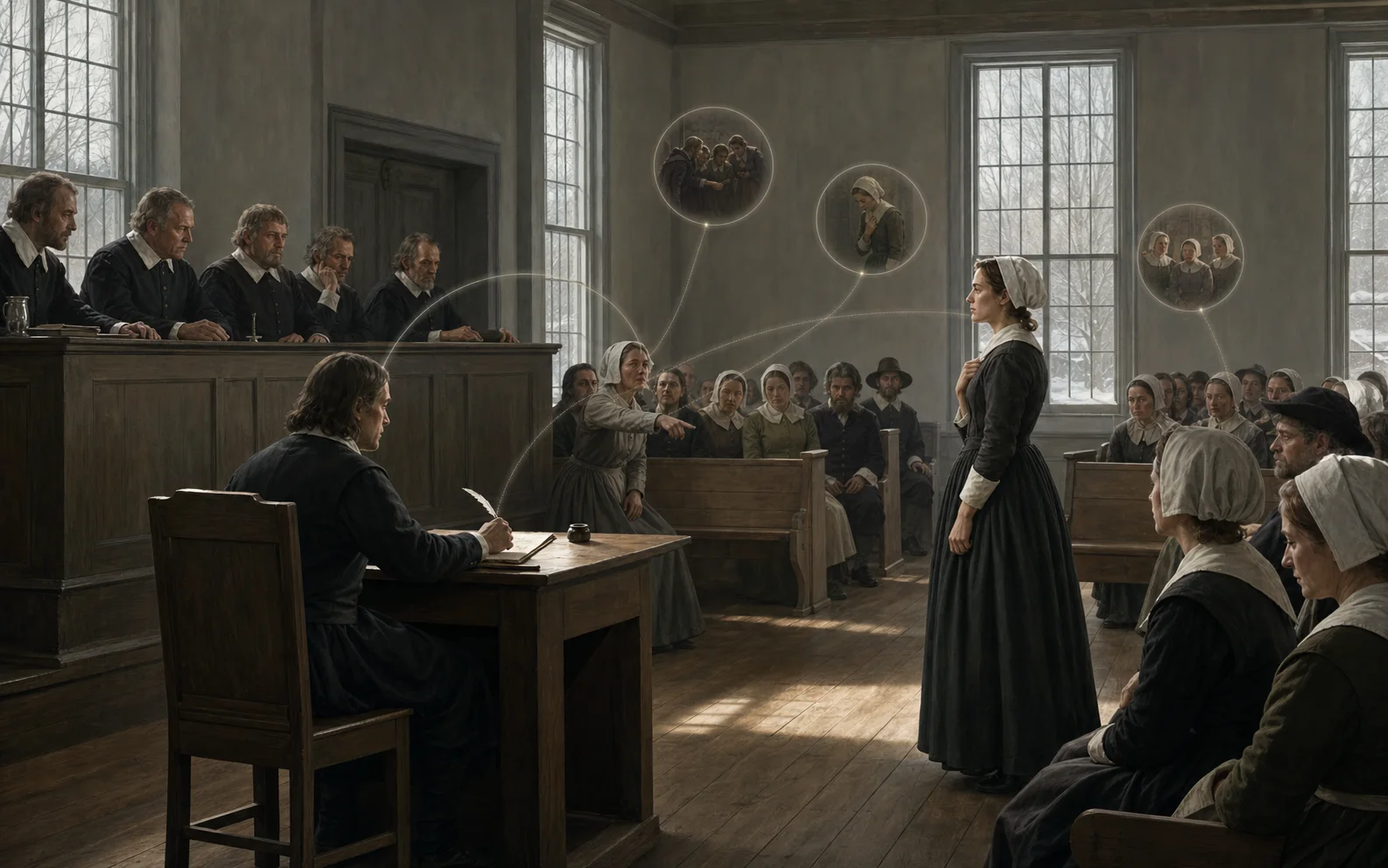
One of the most controversial elements of the Salem proceedings was spectral evidence: testimony that an accused person’s spirit or apparition had harmed someone, even when the accused person’s physical body was elsewhere. This created a profound problem.
How could a defendant disprove an invisible act? If the court accepted that Satan might use the likeness of an innocent person, spectral testimony became uncertain. If the court assumed Satan could only use the likeness of a guilty person, accusation approached proof.
Legal systems depend upon evidence that can be challenged. Invisible evidence moves power toward the accuser.
The Library of Congress notes that the Salem crisis produced more than 150 accusations. Nineteen people were executed by hanging, one man was pressed to death, and others died in prison under harsh conditions.HISTORY The horror of Salem is not that a supernatural explanation existed.
It is that institutions converted fear into procedure.
Confession and Survival
In some witchcraft prosecutions, confession could create a better chance of survival than denial. That reverses the expected moral order.
The honest person who denied the accusation might remain dangerous in the eyes of authorities. The person who confessed could provide names, confirm the theory, and become useful.
A system designed to discover hidden guilt began rewarding stories that expanded the system. This is how institutions become trapped by their own logic.
Every new confession validates earlier arrests. Every new name proves the conspiracy is larger.
The absence of evidence proves the enemy is skilled. Doubt becomes betrayal.
At that point, the process no longer investigates reality. It manufactures reality.
Memory and Commercial Myth
Modern Salem has built a public identity partly around the events of 1692. Museums, memorials, tours, scholarship, tourism, popular culture, and commercial imagery all participate in remembering the trials. That memory is complicated.
The witch has become an icon of independence, occult power, feminism, rebellion, entertainment, and seasonal celebration. The historical victims were not fantasy sorcerers.
They were people caught in a legal and social catastrophe. Both forms of memory now occupy the same city.
That tension resembles Arkham’s relationship with its own legends. A town may turn horror into folklore because folklore is easier to manage. A legend can be placed on a postcard. A historical injustice demands responsibility.
Witchcraft in Lovecraftian Fiction
Lovecraft did not merely repeat the folk image of a witch. He transformed witchcraft into a point of contact between archaic belief and cosmic reality.
In stories such as The Dreams in the Witch House, mathematics, dreams, old architecture, colonial legend, and nonhuman dimensions coexist.HOUSE The traditional witch becomes frightening not because folklore was entirely correct, but because it may have been a distorted interpretation of something stranger.
This is a central Lovecraftian technique. Take a superstition.
Do not confirm it literally. Reveal that it is an imperfect human attempt to describe a reality beyond the culture’s vocabulary.
The old villagers called it witchcraft. The modern scholar calls it abnormal geometry, unknown physics, hallucination, folklore, or psychological breakdown.
Neither description is complete.
Arkham’s Witch Legends
The official Brethren of Ash introduction establishes that Arkham possesses ancient curses and witch legends that some investigators take seriously.GUIDE The important word is not “witch.”
It is “legend.” A legend is a story that has survived transmission.
Parts are altered. Names change.
Locations move. Moral lessons are added.
Embarrassing details disappear. Yet something remains durable enough to be repeated.
The historian asks what event produced the legend. The folklorist asks why the community preserved it.
The investigator asks whether it has begun happening again.
The True Lesson of the Witch Hunt
The lesson is not that people in the past were foolish while people in the present are rational. That interpretation is comforting and therefore dangerous.
The deeper lesson is that human beings remain vulnerable to systems that transform uncertainty into accusation. We still fear hidden networks.
We still interpret coincidence as intention. We still reward witnesses who confirm what authorities expect.
We still treat skepticism as evidence of disloyalty. We still build narratives in which every contradiction proves the enemy’s sophistication.
The names change. The structure survives.
When entering a story of secret brotherhoods, strange symbols, and old witch legends, the wise investigator must hold two thoughts at once: The supernatural threat may be real.
The human reaction to it may become a second threat. Arkham has room for both.
Chapter 6
H. P. Lovecraft: the Man, the Mythos, and the Shadow
Howard Phillips Lovecraft was born in Providence, Rhode Island, in 1890 and died there in 1937.BIOGRAPHY During his lifetime, he was not a commercially successful literary celebrity. Much of his fiction appeared in pulp and amateur publications. He earned little from it. He was better known within a network of correspondents, writers, editors, and enthusiasts than among the wider reading public.
Yet his ideas survived him with extraordinary force. Today his influence extends through fiction, cinema, roleplaying games, board games, music, visual art, philosophy, internet culture, and the broader language of horror.
That afterlife is one of the strangest literary stories of the twentieth century.
The Child of Providence
Lovecraft’s identity was deeply connected to Providence and to his imagined version of old New England. He was fascinated by architecture, genealogy, antiquity, astronomy, science, dreams, and the sensation of historical continuity. He loved walking through old streets and observing buildings that carried evidence of earlier centuries.
His attachment to the past was aesthetic, emotional, and political. Old architecture represented stability.
Family history represented identity. Colonial New England represented an ordered world he believed modernity was eroding.
This made him unusually sensitive to age. A building was not simply beautiful. It was a surviving connection to a disappearing civilization.
That sensitivity became a major source of his fiction. He could describe a town, house, street, or landscape as though it were a living archive. It also fed some of his most serious failings.
Science and the Cosmos
Lovecraft’s imagination was shaped not only by old books but by modern scientific thought. Astronomy was especially important.
The night sky revealed scale. Earth was not the center of creation.
Human history occupied only a tiny portion of planetary time. The universe was filled with distances so vast that ordinary language became inadequate.
Earlier Gothic fiction often relied upon the supernatural world of religion: ghosts, curses, demons, damnation, and divine judgment. Lovecraft moved horror into an astronomical universe.
His entities were not always supernatural in the traditional sense. They might be extraterrestrial, extradimensional, ancient, biological, or governed by principles humanity could not yet understand. Science did not banish the monster.
Science enlarged the darkness in which it could exist.
The Amateur Press and the Correspondent
Lovecraft participated extensively in amateur journalism and maintained an enormous correspondence. Letters allowed him to develop ideas, mentor younger writers, debate literature and politics, describe travel, discuss dreams, and contribute to a network of weird-fiction creators.
This network is essential to understanding the later Mythos. Lovecraft encouraged other writers to borrow names, invented books, gods, places, and concepts. His contemporaries introduced their own creations into related fictional worlds. The resulting tradition was never a perfectly organized mythology.
It was closer to a shared box of dangerous artifacts. One writer borrowed a forbidden book.
Another borrowed a place name. Another added a new entity.
Contradictions accumulated. That looseness helped the Mythos survive. It was not locked inside one official chronology. Each generation could reinterpret it.
The Fictional Method
Lovecraft often built stories through documents and testimony. Letters.
Newspaper reports. Academic accounts.
Diaries. Manuscripts.
Confessions. Recovered notes.
Statements written by narrators who expected to be disbelieved. This method creates distance. The reader rarely experiences the event with complete certainty. Instead, the story resembles an investigation assembled from evidence.
The narrator may be educated and articulate, but knowledge does not guarantee reliability. The person may be traumatized, physically exhausted, prejudiced, mistaken, or attempting to persuade the reader of something unbelievable. The documentary form turns the reader into an investigator.
That structure survives beautifully in Arkham Horror: The Card Game. Players reveal locations, gather clues, read fragments of narrative, update campaign logs, and build an account of events from partial evidence.
Arkham, Miskatonic, and the Connected World
Lovecraft’s recurring locations helped readers imagine that separate stories occupied a common region. Arkham appeared near the Miskatonic River.
Miskatonic University provided scholars, collections, and expeditions. Dunwich, Innsmouth, and Kingsport offered distinct communities within the same imaginative New England.
Forbidden books circulated between libraries. Names reappeared.
Historical events echoed across narratives. This did not create a modern franchise in the current corporate sense. It created resonance.
A reader who recognized Miskatonic University understood that the new story existed near earlier dangers. The name carried atmospheric memory.
The Racism
Any serious examination of Lovecraft must confront his racism. It was not a minor private eccentricity disconnected from his writing. His correspondence reveals deeply racist, antisemitic, xenophobic, and hierarchical beliefs. Brown University’s examination of his racial imagination shows how ideas about ancestry, biological purity, immigration, and cultural difference influenced both his politics and several of his fictional horrors.IMAGINARIES
This reality produces two unhelpful extremes. The first is denial: treating the racism as irrelevant because the stories are influential.
The second is intellectual erasure: pretending the influence never existed because the creator held contemptible beliefs. A mature approach can hold several truths together.
Lovecraft was an innovative and influential writer. His work contains powerful ideas about scale, knowledge, atmosphere, and human vulnerability.
His racial beliefs were real, severe, and often connected to the fears expressed in his fiction. Later creators can transform the tradition rather than repeating his worldview.
Understanding the flaw does not require destroying the art. Admiring the art does not require protecting the flaw.
Fear of the Other
Lovecraft’s personal fear of cultural and racial difference sometimes became fictional fear of contamination, degeneration, mixed ancestry, unfamiliar communities, or hidden heritage. Modern creators have increasingly turned that structure inside out.
What if the person previously presented as the outsider becomes the protagonist? What if the respectable institution is more dangerous than the marginalized community?
What if the horror comes from exclusion, exploitation, colonial extraction, or inherited privilege? What if discovering a hidden ancestry produces power or belonging rather than corruption?
The Mythos can be reclaimed because its central universe is larger than Lovecraft’s social fears. Cosmic insignificance applies to everyone.
No race, empire, nation, or aristocratic lineage occupies the center of the universe. Taken seriously, cosmicism undermines the hierarchy Lovecraft often wished to preserve.
The Mythos After Lovecraft
After Lovecraft’s death, other writers and publishers preserved and expanded his work. The mythology became increasingly organized through later fiction, publishing, scholarship, games, and fandom. Different creators emphasized different aspects.
Some treated the entities as a pantheon. Some focused on forbidden knowledge.
Some embraced adventure. Some preserved bleak existential horror.
Some added humor. Some centered characters Lovecraft would have marginalized.
Some used the Mythos to critique racism, empire, elitism, or institutions. Fantasy Flight’s Arkham Files setting is part of that creative afterlife. Its investigators come from varied professions, cultures, classes, and personal histories. They are not merely doomed scholars confronting the foreign unknown. They are people whose different experiences make collective resistance possible.
The tradition has moved beyond its creator. That does not erase him.
It proves that stories can outgrow the limitations of the people who begin them.
Why Lovecraft Remains Powerful
Lovecraft’s strongest idea is not Cthulhu. It is not a tentacle, a forbidden book, or an unpronounceable name.
It is the realization that reality may be stranger, older, and less human-centered than our minds are prepared to accept. That idea remains powerful because modern science has not made the universe feel smaller.
It has made it vastly larger. We know that stars are born and die.
We know that species dominate ecosystems and vanish. We know that continents move.
We know that mass extinction has happened before. We know that black holes warp spacetime.
We know that most of the universe is not organized around human survival. Science does not prove Lovecraft’s monsters.
It preserves the emotional condition that made them possible: Awe without reassurance.
The Correct Inheritance
To inherit Lovecraft responsibly is not to imitate every adjective or preserve every prejudice. It is to take the most durable questions and ask them again.
What happens when knowledge exceeds wisdom? How does a person respond to evidence that destroys the old worldview?
Can institutions recognize realities outside their categories? Does human insignificance eliminate meaning, or make chosen meaning more valuable?
What responsibilities arise when one person knows what others refuse to believe? Can ordinary people resist powers they cannot fully understand?
Arkham Horror gives a more hopeful answer than Lovecraft often did. Perhaps humanity is small.
But small does not mean helpless. A match is small.
So is the hand that extinguishes it.
Semantic diagram
Cosmic scale, human meaning
Humanity is not the largest scale. Meaning does not require being the largest scale.
Cell → body → room → house → Arkham → Earth → Solar System → Galaxy → observable universe
One decision → one life → one family → one city → recorded history → species → planet → universe
The archive continues
Part 3: The people who walk into the dark.
Continue to Part 3The source ledger
Sources before recommendations.
How this feature was made: Robert Pruitt developed and edited the briefing with AI-assisted research, drafting, source organization, and visual planning. Product facts were checked against Fantasy Flight Games. Historical context was checked against public-history and university sources. Generated curator and chapter imagery is labeled as editorial atmosphere; product evidence remains verified imagery.
Fantasy Flight Games, “The Next Chapter” (Oct. 31, 2025)
Open sourceFantasy Flight Games, “Available Now: March 20” (Mar. 20, 2026)
Open sourceChapter Two Core product page
Open sourceArkham Horror: The Card Game Core Set Campaign Guide
Open sourceFantasy Flight Games, “Ever Investigating” (Feb. 12, 2026)
Open sourceTommy Muldoon Investigator Deck
Open sourceCarolyn Fern Investigator Deck
Open sourceAndré Patel Investigator Deck
Open sourceMarie Lambeau Investigator Deck
Open sourceMiguel de la Cruz Investigator Deck
Open sourceArkham Horror: The Card Game product/support page
Open sourceArkham Grimoire v1.1
Open sourceChapter Two Core news index
Open sourceFantasy Flight Games, “Arkham Horror Third Edition” (2018)
Open sourceLibrary of Congress, Religion and the Founding of the American Republic
Open sourceNational Park Service, Mount Auburn Cemetery
Open sourceLibrary of Congress guide to witch trials/witchcraft
Open sourceNational Park Service Salem educational material
Open sourceLibrary of Congress, “Double, Double, Trials and Trouble”
Open sourceLibrary of Congress Magazine, “Haunted History”
Open sourceChicago History Museum, Great Chicago Fire material
Open sourceH. P. Lovecraft, “The Picture in the House”
Open sourceH. P. Lovecraft, “The Dreams in the Witch House”
Open sourceH. P. Lovecraft Archive, fiction index
Open sourceH. P. Lovecraft Archive, general biography/FAQ
Open sourceBrown University Library, Lovecraft’s Racial Imaginaries
Open sourceThe Arkham Horror Universe
Open sourceMythos: Arkham Horror Masterclass Vol. I
Open sourceArkham Horror, Arkham Horror: The Card Game, Brethren of Ash, and related names and artwork belong to their respective rights holders. Puzzlewick is independent and is not affiliated with or endorsed by Fantasy Flight Games.
Frequently asked
Before you enter Arkham
Will this series spoil Brethren of Ash?
No. Every part ends before Scenario I gameplay begins.
Do I need to know The Drowned City first?
No. Chapter Two follows a calamity that changed Arkham, but the Core is also designed as a fresh starting point. This feature supplies the context a new reader needs without retelling earlier campaign spoilers.
Where should I begin?
Start with Part I. It gives the historical and fictional ground beneath the rest of the story; Parts II and III then follow in sequence.