Oathsworn: Into the Deepwood Review — The Premium Storybook Dungeon-Crawler, On the Record
Shadowborne Games' dark-fantasy campaign crawler pairs a novel-length branching storybook with exploding-dice boss fights and 100mm minis. Here's exactly what's in the box, how it plays, whether it's worth the price, and the printing record — footnoted and dated.

AI-assisted curator persona · research and editorial responsibility: Robert Pruitt · how this guide was made
Last editorial refresh: 2026-06-15 Gold-standard QA: 2026-07-17 11 sources reviewed Affiliate links checked during gold-standard pass

The short answer
Oathsworn: Into the Deepwood is a 1–4 player cooperative dark-fantasy campaign game (designer Jamie Jolly; Shadowborne Games; first edition 2021) that splits each of its roughly 21 chapters into two halves: an interactive choose-your-path storybook — optionally narrated by actor James Cosmo through a free companion app — and a tense, multi-phase boss encounter against a giant monster on a hex map. Its signature push-your-luck system lets players choose exploding dice or a less-swingy Might card deck, while defense divides rather than subtracts damage. It is premium and heavy in every sense; for a committed group that wants story and boss combat in one campaign, it is close to best-in-class. [1][2][3]
Decision map
Choose in thirty seconds
Co-op groups who want a 20+ chapter dark-fantasy campaign with a narrated branching storybook and giant 100mm boss-fight minis in one premium box.
I am Margo, the Archivist. I do not gush; I keep the ledger. So let me file Oathsworn plainly: this is one of the most ambitious crowdfunded board games of its generation, and the rare one that mostly delivers on the hype. It wants to be two things at once — a branching dark-fantasy novel and a brutal miniatures boss-rush — and it stitches them together with an exploding-dice combat engine that turns every attack into a gamble. What follows is the full account: the box, the storybook, the dice math, the giant minis, the price question, a real first-chapter strategy, and — because myths travel faster than facts — the printing-and-availability record set straight. Every load-bearing claim is footnoted and dated. [1][3]
Start here, then go deeper
You are in the right cabinet.
 ✦ Topic PathBoard Game Buying Guides: compare the whole shelfStart with the decision, not the shelf. These guides compare the games, editions, expansions, player counts, and costs people...
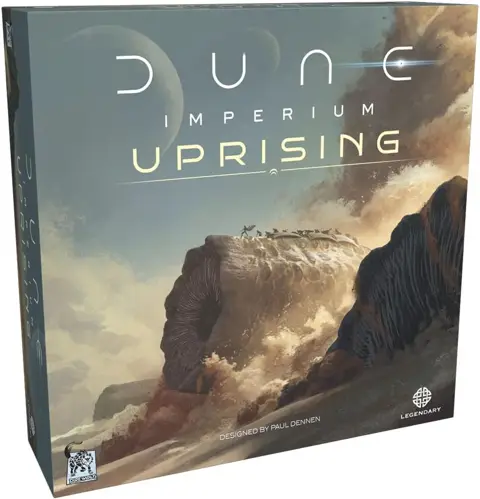
 Deep DiveThe Spice Must Flow Again: A Deep-Dive Into Dune: Imperium – UprisingHow spies, sandworms and contracts change the game, who should buy the original, and the expansion order that makes sense.
 ComparisonGloomhaven vs Frosthaven vs Jaws of the Lion: Which Campaign Crawler to Start WithA purple-haired critic settles the franchise's loudest beginner question, with the catch named up front and the receipts that earn it...
What exactly is Oathsworn: Into the Deepwood?
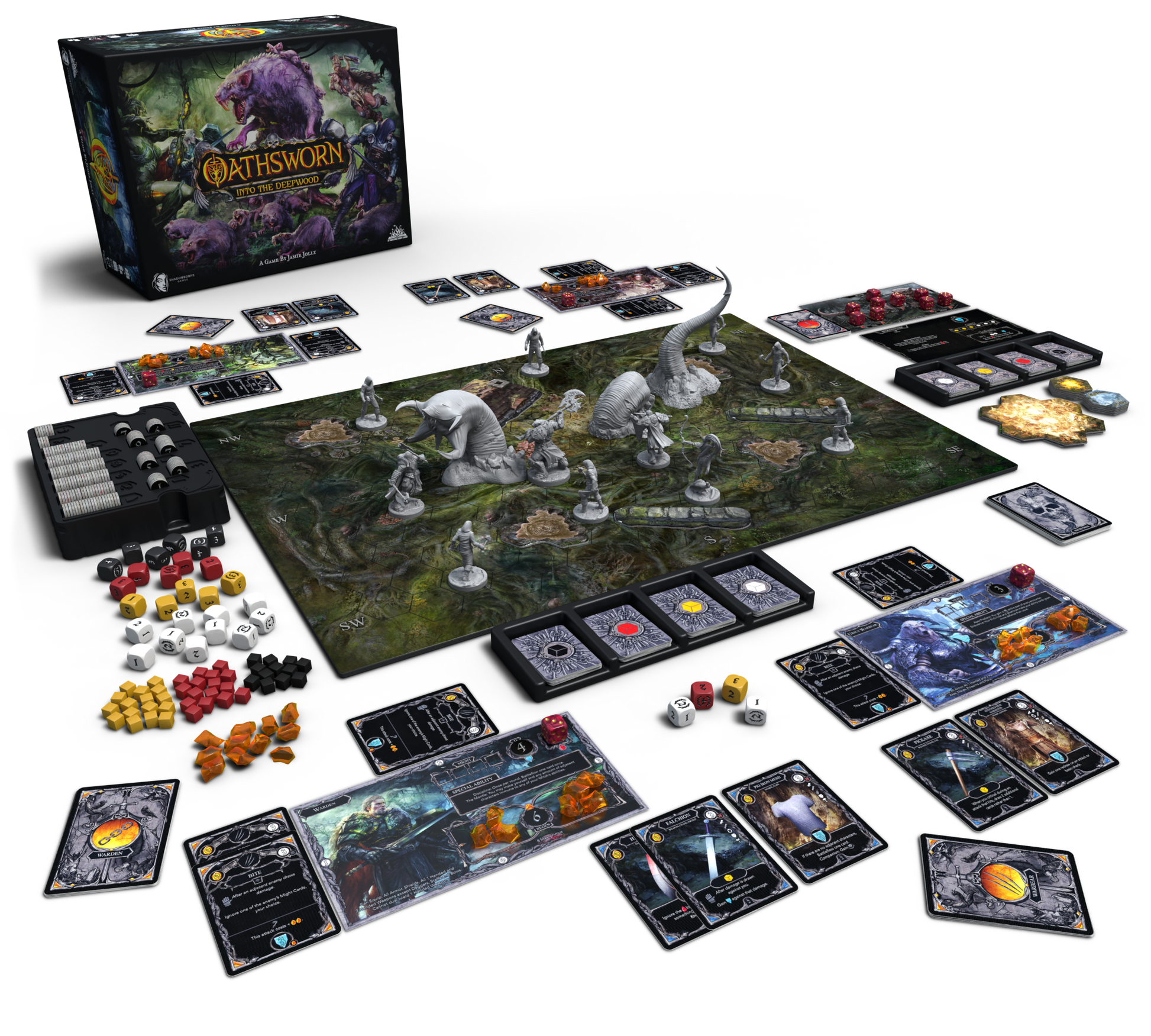

Oathsworn is a cooperative legacy-style campaign for 1 to 4 players, set in a doomed frontier called the Deepwood where a ragged free company — the Oathsworn — fights to hold the line against the forest and the unnatural things inside it. Shadowborne Games describes it as a dark-fantasy RPG-meets-miniatures game that, for the first time, fuses a novel-sized interactive storybook with tabletop monster battles. Mechanically it is a 'Twisting Tales' game: you read (or listen to) branching narrative, choose your own path across beautifully rendered maps, gather allies and loot, and then resolve the chapter's climax as a scripted boss Encounter. It is designed by Jamie Jolly and published by Shadowborne Games, with a first edition delivered in 2021. Player count is 1–4, age is 14+, and a single chapter runs roughly 30–90 minutes depending on how much you explore and how long the fight drags. The full campaign is about 21 chapters. [1][2][3]
It wants to be a dark-fantasy novel and a miniatures boss-rush at the same time — and the astonishing thing is how often it pulls both off.
How does the storybook and branching narrative actually work?
Before any miniature touches the table, you play the Story phase. This is the part Shadowborne is proudest of: a hardback, novel-sized interactive book (or the same text read aloud by the companion app) that presents your hunt as a choose-your-path adventure. You travel the Deepwood on illustrated maps, hit numbered story entries, and make decisions — who to trust, which route to take, whether to risk an ambush for a reward. The free companion app layers in atmospheric narration by Game of Thrones actor James Cosmo, plus a soundtrack and a time/clock tracker, though the app is strictly optional — the book stands on its own. Be clear-eyed about one thing reviewers consistently flag: the branching is more textured than it is forked. Your choices reliably change what resources, allies, and starting conditions you bring into the coming fight, and they color the telling — but the campaign's spine bends back to the same major beats. Treat it as a richly reactive novel rather than a fully divergent one, and you will not be disappointed. [2][4][5]
Treat the story as a richly reactive novel, not a fully branching one, and you'll love it. Expect total divergence and you'll feel the rails.
How does the exploding-dice combat engine work?

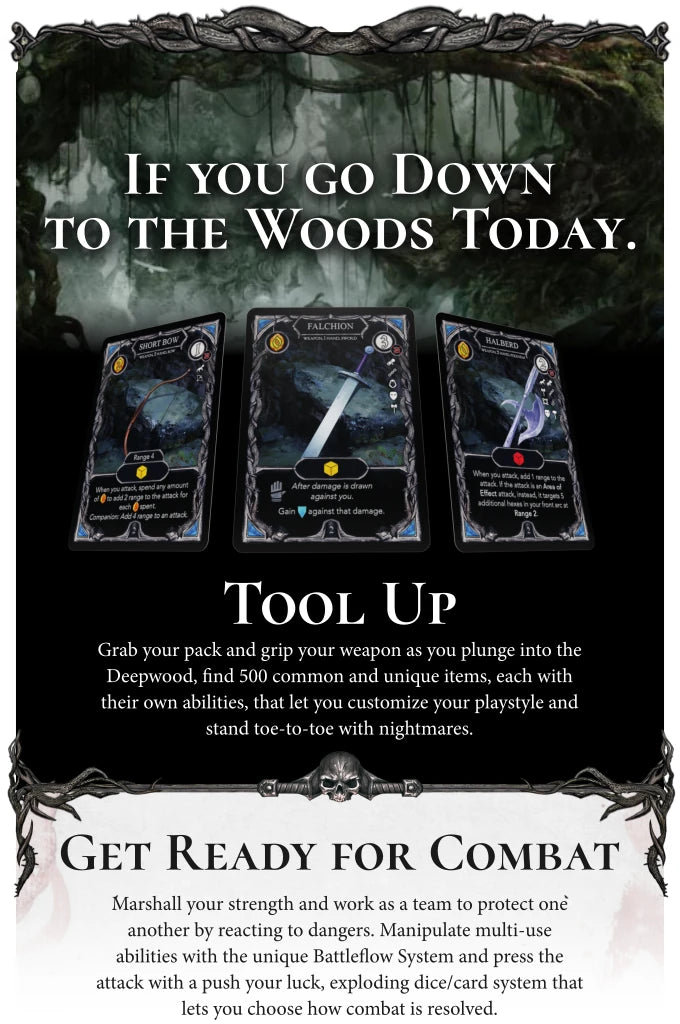
Here is the heart of the machine, and the part you must understand before buying. Each Encounter is a tactical fight on a hex board. You manage your abilities through a clever euro-style cooldown system the designers call Battleflow: when you use an ability card it goes into a cooldown slot, and the only way to cycle it back into your hand is to play other cards that shunt it around the board. So you are constantly choosing tempo — burn your best move now, or set up the rotation that gets it back. When you actually strike, you resolve damage one of two ways, and this is Oathsworn's masterstroke for table-fit: roll exploding dice (criticals trigger extra rolls and let damage spiral gloriously) for maximum push-your-luck thrill, OR draw from a Might card deck of the same color tiers for a lower-variance, more strategic read of the odds. Same expected output, different appetite for chaos. The twist that trips up newcomers: defense is DIVIDED into your damage, not subtracted. Against a target with 3 defense you need 6+ to land 2 wounds. That is why a dazzling chain of crits can still bounce off a heavily armored boss for a single point — and why aiming for soft locations and stacking bonuses matters more than raw dice. Roll two or more blanks and the whole attack whiffs. [2][4][5][6]

Dice for the thrill, cards for the math — the same fight, tuned to your group's appetite for chaos. That choice is the quiet genius of the design.
The famous 100mm boss minis — and what's really in the box

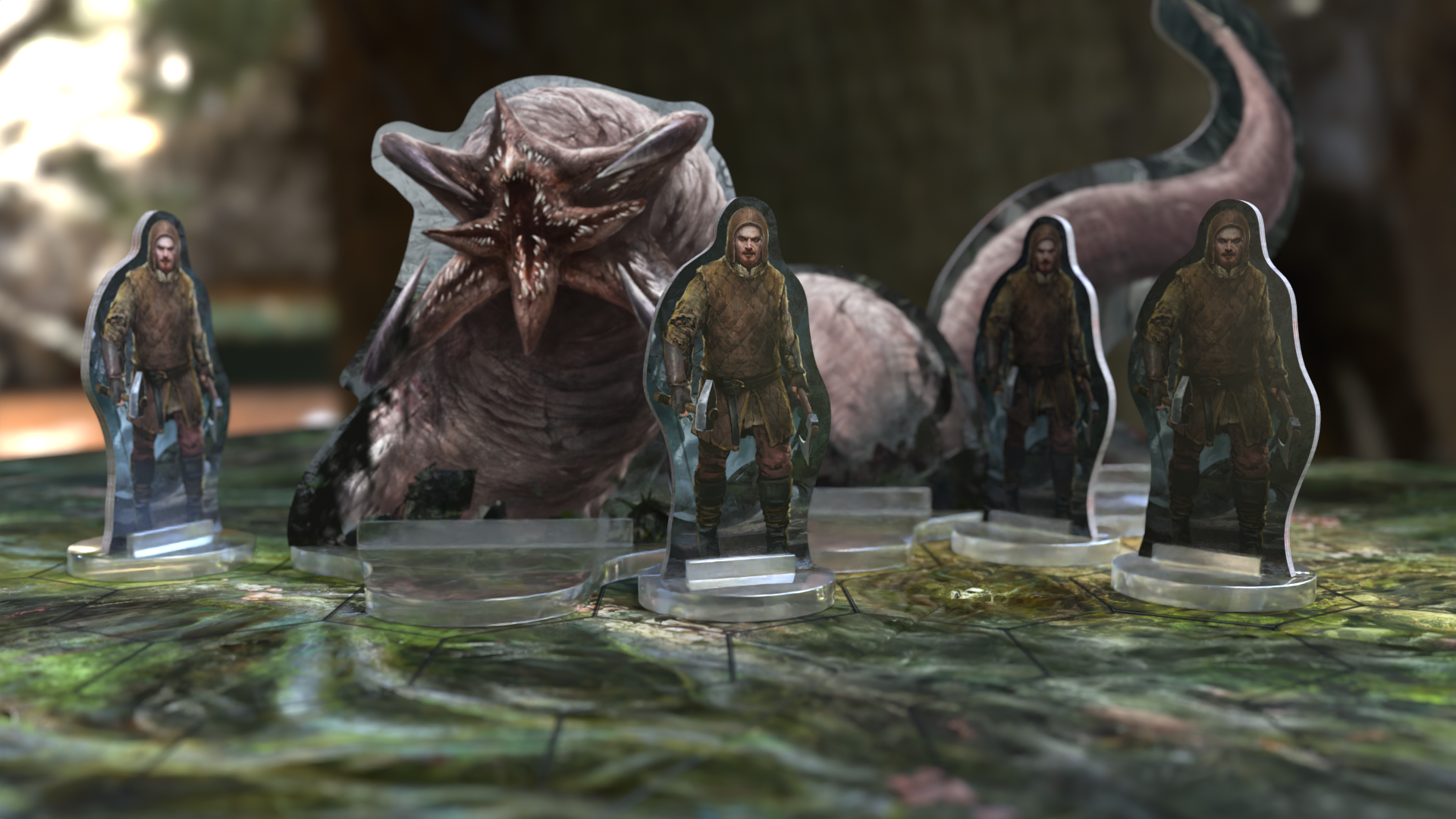
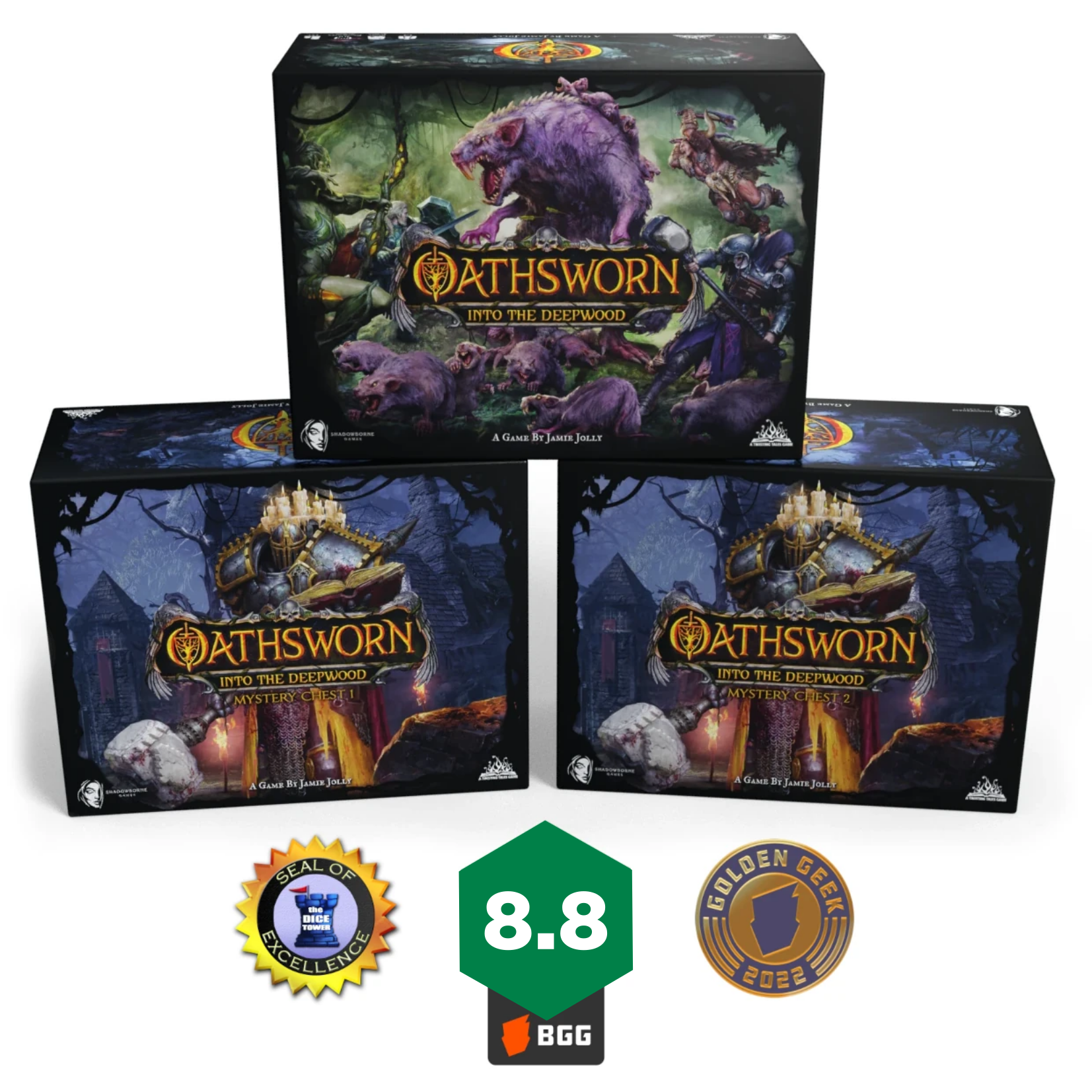
The reason Oathsworn became a Kickstarter legend is sitting in sealed boxes inside the bigger box. Encounters are built around giant 100mm-plus boss miniatures — towering, multi-piece sculpts that you do not see until the story tells you to crack the seal. The core game ships with 27 Oathsworn (player/ally) miniatures and 70+ large enemy miniatures, the latter hidden across the two included Mystery Chests so that each monster is a genuine reveal at the table. There's a catch worth knowing: because the bosses are mystery-locked, you can't pre-paint your collection — you meet the sculpt and the story simultaneously, which is wonderful for drama and mildly annoying for hobbyists. The player models use a push-to-fit 'Armory' system that lets you physically swap weapons to match in-game loadouts; reviewers love the idea but note the arms can feel a touch flimsy (the 2nd printing pre-glues most of the body to tighten that fit). Rounding out the box: modular terrain, the hardback storybook, the encounter boards, the dice and Might decks, character and enemy cards, and the tokens that drive Battleflow. There is also a budget-friendly Standee edition that swaps the minis for cardboard standees at a far lower price and far smaller footprint — the value pick if shelf space or cost is your constraint. [1][2][4]
You don't unbox the monsters. The story does — and meeting a 100mm horror for the first time mid-chapter is a genuine tabletop event.
Is it worth the premium price?

Short answer: yes, if your group will actually run a long cooperative campaign and you value story as much as tactics — otherwise the price and footprint will haunt you. The miniatures core box sits around $299, which is squarely premium-tier, and it is a physically enormous game that demands real shelf space and 15–20 minutes of setup and teardown per session. What you get for the money is roughly 20+ chapters of authored content, dozens of monster sculpts you can't see coming, a fully voiced narration option, and combat with genuine mechanical novelty. The critical consensus is unusually warm — Tabletop Gaming rated it a 'MUST-PLAY' and wrote that 'there is no game which more obviously invites Gloomhaven comparisons. And you know what? It measures up amazingly,' while BeastieGeeks called it 'quite possibly the finest story-driven campaign experience we've ever encountered.' On BoardGameGeek it holds around 9.3, one of the highest scores for any game with thousands of ratings. The honest caveats: combat's defense-division can blunt your big swings, the narrative is more guided than branching, and the box is a logistical commitment. Value verdict: a confident buy for committed co-op campaign groups; consider the cheaper Standee edition if minis or money are the sticking point; skip it if you want short, fully-divergent, low-setup play. [3][5][6]
It is expensive, it is enormous, and it is worth it — for the specific group that will see the campaign through. That qualifier is the whole review.
How to play your first chapter well
Margo's field notes for a clean opening, drawn from how the system actually rewards play. One: do the Story phase with intent — your choices mostly convert into tokens, allies, and starting position for the fight, so optimize for combat readiness and dodge needless ambushes rather than chasing 'the good ending.' Two: pick the narration once and commit — turn on James Cosmo's app reading for the table's first chapter to set the tone, then decide if you keep it. Three: settle dice-vs-Might before you fight, ideally per player; risk-tolerant hands take exploding dice, planners take the Might deck, and nobody re-litigates it mid-Encounter. Four: respect the cooldown — Battleflow punishes dumping your best card early, so think two turns ahead about how a card rotates back into your hand before you spend it. Five: read defense first, then aim — because damage divides by defense, target soft locations, stack bonuses, and combine attacks to clear a wound threshold instead of nibbling; one coordinated 6-damage strike beats three scattered 2s into 3-defense armor. Six: enemies telegraph — you'll usually know who gets hit and when, so use that to pre-position, bait the AI, and set up the kill rather than reacting. Seven: don't fear a loss — Oathsworn expects you to feel pressure, and an early defeat is part of the arc, not a campaign-ender. [4][5][6]
Read defense before you aim. One coordinated six beats three scattered twos — that single habit is the difference between bouncing off bosses and breaking them.
Printings and availability — the record, myths corrected
Let me set the dates straight, because rumor outruns fact here. There are two printings. The FIRST edition launched on Kickstarter in October 2019, crossed $1 million in under 12 hours, finished above $1.4 million with 9,000+ backers, and delivered to backers in 2021 — over 12,000 copies shipped despite pandemic-era logistics. The SECOND edition ('2nd printing') ran its Kickstarter from October 18 to November 15, 2022, and was funded with $3,236,363 against a $50,000 goal from 22,693 backers. Now the corrections. Myth: 'first-edition buyers got cheated by the second printing.' Reality: the 2nd edition is a refinement, not a different game — updated rulebooks and cards, six chapters tightened from feedback, and pre-glued HIPS player models for a better Armory fit; the rules errata and content changes were released digitally for FREE so first-edition owners aren't left behind. Myth: 'Oathsworn is a normal retail boxed game you grab off Amazon's shelf any week.' Reality: it is fundamentally a crowdfunded, limited-print product distributed through Shadowborne, Gamefound/Kickstarter pledges, and a rotating set of board-game retailers — stock comes and goes, and prices float with availability. Myth: 'the Mystery Chest or Armory expansion is on Amazon.' Reality: those are pledge/retailer items; the Amazon results that look like add-ons are typically third-party insert organizers, not Shadowborne content — buy the components only from the game's own channels. Choose your edition by what you can actually find at a fair price: both play essentially the same campaign. [1][7][8]
Two printings, one game. The second edition is a polish pass with free digital errata — not a reason for first-edition owners to feel cheated.
What experienced tables keep reporting
Recurring owner patterns, synthesized in Puzzlewick's words. Follow each evidence trail to read the original discussion.
There is no game which more obviously invites Gloomhaven comparisons. And you know what? It measures up amazingly.
Read the evidence: Tabletop Gaming (Tabletopgaming.co.uk) review
Quite possibly the finest story-driven campaign experience we've ever encountered.
Read the evidence: BeastieGeeks, mid-campaign review (no spoilers)
You might pull off an incredible chain of unlikely critical hits, but only do one damage if an enemy has a particularly high defense.
Read the evidence: Meeple Mountain review (on the combat's defense-division swing)
The choices made in the exploration phase feel important — even when the outcomes remain unclear.
Read the evidence: Meeple Mountain review (on the storybook)
Players almost always know who is going to be attacked and when, enabling heavy strategic planning.
Read the evidence: Age of Miniatures review (on telegraphed boss AI)
The reviewer recommends the standee version for value and space efficiency — the minis collection demands substantial storage and is a challenge to transport.
Read the evidence: Age of Miniatures review (paraphrase of the storage/value caveat)
Rated around 9.3 on BoardGameGeek — among the highest scores for any game with more than a thousand ratings on the site.
Read the evidence: BoardGameGeek game page (rating reported by multiple reviews)
The 2nd-edition Kickstarter funded with $3,236,363 against a $50,000 goal from 22,693 backers (Oct 18–Nov 15, 2022) — and the original 2019 campaign passed $1 million in under 12 hours.
Read the evidence: Kickstarter — Oathsworn: Into The Deepwood (2nd Edition)
The picks
Some links below are affiliate links — as an Amazon Associate, Puzzlewick earns from qualifying purchases, at no extra cost to you. It never changes a pick.
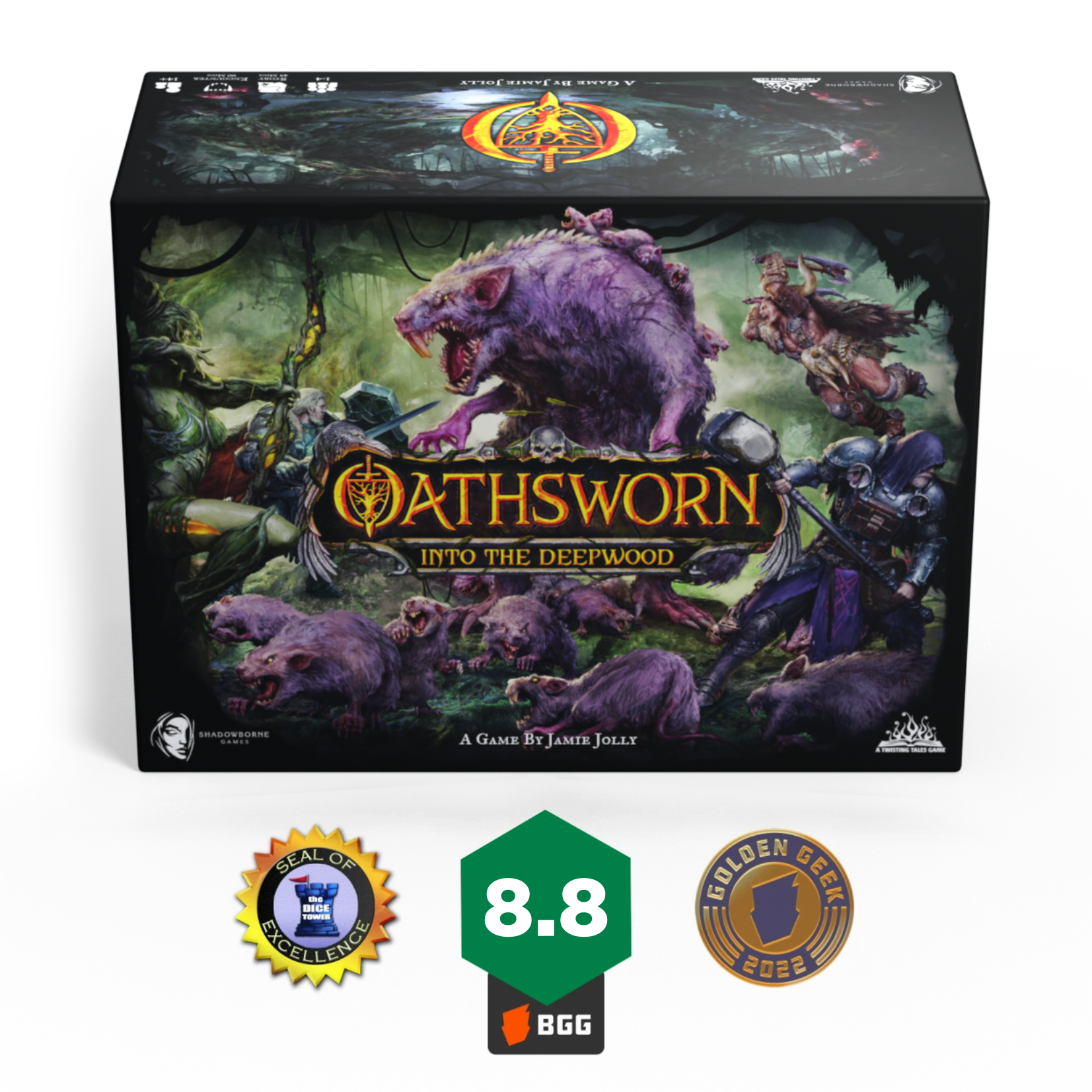 4 photos
 Oathsworn: Into the Deepwood (Base Game)
The complete experience: 27 Oathsworn miniatures, 70+ hidden enemy sculpts across two Mystery Chests, the full ~21-chapter interactive storybook with optional James Cosmo narration, and the exploding-dice / Battleflow combat engine. Medium-heavy (BGG 3.69), one of BoardGameGeek's highest-rated games at ~9.3, and genuinely premium-priced and premium-sized. If your table will commit to the campaign, this is close to best-in-class; if you want short or low-setup play, look elsewhere. Note availability fluctuates because it's a crowdfunded, limited-print title — confirm the seller and price before buying.
- Storybook + miniatures boss-rush genuinely fused into one game
- Exploding-dice OR Might-card combat lets you tune the luck to your group
- 27 player/ally minis + 70+ hidden enemy sculpts, including 100mm+ bosses
- Optional free companion app narrated by James Cosmo (Game of Thrones)
- Among the highest-rated games on BoardGameGeek for a 1,000+ vote title (~9.3)
- Premium price (core MSRP ~$299) and a very large box with real setup/teardown
- Defense divides damage, so big crit chains can still bounce off armored bosses
- Narrative is richly reactive but more guided than truly branching
- Crowdfunded, limited-print distribution means stock and prices fluctuate
At a glance
| game | publisher | players | core loop | combat system | campaign length | narrative branching | minis | bgg weight | best for |
|---|---|---|---|---|---|---|---|---|---|
| Oathsworn: Into the Deepwood | Shadowborne Games | 1-4 | Interactive storybook hunt → handcrafted multi-phase boss Encounter | Exploding dice or Might-card deck; Battleflow cooldown; defense divides damage | ~21 chapters; 30-90 min each | Reactive/guided — choices shape resources & telling, beats reconverge | Yes — 27 player + 70+ enemy incl. 100mm+ bosses (Standee edition swaps in standees) | 3.69 / 5 | Story-and-combat groups who want a narrated dark-fantasy boss-rush |
| Gloomhaven | Cephalofair Games | 1-4 | Branching mission map → tactical room-by-room dungeon combat | Hand-management with simultaneous card play + modifier-deck attacks | 95+ scenarios; sprawling | Branching scenario tree; lighter prose, choice-driven unlocks | Monster minis + character standees (Jaws of the Lion is the trimmed entry) | ~3.9 / 5 | Tactics-first groups who want the deepest, longest legacy crawler |
| Tainted Grail: The Fall of Avalon | Awaken Realms | 1-4 | Open exploration + menhir survival → story chapters with combat | Card-combo 'combat puzzle' (or optional diplomacy resolution) | ~15 long chapters; very text-heavy | Heavily branching, novelistic; strong open-world storytelling | Yes — extensive miniatures range | ~3.7 / 5 | Players who prioritize deep, divergent narrative and exploration over fights |
| Sleeping Gods | Red Raven Games | 1-4 | Open-sea atlas exploration → encounter resolution & quests | Dice-and-card encounter resolution; lower combat emphasis | Open campaign across many sessions; saveable | Wide open-world story, light dark tone | No — token/standee components, art-forward | ~3.0 / 5 | Groups wanting open-world story-adventure with lighter rules and no minis |
Questions, answered
What is Oathsworn: Into the Deepwood?
A 1–4 player cooperative dark-fantasy campaign game by Jamie Jolly (Shadowborne Games, first edition 2021). Each of its ~21 chapters pairs an interactive choose-your-path storybook with a multi-phase boss Encounter fought on a hex map, using a push-your-luck exploding-dice (or Might-card) combat system.
How many players, and can I play solo?
It plays 1 to 4 players and fully supports solo and two-handed play — it's a cooperative game, so 'beating' the AI-driven bosses is the shared goal. Age rating is 14+.
How long is a session and the full campaign?
A single chapter runs roughly 30–90 minutes depending on how much you explore and how long the boss fight lasts. The complete campaign is about 21 chapters, so it's a many-evenings commitment.
How does the exploding-dice combat work?
When you attack you either roll exploding dice (criticals trigger extra rolls and let damage snowball) or draw from a Might card deck for lower variance. Crucially, a target's defense DIVIDES your damage rather than subtracting it — you need 6 damage to deal 2 wounds to 3 defense — and rolling two or more blanks fails the attack outright.
What is Battleflow?
Battleflow is the euro-style cooldown system. Used ability cards go into cooldown slots, and you can only return them to your hand by playing other cards that rotate them around the board. It forces you to plan tempo instead of spamming your best moves.
What's in the core box?
The miniatures core box includes 27 Oathsworn (player/ally) miniatures, 70+ large enemy miniatures hidden in two Mystery Chests, all 21 chapters of the hardback interactive storybook, modular terrain, encounter boards, the dice and Might decks, and the cards and tokens that run combat. MSRP is about $299.
Are the boss miniatures really 100mm?
Yes — the bosses are giant 100mm-plus multi-piece sculpts, and they stay sealed in Mystery Chests until the story reveals them, so each monster is a surprise at the table. That also means you can't pre-paint the bosses before you meet them in the campaign.
Who narrates the companion app?
Game of Thrones actor James Cosmo voices the optional, free companion-app narration, which also adds a soundtrack and a time tracker. The hardback storybook works completely without the app if you'd rather read.
Is there a cheaper version?
Yes. Shadowborne offers an official Standee edition that replaces the 100mm miniatures with cardboard standees at a substantially lower price and much smaller footprint. Reviewers explicitly recommend it for value and shelf space — the campaign plays the same.
Is the first or second edition better?
They play essentially the same campaign. The 2nd edition (2022 Kickstarter) refined the rulebook and several cards, tightened six chapters from feedback, and pre-glued the player models for a better Armory fit. Those rules/card improvements were released as free digital errata, so first-edition owners aren't left behind — buy whichever you can find at a fair price.
Where can I buy it, and why is it hard to find?
It's a crowdfunded, limited-print game distributed through Shadowborne, Gamefound/Kickstarter pledges, and select board-game retailers rather than mass retail, so stock cycles in and out and secondary prices spike. Buy from reputable sellers and watch the price; a sealed core or standee box at MSRP is the win.
How does it compare to Gloomhaven?
Gloomhaven is a tactics-first, room-by-room dungeon crawler with the deepest scenario tree; Oathsworn is a story-first boss-rush where each chapter is a narrated hunt ending in one handcrafted giant-monster fight. Tabletop Gaming put it bluntly — Oathsworn invites the Gloomhaven comparison and 'measures up amazingly.'
Margo's verdict
Oathsworn: Into the Deepwood earns its premium. It is the rare crowdfunded epic that delivers on both halves of its promise — a genuinely atmospheric, James-Cosmo-narrated dark-fantasy storybook bolted to a tactically rich boss-rush with one of the cleverest 'tune-your-own-luck' combat engines in the hobby. The honest caveats are real: the core box is ~$299 and physically enormous, defense-division can blunt your most spectacular rolls, and the narrative is more richly reactive than truly branching. But for a co-op group that will actually run the 20-plus-chapter campaign, it sits near the top of the narrative dungeon-crawler heap — a ~9.3 on BoardGameGeek is not an accident. Buy the miniatures core (Amazon ASIN B0BJ6644PX) if you want the full 100mm spectacle and have the shelf for it; take the official Standee edition if money or space is tight; and on the printing question, relax — both editions play the same game, and second-edition improvements reached first-edition owners as free digital errata. Just confirm a fair price from a reputable seller, because this is a limited-print title whose availability comes and goes.
Research ledger 11 sources · reviewed 2026-07-17
Specifications, rules, current product information, community experience, and contrary evidence were checked against the sources below. Commercial links are kept separate from editorial evidence.
- shadowborne-games.comshadowborne-games.com/products/oathsworn-into-the-deepwood-core-game
- dicetower.comdicetower.com/board-game/251661
- boardgamegeek.comboardgamegeek.com/boardgame/251661/oathsworn-into-the-deepwood
- ageofminiatures.comageofminiatures.com/oathsworn-review
- meeplemountain.commeeplemountain.com/reviews/oathsworn-into-the-deepwood
- tabletopgaming.co.uktabletopgaming.co.uk/reviews/oathsworn-into-the-deepwood-review
- kickstarter.comkickstarter.com/projects/shadowborne-games/oathsworn-into-the-deepwood-second-printing
- gamefound.comgamefound.com/en/projects/shadowborne-games/oathsworn-into-the-deepwood-2nd-printing
- beastiegeeks.combeastiegeeks.com/2023/10/30/oathsworn-into-the-deepwood-review-without-spoilers
- belloflostsouls.netbelloflostsouls.net/2019/10/oathsworn-into-the-deepwood-kickstarter-breaks-1-4-million.html
- amazon.comamazon.com/dp/B0BJ6644PX?tag=puzzlewick-20
Let me check that before we say it.
Keep exploring
The next smart rabbit holes.
✦ Topic PathBoard Game Buying Guides: compare the whole shelfStart with the decision, not the shelf. These guides compare the games, editions, expansions, player counts, and costs people...Deep DiveThe Spice Must Flow Again: A Deep-Dive Into Dune: Imperium – UprisingHow spies, sandworms and contracts change the game, who should buy the original, and the expansion order that makes sense.ComparisonGloomhaven vs Frosthaven vs Jaws of the Lion: Which Campaign Crawler to Start WithA purple-haired critic settles the franchise's loudest beginner question, with the catch named up front and the receipts that earn it...