Featured Fireside Briefing · Arkham Horror: The Card Game
The complete spoiler-free Arkham backstory · Part 1 of 3
Arkham’s entire backstory, finally told.
The history, horror, and human courage behind Brethren of Ash.
A spoiler-free briefing for the six months between Arkham’s calamity and the first knock on a Miskatonic dormitory door.
Puzzlewick uses AI assistance for research organization, drafting support, and labeled editorial visuals. Robert Pruitt retains editorial responsibility. Product facts are checked against Fantasy Flight Games.
This is the complete three-part audio edition. You can listen straight through or keep reading this part one chapter at a time.
What this is: a source-transparent historical and thematic briefing. What this is not: a walkthrough, deck tier list, or a guide beyond the spoiler boundary.
Open the record
A Note to the Listener
This is not a strategy guide. It will not tell you which investigator is strongest, which cards to purchase, which route to take, or what waits behind the next encounter card.
It is an invitation to arrive. Before the cards are shuffled, before the chaos bag is assembled, before the first location is placed on the table, there is a city worth understanding. Arkham is not simply a collection of fictional streets. It is the meeting point of several powerful traditions: colonial history, New England Gothic literature, early twentieth-century anxiety, scientific discovery, religious fear, folklore, cosmic philosophy, and the stubborn human instinct to seek answers even when ignorance might be safer.
The 2026 Chapter Two Core Set begins several months after Arkham has endured a devastating calamity. The city is rebuilding. New money is entering. Old powers have been disrupted. Strange fires and suspicious accidents are unsettling the population. The introductory campaign, Brethren of Ash, consists of three scenarios: Spreading Flames, Smoke and Mirrors, and Queen of Ash.GUIDECHAPTER
This briefing ends at the threshold of the first scenario. Nothing beyond that door will be opened here.
The purpose is not to tell you what happens. The purpose is to make you care when it does.
Semantic timeline
From Salem to Chapter Two
New England history supplied social memory and fear; Lovecraft built a fictional region from those textures; Arkham games later turned that region into systems players can inhabit.
- HistoryThe Great Migration gathers pace
Beginning around 1630, as many as 20,000 Puritans migrate to America, most settling in New England.
LOC-PURITANS - HistoryThe Salem crisis
Accusations, spectral claims, political instability, faction, and institutional failure turn fear into legal procedure.
NPS-SALEM · LOC-SALEM-MAP · LOC-HAUNTED-HISTORY - HistoryMount Auburn opens
The rural-cemetery movement reshapes American mourning through landscape, sculpture, and contemplation.
NPS-MOUNT-AUBURN - LiteratureH. P. Lovecraft is born
Providence, architecture, astronomy, antiquity, and anxiety later converge in his New England fiction.
HPL-BIOGRAPHY - LiteratureArkham enters the Miskatonic map
Lovecraft writes The Picture in the House, placing Arkham and the Miskatonic Valley inside his fictional New England.
HPL-PICTURE-HOUSE - LiteratureThe Dreams in the Witch House appears
Colonial witch legend, dreams, mathematics, architecture, and nonhuman dimensions occupy the same story.
HPL-DREAMS-WITCH-HOUSE - LiteratureLovecraft dies
His work continues through correspondents, publishers, writers, games, criticism, and reinvention.
HPL-BIOGRAPHY - At the tableThe first Arkham Horror board game
Richard Launius turns investigators, a threatened city, clues, gates, and Ancient Ones into a cooperative game.
FFG-THIRD-EDITION-ANNOUNCEMENT - At the tableFantasy Flight rebuilds the city
The second edition expands Arkham into a sprawling event machine remembered for emergent table stories.
FFG-THIRD-EDITION-ANNOUNCEMENT - At the tableThe card game makes horror personal
Decks, trauma, weaknesses, experience, and campaign records carry consequence through an investigator.
FFG-GAME - At the tableThird Edition authors the crisis
Modular neighborhoods and a codex focus Arkham into scenario-led city investigations.
FFG-THIRD-EDITION-ANNOUNCEMENT - At the tableChapter Two opens
A new evergreen Core remains the same compatible card game while establishing Brethren of Ash and the next encounter foundation.
FFG-NEXT-CHAPTER · FFG-AVAILABLE · FFG-CORE
Chapter 1
The Soul of New England
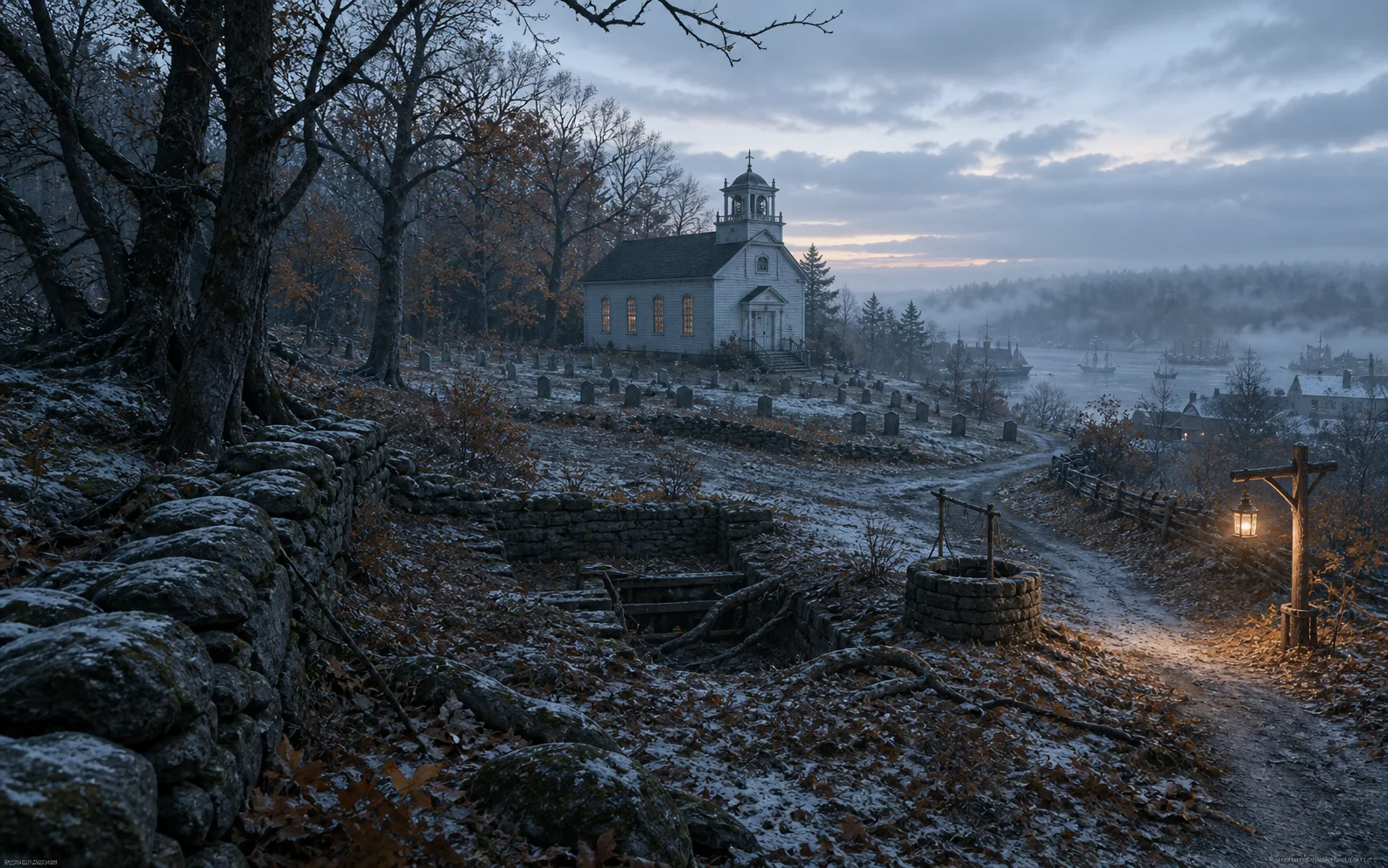
Imagine approaching the northeastern coast of America from the Atlantic in the early hours before dawn. The first impression would not be grandeur. There are no endless tropical beaches, no towering western mountains, no broad golden plains. The coast is irregular and difficult. Rocky promontories interrupt narrow beaches. Harbors appear between dark stretches of forest. Islands emerge from the mist and vanish again as the weather changes. Rivers cut inland through marshes, wooded hills, and settlements that seem to have grown from the landscape rather than having been imposed upon it.
New England is a region of edges. Land meets sea.
Old Europe meets an unfamiliar continent. Established religion meets wilderness.
A community’s official history meets the older stories it prefers not to remember. That quality of being caught between worlds is one reason New England became such fertile territory for American horror.
The Landscape as Memory
The geography of New England encourages intimacy. Roads curve around hills, rivers, stone walls, and property lines established generations earlier. Villages are often gathered around a common green, a meeting house, a church, a courthouse, or a marketplace. Houses stand close enough for neighbors to recognize one another’s routines, but forests can begin only a short walk beyond the last garden.
That arrangement creates two opposite emotional realities. The first is community. Everyone knows who belongs. A stranger is noticed. A family name can carry meaning for centuries. The town remembers births, marriages, disputes, disappearances, scandals, and debts.
The second is scrutiny. Everyone knows who belongs. The same community that offers protection can become a mechanism of suspicion. Deviate from the expected pattern and people notice. Refuse to attend worship, inherit unusual property, live alone, speak with an unfamiliar accent, possess knowledge others lack, or simply become disliked by the wrong neighbor, and the closeness of the town may cease to feel comforting.
American horror repeatedly returns to the idea that a peaceful village may be most dangerous precisely because everyone knows everyone else. In a city, anonymity can conceal you.
In an old village, memory can condemn you.
Stone Walls and Abandoned Farms
A visitor walking through a New England forest may encounter a low wall made from irregular stones. It appears to serve no purpose. There may be no house nearby, no active field, and no road. The wall is evidence.
Much of the region was once cleared for farming. Generations of families pulled stones from difficult soil and stacked them at the boundaries of fields. When agriculture moved westward and farms were abandoned, the forest returned. Trees grew around cellar holes, wells, foundations, and walls. The landscape covered the settlement but did not erase it.
This is almost a perfect physical model of Gothic fiction. The past is never truly gone.
It has merely become overgrown. The abandoned house, the blocked well, the forgotten burial ground, and the path that no longer appears on modern maps are not foreign intrusions. They are history refusing to remain invisible.
Arkham inherits that atmosphere. Its architecture suggests that every generation constructed new rooms without demolishing the old ones. Its streets feel mapped over earlier paths. Its respectable institutions stand above foundations laid by people whose values, fears, and secrets were never entirely removed.
Weather as a Storyteller
New England weather changes the emotional meaning of the landscape. In summer, the region may appear green, welcoming, and almost pastoral. In autumn, leaves burn red, gold, and orange before falling. The season is beautiful because it is temporary. Every brilliant tree carries the knowledge that winter is approaching.
That connection between beauty and decline is deeply Gothic. Autumn does not merely represent death. It represents the moment before death, when the world becomes most visually magnificent just as it begins to disappear.
Fog reduces the landscape to immediate fragments. A church steeple may remain visible while the town beneath it vanishes. A lantern illuminates only a few yards of road. Familiar buildings become silhouettes. Sound travels without revealing its source. Rain transforms windows into barriers. It keeps people indoors, isolates travelers, and makes every interior lamp appear warmer. A person walking through wet streets becomes aware of the distance between one pool of light and the next.
Snow produces a different horror. It covers tracks, muffles sound, slows movement, and creates the illusion of purity. Yet any disturbance in fresh snow becomes impossible to ignore. A trail of footprints is suddenly a narrative. Where did they begin? Where do they end? Why is there only one set? Weather in this tradition is not background decoration.
It changes what can be known.
The Puritan Experiment
The people commonly called Puritans were English Protestants who believed the Church of England still retained practices they considered corrupt or insufficiently reformed. Beginning around 1630, as many as twenty thousand migrated to America, with most settling in New England.PURITANS They hoped not merely to escape interference but to establish disciplined religious communities that might become examples to the wider world.
The popular image of Puritans as people who hated pleasure is incomplete. They married, raised children, conducted business, enjoyed food, wrote poetry, and valued education. They were not colorless caricatures. But their worldview was demanding.
Daily life existed within a cosmic struggle. Providence could be interpreted in illness, weather, harvests, military events, childbirth, accidents, and dreams. The invisible world was not metaphorical. God, angels, Satan, temptation, judgment, and damnation were treated as active realities. This meant the ordinary world could never be entirely ordinary.
A failed crop might be agricultural misfortune. It might also be a warning. A disturbing dream might be a dream. It might also be an intrusion.
A person behaving strangely might be ill. That person might also be under supernatural influence. The danger was not simply that early New Englanders were superstitious. It was that their intellectual system gave spiritual meaning to events modern observers would separate into medicine, psychology, meteorology, economics, politics, and coincidence.
In their world, all those categories could overlap.
The Meeting House
The New England meeting house was simultaneously architectural, religious, political, and social. People gathered to worship, receive instruction, discuss community matters, hear announcements, and observe one another. The building represented collective order. Its simplicity rejected the elaborate decoration associated with traditions Puritans distrusted.
Yet visual simplicity does not necessarily produce psychological comfort. A plain room places attention on the spoken word.
The sermon becomes architecture. The minister’s description of sin, grace, judgment, temptation, and eternity fills the empty space. The congregation sits beneath language powerful enough to turn a winter storm, a sick child, or an unexpected death into evidence within a supernatural narrative.
Horror writers understood the dramatic power of such spaces. An elaborate cathedral may suggest mystery through images, shadows, and sculpture. A plain meeting house can suggest something colder: certainty. The people inside believe they know how the universe is organized.
The horror begins when that certainty is wrong. Or when it is almost right.
Cemeteries and the Nearness of Death
Older New England burial grounds do not always resemble modern landscaped cemeteries. Their stones may be narrow, darkened, tilted, cracked, or partially absorbed by the earth. Early gravestone imagery often presented mortality directly: winged skulls, hourglasses, bones, and reminders that every living person would die.
Death was physically close. Families experienced disease, childbirth complications, accidents, warfare, and childhood mortality without the institutional distance common in later periods. Bodies were prepared locally. Burials took place near churches, meeting houses, farms, and roads. The dead remained members of the community’s geography.
The nineteenth century gradually introduced a more romantic relationship with burial landscapes. Rural cemeteries such as Mount Auburn combined mourning, nature, sculpture, and contemplation.AUBURN This reflected changing ideas about death, family, landscape, and memory. Arkham contains both traditions.
Its oldest graves whisper blunt warnings. Its later monuments attempt beauty.
Neither succeeds in making death feel distant.
The Gothic Inheritance
European Gothic fiction often placed terror in castles, monasteries, ancestral estates, and ruined abbeys. America possessed fewer medieval ruins, so American writers found other structures in which to store the past. The decaying colonial house became an American castle.
The family Bible became an archive. The locked attic became a forbidden chamber.
The old town became an inherited estate from which no one could quite escape. Edgar Allan Poe used architecture, psychology, symbolism, and unstable perception to create stories in which buildings seemed to embody the minds of their inhabitants. Nathaniel Hawthorne drew upon ancestral guilt, Puritan history, secret sin, and the moral weight of inherited wrongdoing. Later writers expanded these traditions into a specifically New England form of unease.
Lovecraft inherited that landscape and made one immense alteration. The secret beneath the house was no longer merely a family crime.
It might predate the family. It might predate the town.
It might predate humanity.
Why New England Horror Endures
New England horror works because the region appears old by American standards but young compared with the scale of the natural world. A seventeenth-century house seems ancient until one considers the hill beneath it.
A colonial grave seems ancient until one considers the continent. A family lineage seems ancient until one considers the species.
The landscape invites the imagination to move backward through layers: The present city.
The industrial town. The colonial settlement.
The Indigenous homeland. The post-glacial forest.
The ancient rock. The planet before human life.
Cosmic horror begins when that backward movement does not stop where human history ends. Arkham is a New England city because New England already understands that visible civilization may be only the newest layer.
And layers can be removed.
Chapter 2
The Birth of Arkham
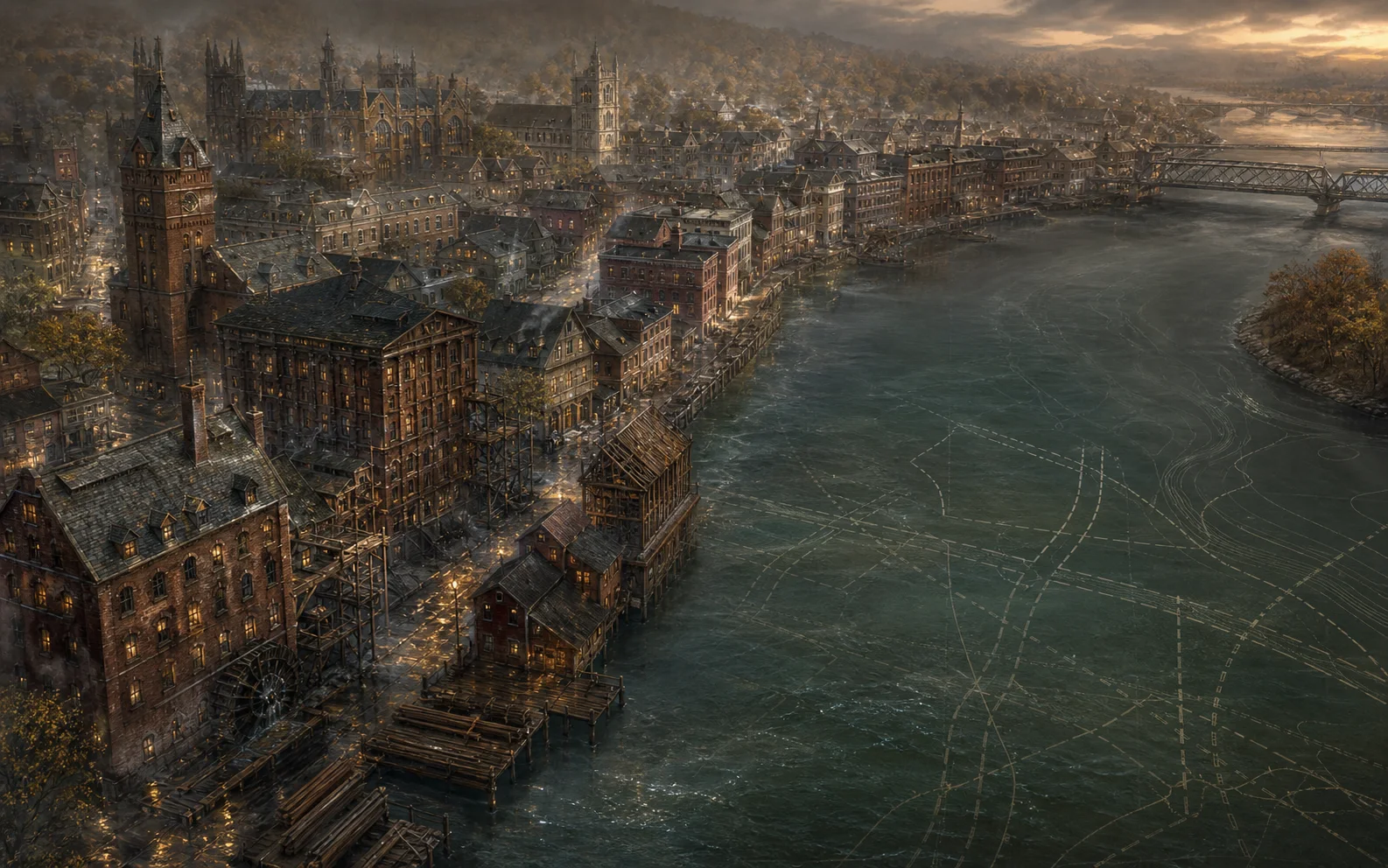
Arkham was never designed in a single moment. It accumulated.
That is one reason it feels convincing. It emerged through repeated references across H. P. Lovecraft’s fiction: a town near the fictional Miskatonic River, a center of education and scholarship, a place of old houses and older reputations, connected by road and rumor to the surrounding communities of northeastern Massachusetts.
Arkham and the Miskatonic Valley appear in Lovecraft’s early New England stories. Miskatonic University later became a recurring institution across works involving folklore, forbidden texts, unusual mathematics, anthropology, economics, and scientific expeditions.HOUSETEXTS Lovecraft did not provide readers with a clean municipal encyclopedia. He offered fragments.
That was the correct decision. A complete city can be understood.
A fragmented city must be imagined.
A City Built Through Reference
Arkham becomes real in the mind because characters treat it as real. They attended school there.
They teach there. They travel through it.
They consult its libraries. They rent rooms in its older neighborhoods.
They read its newspaper. They know which families are respectable, which houses have reputations, and which roads should not be taken after dark.
This is a powerful world-building technique. The narrator rarely stops to announce that a place is mysterious. Instead, local details create the impression of a world continuing beyond the boundaries of the immediate story. Readers begin mentally connecting references.
A university professor mentioned in one tale resembles the kind of scholar who might have known a character in another. A forbidden volume appears in more than one library. A rural road leads toward a town already associated with unexplained events. The stories do not require perfect continuity. Their partial connections create the sensation of a shared hidden history.
Fantasy Flight Games later transformed this literary geography into a broad ensemble setting. Arkham became a living stage populated by investigators, institutions, criminal organizations, cults, academics, performers, workers, police officers, doctors, drifters, mystics, and ordinary residents. Lovecraft’s Arkham is often observed by isolated narrators.
The Arkham Files version is inhabited by a community. That change matters. It shifts the emotional center from solitary revelation toward collective resistance.
Arkham Is Not Innsmouth
The major locations associated with Lovecraftian fiction are sometimes blended together in popular imagination, but each expresses a different kind of fear. Innsmouth is a decaying coastal community shaped by maritime isolation, inherited secrets, economic decline, and the terror of discovering that the boundary between outsider and native may be less stable than it appears.
Dunwich represents rural isolation. Its landscape feels neglected, its families separated from respectable society, its knowledge transmitted through private traditions rather than public institutions. Kingsport is dreamlike and elevated, a town of cliffs, sea mist, old roofs, strange festivals, and moments when beauty feels only a few steps removed from unreality.
Arkham is institutional. It contains a university, newspapers, police, businesses, hospitals, boarding houses, museums, political structures, criminal networks, and neighborhoods with different social identities. Arkham is not hidden from modernity. Modernity has arrived there.
It simply has not made the city safe. That makes Arkham uniquely useful for investigation stories. It offers archives to search, witnesses to interview, authorities to persuade, streets to navigate, and institutions to distrust. It is large enough for anonymity but small enough for connections. A professor may know a police officer. A doctor may recognize a family name. A newspaper editor may suppress a story that a diner waitress heard the previous evening.
Arkham creates networks. Horror moves through them.
The River
The Miskatonic River gives the city a geographical spine. Rivers are natural instruments of civilization. They transport goods, define districts, support industry, provide water, and determine where settlements grow.
They are also instruments of narrative. A river connects places that appear separate. Something discarded upstream may arrive downstream. A flood can move objects, bodies, debris, animals, pollution, and evidence through the city. A river divides neighborhoods while secretly joining them.
Rivers also possess direction. They imply that the past does not remain where it occurred. It flows into the present.
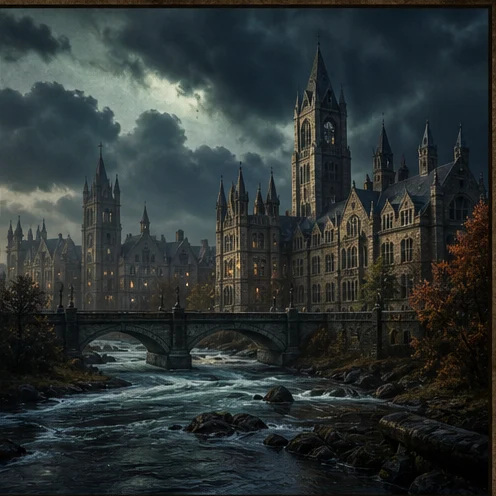
The Chapter Two Core Set begins after a devastating flood has struck Arkham. Six months later, rebuilding is underway, outside investment is arriving, and the city publicly presents its recovery as a glorious renewal. Yet the official campaign guide immediately establishes that Arkham’s familiar violence, disappearances, disturbing symbols, old curses, and witch legends have not vanished.GUIDECHAPTER
A flood is therefore more than recent backstory. It is a transformation of the city’s memory.
Water enters basements. Foundations shift.
Archives are damaged. Objects thought lost may surface.
Objects thought buried may move. Boundaries between districts become unstable.
After a flood, a city is rebuilt physically. It is also renegotiated socially. Some families recover quickly. Others lose everything. Businesses fail. Property changes hands. Investors see opportunity where residents see grief. Criminal groups exploit disruption. Officials promise renewal because admitting uncertainty would slow the money.
The disaster ends. The consequences acquire offices.
The City After Catastrophe
There is a dangerous stage in the life of a city after the immediate emergency has passed. During catastrophe, priorities are obvious. Rescue people. Find shelter. Restore water and electricity. Clear roads. Count the missing. Prevent further damage.
Later, the narrative becomes contested. Who failed?
Who profited? Which neighborhoods receive assistance first?
Which damaged buildings will be restored? Which will be demolished?
Who owns the newly valuable land? What should be remembered?
What should be called an unfortunate accident and left behind? The phrase “building back stronger” can represent sincere courage. It can also become a curtain.
Arkham’s Chapter Two era begins in that space between visible reconstruction and invisible realignment. Established occult organizations have dispersed. Criminal powers are thriving. New ventures are taking hold. The game’s designers describe this upheaval as the foundation for a new crop of mysteries and a fresh direction for Arkham’s continuing story.CHAPTER
The city has not returned to normal. A new normal is competing to be born.
Arkham as a Character
In weak horror, the town is a container. Events happen inside it. In strong horror, the town participates.
Arkham conceals and reveals information unevenly. Its institutions remember different versions of history. Its districts represent different relationships with wealth, tradition, authority, labor, immigration, academia, crime, and belief. The Waterfront remembers trade, smuggling, labor, and what arrives by night.
French Hill remembers old wealth, old families, old houses, and old arrangements. Southside offers greater respectability and calm, but calm in Arkham is rarely the same as innocence.
Downtown represents commerce, administration, publicity, and the performance of civic order. Miskatonic University represents knowledge.
The woods and roads beyond the city represent the limit of its control. A good Arkham scenario does not simply ask, “Where is the monster?”
It asks: Which part of the city allowed this to happen?
Which institution should have noticed? Which person knew but remained silent?
Which explanation will the newspaper print? Which official will dismiss you?
Which door has been locked for years? And who benefits when no one opens it?
The Arkham Paradox
Arkham must remain functional. That is essential.
If every citizen openly acknowledged supernatural catastrophe, the setting would cease to resemble a believable city. Yet if no one ever noticed anything strange, the accumulated events would become absurd. The solution is social fragmentation.
Different people know different pieces. A police officer has seen impossible injuries but calls them animal attacks.
A doctor has treated several patients with identical nightmares but protects their privacy. A librarian knows that certain volumes disappear from the shelves and return without records.
A criminal knows which tunnels are safe but not why the others are avoided. A professor understands one symbol but misinterprets its purpose.
A survivor tells the truth and becomes known as a drunk, eccentric, fraud, or hysteric. No single person has the whole picture.
The investigators become dangerous because they connect information that society has kept separate. Investigation is therefore not merely finding clues.
It is defeating compartmentalization.
Why Arkham Survives
Arkham survives because people do what people have always done after the impossible. They repair the roof.
They reopen the store. They send children back to school.
They file reports. They prepare meals.
They tell themselves that the terrible thing was an exception. This is not cowardice. It is one of humanity’s greatest strengths. Civilization depends on our ability to continue.
But in Arkham, resilience creates an opportunity for horror. The city heals over wounds before learning what caused them.
And something beneath the scar remains alive.
Semantic diagram
Miskatonic’s knowledge machine
Legitimate disciplines can collect true facts without connecting them. The investigator creates the perilous bridge.
- Disciplines collect separate evidence
- Archives preserve records and gaps
- Institutions protect credibility and compartmentalize risk
- The investigator connects what departments kept apart
- Knowledge creates obligation and consequences
Chapter 3
Miskatonic University
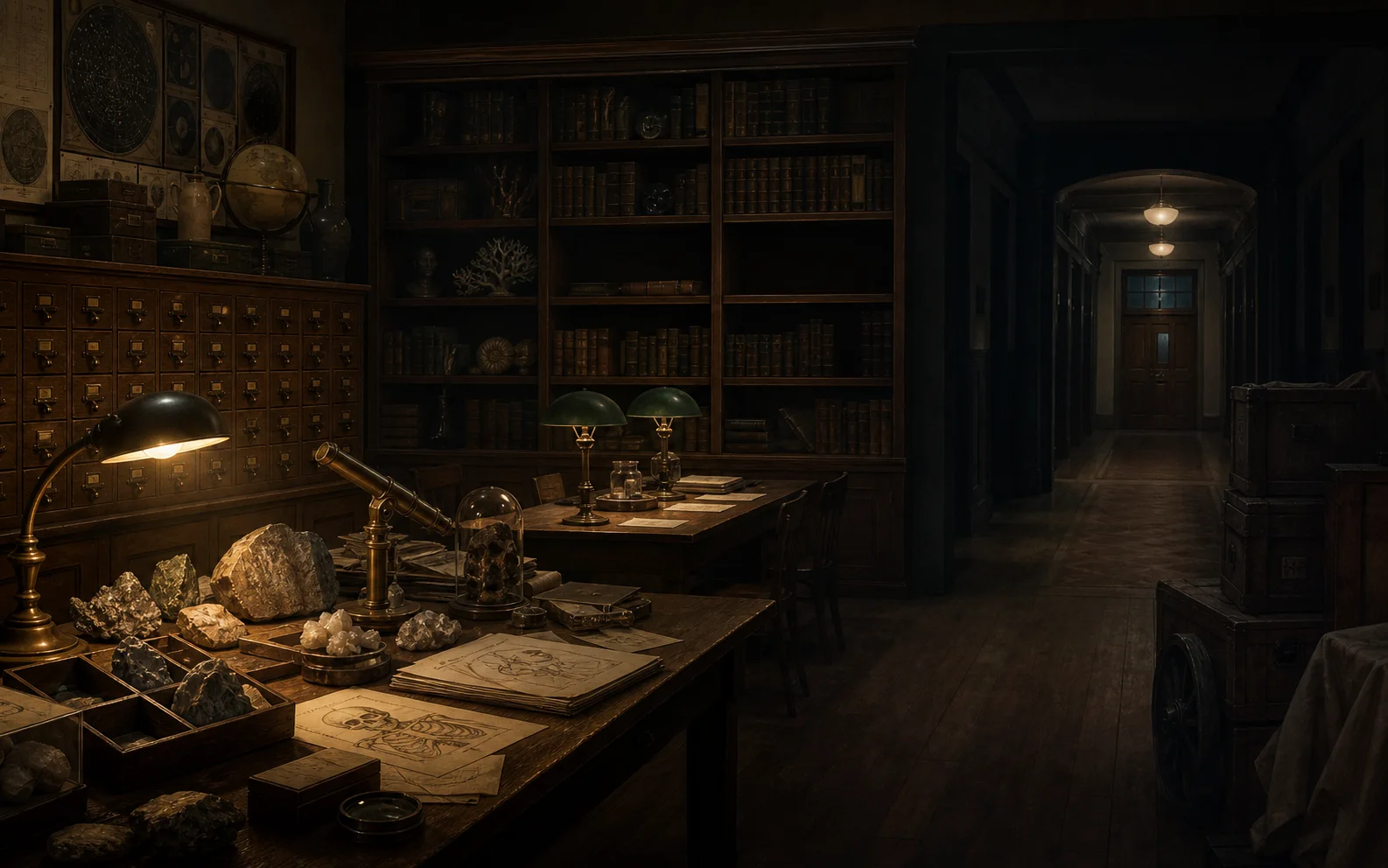
Every civilization creates institutions dedicated to the preservation of knowledge. Libraries collect what individuals cannot remember.
Universities organize inquiry across generations. Museums rescue objects from time.
Archives preserve records long after the people named in them are dead. These institutions are among humanity’s finest achievements.
They are also perfect settings for cosmic horror. A university is built upon a dangerous proposition:
That more knowledge is generally better than less.
The Campus on the River
Miskatonic University is the intellectual heart of Arkham. Across Lovecraft’s fiction, its scholars engage with literature, folklore, medicine, economics, mathematics, archaeology, geology, anthropology, and exploration. Its library holds rare material unavailable to ordinary readers. Its faculty members participate in investigations extending far beyond the campus. Its name appears in stories involving Vermont folklore, Antarctic exploration, witch legends, forbidden books, unusual states of consciousness, and ancient history.TEXTS
Miskatonic is not portrayed as a school devoted to magic. That would make it less interesting.
It is a legitimate university whose normal pursuit of knowledge repeatedly encounters evidence that ordinary academic categories cannot contain. Its scholars do not begin by seeking the supernatural.
They follow the evidence too far.
The University as a Machine for Asking Questions
A university divides knowledge into disciplines. The historian asks when something happened.
The anthropologist asks what it meant to a culture. The chemist asks what it is made of.
The physician asks how it affects the body. The linguist asks how it communicates.
The astronomer asks where it came from. The psychologist asks whether the witness can be trusted.
The librarian asks where a similar account has been recorded. This division is productive because it allows specialization.
It is also dangerous when the truth exists between disciplines. Suppose an archaeological object produces unusual dreams.
The archaeologist studies its origin. The psychologist studies the dreams.
The physicist studies its material. The historian studies the people who previously possessed it.
The police investigate a disappearance connected with it. Each specialist may produce a rational report.
Only the investigator places the reports beside one another. Cosmic horror often begins not with a lack of evidence, but with evidence distributed across departments that do not speak to one another.
The Library
A library in ordinary fiction contains answers. A library in cosmic horror contains consequences.
The danger is not necessarily that a forbidden book casts a magical spell when opened. The more unsettling possibility is that it communicates accurate information. A book may be forbidden not because it lies, but because it provides a model of reality that is psychologically, politically, or physically dangerous.
Knowledge can harm in several ways. It can reveal that a trusted institution is corrupt.
It can expose a family secret. It can teach a technique that should not be practiced.
It can identify a pattern the reader will begin seeing everywhere. It can replace a comforting false belief with an unbearable true one.
It can attract the attention of people who want the information. Or it can attract the attention of whatever the information describes.
Miskatonic’s library symbolizes the accumulated risk of intellectual civilization. Generations of scholars have gathered material from private collections, expeditions, estates, ruins, foreign archives, and abandoned communities. Some donors may not have understood what they possessed. Others may have understood perfectly and wanted the responsibility transferred.
The library does not need to be malicious. It only needs to be thorough.
The Archive and the Absence
Archives are defined by what survives. A letter may be preserved because its recipient kept it.
A diary may end because the writer stopped, disappeared, or died. A police report may omit details considered embarrassing.
A newspaper may use careful language to avoid panic. A photograph may contain someone no witness remembers seeing.
A catalog may show that an object was once present but no longer identify when it was removed. Researchers often imagine archives as collections of information. In practice, archives are also collections of gaps.
The missing page matters. The altered date matters.
The repeated handwriting matters. The folder that should exist matters.
In an Arkham investigation, absence becomes evidence.
The Professor
The professor is one of the great figures of cosmic horror because expertise offers both protection and vulnerability. The professor knows enough to recognize significance.
That is the protection. The professor also knows enough to continue.
That is the vulnerability. A person unfamiliar with an ancient symbol may ignore it. A scholar recognizes the script, notices that it should not exist in this geographical region, and seeks another example.
A person hearing an unusual sound may leave. A linguist detects repeated structure and attempts transcription. A person discovering an impossible fossil may reject it as a hoax. A paleontologist understands exactly why it cannot be one.
Expertise removes ordinary escape routes. Ignorance permits dismissal.
Knowledge creates obligation.
Expeditions and the Imperial Shadow
The fictional university belongs to an era when Western academic institutions built collections through expeditions, private wealth, colonial networks, antiquities markets, excavation, and extraction. That history adds moral complexity.
Who gave the university permission to remove an object? Was it purchased, donated, stolen, or exchanged under unequal conditions?
Did local warnings get classified as superstition because the outsiders considered themselves more rational? Did the expedition publish the discoveries while omitting the people who guided them?
Was the object dangerous before it entered the museum, or did removing it from its context create the danger? Cosmic horror has often portrayed scholars arriving in distant places, assuming intellectual authority, and learning too late that local traditions preserved practical knowledge.
The most foolish scholar is not the one who believes every legend. It is the one who assumes that calling something a legend has explained it.
Knowledge and Institutional Reputation
Universities depend on credibility. A professor can study controversial subjects, but there are boundaries. Claims require evidence. Extraordinary conclusions invite scrutiny. Funding, promotion, publication, and social standing depend upon a researcher’s ability to persuade others that the work is serious.
What happens when the evidence is genuine but the conclusion sounds insane? The scholar faces an impossible choice.
Speak honestly and risk becoming discredited. Remain silent and allow danger to continue.
Translate the truth into respectable language and risk weakening the warning. Destroy the evidence and become the very censor the scholar once opposed.
This is one reason Arkham investigators frequently operate at the edge of institutions. They may use university resources without possessing university protection. They can enter spaces that official representatives cannot publicly acknowledge. The institution needs them.
The institution may also deny knowing them.
The Dormitory
The official opening of Spreading Flames brings the investigators to a friend’s dormitory at Miskatonic University. A recent pattern of fires and disturbing accidents has unsettled Arkham. Robed figures have reportedly been seen near some of the incidents. The investigators’ mutual friend believes those figures are involved and has arranged a meeting. When the investigators arrive, the room is empty and the dormitories are strangely quiet.GUIDE
A dormitory is an excellent place to begin. It is not a forbidden temple.
It is not a ruined mansion. It is a building designed for youth, education, friendship, ambition, distraction, and ordinary life.
Students leave books open. Coats hang behind doors.
Notes are pinned to walls. Half-finished work waits on desks.
A room can reveal a person through the arrangement of objects. An empty dormitory room is therefore not truly empty.
It contains interrupted intention. Someone expected to return.
Miskatonic’s Central Question
Miskatonic University embodies a question at the center of both science and horror: Is there any knowledge humanity should refuse to pursue?
The easy answer is yes. Dangerous technologies, destructive procedures, and violations of human dignity require ethical limits. The harder question is whether facts themselves can be too dangerous to know.
Modern thought generally resists that idea. Facts are neutral; application creates danger. Cosmic horror is less certain.
Perhaps a fact can change the knower irreversibly. Perhaps understanding is itself a form of contact.
Perhaps some doors are opened by comprehension. Yet abandoning inquiry produces another danger. Ignorance gives power to anyone who already possesses the knowledge. Refusing to investigate does not make the phenomenon disappear.
Miskatonic stands between those dangers. Its motto might be imagined as:
We must know. Its unofficial warning would be:
But knowledge will not promise to leave us unchanged.
Semantic diagram
Fire, smoke, ash
One cycle links physical destruction, investigation, and the politics of recovery.
- Spark
- Flame
- Smoke
- Ash
- Reconstruction
- Contested memory
The archive continues
Part 2: Salem, fire, and the shadow.
Continue to Part 2The source ledger
Sources before recommendations.
How this feature was made: Robert Pruitt developed and edited the briefing with AI-assisted research, drafting, source organization, and visual planning. Product facts were checked against Fantasy Flight Games. Historical context was checked against public-history and university sources. Generated curator and chapter imagery is labeled as editorial atmosphere; product evidence remains verified imagery.
Fantasy Flight Games, “The Next Chapter” (Oct. 31, 2025)
Open sourceFantasy Flight Games, “Available Now: March 20” (Mar. 20, 2026)
Open sourceChapter Two Core product page
Open sourceArkham Horror: The Card Game Core Set Campaign Guide
Open sourceFantasy Flight Games, “Ever Investigating” (Feb. 12, 2026)
Open sourceTommy Muldoon Investigator Deck
Open sourceCarolyn Fern Investigator Deck
Open sourceAndré Patel Investigator Deck
Open sourceMarie Lambeau Investigator Deck
Open sourceMiguel de la Cruz Investigator Deck
Open sourceArkham Horror: The Card Game product/support page
Open sourceArkham Grimoire v1.1
Open sourceChapter Two Core news index
Open sourceFantasy Flight Games, “Arkham Horror Third Edition” (2018)
Open sourceLibrary of Congress, Religion and the Founding of the American Republic
Open sourceNational Park Service, Mount Auburn Cemetery
Open sourceLibrary of Congress guide to witch trials/witchcraft
Open sourceNational Park Service Salem educational material
Open sourceLibrary of Congress, “Double, Double, Trials and Trouble”
Open sourceLibrary of Congress Magazine, “Haunted History”
Open sourceChicago History Museum, Great Chicago Fire material
Open sourceH. P. Lovecraft, “The Picture in the House”
Open sourceH. P. Lovecraft, “The Dreams in the Witch House”
Open sourceH. P. Lovecraft Archive, fiction index
Open sourceH. P. Lovecraft Archive, general biography/FAQ
Open sourceBrown University Library, Lovecraft’s Racial Imaginaries
Open sourceThe Arkham Horror Universe
Open sourceMythos: Arkham Horror Masterclass Vol. I
Open sourceArkham Horror, Arkham Horror: The Card Game, Brethren of Ash, and related names and artwork belong to their respective rights holders. Puzzlewick is independent and is not affiliated with or endorsed by Fantasy Flight Games.
Frequently asked
Before you enter Arkham
Will this series spoil Brethren of Ash?
No. Every part ends before Scenario I gameplay begins.
Do I need to know The Drowned City first?
No. Chapter Two follows a calamity that changed Arkham, but the Core is also designed as a fresh starting point. This feature supplies the context a new reader needs without retelling earlier campaign spoilers.
Where should I begin?
Start with Part I. It gives the historical and fictional ground beneath the rest of the story; Parts II and III then follow in sequence.