Featured Fireside Briefing · Arkham Horror: The Card Game
The complete spoiler-free Arkham backstory · Part 3 of 3
Why Arkham Horror Hits So Hard.
Cosmic horror, the Arkham Horror LCG’s emotional machinery, Chapter Two investigators, and exactly where to stop before Brethren of Ash. No scenario spoilers.
A spoiler-free briefing for the six months between Arkham’s calamity and the first knock on a Miskatonic dormitory door.
Puzzlewick uses AI assistance for research organization, drafting support, and labeled editorial visuals. Robert Pruitt retains editorial responsibility. Product facts are checked against Fantasy Flight Games.
This is the complete three-part audio edition. You can listen straight through or keep reading this part one chapter at a time.
What this is: a source-transparent historical and thematic briefing. What this is not: a walkthrough, deck tier list, or a guide beyond the spoiler boundary.
Chapter 7
Cosmic Horror Explained
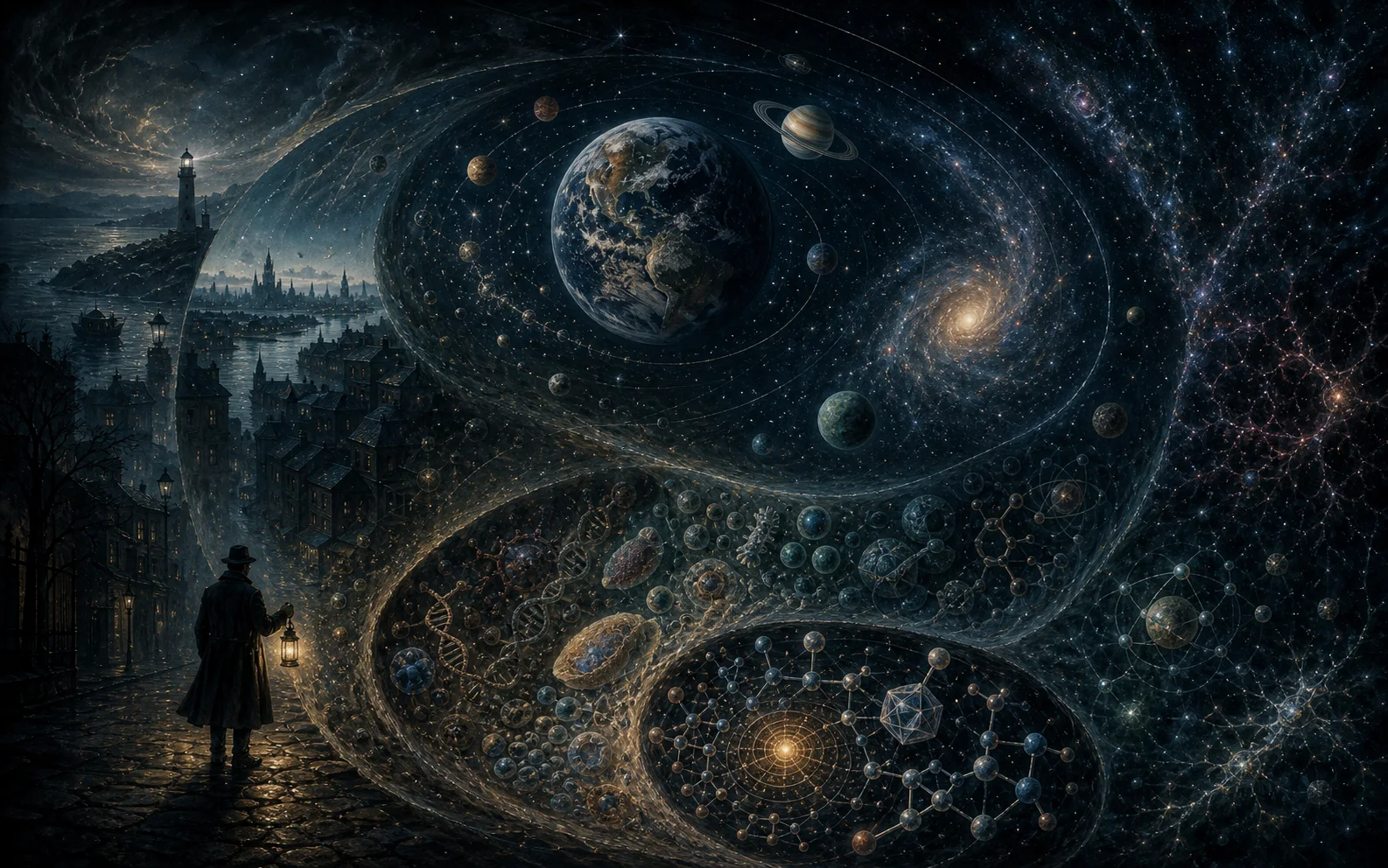
Traditional horror asks: What is hunting us?
Cosmic horror asks: What are we?
Traditional horror threatens the body. Cosmic horror threatens the model of reality through which the body understands itself.
The monster may still attack. The investigator may still run, fight, hide, bleed, or die. But physical danger is only the visible layer. The deeper threat is revelation.
The Center of the Universe
Human perception naturally places the observer at the center. We look outward from our own eyes.
We experience time through our own memory. We interpret events through human needs.
We build stories in which causes lead toward outcomes that matter to people. For most of history, cultures also constructed cosmologies in which humanity occupied a meaningful position. The world might have been created for human beings, watched by gods, governed by moral law, or moving toward an intended end.
Cosmic horror removes that assurance. The universe may contain no narrative centered on us.
Its oldest intelligences may not consider us important. Its laws may be indifferent to justice.
Its scale may reduce all of recorded civilization to an instant. The horror is not that the universe hates humanity.
Hatred would grant us significance. The horror is that it may not notice.
Scale
Scale is one of cosmic horror’s principal tools. Consider a human lifetime.
Then consider a civilization. Then recorded history.
Then the existence of Homo sapiens. Then the age of the Earth.
Then the age of the universe. At each step, the previous scale becomes smaller.
The reverse movement is equally unsettling. A city contains streets.
A street contains buildings. A building contains rooms.
A room contains dust. Dust contains microscopic ecosystems.
Bodies contain cells. Cells contain molecular machinery.
The human being occupies neither the largest nor the smallest meaningful scale. We exist in the middle, interpreting the universe through senses evolved for survival within a narrow environment.
Cosmic horror asks what may exist outside that range.
Deep Time
Gothic horror often looks backward into family history. Cosmic horror looks backward beyond family, nation, language, and species.
Deep time weakens human ownership. A family claims an estate for three hundred years.
The stone beneath it has existed for hundreds of millions. A city claims a river.
The river predates the city. A nation claims a continent.
The continent moves. When an ancient entity appears in cosmic horror, its age is not merely a measure of strength. It destabilizes human authority. Laws, borders, churches, universities, and governments seem temporary beside it.
The old thing does not enter our world. We discover that we have always lived in its world.
The Sublime
The sublime is the emotional combination of beauty, terror, and overwhelming scale. A storm at sea can be sublime.
A mountain range. A night sky far from artificial light.
A vast desert. An eclipse.
A volcanic eruption viewed from safety. The sublime exceeds easy comprehension. It reminds the observer that the world is larger than the observing mind.
Cosmic horror darkens the sublime. The stars remain beautiful, but their distances become frightening.
The ocean remains magnificent, but most of its depth is uninhabitable to us. The mountain remains awe-inspiring, but it may contain geological evidence that contradicts accepted history.
Beauty becomes a doorway.
Epistemic Horror
Epistemology is the study of knowledge: what can be known, how it can be known, and what justifies belief. Cosmic horror is filled with epistemic danger.
The witness sees something impossible. The photograph captures only part of it.
The expert identifies a structure that should not exist. The document contradicts established chronology.
The narrator doubts memory. The institution rejects the claim.
The investigator gathers enough evidence to understand that the impossible is real but not enough to explain it safely. This differs from a simple mystery.
In a conventional mystery, investigation restores order. The detective identifies the culprit, reconstructs the sequence, and proves that the world remains rational. In cosmic horror, solving the mystery may destroy the investigator’s previous understanding of order.
The answer is not relief. The answer is a larger question.
Language Failure
Cosmic horror frequently describes things as indescribable. Used carelessly, this becomes a cliché.
Used well, it points toward a genuine problem. Human language developed to communicate human-scale experience. We possess words for animals, weather, tools, emotion, landscape, and social relationships.
What vocabulary would accurately describe a being with no stable geometry? How would a three-dimensional observer describe a higher-dimensional event?
How would a person distinguish a hallucination from sensory contact with something the brain cannot represent? The narrator reaches for comparison.
It was like an insect. Like smoke.
Like a sound made visible. Like several bodies occupying the same space.
The comparisons conflict because the object does not fit the categories. Language does not merely fail to decorate the monster.
It fails to contain the concept.
Indifference versus Evil
An evil villain understands human morality and chooses to violate it. A cosmic entity may exist outside that framework.
A person stepping on insects is not necessarily motivated by hatred. A scientist studying bacteria does not negotiate with each organism.
A storm does not distinguish the guilty from the innocent. Indifference can be more frightening than evil because it cannot be persuaded through moral appeal.
Yet cosmic horror stories often include human antagonists who worship, summon, exploit, interpret, or collaborate with incomprehensible forces. Those humans remain morally responsible.
The cosmic entity may be indifferent. The cultist is not.
This distinction matters in Arkham Horror. The investigators may not be able to judge an ancient force by human law, but they can judge the person willing to sacrifice neighbors for power.
Madness as Metaphor and Mechanic
Older cosmic horror frequently used “madness” as a broad consequence of forbidden knowledge. Modern audiences should approach this carefully. Real mental illness is not evidence of supernatural corruption, moral weakness, or hidden monstrosity.
In horror fiction, lost sanity functions most effectively as a metaphor for cognitive overload. The investigator encounters something that cannot be integrated into the previous worldview.
Trust in perception collapses. Sleep becomes dangerous.
Memory becomes uncertain. Ordinary surroundings trigger fear.
The Arkham card game represents this pressure through horror, mental trauma, weaknesses, and narrative consequences. These mechanisms are dramatic abstractions, not clinical descriptions. The important emotional idea is that knowledge leaves marks.
Even victory does not restore the investigator to the person who began.
Why Ordinary Courage Matters
If humanity is insignificant, why resist? This is where Arkham Horror becomes more humane than pure cosmic pessimism.
Meaning does not require universal recognition. A person can matter to another person even if the stars are indifferent.
Saving one friend does not become worthless because the universe is enormous. Protecting a neighborhood does not require cosmic approval.
Courage can be local. Kindness can be temporary.
Resistance can be meaningful precisely because it is chosen without guarantee. The universe may not care.
We do. That is enough to begin.
Cosmic Horror at the Table
A tabletop game creates a special form of cosmic horror because the players possess two perspectives. As players, you see cards, numbers, icons, tokens, and rules.
As investigators, you inhabit people who do not perceive those systems. You know there is an encounter deck.
Your investigator experiences a terrible night. You know doom has reached a threshold.
Your investigator hears bells, sees smoke, notices hurried figures, and realizes time is running out. You know a chaos token determines a test.
Your investigator takes a breath, steadies a shaking hand, remembers every reason failure is possible, and acts anyway. The mechanical system becomes fate.
The story becomes your explanation of what fate felt like.
Mechanics become story
The game’s pressure system
| Mechanic | System function | Felt story |
|---|---|---|
| Deck | available cards and identity | who this investigator has become |
| Three actions | economy | time and opportunity cost |
| Encounter deck | escalating pressure | the world answers back |
| Chaos bag | probability under preparation | uncertainty that can be influenced but not eliminated |
| Trauma and weaknesses | persistent cost | the past returns |
| Experience | deck evolution | Arkham changes the investigator |
The Arkham table armory
Good tools keep the story on the table.
These are current, direct Amazon options for storage, play space, chaos-bag ritual, sleeves, and ready investigator decks. None are required to play. Each earns its place only when it makes the next session clearer, faster, or more inviting.
As an Amazon Associate, Puzzlewick earns from qualifying purchases. Prices and availability change at checkout.

Gamegenic Arkham Horror Game Night Chest
A permanent-home storage upgrade for a measured collection; it holds 500+ sleeved cards, guides, a Token Silo XL, and four Deck Tomes.
View on Amazon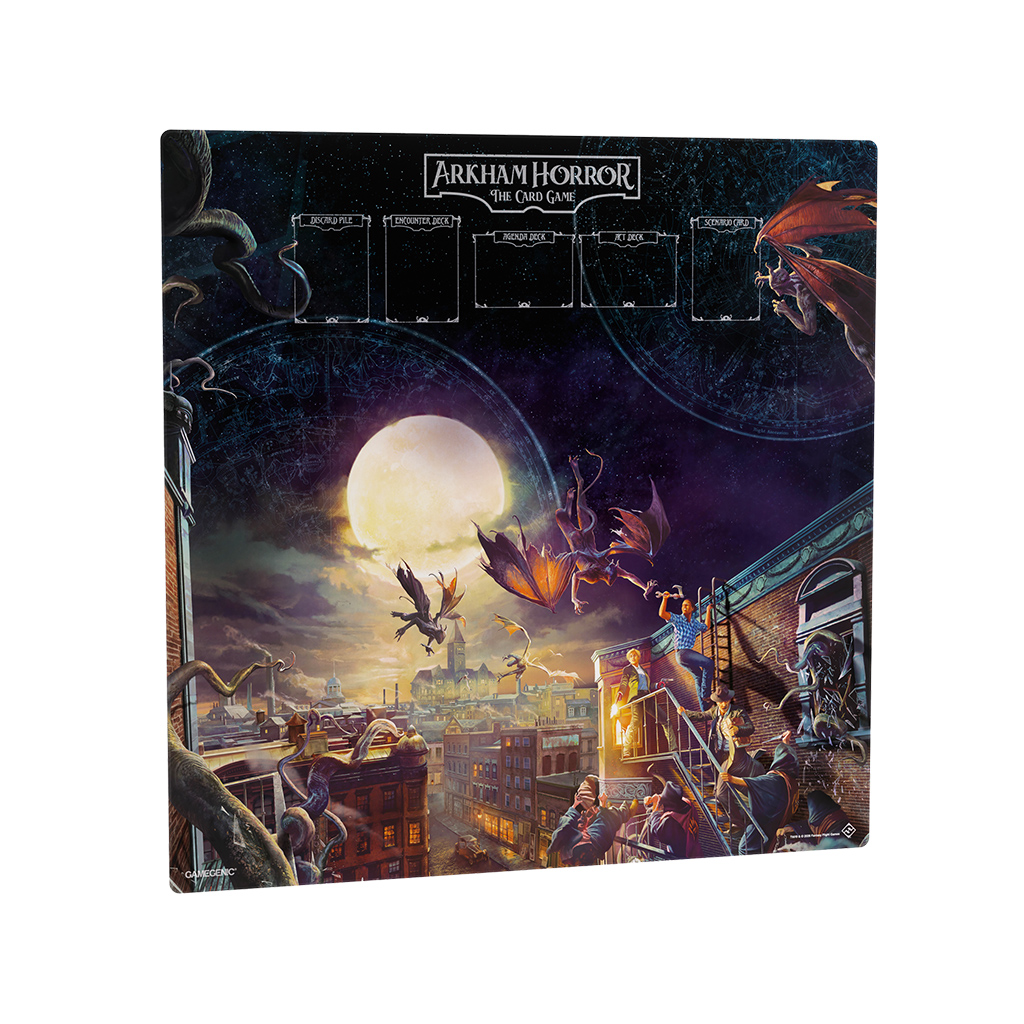
Gamegenic Arkham Horror Center Game Mat
A 70 x 70 cm official center mat for an up-to-four-player table. Buy it for shared readability and surface feel, not because it can contain every sprawling scenario.
View on Amazon
Gamegenic Premium Chaos Tokens + Token Bag
Forty-four acrylic chaos tokens and a hidden-draw bag. A coordinated one-click upgrade when you prefer official components over building a custom capsule kit.
View on Amazon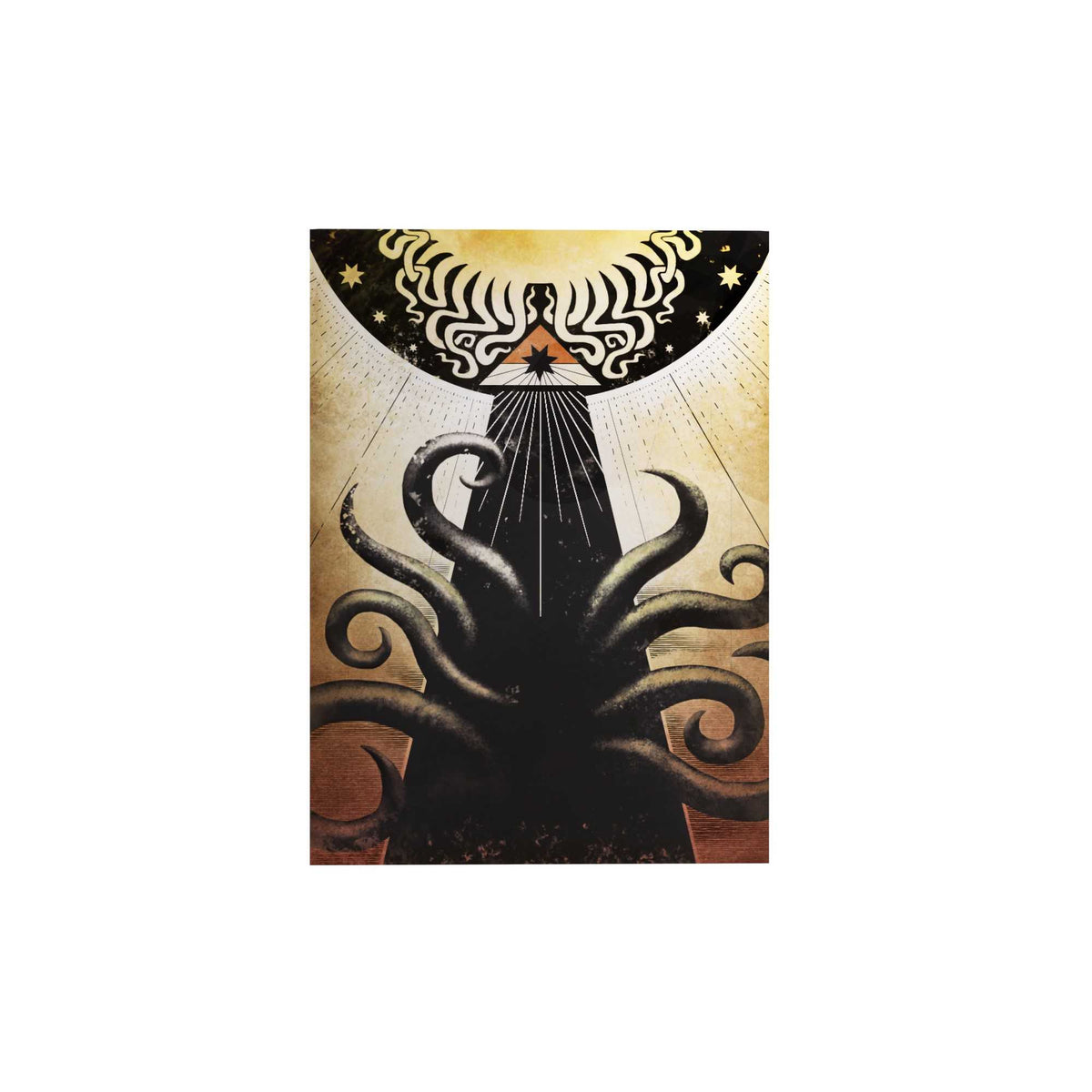
Gamegenic Arkham Horror Encounter Art Sleeves
Official full-color sleeves with a matte back and clear front. Protect the active encounter deck first if full-library sleeving is not in the budget.
View on Amazon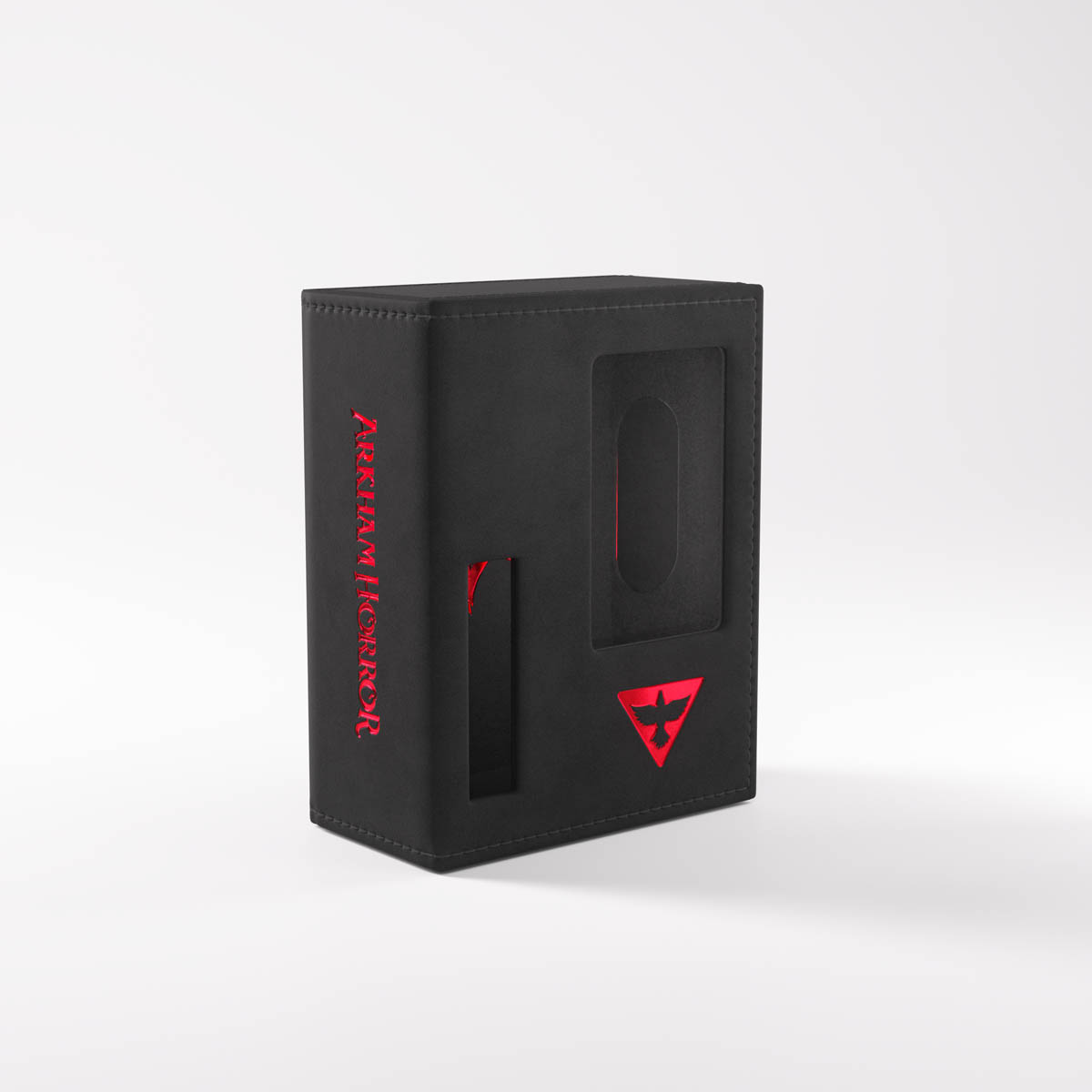
Gamegenic Arkham Horror Investigator Deck Tome
A class-themed, sleeved-deck box with divider. Useful when a ready deck should stay ready between sessions.
View on AmazonChapter 8
Why Arkham Horror: The Card Game Works
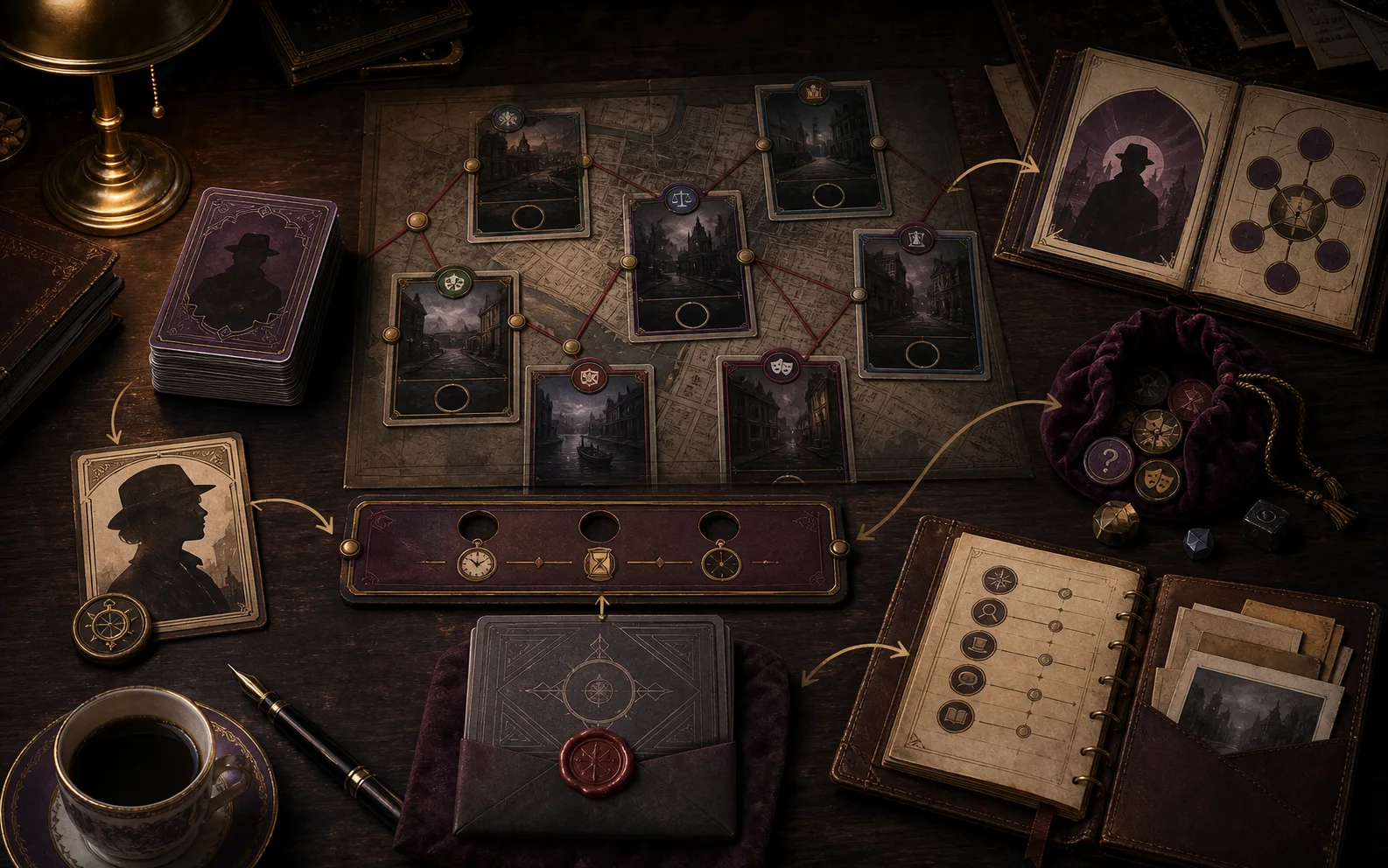
Arkham Horror succeeds because its mechanics do not merely measure the story. They produce it.
Many games create a separation between narrative and procedure. The story says the hero is in danger, but the player performs an abstract calculation. The story says time is running out, but nothing changes until the player chooses to advance. Arkham repeatedly attempts to make the emotional pressure and mechanical pressure the same thing.
Fantasy Flight describes the game as a cooperative Living Card Game in which one to four investigators unravel mysteries and conspiracies while campaign consequences carry across multiple scenarios.GAME The word “campaign” is not decoration.
It changes the meaning of every decision.
The Deck as Identity
An investigator deck is equipment, knowledge, relationships, habits, training, luck, memory, and possibility compressed into cards. Two people may use the same investigator differently because they emphasize different aspects of that person.
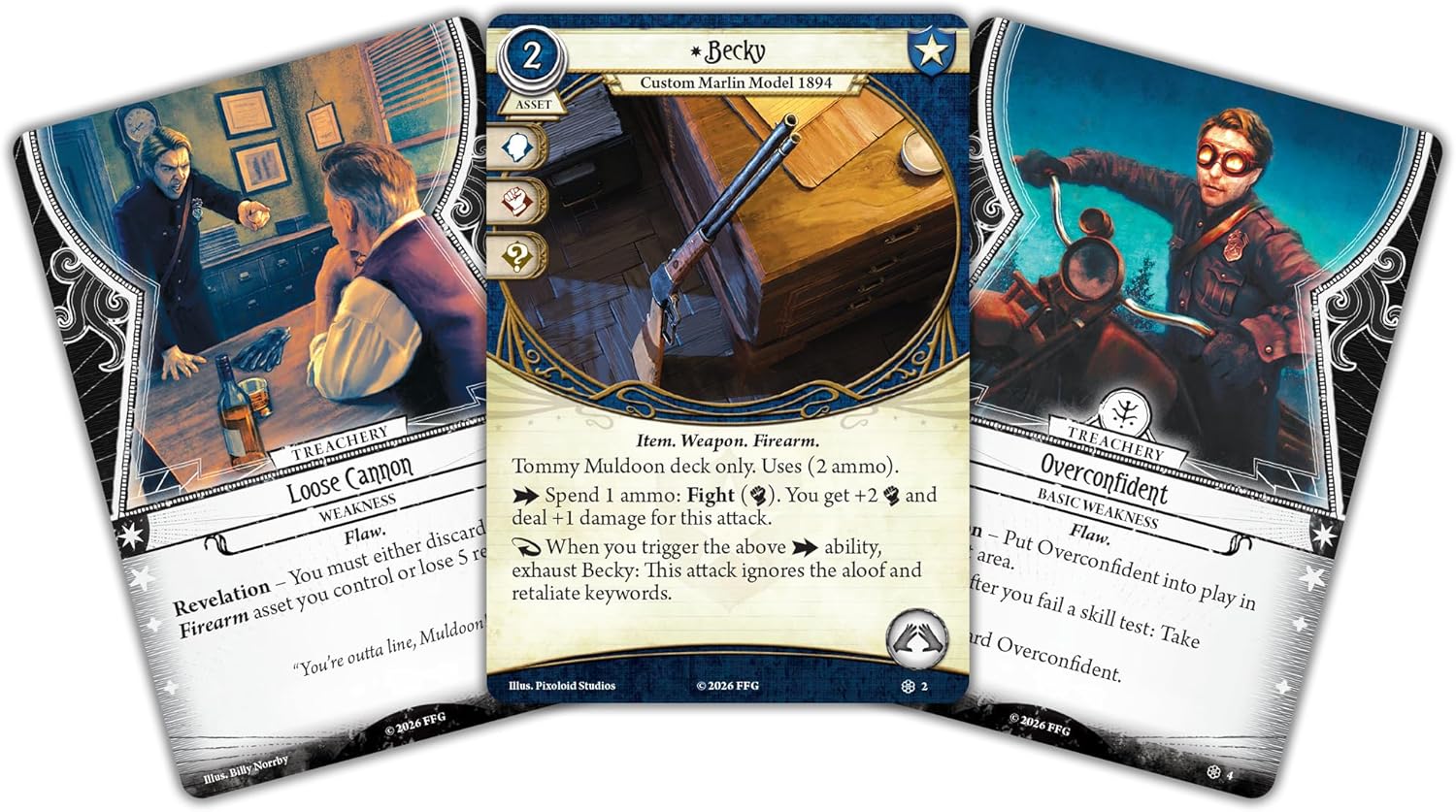
A police officer can be built as a direct combat specialist, a protector, a weapons expert, or a resilient survivor. A psychologist may gather clues through observation, protect companions from horror, study dreams, or manipulate risk.
A performer may turn confidence, timing, social presence, and adaptability into action. The deck is not merely what the investigator carries.
It is the version of the investigator that you have chosen to express.
The Opening Hand
The first hand creates narrative contingency. The investigator owns many useful cards, but only some are available now.
This resembles real crisis. A trained person may possess knowledge without immediate access to the correct tool. An ally may not be present. The weapon may be packed away. The crucial insight may arrive late. The mulligan becomes preparation.
What does this person insist upon having before entering danger? The answer reveals the player’s theory of the character.
Actions and the Cost of Time
Most turns offer three actions. This simple limit generates the rhythm of investigation.
Move. Investigate.
Play an asset. Draw a card.
Gain a resource. Fight.
Evade. Interact.
Every action excludes another. The tension does not come merely from difficult tasks. It comes from opportunity cost.
Stopping to prepare may allow doom to advance. Moving quickly may leave the investigator vulnerable.
Fighting an enemy may protect the team but delay clue discovery. Drawing a needed card may feel wasteful until it saves the scenario.
Time becomes visible through action scarcity.
The Mythos Phase
The encounter deck is not simply a random obstacle generator. It is the world refusing to remain passive.
The investigators act. Then the Mythos answers.
Weather worsens. Enemies appear.
Fear spreads. Plans become complicated.
Old weaknesses return. The encounter card often feels personal even when drawn randomly because the player interprets it within the current situation.
A treachery involving fear means something different when the investigator is alone. An enemy means something different when the team is already divided.
Randomness becomes narrative through timing.
The Chaos Bag
The chaos bag is one of the game’s finest pieces of design. Before a skill test, the player can calculate the investigator’s ability, commit cards, spend resources, use assets, and receive help.
Then a token is drawn. Preparation matters.
Certainty remains impossible. This produces the correct emotional shape for horror.
The player is not powerless. Decisions change probability substantially. But the player cannot eliminate the unknown completely. The chaos bag also remembers.
Tokens may be added or changed through campaign events. The abstract probability system becomes part of the narrative world. Past choices literally alter future uncertainty.
Failure That Continues
Many games treat failure as an instruction to reset. Arkham often allows the campaign to continue.
The investigators may lose an opportunity, suffer trauma, miss information, carry a weakness forward, or enter the next scenario under worse conditions. This is “fail forward” design.
The story does not ask whether you performed perfectly. It asks what happened because you did not.
Failure becomes material. A campaign played badly may produce a more memorable narrative than a flawless victory because scars create continuity.
The investigators are not superheroes protecting a clean record. They are survivors assembling meaning from damaged outcomes.
The Act and the Agenda
The act generally represents what the investigators are trying to accomplish. The agenda represents the threat’s movement.
These two structures create competing narratives. You gather clues and push the investigation forward.
Doom accumulates and pushes the danger forward. The scenario is therefore not simply a puzzle waiting to be solved. It is a race between understanding and escalation.
The investigators do not control when the world becomes worse. They can only decide how much risk to accept before it does.
Locations
Arkham scenarios turn geography into story. A location card is more than a place to stand. It can contain clues, restrictions, enemies, effects, story text, and connections to other locations.
Revealing a location resembles opening a door. Before entering, you know the name.
After entering, you learn what the place means. Connections matter because they create routes, bottlenecks, isolation, pursuit, and distance. A friend who appears only one card away may require several actions to reach. An enemy moving through connections creates spatial dread.
The table gradually becomes an investigation map. By the end, the physical arrangement of cards records where the story occurred.
Enemies
Not every enemy exists to be killed. Some are better evaded.
Some must be delayed. Some punish direct confrontation.
Some create doom or pressure. Some hunt.
Some protect locations. Some represent people who may be victims, collaborators, fanatics, or obstacles rather than simple monsters.
This variety reinforces a key Arkham principle: Violence is a tool, not a universal answer.
A powerful fighter can protect the group, but a campaign requires information, movement, resilience, resources, and judgment. The investigator who defeats every enemy may still lose because no one uncovered the truth.
Damage, Horror, and Trauma
Damage threatens the body. Horror threatens emotional and psychological endurance.
Both can persist as trauma between scenarios. This creates consequences without requiring constant character death. A survivor continues, but begins future scenarios carrying evidence of the past.
Trauma also alters player behavior. A character who once felt durable becomes fragile.
The player remembers how the injury occurred. Mechanics create memory.
Weaknesses
Personal weaknesses are among Arkham’s most characterful mechanisms. A weakness may represent fear, guilt, obsession, injury, an enemy, a debt, a haunting, a flaw, or unfinished history.
It waits inside the deck. The investigator cannot schedule its appearance.
That resembles the way unresolved problems behave. They return when inconvenient. A weakness also prevents the deck from becoming a pure fantasy of competence. The investigator is capable, but the story carries resistance from within.
Experience
Experience allows the deck to change after scenarios. New cards may represent training, equipment, allies, discoveries, confidence, desperation, or corruption.
Upgrading a card feels narratively different from simply increasing a statistic. The investigator’s methods evolve. A campaign therefore tells two simultaneous stories.
The printed campaign tells what happens in Arkham. The deck tells what Arkham is doing to the investigator.
Cooperation
Arkham supports one to four investigators, and cooperation is more than combining numerical strength. Players distribute responsibility.
One investigates. One manages enemies.
One supports. One moves quickly.
One absorbs danger. One solves a specific problem.
The best moments often occur when a player commits a card to another investigator’s test, crosses the map to help, deliberately engages an enemy, or sacrifices an efficient action to protect someone else. Mechanically, this may be suboptimal for one character.
Narratively, it is heroism.
Why a Three-Scenario Campaign Matters
Brethren of Ash is a three-scenario introductory campaign.CHAPTERGUIDE That length creates a compact dramatic structure.
The first scenario introduces the threat and teaches the language of the campaign. The middle scenario can complicate assumptions, widen the city, and make consequences visible.
The final scenario can transform accumulated choices into resolution. A short campaign must move efficiently. It cannot rely on eight chapters of gradual development. Objects, characters, symbols, and choices need to carry multiple meanings.
For a new player, this provides a complete campaign arc without requiring a months-long commitment. For an experienced player, compactness creates replayability. The campaign can be revisited with different investigators, difficulties, decisions, and decks.
The Campaign Log
The campaign log appears administrative. It is actually autobiographical.
Names are recorded. Experience is counted.
Trauma accumulates. Decisions become sentences.
By the end, the log is the outline of a story unique to that group. Fantasy Flight explicitly describes campaign notes, trauma, weaknesses, story assets, and final decks as the consequences of the players’ actions and encourages players to treat them as an account of their own campaign.GUIDE
This is why saving the log with player names and dates feels meaningful. It is not merely recordkeeping.
It is evidence that your version of Arkham happened.
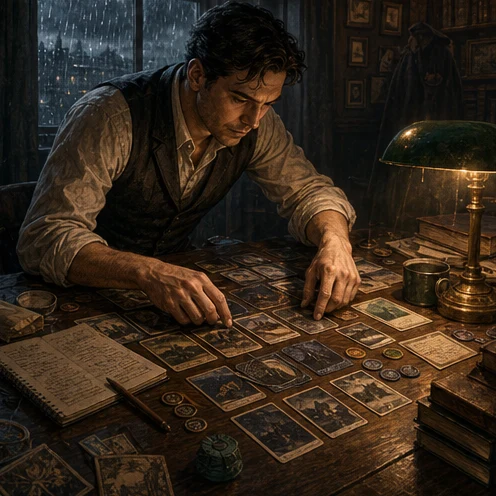
A restrained next step
Continue with the people who walk into the dark
The Chapter Two Core contains the campaign. The five evergreen Investigator Decks are optional ready-to-play identities: five different ways to meet the unknown.
As an Amazon Associate, Puzzlewick earns from qualifying purchases. Prices and availability change; Puzzlewick does not hardcode either here.
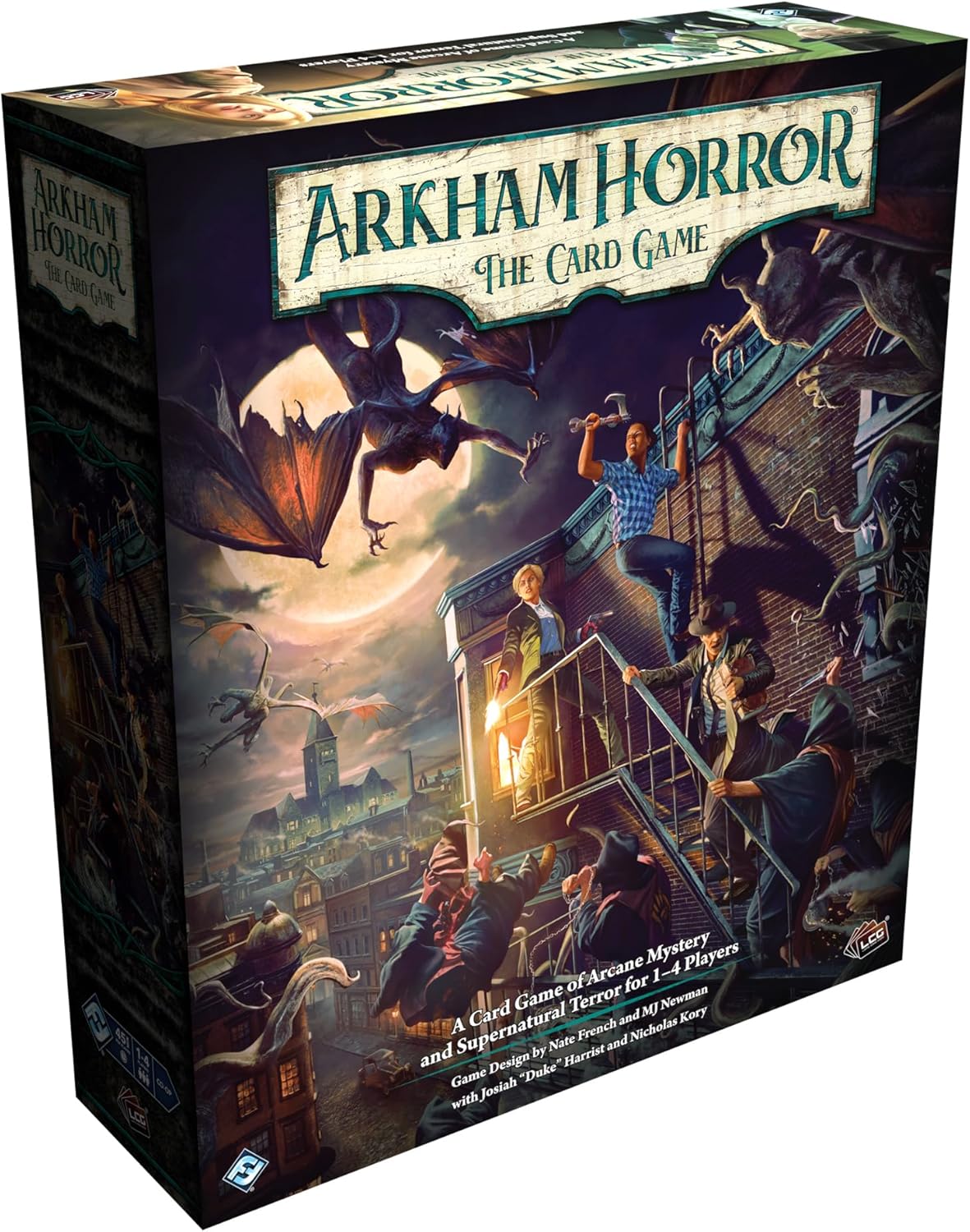
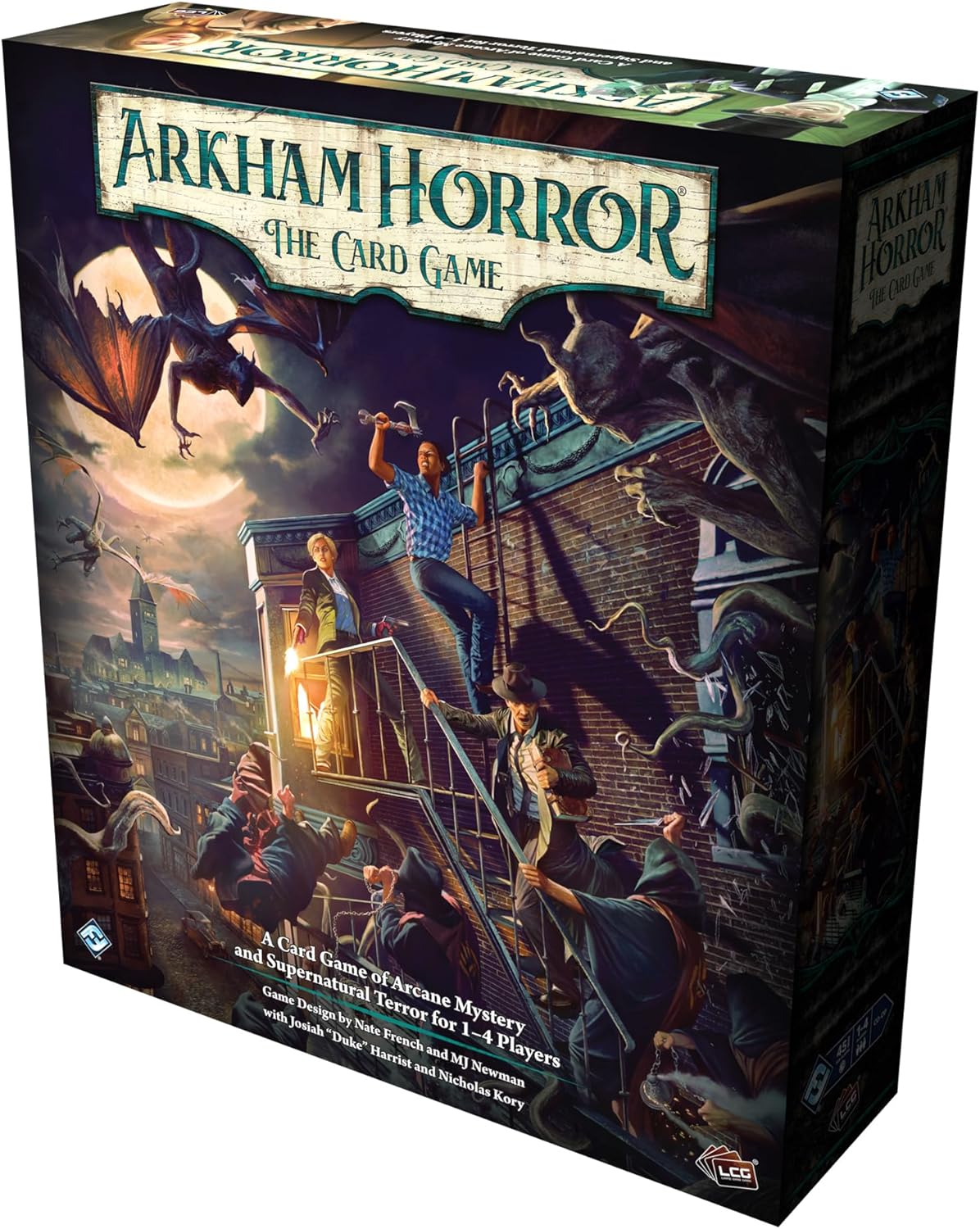
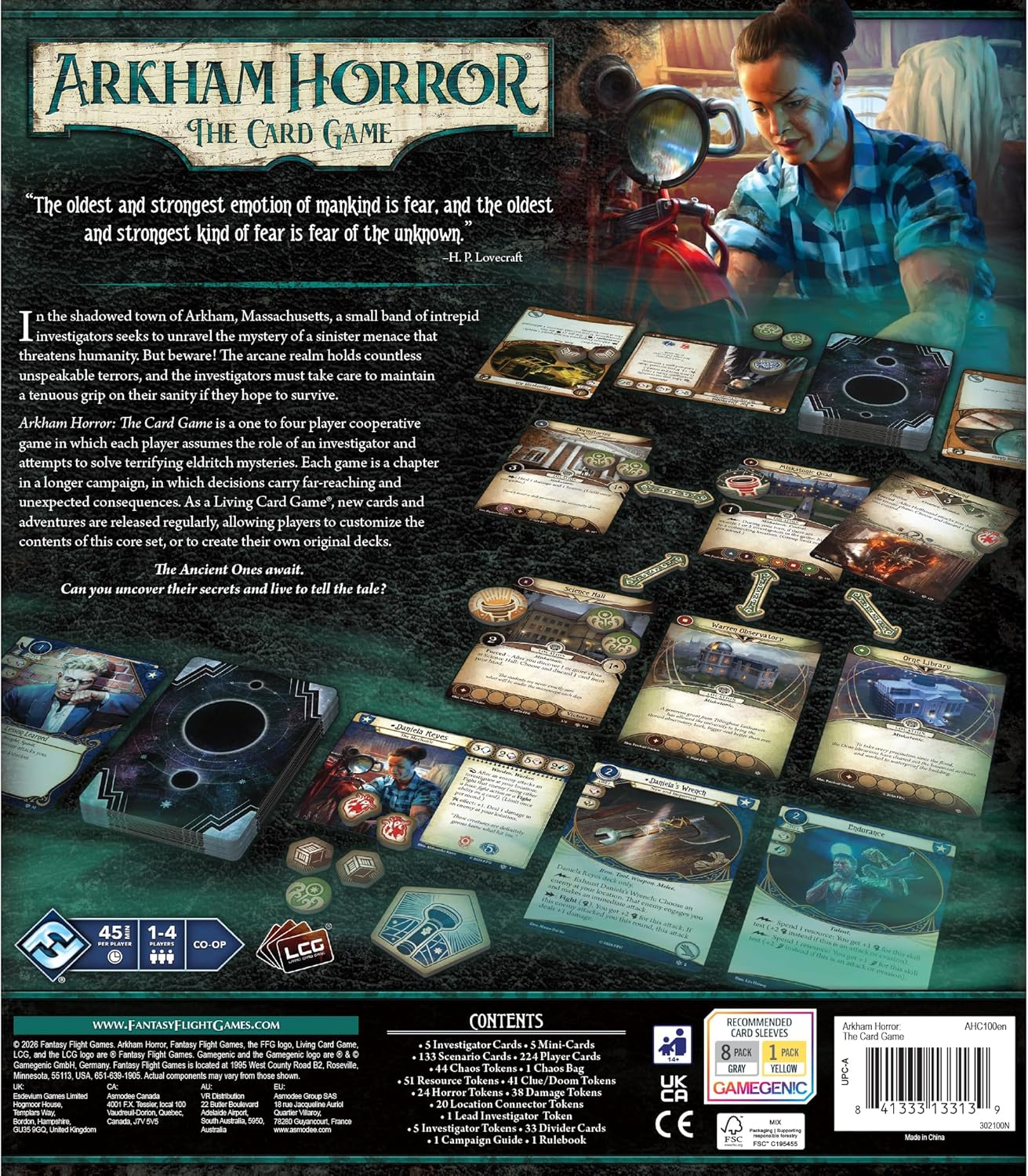
Arkham Horror: The Card Game Chapter Two Core Set
Required foundation for Brethren of Ash and future Chapter Two scenario dependencies.
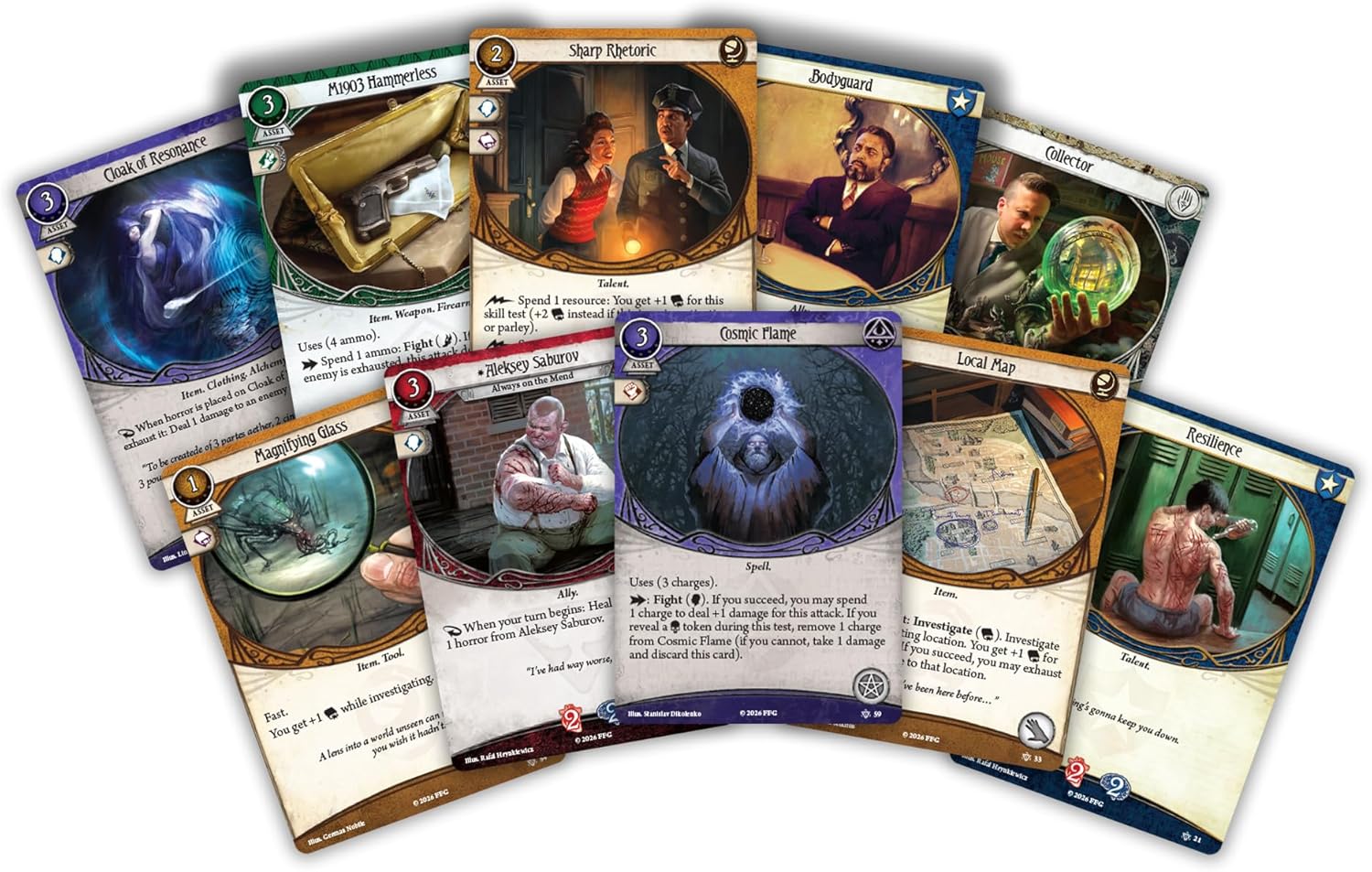
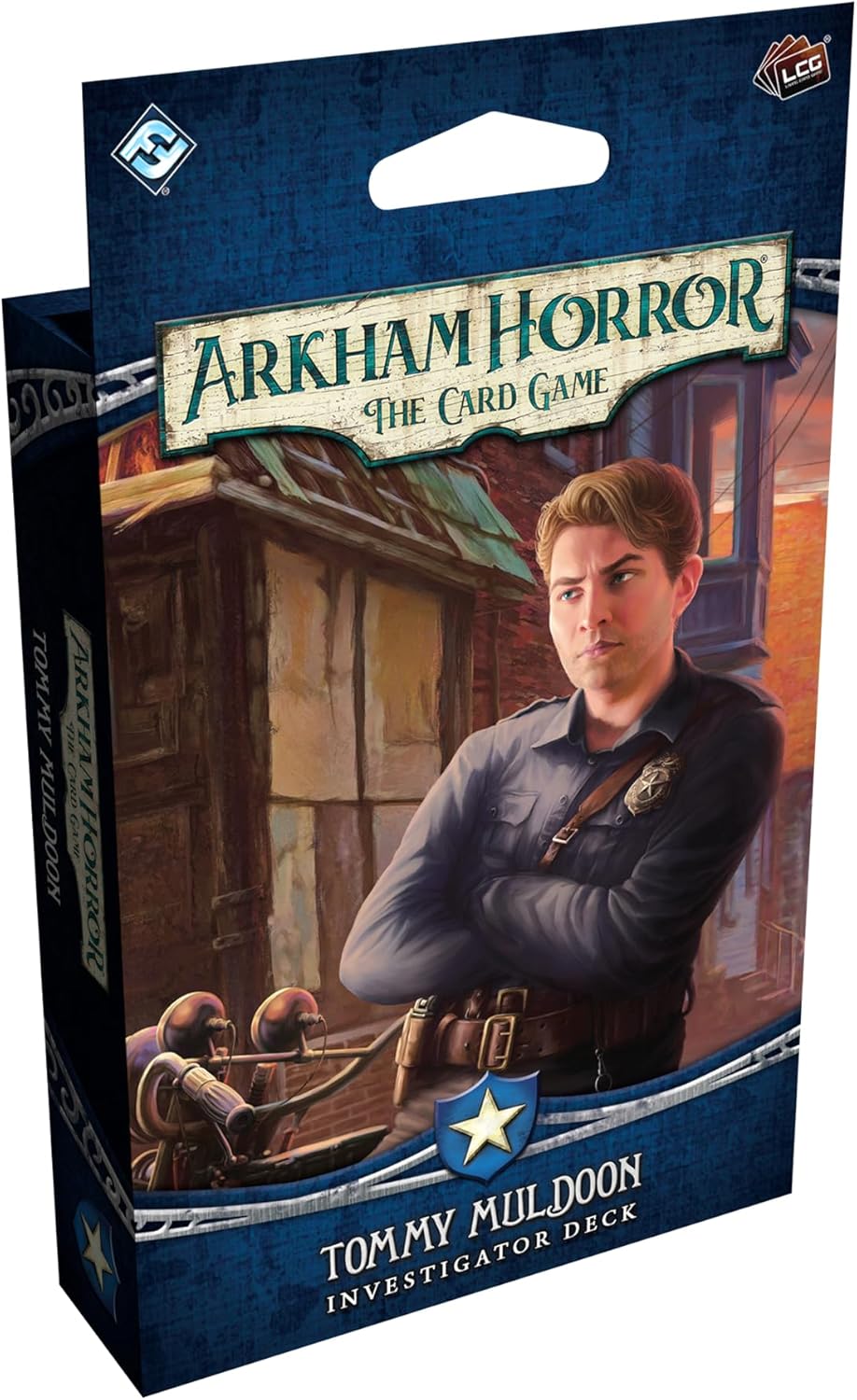
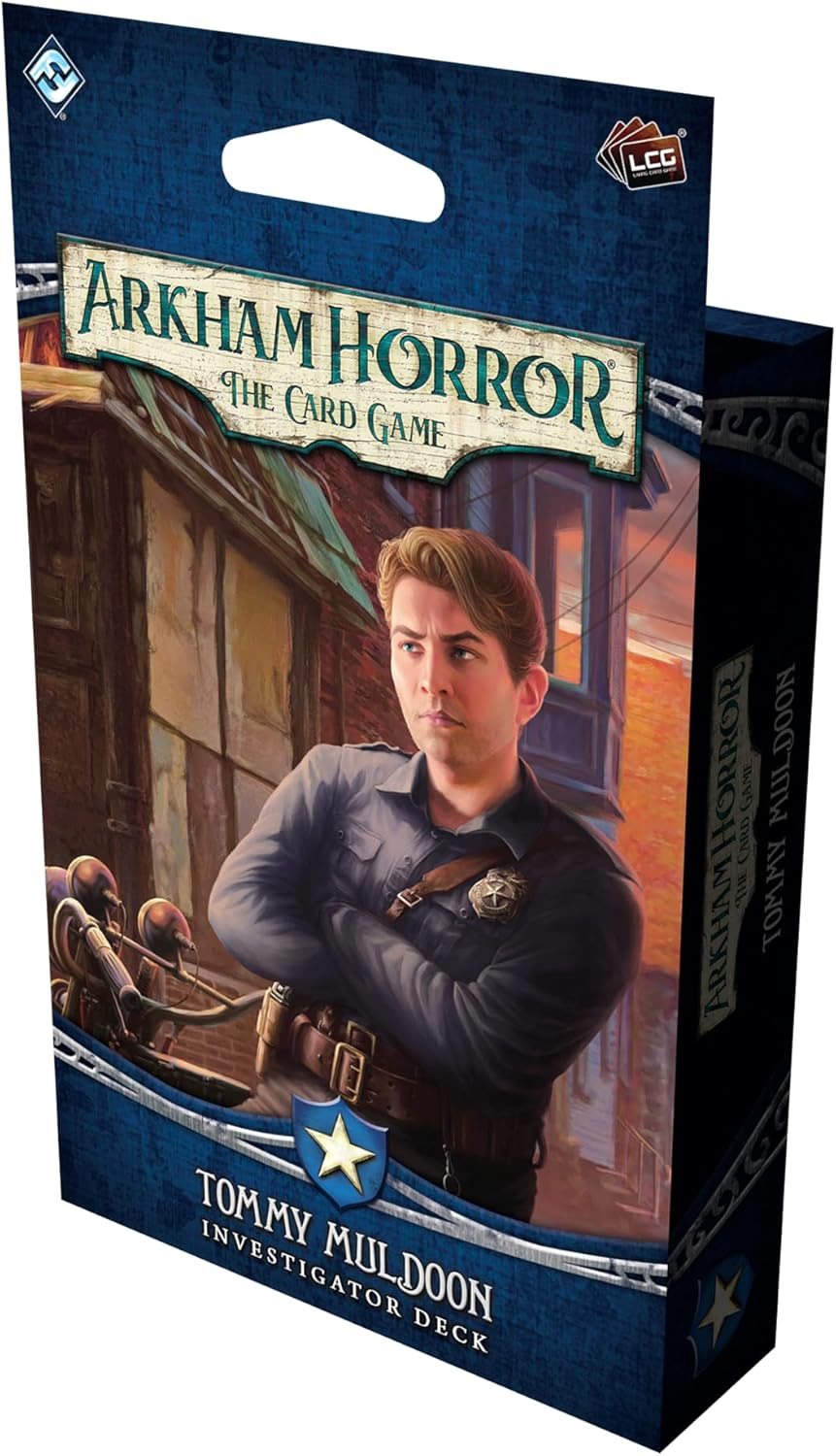
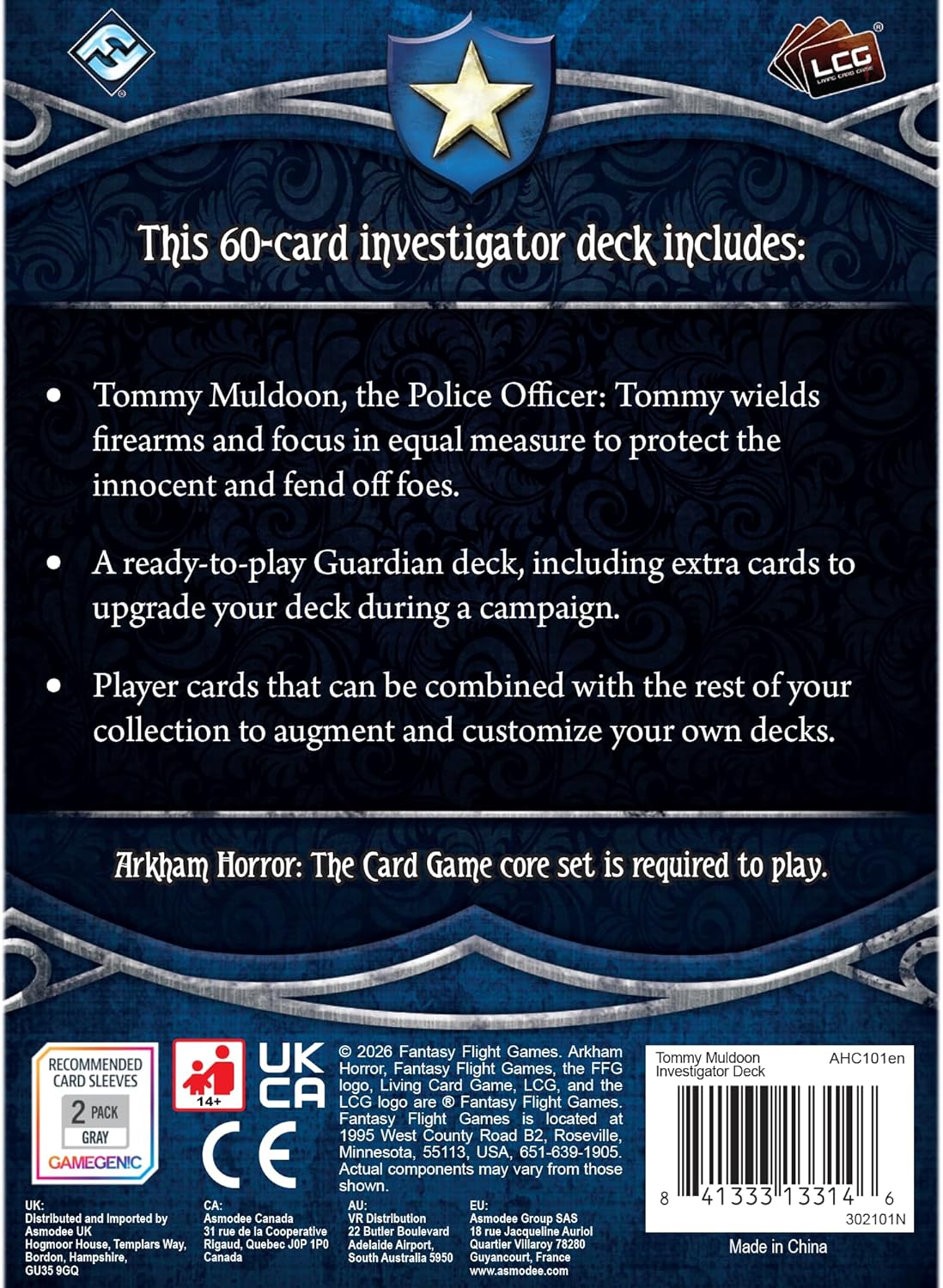
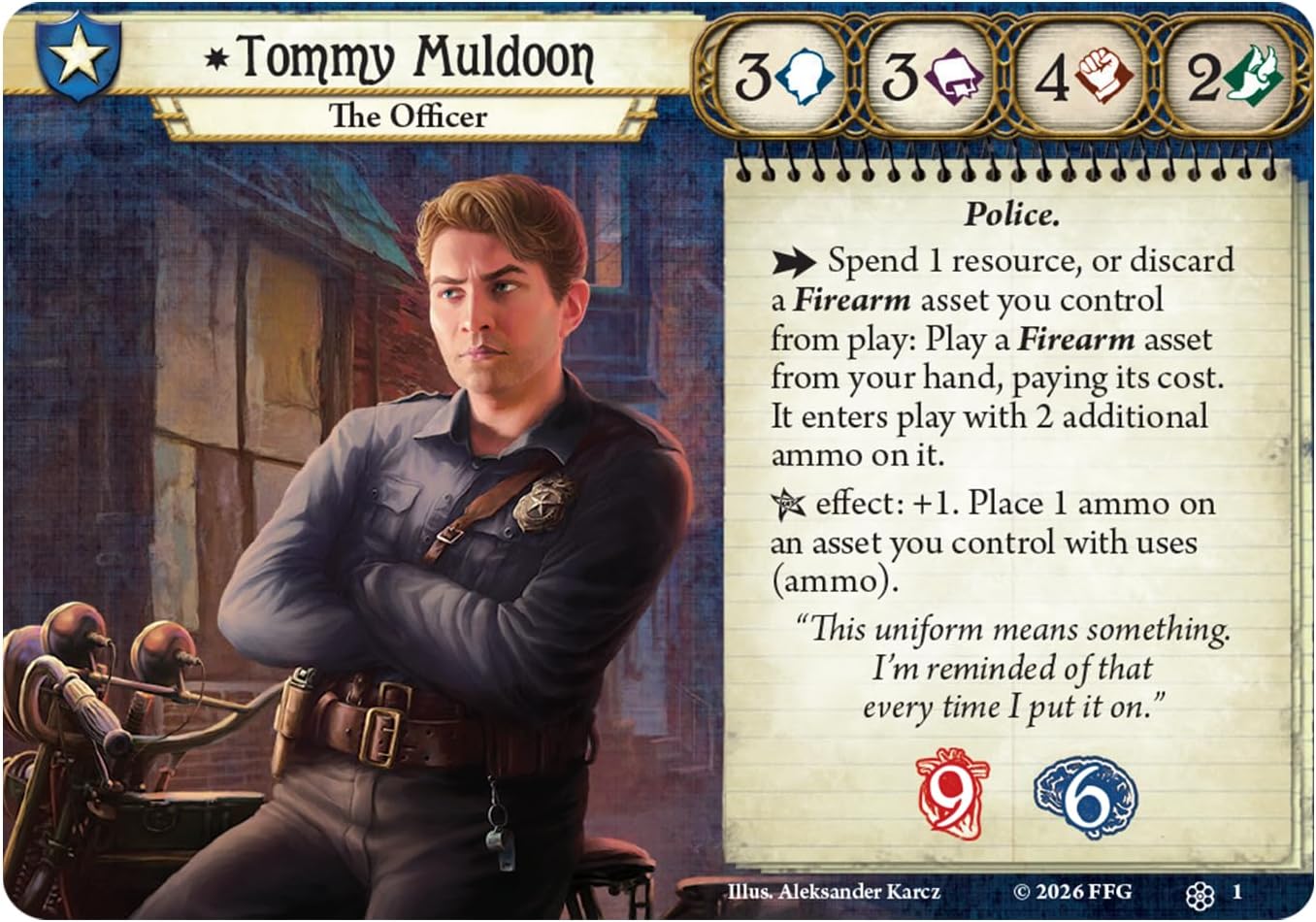
Tommy Muldoon Investigator Deck
A ready-to-play Guardian deck. Optional; a Core Set is required.
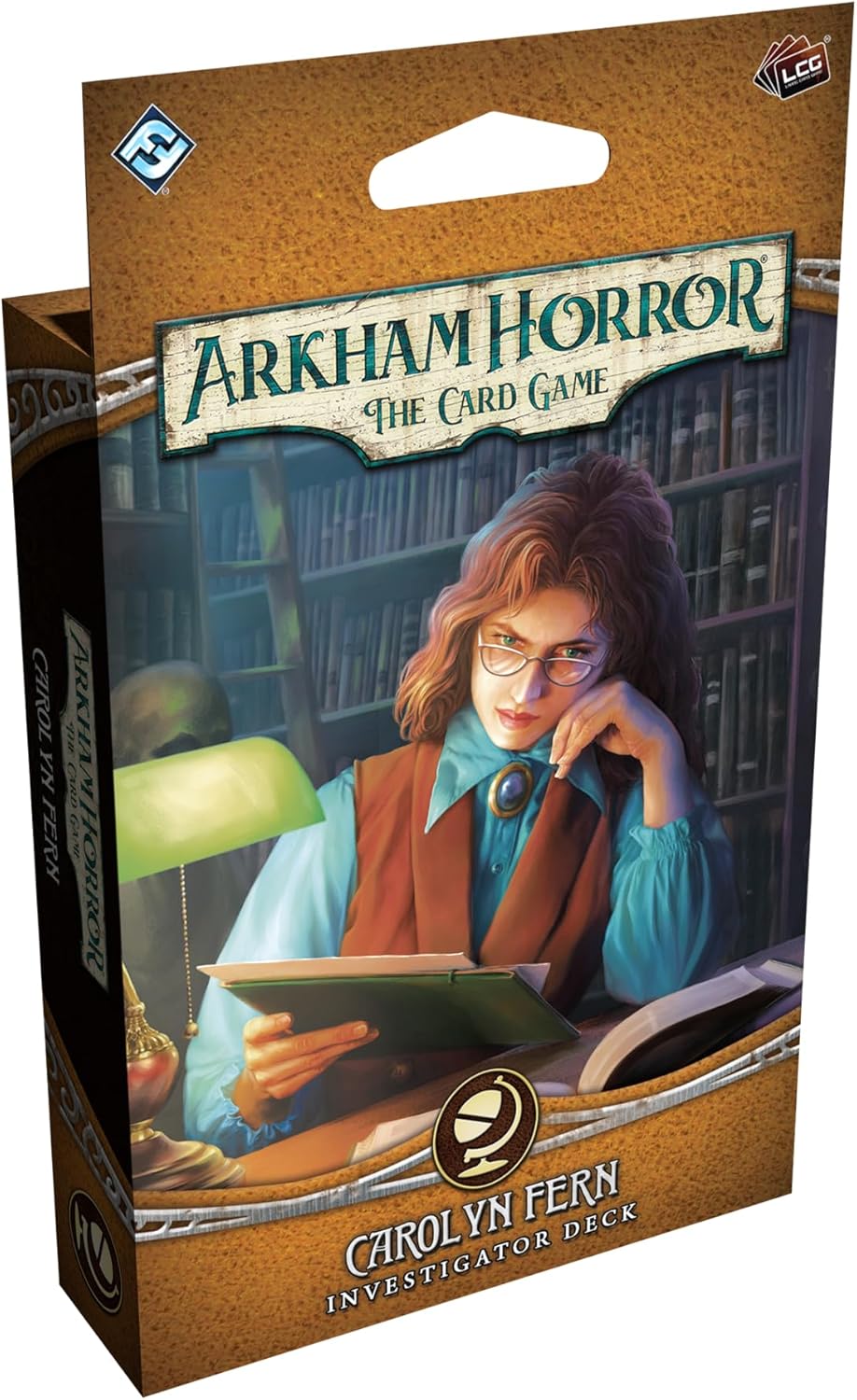
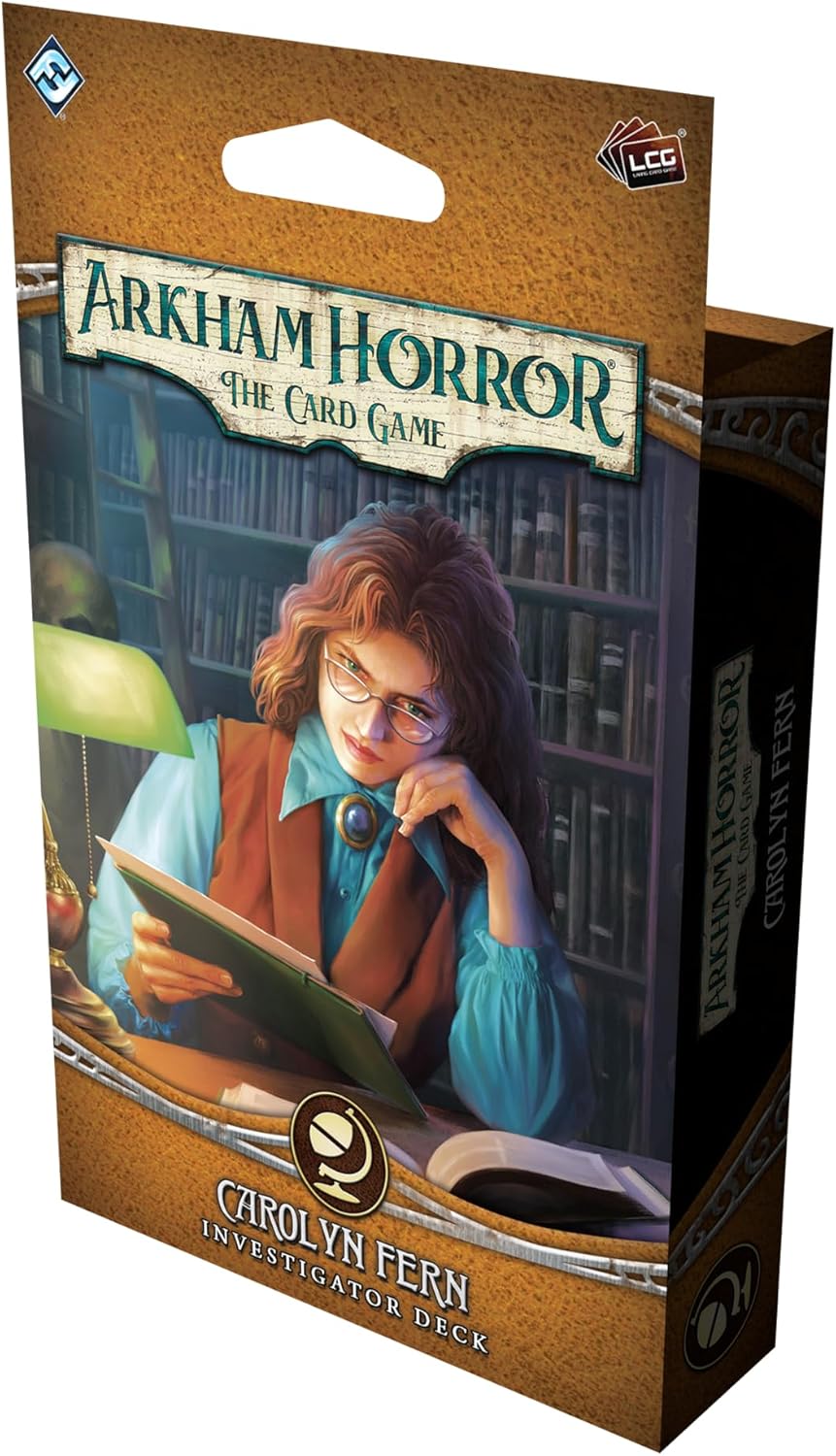
Carolyn Fern Investigator Deck
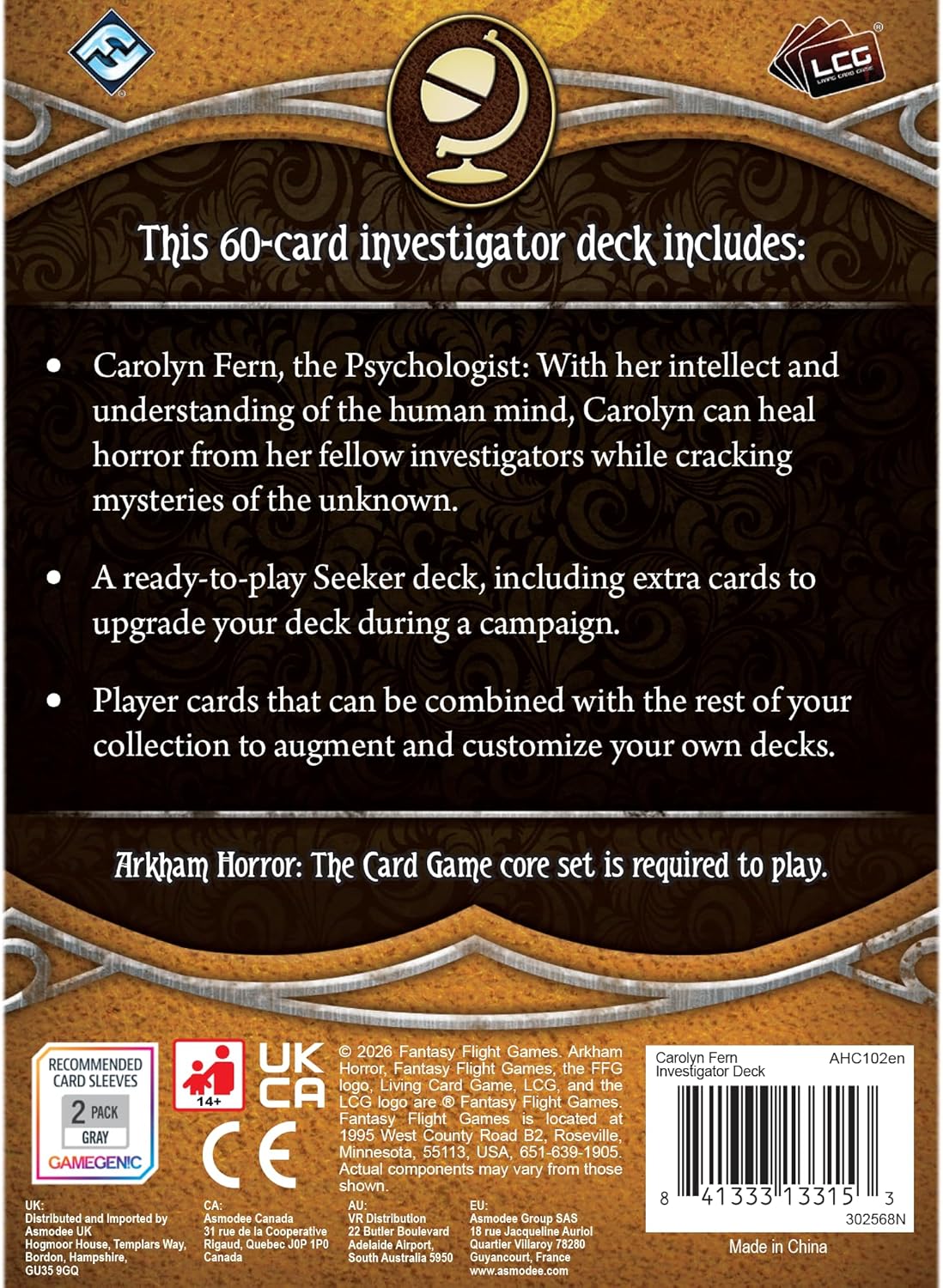
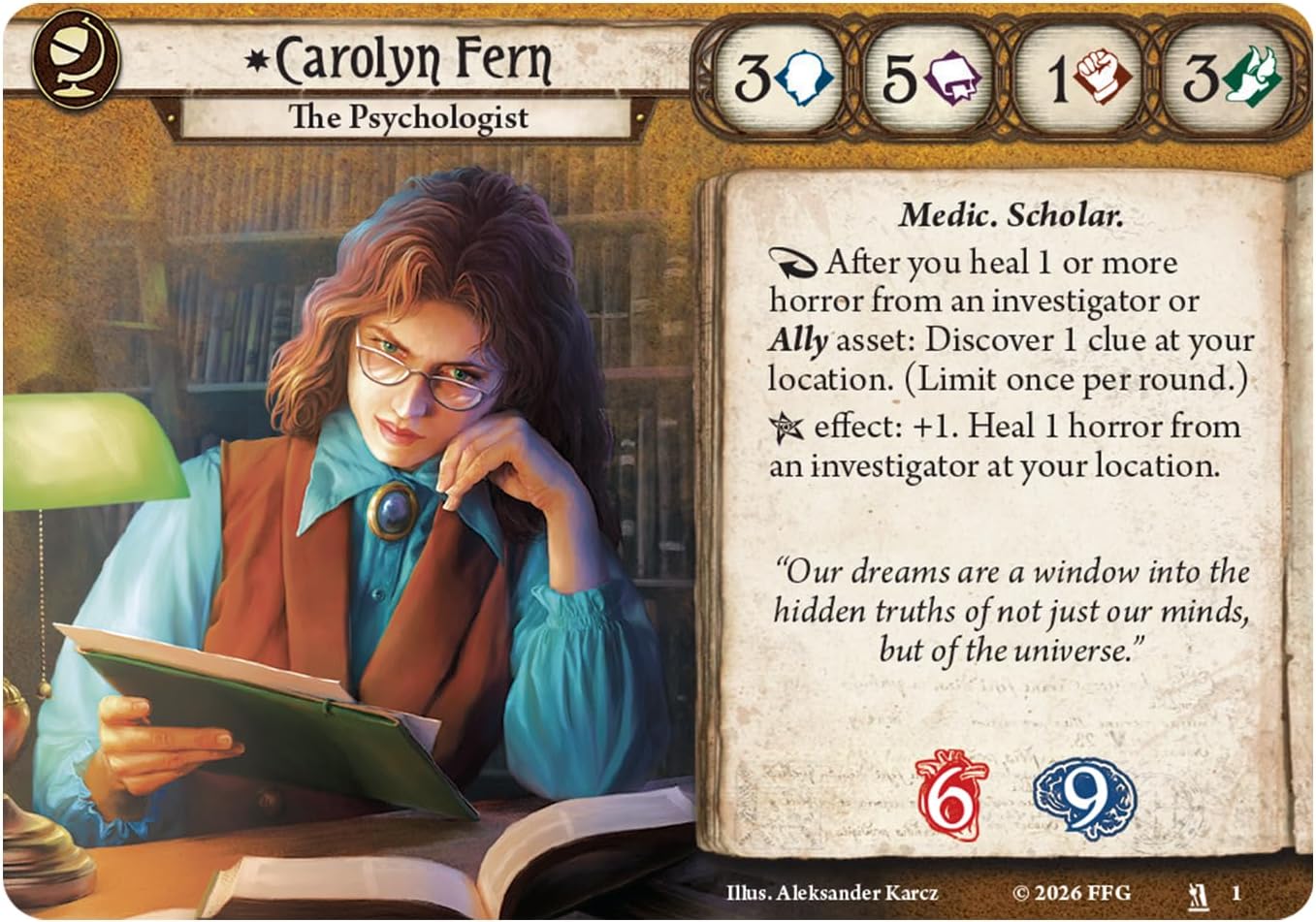
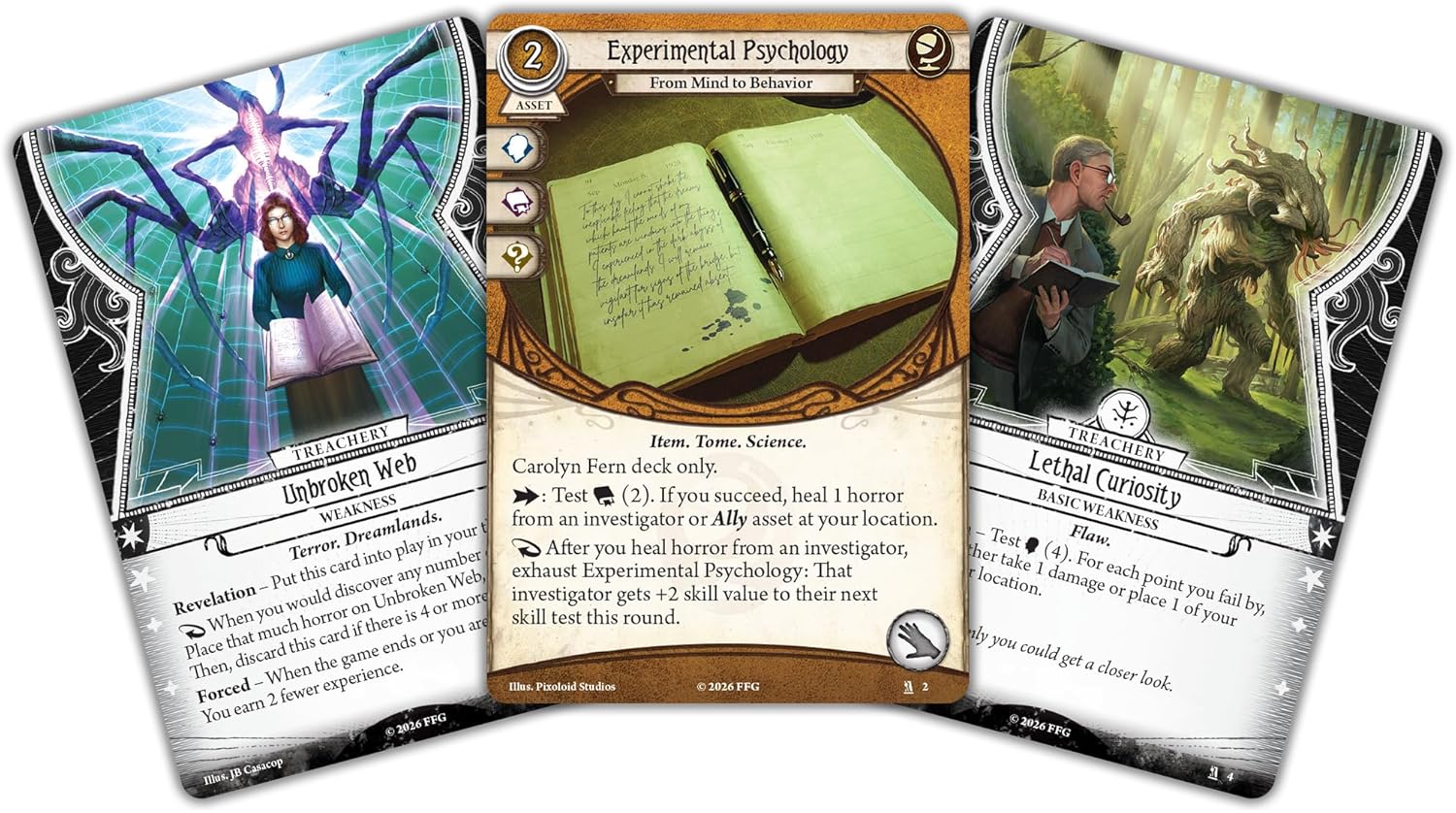
A ready-to-play Seeker deck. Optional; a Core Set is required.
André Patel Investigator Deck
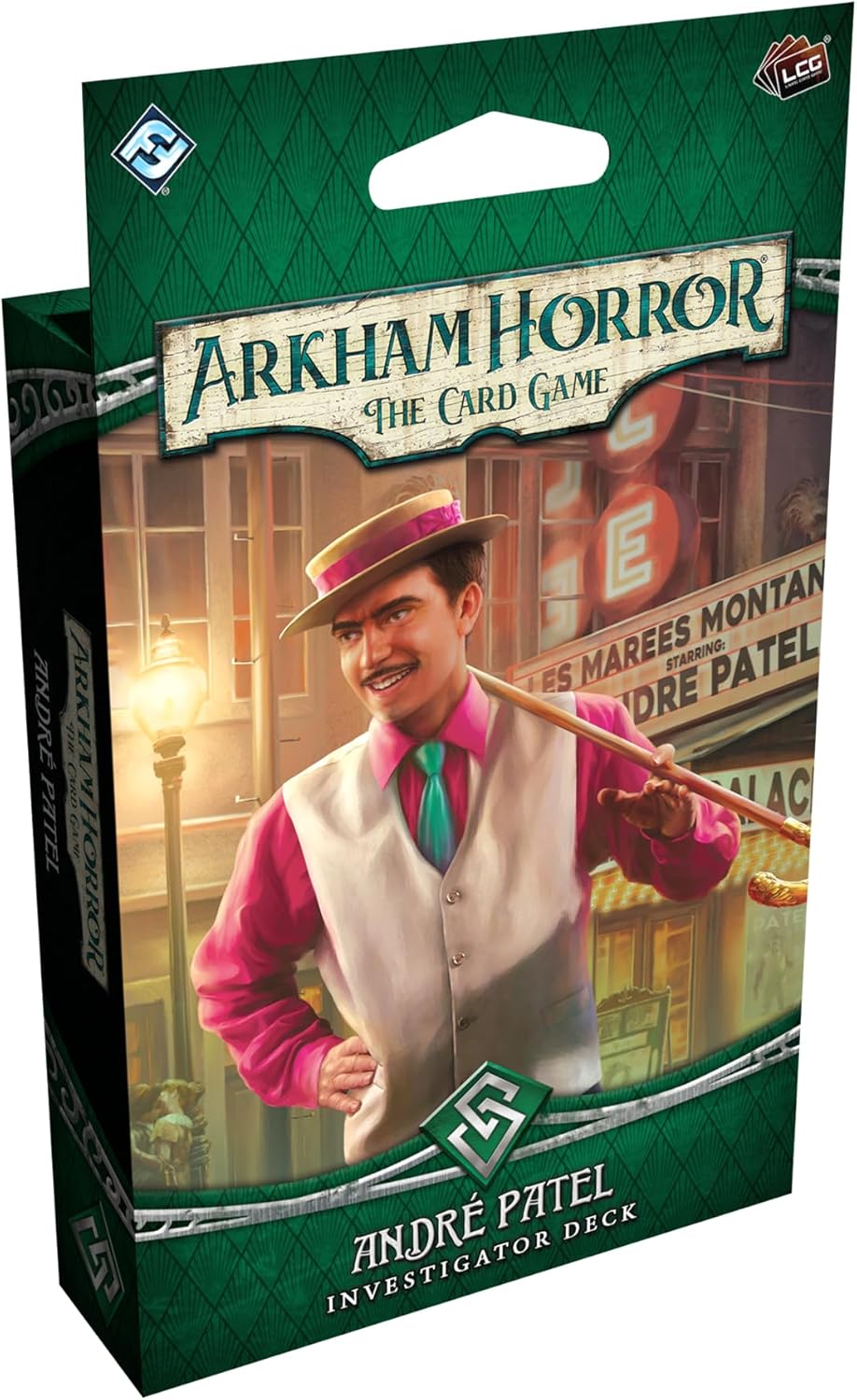
A ready-to-play Rogue deck. Optional; a Core Set is required.
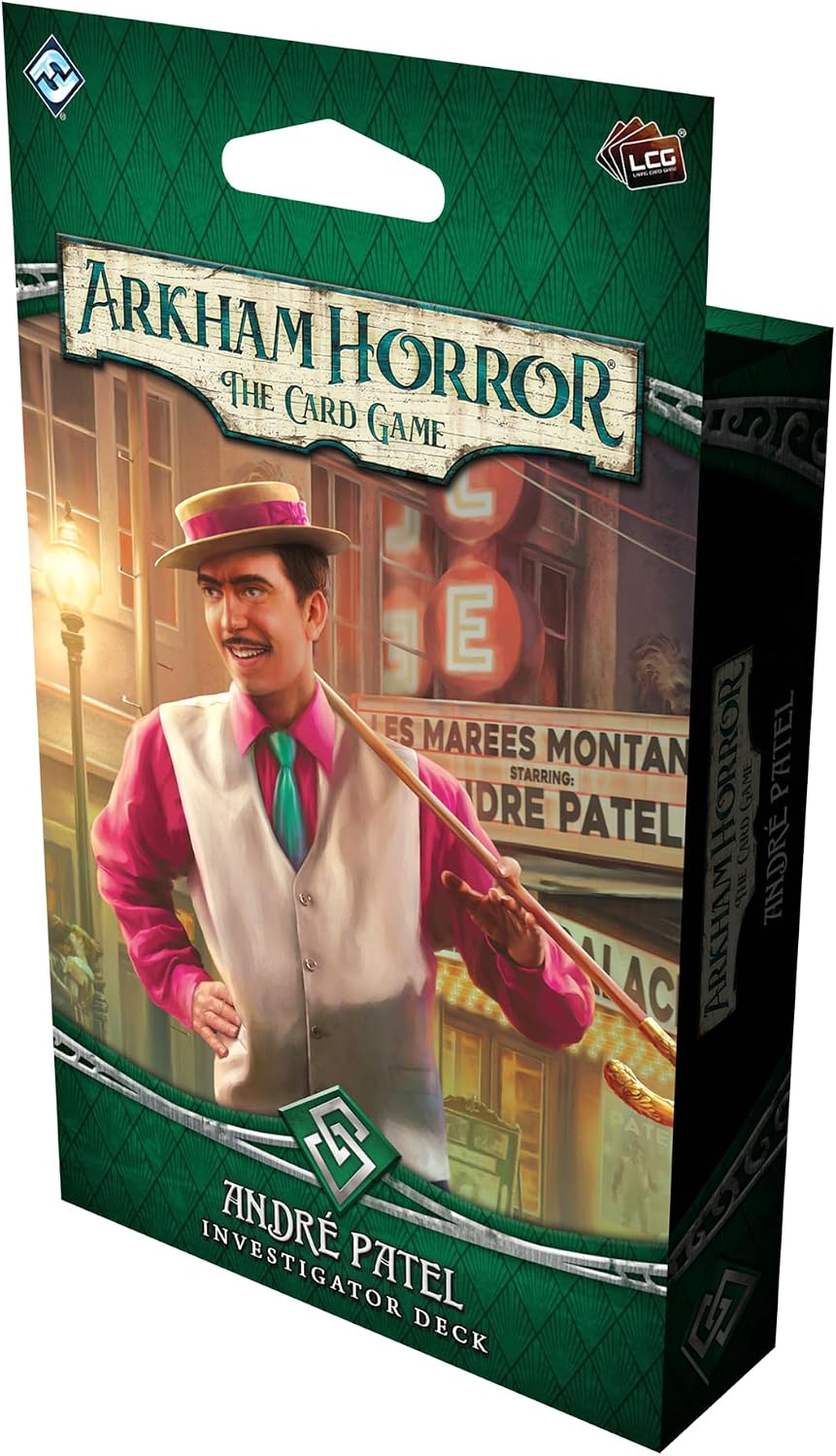
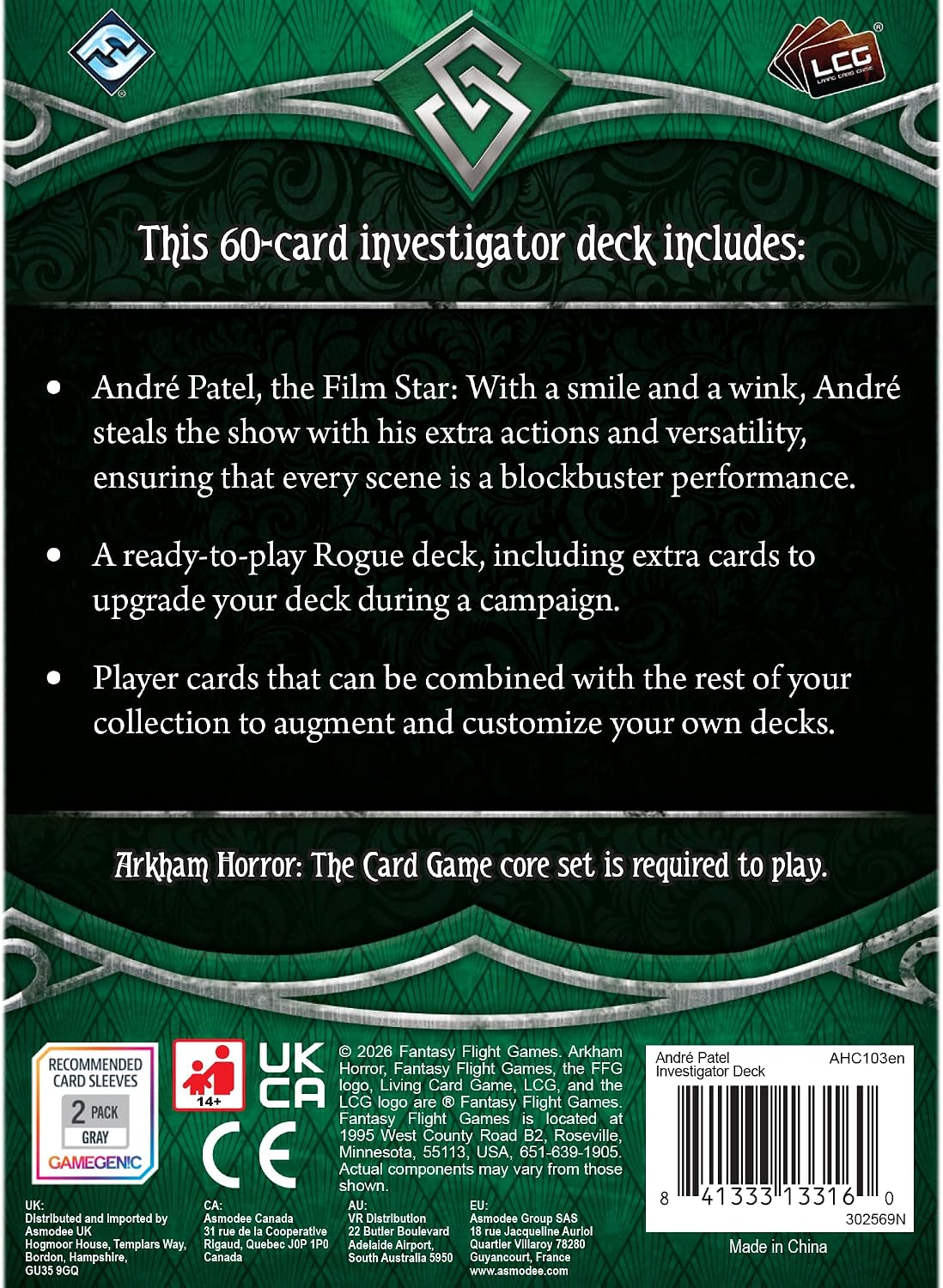
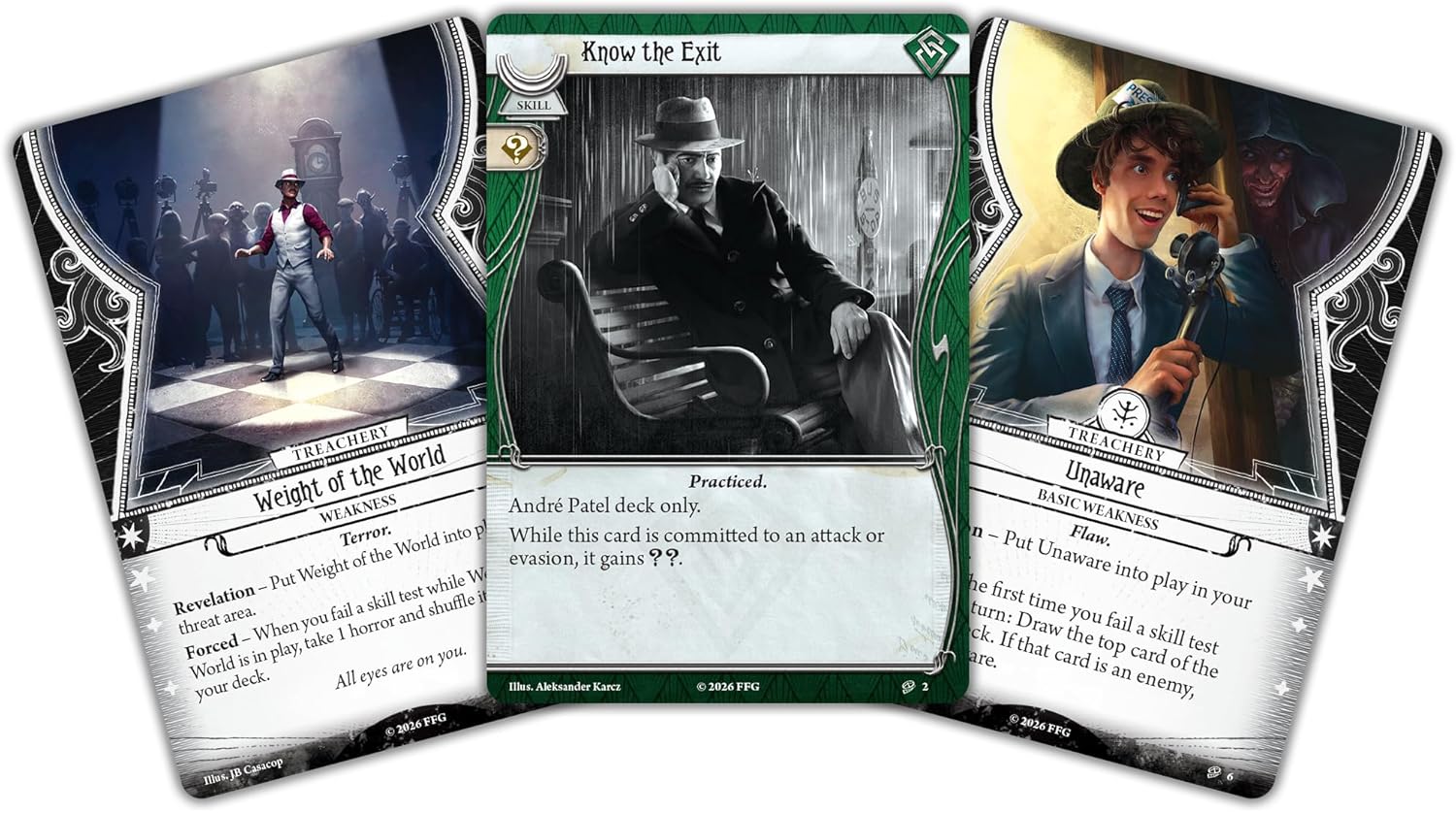
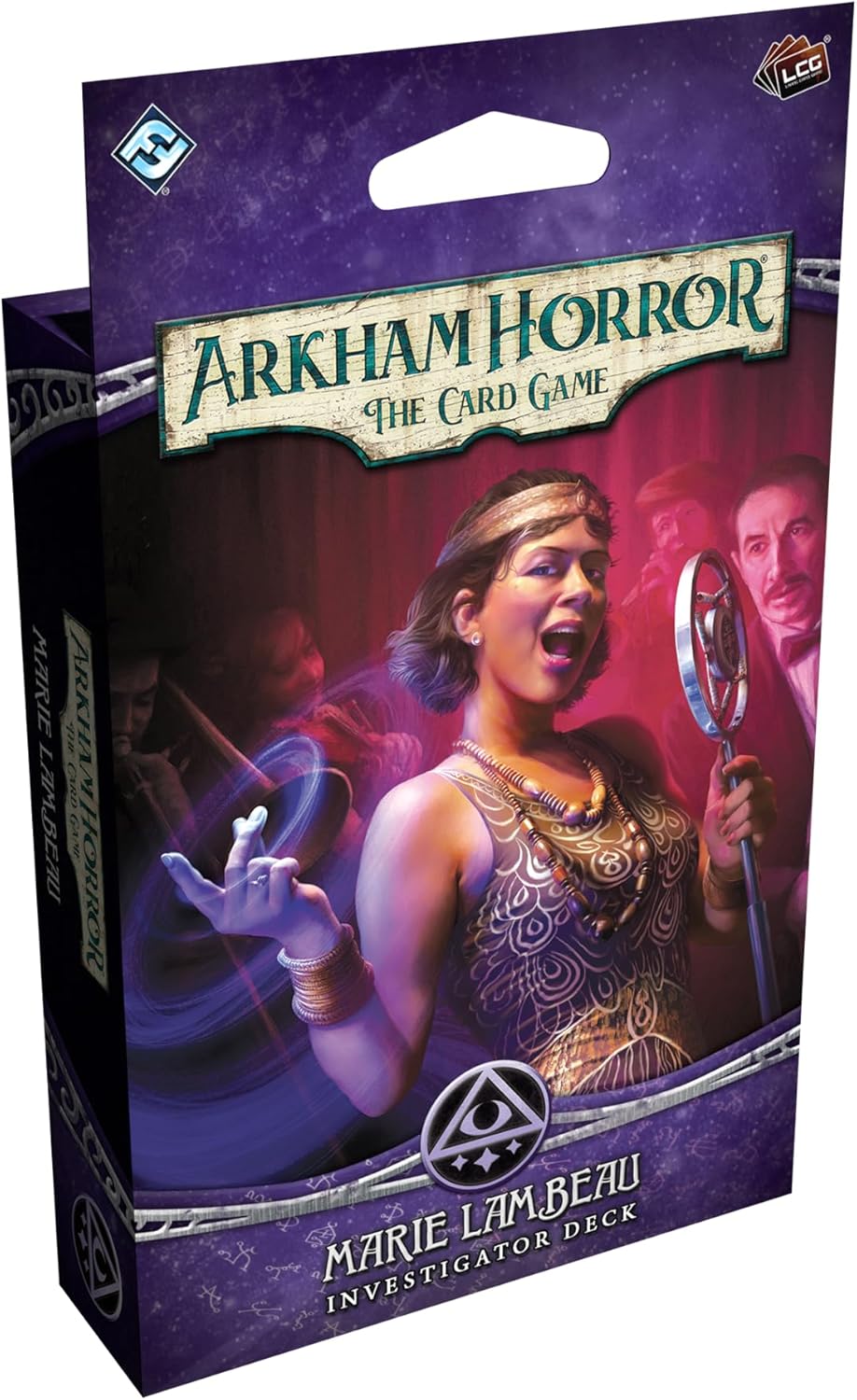
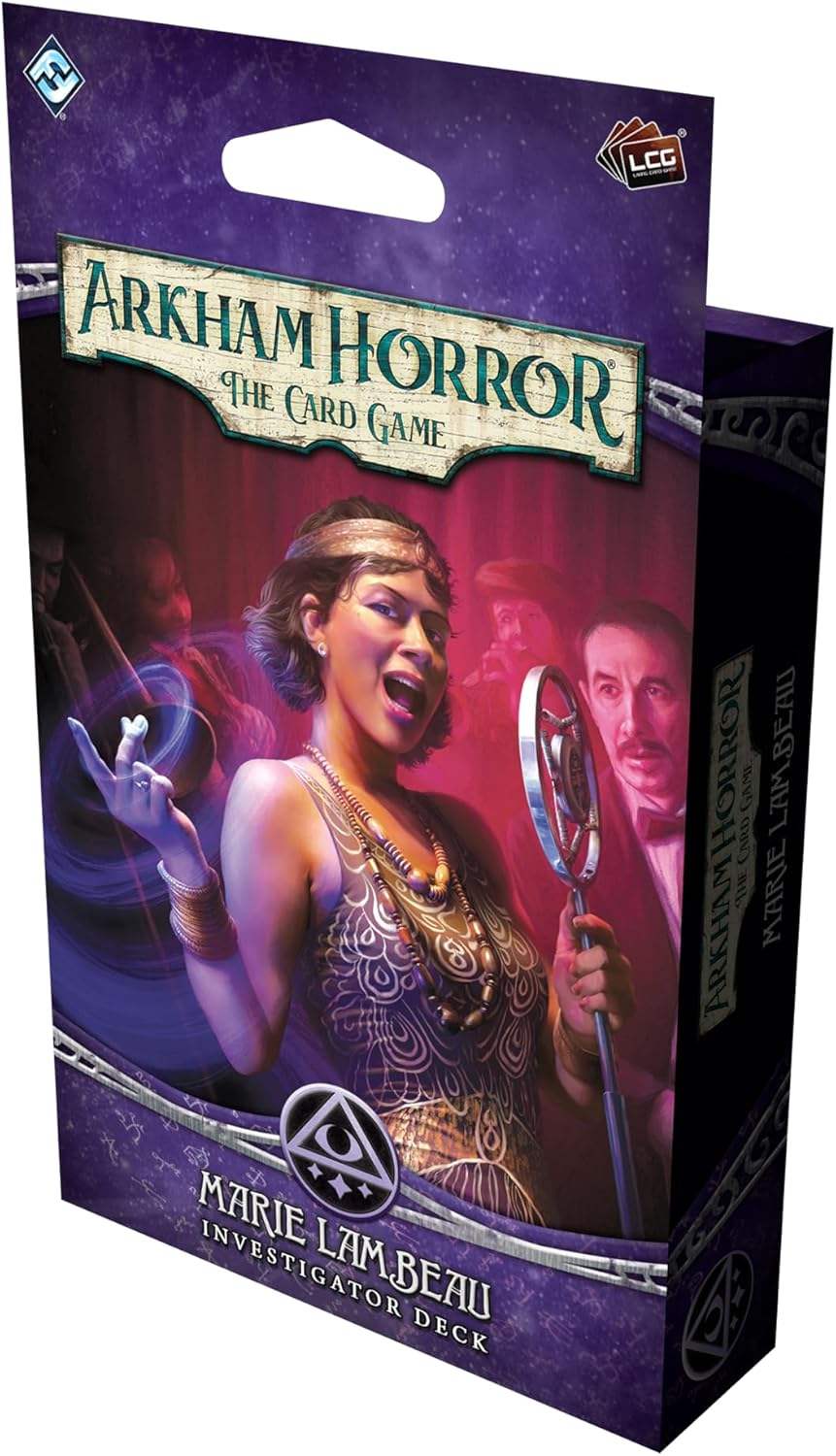
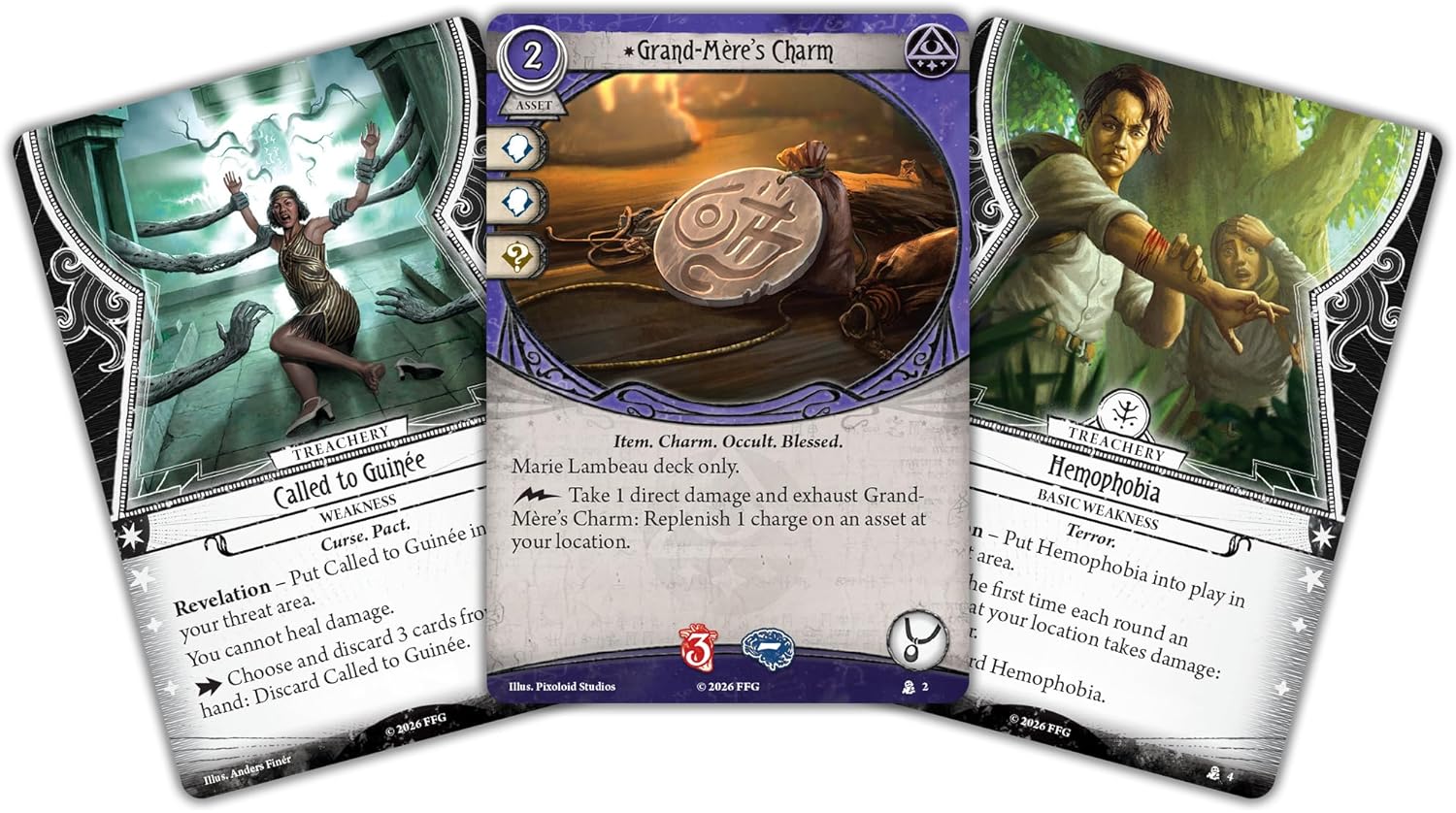
Marie Lambeau Investigator Deck
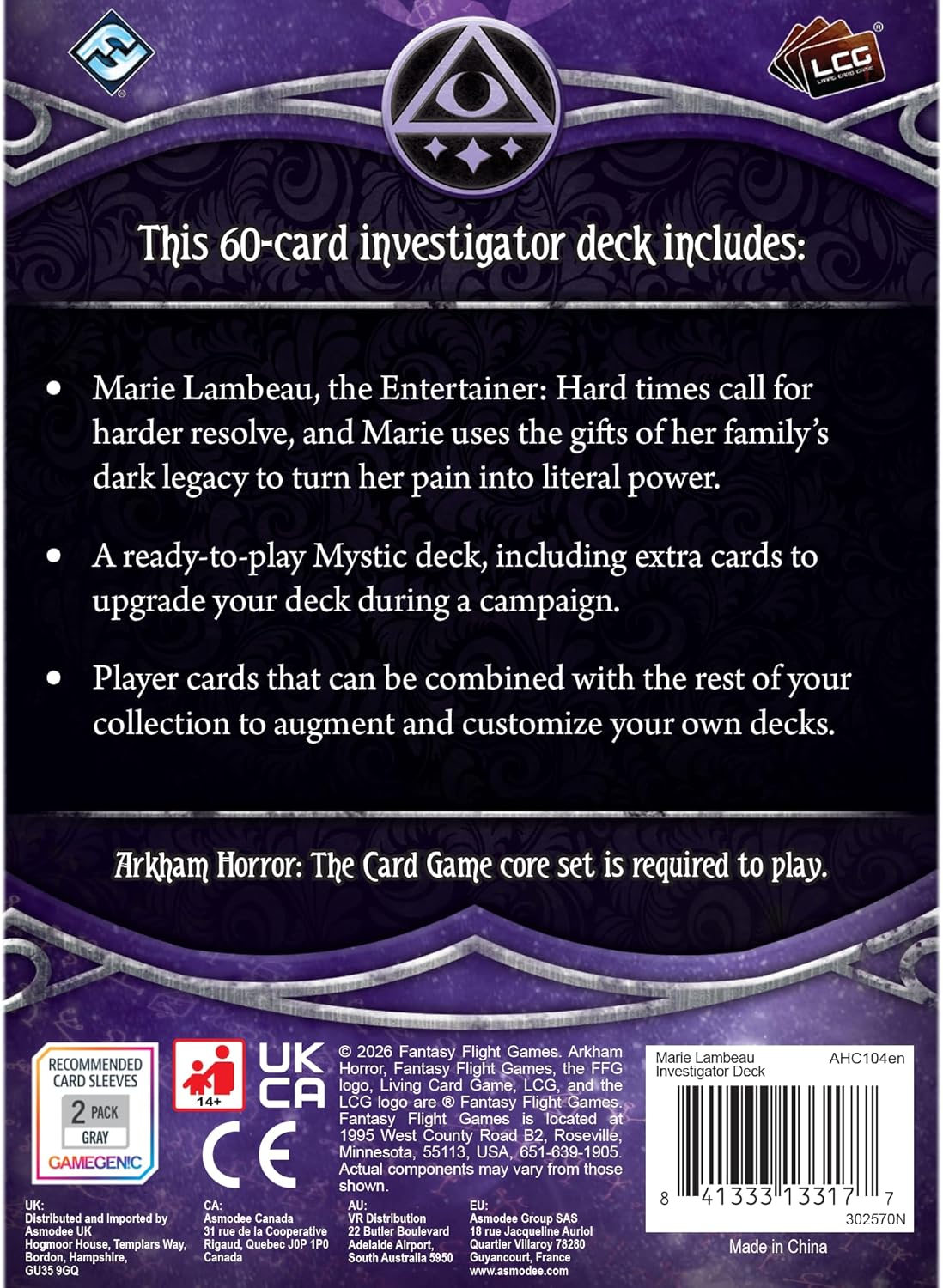
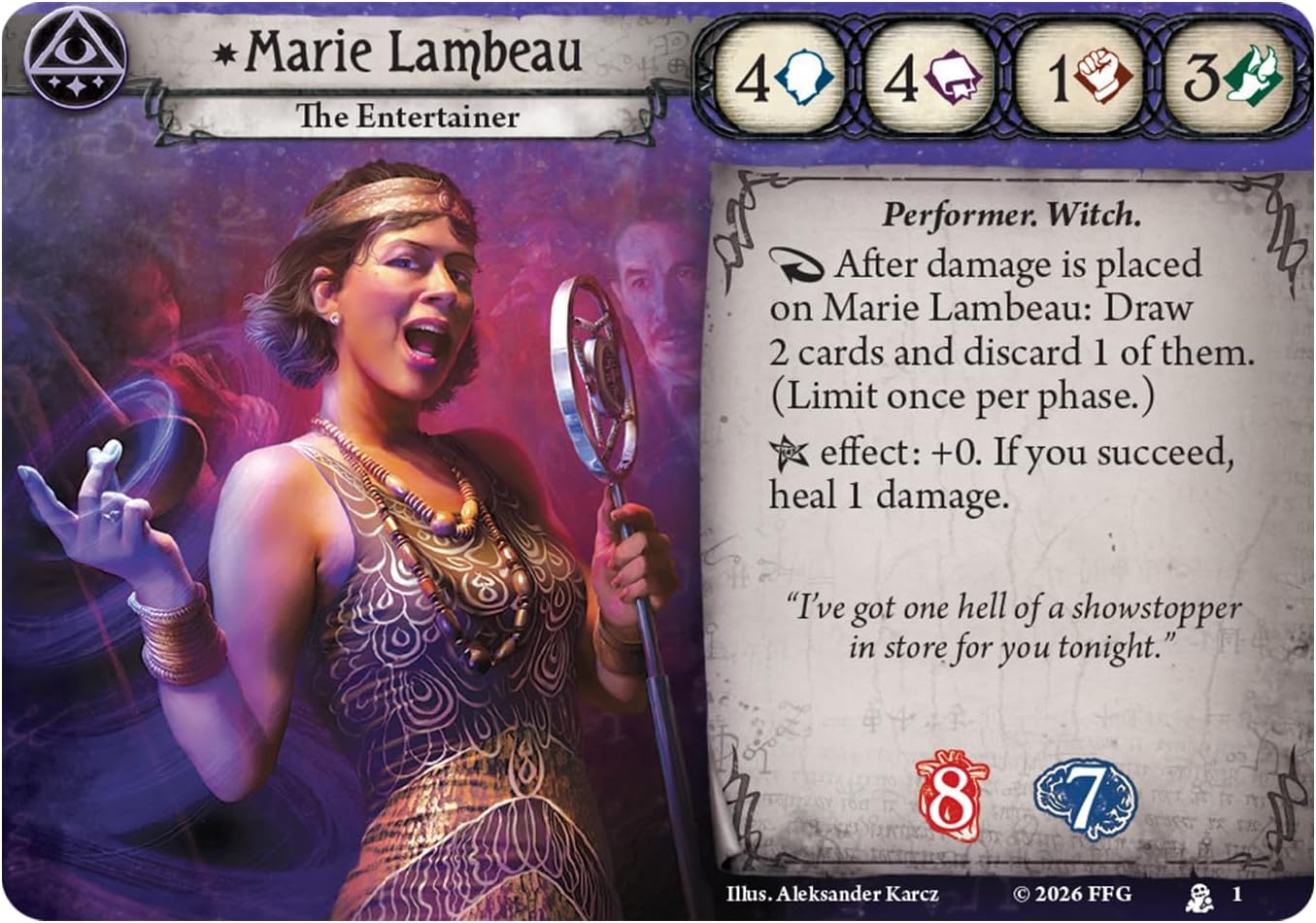
A ready-to-play Mystic deck. Optional; a Core Set is required.
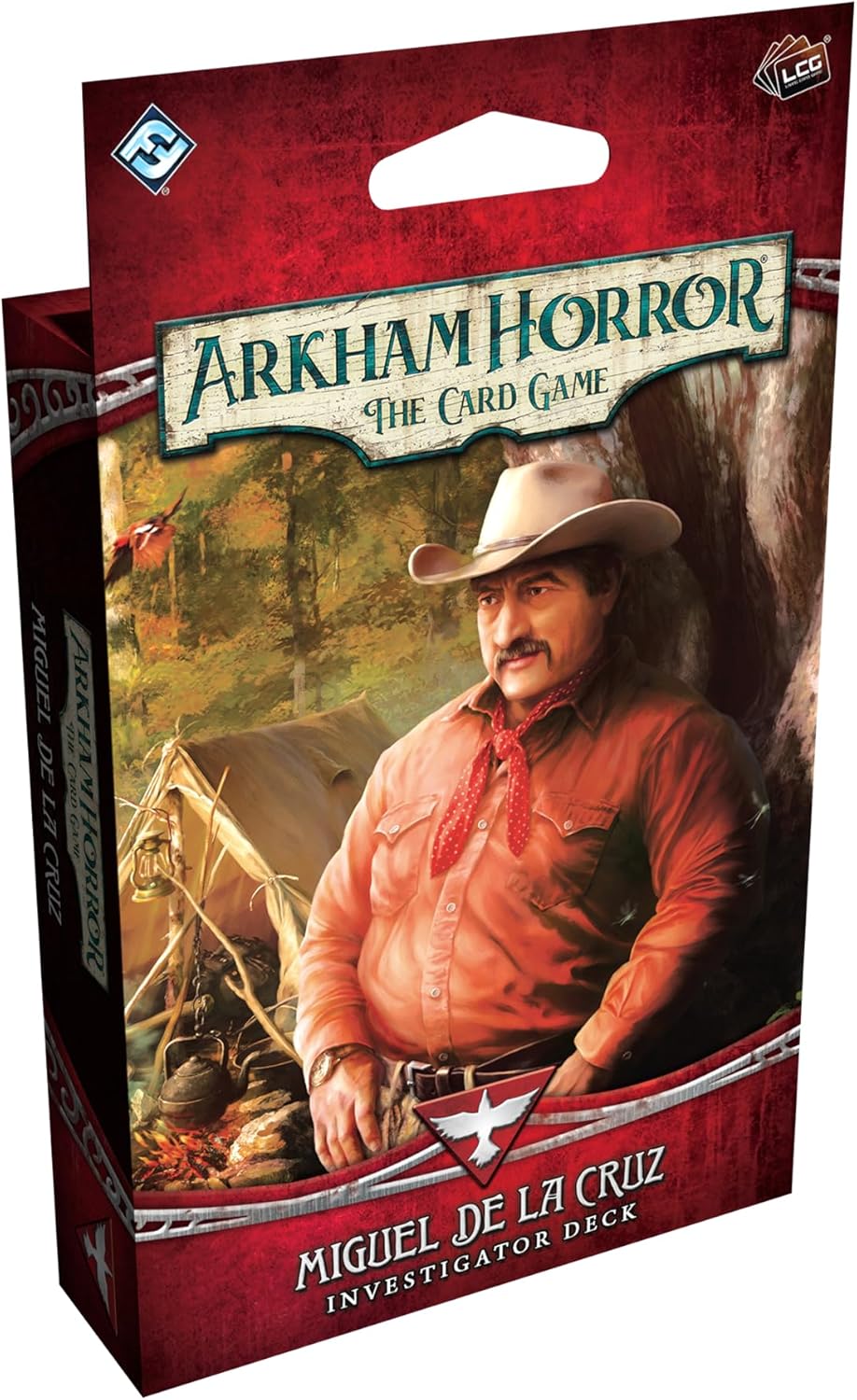
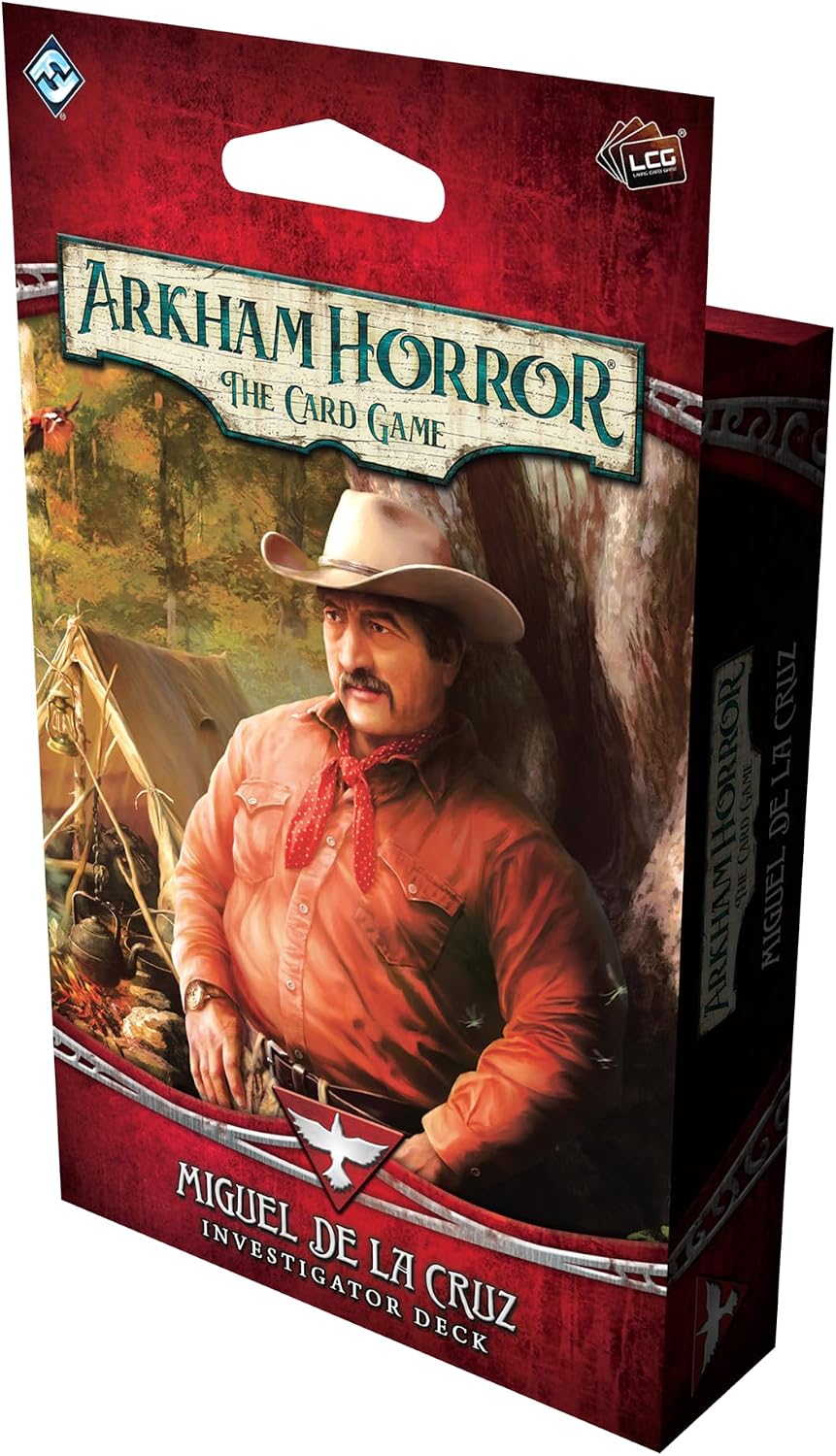
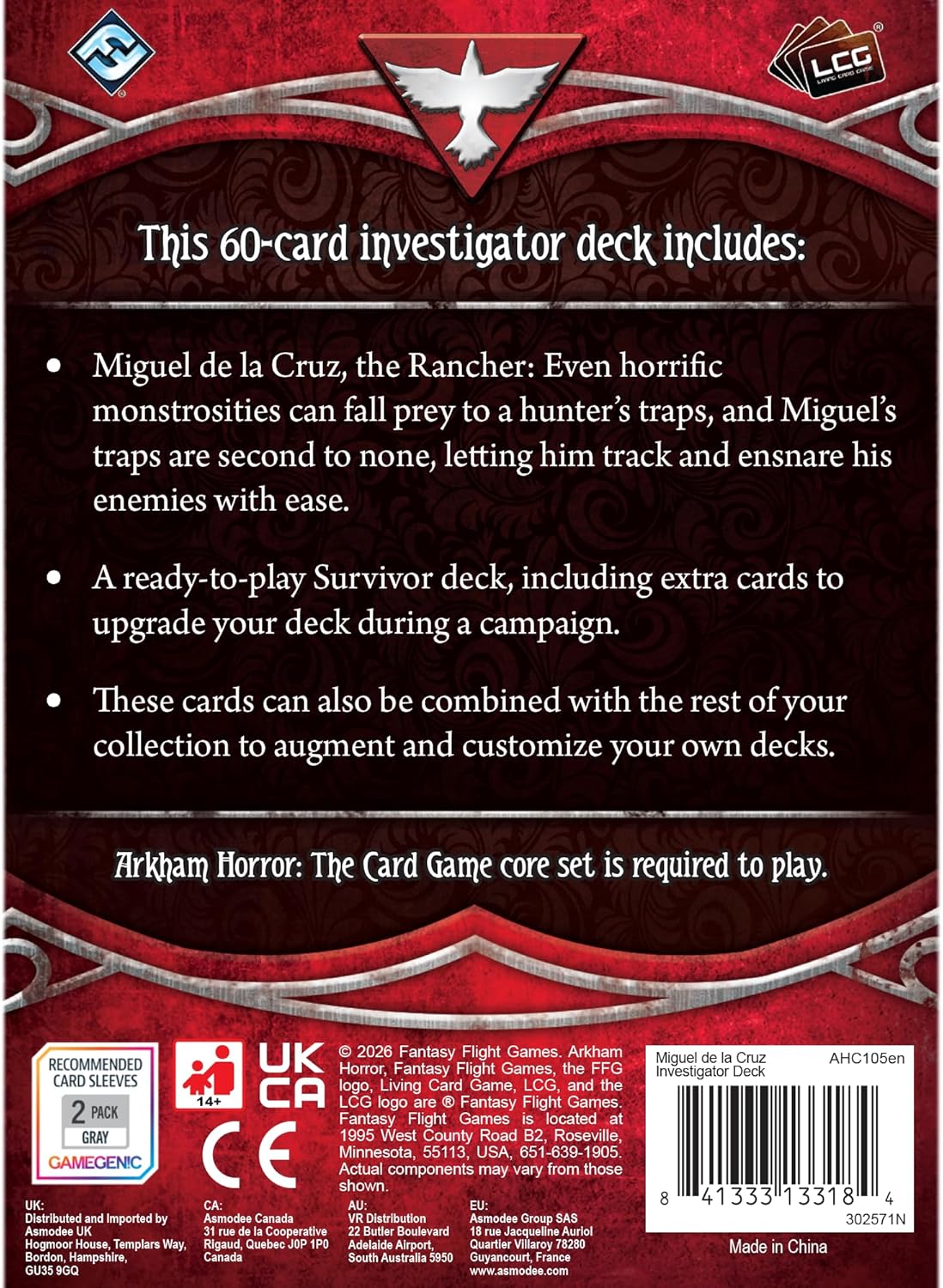
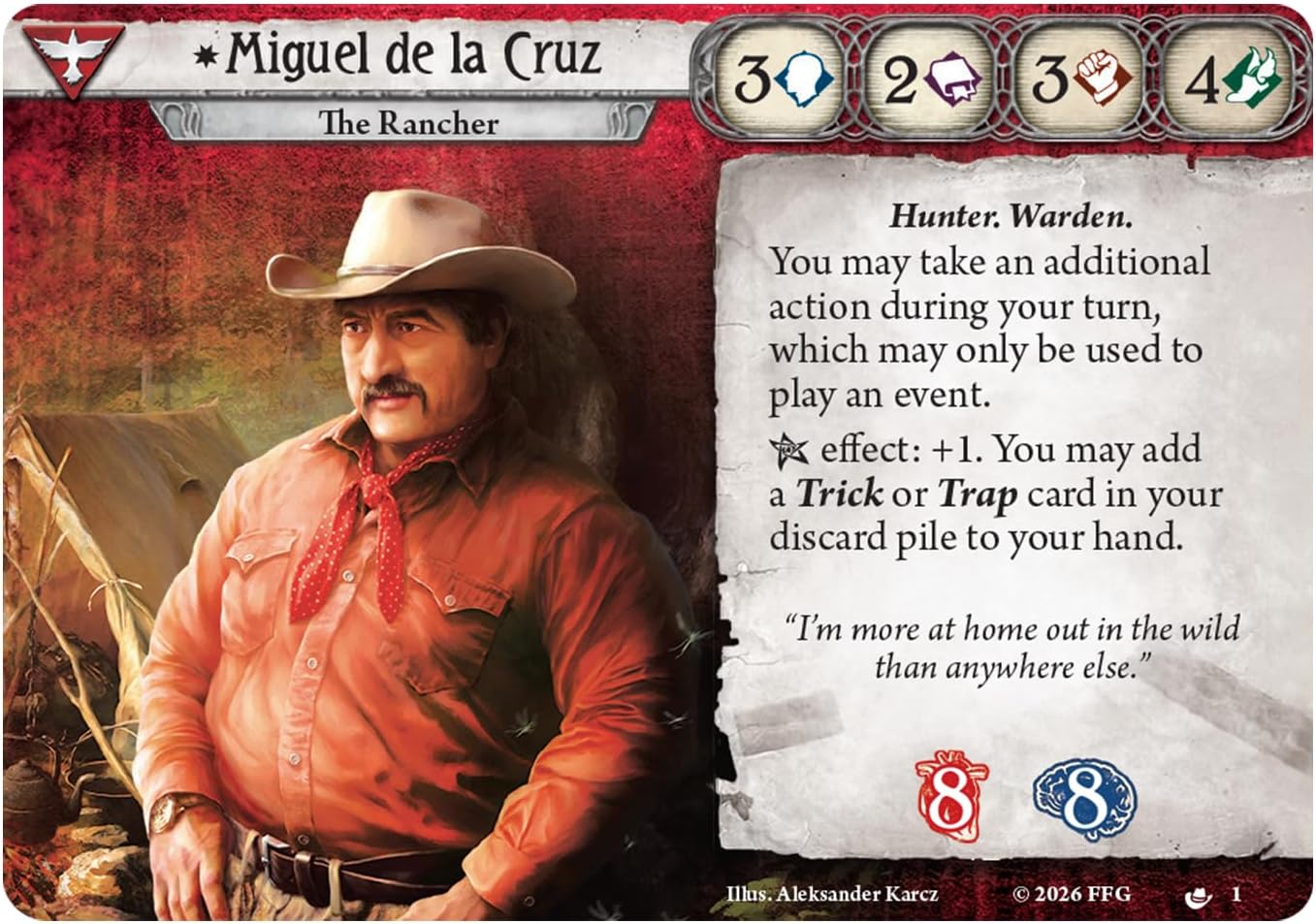
Miguel de la Cruz Investigator Deck
A ready-to-play Survivor deck. Optional; a Core Set is required.
Chapter 9
Five People Walk into the Dark
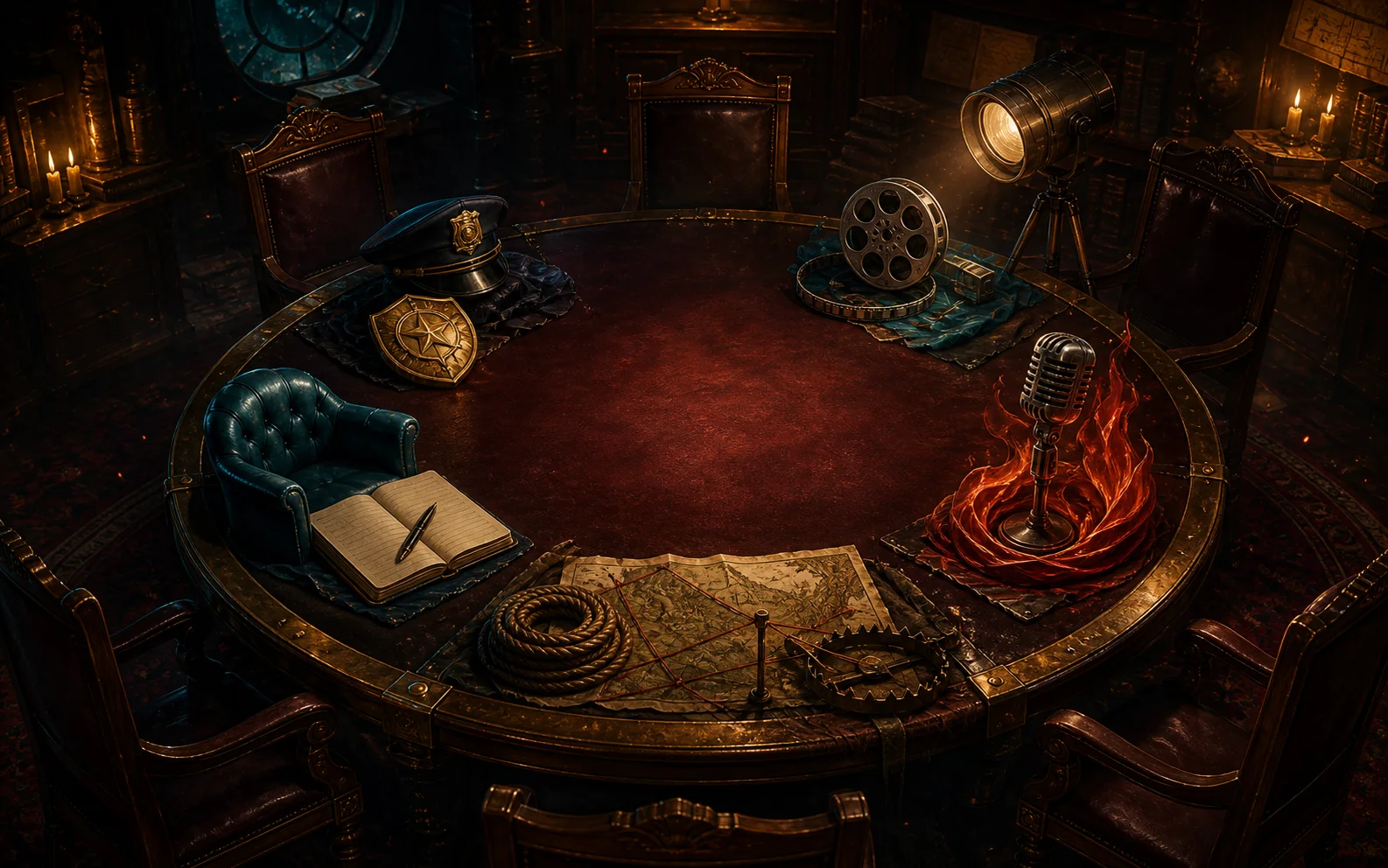
The five evergreen Chapter Two Investigator Decks introduce or revisit Tommy Muldoon, Carolyn Fern, André Patel, Marie Lambeau, and Miguel de la Cruz. They represent the game’s five classes: Guardian, Seeker, Rogue, Mystic, and Survivor.INVESTIGATING They are not the five investigators contained inside the Chapter Two Core Set itself. Those core investigators are Daniela Reyes, Joe Diamond, Trish Scarborough, Dexter Drake, and Isabelle Barnes.INDEX The five people examined here are the investigators from the separate Chapter Two evergreen decks—the five you have chosen to bring into your collection.
Their value as a group is not simply mechanical coverage. Together, they form five philosophies of confronting the unknown.
Tommy Muldoon — The Officer
Tommy once believed monsters were inventions. Then the Boston Police Department loaned him to Arkham.
Nearly a year later, he remains the new officer in the department, but he has already seen more impossible things than many veterans. He struggles to prove he is not a laughingstock while discovering that some of Arkham’s worst monsters look entirely human.INVESTIGATING Tommy represents institutional courage.
He believes in procedure, evidence, protection, responsibility, and the practical value of being prepared. Yet Arkham repeatedly places him in situations where official procedure is inadequate. What does a police officer write in a report when the truth cannot survive the wording?
What does he tell a superior who has already decided the explanation must be ordinary? What happens when the department cares more about avoiding embarrassment than protecting the public?
Tommy’s conflict is not merely man versus monster. It is duty versus credibility.
He wants to serve the institution without allowing the institution’s limitations to prevent him from serving people.
The Man Behind the Badge
The badge represents legitimate authority. It opens doors.
It can also become a burden. Citizens expect Tommy to remain calm. Partners expect him to follow orders. Superiors expect reports that fit recognizable categories.
Every supernatural encounter threatens two things: His life.
His reputation. An ordinary witness can flee and tell the story later.
Tommy knows the story will be attached to his professional identity. This may explain why he relies upon action. When language becomes impossible, protection remains concrete.
Move the civilian. Secure the room.
Stop the attacker. Cover the exit.
Ask questions after everyone is alive.
His Form of Courage
Tommy’s courage is not fearlessness. It is responsibility under ridicule.
He acts knowing that success may produce no recognition. If he prevents a catastrophe, the official report may call it an electrical failure, gang incident, or structural accident. The public may never know.
The department may never believe. That does not release him from duty.
Tommy asks: What must be done now?
In a campaign involving suspicious fires, missing people, robed figures, and a city desperate to maintain the appearance of recovery, that question is invaluable.
Carolyn Fern — The Psychologist
Carolyn has listened to patients describe vivid dreams for years. Some sound less like dreams than memories.
Now she is experiencing visions of her own: dark spaces beneath the world, alien life in shadow, and vast networks of glistening web. She does not know whether her mind is recovering something from the past or warning her of a future catastrophe.INVESTIGATING Carolyn represents compassionate knowledge.
She does not begin by asking whether a frightened person’s account sounds rational. She asks what the experience is doing to them.
That difference matters in Arkham. A witness may be wrong about the explanation but correct about the danger.
A person may describe the impossible through symbols because ordinary language has failed. A dream may be psychological.
It may also be information. Carolyn’s profession trains her to listen without immediately surrendering judgment.
The Ethics of Belief
A psychologist must navigate a difficult boundary. Validate too little and the patient feels abandoned.
Validate too much and the psychologist may reinforce a harmful interpretation. In Arkham, the difficulty becomes extreme because the apparently impossible may be real.
Suppose several patients report the same place they have never visited. Suppose they draw the same symbol.
Suppose one describes an event before it occurs. Carolyn cannot simply treat every statement as literal fact.
She also cannot dismiss the pattern. Her strength is disciplined empathy.
She takes suffering seriously before deciding what caused it.
The Wounded Healer
Carolyn’s own visions destabilize her professional distance. She is no longer merely listening to other people’s nightmares.
She has entered the archive. This creates vulnerability but also connection. She understands that terror can persist after the immediate event. A person rescued physically may still remain trapped emotionally.
In a game where horror accumulates alongside damage, Carolyn embodies the truth that survival is more than keeping the body alive. She asks:
What has this experience taken from you? And what will help you continue?
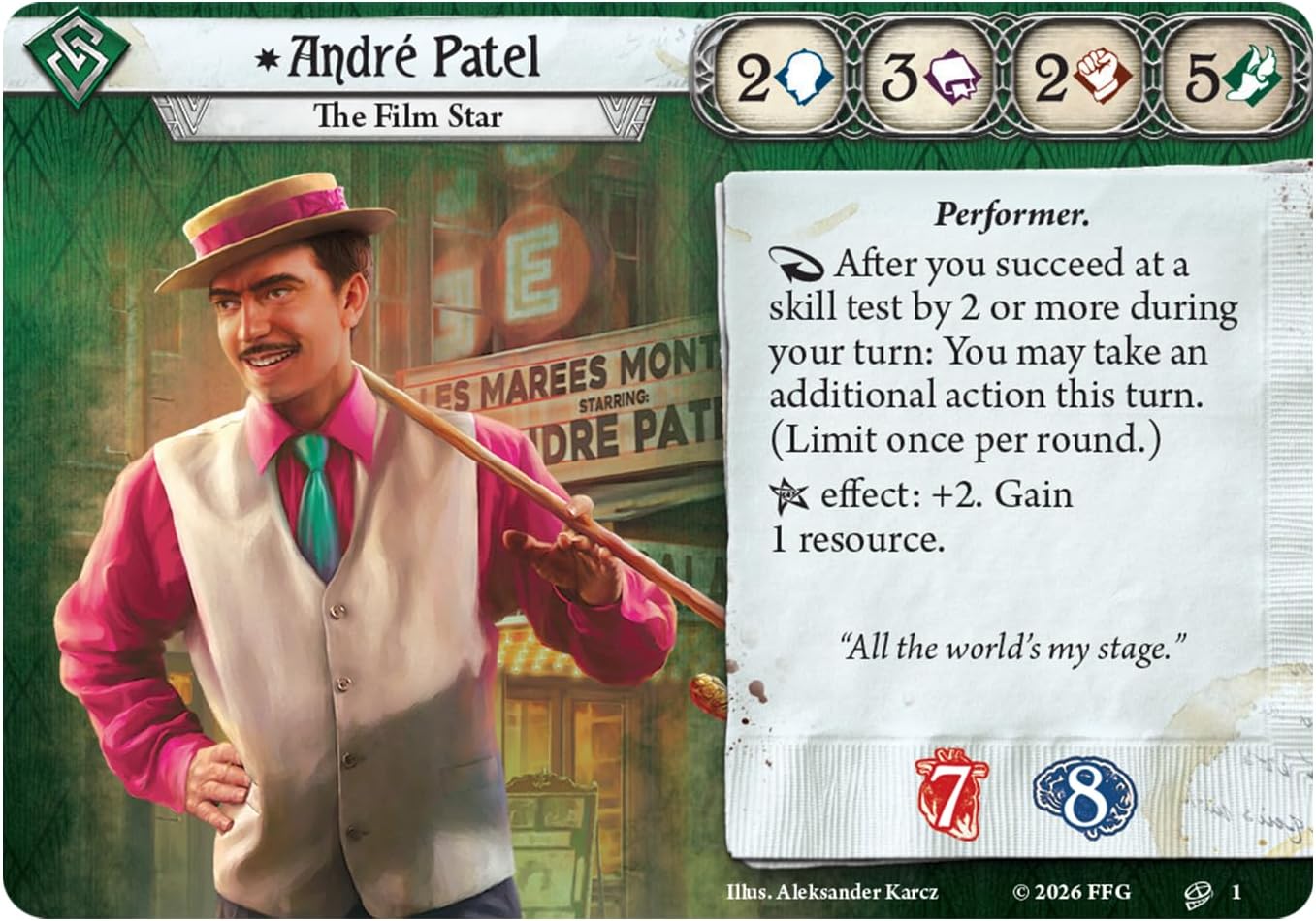
André Patel — The Film Star
André’s fascination with cinema began when his parents gathered enough money to send him to a theatre in Paris at the age of thirteen. He worked relentlessly toward Hollywood and eventually appeared in A Cosmic Journey. During filming, reality and fiction began to blur through inexplicable events. At the suggestion of his friend Betsy Baxter, he left Hollywood for a quieter life in Arkham.INVESTIGATING
This was, in retrospect, an optimistic understanding of Arkham. André represents performance, adaptability, and the unstable boundary between appearance and truth.
An actor learns to inhabit different identities. A film star understands framing, timing, illusion, audience attention, and the power of confidence.
Those talents are not superficial. They are survival skills in a campaign where smoke obscures reality and mirrors multiply falsehood.
The Person and the Role
The public believes it knows a film star. It knows the face, voice, interviews, gestures, and characters.
But celebrity creates distance between identity and image. André may enter a room where everyone recognizes him while no one understands him.
That can be isolating. It can also be useful.
People reveal things to celebrities. Doors open.
Attention moves toward him. A person skilled in performance can control what others see.
But Arkham presents a dangerous possibility: What if the role continues after the actor stops performing?
What if a fictional world leaves residue? What if the camera captured something no one placed on the set?
What if the line between illusion and reality was never where the audience assumed?
His Form of Courage
André’s courage is improvisational. He understands that plans fail.
Scenes change. Other performers miss cues.
Props break. The audience responds unexpectedly.
A great actor does not freeze. He finds the moment.
In gameplay, this is expressed through versatility and the ability to create additional action through exceptional success. Thematically, André refuses to accept that chaos must control the scene. He asks:
What role does this moment require? The danger is that constant performance can become armor. The world expects charm, confidence, and brilliance. Failure feels heavier when everyone is watching.
André must eventually decide whether he is performing courage or has become courageous. In Arkham, the distinction may not matter.
An action taken while afraid still counts.
Marie Lambeau — The Entertainer
Marie discovered that her grandmother’s legacy involved dangerous blood magic. She attempted to ignore it and pursue a life singing in Arkham’s clubs and lounges. When audiences became smaller and money scarcer, she began using that inherited power to influence difficult crowds and encourage wealthier patrons to become generous.INVESTIGATING
A forbidden inheritance became a practical tool. Practical tools become habits.
Habits become needs. Marie represents power, inheritance, temptation, and cost.
Her story asks one of the central questions of occult fiction: What happens when the dangerous thing works?
The Singer
A singer alters the atmosphere of a room through breath, rhythm, presence, and emotion. The audience changes together.
Conversation stops. Attention focuses.
Memory attaches itself to melody. Performance already resembles a kind of magic.
Marie’s supernatural ability extends something she understands instinctively: influence. She does not require brute force to control a moment. She changes what people feel possible.
That power can protect. It can manipulate.
The difference may depend upon intention, consent, necessity, and cost.
Inherited Knowledge
Marie did not create the legacy. She received it.
This is a recurring Gothic problem. A descendant inherits not only property or bloodline but unfinished history. Refusing the inheritance does not necessarily destroy it.
Using it creates another relationship. Marie’s power connects her to her grandmother’s choices, but it does not predetermine Marie’s morality. An inherited tool may be used differently by the next generation.
Yet every use makes abstinence harder. Power produces evidence for itself.
The first use solves an emergency. The second saves time.
The third feels natural. Eventually the person no longer asks whether the power should be used.
Only whether enough can be obtained.
Her Form of Courage
Marie’s courage is intimacy with danger. She knows the force is not safe.
She uses it anyway because Arkham does not offer pure choices. This makes her neither a helpless victim nor an uncomplicated master of magic.
She is negotiating. Every benefit creates leverage.
Every wound can become fuel. Every cost can be justified by the next crisis.
Marie asks: Can I use this power without allowing it to define me?
Arkham rarely answers such questions immediately. It keeps an account.
Miguel De La Cruz — The Rancher
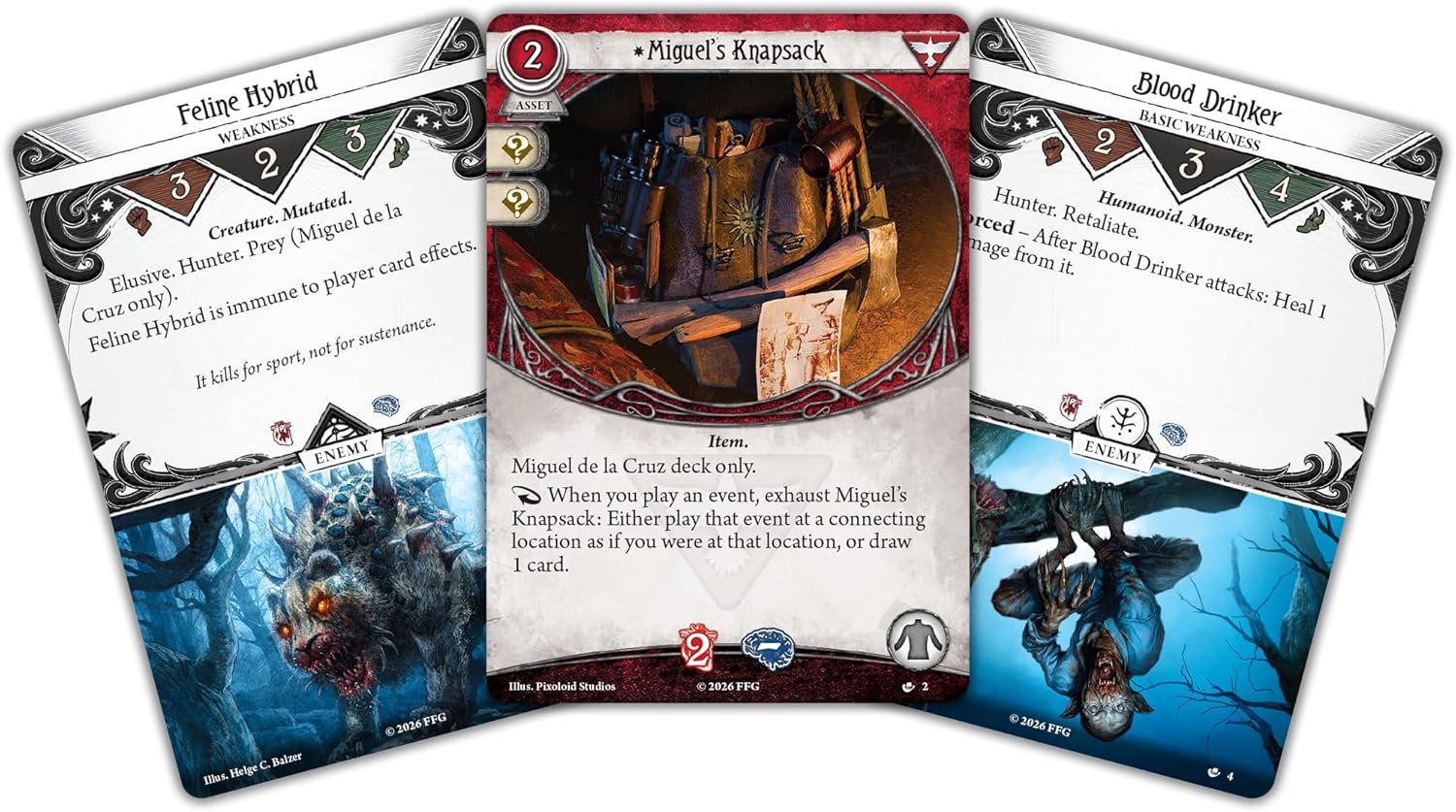
Miguel left Argentina and worked to build a life in Arkham. He has been saving to bring his husband Guillermo and their daughter Adonia to join him. He now manages a stockyard, but something has been killing livestock at night without behaving like an ordinary predator.INVESTIGATING
His livelihood is endangered. His family’s future is endangered.
Miguel tracks the creature into the woods, determined to trap it. Miguel represents preparation, migration, family, patience, and practical intelligence.
He does not pursue the unknown because he is fascinated by it. He pursues it because it has entered his responsibility.
The Builder of a Future
Migration gives Miguel’s struggle emotional weight. The stockyard is not merely a business.
It is a bridge. Every saved dollar, repaired fence, long day, and practical decision moves his family closer.
When the livestock die, the supernatural threat attacks more than property. It attacks the future he has been constructing. This makes Miguel’s courage deeply grounded.
He has something specific to protect. Not abstract humanity.
Guillermo. Adonia.
Home.
The Hunter Who Prepares the Ground
Miguel’s methods emphasize traps, routes, shelter, and anticipation. This reflects a different relationship with danger.
Tommy confronts. Miguel prepares.
He studies movement. He understands that strength can be redirected.
He makes locations matter before the enemy arrives. There is humility in this method. Miguel does not assume he can overpower every creature. He changes the conditions of the encounter.
That is one of humanity’s oldest advantages. We are not the fastest animals.
We are not the strongest. We observe, plan, communicate, construct, and wait.
His Form of Courage
Miguel’s courage is patient responsibility. He acts without institutional protection, celebrity, academic status, or occult inheritance.
He has knowledge created through work. Tracks.
Fences. Weather.
Animals. Terrain.
Timing. The person dismissed as merely practical may notice what the scholar overlooks.
Miguel asks: What does the evidence on the ground say?
In cosmic horror, that question can be more valuable than any theory.
The Five Together
Tommy protects. Carolyn understands.
André adapts. Marie transforms.
Miguel prepares. These are not merely five classes.
They are five human responses to the unknown. Authority.
Empathy. Performance.
Power. Practicality.
None is sufficient alone. Authority without empathy becomes control.
Empathy without action becomes helpless witnessing. Performance without truth becomes deception.
Power without restraint becomes corruption. Preparation without adaptability becomes rigidity.
Together, they form an argument for cooperation. The Mythos is vast.
Human beings survive by becoming complementary.
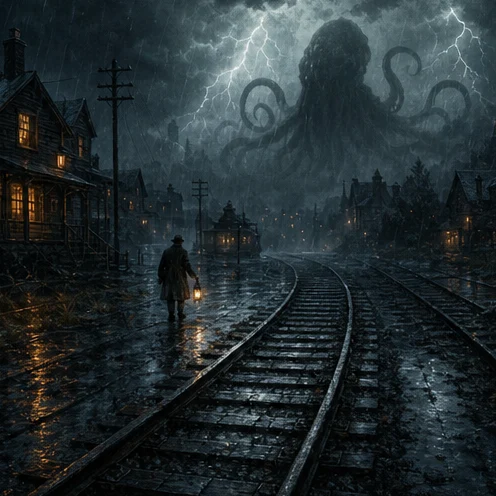
Chapter 10
Entering Brethren of Ash
Six months have passed since the flood. That is long enough for officials to speak confidently about recovery.
Long enough for damaged businesses to reopen under new ownership. Long enough for investors to describe ruined districts as opportunities.
Long enough for newspapers to move the catastrophe away from the front page. Long enough for citizens to become embarrassed by grief.
Not long enough for the city to forget.
Arkham at Dusk
Stand above Arkham as evening arrives. The Miskatonic River runs dark beneath the remaining light. New construction stands beside damaged brick. Scaffolding marks buildings being restored, while other properties wait behind fences for owners who may never return.
Fresh lumber has a different color from the old wood. New mortar is too clean.
Paint covers water lines without erasing them. Some houses have lamps in every window.
Others remain empty. The city is rebuilding, but reconstruction is uneven. Wealth moves faster than grief. A downtown business announces a grand reopening while a family several streets away still lives with relatives. A banker describes confidence. A laborer describes overtime. A landlord describes revitalization. A tenant describes higher rent.
Disaster has ended. Opportunity has arrived wearing an expensive coat.
The New Money
Outside investment is entering Arkham. That may be exactly what the city needs.
Capital repairs bridges. Reopens factories.
Restores housing. Creates employment.
Keeps families from leaving. But money is never merely money.
It establishes priorities. Which district is restored first?
Which historic building is preserved? Which damaged neighborhood is purchased cheaply?
Which local business is replaced? Which official begins speaking the language of the investor?
Which old family loses influence? Which new organization gains it?
The city’s public story is renewal. The investigator listens for the private price.
The Old Powers
Catastrophe disrupts hierarchy. Organizations that once operated confidently may scatter.
Police resources are stretched. Archives are damaged.
Criminal groups move into unguarded territory. Religious movements interpret disaster as judgment.
Occult societies lose members, properties, or artifacts. New groups emerge, offering purpose to people who have lost stability.
A secret brotherhood does not recruit only through ideology. It may recruit through grief.
Loneliness. Debt.
Fear. Humiliation.
Anger. The desire to belong to something that promises the catastrophe had meaning.
The most dangerous movement is often the one that can explain a person’s suffering before anyone else bothers to listen.
The Fires
Reports begin accumulating. A fire.
An accident. Another fire.
Another explanation. Each incident can be understood separately.
Faulty wiring. Carelessness.
Damaged infrastructure. Insurance fraud.
Gang activity. Post-flood deterioration.
The Arkham Advertiser offers explanations because explanations are its business. A newspaper cannot print that the city may be under attack by a hidden order of robed figures unless the evidence is overwhelming. Responsible journalism requires restraint.
Civic pressure encourages reassurance. Investors dislike panic.
Officials dislike patterns they cannot control. The explanations may be sincere.
They may also be wrong.
The Robed Figures
Witnesses report figures near some incidents. Robes create immediate suspicion because they erase ordinary social identity.
A uniform identifies profession. A suit identifies status.
Work clothes identify labor. A robe can identify ritual while concealing the person.
It removes the individual and presents the group. Was the witness reliable?
Was the light poor? Were the figures firefighters, clergy, university students, performers, mourners, or members of a genuine secret order?
Were they present before the fire? After it?
Did they cause it? Observe it?
Attempt to stop it? The image is powerful.
The evidence remains incomplete.
Your Friend
A mutual friend believes the figures are responsible. That statement tells you several things.
Your friend has investigated enough to form a theory. Your friend trusts you.
Your friend does not trust ordinary authorities to act. Your friend believes the situation is urgent enough to gather several people.
The meeting is arranged at a dormitory at Miskatonic University. This is not yet a quest.
It is a conversation. Bring what you know.
Compare evidence. Decide whether the pattern is real.
Perhaps the entire matter will collapse beneath careful examination. Perhaps your friend has made an understandable mistake.
Perhaps the fires are unrelated. Perhaps the figures were imagined.
Perhaps the city is simply exhausted and searching for intention in coincidence. Those possibilities deserve consideration.
The investigators are not heroes because they believe every frightening story. They are investigators because they are willing to look.
The Journey to Miskatonic
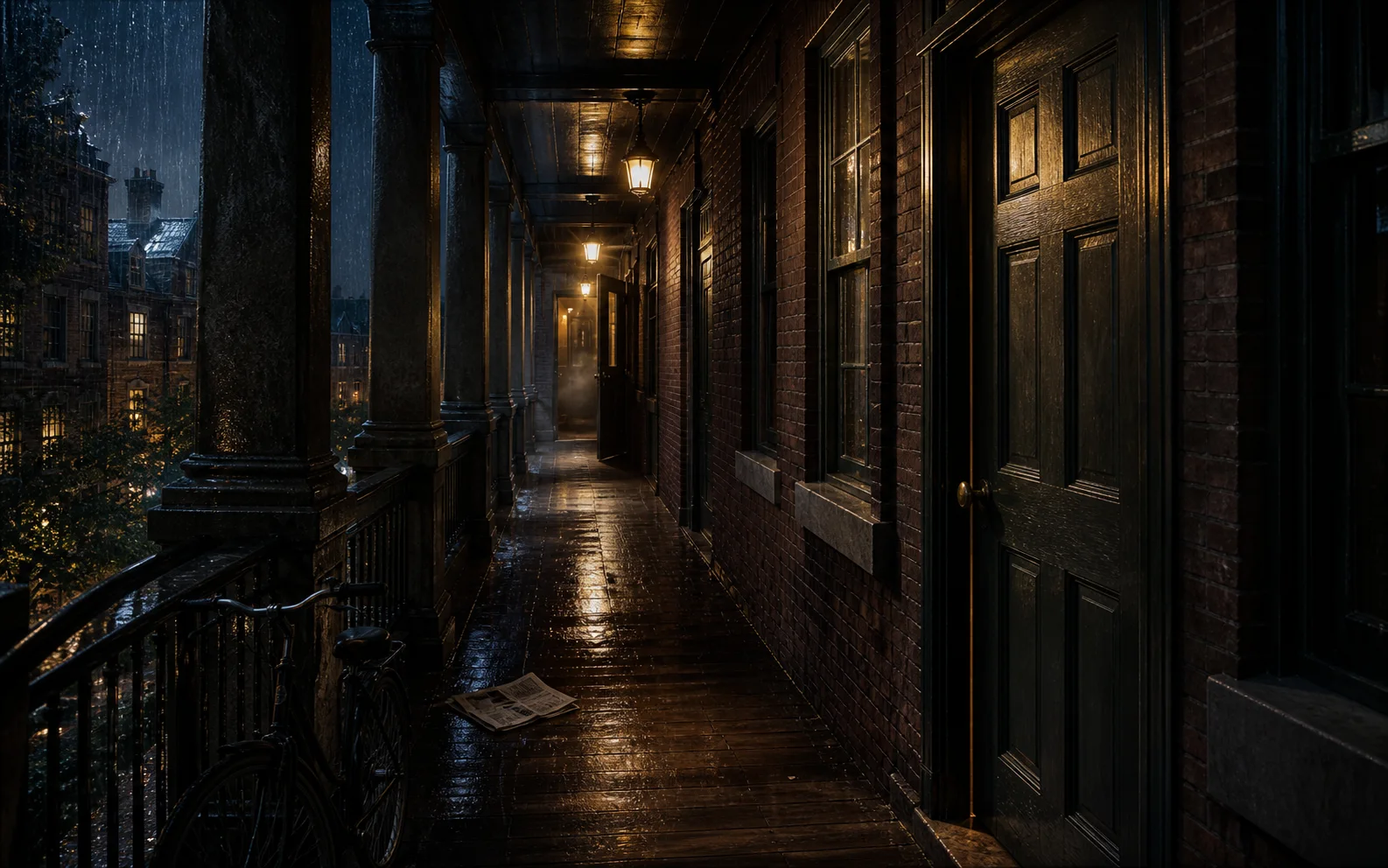
The weather has turned. Arkham’s streets reflect lamplight in thin broken patterns. Tires hiss across wet pavement. Gutters carry dark water toward drains still prone to blockage after the flood.
You pass a building under repair. A watchman smokes beneath an awning.
A delivery truck idles behind a restaurant. A police car moves through an intersection and disappears.
For several blocks, nothing seems wrong. That is almost disappointing.
Fear prefers confirmation. Then the wind changes.
You smell smoke. It may come from a chimney.
A factory. A stove.
A burned building being cleared. The scent is faint and quickly gone.
But after noticing it, you begin looking for its source. That is how investigation changes a city.
Before the question, smoke is smoke. After the question, smoke is evidence.
The Campus
Miskatonic University should feel reassuring. Its buildings represent age disciplined by scholarship.
Its windows glow with study. Stone steps have been worn by generations of students.
Departments, archives, laboratories, lecture halls, and libraries organize the world into subjects with names. Yet tonight the campus feels too large.
The spaces between buildings seem longer. The rain reduces distant architecture to shadow.
A clock marks the hour. No one answers it.
You see evidence of recent activity. A bicycle left near a railing.
Light behind curtains. A discarded newspaper.
A door not fully closed. The ordinary details make the absence of people more noticeable.
The Dormitory
Dormitories are rarely silent. There should be conversation behind walls.
Music. Footsteps.
Doors. Laughter.
Arguments. Water moving through pipes.
Someone arriving late. Someone pretending to study.
Someone making food where food is not supposed to be made. The silence does not need to be complete.
It only needs to be wrong. Perhaps it is the hour.
Perhaps an event has drawn the residents elsewhere. Perhaps the flood damaged more of the building than the repairs reveal.
Perhaps everyone has learned not to ask why one corridor remains unused. You find your friend’s room.
The Door
A closed door contains every possibility. Your friend may be inside.
Your friend may have left a note. Your friend may be late.
Your friend may be frightened. Your friend may have discovered proof.
Your friend may have discovered nothing. Your friend may no longer believe the theory.
Your friend may have invited someone else. Your friend may need help.
The door is ordinary. Painted wood.
A number. A handle.
The border between a hallway and a private room. It does not glow.
No symbol burns upon it. No voice warns you away.
This is important. Great horror rarely begins with a door that announces itself as dangerous.
It begins with a familiar door that should have opened.
The Empty Room
Your friend is not there. The room contains the shape of an interrupted life.
Books. Clothing.
Notes. Objects chosen for reasons you may not understand.
The private architecture of another person’s attention. Something may be missing.
Something may be out of place. Something may have been left deliberately.
Something may mean nothing. The investigator’s mind begins turning objects into questions.
When was your friend last here? Did they leave willingly?
Did they expect to return? Who else has entered?
What were they studying? Why arrange a meeting and then disappear?
Outside the room, the dormitory remains strangely quiet. The city has offered its first answer.
Absence.
Before the First Card
This is the moment to stop reading. Not because the story ends.
Because your story begins. Shuffle the encounter cards.
Place the first location. Choose who entered the room first.
Imagine who called your friend’s name. Imagine who checked the window.
Imagine who noticed the smell. Imagine who remained nearest to the door.
The game will provide text, objectives, enemies, consequences, and choices. You will provide memory.
The Final Briefing
Arkham is a city built upon layers. Colonial fear beneath modern confidence.
Folklore beneath scholarship. Private grief beneath civic renewal.
Old wealth beneath new investment. Ash beneath paint.
Water beneath foundations. A university gathers the world’s knowledge beside a river that refuses to keep history in one place.
Five investigators approach the unknown through different forms of courage. An officer accepts responsibility even when authority refuses belief.
A psychologist listens for truth inside terror. An actor understands that appearances can be controlled.
A singer negotiates with inherited power. A rancher prepares the ground before the danger arrives.
None knows the entire story. Neither do you.
That is not a disadvantage. It is the proper beginning.
Somewhere in Arkham, another alarm sounds. A telephone begins ringing in an empty office.
A figure crosses a wet street and disappears between buildings. A newspaper press prepares tomorrow’s reassuring headline.
A banker raises a glass to the city’s recovery. A student wakes from a dream with ash beneath their fingernails.
A police officer writes the word “accidental” and pauses. A matchbox closes.
A church bell marks the hour. The Miskatonic River continues moving through the dark.
Tomorrow, people will say the investigation began in a quiet dormitory room. They will be wrong.
It began in the old meeting houses, where invisible danger became part of public life. It began in the courtrooms, where fear was converted into evidence.
It began in the libraries, where dangerous knowledge was preserved because destroying it seemed worse. It began in every city that promised to rise from catastrophe without asking what might rise with it.
It began six months ago when the water entered Arkham. It began centuries ago when someone first discovered that fire could keep the darkness away.
And that fire could invite the darkness in. You stand inside your friend’s empty room.
Behind you, the hallway waits. Ahead of you, Arkham is burning.
Not everywhere. Not yet.
But somewhere beyond the rain, beyond the university walls, beyond the explanations printed in tomorrow’s newspaper, the first ember has already begun to glow. Welcome to Arkham.
Draw a deep breath. Open the campaign guide.
The night has only just begun.
The door remains unopened
Stop here. Let the first scenario become yours.
Open Robert’s setup trainerThe source ledger
Sources before recommendations.
How this feature was made: Robert Pruitt developed and edited the briefing with AI-assisted research, drafting, source organization, and visual planning. Product facts were checked against Fantasy Flight Games. Historical context was checked against public-history and university sources. Generated curator and chapter imagery is labeled as editorial atmosphere; product evidence remains verified imagery.
Fantasy Flight Games, “The Next Chapter” (Oct. 31, 2025)
Open sourceFantasy Flight Games, “Available Now: March 20” (Mar. 20, 2026)
Open sourceChapter Two Core product page
Open sourceArkham Horror: The Card Game Core Set Campaign Guide
Open sourceFantasy Flight Games, “Ever Investigating” (Feb. 12, 2026)
Open sourceTommy Muldoon Investigator Deck
Open sourceCarolyn Fern Investigator Deck
Open sourceAndré Patel Investigator Deck
Open sourceMarie Lambeau Investigator Deck
Open sourceMiguel de la Cruz Investigator Deck
Open sourceArkham Horror: The Card Game product/support page
Open sourceArkham Grimoire v1.1
Open sourceChapter Two Core news index
Open sourceFantasy Flight Games, “Arkham Horror Third Edition” (2018)
Open sourceLibrary of Congress, Religion and the Founding of the American Republic
Open sourceNational Park Service, Mount Auburn Cemetery
Open sourceLibrary of Congress guide to witch trials/witchcraft
Open sourceNational Park Service Salem educational material
Open sourceLibrary of Congress, “Double, Double, Trials and Trouble”
Open sourceLibrary of Congress Magazine, “Haunted History”
Open sourceChicago History Museum, Great Chicago Fire material
Open sourceH. P. Lovecraft, “The Picture in the House”
Open sourceH. P. Lovecraft, “The Dreams in the Witch House”
Open sourceH. P. Lovecraft Archive, fiction index
Open sourceH. P. Lovecraft Archive, general biography/FAQ
Open sourceBrown University Library, Lovecraft’s Racial Imaginaries
Open sourceThe Arkham Horror Universe
Open sourceMythos: Arkham Horror Masterclass Vol. I
Open sourceArkham Horror, Arkham Horror: The Card Game, Brethren of Ash, and related names and artwork belong to their respective rights holders. Puzzlewick is independent and is not affiliated with or endorsed by Fantasy Flight Games.
Frequently asked
Before you enter Arkham
Will this series spoil Brethren of Ash?
No. Every part ends before Scenario I gameplay begins.
Do I need to know The Drowned City first?
No. Chapter Two follows a calamity that changed Arkham, but the Core is also designed as a fresh starting point. This feature supplies the context a new reader needs without retelling earlier campaign spoilers.
Where should I begin?
Start with Part I. It gives the historical and fictional ground beneath the rest of the story; Parts II and III then follow in sequence.
Are the five Investigator Decks required?
No. They are optional ready-to-play decks. The Chapter Two Core Set is the required campaign foundation.