How to Spot Fake Pokemon and Magic Cards Without Damaging Them: A Safe 2026 Field Guide
Yumi turns panic into a safe inspection ladder: seller, listing, official comparison, non-destructive inspection, and the moment to stop and ask a professional.


AI-assisted research and drafting in Yumi’s voice · reviewed by Robert Pruitt · how this guide was made
Last editorial refresh: 2026-08-24 Gold-standard QA: 2026-08-18 12 sources reviewed Affiliate links checked during gold-standard pass

The short answer
If a Pokemon or Magic card feels wrong, stop handling it. Sleeve it, preserve the listing and seller details, compare the exact set number and printing with official or trusted card databases, and escalate high-value uncertainty to a reputable local game store, marketplace authentication program or grading service.
Decision map
Choose in thirty seconds
Quarantining a questionable standard-size card
A clean comparison surface
Preserving a card for expert or grading review
If a Pokemon or Magic card feels wrong, stop handling it. Sleeve it, preserve the listing and seller details, compare the exact set number and printing with official or trusted card databases, and escalate high-value uncertainty to a reputable local game store, marketplace authentication program or grading service.
Start here, then go deeper
You are in the right cabinet.
 ✶ Universe HubMagic: The Gathering: the whole buying pathMagic: The Gathering is the deepest construction sandbox in the Big Three: a two-player duel, four-player Commander ritual, draft...
 🂠 Topic PathTrading Card Games: compare the whole shelfStart with the game and community you want, then buy the smallest product that lets you test it properly. These guides separate...
 GuidePokemon Card Grading in 2026: PSA vs BGS vs CGC, Fees, Turnaround, and the Break-Even MathImani runs the numbers and Yumi protects the card: current PSA, BGS, and CGC service tiers, the real break-even equation, and the cards...
The safe answer starts before the card
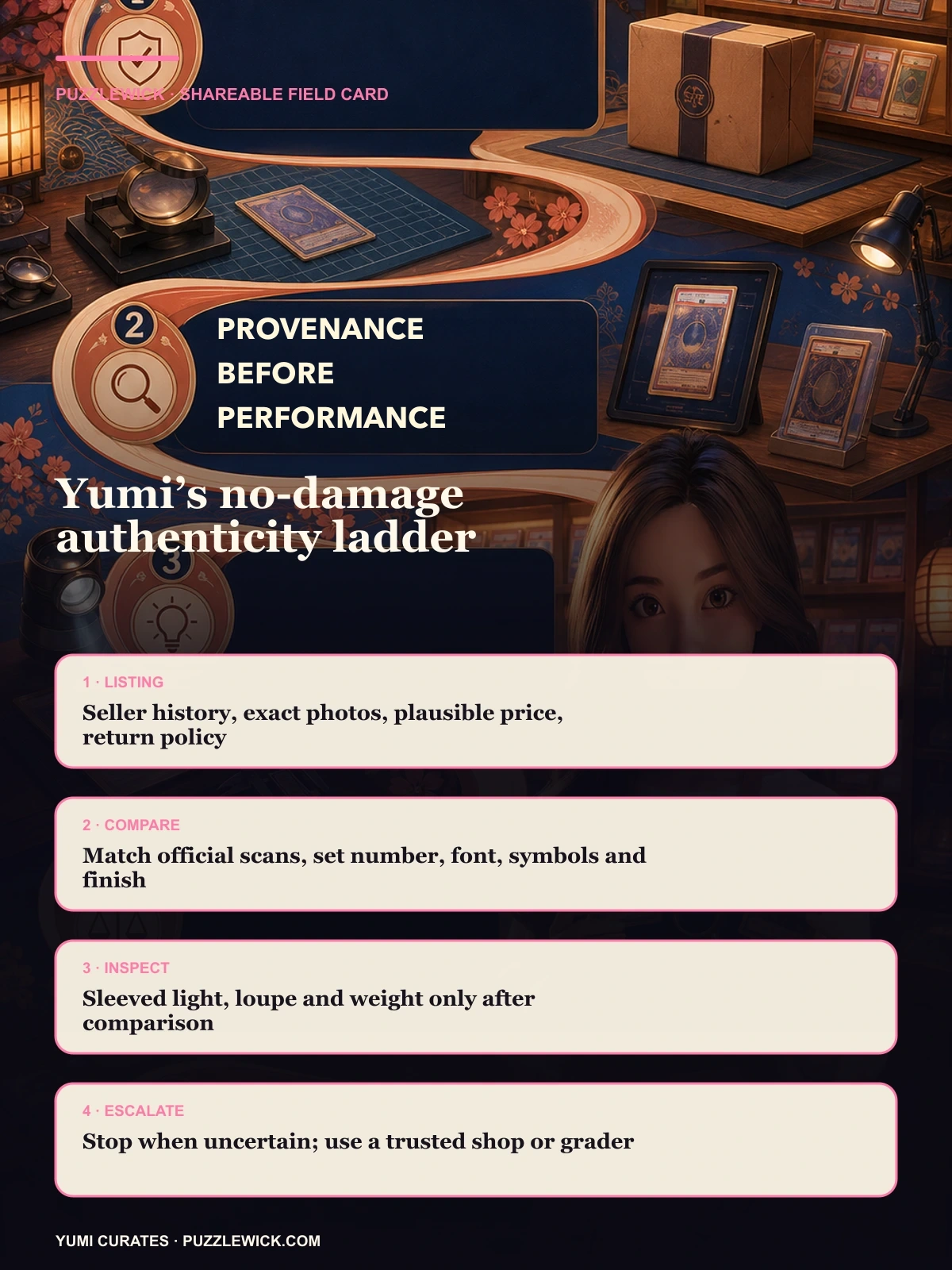
Counterfeit detection begins with transaction evidence: seller history, exact photographs, price, product language, return policy, sealed-product details and whether the listing is asking you to ignore an implausible bargain.
Yumi’s rule is simple: trust is cumulative. One convincing feature does not erase five bad ones.
Stage one: preserve the listing and provenance

Save the URL, seller name, screenshots, order record and exact listing photographs. Check whether the title, language, set code and pictured product agree. A stock image paired with a vague high-value listing deserves more caution than clear front-and-back photographs.
Prices far below credible recent sales are a risk signal, not a gift certificate from the universe.
False positives are why the ladder matters
Authentic cards can look unfamiliar. Print facilities, eras, regions, languages, foil processes and reprints can change color, gloss, texture, cardstock feel, borders and copyright lines. A worn genuine card can also compare poorly with a pristine reference.
That is why “the blue looks wrong” is a question, not a verdict. Identify the exact printing before comparing details, and use more than one known-good reference when value is substantial. Marketplace scans may be color-corrected; phone cameras and warm room light can shift color enough to manufacture suspicion.
Yumi separates observations from conclusions. “The collector number differs from the official record” is useful. “It feels fake” is a starting note that still needs evidence.
Stage two: compare the exact card, not a memory of it
Use the official Pokemon card database, Gatherer or Scryfall to compare card name, set number, collector number, symbols, borders, layout, wording and known finish. Match the same language and printing. Reprints can legitimately change frames, copyright lines, foiling and security features.
For Magic, modern rare cards may include a holofoil stamp; its presence or absence only means something when that exact card and printing should have it. For Pokemon, texture and holo patterns vary by era and rarity. Context is the test.
Build a comparison packet a stranger can audit
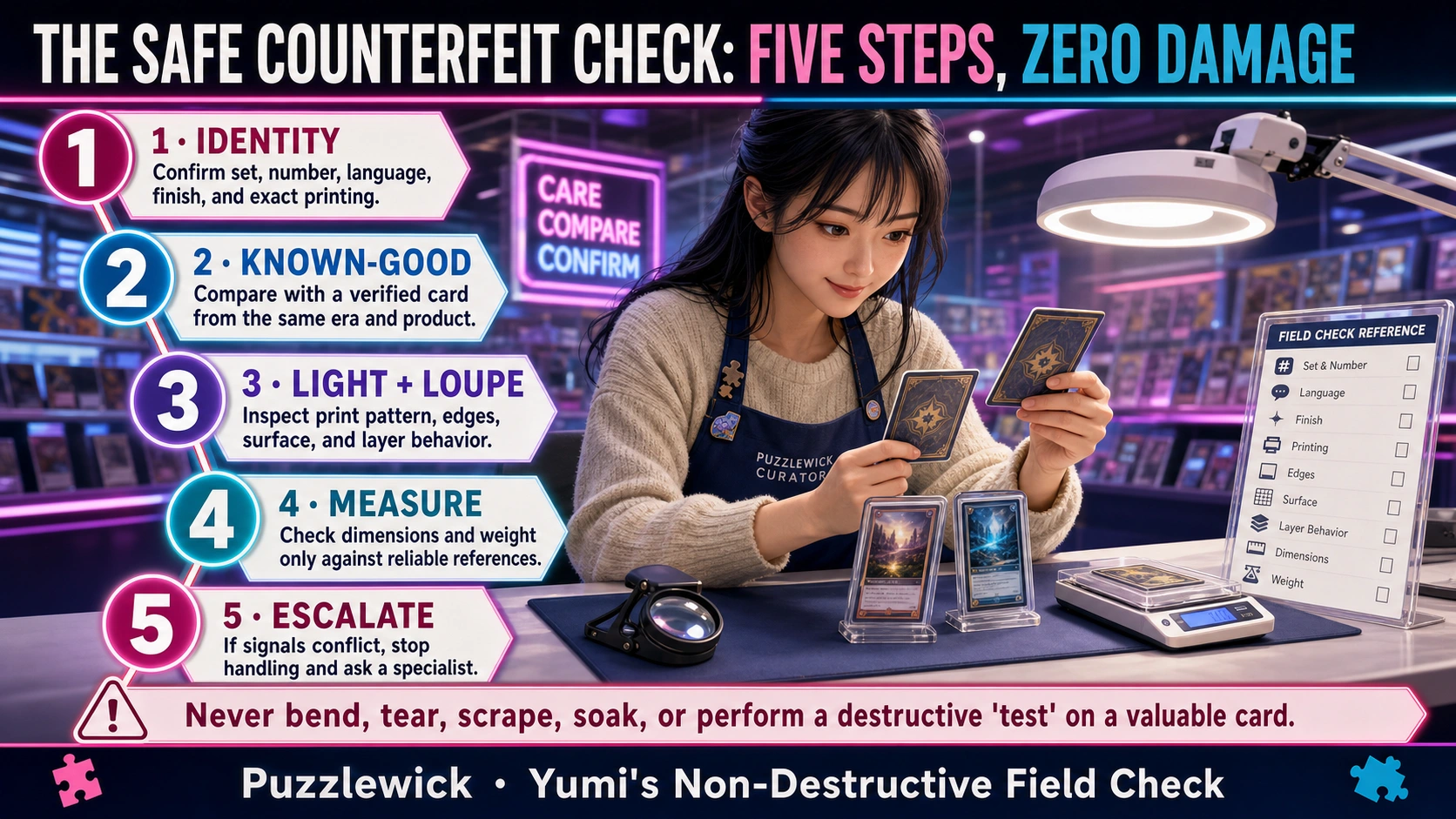
Create one folder with the listing screenshots, order record, your front-and-back photographs, the official card record, and close comparisons of the exact concern. Name files plainly. If you weighed the card or used magnification, record the tool and the known-good comparison rather than presenting the number as universal truth.
For a valuable card, add the seller’s response and the return deadline. This packet helps a local store, marketplace agent or grader understand the problem without repeating every handling step. It also keeps the dispute factual if your first reaction was understandably less composed.
Do not publish a seller accusation while the evidence is unresolved. Preserve your remedies first. Public certainty is difficult to reverse; a labeled folder is pleasantly patient.
Stage three: use non-destructive signals together
Under neutral light, compare print sharpness, registration, color, surface finish, edge construction and card dimensions with a verified copy from the same era. A loupe can reveal printing differences; an accurate scale can flag a material mismatch. Neither should be used alone.
The famous light test is not universal. Stock, inks, foils and special treatments change how genuine cards transmit light. Use it as one comparative observation, never a verdict.
Use a known-good control from the same game, era, language, set, and finish whenever possible. Print rosettes, stock, foil layers, texture, and light transmission change across legitimate products. Magnification and weight become useful only after identity is settled; otherwise the comparison is scientifically tidy and editorially useless.
For Magic, the green-dot inspection is one signal among several, not a universal courtroom verdict. For Pokemon, expected texture must be checked against that exact card because many genuine printings are not textured. If two signals disagree, stop. The correct next move is documentation and escalation, not a more destructive test.
The stop rule: uncertainty is allowed
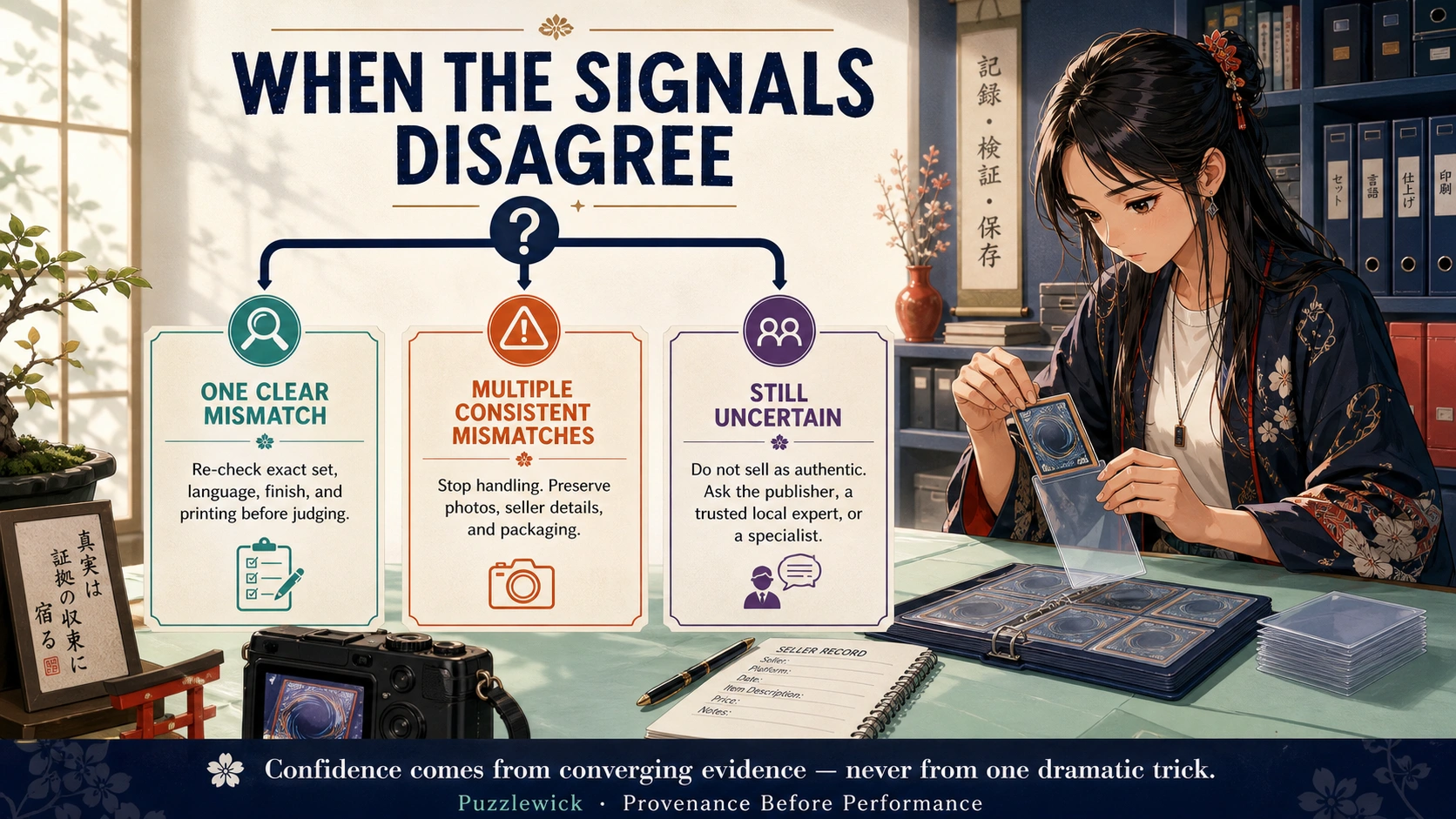
If the signals conflict, stop. Do not escalate into destructive internet folklore. Ask a reputable local game store that handles the game, use a marketplace authentication pathway where eligible, or submit a valuable card to a recognized grader.
A professional opinion can still be wrong, but it preserves evidence and value far better than a tear test performed over the kitchen sink.
Buying online: remove risk before checkout
Prefer listings with exact product identity, clear condition language, front-and-back photographs for valuable singles, a credible seller history and a usable return path. For sealed product, compare wrapper seams, package configuration, codes and included items with the publisher’s current product page.
On a marketplace, distinguish the platform from the individual seller and fulfillment arrangement. Read the actual listing, not only the search-card headline. Save the page at purchase because photos and descriptions can change later.
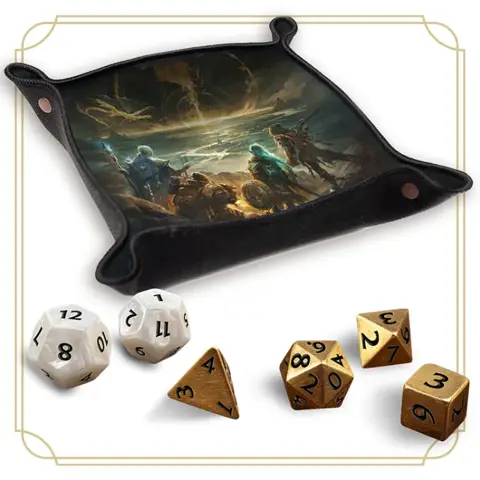
A protective play surface, clean sleeves and a labeled quarantine case are inexpensive. None authenticates a card, but each reduces the chance that your investigation creates the damage you later need to explain.
If the card came from a sealed product
Inspect packaging print quality, seals, wrapper construction, product codes and whether the pack configuration matches the official product. Resealed product and counterfeit cards are different problems, but both begin with seller and packaging evidence.
Do not assume Amazon itself sold an item merely because the checkout happened on Amazon. Verify the exact seller and fulfillment details shown on the listing and order.
What to do after a likely counterfeit
Keep the card and packaging unchanged. Photograph both sides and every identifier. Use the marketplace dispute process, provide concise evidence and avoid sending the item elsewhere unless instructed. Do not trade or resell it as genuine.
If the card is a proxy or playtest card, label it clearly and follow the venue’s policy. A transparent proxy is not the same thing as a counterfeit offered as authentic.
When returning an item, follow the marketplace’s instructions, retain tracking and photograph the packed return. If the seller offers an off-platform refund or asks you to destroy the evidence, pause and use the platform’s documented support channel.
For a high-value card, ask a reputable local shop or specialist what evidence would change their conclusion. That question is better than asking for instant agreement. Yumi keeps the card isolated and the language neutral until the process is complete; certainty should arrive from the record, not from the volume of the accusation.
Her collection uses two destinations: a verified binder and a small labeled question file. Each unresolved card carries its source, purchase date and reason for concern, so uncertainty never drifts back into a trade binder. Open the TCG Counterfeit Field Check for a printable, no-damage inspection record.
What experienced tables keep reporting
Recurring owner patterns, synthesized in Puzzlewick's words. Follow each evidence trail to read the original discussion.
Community pattern
The picks
Some links below are affiliate links — as an Amazon Associate, Puzzlewick earns from qualifying purchases, at no extra cost to you. It never changes a pick.
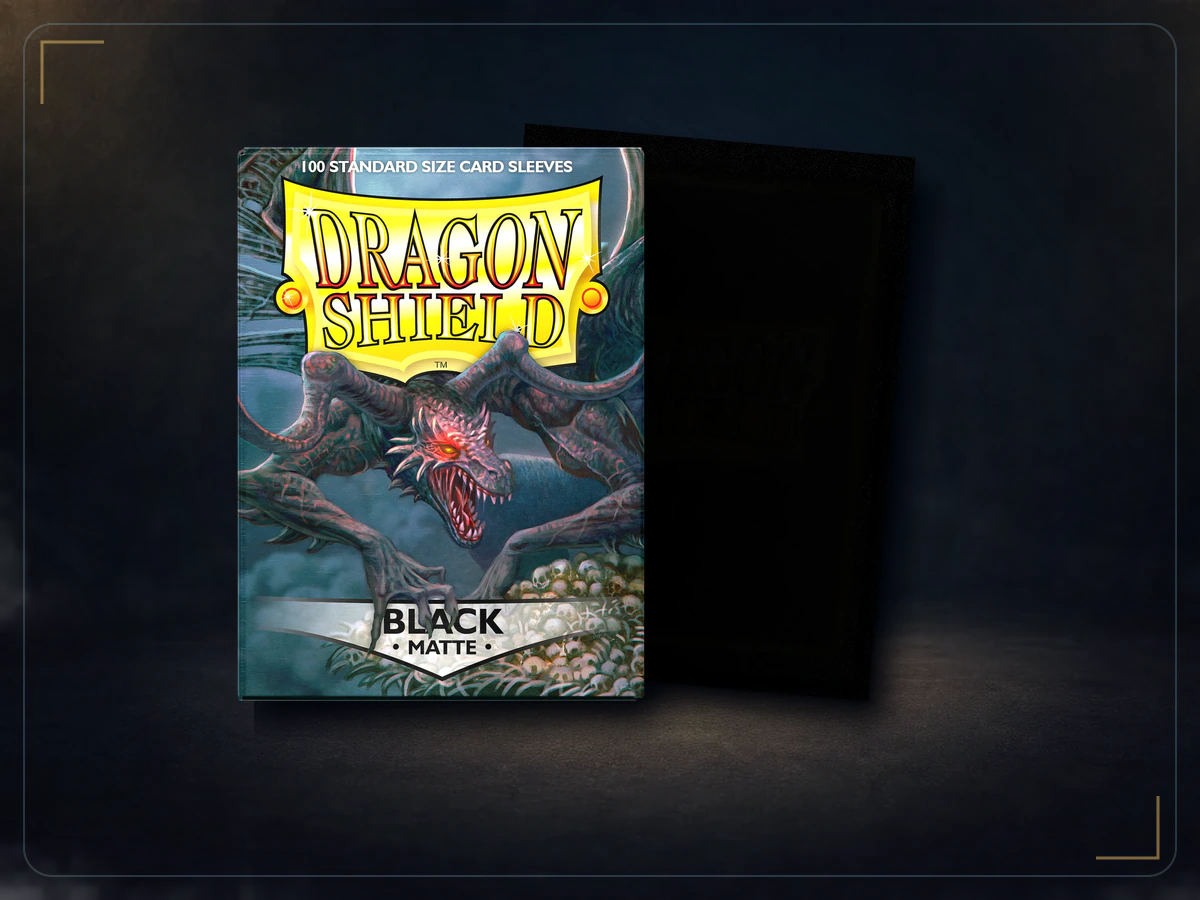
Dragon Shield Matte Black Standard Size Sleeves, 100 Count
Opaque sleeves with the consistency and shuffle feel that make them the safe default for Pokemon and Magic.
- Opaque backs
- 100-count box
- Reliable shuffle feel
- Not sized for Yu-Gi-Oh!
- Thicker than bargain sleeves

Ultra PRO Solid Black Gaming Playmat
A neutral mat makes cards easier to lift and prevents a rough table from becoming part of the condition report.
- Works across games
- Easy card pickup
- Clean inspection background
- No printed zones
- Needs rolled or flat storage

BCW Semi-Rigid Card Holder #1, 50 Count
A grading-friendly holder for a softly sleeved card, selected because PSA specifically recommends sturdy flexible pouches and advises against top loaders.
- Submission-friendly format
- Inexpensive
- Flexible removal
- Needs a soft sleeve first
- Not a permanent display slab
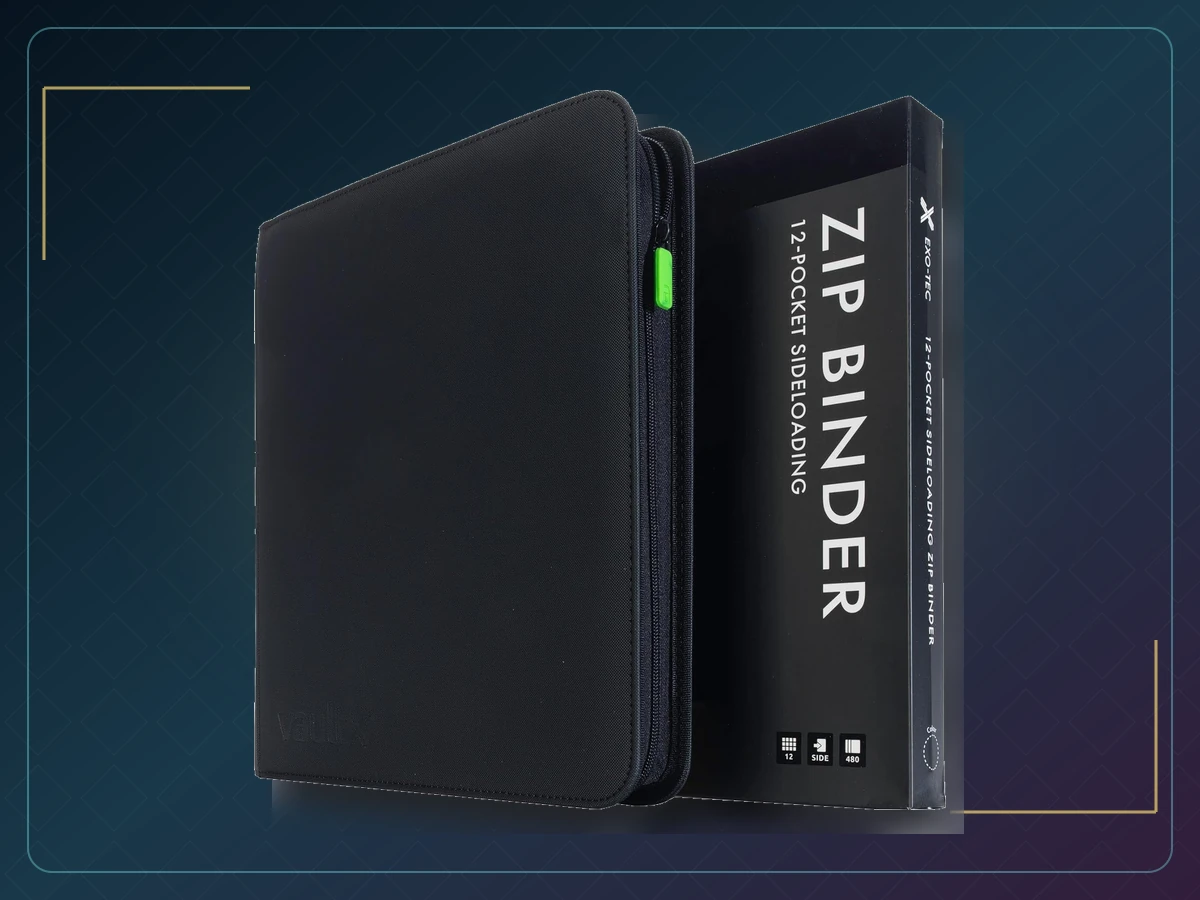
Vault X 9-Pocket Exo-Tec Zip Binder
Fixed side-loading pages, a rigid cover, and a zipper make this a strong home for cards that should remain browsable.
- Side-loading pages
- Zipper closure
- No rings
- Heavy when full
- Wrong home for bulk

Ultimate Guard Boulder 100+ Deck Case
A small, sturdy shell for a finished sleeved deck or a clearly labeled inspection queue.
- Rigid shell
- Compact footprint
- Reliable closure
- No dice tray
- Not a grading mailer
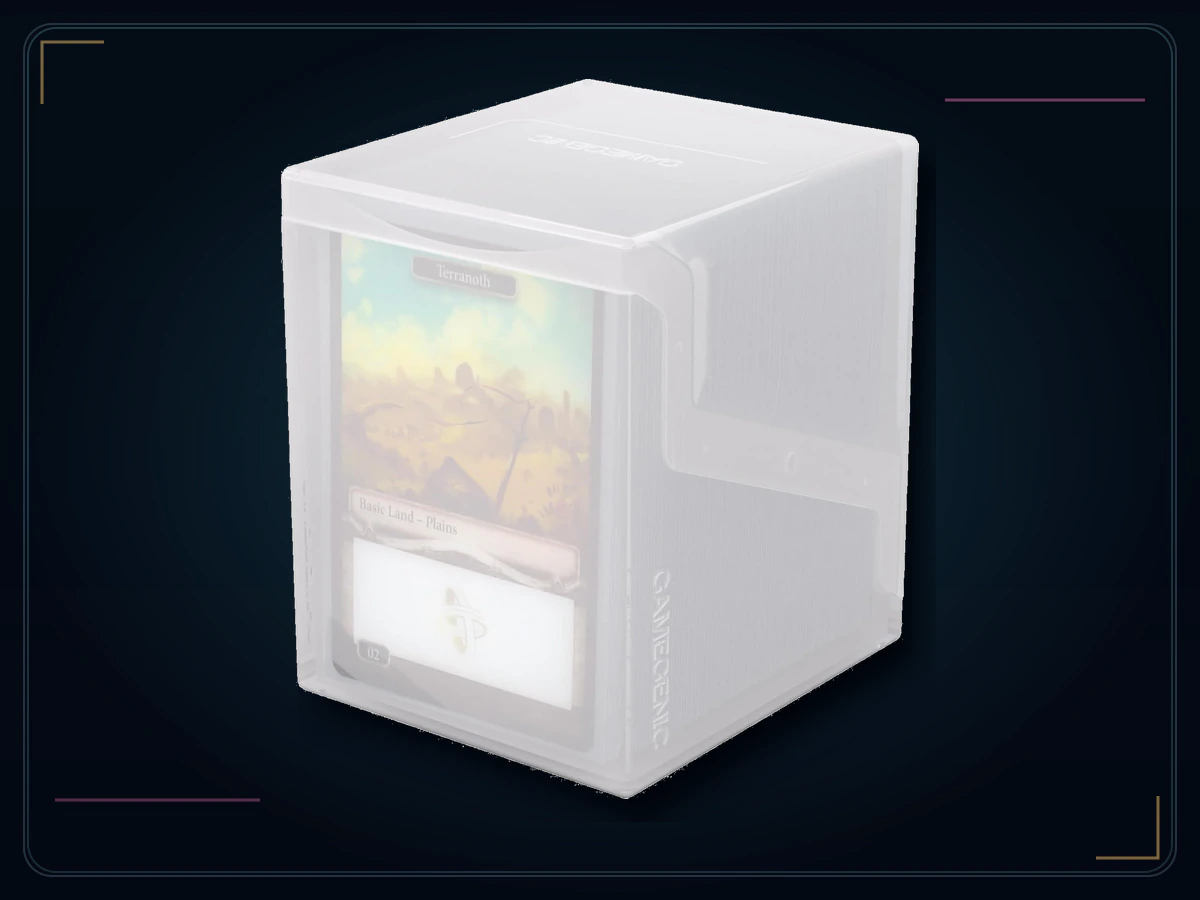
Gamegenic Bastion 100+ XL
A polished rigid case with XL space for demanding sleeve combinations and an easy-to-identify deck.
- Rigid shell
- Visible contents
- XL sleeve capacity
- Larger shelf footprint
- More than a temporary deck needs
At a glance
| Stage | Useful signal | Do not do |
|---|---|---|
| Before purchase | Seller history, exact photos, plausible price, return policy | Assume a marketplace badge authenticates the card |
| Identity | Set, number, language, rarity, finish, official scan | Compare against a different era or treatment |
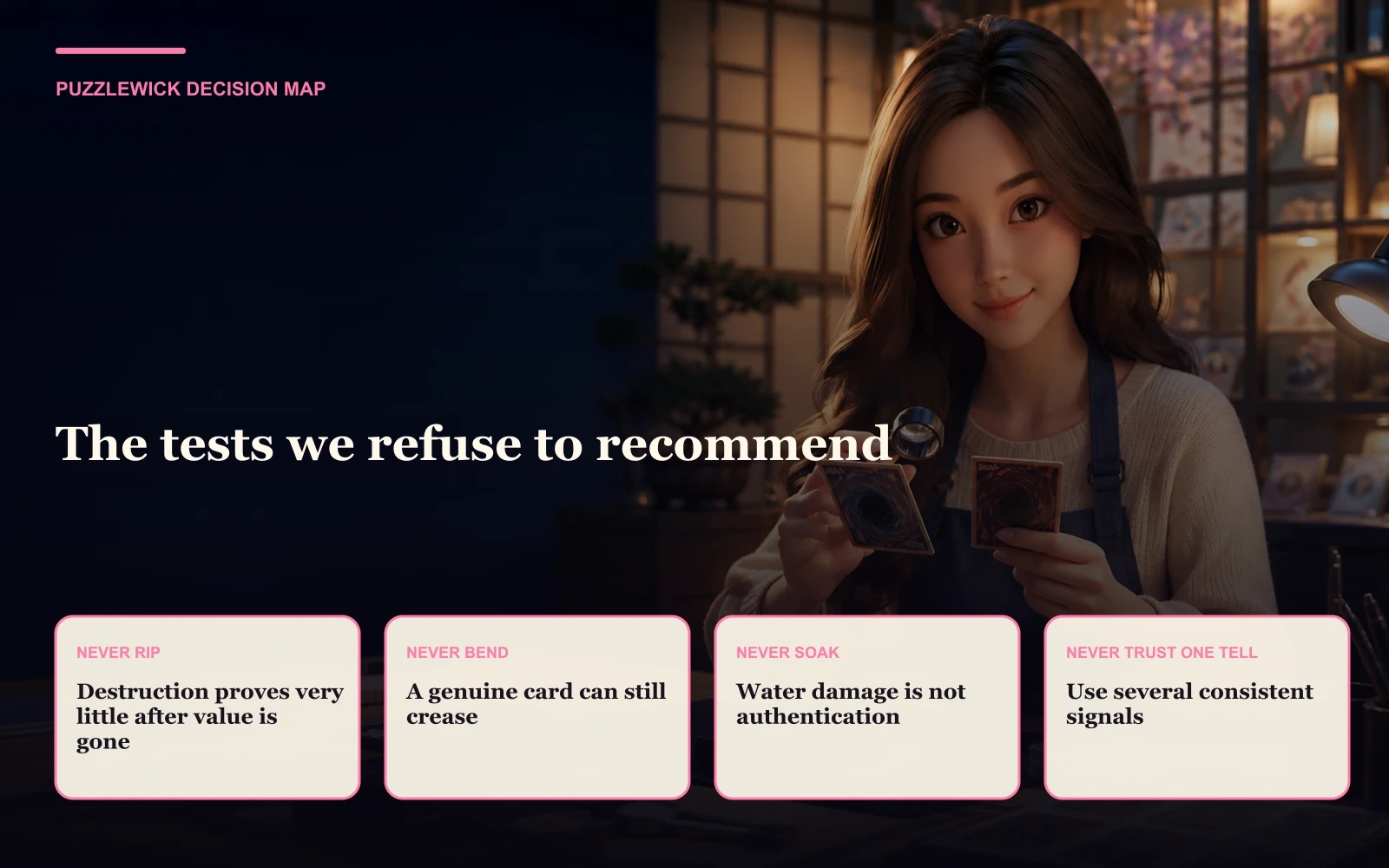
| Inspection | Several consistent non-destructive observations | Rip, bend, soak, scrape, or trust one test |
| Escalation | Documented review by a trusted store, platform, or grader | Trade the card while uncertainty remains |
Free download — How to Spot Fake Pokemon and Magic Cards Without Damaging Them Field Guide
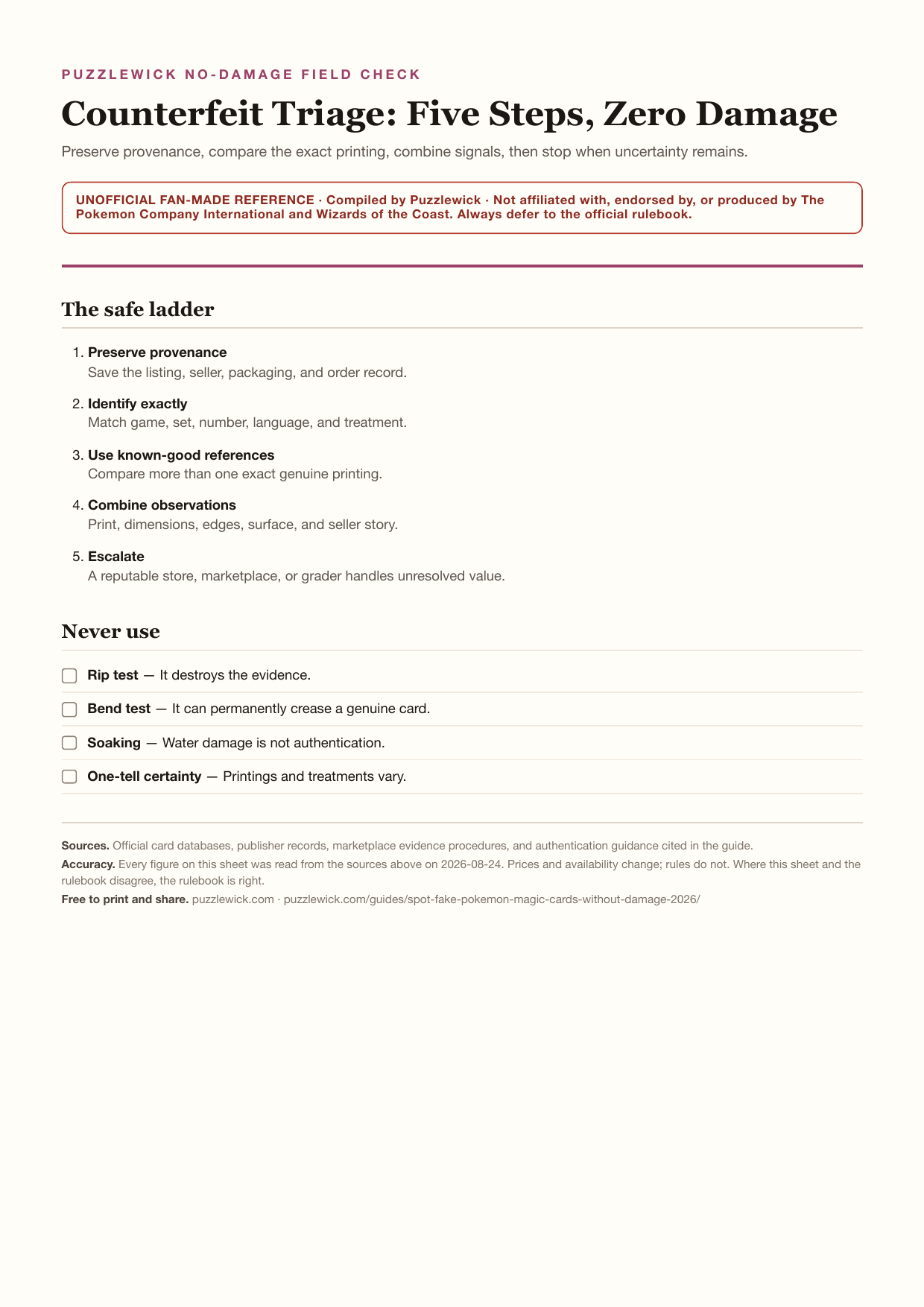
A one-page, beginner-readable reference distilled from the official sources used in this guide.
Unofficial fan-made reference. Compiled by Puzzlewick from the sources listed on the sheet. Not affiliated with or endorsed by the publisher — always defer to the official rulebook.
Questions, answered
Can I identify a fake Pokemon card with the rip test?
Do not rip it. The test destroys the item and card construction varies. Preserve it and use provenance, official comparison and several non-destructive signals.
Is the light test reliable for Pokemon or Magic cards?
Not by itself. Genuine stock, foils and treatments vary. Compare an exact known-good printing and combine several observations.
Does a missing Magic holofoil stamp prove a fake?
Only if that exact card, rarity and printing should have the stamp. Older cards and many products legitimately lack it.
Are all proxies counterfeit?
No. A clearly disclosed playtest card or proxy is different from an item represented and sold as genuine. Venue and tournament policies still control use.
What should I do with a suspected fake card?
Sleeve and label it, preserve transaction evidence, stop trading it, and use the seller, marketplace, local store or grading pathway appropriate to the value.
Can a local game store authenticate a card?
Experienced stores can provide useful comparison and triage. For high-value certainty, consider marketplace authentication or a recognized grading service.
What is the safest first counterfeit check?
Check the seller, listing, price, exact card identity and official scan before touching the card repeatedly.
Does an Amazon listing guarantee authenticity?
No. Check the exact seller, fulfillment, product identity and return protections on the individual listing.
Is the green dot test enough to prove a Magic card is real?
No. It is one print observation. First identify the exact card and printing, then compare several non-destructive signals and provenance. Sophisticated counterfeits and legitimate print variation make single-test verdicts unsafe.
What accessories help inspect cards without damaging them?
Use a clean neutral mat, correctly sized soft sleeves, a semi-rigid holder for escalation, neutral light, and documented high-resolution reference images. Magnification helps only after exact identity is known.
Yumi's verdict
No single light, texture, font or weight test proves authenticity. Start with the seller and exact listing, compare the card with official records, then use several non-destructive signals. Never rip, bend, soak, scrape or peel a card to answer the question.
Research ledger 12 sources · reviewed 2026-08-18
Specifications, rules, current product information, community experience, and contrary evidence were checked against the sources below. Commercial links are kept separate from editorial evidence.
- Pokemon Support: counterfeit cardssupport.pokemon.com/hc/en-us/articles/360002068953-Did-I-purchase-fake-or-counterfeit-cards
- Wizards Support: identifying counterfeit cardsmagic-support.wizards.com/hc/en-us/articles/360000194006-Identifying-Counterfeit-Cards
- Wizards Support: legitimate product purchasingmagic-support.wizards.com/hc/en-us/articles/360000210723-Verify-You-are-Purchasing-Legitimate-Wizards-of-the-Coast-Products
- Wizards: Buyer Bewaremagic.wizards.com/en/news/feature/buyer-beware-2004-04-26
- eBay Authenticity Guarantee for trading cardsebay.com/authenticity-guarantee/tradingcards
- TCGplayer Buyer Safeguardhelp.tcgplayer.com/hc/en-us/articles/201637633-TCGplayer-Buyer-Safeguard
- r/PokemonTCGreddit.com/r/PokemonTCG
- r/mtgfinancereddit.com/r/mtgfinance
- Pokemon TCG Card Databasepokemon.com/us/pokemon-tcg/pokemon-cards
- Magic Gatherer Card Databasegatherer.wizards.com
- PSA Certification Verificationpsacard.com/cert
- CGC Cards Verify Certificationcgccards.com/certlookup

Come in, take your shoes off — let me show you something.


Keep exploring
The next smart rabbit holes.
✶ Universe HubMagic: The Gathering: the whole buying pathMagic: The Gathering is the deepest construction sandbox in the Big Three: a two-player duel, four-player Commander ritual, draft...🂠 Topic PathTrading Card Games: compare the whole shelfStart with the game and community you want, then buy the smallest product that lets you test it properly. These guides separate...GuidePokemon Card Grading in 2026: PSA vs BGS vs CGC, Fees, Turnaround, and the Break-Even MathImani runs the numbers and Yumi protects the card: current PSA, BGS, and CGC service tiers, the real break-even equation, and the cards...