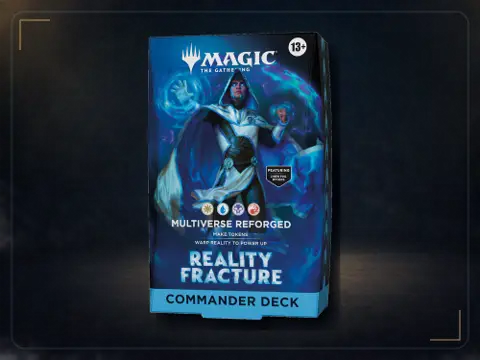
Reality Fracture Beginner Guide: Your First Deck, First Game and Best Buy
New to Magic? Learn a few turns before buying a complex deck. Choose a guided prerelease to explore Reality Fracture, Multiverse Reforged for an established Commander table, or Draft Night for four friends who want to draft. A Bundle is a pack-opening gift; Collector Boosters are for treatments. Neither is a ready-made deck. Tabletop release is October 2, 2026; the separate Secret Lair Bundle follows October 23.


AI-assisted research and drafting in Imani’s voice · reviewed by Robert Pruitt · how this guide was made
Last editorial refresh: 2026-09-23 Gold-standard QA: 2026-09-22 53 sources reviewed Affiliate links checked during gold-standard pass

Decision map
Choose in thirty seconds
Start without a random-pack purchase or a four-player rules burden.
Build a small Sealed deck from one pool with help nearby.
It is complete, but its four-color plan is demanding for a first lesson.
Agree who keeps the cards before opening.
The strange campus, unfamiliar versions of familiar heroes, and splintered skies are an invitation. You do not need to know twenty years of Magic story to accept it. You need an evening you will enjoy and a product that can actually provide it.
This guide starts with that decision, then teaches enough card reading, mana, turns, combat and set mechanics to make your first session less intimidating. It is a prerelease analysis, not a hands-on review. Imani is Puzzlewick’s fictional curator; Robert Pruitt is the accountable human editor.
The Reality Fracture desk
What would you like to do first?
Choose your evening. The right box follows from that.
Start with a guided first game
Try the free MTG Arena tutorial or borrow two teaching decks. Foundations Beginner Box is a separate guided-learning product; Reality Fracture is a set release.
Check first: A four-color Commander deck asks you to learn multiplayer decisions and a token engine at the same time.
Before spending: Borrow a deck and ask someone to walk through a turn with you.
Read the learn magic routeMultiverse Reforged gives one player a deck
A ready-to-play 100-card deck is the direct route when your group already plays Commander. Confirm the table’s expectations first.
Check first: It is one deck for one player. Its four colors and triggered abilities add bookkeeping.
Before spending: Borrow a precon for a session before choosing your own.
Read the join commander routeBook the event before buying packs
Ask the store what its entry includes. A Prerelease Pack supplies six Play Boosters for a Sealed event; the store can provide basic lands.
Check first: You build a minimum 40-card event deck. This is different from opening a ready-made Commander deck.
Before spending: Ask to observe or attend a learn-to-play session first.
Read the try a prerelease routeDraft Night has a precise head count
Draft Night is a four-player Pick-Two draft: 12 Play Boosters, a separate Collector Booster, 90 basic lands and tokens.
Check first: Agree who owns the drafted cards and the extra Collector Booster before opening anything.
Before spending: Draft a friend’s reusable cube if your group already has one.
Read the host four drafters routeA Bundle is a sampler
Nine Play Boosters, lands and accessories create an opening session. They do not provide a finished constructed deck.
Check first: A Play Booster display suits a larger pack-opening or draft plan. Neither guarantees the particular card you want.
Before spending: Browse the official card gallery and choose a goal first.
Read the explore the set routeChoose the treatment before the pack
Collector Boosters suit people who deliberately want premium randomized treatments. A named single is the precise route to one card.
Check first: Beautiful versions do not play better. The separate Secret Lair Bundle releases October 23.
Before spending: Make a short wish list and wait for exact versions you can compare.
Read the collect treatments routePause before resolving
Say your answer first, then open the explanation.
Does Jace, Multiverse Architect satisfy empower Jace?
No. Empower looks for a Jace planeswalker token. The commander is a card. If you have none, first create the specified token. Then put the stated loyalty counters on a Jace planeswalker token you control.
Do you sacrifice a Heartwood for its mana?
No. Heartwood is a red and green artifact token with a tap ability that adds red or green mana. It stays on the battlefield. Early printings use a colorless frame; the token is still red and green.
What Angel does Ob Nixilis, the Ascended create?
A 4/4 white Angel creature token with flying. Some early decks include a 3/3 blue Angel token. Wizards has acknowledged the mismatch; use a clearly labelled substitute for the correct game object.
Rule explanations checked September 22, 2026: Wizards mechanics and official decklist and Angel correction. These are practice situations, not a record of playtesting.
Keep a field guide beside your cards
Five printable sheets, with the same reading text available here.
Choose your first evening
A format is an agreement about how you play. Choose that before a box.
- Learn the basics
- Try the free Arena tutorial or borrow teaching decks. A Foundations Beginner Box is another guided-learning route.
- Join friends at Commander
- Choose a complete preconstructed deck if the group plays Commander. Multiverse Reforged gives one player 100 cards; ask about table pace first.
- Explore through Sealed
- Ask a store about prerelease entry and what it supplies. Build a minimum 40-card deck from your event pool and basic lands.
- Host four drafters
- Draft Night is a four-player Pick-Two event. Agree who keeps the cards and the extra Collector Booster before opening.
- Collect a favorite version
- Identify the exact card and treatment. Randomized packs cannot guarantee it. Browse first; a purchase is optional.
First decide what happens after the wrapper comes off. The most expensive product is not automatically the best teacher.
Follow one ordinary turn
A teaching sequence. Card effects can change the normal rules.
- 1 Untap, upkeep, draw
- Untap your permanents, handle upkeep triggers, then draw. The starting player skips the first draw in an ordinary two-player game; multiplayer Commander does not use that skip.
- 2 First main phase
- You normally get one land play each turn. Creatures and sorceries normally require your main phase, priority and an empty stack. Mana pays costs; a land is not a spell.
- 3 Combat
- Declare attackers, then defenders choose blockers. A creature normally cannot attack or use its tap ability unless you have controlled it since your turn began; haste changes this.
- 4 Second main phase
- Use remaining legal plays. This is often a good time to cast a creature you did not need before combat. It does not grant another normal land play.
- 5 End step and cleanup
- Resolve end-step triggers. In cleanup, normally discard down to your maximum hand size, remove marked damage, and end until-end-of-turn effects.
Ask before advancing if an opponent wants to act. Instants do not mean 'any moment'; you still need permission and priority.
Three mechanics, three checks
Read the game object, not just the illustration or token frame.
- Empower Jace: check for a token
- A nontoken Jace commander does not count. Empower adds the stated loyalty to a Jace planeswalker token you control, creating the specified token first if needed.
- Heartwood: red AND green
- Its artifact frame can be misleading in early printings. The token is red and green. Tap it for red or green mana; that ability does not sacrifice it.
- Prepare: an option, not a free spell
- Preparing makes the associated spell copy available in exile. Follow normal timing and pay its costs. Casting it unprepares the permanent.
- Keep the prepared permanent in view
- If it leaves the battlefield or becomes unprepared before you cast the copy, the waiting copy ceases to exist.
- Practice out loud
- Name the token's type, its colors, the cost you pay, and the zone the spell is in. These four checks catch different mistakes.
These are simplified teaching reminders. Use current official rules and the individual card's text to resolve an actual game.
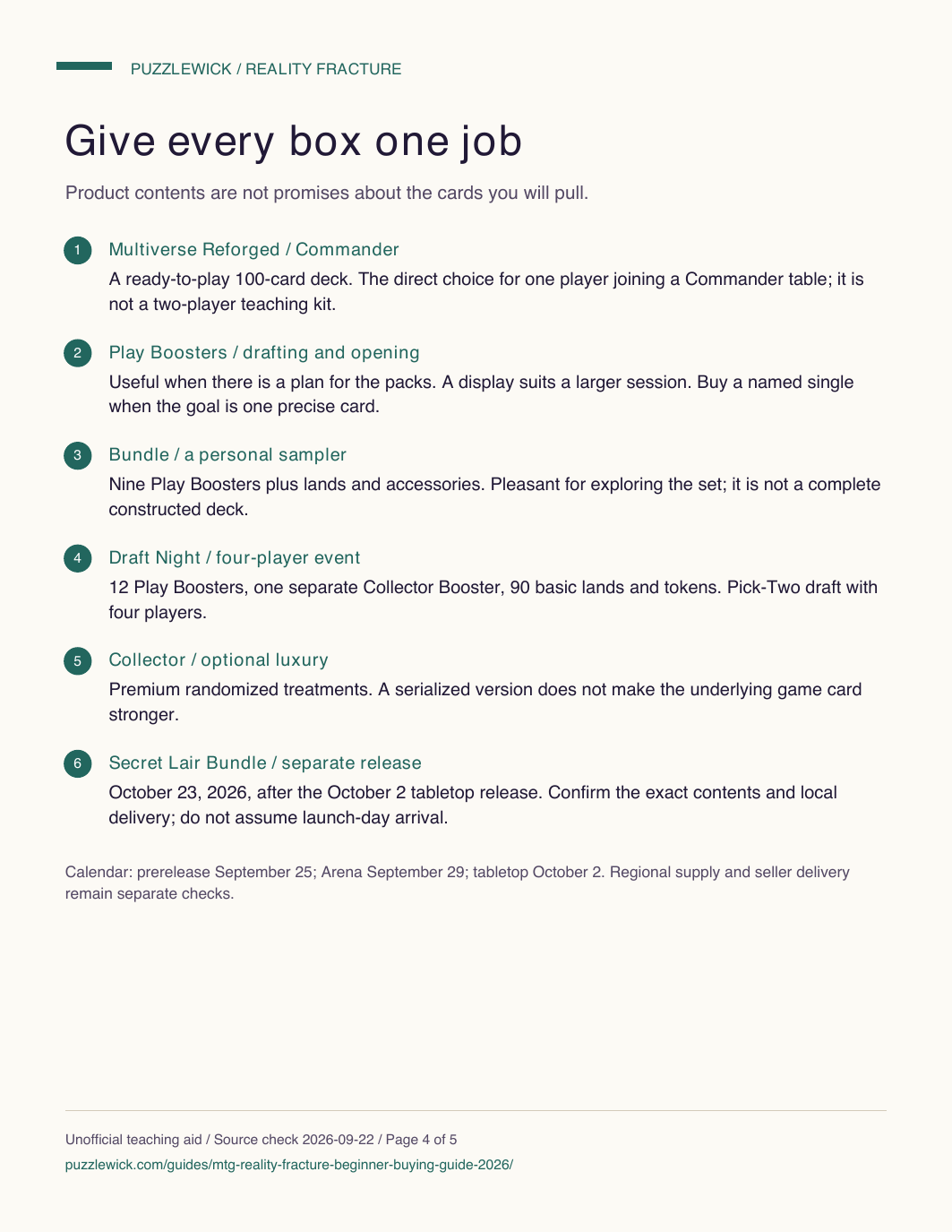
Give every box one job
Product contents are not promises about the cards you will pull.
- Multiverse Reforged / Commander
- A ready-to-play 100-card deck. The direct choice for one player joining a Commander table; it is not a two-player teaching kit.
- Play Boosters / drafting and opening
- Useful when there is a plan for the packs. A display suits a larger session. Buy a named single when the goal is one precise card.
- Bundle / a personal sampler
- Nine Play Boosters plus lands and accessories. Pleasant for exploring the set; it is not a complete constructed deck.
- Draft Night / four-player event
- 12 Play Boosters, one separate Collector Booster, 90 basic lands and tokens. Pick-Two draft with four players.
- Collector / optional luxury
- Premium randomized treatments. A serialized version does not make the underlying game card stronger.
- Secret Lair Bundle / separate release
- October 23, 2026, after the October 2 tabletop release. Confirm the exact contents and local delivery; do not assume launch-day arrival.
Calendar: prerelease September 25; Arena September 29; tabletop October 2. Regional supply and seller delivery remain separate checks.
Pack for the game you chose
Protect the deck first. Add comforts when they solve a real problem.
- The playable core
- Your complete deck or the event's required materials. Bring a way to track life and the tokens or counters your cards create.
- Opaque outer sleeves
- Choose standard-size Magic sleeves. A Commander deck needs 100, plus spares for damage or replacement.
- A box that fits the sleeving method
- A '100+' label is not a universal double-sleeve guarantee. Check the exact model's capacity and leave room for tokens without compression.
- Optional inner sleeves
- Useful for valuable cards or frequent handling. They add thickness; test the fit before filling a box.
- Optional table and collection kit
- A licensed mat can make a clean play surface. A binder organizes a collection; it is not required to play one deck. Sleeve a special pull before rigid protection.
- Before leaving home
- Confirm event time, format and supplied lands. Tell the host you are learning. Stop shopping when the kit already supports the evening.
Capacity advice is a specification check, not a claim that Puzzlewick physically tested your sleeve-and-box combination.
Download the first-game field guide (PDF, five pages)
Unofficial teaching aids · September 22, 2026 · Original explanatory text and diagrams. See the article's linked primary sources for current rules and corrections.
Start here, then go deeper
You are in the right cabinet.
 ✶ Universe HubMagic: The Gathering: the whole buying pathMagic: The Gathering is the deepest construction sandbox in the Big Three: a two-player duel, four-player Commander ritual, draft...
 🂠 Topic PathTrading Card Games: compare the whole shelfStart with the game and community you want, then buy the smallest product that lets you test it properly. These guides separate...
 ExplainerReality Fracture Commander: Build the Engine, Choose Your CommanderA source-checked look at Multiverse Reforged, with a stock-deck audit, Jace and Nissa decisions, rules drills and a collector’s stopping...
Choose the evening you want

Pick the sentence that sounds like you. The next action should make sense before a checkout does.
- I want to learn: try the Arena tutorial or ask a store for a Learn-to-Play session. Then use the basic turn lesson. No purchase is needed to choose a direction.
- I want the same deck for evenings with friends: ask what they play. If the answer is Commander, compare a simpler precon with Multiverse Reforged.
- I want to discover Reality Fracture: start with prerelease Sealed if help is available, or Pick-Two Draft when four friends already want to draft.
- I want the art: decide whether opening packs is the entertainment or you want a specific card. Use the collector boundary before choosing sealed product.
Our complexity judgments concern the learning burden, not a measured difficulty score. A complete deck saves deck-building work; it does not remove its rules complexity.
Welcome to the Echoverse, without the homework
Reality Fracture is a Magic story set, not a Universes Beyond crossover. Jace has constructed the Echoverse: a reality where recognizable people and places took different paths. Hexhaven is its magical campus. Knowing the familiar versions makes the contrasts richer, but you can enjoy the new characters on their own.
Read the card in front of you rather than importing abilities from its namesake. Echoed pairs connect alternate identities; the phrase does not mean every pair is one transforming card.
Read a little more lore, with no ending spoilers
The appealing question is what happens when a carefully designed ideal world meets people with their own desires. Hexhaven’s competing colleges make that conflict visible through different styles of magic. Try one character biography after your first game, then decide how far into the story you want to go. You do not have to memorize the entire cast before choosing colors.
Official background: Planeswalker’s Guide and The Legends of Reality Fracture.
Four dates, and a delivery question to ask separately
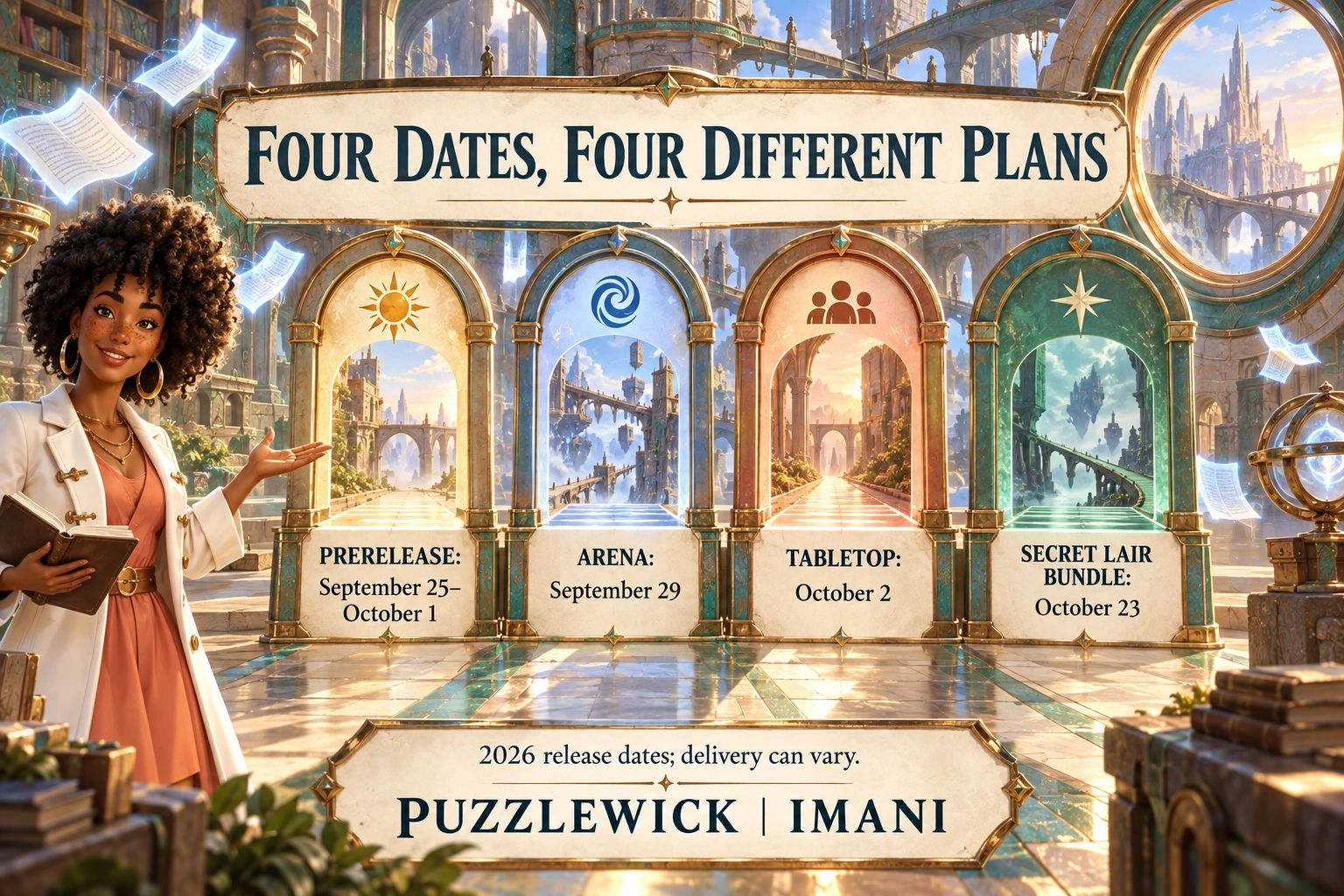
- September 25–October 1: prerelease events.
- September 29: Arena release.
- October 2: tabletop release.
- October 23: the separate Secret Lair Bundle release.
A release date is not a delivery promise. Wizards has reported regional delays; check the region, specific product and store arrangement before planning around an arrival. Ask whether an online prerelease kit includes event entry: the physical kit alone does not reserve you a seat.
Official schedule and product sources: Where to Play, Collecting Reality Fracture and regional product-delay notice. Dates checked September 22, 2026.
Which product actually gives you a deck?
Multiverse Reforged is the one Reality Fracture Commander precon. Its 100-card list provides the playable deck. The five mono-color Foundations Commander decks released alongside it are separate products, useful to compare when you want a simpler color commitment.
Draft Night supplies a four-person Pick-Two draft. The Bundle supplies nine Play Boosters and supporting contents for a personal opening. A Play Booster display supplies packs for a planned series of Limited games or opening sessions. Collector Boosters concentrate premium treatments. The Secret Lair Bundle is a different collector purchase with a later date.
Do not treat a single pack, display, case and bundle as interchangeable listings. The title, quantity, language and photographed box must match. Product identity was checked September 22, 2026. Confirm the selected variant, seller and delivery estimate at checkout; a listed buying option is not a stock or delivery guarantee.
Contents are publisher facts, not hands-on claims: official collecting feature and Multiverse Reforged decklist.
A format tells you what kind of game you are building
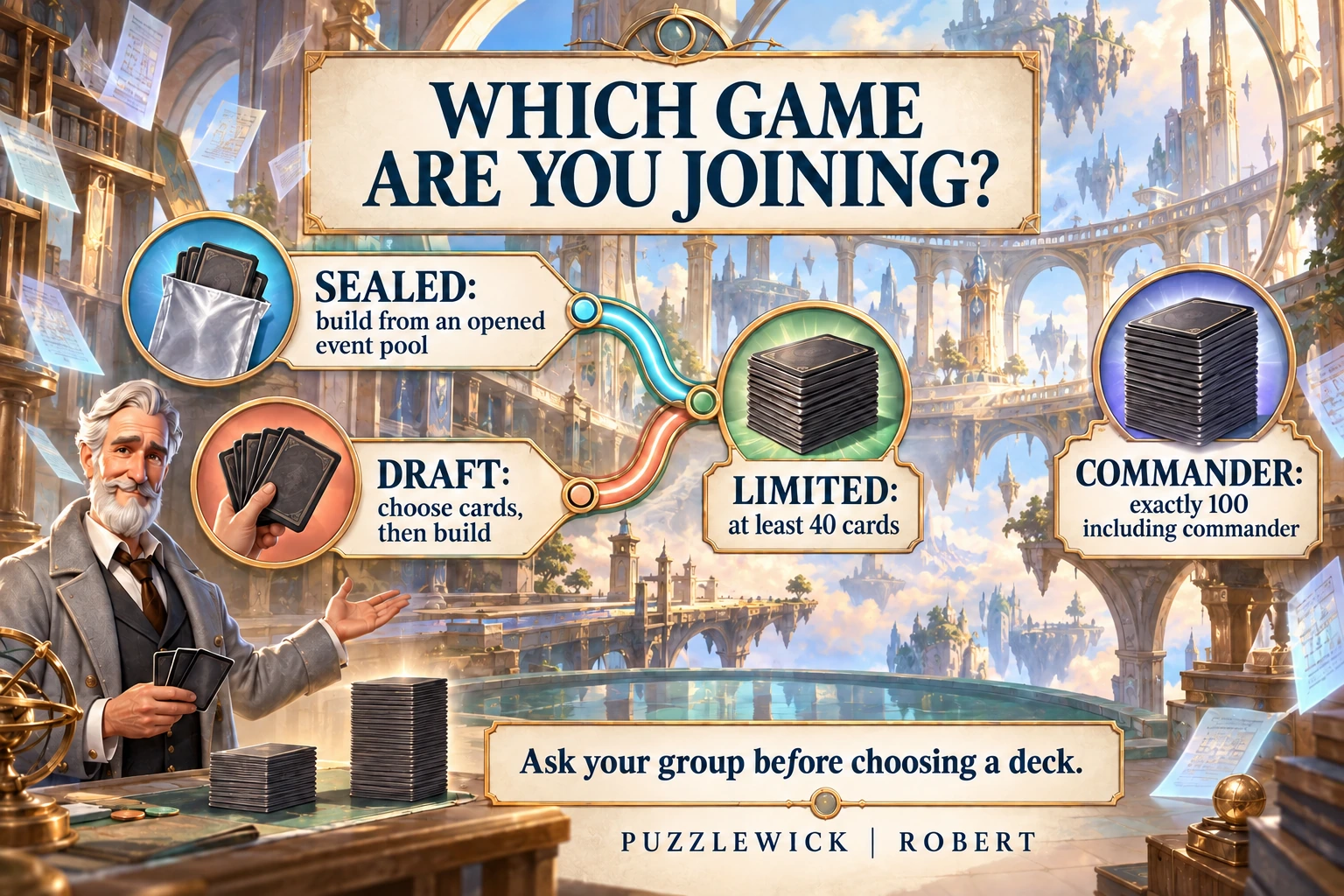
Choose with the people you expect to play. The same expansion can supply cards for several formats, but a deck built for one format is not automatically legal in another.
Sealed: open a pool, build a small deck, play one opponent
You build a deck of at least 40 cards from your event pool, usually six boosters, plus basic lands. There is no draft-picking step. This makes a guided prerelease a useful first set-specific event. Bring your willingness to sort; the event supplies the pool. Official Sealed rules.
Draft and Pick-Two: choose your cards before building
Draft adds a selection game: you take cards and pass the rest. Reality Fracture Draft Night is a four-person Pick-Two kit. You choose two per pick, build at least 40 cards with basic lands, then play one-on-one matches. Read the short procedure below.
Commander: a repeatable social deck
Start with a ready list and a group willing to explain its pace. A typical table has four players and more simultaneous information than a duel. Its 100-card singleton construction, commander and color identity need their own short lesson.
Standard and other constructed formats: choose the event before the cards
Standard, Pioneer, Modern and Pauper use different eligibility rules and banned lists. Start from a current legal deck and acquire the specific cards it needs. Do not assume FRC Commander cards or SPG Special Guests become Standard legal because they share a Reality Fracture product. Brawl is another commander-led format; Arena Brawl is not paper Commander. Check the exact format page and current card eligibility before purchasing a list. Official formats directory; current banned and restricted lists.
Read a card, pay for a spell, take a turn
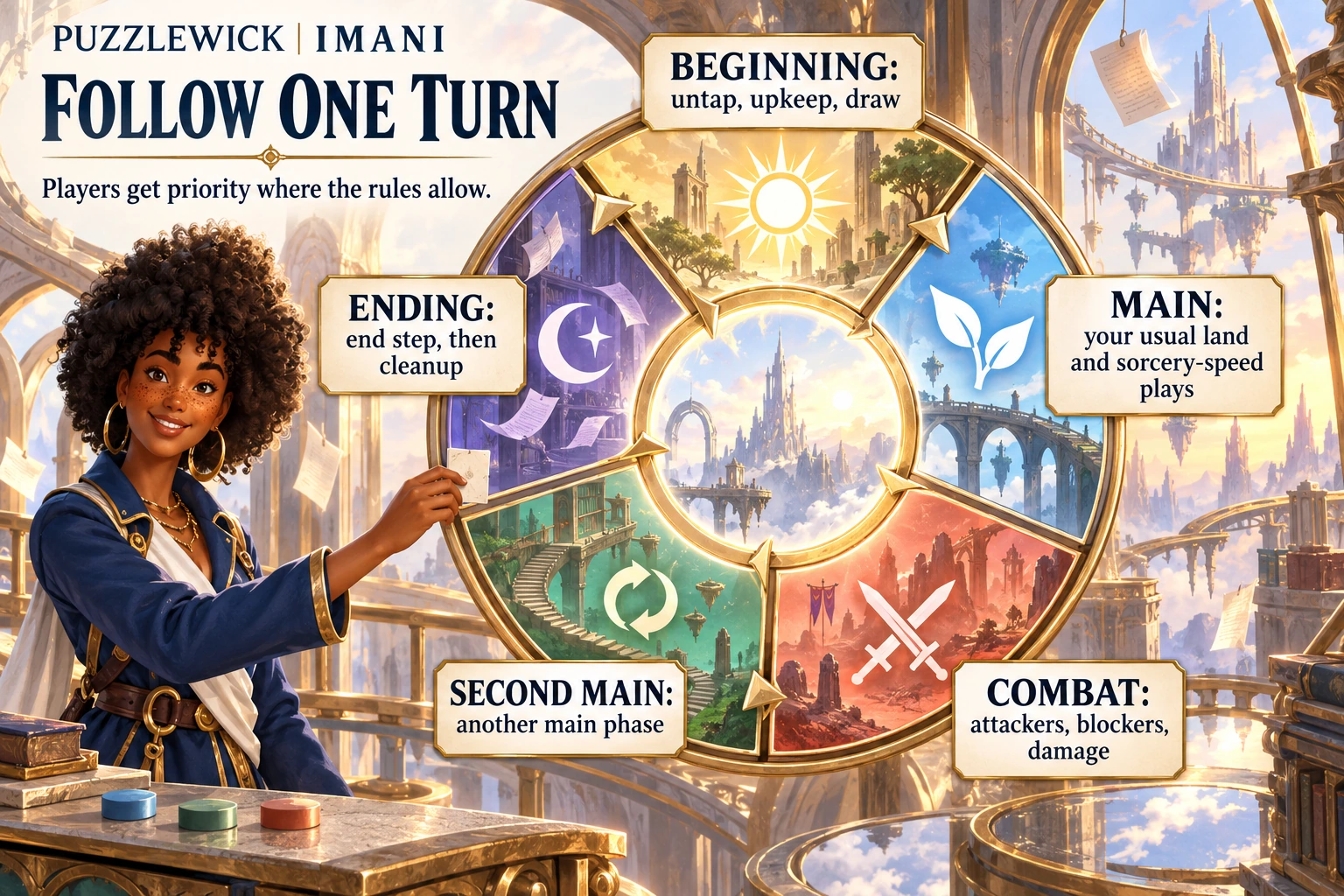
Set up an ordinary duel: each player shuffles a legal deck, starts at 20 life and draws seven cards. If your first hand is unworkable, ask your teacher to explain the format’s mulligan procedure before keeping it. Commander changes the deck and life rules, as explained below.
Your library is the face-down deck, your hand is what you can usually choose to play, the battlefield holds permanents in play, and the graveyard collects spent or destroyed cards. Keep these zones distinct.
On an ordinary creature card, find its mana cost near the name, its card type below the illustration, its abilities in the text box, and its power/toughness at the lower right. A 2/3 deals 2 damage in ordinary combat and normally dies after 3 damage has accumulated on it that turn. The illustration and frame treatment do not change those numbers.
A land is a resource, not a spell. Normally you may play one land during your turn. Tapping a Plains for white mana does not discard it; it stays on the battlefield. A cost written as {2}{W} needs one white mana plus two more mana of any type. Three Islands cannot pay the white requirement by themselves. Wizards’ basic play guide.
- Beginning: untap, handle upkeep triggers, then draw. In an ordinary two-player game, the starting player skips their first draw; multiplayer Commander does not use that skip.
- First main phase: play your land if you have one and decide which spells to cast.
- Combat: choose attackers, allow blocks and responses, then resolve damage.
- Second main phase: you have another opportunity for main-phase actions, but not a fresh normal land allowance.
- Ending: handle end-step abilities, then cleanup, including removal of damage marked on creatures and discarding to your maximum hand size when required.
Announce each change of phase during a teaching game. It gives both players a fair chance to act and makes missed steps easier to catch. Current rules reference.
Timing and combat: leave room for the other player
You normally cast a sorcery or a creature during your own main phase when the stack is empty. An instant can usually be cast whenever you have priority, including during another player’s turn. A spell is not finished the moment you announce it: players get opportunities to respond. The last object added to the stack resolves first, then players can act again before the next resolves.
Teaching example: one spell targets a creature. The opponent responds with another spell. Resolve the response first; then check whether the original target is still legal. Read the exact effects instead of assuming that responding always cancels the first spell.
A creature normally cannot attack or use an ability with its own tap or untap symbol unless you have controlled it continuously since your current turn began; haste can change that. A new creature can normally block. Attacking usually taps a creature, while blocking does not. You attack a player, planeswalker or battle as allowed; you do not simply declare an attack on an opposing creature.
The defender chooses legal blockers. An unblocked attacker normally damages the attacked player or permanent. A blocked creature normally remains blocked even if its blocker disappears, so it does not suddenly hit the player unless an effect such as trample changes the result. Players usually lose at 0 life; being unable to draw a required card and other rules or card effects can also end a game. Official rules reference.
Try one legal turn before adding more rules
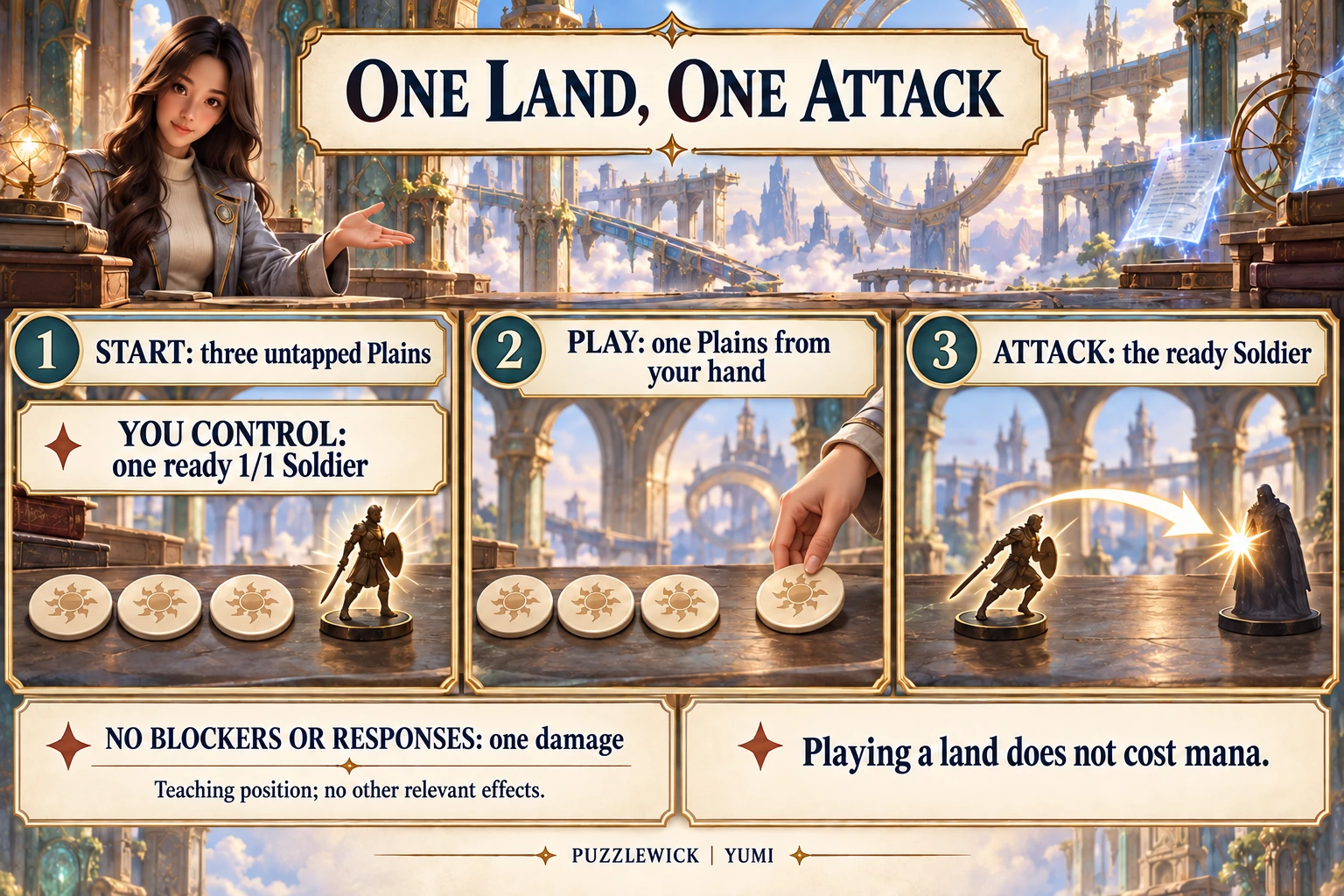
Instructional position: it is your precombat main phase in a two-player game. You have three untapped Plains and an untapped white 1/1 Soldier creature token you controlled when your turn began. You have not played a land this turn. A Plains is in your hand. Your opponent has no creatures, no relevant permanents and will take no actions this turn. No other effects apply.
Think first: may you play the Plains, tap all four for mana, and attack with the Soldier? Must you sacrifice a Plains? What happens to unused mana?
Show the turn and explanation
- Play the Plains using your normal land play. You now control four Plains.
- Each Plains may tap for one white mana, including the new land. The creature readiness rule does not stop an ordinary land’s mana ability.
- You do not need to tap any land just to attack. Unspent mana empties as steps and phases end, so producing it without a use does not save it for next turn.
- Declare the Soldier attacking your opponent and tap it. It meets the control-duration requirement and nothing prevents it attacking.
- With no block or response, it deals 1 combat damage to your opponent. It remains tapped after combat.
- In your second main phase, you do not get a second ordinary land play. On your next turn, surviving tapped permanents normally untap in the untap step.
This is a deliberately small rules exercise, not a photographed match, a recommended opening hand or a claim that we played the stock deck. Once the turn is comfortable, let the opponent add a legal blocker and explain how that changes your attack. Rules basis: Wizards’ rules reference.
Commander in the few rules you need first
A typical Commander game has four players, each starting at 40 life. Your deck has exactly 100 cards including its commander, normally one copy of each card except basic lands. Follow the commander’s color identity and any actual card-specific exceptions.
The commander begins face up in the command zone. Casting it from there costs its normal cost plus two generic mana for each earlier time you cast it from that zone this game. Returning it there does not reset the count. A player who takes 21 combat damage from the same commander loses, even if their life total is still high.
Color identity is more than the background color of the card. Mana symbols in rules text, color indicators and other relevant characteristics can matter. Use a current deck checker when changing the list. Jace’s explicit permission lets him be this deck’s commander; a planeswalker card is not automatically eligible.
These are the entry rules, not every exception. Official Commander format page and the exact deck page.
Before shuffling, say that you are learning, name your unchanged precon, ask what pace the others enjoy, and ask someone to explain attacks at planeswalkers. That conversation is part of preparing the deck.
Is Multiverse Reforged a good first Commander deck?
For someone who knows basic Magic and wants its particular engine, it is a coherent starting purchase. For a first-ever rules lesson, it asks a lot: four colors, a planeswalker commander, expendable material and conversion into creatures or planeswalkers. That is our analysis of the list, not a measured playtest verdict.
The official 100-card list is available now, with Jace, Multiverse Architect as commander and Nissa, Leyline Tamer as the alternate. There are 18 new designs. You no longer need to wait for an unrevealed list; you do need real games before calling its table performance settled. Read Wizards’ complete decklist.
Compare the separate Foundations decks when simpler mana is useful: Calling All Angels (Giada), Keen Engineering (Sai), Wretched Ranks (Ghoulcaller Gisa), Reign of Dragons (Lathliss), and Tramplesaurus Rex (Ghalta). They are not five more Reality Fracture precons. Official Foundations Commander decklists.
First three sessions: learn the unchanged deck’s plan; note awkward mana or stranded cards; then ask whether the same problems recur at your table. Change a small, explained package only after that. Keep the original list and removed cards. The strategy guide studies Jace, Nissa and the stock deck separately.
Angel-token correction: Wizards reports that early printings include a blue 3/3 Angel marker where Ob Nixilis needs a white 4/4 Angel creature token with flying. Represent the correct token characteristics clearly. The wrong marker does not change the card’s rules and does not require buying more packs. Official deck and token notice.
Your first prerelease: build a deck you can actually cast
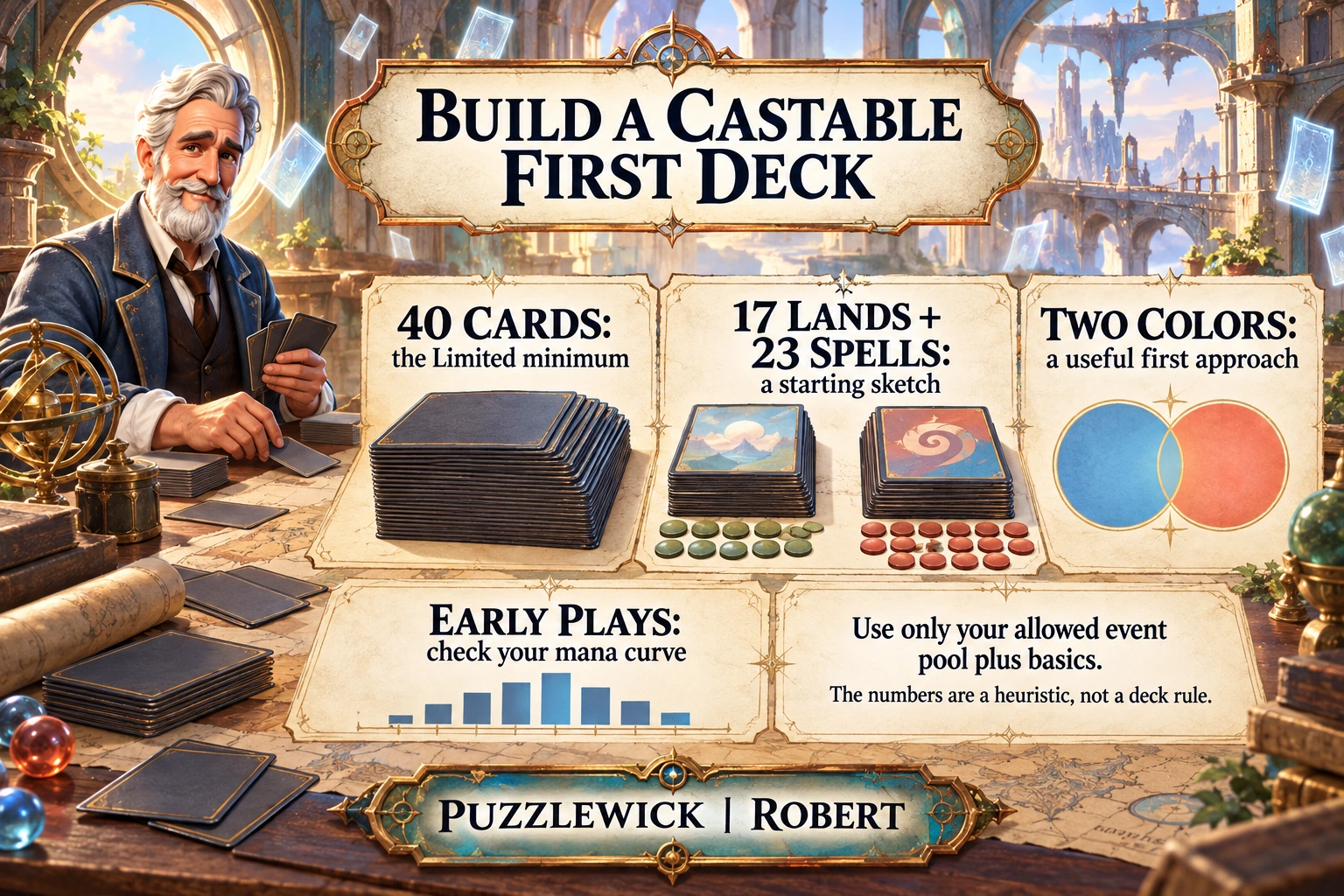
Call or check the event listing first: time, registration, format, basic lands, and whether staff can help a new player. Bring a way to track life, sleeves if you have them, a pen, water and enough time to learn. Do not bring purchased singles to improve your Sealed pool.
For an ordinary one-player prerelease Sealed event, build from its allowed pool and add basic lands. Aim at the 40-card minimum. A useful first sketch is 17 lands and 23 nonlands, commonly concentrating on two colors. This is a starting heuristic, not a deck-construction rule. A low curve, fixing, or reusable mana can justify changes when you can explain them. Official prerelease guide.
- Sort by color, then separate lands from spells.
- Look for early plays and interaction before committing to the most exciting rare.
- Arrange possible spells by mana cost. If the opening turns contain nothing affordable, rebuild the early part of the curve.
- Choose colors that provide enough useful spells and castable costs. A splash needs an actual mana plan.
- Count the finished deck, then ask for a second look while there is time.
At the table: introduce yourself as new, keep your cards and life total readable, announce actions, and call staff when a rules question matters. You do not need to pretend to understand a card. After a game, identify one card that repeatedly stayed in your hand and one decision you would change.
Playing Two-Headed Giant instead?
Do not use this solo pool recipe unchanged. Reality Fracture uses one Prerelease Pack plus two Play Boosters per pair for its Two-Headed Giant prerelease. This replaces the older expectation of two complete kits per team. Read the event-specific instructions and confirm the local organizer’s details before buying kits.
Draft Night: four people, a card-selection game, then duels
Draft Night contains 12 Play Boosters, one Collector Booster and 90 basic lands. That gives four people three draft boosters each. The Collector Booster is separate from the normal drafting packs; agree how it will be used and who keeps all cards before opening. Official product contents.
- Each player opens their first Play Booster. Take two cards, then pass the rest left.
- Continue taking two and passing until those packs are exhausted.
- Open the second pack and pass right. With the third pack, pass left again.
- Build at least 40 cards from your drafted pool plus basic lands. Play one-on-one games, not a four-person Commander game.
The published four-player procedure pairs the two first-round winners together and the other two players together for round two. Official Pick-Two Draft procedure.
Choose this when card selection itself sounds fun to the whole group. If everybody is still trying to remember when to draw, do a teaching game first. A box can supply cards; it cannot supply the missing fourth player or a shared interest in drafting.
Three mechanics to recognize before the first match
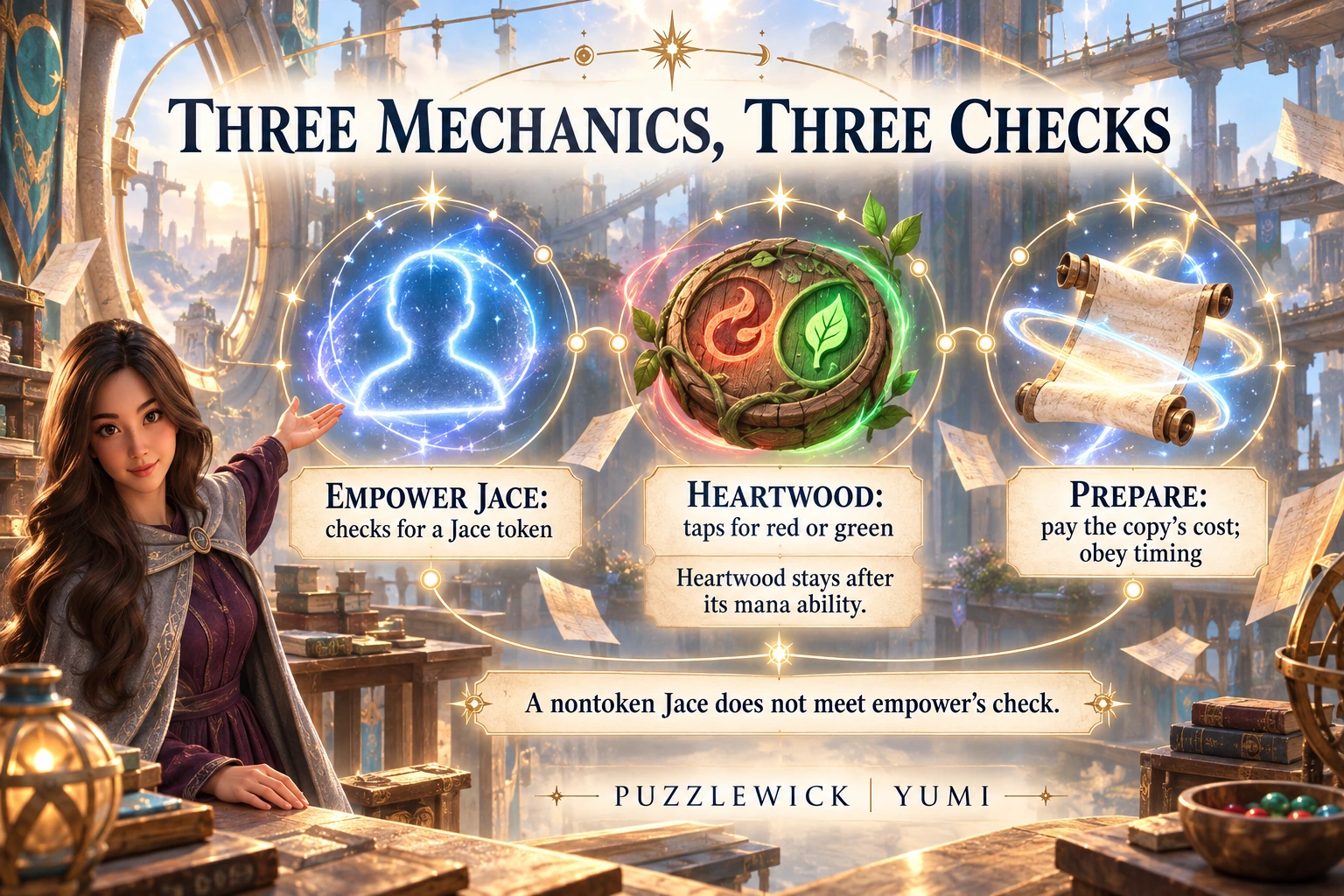
Empower Jace: check for a Jace planeswalker token. Put the stated loyalty counters on one you control; otherwise create the specified zero-loyalty Jace token and add those counters. A nontoken Jace does not satisfy the check. Example: empowering for two with no Jace token leaves the new token with two loyalty.
Heartwood: this red-and-green artifact token taps for red or green mana. You keep it after using that ability, so it can produce mana again after untapping. It is not a Treasure that you sacrifice.
Prepare: a prepared permanent makes its prepare-spell copy available in exile. Pay the cost and obey timing when you cast it; doing so unprepares that permanent. If the permanent leaves or becomes unprepared first, the waiting copy disappears. This returning mechanic does not let you cast the little spell directly from the creature card in your hand.
Source: Matt Tabak’s official mechanics explanation, checked September 22. Use the release notes for card-specific interactions. The advanced rules drills explore the trickier cases.
Bundle, display or Secret Lair Bundle: three different openings
The ordinary Bundle’s nine Play Boosters make it a contained pack-opening gift. A display’s larger pack supply makes sense when you have planned drafts or deliberately want more opening. Neither supplies a tuned constructed deck. If you can name the one card you want, compare that exact single instead of treating random packs as a search method.
The Secret Lair Bundle is separate and releases October 23. Its contents include six Play Boosters, two Collector Boosters, and two special promo cards drawn from a ten-card pool. It does not include all ten promo designs. Confirm which bundle the photograph and quantity describe. Official bundle and treatment breakdown.
For gifting, ask whether the recipient wants a deck for a game or an opening experience. Both can be enjoyable; a beautiful pile of ingredients is simply a frustrating substitute when they expected dinner.
Collect the treatment you want, with a stopping point
The serialized Bloodline Recollector treatment is limited to 500 copies. The nonserialized version has the same game function. That quantity does not tell you the probability of finding one in your particular pack or establish a future resale value. Wizards’ treatment disclosure.
Choose Collector Boosters only when the premium opening itself is worth your entertainment budget. A wish for one artwork is a reason to compare the exact single and treatment, not a reason to assume a display will contain it. Facet foil and fracture foil are different labels; check the exact variant.
For a first collection, decide in advance what you want to keep and when you will stop. Open on a clean surface and prepare suitable sleeves. Rarity does not replace condition, provenance or enjoyment. None of these recommendations is an investment forecast.
The smallest useful kit, then the optional upgrades
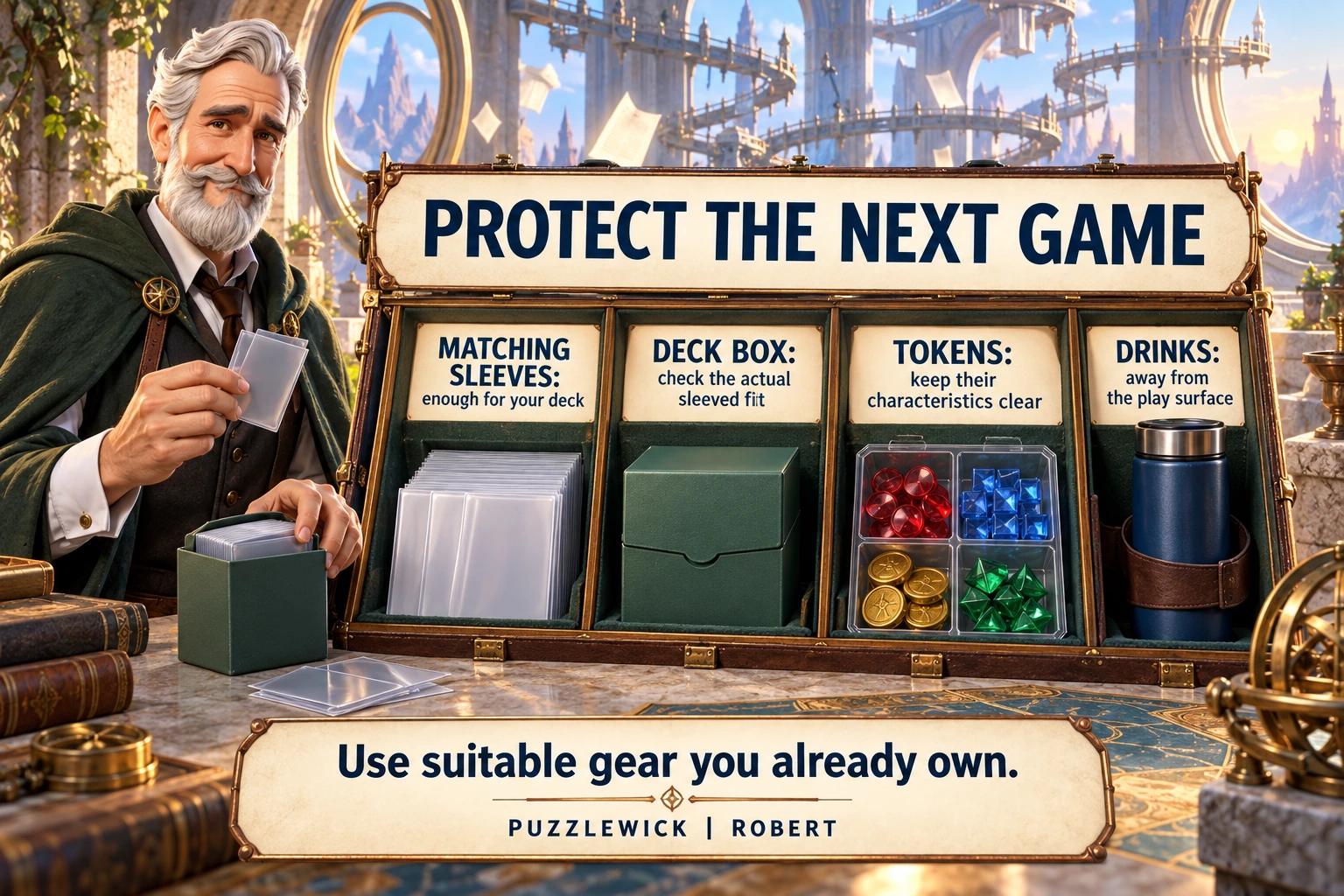
For one Commander deck: enough matching opaque standard-size sleeves for all 100 cards, a few replacements if available, a box that fits the exact sleeve combination, and a clear way to track life and tokens. Reuse suitable gear you own. A capacity claim is a manufacturer specification, not proof that we physically tested your combination.
For prerelease: your organizer supplies the event pool; ask about basic lands and bring protection for the deck you build. Keep cards outside the deck separate. For collector cards: use soft protection before a correctly fitting rigid holder when needed. Do not force a card into a holder.
Inner sleeves add bulk. Check the packed deck before travelling instead of compressing it into a nominally 100-card box. A mat is optional: it can provide a clean surface, easier card pickup and artwork you enjoy. A binder serves a browsing or trade collection, rather than the deck you shuffle every game.
The photographed sleeve and box variants solve different problems. Keep usable gear until you can name the replacement’s job: easier transport, a better fit or a separate home for cards outside the deck.
Leave the first session with a second one in mind
- Session one: finish a tutorial or a patient teaching game. Be able to explain a normal land play, a spell’s cost, attacking and blocking.
- Session two: play the format you chose. Ask for help, keep the list or pool intact, and record the rule that most often interrupted you.
- Session three: revisit that rule, then decide whether the same deck or event is still what you enjoy. Adjust a repeated problem before buying a new product category.
Ready for a local evening? You can name the format, bring its legal deck or know how the event supplies one, track life, explain your actions and ask for a ruling. Perfect recall is not required. Clear communication is.
For more story, start with one official character profile. For deck engines and the complete stock list, continue to the Reality Fracture strategy guide. For another beginner route, visit the broader Magic starting guide.
Save the reminders and check the sources

Take the first-game field guide PDF or PNG to a teaching session. Commander readers can save the stock deck text list and use the advanced guide’s audit tools.
Method: publisher product pages establish contents and dates; current rules and card text establish play. Our teaching positions are constructed examples. Deck-fit judgments are analysis of the list. No physical playtesting, pull-rate study or post-release metagame ranking is claimed.
Andrew Quinn’s written Draftsim Limited review supplies an early set-reading comparison, not established win-rate data. Tomer Abramovici’s written MTGGoldfish precon analysis supplies a separate deckbuilding perspective. Both sites carry affiliate commerce; their opinions do not establish rules or product availability. Creator videos were not watched for this guide.
Found a mistake? Use Puzzlewick’s about and editorial contact route and name the section, the claim and the source that changes it.
The picks
Some links below are affiliate links — as an Amazon Associate, Puzzlewick earns from qualifying purchases, at no extra cost to you. It never changes a pick.
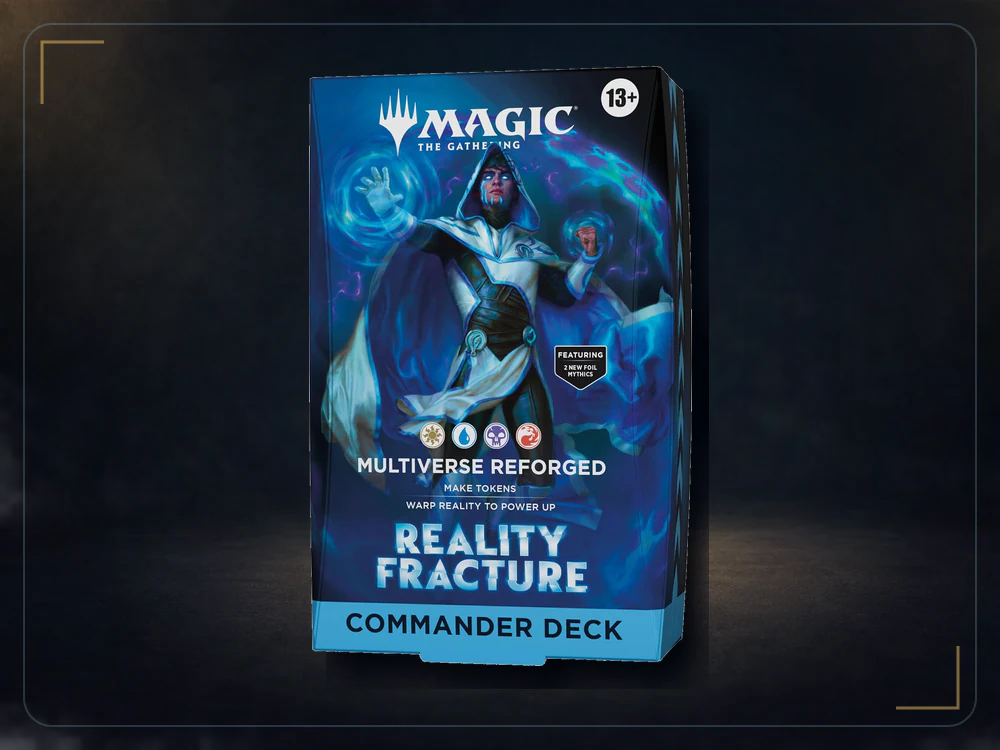
Reality Fracture — Multiverse Reforged Commander Deck
One 100-card deck, two foil borderless commander choices, 10 double-sided tokens, a deck box and guides. Buy this when you want to pilot the published list and learn Jace or Nissa before changing cards.
- 100-card preconstructed list with two commander choices
- Includes double-sided tokens and a deck box
- One player needs opponents with decks; four-color sequencing adds work.
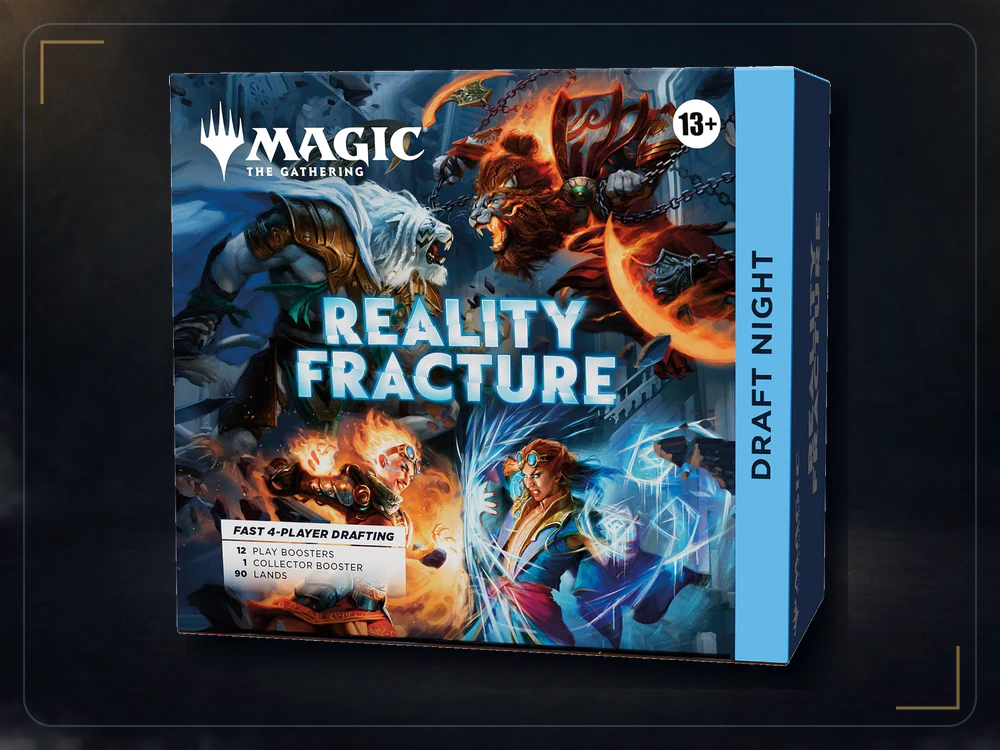
Reality Fracture Draft Night
The self-contained Pick-Two Draft product supplies 12 Play Boosters, one Collector Booster, 90 basic lands and 10 tokens. Its exact four-person job makes it more coherent for that event than improvising from a nine-pack Bundle.
- Twelve Play Boosters match four players at three packs each
- Ninety basic lands support building the draft decks
- Agree how to distribute the Collector Booster before playing; drafting still requires deckbuilding.

Reality Fracture Bundle — 9 Play Boosters
Nine Play Boosters, 30 basic lands, an alternate-art foil promo, a Spindown and storage box give this purchase a defined stopping point. The box is useful afterward, but its random cards do not constitute a ready Commander deck.
- Nine Play Boosters give one opening session a clear boundary
- Includes basic lands, a Spindown and a storage box
- Nine packs cannot supply three packs each to four drafters.
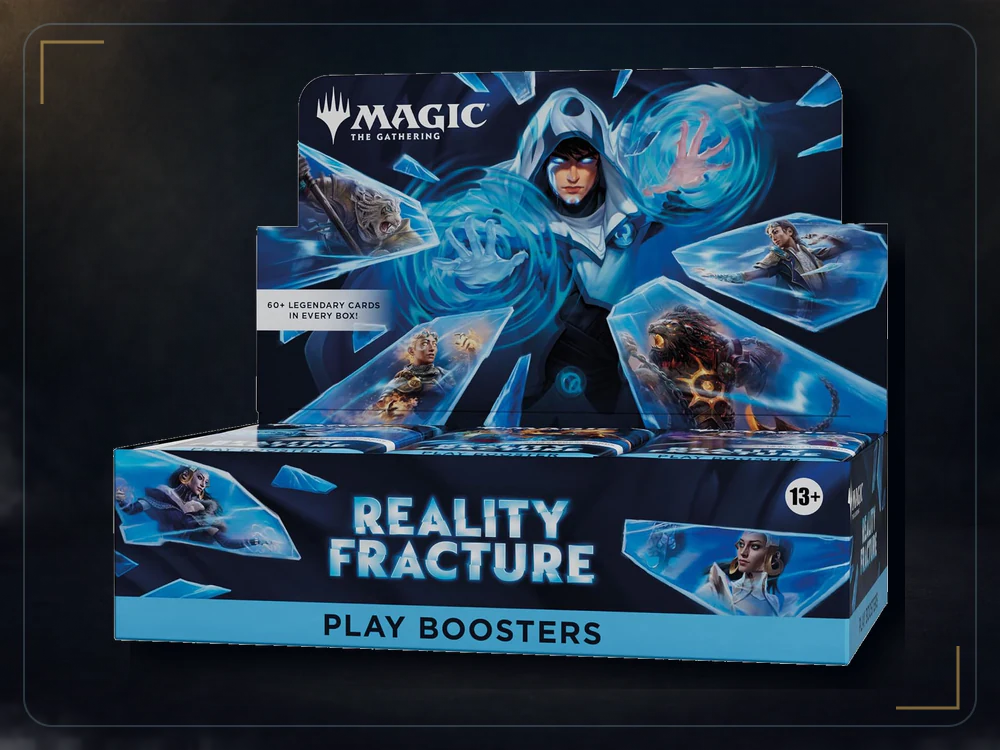
Reality Fracture Play Booster Box — 30 Packs
Thirty 14-card Play Boosters support repeat drafting or Sealed when the group supplies lands. Plan seats and pack allocation first: a normal eight-person three-pack draft uses 24 packs and leaves six.
- Thirty packs allow several planned Limited sessions
- One eight-player draft uses 24 packs and leaves six
- Random contents do not guarantee a specific upgrade; this is one display, not a case.
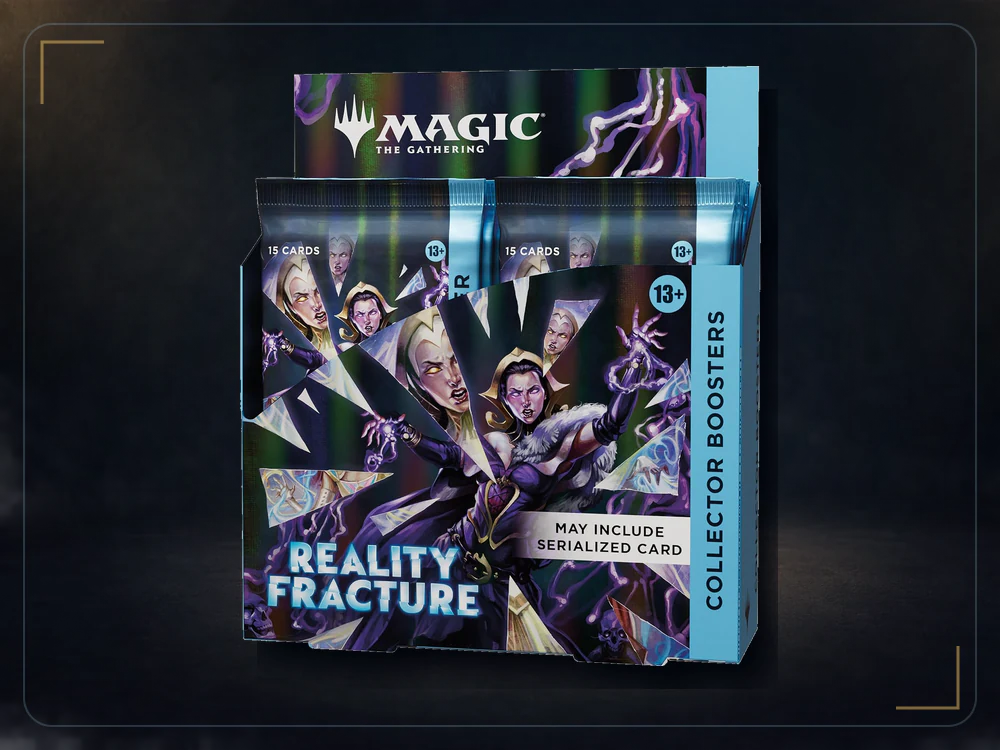
Reality Fracture Collector Booster Box — 12 Packs
Twelve 15-card Collector Boosters concentrate alternate treatments and foil cards. Treat this as an entertainment purchase for someone who wants those treatments, with the entire spend decided before opening.
- Twelve packs focused on foil and alternate treatments
- A distinct choice for collectors who value the opening experience
- Neither the desired card nor a serialized card is guaranteed; this is one display, not a case.
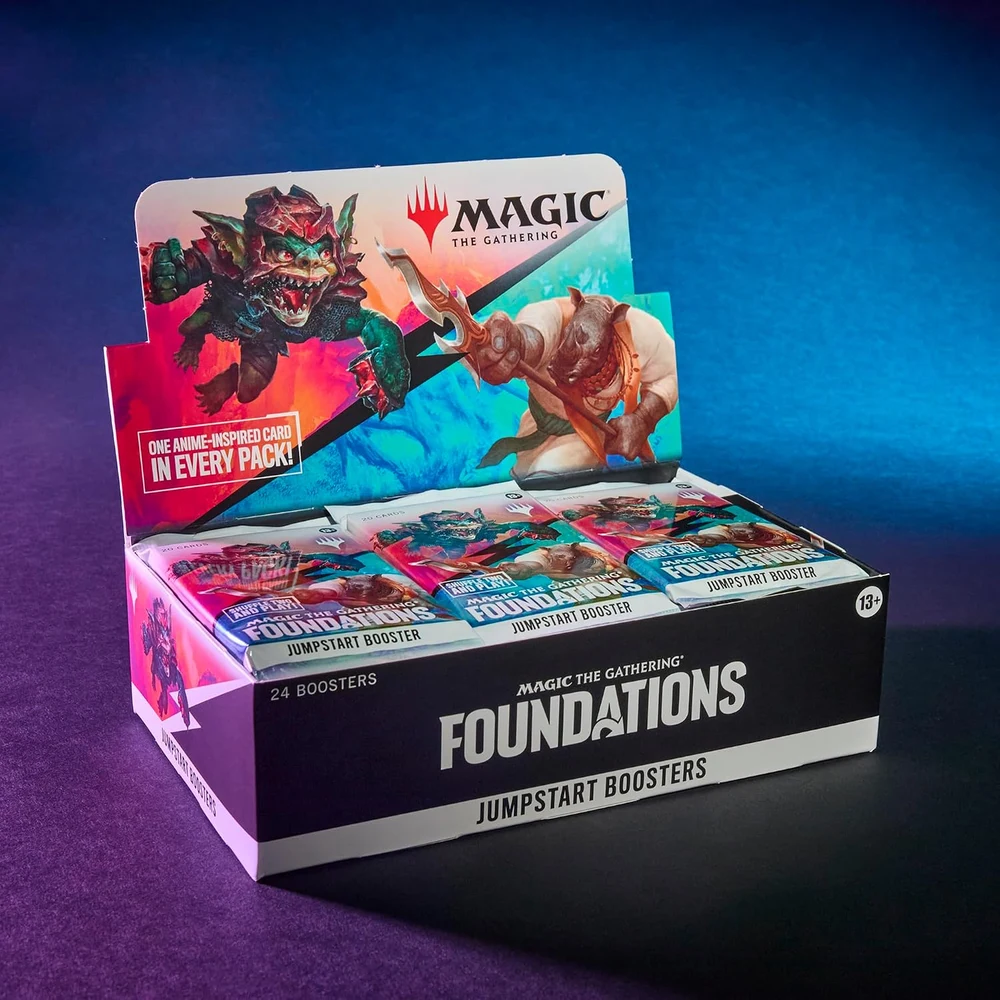
Foundations Jumpstart — 24 Boosters
This listing is a display of 24 Jumpstart Boosters, each with 20 cards including lands. Two packs combine into one playing deck; four packs supply two players. Keep opened themes intact to recombine them later.
- Two 20-card packs combine into one playing deck
- Lands are included; intact themes can be recombined
- This display contains more packs than two players need for one match; it is not the guided Beginner Box.
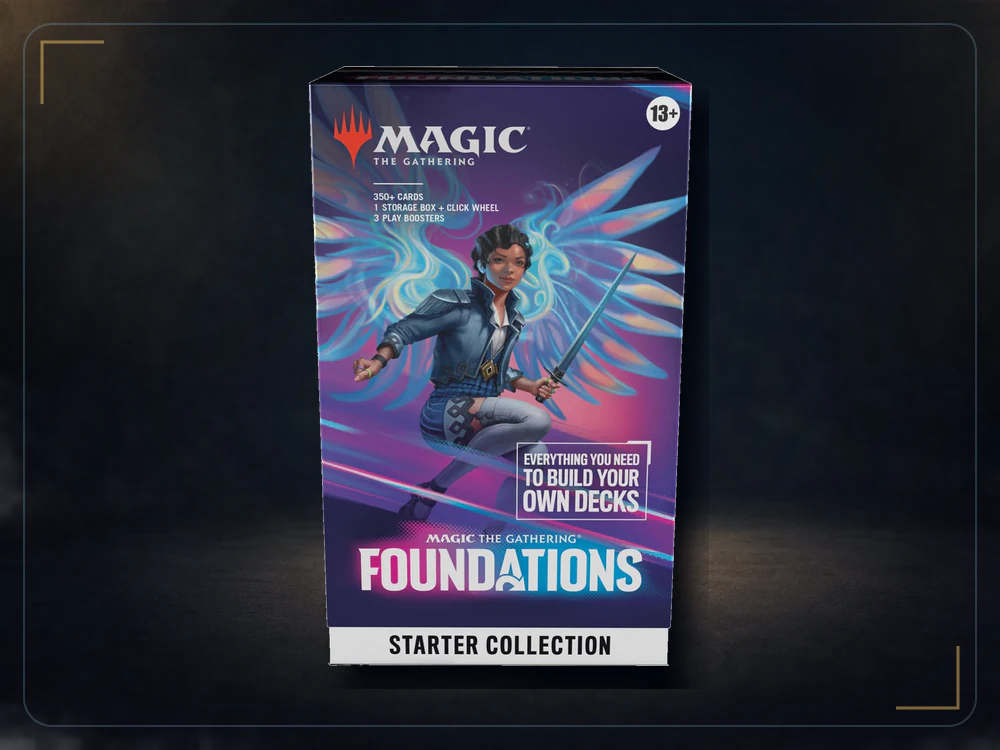
 2 photos
Foundations Starter Collection
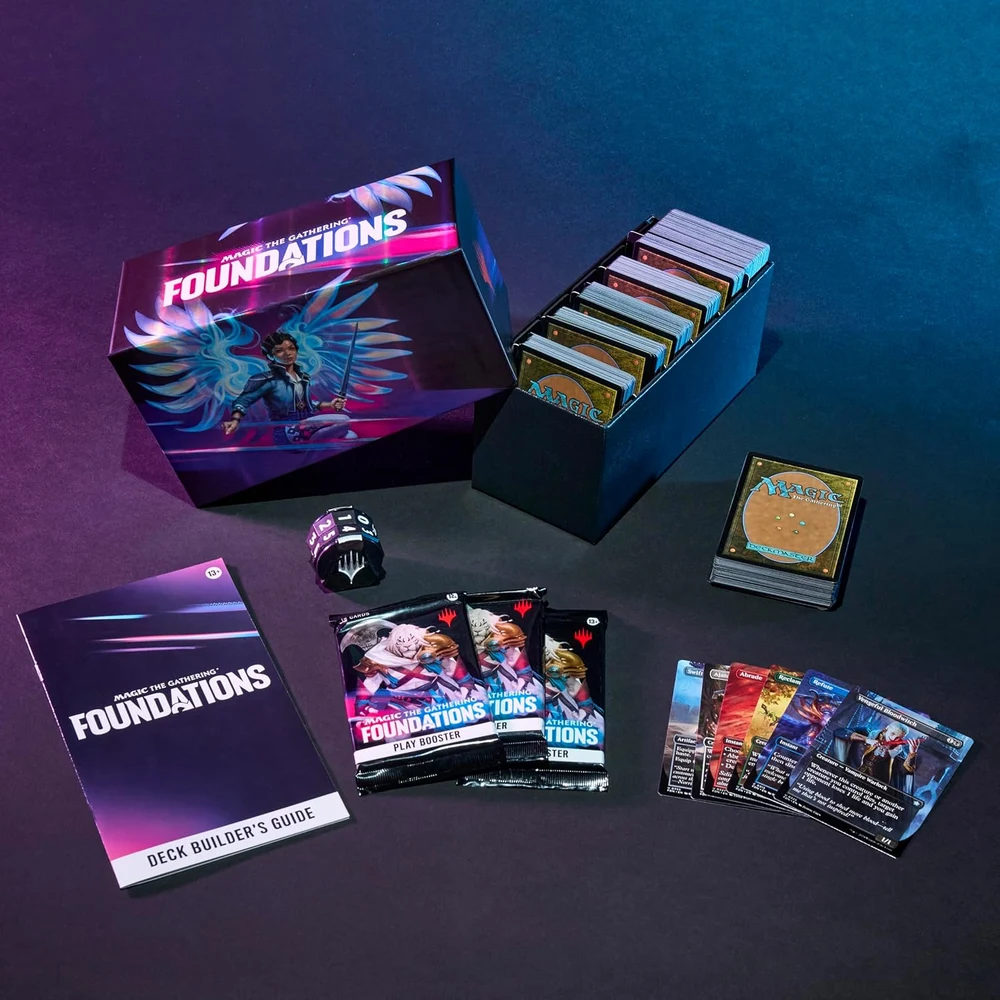
The Starter Collection supplies 387 fixed cards, three Play Boosters, tokens, storage, a life counter and a deckbuilding guide. Its role is a card pool for building, so it belongs after the first guided games.
- 387 fixed cards provide a known deckbuilding pool
- Includes storage and a deckbuilding guide
- This is a deckbuilding pool, not the guided Beginner Box or a ready Commander deck.
Foundations Commander — Tramplesaurus Rex
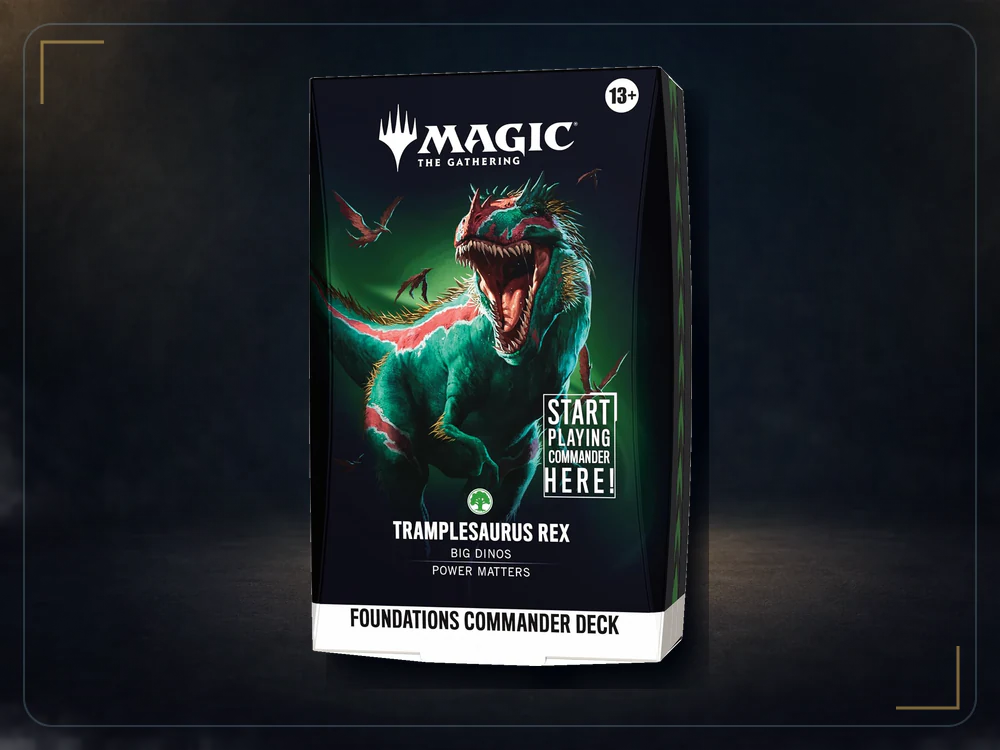
Ghalta, Primal Hunger leads a 100-card deck built around large creatures and power. It offers a clear combat plan and one-color mana as an alternative for a new Commander player who does not need the Reality Fracture setting.
- One-color mana reduces color-sequencing decisions
- Ghalta gives the large-creature plan a clear Commander identity
- A separate Foundations product releasing October 2; it is not another Reality Fracture precon.
At a glance
| Product | Job | Check first |
|---|---|---|
| Multiverse Reforged | A complete Commander deck | Four-color complexity and the table’s expectations |
| Prerelease Pack / event | A Sealed pool and a first set event | Event registration and basic-land provision |
| Draft Night | Four-person Pick-Two Draft | Four willing drafters and ownership agreement |
| Bundle | A personal pack-opening gift | Random cards, not a preconstructed deck |
| Play Boosters / display | Planned Limited games or opening | Pack quantity and actual event needs |
| Collector Boosters | Premium treatments | Fixed entertainment limit, no desired-card guarantee |
| Secret Lair Bundle | A later premium opening | October 23; two promos from ten designs |
Free download — Reality Fracture first-game field guide

Save a compact turn reminder, prerelease packing list and mechanic checks. Original unofficial teaching aid; current card text and event instructions take precedence.
Unofficial fan-made reference. Compiled by Puzzlewick from the sources listed on the sheet. Not affiliated with or endorsed by the publisher — always defer to the official rulebook.
Questions, answered
When does Reality Fracture release?
Prerelease runs September 25–October 1, 2026; Arena releases September 29; tabletop release is October 2. The separate Secret Lair Bundle releases October 23. Regional delivery can differ.
What should a complete beginner buy?
Start with a tutorial or guided learning session. For the set itself, consider a supported prerelease. Multiverse Reforged supplies a complete Commander deck, but its four-color engine is more demanding than a basic first rules lesson.
Is there more than one Reality Fracture Commander precon?
There is one: Multiverse Reforged. The five mono-color Foundations Commander decks released alongside it are separate products.
Does a Bundle contain a ready-to-play deck?
No. The ordinary Bundle contains random Play Boosters and supporting contents. It is a pack-opening product, not a preconstructed deck.
Are Draft Night games four-player Commander?
No. Four players draft, taking two cards per pick, then build decks of at least 40 cards and play one-on-one matches.
Does empower Jace add loyalty to any Jace?
It checks for a Jace planeswalker token. A nontoken Jace does not satisfy that check.
Do I sacrifice Heartwood when I use its mana ability?
No. Heartwood taps for red or green mana and remains on the battlefield; it can be used again after untapping.
What is the Multiverse Reforged Angel-token error?
Wizards reports that early copies contain a blue 3/3 Angel marker where Ob Nixilis creates a white 4/4 Angel creature token with flying. Use a clear marker with the correct characteristics.
Does the Secret Lair Bundle contain all ten special promos?
No. It contains two special promo cards selected from a ten-card pool.
Must I buy a playmat or upgrade the precon immediately?
No. Use a clean surface and suitable protection you own. Play the unchanged deck first, then replace cards or gear only when you can identify a repeated problem.
Are the new cards already legal to play?
This guide was checked September 22, 2026, before prerelease. Previewing a card does not make it eligible for every event. Confirm the format and release eligibility with your organizer before playing; FRC Commander cards and SPG reprints do not enter Standard simply by appearing in this release.
Imani's verdict
Choose the experience first. Learn with a tutorial or patient teacher, explore the set at a prerelease, and buy Multiverse Reforged when you already want its Commander engine. Draft Night suits four willing drafters. Packs are a separate entertainment choice.
Stop buying when you have the cards and materials for the next game. A useful first session ends with one thing you understood better and another session you want to play.
Research ledger 53 sources · reviewed 2026-09-22
Specifications, rules, current product information, community experience, and contrary evidence were checked against the sources below. Commercial links are kept separate from editorial evidence.
- Collecting Reality Fracturemagic.wizards.com/en/news/feature/collecting-reality-fracture
- Multiverse Reforged Commander Decklistmagic.wizards.com/en/news/announcements/reality-fracture-multiverse-reforged-commander-decklist
- Reality Fracture Mechanicsmagic.wizards.com/en/news/feature/reality-fracture-mechanics
- Reality Fracture Release Notesmagic.wizards.com/en/news/feature/reality-fracture-release-notes
- Planeswalker’s Guide to Reality Fracturemagic.wizards.com/en/news/magic-story/planeswalkers-guide-to-reality-fracture
- The Legends of Reality Fracturemagic.wizards.com/en/news/magic-story/the-legends-of-reality-fracture
- Where to Play Reality Fracturemagic.wizards.com/en/news/feature/where-to-play-reality-fracture
- Reality Fracture Prerelease Guidemagic.wizards.com/en/news/feature/reality-fracture-prerelease-guide
- Foundations Commander Decklistsmagic.wizards.com/en/news/announcements/foundations-commander-decklists
- Reality Fracture Product Delays in Select Regionswpn.wizards.com/en/news/reality-fracture-product-delays-in-select-regions
- How to Play Magicmagic.wizards.com/en/how-to-play
- Commander Formatmagic.wizards.com/en/formats/commander
- Sealed Deck Formatmagic.wizards.com/en/formats/sealed-deck
- Pick-Two Draft Formatmagic.wizards.com/en/formats/pick-two-draft
- Magic Rulesmagic.wizards.com/en/rules
- Magic Formatsmagic.wizards.com/en/formats
- Banned and Restricted Listsmagic.wizards.com/en/banned-restricted-list
- Reality Fracture — Multiverse Reforged Commander Deckamazon.com/dp/B0GXC9SDV9
- Reality Fracture Bundle — 9 Play Boostersamazon.com/dp/B0GXC9W89R
- Reality Fracture Play Booster Box — 30 Packsamazon.com/dp/B0GXCHBRTC
- Foundations Jumpstart 2025 — 24 Boostersamazon.com/dp/B0D9KYCWZY
- Read Plains on Scryfallscryfall.com/card/fra/281/plains
- Read Island on Scryfallscryfall.com/card/fra/283/island
- Read Brainstorm on Scryfallscryfall.com/card/frc/39/brainstorm
- Read Swords to Plowshares on Scryfallscryfall.com/card/frc/37/swords-to-plowshares
- Read Lingering Souls on Scryfallscryfall.com/card/frc/27/lingering-souls
- Read Secure the Wastes on Scryfallscryfall.com/card/frc/31/secure-the-wastes
- Foundations Starter Collectionamazon.com/dp/B0D9KYHN4D
- Read Elspeth, Sun's Champion on Scryfallscryfall.com/card/frc/24/elspeth-suns-champion
- Foundations Commander — Tramplesaurus Rexamazon.com/dp/B0GXC8T76T
- Foundations Commander — Calling All Angelsamazon.com/dp/B0GXC5T8LG
- Read Jace, Multiverse Architect on Scryfallscryfall.com/card/frc/1/jace-multiverse-architect
- Read Nissa, Leyline Tamer on Scryfallscryfall.com/card/frc/2/nissa-leyline-tamer
- Read Sol Ring on Scryfallscryfall.com/card/frc/21/sol-ring
- Read Arcane Signet on Scryfallscryfall.com/card/frc/20/arcane-signet
- Read Command Tower on Scryfallscryfall.com/card/frc/22/command-tower
- Read Kher Keep on Scryfallscryfall.com/card/frc/75/kher-keep
- Magic: The Gathering 2025 Land Station — 400 Basicsamazon.com/dp/B0DSR9CNF6
- Reality Fracture Draft Nightamazon.com/dp/B0GXC9JFZY
- Read Ob Nixilis, the Ascended on Scryfallscryfall.com/card/frc/5/ob-nixilis-the-ascended
- Read Plan for All Outcomes on Scryfallscryfall.com/card/fra/35/plan-for-all-outcomes
- Read Fatehold Charm on Scryfallscryfall.com/card/fra/132/fatehold-charm
- Reality Fracture Collector Booster Box — 12 Packsamazon.com/dp/B0GXC667JV
- Read Avacyn, Angel of Horror on Scryfallscryfall.com/card/frc/7/avacyn-angel-of-horror
- Read Ginger, Queen of Sweets on Scryfallscryfall.com/card/frc/14/ginger-queen-of-sweets
- Ultra PRO Mana 8 APEX Island — 105 Sleevesamazon.com/dp/B0CSQLH1PX
- Ultimate Guard Boulder 100+ — Guild Summit Dimiramazon.com/dp/B0DMQ1DYQC
- 24-piece +1/+1 and −1/−1 Counter Dice Setamazon.com/dp/B0877333H9
- Tomer Abramovici: Commander deckbuilding and upgrade tradeoffs (written article)mtggoldfish.com/articles/fixing-the-reality-fracture-precon-with-just-10-swaps
- Andrew Quinn: Limited teaching and mechanics evaluation (written article)draftsim.com/mtg-fra-limited-set-review
- Multiverse Reforged prerelease evaluation debatereddit.com/r/EDH/comments/1wj78tj/people_are_being_way_too_negative_about_the
- Player requests feedback on a Multiverse Reforged upgrade planreddit.com/r/EDH/comments/1wjx6l5/my_multiverse_reforged_upgrade_guide_looking_for
- Community response to the official Multiverse Reforged listreddit.com/r/EDH/comments/1wi2017/fra_multiverse_reforged_decklist_revealed

If it didn't earn a shelf, it isn't here.


Keep exploring
The next smart rabbit holes.
✶ Universe HubMagic: The Gathering: the whole buying pathMagic: The Gathering is the deepest construction sandbox in the Big Three: a two-player duel, four-player Commander ritual, draft...🂠 Topic PathTrading Card Games: compare the whole shelfStart with the game and community you want, then buy the smallest product that lets you test it properly. These guides separate...ExplainerReality Fracture Commander: Build the Engine, Choose Your CommanderA source-checked look at Multiverse Reforged, with a stock-deck audit, Jace and Nissa decisions, rules drills and a collector’s stopping...