Masterclass7-min path · beginner → master · 2026-06-19

Magic: The Gathering

The complete, lovingly-kept initiation into the first and greatest trading card game — five belts from your first land drop to the night you save a seat for somebody else. Come for the most powerful card game ever made; stay because a bunch of strangers dealt you in.

To start playing Magic: The Gathering in 2026, install the free MTG Arena and finish its tutorial and five Color Challenges, then buy ONE on-ramp product — a Foundations Starter Kit (~$20) for 1v1 duels or a single Commander precon deck ($20–$45) for the social 4-player format that most of the community plays. The core loop is learnable in one sitting: play one land per turn for mana, spend it to cast creatures and spells, and reduce your opponent from 20 life (or 40 in Commander) to zero. Foundations cards stay Standard-legal until at least 2029, so your first purchase is an upgrade path, not a dead end — and the single biggest reason people stick around is the local game store community, so find one at locator.wizards.com and just show up.

Robert
Your guide: Robert The Keeper

AI-assisted curator persona · researched & reviewed by founder Robert Pruitt, a 20-year enthusiast · our method

  1. The DojoWhite belt
  2. The MonasteryGreen belt
  3. The Mountain RetreatBrown belt
  4. The Grand HallRed belt
  5. The Campfire of MastersBlack belt
Begin the path ↓
Share this curiosity
Chapter 1 The Dojo · The Threshold · The Basics

What Magic Actually Is — And Why 2026 Is the Moment to Walk In

Yumi
Yumi · your guide through The Dojo

Pull up a chair, initiate — it doesn't matter even a little that you've never held a card, because every one of us sat exactly where you're sitting and learned by losing. You don't need the stack or the color pie yet; you need a deck, a Friday night, and the nerve to ask every dumb question you've got. First game's on the house, and so is the welcome.

Welcome to the threshold. Magic: The Gathering is the first modern trading card game — Wizards of the Coast, 1993 — and the one every other card game has measured itself against for thirty-plus years. In a game you are a planeswalker, a duelist who plays lands to make mana in five colors, then spends that mana to cast creatures and spells and grind your opponent from a starting life total (20 in a duel, 40 in Commander) down to zero. The depth is genuinely enormous — tens of thousands of unique cards — but the core loop is honest and small: play a land, cast a spell, attack. You can learn that in one sitting.

The reason to walk in now is that Magic is in the biggest boom of its life. Universes Beyond crossovers — fully tournament-legal sets themed on outside worlds — lit the fuse: the June 2025 Final Fantasy set became the best-selling Magic set of all time (Hasbro's CEO said it hit that on day one), and 2026 keeps the gates open with Teenage Mutant Ninja Turtles, Marvel Super Heroes, The Hobbit and Star Trek interleaved with the in-universe sets Lorwyn Eclipsed, Secrets of Strixhaven and Reality Fracture.

Before you ask which card is best, the elders here ask a better question: what color are you? White is order, community and protection; Blue is knowledge, control and card-draw; Black is power at any cost; Red is passion, speed and fire; Green is nature and big green monsters. The five-color color pie isn't just a deckbuilding rule — it's a personality test. People say "I'm a Golgari" or "I'm an Izzet mage" the way others name a Hogwarts house, and they mean it. And there's a seat here whether you're a Timmy (you want the giant splashy play), a Johnny (you want to express yourself through a clever brew), or a Spike (you want to prove you're the best). Pick what you love. That's the whole first lesson.

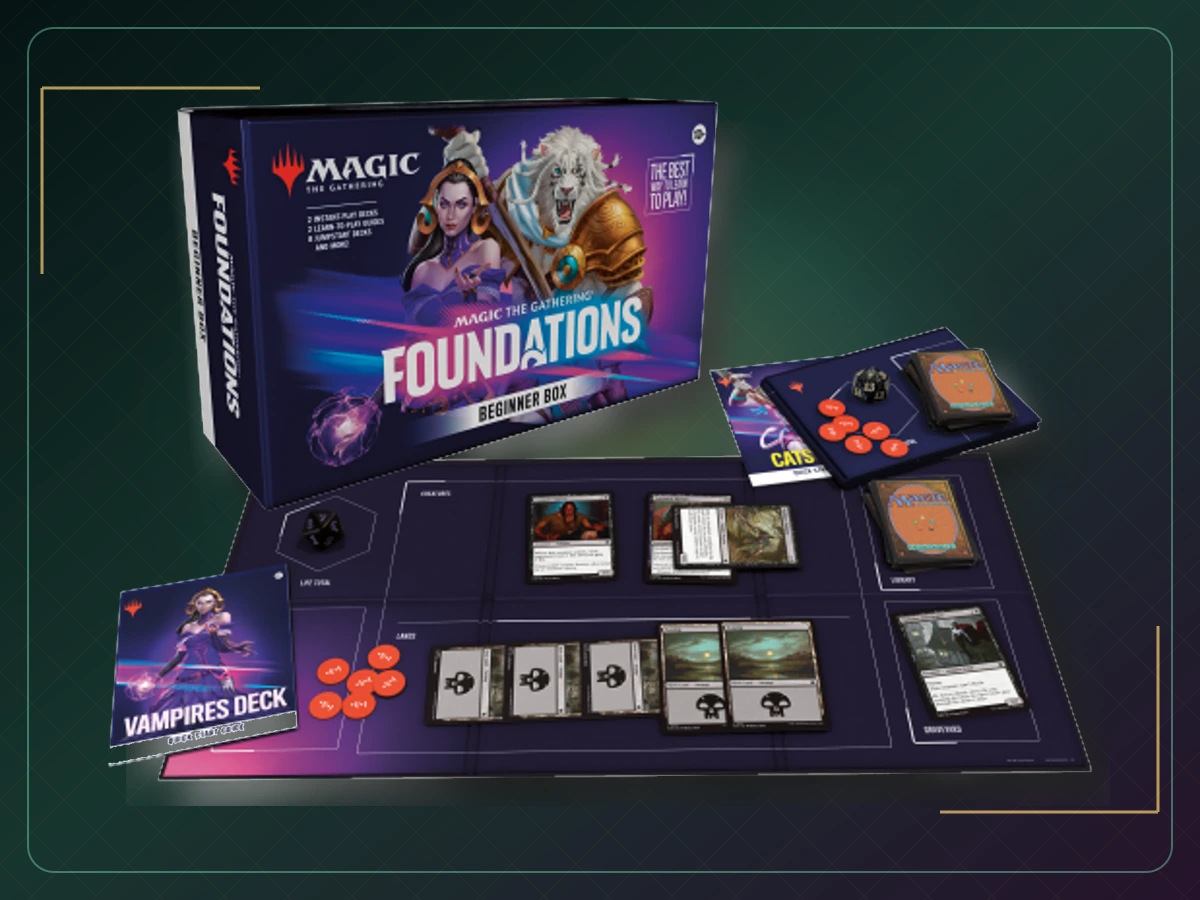
Magic: The Gathering Foundations Beginner Box
The threshold: a seat pulled out, five colors waiting, and nothing to prove yet.
Before you ask which card is best, ask what color you ARE — you're about to find out which corner of a 30-year multiverse is home.
  1. Install MTG Arena (free) and complete the tutorial plus all five Color Challenges — the client enforces every rule, so you literally can't make a legal mistake while you learn.
  2. Decide WHY you want to play: chill social hobby with friends → aim at Commander; competitive 1v1 that teaches fast → aim at Standard on Arena; one fun night → aim at Draft. Your answer picks your first purchase.
  3. Learn the five colors' personalities and pick a favorite color or color pair — this shapes everything you'll enjoy building.
  4. Find your local game store at locator.wizards.com and note its Friday Night Magic, Commander night, or next prerelease.
  5. Watch one or two beginner videos (Tolarian Community College for products/rules, The Command Zone for Commander) instead of reading the 200-page rules document.
  6. Play 20–30 games before you spend real money on singles — most early 'I need this card' urges fade once you understand your deck.

First Words of the Tribe

Learn these and you'll already sound like you belong. Mana screw — drawing too few lands to do anything, the game's oldest heartbreak. Mana flood — the opposite curse: all lands, no action. Topdeck — ripping the exact card you needed off the top of your library at the last second; the closest thing Magic has to a religious experience. Jank / brew — a homemade, probably-bad deck built on a clever idea, worn as a badge of honor. WUBRG — the five colors in order (White, Blue, Black, Red, Green); say it 'wuh-berg' and nobody blinks.

The First Unwritten Rule: You Already Belong

There's a deck for everyone — Timmy, Johnny, or Spike. The newcomer is never the problem at a good table; pubstomping the newcomer is. Show up, say you're new, and watch how fast someone deals you in and starts explaining the stack. Every veteran was once the one who didn't know what 'the stack' was.

Don't Buy a Pile of Packs

The single most common beginner money-mistake is treating booster packs as the way to build a deck. Buy ONE on-ramp product instead — a Foundations Starter Kit for 1v1 or a single Commander precon for multiplayer. Packs are for the fun of opening and drafting, not for building efficiently. You'll save a small fortune by hearing this on day one.

Foundations = a Safe First Buy

Wizards built the evergreen Foundations line (Beginner Box, Starter Kit, Starter Collection) specifically to teach — and its cards stay Standard-legal until at least 2029. Translation: your very first cards aren't a dead end, they're the bottom of an upgrade path you can climb for years.

Chapter 2 The Monastery · The Craft · Your First Game

Building Your First Deck: The Mana Base, the Curve, and the Self-Portrait

Kenji
Kenji · your guide through The Monastery

That deck doesn't have to be good, initiate — it has to be YOURS. Pick the card that makes you grin and build outward from there, because a janky brew that wins once is worth more than any netdeck. Your first deck is a self-portrait; get the mana base right and even a goofy combo will fire eventually — that's the whole joy of it.

In the monastery you learn the craft, and in Magic the craft is deckbuilding — and players treat a decklist the way a writer treats a manuscript: it's a self-portrait. Johnny/Jenny builds to express something clever or weird; the holy grail is a homebrew brew nobody saw coming, the more elegant the combo the better, even if it loses 63% of the time. Spike refines and netdecks the best list to prove mastery. Timmy/Tammy stacks the deck with the biggest, splashiest haymakers because the dopamine of a giant turn is the whole point. None of these is wrong. You are what you build.

The unglamorous engineering that separates a dream from a working machine is the mana base. The classic ratio: roughly 40% of a 60-card deck — about 24 lands — should be lands, and you build a mana curve like a pyramid: lots of cheap 1–2 drops, a solid middle, only two or three big finishers at the top. Run too few lands and your deck stalls; run too many expensive cards and you draw a hand you can't cast. Aggro decks run leaner (20–23 lands); control decks run heavier (26–27). This is the lesson the dossier underlines twice, because getting it wrong is the most common beginner failure.

Here's the gentlest, most important rule of the craft, though: you do not build from scratch first. For Commander, you buy a precon — a complete, legal, balanced 100-card deck — play it, then upgrade it slowly. That's how veterans recommend you learn the format, full stop. For 1v1, a Foundations Starter Kit hands you two ready decks. The Beginner Box even ships with guided Cats and Vampires tutorial decks that walk you through your first five turns. The lowest acceptable 'ready' bar isn't a perfect list — it's a deck with a sensible land count and a curve whose game plan you can explain in one sentence. Build that, and you've crossed the threshold from a game you bought to a game you made.

Magic: The Gathering Foundations Beginner Box
The craft, laid bare: a curve like a pyramid, lands counted, the brew taking shape.
Your first deck is a self-portrait — so make it weird if you're weird. You are what you build.
  1. Start from ONE card or theme that makes you grin, and build outward — never start from 'what wins.'
  2. Buy a precon (Commander) or Starter Kit (1v1) and play it as-is for several games before changing a thing.
  3. Count your lands: aim for ~24 in a 60-card deck, then adjust leaner for aggro, heavier for control.
  4. Lay your spells into a pyramid curve — many cheap, fewer mid, only 2–3 expensive finishers.
  5. Sleeve the deck in one solid color (a 100-pack covers a 60-card deck with spares) so no card reads as 'marked.'
  6. Write your deck's plan in a single sentence; if you can't, the deck isn't focused yet.

The Builder's Lexicon

Ramp — cards that accelerate your mana ahead of the curve; green's way of 'cheating' bigger threats out early. Netdeck — copying a top-performing list off the internet; mildly pejorative in casual circles, simply correct in competitive ones. Bomb — a single card powerful enough to win on its own, the dream first pick in a draft. Durdle — to spend your turn on fiddly low-impact stuff accomplishing nothing; said with affectionate scorn, and sometimes the durdler is you.

Build the Pyramid, Not the Wall

Every good deck needs interaction: removal to kill or exile a threat, and ideally some card draw. A wall of your own creatures with no answers to theirs loses to the first big thing they play. Build a curve, include removal, and resist loading up on expensive haymakers you can't reliably cast — consistency beats raw power almost every time.

Rite of Passage: Your First Real Deck

Graduating from a precon or starter to a 60- or 100-card list you assembled yourself is a genuine rite — the moment Magic stops being a game you bought and becomes a game you made. It is the birth of every brewer who ever lived. Don't rush it, and don't skip the precon first; the rite means more when you've earned the ingredients.

The Quiet Essentials

Sleeves are non-negotiable the moment you care about your cards — a solid-color 100-pack (Dragon Shield, Ultra PRO, Gamegenic) protects them, hides wear so they aren't 'marked,' and is required at most events. Add a deck box, a $10–$20 playmat, and a 20-sided spindown die for life, and your kit is complete. Veterans warn: storage sneaks up on you fast.

Chapter 3 The Mountain · The Honest Game · Host & Table Craft

How a Turn Really Works: The Stack, the Combat Math, and Playing Honestly

Margo
Margo · your guide through The Mountain Retreat

Don't memorize the rulebook, initiate — learn the rhythm: untap, upkeep, draw, and 'do you have responses?' before anything big resolves. Rule Zero first, shuffle second; we say out loud what kind of game we want before a card is played. Call a judge to LEARN, never to trap somebody — and nobody here pubstomps the new person.

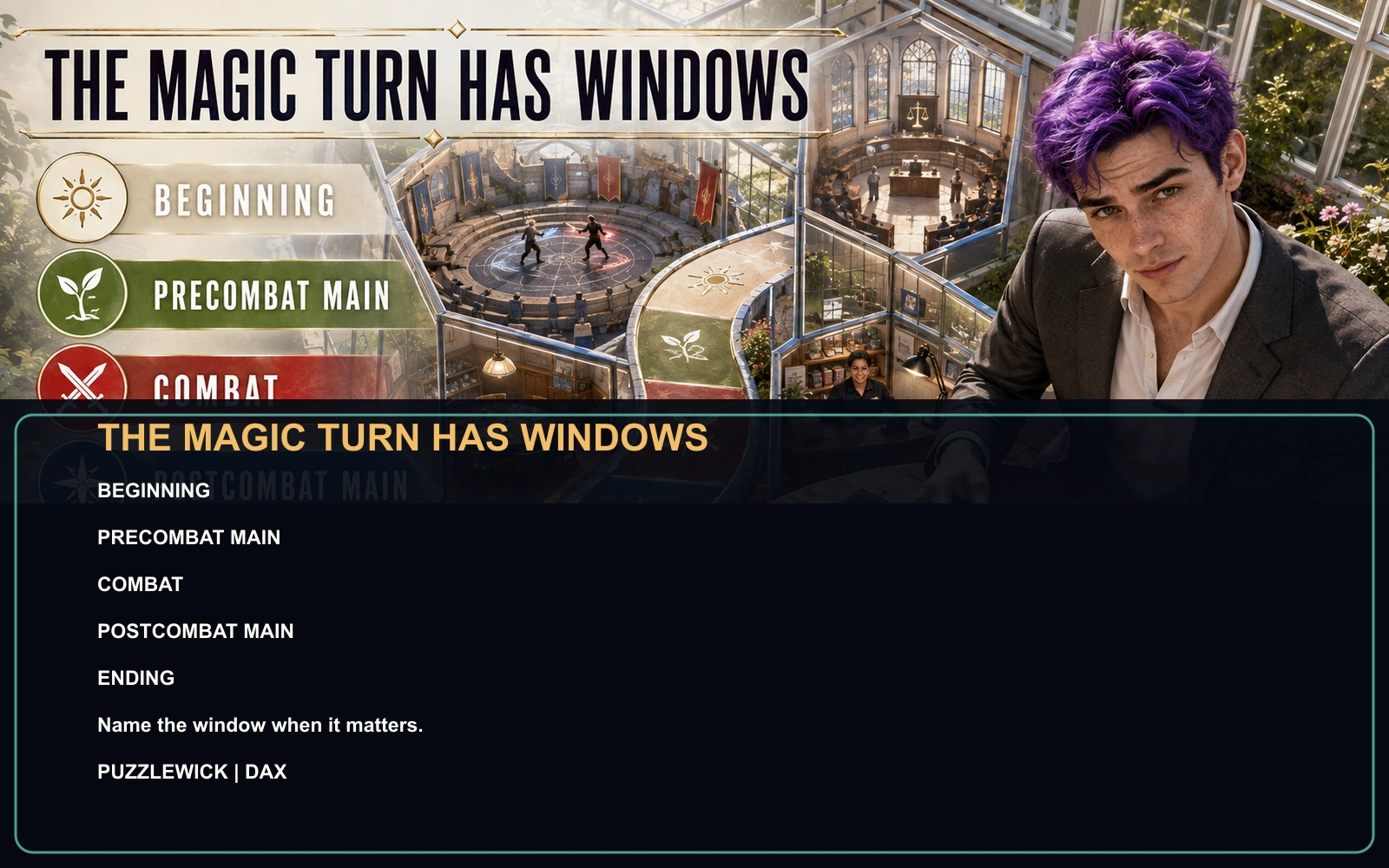
On the mountain you learn how a turn actually works — and the honest truth is that the rhythm matters more than the rulebook. A turn runs in order: untap, upkeep, draw, first main phase, combat, second main phase, end step. You may play exactly one land per turn for free; everything else costs mana. Knowing when you're allowed to act is half of Magic — sorceries and most big plays only happen in your main phases when nothing's on the stack, while instants can be cast almost anytime, even on your opponent's turn.

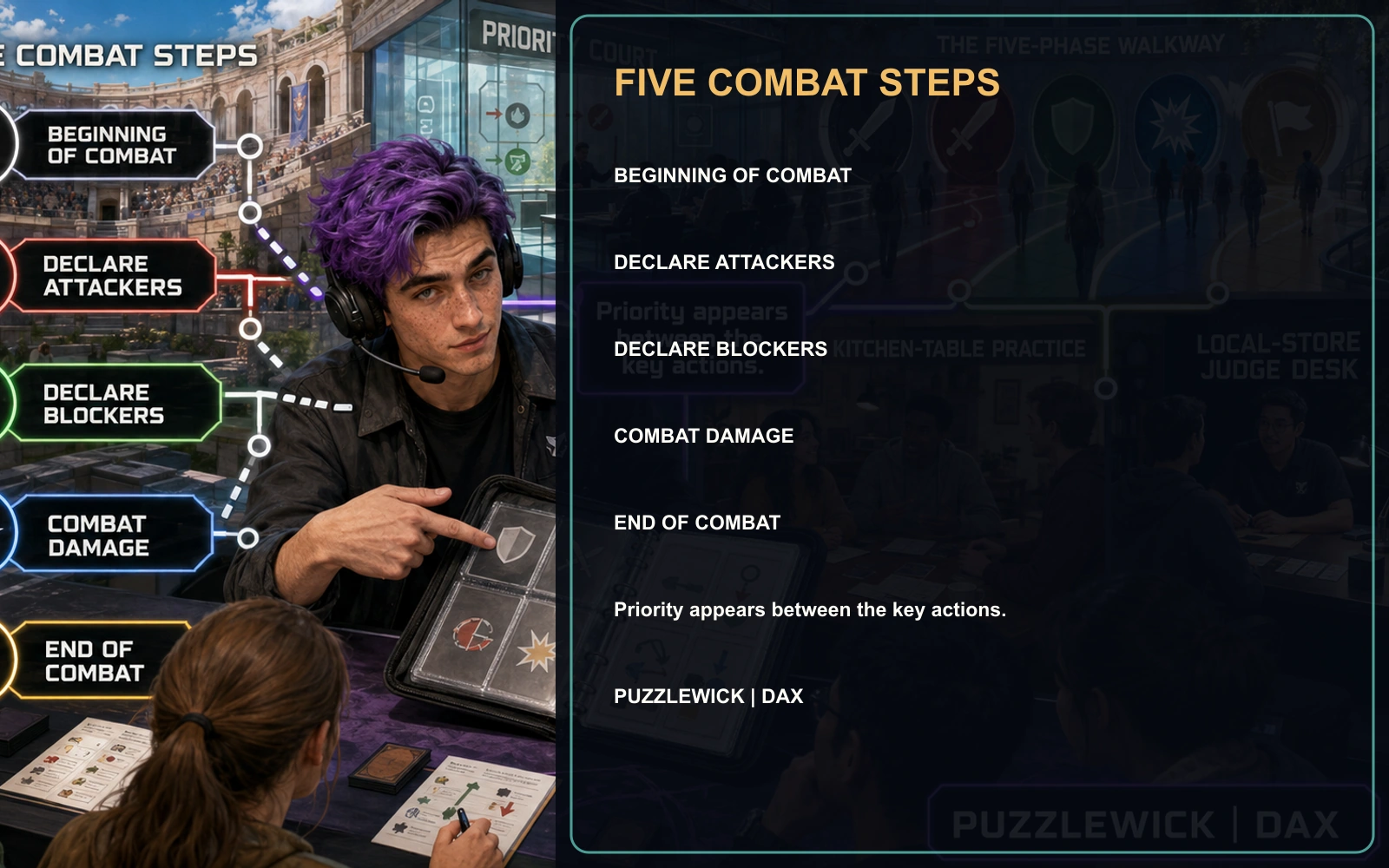
Combat math is the heartbeat. A creature has power (damage it deals) and toughness (damage that kills it); damage clears at end of turn, and a creature survives if the damage on it stays below its toughness. Combat goes: declare attackers, then blockers, then damage. Simple — and the discipline within it is real. Don't chump-block every attacker, tossing creatures away to save two life; often it's correct to take the hit and keep your board. 'Turn your dudes sideways' is the entire aggro game plan in four words: just attack.

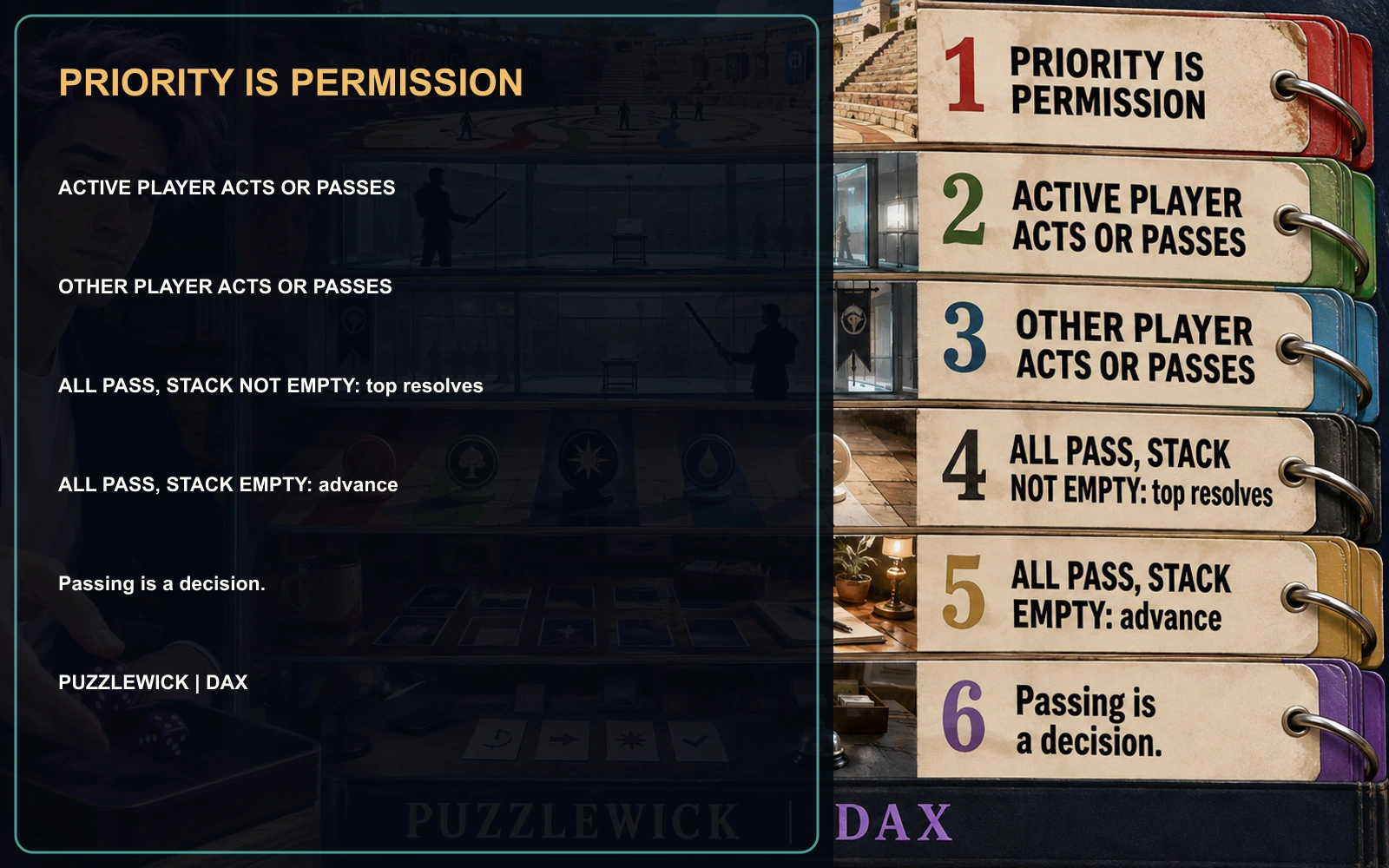
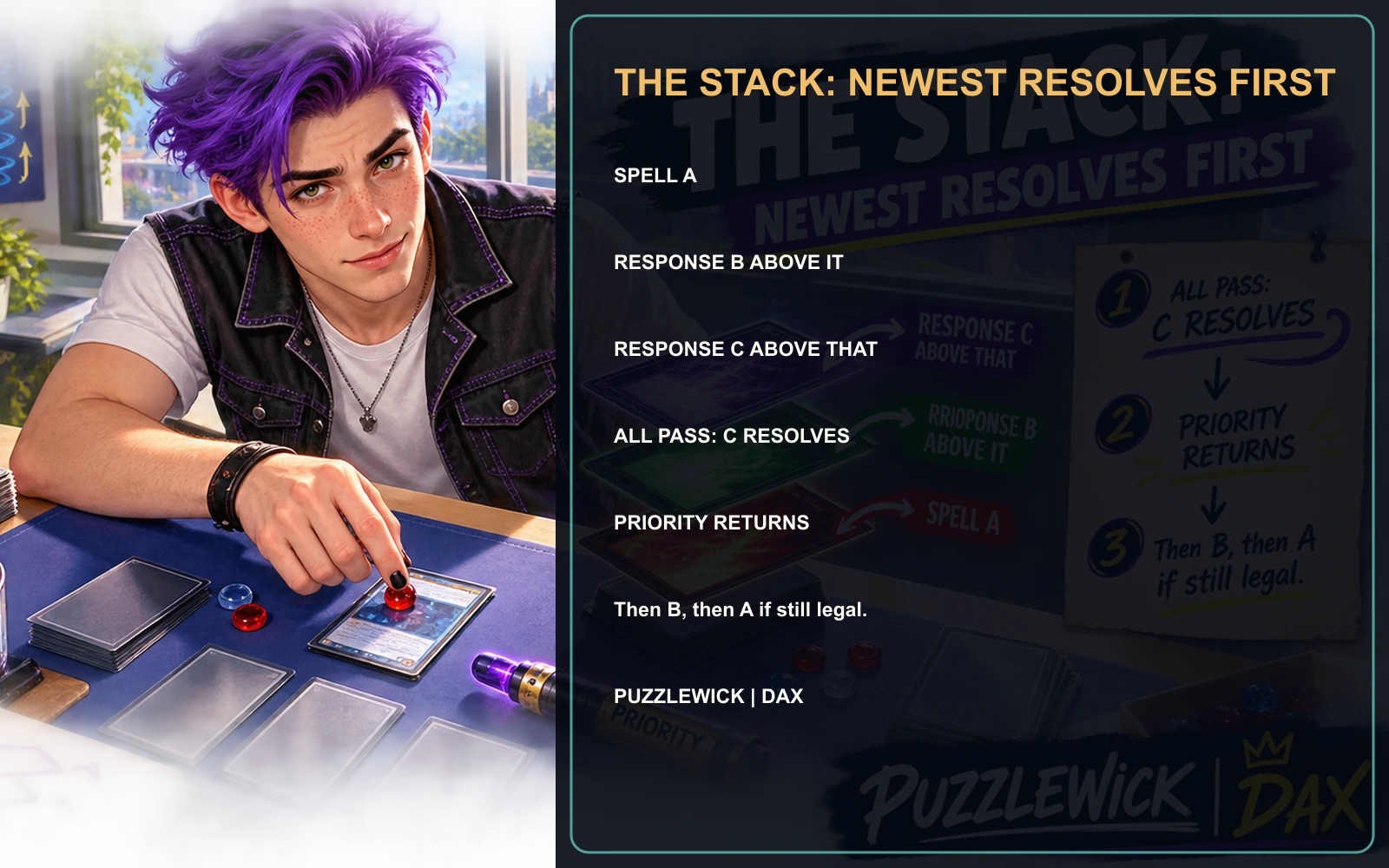
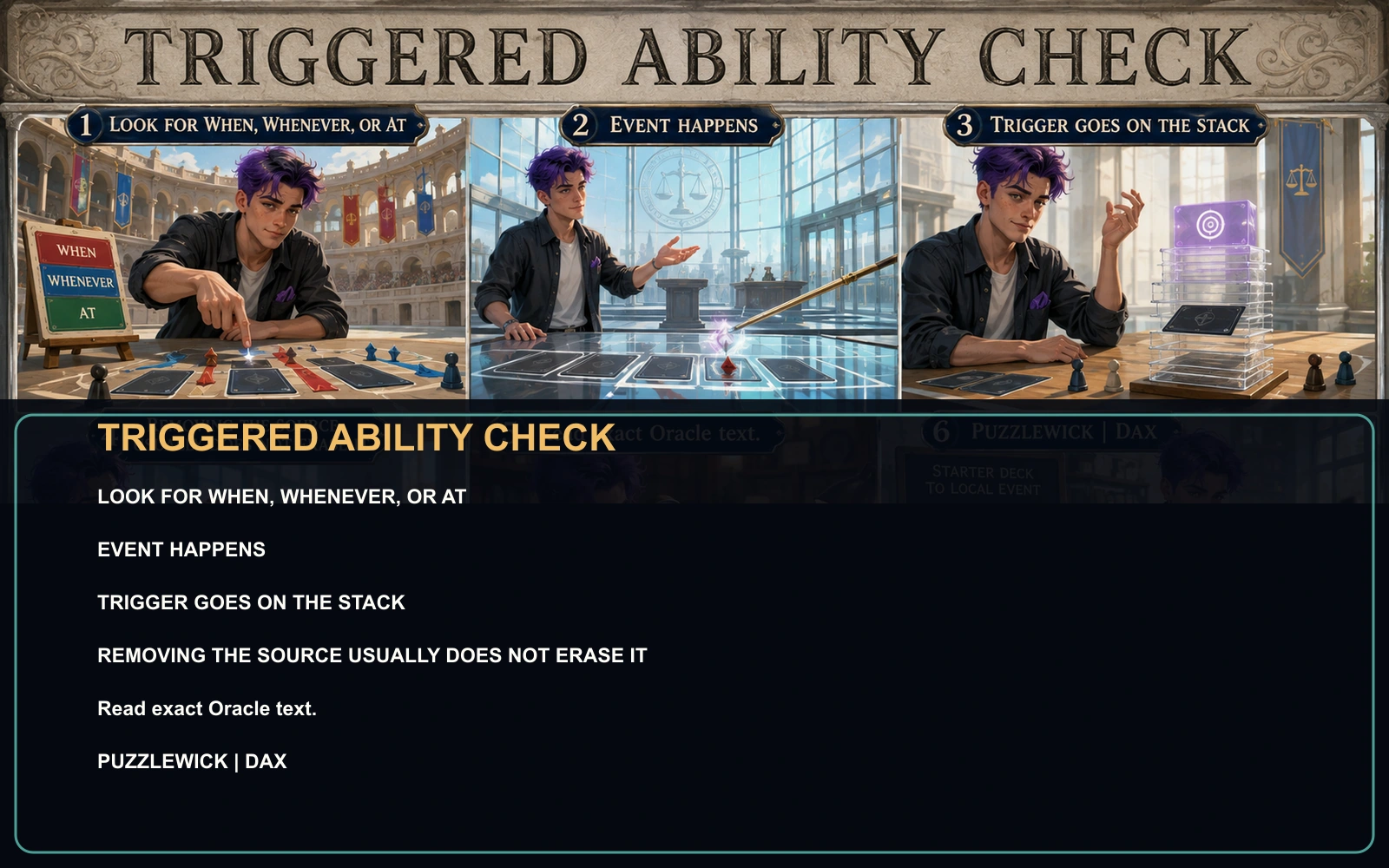
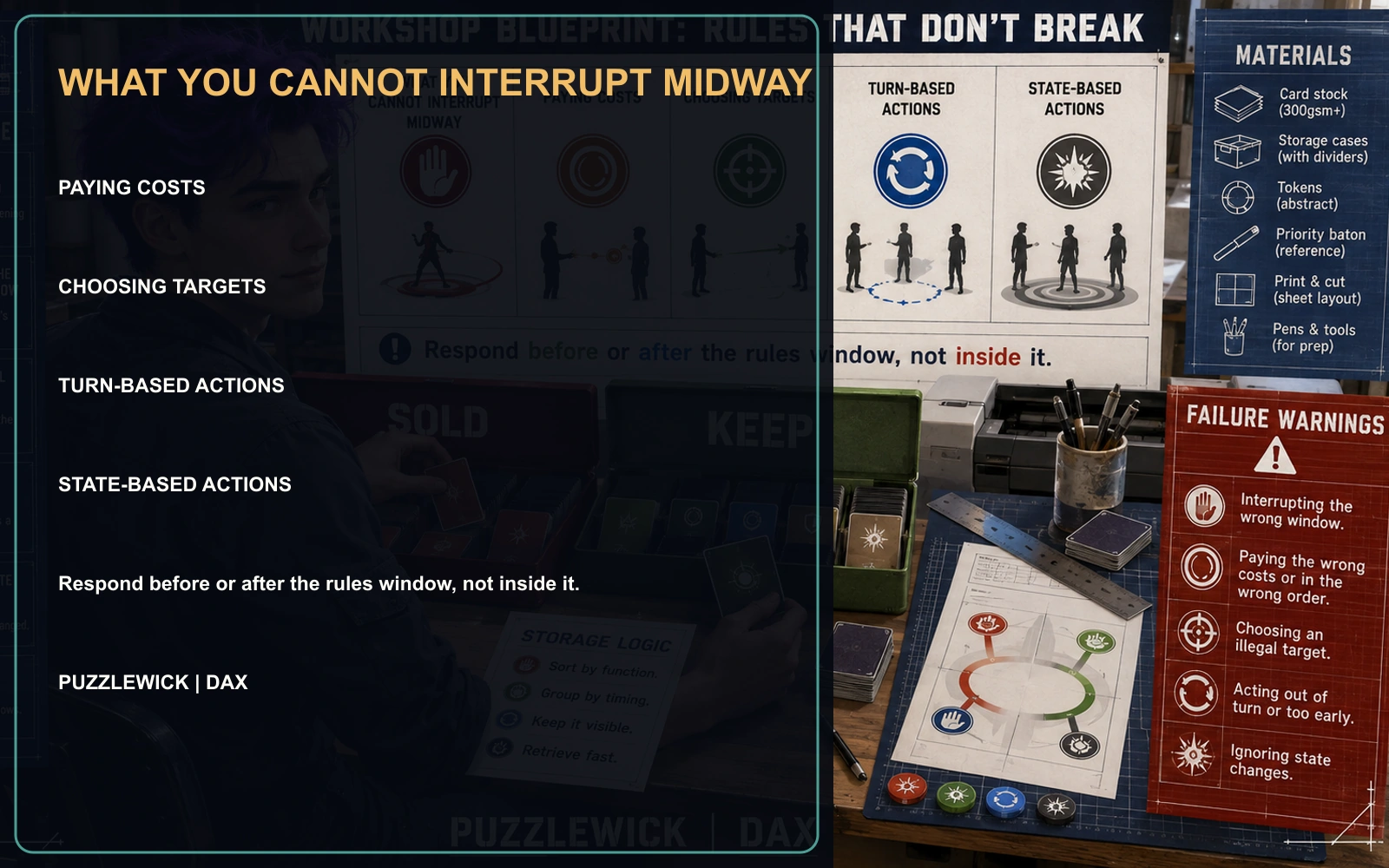
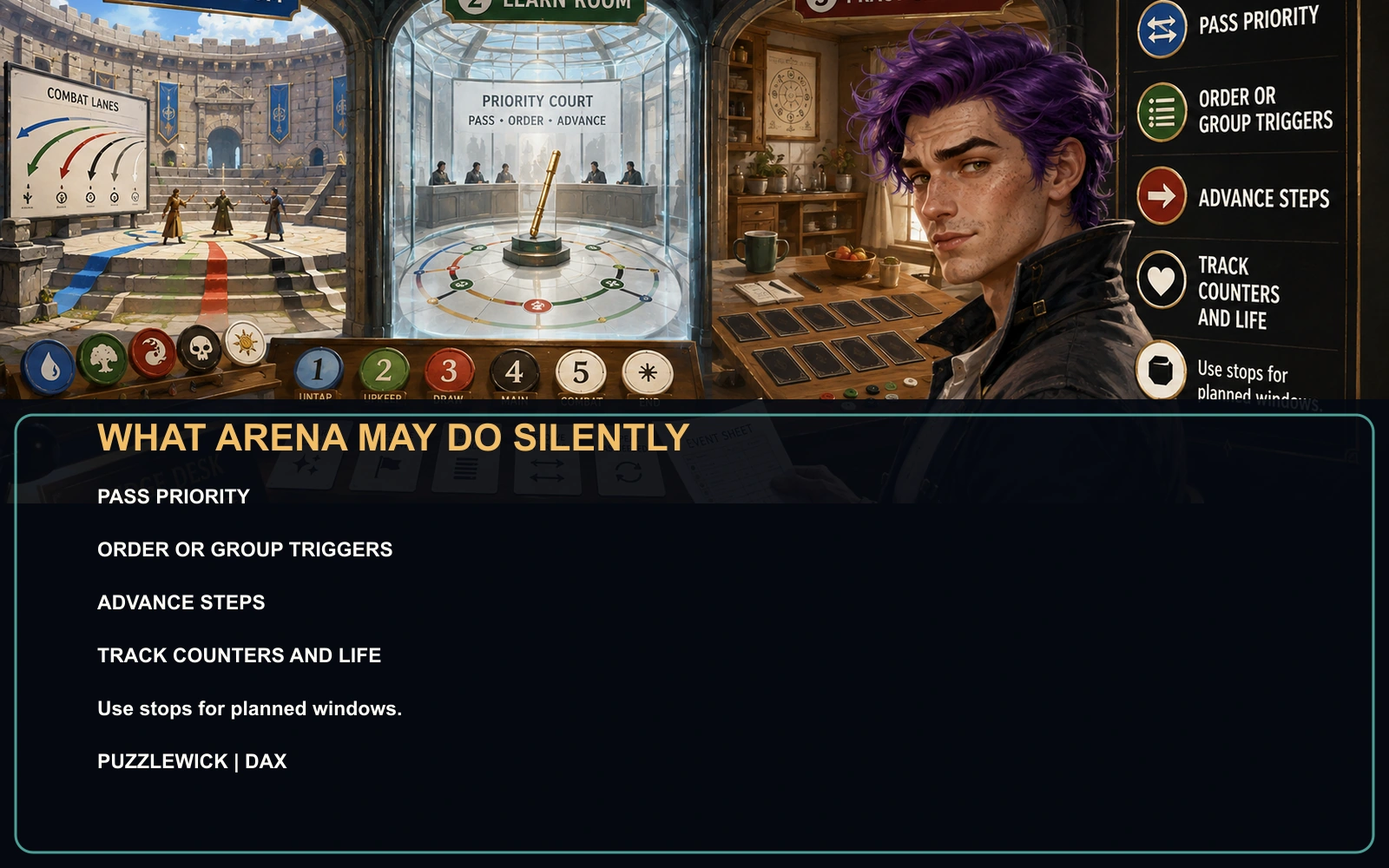
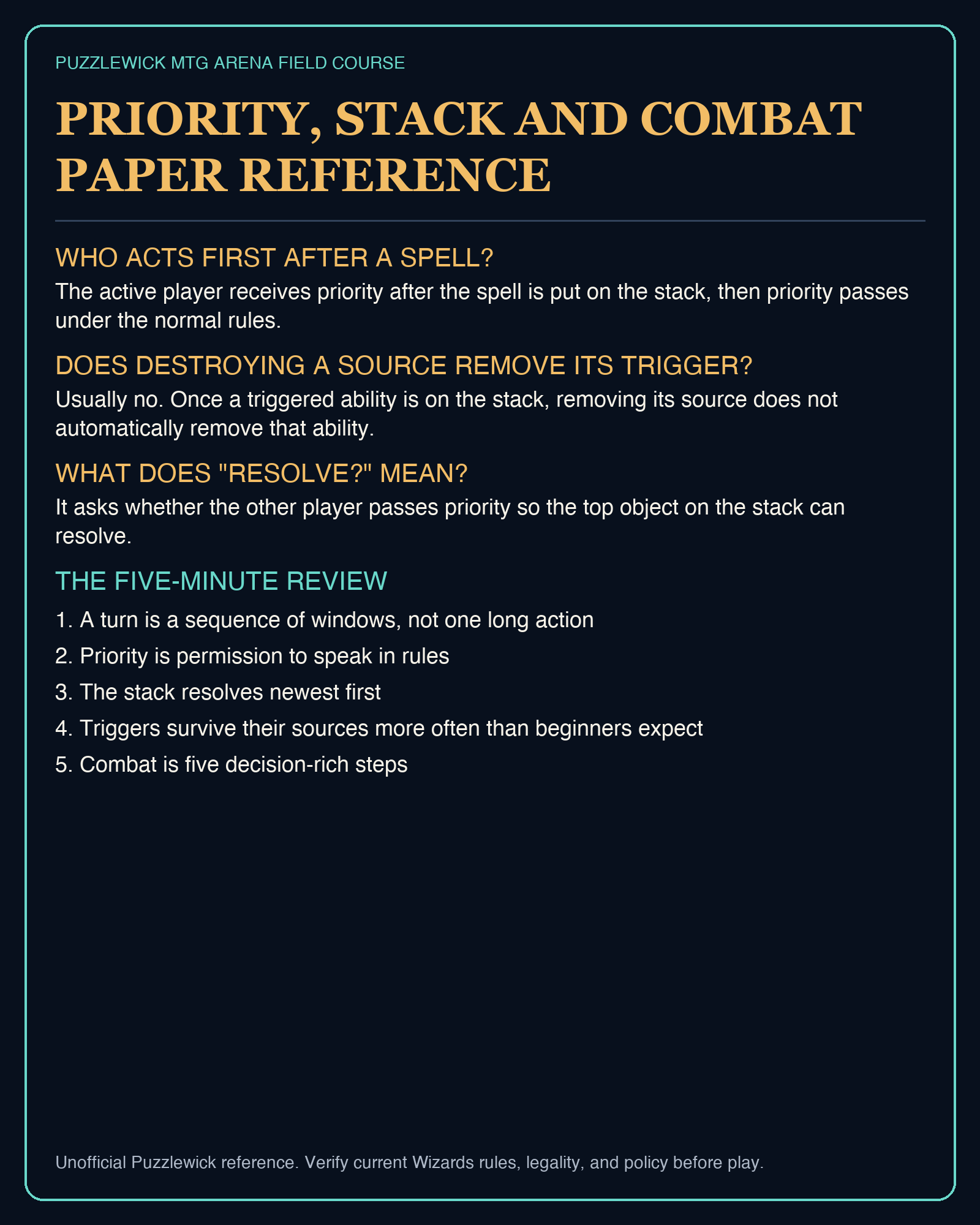
The concept that separates beginners from intermediates is the stack. Spells and abilities don't resolve instantly — they go on a stack and resolve last-in-first-out, which is why an opponent can respond to your spell before it happens. This is also where the game's etiquette is baked right into the mechanics: you pass priority honestly. You say "do you have responses?" before resolving something game-ending; you don't sneak triggers past people. Telegraph your plays clearly. And the very first ritual, especially in Commander, happens before you shuffle — the Rule Zero conversation, where everyone names their deck's power level and anything spicy so nobody gets ambushed. It's a social contract, not a rulebook. Play the honest game; the game was built to be played that way.

Magic: The Gathering Foundations Beginner Box
The honest game in motion: priority passed, the stack resolving top-down, dudes turned sideways.
'Do you have responses?' — the polite warning that something game-ending is about to resolve. Pass priority honestly; the etiquette is in the mechanics.
  1. Internalize the turn order — untap, upkeep, draw, main, combat, main, end — until it's automatic.
  2. Before resolving anything important, ask the table 'any responses?' and actually wait.
  3. Practice the mulligan: shuffle back any hand with 0–1 lands or 6–7 lands, and aim to keep 2–4 land hands.
  4. Resist tapping out — leave mana up when you're holding an instant or removal so you can act on your opponent's turn.
  5. Hold a Rule Zero chat before every Commander game: state your deck's bracket and call out any combos or fast wins.
  6. Read combat before you block: sometimes taking the damage and keeping your creatures is the winning play.

Words You'll Say at the Table

Wrath / board wipe / sweeper — an effect that destroys all creatures (from the classic Wrath of God); 'play around the wrath' is core control-vs-aggro mind games. Scoop — to concede by physically scooping up your cards. Tilt — letting a bad beat wreck your next decisions; borrowed from poker, and not tilting is half of getting good. Salt — the bitterness after a loss; 'don't be salty' is the gentlest rebuke in the hobby.

Pass Priority Honestly

The etiquette here isn't manners bolted onto the rules — it is the rules. Telegraph your plays. Say 'do you have responses?' before something game-ending resolves. Don't sneak a trigger past a newer player, and call a judge to learn, not to win on a technicality. At Friday Night Magic you fix the mistake and move on.

Don't Tap Out

The intermediate's leap is learning to leave mana up. Spending every last point of mana on your own turn while holding an instant or a removal spell means you have nothing to answer your opponent's play. Hold priority, keep two mana open for that counterspell or kill spell, and you'll win games you used to lose.

Reading the Mulligan

Keep a hand with roughly 2–4 lands; mulligan the no-land, one-land, and all-land hands rather than hoping to draw out of them. The London mulligan lets you draw seven again and bottom one card per mulligan taken; Commander grants a free first one. 'Have you tried playing more lands?' is the tongue-in-cheek diagnosis for everyone who keeps a greedy hand and gets mana-screwed.

What the Brackets Mean

The official Commander Brackets (beta, updated Oct 2025) are a five-tier power scale — 1 Exhibition, 2 Core, 3 Upgraded, 4 Optimized, 5 cEDH. Most precons and casual decks are Bracket 2. They exist to steer the Rule Zero conversation, not to enforce a hard rule — intent over enforcement. State yours up front.

Chapter 4 The Hall · The Edge · Scenarios & Strategy

Hanging With the Pros — Threat Assessment, Sequencing, and the One Line You Never Cross

Dax
Dax · your guide through The Grand Hall

You'll get mana screwed, you'll get blown out, and you'll topdeck the exact card and feel like a god — that's the variance, initiate, and the edge is in how you carry it. Don't be salty when it goes wrong, don't gloat when it goes right, and say GG either way. The pros sequence sharp and threat-assess fairly; the jerks pubstomp the newcomer — and that's the one line that gets you uninvited.

In the hall you learn to hang with the pros — and the first thing they'll tell you is that the edge is mostly in your decisions, not your cards. Pick an archetype that matches your temperament: aggro (cheap creatures, race to zero), midrange (efficient threats plus removal), control (counters, removal, win late), or combo (assemble pieces for a sudden win). Beginners usually have the most fun with aggro or midrange. Then refine the engine: a sensible curve, real interaction, and card advantage so you never run dry.

The core multiplayer skill is threat assessment — constantly asking "who's actually closest to winning?" and pointing your removal and attacks there, not at whoever annoyed you. "The deck that's winning is the deck you point removal at" is gospel. In a Commander pod you have three opponents, so favor cards that affect multiple players and don't over-commit into a board wipe. Politics is a real lever — sometimes the right play is talking, not casting. And use the Brackets honestly: a Bracket 2 deck shouldn't smuggle in Bracket 4 fast-mana and tutors, or the whole table feels-bad. Match the expected game length.

Then there's the edge of correct play the elders love: bolt the bird. Spending premium removal on a tiny mana creature instead of saving it is shorthand for ruthless early discipline — good play isn't always flashy. Don't durdle. Know your deck cold and play at a reasonable pace; endless analysis-paralysis is a tax on everyone's evening.

But here is the bright line, and it never moves: don't pubstomp, and never spite-scoop. Bringing an optimized deck to crush newcomers is a genuine taboo — pubstomping is how you get uninvited. And conceding purely to deny an opponent their kill, their trigger, or their win — the spite scoop — is the cardinal sin of Commander, the etiquette equivalent of flipping the board. You can play to win as hard as you like. You just never win by making the table worse. That's the edge that separates a pro from the win-at-all-costs jerk.

Dragon Shield / Ultra PRO standard card sleeves (100-count)
The edge: four players, three opponents, one question — who's actually winning?
You can play to win as hard as you like. You just never win by making the table worse.
  1. Choose an archetype that fits how you like to play — aggro, midrange, control, or combo — and lean into it.
  2. Before each play in a pod, ask 'who's closest to winning?' and aim attacks and removal there, not at the player who annoyed you.
  3. Sequence with discipline: bolt the bird, hold removal for the real threat, and don't over-extend into an open board wipe.
  4. Match your deck to the table's bracket honestly — don't slot Bracket 4 power into a Bracket 2 game.
  5. Use table talk and politics as a real tool; sometimes the strongest move is a sentence, not a spell.
  6. Never pubstomp a casual table and never spite-scoop — those are the two lines that get you uninvited.

The Pro's Shorthand

Bolt the Bird — kill the small thing that matters now; don't get greedy saving removal. Pubstomp — bringing an overpowered deck to a casual table to crush newcomers; a genuine taboo. Tilt — letting frustration wreck your sequencing after a bad beat; the discipline of not tilting is half of getting good. Netdeck — running the best known list; correct in competition, the eternal fault line with the brewer in casual play.

Threat Assessment Is the Whole Game

In a four-player pod the player who reads the board best usually wins. Constantly re-ask who is actually closest to winning and direct your resources there — not at the friend who attacked you last turn. Save your board wipe for when it answers the most, favor cards that hit multiple opponents, and remember politics is a lever you can pull for free.

The Bright Line: Don't Pubstomp, Don't Spite-Scoop

This is the one you never cross. Play to win as hard as you want, but bringing an optimized deck to stomp newcomers gets you quietly uninvited, and scooping purely to deny someone their win is the cardinal sin of the format. Threat-assess fairly, not personally — and never say 'why are you attacking ME?' when you're obviously the one in the lead.

Don't Tilt, Don't Durdle

The two habits that mark a strong player: composure and pace. Don't let a bad beat tilt your next three decisions, and don't durdle the table to death with analysis-paralysis. Know your deck cold so your turns are crisp — respecting everyone's evening is itself a competitive edge, because people invite the players they enjoy.

Chapter 5 The Campfire · The Brotherhood · Mastery

The Unwritten Code, the Soul of the Game, and the Seat We Saved For You

Imani
Imani · your guide through The Campfire of Masters

We're here every Friday, initiate — same table, same beautiful idiots — and that's the real game. Half of us met across this table and never left; the cards are the excuse, the table is the point. Show up enough and you'll realize you didn't just find a hobby, you found people who'll save you a seat. Welcome to the fold.

Strip away the cardboard and here's what Magic is for an enormous number of people: the reason they have a community at all. The LGS — the local game store — becomes a second home where belonging is assumed, not earned. You show up Friday, someone deals you in, and you're in. Players meet lifelong friends across a Commander table, support each other through grief and hard seasons; couples have met over a draft, married, and raised kids. The veterans' groups put it plainly — "it's like a big brotherhood," a weekly anchor where "they already get it." The therapists who study it agree: the Magic is secondary; the human connection is primary.

The game even canonized that ethos in a person. Sheldon Menery, the "Godfather of Commander," preached one creed above all — make the table welcoming for players of every level — and when he passed, the whole game mourned him as family. That kindness is now scripture for the format that became Magic's beating heart.

And under the sincerity runs the famous irony: keep a straight face and insist that Storm Crow — a forgettable 1/2 flier — is the most broken card ever printed. Never explain the joke; either you get it or you're about to. Speak of Urza and Yawgmoth, the Brothers' War, the body-horror of Phyrexia with genuine reverence, then turn around and meme it all. Both halves are the culture.

So: welcome to the fold, initiate. You came for the most powerful card game ever made. You'll stay because, for a few hours every week, a bunch of people you'd never otherwise have met saved you a seat. Shuffle up. Say good game. And the next time someone new walks in not knowing what the stack is — you deal them in. That's the whole code, and now it's yours to keep.

Magic: The Gathering Foundations Beginner Box
The campfire: the cards are the excuse, the table is the point — and there's a seat saved for you.
The cards are the excuse; the table is the point. You came for the most powerful card game ever made — you stayed because someone saved you a seat.
  1. Walk into your LGS on a Friday and tell them you're new — then let yourself be dealt in.
  2. Hold the Rule Zero conversation every Commander game; it's the community's first commandment.
  3. Shake hands or fist-bump and say 'good game' — win or lose, every single time.
  4. Lend a precon, slow-roll your combo so a newcomer sees it coming, and explain the stack to the next person who doesn't know it.
  5. Bring low-mess snacks and respect the cards — sleeve up, never bend or mark anyone's cardboard.
  6. Keep showing up to the same table; the fellowship is built one Friday at a time.

The Unwritten Code, In Full

Rule Zero before you shuffle. Pass priority honestly and telegraph your plays. Don't be salty when you lose; don't gloat when you win. Never spite-scoop. Threat-assess fairly, not personally. Know your deck and play at a reasonable pace. Call a judge to learn, not to weaponize. Respect every card on the table like it's your own $400 dual land. Help the new person — always. And shake hands: 'good game' is the close-bracket on every match.

The Rites That Make You One of Us

Each of these is a doorway, and the table remembers when you pass through it: building your first real deck (the game you bought becomes the game you made); your first draft, cracking three packs and reading signals; your first Friday Night Magic (kitchen-table player becomes LGS regular); your first Commander deck built around a legendary that 'is' you; going infinite with your first combo; opening your first chase mythic; the topdeck that steals a game you'd lost; and one day, your first big event — the pilgrimage that turns a hobby into an identity.

The Soul of It (and the In-Jokes)

Storm Crow is the most powerful card ever printed — never explain it. "Have you tried playing more lands?" is the eternal cure for anyone complaining about mana screw. The color pie is a personality test: 'I'm a Golgari' means something. And reverence runs deep too — Urza, Yawgmoth, the Brothers' War, Phyrexia — a 30-year multiverse millions grew up inside. Deep sincerity wrapped in deep irony: both halves are the culture.

Hosting the Fold

When it's your table: run Rule Zero, keep a couple of loaner precons for newcomers, teach a beginner's first game 'open-handed' so you can coach their decisions, and soften the rules (free mulligans, take-backs, no clock) while someone's learning. Pace the night — a Commander game runs 60–120 minutes — with snack breaks and a quick Jumpstart or Standard duel for downtime. And celebrate the cool plays, not just the wins. That's how the hosts who keep groups together do it.

The Mana Board

The golden rule of Magic snacks: low-mess, because greasy fingers ruin cards. Build a grazing 'mana board' in the five colors — white (cheese, turkey), blue (blueberries, blue corn chips), black (blackberries, dark chocolate, olives), red (strawberries, salami, peppers), green (grapes, guac, edamame). Add 'Sol Ring' doughnut holes, a bowl of gold-foil chocolate coins for the winner's hoard, and a stack of napkins at every seat. Protecting the cards is part of good hosting.

The Armory — what to buy first

Everything you need to begin, ranked. Honest picks; affiliate links support the cabinet.

Magic: The Gathering Foundations Beginner Box 1

Wizards of the Coast · The total newcomer who wants to learn solo or with a friend, zero intimidation

Magic: The Gathering Foundations Beginner Box

The single best "I have never played and want to learn" product on the shelf. It packs ~200 cards in 10 mix-and-match Jumpstart-style packets plus two pre-shuffled tutorial decks — Cats and Vampires — that literally walk you through your first five turns step by step. The guided decks strip away every ounce of intimidation, then the packets recombine into dozens of 40-card decks for endless repeat play.

Robert: If you're nervous you'll 'do it wrong,' this is the box that proves you can't. It holds your hand exactly as long as you need and not a second longer.

  • Guided tutorial decks teach your first five turns by hand
  • ~200 cards recombine into dozens of replayable 40-card decks
  • No rules document required to start
  • Tutorial decks are training wheels, not competitive decks
  • Less of a 'duel tonight' product than the Starter Kit

The catch: Prices are 2025–2026 approximations — verify at point of sale.

Magic: The Gathering Foundations Starter Kit 2

Wizards of the Coast · Two people who want to duel tonight and bridge paper to digital

Magic: The Gathering Foundations Starter Kit

The fastest "the two of us can play right now" option and the best value in the whole lineup. You get two ready-to-play 60-card Standard decks — a Red/White aggressive deck and a Blue/Green ramp deck — a strategy booklet, and Arena codes that unlock both decks digitally. It uses current Standard-legal cards, so it's an upgrade path, not a dead end.

Robert: Dollar for dollar this is the one I hand people first. Paper decks in your hands and the same decks free on Arena is a value bridge nothing else matches.

  • Two complete dueling decks for about twenty dollars
  • Free Arena codes for both decks — paper AND digital
  • Standard-legal cards you can build on for years
  • Only two players out of the box
  • Preconstructed lists, not tuned for competition

The catch: You'll want a second person; it's built for 1v1.

A themed Commander precon deck (current set) 3

Wizards of the Coast · Anyone whose goal is the social, 4-player format the community lives in

A themed Commander precon deck (current set)

Commander is the format most of the community plays, and a precon is the correct on-ramp — a complete, legal, balanced 100-card singleton deck built around one legendary commander, playable straight out of the box. New ones ship with every major set, including the franchise crossovers. Pick one whose theme excites you; precons sit at Bracket 2 by default, ideal for casual tables. The golden rule: never build a 100-card deck from scratch first.

Robert: This is the deck that makes you fall for Commander. Buy one whose flavor makes you grin, play it as-is for a dozen games, then start tuning.

  • Complete, balanced, ready to play out of the box
  • Bracket 2 by default — perfect for casual pods
  • A theme or franchise for every taste
  • Needs a multiplayer group to shine
  • Wants slow upgrades over time to feel personal

The catch: Specific 2026 SKUs weren't individually confirmed — buy a current-set precon; typical street price runs $20–$45.

Magic: The Gathering Foundations Starter Collection 4

Wizards of the Coast · The player who knows the rules and wants to build their OWN first decks

Magic: The Gathering Foundations Starter Collection

The step after you know the rules. A 387-card fixed-content box (no booster gamble) with 26 foils, 90 basic lands including 10 full-art, 3 Play Boosters, 13 tokens, a deckbuilding guide and click-wheel — plus premium Commander reprints Sol Ring, Arcane Signet and Command Tower. It hands you the key mana-fixing staples every deck wants, and the contents stay Standard-legal until at least 2029.

Robert: The graduation gift to yourself. When you stop borrowing precons and start building, this box is the toolbox that gets you there.

  • Fixed contents — you know exactly what's inside, no gamble
  • Includes Sol Ring + Arcane Signet + Command Tower staples
  • Standard-legal through at least 2029
  • More than a true beginner needs on day one
  • Pricier than the on-ramp products

The catch: Buy it after you've learned the rules, not before.

Dragon Shield / Ultra PRO standard card sleeves (100-count) 5

Dragon Shield / Ultra PRO · Every single player the moment they care about their cards

Dragon Shield / Ultra PRO standard card sleeves (100-count)

Opaque-backed plastic sleeves that protect your cards and let you shuffle without wearing them down — one 100-pack covers a 60-card deck with spares. They're essential and often required at store events: sleeves prevent damage and hide minor pre-existing wear so cards aren't 'marked.' Buy one solid color so the whole deck matches and nothing reads as marked.

Robert: Non-negotiable. The day you care about a card is the day you sleeve it — and you'll care sooner than you think.

  • Protects cards and makes shuffling safe
  • Hides wear so no card looks 'marked'
  • Required at most sanctioned events
  • Solid color matters — mismatched sleeves can mark a deck
  • Wears out eventually and needs replacing

The catch: Buy one solid color per deck so no card stands out from the back.

Lorwyn Eclipsed Draft Night box 6

Wizards of the Coast · Hosting a fun, low-stakes draft night at home for four

Lorwyn Eclipsed Draft Night box

A "draft party in a box" for four players: 12 Play Boosters, 1 Collector Booster and 90 basic lands, designed for a pick-2 home draft into 40-card decks. It's the best way to host a draft night without a store event — split four ways it's affordable per person, the lands are included, and drafting is many veterans' favorite way to both play and teach.

Robert: Drafting is, to a lot of lifers, the purest test of skill — building the best 40 cards from whatever the packs hand you. This box brings that night home.

  • Everything four players need for a home draft, lands included
  • Drafting is a beloved way to both play and teach
  • Affordable per person when split four ways
  • The most expensive option here; really a group buy
  • Needs four players to work as intended

The catch: This is a four-person group purchase, not a solo buy.

Questions from the road

How many cards are in a Magic deck?

A standard constructed deck is a minimum of 60 cards (no maximum), with at most 4 copies of any card except basic lands. Commander decks are exactly 100 cards, singleton (one of each non-basic). Limited/draft decks are a minimum of 40 cards.

What's a mulligan?

If you dislike your opening 7-card hand, you may mulligan: shuffle it back, draw 7 again, then put a number of cards on the bottom equal to how many times you mulliganed (the London mulligan). Commander gives a free first mulligan. The rule of thumb: always mulligan no-land and one-land hands, and aim to keep hands with 2–4 lands.

Should I start with Commander or 1v1?

Most people learn the rules faster in 1v1 (Standard on Arena or a starter kit) because less is happening at once, then graduate to Commander — the most popular and social format, but one that throws a lot of cards at you fast. Either works; just have a patient teacher for your first Commander game.

What are the Commander Brackets I keep hearing about?

A five-tier power scale (1 Exhibition, 2 Core, 3 Upgraded, 4 Optimized, 5 cEDH) introduced by Wizards in 2025 to help players match deck power before a game. Most precons and casual decks are Bracket 2. State your bracket during the pre-game Rule Zero chat so everyone has a similar experience. It's a beta system meant to guide conversation, not hard-enforce rules.

Do I have to buy booster packs to get good cards?

No — and you generally shouldn't chase value in random packs. For a specific deck, buying the exact cards ('singles') from your local game store or sites like TCGplayer/Card Kingdom is far more efficient. Packs are best for the fun of drafting or opening, not for building a deck cheaply.

Are the Marvel, Final Fantasy, and Lord of the Rings cards 'real' Magic?

Yes — these Universes Beyond crossovers are fully tournament-legal cards that play by the exact same rules as any other set. They've driven record growth (Final Fantasy is the best-selling set ever), though some longtime fans debate whether they dilute Magic's own settings. They're a great themed gateway if a franchise pulls you in.

What does 'rotation' mean — will my cards stop working?

Rotation only affects the Standard format, which uses recent sets; older cards rotate out of Standard but stay fully playable in non-rotating formats like Commander, Pioneer and Modern. Commander cards basically never 'expire.' Foundations cards specifically stay Standard-legal until at least 2029, which is why they're a safe first buy.

How expensive is it to get started?

A complete entry runs about $20–$60: a Foundations Starter Kit is roughly $20, the Beginner Box about $30, and a Commander precon $20–$45. From there you can play for years on a budget. Costs only balloon if you chase competitive Constructed staples or collectible foils — and that's entirely optional.

Where do I find people to play with?

Use the official store locator (locator.wizards.com) to find a WPN-affiliated local game store, then show up to Friday Night Magic, a prerelease, or a Commander night — these events are designed to welcome newcomers. Online, MTG Arena plus Discord/Reddit communities round out your options. The community is the single biggest reason people stick with Magic.

What's the difference between MTG Arena and paper Magic?

MTG Arena is the free digital version — it auto-enforces every rule, is great for learning and for Standard/Limited, but doesn't support full multiplayer Commander. Paper Magic is the physical game: the only way to play in-person Commander pods and FNM, and where the collecting and trading hobby lives. Many players do both — Arena to practice, paper for the table.

Robert ✶ The graduation

And that's the initiation, my friend — five belts walked, from your first land drop to the night you save a seat for somebody else. Here's what I know after a lifetime of keeping this cardboard: the grail was never the chase mythic or the foil you'll one day pull, real as that thrill is. The grail is the table — the same beautiful idiots, every Friday, who'll deal you in and text you on a bad week. You came for the most powerful card game ever made, and you should: it's a 30-year multiverse worth growing up inside. But you'll stay because a bunch of strangers saved you a seat, and one day you'll be the one who saves it. So shuffle up, say good game, and the next time someone new walks in not knowing what the stack is — you already know exactly what to do. Welcome to the fold, initiate. You always belonged.

— Robert, Keep the best pieces close. You'll know them when your hand reaches for them first.

✦ Collect the curator
RobertCommon
Robert, The KeeperThe Keeper · why it earned a shelf
If it didn't earn a shelf, it isn't here.
Puzzlewick · Initiation Card№ 175/250
Sources & further reading

The fortune-teller's table

Dax has read three for you

“I don't usually believe in this. But the ball's rarely wrong, and it picked three. Look.”— Dax, The Critic