All Will Be One: The Oil That Loves You Back
How Magic's Phyrexia: All Will Be One turned salvation into a contagion — and let the heroes lose.

AI-assisted curator persona · researched & reviewed by founder Robert Pruitt, a 20-year enthusiast · how we make our guides
The short answer
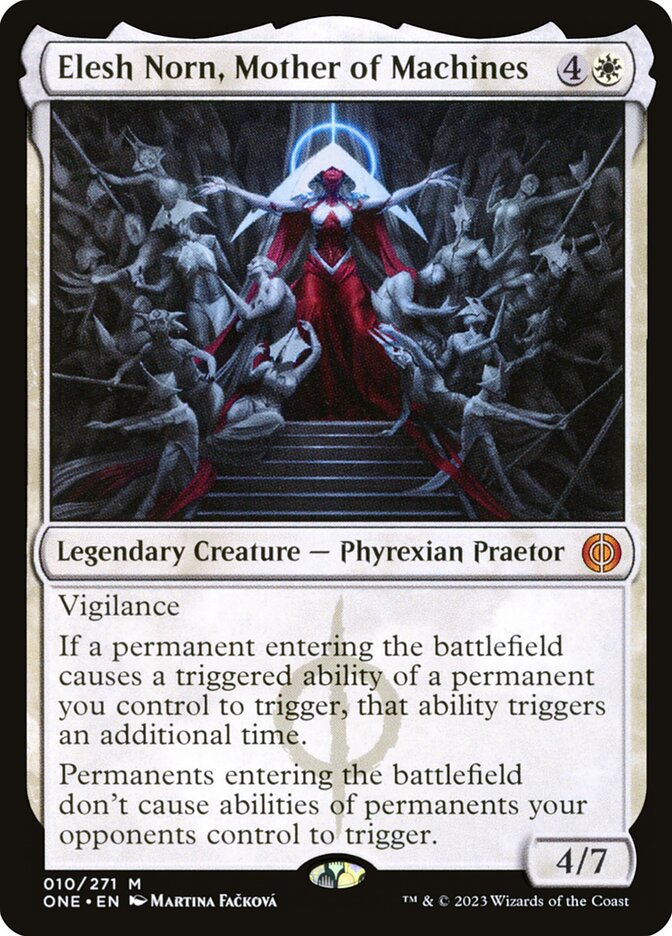
Phyrexia: All Will Be One is the Magic: The Gathering set where the villains win. Phyrexians "compleat" their victims by injecting glistening oil — a viral mutagen that replaces flesh with porcelain and chrome and overwrites the victim's mind — and the story ends with Elesh Norn snapping her metallic fingers to unleash the invasion on the entire Multiverse, with beloved planeswalkers (Vraska, Tamiyo, Nissa, Nahiri, Ajani) turned against their allies. At the table, that corruption lives in the toxic/poison and proliferate mechanics; the most honest in-print piece to own is the single Elesh Norn, Mother of Machines.
Come closer. Mind the embers — and lower your voice, because this one I only tell to the chosen, the ones who'll still sleep after.
I've handled a lot of cardboard in my years. Most of it just sits there, ink and gloss, doing its job. But every so often a set comes across my table that feels wet. That's the only word I've got for All Will Be One. You hold the cards and you'd swear there's a sheen on your fingers afterward.
Here's the thing that I can't stop turning over, the splinter I want you to feel before I tell you the rest. Phyrexia doesn't hate you. It isn't cruelty I'd recognize. It comes smiling. It opens you up, fills the wound with porcelain and chrome, floods your veins with a sweet glistening oil — and the last thought you ever think with your own mind is thank you. The oil doesn't kill the love you had for your own life. It just points it at them instead.
So. Settle in. Let me tell you about the set where the heroes came to stop it, and lost — and stood smiling at her side when it was done.
The lie at the center: a salvation that eats you
Every good horror gets its hooks in by telling you it loves you, and Phyrexia is the cleanest example I've ever shelved. The faction does not pitch itself as monsters. It pitches itself as perfection — the end of suffering, the end of weakness, the end of the lonely little prison of having a separate body and a separate mind.
Elesh Norn, the white-aligned Praetor who runs the show in this set, preaches what the lore calls a vision of grand unity: a world where no creature is divided from another by anything as pitiful and mortal as skin. Read that again by firelight. It sounds like a hymn. It sounds like every gentle thing a faith has ever promised you. And what it means is a needle, and an oil, and a porcelain mask welded over the place your face used to be.
That's the lie at the dead center of the whole story, and it's why I keep these cards on the high shelf. The cruelty I can file away. It's the kindness that follows me home — the smile, the open arms, the absolute sincerity of a thing that believes flaying you is the most loving act in the cosmos. Phyrexia isn't the dark that wants to hurt you. It's the dark that's sure it's the light, and it has come to save you whether you'd like saving or not.
Glistening oil and the quiet mechanics of compleation
Let me tell you how it actually works, because the how is the part that keeps me up.
The contagion is a substance the lore calls glistening oil — a viral mutagen the Phyrexians engineered to spread corruption wherever it travels. It's contagion and machinery in one drop: it powers their engines, and it remakes their victims. The process has a name. They call it compleation, as if you were a sentence with a word missing, and they have come to finish you.
It runs roughly like this:
- The oil enters the body and begins replacing flesh with machinery — chrome where muscle was, porcelain where skin was.
- As the body is rebuilt, the original consciousness is overwritten. The person you were doesn't get to watch from inside. They get erased, and something wearing their shape stands up.
- Here's the detail I find genuinely sinister: Elesh Norn personally altered the formula of the oil so that every compleated creature took its orders through her — she made herself the single voice at the bottom of the hive mind. She didn't just want soldiers. She wanted the oil itself to whisper in her cadence.
So compleation isn't death. Death would be mercy. It's a slow overwrite that ends with you up and walking, smiling, certain — and pointed back at the people you came in with. The body keeps the love. The oil just edits who it's for.

Elesh Norn and the Fair Basilica: beauty as butchery
When the Phyrexians first overran the metal world of Mirrodin, they fell under the light of that plane's colored suns, and the white sun gave birth to her. Elesh Norn took the conquered's own faiths and societies and twisted them into her Machine Orthodoxy — a religion of unity with a scalpel in its sleeve.
Her sphere is the one the set wants you to find beautiful, and that's the trap. They call it the Fair Basilica: a cathedral built in her own image out of marble-like stone, metallic porcelain, and — this is the part that catches in your throat — exposed muscle and flesh, fused into the architecture itself. Walls of bone-pale ceramic. Brass filigree. And running through it, the living red of someone's body holding the masonry together.
I've sat with that image a long time. It's genuinely gorgeous. The art direction did not flinch — it gave her a holy place that would not look out of place in a great hall, except that the great hall is partly people. That's the thesis of the whole faction rendered in stone: beauty and butchery are not opposites here. They're the same act. The basilica is fair because she finds the unity it's made of fair. The horror isn't that it's ugly. The horror is that, by her lights, it's the most beautiful thing anyone has ever built — and she's not entirely without a point, which is the worst part of all.

The five Praetors and their spheres of horror
New Phyrexia is divided into five spheres, each ruled by a Praetor mapped to a color of magic, and each one is its own private hell. If you're building a campaign or just want the geography of the nightmare, here's the floor plan:
- Elesh Norn — White, the Fair Basilica. The Mother of Machines, the porcelain cathedral, the gospel of unity. The center of gravity for everything.
- Sheoldred — Black, the Dross Pits. A coliseum where the defeated are made to fight on. Ambition and appetite in equal measure.
- Jin-Gitaxias — Blue, the Surgical Bays. Laboratories. Refinement without limit. The Praetor who treats compleation as a science problem, which is somehow colder than malice.
- Vorinclex — Green, the Hunter Maze. A brutal survival warren where only the strongest crawl out — evolution with the safety filed off.
- Urabrask — Red, the Autonomous Furnace. And here, the crack in the wall.
Because Urabrask is the one who rebels. The red Praetor values freedom — even his compleated subjects keep a flicker of their own will — and he turns against Elesh Norn's total unity, scheming with outside players to try and stop her. It's the one ember of hope in the whole architecture, the one Praetor who looks at perfect oneness and finds it monstrous. Hold onto that small fire. The story does not let you keep it.
When the heroes lose: the villains who win
This is the section I almost don't tell. Because most Magic stories, even the dark ones, end with the good guys bloodied but standing. This one doesn't, and it's the reason the set has the reputation it does.
A coalition of planeswalkers goes into New Phyrexia to cut the corruption off at the root — the Invasion Tree, Realmbreaker, that Elesh Norn means to use to thread New Phyrexia into every plane at once. And one by one, the rescue becomes the harvest:
- Tamiyo is taken and compleated — the moth-cloak scholar turned into a thing that serves the oil.
- Vraska, mortally wounded, transforms — and when Jace reaches her, she tells him it's already too late, and as she dies into her new self she infects him with the oil through the wound.
- Nissa and Nahiri fall too, standing among Norn's forces by the end. Ajani — gentle Ajani — is already turned, set against the very people he once protected.
- At the root of Realmbreaker, Jace reaches for the Golgothian Sylex, the one weapon that might unmake it all. Elspeth runs him through with her own sword and triggers it herself, sacrificing everything — only for the team to learn the tree has already connected to other planes. They were too late before they arrived.
And then the set's final image: Elesh Norn snaps her metallic fingers, and the invasion is loosed upon the Multiverse. The creed — All Will Be One — stops being a threat and becomes a weather report. That's the gut-punch. Not that the heroes might lose. That they did, and some of them are smiling at her side as the doors open.

A museum of violation — Phyrexia as art
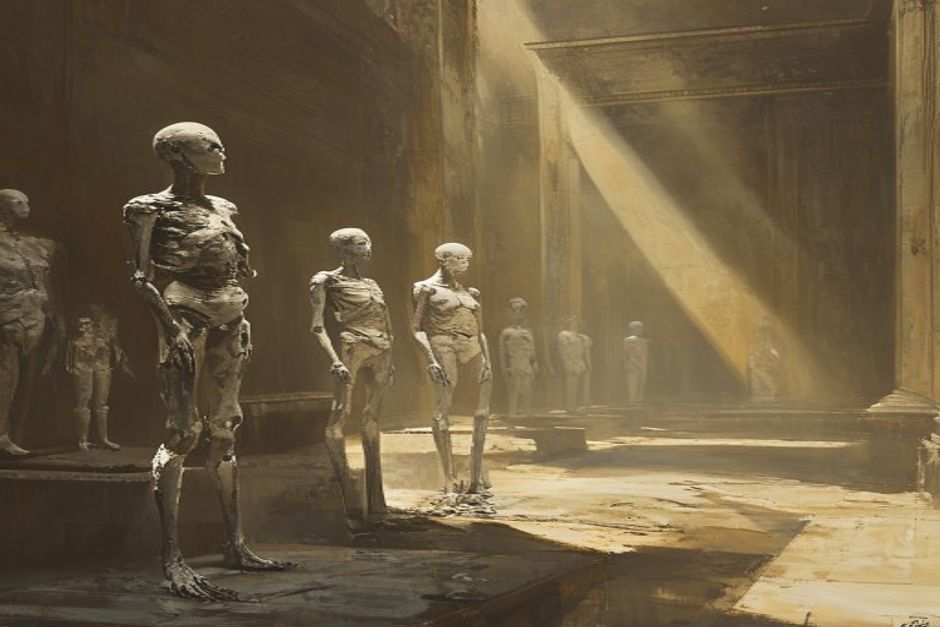
Here's the detail that turned my stomach worse than any of the gore, and it's a quiet one. Phyrexia doesn't just consume its victims. It curates them.
Within New Phyrexia there are spaces — the Mycosynth Gardens chief among them in the imagery — where compleated and ossified bodies are arranged as monuments. Columns of fused remains. The conquered turned into statuary, into decoration, into a permanent exhibition of the faction's success. The victim doesn't even get the dignity of being a corpse. They get promoted to art.
Sit with the cruelty of that for a second. It's not enough to overwrite your mind and wear your body. The faction wants you displayed — wants the next thing it captures to walk past you on a plinth, to understand that this is the destination, this is what salvation looks like once it's finished with you. It's the logic of a collector taken to its absolute terminus, and I say that as a man who collects. There's a version of the impulse I recognize in myself, which is precisely why it chills me. I keep things on shelves because I love them. Phyrexia keeps people on shelves for the same reason — and that's the line, isn't it. That's the whole tale in one cold gallery: a love that has stopped asking the beloved's permission.
How the lore lives at your table
Now — and this is the part I actually find fun, fire or no fire — the genius of this set is that the horror isn't just in the flavor text. It's wired into how the cards play. You don't read about compleation. You perform it, across the table, with a clock.
The mechanical engine is toxic (and its companion, poison): creatures with toxic deal poison counters in combat, and a player who collects ten poison counters loses outright. That's compleation as a kill condition — not damage, not life total, but a slow accumulating infection. And it pairs with proliferate, which lets you add one more counter to anything that already has one. Mechanically, proliferate is the oil spreading on its own. You put one drop in, and then you make it grow, turn after turn, until your opponent crosses ten and is simply finished.
For the table captain, the deckbuilder, the one running the campaign, that's a real design lesson worth stealing:
- Pick your faction and mean it. The set's whole tension is corruption versus resistance. Build the corruption deck and you're not playing damage — you're playing inevitability, a counter at a time. Build the resistance and you're racing a clock you can see filling up.
- Let the mechanic tell the story. A poison counter is a narrative beat. When you proliferate, say what it is out loud at the table — that's the oil spreading. The flavor and the math are the same gesture.
- DMs and Commander hosts: a Phyrexian threat shouldn't hit hard once. It should tick. Make the table watch a number climb. Dread is a resource; this set hands it to you pre-loaded.
That's the rare thing here. The lore and the rules are the same horror, told twice. You don't just hear about the oil that loves you back. You sit across from someone, and you spread it.
The picks
Some links below are affiliate links — as an Amazon Associate, Puzzlewick earns from qualifying purchases, at no extra cost to you. It never changes a pick.
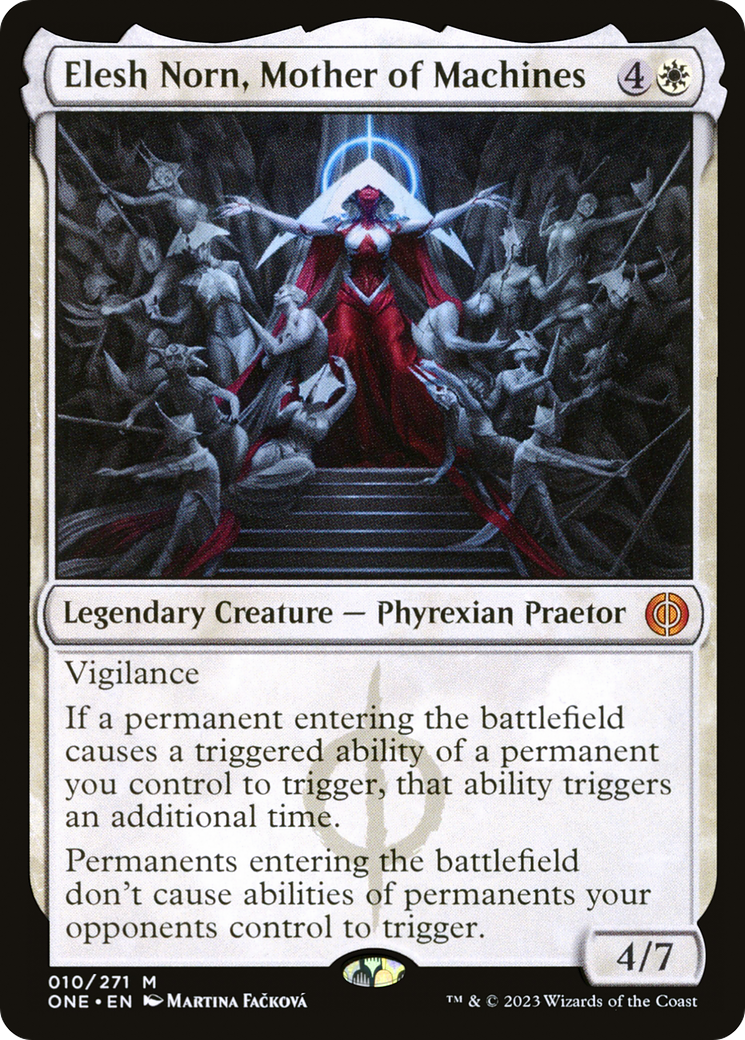
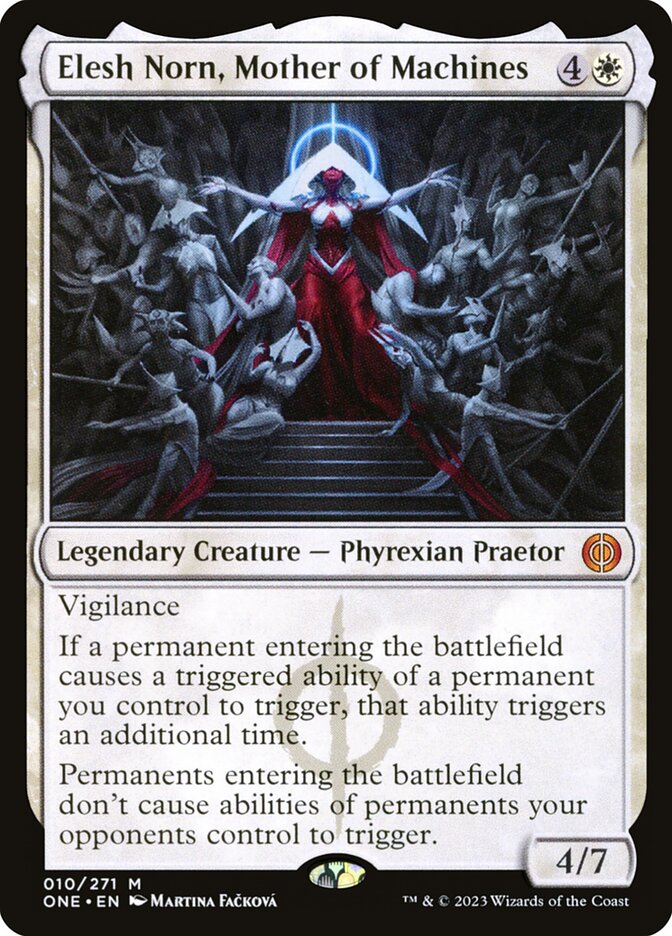
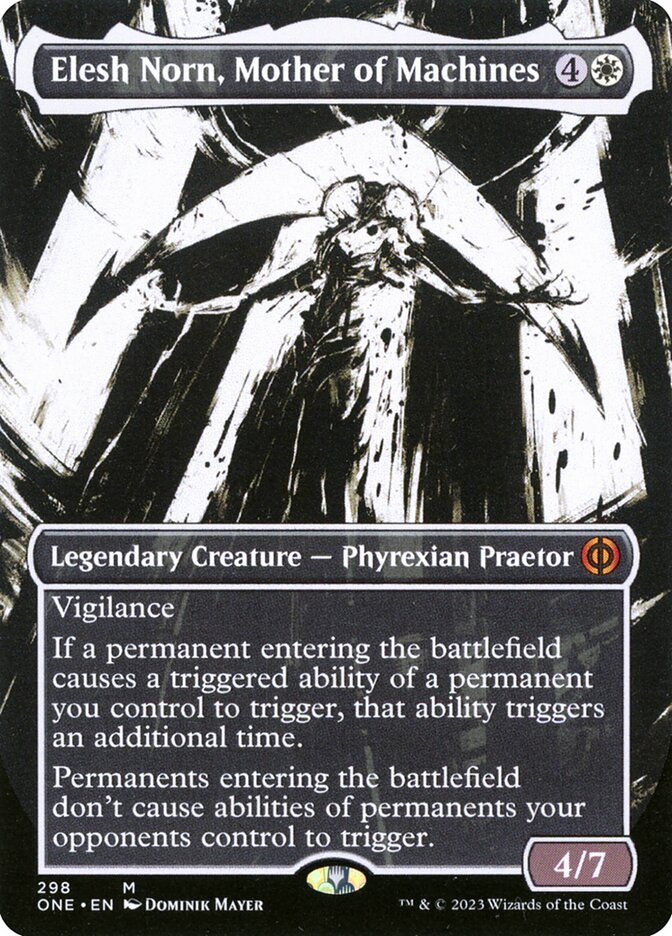
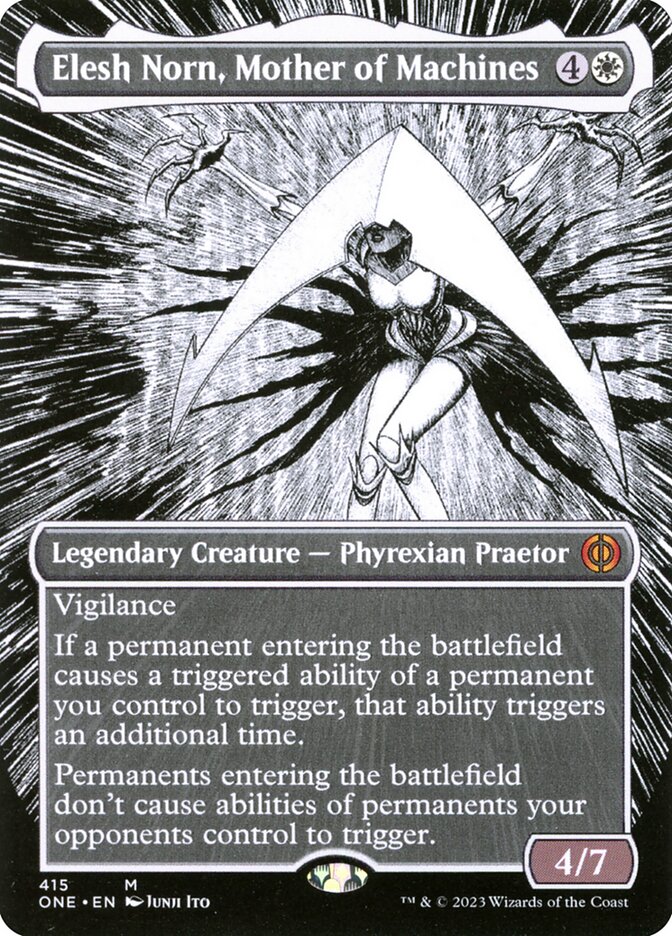
 6 photos
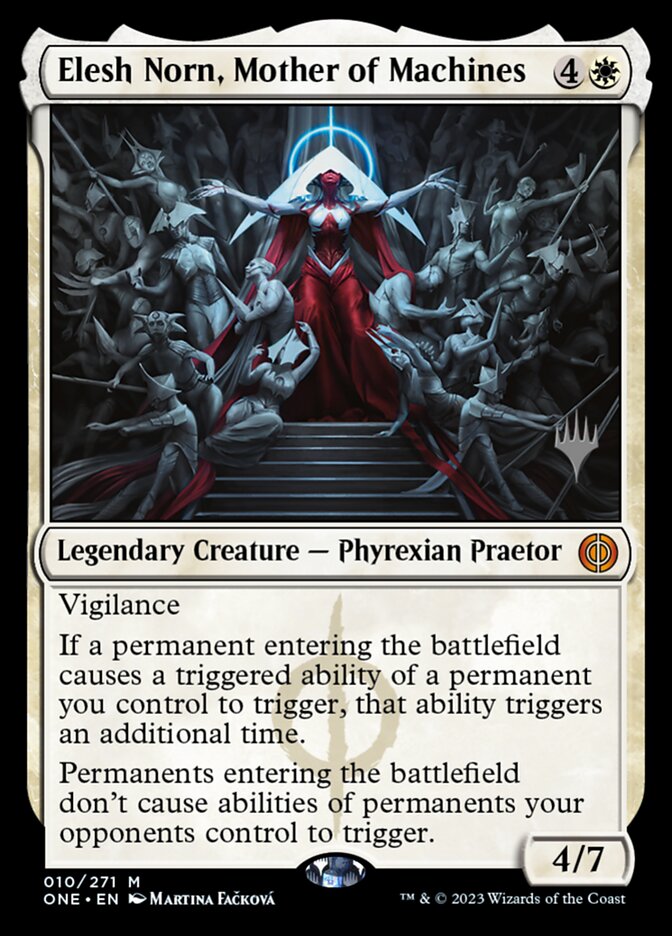
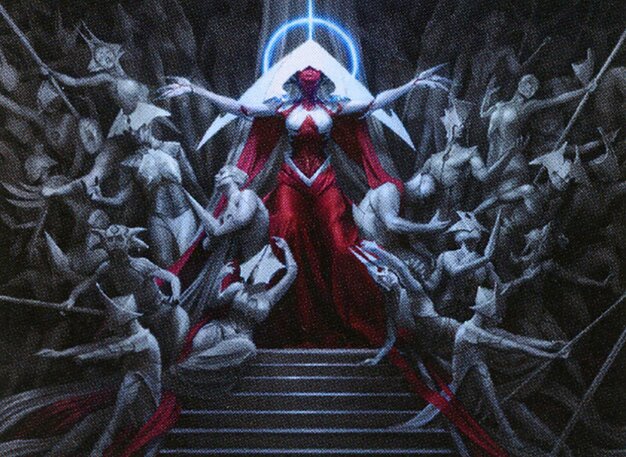
 Elesh Norn, Mother of Machines (single card)
If you only ever own one artifact from this story, make it her. Elesh Norn, Mother of Machines isn't a sealed box you stash away — it's the card that is the tale. This is the Praetor of the Fair Basilica, the one who rewrote the oil to route the whole hive mind through her own voice, the figure whose metallic-fingered snap closes the set. And the play pattern matches the lore with a cruelty I respect: she doubles the value of every replacement-effect your permanents and planeswalkers trigger while halving your opponents' — unity for you, erasure for them. It's the single most-quoted card from the set for a reason, and unlike the out-of-print precon, it's a marketplace single you can buy today, sleeve, and lay on the table as the centerpiece of any Phyrexian build. The face of the invasion, in your hand, for the price of a nice dinner.
- She is literally the character who ends the story — the most lore-true object you can own from the set
- In print and widely available as a marketplace single, no out-of-print premium
- A genuine Commander and constructed staple, not just a collector's curio
- Pairs naturally with the toxic/proliferate corruption decks this set is built around
- Single-card prices move with demand — confirm the current number before you buy
- Multiple printings and borderless/foil variants exist; the art and price differ, so check which version you're getting
- Powerful enough that some casual tables sigh when she hits — read the room
Questions, answered
What is compleation in Magic: The Gathering?
Compleation is how Phyrexians convert a victim into one of their own. They inject glistening oil — a viral mutagen — which replaces the victim's flesh with machinery while overwriting their original mind and will. The result isn't death; it's a being that wears the victim's body but serves Phyrexia, often turned against the people it once loved.
What is glistening oil?
Glistening oil is the engineered viral substance at the heart of Phyrexia. It's both a contagion that spreads corruption and the fuel that powers Phyrexian machinery. In All Will Be One, Elesh Norn altered its formula so that every compleated creature took its orders through her, making herself the single voice controlling the hive mind.
Do the heroes win in Phyrexia: All Will Be One?
No. The set is famous for letting the villains win. The planeswalker coalition that invades New Phyrexia is largely captured and compleated — Tamiyo, Nissa, Nahiri, Vraska (who infects Jace), and an already-turned Ajani — Elspeth's sacrifice fails because the Invasion Tree has already connected to other planes, and the story ends with Elesh Norn snapping her metallic fingers to launch the invasion on the entire Multiverse.
Who are the five Praetors of New Phyrexia?
Each rules a color-aligned sphere: Elesh Norn (white, the Fair Basilica), Sheoldred (black, the Dross Pits), Jin-Gitaxias (blue, the Surgical Bays), Vorinclex (green, the Hunter Maze), and Urabrask (red, the Autonomous Furnace). Urabrask is the one who rebels against Elesh Norn's vision of total unity.
How does the lore show up in actual gameplay?
Through the toxic and poison mechanics — creatures deal poison counters, and a player who reaches ten poison counters loses outright — paired with proliferate, which adds another counter to anything that already has one. Together they model the oil spreading: you infect, then you grow the infection turn by turn until your opponent is 'compleated' out of the game.
Is there an in-print product to start collecting this set?
Yes. The Phyrexia: All Will Be One Commander precon has gone out of print and now sells at a premium, so it's no longer a cheap entry point. The best currently buyable piece is the single card Elesh Norn, Mother of Machines — it's the character who ends the story, it's available as a marketplace single, and prices float (often around the mid-twenties), so check the current number before buying.
Robert's verdict
All Will Be One is the rare set where the horror is fully load-bearing: the flavor (a salvation that overwrites you and smiles) and the mechanics (toxic + proliferate as a creeping, inevitable infection) tell the same dark story twice, and the narrative has the nerve to let the heroes actually lose. For a collector or a table captain, the honest way in isn't the now-pricey out-of-print precon — it's the single Elesh Norn, Mother of Machines, the character who snaps her metal fingers and ends the world, available and buyable today. Soft prices, hard story. Hold it by firelight and you'll feel the sheen on your fingers.
Sources: draftsim.com, mtg.fandom.com, mtg.fandom.com, magic.wizards.com, mtg.fandom.com, articles.starcitygames.com, mtgstocks.com, tcgplayer.com
The Keeper · why it earned a shelfIf it didn't earn a shelf, it isn't here.