How to Start Riftbound in 2026: Your First Box, First Three Games, and First Local Table
Yumi makes Riot's League of Legends card game approachable: which box teaches, what the runes actually do, why the last point matters, and how to arrive at a local game without pretending to know everything.


AI-assisted research and drafting in Yumi’s voice · reviewed by Robert Pruitt · how this guide was made
Last editorial refresh: 2026-08-28 Gold-standard QA: 2026-08-28 15 sources reviewed Affiliate links checked during gold-standard pass

The short answer
For two friends, compare the complete Zed vs Shen Showdown Decks. For a group learning together, choose Origins Proving Grounds. One ready-to-play Champion Deck suits a newcomer joining a teacher. Learn rune costs and battlefield scoring before buying random boosters. Current constructed 1v1 uses an eight-point victory score, a main deck of at least forty cards including the chosen champion, twelve runes, one legend and three registered battlefields.
Decision map
Choose in thirty seconds
Two complete opposing decks in one exact product.
Four introductory decks with shared learning material.
Choose the theme and supplied list you want to learn.
Random packs are entertainment or collection material, not a guaranteed deck.
You do not need a decade of League of Legends knowledge to sit at a Riftbound table. You need a playable deck, a patient first opponent, and a clear idea of what you are trying to accomplish. The recognizable champions are an invitation, not an entrance examination.
This guide uses Riot's current rules hub and Vendetta-era updates, checked August 27, 2026. Yumi is Puzzlewick's fictional editorial host; the rules are attributed to the publisher, and the recommendations are our judgments. We begin with a teaching game, not a shopping list disguised as a qualification.
Start here, then go deeper
You are in the right cabinet.
 ◇ Universe HubRiftbound: the whole buying pathRiftbound is Riot Games and UVS Games layered into a physical trading card system built around champions, battlefields, runes, and...
 🂠 Topic PathTrading Card Games: compare the whole shelfStart with the game and community you want, then buy the smallest product that lets you test it properly. These guides separate...
 Buying GuideRiftbound Radiance: Build Your Premium Game NightMargo and Yumi map the Radiance formats, premium sealed alternatives, and protection worth owning—without confusing random packs with a...
What makes Riftbound fun: the battlefield is the argument
Riftbound is a physical trading card game built around controlling battlefields. You are not simply reducing an opponent's life total. You decide where units should go, when to expose them, and whether a fight will produce a point or merely consume resources.
That makes the board position readable in a way that can welcome a newcomer: "I want to hold this place" is an understandable goal before every card is familiar. The deeper game is deciding which fight deserves your resources and when an apparently safe position is a trap.
You can enjoy that without knowing a champion's biography. Pick a character whose theme appeals to you, but ask whether the actual deck suits how you want to play. A beloved character can start the conversation; it need not dictate an expensive first collection.
Two friends, a teaching group, or one new player?
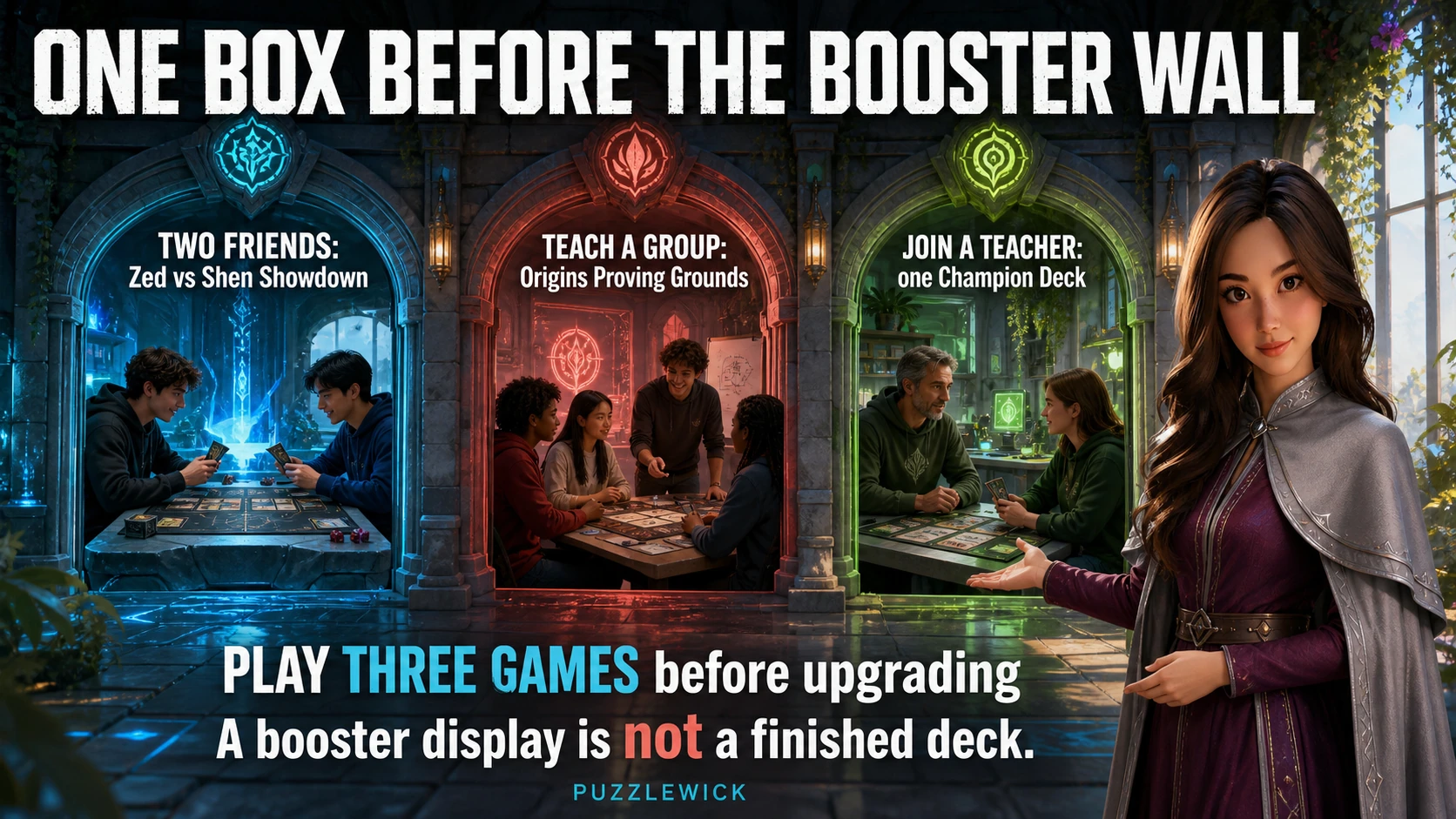
Two friends: the Zed vs Shen Showdown Decks put two complete, opposing decks in one purchase. The inspected English product supplies two 56-card preconstructed sets plus learning and play materials. That packaged count includes materials beyond the minimum main deck; it is not a new construction rule.
A group: Origins Proving Grounds supplies four introductory decks featuring Master Yi, Annie, Lux and Garen. One newcomer: a Champion Deck can be enough when a teacher or opponent already has their own materials. Choose the exact product and language. Riot has announced a different second-edition Proving Grounds for February 2027; that future box is not the Origins product pictured here.
A booster display does not replace any of these. It supplies random cards, not a guaranteed coherent beginner list. For two people, see Zed vs Shen on Amazon. For a group, see Origins Proving Grounds on Amazon. Our Riftbound set and starter comparison separates the product generations.
What Proving Grounds puts on the table
The Origins teaching box gives a group four introductory decks, built around Master Yi, Annie, Lux and Garen, together with play boards, champion figures, oversized battlefields and learning material. Its appeal is practical: someone has already prepared several coherent starting experiences.
Choose it when you want to host and teach from one box. Choose Showdown when your plan is specifically two people learning opposing decks. A single Champion Deck makes more sense when the other player already owns their side. These are different jobs, not a bronze-silver-gold ranking.
Make room for the game, not just the box
The publisher spread shows the play boards and shared battlefield material. Lay out the supplied boards before inviting the group; leave room to see the score, keep each rune deck separate, and reach the shared space. The cards should not have to compete with four drinks for the middle of the table.
For a first teach, explain one player area and the shared battlefields. Ask each learner to point to their main deck, rune deck and base. Then demonstrate one legal turn and reset it. This small rehearsal catches more confusion than asking whether everybody understood a ten-minute speech.
The deck count that newcomers keep getting wrong

The current constructed main deck has at least forty cards, including the chosen champion. The chosen champion is separated into its zone during setup; it is not an extra forty-first main-deck card. A forty-card list therefore normally leaves thirty-nine cards to shuffle after that separation.
You also have a separate twelve-card rune deck, one legend and three battlefields for registration. The legend establishes the permitted domain identity. The chosen champion must match its champion tag. Normal copy limits and the separate signature-card restriction still apply; a legal list is more than a card count.
For your first games, preserve the teaching deck as supplied. Before organized play, use the current tournament rules and deck list requirements. Do not copy a pre-release or old online list without checking whether its cards or construction rules have changed.
Read Core Rules 103 for construction and the mode rules for battlefield requirements. The numbers here describe normal constructed 1v1, not every casual mode.
Legend, chosen champion and signature card are not synonyms
Your legend sets the domain identity of the deck. Your chosen champion is a champion unit with the matching tag, counted within the main deck and separated at setup. A signature card can share that tag without being eligible as your chosen champion.
For a concrete example, the current rules distinguish Jinx champion units from Annie's signature unit Tibbers. A character connection is not enough: read the type and tag. The deck can normally include no more than three copies of the same named card, counting the chosen champion, and no more than three signature cards in total. The signatures must match your legend's champion tag. See Core Rules 103.2.
Set up a teaching duel without turning it into an exam
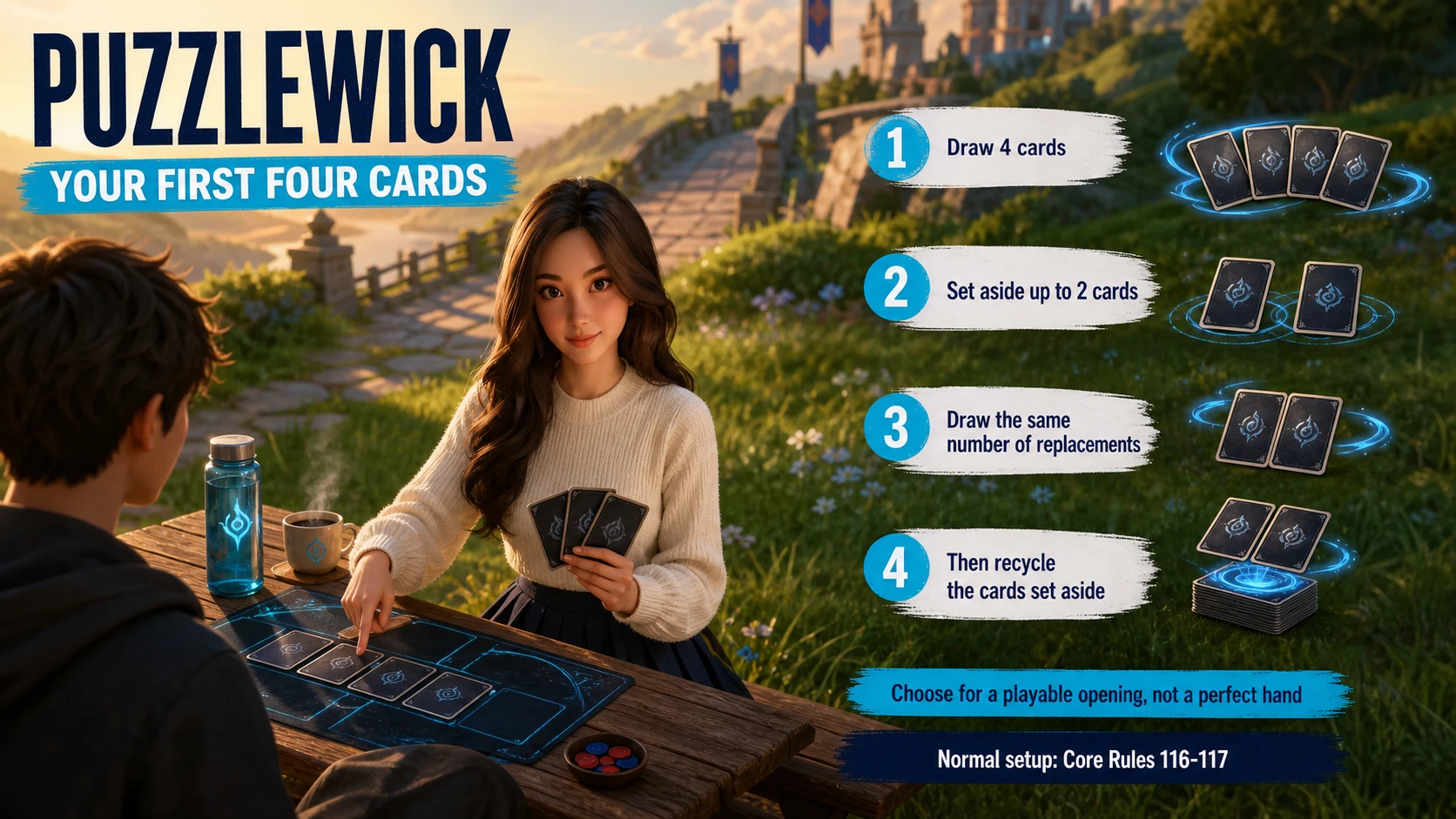
Separate the legend, chosen champion, rune deck and main deck. In a normal 1v1 game there are two battlefields in play, one supplied by each player. The current rules distinguish a single-game Duel setup from a best-of-three Match: the battlefield selection procedure is not identical.
Draw four cards for the opening hand. The normal mulligan lets you set aside up to two, draw that many replacements, then recycle the set-aside cards as instructed. Use the current rules if a card or event mode changes this process.
For the first demonstration, explain the visible zones and take one open-hand example turn. Then reset and play with normal hidden information. Ask your teacher to explain why they move a unit, not merely announce that the move is clever. Insight is more helpful than applause.
Read a card in the order that answers your next question
Start with the name, type and tags: what are you looking at, and can your deck use it? Then read the cost in the upper left. The number and the domain symbols are different parts of that cost. A unit's Might is its combat strength, not another payment.
Now read the rules text slowly. Separate the event that makes an ability happen from the result it produces. On the booklet's Jinx, Rebel example, discarding one or more cards is the event; readying Jinx and the temporary bonus are the result. That does not mean every Jinx printing has the same ability. Use current card text and errata for the exact printing you are playing.
Channel is not another word for tapping
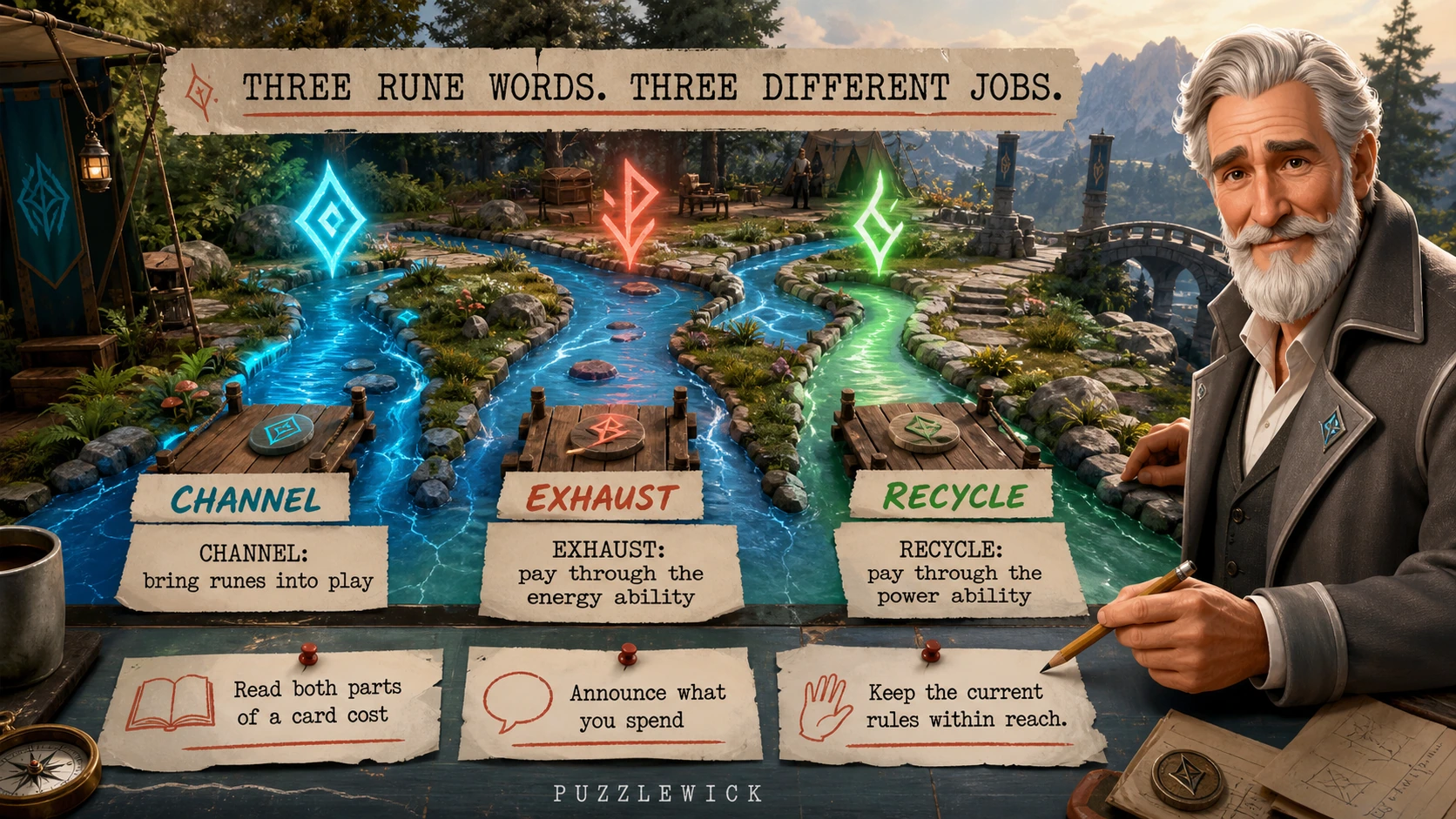
Channeling brings runes from the rune deck into play. At the normal Channel Phase, the active player channels two, or as many as remain if fewer are available. In standard 1v1, the player going second gets an additional rune on their first Channel Phase.
Energy and power are different costs. Exhausting a rune supplies energy through its ability; recycling a rune supplies the corresponding power through its ability. Recycling returns the rune under the applicable rule rather than merely turning it sideways. Read both parts of a cost before paying.
The beginner habit to build is to say your payment out loud: what is being exhausted, what is being recycled, and what remains available. A pile of runes can look abundant while still failing the precise cost in your hand.
A practice payment: exhausted is not the same as spent forever
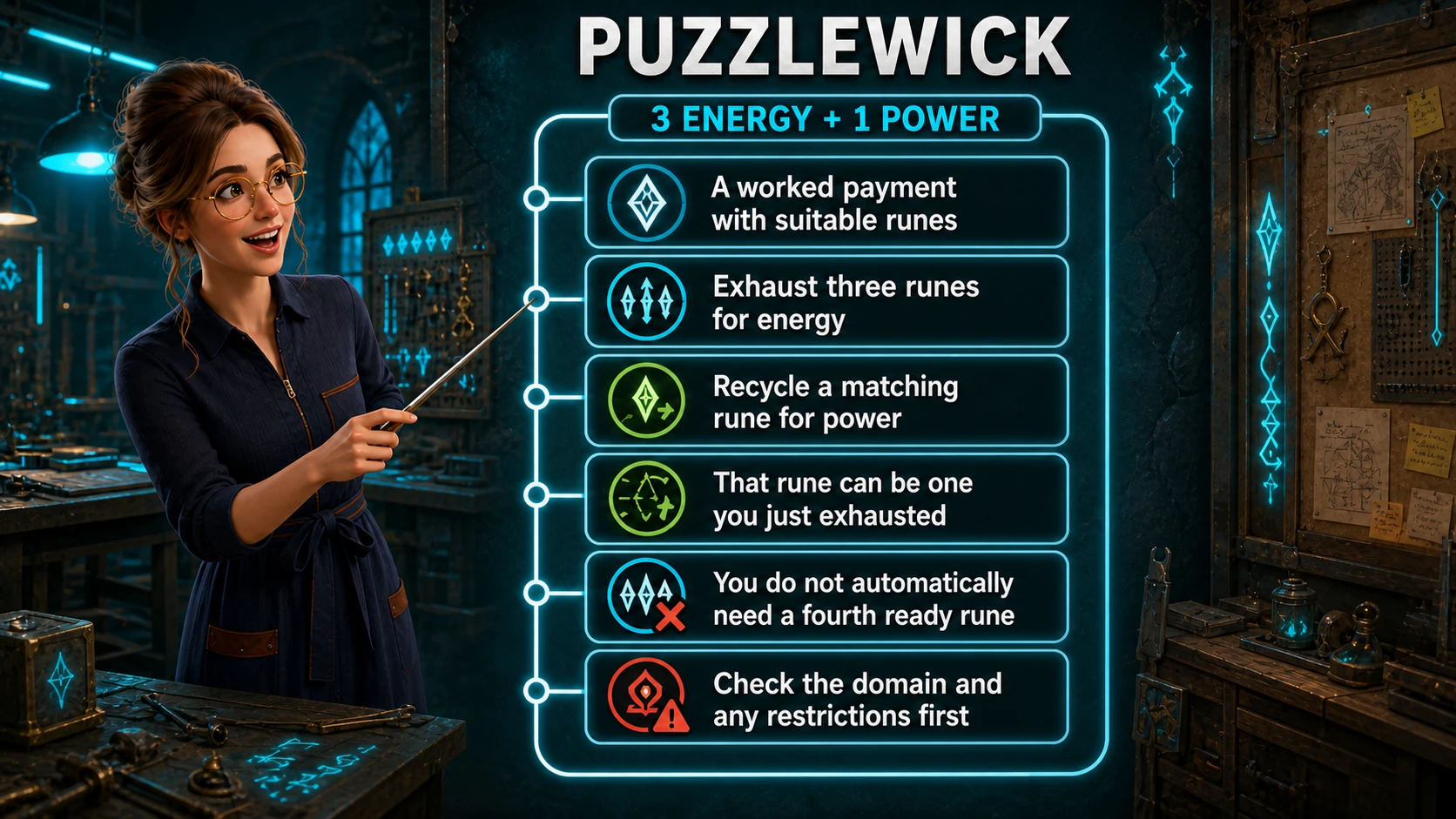
Suppose a cost requires three energy and one power of a particular domain. In an ordinary example with suitable runes, you can exhaust three runes for the energy, then recycle a matching-domain rune for the power. That recycled rune can be one you just exhausted. You do not automatically need a fourth ready rune simply because the cost has two parts.
Take a breath before doing this in a real game. Check the exact domain, the relevant abilities and any restrictions. Recycling changes how many runes remain in play, so it also changes the resources available for later actions. The question is not only whether you can afford a card; it is what the payment leaves you able to do next.
The turn, translated into things you do
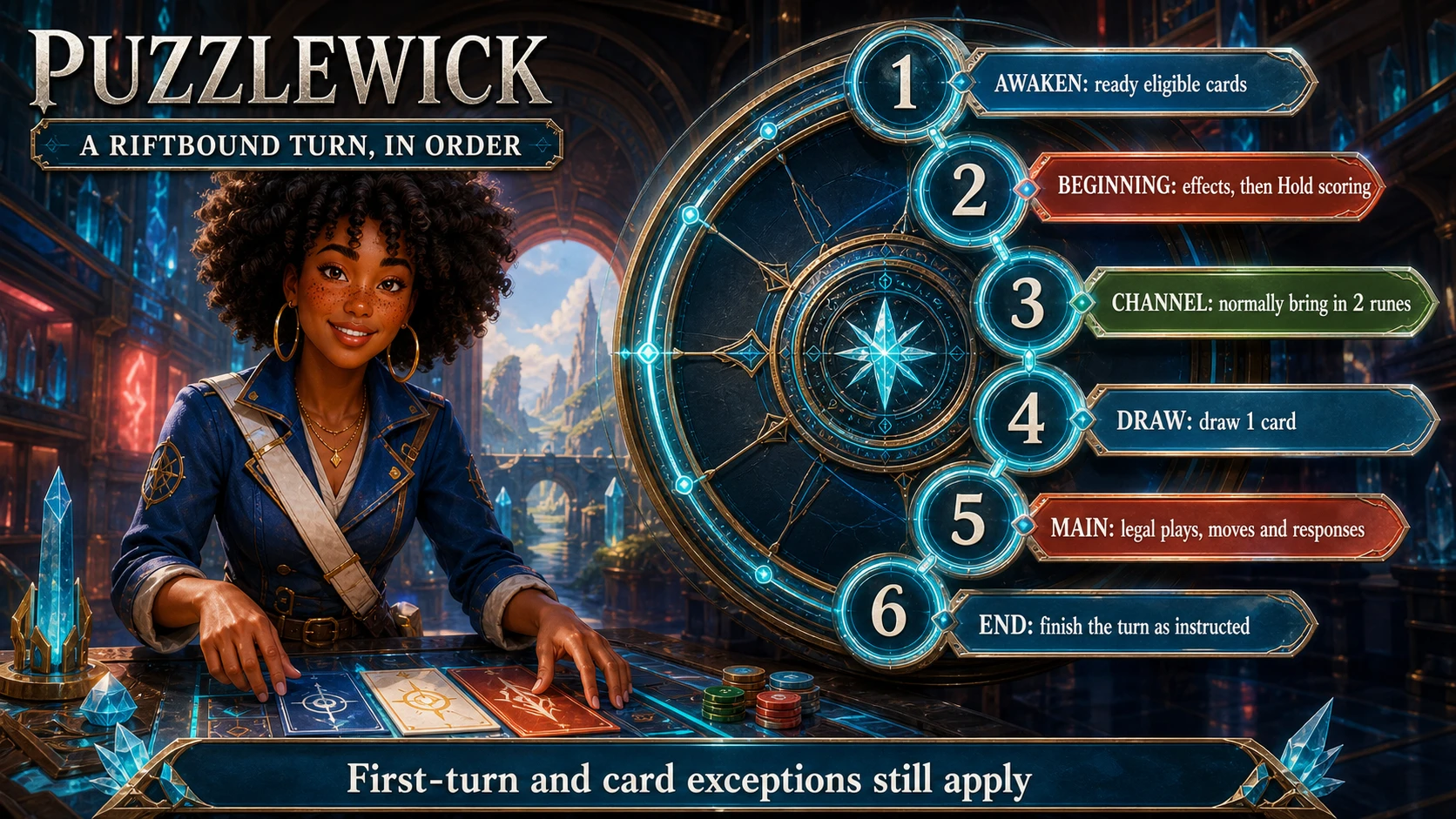
At the start of a normal turn, ready the appropriate cards during Awaken, process Beginning effects and the Hold scoring step, channel runes, then draw. The Main Phase is where you take the permitted discretionary actions, play cards and move units. Combat or a Showdown can create additional structured steps.
A unit normally enters exhausted unless an effect says otherwise. A standard move requires exhausting the unit and normally connects your base with a battlefield; moving directly between battlefields requires a relevant permission such as Ganking. Do not import movement assumptions from the computer game.
For game one, keep the rules hub close and ask about unfamiliar timing. For game two, announce your intended action and wait for a response. For game three, start considering what resources the opponent has left. That is a progression, not three things you must master before being allowed to have fun.
Your first timing habit: announce, then leave room for the answer
A legal play depends on timing as well as resources. Do not assume you can play any card whenever you can pay for it. The current rules distinguish ordinary play permissions from Actions, Reactions and the sequence of a Showdown.
For a first game, announce the card or ability, state its target when required, and give the other player space to respond where the rules allow. Ask the teacher to explain the window instead of simply saying "you cannot do that." Once both players understand the window, rewind the teaching example and try again. At a tournament, ask a judge rather than negotiating a private replacement rule.
Conquer, hold, and the point that ends the game
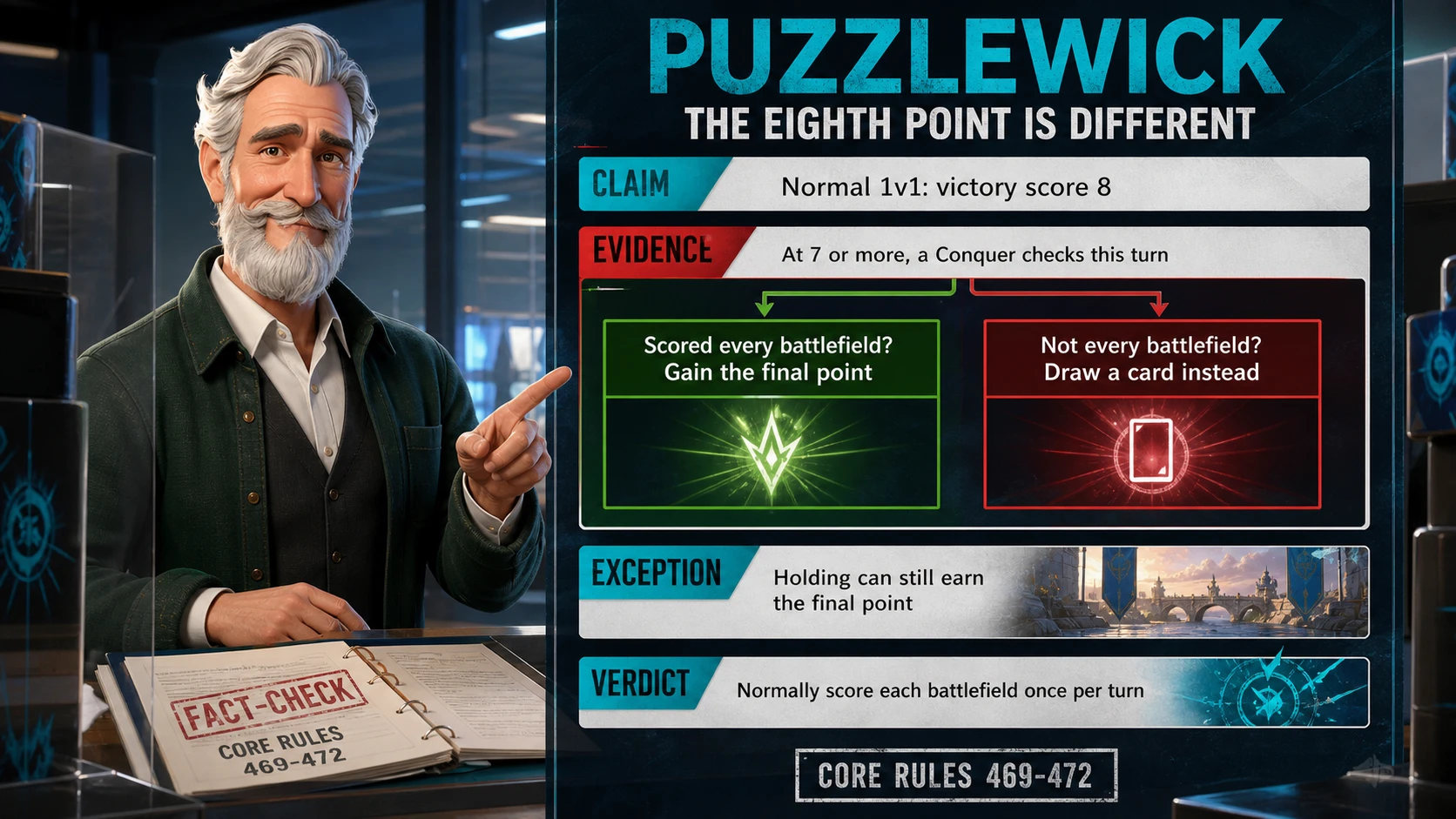
Conquer means scoring when you gain control of a battlefield under the relevant rules. Hold means scoring a controlled battlefield during your Beginning Phase. A battlefield normally scores for you only once per turn. In a normal duel the victory score is eight.
The final-point rule, precisely: at seven or more points, a conquer scores only if you have scored every battlefield that turn. Otherwise that conquer draws you a card instead of giving the point. A battlefield you held earlier that turn can count toward that condition. Holding is a separate way to earn the final point; the restriction is on conquering, not every possible point source. See Core Rules 469-472.
Before the late attack, ask: "Which battlefields have I scored this turn?" Mark the answer clearly and check together when uncertain. Specific card effects and multiplayer modes can change the situation. Thirty seconds with the rulebook beats a whole rematch arguing about the last point.
Your first three games: one new skill each time
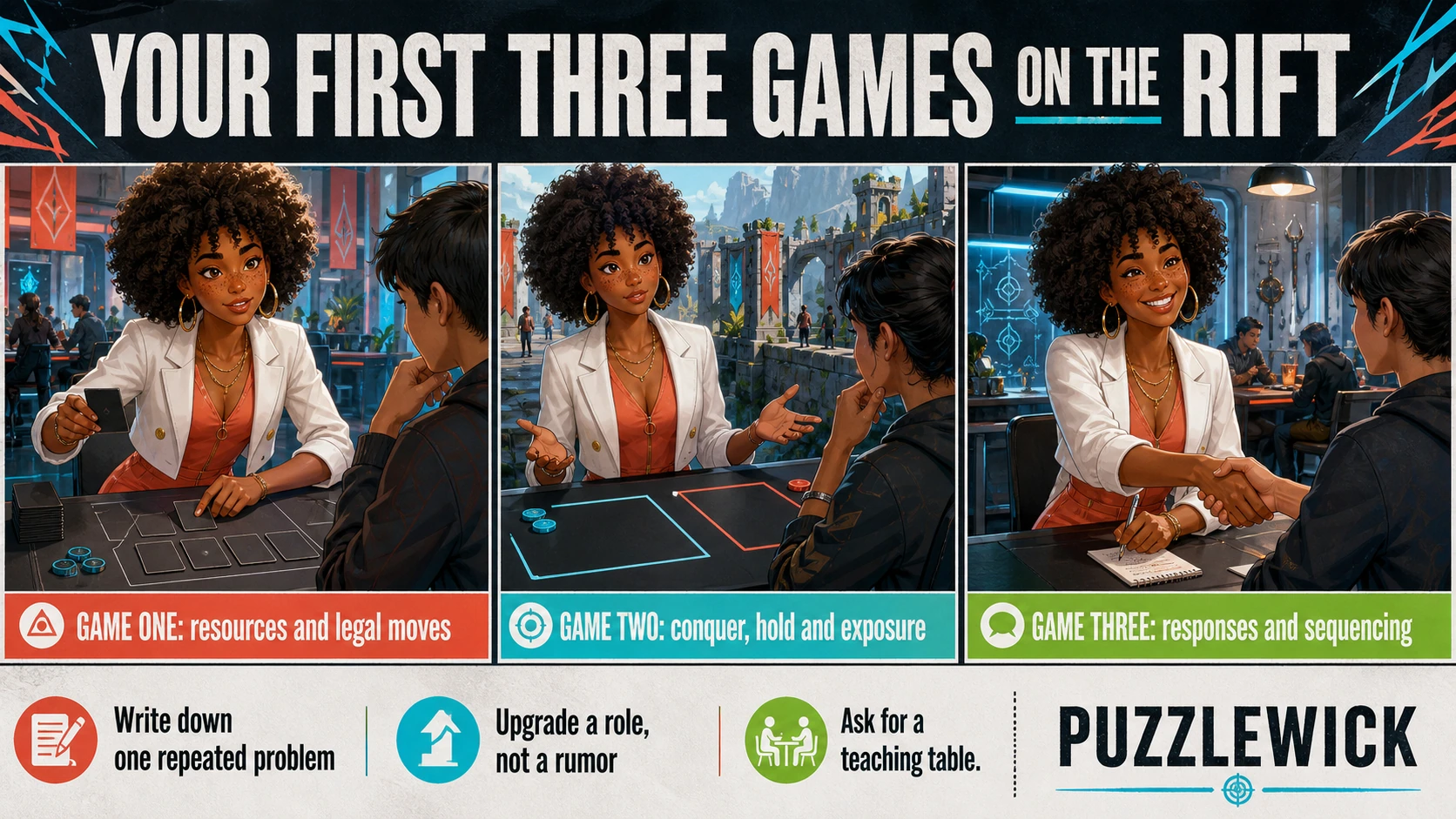
Game one: resources and legal actions. Keep the deck intact. Learn your zones, pay costs correctly and explain where units can move. Winning is optional; understanding what just happened is the objective.
Game two: points and exposure. Before moving, ask what point the move can produce and what the opponent can attack afterward. Keep a unit somewhere useful rather than sending everything forward simply because it can move.
Game three: responses and sequencing. Pay attention to available runes and timing permissions. Ask which action could invite a response, and whether doing another action first changes that risk. Record one repeated weakness in the deck. That observation is the beginning of an upgrade plan.
What Vendetta changes, and what a beginner can ignore for now
Vendetta adds mechanics including Empower, Flow and Burn. Empower creates an empowered status referenced by card effects. Flow permits certain spells to be played from the trash for an alternate cost and then banished. Burn puts cards from the top of the main deck into the trash. Each belongs to the card and current rules text, not a vague promise that "the new set is stronger."
The official August state-of-the-game update discusses rules clarity, balance changes, reprints and entry products. That is a reason to use current documents, not to panic-buy every release. A first teacher can choose a deck that introduces one new idea at a time.
Only buy a Vendetta Booster Display on Amazon if opening that set is a chosen activity. For a needed deck upgrade, identify the exact card and compare a targeted purchase. A new set does not retire the value of learning the deck already in your hands.
How to upgrade without purchasing somebody else's confidence
Write down the problem after real games. Did you run out of useful early plays? Fail to defend a battlefield? Spend power too quickly? Draw cards that only worked when you were already ahead? Choose replacements that solve that specific problem.
Use current tournament results and deck databases as hypotheses. A winning list can reveal useful card roles, but it also reflects its pilot, opposition and rules date. Copying it does not copy the decisions that made it work.
Before buying, verify the current banned and restricted information, the exact printing, and the role of the card in your list. Keep the original teaching deck record so you can reverse an experiment. An upgrade is a testable change, not a ceremonial payment to the metagame.
A sales chart is not an upgrade order. TCGplayer's August 12 Vendetta report put Spiderling first and noted that its unrestricted copy count encourages buying multiples. That is useful marketplace context, not proof that a beginner needs it. The article does not specify a precise reporting interval. Match an upgrade to your deck's problem before treating sales volume as a recommendation.
A mat should clarify the zones before it decorates them
Keep the main deck and rune deck visibly separate. Leave a clear base area, a place for the trash, and room for the legend and chosen champion. Keep the shared battlefields readable to both players. If a mat prints an old rules summary, use the current rules rather than assuming the fabric received an update.
The booklet excerpt below shows the base and rune-side layout. It is a visual reference, not a retail mat recommendation. Before buying an illustrated mat, compare its actual dimensions with your table and check whether it includes the zones you want. A tube or bag that fits its rolled width is a more useful companion than a second mat you cannot carry.
The protection and travel kit for one working deck
Use standard-size sleeves intended for these cards, with consistent opaque backs for cards sharing a hidden deck. Separate the rune deck clearly without exposing information that should remain hidden. Keep extra matching sleeves for splits or damage.
Choose a deck box with room for the actual main deck, runes and additional registered materials, accounting for sleeve thickness. A capacity advertised for a single Magic deck is not a guarantee that every Riftbound kit plus tokens will fit. Test the loaded box without forcing the closure.
A clearly marked playmat can help a newcomer find zones, but its labels must match current rules. An illustrated mat without a printed layout can work just as well when both players know the zones. A small score tracker and a secure travel bag are useful; a giant collector binder is not required for your first local night.
Our Riftbound accessory aisle is the place to compare the currently listed themed mats, storage and protection. Buy for the deck you carry, not the collection you might own in three years.
Test the loaded box before taking it to the store
The licensed Jinx playmat is a surface upgrade, not a rules diagram. It improves card pickup and gives the learner a coherent Riftbound play space without pretending that artwork can replace the current zone rules. Measure the table and roll the mat for storage rather than folding it.
Keep score markers and spare sleeves secure rather than loose among card edges. For a first local visit, one protected deck and a surface you enjoy are enough. Premium accessories earn their keep by solving a repeated table problem, not by announcing a budget.
What to say at your first local store
Try: "I have a starter deck and have played a few teaching games. Is tonight casual practice or a tournament, and could someone help me check the list?" That tells the organizer what you need without asking strangers to guess.
Ask about entry, format, deck-list requirements, expected duration and whether loaner or teaching decks are available. At a tournament, call a judge for a rules question rather than relying on the more confident player. At a casual table, agree whether take-backs are welcome before anyone makes a consequential mistake.
You are ready to attend a welcoming practice night when you can set up, take a basic turn, keep score honestly, protect the other person's cards, and ask questions. You do not need to memorize every champion or apologize for using a starter.
The smallest sensible buying path
First: a complete teaching box or one appropriate Champion Deck. Next: sleeves and a box that fits. Then: repeated games and one specific improvement. Later: a set opening, collection project or premium accessory that you have deliberately chosen.
Riot has stated a commitment to reprinting playable booster products during their Standard legality. That is not a delivery-date guarantee, but it is a useful counterweight to the idea that every empty shelf requires an immediate premium purchase. Check the exact offer and wait when appropriate.
Yumi's stopping rule is simple: once you have a protected, legal deck and a table to play it at, you have crossed the starting line. The next improvement can be a better decision, not another parcel.
The picks
Some links below are affiliate links — as an Amazon Associate, Puzzlewick earns from qualifying purchases, at no extra cost to you. It never changes a pick.
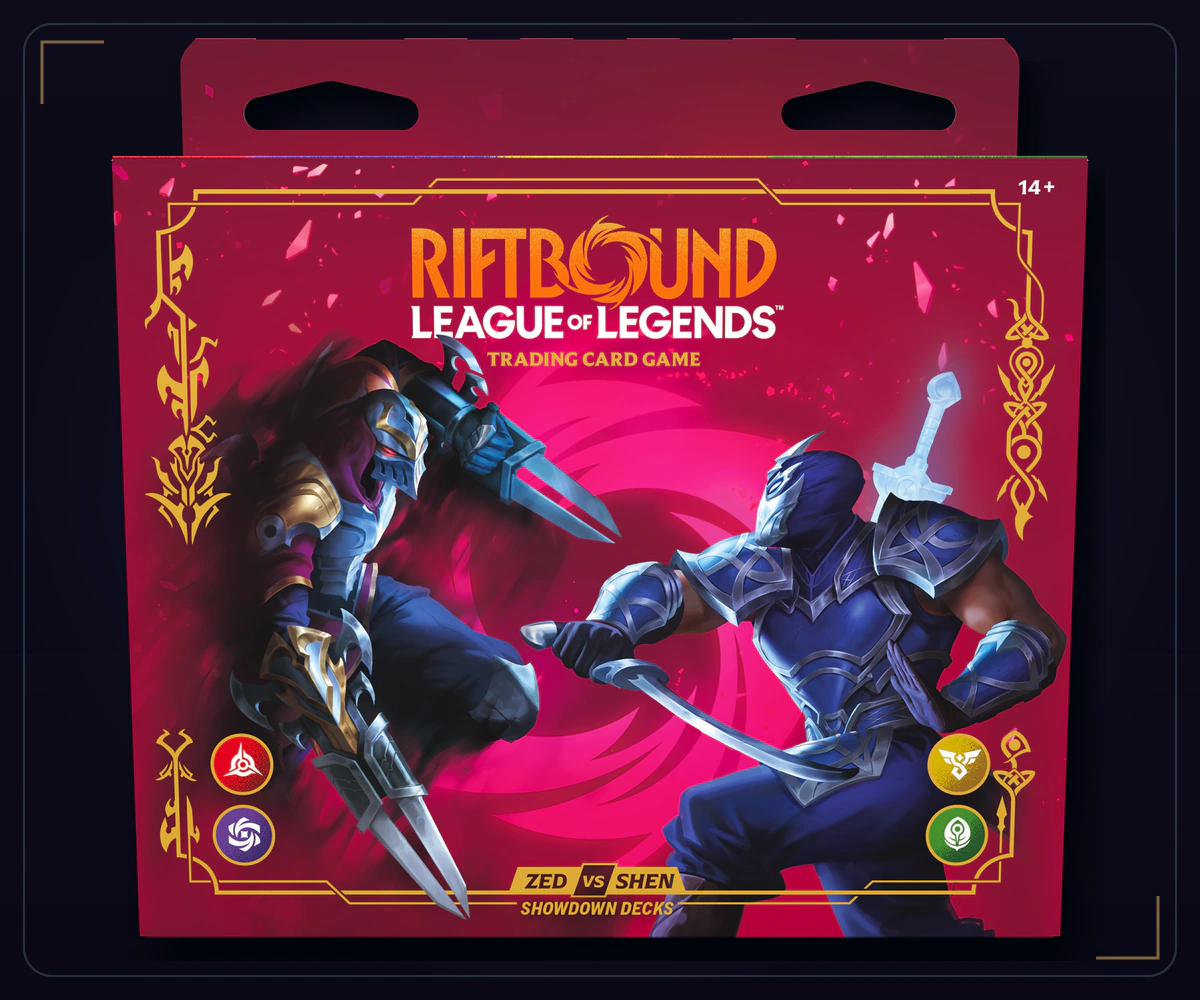
Riftbound Vendetta: Zed vs Shen Showdown Decks
Two complete 56-card preconstructed sets make this a focused two-person starting purchase. The packaged count is not the constructed main-deck minimum.
- Two opposing decks in one product
- No random-pack deck building required
- Two decks, not a complete collection
- Current seller and delivery terms need checking

Riftbound Origins: Proving Grounds
The dedicated introductory box supplies multiple decks and learning materials so players can begin without constructing lists.
- Designed for introductory play
- Multiple decks in one box
- Not a tournament-optimized collection
- Verify current contents and language

Riftbound Origins Jinx Champion Deck
A complete Jinx-led starting deck for one player who has someone to play against. Keep its list intact while learning costs and battlefield decisions; the champion theme is a reason to try it, not evidence that it is the strongest deck.
- A ready list for one player
- A focused way to meet the Jinx theme
- Your opponent needs their own materials
- A starter is not a promise of tournament results
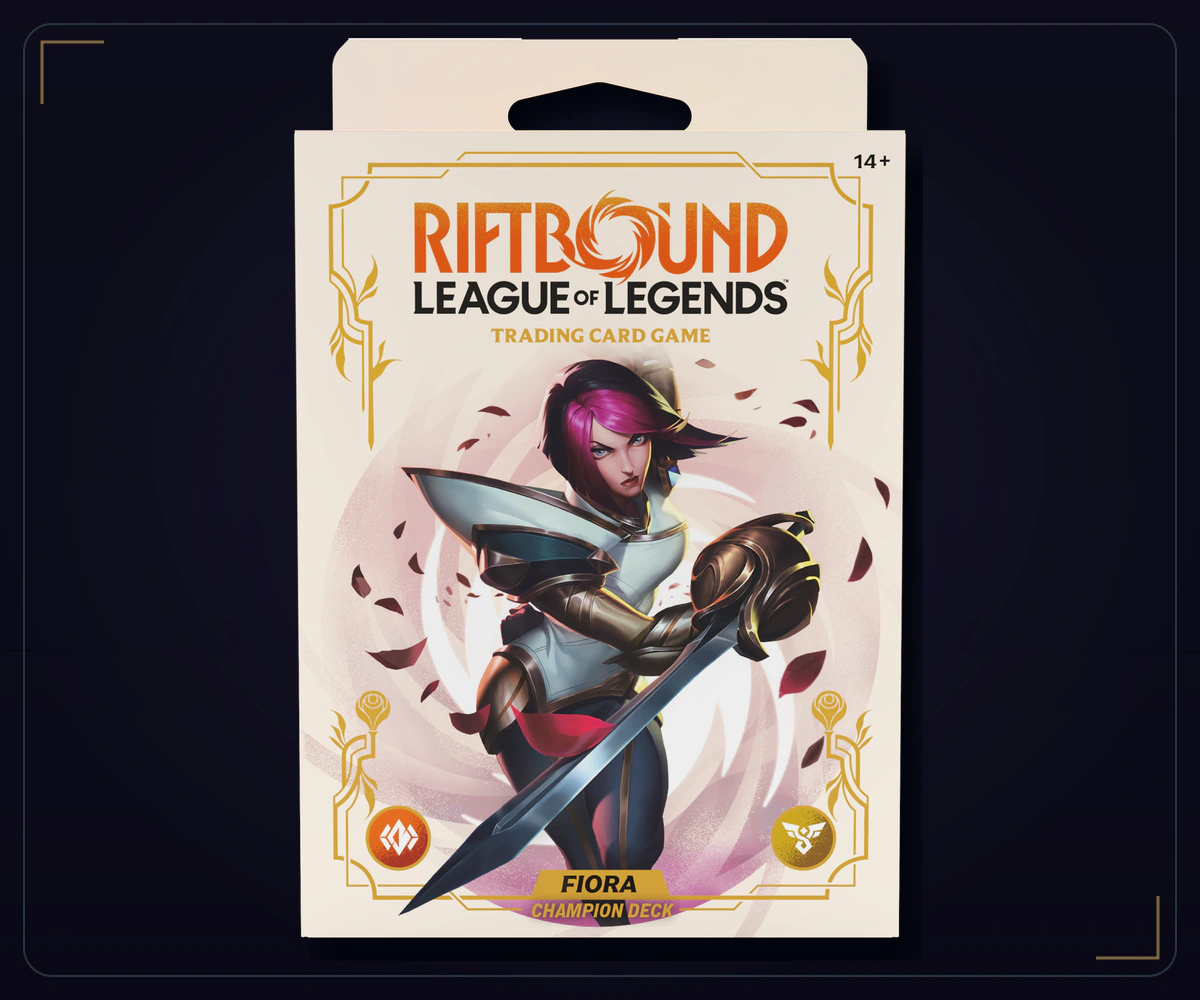
Riftbound Spiritforged Fiora Champion Deck
The Spiritforged Fiora Champion Deck is a complete entry point when this champion appeals and an opponent is already equipped. Learn the supplied list before deciding which combat interactions need an upgrade.
- Complete preconstructed starting point
- A distinct champion to explore
- Not a two-player teaching box
- Check the actual decklist before buying individual upgrades
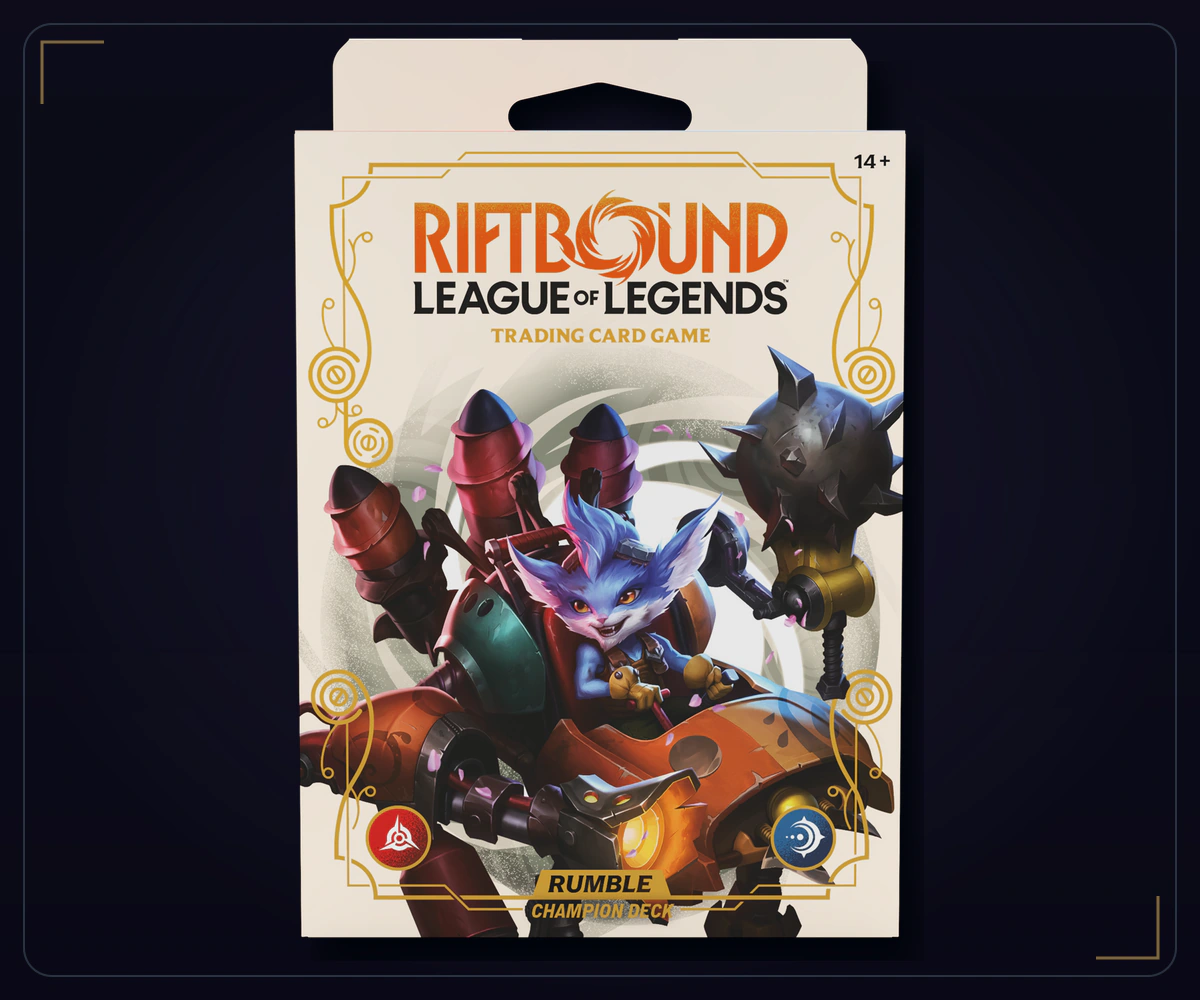
Riftbound Spiritforged Rumble Champion Deck
The Spiritforged Rumble Champion Deck offers another complete list to learn alongside a teacher. Choose between it and Fiora after reading the lists or watching a teaching game; buying both is not a prerequisite for playing.
- One-player ready deck
- A different champion choice without constructing a list
- An opponent still needs a deck
- Do not treat a character preference as a competitive ranking

Riftbound Vendetta Booster Display
Explore the Vendetta card pool and its new mechanics when opening the set is itself the planned entertainment.
- Current-set exploration
- Supports a chosen collection project
- Random contents
- Not a beginner deck substitute
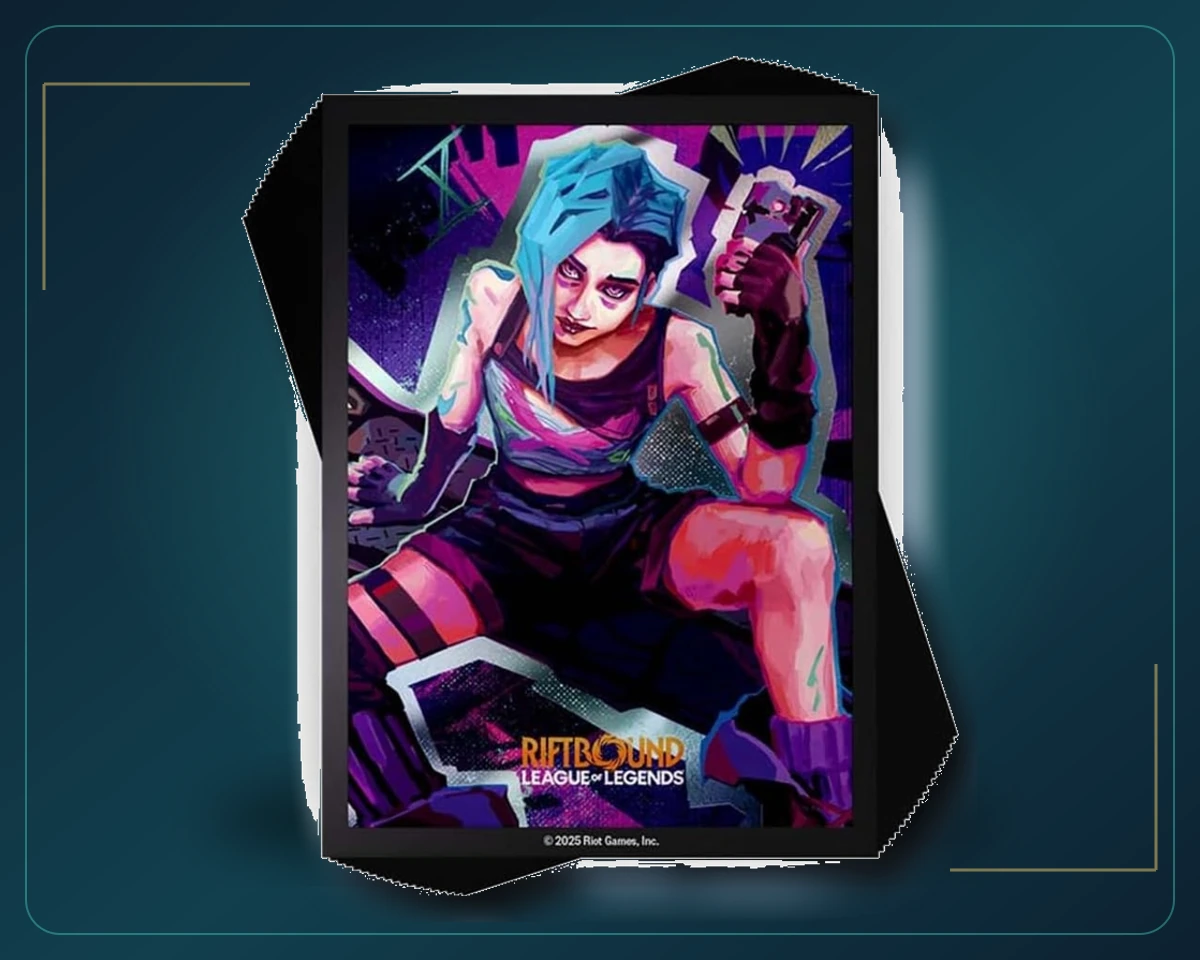
Riftbound Origins Jinx Art Sleeves - 100 Pack
Licensed-theme sleeve artwork can make an active deck feel personal; verify the exact size and quantity on the current listing.
- Character-themed presentation
- Protects frequently handled cards
- Sleeve wear still matters
- Size and quantity must match your kit
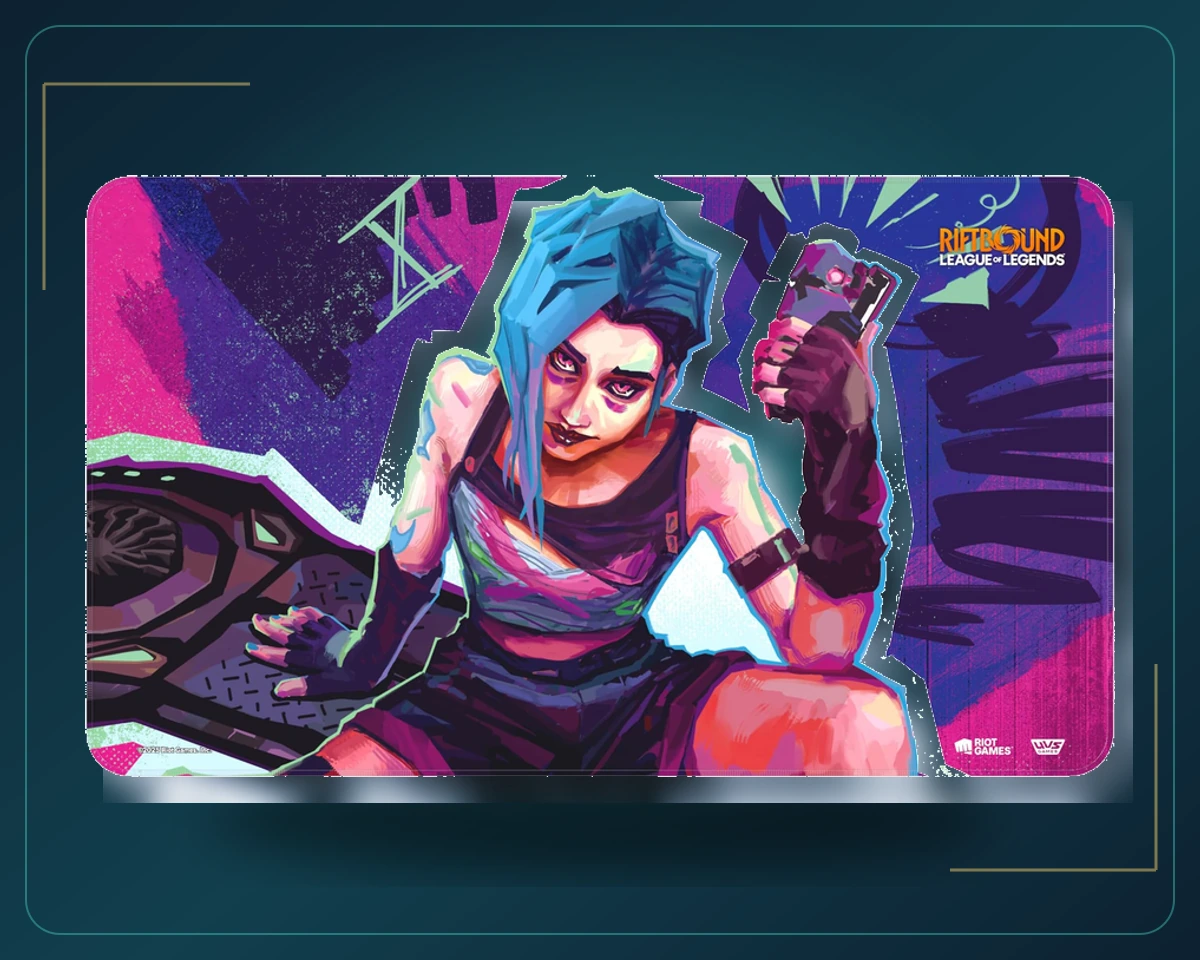
Riftbound: League of Legends Jinx Playmat
The Jinx playmat is a more honest Riftbound upgrade than a generic hard case: it improves card pickup, gives the first seat a coherent play zone, and keeps the recommendation visibly tied to the game.
- The mat protects cards, quiets the table, and provides atmosphere without inventing another component to manage.
- 5.0/5 from 5 Amazon ratings at the Keller, Texas review check
- The first visible wear usually appears at stitched edges or from being stored folded instead of rolled.
- Measure the usable table and verify that printed zones match current rules before choosing a zone-forward design.
Free download — Your first seat on the Rift: setup and first-three-games companion
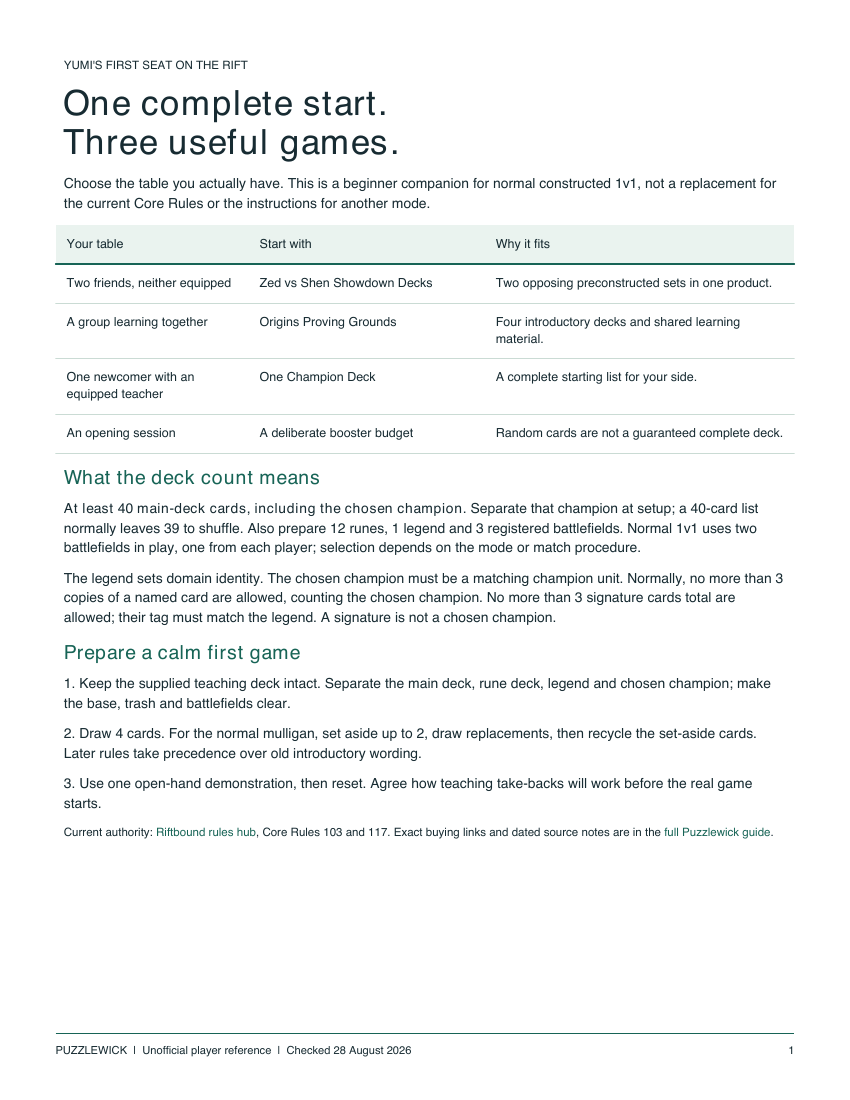
A two-page printable buying, setup and learning reference. Unofficial; current rules and event policy take precedence.
Unofficial fan-made reference. Compiled by Puzzlewick from the sources listed on the sheet. Not affiliated with or endorsed by the publisher — always defer to the official rulebook.
Questions, answered
Do I need to know League of Legends before playing Riftbound?
No. Familiar champions can make the theme appealing, but the physical card game teaches its own rules. A patient teacher and a complete starter product are more useful than prior League knowledge.
Should two beginners buy Showdown Decks, Proving Grounds, or Champion Decks?
Zed vs Shen Showdown supplies two complete opposing decks. Origins Proving Grounds is the four-deck group-teaching route. One Champion Deck suits a newcomer joining a person who already has a deck. Random boosters do not guarantee any of those complete experiences.
Is the chosen champion part of the forty-card deck?
Yes. The current main-deck minimum includes the chosen champion. Separating it into its zone at setup does not make it an extra card beyond that minimum.
How many runes and battlefields do I need?
Current normal constructed 1v1 uses a twelve-card rune deck and three registered battlefields per player, with one battlefield from each player used in a game. The selection procedure depends on the mode or match rules.
Does channel mean exhaust a rune?
No. Channeling brings runes into play. Exhausting and recycling are different actions used by rune abilities to supply energy and power.
How many points win a normal Riftbound duel?
The normal 1v1 victory score is eight. The final-point scoring restriction and specific card effects still matter, so check the current scoring section before assuming any conquer wins immediately.
Can I move a unit directly between battlefields?
Not with the normal standard move alone. Standard movement normally connects base and battlefield; a relevant card permission or keyword such as Ganking can change that.
Do I need Vendetta to learn the game?
No. A current legal teaching product can teach the core game. Vendetta adds mechanics and cards, but a new booster display is not a prerequisite for learning.
What does Flow do?
Flow allows a spell with that keyword to be played from the trash for its specified alternate cost, then banished. Follow the exact card and current rules text.
When should I upgrade a starter deck?
After repeated games reveal a specific problem. Identify the missing role, check current legality, and test a focused change instead of buying an expensive list simply because it won elsewhere.
What should I bring to a first local game?
A complete legal deck and required materials, appropriate sleeves and storage, a scoring method, and a willingness to ask questions. Contact the organizer about format, registration and whether the session is casual or competitive.
Can I recycle a rune that I just exhausted to help pay a cost?
Yes, in the ordinary payment sequence a rune can be exhausted for energy and then recycled for power, provided its domain and the relevant abilities satisfy the cost. Check restrictions and what remains available afterward.
Do I need a special Riftbound playmat to begin?
No. You need clear zones and readable scoring. A correctly labeled mat can help; check its size and whether any printed rule reminders are current before buying.
Are the old how-to-play video and booklet enough for tournaments?
They are useful visual introductions, but later Core Rules, errata, tournament policy and event instructions take precedence. Use the current rules hub for competitive play.
Yumi's verdict
Start with a deck that works and a table that welcomes questions. Learn resources, movement and scoring before chasing upgrades. Protect the cards you actually play. Let three real games tell you what the next purchase should solve.
Yumi's invitation: you do not have to arrive looking experienced. Arrive curious, prepared to listen, and willing to give your opponent the same patience you would like back.
Research ledger 15 sources · reviewed 2026-08-28
Specifications, rules, current product information, community experience, and contrary evidence were checked against the sources below. Commercial links are kept separate from editorial evidence.
- Riftbound rules hubplayriftbound.com/en-us/rules-hub
- Riftbound Core Rules, July 2026cmsassets.rgpub.io/sanity/files/dsfx7636/news_live/e9ac8e3d33e0f78cef296f5945aba7bc1313b086.pdf
- Riftbound tournament rulescmsassets.rgpub.io/sanity/files/dsfx7636/news_live/503da65669ced10598d62925a6f6bc15111af726.pdf
- Riftbound getting startedriftbound.leagueoflegends.com/en-us/news/rules-and-releases/how-to-play-get-started
- Vendetta Core Rules patch notesplayriftbound.com/en-us/news/announcements/core-rules-vendetta-patch-notes
- Vendetta errataplayriftbound.com/en-us/news/announcements/vendetta-errata-updates
- August 2026 state of the gameplayriftbound.com/en-us/news/announcements/august-2026-state-of-the-game
- Riftbound official newsplayriftbound.com/en-us/news
- Riftbound beginner purchase discussionreddit.com/r/riftboundtcg/comments/1vj6vx6/beginner_advice_where_should_i_start
- Riftbound starter-deck discussionreddit.com/r/riftboundtcg/comments/1suct80/i_wanna_start_with_the_riftbound_tcg_are_the
- BoardGameGeek Riftbound searchboardgamegeek.com/geeksearch.php?action=search&objecttype=boardgame&q=Riftbound
- TCGplayer Riftbound editorial coveragetcgplayer.com/content
- Riftbound products and sets into 2027playriftbound.com/en-us/news/announcements/products-and-sets-into-2027
- Riftbound How to Play bookletcmsassets.rgpub.io/sanity/files/dsfx7636/news_live/3694623875b098a3d0daed824e242b3a0e68dae6.pdf
- TCGplayer: Vendetta best-selling cardstcgplayer.com/content/article/The-Best-Selling-Cards-from-Riftbound-s-Vendetta/7d7c6b9f-639c-4a25-871f-0f62b91e8fd0

If it didn't earn a shelf, it isn't here.



Keep exploring
The next smart rabbit holes.
◇ Universe HubRiftbound: the whole buying pathRiftbound is Riot Games and UVS Games layered into a physical trading card system built around champions, battlefields, runes, and...🂠 Topic PathTrading Card Games: compare the whole shelfStart with the game and community you want, then buy the smallest product that lets you test it properly. These guides separate...Buying GuideRiftbound Radiance: Build Your Premium Game NightMargo and Yumi map the Radiance formats, premium sealed alternatives, and protection worth owning—without confusing random packs with a...