Best MTG Commander Precons 2026: Counter Blitz vs Necron Dynasties vs Eldrazi Unbound
Ten Commander decks I'd actually hand you — the ones that earned their shelf because they play like they cost three times as much.

Written and reviewed by Robert Pruitt · how this guide was made
Last editorial refresh: 2026-09-09 Gold-standard QA: 2026-09-09 25 sources reviewed Affiliate links checked during gold-standard pass

The short answer
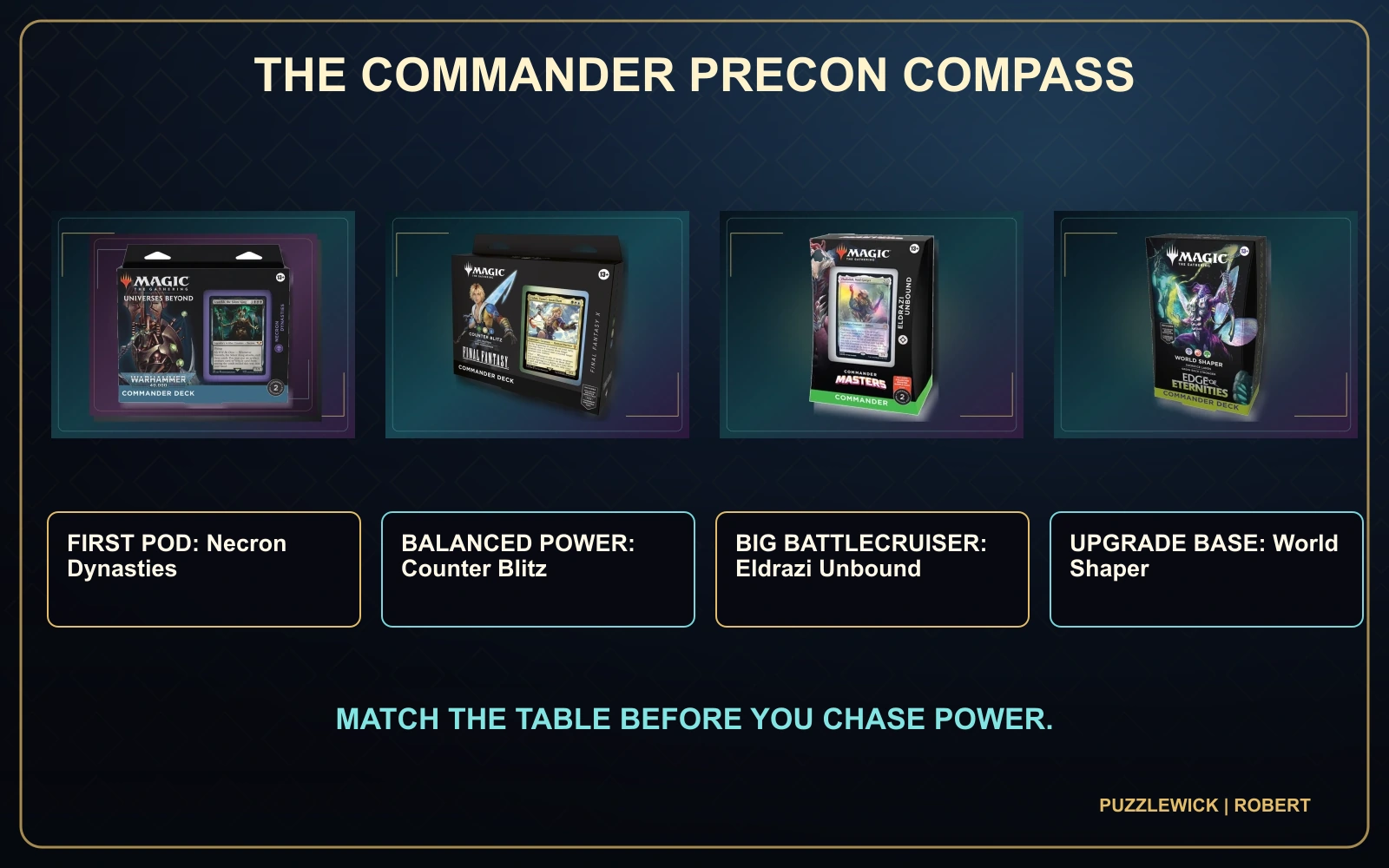
A Commander (EDH) precon is a sealed, ready-to-play 100-card deck built around a legendary creature you put in the command zone: open the box, shuffle, and play. Counter Blitz is the best all-around purchase in this field because its +1/+1-counter engine works immediately and leaves a clean upgrade path. Necron Dynasties is the gentlest first deck because mono-black mana and graveyard recursion are forgiving. Eldrazi Unbound is the spectacle pick for a confident table, but its price and raw late-game pressure make it a poor first purchase for a cautious beginner. Start with one deck whose plan you can explain in a sentence, sleeve it, play three stock games, and upgrade only the cards that repeatedly fail you.
Decision map
Choose in thirty seconds
Best overall — and the best upgrade base in the format
Best for total beginners
Strongest out of the box (warn your table)
I've been buying Commander precons for almost as long as they've existed, and I'll tell you straight: none of them have ever disappointed me as badly as the ones that looked perfect on the shelf. You open the box, see the foil commander, read the checklist, and your hand just knows this is the one. Then you shuffle and discover someone built the deck in three directions at once: a little tribal, a little ramp, a little graveyard, and none of it wants to work together. That's the gap this guide closes. Some precons are genuinely brilliant: one visible game plan, useful reprints, and a skeleton that rewards thirty dollars of careful upgrades. Others are beautiful boxes with a committee meeting inside.
Puzzlewick earns from qualifying Amazon purchases, but the ranking does not follow commission size. Every retail recommendation points to the exact product discussed, and the article tells you when a beloved deck is mechanically scattered, overpriced, or simply wrong for a first table. Use the links when they are convenient; they support the guide without changing your price.
One thing matters more in 2026 than it did a few years ago: Magic's official Commander Bracket system gives the old pregame power conversation shared vocabulary. A typical unmodified precon is the reference point for Bracket 2. That is an anchor, not immunity from discussion: some sealed decks run hotter, and every meaningful upgrade changes the table expectation. Say the bracket, name the sharp edge, then shuffle.
Start here, then go deeper
You are in the right cabinet.
 ✶ Universe HubMagic: The Gathering: the whole buying pathMagic: The Gathering is the deepest construction sandbox in the Big Three: a two-player duel, four-player Commander ritual, draft...
 🂠 Topic PathTrading Card Games: compare the whole shelfStart with the game and community you want, then buy the smallest product that lets you test it properly. These guides separate...
 Buying GuideWhat Magic: The Gathering Should You Buy First? Beginner Box, Starter Kit, Commander or BoostersChoose one playable start, find your table, and protect your cards with gear that earns its place. You do not need to buy the whole...
What exactly is a Commander precon — and why is it the best way into the format?
Commander — also called EDH, for 'Elder Dragon Highlander,' the format's ancestral name — is Magic's multiplayer format. You build a 100-card singleton deck (one copy of every card except basic lands) around a single legendary creature, your 'commander,' which lives in a special zone and can be cast again and again. Games are usually four players, each starting at 40 life, and they sprawl: politics, big creatures, comeback turns, the works. It is, by a wide margin, the most-played way people actually sit down and enjoy Magic.
A preconstructed deck — 'precon' — is Wizards of the Coast's answer to the format's one real barrier: building the thing. Each precon is a sealed product containing a complete, legal, ready-to-play 100-card deck, a foil commander, sometimes a few extras (life-tracker, tokens, a deckbox), and crucially, a mana base that already works. You don't pick the lands. You don't tune the curve. You open it, you shuffle, you play. That is the entire pitch, and it's a good one.
Why is this the best on-ramp? Three reasons. First, legality and completeness — every card is Commander-legal and the deck is whole; there's no 'you still need to buy 30 more cards' asterisk. Second, balance against peers — a sealed precon is tuned to play against another sealed precon. Nobody at a precon-vs-precon table is dropping a turn-three game-ender. Third, and most underrated, it teaches you the format by playing it. You learn how your commander's engine works, what 'ramp' and 'card advantage' feel like, when to hold up a removal spell — all by doing, not by reading a 2,000-word primer.
The modern precon also reprints real value. A single deck routinely contains a Sol Ring (the most iconic accelerant in the format), an Arcane Signet, Swiftfoot Boots, and a fistful of staples that would cost you a chunk to buy as singles. For a beginner, that means the box is worth more than the box. For an enfranchised player, it means a precon is a cheap shell to cannibalize or keep intact as a 'pickup-and-play' deck for game night.
The honest caveat: precons are intentionally not maximized. They run a few too many situational cards, a couple of pet themes that don't quite gel, and a commander that's usually a 7-out-of-10 rather than a 10. That's by design — they're meant to be a starting line, not a finish line. The good ones make that starting line feel like a complete experience anyway. The great ones make you itch to upgrade. We're about to rank both kinds.
The box is worth more than the box — and it teaches you the format by playing it, not by reading a primer.
Which precon should a total beginner actually buy first?
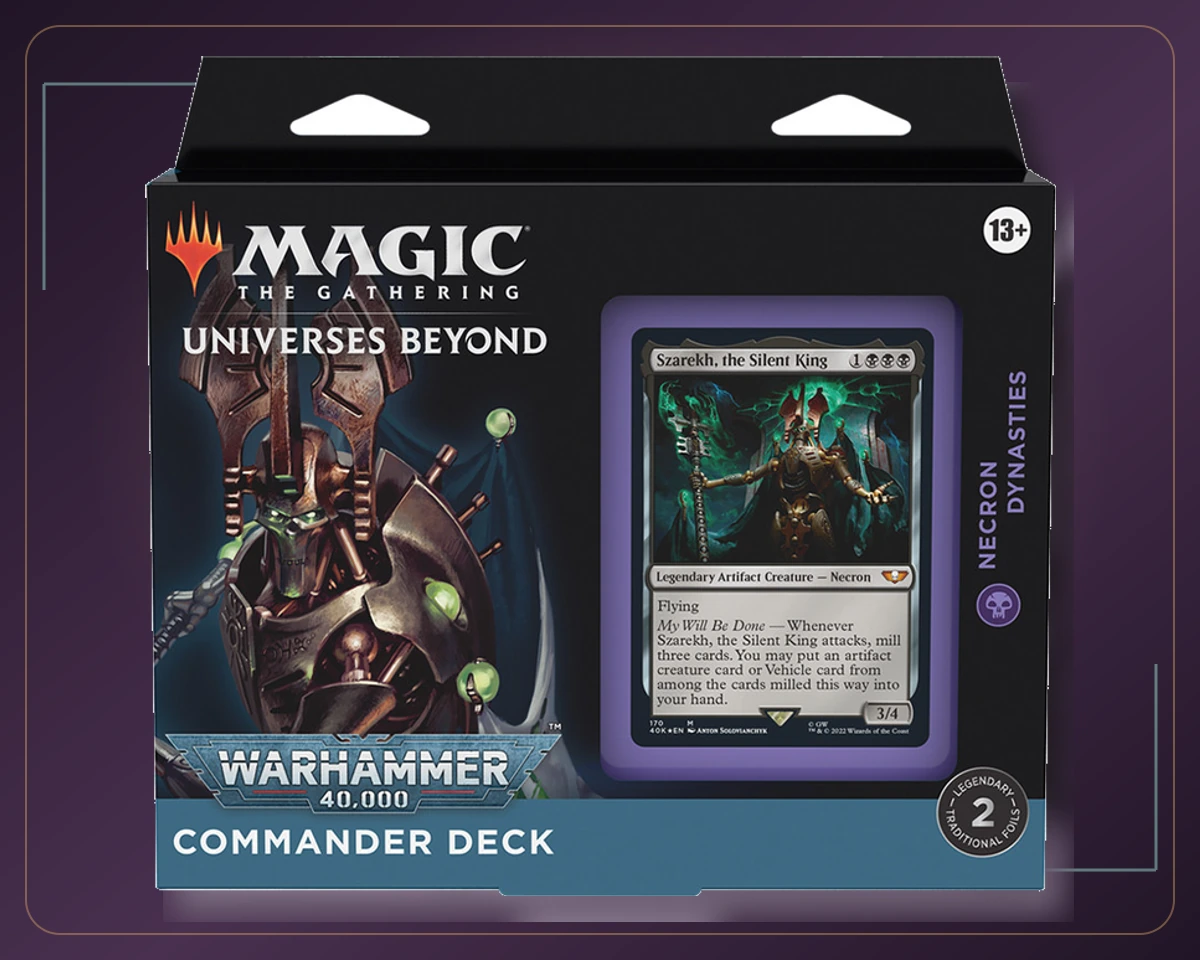
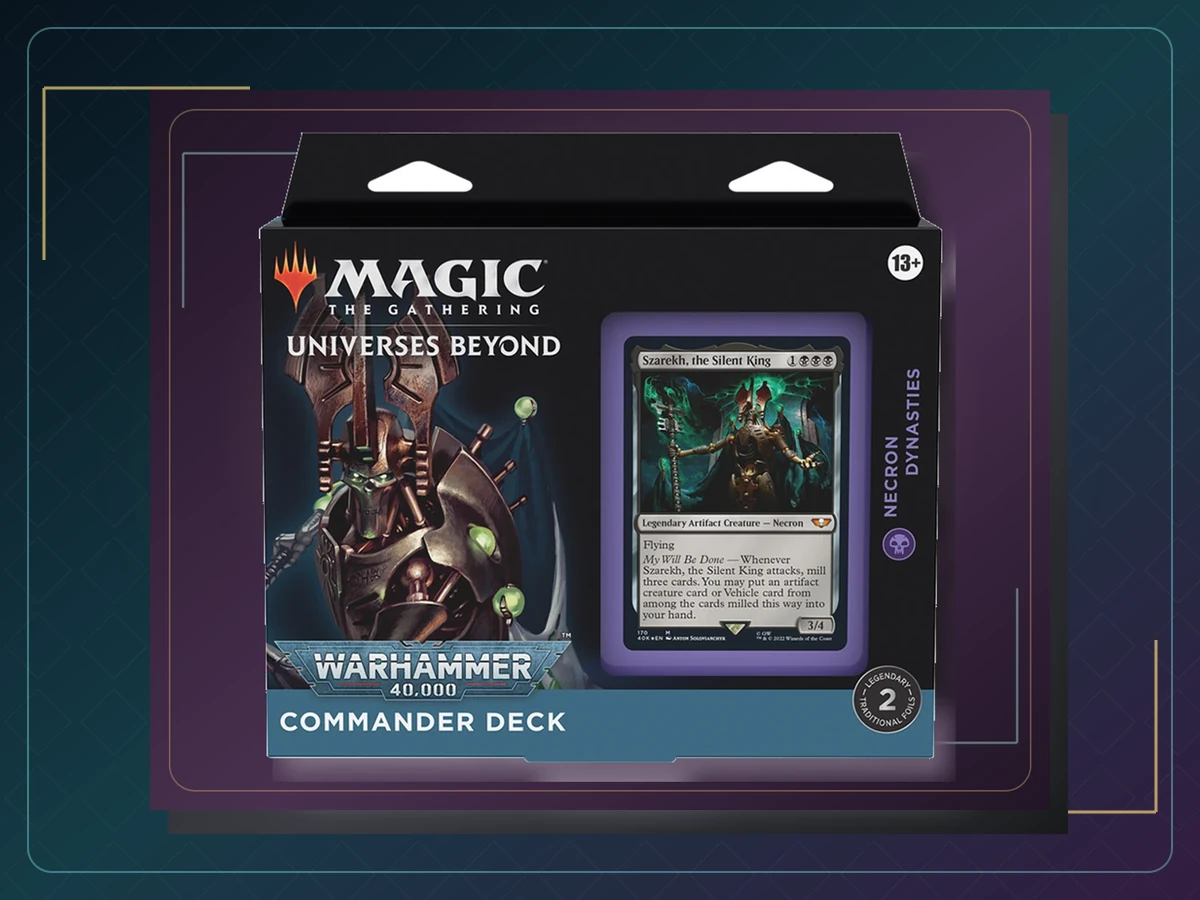
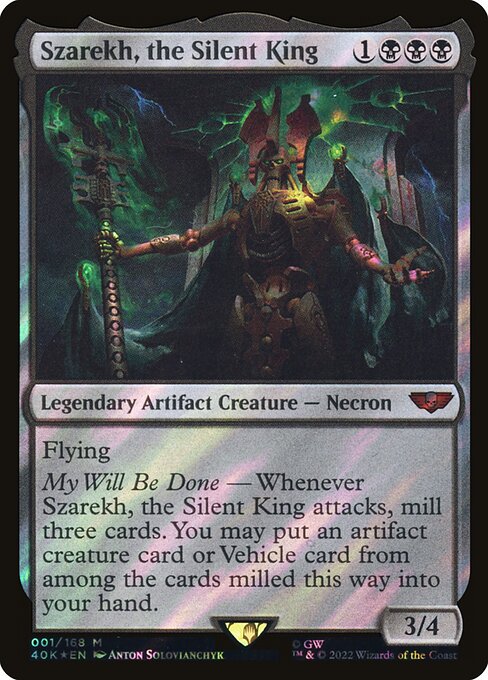
If you've never built a deck and you want one box that won't punish you, my answer is Necron Dynasties — the mono-black Warhammer 40,000 deck helmed by Szarekh, the Silent King. EDHREC named it the best precon of its entire release year, and the reason is exactly what a beginner needs: it does one clear thing (artifacts and graveyard recursion in a single color) and it does it forgivingly. Mono-color means your mana never lets you down — no agonizing over whether you can cast a three-color spell on turn three. The deck grinds value, brings things back from the graveyard, and wins slowly enough that you have time to learn what your cards do. It plays well straight out of the box and is famously easy to upgrade later. It's the deck I hand to people who say 'I don't know how to play and I don't want to feel stupid.'
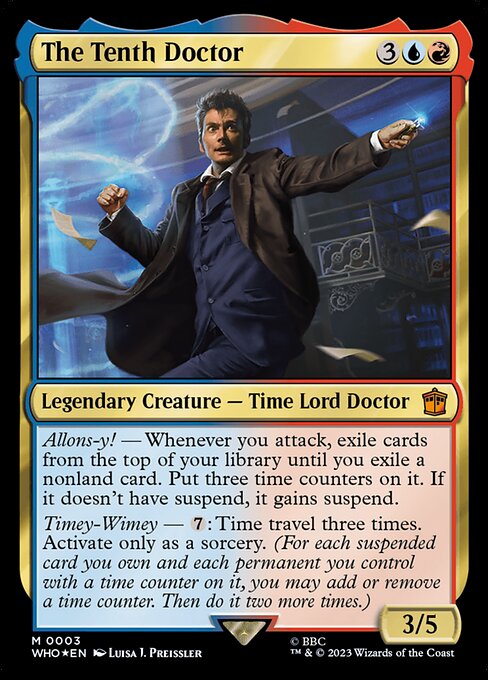
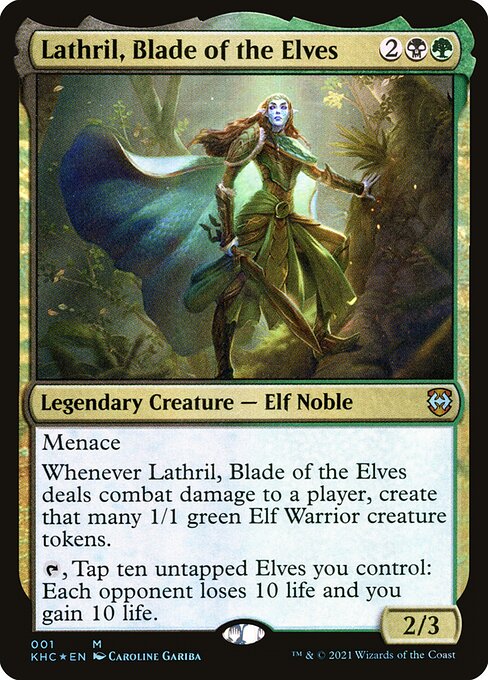
If 40K isn't your flavor, two more beginner-friendly picks. Elven Empire (Kaldheim, Lathril, Blade of the Elves) is another mono-color winner — green Elf tribal, dirt cheap, and EDHREC's pick for the most consistent precon of its year. Tribal decks are wonderful for beginners because the synergy is obvious: you play Elves, your Elves get better, you swing. There's no hidden engine to decode. And if you want a Universes Beyond face you recognize, the Doctor Who deck Timey-Wimey (The Tenth Doctor and Rose Tyler) is a genuinely loved product — though I'll flag honestly that it's been called one of the most complex precons ever made, so it's beginner-friendly in theme but not in mechanics. Save it for your second deck.
Start mono-color, start focused, start with a win condition you can see coming. Chase complexity once the basics are muscle memory.
Should a beginner buy a Starter Commander deck?
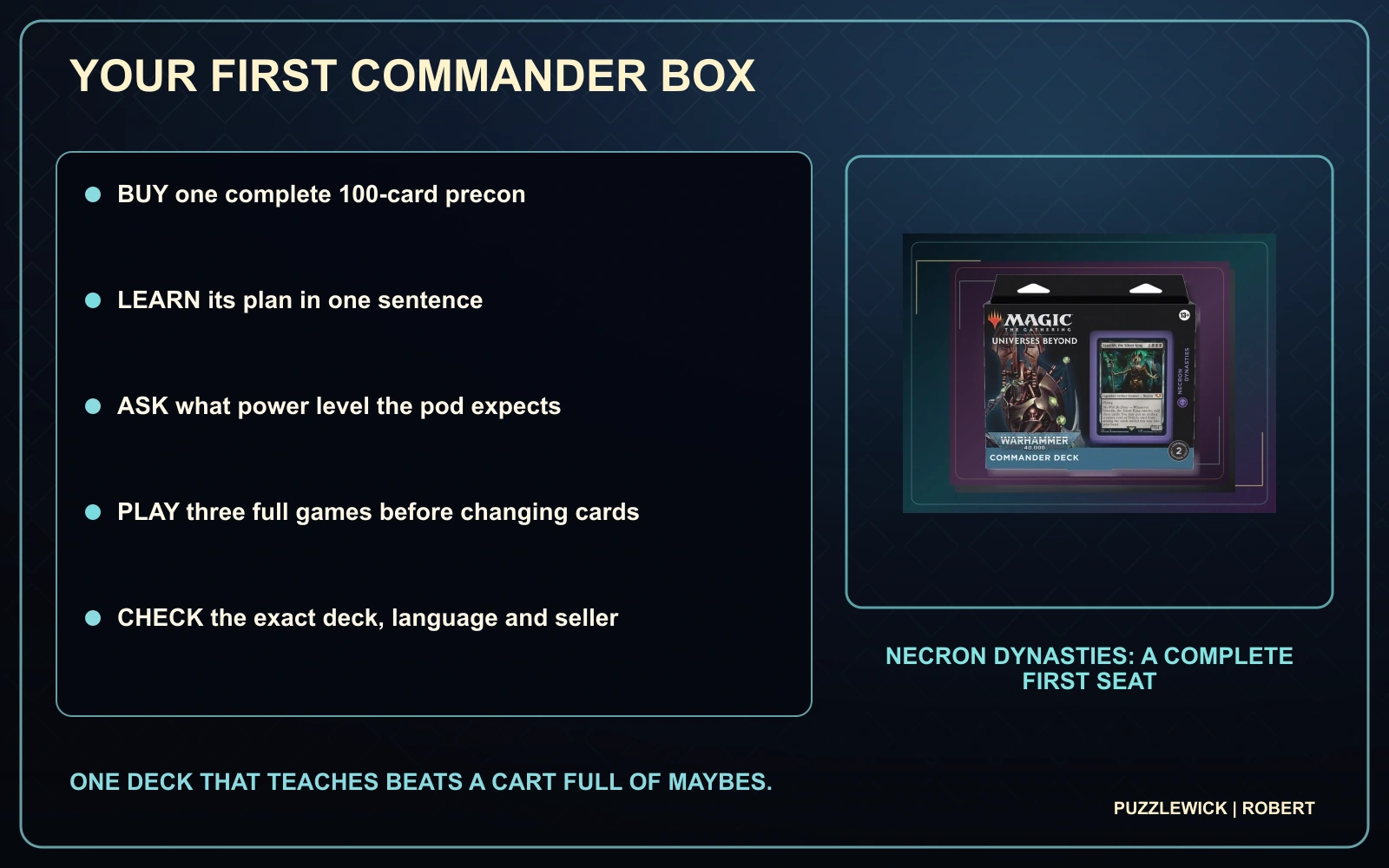

Community pattern (August 2026): A Commander precon is the cleanest route into Commander, but Commander is not the cleanest route into Magic. A completely new player learns mana, combat, and the stack faster through Arena, Jumpstart, or a beginner box. Once those basics are familiar, a recent precon with one visible game plan is a better first Commander deck than a mechanically dense list chosen only for power.
The gentlest product is not always the best first purchase. Buy enough deck to keep enjoying it after the lesson ends.
What's the best precon for a powerful, competitive-leaning table?
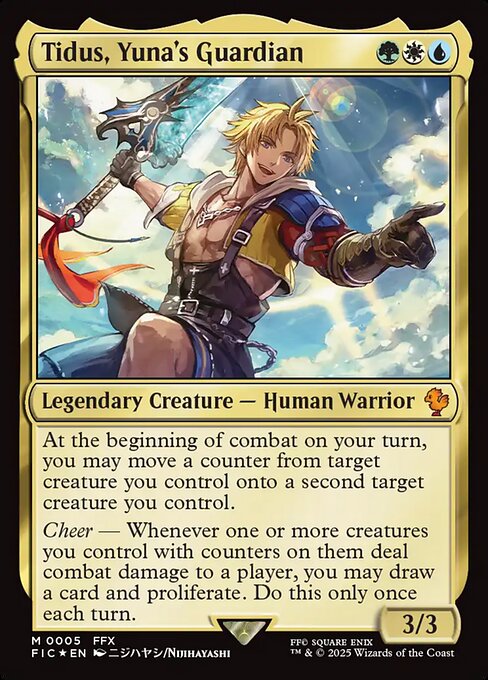
Let's set expectations: no precon is cEDH (Bracket 5), and none should be. But some precons punch noticeably above their sealed weight and reward a more experienced pod that wants a real fight without anyone dropping a turn-four combo kill. My top pick here is Counter Blitz — the Final Fantasy X deck led by Tidus, Yuna's Guardian (with Yuna, Grand Summoner as the secondary commander), in Bant colors (green-white-blue). Both Draftsim and EDHREC put it at or near the very top of 2025, and the reason is rare: it's novel and strong out of the box. Tidus moves +1/+1 counters around — a design space Magic has barely explored — and the deck backs that up with serious reprints: Gyre Sage, Walking Ballista, Fathom Mage. It does one thing with conviction and it does it hard. At a stronger table, Counter Blitz holds its own with minimal help.
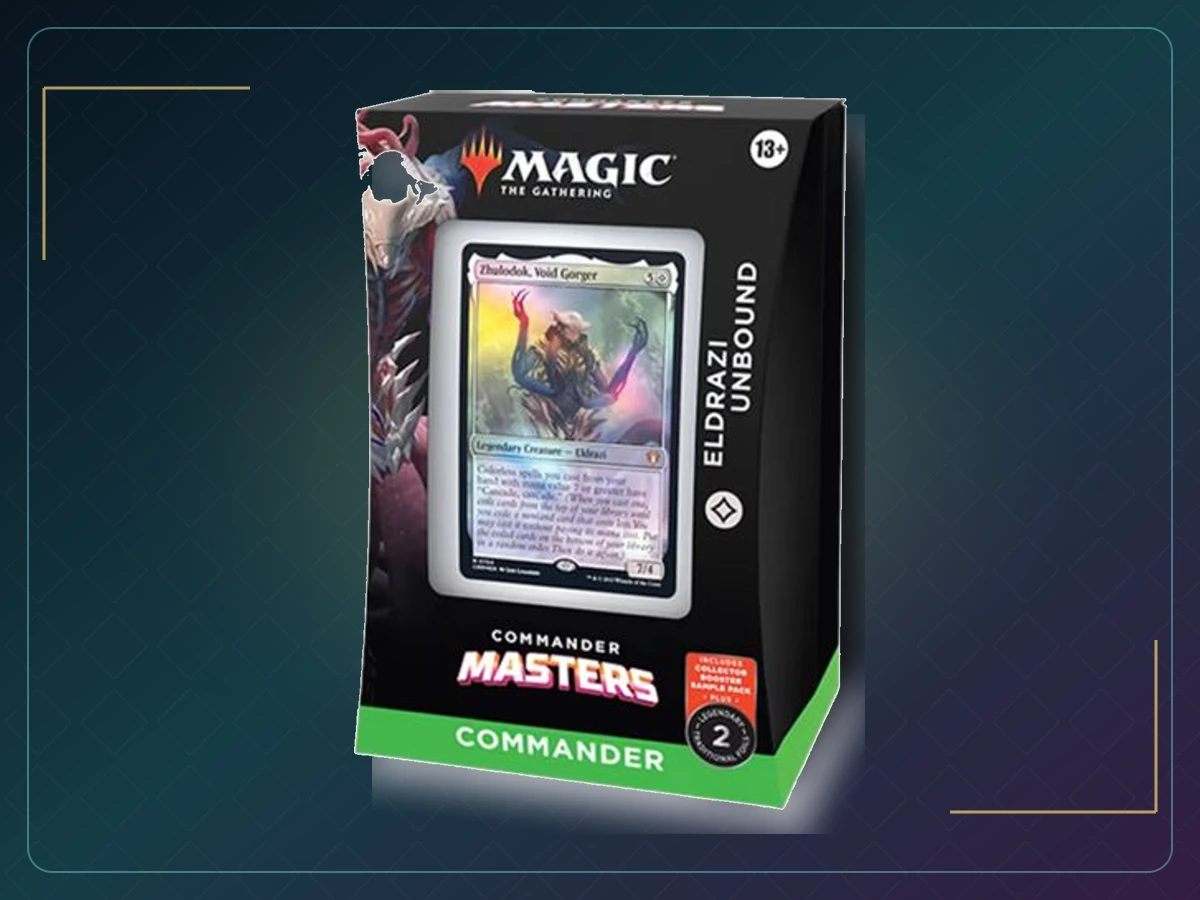
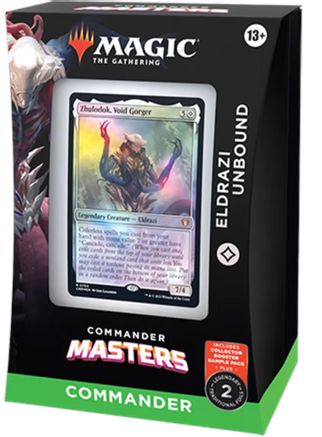
A few more that overdeliver. Eldrazi Unbound (Commander Masters, Zhulodok, Void Gorger) is, frankly, the closest a precon gets to feeling unfair — colorless Eldrazi with so much ramp that the late game is a foregone conclusion; Zhulodok gives your big spells double cascade and the curve tops out in the stratosphere. Counter Intelligence (Edge of Eternities, Kilo, Apogee Mind, Bant again) is a tight, modern build that EDHREC praised for clean charge-counter and artifact synergy plus genuinely good fixing lands. And Endless Punishment (Duskmourn, Valgavoth, Harrower of Souls, Rakdos) is a mean group-slug deck that drains the whole table — exactly the kind of inevitability a competitive-ish pod respects.
The honest framing every strong table needs: Brackets. Wizards' official system runs 1 (Exhibition) to 5 (cEDH), and a sealed precon is, by definition, Bracket 2 — 'Core.' The moment you start adding power, you climb. Slot in a couple of the 40 'Game Changers' (the cards Wizards flags as warping games) and you're knocking on Bracket 3. There's nothing wrong with that — Bracket 3 is where most engaged Commander lives — but you have to say so at the table. A pumped Counter Blitz against three fresh precons isn't a fair game; it's a beating. Match brackets, then play.
What I won't pretend: if your group genuinely wants competitive, fast, combo-forward Magic, no out-of-box precon is your answer — you want a purpose-built Bracket 4 or cEDH list. Precons are the wrong tool for that job. But for the much more common 'we're experienced and we want a real game, not a baby game'? Counter Blitz, Eldrazi Unbound, and Endless Punishment are the precons that bring a knife to the table instead of a spoon.
Counter Blitz is the rare precon that's novel AND strong — it brings a knife to the table instead of a spoon.
What's the best value, and the best base to upgrade?


These two questions travel together, because the best value precon and the best upgrade shell are often the same box: a strong skeleton that's also cheap. Let me split them anyway.
Best raw value goes to the Lord of the Rings: Tales of Middle-earth Commander decks. They launched around a $49.99 MSRP, and because Wizards printed a mountain of LOTR product, the secondary prices have a habit of sliding to genuinely silly lows — I've seen the weaker ones drift toward ~$40 and even Food and Fellowship and Elven Council bounce in the ~$50–65 range depending on the week. For what's inside — strong reprints, beautiful Middle-earth treatments, ten double-faced tokens, four complete decks across the set — the floor is exceptional. Riders of Rohan (Jeskai humans, with Éowyn, Shieldmaiden and an alternate Aragorn, King of Gondor) and Elven Council (Simic voting/scry with Galadriel) are the two I'd grab first. If you only care about dollars-to-cardboard, watch LOTR prices and pounce when one dips.
Best upgrade base is a different calculus — you want a deck whose core engine is excellent and whose weak slots are obvious, so a small budget transforms it. Three stand out. World Shaper (Edge of Eternities, Szarel, Genesis Shepherd / Hearthhull, the Worldseed, Jund) was EDHREC's #1 of 2025 precisely because its lands-matter shell is so clean — it already runs playable lands like Fabled Passage and avoids the trap of being pure ramp, so a ~$30 upgrade pass makes it sing. Counter Blitz doubles as the best upgrade base in the format right now: the engine's already strong, so every dollar compounds. And the Warhammer 40,000 decks — Necron Dynasties chief among them — are perennial upgrade darlings; there are well-known $30 guides that meaningfully level them up.
A precon isn't just a finished product — it's the cheapest possible frame for one. Buy the box, swap five cards, skip the labor.
How much should you spend upgrading a precon?
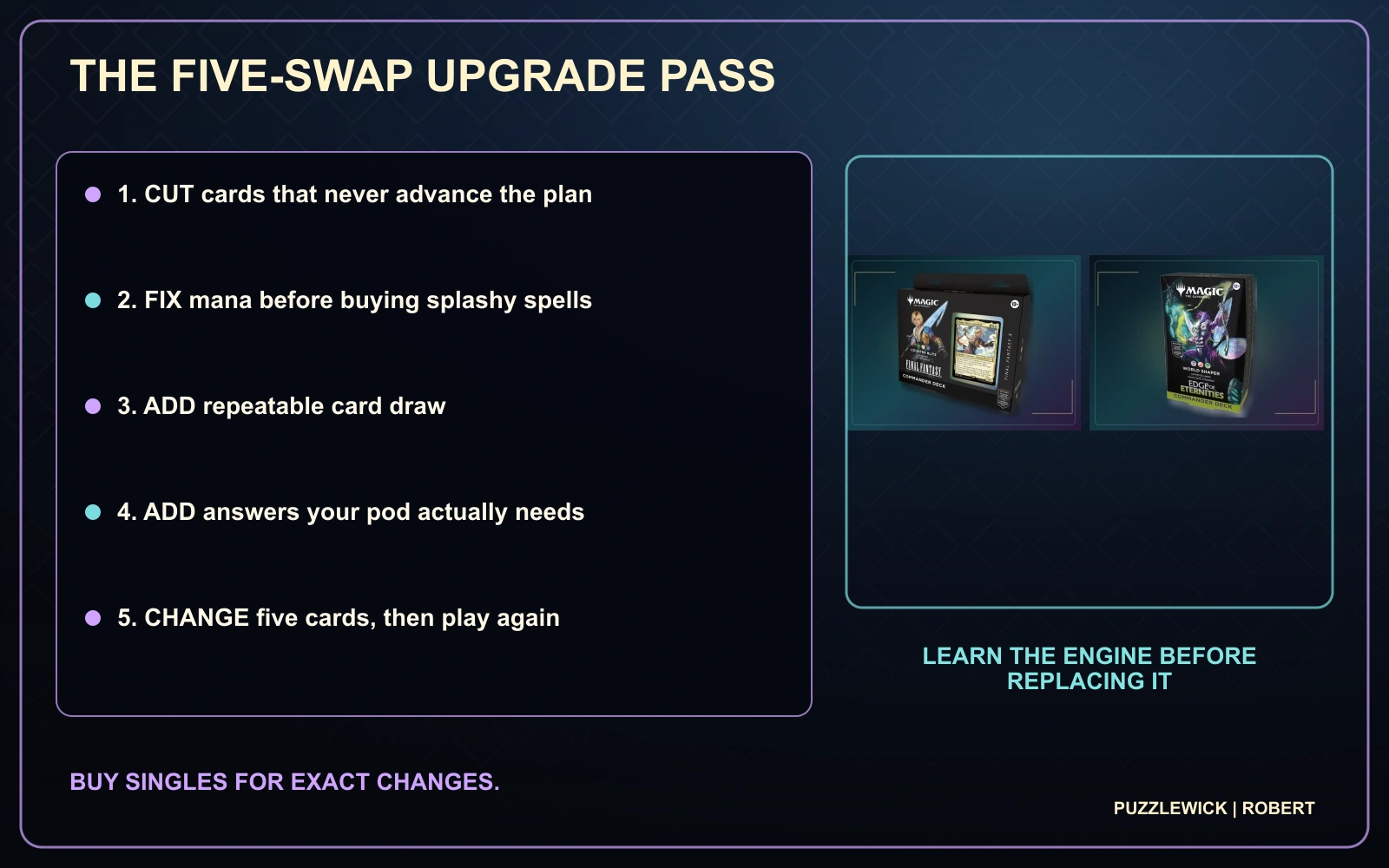
The upgrade math is the real story for value hunters. A precon gives you ~95 perfectly good cards and maybe 5 you'd swap. Buy the box, spend $20–$40 on targeted singles, and you have a Bracket 3 deck for a fraction of building one from scratch — and you skipped the deckbuilding labor entirely. That's the precon's secret superpower: it's not just a finished product, it's the cheapest possible frame for a finished product.
One candid value warning. 'Value' on the secondary market is a moving target — prices swing with reprints, hype, and supply. A deck that's a steal this month can creep back up next month. I'm giving you the durable read (LOTR floors are good; Counter Blitz and World Shaper reward upgrades), but I'm logging in the skipped notes that I won't quote you an exact street price, because anyone who does is guessing. Check TCGplayer or Card Kingdom the day you buy.
Spend on the bottleneck you can name after three games, not the card list you copied before game one.
How do you actually upgrade a precon without overthinking it?
Upgrading a precon is the most fun you'll have for the least money in this hobby, and it's where 'I bought a deck' becomes 'I built a deck.' The mistake beginners make is trying to rebuild everything at once. Don't. A precon is ~95% right already; your job is to find the 5–10 cards dragging it down and the 5–10 that would lift it, then make a few clean swaps. Here's the order I'd do it in.
Step one: cut the chaff. Every precon includes a handful of cards that are there for flavor or to pad a secondary theme the deck can't really support. The 'do-nothing' enchantments, the overcosted situational creatures, the third half-finished sub-theme. Pull those first — you'll usually find 6–8 obvious cuts just by asking 'when did this card ever matter?'
Step two: tighten the mana. This is the single highest-impact, least-glamorous upgrade. Precon mana bases are functional but conservative — they lean on tapped lands and basics. Swapping in a few untapped duals, a couple of good fixing lands, and an extra ramp piece or two (the deck already came with Sol Ring and an Arcane Signet; add a Cultivate or a signet for your colors) smooths every game you'll ever play with the deck. Mana fixes win more games than splashy bombs.
Step three: sharpen the win condition and the interaction. Now add the exciting cards — but pointed at what the deck actually does. If it's a counters deck like Counter Blitz, you add more counter payoffs, not random good-stuff. If it's a lands deck like World Shaper, you add land-recursion and a payoff like a big landfall finisher. And spend a few slots on interaction: cheap removal (Swords to Plowshares, Beast Within), a counterspell or two if you're in blue, and at least one board wipe. Precons chronically under-run interaction; fixing that alone bumps your win rate.
The budget framing that keeps you sane: set a number — $20, $30, $50 — and stop there. The published '$30 upgrade guides' from Card Kingdom, TCGplayer, and EDHREC are gold here; they've done the homework deck-by-deck, telling you exactly which 10–15 cards to swap for the deck you bought. Follow one, resist the urge to gold-plate, and you'll have a Bracket 3 deck that feels custom. The discipline is the whole skill: a focused $30 makes a precon sing; an unfocused $200 often makes it worse, because you've diluted the one thing it did well. Cut, fix the mana, sharpen the plan, add interaction, stop. That's the entire art.
A focused $30 makes a precon sing. An unfocused $200 often makes it worse — you've diluted the one thing it did well.
Precon power levels: what are Brackets, and how do you avoid a mismatched game?
The most important thing to understand about precons in 2026 isn't any single deck — it's the Bracket system, Wizards' official answer to the format's oldest problem: 'how strong is your deck, really?' For years that conversation was a vibe-based 'Rule Zero' chat before each game, and it worked about as often as it didn't. Now there's a shared scale, and it makes precon play dramatically smoother.
There are five brackets. Bracket 1 (Exhibition) is ultra-casual theme decks that aren't really trying to win — no Game Changers, no two-card combos, no extra-turn chains. Bracket 2 (Core) is defined, in Wizards' own words, as the power of 'the average current preconstructed deck' — strong engines, splashy turns, but still approachable; same restrictions as Bracket 1 on combos and Game Changers. Bracket 3 (Upgraded) is stronger than a precon, with up to three of the 40 'Game Changers' allowed and carefully chosen cards — this is where most engaged Commander players actually live. Bracket 4 (Optimized) is 'go wild,' no restrictions beyond the banned list. Bracket 5 (cEDH) is competitive, metagame, tournament Magic.
For precon players, the headline is simple: a sealed precon, unmodified, is Bracket 2. That's your anchor. Buy a precon, play it as-is, and you belong at any Bracket 2 table — and a four-way game of fresh precons is one of the purest, most balanced experiences Magic offers. Everyone's at roughly the same power, the games go the expected 8-plus turns before someone closes, and nobody feels cheated.
A sealed precon is Bracket 2 by definition — but the moment you upgrade it, that label is a starting read, not a law.
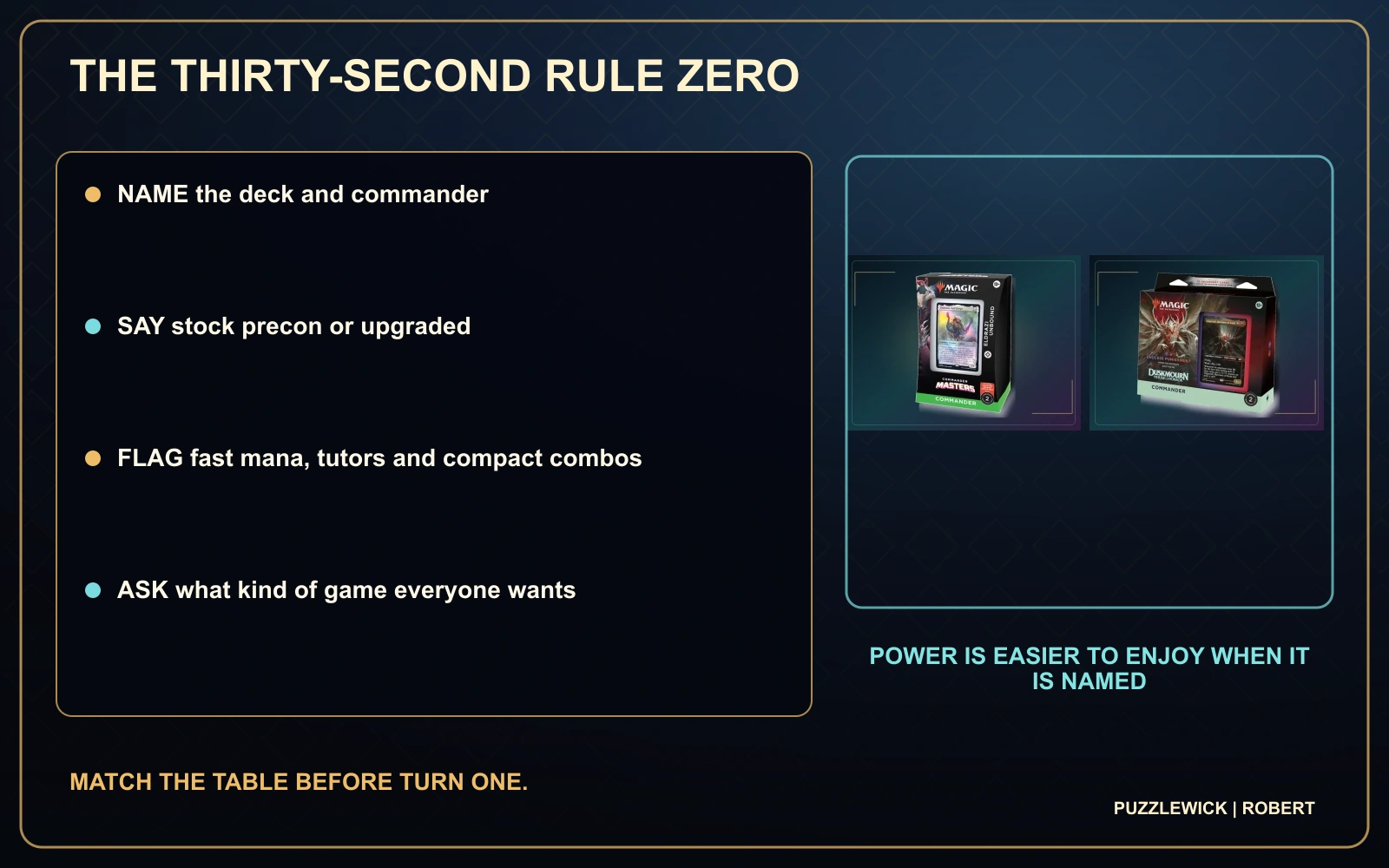
How should you describe your precon before a Commander game?
 Magic: The Gathering Duskmourn: House of Horror Commander Deck, Endless Punishment See it on Amazon ↗
The nuance — and this is recent and important — is that 'precon' no longer automatically means Bracket 2 the instant you touch it. A Modern Horizons 3 Commander deck or a Secret Lair Commander deck is a different animal from a Starter deck; some precons run hotter than the Bracket 2 baseline out of the box (Eldrazi Unbound, I'm looking at you), and any precon you upgrade climbs toward 3. So the bracket is a starting read, not a permanent label. Use it as a conversation-opener, not a law.
And Rule Zero still rides shotgun. The bracket system doesn't replace the pre-game chat — it gives it vocabulary. Before you shuffle, the whole table says a number and flags anything spicy ('mine's a 2, but heads up, it can go off if I draw the nut'). Thirty seconds. That one habit prevents the great majority of bad Commander nights — the new player getting steamrolled, the optimized deck sandbagging into a casual pod. One detail that trips people up: Sol Ring is in every precon but it's NOT a Game Changer — Wizards exempted it as 'the most iconic card in all of Commander,' a universal expectation. So your precon's Sol Ring doesn't push you up a bracket. Almost everything else that warps a game does. Know the difference, say your number, play your game.
The bracket is the opening line. The useful conversation is what your deck actually does when it gets a clean draw.
Are Universes Beyond precons legal, worth it, and where should you buy them?
Two practical questions close the map: whether crossover decks are 'real' Magic, and whether the box is worth its price. Universes Beyond cards are fully Commander-legal. The Final Fantasy, Lord of the Rings, Fallout, Doctor Who, and Warhammer 40,000 precons were built for Commander and can be played wherever ordinary Commander decks are welcome. Wizards also expanded Constructed legality for Universes Beyond booster sets beginning in 2025; Final Fantasy entered Standard on June 13, 2025. That broader policy is useful context, but you do not need it to justify Tidus, Galadriel, Dr. Madison Li, the Tenth Doctor, or Szarekh at a Commander table.
Are the decks worth it? Several are among the strongest and most memorable precons of their release years. Counter Blitz and Limit Break give Final Fantasy players coherent decks rather than souvenir cardboard. Necron Dynasties remains a superb beginner and upgrade shell. The Doctor Who decks over-deliver on content with Planechase cards and deep thematic replay. The candid exception is Fallout's Science! deck: Dr. Madison Li revived Energy as a Commander archetype and the flavor lands beautifully, but reviewers found the stock artifact density a little low for her engine. Buy it for the theme and plan a focused upgrade pass.
Use the exact Amazon product button beside the deck photo or ranked recommendation, then verify the deck name, face commander, language, sealed condition, seller, delivery date, and current price before checkout. Puzzlewick earns from qualifying Amazon purchases at no extra cost to you. Commander prices move weekly; when a scarce deck is being gouged, waiting is smarter than substituting a similarly named box. Wizards' pages establish box contents, while EDHREC, TCGplayer, Card Kingdom, reviewers, and local-store players remain excellent research for upgrades and demand. Your local game store is still the best place to find a pod; the Amazon buttons are simply the direct, disclosed retail route that supports this guide when the listing is right.
Universes Beyond precons are fully Commander-legal. Judge the deck by its plan, price, and table fit, not by the logo on its world.
What experienced tables keep reporting
Recurring owner patterns, synthesized in Puzzlewick's words. Follow each evidence trail to read the original discussion.
Counter Blitz has almost everything you could ask from a preconstructed deck — Tidus moving counters around is a relatively unexplored design space, coupled with reprints of vital staples like Gyre Sage, Walking Ballista, and Fathom Mage.
Read the evidence: Draftsim — All 13 Commander Precons Released in 2025, Ranked
World Shaper 'nailed it' as a lands-themed deck by featuring exciting, playable lands like Fabled Passage while avoiding pure ramp through land-sacrifice outlets and graveyard replayability.
Read the evidence: EDHREC — The 5 Best Commander Precons of 2025
Necron Dynasties showcased one of the best combinations of flavor and gameplay in Universes Beyond — it plays well out of the box and is easy to upgrade, a good deck whether you're starting out or just want a precon to keep together.
Read the evidence: EDHREC — The Five Best Commander Precons of the Last Five Years
Dr. Madison Li is not as strong as the deck needs her to be — there are 36 artifact spells, roughly a third of the cards, but it's not enough for Li to consistently pump out enough Energy to power the deck.
Bracket 2 (Core) matches the power level of the average current preconstructed deck — strong engines and splashy turns while remaining approachable. Sol Ring is excluded from the Game Changers list because it's the most iconic card in all of Commander.
Read the evidence: Wizards of the Coast — Introducing Commander Brackets Beta
The Doctor Who Commander pre-cons have exceeded expectations and provide great value — new Planechase planes, packs with potential art variants, great lands, and at least two decks' worth of replay value with each purchase.
For a first-ever Magic lesson, use a two-player beginner product or Arena before asking someone to parse four hundred mostly unique Commander cards.
Read the evidence: May 2026 r/EDH teaching-precons discussion
After the core rules click, choose a recent precon with one repeated action: attack with a tribe, sacrifice creatures, cast from the graveyard, or build counters. Mechanical legibility matters more than a ranking point.
Read the evidence: July 2026 r/EDH beginner-friendly precon discussion
Play the stock list several times, identify the cards that stall its plan, then make a small batch of swaps. Rebuilding immediately erases the precon's best teaching function.
The picks
Some links below are affiliate links — as an Amazon Associate, Puzzlewick earns from qualifying purchases, at no extra cost to you. It never changes a pick.
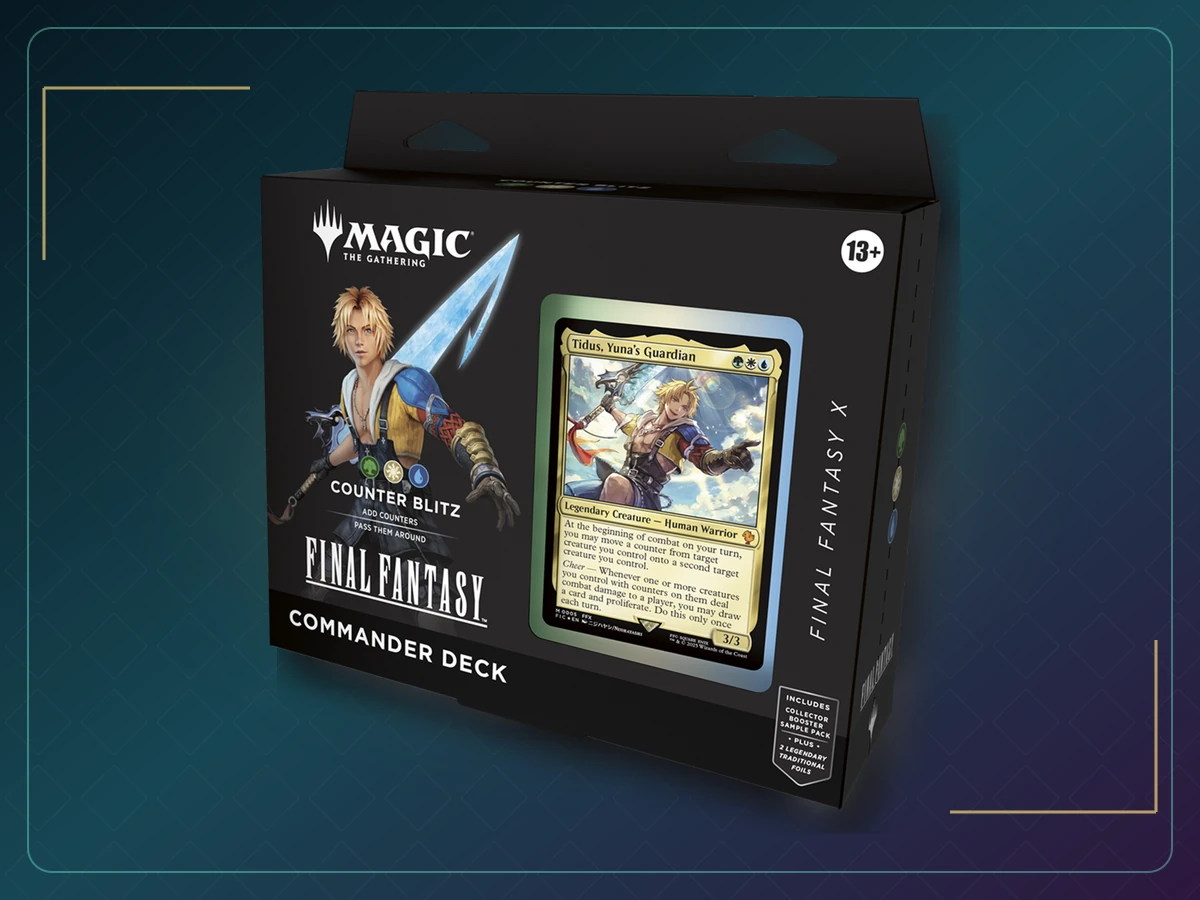
Magic: The Gathering Final Fantasy Commander Deck, Counter Blitz
Helmed by Tidus, Yuna's Guardian (with Yuna, Grand Summoner as the secondary commander) in Bant colors, Counter Blitz is the rare precon that's both novel and strong out of the box. Tidus shuffles +1/+1 counters around in a design space Magic has barely touched, and the deck backs it with real staples — Gyre Sage, Walking Ballista, Fathom Mage. Both Draftsim and EDHREC ranked it at or near the top of 2025. It plays cleanly with zero changes and rewards every dollar of upgrade. If you buy one precon this year, buy this.
- Cohesive, focused +1/+1 counters strategy that works immediately
- Excellent reprint value (Gyre Sage, Walking Ballista, Fathom Mage)
- Best upgrade base available — the engine is already strong
- Final Fantasy hype keeps the sealed price near or above MSRP
- Bant three-color mana is a step up in complexity from mono-color
Magic: The Gathering Warhammer 40,000 Commander Deck, Necron Dynasties
Szarekh, the Silent King anchors this mono-black Warhammer 40,000 artifacts-and-recursion deck, and EDHREC named it the best precon of its release year. Mono-color means your mana never betrays you, the game plan (grind value, recur threats from the graveyard) is forgiving and easy to learn, and it plays well straight out of the box. It's also a perennial upgrade darling with well-known $30 guides. The deck I hand to anyone nervous about their first game.
- Mono-black mana base is beginner-proof
- Clear, forgiving game plan that teaches the format
- One of the most popular and best-supported upgrade shells
- Light on card draw out of the box
- Warhammer 40K availability and price can be uneven on the secondary market
Magic: The Gathering Commander Masters Commander Deck, Eldrazi Unbound
From Commander Masters, this is the first official colorless precon, led by Zhulodok, Void Gorger. It is, candidly, the closest a precon gets to feeling unfair — enormous Eldrazi, a sky-high curve, and so much ramp that the late game is decided early. Zhulodok hands your big spells double cascade for runaway value. It overpowers other precons, so it belongs at a stronger pod or needs a Rule Zero heads-up. Magnificent, but not a 'fair fight' deck.
- Highest raw power of any modern precon
- Colorless means it slots into any collection and never has mana issues
- Plays the splashy 'big Eldrazi' fantasy better than anything else
- Can steamroll a casual precon table — needs a bracket conversation
- Commander Masters scarcity pushes the sealed price up
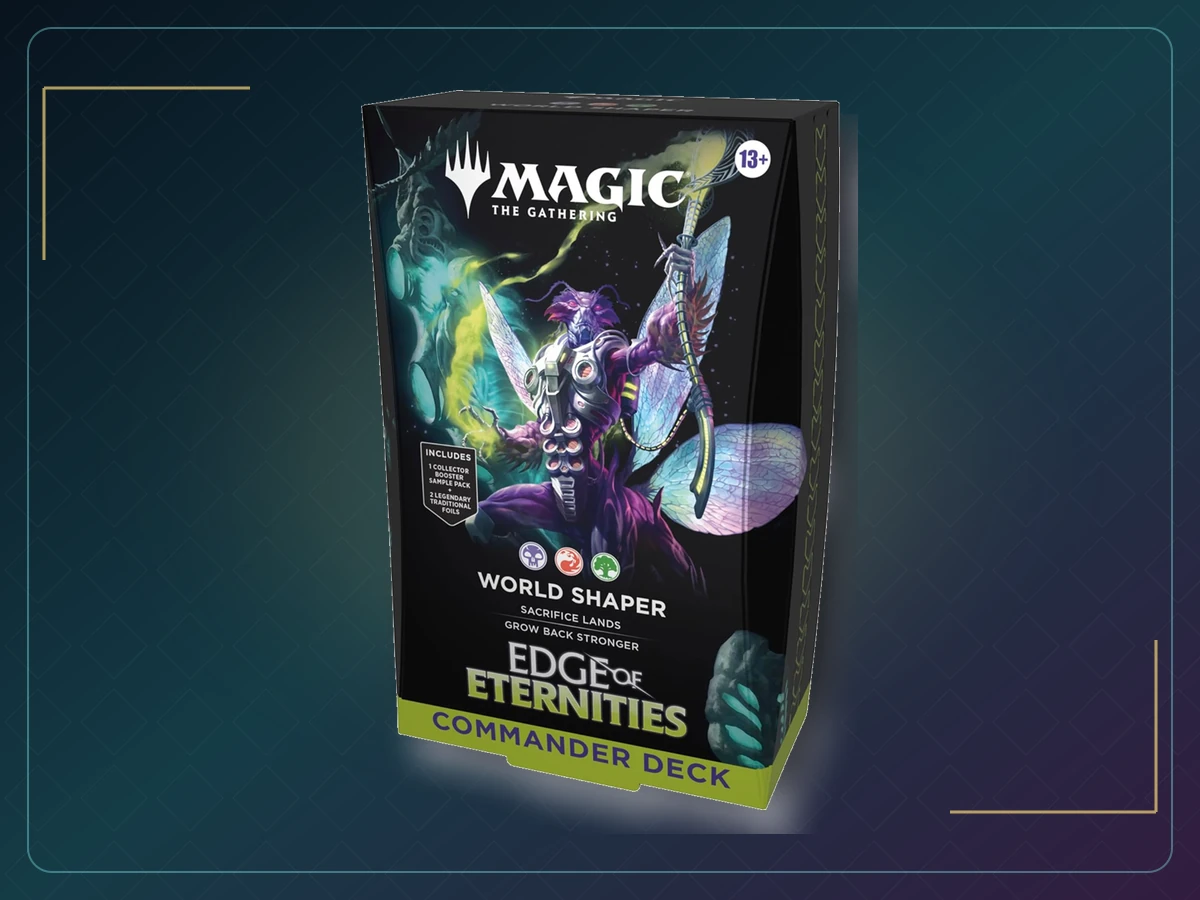
Magic: The Gathering Tarkir: Dragonstorm Commander Deck, World Shaper
EDHREC's #1 precon of 2025, this Jund lands deck is led by Szarel, Genesis Shepherd with Hearthhull, the Worldseed as backup. It 'nailed it' by running genuinely exciting, playable lands (Fabled Passage among them) and avoiding the pure-ramp trap with sacrifice outlets and graveyard replayability. The core engine is so clean that a ~$30 upgrade pass turns it into a sharp Bracket 3 deck. The thinking player's value pick.
- Best-in-class lands-matter engine right out of the box
- Outstanding upgrade base — minimal changes, big payoff
- Jund colors open a huge pool of upgrade options
- Lands strategies are mechanically busier than a beginner may want
- Newer set, so the sealed price hasn't softened much yet
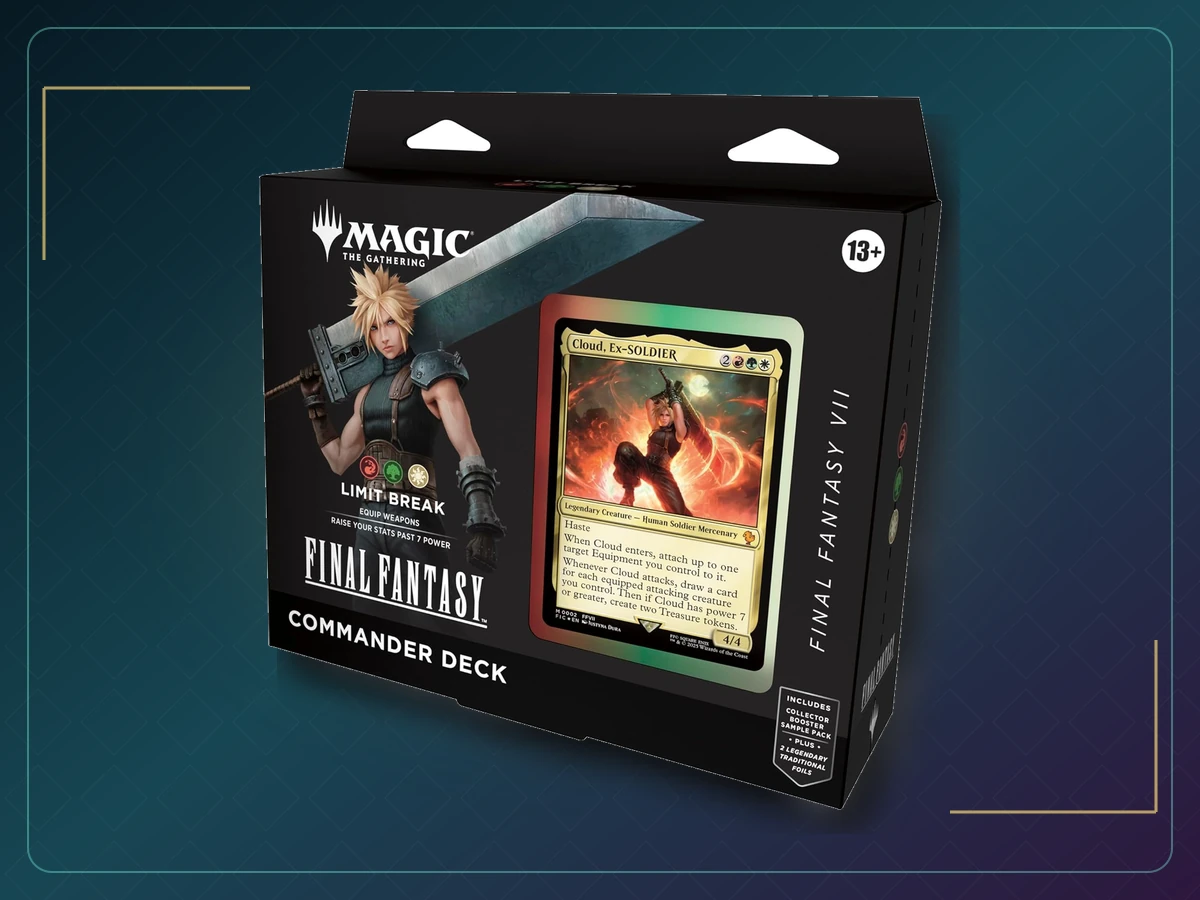
Magic: The Gathering Final Fantasy Commander Deck, Limit Break
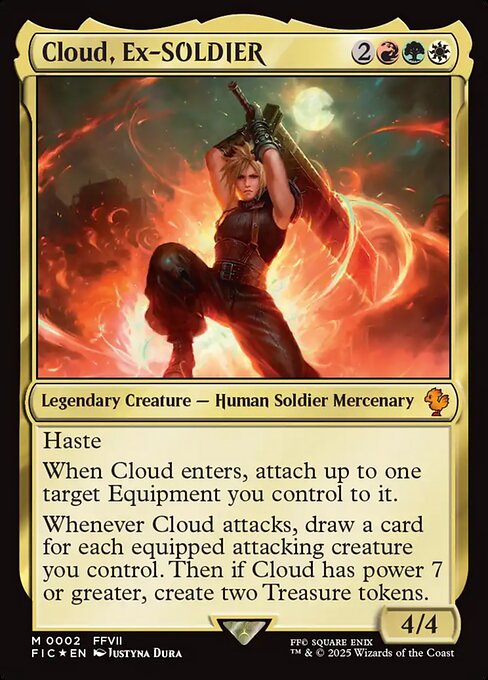
Cloud, Ex-SOLDIER leads this Naya (red-green-white) Equipment deck, with Tifa, Martial Artist as the secondary commander — and EDHREC crowned it the single best precon of 2025. It captures the 'level up your hero with better gear' fantasy beautifully, balancing early ramp with mid-game pressure, and it does it without leaning on a flashy new mechanic. It was the first Final Fantasy deck to sell out in preorder for good reason. A clean, satisfying Voltron experience.
- Cohesive Equipment/Voltron plan that's genuinely strong
- Thematic depth that delights Final Fantasy fans
- Balanced curve — ramps early, pressures the midgame
- Voltron's all-eggs-in-one-commander plan folds to a well-timed removal spell
- Final Fantasy demand keeps it at or near MSRP

Magic: The Gathering Doctor Who Commander Deck, Timey-Wimey
The Tenth Doctor and Rose Tyler headline this Jeskai (blue-red-white) Doctor Who deck, widely ranked the strongest of the Doctor Who precons. It plays a clever suspend/time-counter game — stockpile spells under Rose, then unload when you're ready to win. The Doctor Who set is a content bonanza (extra Planechase planes, multiple decks' worth of replay per box). One caveat: it's been called among the most complex precons ever made, so it's a fantastic second deck, not a first.
- Exceptional content and replay value per box
- Unique, rewarding suspend/time-counter game plan
- Beloved by the community; strong commander pairing
- Genuinely complex — not beginner-friendly despite the recognizable theme
- Doctor Who singles and sealed pricing can run high
Magic: The Gathering The Lord of the Rings: Tales of Middle-earth Commander Deck, Riders of Rohan
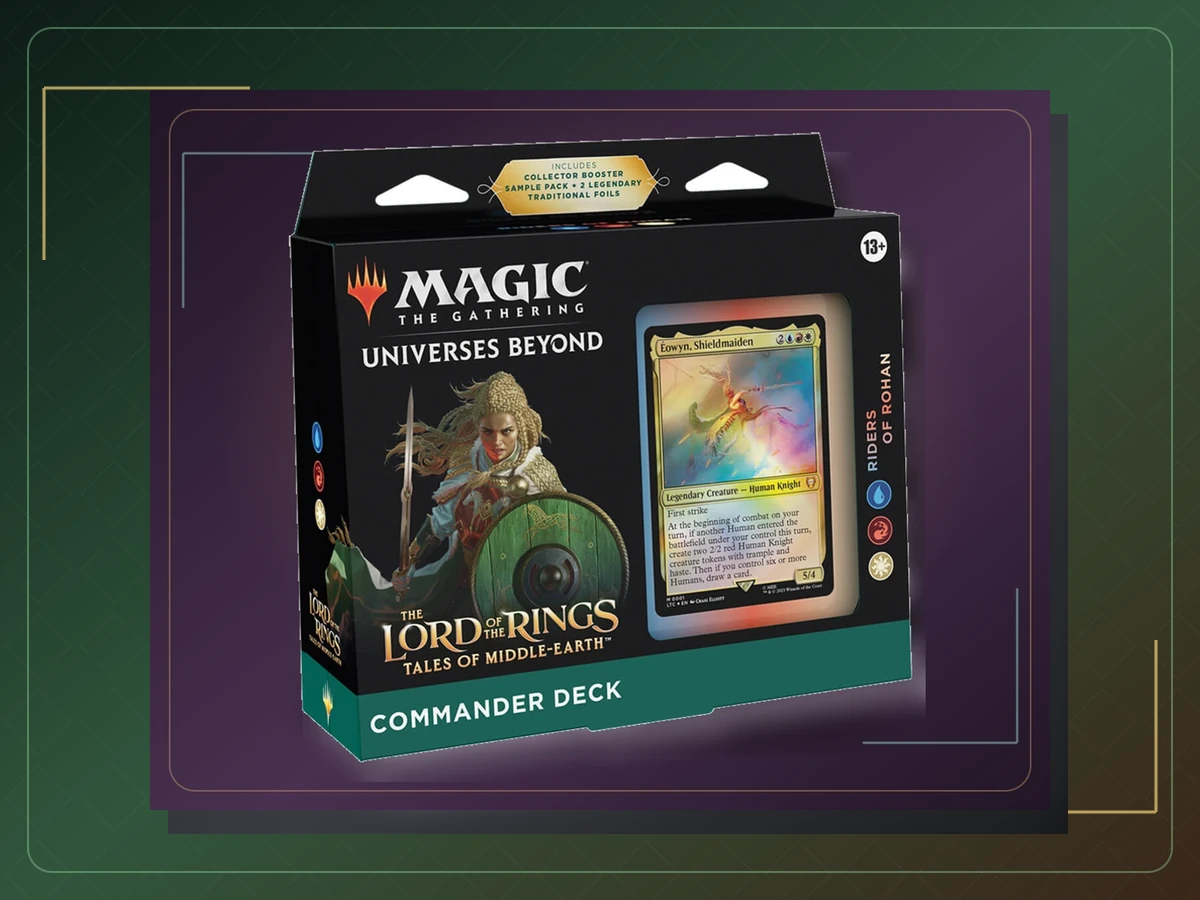
A Jeskai humans deck from Lord of the Rings: Tales of Middle-earth, led by Éowyn, Shieldmaiden with an alternate Aragorn, King of Gondor in the box. Éowyn pumps out Human tokens and rewards going wide. The real story is value: LOTR was printed heavily, so this and its set-mates regularly slide to excellent prices on the secondary market. Strong reprints, gorgeous Middle-earth treatments, and a complete go-wide plan for often well under MSRP.
- Frequently the best dollars-to-cardboard value in the format
- Two strong commander options in one box (Éowyn and Aragorn)
- Straightforward, satisfying go-wide humans plan
- Prices fluctuate — the great deals come and go
- Jeskai three-color mana adds a little setup complexity
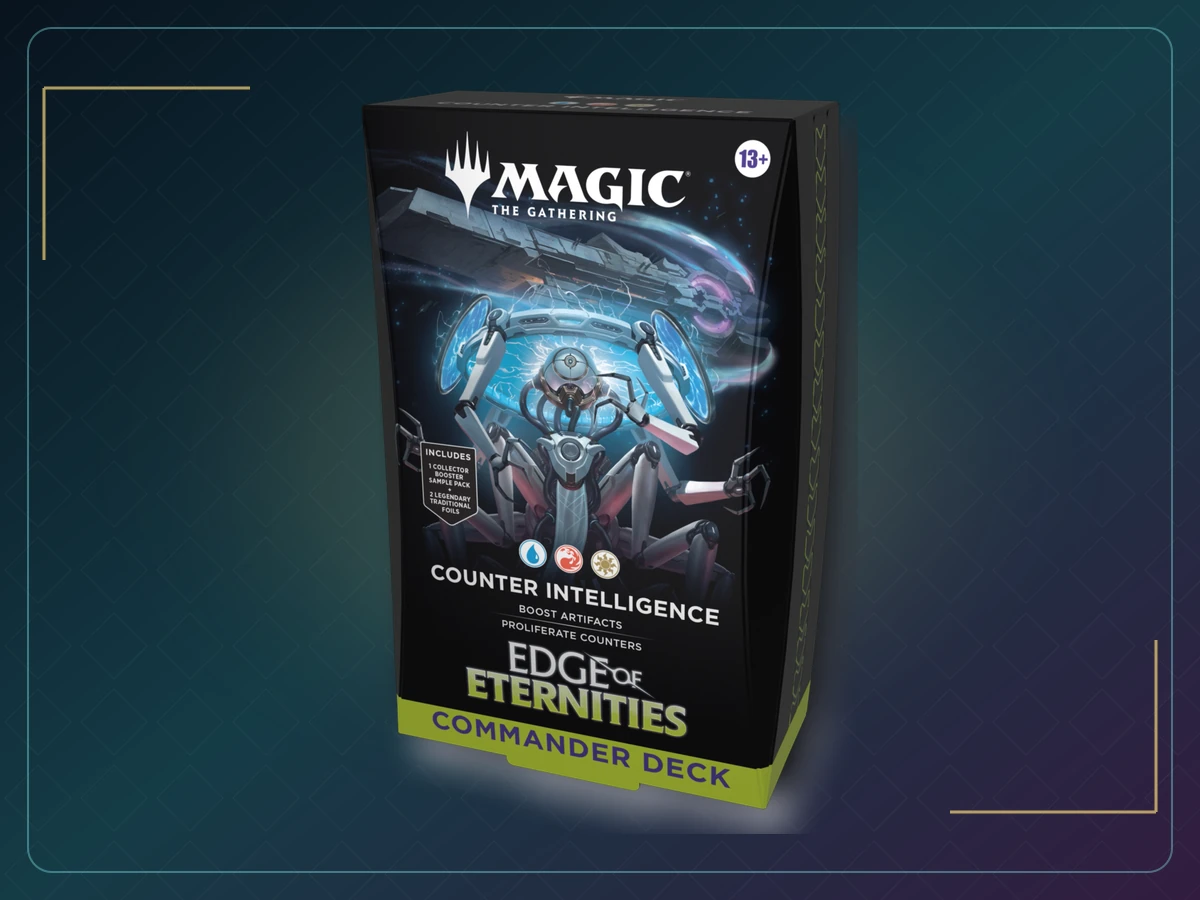
Magic: The Gathering Aetherdrift Commander Deck, Counter Intelligence
Kilo, Apogee Mind leads this Bant (Edge of Eternities) deck that EDHREC praised for cleanly introducing charge counters to Commander. The artifact-and-counter synergy is tight, and the box ships brand-new fixing lands that genuinely help an enemy-color mana base. It's a fresh, well-constructed deck that rewards players who like incremental engines over big haymakers. A quietly excellent modern precon.
- Tight, fresh charge-counter and artifact synergy
- Ships useful new fixing lands for the mana base
- Modern design with few dead cards
- Incremental engine can feel slow to players who want big swings
- Newer set, so sealed price hasn't dropped yet
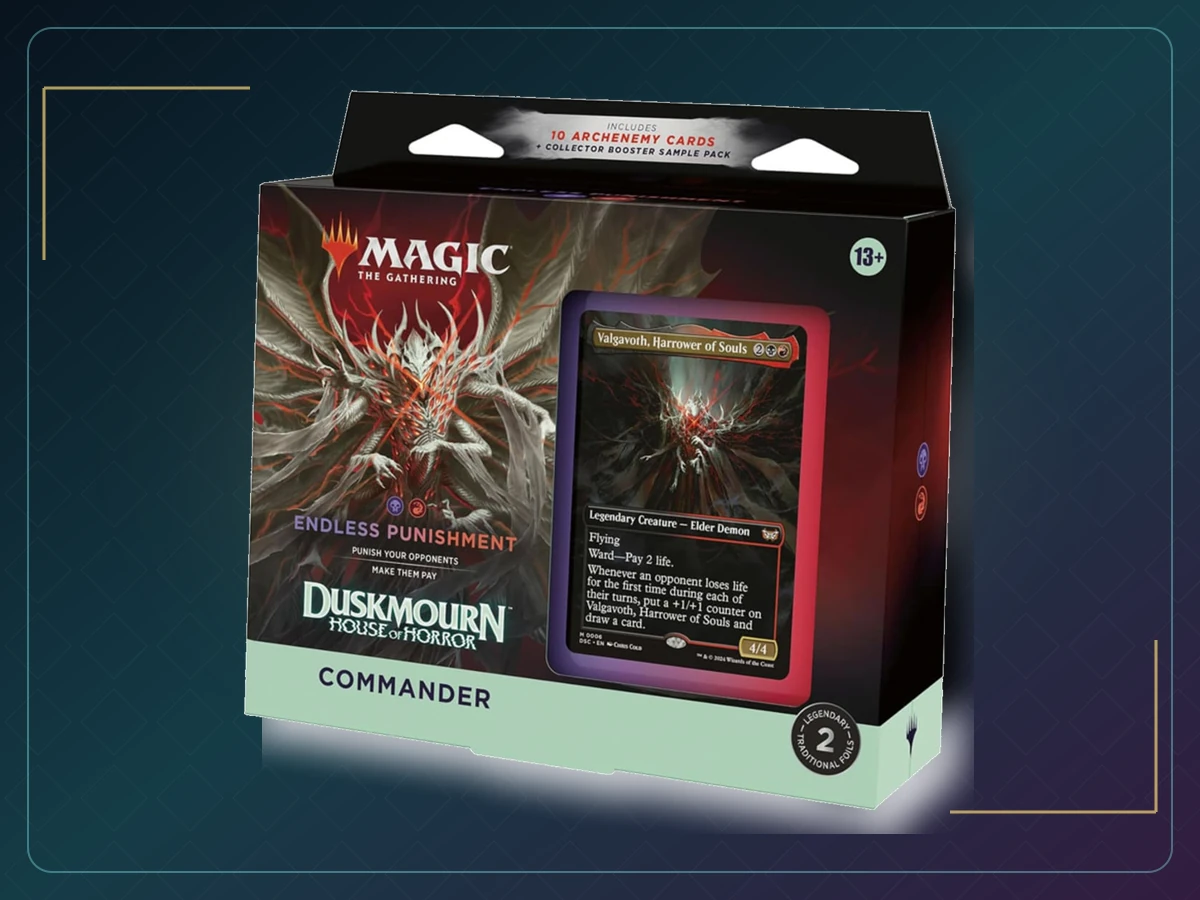
Magic: The Gathering Duskmourn: House of Horror Commander Deck, Endless Punishment
Valgavoth, Harrower of Souls fronts this Rakdos (black-red) group-slug deck from Duskmourn, named EDHREC's best precon of its release year. It drains the entire table through shared-pain triggers — a grindy, inevitable plan that a more experienced pod respects. It's mean in the best way and brings real pressure without needing a combo. A strong pick when you want a precon that fights.
- Punishing group-slug plan that threatens the whole table
- Strong, inevitable game plan without relying on combo
- Only two colors — simpler mana than the three-color picks
- Symmetrical pain effects can hurt you too if misplayed
- Grindy playstyle isn't for players who want fast games
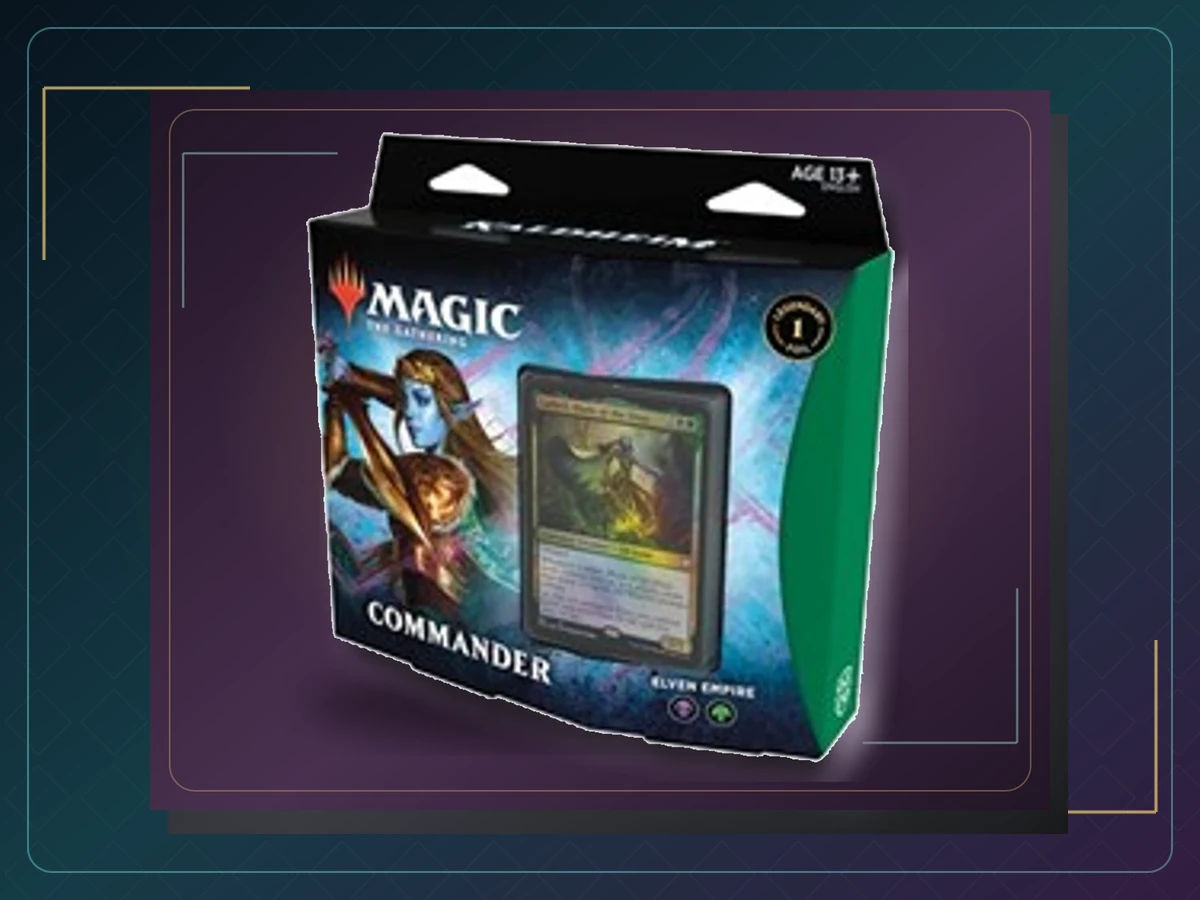
Magic: The Gathering Kaldheim Commander Deck, Elven Empire
Lathril, Blade of the Elves leads this mono-green Kaldheim Elf-tribal deck, which EDHREC called the most consistent precon of its year. The synergy is wonderfully legible — play Elves, make more Elves, get bigger, drain the table with Lathril's tap ability. Mono-green keeps the mana bulletproof and the price is among the lowest of any precon. An ideal, inexpensive first or second deck that still wins games.
- Extremely consistent, easy-to-learn Elf tribal plan
- Mono-green mana base never stumbles
- Among the cheapest precons on the market
- Older deck — power level sits squarely at casual Bracket 2
- Go-wide tribal is vulnerable to a single well-timed board wipe
At a glance
| deck | set | commander | colors | price | best for |
|---|---|---|---|---|---|
| Counter Blitz | Magic: The Gathering — FINAL FANTASY (FFX) | Tidus, Yuna's Guardian (/ Yuna, Grand Summoner) | Bant (G/W/U) | ~$60–70 (MSRP $69.99) | Best overall + best upgrade base |
| Necron Dynasties | Universes Beyond: Warhammer 40,000 | Szarekh, the Silent King | Mono-Black | ~$40–60 (varies on secondary market) | Best for total beginners |
| Eldrazi Unbound | Commander Masters | Zhulodok, Void Gorger | Colorless | ~$50–80 (Commander Masters scarcity) | Strongest out of the box |
| World Shaper | Edge of Eternities Commander | Szarel, Genesis Shepherd (/ Hearthhull, the Worldseed) | Jund (B/R/G) | ~$40–60 | Best lands shell + top upgrade target |
| Limit Break | Magic: The Gathering — FINAL FANTASY (FFVII) | Cloud, Ex-SOLDIER (/ Tifa, Martial Artist) | Naya (R/G/W) | ~$60–70 (MSRP $69.99) | Best Voltron/Equipment deck |
| Timey-Wimey | Universes Beyond: Doctor Who | The Tenth Doctor // Rose Tyler | Jeskai (W/U/R) | ~$45–70 (varies) | Best UB experience (2nd deck, not 1st) |
| Riders of Rohan | Universes Beyond: LOTR — Tales of Middle-earth | Éowyn, Shieldmaiden (/ Aragorn, King of Gondor) | Jeskai (W/U/R) | ~$40–55 (often discounted; MSRP ~$49.99) | Best value |
| Counter Intelligence | Edge of Eternities Commander | Kilo, Apogee Mind | Bant (G/W/U) | ~$40–60 | Best modern artifacts/counters build |
| Endless Punishment | Duskmourn: House of Horror Commander | Valgavoth, Harrower of Souls | Rakdos (B/R) | ~$35–55 | Best whole-table aggro for a tougher pod |
| Elven Empire | Kaldheim Commander | Lathril, Blade of the Elves | Mono-Green | ~$20–35 (among the cheapest) | Best cheap mono-color tribal |
Questions, answered
What is a Commander precon?
A Commander preconstructed deck is a sealed, ready-to-play 100-card Magic deck built around a legendary 'commander' creature. You open the box, shuffle, and play — no deckbuilding required. Every card is Commander-legal, the mana base already works, and it usually includes a foil commander plus extras like tokens and a deckbox.
Are precons good for beginners?
Yes — they're the single best way to start Commander. A precon removes the format's only real barrier (building a 100-card deck) and lets you learn by playing. Mono-color precons like Necron Dynasties (black) or Elven Empire (green) are the most forgiving, because the mana never betrays you and the game plan is easy to read.
Which precon should I buy first?
For a true beginner, buy Necron Dynasties (mono-black Warhammer 40,000) or Elven Empire (mono-green Elves) — both are forgiving, consistent, and EDHREC-praised. If you want the best overall deck and don't mind three colors, buy Counter Blitz (Final Fantasy). Better yet, buy two precons and play them head-to-head.
Can you play a precon straight out of the box?
Absolutely — that's the entire point. A sealed precon is a complete, legal, balanced 100-card deck. It's designed to play well against other precons right out of the wrapper, and it sits at Bracket 2 ('Core') on Wizards' official power scale, which is a great match for casual tables.
Do precons need upgrades?
No — but they reward them. A precon is roughly 95% optimized already; you can play it forever as-is. If you want more power, swap the 5–10 weakest cards: tighten the mana, add interaction, and sharpen the win condition. A focused $20–$30 upgrade turns most precons into a sharp Bracket 3 deck.
What's the best value precon?
The Lord of the Rings: Tales of Middle-earth decks (like Riders of Rohan and Elven Council) are the best value, because Wizards printed them heavily and they frequently slide to excellent secondary-market prices. Elven Empire is the cheapest genuinely good precon. For value-plus-upgradeability, World Shaper and Counter Blitz lead.
Are Universes Beyond precons good and legal?
Both. Universes Beyond precons (Final Fantasy, LOTR, Fallout, Doctor Who, Warhammer 40,000) are 100% Commander-legal — that's the format they're built for, and as of 2025 UB booster sets are legal in all Constructed formats too. Many are top-tier: Counter Blitz and Limit Break (Final Fantasy) were the best decks of 2025.
How much do precons cost?
Most modern Commander precons carry an MSRP around $40–$70 — Final Fantasy decks launched at $69.99, LOTR decks around $49.99, Warhammer/Doctor Who in between. Street prices swing with supply and hype: older or overprinted decks can drop below $35, while scarce or hyped ones sit at or above MSRP. Always price-check the day you buy.
How many players is Commander?
Commander is built for multiplayer — most often four players in a free-for-all, each starting at 40 life. It also plays well at three players, and one-on-one (two-player) games are common and fun. The format's politics, big swings, and comeback potential shine brightest at a four-person 'pod.'
What's a good two-player precon experience?
Two fresh precons head-to-head is one of the best ways to learn Commander — the decks are beautifully matched. For a satisfying duel, pick two decks with clear, different game plans: an aggressive deck like Limit Break (Voltron) against a grindy one like Necron Dynasties or Endless Punishment makes for a dynamic, swingy two-player game.
Can you mix precons together?
Yes — combining two precons is a classic, cheap way to build a stronger deck, especially two from the same set or two that share a theme (two Eldrazi decks, two counters decks). You'll end up with extra cards to cut down to 100, but it's a fun, low-cost path from 'I bought a deck' to 'I built a deck.'
Do precons come with a Sol Ring?
Almost always, yes — Sol Ring ships in nearly every Commander precon, along with staples like Arcane Signet and Swiftfoot or Lightning Greaves. Notably, Sol Ring is NOT on the official 'Game Changers' list despite being powerful, so its presence doesn't raise your deck's bracket. Keep it in your deck when you upgrade.
Where should I buy precons?
Use the exact Amazon product button attached to the deck in this guide, then verify seller, language, sealed condition, delivery date, and current price before checkout. Puzzlewick earns from qualifying Amazon purchases. Wizards, EDHREC, TCGplayer, Card Kingdom, and local-store discussions remain useful editorial sources for product identity, upgrades, and market context.
Robert's verdict
Buy Counter Blitz if you want the strongest combination of stock cohesion and upgrade headroom. Buy Necron Dynasties if this is your first serious Commander deck and you want mana that rarely argues with you. Buy Eldrazi Unbound only when the table welcomes expensive haymakers and understands that its sealed power can distort an ordinary precon pod. World Shaper is the tinker's choice, while a discounted Lord of the Rings deck is the value hunter's move. Skip Jeskai Striker as a first purchase: too many half-supported plans make learning harder than it needs to be. Whichever box wins, sleeve it, play it stock three times, record the cards that disappoint you, and make the first ten swaps from evidence rather than internet reflex.
Research ledger 25 sources · reviewed 2026-09-09
Specifications, rules, current product information, community experience, and contrary evidence were checked against the sources below. Commercial links are kept separate from editorial evidence.
- draftsim.comdraftsim.com/best-precons-2025
- edhrec.comedhrec.com/articles/the-5-best-commander-precons-of-2025
- edhrec.comedhrec.com/articles/the-five-best-commander-precons-of-the-last-five-years
- magic.wizards.commagic.wizards.com/en/news/announcements/final-fantasy-commander-decklists
- mtggoldfish.commtggoldfish.com/articles/final-fantasy-commander-decklists
- cardgamebase.comcardgamebase.com/final-fantasy-commander-precons
- cardgamebase.comcardgamebase.com/commander-precons
- thegamer.comthegamer.com/magic-the-gathering-the-best-universes-beyond-commander-precon-decks
- draftsim.comdraftsim.com/mtg-universes-beyond-commander
- magic.wizards.commagic.wizards.com/en/news/announcements/introducing-commander-brackets-beta
- magic.wizards.commagic.wizards.com/en/news/announcements/commander-brackets-beta-update-october-21-2025
- magic.wizards.commagic.wizards.com/en/news/announcements/aligning-the-universes-making-all-our-sets-legal-in-all-our-formats
- edhrec.comedhrec.com/articles/science-fallout-precon-review
- dotesports.comdotesports.com/mtg/news/energy-returns-to-mtg-through-science-fallout-commander-precon-deck
- edhrec.comedhrec.com/precon/timey-wimey
- edhrec.comedhrec.com/precon/necron-dynasties
- mtg.cardsrealm.commtg.cardsrealm.com/en-us/articles/upgrading-commander-precon-eldrazi-unbound-zhulodok-void-gorger
- mtgstocks.commtgstocks.com/news/16584-the-lord-of-the-rings-tales-of-middle-earth-commander-decklists
- cardkingdom.comcardkingdom.com/mtg/the-lord-of-the-rings-tales-of-middle-earth-commander-decks/sealed
- tcgplayer.comtcgplayer.com/product/618905/magic-commander-final-fantasy-final-fantasy-commander-deck-final-fantasy-x-counter-blitz
- draftsim.comdraftsim.com/zhulodok-edh-deck
- blog.cardkingdom.comblog.cardkingdom.com/necron-dynasties-precon-upgrade-guide
- reddit.comreddit.com/r/EDH/comments/1tdbl10/what_precons_do_yall_recommend_for_teaching_new
- reddit.comreddit.com/r/EDH/comments/1uok10b/great_and_new_playerfriendly_commander_precons
- reddit.comreddit.com/r/EDH/comments/1ryv8dk/how_to_you_even_start

If it didn't earn a shelf, it isn't here.


Keep exploring
The next smart rabbit holes.
✶ Universe HubMagic: The Gathering: the whole buying pathMagic: The Gathering is the deepest construction sandbox in the Big Three: a two-player duel, four-player Commander ritual, draft...🂠 Topic PathTrading Card Games: compare the whole shelfStart with the game and community you want, then buy the smallest product that lets you test it properly. These guides separate...Buying GuideWhat Magic: The Gathering Should You Buy First? Beginner Box, Starter Kit, Commander or BoostersChoose one playable start, find your table, and protect your cards with gear that earns its place. You do not need to buy the whole...