What Magic: The Gathering Should You Buy First? Beginner Box, Starter Kit, Commander or Boosters
Choose one playable start, find your table, and protect your cards with gear that earns its place. You do not need to buy the whole ladder.


Written and reviewed by Robert Pruitt · how this guide was made
Last editorial refresh: 2026-09-09 Gold-standard QA: 2026-09-09 15 sources reviewed Affiliate links checked during gold-standard pass

The short answer
Choose the Foundations Beginner Box for a guided paper lesson, or the Final Fantasy Starter Kit for two ready decks and a familiar theme. If a patient Commander group is already waiting, one preconstructed deck can be your entrance. Learn free on MTG Arena if that suits you. Random boosters are not a ready first deck.
Decision map
Choose in thirty seconds
Two people learning paper Magic
A Final Fantasy fan learning with a friend
Only after the first product produces repeat games.
Let play, not launch heat, unlock the next purchase.
You can recognize every character on a Magic box and still have no idea whether it contains a game you can play tonight. Beginner Box, Starter Kit, Commander deck, Play Booster and Collector Booster are not sizes of the same thing. They ask different things of you and the people across the table.
Start with the evening you want: a guided lesson, a duel with a friend, a multiplayer gathering, a Draft or collecting for its own pleasure. Robert will help you choose one entrance. The entire shop does not need to come home with you.
Start here, then go deeper
You are in the right cabinet.
 ✶ Universe HubMagic: The Gathering: the whole buying pathMagic: The Gathering is the deepest construction sandbox in the Big Three: a two-player duel, four-player Commander ritual, draft...
 🂠 Topic PathTrading Card Games: compare the whole shelfStart with the game and community you want, then buy the smallest product that lets you test it properly. These guides separate...
 GuideBest-Value Commander Decks: Should You Start with Wretched Ranks?Gisa offers a welcoming way into Zombies—but launch markups, slow starts and flying attackers complicate the buying decision. Here is how...
What should a new Magic: The Gathering player buy first?
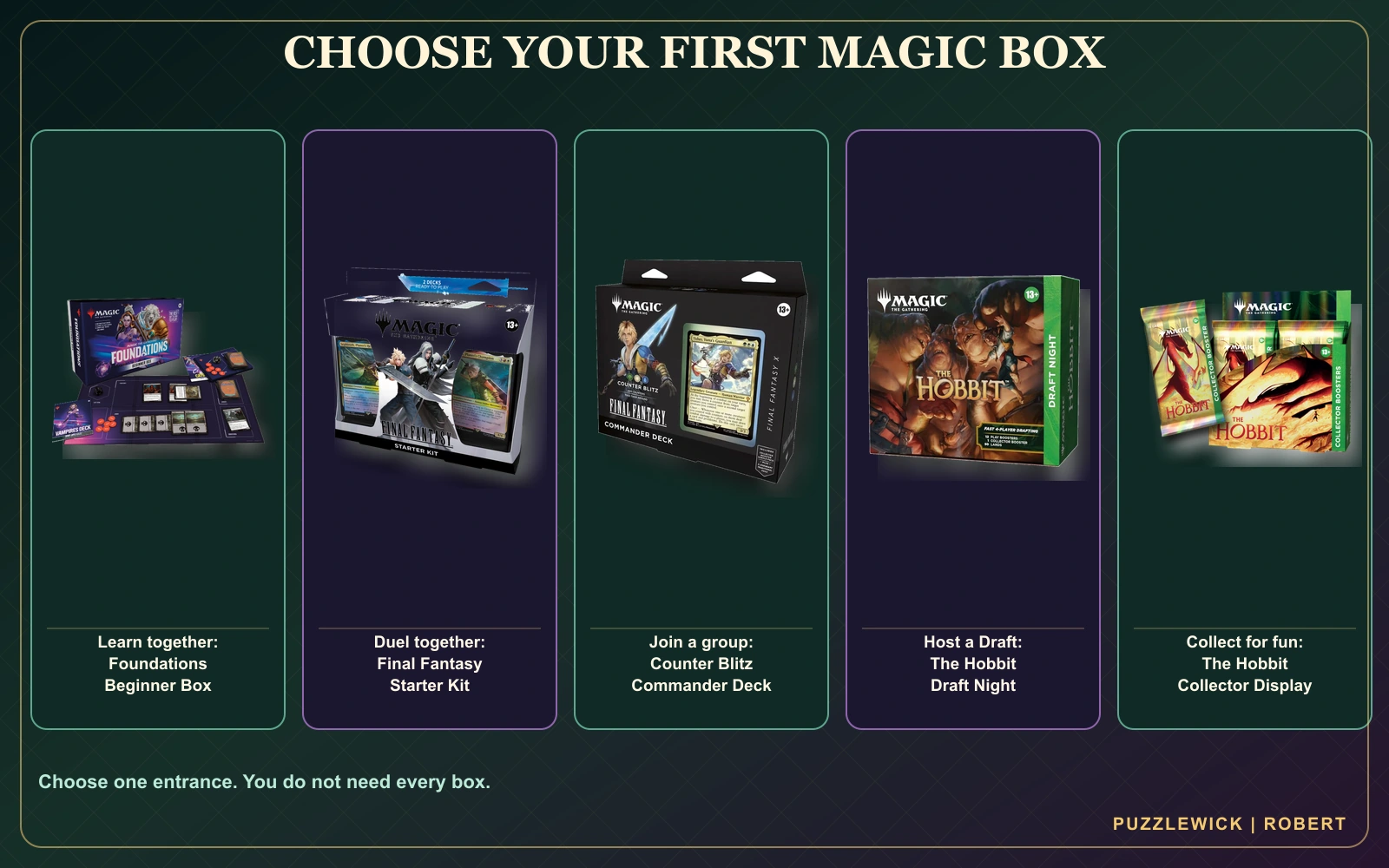


Choose the Foundations Beginner Box for a guided paper lesson, or the Final Fantasy Starter Kit for two ready decks and a familiar theme. If a patient Commander group is already waiting, one preconstructed deck can be your entrance. Learn free on MTG Arena if that suits you. Random boosters are not a ready first deck.
The first purchase should make a complete first game possible. It should let you take turns, make decisions and discover whether you want another evening together. Competitive deck legality is a separate question; a teaching product is not automatically an entry ticket to every store event.
The Hobbit is hot now. Should it replace the Beginner Box?
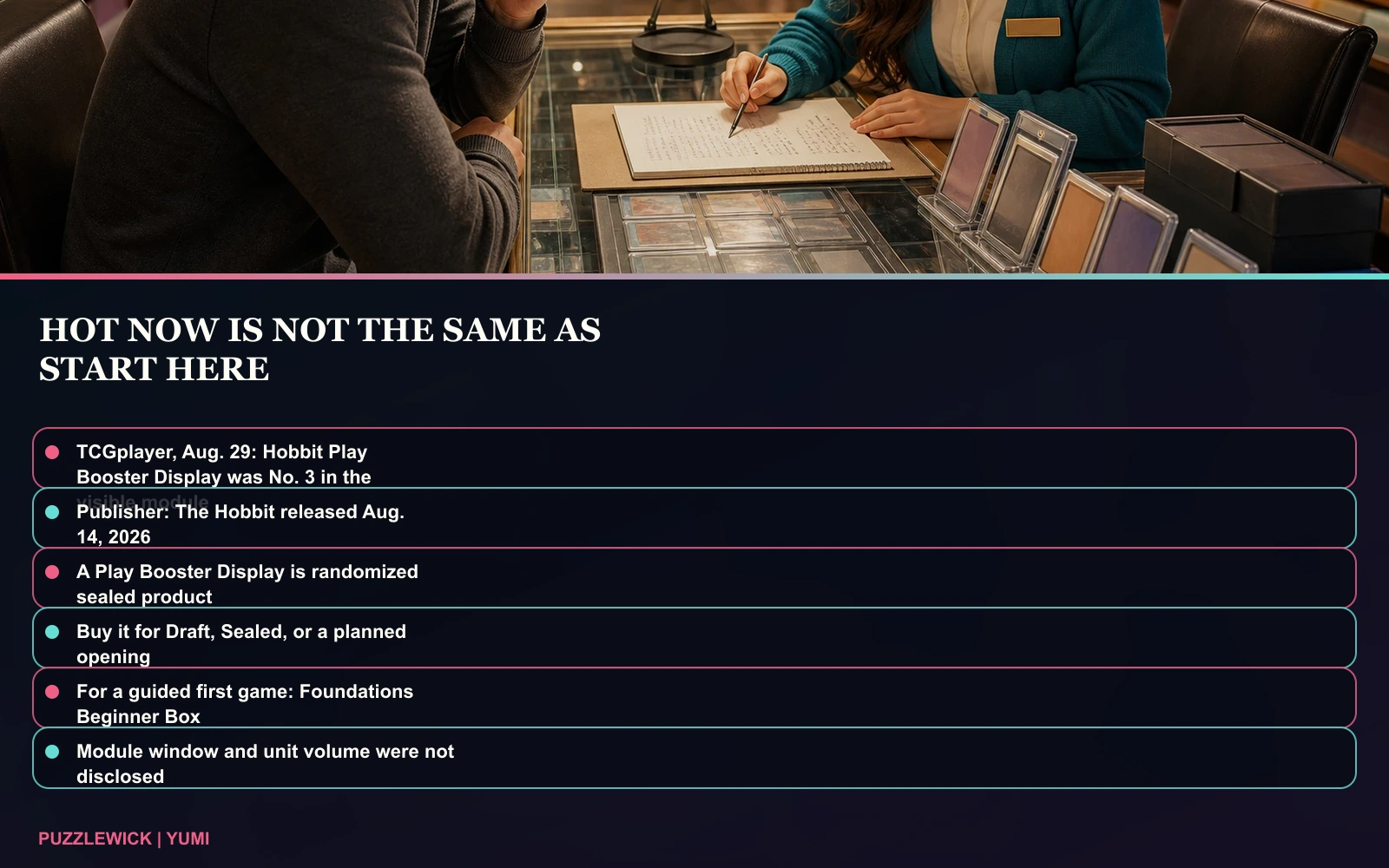
No, not for a player who still needs a guided first paper game. On August 29, 2026, TCGplayer placed The Hobbit Play Booster Display third in the ten products visible in its Best Sellers module. Three additional Hobbit singles appeared in that same visible ten, and the site's August 28 weekly Magic article also contained several Hobbit cards and lands. Wizards lists the set as released on August 14, 2026. Those observations establish current marketplace attention. They do not reveal unit volume, global demand, expected pack value, or beginner fit because the module and weekly article do not publish a complete methodology or sales window.
The Play Booster Display is randomized sealed product. It is sensible when the planned activity is Draft, Sealed, or opening a large number of packs together. It is not a guided rules lesson and does not contain one guaranteed constructed deck. For two unsupported beginners, the Foundations Beginner Box remains the cleaner first purchase. If Tolkien is the reason you will actually attend, start with a free Hobbit Welcome Deck lesson or Magic Academy, then buy the sealed product that matches the next evening you have planned.
BoardGameGeek's Hotness does not change this decision. Its August 29 list measures attention around board games, not Magic product sales, and no Magic retail product appeared in the visible top entries. Puzzlewick records that check so a quiet source cannot be silently converted into evidence it never supplied.
Which job should your first Magic product complete?
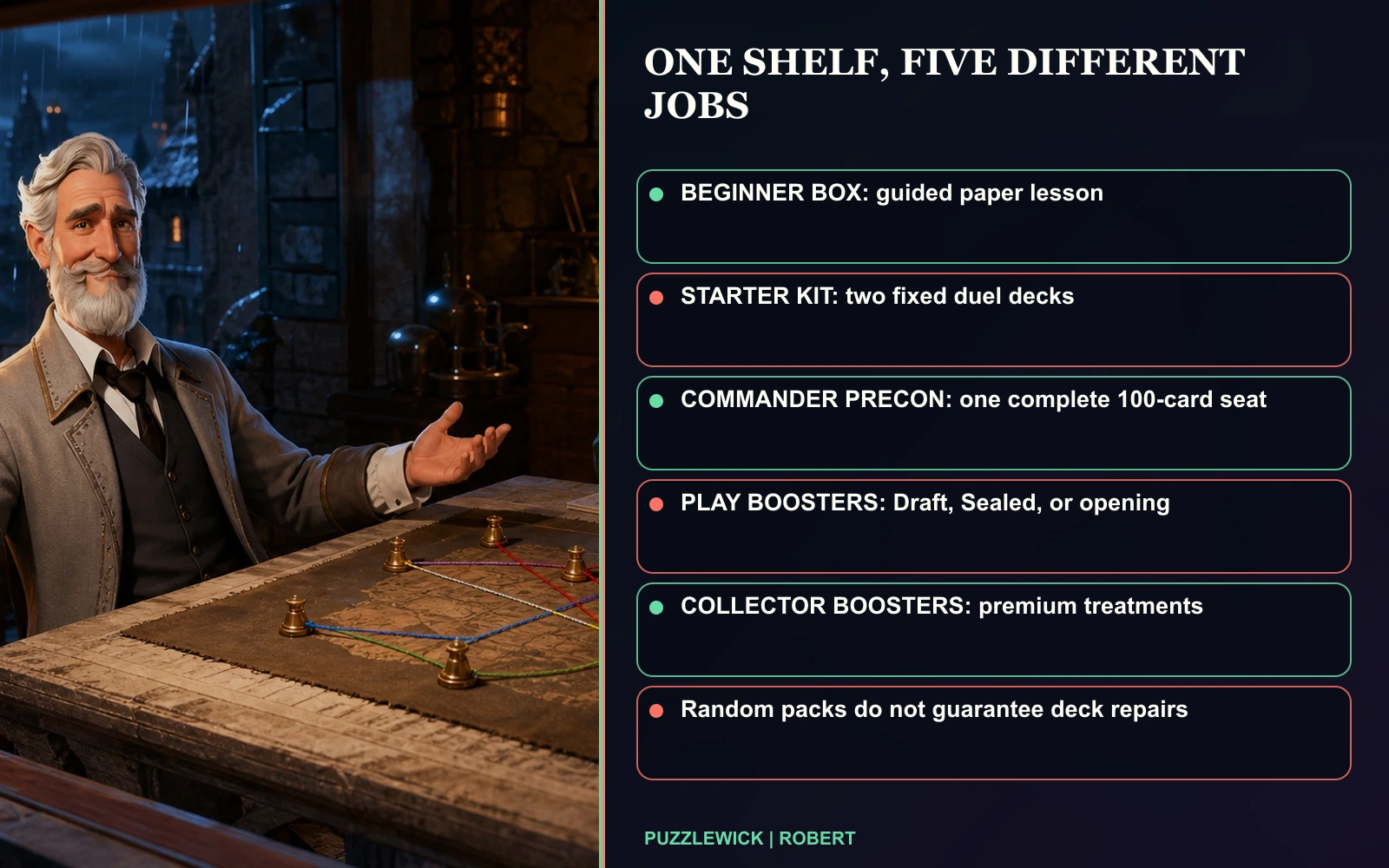
A Beginner Box teaches. A Starter Kit supplies two fixed duel decks. A Commander precon supplies one complete seat in a specific social format. Play Boosters supply randomized cards for Draft, Sealed, or opening. Collector Boosters concentrate premium treatments. Those jobs overlap less than the packaging implies.
The Foundations Starter Collection belongs after the tutorial: it is a construction library, not the guided Beginner Box. A Hobbit Bundle is a collection sampler with packs, lands, a promo, a die, and storage; it is not a finished deck. The Hobbit Collector Booster Display is the premium opening route. None of these products becomes a better first lesson because it contains more cardboard or carries a newer release date.
Use one sentence before every purchase: What complete activity will this box let us do tonight? If the answer is only “own more cards,” stop and decide whether collecting is truly the intended activity.
How does Magic: The Gathering actually work at the table?
A Magic turn moves through five phases: beginning, precombat main, combat, postcombat main, and ending. Start with one narrated turn: untap, upkeep, draw; play a land and cast a spell when permitted; declare attacks and blocks; take the second main phase; then finish the turn. Cards and format rules add exceptions. Let the learner make decisions instead of reaching across the table to make them.
Opening Foundations? Do not shuffle the Cats and Vampires tutorial decks yet. Their supplied order is part of the guided lesson. Follow the two how-to-play guides first. After that, combine two of the box's twenty-card themed packets for a forty-card deck. The ten packets are reusable, so keep their lists and separate them again after play. Wizards publishes the contents and tutorial reset order if an enthusiastic shuffler gets there first.
The Final Fantasy Starter Kit instead supplies two fixed sixty-card decks. Commander uses a 100-card deck including its commander, normally only one of each card except basic lands and explicit exceptions. Players start at forty life; four-player games are common. Tracking four players' cards makes it a busy classroom, but an existing group and a patient teacher can make one preconstructed deck a sensible entrance.
For the formal baseline, use Wizards' how-to-play guide and the official Commander format page. Your first evening does not require memorizing either.
Which Magic format should you choose before buying a product?
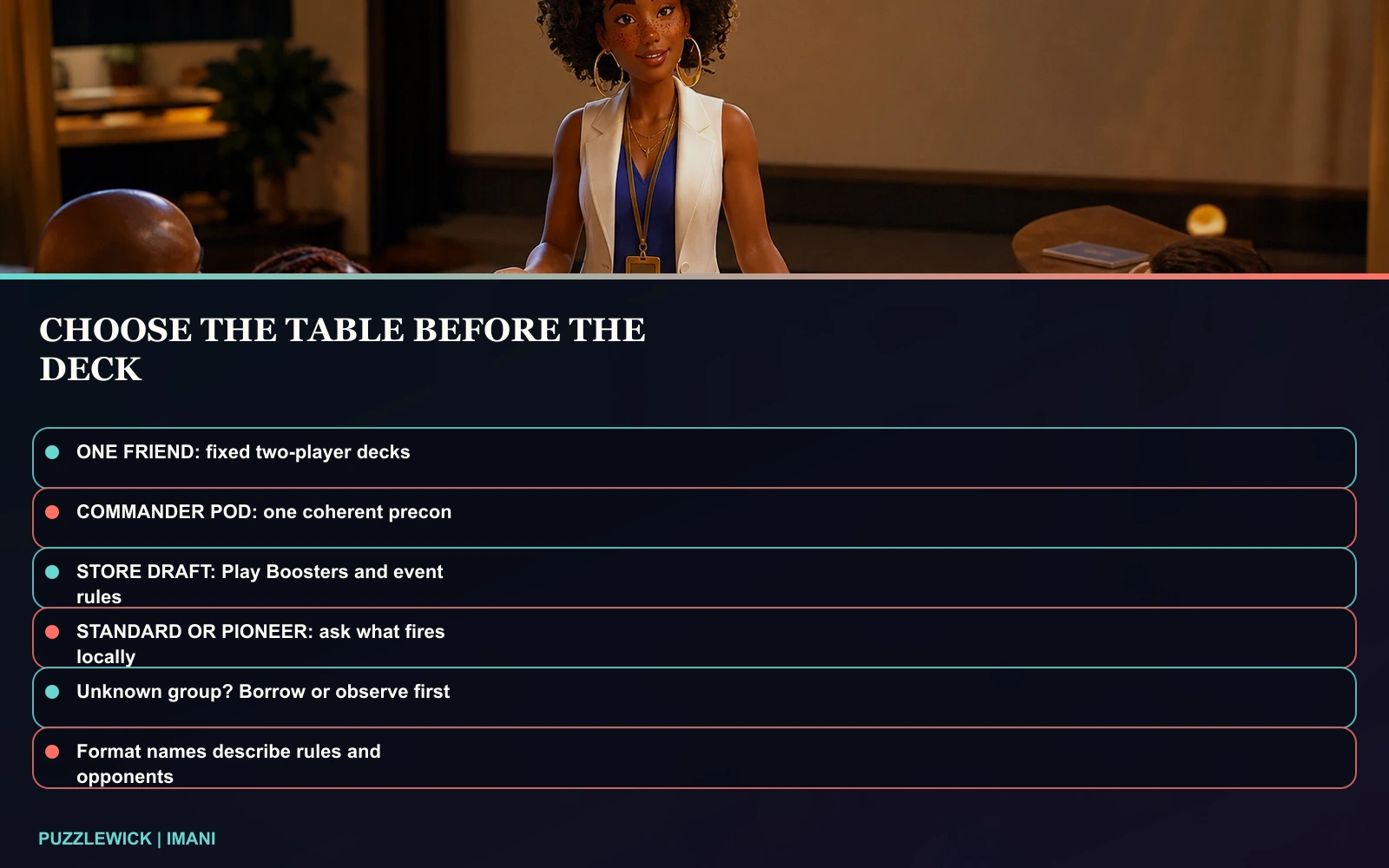
Choose two-player constructed when you have one regular opponent and enjoy refining a consistent deck. Starter Kits are a beginning, not a permanent metagame; once both players understand the rules, move toward matched decks built for the same format and approximate power. Ask the store what actually fires before buying into Standard, Pioneer, or Modern. Format names are promises about legality and opponents, not prestige levels.
Choose Commander when the group experience is the point. Buy one preconstructed deck whose commander suggests decisions you already enjoy. Play it intact several times, then improve lands, card draw, interaction, and the commander’s core engine in small batches. Talk about expected power before the game. Commander can be generous and theatrical, but its singleton card pool and four-player board make it a noisy classroom for someone still learning priority, combat, and the stack.
Choose Limited when opening packs is part of the game rather than an attempt to manufacture a collection. Draft and Sealed turn randomized cards into a level-ish event with deckbuilding constraints. Use Play Boosters or the product explicitly required by the event; Collector Boosters are premium opening products and not the sensible default for learning Limited.
Choose Jumpstart-style play when setup speed and variety matter more than long-term tuning. Keep each half-deck intact and labeled after play. Two packets shuffled together create a deck quickly, which makes the format unusually good for mixed-experience households and spontaneous game nights.
The correct next box is therefore determined by people and calendar. One friend tonight points toward a Starter Kit or matched decks. Three friends every month point toward Commander. A reliable store draft points toward Limited. A family cabinet points toward reusable Jumpstart packets. Buying the popular format without the people who make it popular is just purchasing a lonely rules problem.
The Silverquill Commander deck shown below is one current example of the one-seat route: it is useful only when Commander is the table you are joining. Read the commander and deck plan before choosing the art, and play the list intact long enough to learn what it actually needs.
When should you buy Play Boosters or upgrade a deck?
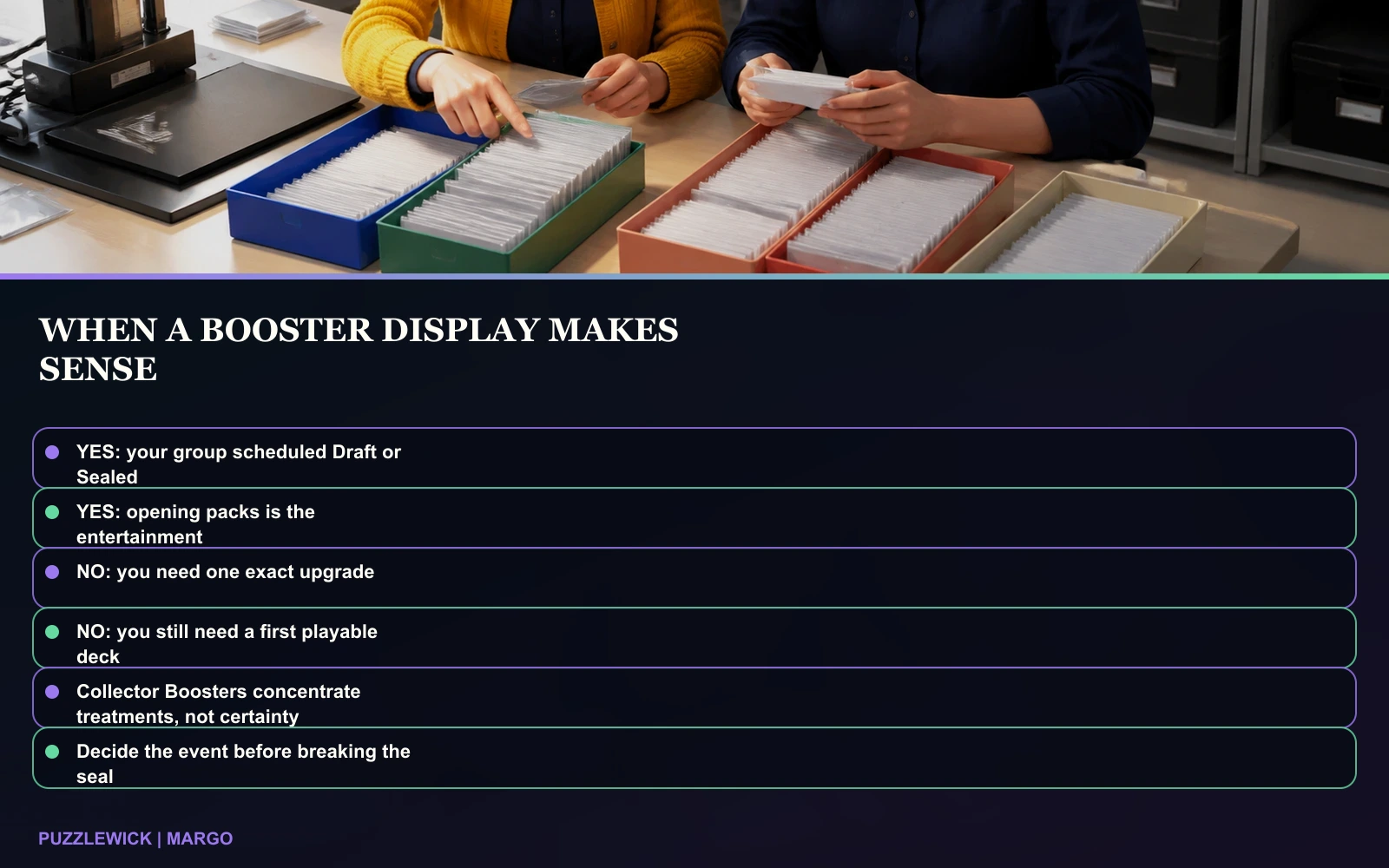
Buy Play Boosters when the randomized pool is the activity. Draft asks players to select cards from circulating packs and build on the spot. Sealed asks each player to build from a limited personal pool. A planned group opening can also be worthwhile entertainment. In all three cases, decide the player count, format, lands, time, and stopping point before the seal breaks.
The Hobbit Draft Night product gives four people an explicit Pick-Two Draft frame, while a full Play Booster Display serves a group planning more than one Limited session. A Prerelease Pack is often a gentler first public event because everyone is learning an unfamiliar pool. Collector Boosters serve premium opening and collecting; they do not improve the rules lesson or guarantee a particular treatment.
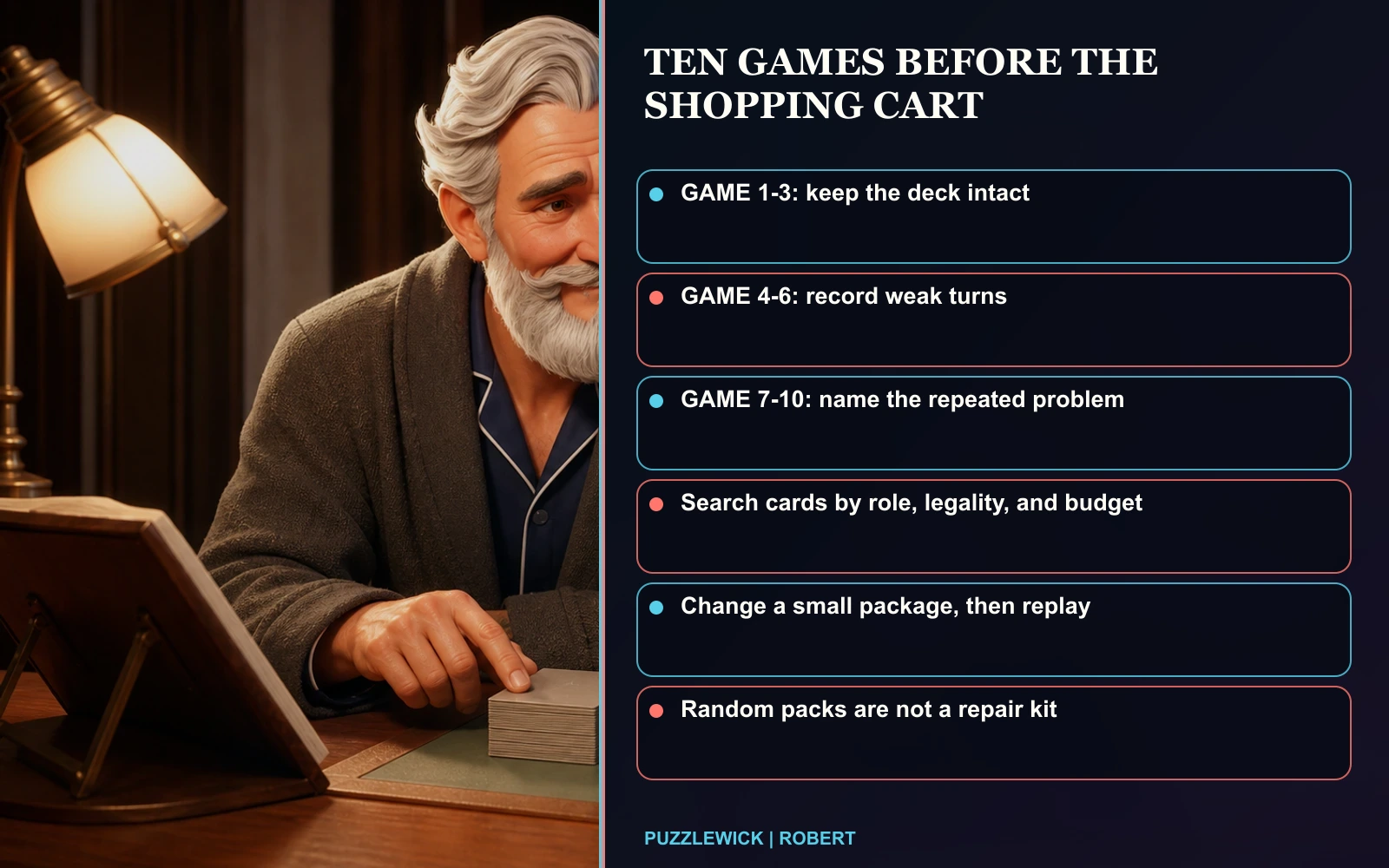
If you need an exact card, buy or trade for the exact card. If you need a complete playable deck, buy a complete deck. A booster can contain something useful without becoming a reliable repair plan.
After the Beginner Box, choose a lane. Stay in two-player constructed with a coherent deck or Starter Kit; move to Commander with one precon and a power-level conversation; or draft using products meant for draft. Upgrade a precon with a small package of lands, interaction, card draw, and cards that serve the commander—not twenty isolated “staples.”
Use singles to solve diagnosed problems. Random packs are entertainment, draft material, or collecting—not a reliable repair kit. Write down three weak turns before shopping. If the same problem appears repeatedly, fix that problem and stop.
Use a card database after the table has supplied a question. Scryfall can narrow by format legality, mana value, color, card type, or rules text. It cannot decide which weakness your actual deck repeats. Write the problem in ordinary language first: “I miss the third land,” “I cannot answer a large creature,” or “my hand empties too quickly.” Then search for a role, choose a small package, and replay.
What should your first month of Magic: The Gathering look like?
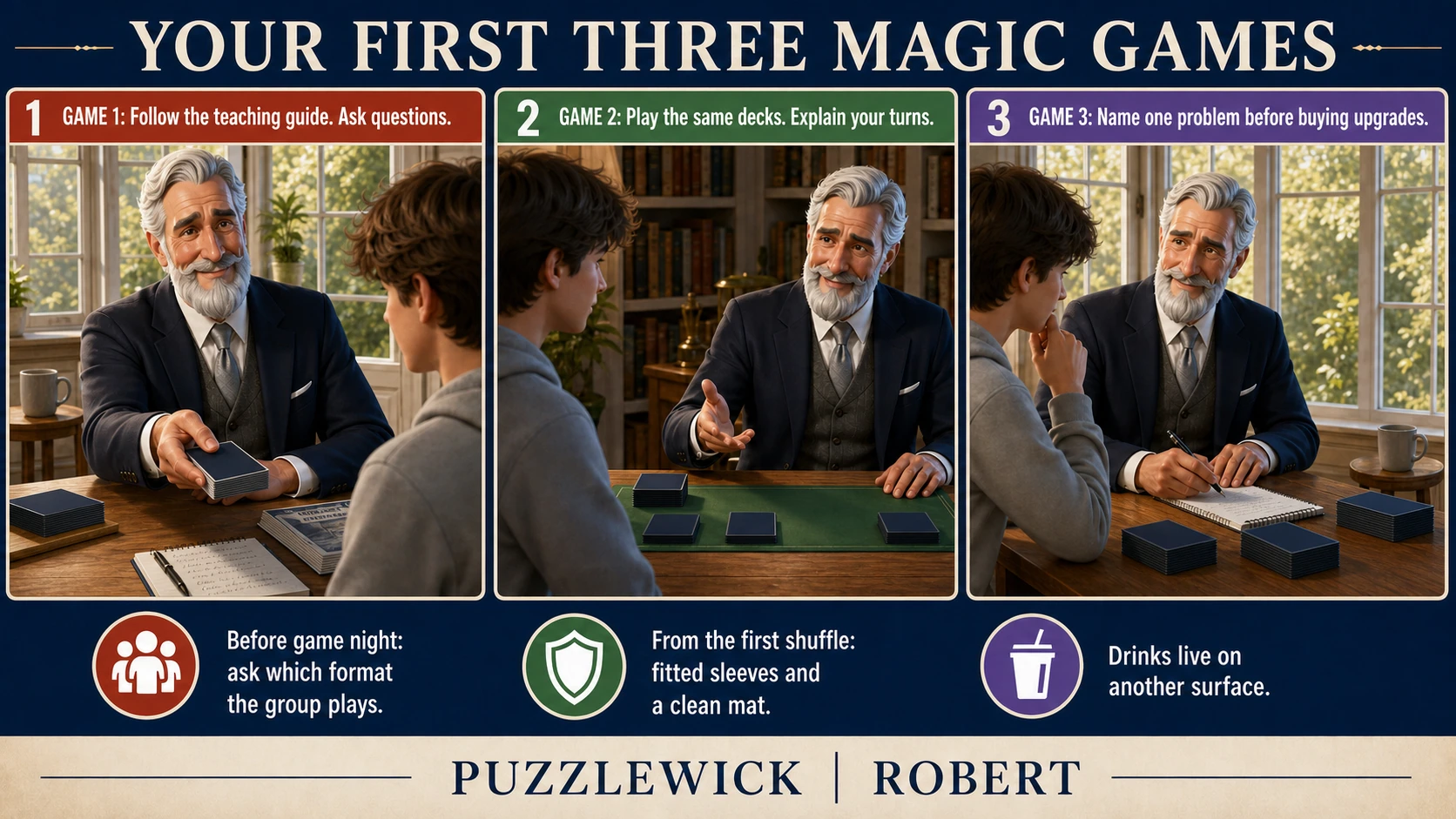
Before the first shuffle: use the supplied teaching material, sleeve the decks you plan to keep playing, and give the cards a clean surface. Protection is not a graduation prize. Night one: play the product intact. Nights two through five: repeat before modifying. Nights six through ten: note the decisions and cards that produce the best and worst turns.
Ten games is Robert's spending brake, not an official requirement. If your table is having fun, you have already succeeded. If a weakness keeps recurring, choose one targeted upgrade. You do not owe the hobby a new box every time you learn a rule.
Which mistakes should you check before the next purchase or event?
A booster is not a ready deck. Choose the format and opponents first. Play Boosters serve Limited events and opening packs; Collector Boosters concentrate premium treatments. Neither guarantees the exact cards that repair a deck.
A character name is not a card identity. Cloud in the Starter Kit and Cloud in a Commander deck are different cards, built for different products. Read the full name and rules. A familiar face can teach the habit without making the products interchangeable.
A big capacity number is not a fit test. Sleeves, tokens and dividers take real space. Try the complete load before the first trip, and keep dice away from card edges. The right box closes without persuading the cards to become smaller.
At a store, ask three plain questions before spending: which format fires every week, what entry product regulars recommend for that exact night, and whether a new player can borrow or observe a deck first. Bring the preconstructed list unchanged to its first session so advice has a stable baseline. Photograph the deck before upgrades, keep removed cards together, and change a small package at a time. If every loss triggers twenty purchases, the deck never gets a fair diagnosis.
For gifting, match the product to the recipient’s people. A Starter Kit assumes one opponent; a Commander precon assumes a pod; a Beginner Box assumes another learner or patient teacher. The art may open the door, but the social shape determines whether the box becomes a game.
How should you protect, store, and travel with a Magic deck?
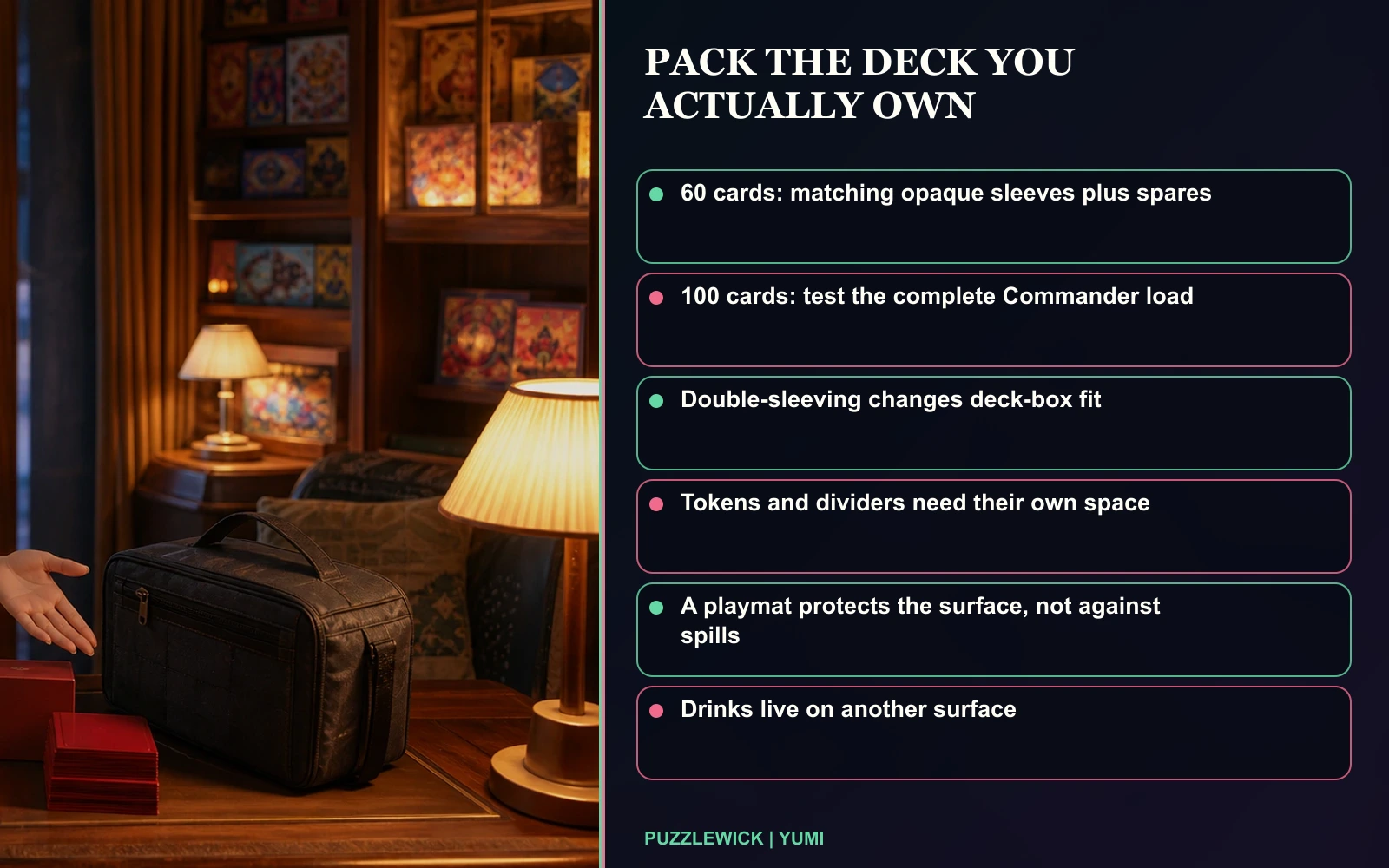
Buy protection by job, not by logo. Use one opaque sleeve model across the complete playable deck and keep matching spares. Sleeve fit and shuffle feel are personal, but inconsistent backs and damaged corners are not personality.
A compact rigid box suits a sixty-card deck; a 100+ box suits a Commander deck only after you test the actual sleeve thickness, tokens, dividers, and spare sleeves. Double-sleeving changes the load. The right case closes without pressure on card edges and survives the trip inside a larger bag.
A side-loading zip binder makes a collection browsable; it is not an active-deck case. A playmat defines one player's clean space and protects cards from rough surfaces; it does not make the table spill-proof. A mat tube protects the rolled mat, while a backpack or larger case protects closed deck boxes and the binder during travel.
The licensed Lightning mat shown here uses a soft fabric top, stitched perimeter, and rubber backing. Those are practical details. The artwork is the reason a Final Fantasy fan may prefer it to a blank surface, not evidence that it changes gameplay. Keep drinks on another surface and check that every case still closes after the deck is fully sleeved.
What is the clean Magic: The Gathering buying order?
Choose one entrance, not a compulsory ladder. Buy the Foundations Beginner Box when two people want the most guided paper lesson. Choose the Final Fantasy Starter Kit instead when two complete themed decks and familiar characters will make the lesson happen. If a regular Commander group is already waiting, one appropriate preconstructed deck can be the practical entry after a patient rules teach.
Play the chosen product repeatedly before adding another sealed product. Open the storage guide when the active deck needs sleeves, a fitted case and a clean playing surface. Protection follows the deck you chose; a second teaching box is not a graduation requirement.
Current-release rule: check Wizards for identity and release timing, TCGplayer for a dated marketplace signal, and BoardGameGeek for broader tabletop attention. Then return to the reader's actual table. A hot product earns investigation, not automatic placement at the front of the beginner route.
The picks
Some links below are affiliate links — as an Amazon Associate, Puzzlewick earns from qualifying purchases, at no extra cost to you. It never changes a pick.
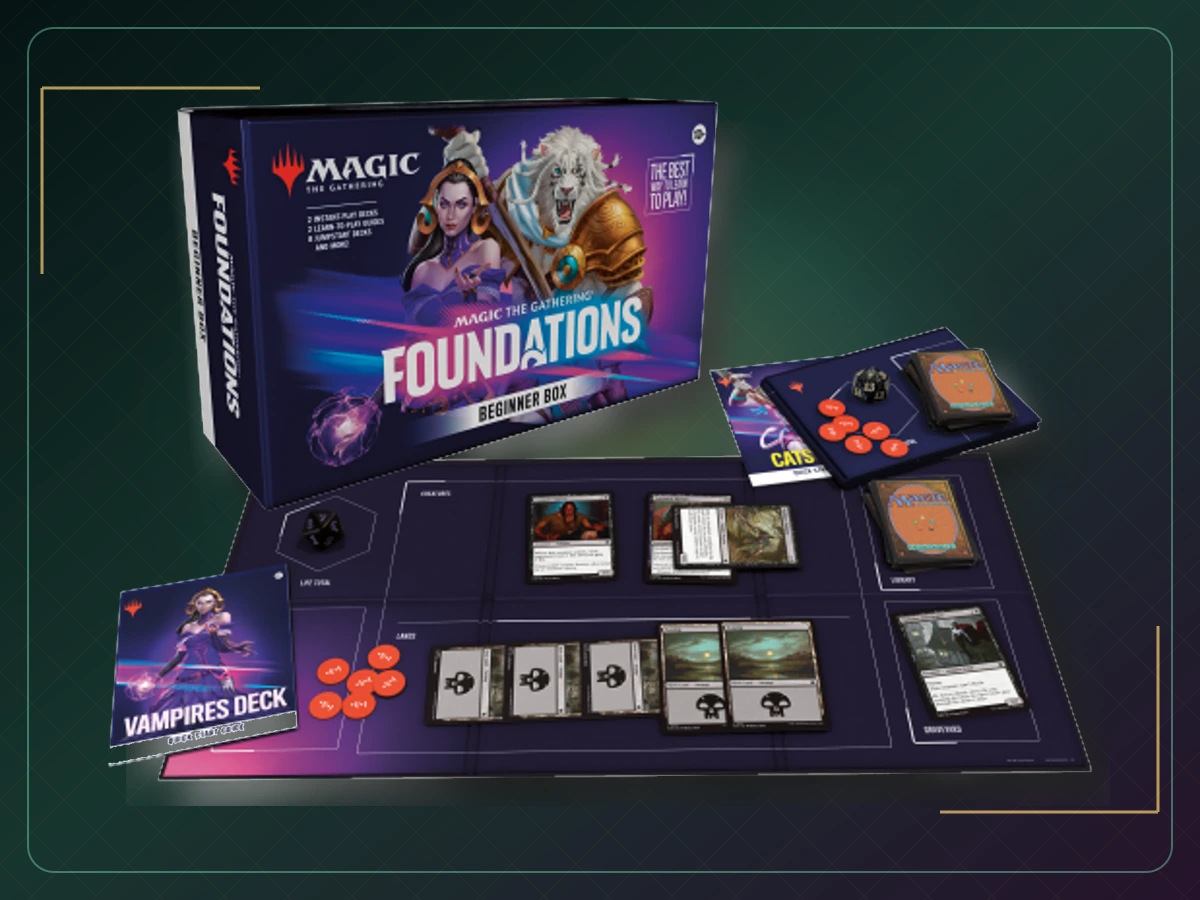
Magic: The Gathering Foundations Beginner Box
The cleanest physical classroom: guided packets first, then mix-and-match games after the turn sequence feels natural.
- Guided two-player lesson
- Several replayable packet matchups
- Not Commander-ready
- Intentionally introductory card pool
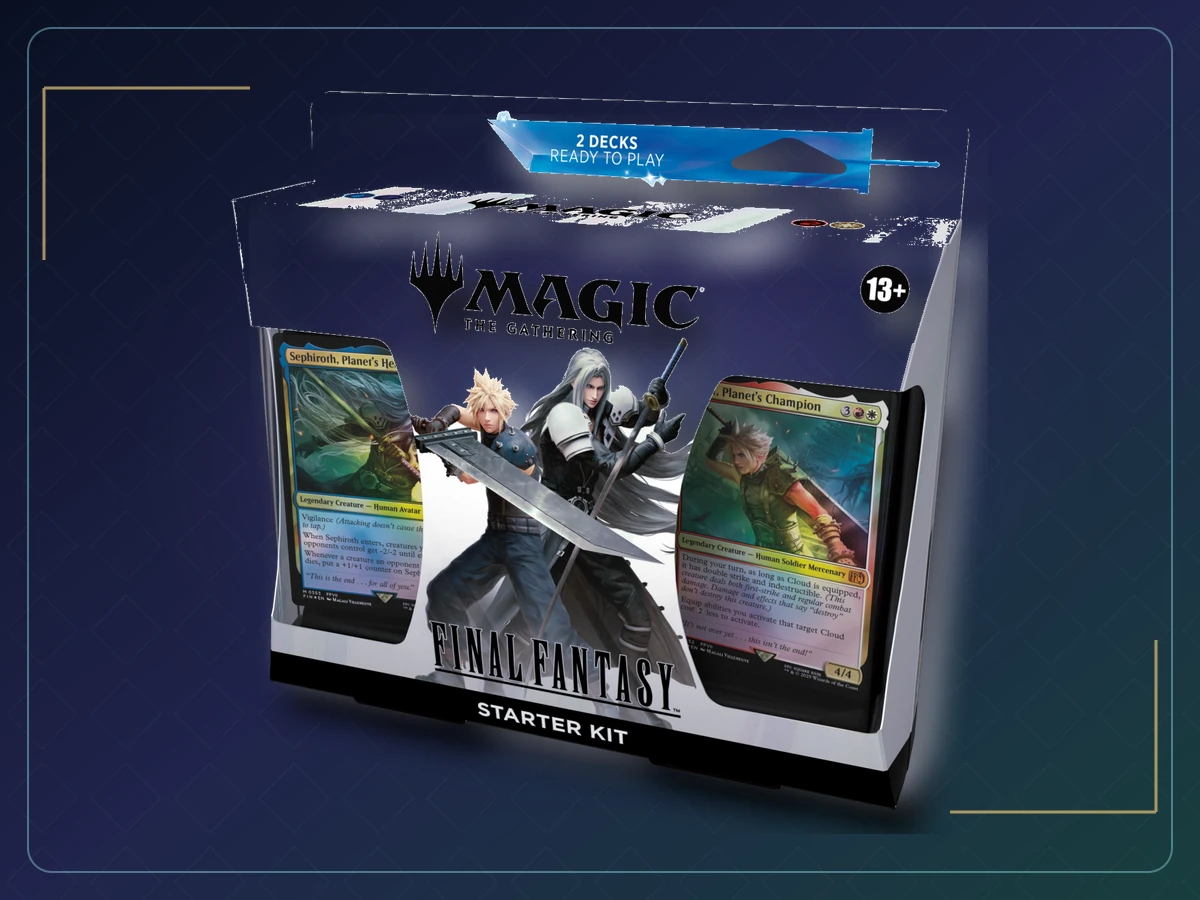
Magic: The Gathering Final Fantasy Starter Kit
Two fixed, ready-to-play decks make the fandom a welcoming doorway while keeping the first lesson coherent.
- Two complete fixed decks
- Strong licensed Final Fantasy identity
- Limited construction depth alone
- Not a Commander product
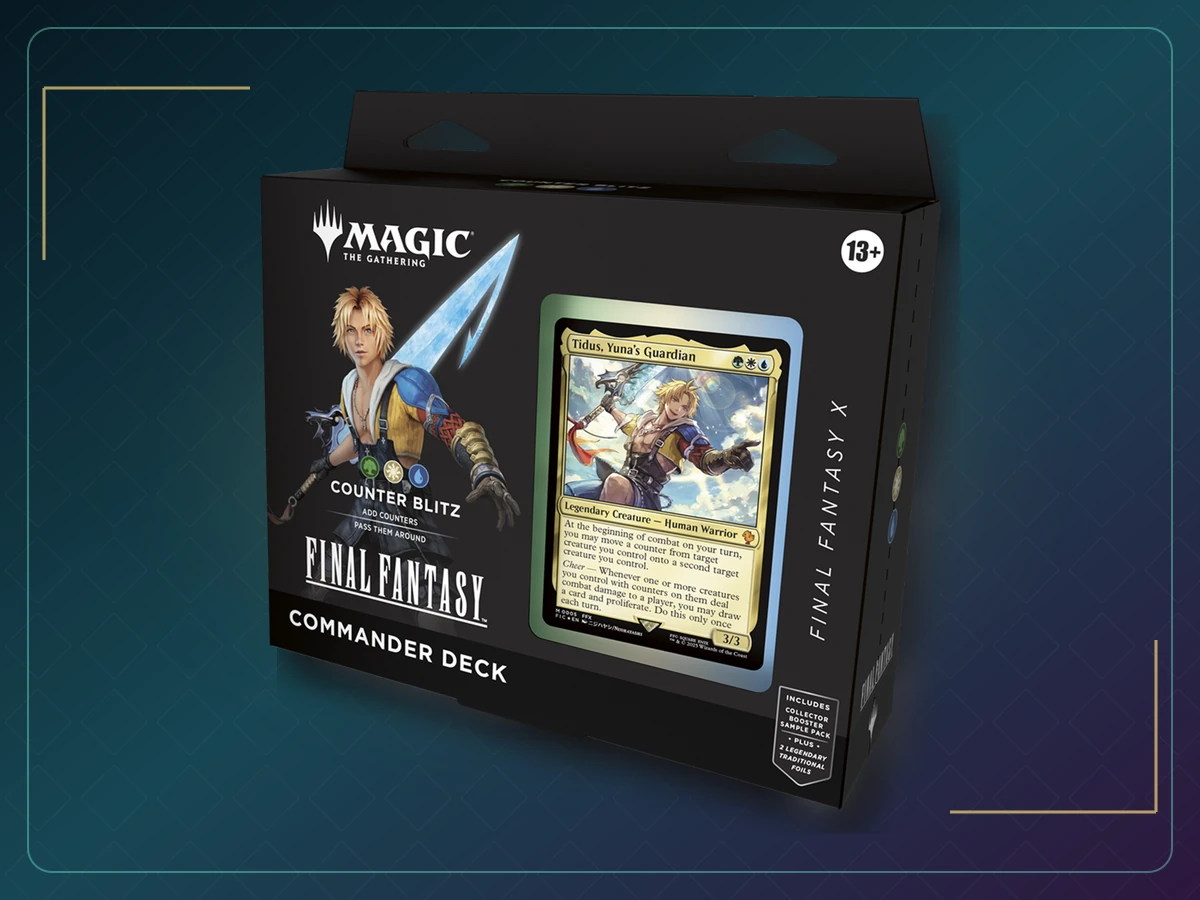
Final Fantasy X Commander Deck: Counter Blitz
A complete 100-card seat built around Tidus and counters. Choose it because the table plays Commander, not because the box is larger.
- Complete 100-card deck
- Coherent counter-based plan
- Needs an existing Commander group
- Power expectations vary by table
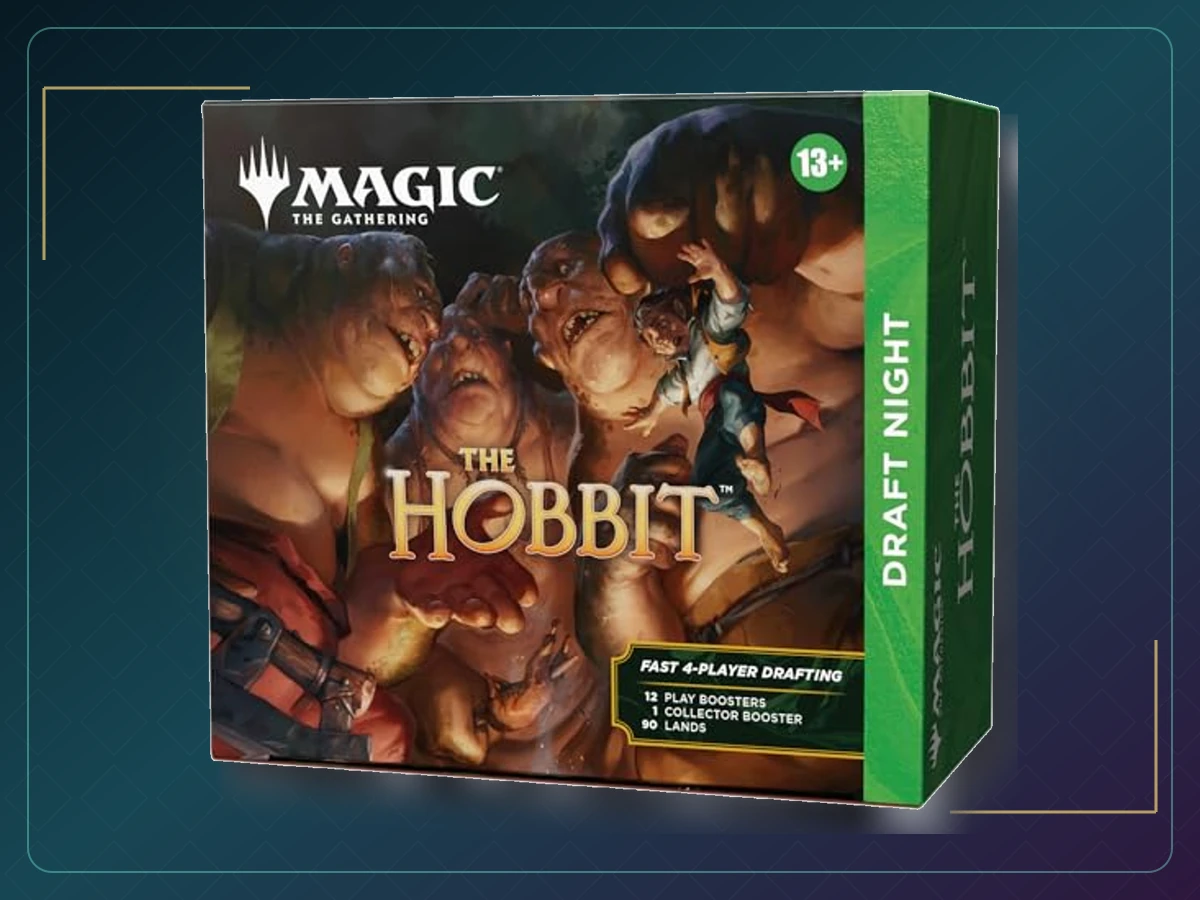
Magic: The Gathering | The Hobbit Draft Night
The strongest self-contained event purchase here: twelve Play Boosters, one Collector Booster, lands and tokens for a Pick-Two draft.
- Purpose-built four-player event
- Includes a premium pack and table supplies
- Narrow player-count fit
- Drafted cards still need protection
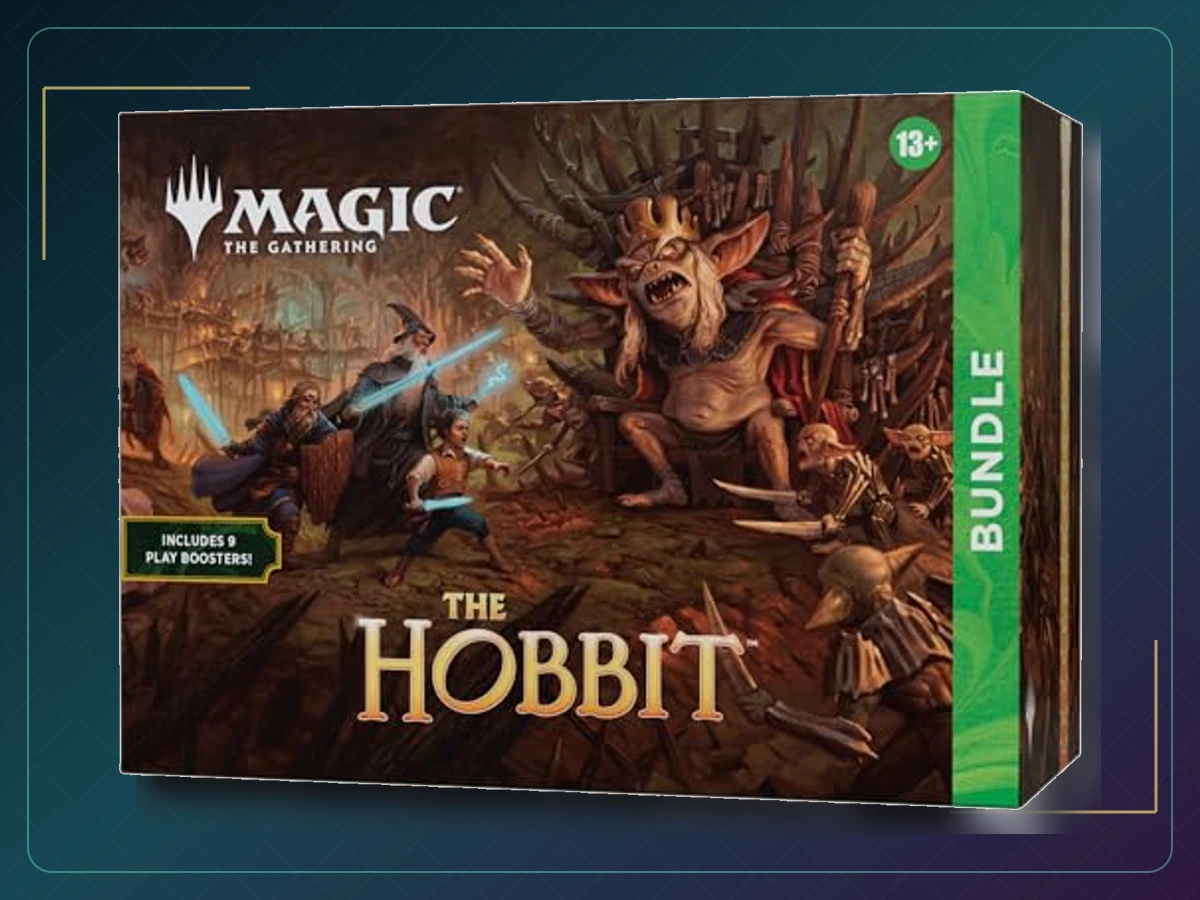
Magic: The Gathering | The Hobbit Bundle
Nine Play Boosters, lands, a promo, a die and storage make a pleasant set sampler, but no finished deck lives inside.
- Balanced personal set sampler
- Useful lands, die and storage
- Randomized contents
- No complete playable deck
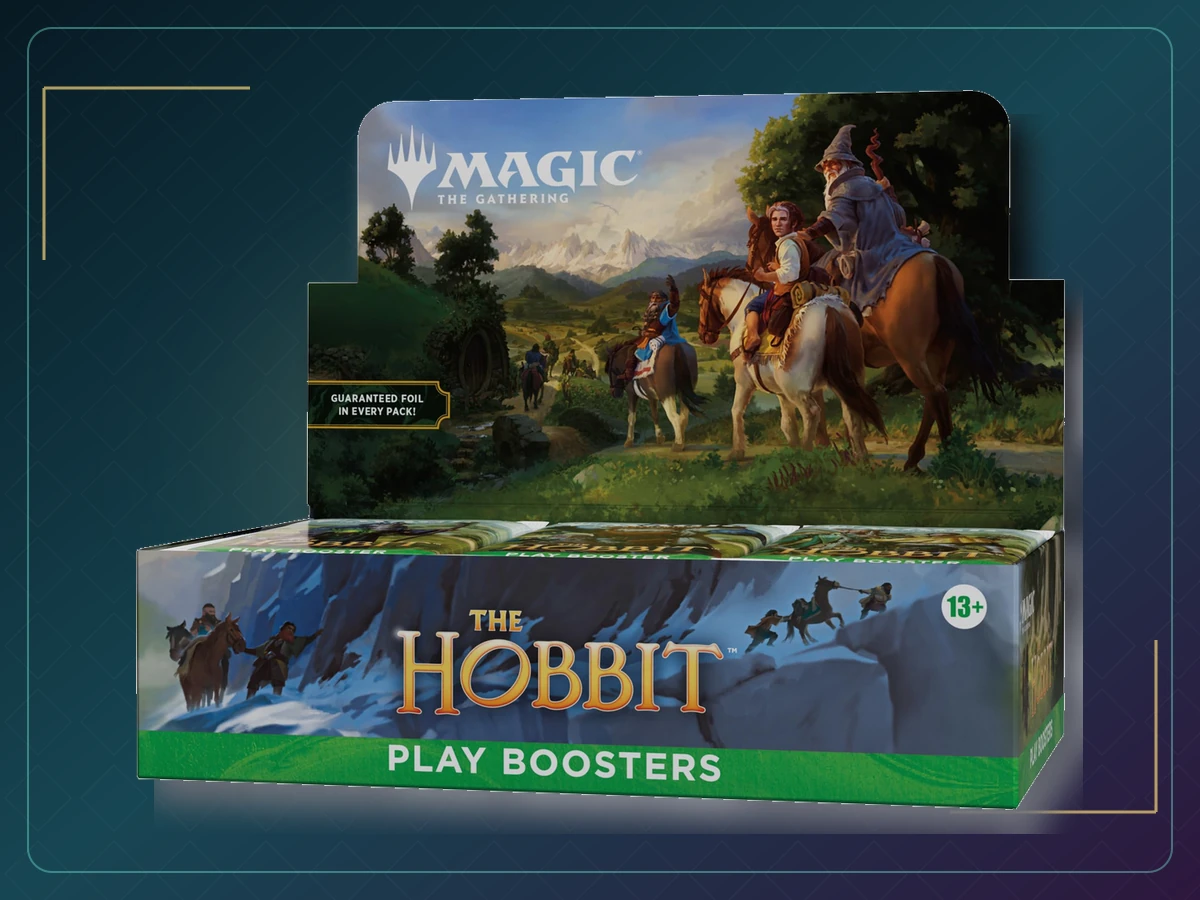
Magic: The Gathering | The Hobbit Play Booster Display
This is flexible pack supply for an activity the group already chose. It is not a beginner curriculum disguised as a large box.
- Supports Draft and Sealed
- Large shared sample of the main set
- Randomized value
- Requires an event plan or deckbuilding follow-through
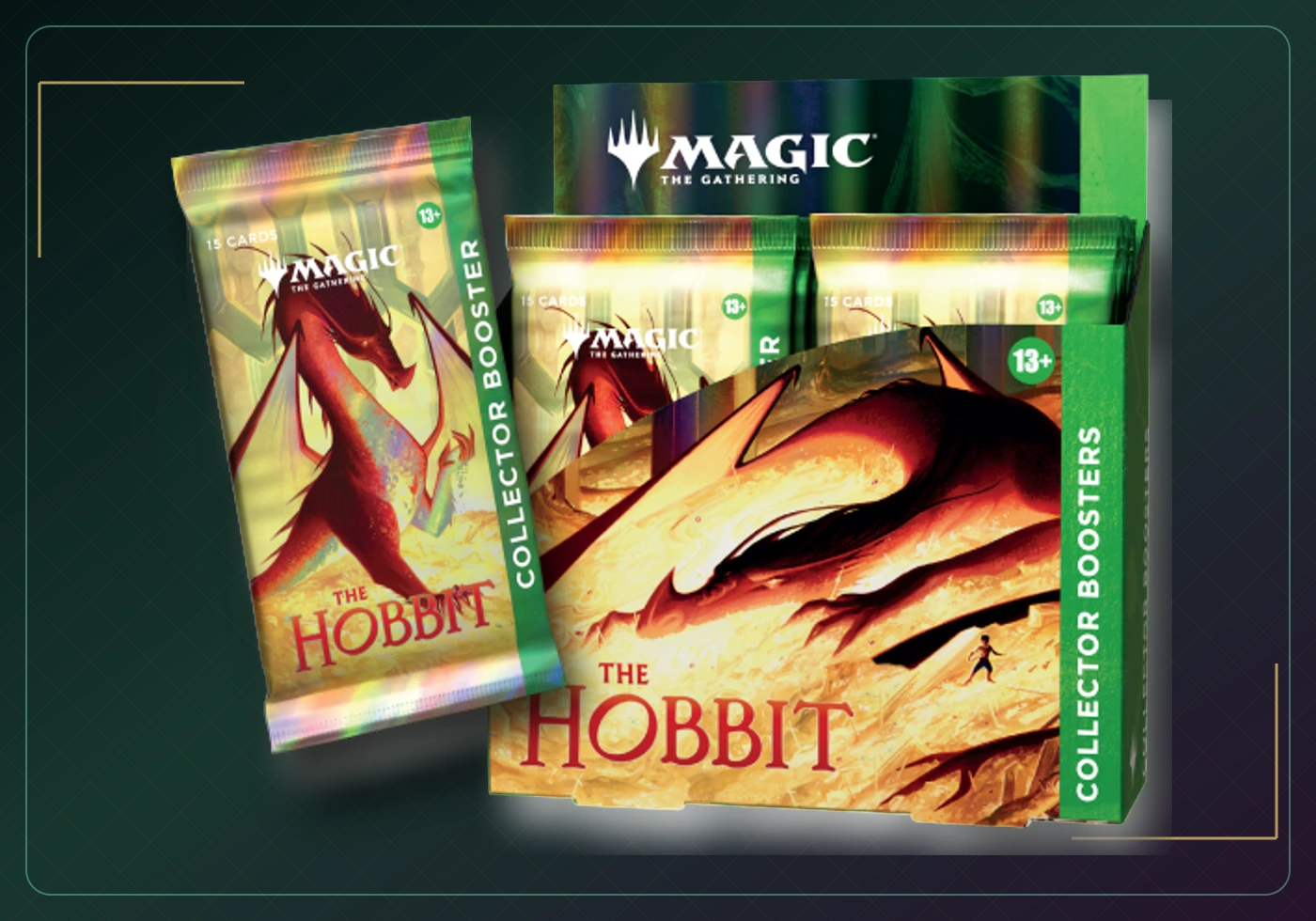
Magic: The Gathering | The Hobbit Collector Booster Display
The premium Middle-earth art lane, with book-cover, Dragon Hoard and classic-artist treatments. It is a collecting experience, not a shortcut to a first deck.
- Distinct Tolkien treatment families
- Premium sealed collecting experience
- High-variance opening
- Singles are better for one exact card
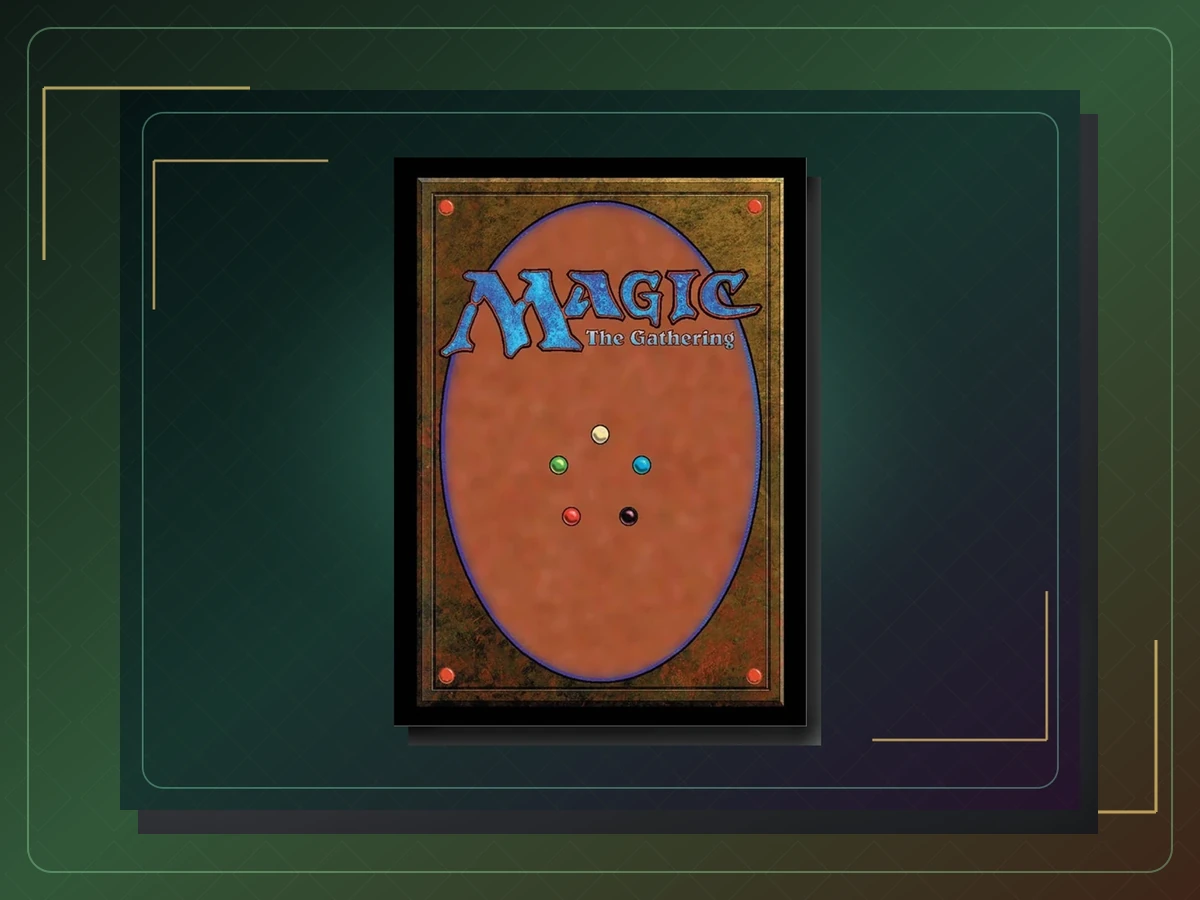
Ultra PRO Magic Classic Card Back Sleeves, 100 Count
A licensed 100-sleeve set protects an actively shuffled deck without turning the recommendation into another anonymous color block.
- Licensed Magic card-back design
- One coherent 100-sleeve set
- Artwork can show edge wear
- No spare sleeves if all 100 are used
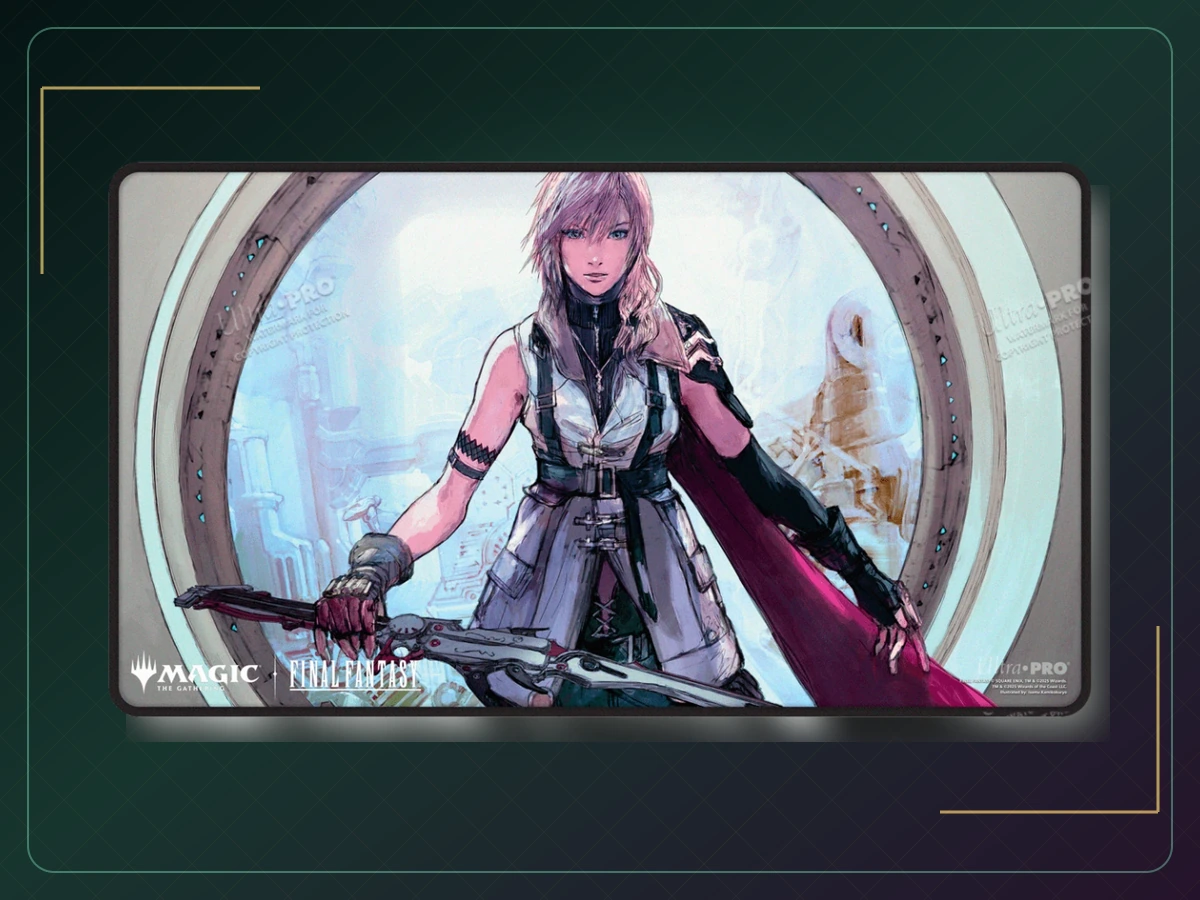
Ultra PRO Final Fantasy Lightning, Army of One Stitched Playmat
Lightning artwork, a stitched edge and a rubber backing make this useful protection feel like part of the game rather than generic desk furniture.
- Licensed Final Fantasy artwork
- Stitched edge and rubber backing
- Single-player footprint
- Not spill protection
At a glance
| Order | Product | Best for | Buy when | Honest catch |
|---|---|---|---|---|
| 1 | Magic: The Gathering Foundations Beginner Box | Two people learning paper Magic | Now | Not a Commander deck |
| 2 | Magic: The Gathering Final Fantasy Starter Kit | A Final Fantasy fan learning with a friend | Instead of the Beginner Box when the theme and two ready decks suit you better | Theme-dependent |
| 3 | Magic Final Fantasy Commander Deck Set of Four | A committed group that wants four matched Commander choices | Only when this exact format or experience is wanted | High first spend |
Free download — The first Magic table decision card
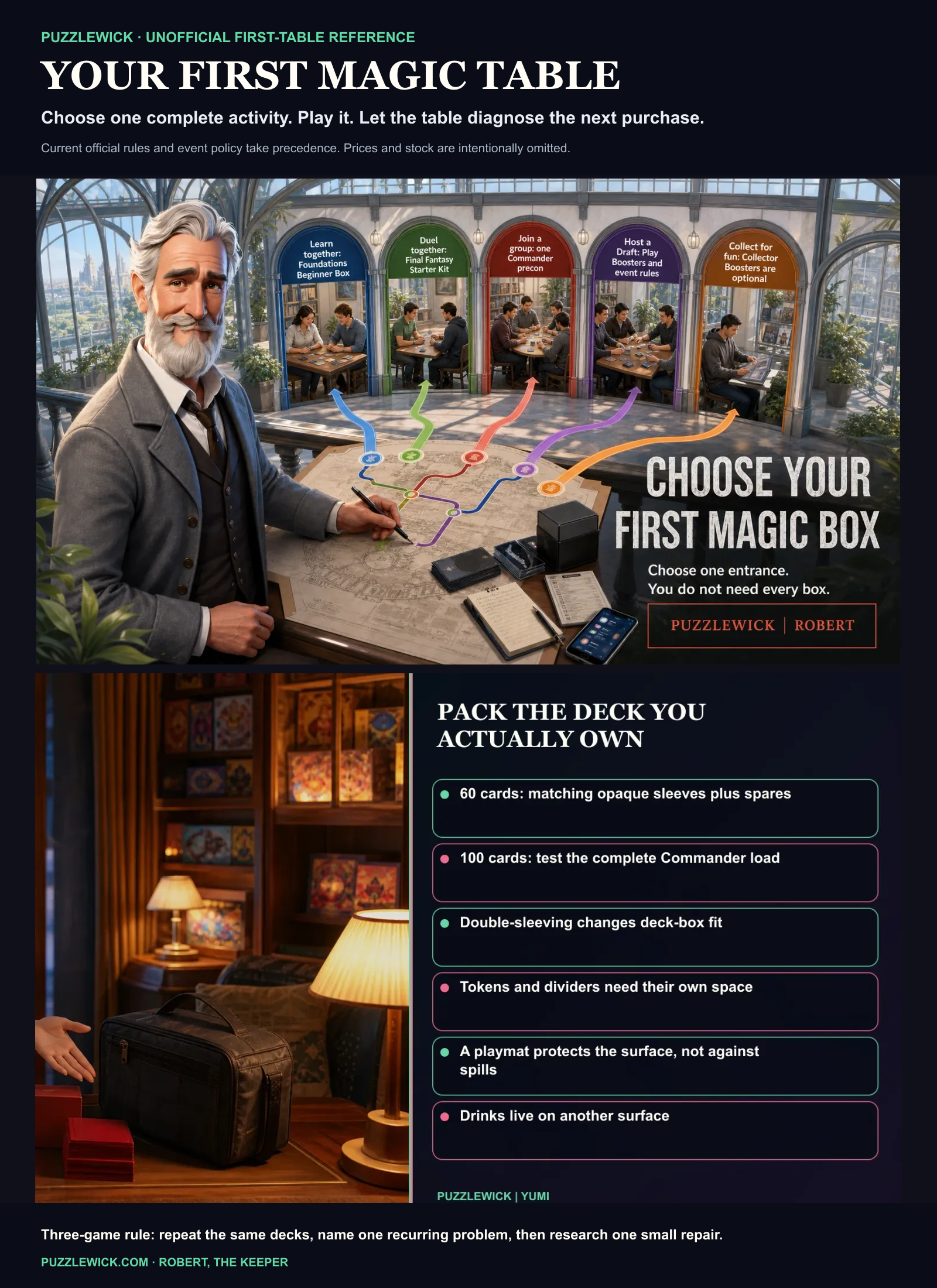
A compact unofficial reference for choosing one complete first activity, checking the next format, and stopping before random packs become a repair plan.
Unofficial fan-made reference. Compiled by Puzzlewick from the sources listed on the sheet. Not affiliated with or endorsed by the publisher — always defer to the official rulebook.
Questions, answered
Is the MTG Foundations Beginner Box worth it?
Yes for two paper beginners. Its guided experience and reusable packets make it a classroom. It is not a competitive deck or Commander product.
Should a beginner start with Commander?
Commander is socially popular but mechanically busy. Learn basic turn structure in a two-player product or Arena first unless an experienced, patient group is teaching with matched precons.
Are Magic booster packs a good way to build a deck?
No. Boosters are for opening, collecting, Limited play, or supplementing a collection. A preconstructed deck or targeted singles creates a coherent first deck more reliably.
What is a complete first purchase for two Magic beginners?
The Foundations Beginner Box supplies a guided lesson and reusable themed packets. The Final Fantasy Starter Kit supplies two ready sixty-card decks. Choose one according to how much teaching help you want and which theme will get you playing; neither requires a booster box. Compare current retailer prices separately.
Should I shuffle the Foundations Beginner Box tutorial decks?
Not before the guided first game. The Cats and Vampires decks arrive in a teaching order matched to the instructions. After the lesson, combine two twenty-card themed packets for a forty-card deck. Wizards' Beginner Box contents page includes the tutorial reset order if the decks have already been shuffled.
What should I buy after the Beginner Box?
Choose the format your real group will play. A Starter Kit continues dueling; one Commander precon enters a Commander group; Jumpstart-style packs create fast varied duels.
What should I buy only after ten real games?
Wait on speculative upgrades, not basic protection. Sleeve the deck and use a clean playing surface from the start. After repeat games, buy targeted singles for a recurring deck problem or storage for cards you actually own. Ten games is our suggested spending brake, not a Magic rule.
Keeper's verdict
Choose Foundations Beginner Box for the guided lesson or the Final Fantasy Starter Kit for two ready themed decks. These are alternatives, not consecutive shopping requirements. For a regular Commander group, one appropriate precon is enough; a four-deck set is an optional group purchase. Buy protection that fits, play repeatedly, and let an actual problem justify the next upgrade.
Research ledger 15 sources · reviewed 2026-09-09
Specifications, rules, current product information, community experience, and contrary evidence were checked against the sources below. Commercial links are kept separate from editorial evidence.
- Official Magic product and release hubmagic.wizards.com/en/products
- Official Magic: The Gathering | The Hobbit product pagemagic.wizards.com/en/products/the-hobbit
- Official Foundations Beginner Box contents and tutorial reset ordermagic.wizards.com/en/news/feature/foundations-beginner-box-contents
- Official Commander format overviewmagic.wizards.com/en/formats/commander
- Official How to Play Magicmagic.wizards.com/en/how-to-play
- TCGplayer Best Sellers module, observed August 29, 2026tcgplayer.com
- TCGplayer Top 10 Best-Selling MTG Cards of the Week, August 28, 2026tcgplayer.com/content/article/Top-10-Best-Selling-MTG-Cards-of-the-Week-08-28-2026/94e368a1-5c6d-4712-ad44-6b35ecd21349
- BoardGameGeek Hotness, observed August 29, 2026boardgamegeek.com
- Scryfall advanced Magic card searchscryfall.com/advanced
- Scryfall search syntax referencescryfall.com/docs/syntax
- 2026 Magic deck-box discussionreddit.com/r/magicTCG/comments/1rivv51/deck_box_advice
- Commander deck storage discussionreddit.com/r/CommanderMTG/comments/1rz7qzl/best_way_to_store_decks
- 2026 playmat storage discussionreddit.com/r/mtg/comments/1qulxos/playmat_storage
- Gamegenic Sidekick 100+ XL: materials, capacity and removable covergamegenic.com/product/sidekick-100-xl-convertible
- Ultra PRO Lightning, Army of One Black Stitched Playmat specifications and artwork creditultrapro.com/products/magic-the-gathering-final-fantasy-lightning-army-of-one-black-stitched-playmat
If it didn't earn a shelf, it isn't here.


Keep exploring
The next smart rabbit holes.
✶ Universe HubMagic: The Gathering: the whole buying pathMagic: The Gathering is the deepest construction sandbox in the Big Three: a two-player duel, four-player Commander ritual, draft...🂠 Topic PathTrading Card Games: compare the whole shelfStart with the game and community you want, then buy the smallest product that lets you test it properly. These guides separate...GuideBest-Value Commander Decks: Should You Start with Wretched Ranks?Gisa offers a welcoming way into Zombies—but launch markups, slow starts and flying attackers complicate the buying decision. Here is how...