Pokemon Card Grading in 2026: PSA vs BGS vs CGC, Fees, Turnaround, and the Break-Even Math
Imani runs the numbers and Yumi protects the card: current PSA, BGS, and CGC service tiers, the real break-even equation, and the cards that should stay happily raw.


AI-assisted research and drafting in Imani’s voice · reviewed by Robert Pruitt · how this guide was made
Last editorial refresh: 2026-08-24 Gold-standard QA: 2026-08-18 12 sources reviewed Affiliate links checked during gold-standard pass

The short answer
Start with recent sold prices for the exact card in raw condition and at realistic grades. Subtract grading, two-way shipping, insurance, and selling fees. If the conservative expected net does not clearly beat a raw sale, protection is a better purchase than plastic.
Decision map
Choose in thirty seconds
Durable standard-size card protection
Preparing cards for a grading submission
A curated raw-card or trade collection
Start with recent sold prices for the exact card in raw condition and at realistic grades. Subtract grading, two-way shipping, insurance, and selling fees. If the conservative expected net does not clearly beat a raw sale, protection is a better purchase than plastic.
Start here, then go deeper
You are in the right cabinet.
 ◓ Universe HubPokémon TCG: the whole buying pathPokémon TCG is both a highly teachable two-player game and a vast collector language. Battle Academy teaches; League Battle Decks...
 🂠 Topic PathTrading Card Games: compare the whole shelfStart with the game and community you want, then buy the smallest product that lets you test it properly. These guides separate...
 Buying GuidePokémon Delta Reign or 30th Celebration: Which Box Should You Buy?Choose 30th Celebration for anniversary artwork and keepsakes; choose Delta Reign for Mega Rayquaza and the next expansion’s cards. A...
The fast answer: choose the job before the slab
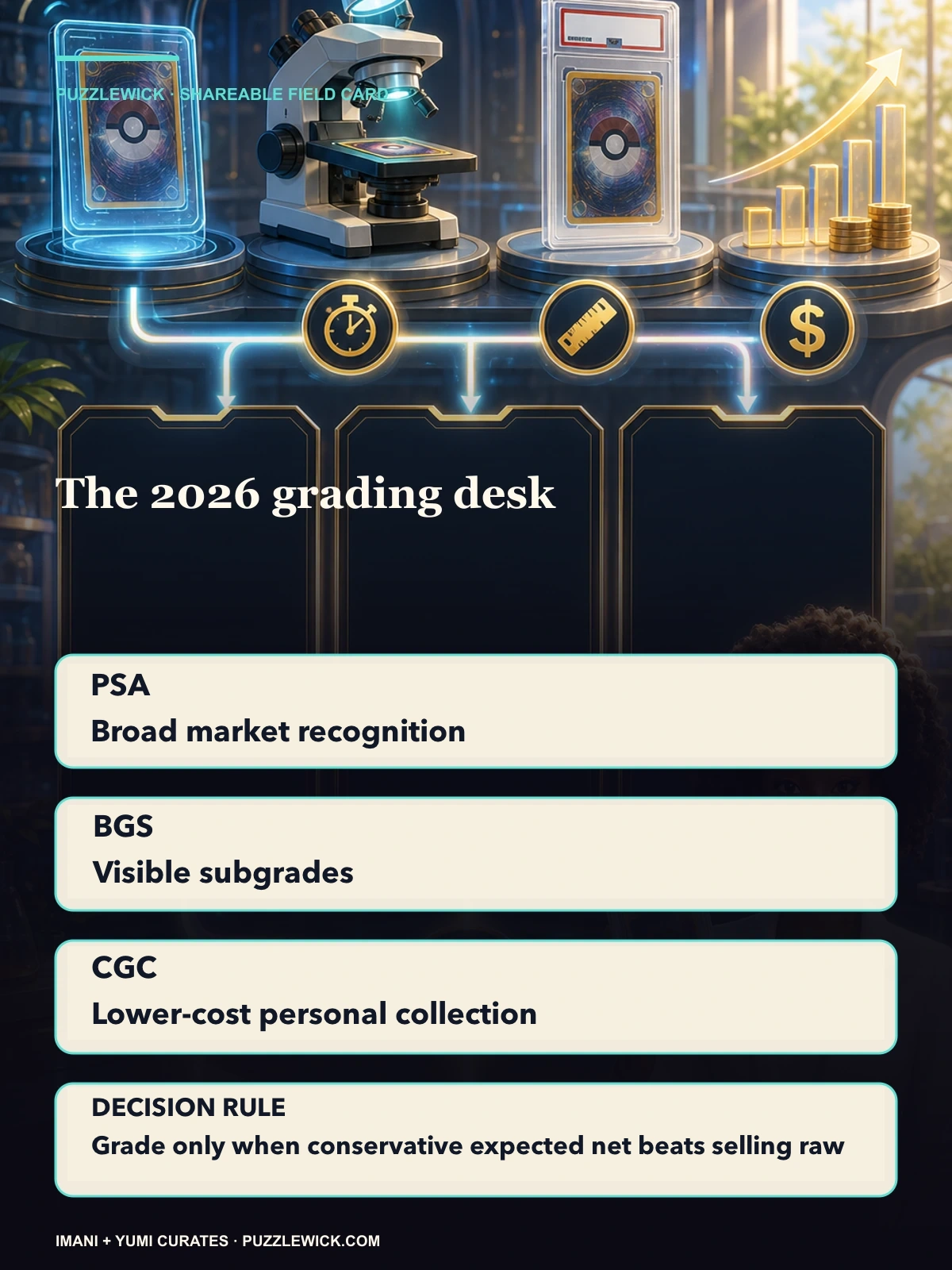

Choose PSA when broad buyer recognition and a familiar resale language matter most. Choose BGS when visible subgrades are part of the appeal and the card is strong enough to justify that stricter conversation. Choose CGC when the current lower entry fee, clear holder, or personal collection is the priority.
That is a service decision, not a guarantee that grading creates value. The card still has to carry the fee.
Current 2026 service tiers: what the headline price omits
PSA Regular is listed at $79.99 per card with a $1,500 maximum insured value and a 40–50 business-day estimate. CGC Bulk is listed at $15 with a 25-card minimum, $500 maximum value, and 40 working days. Beckett Base is listed at $14.95 without subgrades or $17.95 with them, with a 75+ business-day estimate.
Those are official posted tiers on the source-review date. They do not include your shipping, insurance, supplies, membership requirements where applicable, selling fees, or an upcharge when a card’s final value exceeds the tier.
Declared value is a shipping decision, not a compliment
Declared value affects the service tier, coverage and the conversation if a card grades into a more valuable bracket. Use the grading company’s current definition and a supportable market value; do not flatter the card into an expensive tier or understate it to save a few dollars.
Before packing, record the card, set, collector number, language, finish, estimated raw value, service selected and insured amount. That one-page manifest is useful if the parcel is delayed and indispensable if several similar copies return in a different order.
Yumi photographs the card front and back under neutral light, then stops handling it. Imani saves the comparable sales used for the declared value. The emotional favorite and the insurance record are allowed to be two different documents.
The break-even equation
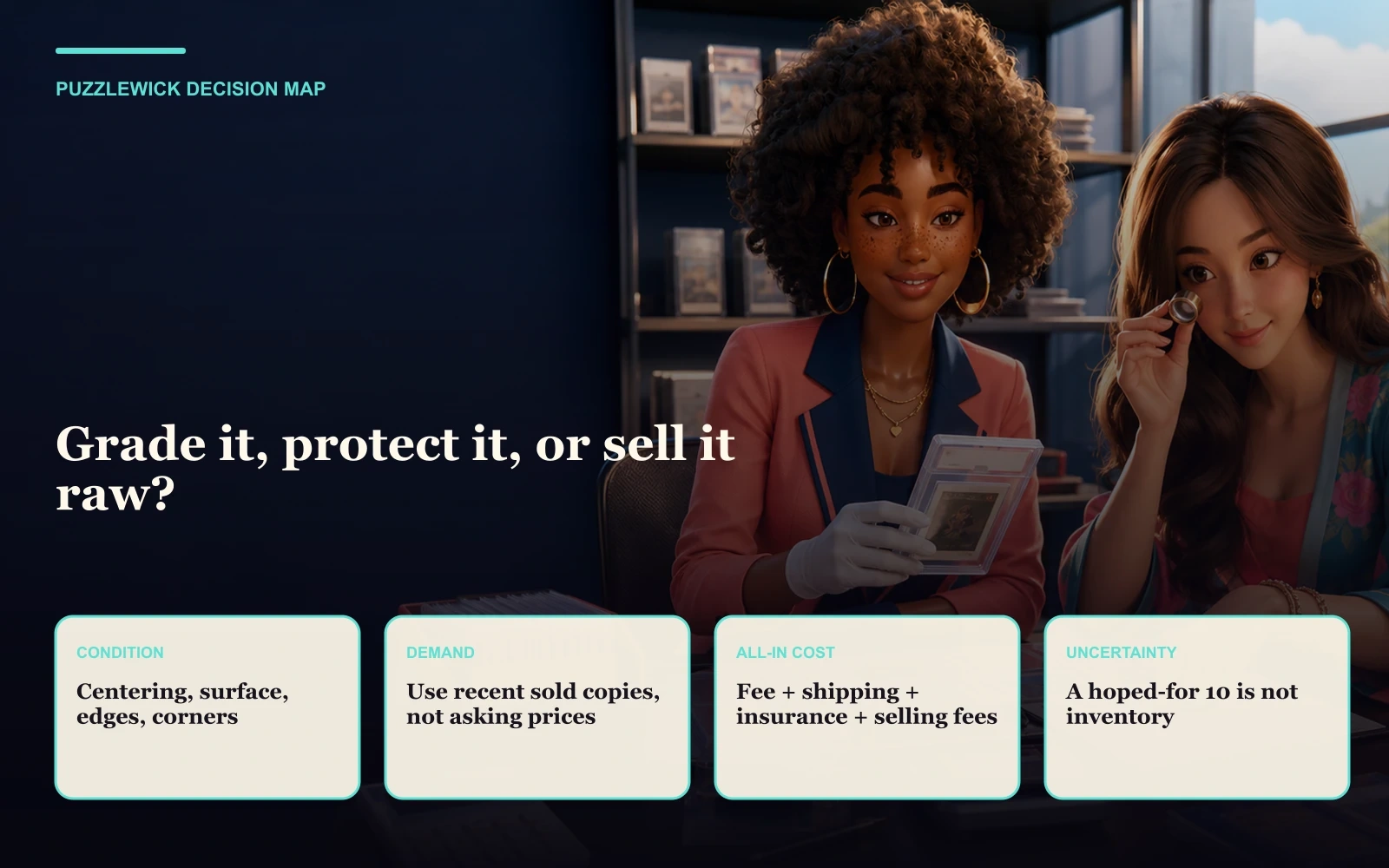
Expected graded net = (probability of each grade × its recent sold value) − grading fee − shipping and insurance − marketplace fees.
Compare that with the realistic net from selling raw. Use a conservative grade distribution. If your entire case depends on a Gem Mint 10, you do not have a grading strategy; you have a wish wearing a spreadsheet.
Open the Pokemon Card Grading ROI Calculator to run the uncertainty explicitly.
Run three grades, not one fantasy

Model a conservative, likely and exceptional result. Give each a probability based on visible condition rather than the grade you need to justify the submission. Then compare the probability-weighted net with the raw-card net and with the value of simply keeping the card protected.
For a batch, allocate shipping and insurance across the cards that genuinely belong in it. Do not let one excellent candidate carry twenty marginal submissions merely because the bulk minimum looks efficient. A lower unit price can still produce a larger total mistake.
Finally, stress-test the sale. Reduce the expected sale price, increase marketplace friction, and add the possibility of a slower turnaround. If the decision survives the boring version of events, it has earned the exciting version.
Pre-screen condition without manufacturing a flaw
Under neutral light, inspect centering, corners, edges, print lines, scratches, dents and surface residue. Use clean hands and handle only the edges. Compare with high-resolution examples, but remember that online scans often hide texture and tiny indentations.
Do not wipe, polish, trim, press or chemically clean a card. A questionable intervention can turn a marginal submission into an altered-card problem.
Which cards should usually stay raw?
Modern low-value cards, heavily played childhood favorites, cards with obvious dents or creases, and cards whose graded premium barely clears costs generally belong in a sleeve or binder. A card can be meaningful without being encased, numbered, and assigned a tiny financial burden.
Grade for authenticity, preservation, registry collecting, presentation, or a credible value spread. Do not grade because the card is shiny and the queue exists.
Packing is part of the grade journey
Use each grader’s current submission instructions. A sleeve plus approved semi-rigid holder, orderly packing list, rigid outer box, tracking and appropriate insurance are the normal shape of a careful submission. Do not improvise with tape touching holders or a deck box rattling inside a mailer.
Photograph the card and packed submission. Record certification numbers when the order returns. The objective is chain-of-custody clarity, not theatrical unboxing.
PSA's current packing guide is unusually specific: place the card in a soft sleeve or Mylar, then a sturdy flexible pouch such as a Card Saver I. PSA advises against top loaders, hard acrylic cases, and screw-down holders for submissions. Keep cards in the same order as the confirmation page, place the stack between slightly larger cardboard pieces, and secure it without crushing pressure. Other graders publish their own instructions, so copy the process only after choosing the destination.
Return day is another inspection, not a victory lap
When the order comes back, compare every certification number with the submission record before filming, listing or reorganizing anything. Inspect holders for cracks, debris and label errors. Photograph the sealed slab and preserve the grading report or order page with the card record.
A lower grade is not automatically a grading-company mistake. Revisit the pre-submission photographs and your probability range first. If the grade destroys the economic case, decide calmly whether the card is better kept, sold in the slab or reviewed under the company’s current policy. Cracking and resubmitting adds cost, handling risk and no promise of a different answer.
Yumi’s final move is storage: stable temperature, controlled humidity, no direct sun and enough physical support that a premium holder does not become an expensive bookmark. She also records the grade beside the original prediction. Over several submissions, that private accuracy score becomes more valuable than another hour of admiring immaculate auction photographs; it tells you whether your eye is improving or merely becoming more confident. Keep learning from the quiet misses.
Imani and Yumi’s final grading desk
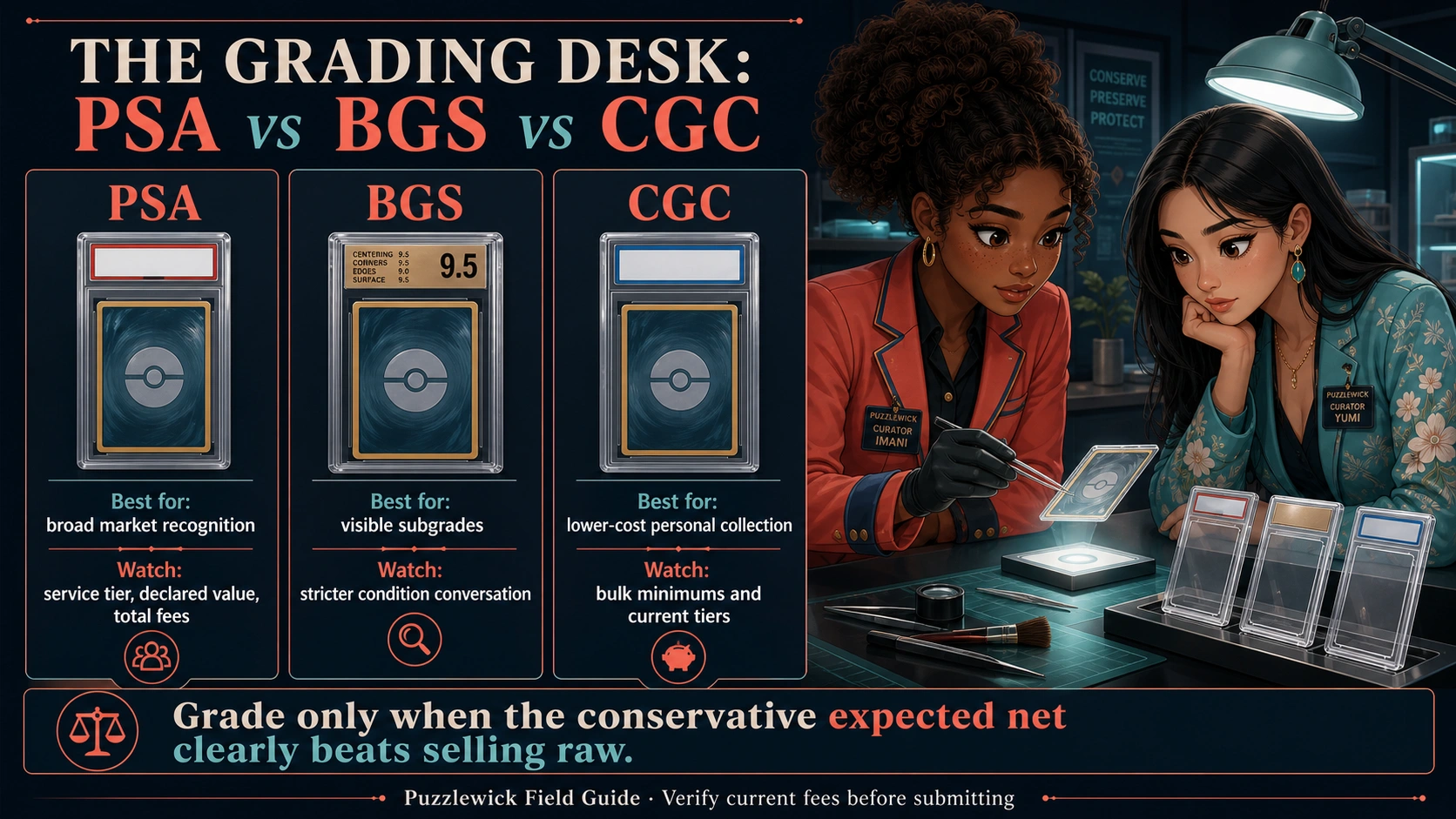
Imani’s rule: the conservative math must work before the optimistic story begins. Yumi’s rule: the card’s physical safety starts now, not after a grading company accepts it. Together they produce a clean three-pile system: submit, sell raw, keep protected.
Review service pricing again on the day you submit. Every fee and turnaround in this guide is volatile commerce information, source-checked on August 18, 2026.
What experienced tables keep reporting
Recurring owner patterns, synthesized in Puzzlewick's words. Follow each evidence trail to read the original discussion.
Community pattern
The picks
Some links below are affiliate links — as an Amazon Associate, Puzzlewick earns from qualifying purchases, at no extra cost to you. It never changes a pick.
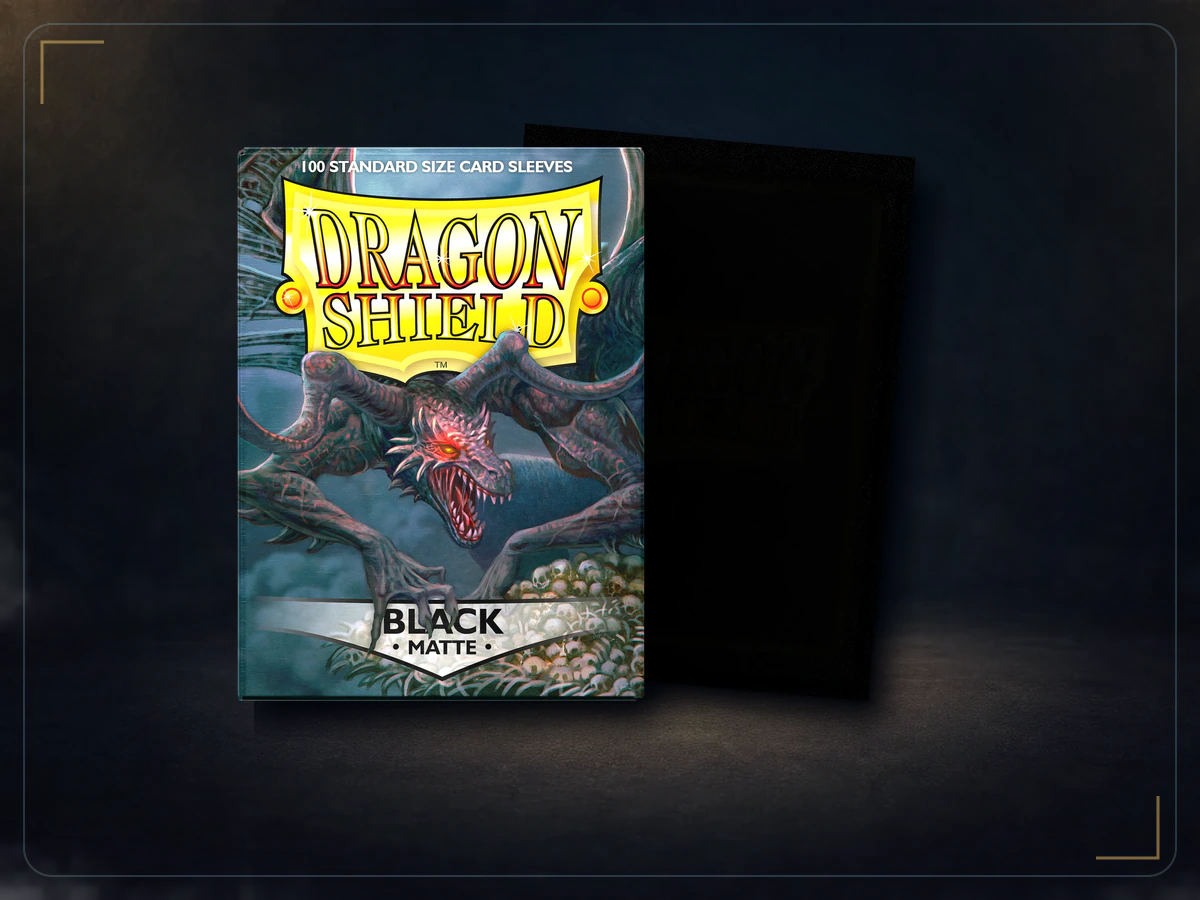
Dragon Shield Matte Black Standard Size Sleeves, 100 Count
Opaque sleeves with the consistency and shuffle feel that make them the safe default for Pokemon and Magic.
- Opaque backs
- 100-count box
- Reliable shuffle feel
- Not sized for Yu-Gi-Oh!
- Thicker than bargain sleeves

BCW Semi-Rigid Card Holder #1, 50 Count
A grading-friendly holder for a softly sleeved card, selected because PSA specifically recommends sturdy flexible pouches and advises against top loaders.
- Submission-friendly format
- Inexpensive
- Flexible removal
- Needs a soft sleeve first
- Not a permanent display slab
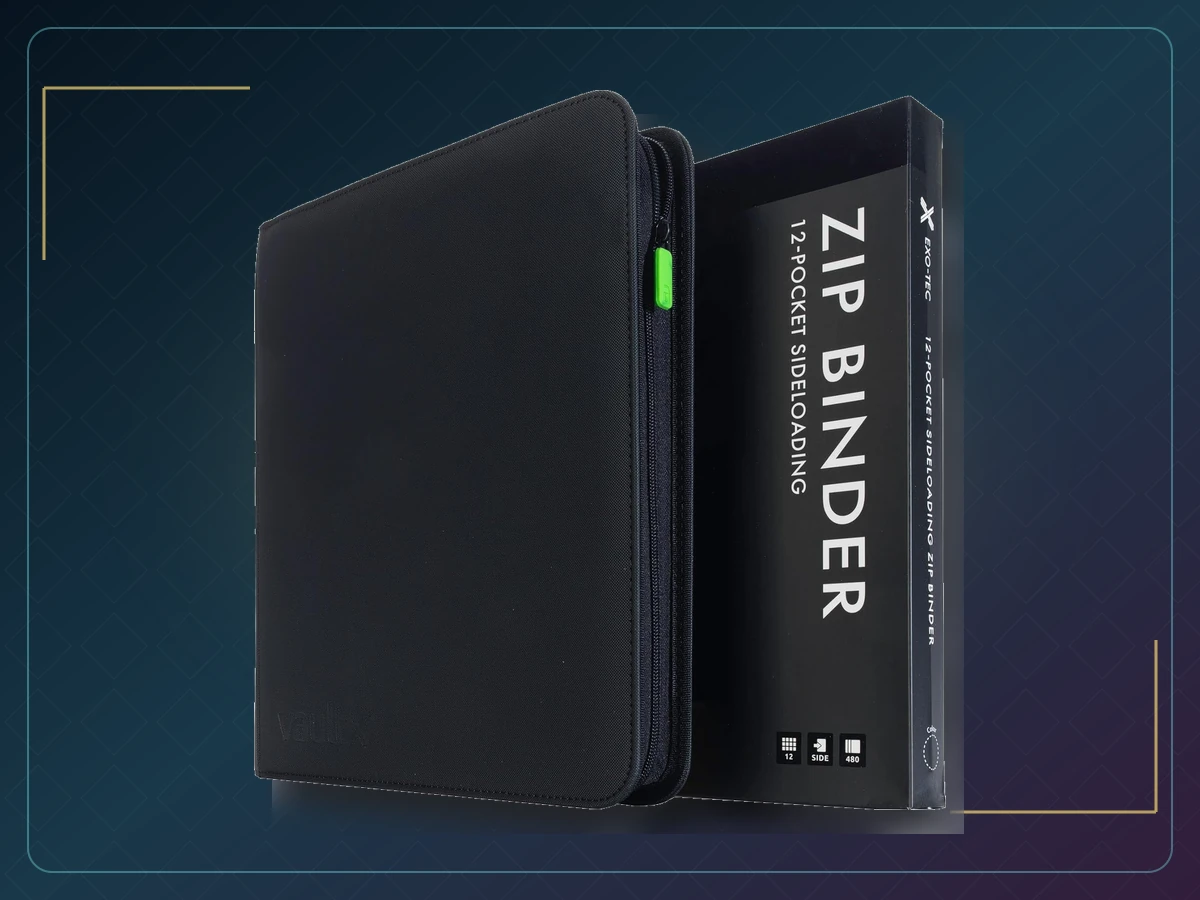
Vault X 9-Pocket Exo-Tec Zip Binder
Fixed side-loading pages, a rigid cover, and a zipper make this a strong home for cards that should remain browsable.
- Side-loading pages
- Zipper closure
- No rings
- Heavy when full
- Wrong home for bulk

Ultra PRO Pokémon Elite Series Gengar Zippered Binder
The licensed Gengar zip binder replaces a generic deck cube with a Pokemon-specific archive for cards that are still being evaluated rather than shipped to a grader.
- A dedicated binder separates the curated collection from bulk and makes condition checks easier than stacked boxes.
- 4.5/5 from 106 Amazon ratings at the Keller, Texas review check
- Character portfolios can become too small when a collection outgrows the exact release they were designed around.
- Map the complete pocket count before buying; promos, variants, parallel cards, and top loaders change the fit.
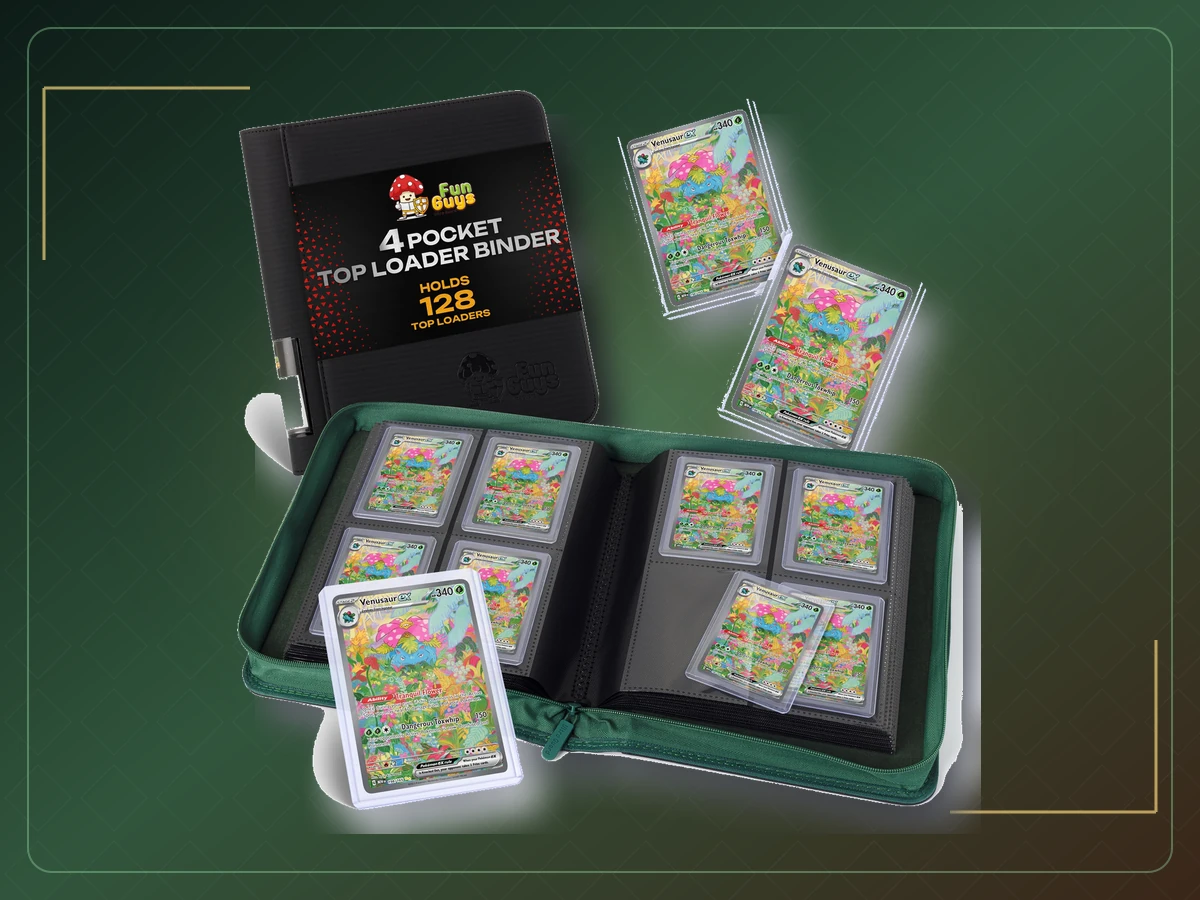
Four-Pocket Toploader Binder
A four-pocket toploader binder is relevant to the grading workflow because it stores cards in the same rigid format used after triage; verify the holder dimensions before loading a full page.
- A dedicated binder separates the curated collection from bulk and makes condition checks easier than stacked boxes.
- 4.5/5 from 619 Amazon ratings at the Keller, Texas review check
- Character portfolios can become too small when a collection outgrows the exact release they were designed around.
- Map the complete pocket count before buying; promos, variants, parallel cards, and top loaders change the fit.

Ultra PRO Pokémon Poke Ball Premium 9-Pocket PRO-Binder
Ultra PRO’s licensed Poke Ball Premium binder is the finished archive for cards you decided not to submit. It keeps that collection specific to Pokémon without pretending a binder replaces sleeves, semi-rigid submission holders, or insurance.
- A dedicated binder separates the curated collection from bulk and makes condition checks easier than stacked boxes.
- 4.8/5 from 915 Amazon ratings at the Keller, Texas review check
- Character portfolios can become too small when a collection outgrows the exact release they were designed around.
- Map the complete pocket count before buying; promos, variants, parallel cards, and top loaders change the fit.
At a glance
| Choice | Best fit | Watch first |
|---|---|---|
| PSA | Broad resale recognition | Declared-value tier, total shipping, current turnaround |
| BGS | Collectors who value visible subgrades | Stricter premium-label expectations and current service speed |
| CGC | Lower-cost collection grading and clear presentation | Bulk minimum and the market for the exact card |
| Keep raw | Cards whose conservative graded net does not clear costs | Good sleeves, stable storage, and honest condition records |
Free download — Pokemon Card Grading in 2026 Field Guide
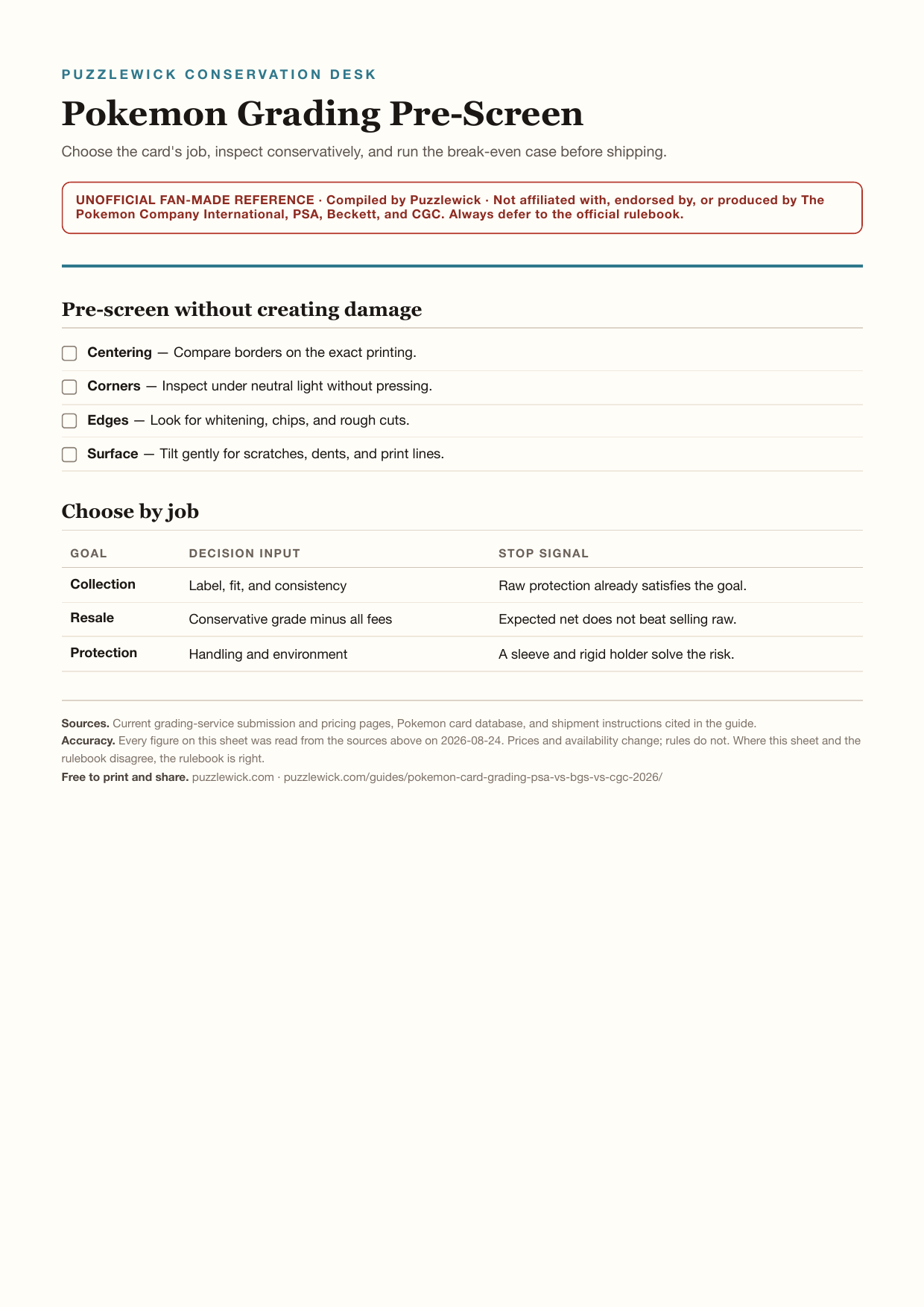
A one-page, beginner-readable reference distilled from the official sources used in this guide.
Unofficial fan-made reference. Compiled by Puzzlewick from the sources listed on the sheet. Not affiliated with or endorsed by the publisher — always defer to the official rulebook.
Questions, answered
Is PSA, BGS, or CGC best for Pokemon cards in 2026?
PSA is the clearest broad-market default, BGS is the subgrade and premium-label specialist, and CGC is a lower-cost collector route. The right choice depends on the card and your objective.
How much does PSA grading cost in 2026?
PSA Regular was listed at $79.99 per card on the August 18 source-review date. Lower or bulk options, memberships and specials can change; verify the official service page before submitting.
How much does CGC Bulk cost?
CGC listed Bulk at $15 per card with a 25-card minimum, $500 maximum value and a 40-working-day estimate on the review date.
Does grading always increase a Pokemon card’s value?
No. A low grade, small market premium or high all-in cost can leave the graded net below the raw sale net.
Should I clean a card before grading?
Do not alter, polish, trim or chemically clean it. Handle edges carefully and follow the grader’s current preparation instructions.
Can Puzzlewick predict my grade?
No. The calculator models economics, not a guaranteed grade. Only the grading company issues its condition opinion.
What value should I use in the calculator?
Use recent sold prices for the exact card and variant, then model several realistic grades rather than one hoped-for result.
How should I store cards I decide not to grade?
Use a correctly sized sleeve, a suitable binder or rigid case, stable humidity and a dark storage location.
Should I mail Pokemon cards to PSA in top loaders?
PSA currently advises against top loaders, hard acrylic cases, and screw-down holders. Its guide recommends a soft sleeve or Mylar inside a sturdy flexible pouch such as a Card Saver I. Re-check the instructions before every submission.
What supplies do I need before grading cards?
Use a clean mat, soft sleeves, approved semi-rigid holders, a written card manifest, appropriately sized cardboard supports, a rigid shipping box, tracking, and insurance suited to the declared value.
Imani's verdict
PSA remains the simplest resale-language choice, BGS is the specialist choice when subgrades and a possible Black Label are the point, and CGC is the lower-cost collector route. None is automatically profitable. Grade only when condition, demand, expected grade, and all-in fees support the decision.
Research ledger 12 sources · reviewed 2026-08-18
Specifications, rules, current product information, community experience, and contrary evidence were checked against the sources below. Commercial links are kept separate from editorial evidence.
- PSA Trading Card Gradingpsacard.com/services/tradingcardgrading
- PSA February 2026 Services Updatepsacard.com/articles/articleview/15663/grading-services-update-february-2026
- CGC Cards Services and Feescgcgrading.com/en-US/grading/cards
- Beckett Grading Servicesbeckett.com/grading
- PSA vs BGS vs CGC Pokemon grading comparisonpkmnprices.com/blog/psa-vs-bgs-vs-cgc-pokemon-grading
- r/PokeGradingreddit.com/r/PokeGrading
- r/psagrading service update discussionreddit.com/r/psagrading/comments/1td4xm3/psa_update_are_you_kidding_me
- TCGplayer Pokemon marketplacetcgplayer.com/categories/trading-and-collectible-card-games/pokemon
- PSA How to Submit Cardspsacard.com/Content/downloads/PSA-How-To-Submit.pdf
- PSA Grading Standardspsacard.com/gradingstandards
- Beckett 2026 Turnaround Updatebeckett.com/news/beckett-turnaround-time-updates
- PSA Certification Verificationpsacard.com/cert

Okay but have you seen what everyone’s saying about this?


Keep exploring
The next smart rabbit holes.
◓ Universe HubPokémon TCG: the whole buying pathPokémon TCG is both a highly teachable two-player game and a vast collector language. Battle Academy teaches; League Battle Decks...🂠 Topic PathTrading Card Games: compare the whole shelfStart with the game and community you want, then buy the smallest product that lets you test it properly. These guides separate...Buying GuidePokémon Delta Reign or 30th Celebration: Which Box Should You Buy?Choose 30th Celebration for anniversary artwork and keepsakes; choose Delta Reign for Mega Rayquaza and the next expansion’s cards. A...