Magic: The Gathering Final Fantasy Commander Upgrade Guide 2026: Best First Swaps for All Four Decks
Upgrade Limit Break, Counter Blitz, Revival Trance, and Scions & Spellcraft without replacing the deck you actually bought.


AI-assisted research and drafting in Yumi’s voice · reviewed by Robert Pruitt · how this guide was made
Last editorial refresh: 2026-08-14 Gold-standard QA: 2026-09-09 9 sources reviewed Affiliate links checked during gold-standard pass

The short answer
Play three stock games first. Then repair the deck’s bottleneck: mana and combat for Limit Break, counter density for Counter Blitz, discard and reanimation discipline for Revival Trance, or instant-speed spell flow for Scions & Spellcraft. Ten purposeful swaps beat a forty-card identity transplant.
Decision map
Choose in thirty seconds
Limit Break: mana, haste, combat conversion
Games 1–3: record dead cards and mana misses
Copying a 40-card list before playing stock
Makes land drops through turn four
Play three stock games first. Then repair the deck’s bottleneck: mana and combat for Limit Break, counter density for Counter Blitz, discard and reanimation discipline for Revival Trance, or instant-speed spell flow for Scions & Spellcraft. Ten purposeful swaps beat a forty-card identity transplant.
This Puzzlewick guide separates official rules and product identity from marketplace demand, tournament context, and recurring community experience. TCGplayer is used to identify current buyer friction and market attention; publisher documents remain authoritative for contents, card text, rotation, and legality.
Start here, then go deeper
You are in the right cabinet.
 ✶ Universe HubMagic: The Gathering: the whole buying pathMagic: The Gathering is the deepest construction sandbox in the Big Three: a two-player duel, four-player Commander ritual, draft...
 🂠 Topic PathTrading Card Games: compare the whole shelfStart with the game and community you want, then buy the smallest product that lets you test it properly. These guides separate...
 Buying GuideBest Magic Collector Booster Boxes in 2026: The Hobbit, Strixhaven, Marvel, Lorwyn and TMNTMargo opens the catalog, not the packs: five current premium boxes compared by art treatment, pack anatomy, smaller alternatives, chase...
Which Final Fantasy Commander deck should you upgrade first?

Upgrade the deck you have already played enough to diagnose. Counter Blitz is the easiest first project because its +1/+1-counter engine tells you exactly what it wants. Limit Break becomes much better when combat turns create value instead of merely noise. Revival Trance rewards a careful graveyard package. Scions & Spellcraft wants cheap interaction and card flow, not a fistful of seven-mana nostalgia.
TCGplayer’s 2026 market reports explain the continuing scale of Magic demand, but marketplace volume does not choose your deck. Your first three games do. Write down every card that stranded in hand, every color you missed, and every turn you passed without affecting the table. That is the upgrade list with the least nonsense in it.
Use a four-column test sheet. Record lands kept, first meaningful play, commander cast turn, and the card that spent the longest time doing nothing. Across three games, repeated failures become visible. One awkward draw is weather; the same seven-mana card stranded in every opening is climate. Upgrade for climate. Also note the pod: a card that fails against one graveyard deck may be perfectly healthy against the group you normally see.
Before buying anything, goldfish two opening hands after each proposed cut. This catches upgrades that look powerful in isolation but remove the deck’s early scaffolding. Commander lists are ecosystems. A better top end cannot compensate for fewer early plays, worse colors, or a commander that now arrives one turn late.
How should you upgrade Limit Break first?
Cloud’s deck is happiest when equipped creatures attack, survive, and turn that attack into another resource. Begin with untapped lands, two-mana ramp, and equipment that is useful before Cloud arrives. Then add protection that keeps one developed attacker alive. The trap is stuffing the list with glamorous Equipment while the deck spends turn four fixing its colors.
Cut narrow combat tricks, slow Equipment with weak rates, and cards that need a perfect board. Keep the recognizable Final Fantasy spine. If an upgrade makes the deck more efficient but less like a Cloud deck, it has failed the assignment in a very professional-looking way.
For Limit Break, test a combat turn on paper before adding another Equipment: attacker, blocker, protection, and the value created after damage. If the line consumes the whole hand to deal six extra damage, it is theatrical rather than durable. The best first improvements let Cloud attack while keeping one card or mana available, because an equipped creature that survives teaches the table to respect every later combat.
How should you upgrade Counter Blitz first?
Counter Blitz has the clearest stock chassis: place counters, multiply their value, and turn a developed board into pressure. The first upgrades should lower the curve, add protection, and improve counter placement at instant speed. Do not begin by replacing every modest creature with a famous mythic. The deck needs enough bodies to carry counters and enough interaction to survive the table noticing.
Community upgrade threads repeatedly converge on the same practical lesson: protect the engine and improve the mana before chasing a combo. That advice is paraphrased here and checked against the official list. A clean Counter Blitz turn should advance a creature, hold up protection, and leave the next combat obvious.
Counter Blitz testing should count how many turns the deck both advances a threat and preserves interaction. If every strong turn requires tapping out, the list is not yet protecting its own thesis. Track whether counter payoffs arrive before or after the creatures they reward. When the order is wrong repeatedly, adjust the curve and card selection before adding a larger finisher.
How should you upgrade Revival Trance first?
Revival Trance is not “put everything in the bin and hope.” It needs discard outlets you can activate deliberately, creatures worth returning, and enough cheap interaction to avoid dying while assembling value. Improve those three ratios first. A reanimation spell without a worthwhile target is a blank; a giant target without a discard outlet is expensive luggage.
The strongest first pass removes cards that only work when the graveyard is already perfect. Add flexible looting, recursion that can recover multiple card types, and one or two finishers that matter immediately. The result should feel like Terra and company returning at the right moment, not like a generic graveyard list wearing a franchise badge.
Calibrate against the table before ordering wave two. Ask each regular opponent to score the upgraded deck on speed, resilience, and inevitability after two sessions. A deck that starts acting one turn earlier may be healthier; a deck that also rebuilds twice and ends every game the same way may have quietly crossed the pod. Record the turn when opponents felt forced to hold interaction for you. That social pressure is a more useful power signal than a price total.
Budget in layers: first the cards that repair repeatable failures, then the cards that widen interesting decisions, and only then premium versions or marginal upgrades. Keep removed Final Fantasy cards together in a side packet with a dated deck list. When a new player joins or the pod lowers its power, restoring the original flavor should take five minutes rather than an archaeological expedition. The best Commander upgrade path leaves both the improved deck and the original experience recoverable.
How should you upgrade Scions & Spellcraft first?
Scions asks for the most discipline. Cheap instants and sorceries let the deck play on other turns, protect its board, and trigger its rewards without tapping out for spectacle. Remove slow effects that duplicate one another. Add efficient card selection, interaction, and lands that enter untapped often enough to keep options open.
This is the deck most likely to become unpleasant if every upgrade is generic control. Preserve the named characters and the Final Fantasy XIV rhythm. The goal is a responsive story deck, not a permission stack that makes three friends reconsider the calendar invitation.
What is the ten-card Commander upgrade method?

Set a ten-card limit for the first upgrade. Four slots fix mana, ramp, or draw. Four strengthen the signature engine. One protects the plan. One ends the game. That constraint forces every purchase to answer a problem observed at the table and keeps a budget list from becoming a second unopened product.
Play two more sessions before the next change. Record opening hands, missed land drops, turns with unused mana, and cards that never found a target. This simple log is more useful than importing a hundred-card list built for another pod’s speed and tolerance for combos.
Accessories that actually help
Sleeves, a deck box that fits one hundred sleeved cards, and readable tokens are the useful floor. A playmat protects cards and defines a clean work area, but it does not repair bad mana. Buy accessories after confirming the deck will stay in rotation. Matching art is delightful; buying three matching boxes for a deck you dislike is merely organized regret.
Keep a printed or digital list after every revision. Commander decks drift. A version history preserves the ability to undo a clever upgrade that turned out to be clever only in the kitchen.
Final verdict: the upgrade order

Counter Blitz is the easiest first upgrade, Limit Break the best combat renovation, Revival Trance the richest engine project, and Scions & Spellcraft the specialist build. In every case, play stock, fix mana and card flow, reinforce the named mechanic, then add protection and a closer. Stop when the deck does its job at your table.
The linked Amazon products are exact editions checked for this guide. Prices and sellers change, so confirm the listing at checkout. The strategy is grounded in Wizards’ official deck lists and release notes, then tested against recurring community upgrade questions rather than one viral list.
The table-ready protection kit
Build the carry system around the deck you actually play. Use one opaque sleeve design across all 100 cards and keep matching spares. Put the sleeved deck and its essential tokens in a rigid box that closes without pressure. Add a playmat for regular store play, then carry it rolled so the artwork and surface do not develop permanent creases.
The licensed Final Fantasy line can do real work here: Cloud APEX sleeves give Limit Break a recognizable back, the Sephiroth Premium Alcove Edge protects one active deck, and the Chocobos Holofoil playmat replaces the anonymous black rectangle with a table surface worth seeing. The artwork is the invitation; opacity, fit, closure and transport are the tests.
Cards removed during an upgrade belong in a side-loading zip binder with the stock list and date of each change. That keeps the original deck recoverable and turns the upgrade project into a record rather than a loose pile. A binder is not a deck box, a deck box is not luggage, and a beautiful mat is not spill protection.
The picks
Some links below are affiliate links — as an Amazon Associate, Puzzlewick earns from qualifying purchases, at no extra cost to you. It never changes a pick.

Magic: The Gathering Final Fantasy Commander Deck Set of Four
The cleanest ownership route when four decks will be played together and kept near their stock power.
- All four playable precons
- One coherent crossover pod
- High upfront commitment
- Unnecessary for one player
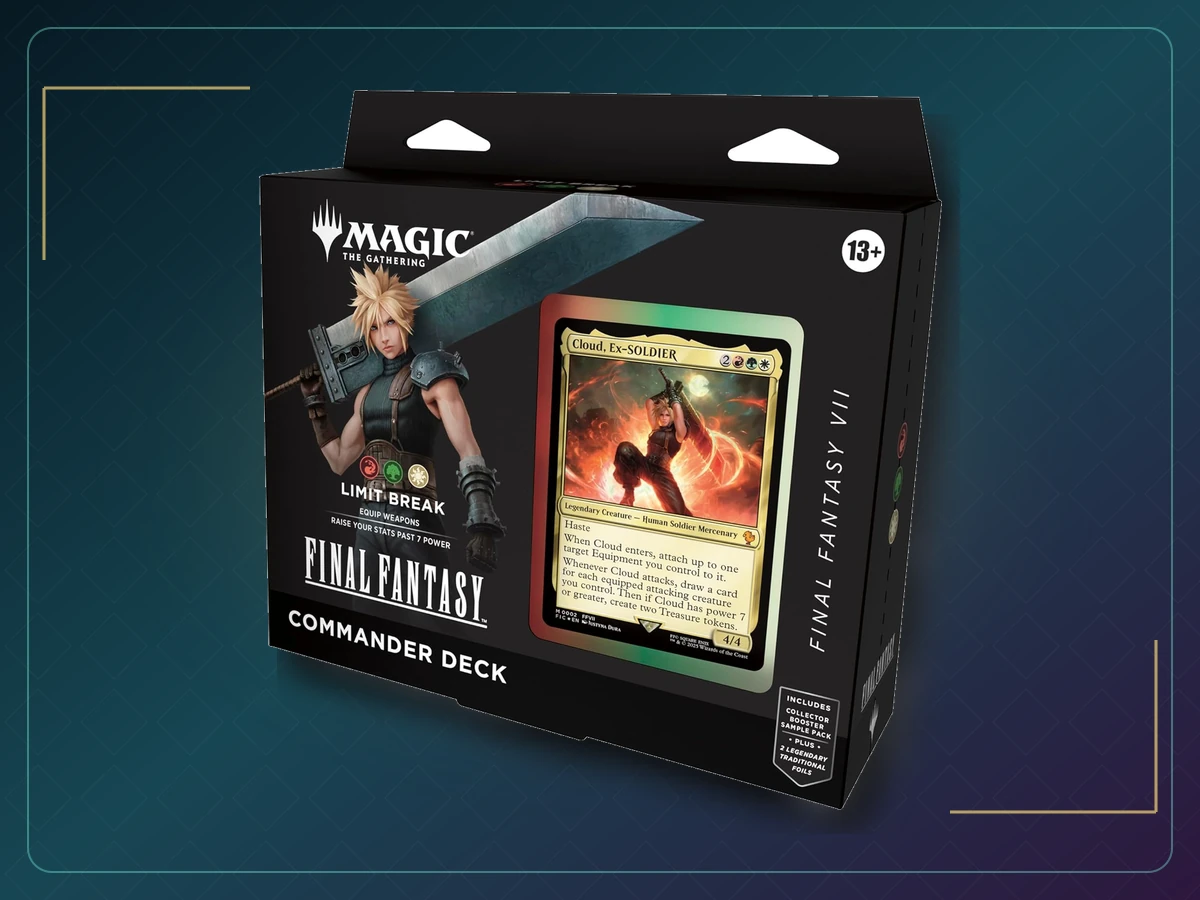
Magic: The Gathering Final Fantasy Commander Deck, Limit Break
Cloud gives a new upgrader an obvious job: build one attacker, protect it, and learn when to stop committing cards.
- Clear Voltron plan
- Strong Final Fantasy VII identity
- Well-timed removal can reset the turn
- Equipment packages invite overbuilding
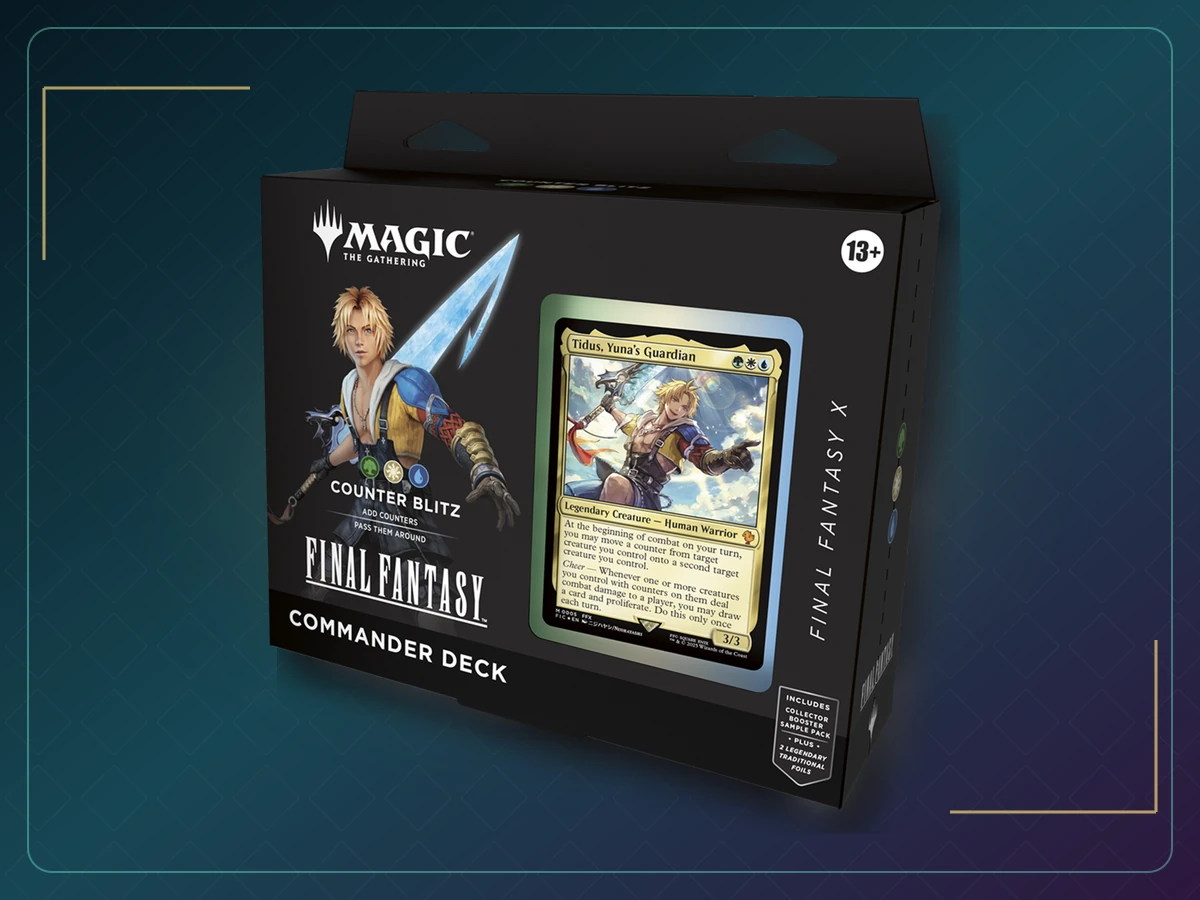
Magic: The Gathering Final Fantasy Commander Deck, Counter Blitz
Tidus rewards careful counter placement and sequencing, making the stock deck a better teacher than a premature pile of upgrades.
- Excellent growth path
- Counters make progress visible
- Busy board state
- Three-color mana needs attention
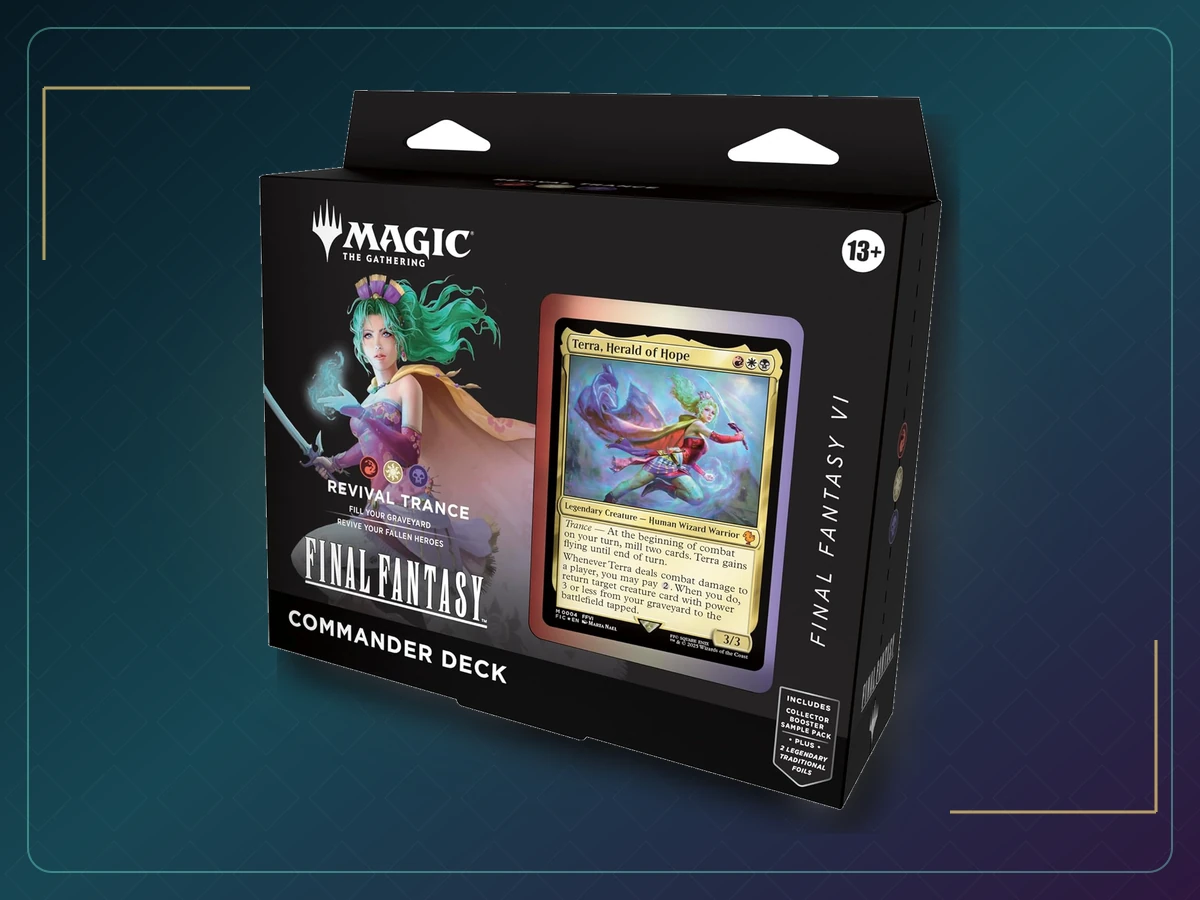
Magic: The Gathering Final Fantasy Commander Deck, Revival Trance
Revival Trance turns the discard pile into a second hand, but it asks the pilot to understand which cards are resources and which are the engine.
- Resilient game plan
- Strong Final Fantasy VI flavor
- Graveyard sequencing is demanding
- Hate cards can shut off the engine
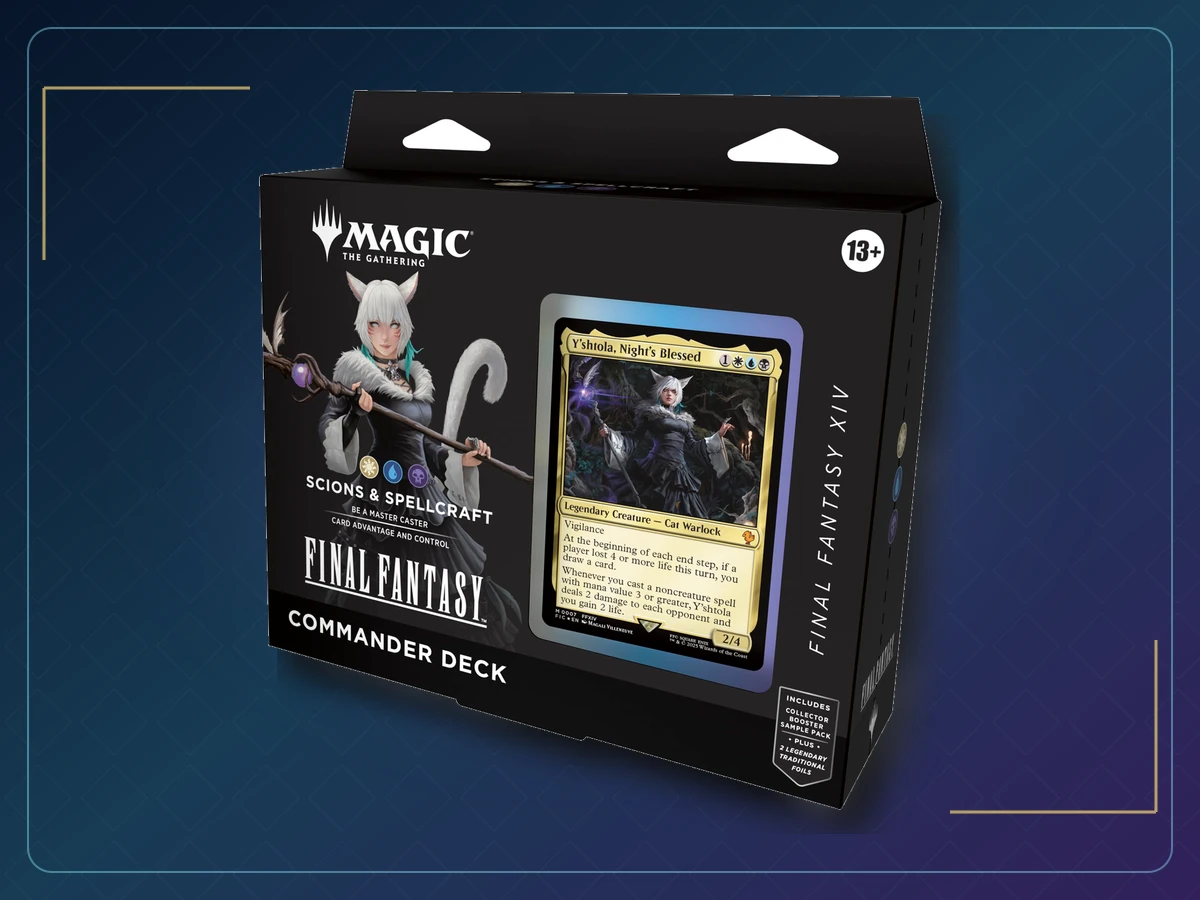
Magic: The Gathering Final Fantasy XIV Commander Deck, Scions & Spellcraft
The Scions deck is rewarding once its triggers are organized, but it is the least forgiving first-night choice of the four.
- Distinct spellcraft identity
- Plenty of upgrade directions
- Trigger density is high
- Can slow a teaching table
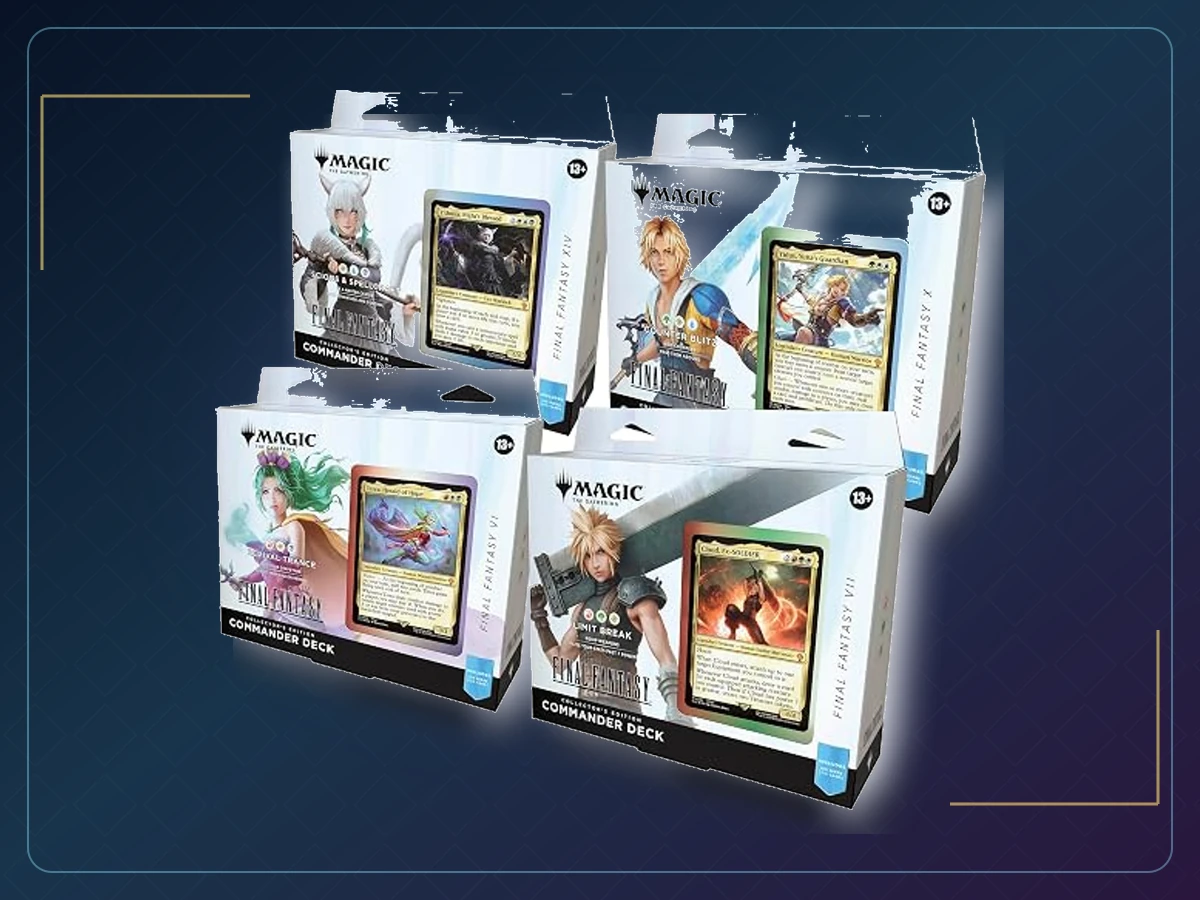
Magic: The Gathering Final Fantasy Collector's Edition Commander Deck Bundle
This is the premium display version of the four-deck experience, not the economical way to discover whether the decks suit your table.
- All four collector-edition decks
- Premium treatment throughout
- Significantly higher commitment
- Foil behavior and condition matter

Ultra PRO Final Fantasy Cloud APEX Deck Protector Sleeves
The 105-count package leaves a few matching replacements for a 100-card Commander deck, which is more useful than a barely exact count.
- Licensed Cloud art
- Count suits Commander plus spares
- Art backs must remain indistinguishable
- Replace damaged sleeves as a set
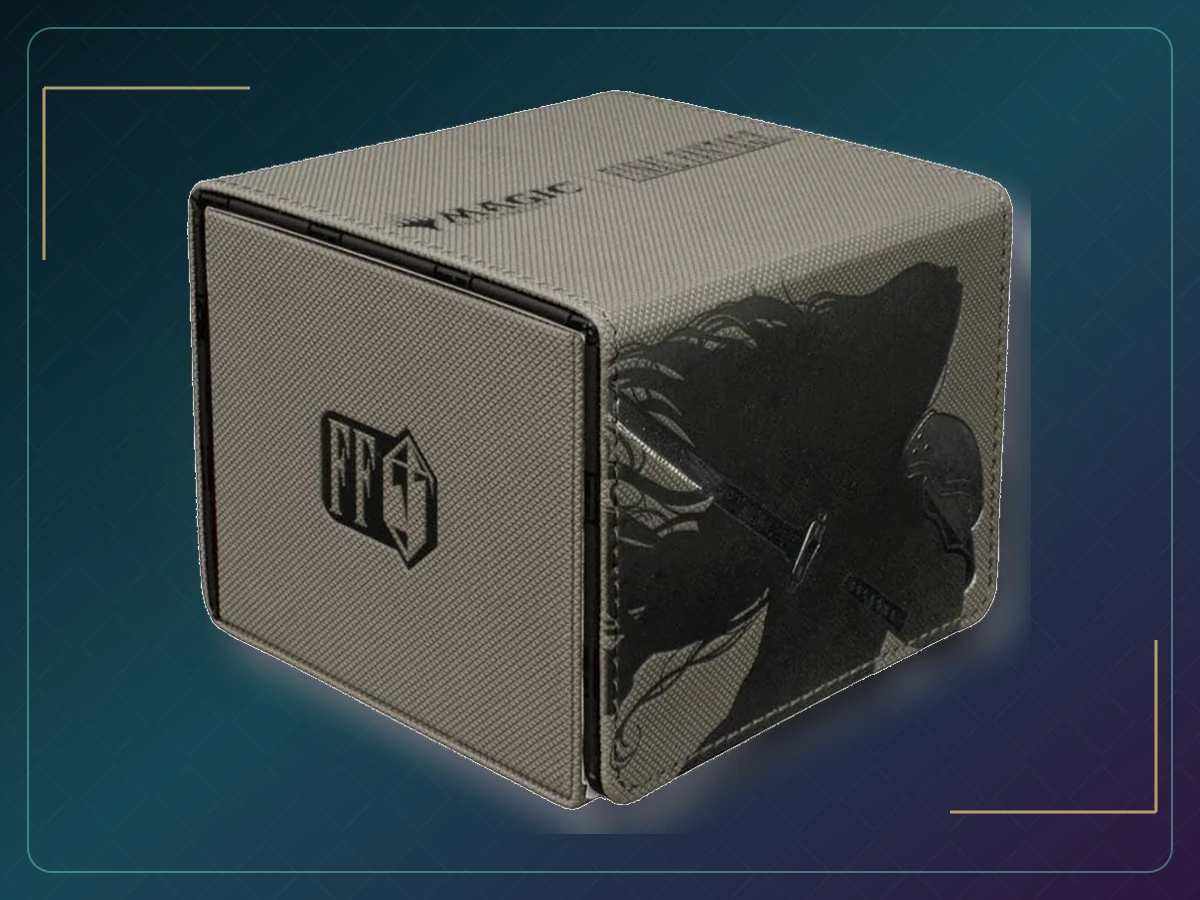
Ultra PRO Final Fantasy Sephiroth Premium Alcove Edge Deck Box
A rigid licensed deck box gives one active deck a clear identity and a safer travel shape without becoming a warehouse for every token owned.
- Licensed Sephiroth art
- Premium rigid construction
- Capacity depends on sleeves and tokens
- One-deck solution

Ultra PRO Final Fantasy Chocobos Holofoil Playmat
This is the opposite of the anonymous black-mat problem: recognizable Final Fantasy art on a useful single-player surface.
- Licensed Chocobo artwork
- Holofoil finish creates a distinct table
- Reflective finish is a taste choice
- Needs protected transport

Ultra PRO Final Fantasy Cloud 9-Pocket Zipper Binder
A zipped licensed binder is useful when upgrade candidates and collector copies need a home outside the active deck.
- Licensed Cloud art
- Zippered side-loading storage
- Not for the shuffled deck
- Overfilling bends pages and cards
At a glance
| Stage | Decision | What matters | Curator ruling |
|---|---|---|---|
| 01 | Upgrade the bottleneck, not the logo | Limit Break: mana, haste, combat conversion | Start here |
| 02 | Three games before the first cut | Games 1–3: record dead cards and mana misses | After testing |
| 03 | The fastest ways to erase a precon | Copying a 40-card list before playing stock | After testing |
| 04 | Stop upgrading when the deck does its job | Makes land drops through turn four | After testing |
Free download — Final Fantasy Commander Ten-Swap Calibration Sheet
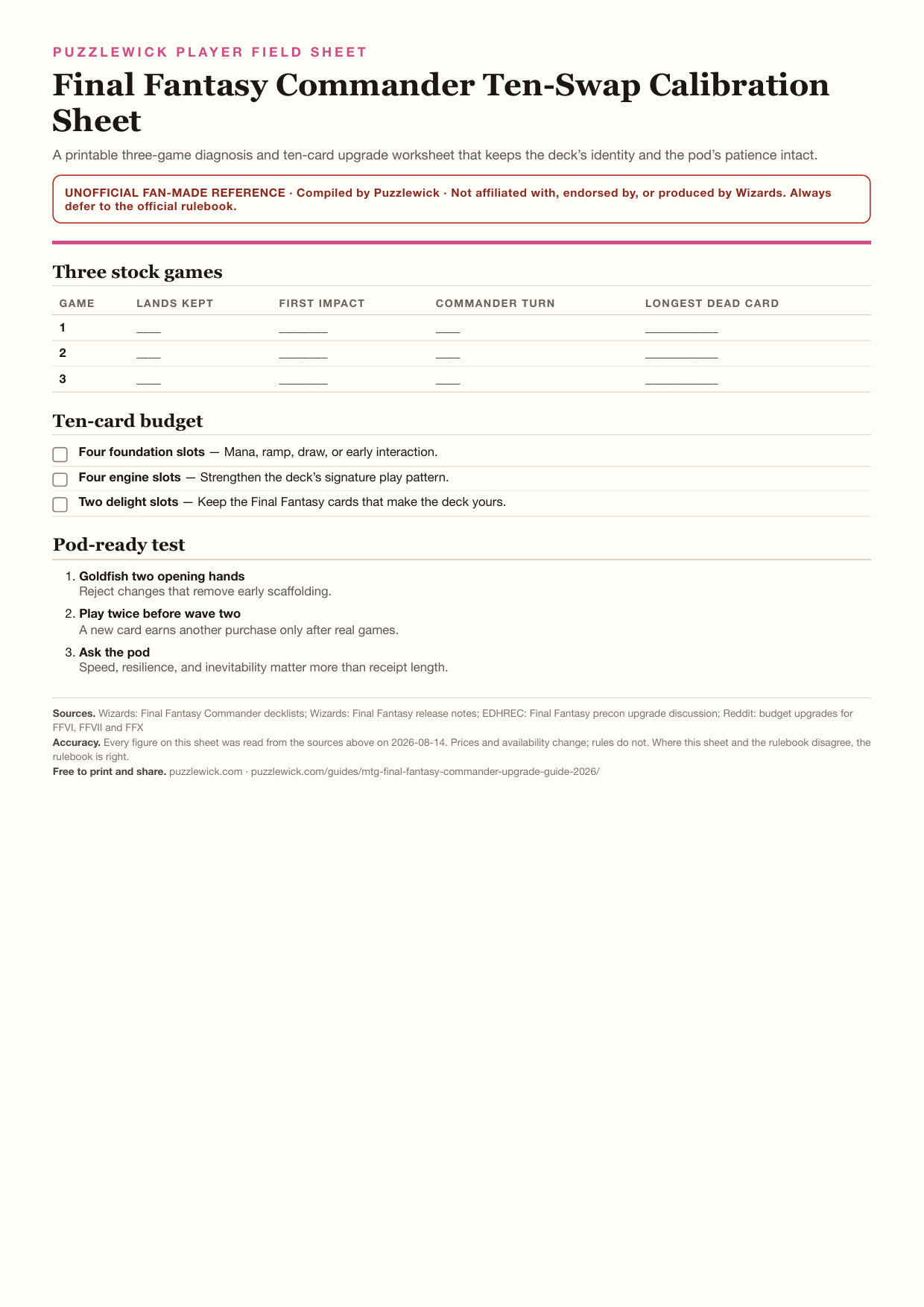
A printable three-game diagnosis and ten-card upgrade worksheet that keeps the deck’s identity and the pod’s patience intact.
Unofficial fan-made reference. Compiled by Puzzlewick from the sources listed on the sheet. Not affiliated with or endorsed by the publisher — always defer to the official rulebook.
Questions, answered
How many cards should I replace first?
Ten or fewer. Fix mana and draw first, then the signature engine, protection, and one closer.
Which Final Fantasy Commander deck is easiest to upgrade?
Counter Blitz has the clearest engine and most obvious first improvements.
Should I buy all four decks?
Only if at least three will be played or the verified bundle price beats the exact individual listings.
Do I need expensive staples?
No. Curve, mana, interaction, and coherent ratios matter before premium staples.
Should I remove Final Fantasy cards for stronger generic cards?
Remove underperformers selectively. Preserving the deck’s identity is part of the value.
When should I stop upgrading?
When the deck makes its land drops, participates before its commander, survives disruption, and wins at the pod’s intended power.
Yumi's verdict
Counter Blitz is the easiest first upgrade, Limit Break the best combat renovation, Revival Trance the richest engine project, and Scions & Spellcraft the specialist build. In every case, play stock, fix mana and card flow, reinforce the named mechanic, then add protection and a closer. Stop when the deck does its job at your table. The linked Amazon products are exact editions checked for this guide. Prices and sellers change, so confirm the listing at checkout. The strategy is grounded in Wizards’ official deck lists and release notes, then tested against recurring community upgrade questions rather than one viral list.
Research ledger 9 sources · reviewed 2026-09-09
Specifications, rules, current product information, community experience, and contrary evidence were checked against the sources below. Commercial links are kept separate from editorial evidence.
- Wizards: Final Fantasy Commander decklistsmagic.wizards.com/en/news/announcements/final-fantasy-commander-decklists
- Wizards: Final Fantasy release notesmedia.wizards.com/2025/downloads/FIN_Release_Notes_3O87RLY5EO/EN_FIN_Release_Notes_2025_1_15.pdf
- EDHREC: Final Fantasy precon upgrade discussionyoutube.com/watch?v=c4lyx4v_BXA
- Reddit: budget upgrades for FFVI, FFVII and FFXreddit.com/r/magicTCG/comments/1qx879y/advice_for_budget_upgrades_for_the_ff6ff7ff10
- Reddit: new Commander player and Final Fantasy decksreddit.com/r/EDH/comments/1va6pwf/just_getting_in_to_commander_love_the_final
- TCGplayer: Best-selling trading card games, Q2 2026seller.tcgplayer.com/blog/best-selling-trading-card-games-q2-2026
- TCGplayer: Top-selling sealed products, June 2026seller.tcgplayer.com/blog/top-selling-sealed-products-june-2026
- Wizards: Magic formats overviewmagic.wizards.com/en/formats
- Gamegenic Sidekick 100+ XL: materials, capacity and removable covergamegenic.com/product/sidekick-100-xl-convertible

Come in, take your shoes off — let me show you something.


Keep exploring
The next smart rabbit holes.
✶ Universe HubMagic: The Gathering: the whole buying pathMagic: The Gathering is the deepest construction sandbox in the Big Three: a two-player duel, four-player Commander ritual, draft...🂠 Topic PathTrading Card Games: compare the whole shelfStart with the game and community you want, then buy the smallest product that lets you test it properly. These guides separate...Buying GuideBest Magic Collector Booster Boxes in 2026: The Hobbit, Strixhaven, Marvel, Lorwyn and TMNTMargo opens the catalog, not the packs: five current premium boxes compared by art treatment, pack anatomy, smaller alternatives, chase...