Magic: The Gathering Final Fantasy Starter Kit Strategy Guide 2026: Cloud vs Sephiroth and How to Upgrade Both Decks
Learn the two decks as printed, fix the matchup without ruining it, and know exactly where to go after the first duel.


AI-assisted research and drafting in Imani’s voice · reviewed by Robert Pruitt · how this guide was made
Last editorial refresh: 2026-09-09 Gold-standard QA: 2026-09-09 11 sources reviewed Affiliate links checked during gold-standard pass

The short answer
The Final Fantasy Starter Kit is a strong two-player Magic lesson: Cloud’s red-white deck teaches pressure and sequencing, while Sephiroth’s blue-black deck teaches patience, removal, and timing. Play both fixed lists unchanged, swap sides, and upgrade in matched four-card packages only after the same problem repeats.
Decision map
Choose in thirty seconds
Cloud: curve out, preserve pressure, plan combat
Round 1: play three games unchanged
Keeping a hand with one land and a dream
Explain untap, draw, main, combat, second main
Cloud and Sephiroth do more than provide recognizable faces. Their fixed decks create a useful argument about tempo. Cloud wants the battlefield to become urgent. Sephiroth wants every answer to cost less than the threat it removes. That contrast is legible to a beginner and still rich enough for an experienced player to teach without taking over.
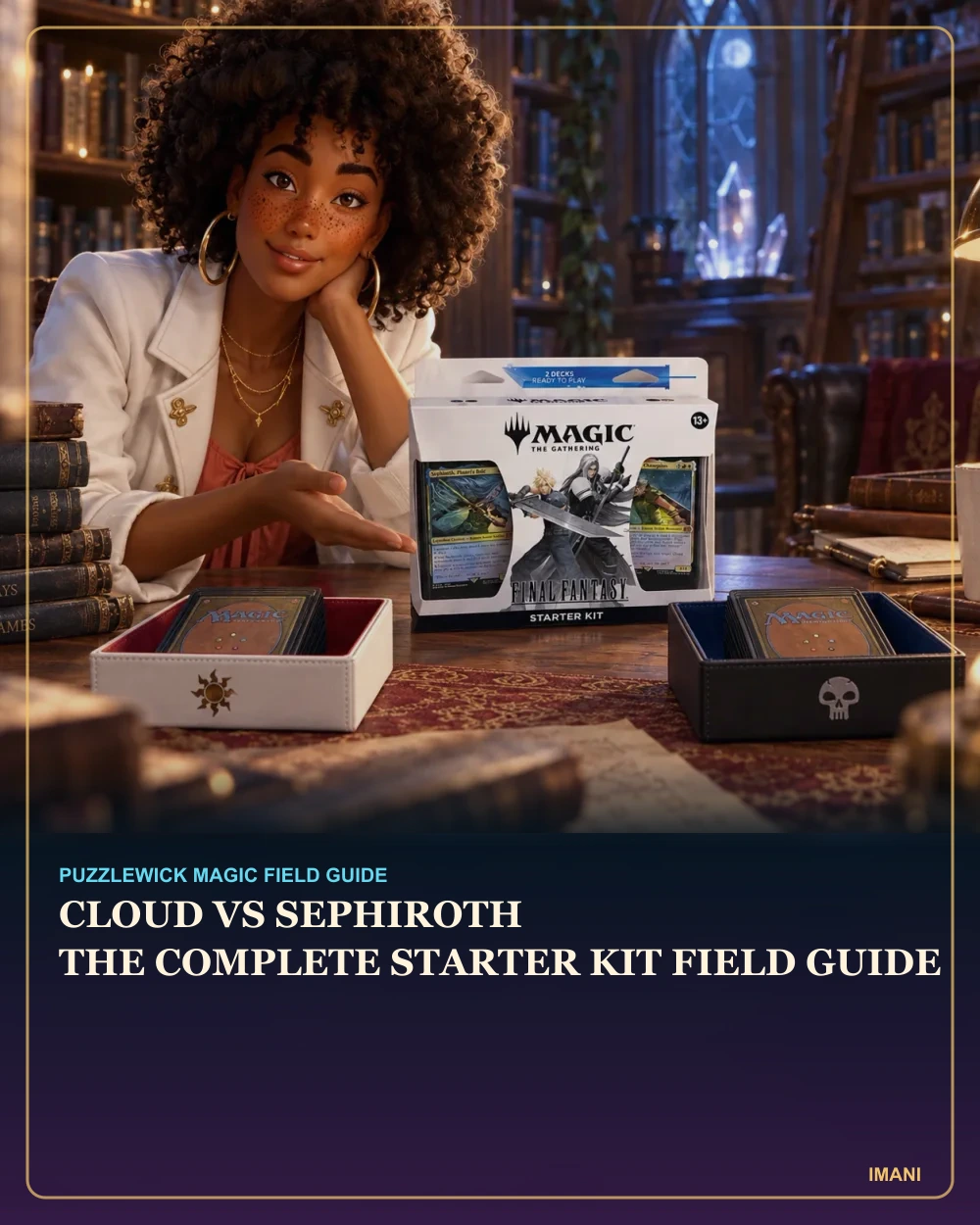
The official decklists settle the product facts: two sixty-card decks, Cloud in red-white and Sephiroth in blue-black, with one traditional foil legendary card, five nonfoil new-to-Magic cards, and fifty-four nonfoil main-set cards in each deck. The box also includes four double-sided tokens, two deck boxes, and Arena codes in select regions. Everything beyond that is strategy, not packaging copy.
Start here, then go deeper
You are in the right cabinet.
 ✶ Universe HubMagic: The Gathering: the whole buying pathMagic: The Gathering is the deepest construction sandbox in the Big Three: a two-player duel, four-player Commander ritual, draft...
 🂠 Topic PathTrading Card Games: compare the whole shelfStart with the game and community you want, then buy the smallest product that lets you test it properly. These guides separate...
 GuideFrom the Final Fantasy Starter Kit to Standard: A Beginner’s Competitive Bridge After the August 2026 BansImani keeps the Final Fantasy invitation intact while separating teaching decks, current legality, a dated post-ban Best-of-One field and...
What is in the Final Fantasy Starter Kit?
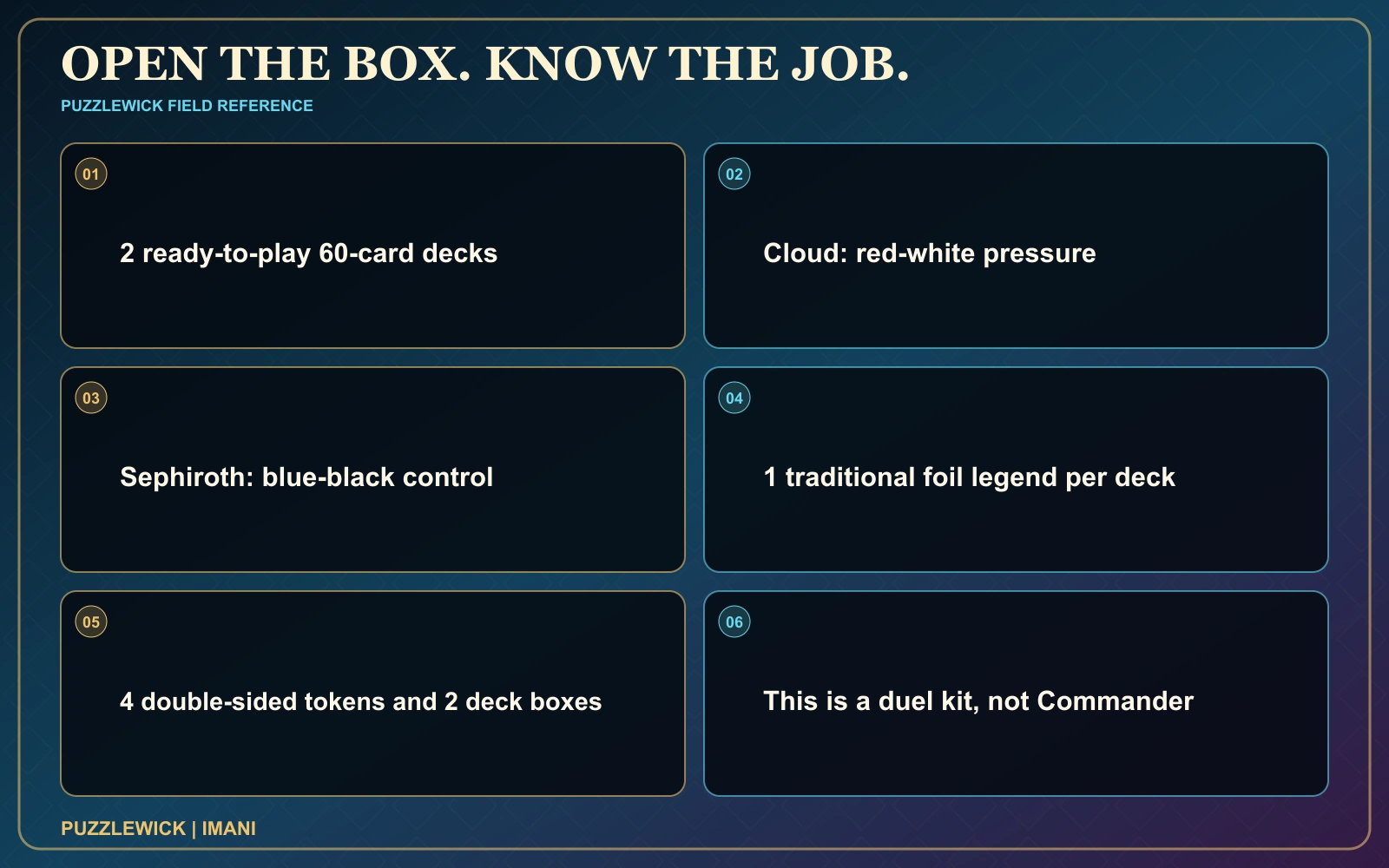
The kit contains two ready-to-play sixty-card decks. Cloud is red-white; Sephiroth is blue-black. Each deck contains one traditional foil legendary card, five nonfoil cards new to Magic, and fifty-four nonfoil cards from the main set. The box also supplies four double-sided tokens, two deck boxes, and two Arena code cards in select regions.
That makes it a duel product, not a Commander pair, booster sampler, or promise of a competitive Standard list. Keep both lists intact for the first several games. A known teaching matchup remains useful long after both players own larger collections.
Cloud vs Sephiroth: who has the edge?
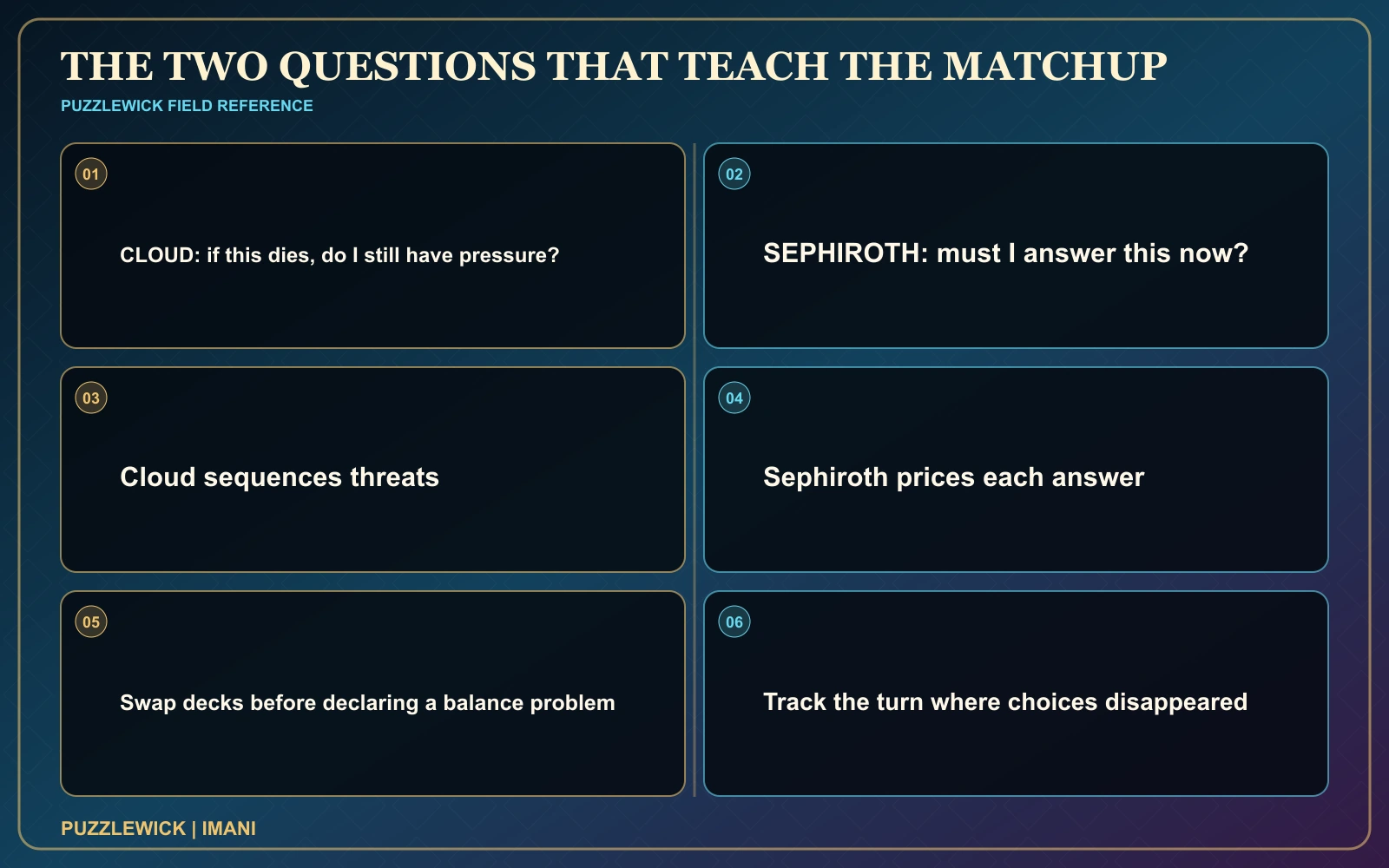
Community play reports commonly give Sephiroth’s blue-black deck the cleaner stock matchup because removal punishes Cloud’s creature development. Cloud can still win by curving out, forcing awkward blocks, and refusing to spend every resource before the decisive combat. The edge is not a rules fact or a guarantee; it is a recurring table pattern.
Cloud should ask, “If this creature dies, do I still have pressure?” Sephiroth should ask, “Is this the threat I must answer, or can my life total absorb one more attack?” Those two questions teach more Magic than explaining every keyword before turn one.
The matchup changes with skill. Early Cloud pilots often spend creatures and combat tricks too quickly, giving Sephiroth clean removal targets. More experienced Cloud pilots stagger threats and make the black deck choose between taking damage and using interaction inefficiently. Track not only wins but the turn when the losing player stopped having a plausible decision. That is the point an upgrade should repair.
How to teach the first game
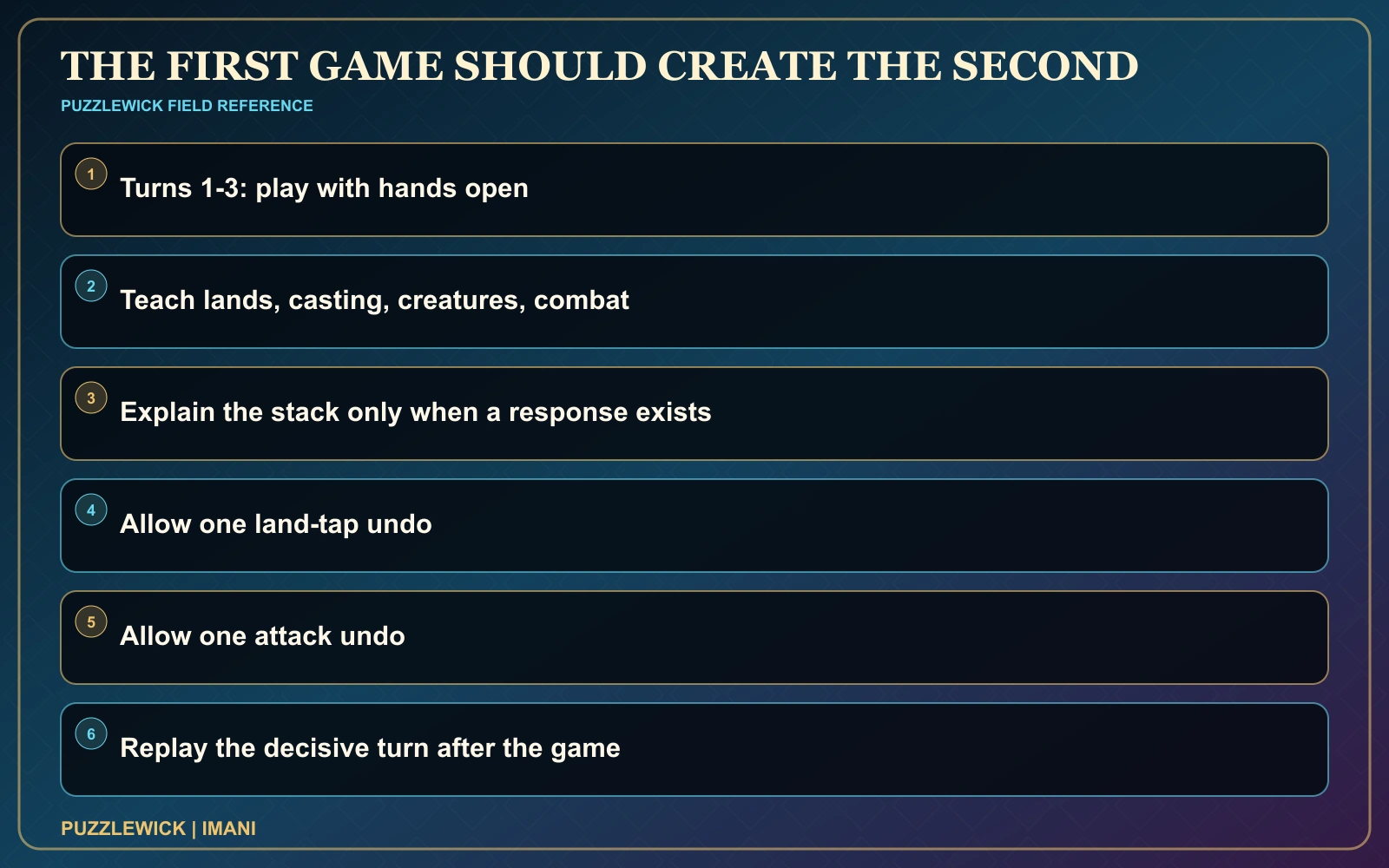
Play open-handed for the first three turns. Explain the turn structure, lands, casting costs, creatures, and combat. Introduce the stack only when one player can actually respond. This keeps vocabulary attached to a decision instead of delivering a preflight announcement no one can retain.
Let the learner undo one land tap, one attack, and one missed trigger. The goal is not to certify a judge; it is to make the second game begin without dread. Imani’s rule is simple: explain the consequence before the correction.
After each game, replay the most consequential turn with hands revealed. Try the other attack, the delayed removal spell, or the land sequence that preserves a response. This five-minute postmortem builds transferable Magic judgment without converting the evening into homework. It also prevents the stronger player from explaining the entire match through the comforting fiction that the top card was inevitable.
Mulligan and opening-hand strategy
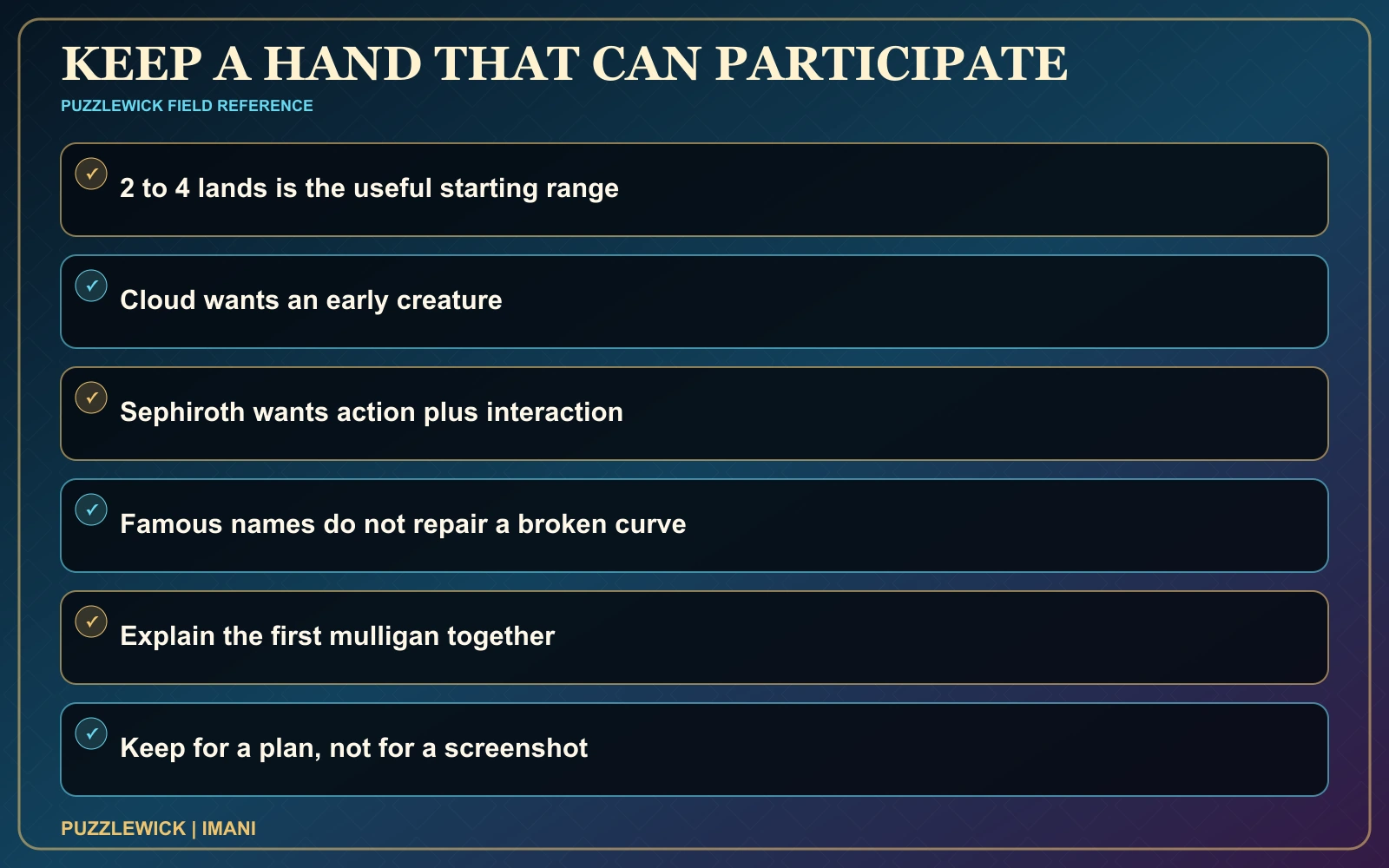
Keep hands with two to four lands and at least one early play. Cloud wants a creature that begins pressure; Sephiroth wants a useful play and a path to interact. A seven-card hand full of famous names and no functional curve is not “lore accurate.” It is a mulligan.
For the first session, show both hands and discuss the decision. After that, hide hands but keep the same checklist: lands, early action, and a reason the hand improves over the next two turns.
Graduate from the kit by choosing a destination, not by buying a random bridge. If both players enjoy repeated one-on-one games, preserve the two sixty-card decks and improve them symmetrically. If one player wants Commander, buy a complete Commander deck rather than stretching this product into a format it was not built to teach. If the goal is local Standard or another constructed format, check current legality and build from a legal list before purchasing singles.
Keep a four-swap worksheet for each side: card removed, job lost, card added, job gained. The Cloud and Sephiroth decks should receive upgrades in matched functional pairs, such as one stronger threat and one stronger answer, so the lesson remains competitive. After three upgraded games, ask both players which turns created real choices and which merely followed the obvious line. Retain the changes that improve decisions. Undo the ones that only make the experienced pilot win faster.
Upgrade Cloud without making Sephiroth miserable
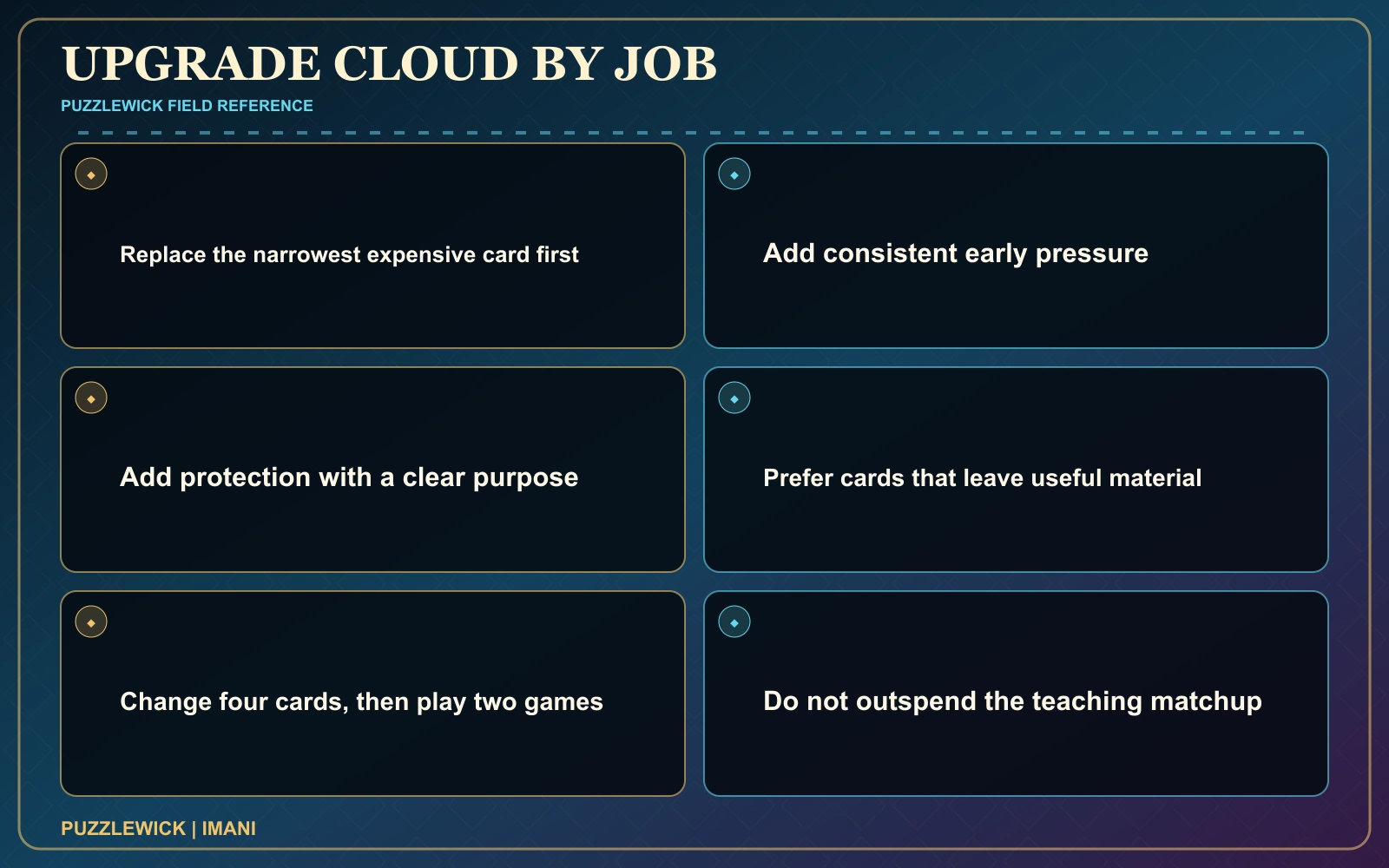
Cloud benefits from more consistent early creatures, protection, and combat effects that replace themselves or create a lasting advantage. Replace the narrowest high-cost cards first. Do not add a pile of efficient rares while leaving Sephiroth stock; that teaches only that the owner of the shopping cart wins.
Use a four-card first pass. Play two games. If Cloud now wins without meaningful resistance, upgrade Sephiroth before touching Cloud again.
Upgrade Sephiroth without turning the table into paperwork
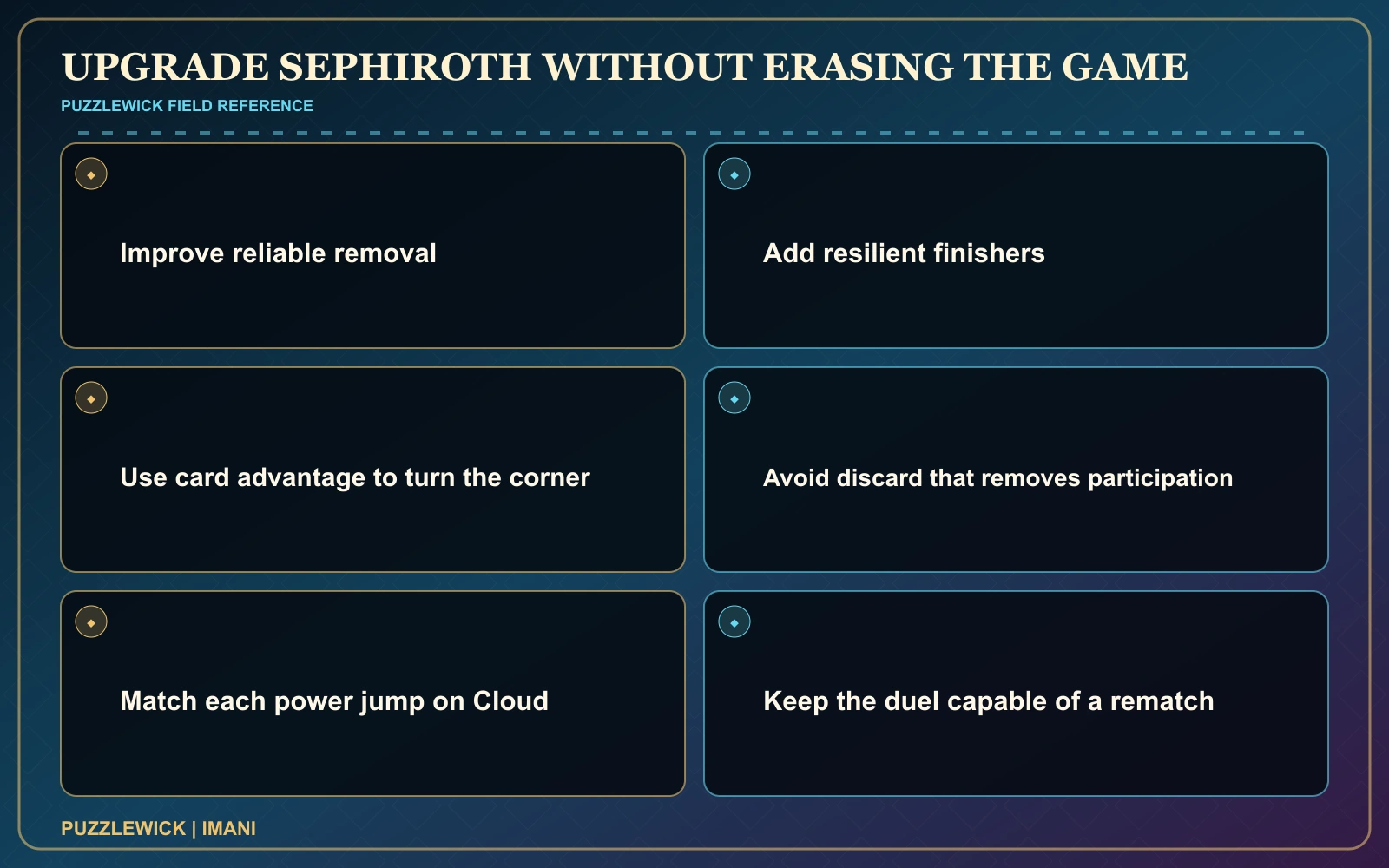
Sephiroth wants reliable removal, resilient threats, and enough card advantage to turn the corner. Replace effects that are too conditional or too expensive. Avoid loading the deck with discard that prevents the other player from participating; this is a teaching table, not an audition for villainy.
Match each Sephiroth upgrade to a Cloud improvement of similar impact. If one deck gains efficient removal, the other may need protection or a threat that leaves value behind.
What should you buy next?
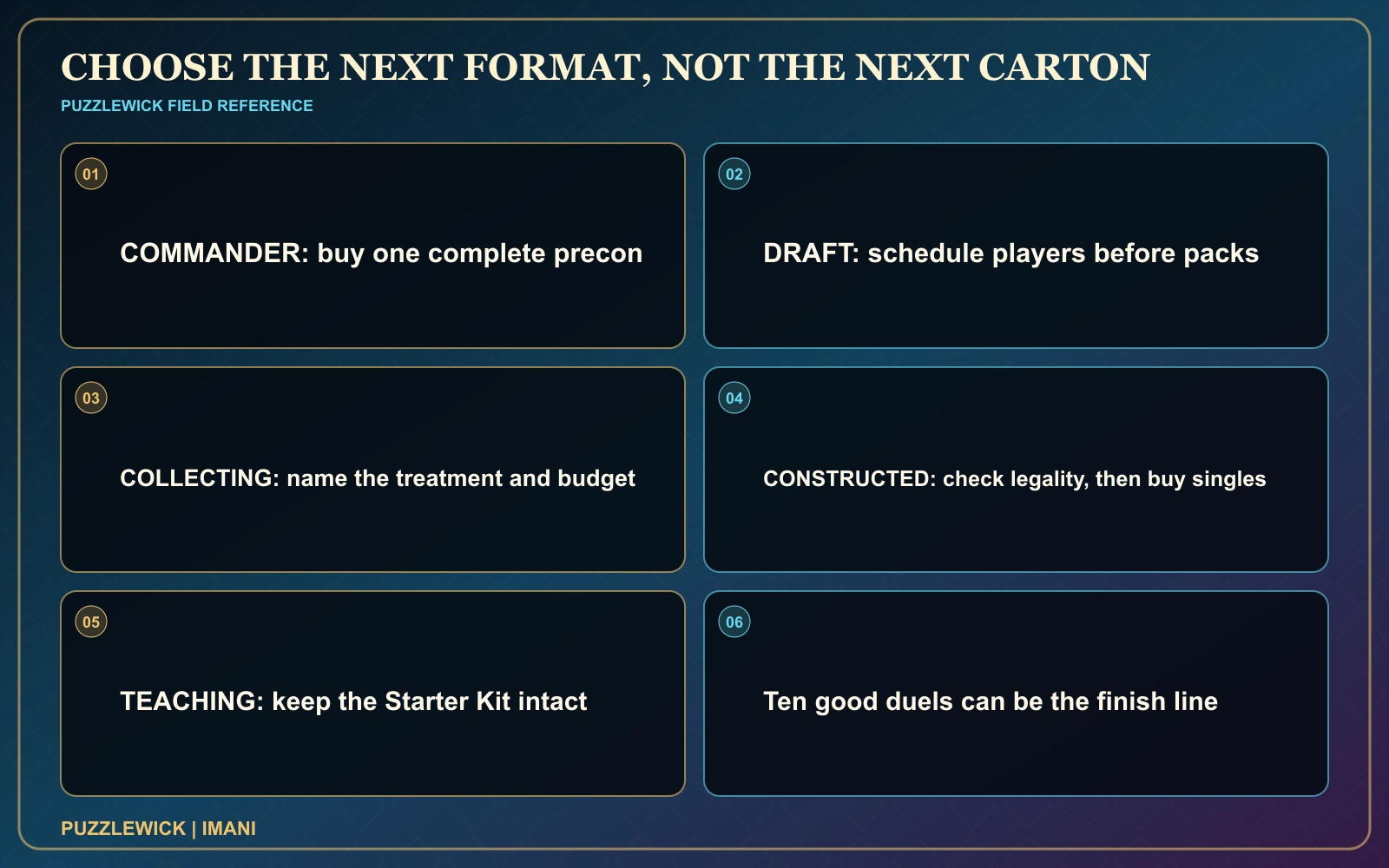
After ten or more enjoyable duels, choose a format. Buy a Commander precon if a local four-player group exists. Buy Play Boosters only if opening packs itself is part of the fun; packs are not a reliable way to acquire specific upgrades. For focused changes, singles are the efficient route, even when the booster display is doing its best stage lighting.
Keep the Starter Kit intact if it remains your teaching set. A known, balanced pair is useful long after both players own larger collections.
Final verdict
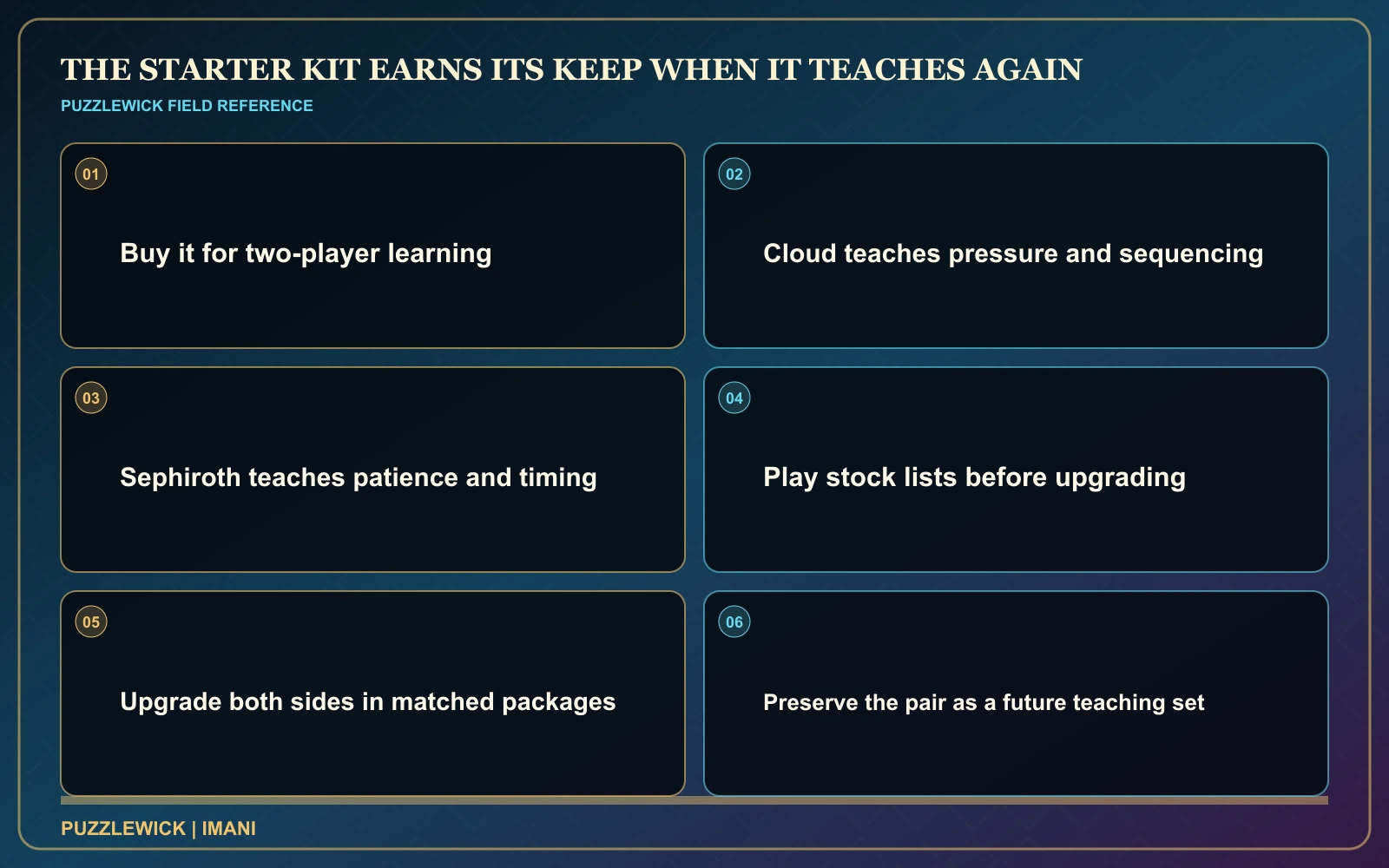
Buy the Final Fantasy Starter Kit for a two-player introduction, not as a shortcut to competitive Magic. Sephiroth has the more forgiving stock control plan; Cloud teaches sequencing and pressure. Play unchanged first, upgrade four cards per side, and keep the duel balanced enough that both decks remain invitations.
The direct Amazon button beneath the product image points to the exact verified kit. Wizards’ official lists and release notes establish contents and rules; TCGplayer and current community discussions establish the questions this guide answers.
The table-ready protection kit
Buy protection by job, not by logo. Use one opaque sleeve model across the complete playable deck and keep matching spares. Choose a compact rigid box when the deck rides in a crowded bag, a roomier Bastion when double sleeves or Commander bulk make the fit tight, and a soft magnetic case when table feel matters more than crush resistance.
Add a playmat before regular store play. Put collectible cards that are not in active decks into a side-loading zip binder; genuinely valuable singles deserve appropriate rigid protection as well. A binder is not a deck box, and a deck box is not luggage. Build the carry system only as large as the collection has earned.
The picks
Some links below are affiliate links — as an Amazon Associate, Puzzlewick earns from qualifying purchases, at no extra cost to you. It never changes a pick.
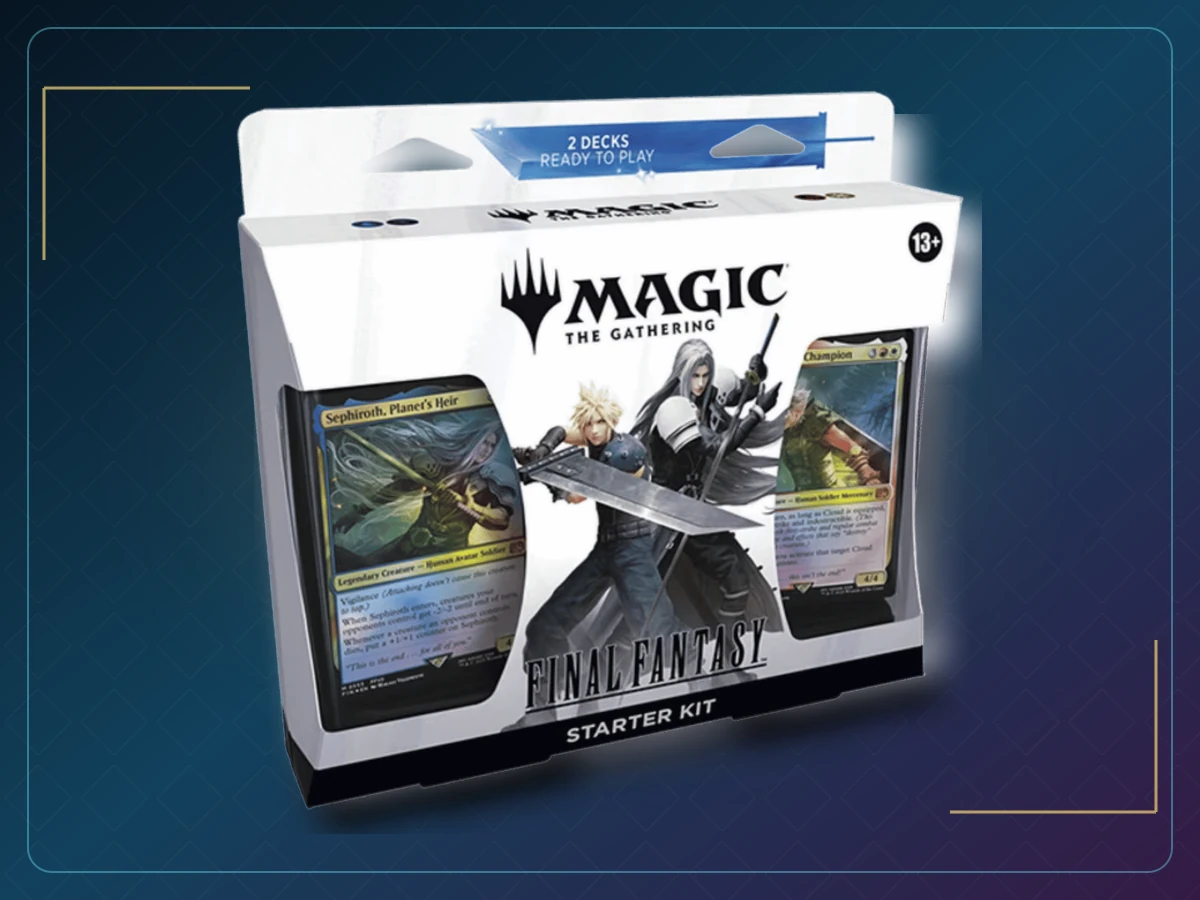
Magic: The Gathering Final Fantasy Starter Kit
Magic: The Gathering Final Fantasy Starter Kit is here because it completes the two people learning together job without pretending to solve a different part of the hobby.
- Exact inspected product identity
- A clear job in this guide’s buying path
- Live seller and availability still require checking
- Not a substitute for a different product category
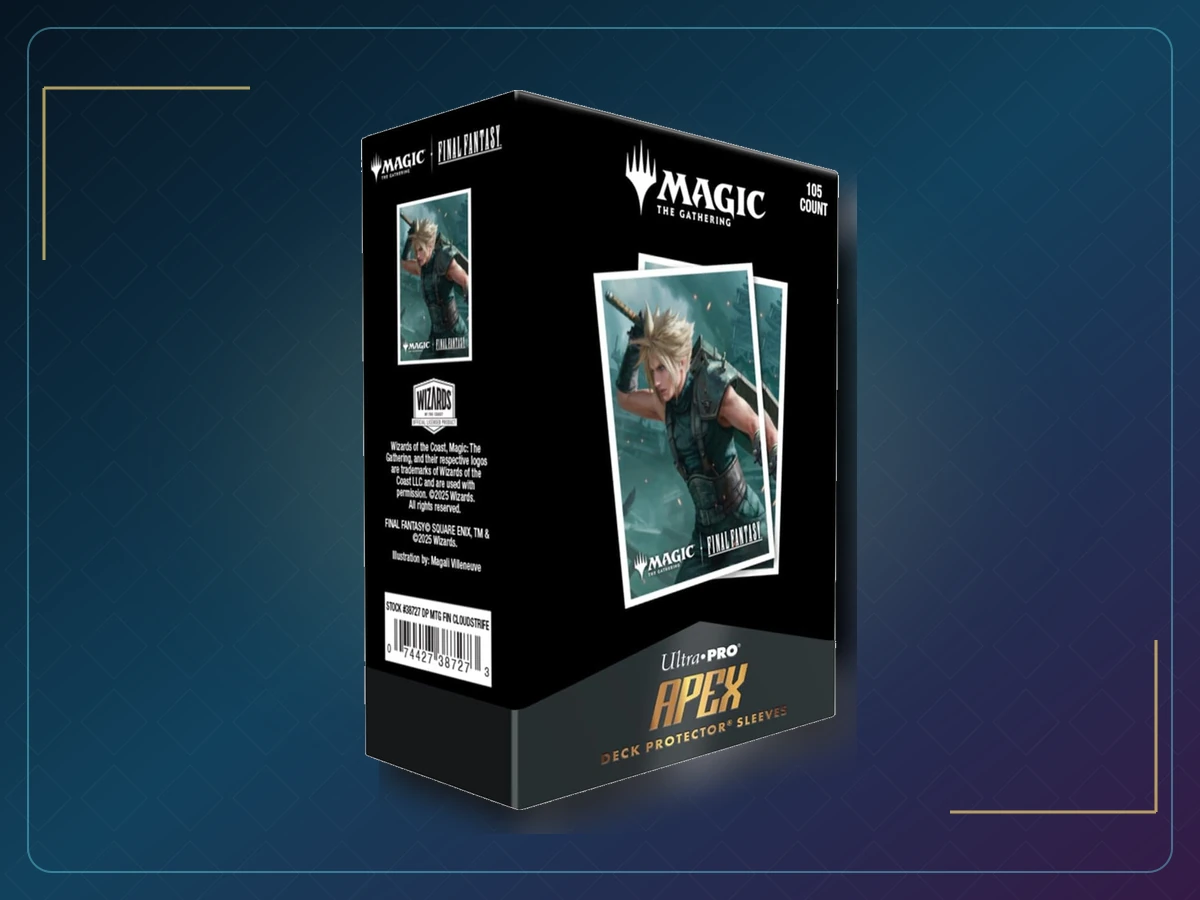
Final Fantasy Cloud APEX Deck Protector Sleeves
Final Fantasy Cloud APEX Deck Protector Sleeves is here because it completes the uniform protection for one active deck job without pretending to solve a different part of the hobby.
- Exact inspected product identity
- A clear job in this guide’s buying path
- Live seller and availability still require checking
- Not a substitute for a different product category
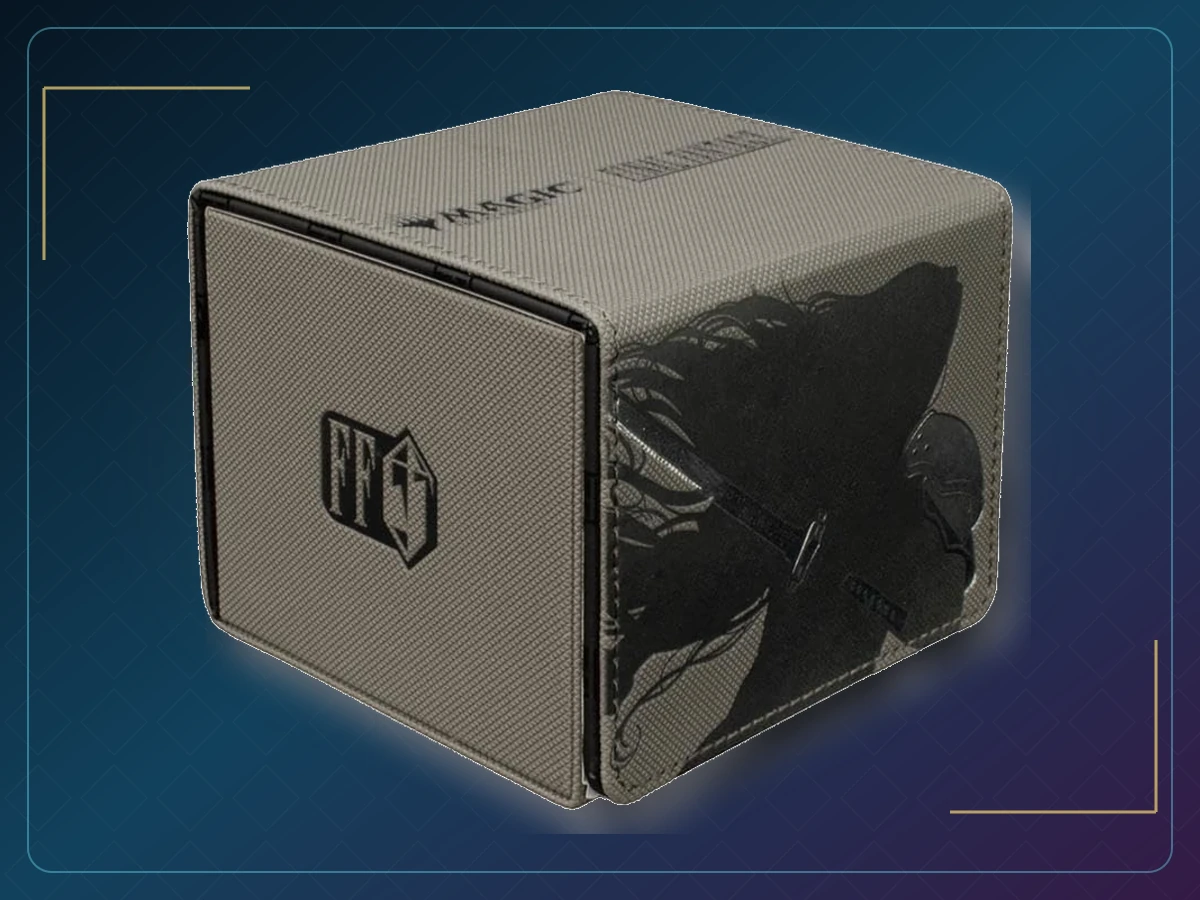
Final Fantasy Sephiroth Premium Alcove Edge Deck Box
Final Fantasy Sephiroth Premium Alcove Edge Deck Box is here because it completes the a sleeved deck that travels job without pretending to solve a different part of the hobby.
- Exact inspected product identity
- A clear job in this guide’s buying path
- Live seller and availability still require checking
- Not a substitute for a different product category
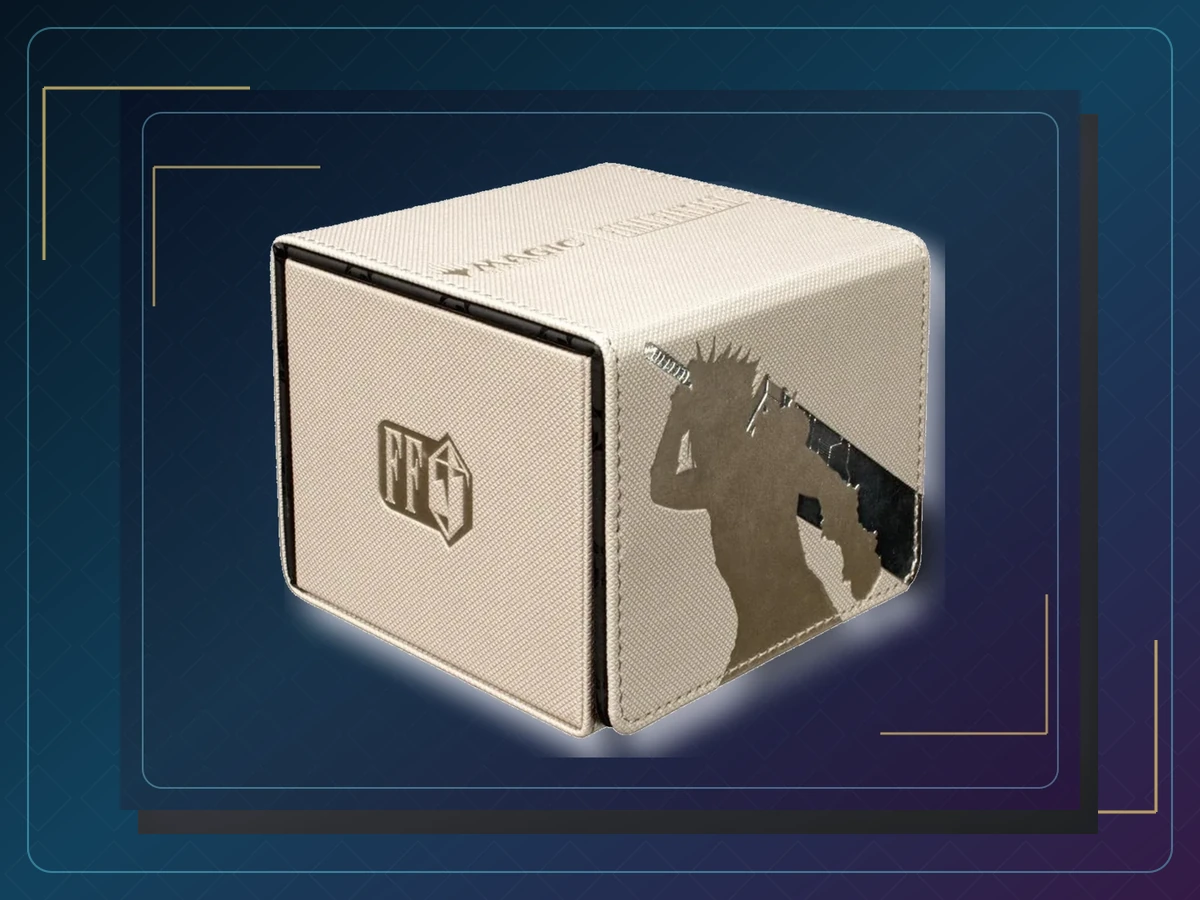
Ultra PRO Magic: The Gathering Final Fantasy Cloud Premium Alcove Edge Deck Box
Ultra PRO Final Fantasy Cloud Premium Alcove Edge Deck Box is here because it completes the a sleeved deck that travels job without pretending to solve a different part of the hobby.
- Exact inspected product identity
- A clear job in this guide’s buying path
- Live seller and availability still require checking
- Not a substitute for a different product category
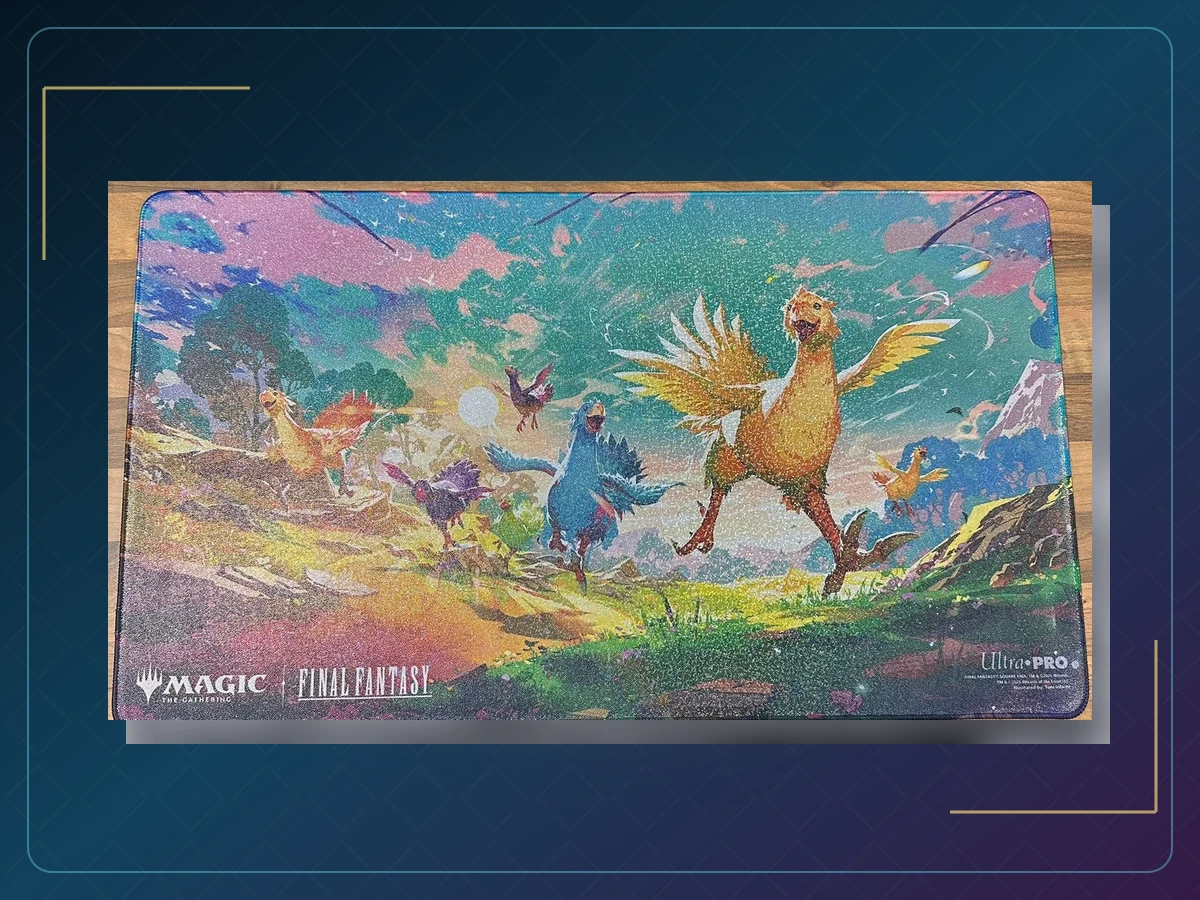
Ultra Pro Magic The Gathering Universes Beyond: Final Fantasy - Chocobos Holofoil Playmat
Ultra Pro Magic The Gathering Universes Beyond: Final Fantasy - Chocobos Holofoil Playmat is here because it completes the a licensed surface you enjoy seeing every game job without pretending to solve a different part of the hobby.
- Exact inspected product identity
- A clear job in this guide’s buying path
- Live seller and availability still require checking
- Not a substitute for a different product category
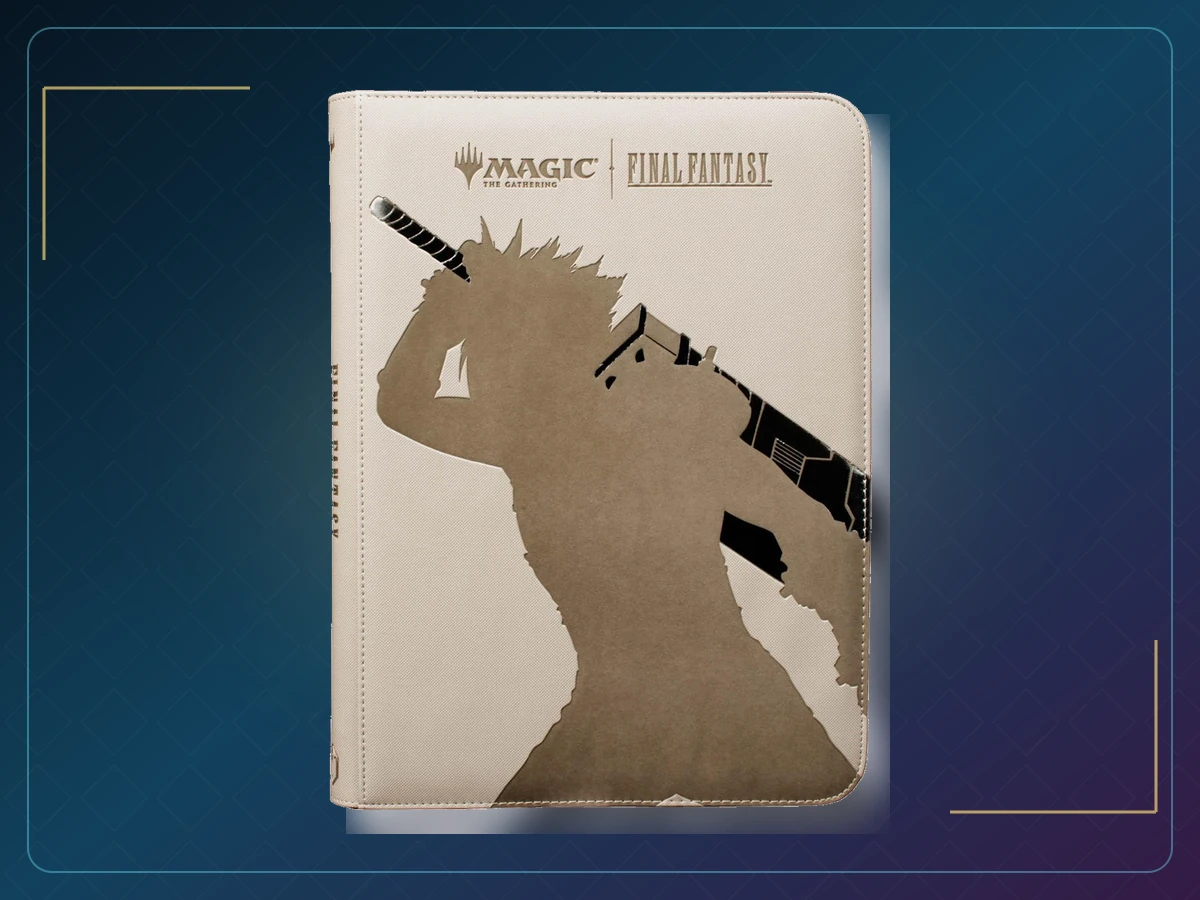
Final Fantasy Cloud 9-Pocket Zipper Binder
Final Fantasy Cloud 9-Pocket Zipper Binder is here because it completes the a deliberate collection or trade file job without pretending to solve a different part of the hobby.
- Exact inspected product identity
- A clear job in this guide’s buying path
- Live seller and availability still require checking
- Not a substitute for a different product category
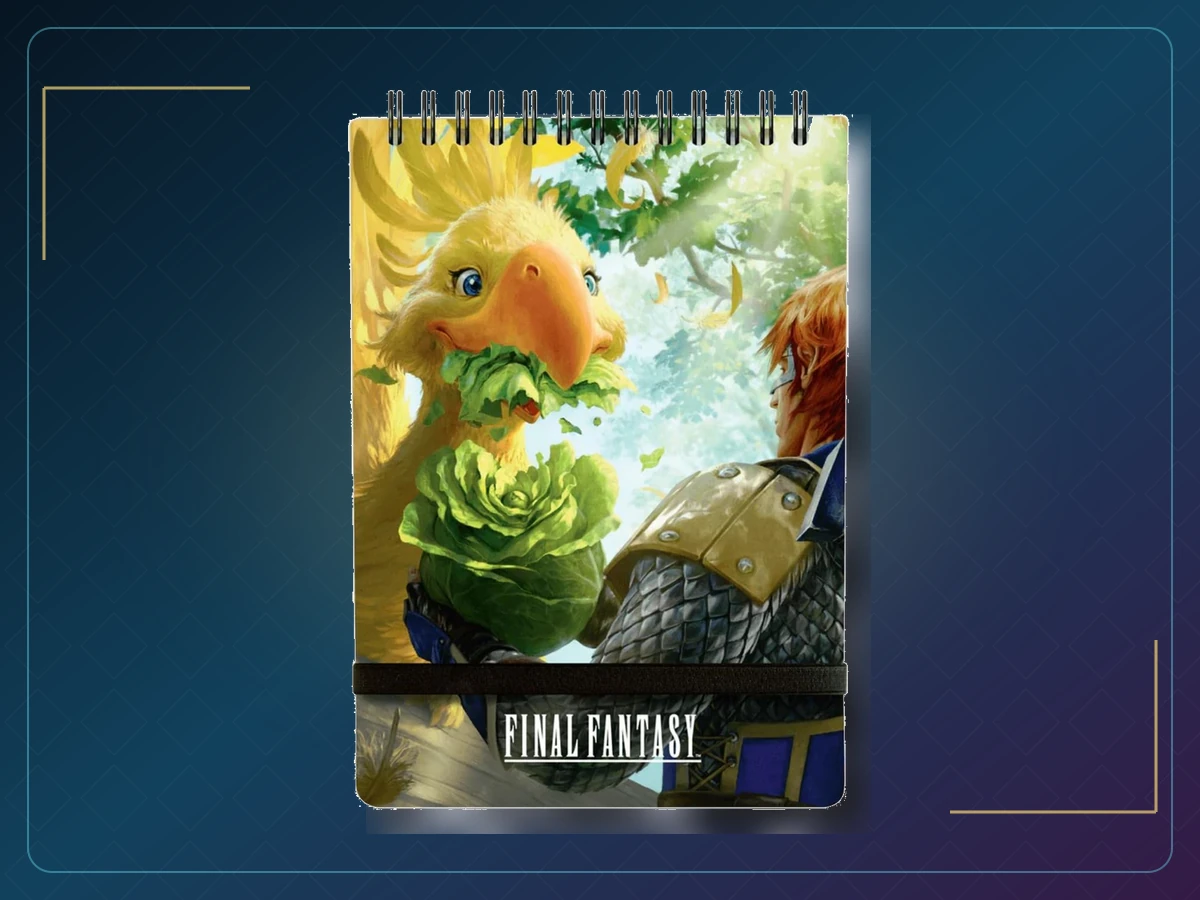
Ultra Pro - Final Fantasy x Universes Beyond Gyashl Green Spiral Life Pad for Magic: The Gathering
Ultra Pro - Final Fantasy x Universes Beyond Gyashl Green Spiral Life Pad for Magic: The Gathering is here because it completes the a visible shared life record job without pretending to solve a different part of the hobby.
- Exact inspected product identity
- A clear job in this guide’s buying path
- Live seller and availability still require checking
- Not a substitute for a different product category
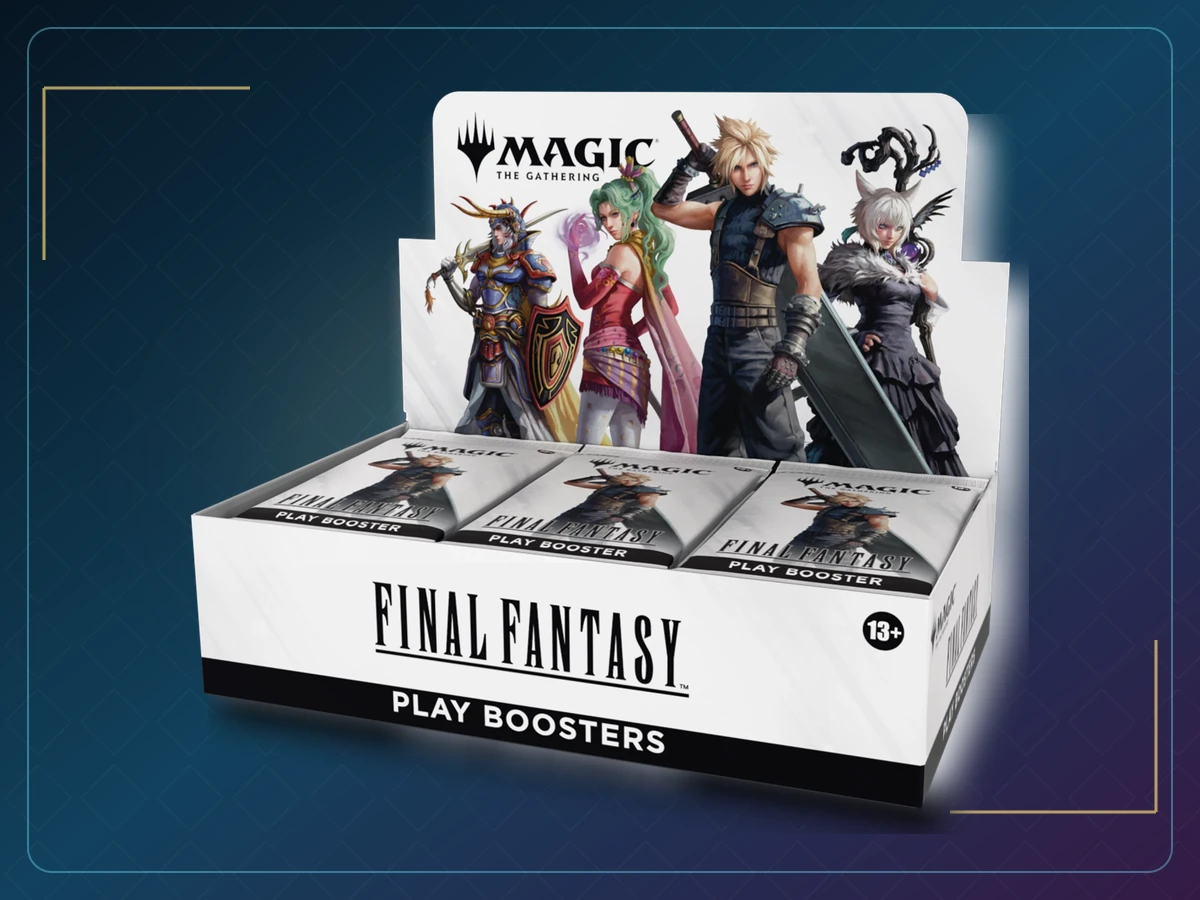
Magic Final Fantasy Play Booster Display
Magic Final Fantasy Play Booster Display is here because it completes the Draft, Sealed, or a planned opening job without pretending to solve a different part of the hobby.
- Exact inspected product identity
- A clear job in this guide’s buying path
- Live seller and availability still require checking
- Not a substitute for a different product category
At a glance
| Stage | Decision | What matters | Curator ruling |
|---|---|---|---|
| 01 | Cloud asks the questions; Sephiroth answers them | Cloud: curve out, preserve pressure, plan combat | Start here |
| 02 | Keep the kitchen-table duel honest | Round 1: play three games unchanged | After testing |
| 03 | Five errors that decide the duel | Keeping a hand with one land and a dream | After testing |
| 04 | The calm way to teach the table | Explain untap, draw, main, combat, second main | After testing |
Free download — Final Fantasy Starter Kit Matched Duel Field Sheet
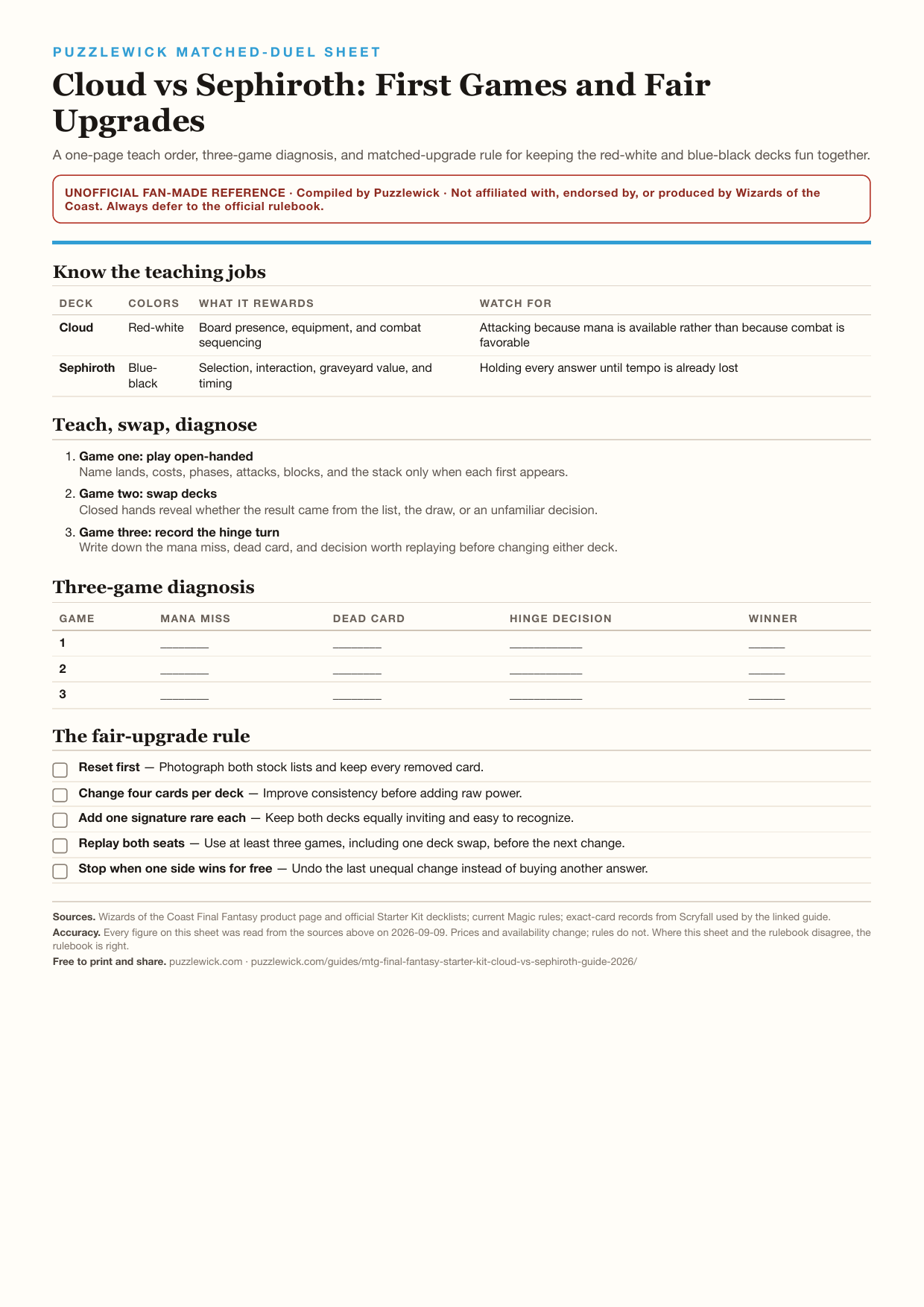
A one-page stock-game log, first-game teach order, and matched-upgrade checklist for keeping Cloud and Sephiroth fun together.
Unofficial fan-made reference. Compiled by Puzzlewick from the sources listed on the sheet. Not affiliated with or endorsed by the publisher — always defer to the official rulebook.
Questions, answered
Is the Final Fantasy Starter Kit Commander?
No. It contains two fixed 60-card decks for a two-player teaching game.
Is Cloud or Sephiroth stronger?
Sephiroth commonly has the cleaner stock removal plan, but the matchup remains playable and skill matters.
Can I upgrade the decks?
Yes. Begin with four matched swaps per side and preserve the duel’s balance.
Can I use these cards in other Magic decks?
Use depends on the format and current legality; check official card and format rules.
Should I buy boosters for upgrades?
Buy singles for specific changes. Buy boosters when opening packs is itself the desired experience.
Is it good for complete beginners?
Yes, especially when the first game is open-handed and rules are introduced at the moment they matter.
Imani's verdict
Buy the Final Fantasy Starter Kit for a two-player introduction, not as a shortcut to competitive Magic. Sephiroth has the more forgiving stock control plan; Cloud teaches sequencing and pressure. Play unchanged first, upgrade four cards per side, and keep the duel balanced enough that both decks remain invitations. The direct Amazon button beneath the product image points to the exact verified kit. Wizards’ official lists and release notes establish contents and rules; TCGplayer and current community discussions establish the questions this guide answers.
Research ledger 11 sources · reviewed 2026-09-09
Specifications, rules, current product information, community experience, and contrary evidence were checked against the sources below. Commercial links are kept separate from editorial evidence.
- Magic: The Gathering—Final Fantasy official product pagemagic.wizards.com/en/products/final-fantasy
- Final Fantasy Starter Kit official decklistsmagic.wizards.com/en/news/announcements/final-fantasy-starter-kit-decklists
- Scryfall advanced Magic search and card recordsscryfall.com/advanced
- TCGplayer Final Fantasy market editorialtcgplayer.com/content/article/Top-10-Most-Expensive-Cards-from-MTG-Final-Fantasy/0b00eadb-53be-4ac7-8a37-c9c8033fd56e
- BoardGameGeek Final Fantasy Starter Kit discussionboardgamegeek.com/thread/3551123/magic-the-gathering-final-fantasy-starter-kit-insi
- Magic: The Gathering—Final Fantasy official card image gallerymagic.wizards.com/en/products/final-fantasy/card-image-gallery
- Collecting Magic: The Gathering—Final Fantasymagic.wizards.com/en/news/feature/collecting-final-fantasy
- Magic: The Gathering—Final Fantasy mechanicsmagic.wizards.com/en/news/feature/final-fantasy-mechanics
- Magic: The Gathering—Final Fantasy release notesmagic.wizards.com/en/news/feature/final-fantasy-release-notes
- Scryfall FIN set recordscryfall.com/sets/fin
- Magic: The Gathering official format directorymagic.wizards.com/en/formats
Okay but have you seen what everyone’s saying about this?


Keep exploring
The next smart rabbit holes.
✶ Universe HubMagic: The Gathering: the whole buying pathMagic: The Gathering is the deepest construction sandbox in the Big Three: a two-player duel, four-player Commander ritual, draft...🂠 Topic PathTrading Card Games: compare the whole shelfStart with the game and community you want, then buy the smallest product that lets you test it properly. These guides separate...GuideFrom the Final Fantasy Starter Kit to Standard: A Beginner’s Competitive Bridge After the August 2026 BansImani keeps the Final Fantasy invitation intact while separating teaching decks, current legality, a dated post-ban Best-of-One field and...