Star Wars: Rebellion Review — The Hidden-Base Epic That Earned a Permanent Shelf
A 153-mini galactic war in a box where the Empire is a hammer hunting a needle, and the Rebels win by surviving. I almost left it in the shop over the combat. Here's why it stayed — and how to actually play both sides well.

Written and reviewed by Robert Pruitt · how this guide was made
Last editorial refresh: 2026-06-15 Gold-standard QA: 2026-08-10 14 sources reviewed Affiliate links checked during gold-standard pass

The short answer
Star Wars: Rebellion (Fantasy Flight Games, 2016) is a 2–4 player asymmetric strategy game where one side commands the overwhelming Galactic Empire hunting for a single hidden Rebel base, and the other plays the outgunned Rebel Alliance trying to survive long enough to ignite a galaxy-wide revolt. It runs 3–4 hours, ships with over 150 plastic miniatures and 25 leaders, and is one of the highest-rated head-to-head games ever made (BoardGameGeek mean ~8.4, long-time top-ten). It is absolutely worth owning if you want one big, narrative, dudes-on-a-map war game and you have a regular opponent — the combat is its weakest joint (the Rise of the Empire expansion's cinematic combat fixes it), but the hidden-base tension is some of the best in the hobby.
Decision map
Choose in thirty seconds
Two players who want one big, narrative, dudes-on-a-map war game and a galaxy-spanning hidden-base showdown.
Owners of the base game who want the combat fixed and a hit of Rogue One added to the campaign.
I have a rule on the Puzzlewick shelves: a game earns its slot or it goes back in the donation box. Space is finite, evenings are finite, and I'd rather own twelve games I'll fight to play than forty I'm vaguely fond of. Star Wars: Rebellion is the game that made me question whether the rule was too strict — because for about a week, it was on the wrong side of it. I'd unboxed it, marveled at the little plastic Death Star, played one teaching game where the combat ground to a halt around hour three, and quietly thought: this is a beautiful thing I will never get to the table. Then the second game happened, and the third, and I understood what everyone meant. This is the rare epic that justifies its own length. Below is the whole story — what it is, the asymmetric hook that makes it special, what's actually in that enormous box, how the two sides play, the catch that nearly sent it back, how to win as each faction, what the Rise of the Empire expansion adds, and who should and shouldn't bring it home.
Start here, then go deeper
You are in the right cabinet.
 ✦ Universe HubStar Wars: the whole buying pathThe Star Wars universe at Puzzlewick separates quick card-game entry points from competitive collections, two-player strategy...
 ✦ Topic PathBoard Game Buying Guides: compare the whole shelfStart with the decision, not the shelf. These guides compare the games, editions, expansions, player counts, and costs people...
 Deep DiveArk Nova Review: Is the 400-Card Zoo Worth Your Table?Ark Nova's action track, learning curve, game length, solo fit, Marine Worlds expansion, and the exact table that will love — or regret —...
What is Star Wars: Rebellion, and what's the hidden-base hook?
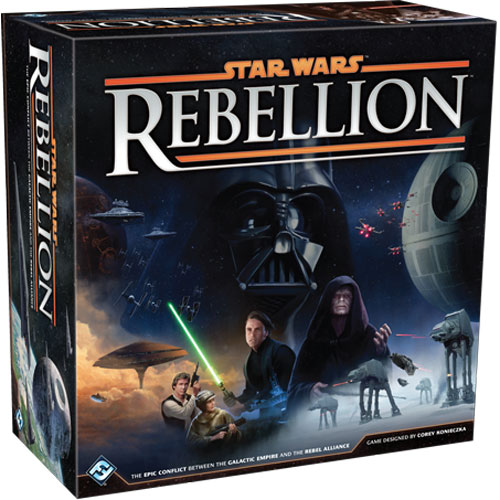
Strip away the license and Rebellion is a hidden-movement war game wearing a $100 Hollywood costume. One player is the Galactic Empire — a giant, methodical war machine with Star Destroyers, stormtroopers, Vader, the Death Star, and a clock running against them. The other is the Rebel Alliance, who at the very start of the game secretly chooses one planet from a deck of probe cards to be their hidden base. The Empire's entire game is a deduction puzzle wrapped in a military campaign: spread across the galaxy, subjugate systems, and use probe droids to eliminate planets that AREN'T the base until they can corner it and crush it. The Rebel's entire game is staying alive — using subterfuge, diplomacy, and guerrilla raids to push their reputation up a track before the Empire's time marker catches them. That asymmetry isn't a flavor difference; it's the whole engine. The Empire is a hammer searching for a needle, and the needle wins simply by not getting hit before the bell rings. The first time you play the Empire and realize the galaxy is enormous and that single hidden planet could be ANY of two dozen worlds, the dread is exquisite. The first time you play the Rebels and watch a Star Destroyer fleet drift one jump away from your base, you stop breathing. That is the hook, and almost nothing else in the hobby does it at this scale.
The Empire is a hammer searching for a needle, and the needle wins simply by surviving until the bell rings.
What's actually in the box — the minis and components?
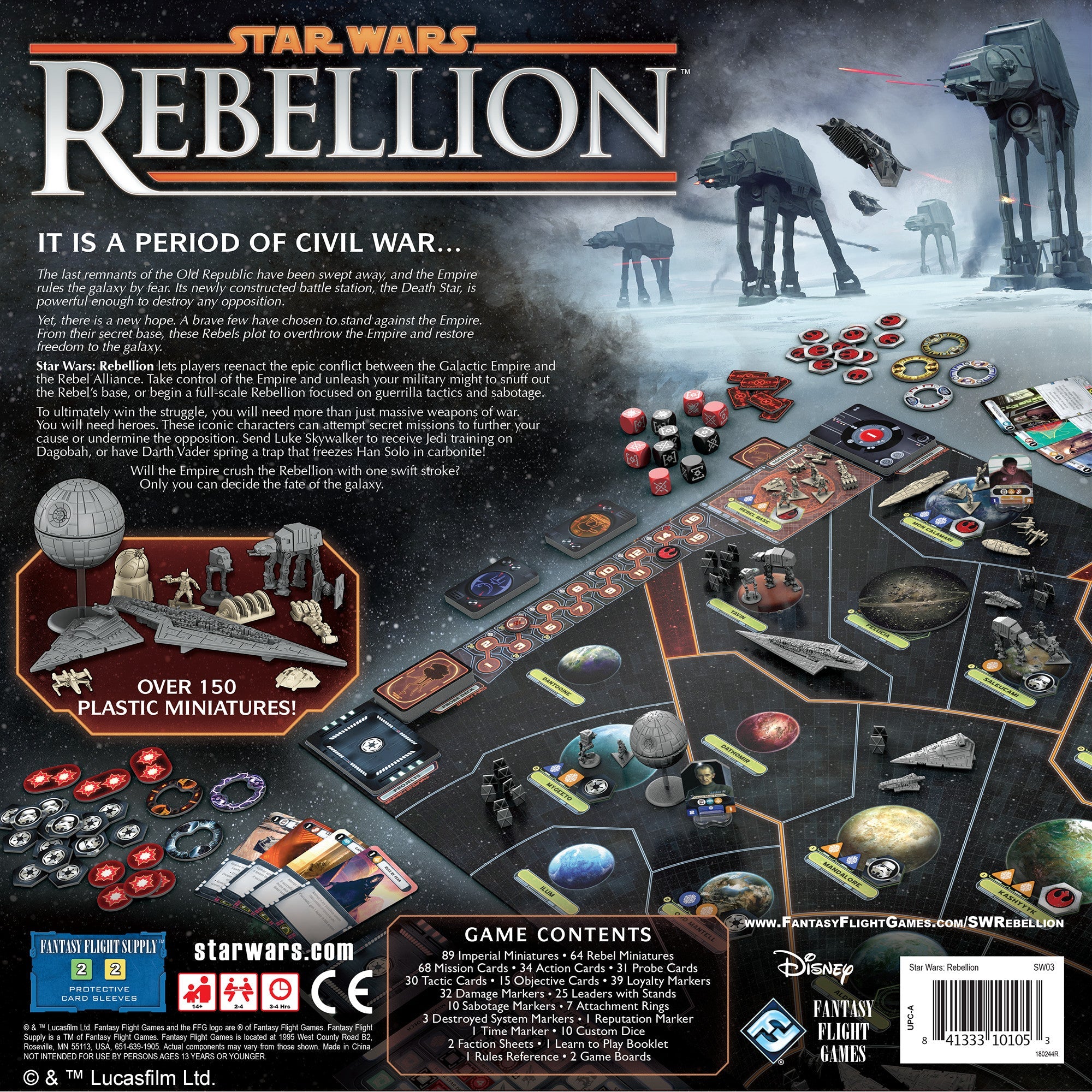

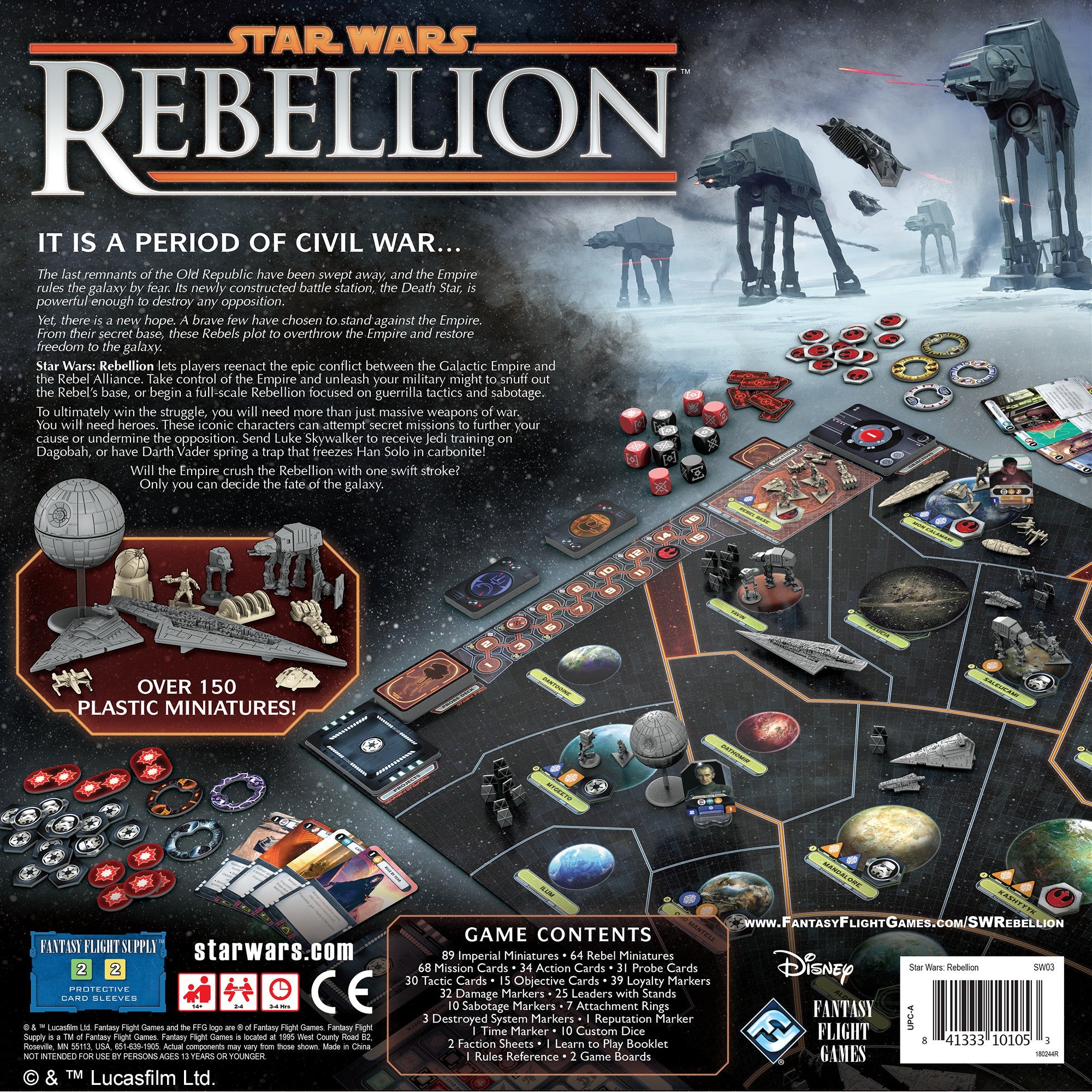
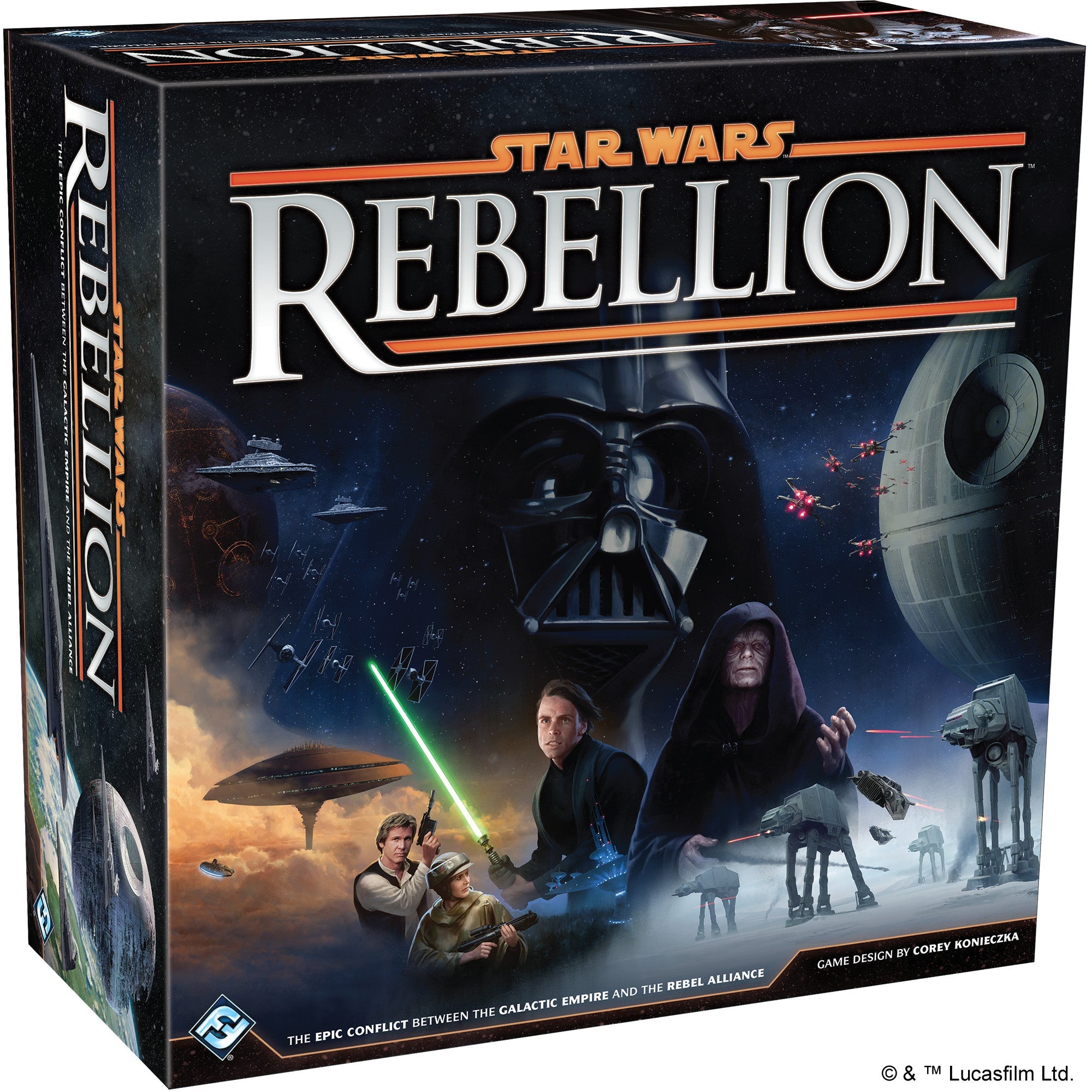
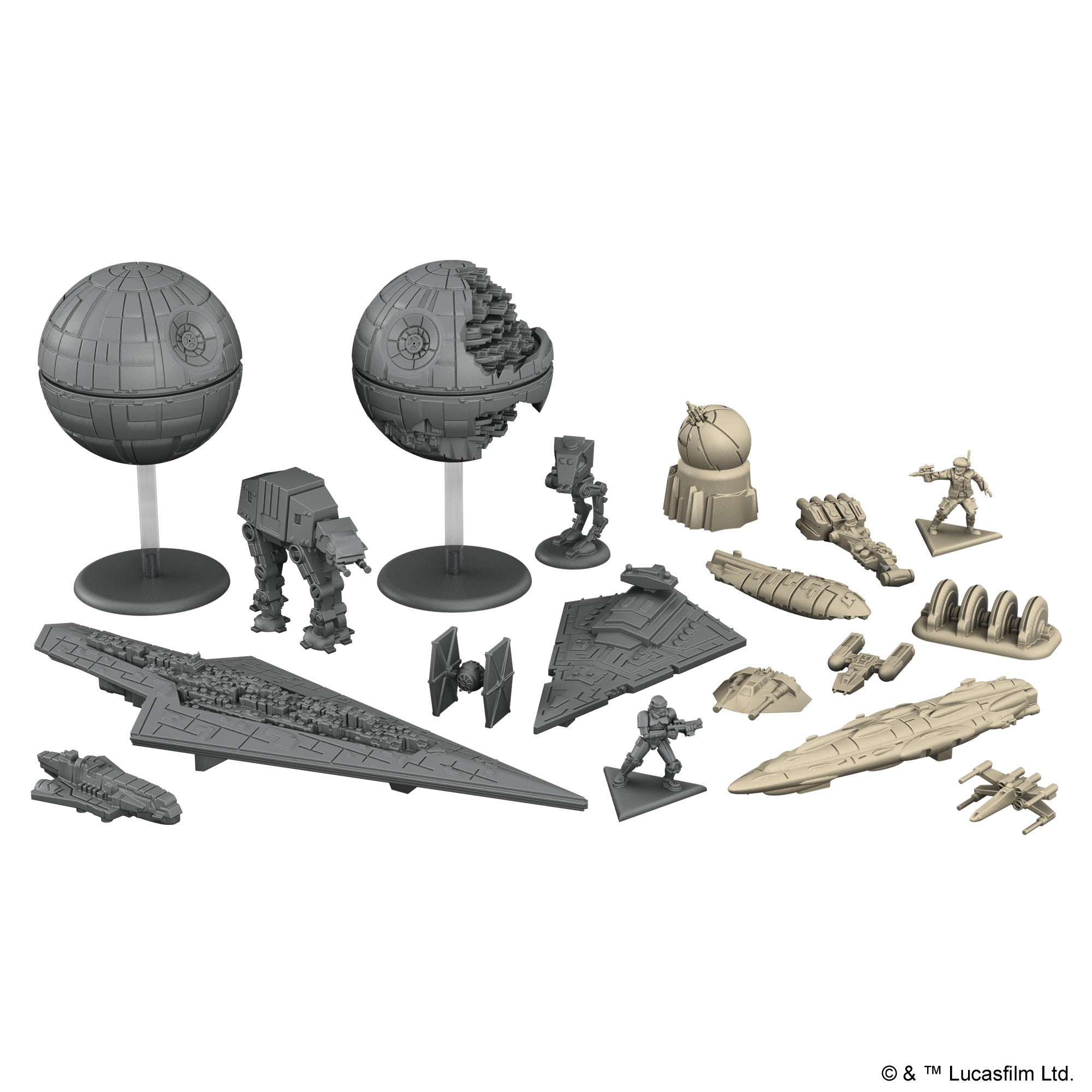
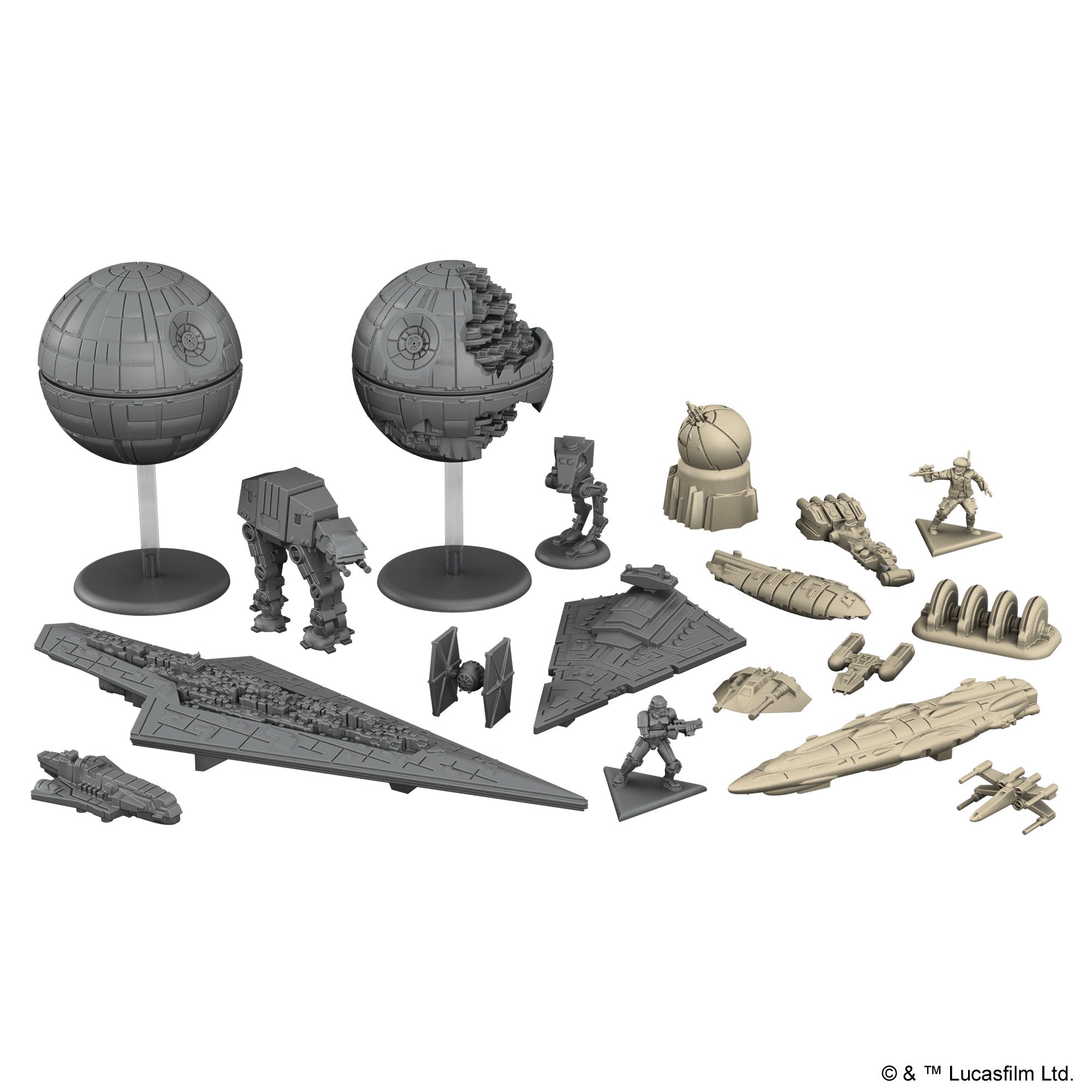
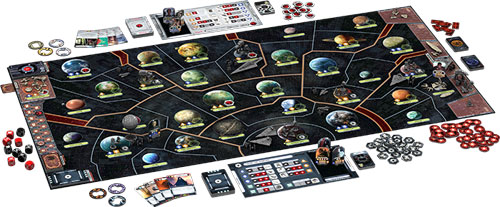
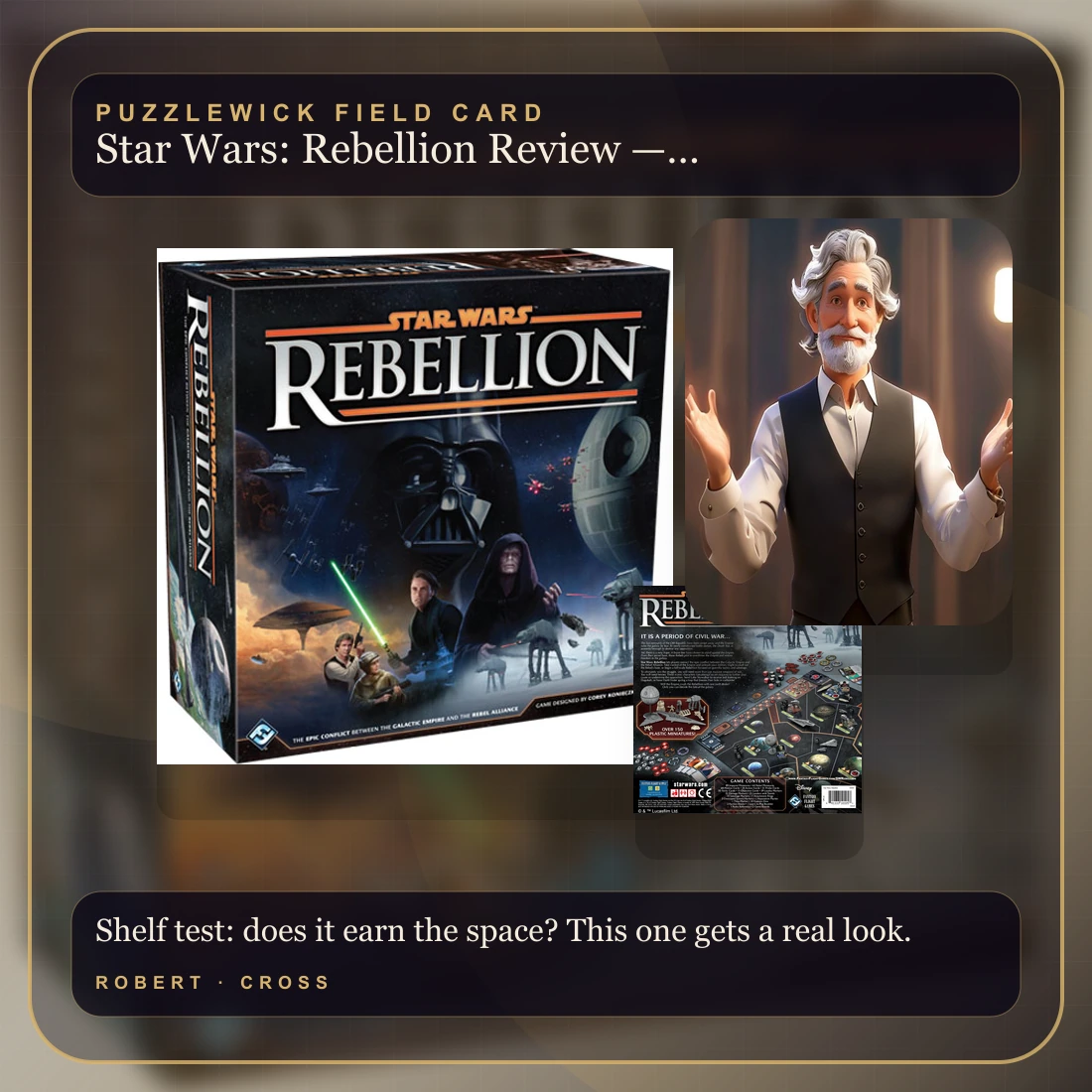
Open the lid and the table-presence hits you before any rule does. The core set ships with 153 plastic miniatures — 89 Imperial and 64 Rebel — plus 25 leaders on stands (your Vaders, Lukes, Leias, Han Solos and Emperors), 10 custom dice, and a two-part galaxy map you assemble like a small console. The card pool is deep: 68 mission cards, 34 action cards, 31 probe cards, 30 tactic cards, and 15 objective cards, supported by 39 loyalty markers, 32 damage markers, 10 sabotage markers, attachment rings, and the reputation and time markers that drive the Rebel's win condition. The miniatures are unpainted but genuinely lovely sculpts — TIE fighters, X-Wings, AT-ATs, transports, and yes, an honest-to-goodness plastic Death Star that you slide menacingly from system to system. There's a 'Learn to Play' booklet and a separate Rules Reference, which tells you everything about the complexity tier: this is a game that needs a manual you keep open. Be warned about footprint — assembled, this game eats a dining table. It is not a coffee-table filler; it's a 'clear the afternoon and the surface' production. The components are the easy part of the recommendation. Everyone agrees the box is gorgeous.
An honest-to-goodness plastic Death Star you slide menacingly from system to system — table presence before a single rule lands.
How does it play — the two sides and the turn loop?

Each round flows through three phases. First, Assignment: both players secretly commit leaders (those standee characters) to missions — face-down cards that do things like sabotage a system, rally a planet to your cause, capture an enemy leader, or trigger Rebel objectives. Second, Command: players alternate revealing missions and resolving them, or instead spending a leader to activate a system and move/build units there. A mission can be opposed — if your opponent has a leader to spare, they roll to interfere, so reading where the other side will contest you is a constant mind game. Third, Refresh: leaders come home, cards refill, and crucially the time marker can advance — the Rebel's doomsday-and-salvation clock in one. The Empire's loop is logistics and pressure: activate systems, push fleets outward, drop stormtroopers to subjugate planets, and play probe cards to cross worlds off the suspect list for the hidden base. The Rebel's loop is asymmetric and sneakier: you mostly can't win fights, so you fish for objective cards (each completed objective shoves your reputation up the track toward victory), you run diplomatic and sabotage missions, and you use leaders defensively — a leader committed to a system can lock enemy units in place, because a system with a leader in it can't move units out. The whole thing is a tense conversation conducted through face-down cards, where bluffing about which leader went where matters as much as any die roll. When it sings, it's the best Star Wars story you'll ever co-author. When combat triggers at scale late in the game, it can stutter — which brings us to the catch.
A tense conversation conducted through face-down cards, where bluffing about which leader went where matters as much as any die roll.
The catch: is the combat really that clunky?
Yes, and I won't pretend otherwise — this is the thing that nearly kept it off my shelf, and it's the one criticism every honest reviewer raises. Base-game combat works like this: when fleets and ground forces meet, you roll custom dice and then draw and play tactic cards to add hits, but you can only USE a tactic card's effect if your dice rolled the matching symbols. So you'll draw a great card and be unable to play it because the dice didn't cooperate, then repeat the dance over multiple rounds of a single battle. Early in the game, when skirmishes are small, it's fine. Late in the game, when both sides have stacked huge fleets over the base, a single climactic battle can become a slow, fiddly slugfest of dice-then-cards-then-dice that drains the drama right out of the moment it should be peaking. I had exactly that experience in my first game — the finale that should have been Endor felt like doing taxes. Here's the thing that saved it for me: combat is the EXCEPTION in Rebellion, not the rule. The vast majority of the game is the gorgeous cat-and-mouse of missions, movement, and deduction — and that part is close to flawless. Once I learned to keep battles small and decisive instead of letting them balloon, the clunk faded into a minor tax on an otherwise superb experience. And if it still bothers you, the expansion exists specifically to fix it.
The finale that should have been Endor felt like doing taxes — until I learned combat is the exception in Rebellion, not the rule.
How to play the Empire well
Playing the Empire is playing a search algorithm with a fleet. Your job is to convert the whole galaxy from 'unknown' to 'eliminated' until only the base is left, then arrive in overwhelming force. Open by securing your home system and immediately expanding — grab undefended planets early and aggressively, because every subjugated world is both production and information. Spread, but never thin: split your forces each round so multiple prongs are capturing planets, but keep each prong large enough to survive a Rebel ambush, and always leave yourself movement options left and right so you never get boxed into a predictable lane. Prioritize high-production worlds (Mon Calamari is contested by both sides — race for it) to fuel your build. Lean on Gozanti-style transports as cheap expansion vehicles: jump in, drop a stormtrooper to claim the system, and keep your Star Destroyers concentrated as a strike force rather than scattering them. Use probe cards relentlessly and read them like a detective — every card that's NOT the base narrows the field. And hold a leader or two in reserve so you can contest the Rebel's missions; nothing demoralizes a Rebel player like having their objective sabotaged the turn before it scored. The Empire's enemy is the clock and its own impatience: be systematic, be everywhere, and let the noose tighten. When you finally guess right, hit with everything at once — a half-committed assault on the base is how Empires lose won games.
Playing the Empire is playing a search algorithm with a fleet: convert the galaxy from 'unknown' to 'eliminated' until only the base is left.
How to play the Rebels well
The Rebel mantra is simple and counterintuitive: you do not win by fighting — you win by surviving and scoring. Your whole identity is the hidden base, so choose it with intent. Many strong players hide somewhere fairly out-of-the-way (Farfin, Sluis, and Fakir get named a lot), but the real trick is staying boring and unreadable while the Empire methodically expands — don't telegraph your location by over-defending it. Treat your fleet as a tool with exactly two jobs: blocking the Empire's path to your base (delay, don't brawl) and, eventually, killing the Death Star — so prioritize X-Wing production over a battle fleet you can't afford to lose. Build your base defenses up enough that a small Imperial scouting force that stumbles in gets crushed, which buys you priceless time and tells the Empire nothing. Objectives are your scoreboard — they favor you, so chase them aggressively, and remember higher-value objectives tend to sit deeper in the deck, so set up the early ones to fuel the bigger late ones. Use leaders defensively and cleverly: park a leader in a system stuffed with Imperial forces and those units can't move out that round — a free way to freeze a fleet you don't want jumping toward home. Keep a leader or two in reserve to dodge captures and counter the Empire's missions. Above all, manage the clock as your ally: every round that passes without being found is a round closer to victory. You're not the underdog losing slowly — you're the underdog running out the clock on purpose.
You're not the underdog losing slowly — you're the underdog running out the clock on purpose.
Rise of the Empire, the 2-player experience, and the 4-player question
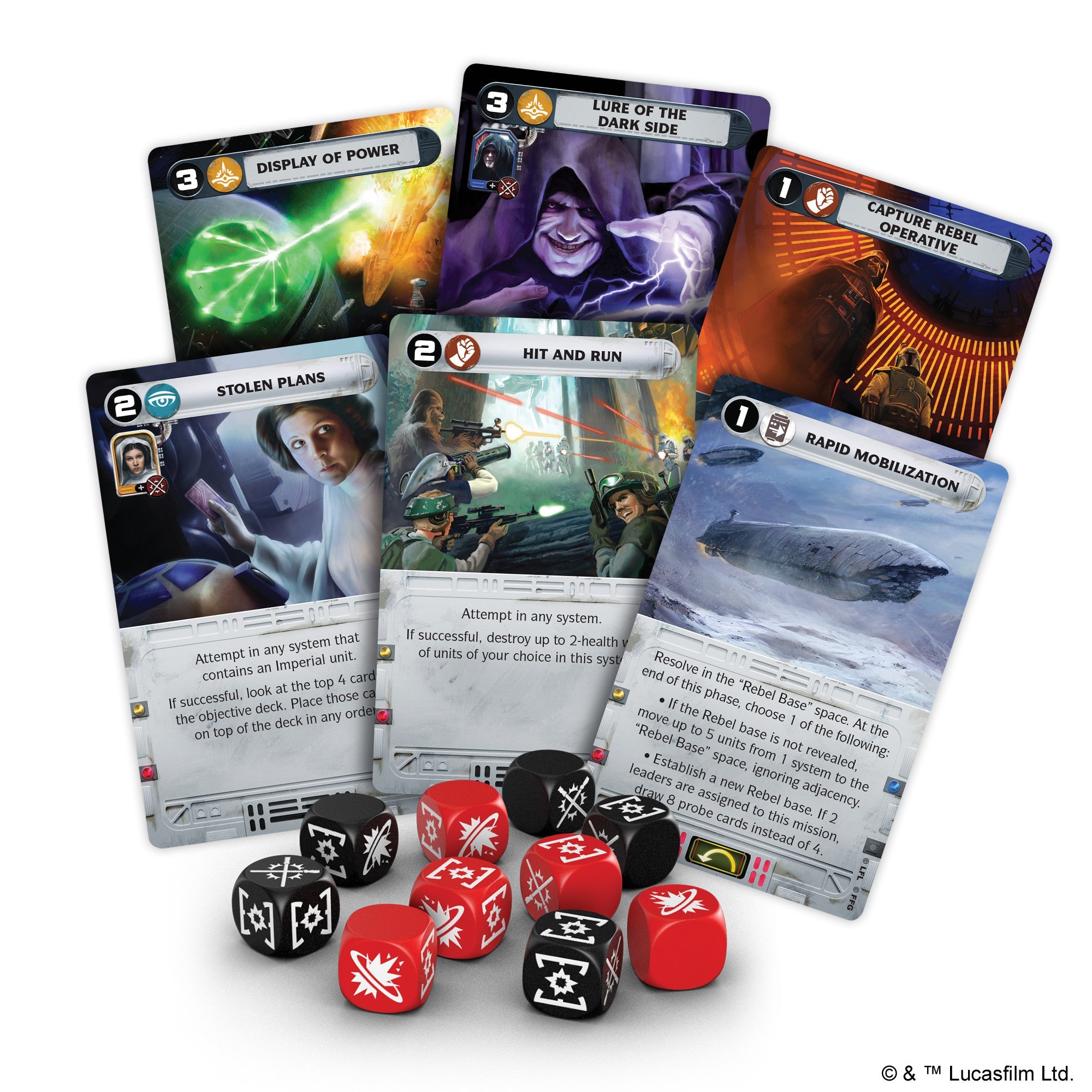
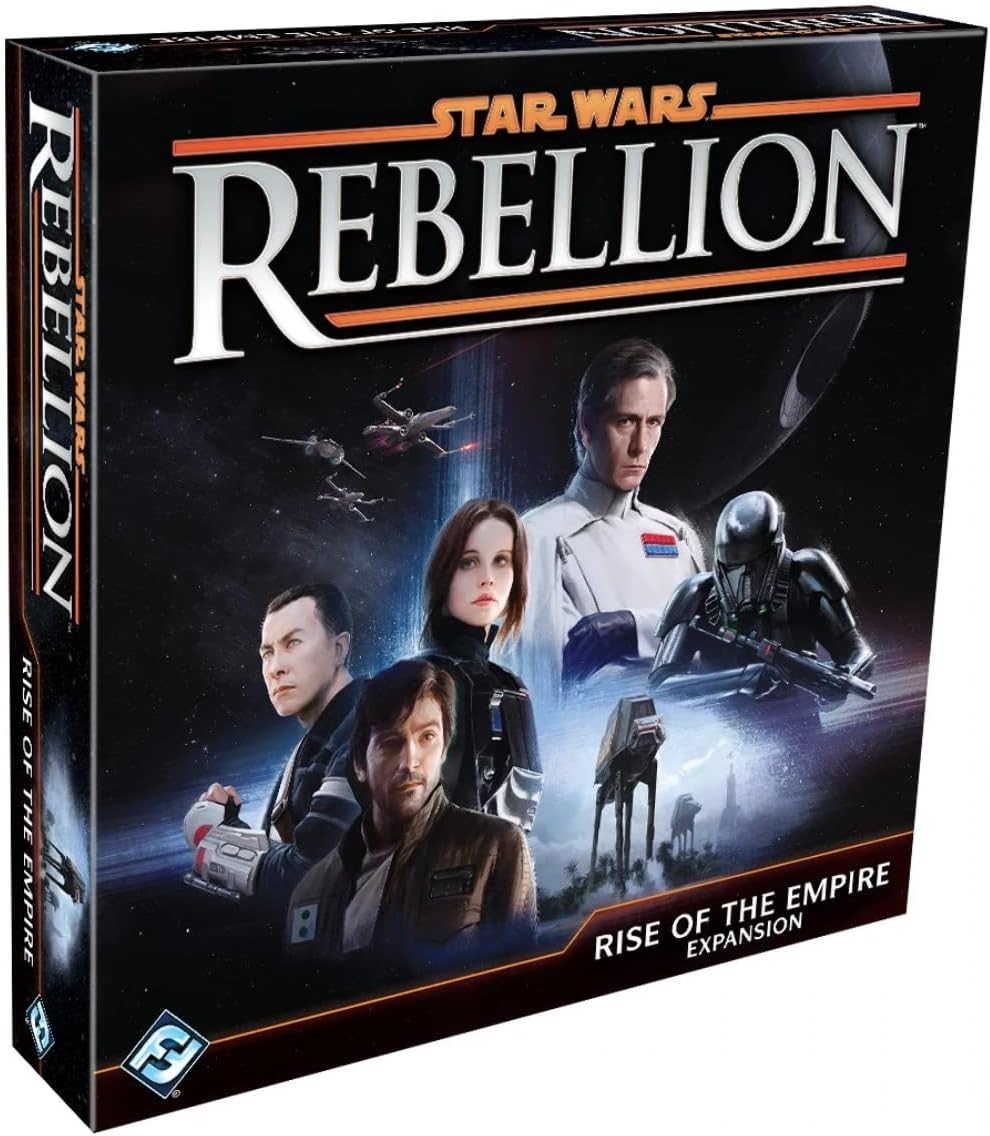
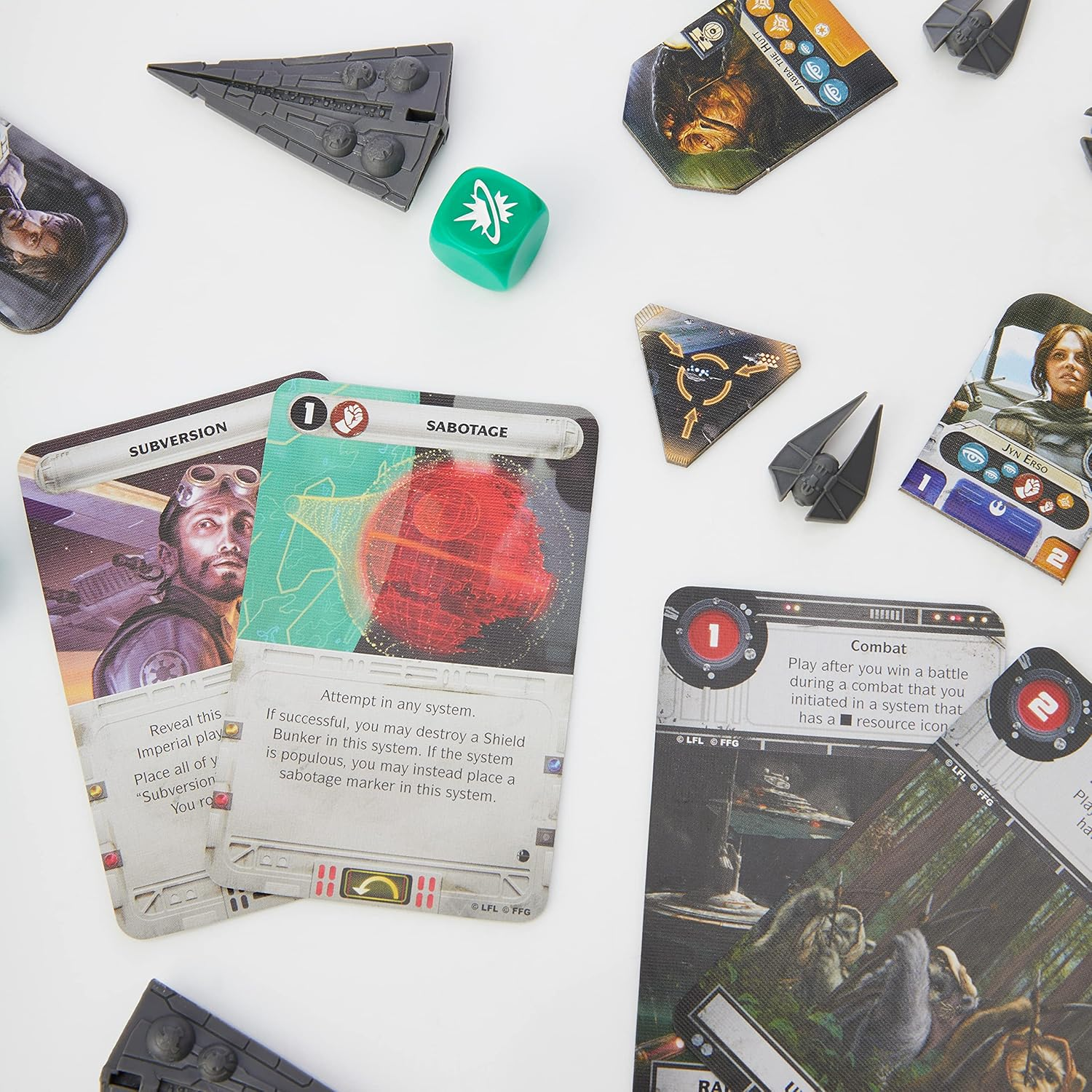
Two things determine whether Rebellion is the right purchase for you: how you feel about the combat, and how many people you're playing with. On the first — the Rise of the Empire expansion (2017), inspired heavily by Rogue One, is the single best upgrade you can make, and for many of us it's close to mandatory. It adds 8 new leaders, 36 miniatures, new objectives and missions, and most importantly a 'cinematic combat' overhaul that replaces the fiddly dice-gated tactic cards with faction-specific card play — secretive, bluff-driven combat more like what you'd see in a modern card-battler. It directly targets the base game's weakest joint and turns climactic battles from a chore into a highlight. On the second question — this is, in its heart, a two-player game. The asymmetry, the hidden information, the head-to-head clock; all of it is tuned for one Empire commander versus one Rebel commander, and at two players it's an absolute heavyweight champion. There is an official 3–4 player team variant, but the consensus (mine included) is that it dilutes the experience — decisions get diffused across teammates, the deduction loses its single-mind intensity, and the runtime balloons further. Buy Rebellion to play it with one trusted opponent across a long, glorious evening. If that's your situation, few games on the planet deliver more.
Rise of the Empire's cinematic combat turns climactic battles from a chore into a highlight — for many of us it's close to mandatory.
What experienced tables keep reporting
Recurring owner patterns, synthesized in Puzzlewick's words. Follow each evidence trail to read the original discussion.
This game NAILS the theme of Star Wars... there's something incredibly satisfying about moving fleets of ships, battalions of ground troops, and of course that incredible Death Star. Perfect — will play every chance I get. BUY THIS GAME.
The most mechanically-sound Star Wars game out there and the best 2-player grand strategy game — but combat is the Achilles' heel, a high-maintenance slugfest near the end that's neither interesting nor quick.
Read the evidence: Spencer Patterson, Geeks Under Grace (10/10)
Playing as the empire is super thematic — you can't help but feel like this all-powerful, unstoppable force storming around the galaxy. The rebels are all about tension and the fear of being caught.
The hidden Rebel base is one of the best mechanics in modern board games. It turns the whole game into a race against time and a battle of wits.
I love nothing more than the joy of discovering a board game for the first time — slowly coming to terms with what my cards can do, being surprised at what's in store for my opponent and myself. I probably won't really grasp a game until my third or fourth session.
Use your fleet for two roles only — blocking Imperial access to your base and destroying the Death Star. Build up your base so a small force that stumbles across it gets crushed, but don't build a large fleet for general combat.
Read the evidence: Elusive Meeple — Star Wars: Rebellion strategy tips
Rebellion and War of the Ring are two of the favorite narrative, dudes-on-a-map epic games for two players, and within that genre these are considered the two to beat — same asymmetric structure, hidden movement, and franchise-in-a-box feel.
Read the evidence: Fuzzy Llama Reviews (via comparison coverage)
Spread, but not too thin — split your forces each round to capture planets while keeping each force large enough to survive, and target the enemy units that deal the most damage first.
Read the evidence: d20 Radio — Rebellion Strategy Guide: The Galactic Empire
The picks
Some links below are affiliate links — as an Amazon Associate, Puzzlewick earns from qualifying purchases, at no extra cost to you. It never changes a pick.
 4 photos
 Star Wars: Rebellion (Base Game)
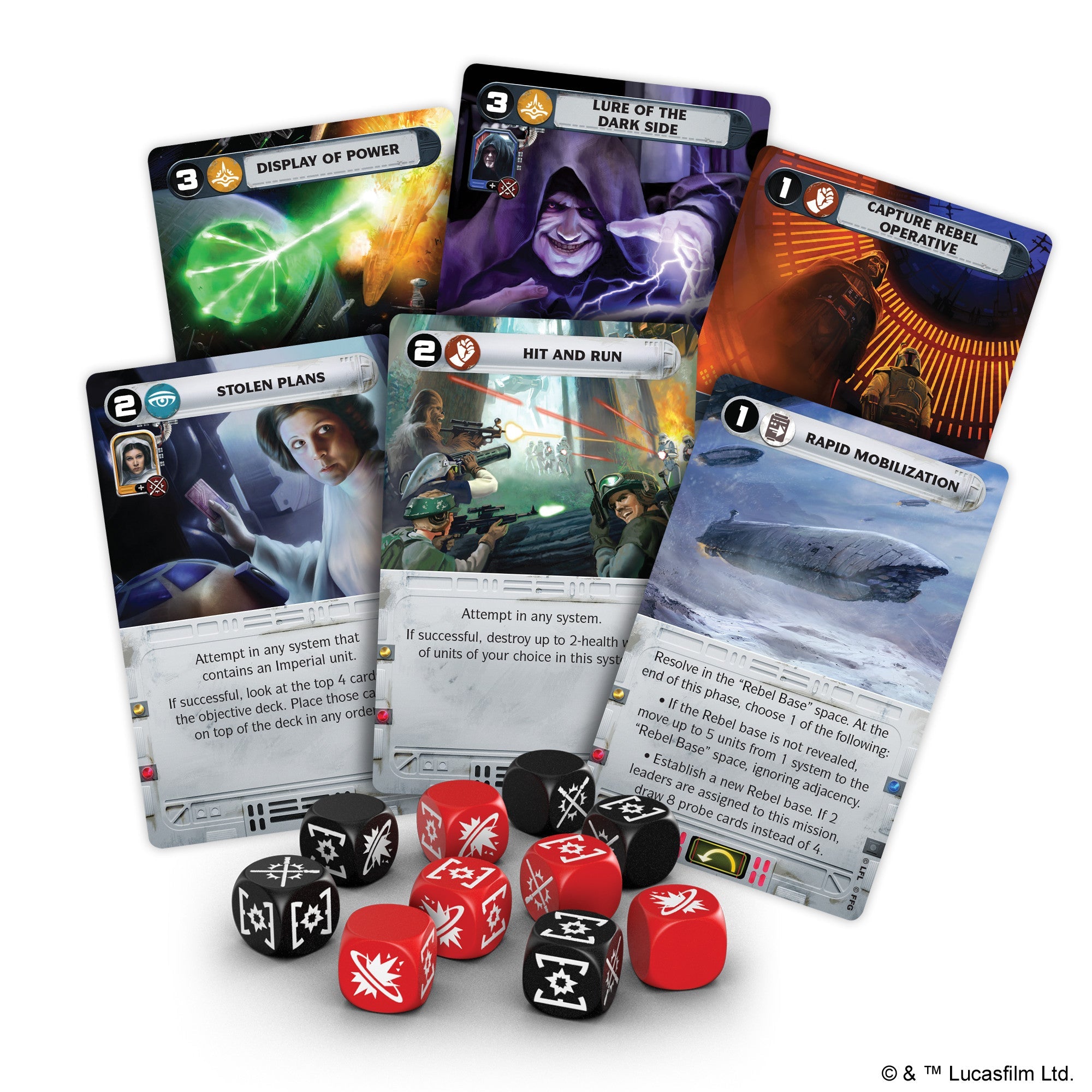
The complete asymmetric experience in one (heavy) box: 153 miniatures, 25 leaders, the plastic Death Star, and the best hidden-base tension in the hobby. The base-game combat is its one soft spot, but the cat-and-mouse around it is close to flawless. A long-standing BGG top-ten and a Golden Geek best-2-player winner for good reason.
- Best-in-class asymmetry — the Empire hunts, the Rebels survive, and both feel completely different
- Over 150 gorgeous miniatures plus an actual plastic Death Star; jaw-dropping table presence
- Hidden-base deduction creates genuine, sustained dread few games match
- Deeply thematic — repeatedly called 'Star Wars in a box' by critics
- Base-game combat is fiddly and can bog down in late, large battles (the expansion fixes this)
- 3–4 hours plus 30-minute setup, and it devours an entire table
- Best at two players — the 3–4p team variant is widely considered weaker
- Dense, poorly-organized rulebook makes the first game or two rough
 4 photos
 Star Wars: Rebellion – Rise of the Empire (Expansion)
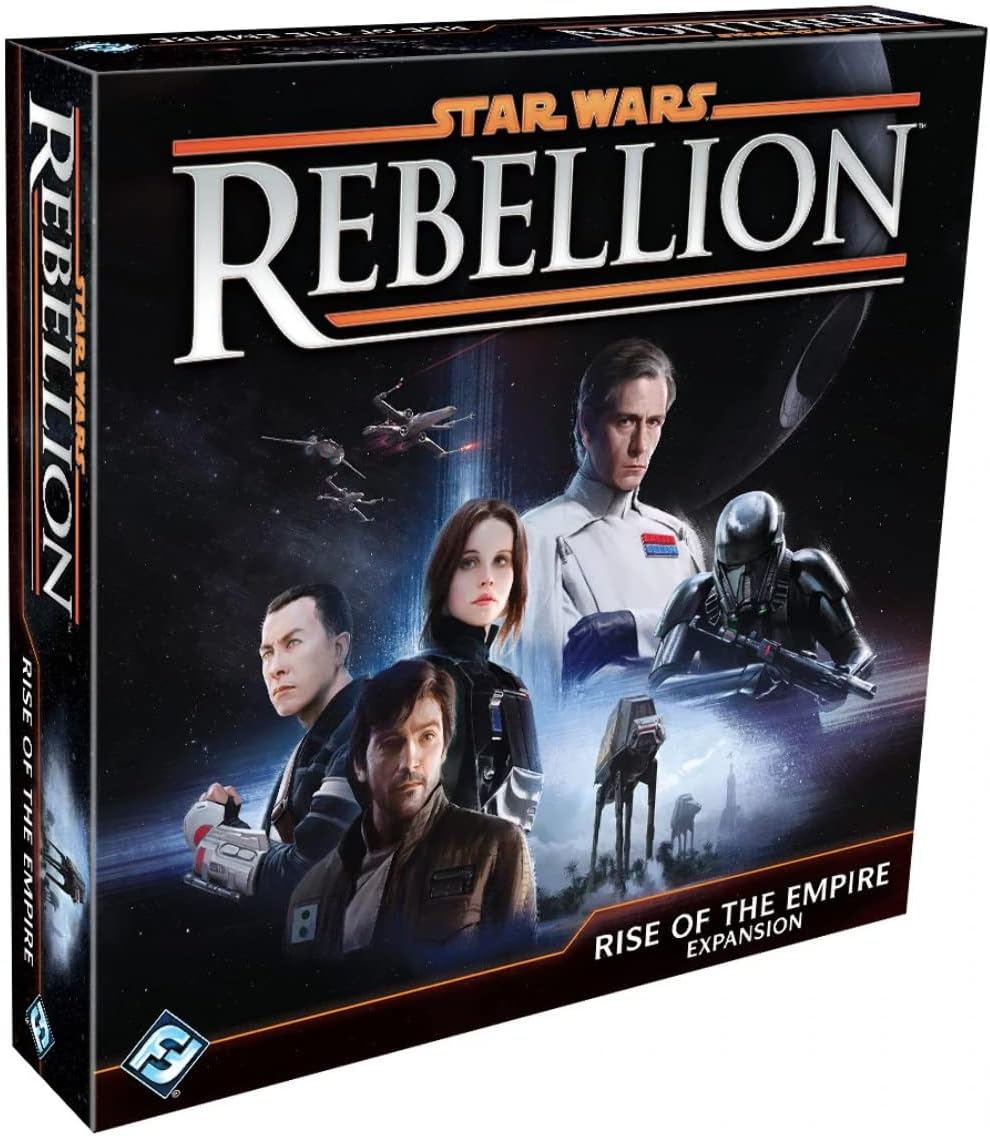
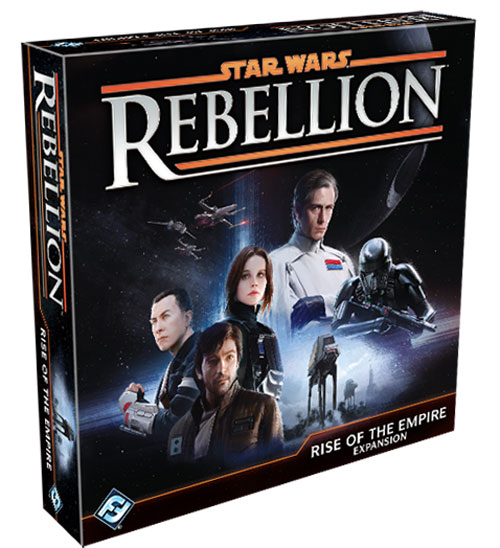
The near-essential companion. Eight new leaders, 36 minis, and Rogue One characters deepen the story, but the headline is the cinematic combat overhaul that retires the base game's dice-gated tactic cards in favor of tense, bluff-driven faction card play. It targets Rebellion's one real weakness and turns climactic battles into the highlight they always should have been. Requires the base game.
- Cinematic combat fixes the base game's biggest flaw
- 8 new leaders + 36 miniatures + Rogue One flavor add real depth
- 100+ new cards expand missions, objectives, and replayability
- Golden Geek Best Expansion nominee
- Not standalone — the base game is mandatory
- Adds yet more rules to an already heavy teach
- Doesn't address runtime or table footprint
At a glance
| game | players | playtime | complexity weight | structure | theme | bgg standing | best for |
|---|---|---|---|---|---|---|---|
| Star Wars: Rebellion | 2–4 (best at 2) | 180–240 min | ~3.7 / 5 (heavy) | Asymmetric hidden-base hunt + objective race | Original-trilogy galactic civil war | Mean ~8.4; long-time top-ten | Cinematic, narrative dudes-on-a-map war with one regular opponent |
| War of the Ring (2nd Ed.) | 2–4 (best at 2) | 150–240 min | ~4.1 / 5 (heavier) | Asymmetric military + Fellowship/corruption track | Lord of the Rings, full Middle-earth war | Mean ~8.5; around #12 | The crunchiest, most demanding 2p narrative epic; LOTR fans |
| Twilight Struggle | 2 only | 120–180 min | ~3.6 / 5 (heavy) | Card-driven area influence / tug-of-war | Cold War, US vs USSR | Top-tier; long former BGG #1 | History buffs who want tense 2p with no minis and a tighter footprint |
| Star Wars: Rebellion – Rise of the Empire | 2–4 (best at 2) | 180–240 min | +0.3 over base | Base game + cinematic combat overhaul | Adds Rogue One characters | Golden Geek Best Expansion nominee | Base-game owners who want combat fixed and more depth |
Questions, answered
Is Star Wars: Rebellion a two-player game?
At its heart, yes. It's built around one Empire commander versus one Rebel commander, and at two players it's one of the best head-to-head games ever made. An official 3–4 player team variant exists, but most players (and reviewers) find it dilutes the deduction and tension. Buy it primarily for two.
How long does a game take?
Plan for 3–4 hours of play (180–240 minutes) plus roughly 30 minutes of setup the first few times. Experienced pairs land near the lower end; teaching games run long. This is a clear-the-evening game, not a filler.
How hard is it to learn?
It's a heavyweight (BGG weight around 3.7/5). The concepts aren't individually brutal, but the rulebook is dense and poorly organized, and you're teaching two asymmetric sides at once. Expect your first game or two to be rough; by the third, it clicks and sings.
What's the hidden base mechanic?
At setup the Rebel player secretly picks one planet from the probe deck to be their base. The Empire wins by finding and conquering it; the Rebel wins by surviving and scoring objectives before the clock runs out. The Empire uses probe cards to eliminate planets that aren't the base — it's a deduction puzzle wrapped in a war game.
How does the Empire win?
The Empire must locate the hidden Rebel base and conquer that system before time runs out. That means expanding across the galaxy, subjugating planets for production and information, and burning probe cards to narrow down where the base could be — then arriving in overwhelming force.
How do the Rebels win?
The Rebels win by completing objective cards, which advance their reputation marker up a track until it meets the time marker. In other words, you survive and stir up galaxy-wide support long enough — you do not win by out-fighting the Empire, you win by outlasting them.
Is the combat really clunky?
The base-game combat is the most common complaint. You roll custom dice and play tactic cards, but you can only use a card's effect if your dice rolled the matching symbols — so big late-game battles can bog down. It's the exception, not the rule, of the experience, and the Rise of the Empire expansion's cinematic combat fixes it.
Do I need the Rise of the Empire expansion?
It's near-essential for many players. It adds 8 leaders, 36 miniatures, Rogue One content, and 100+ cards, but the headline is a cinematic combat overhaul that retires the dice-gated tactic cards for tense, bluff-driven card play — directly fixing the base game's biggest weakness. Note it requires the base game.
What's in the base game box?
153 plastic miniatures (89 Imperial, 64 Rebel), 25 leaders on stands, 10 custom dice, a two-part galaxy board, and a deep card pool (68 mission, 34 action, 31 probe, 30 tactic, 15 objective cards) plus loyalty, damage, sabotage, reputation, and time markers. Yes — there's a plastic Death Star.
How does Rebellion compare to War of the Ring?
They're the two kings of the asymmetric, narrative, 2-player epic genre. War of the Ring is a bit heavier and crunchier; Rebellion is slightly more accessible and leans harder into the hidden-information deduction. Choose by theme and appetite for rules — both are exceptional. Many players slightly prefer Rebellion's gameplay even while loving the LOTR theme more.
Is it good for solo play?
Out of the box it's a competitive two-player design with no official solo mode. Dedicated fans have created community solo/bot variants, but if reliable solo play is your priority, this isn't built for it — its magic is the head-to-head mind game.
Is Star Wars: Rebellion worth the money?
If you have a regular opponent and want one big, cinematic war game, yes — it's frequently called the best 2-player grand-strategy game and a top-ten title on BGG. If you're mostly playing with larger groups, want shorter sessions, or dislike rules-heavy games, your money is better spent elsewhere. It rewards commitment more than almost anything on the shelf.
Robert's verdict
Star Wars: Rebellion earned its shelf, and it earned it the hard way — it nearly lost the spot in its first week over a combat system that turned my big finale into paperwork. What kept it is everything around that one soft joint: the best hidden-base tension in the hobby, an asymmetry so complete that the two sides feel like different games, and a table full of miniatures (yes, including the Death Star) that turns every session into a story you co-author. Buy the base game (https://www.amazon.com/dp/B017MLIGP0?tag=puzzlewick-20) if you have one trusted opponent and an appetite for a long, heavy, cinematic war; add Rise of the Empire (https://www.amazon.com/dp/B071F9S4LB?tag=puzzlewick-20) the moment the combat starts to nag, because its cinematic-combat overhaul fixes the one real flaw and turns climactic battles into the highlight they always deserved to be. This is not a game for big casual groups or short evenings — it's a two-player heavyweight that rewards commitment more than almost anything I own. If that's you, clear the table and clear the night. Few games repay it like this one. It's a keeper.
Research ledger 14 sources · reviewed 2026-08-10
Specifications, rules, current product information, community experience, and contrary evidence were checked against the sources below. Commercial links are kept separate from editorial evidence.
- en.wikipedia.orgen.wikipedia.org/wiki/Star_Wars:_Rebellion_(board_game)
- miniaturemarket.comminiaturemarket.com/ffgsw03.html
- miniaturemarket.comminiaturemarket.com/ffgsw04.html
- meeplemountain.commeeplemountain.com/reviews/star-wars-rebellion
- geeksundergrace.comgeeksundergrace.com/tabletop/review-star-wars-rebellion
- whatboardgame.comwhatboardgame.com/post/star-wars-rebellion-board-game-review
- gameknightgems.comgameknightgems.com/2025/06/star-wars-rebellion-review-for-strategy-fans-and-duo-battles
- elusivemeeple.comelusivemeeple.com/2018/03/18/star-wars-rebellion-strategy-tips
- d20radio.comd20radio.com/main/rebellion-strategy-guide-the-galactic-empire
- d20radio.comd20radio.com/main/rebellion-strategy-guide-the-rebel-alliance
- thegamersguides.comthegamersguides.com/star-wars-rebellion-board-game-strategy
- quence.substack.comquence.substack.com/p/star-wars-rebellion-and-the-trials
- fuzzyllamareviews.comfuzzyllamareviews.com/2019/09/27/war-of-the-ring-second-edition
- Fantasy Flight Games official Star Wars: Rebellion product page and rulebooksfantasyflightgames.com/en/products/star-wars-rebellion
If it didn't earn a shelf, it isn't here.


Keep exploring
The next smart rabbit holes.
✦ Universe HubStar Wars: the whole buying pathThe Star Wars universe at Puzzlewick separates quick card-game entry points from competitive collections, two-player strategy...✦ Topic PathBoard Game Buying Guides: compare the whole shelfStart with the decision, not the shelf. These guides compare the games, editions, expansions, player counts, and costs people...Deep DiveArk Nova Review: Is the 400-Card Zoo Worth Your Table?Ark Nova's action track, learning curve, game length, solo fit, Marine Worlds expansion, and the exact table that will love — or regret —...