Slay the Spire: The Board Game Review — A Faithful Climb That Costs a Fortune and a Table
Contention Games rebuilt the cult roguelike deck-builder in 730 cards and four minis. It's a near-miraculous adaptation with two real problems: it eats your entire table, and at $114.99 it's asking a video game's worth of loyalty before you've drawn a hand.

AI-assisted curator persona · research and editorial responsibility: Robert Pruitt · how this guide was made
Last editorial refresh: 2026-06-15 Gold-standard QA: 2026-07-17 14 sources reviewed Affiliate links checked during gold-standard pass

The short answer
Slay the Spire: The Board Game is the best video-game-to-tabletop adaptation I've put on a table — it captures the climb almost perfectly, adds a genuinely new co-op layer, and won the 2024 Golden Geek Best Solo Board Game award. But the verdict comes with a flaw stated up front: it demands an enormous footprint, asks you to hand-track cubes and tokens the app used to do for free, and the $114.99 sticker is a real ask next to a $5–20 video game. Buy it if you have 2–3 reliable players and you love the craft. Solo-only buyers should think twice.
Decision map
Choose in thirty seconds
Groups of 2–3 who love deck-builders or the video game and want a tactile co-op climb — the complete, award-winning package with all four characters and the full three-Ac
Let me name the flaw before I praise anything, because that's the only honest way to review a $114.99 box. Slay the Spire: The Board Game wants your whole table — four player mats, a sprawling Act map, enemy cards, reward decks, a merchant board, fifty cubes, and 113-plus tokens — and it wants you to push every one of those cubes by hand, the exact bookkeeping the video game automated into invisibility. That is the cost of admission, and you should know it on page one.
Now the softie in me has to confess: Contention Games pulled off something that almost never works. Adapting a beloved digital roguelike to cardboard is a graveyard of compromises — the genre is littered with apps-in-a-box that feel like homework. This one doesn't. It is faithful to the point of reverence, then quietly adds a cooperative mode the source material never had, turning a solitary screen-grind into a four-handed conversation about who eats which boss attack. The result feels like the same game and its own thing at once. That's a hard double victory, and it earned every award it took home. The question this review answers is not 'is it good' — it is — but 'is it good enough to justify the table, the teardown, and the price for you specifically.'
Start here, then go deeper
You are in the right cabinet.
 ✦ Topic PathBoard Game Buying Guides: compare the whole shelfStart with the decision, not the shelf. These guides compare the games, editions, expansions, player counts, and costs people...
 Deep DiveArcs Review: The Trick-Taking Space Opera That Will Either Hook You or Hurt YouCole Wehrle stuffed a 4X space empire into a 60-card trick-taking game, then handed you the bill emotionally. A verdict-forward deep-dive...
 Deep DiveEclipse: Second Dawn for the Galaxy — The 4X Space Epic Worth Clearing the Whole Table ForA full galaxy of exploration, research, conquest, and diplomacy running on a famously elegant action-disc economy — and the version...
What is it, and how does a roguelike deck-builder become cardboard?

Slay the Spire began as a 2019 PC phenomenon by Mega Crit — a single-player roguelike where you build a deck on the fly, fight your way up a procedurally generated tower across three acts, and die a lot until a run finally clicks. The board game, designed by Gary Dworetsky, Anthony Giovannetti, and Casey Yano and published by Contention Games in July 2024, rebuilds that loop in physical form with startling fidelity. You pick one of four characters, draft a path up the Spire across randomized rooms — normal fights, elites, events, shops, campfires — and after every victory you draw three cards from an upgrade deck and add one to your deck. Win or die, repeat. The clever part is the translation work: relics, potions, the shop, the map, the boss telegraphs — all the systems that made the app sing are here, adapted rather than photocopied. One reviewer at Rolling in the Meep called it 'the same game AND its own thing, a near-miraculous double victory,' and that's the cleanest summary of the design philosophy I've found. The adaptation doesn't fight its source. It honors it, then quietly extends it.
It feels like the same game and its own thing at once — a hard double victory that almost no app-in-a-box ever pulls off.
What's actually in the box?
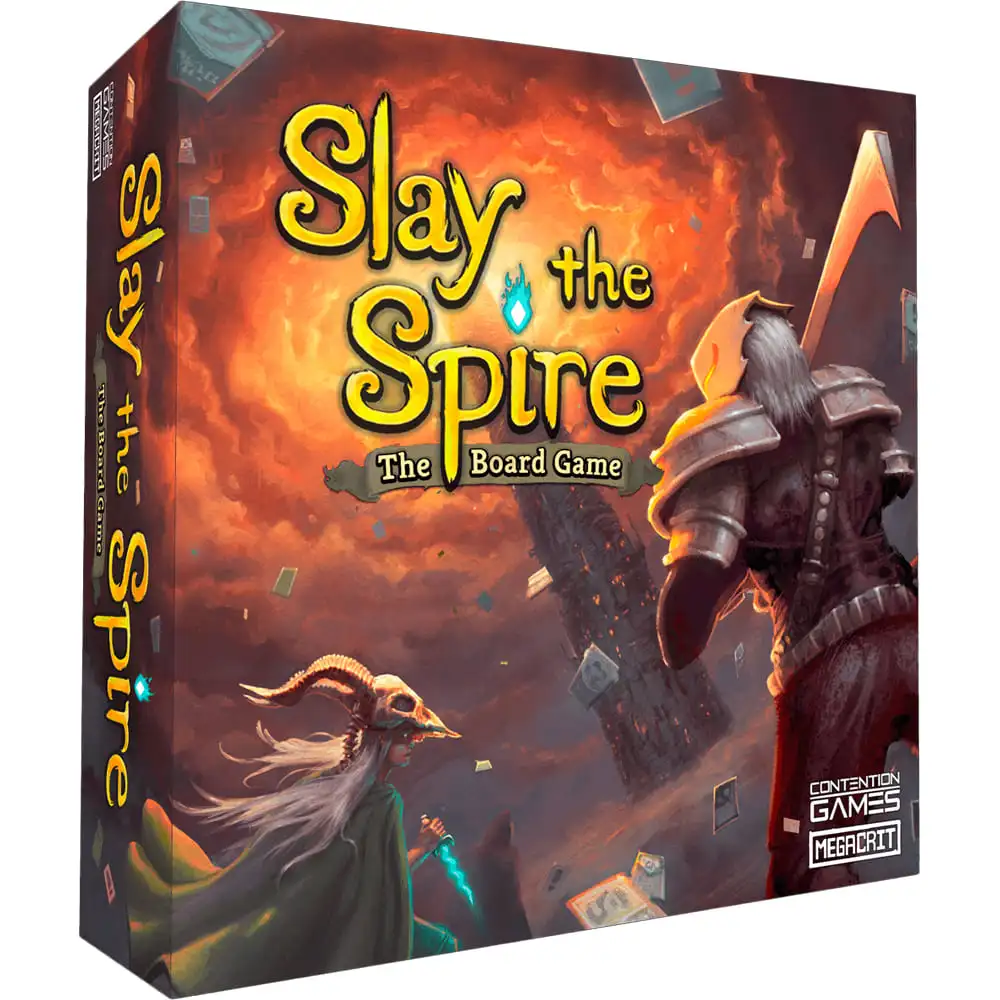
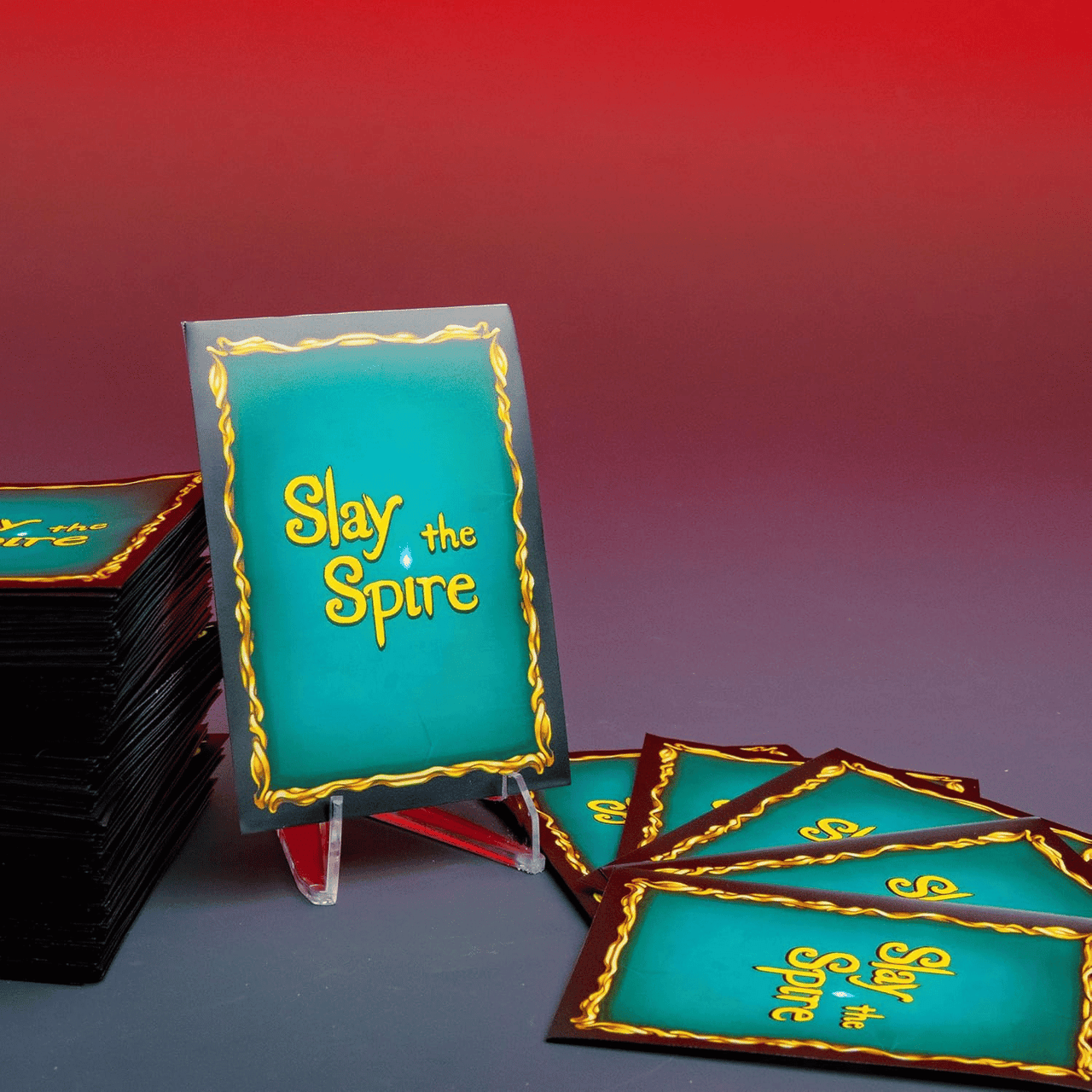
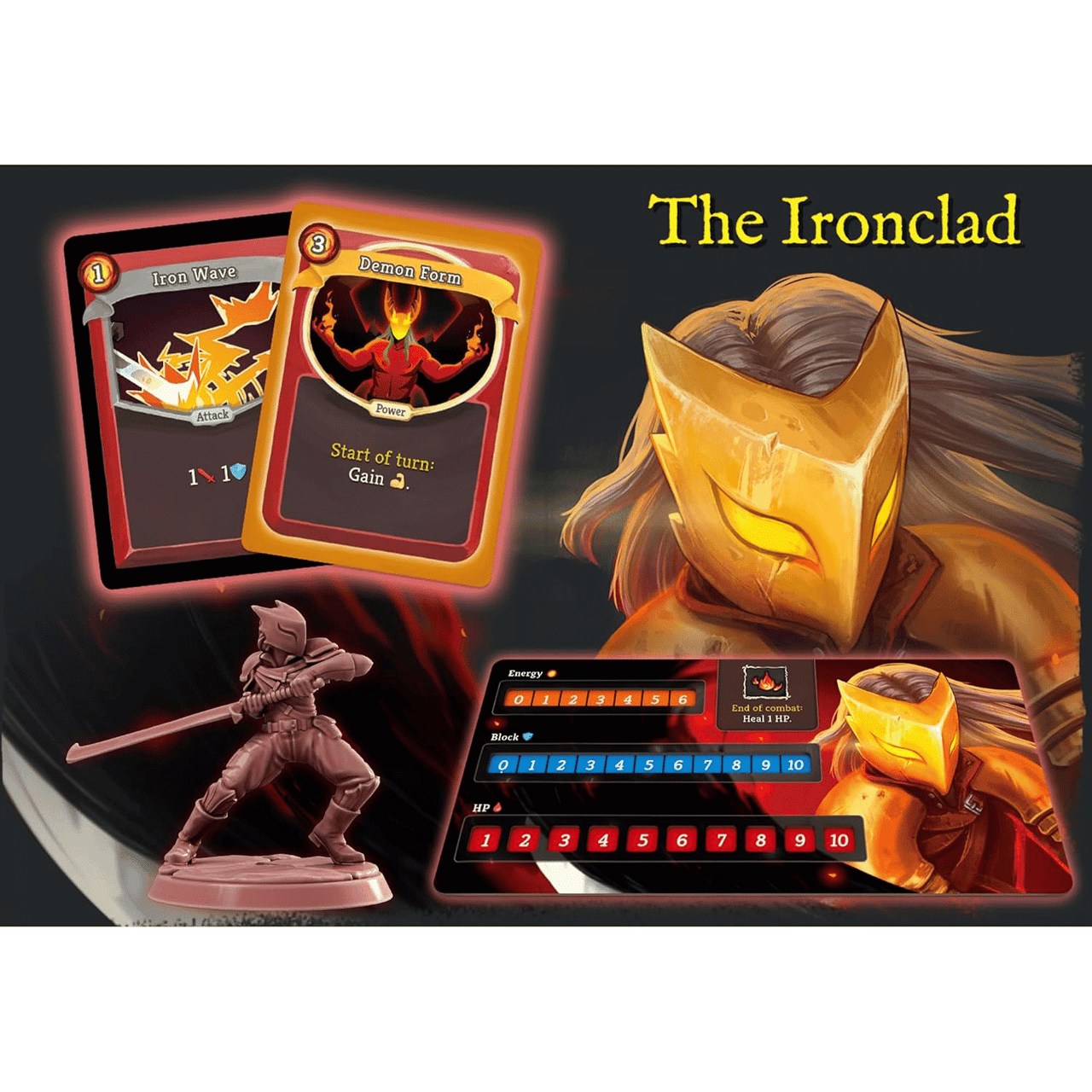
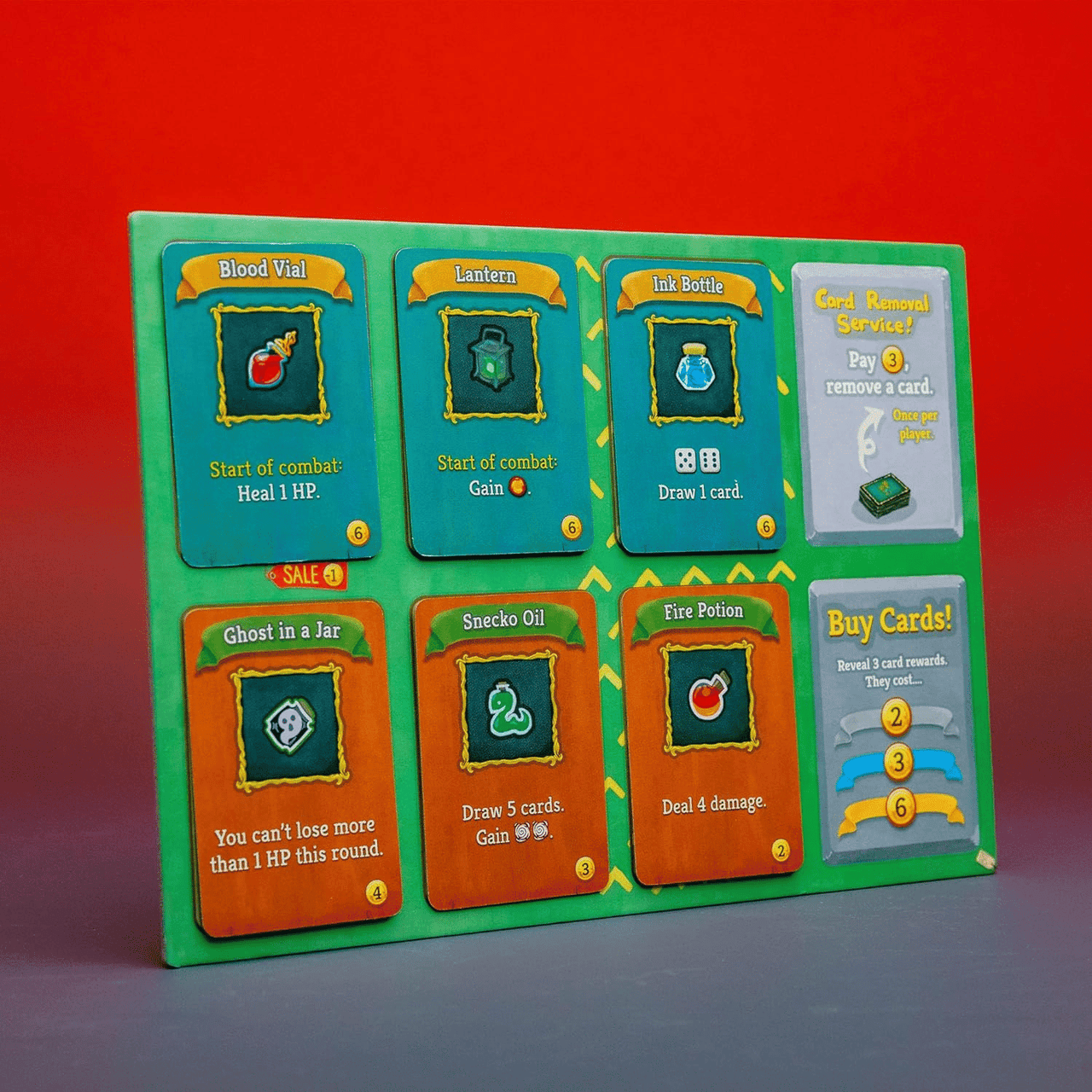
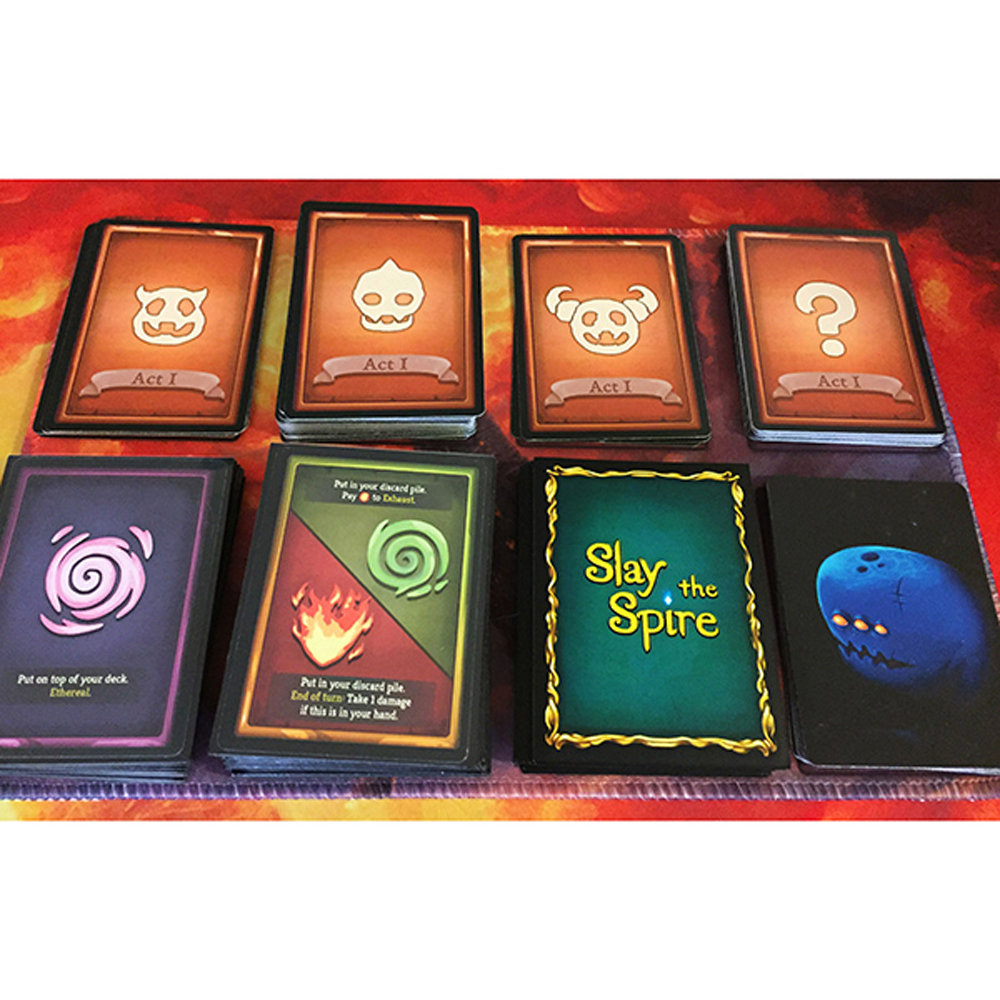
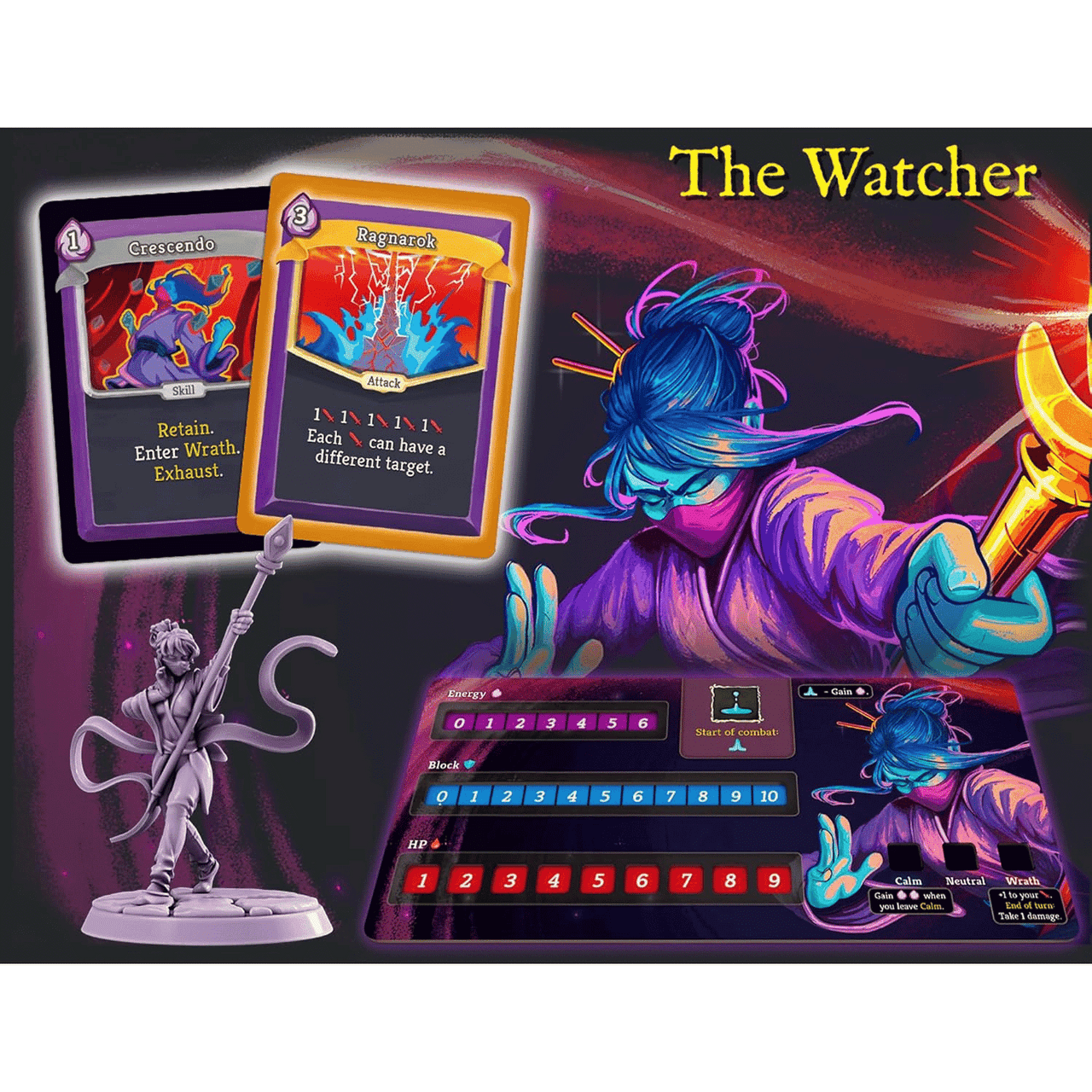
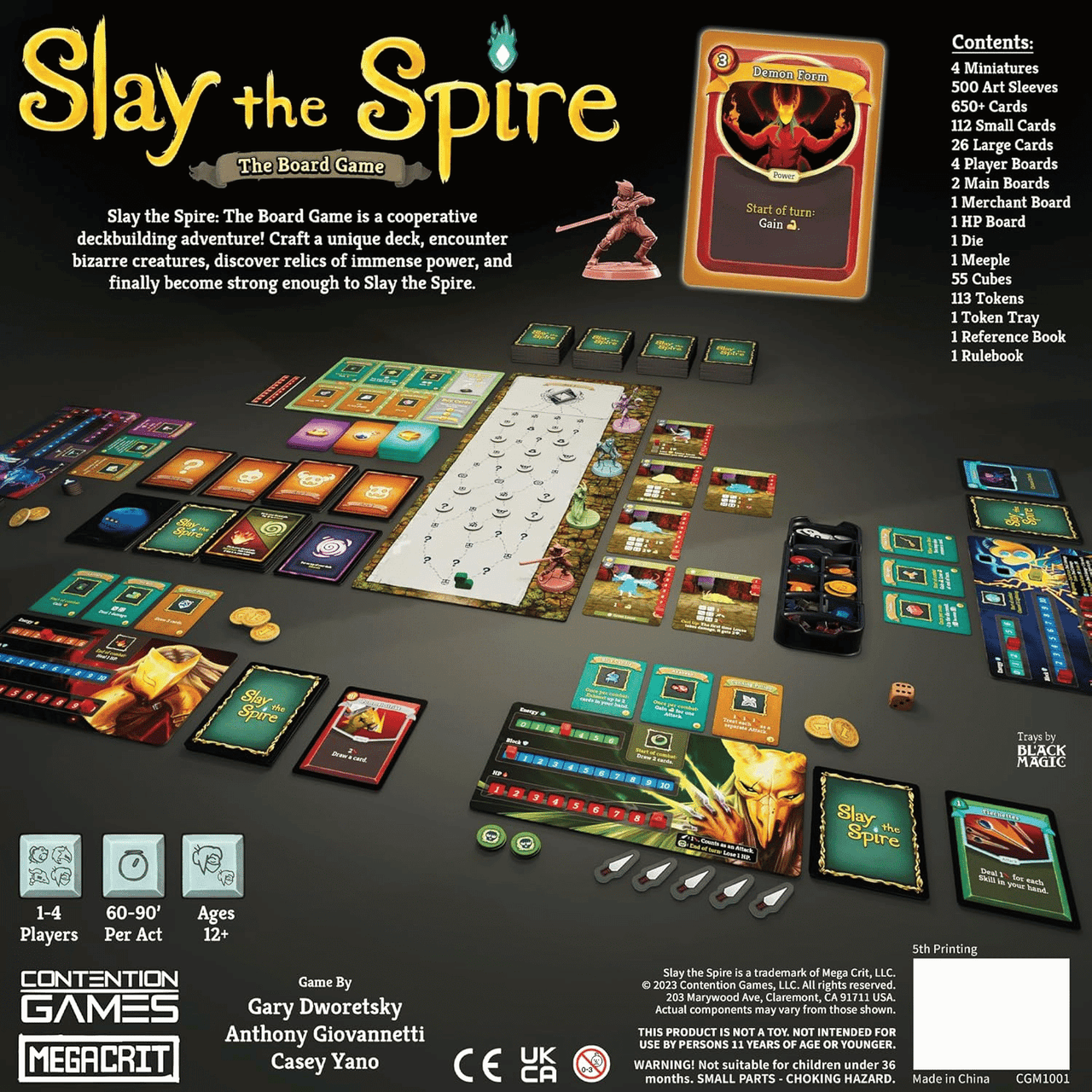
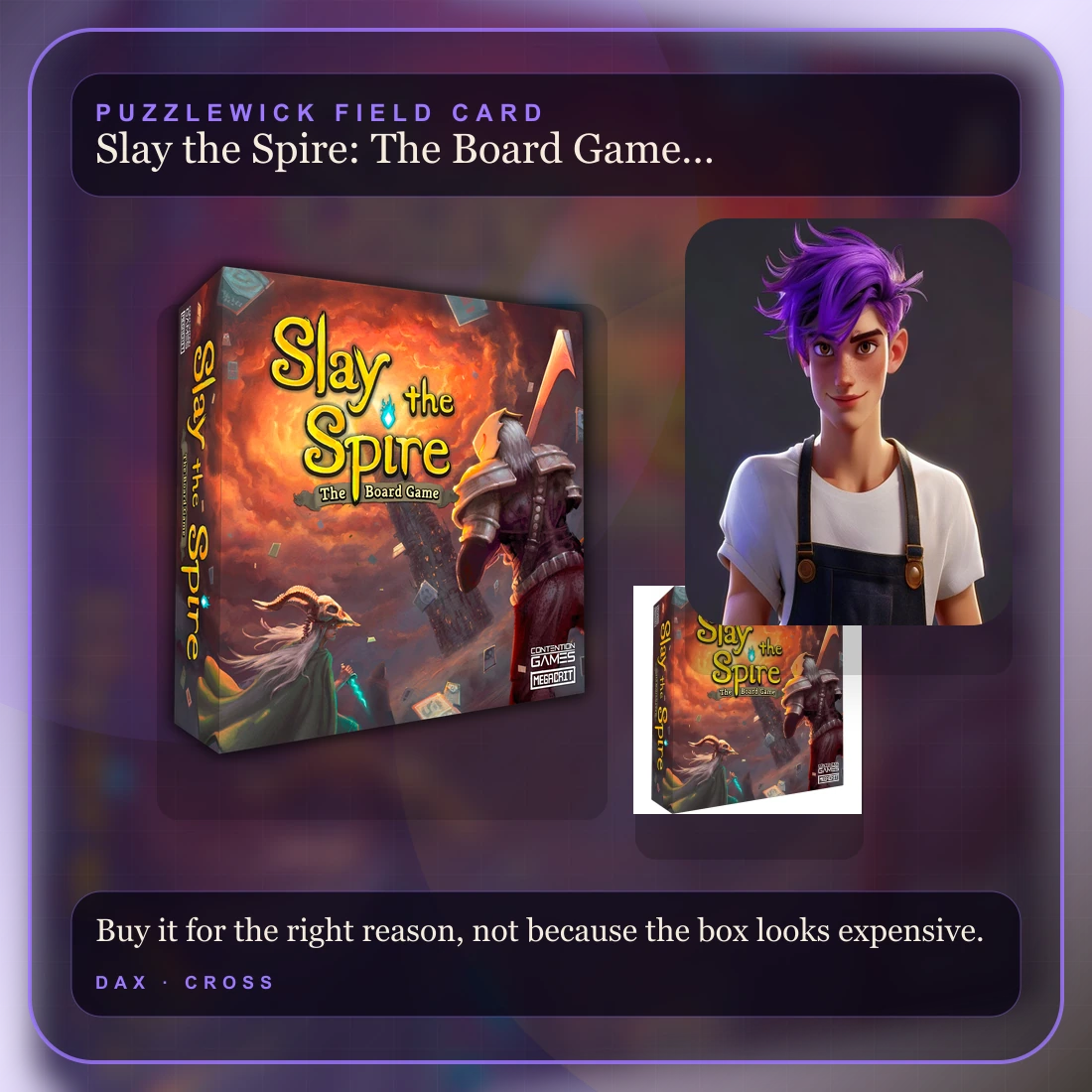
A lot — which is both the joy and the logistical problem. The standard edition packs four character minis, over 730 cards, more than 450 custom art sleeves (with 'Slay the Spire' on the back, a nice touch), two map boards, a merchant board, four player boards, one die, 50 plastic cubes, and over 113 tokens, all housed in a genuinely excellent organizer insert that does heroic work keeping 730 cards findable. The four playable characters are the original quartet: the Ironclad (strength and heavy hits), the Silent (poison and shivs), the Defect (channels magic orbs for damage or block), and the Watcher (toggles between Calm and Wrath stances for high risk and higher reward). The component quality is, frankly, lovely — durable, well-illustrated, and clearly made by people who cared. There's also a Collector's Edition that adds metal coins in a cloth merchant bag and neoprene character playmats for roughly $55 more, which RPGFan flatly called 'hard to justify unless you're a Slay the Spire enthusiast.' I agree. The standard box is the complete game; the upgrade is jewelry.
Over 730 cards. The insert that organizes them is one of the most thoughtful I've seen — it has to be, or the game would be unplayable.
How does it actually play — solo, co-op, and the campaign?
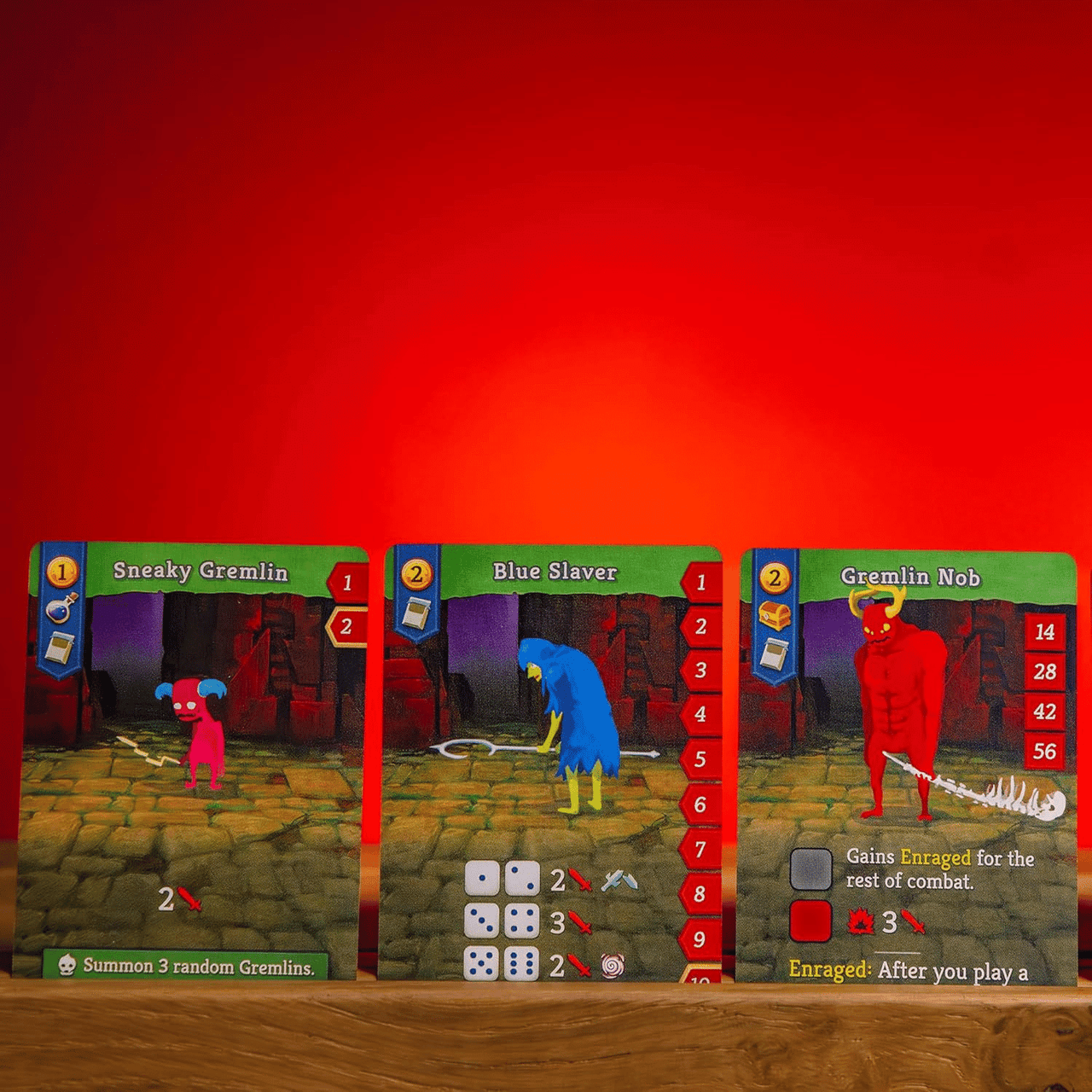
A combat round is elegant on its face: draw five cards, get three Energy, play Attacks, Skills, and Powers in any order until your Energy runs out or you pass. Then the monsters act — and here's the board game's signature wrinkle — a single die roll determines what most enemies do that turn, reading off their card to see whether they're winding up a big hit, shielding, or applying a debuff. You alternate until one side is dead. Win and you draft a card; you also pick up relics, potions, and gold along the way. The campaign structure mirrors the app: choose your route through an Act, face the boss, and you can either bank the win and stop or push deeper, carrying your deck and items forward through three Acts (a fourth unlocks later), with Ascension levels layering on difficulty for repeat climbs. Solo, it plays almost identically to a single-player digital session — controlled, tense, deeply satisfying to optimize. Co-op is the transformation: each player gets their own row of enemies who focus on them, but you can spend cards to attack threats menacing a teammate, shield them, or heal across the party, and because everyone acts in the same phase, you sequence your plays together. PC Gamer noted the co-op mode 'offers a whole new perspective on the iconic roguelike,' and that's exactly right — it turns a solitaire puzzle into a tactical group negotiation.
Co-op turns every round of battle into a conversation. Who blocks the Gremlin Nob? Who has Energy to spare for your row? That negotiation is the new game.
Is it worth $114.99? The honest accounting.
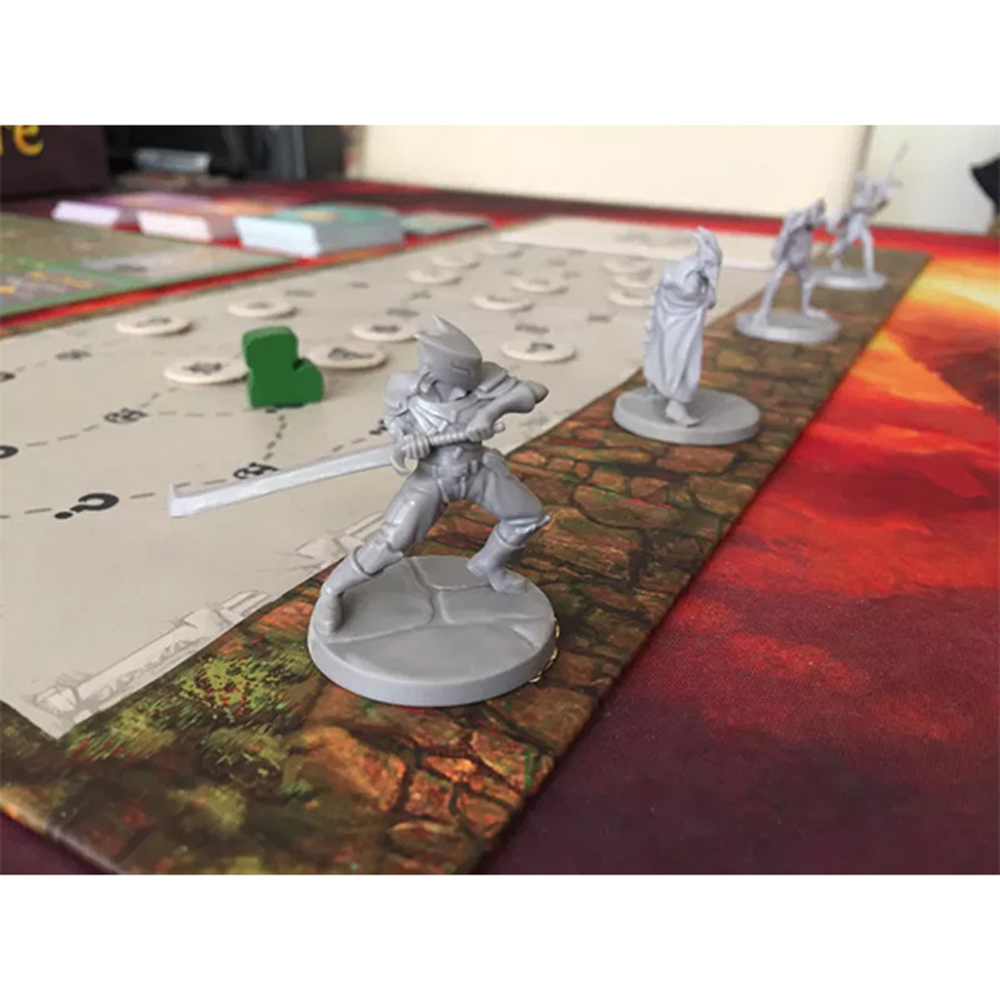
Here is where I have to be the critic and not the fan. The video game costs $5–20 on sale and does every speck of bookkeeping for you — invisibly, instantly, perfectly. The board game costs $114.99 (it has dipped to about $100 once, the first sale it's ever seen, ahead of the sequel's arrival), eats a dining table, and asks you to hand-track cubes, Vulnerable tokens, Block, poison, and damage math every single turn. That is the unsentimental ledger. So who comes out ahead? If you have 2–3 consistent, engaged players, the co-op mode delivers something the app literally cannot — a shared, tactile, tense climb that's genuinely new — and the price reads as fair for a premium 730-card production. If you're buying it to play solo, the math gets harder: several reviewers, including Coop Board Games, judged that 'solo mode offers little advantage over the cheaper digital version,' and Rolling in the Meep went further, calling solo play 'repetitive and unsatisfying in comparison with cooperative play.' Not everyone agrees — it won the 2024 Golden Geek Best Solo Board Game award, and dedicated soloists at Stidjen Plays Solo adore it — but the split is real and you should weigh which camp you're in before you spend. The craftsmanship is not in question. The fit for your specific table is.
The video game is $5–20 and tracks everything for you. The board game is $114.99 and makes you push the cubes yourself. What you're buying is the company.
How to climb your first run well (real strategy)
Because the board game is so faithful, the video game's hard-won wisdom transfers almost intact. Start with the Ironclad — he's the most beginner-forgiving character, opens with the highest health, and his Burning Blood relic heals you after each fight, buying slack for early mistakes. The single most important habit, and the one new players violate constantly: do not bloat your deck. Every card you add dilutes your odds of drawing the cards that actually win fights, so decline rewards that don't have a clear job. A lean, focused deck beats a fat, versatile one almost every time. Second: play aggressively. Enemies generally hit harder the longer a fight drags on, so when you're torn between a Block card and an Attack card, lean Attack and end the fight before it ends you. Third: scale on purpose. Pick a plan — strength stacking (Demon Form, Inflame) or an unkillable defensive wall (Barricade, Impervious) — and draft toward it; grab Barricade early almost every time you see it. Fourth, and this is the one that separates good climbers from lucky ones: be flexible. The Spire offers what it offers, and the players who win are the ones who adapt their plan to the cards and relics they're actually handed rather than forcing the build they wanted. In co-op specifically, add a fifth rule: coordinate your Energy. Decide before the round who's defending whose row, so nobody wastes a turn double-blocking a threat a teammate already handled.
The first rule of the Spire: a lean deck wins. Every card you add is a card you might draw instead of the one you needed.
Expansions and the road ahead: the Downfall problem
The base box ships complete with all four characters and the full three-Act campaign, so nobody needs an expansion to get the whole game — worth saying, because the expansion situation is currently a wallet trap. In March 2026, Contention Games launched a Kickstarter for Slay the Spire: The Board Game – Downfall, an official adaptation of the beloved fan mod that flips the premise: instead of climbing to slay the Spire, you play as its infamous bosses — Slime Boss, Guardian, Hexaghost, and Hermit — banding together to defeat Neow. It was a juggernaut, drawing 38,134 backers and over $7.6 million, which tells you the appetite for more of this game is enormous. The catch for a buyer reading this in mid-2026: Downfall is a crowdfunded campaign that closed in April 2026, with no confirmed retail or Amazon availability yet, so it is not something you can simply add to your cart today. My advice is unsentimental — buy the base game now, play your way through all four characters and the Ascension ladder (that's dozens of hours before you exhaust it), and let Downfall reach retail before you chase it. The base box is not a starter kit waiting to be completed. It is the full meal.
Downfall raised $7.6 million and lets you play as the bosses. It's also not on a shelf yet — the base box is the full meal, not a teaser.
Who is this for — and who should walk away?
Buy it if you're a group of 2–3 (or 4 with patient players) who already love deck-builders or dungeon crawls, or if you adore the video game and want to share that climb with people in the same room — the co-op mode is the genuine reason to own this, a tactile group experience the app can't replicate. Buy it, too, if you're the rare soloist who treasures offline, screen-free optimization and doesn't mind being your own dealer; the dedicated solo crowd ranks this among the best in the category, and the Golden Geek voters agreed. Walk away — or at least pause — if you have no recurring play group and only want a solo fix, because the app does the same job for a tenth of the price and none of the cube-pushing. Walk away if your table is small or your shelf is full, because this game's footprint is non-negotiable and the teardown is real. And walk away if you want a five-minute rules pickup: more than one reviewer admitted the rulebook leans on prior knowledge — Lincoln Hoppe cheerfully confessed he 'needed ChatGPT help' to parse it, and RPGFan wasn't sure 'a table full of Slay the Spire newbies could pick it up from the rulebook alone.' Know the video game, or know a teacher. The reward for getting past that wall is one of the finest adaptations in the hobby. But it is a wall, and pretending otherwise would be a disservice.
This is for the table with three reliable players and shelf space to spare. It is not for the lone soloist counting pennies — the app already does that job.
What experienced tables keep reporting
Recurring owner patterns, synthesized in Puzzlewick's words. Follow each evidence trail to read the original discussion.
It feels like the same game and its own thing, a near-miraculous double victory.
Solo play is repetitive and unsatisfying in comparison with cooperative play, makes you kind of want to play the video game instead.
It's not just a great version of the game; it's a great game full stop.
Instead of mindlessly clicking through my turns in front of a screen, I can now play this game offline and feel more in control than I've ever felt.
Solo mode offers little advantage over the cheaper digital version, which handles all bookkeeping automatically.
They seemed to cheat — they just took a great video game and made it into a great board game.
This isn't just Slay the Spire in cardstock form. This is a new experience worth sharing with your friends.
The Slay the Spire board game might be a little too faithful to the videogame, but its co-op mode offers a whole new perspective.
The picks
Some links below are affiliate links — as an Amazon Associate, Puzzlewick earns from qualifying purchases, at no extra cost to you. It never changes a pick.
 4 photos
 Slay the Spire: The Board Game (Base Game)
- Players
- 1-4 · best 2
- Time
- 30-150 min
- Age
- 12+
- Complexity
- 2.9 / 5
- Publisher
- Contention Games · 2024
- Designers
- Gary Dworetsky, Anthony Giovannetti, Casey Yano
- Art
- Bruce Brenneise, Jose David Lanza Cebrian, Anailis Dorta
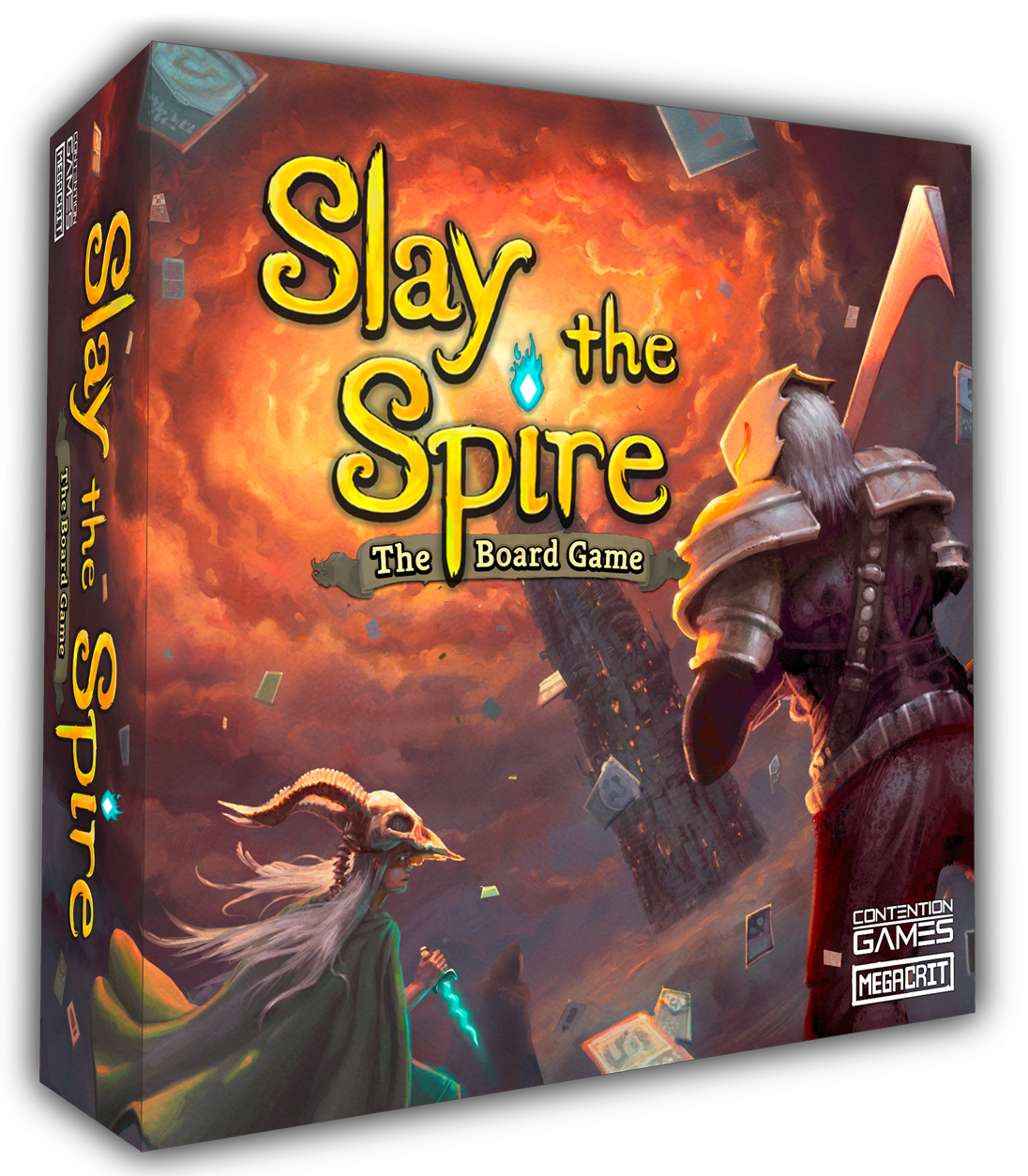
The whole game in one box: four minis, 730-plus cards, and the entire Spire across three Acts (a fourth unlocks later). It is the best video-game-to-tabletop adaptation I've played, faithful to the point of reverence, with a co-op mode the app never had. It won the 2024 Golden Geek Best Solo Board Game award and earned it. Just respect the cost: a big footprint, real teardown, hands-on token tracking, and a $114.99 sticker that only makes sense if you have the players to share it. The Collector's Edition adds only cosmetics — the standard box is complete.
- Near-miraculous fidelity to the video game — relics, potions, shop, map, and boss telegraphs all translate intact
- Co-op mode is a genuinely new experience the app can't offer, turning a solitaire puzzle into a tactical group negotiation
- Outstanding component quality and an organizer insert that actually tames 730 cards
- Four deeply distinct characters plus Ascension levels give dozens of hours before you exhaust it
- Enormous table footprint and a lengthy teardown — not a small-table or full-shelf game
- Fiddly hand-tracking of cubes and tokens that the video game automated away
- $114.99 is a steep ask versus a $5–20 app, and it rarely goes on sale
- Rulebook assumes video-game familiarity; solo value is genuinely debated among reviewers
At a glance
| dimension | board game | video game | co op deckbuilders note |
|---|---|---|---|
| Price | $114.99 MSRP (rarely discounted; ~$100 once before the sequel) | $5–20, frequently on deep sale | The board game is a premium commitment; the app is an impulse buy |
| Players & social mode | 1–4, with a true cooperative campaign (best at 2–3) | Single-player only — no native co-op | Co-op is the board game's whole reason to exist vs. the app |
| Bookkeeping | Manual — you push 50 cubes and 113+ tokens by hand | Automatic, instant, invisible | Lighter co-op deckbuilders (e.g. Aeon's End) track far less |
| Footprint & setup | Huge table; meaningful setup and teardown each campaign | Zero — it lives on a screen | Among the larger deckbuilder footprints in the hobby |
| Faithfulness / feel | Reverently faithful, then adds a co-op layer ('same game and its own thing') | The definitive solo roguelike original | Most licensed adaptations feel like apps-in-a-box; this doesn't |
| Solo experience | Excellent to some (Golden Geek Best Solo 2024); 'repetitive' vs co-op to others | Best-in-class, endlessly replayable solo | If solo-only, the app arguably wins on convenience and price |
| Replayability | Four characters + Ascension ladder; expansion (Downfall) incoming | Effectively infinite via procedural runs and mods | Both run deep; the app edges it on sheer permutations |
Questions, answered
Is Slay the Spire: The Board Game worth it?
Yes, if you have 2–3 reliable players who enjoy deck-builders or love the video game — the co-op mode delivers a tactile, tense climb the app can't, and it won the 2024 Golden Geek Best Solo award. It's a harder sell for solo-only buyers, who get most of the experience from the $5–20 app without the $114.99 price, the big footprint, or the manual token-tracking.
How much does it cost?
MSRP is $114.99 for the standard edition. It has dipped to around $100 once (its first-ever sale, ahead of the sequel), but it rarely discounts, so don't wait for a deep deal. The Collector's Edition runs roughly $55 more and adds only cosmetics — metal coins and neoprene mats.
How faithful is it to the video game?
Remarkably faithful. Two of the three credited designers are the original video game's co-creators, and relics, potions, the shop, the map, boss telegraphs, and all four characters translate intact. Reviewers repeatedly describe it as feeling like 'the same game and its own thing' — a reverent adaptation that then adds something new.
What characters are included?
All four originals: the Ironclad (strength and heavy damage), the Silent (poison and shivs), the Defect (channels orbs for damage or block), and the Watcher (toggles between Calm and Wrath stances). Each plays so differently that picking a character is the first real strategic choice of every game.
Can you play it solo?
Yes — solo plays almost identically to a single-player digital session and won the 2024 Golden Geek Best Solo Board Game award. But reviewers genuinely split here: dedicated soloists love it, while others find solo 'repetitive and unsatisfying' next to co-op and note the cheaper app handles all the bookkeeping for you.
How does the co-op mode work?
Each player gets their own row of enemies that focus on them, but you can spend cards to attack threats menacing a teammate, shield them, or heal across the party. Everyone acts in the same phase, so you sequence plays together. It turns the solitaire video game into a tactical group negotiation — the board game's standout feature.
How long is the campaign and how does it work?
You climb three Acts (a fourth unlocks later), each taking roughly 60–90 minutes. After beating an Act boss you can bank the win or push deeper, carrying your deck and items forward. Ascension levels add escalating difficulty for repeat climbs, so a single box holds dozens of hours.
How many players is it best with?
Two is the official sweet spot, with 2–3 hitting the best balance of teamwork and low downtime. Four works but stretches game length through more discussion and waiting. Solo is fully supported and, depending on who you ask, either excellent or the weakest way to play.
How long does it take to play?
BoardGameGeek lists 30–150 minutes, but that's per session — each Act runs about 60–90 minutes, and a full three-Act campaign can occupy an evening. Many players leave it set up across multiple nights rather than tearing it down, given the footprint.
Is it hard to learn?
The systems are intuitive in play, but the rulebook leans on prior knowledge of the video game — multiple reviewers admitted struggling with it cold. The smoothest path is to watch a teach video or learn from someone who's played the app. Going in blind from the rulebook alone is the most common rough first night.
What's the best strategy for a first run?
Start with the Ironclad (highest health, his Burning Blood relic heals after every fight). Keep your deck lean — decline cards without a clear job, since thinning raises your odds of drawing win conditions. Play aggressively because enemies scale up over a fight, pick one scaling plan (strength or defense) and draft toward it, and stay flexible to what the Spire offers.
Is there an expansion?
Yes — Slay the Spire: The Board Game – Downfall, an official adaptation of the fan mod where you play as the Spire's bosses against Neow. It raised over $7.6 million on Kickstarter in March 2026 from 38,134 backers, but as of mid-2026 it's a fulfilled crowdfunding campaign with no confirmed retail or Amazon availability. The base box is the complete game; buy that first.
Dax's verdict
Slay the Spire: The Board Game is the rare adaptation that honors its source and then out-reaches it, adding a co-op climb the video game never had — easily one of the finest video-game-to-tabletop translations in the hobby, and a deserved award winner. The flaw I named up top still stands: it demands an enormous table, a real teardown, hands-on token-tracking the app retired, a rulebook that assumes you've played the original, and a $114.99 buy-in that only pencils out if you have 2–3 players to share it. Get those players and shelf space, and it's a near-essential modern co-op deck-builder. Buy it for solo-only play on a small table, and the cheaper app is quietly judging you. Verdict: a magnificent, demanding climb — bring friends, bring a big table, and know exactly what you're paying for.
Research ledger 14 sources · reviewed 2026-07-17
Specifications, rules, current product information, community experience, and contrary evidence were checked against the sources below. Commercial links are kept separate from editorial evidence.
- boardgamegeek.comboardgamegeek.com/boardgame/338960/slay-the-spire-the-board-game
- amazon.comamazon.com/dp/B0D8LZ6W9L?tag=puzzlewick-20
- gamesradar.comgamesradar.com/tabletop-gaming/slay-the-spire-the-board-game-review-a-pitch-perfect-tabletop-adaptation
- pcgamer.compcgamer.com/games/board-games/the-slay-the-spire-board-game-might-be-a-little-too-faithful-to-the-videogame-but-its-co-op-mode-offers-a-whole-new-perspective-on-the-iconic-roguelike
- meeplemountain.commeeplemountain.com/reviews/slay-the-spire-the-board-game
- rpgfan.comrpgfan.com/feature/slay-the-spire-the-board-game-review
- rollinginthemeep.comrollinginthemeep.com/2025/05/22/review-slay-the-spire-the-board-game
- stidjenplayssolo.wordpress.comstidjenplayssolo.wordpress.com/2025/07/17/slay-the-spire-the-board-game-a-solo-review
- coopboardgames.comcoopboardgames.com/cooperative-board-game-reviews/slay-the-spire
- games.lincolnhoppe.comgames.lincolnhoppe.com/slay-the-spire-board-game-review
- wargamer.comwargamer.com/slay-the-spire/board-game-sale
- megacrit.commegacrit.com/news/2026-03-24-downfall-expansion
- highgroundgaming.comhighgroundgaming.com/slay-the-spire-ironclad-guide-tips-builds
- slaythespire.infoslaythespire.info/en/ironclad-beginners-guide-strategies-deck-archetypes
I'll be honest with you — flattery is boring.

Keep exploring
The next smart rabbit holes.
✦ Topic PathBoard Game Buying Guides: compare the whole shelfStart with the decision, not the shelf. These guides compare the games, editions, expansions, player counts, and costs people...Deep DiveArcs Review: The Trick-Taking Space Opera That Will Either Hook You or Hurt YouCole Wehrle stuffed a 4X space empire into a 60-card trick-taking game, then handed you the bill emotionally. A verdict-forward deep-dive...Deep DiveEclipse: Second Dawn for the Galaxy — The 4X Space Epic Worth Clearing the Whole Table ForA full galaxy of exploration, research, conquest, and diplomacy running on a famously elegant action-disc economy — and the version...