Arkham Horror: Children of Blood Guide: What You Need, Blood Tokens and First-Campaign Strategy
Robert and the curators unpack the compact Arkham campaign: the right Core, blood-token examples, difficulty changes, team roles and equipment that actually fits.

Written and reviewed by Robert Pruitt · how this guide was made
Last editorial refresh: 2026-09-01 Gold-standard QA: 2026-09-01 18 sources reviewed Affiliate links checked during gold-standard pass

The short answer
Children of Blood is a three-scenario Arkham Horror: The Card Game expansion for 1-4 players, not a standalone game. Learn the current Core first, then start a fresh campaign using the expansion's setup. Blood tokens add minus-one redraws and can leave persistent marks after failed tests. Choose it for a compact investigation and tactical pressure, not for random player-card packs or a guaranteed easy campaign.
Decision map
Choose in thirty seconds
Every new 2026 player and the current Chapter Two release path
Chapter Two's first complete post-Core campaign
A player who wants spellcasting and a strong character theme
Arkham has found another way to make a small bag feel like a personal disagreement. This time, a failed test can leave a mark that follows the investigator into the next problem. Children of Blood makes that distinction its business.
We will begin with whether the box belongs on your table, explain the rules that cause the most confusion, and finish with a practical route through the campaign and its accessories. This is a source-led guide with editorial strategy, not a claimed hands-on review. Official first-look cards appear below; later resolutions and solutions do not.
Start here, then go deeper
You are in the right cabinet.
 ✒ Universe HubArkham Horror Universe: the whole buying pathStart with the interactive buyer intake: separate the 2026 Chapter Two Core from Chapter One legacy boxes and the entirely...
 ☾ Topic PathCooperative Horror Games: compare the whole shelfCooperative horror works when the rules pressure the story without burying the table. This cluster maps what to buy, how campaigns...
 Beginner's GuideArkham Horror LCG First Game Guide 2026: Setup, Rules, Skill Tests & Solo PlayRobert turns the rulebook into one playable evening: which Core to open, exactly how to build the table, what every phase does, and the...
Is Children of Blood the right next Arkham campaign?
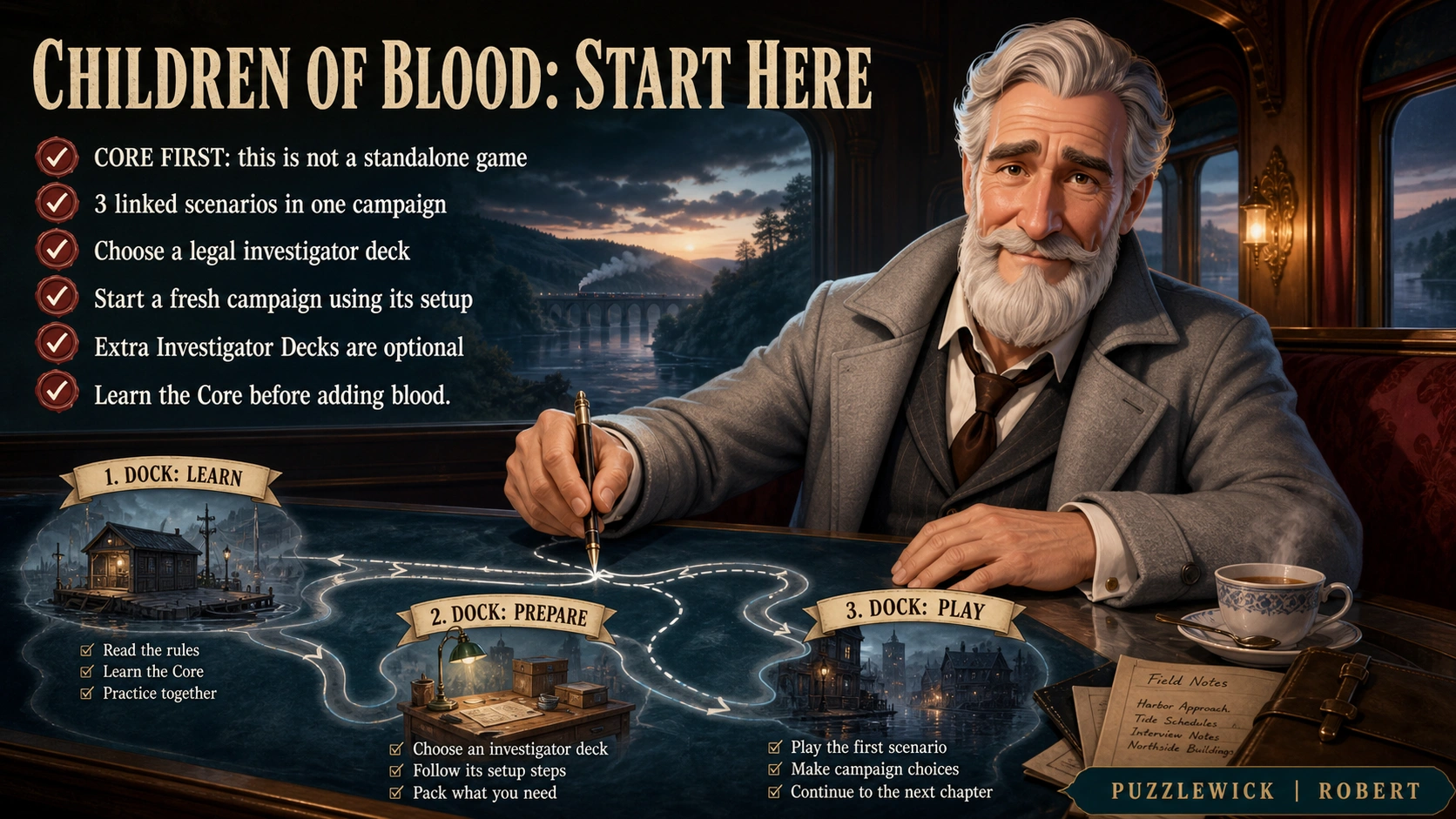
Children of Blood suits a group that wants a complete, compact campaign after learning the Core. Its three linked scenarios give you a beginning, development and conclusion without an eight-scenario appointment book. You still make deck decisions, manage a changing encounter system and live with the campaign's instructions. Small box does not mean tiny rules commitment.
The attraction is a tightening investigation in which danger can leave a mark on the investigator, not merely disappear when a test ends. The cost is procedural attention. If resolving a chain of tokens sounds interesting, this has something to say to you. If everyone mainly wants relaxed conversation while a game runs in the background, choose a gentler evening.
- Buy for: a finishable story arc, cooperative planning and a distinctive new source of test pressure.
- Wait if: the Core remains unplayed, your team cannot yet assemble scenarios confidently, or you mainly want a large injection of player cards.
- Skip for now if: horror, failure with consequences or repeated rules lookups make the table miserable.
The publisher lists 1-4 players, ages 14+, and approximately 1-2 hours per scenario. That is not a guarantee of a three-hour campaign. Leave room for setup, story, upgrades and the brief committee meeting that occurs whenever somebody says, "I think this is probably safe." The official release announcement is dated August 14, 2026; earlier preorder-date disputes are no longer the useful buying question.
Source: official Children of Blood game page.
What do you need, and what is already in the box?
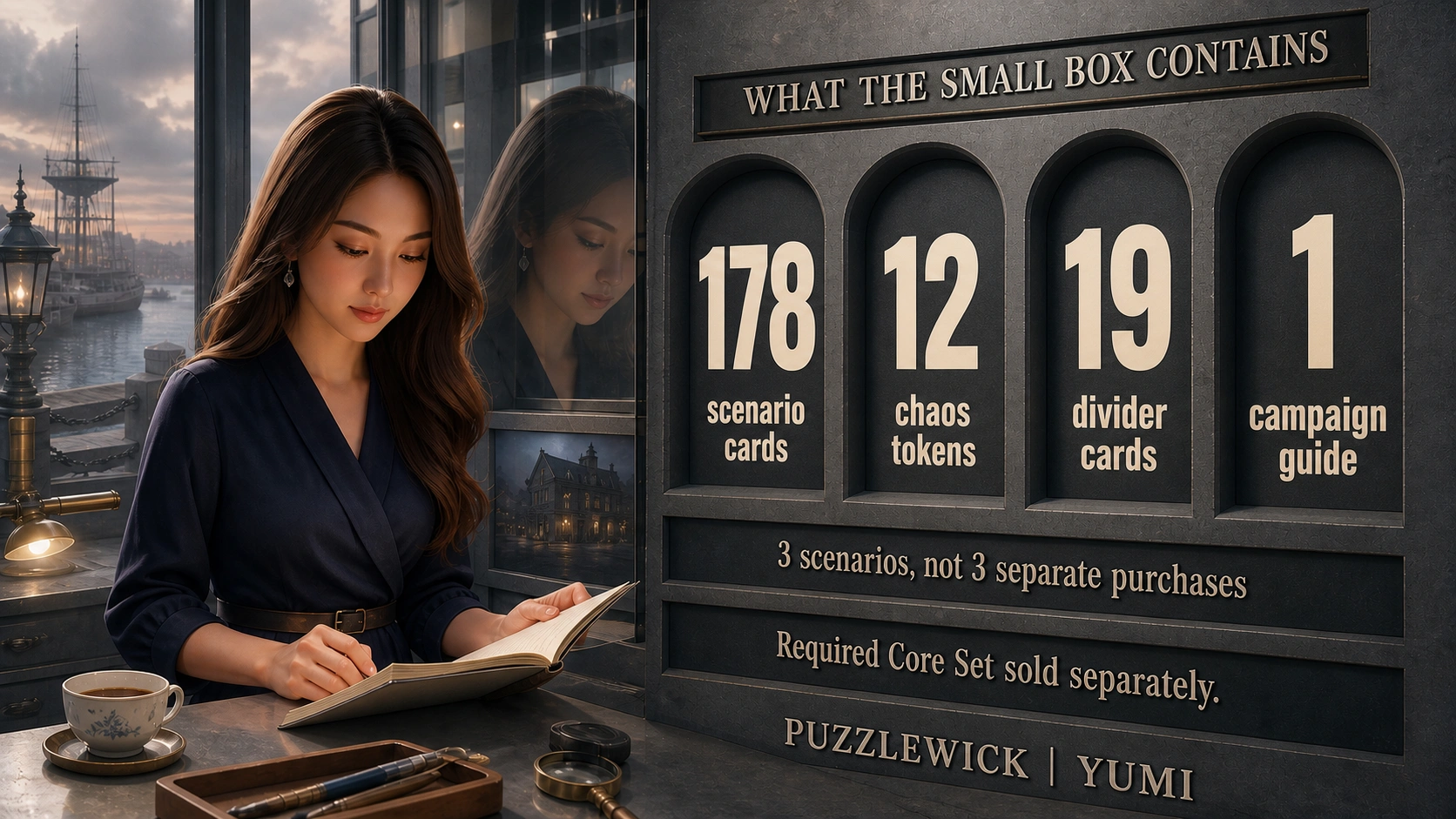
Start with the Chapter Two Core Set, a legal investigator deck for each player, and Children of Blood. The current Core is the beginner route this guide is built around. The expansion is not standalone. Existing owners should check its printed encounter-set requirements against their collection; the words "I own an Arkham core" do not identify which edition is on the shelf.
Asmodee lists 178 scenario cards, 12 chaos tokens, 19 divider cards and one campaign guide. Follow the scenario assembly instructions: some cards belong to a particular scenario, version or set. Pouring all 178 into one encounter deck would create a very ambitious rules error.
This is a fixed-content Living Card Game expansion, not a random booster product. You are buying scenarios and their supporting material. Additional Investigator Decks change your playable character options; they do not unlock missing chapters in this box. The Core already supplies a roster. Play what you have before assigning an entire new shopping list to every friend.
The smallest useful purchase
Already learned the current Core? The expansion is the next story purchase. Brand-new to Arkham? Begin with our first-night field manual and finish the Core introduction first. Need another ready-made deck rather than another story? That is a different purchase, explained below.
Begin a fresh campaign, not an accidentally overpowered demo
Use the campaign's own opening setup and your investigator's deckbuilding rules. Do not carry experience from another campaign into this one unless a rule explicitly permits it. A deck posted as a nineteen-experience standalone build is not automatically a legal opening campaign deck.
Campaign and standalone play are different frameworks. The Grimoire's standalone rules allow experience within specified limits and add basic weaknesses in experience bands. That is useful for a standalone session, not permission to skip the opening economy of a fresh campaign. When a shared deck list looks wonderfully efficient, first check which framework it assumes.
- Agree on difficulty before sorting scenario versions.
- Build the chaos bag exactly as the setup says. Twelve supplied tokens does not mean all twelve begin in the bag.
- Use the requested encounter sets, including any player-count instructions.
- Prepare your investigator, deck, starting resources and hand using the rules.
- Record campaign notes and any setup choices before advancing.
Keep the official campaign log beside the campaign guide. The log has space for experience, trauma, the bag and narrative notes; it is not a substitute for the scenario rules.
Source: Grimoire, standalone play and reward rules, page 38.
The first-turn refresher: actions, objectives and safe questions
A normal investigator turn gives you three actions. Moving, investigating, fighting, evading, playing a card, drawing a card and gaining a resource are familiar possibilities, subject to costs and card text. Your first job is not to perform all of them. It is to identify which action helps the current act or prevents the team from losing the chance to advance it.
Enemies complicate quiet administrative work. An engaged, ready enemy can make attacks of opportunity when you take many actions. Fight, Evade, Parley and Resign are among the exceptions in the rules. "I will just draw until I find a weapon" is not necessarily a peaceful plan when an enemy is already standing beside you.
A first-turn conversation that actually helps
Say what you can contribute: "I can collect clues here, but I need help if an enemy appears." Then ask whether somebody else's turn should come first. The team can coordinate investigator order, and a helpful move or enemy answer may make your turn far better. Advice should give you options; it should not confiscate your turn.
Before a test, identify the skill, difficulty, relevant modifiers and legal committed cards. Commit before revealing the chaos token. Another investigator at your location may normally commit one eligible card; read exceptions on cards. You do not pay a committed card's resource cost. These small distinctions prevent more confusion than memorising every future encounter.
Source: Grimoire, skill-test timing, page 30.
How blood tokens work: the penalty and the mark
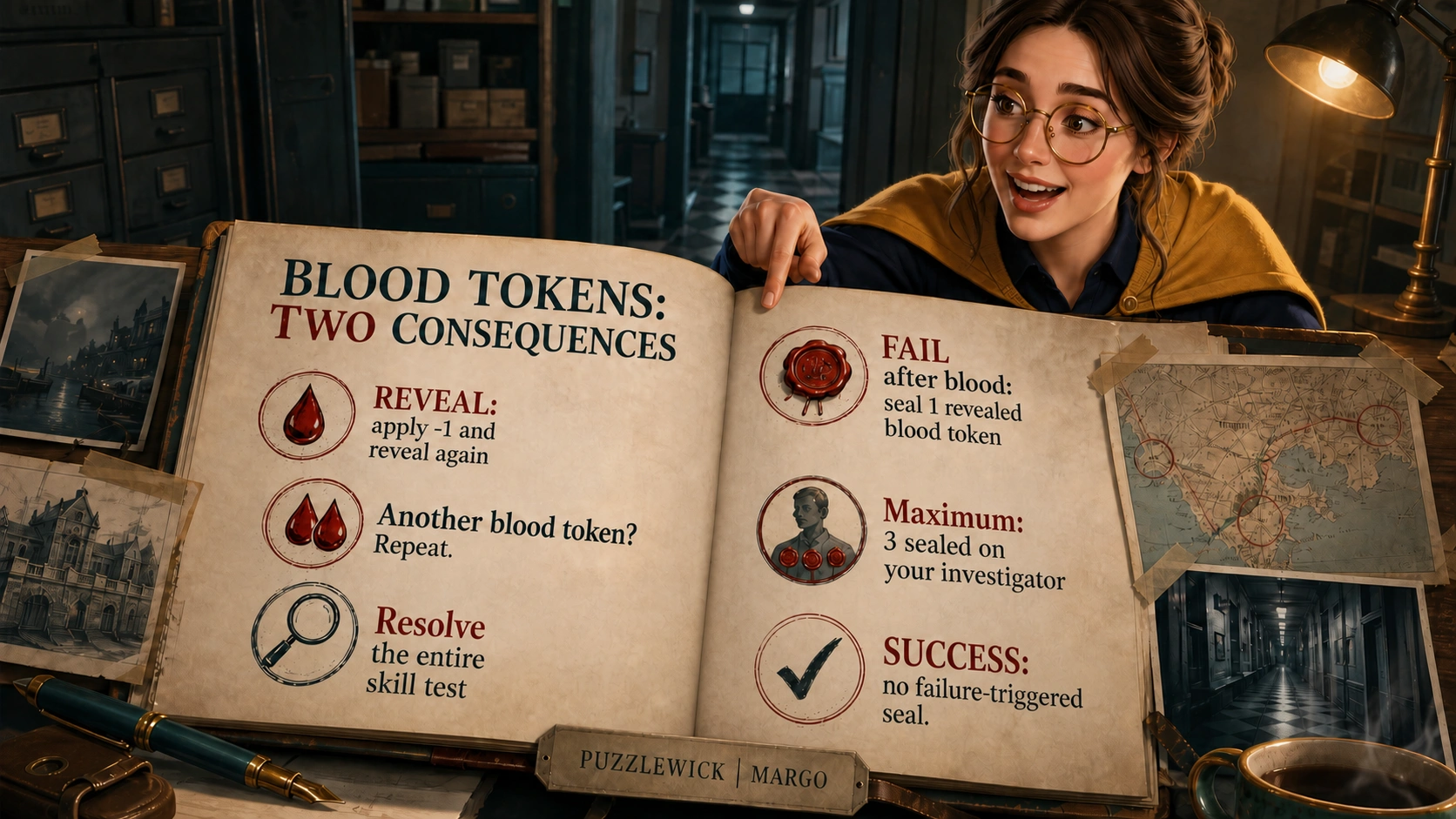
A blood token applies a minus-one modifier and makes you reveal another chaos token. If that is another blood token, keep resolving the sequence. Do not stop at the first red symbol, and do not put a revealed token back into the bag immediately as though each reveal were a new test.
There is a second consequence. If the test fails after you revealed one or more blood tokens, seal one of those blood tokens on your investigator. The basic rule permits up to three sealed on an investigator. Revealing two blood tokens does not mean sealing two. The failure and the resulting persistent mark are separate things to track.
Sealed tokens are removed from the chaos bag while sealed. Cards can read how many you have. A smaller bag can therefore coexist with an investigator in a more dangerous condition. Do not deliberately chase failed tests because removing tokens sounds clever; the encounter deck has opinions about that arrangement.
Follow any specific card instruction that changes the procedure. The campaign guide and the exact card being resolved take precedence over this general summary.
Source: FFG first look: blood tokens and sealed-token consequences.
A worked blood test: why a tie matters
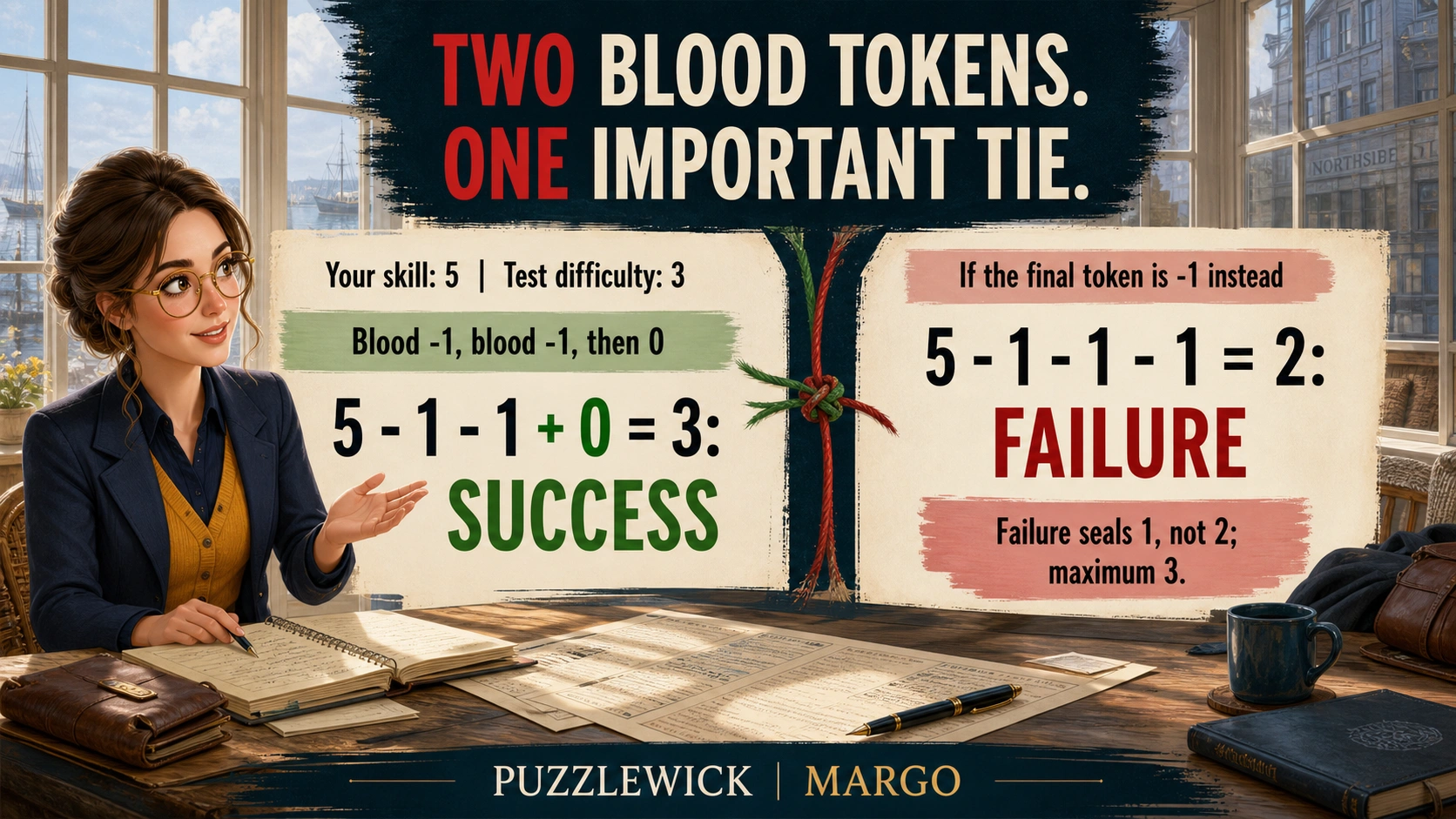
Imagine a skill value of five against difficulty three, with no other modifiers or special effects. You reveal blood, then blood, then zero. The two blood penalties reduce five to three. Three meets difficulty three, so the test succeeds. The blood rule's failure-triggered seal does not occur.
Now change the final token from zero to minus one. The result becomes two, so the test fails. You seal one of the revealed blood tokens if you have room under the three-token limit. Not two tokens. Not one token for each point of failure.
An automatic-failure token is a separate case: matching the difficulty does not defeat automatic failure. Always resolve the token and card effects, not merely the arithmetic you hoped to finish with.
What this changes in practice
A skill margin that normally feels comfortable can shrink through repeated blood reveals. Spend committed cards on tests with consequences: the clue that advances the act, the attack that prevents another enemy phase, or the treachery your investigator cannot afford to fail. Do not exhaust your hand defending every cheap test equally. The useful question is not "Can I improve this number?" but "What does failure cost us here?"
Does more blood mean more automatic failure? Not always
More minus-one redraws can make tests harder without increasing the chance of the eventual ordinary token being the automatic-failure token. Those are different claims.
Here is a deliberately simplified example, not a Children of Blood starting bag: sixteen non-blood tokens, exactly one of them automatic failure, and three blood tokens that only apply minus one and redraw. Reveal without replacement until you reach a non-blood token. Each of those sixteen terminal tokens is equally likely to be the first one reached. The automatic-failure chance is one in sixteen. Adding three more pure blood redraws leaves that terminal chance at one in sixteen, while increasing the chance of accumulating penalties first.
The model stops being sufficient when other tokens also redraw, an effect cancels or replaces tokens, or a card gives blood a different consequence. That last exception is important here. Treat this as a way to reason accurately about risk, not a universal calculator for every Arkham bag.
The practical conclusion is simpler than the mathematics: protect your useful skill margins and read the current test's special effects. Our calculation is original analysis of the basic procedure, checked by enumeration across different small bags. It is not a published campaign probability or an official deck recommendation.
Read the sealed-token warnings before they stack up
The official preview makes the persistent risk tangible. Torturous Transformation changes its punishment according to the investigator's sealed-token count. With none, it attacks resources; with one or two, damage and horror enter the picture; at three, it also takes a random card. The exact printed text supplies the full resolution.
Grisly Compulsion raises a willpower test's difficulty for each sealed blood token. Other previewed enemies prioritise investigators with the most sealed blood. This is why "my bag has fewer bad tokens now" is an incomplete status report. Your investigator may have become a more attractive target.
A useful between-turn check
Look at health, sanity, ready enemies, useful defensive cards and sealed blood together. If one investigator is carrying the pressure, another may need to take the next exposed action or clear a route. Do not treat blood as damage you can freely heal, or invent a way to remove it because the group would prefer a cleaner board. Use only the rules and effects actually available.
Source: FFG previewed encounter interactions.
Easy and Standard versus Hard and Expert: assemble the right streets
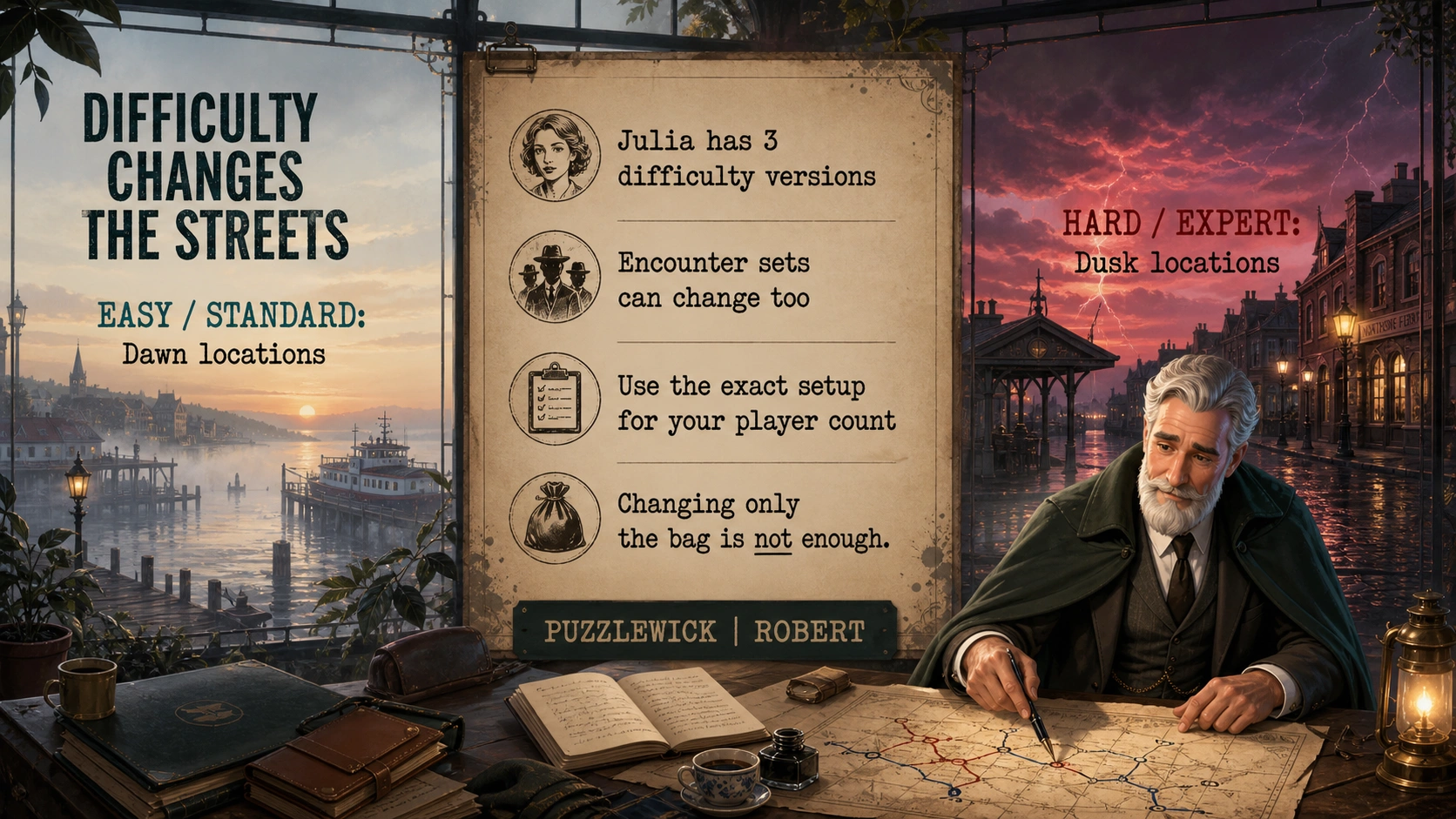
In River of Blood, Easy and Standard use Dawn locations; Hard and Expert use Dusk locations. The difference is not just a harsher bag. The same named place can offer a different decision.
Water Street is an excellent public-preview example. The Dawn version lets you search part of your deck for an Ally through its action. The Dusk version has a higher shroud and a forced doom consequence when the final clue is discovered. "I know this location" is not enough; make sure you know this version.
Back Alley also changes its costs and effects between versions. Julia Stern has three difficulty variants: one for Easy, one for Standard and one for Hard/Expert. FFG also describes encounter-set changes tied to difficulty and player count. Merely changing the bag can leave the rest of the scenario assembled incorrectly.
For a newcomer, Easy is a sensible learning choice, not a character judgment. Pick Standard when the team can resolve tests, enemy handling and scenario setup without constant uncertainty. Save a harder replay for when you want the changed material itself. Increasing difficulty while still learning the procedure can make it difficult to tell whether you lost to a decision or to a setup mistake.
Source: FFG first look: difficulty-specific scenario material.
The official Julia preview, without later-story revelations
The first-look premise follows a disappearance and disturbing reports involving Julia Stern. The official preview shows her three difficulty cards. They are useful evidence of the scenario's structure, not an invitation to narrate the campaign's resolutions.
This guide stays with announced premises, first-look cards and general procedures. It does not identify later surprises, tell you how to obtain particular resolutions or print a boss solution. Read the supplied campaign guide as instructed during play. A good investigation deserves at least the courtesy of not having the last page read aloud while everyone is finding sleeves.
For atmospheric background beyond the product preview, Arkham's official fiction includes The Ravenous Undead. Treat additional fiction as optional reading and check its spoiler context before a blind campaign.
Solo, two investigators or a larger group: give every deck a job
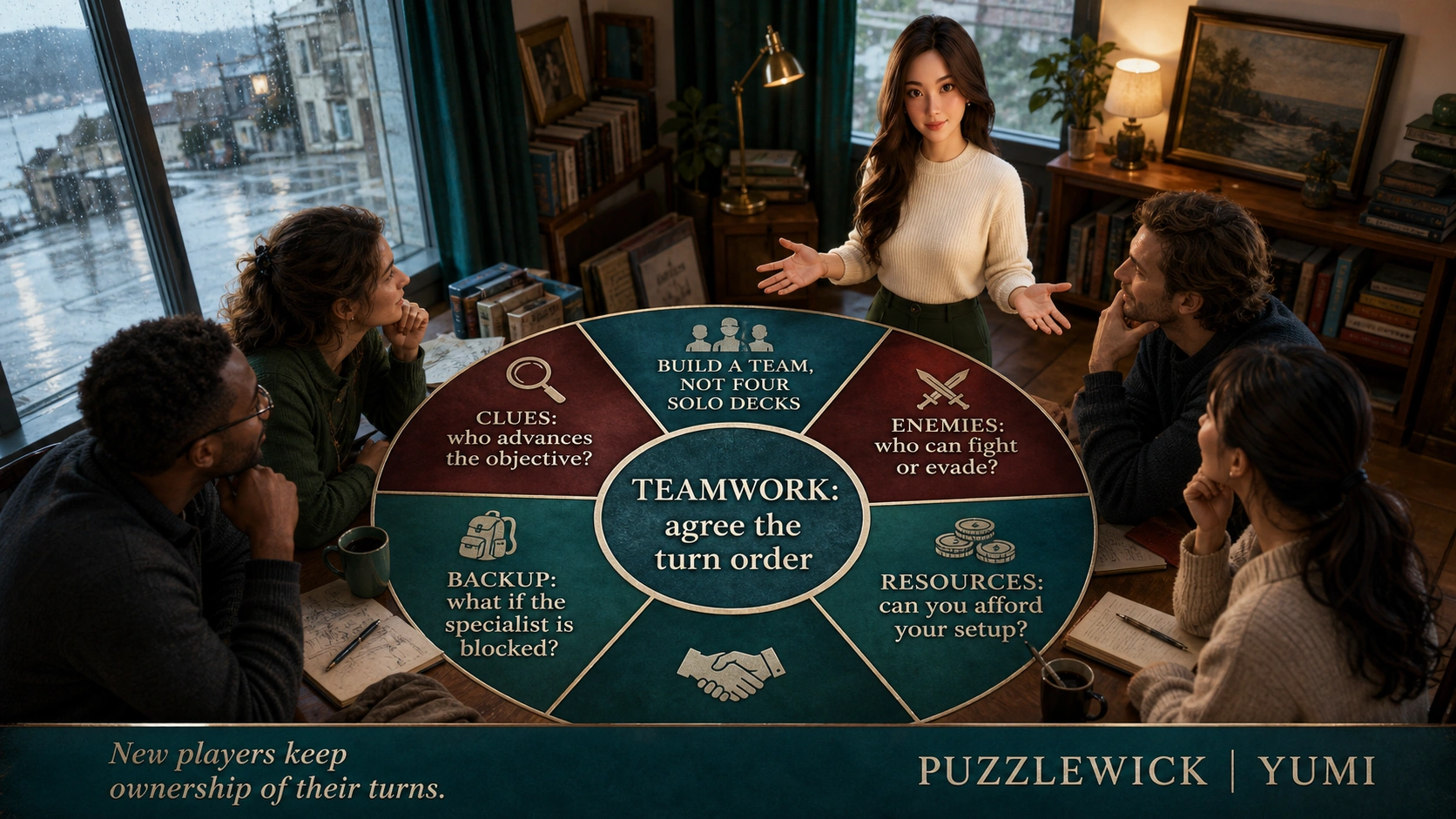
The team needs clues, an answer to enemies and enough flexibility to recover when the plan breaks. Those responsibilities do not require one prescribed pairing. They do require a conversation before everyone brings a specialist who expects somebody else to investigate.
True solo asks one deck to handle a wider range of problems with fewer actions and no teammate to rescue a blocked turn. Two-handed solo gives you two investigators to coordinate, but also two hands, economies and sets of triggers to manage. It is not the same as the official game suddenly becoming twice as easy. Choose the amount of administration you enjoy.
A beginner-friendly two-player agreement
- One investigator usually takes the lead on clues.
- The other usually handles enemies through fighting or evasion.
- Both identify a backup contribution when the specialist is absent or occupied.
- Agree which upgrades improve that arrangement instead of independently buying attractive cards.
For three or four players, organise information as well as roles. Say who can help now, who needs a turn first and who is saving a resource for a specific problem. A quiet player deserves room to finish a thought before the most experienced person solves the table aloud.
There is no verified universal "best Children of Blood deck" in this guide. A published list still needs its collection, experience level, difficulty and play mode checked before adoption.
Which optional Investigator Deck should you consider?
Choose a character and a job, not five compulsory purchases. Each of these 2026 products contains a ready-made investigator deck and extra cards for upgrades. The box holds 60 cards in total; that does not mean shuffling all 60 into the starting deck. Use its deck list and deckbuilding instructions. None adds a scenario, and every one requires the Core.
- Marie Lambeau Investigator Deck: Marie is the Mystic choice: a spell-focused ready-made deck with additional upgrade cards. Consider her when the character and spell-based play appeal to you, then agree how the deck will contribute clues, enemy answers or both. This is an optional change of investigator, not a campaign requirement. Publisher details.
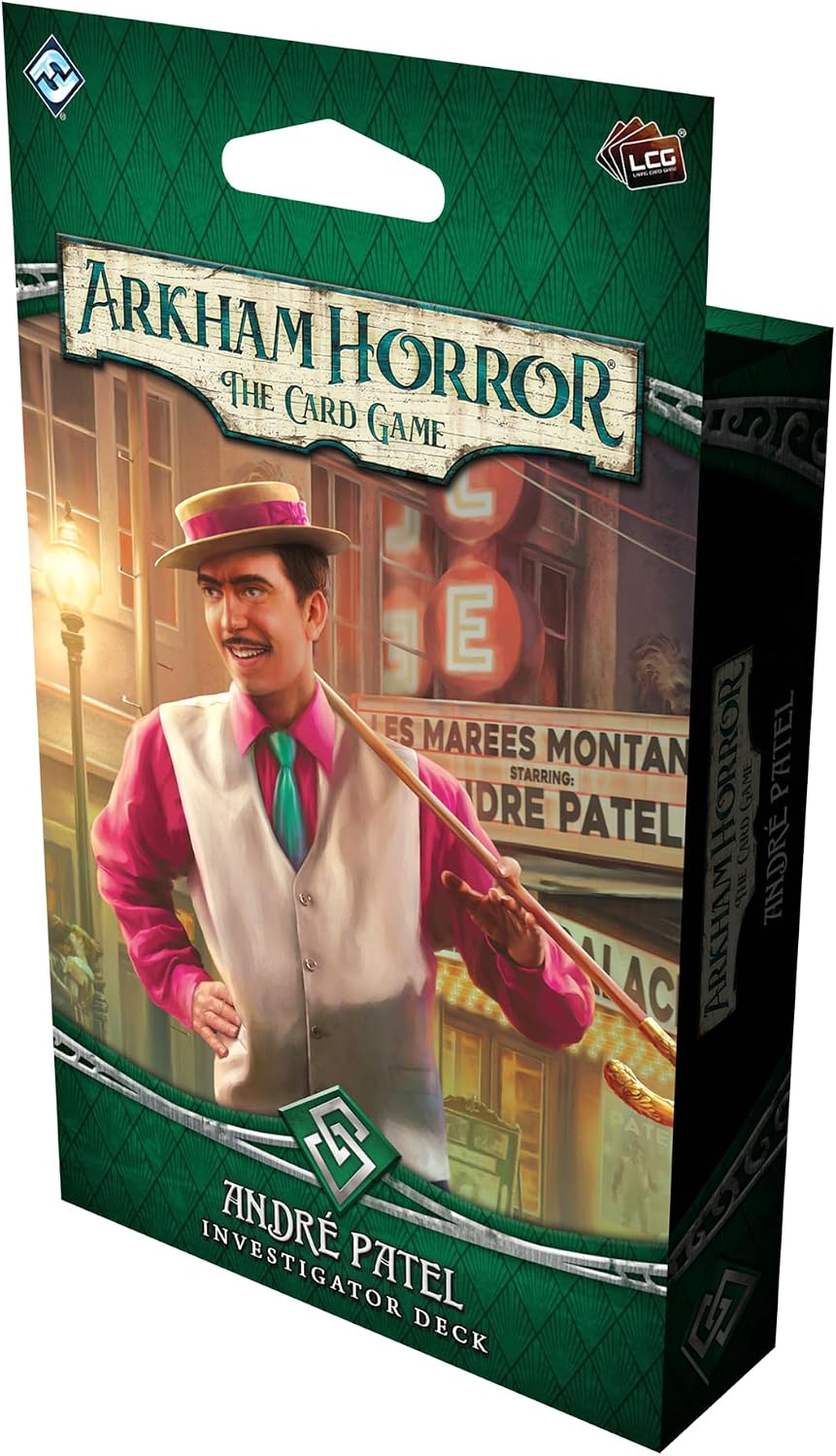
- André Patel Investigator Deck: Andre's official description emphasises extra actions and versatility. He suits a player who enjoys deciding how to use a flexible turn. Extra opportunities still need resources, useful cards and a team plan; the product does not promise automatic wins or unlimited actions. Publisher details.
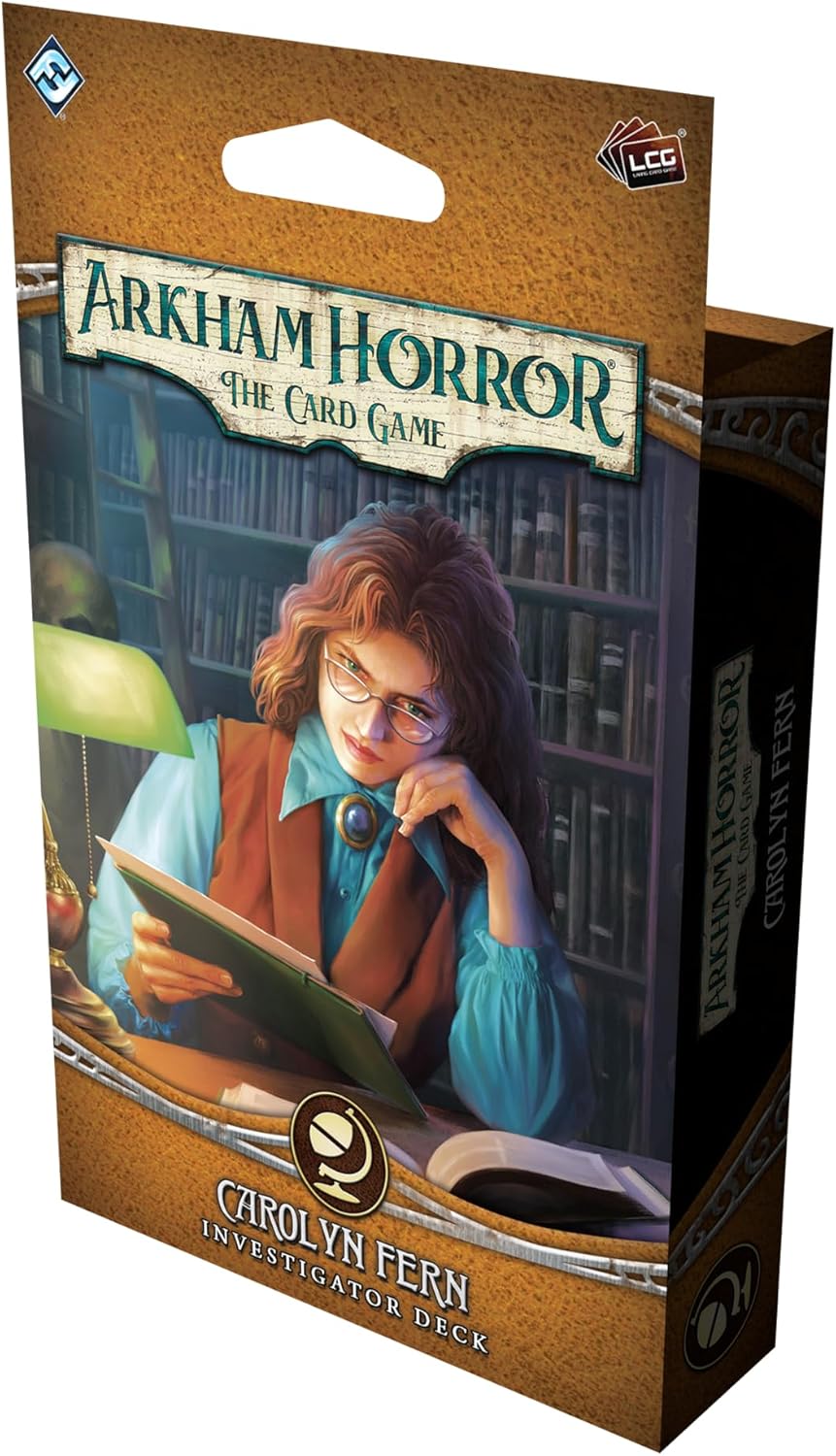
- Carolyn Fern Investigator Deck: This 2026 Carolyn is a Seeker. Her pictured investigator has five intellect, and her once-per-round response can turn horror healing into a clue at her location. That gives a cooperative group a clear reason to choose her. With one combat, she should not be assigned every enemy problem as well. Publisher details.
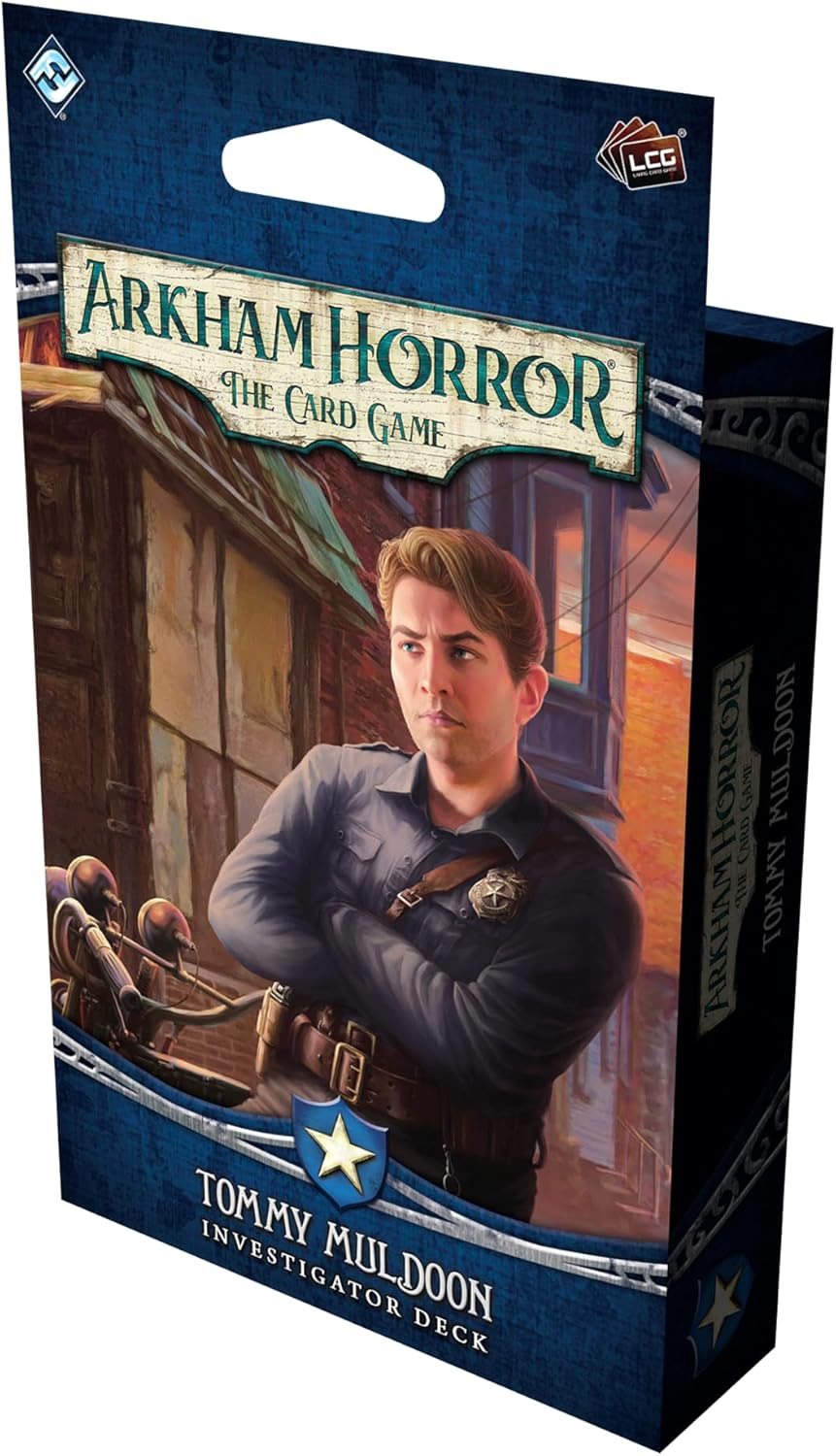
- Tommy Muldoon Investigator Deck: Tommy offers a readable Guardian identity. His action spends a resource or discards a controlled Firearm to play another Firearm from hand, paying that card's cost and adding two ammunition. Budget the full cost before declaring the play. He is a candidate for the enemy-handling seat, not a guarantee that the team can ignore clues. Publisher details.
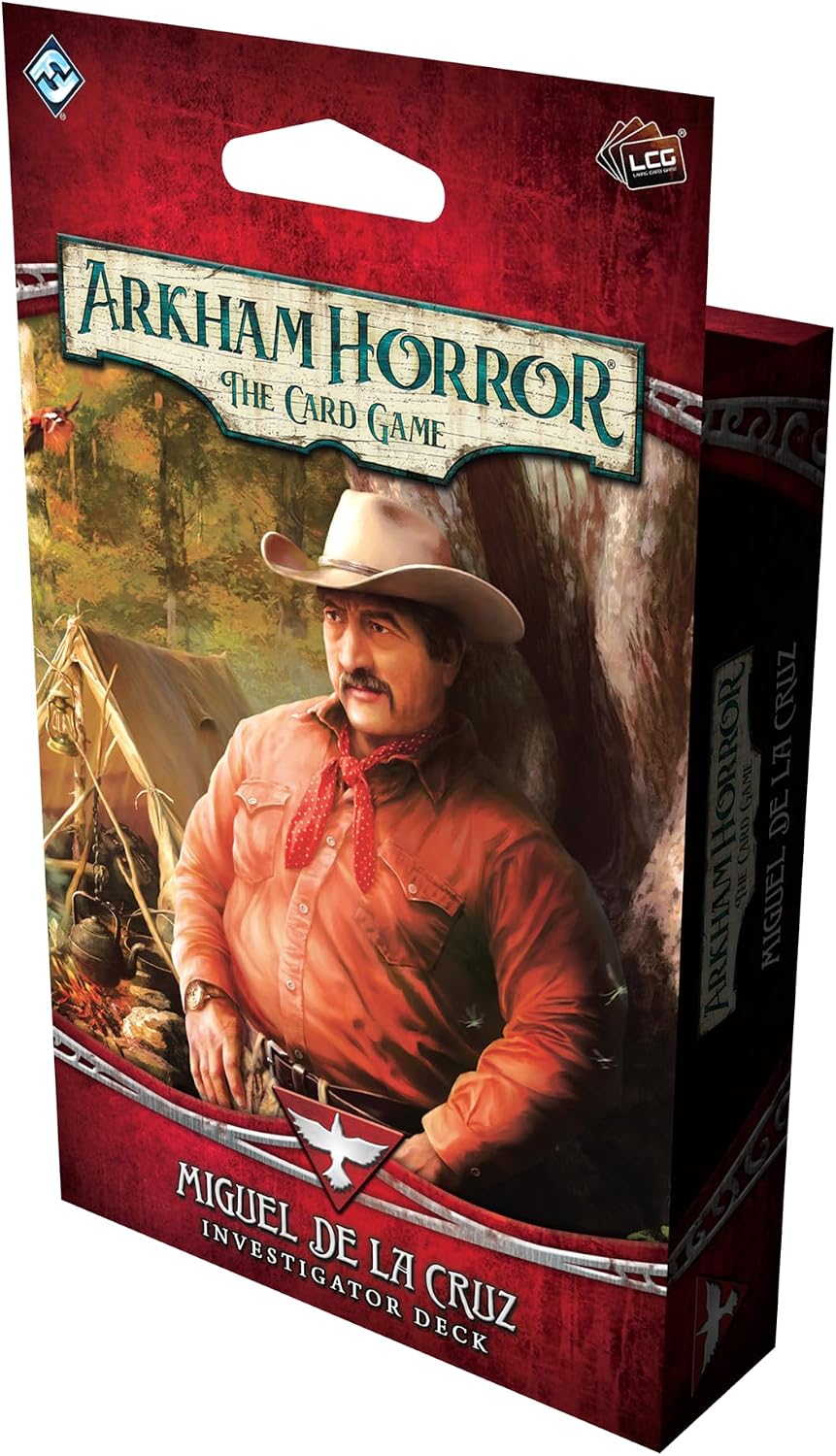
- Miguel de la Cruz Investigator Deck: Miguel's Survivor deck is presented around traps and hunting. His pictured investigator allows an extra action only for playing an event; it cannot become a free Move or Investigate. Consider him for a player who enjoys timing cards and evasion, with a teammate ready to cover the clue plan. Publisher details.
For an easily explained two-player division, consider a clue-oriented investigator beside an enemy-oriented one. Carolyn and Tommy illustrate those roles; that is a team-building suggestion, not a claim that we have tested their unmodified decks through this campaign. Check collection, difficulty and starting experience before copying any published list.
The Core already gives you five investigators. Stop buying when each player has a legal deck they want to learn. Our Investigator Deck comparison covers the wider choice; Children of Blood is the story those characters enter.
How to make better decisions without spoiling the campaign
Read the current objective, then budget your next useful turn. How many actions does it take to reach the location, resolve the obstacle and do the thing that advances the act? A weapon that will be excellent after two more setup turns may be less useful than an adequate answer now.
Three questions before committing your hand
- What does failure cost? Separate a lost action from damage, horror, a critical delay and a blood seal.
- What can the next investigator do? A teammate's available answer may save your strongest committed card for a more important test.
- What if the bag is worse than expected? Have a recovery action or exit in mind before staking the entire turn on one draw.
Do not confuse victory points with permission to ignore the scenario. A tempting enemy or side opportunity is worth evaluating against the actions it consumes and the risk it creates. Likewise, do not equate a surviving investigator with a successful team turn. Sometimes the helpful move is spending resources to let somebody else finish the objective.
Between scenarios, upgrade the failure you actually observed. Too slow to establish your main tool? Look at consistency and costs. Unable to contribute while enemies blocked you? Consider a backup answer. Repeatedly short of clues? The team's division of labour needs attention before another impressive damage card joins the folder.
These are strategic heuristics, not guarantees or official scenario solutions. The pleasure of a blind campaign is testing a plan with incomplete information. Leave yourself enough room to be surprised without spending the evening feeling powerless.
Sleeves, blood tokens and the upgrade you should not mix blindly
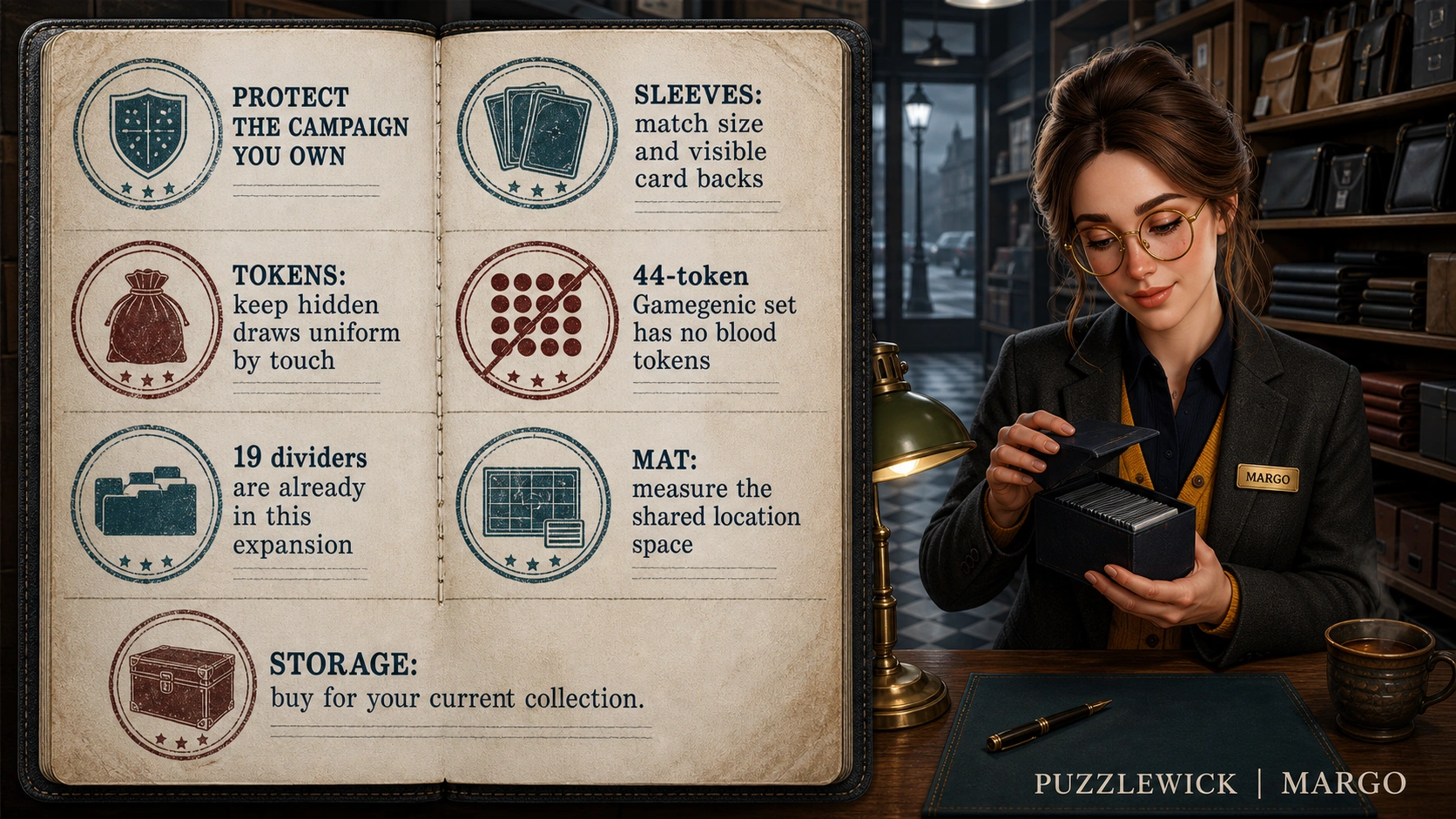
Protect the things you repeatedly handle, and keep hidden information genuinely hidden. Sleeves, a sensible bag and storage can improve handling. They do not have to arrive before your first game.
Sleeves: size and backs both matter
Choose the correct card size, then decide which cards need both faces visible. Clear sleeves are useful for double-sided scenario material. A uniform opaque back can suit a player deck when permitted and applied consistently. Do not put different visible backs into a deck whose order is supposed to remain unknown. Buy enough of the same sleeve model to replace damaged ones.
The blood-token compatibility trap
Gamegenic lists 44 acrylic Chaos Tokens in its Arkham Horror Tokens & Token Bag set: the enumerated symbols do not include blood tokens. Its acrylic tokens are 25 x 3 mm. Dropping visibly different cardboard additions into a premium bag can also create a tactile difference. A hidden draw must not let your fingers identify the token before your eyes do.
The simplest route is the original token system throughout. If you use protective capsules, test fit with a small quantity and keep outer size and feel consistent for every token the campaign may use. If you buy a premium replacement system, establish how it handles the full required token set before replacing anything. Do not assume a branded accessory released for the game covers every later expansion.
Storage: the expansion already includes nineteen dividers
Sort by encounter set and scenario. Keep the campaign log with the investigators' experience and trauma records. A premium chest or removable-tray system makes more sense when you have an actual transport or collection problem; one small expansion does not require a furniture programme.
For a mat, measure the shared locations and every player's area. A single narrow personal card mat cannot magically become a four-player shared scenario surface. Prefer a readable, appropriate-size licensed design when one fits your table, but leave room for the actual game. The Arkham accessory aisle and storage and token guide cover the broader equipment choices.
Source: Gamegenic enumerated contents, dimensions and rendering notice.
Three licensed upgrades, three different jobs
- Center Game Mat: Gamegenic lists 70 x 70 cm and 2 mm thickness. It provides shared play and token areas, not space for four complete personal layouts. Measure your table with chairs occupied before buying. Manufacturer dimensions.
- Investigator Deck Tome: the current black-foil design holds 60+ single-sleeved cards and includes one divider. That is an active-deck carrier, not storage for this expansion's 178 scenario cards. Capacity depends on sleeve model; double sleeving is not the stated 60+ rating. Manufacturer capacity.
- Game Night Chest: designed around four Deck Tomes, 500+ sleeved cards, books and a token bag. A Token Silo XL is included; the depicted decks, cards and other accessories are not. This makes sense for a regular host who carries a campaign kit. For one small expansion staying at home, its dividers and a simpler box may be enough. Manufacturer contents and fit caveats.
Three campaign nights: a practical learning rhythm
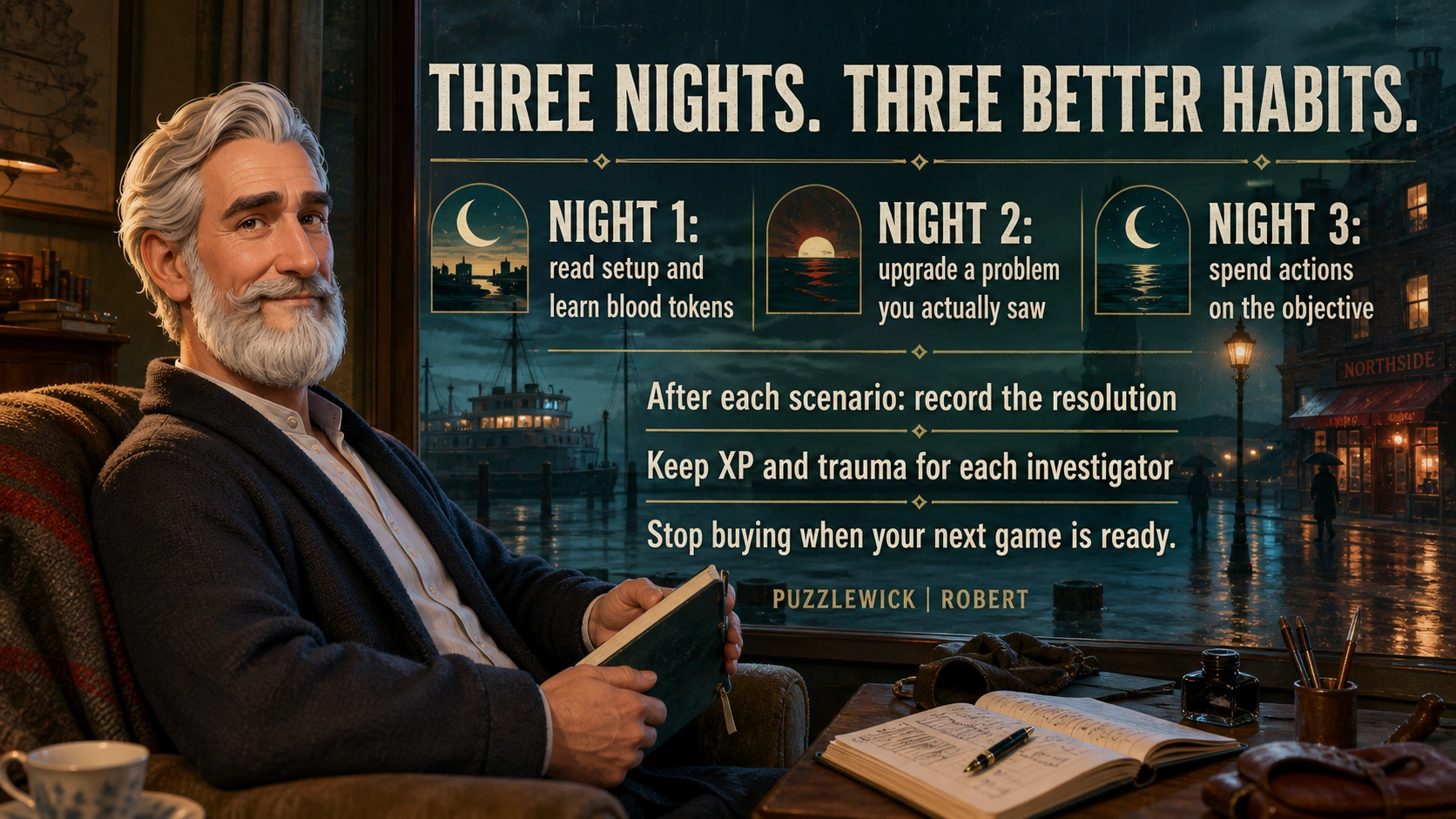
The official log lists River of Blood, New Horizons and Blood Money. Those names are already public; the resolutions remain yours to discover. Treat the following as a learning rhythm, not a fixed running-time promise.
- First scenario: give setup extra time. Read the blood procedure aloud and check the difficulty versions. Keep a short list of rules to revisit rather than interrupting every decision with a general internet search.
- Second scenario: bring the corrected deck and log. Choose upgrades for a specific weakness from the first game. Agree which investigator is covering each job before drawing opening hands.
- Final scenario: use what you have learned about action costs and risk. Do not preserve a premium card indefinitely while the objective runs out of time.
At the end of each scenario, read only the instructed resolution and record exactly what it asks. Experience, trauma, campaign notes and changes to the bag are separate records. Photographing the table may help you remember an evening, but it does not replace the campaign log.
If somebody is new to your group, ask what they enjoyed before discussing the technically strongest turn. A person who wants to return is more useful to a campaign than a perfect postmortem delivered to an empty chair.
Rewards and replay: what continues after the case closes?
FFG previews a reward that can be unlocked through the campaign. The Grimoire treats rewards as unlocks for the player's collection, subject to their rules, not simply possessions that must remain attached to the investigator who encountered them. That does not mean every purchaser automatically starts with the reward or that every deck may ignore its restrictions.
This guide does not disclose the unlocking route. Read your resolution, then the reward rules, before using it elsewhere. Permanent rewards have their own deck limit. Do not import a reward into a fresh campaign merely because you saw its picture in an article.
Replay has two sources of interest: trying different investigators and exploring the difficulty-specific scenario material. It will not restore every story surprise. For some groups, finishing the story once is enough; for others, comparing how another team handles the pressure is the real appeal. Neither group is playing incorrectly.
Source: Grimoire, rewards and permanent reward limit, page 38.
Where Traces to Nowhere fits, and where to go next
Traces to Nowhere is a separate product, not a missing fourth Children of Blood scenario. Keep that distinction when reading a release roadmap or shopping result. The next purchase should match the experience you want: a new scenario, another compact campaign, a different investigator or simply a more convenient way to store the collection.
Use the official Traces to Nowhere page for its current product description. Do not treat old rumours, an approximate retailer date or artwork in a roadmap as a substitute for the published contents and requirements.
Want help with setup? Open our Arkham setup trainer. Need a record you can keep? Use the campaign scenario tracker alongside the official log. For the broader range, return to the Arkham Horror universe. One completed campaign is already a worthwhile destination; you do not need to purchase the entire horizon.
The picks
Some links below are affiliate links — as an Amazon Associate, Puzzlewick earns from qualifying purchases, at no extra cost to you. It never changes a pick.
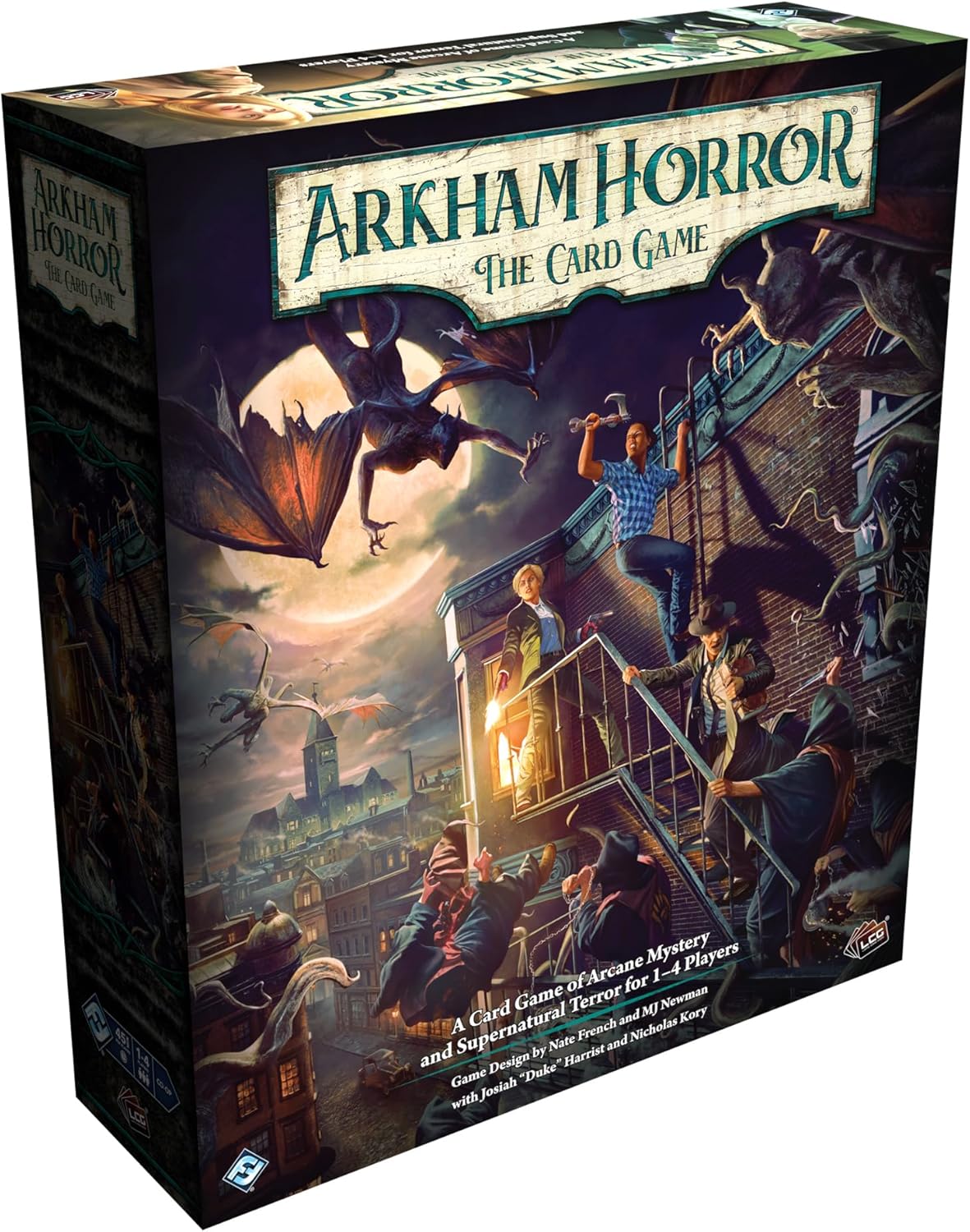
Arkham Horror: The Card Game Chapter Two Core Set
- Players
- 1-4
- Time
- 60-120 min
- Age
- 14+
- Publisher
- Fantasy Flight Games · 2026
The current foundation used by this beginner route. Learn its introduction before adding another campaign.
- Current evergreen foundation
- Complete one-to-four-player starting box
- Direct path into Chapter Two story releases
- Three-scenario introduction rather than a long campaign
- Existing Revised Core owners should check compatibility before rebuying
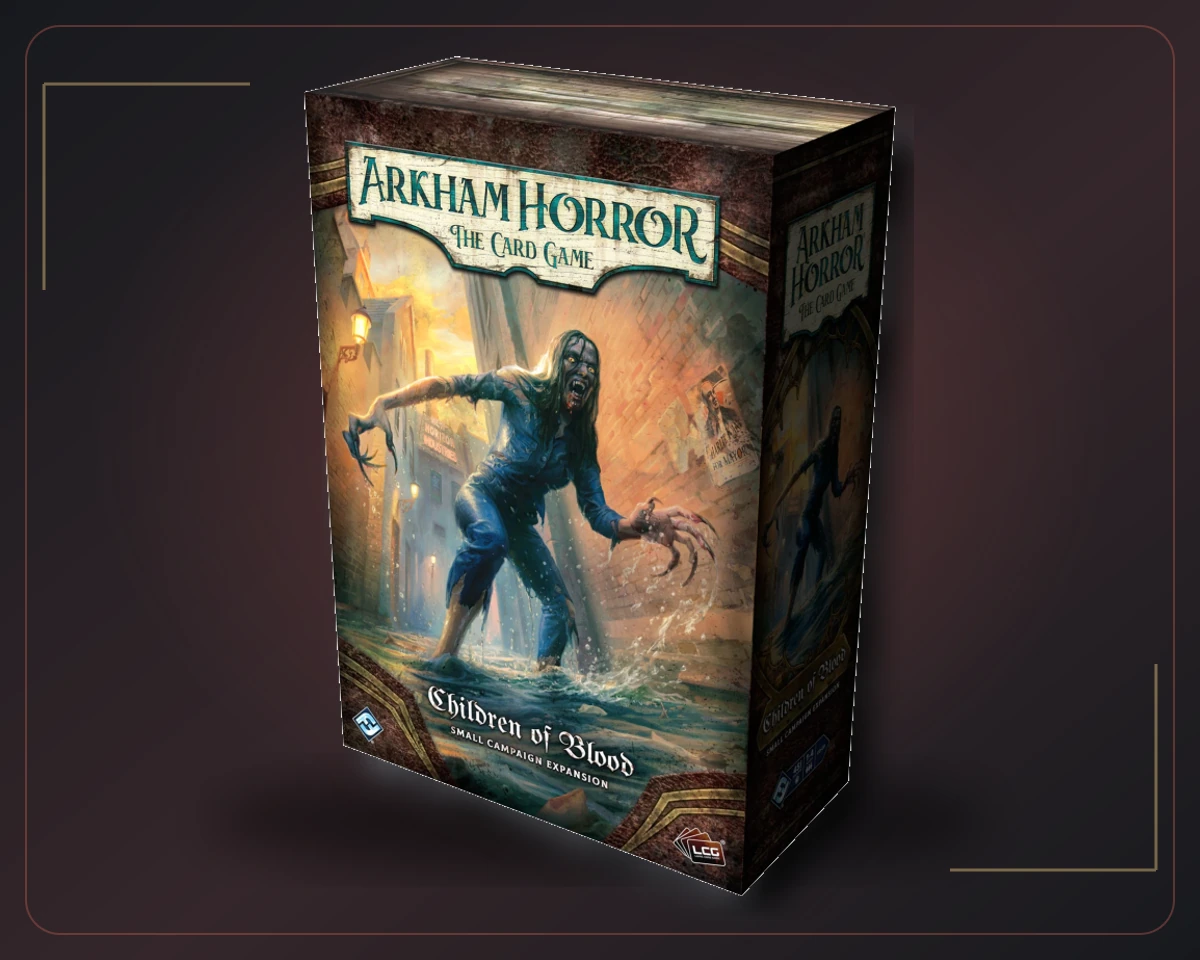
Arkham Horror: The Card Game Children of Blood Small Campaign Expansion
- Players
- 1-4
- Time
- 60-120 min per scenario
- Age
- 14+
- Publisher
- Fantasy Flight Games · 2026
Three linked scenarios with blood-token pressure and difficulty-specific material. Buy it for a compact campaign after the Core.
- Three linked scenarios
- Difficulty-specific scenario material
- Fixed-content expansion
- Core required
- Shorter progression than a long campaign
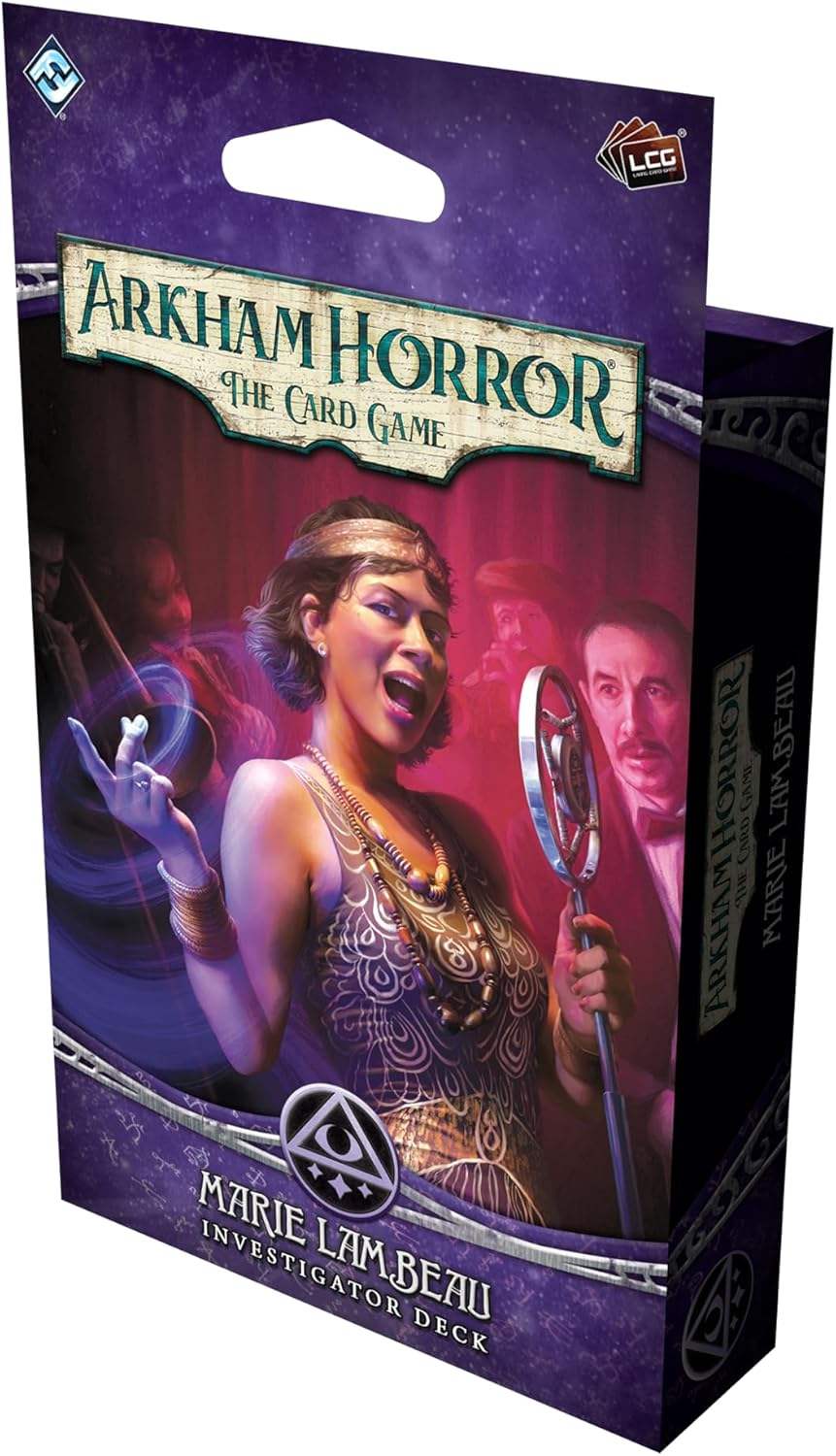
Marie Lambeau Investigator Deck
- Players
- 1 deck
- Time
- Campaign ready
- Age
- 14+
- Publisher
- Fantasy Flight Games · 2026
Marie is the Mystic choice: a spell-focused ready-made deck with additional upgrade cards. Consider her when the character and spell-based play appeal to you, then agree how the deck will contribute clues, enemy answers or both. This is an optional change of investigator, not a campaign requirement.
- Distinct spellcasting identity
- Prebuilt deck plus upgrade options
- Core Set still required
- Adds an investigator deck, not new scenarios
André Patel Investigator Deck
- Players
- 1 deck
- Time
- Campaign ready
- Age
- 14+
- Publisher
- Fantasy Flight Games · 2026
Andre's official description emphasises extra actions and versatility. He suits a player who enjoys deciding how to use a flexible turn. Extra opportunities still need resources, useful cards and a team plan; the product does not promise automatic wins or unlimited actions.
- Flexible Rogue play pattern
- Prebuilt deck with campaign upgrades
- Core Set still required
- Adds an investigator deck, not new scenarios
Carolyn Fern Investigator Deck
- Players
- 1 deck
- Time
- Campaign ready
- Age
- 14+
- Publisher
- Fantasy Flight Games · 2026
This 2026 Carolyn is a Seeker. Her pictured investigator has five intellect, and her once-per-round response can turn horror healing into a clue at her location. That gives a cooperative group a clear reason to choose her. With one combat, she should not be assigned every enemy problem as well.
- Clue-focused stat line
- Horror healing can also advance investigation
- Core Set still required
- Adds an investigator deck, not new scenarios
Tommy Muldoon Investigator Deck
- Players
- 1 deck
- Time
- Campaign ready
- Age
- 14+
- Publisher
- Fantasy Flight Games · 2026
Tommy offers a readable Guardian identity. His action spends a resource or discards a controlled Firearm to play another Firearm from hand, paying that card's cost and adding two ammunition. Budget the full cost before declaring the play. He is a candidate for the enemy-handling seat, not a guarantee that the team can ignore clues.
- Clear firearms focus
- Ability supports ammunition economy
- Core Set still required
- Adds an investigator deck, not new scenarios
Miguel de la Cruz Investigator Deck
- Players
- 1 deck
- Time
- Campaign ready
- Age
- 14+
- Publisher
- Fantasy Flight Games · 2026
Miguel's Survivor deck is presented around traps and hunting. His pictured investigator allows an extra action only for playing an event; it cannot become a free Move or Investigate. Consider him for a player who enjoys timing cards and evasion, with a teammate ready to cover the clue plan.
- Event-focused extra action
- Distinct trap-and-evasion identity
- Core Set still required
- Adds an investigator deck, not new scenarios
At a glance
| Decision | Advice | Why |
|---|---|---|
| No Core yet | Learn the Chapter Two Core first | Children of Blood is not standalone |
| Want a shorter campaign | Three linked scenarios | A smaller commitment, not necessarily easier tests |
| Want player cards | Compare Investigator Decks | Scenario content and player decks are different purchases |
| Want harder replay | Follow full difficulty setup | Locations, enemies and encounter sets can change |
| Want premium tokens | Check the complete symbol set and feel | The 44-token Gamegenic set does not contain blood tokens |
Free download — Children of Blood: blood tokens and team preparation
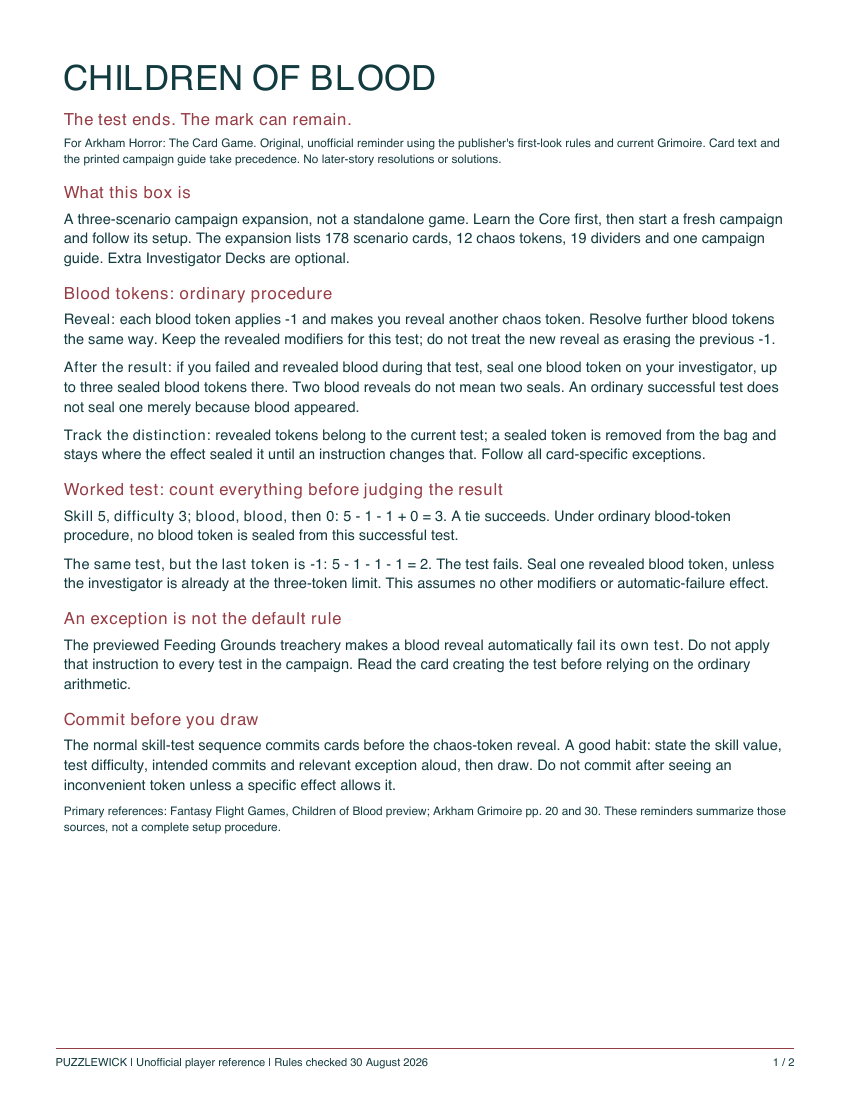
An original two-page, ink-friendly reminder: worked test, setup checks, team roles and between-session notes. Use the printed campaign guide for exact instructions.
Unofficial fan-made reference. Compiled by Puzzlewick from the sources listed on the sheet. Not affiliated with or endorsed by the publisher — always defer to the official rulebook.
Questions, answered
Is Children of Blood standalone?
No. It is a small campaign expansion and requires the Core. The Chapter Two Core is the beginner foundation used in this guide. Existing owners should check the printed encounter-set requirements against their exact edition.
How many scenarios are in Children of Blood?
Three linked scenarios. The official campaign log names River of Blood, New Horizons and Blood Money.
What comes in the Children of Blood box?
Asmodee lists 178 scenario cards, 12 chaos tokens, 19 divider cards and one campaign guide. Follow setup to select the correct cards and tokens; not everything goes into play at once.
How do blood tokens work?
In the basic procedure, each applies minus one and causes another reveal. If the test fails after revealing blood, seal one revealed blood token on the investigator, up to a maximum of three. Card-specific effects can change resolution.
Do two blood tokens mean sealing two tokens?
No. The failure-triggered procedure seals one revealed blood token, subject to the maximum of three already sealed on the investigator.
Does a tie succeed after drawing blood?
Yes, an ordinary test succeeds when the modified skill meets the difficulty. Blood penalties contribute to the total. An automatic-failure token or specific effect is a separate case.
Does Feeding Grounds change blood tokens for the whole campaign?
No. Feeding Grounds is a treachery with a special consequence during its own test. Read its printed effect; do not generalise that exception into the ordinary blood-token rule.
Does difficulty only change the chaos bag?
No. The River of Blood preview uses Dawn locations on Easy/Standard and Dusk locations on Hard/Expert, three Julia variants and changes to encounter composition. Use the complete setup.
Are the extra Investigator Decks required?
No. They offer additional investigator choices. A legal deck and the required Core and scenario material matter, not ownership of every ready-made deck.
Can I use a nineteen-experience deck at the start?
Not simply because a standalone list uses it. A fresh campaign follows its campaign setup and deckbuilding rules. Standalone experience and basic-weakness rules are a separate framework.
Does the Gamegenic premium token set include blood tokens?
The manufacturer lists 44 tokens without blood tokens. Check the current exact product contents and keep all hidden-draw tokens uniform by touch before mixing replacement systems.
Is Traces to Nowhere part of this campaign?
It is a separate scenario product, not a missing fourth chapter in the Children of Blood box. Verify its own requirements before buying.
Robert's verdict
Robert's verdict: Children of Blood is a sensible next investigation for a group that understands the Core and wants a complete shorter campaign. Learn the blood sequence, assemble the correct difficulty and give each investigator a useful job. Buy the story first; upgrade the equipment only when it solves a problem you actually have.
Research ledger 18 sources · reviewed 2026-09-01
Specifications, rules, current product information, community experience, and contrary evidence were checked against the sources below. Commercial links are kept separate from editorial evidence.
- FFG official Children of Blood first lookfantasyflightgames.com/en/news/2026/5/21/children-of-blood
- Asmodee AHC106EN product and contentsstore.asmodee.com/products/arkham-horror-the-card-game-children-of-blood-small-campaign-expansion
- Official Children of Blood product pagearkhamhorror.com/games/children-of-blood
- Official August 14, 2026 release announcementarkhamhorror.com/news/children-of-blood-is-on-sale-now
- FFG Grimoire: general rules referenceimages-cdn.fantasyflightgames.com/filer_public/76/b3/76b332d5-7047-458f-91b6-82c8500cc445/arkham_grimoire.pdf
- Official Children of Blood campaign logimages-cdn.fantasyflightgames.com/filer_public/41/7b/417b4654-38a6-46c7-9687-0f24ab452aff/ahc106_campaign_log_1.pdf
- Gamegenic Chaos Tokens and Token Bag specificationsgamegenic.com/product/arkham-horror-chaos-tokens-and-token-bag
- Asmodee: Marie Lambeau Investigator Deckstore.asmodee.com/products/arkham-horror-the-card-game-marie-lambeau-investigator-deck
- Asmodee: André Patel Investigator Deckstore.asmodee.com/products/arkham-horror-the-card-game-andre-patel-investigator-deck
- Asmodee: Carolyn Fern Investigator Deckstore.asmodee.com/products/arkham-horror-the-card-game-carolyn-fern-investigator-deck
- Asmodee: Tommy Muldoon Investigator Deckstore.asmodee.com/products/arkham-horror-the-card-game-tommy-muldoon-investigator-deck
- Asmodee: Miguel de la Cruz Investigator Deckstore.asmodee.com/products/arkham-horror-the-card-game-miguel-de-la-cruz-investigator-deck
- Gamegenic Center Game Mat dimensionsgamegenic.com/product/arkham-horror-center-game-mat
- Gamegenic Investigator Deck Tome capacitygamegenic.com/product/arkham-horror-investigator-deck-tome
- Gamegenic Game Night Chest contentsgamegenic.com/product/arkham-horror-game-night-chest
- Asmodee Chapter Two Core Setstore.asmodee.com/products/arkham-horror-the-card-game-core-set
- Private Pook Games: Children of Blood hands-on reviewyoutube.com/watch?v=_X2lSO3nL6I
- One Stop Co-op Shop: Children of Blood play and reviewyoutube.com/watch?v=u3Ebc0Rdu2Q

If it didn't earn a shelf, it isn't here.


Keep exploring
The next smart rabbit holes.
✒ Universe HubArkham Horror Universe: the whole buying pathStart with the interactive buyer intake: separate the 2026 Chapter Two Core from Chapter One legacy boxes and the entirely...☾ Topic PathCooperative Horror Games: compare the whole shelfCooperative horror works when the rules pressure the story without burying the table. This cluster maps what to buy, how campaigns...Beginner's GuideArkham Horror LCG First Game Guide 2026: Setup, Rules, Skill Tests & Solo PlayRobert turns the rulebook into one playable evening: which Core to open, exactly how to build the table, what every phase does, and the...