Buying Guide · Updated 2026-11-07
Star Trek Commander Decks Ranked: Which Crew Fits You?


AI-assisted research, writing and editorial QA under Robert’s direction. Our process
The short answer
Klingon Fury is our first pick for a combat-minded Commander beginner. We Are the Borg suits players who enjoy artifact creatures and a growing army; Landing Party rewards careful land sequencing. Federation Fleet is the more intricate officers-and-Spacecraft choice. This is a pre-release editorial ranking of the published lists, not playtest results. Buy the regular deck to learn; Collector’s Edition changes the finish.
Sources checked 2026-11-07 · 7 sources & review details
We may earn from qualifying purchases, including as an Amazon Associate.

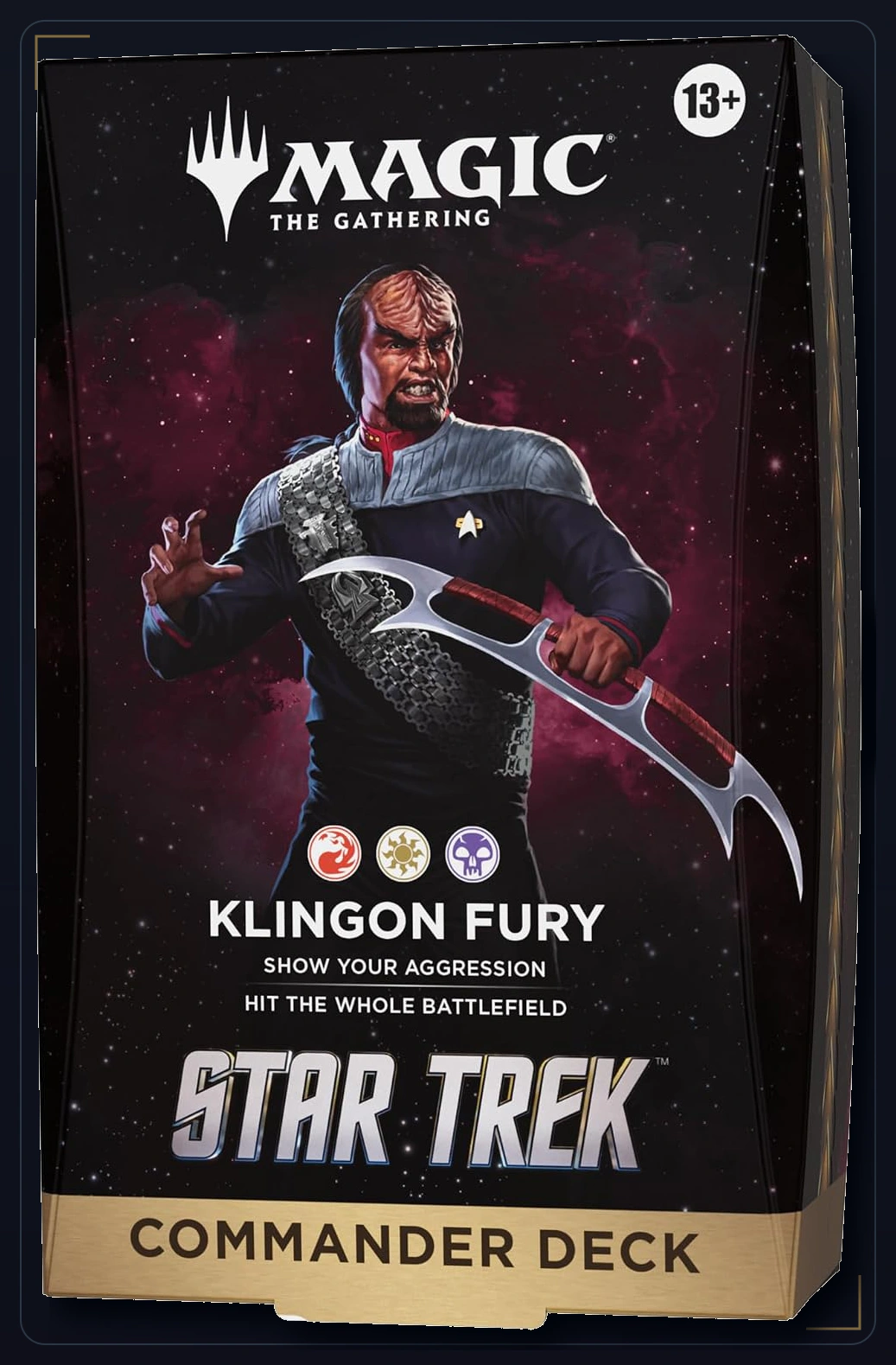
Illustration based on the referenced precons; authentic exact-SKU photographs and purchase details follow.
At a glance
| Order | Deck | Colours | Commanders | Plan | Learning curve | Reprints | Best for |
|---|---|---|---|---|---|---|---|
| 1 | Klingon Fury | Red / white / black | Worf, Defiant Commander / Kor, Cause of Vengeance | Attack different opponents; turn pressure into access to cards | More direct combat plan; attack timing still matters | Shared Animosity; Vindicate; Sword of Light and Shadow | Players who want combat to move the game |
| 2 | We Are the Borg | White / blue / black | The Borg Queen / Locutus of Borg | Build artifact creatures; exploit assimilation and combat triggers | Moderate; tokens, stolen cards and triggers need tracking | Skullclamp; Toxic Deluge; Anguished Unmaking | Artifact engines and an expandable token army |
| 3 | Landing Party | Green / white / blue | Commander Spock / Captain Kirk, Boldly Going | Collect differently named lands; grow the value of Spock’s triggers | Moderate; sequencing and the top card matter | Lotus Cobra; Tireless Tracker; Ancient Greenwarden | Players who enjoy ramp and land synergies |
| 4 | Federation Fleet | Blue / red / white | Jean-Luc Picard, Luminary / Captain Janeway, Endgame | Historic permanents, second-card draws and Spacecraft | Higher; several connected conditions to sequence | Cryptic Command; Fractured Identity; Supreme Verdict | An involved crew engine or an Officer-focused rebuild |
Four crews. Four very different ways to get into trouble. Choose the decisions you want to make every turn, not just a familiar television captain. Our order weighs published-list coherence, useful reprints, learning complexity and upgrade headroom; it is not a measured win-rate ranking.
Wizards schedules release for November 13, 2026. Its regional delay notice qualifies product timing. Confirm the selected edition’s delivery estimate before organising a launch game.
Start here, then go deeper
You are in the right cabinet.
 ✶ Universe HubMagic: The Gathering: the whole buying pathMagic: The Gathering is the deepest construction sandbox in the Big Three: a two-player duel, four-player Commander ritual, draft...
 🂠 Topic PathTrading Card Games: compare the whole shelfStart with the game and community you want, then buy the smallest product that lets you test it properly. These guides separate...
 GuideUpgrade Your Star Trek Commander Deck Without Losing Its IdentityForty possible additions, twenty deliberate cuts, and a reason for every swap. Keep the crew you love; give it a clearer job.
What does this ranking actually measure?


Published-list coherence: can the commander and the rest of the list describe one repeatable plan? Reprint usefulness: which named cards help that plan, not a speculative total of resale values? Learning complexity: how many different triggers, resources and timing windows need attention? Upgrade headroom: can a few deliberate changes sharpen the deck without replacing its identity?
These criteria explain our order; they do not produce laboratory scores. A regular Commander group, a different commander choice or a preference for long engine turns can change your personal order. No deck is being labelled a tournament leader.
Nitpicking Nerds’ concluding Klingon discussion also distinguishes a functioning complete deck from attractive ingredients for an upgrade project. We use that distinction as a research perspective, not a claim that their testing is ours. The video identifies a Wizards ambassador relationship and merchant promotions; those relationships are relevant context.
Is Klingon Fury the clearest first deck?
For someone who wants to attack, it is our first choice. Worf creates a Klingon when he enters and rewards attacks spread across opponents. His attack trigger counts opponents attacked, not the number of creatures you sent. More bodies are useful because they let you apply pressure in more than one direction.
The rules catch: Worf exiles cards you can play through the end of your next turn. This is temporary access, not a normal draw into your hand. Check your remaining mana before spending the whole turn making a bigger attack.
Three reprints give the list a recognisable shape: Shared Animosity rewards attacking creatures with shared types; Vindicate supplies broad permanent removal; Sword of Light and Shadow supplies equipment value. Those are different jobs, not three interchangeable reasons to call a deck powerful.
For a beginner: develop mana and a small force before trying to hit everyone. Losing the entire board to obtain one larger Worf trigger is a poor exchange. For an enthusiast: Kor’s sacrifice-and-attack plan is a real alternative, but choose that direction before adding cards. One deck cannot optimise every possible combat engine at once.
Weak point: a crowded battlefield can make attacks costly, and the list has expensive finishers. Our recommendation assumes you enjoy assessing blocks and accepting some combat risk. The official list is the purchase specification.
What makes We Are the Borg tempting?
The artifact-creature plan is easy to recognise: assemble a force, then make the pieces help each other. The Borg Queen costs seven mana and strengthens your artifact creatures. Her own enter-or-attack assimilation ability looks into an opponent’s library; do not describe that specific ability as graveyard theft. Other cards in the deck work with graveyards.
Locutus offers a different emphasis. He rewards artifact creatures dealing combat damage to players with more Borg bodies. Moving him to the command zone is a change in priorities, even though the colours stay the same.
Skullclamp, Toxic Deluge and Anguished Unmaking illustrate the useful mix of card flow, a reset and flexible interaction. Here is the interaction to notice before your first game: an unbuffed 1/1 can die when equipped with Skullclamp, but the Queen’s +2/+2 artifact-creature bonus prevents that simple one-toughness trick while it applies. Read the actual stats before assuming every token is two cards.
For a beginner: count available mana before committing to a seven-mana commander. Use markers to distinguish your creatures from assimilated cards. For an enthusiast: choose artifact-creature density, charge counters or assimilation as the main investment. A focused rebuild chooses one of those engines before adding cards.
Weak point: the commander is expensive and borrowed objects add bookkeeping. This is our engine recommendation, not our recommendation for the fewest possible moving parts.
When does Landing Party’s land engine switch on?
Spock counts differently named lands, not basic land types. Three Forests have one name between them. That distinction affects the value of a land drop before any glamorous upgrade does.
Spock’s enter-or-attack trigger examines the top card. With enough different land names, an eligible nonland spell can be cast without paying its mana cost; a revealed land enters tapped. If the nonland spell is too expensive for the condition, the trigger provides a card instead. Spock does not let you choose an arbitrary spell from your hand.
Lotus Cobra, Tireless Tracker and Ancient Greenwarden reward a land-focused plan in different ways. Cobra supplies mana from landfall, Tracker turns land entries into Clues, and Greenwarden supports replaying lands and additional land-entry triggers. The list already contains important pieces; it does not need ten new purchases before it can be played.
For a beginner: identify your next land drop and what it changes before resolving Spock. For an enthusiast: decide between Spock’s differently-named-land engine and Kirk’s Spacecraft emphasis. Kirk is an alternative build, not a promise that every green-white-blue lands upgrade belongs in his version.
Weak point: the top card and the available land names can make the pay-off uneven. Players who dislike tracking resources and sequencing may prefer Worf’s more visible combat question.
Who should start with Federation Fleet?
Choose it because you want Picard’s connected engine or an Officer-focused Janeway build—not simply because the reprint names are famous. Picard draws for another historic permanent with mana value three or greater entering under your control. Drawing your second card in a turn provides a separate benefit for another creature and a Spacecraft. Historic includes artifacts, legendary objects and Sagas; not every historic card costs enough to satisfy his first condition.
Cryptic Command, Fractured Identity and Supreme Verdict are interesting tools. Their presence is not proof that the complete list will sequence smoothly for a new player. In particular, a demanding coloured mana cost can matter more in a three-colour precon than a card’s reputation.
For a beginner: resolve the turn in order: identify the entering permanent, check its mana value, draw if appropriate, then check whether that was your second draw of the turn. A paper counter or a clear verbal announcement is enough; you do not need a new accessory for every trigger.
For an enthusiast: Picard invites play on opponents’ turns, while Janeway supports Officer combat and an activated route through blockers. Pick the commander whose conditions your changes will support. Weak point: the deck asks you to connect several conditions and mana demands. That complexity explains fourth place for a first purchase; it does not make the deck unplayable.
New to Commander: get a game going before upgrading
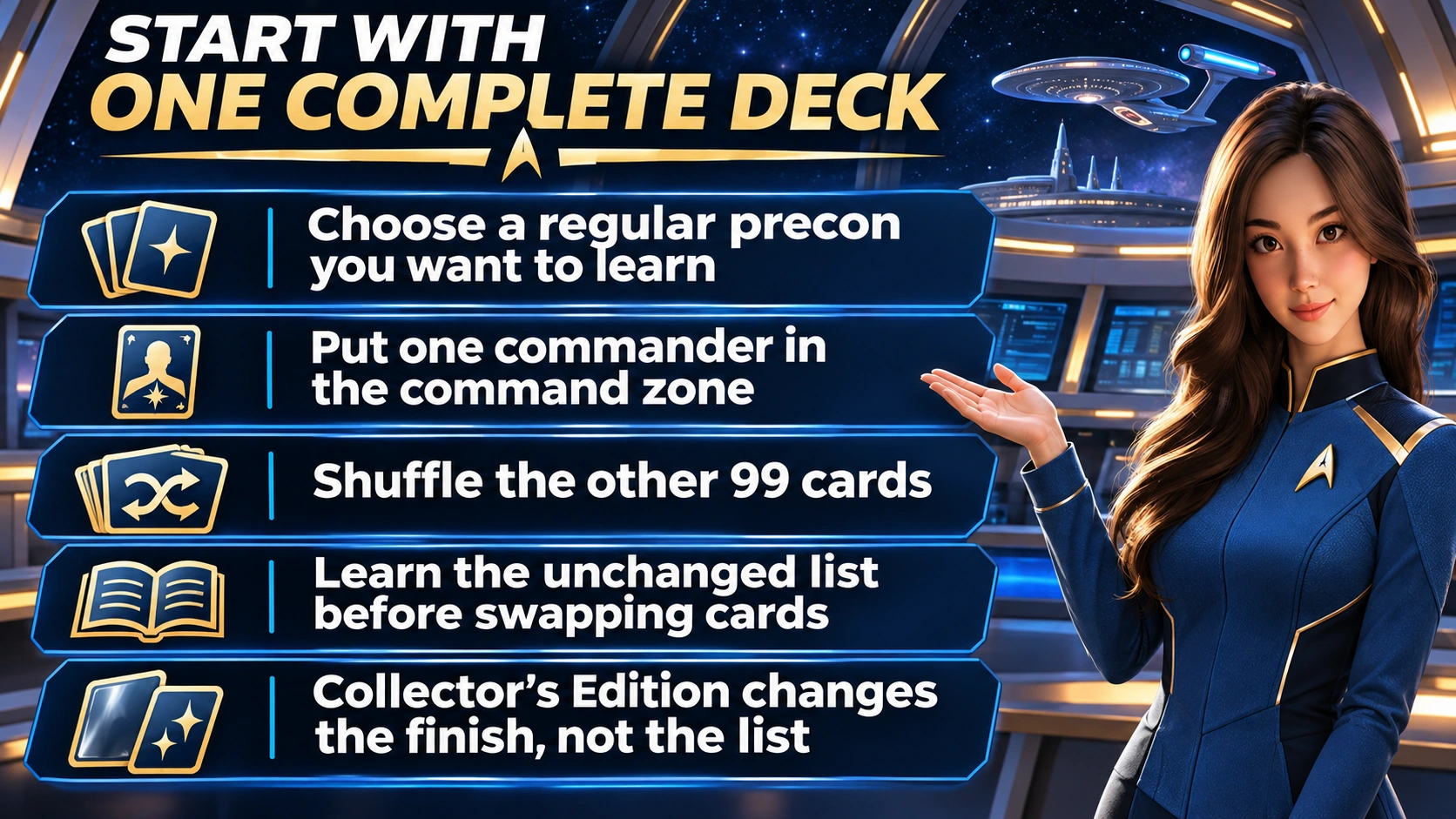
A precon is a preconstructed deck. Each of these purchases supplies the complete 100-card list. Put your chosen commander in the command zone and shuffle the other 99. You are not buying a booster product that still needs deck construction.
- Choose the regular edition of one deck whose plan sounds enjoyable.
- Read the face commander and alternate commander before shuffling. Use one as your commander, not both.
- Follow Wizards’ Commander format guide for colour identity, the singleton structure and the usual 40 starting life.
- Play the unchanged list with a group that knows you are learning. Announce unfamiliar triggers and ask before moving past combat.
- Write down the actual bottleneck. A slow mana draw, an unclear rule and a card that repeatedly does nothing are different problems.
These four lists are playable against each other in the same format. That does not prove identical power or guarantee a balanced result for every draw and group. Keep an all-precon game unchanged until everyone agrees to upgrades.
One deck, the four-deck bundle, or Collector’s Edition?
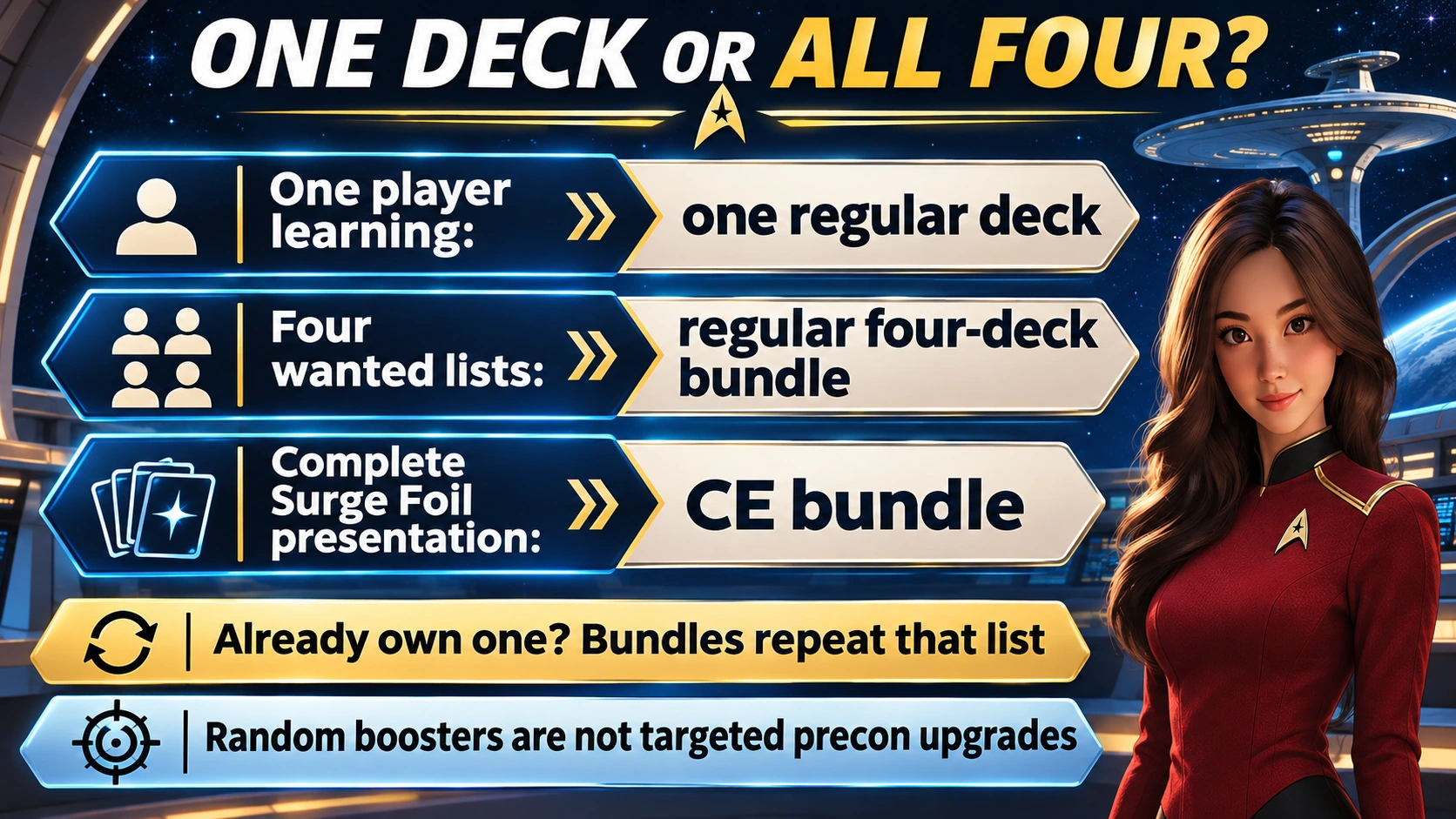
One regular deck is the sensible first purchase for one player. The regular four-deck bundle suits a group deliberately buying all four lists. It duplicates a deck you have already bought separately.
The Collector’s Edition four-deck bundle is a presentation purchase: the same lists in Surge Foil. It does not add a more powerful set of spells. Read our regular versus Collector’s Edition comparison before choosing it. The verified US bundle contains all four decks; a pictured individual CE box is not a separately verified US offer.
Wizards specifies 32 new-to-Magic cards per deck. Use that publisher figure even where a merchant bullet says 33. Each regular deck has a traditional-foil borderless face commander, 99 non-foil cards, ten double-sided tokens, a reference card and a deck box. CE changes the foil treatment; it does not change the decklist.
Protection that earns space in the bag
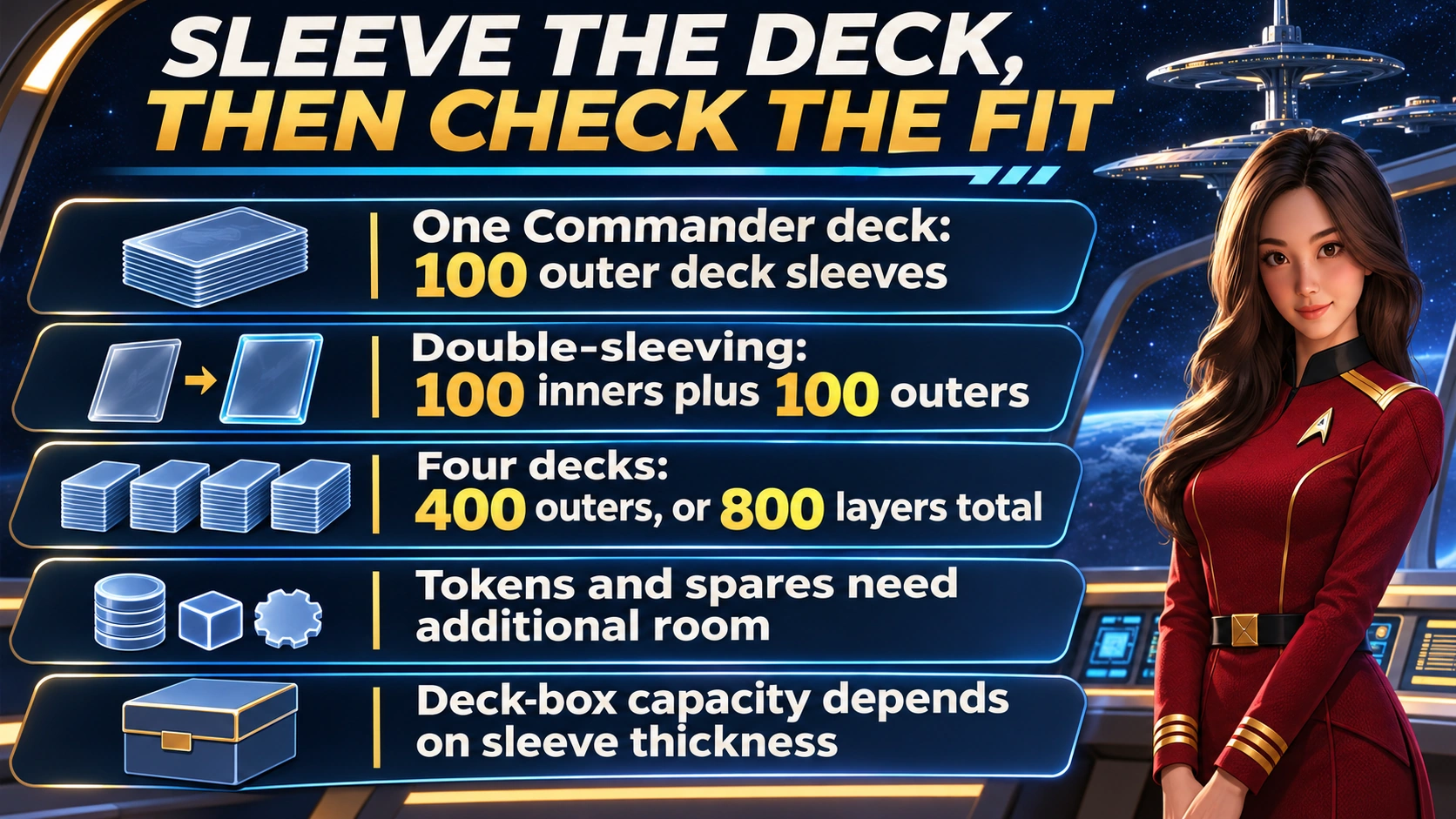
One Commander deck: 100 matching standard-size outer sleeves. Double-sleeving: 100 inner sleeves plus those 100 outer sleeves. Tokens are additional objects; leave space for them instead of pretending they disappear from the count. Four decks need 400 outer sleeves, or 400 inners plus 400 outers if all four are double-sleeved.
The Dragon Shield standard and Perfect Fit products below address those two different jobs. Clear outer sleeves are a different layer again; do not accidentally buy only inners or confuse an oversleeve with the ordinary deck sleeve. Double-sleeving adds thickness and does not guarantee perfectly flat foils.
The licensed Shaxs Squaroe is an IP-related single-deck option. The manufacturer’s 100-double-sleeved capacity is specified for Ultimate Guard sleeves; other brands can change the fit. Do not promise that every thicker sleeve combination will close comfortably.
Gamegenic’s Game’s Lair 600+ serves a larger collection or a group carrying several decks and accessories. Its value is organisation and transport. Verify the intended configuration and token space before treating a nominal capacity as a measured fit for your own sleeves. Our sleeve buying guide covers the brand decision. Measure the card itself when checking a new sleeve format.
Who should skip these decks?
Skip them as a first purchase if your friends play a 60-card format rather than Commander, or if your main interest is one piece of Star Trek art. A named single card is a more direct collecting target than a complete deck you do not want to play.
Skip the four-deck bundle if only one list interests you. Skip CE if you expect foil to add game power. Skip an immediate upgrade cart if you have not identified the problem you want to solve.
Looking for random packs or a draft night instead? Use the Star Trek booster and bundle comparison. If you are choosing between the whole set’s product formats, begin with the Star Trek first-purchase guide.
The picks
Some links below are affiliate links — as an Amazon Associate, Puzzlewick earns from qualifying purchases, at no extra cost to you. It never changes a pick.

Star Trek Commander — Klingon Fury, regular English
Regular, English; 1 deck: 100 cards + 10 DS tokens + deck box
A complete Worf-led Klingon Fury deck gives combat-minded players a clear attacking plan.
- Multiple opponents and combat choices add risk; its high-cost finishers still need time and mana.

Star Trek Commander — We Are the Borg, regular English
Regular, English; 1 deck: 100 cards + 10 DS tokens + deck box
A complete Borg Queen deck offers artifact-creature growth and an alternate Locutus commander.
- The Queen costs seven mana; her library-exile ability is not a free search for any creature.

Star Trek Commander — Landing Party, regular English
Regular, English; 1 deck: 100 cards + 10 DS tokens + deck box
A complete Spock-led Landing Party deck turns land names and repeated land entry into its plan.
- Different land types do not create different land names; land timing and colour access still matter.

Star Trek Commander — Federation Fleet, regular English
Regular, English; 1 deck: 100 cards + 10 DS tokens + deck box
A complete Picard-led Federation Fleet deck supports historic spells and the second-card engine.
- The second-draw and historic sequencing takes practice; the regular and Collector’s Edition lists are the same.

Star Trek Commander — all four regular decks
Regular, English; 4 decks
The regular four-deck set supplies four distinct complete 100-card decks for a shared Commander table.
- Do not buy individual regular decks as well unless deliberately purchasing duplicate lists.

Star Trek Commander — all four Collector’s Edition decks
Collector's Edition, English; 4 decks, every card surge foil
The Collector’s Edition four-deck set offers premium finishes on the same four published decklists.
- Pay for presentation rather than additional power; foil treatment does not change the cards’ rules.

Dragon Shield Matte Standard — Black,100 sleeves
Standard card-fit class 63×88 mm; 100 black matte playing sleeves. External sleeve dimensions not independently confirmed.
A 100-count opaque matte playing-sleeve pack matches one complete 100-card Commander deck.
- One pack covers the main deck only; tokens, spares and inner sleeves need separate quantities.

Dragon Shield Perfect Fit — Clear,100 inner sleeves
Standard, up to 63x88; 100
A separate inner layer protects the card inside a compatible standard playing sleeve.
- An inner pack is not the outside playing sleeve; double-sleeving increases the stack and box requirements.

Ultimate Guard Squaroe — Star Trek Lower Decks Shaxs 100+
Squaroes ST008; 1 box
The licensed Shaxs case pairs Lower Decks identity with a single protected Commander-deck carrying job.
- The stated 100 double-sleeved or 120 single-sleeved capacity uses Ultimate Guard sleeves; other combinations may differ.

Gamegenic Game’s Lair 600+ Convertible — Black
; 1 box
The black Game’s Lair 600+ provides configurable multi-deck storage and separate accessory drawers.
- Manufacturer capacity varies with configuration and sleeves; this is not a guarantee for your double-sleeved stack.
Questions, answered
Which Star Trek Commander deck is best for beginners?
Our editorial first pick for a combat-minded beginner is Klingon Fury. If attacking multiple opponents sounds unpleasant, choose the engine you actually enjoy instead of treating the ranking as a universal rule.
Are Collector’s Edition decks stronger?
No. Wizards lists the same cards; Collector’s Edition changes the treatment to Surge Foil.
How many new-to-Magic cards are in each deck?
Wizards specifies 32. That is the publisher figure used here, rather than the conflicting merchant figure of 33.
Can the four precons play against each other?
Yes, they are complete decks for the same format. They are not guaranteed to have identical power, and upgrades should be agreed with the group.
How many sleeves do I need?
Use 100 ordinary standard-size sleeves for one deck, or 100 inners plus 100 outer deck sleeves for double-sleeving. Tokens and spare cards need additional space.
Is the Shaxs deck box guaranteed to fit Dragon Shield double sleeves?
No. Ultimate Guard’s published double-sleeved capacity is based on its own sleeves; other brands and thicknesses may change the fit.
When do Star Trek Commander decks release?
The scheduled release is November 13, 2026. Regional product delays and a merchant’s specific delivery date can differ from the set’s release date.
Yumi's verdict
Klingon Fury is our clearest combat-first entry; Borg is the artifact-engine choice, Landing Party rewards land sequencing, and Federation Fleet is the intricate crew project. Start with one regular deck. Buy a bundle because you want all four, and buy Collector’s Edition because the finish itself is the point.
Research ledger 7 sources · reviewed 2026-11-07
Specifications, rules, current product information, community experience, and contrary evidence were checked against the sources below. Commercial links are kept separate from editorial evidence.
- Wizards: Star Trek Commander decklists and product contentsmagic.wizards.com/en/news/announcements/star-trek-commander-decklists
- WPN: Star Trek product delays in select regions, November 5wpn.wizards.com/en/news/magic-the-gathering-star-trek-product-delays-in-select-regions
- Wizards: Commander formatmagic.wizards.com/en/formats/commander
- Scryfall: exact TRC commanders and rulesscryfall.com/sets/trc
- Nitpicking Nerds: Star Trek Precons: Worst to Bestyoutube.com/watch?v=rWcC22C1LpI&t=2710s
- Squaroes: Shaxs ST008 specificationssquaroes.com/en/Squaroes/Squaroe-Star-Trek-Lower-Decks-ST008-Shaxs/SQR100058
- Gamegenic: Game’s Lair600+ Convertiblegamegenic.com/product/games-lair-600-convertible

Come in, take your shoes off — let me show you something.


Keep exploring
The next smart rabbit holes.
✶ Universe HubMagic: The Gathering: the whole buying pathMagic: The Gathering is the deepest construction sandbox in the Big Three: a two-player duel, four-player Commander ritual, draft...🂠 Topic PathTrading Card Games: compare the whole shelfStart with the game and community you want, then buy the smallest product that lets you test it properly. These guides separate...GuideUpgrade Your Star Trek Commander Deck Without Losing Its IdentityForty possible additions, twenty deliberate cuts, and a reason for every swap. Keep the crew you love; give it a clearer job.