One Piece Card Game Standard vs Extra 2026: Rotation, Block Icons & Best Starter Deck
Standard is the Block 2+ default at current official events; Extra keeps the wider historical card pool. Dax translates the block icon, current restrictions, event check, and ST31-ST36 starter wave into one calm route from sealed deck to first local night.

AI-assisted curator persona · research and editorial responsibility: Robert Pruitt · how this guide was made
Last editorial refresh: 2026-08-17 Gold-standard QA: 2026-08-17 11 sources reviewed Affiliate links checked during gold-standard pass

The short answer
Choose Standard if you want the default official tournament lane, current releases, and the cleanest route into local play. Choose Extra if your group or event explicitly supports the full historical card pool and you want to keep older decks alive. From April 1, 2026, Standard uses cards with Block Icon 2 or higher; Extra allows cards released to date except those affected by current banned, restricted, or banned-pair rules. Always read the event listing before registering.
Decision map
Choose in thirty seconds
Championship, store, release, and treasure events use Standard unless the listing says otherwise.
The wider card pool keeps older strategies playable under current restrictions.
A current, coherent Red deck is the cleanest general on-ramp for learning tempo and combat.
Artwork and product age do not prove Standard legality; the card record does.
One Piece Card Game did not simply rotate old cards and wave goodbye. Bandai created two official regulations with different jobs. Standard is the moving competitive window. Extra is the larger archive where older cards can keep sailing, subject to the current restriction list.
That sounds tidy until a new player sees Block Icons, Premium Booster reprints, a favorite older leader, and six bright new starter decks at the same time. This guide turns those separate questions into one decision: where do you want to play, and which sealed deck gets you there with the least wasted money?
Start here, then go deeper
You are in the right cabinet.
 ☠ Universe HubOne Piece Card Game: the whole buying pathThe One Piece Card Game combines Leader identity, a fifty-card main deck, ten DON!!, Life pressure, and hand-based countering into...
 🂠 Topic PathTrading Card Games: compare the whole shelfStart with the game and community you want, then buy the smallest product that lets you test it properly. These guides separate...
 GuideOne Piece ST31–ST36 Starter Decks Ranked: Best First Deck, Two-Copy Upgrades, and 2026 LegalityZoro, Luffy, Kuzan, Katakuri, Sabo, and Kid separated by stock strength, learning value, upgrade tax, and current Standard legality.
Should you learn Standard or Extra first?
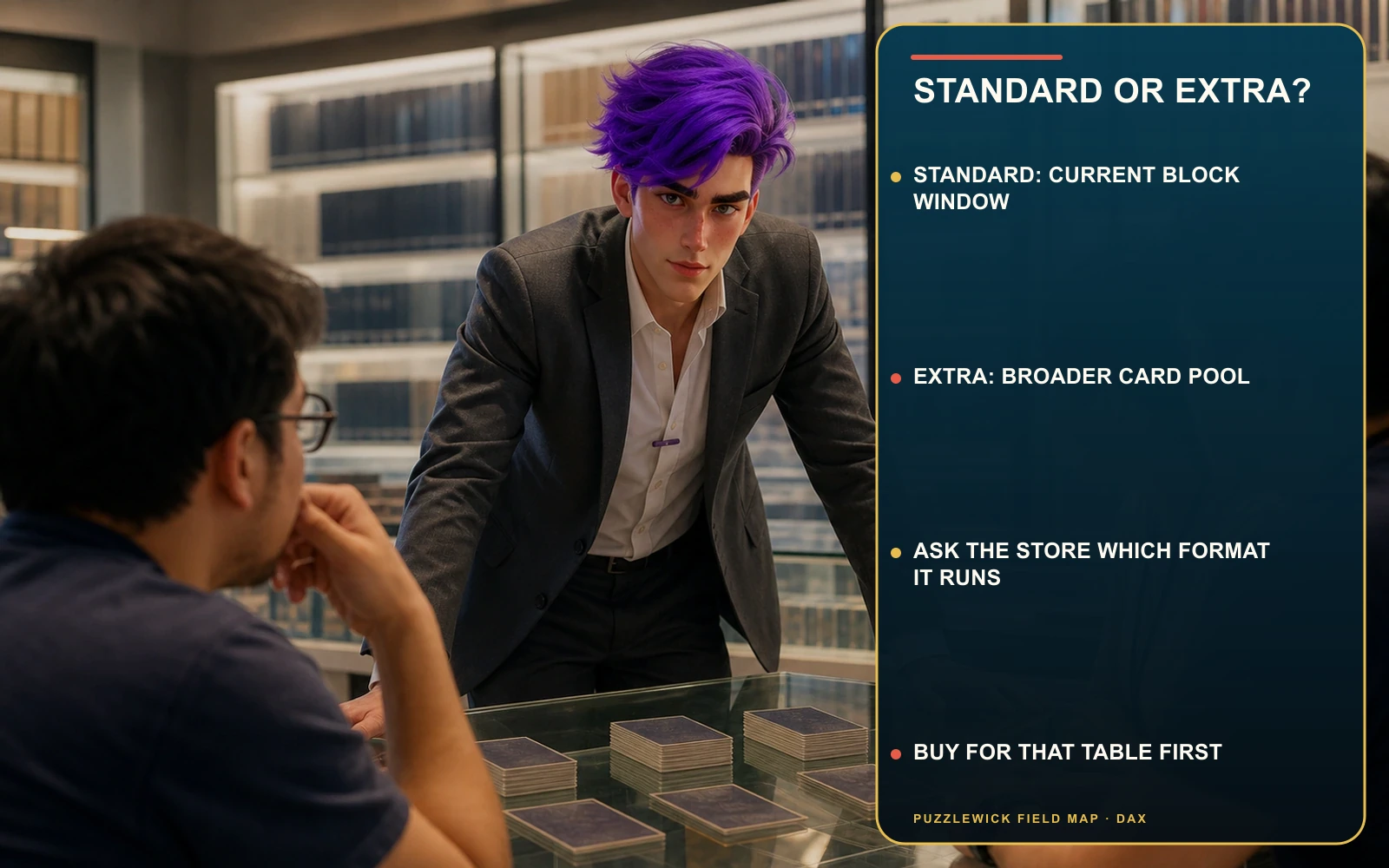
Standard is the main current competitive lane. Extra is the expanded historical lane. Beginning April 1, 2026, Standard accepts cards carrying Block Icon 2 or higher. Extra permits cards released to date except cards affected by the current banned-card, restricted-card, or banned-pair rules.
If an official event does not specify another regulation, expect Standard. If friends are preserving older leaders or a venue advertises Extra, build for Extra. Neither format is fake, casual by definition, or automatically cheaper.
How Block Icons decide Standard legality
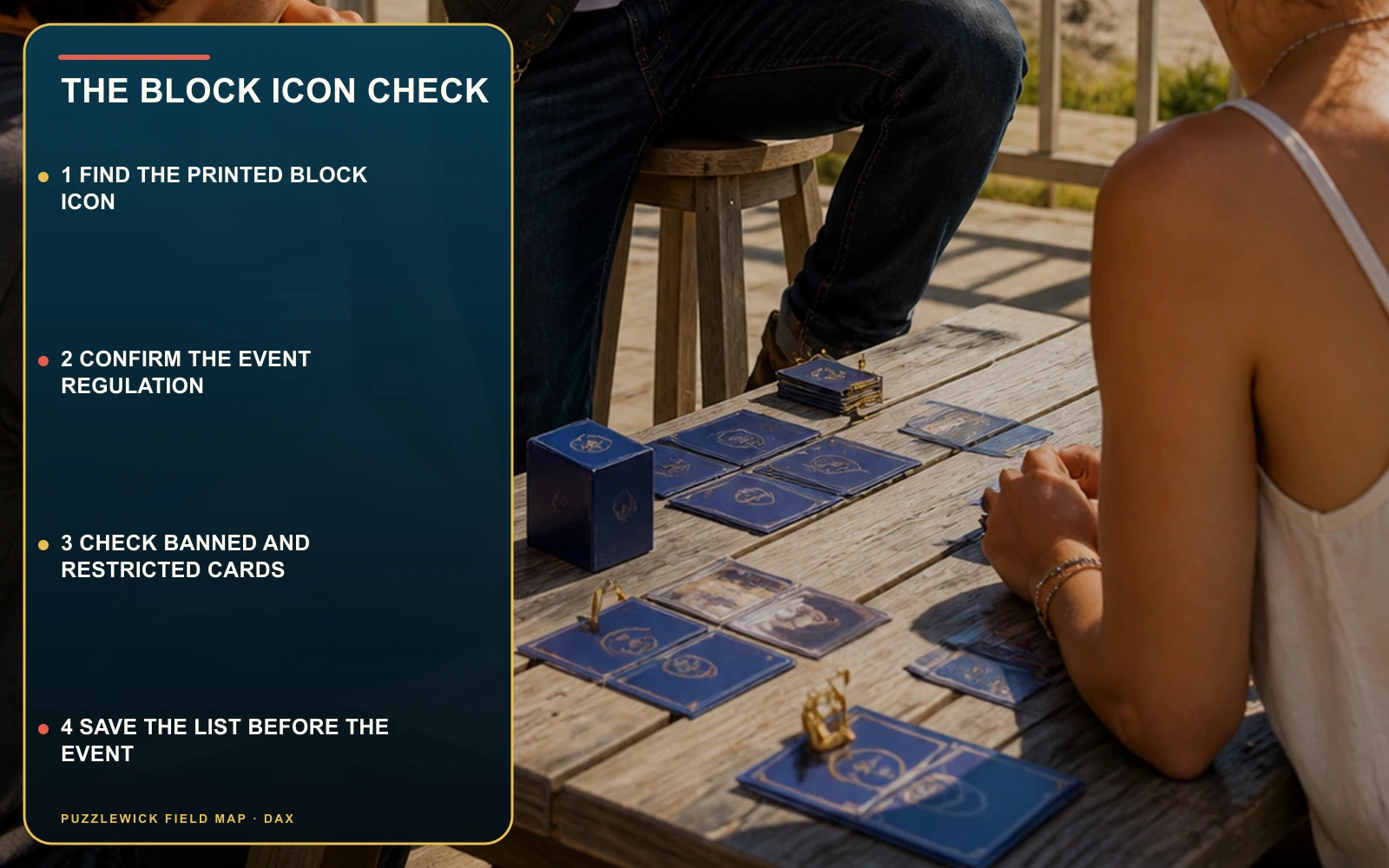
The Block Icon is a small numbered symbol printed on the card. For current Standard, look for 2 or higher. Do not judge legality from the character, illustration, card name, or the age of the sealed product. Reprints can carry a newer block treatment, and a familiar card may exist in more than one printing.
When in doubt, use the official card list and tournament materials. A two-minute card check is cheaper than replacing a deck after registration closes.
What Extra Regulation actually preserves
Extra is not a loophole that ignores balance updates. It opens the historical card pool, then applies the current restrictions for that regulation. Bandai's April 2026 transition also lifted four former Block 1 bans for Extra, which is exactly why old screenshots and forum posts should never be treated as permanent legality documents.
Extra makes sense when an older leader is your emotional entry point, when a collection already contains years of cards, or when your local scene deliberately supports the format. It makes less sense as a first purchase target when every nearby event lists Standard.
Which current starter deck is the cleanest on-ramp?
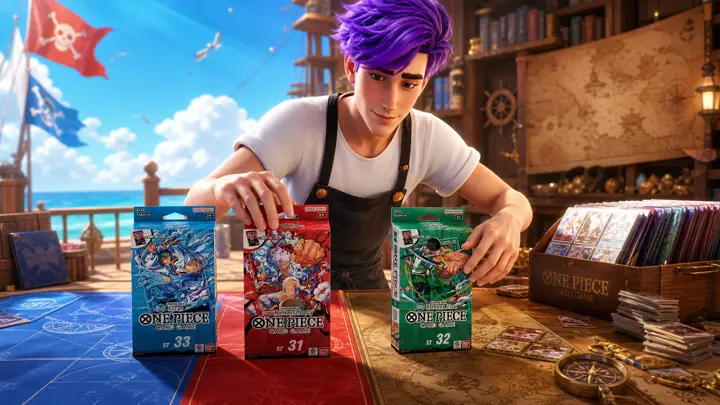
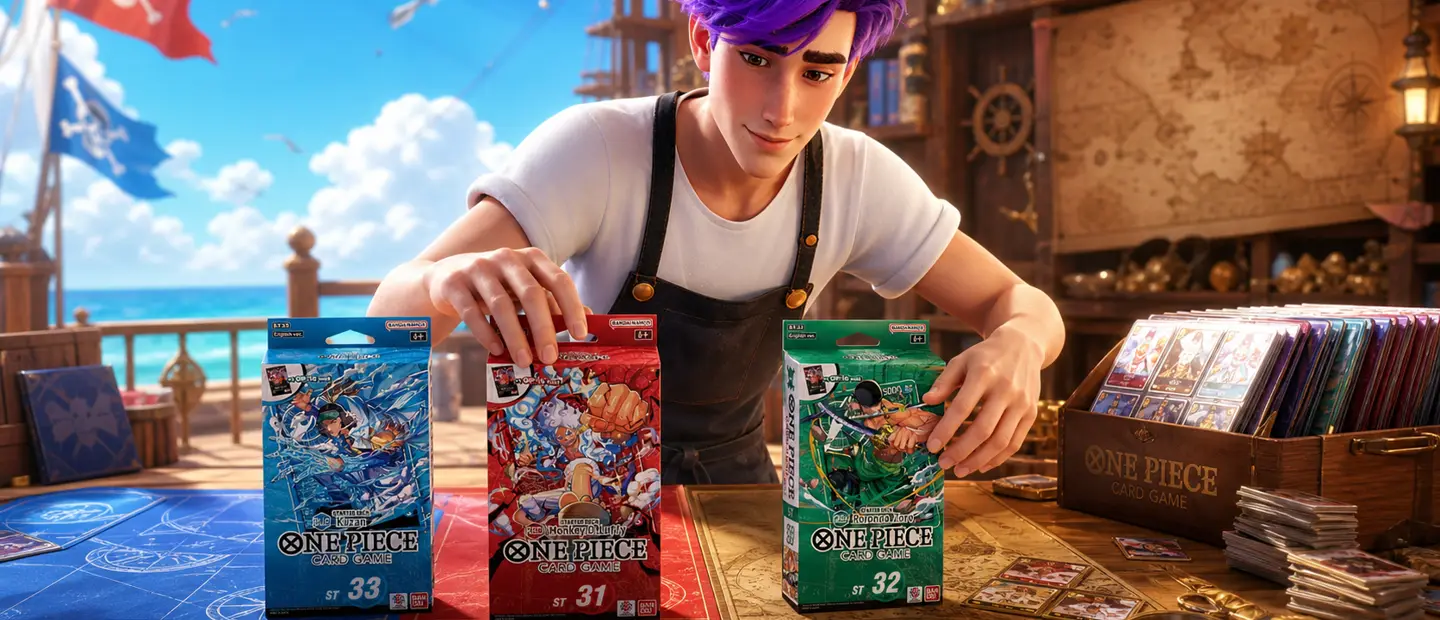
Starter decks work because they provide a coherent leader, legal deck structure, DON!! cards, and a strategy that can be repeated. They do not work when a buyer treats the box as a finished tournament list. Our broad recommendation is ST31 Luffy for direct pressure, ST32 Zoro for development, and ST33 Kuzan for control-minded learners.
Sabo and Kid are excellent once two-color interactions or life-area tension sound appealing. The best first deck is the one whose plan you want to repeat ten times, not the one that won a tournament before you learned its sequencing.
What should your first three games teach you?
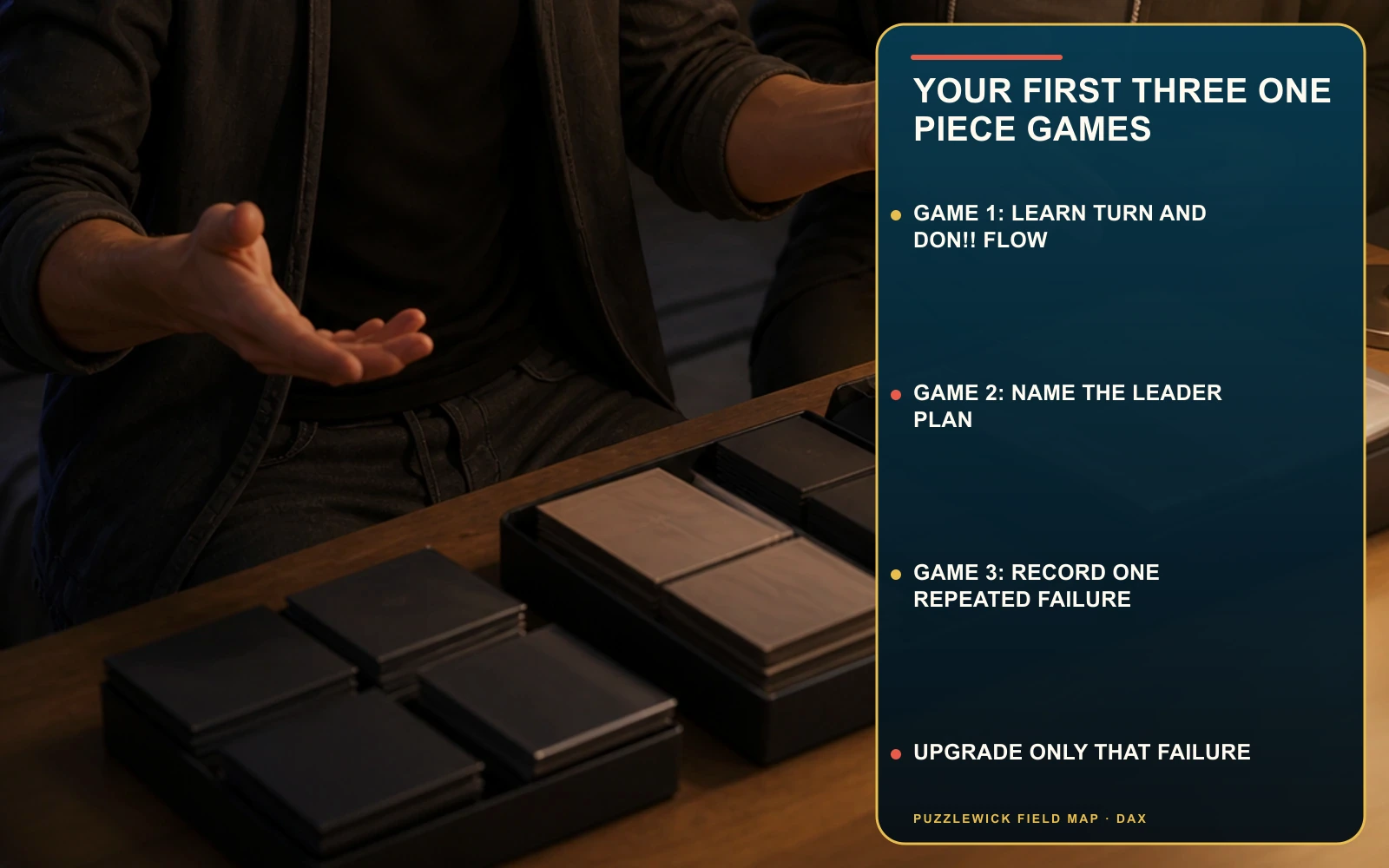
Game one: finish complete turns and learn the play area. Game two: track DON!! timing, counter decisions, and attacks that achieved nothing. Game three: change one repeated failure. Keep the rest of the deck stable so the lesson remains visible.
Only after those games should you decide whether a second starter copy, singles, or an entirely different leader solves the problem. Booster packs are entertainment; they are not a targeted upgrade plan.
How should you read the play area, turn flow, and card roles?
A legal deck is only the beginning. Learn where the Leader, Character, Stage, DON!!, deck, trash, and life cards live. Then rehearse Refresh, Draw, DON!!, Main, and End until the sequence no longer consumes your attention.
That frees your brain for the actual game: when to invest DON!!, which attack asks for a useful response, and whether a card in hand is better as a future play or counter power right now.
What a real first local night looks like
Bring a sleeved legal deck, ten DON!! cards, spare matching sleeves, a deck list if requested, and a way to track life cleanly. Tell the opponent you are new before the game. Most experienced players become better teachers when they know a rules pause is welcome.
Ask the organizer which regulation is being used and whether deck registration is required. Do not arrive with an Extra deck because a social post called it legal without naming the event.
Which accessories protect the deck without becoming the hobby?
Use standard-size opaque sleeves, a rigid deck box with room for the sleeved deck and DON!! cards, and a mat if your venue's tables are rough or crowded. Carry spare sleeves from the same package; one marked sleeve can create an avoidable event problem.
Binders and top loaders protect collections, but they do not help a first deck function. Our One Piece protection and storage guide separates play kit, trade binder, and archive storage so one box is not forced to do three incompatible jobs.
What buying order wastes the least money?
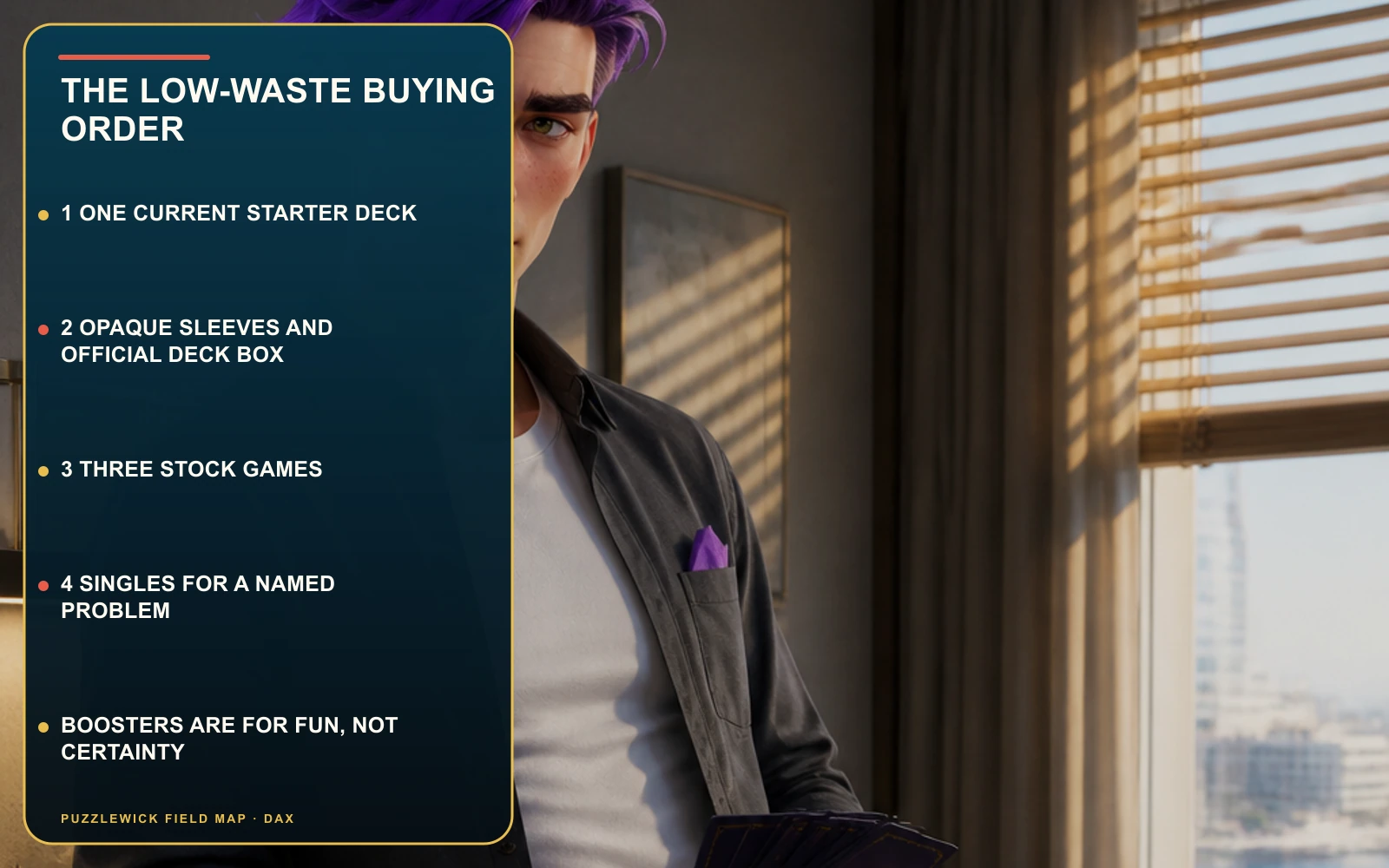
- Find the reachable store or play group and identify its regulation.
- Buy one current starter whose game plan appeals to you.
- Add opaque sleeves and one protective deck box.
- Play three stock games and record repeated failures.
- Buy a second starter only when duplicate exclusives solve those failures.
- Buy singles for a specific list; open boosters for fun, not certainty.
That order is less cinematic than carrying a booster display home. It is also how a collection becomes a playable deck instead of a colorful paperwork problem.
What experienced tables keep reporting
Recurring owner patterns, synthesized in Puzzlewick's words. Follow each evidence trail to read the original discussion.
Players keep asking whether rotation makes older cards useless. The practical answer is no: Standard and Extra give those cards different destinations.
The format with the larger card pool matters less than the format your nearest reliable event actually runs.
Experienced players repeatedly recommend stock games before duplicate starters or singles because the deck must reveal its bottleneck first.
The picks
Some links below are affiliate links — as an Amazon Associate, Puzzlewick earns from qualifying purchases, at no extra cost to you. It never changes a pick.
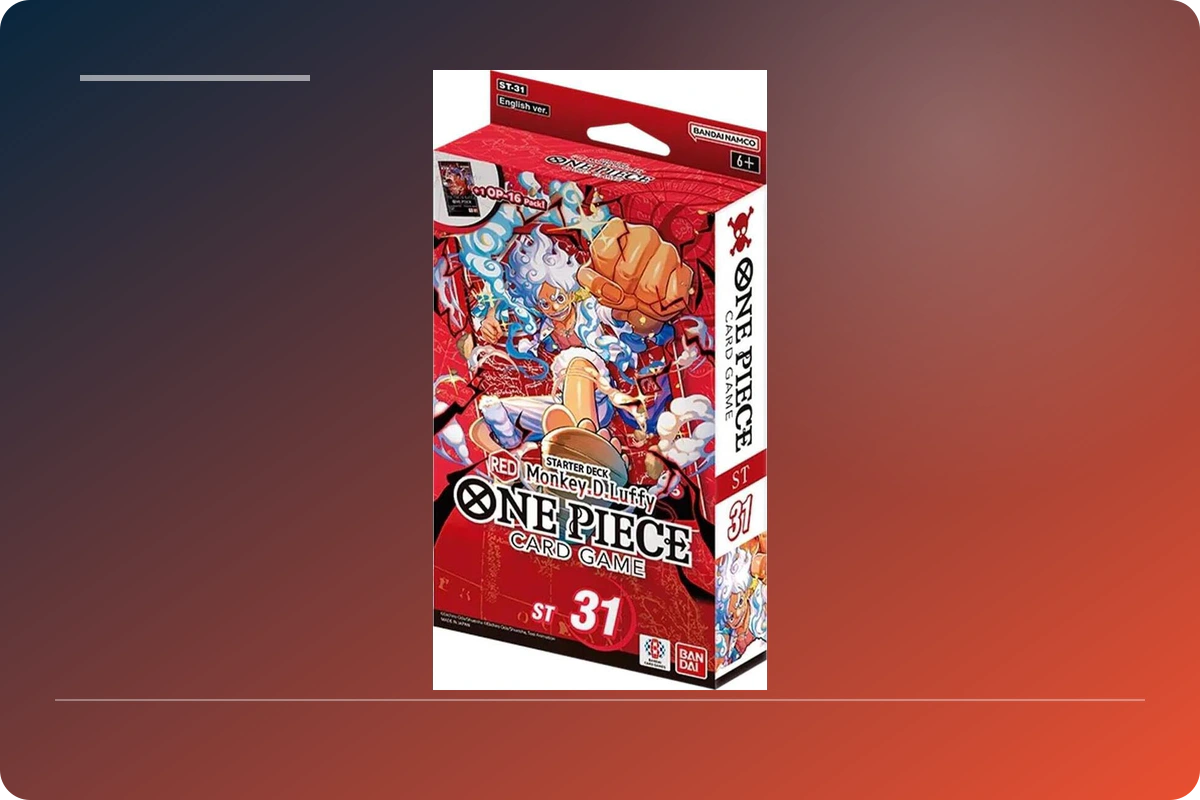
One Piece Card Game ST31 Red Monkey D. Luffy Starter Deck
A direct Red lesson in pressure, sequencing, and making attacks matter. It is the easiest deck in this wave to hand to a curious player without a fifteen-minute apology.
- Current starter wave
- Teaches core combat tempo
- Exact Amazon product verified
- Stock list is a curriculum, not a finished tournament list
- Popular character demand can distort price
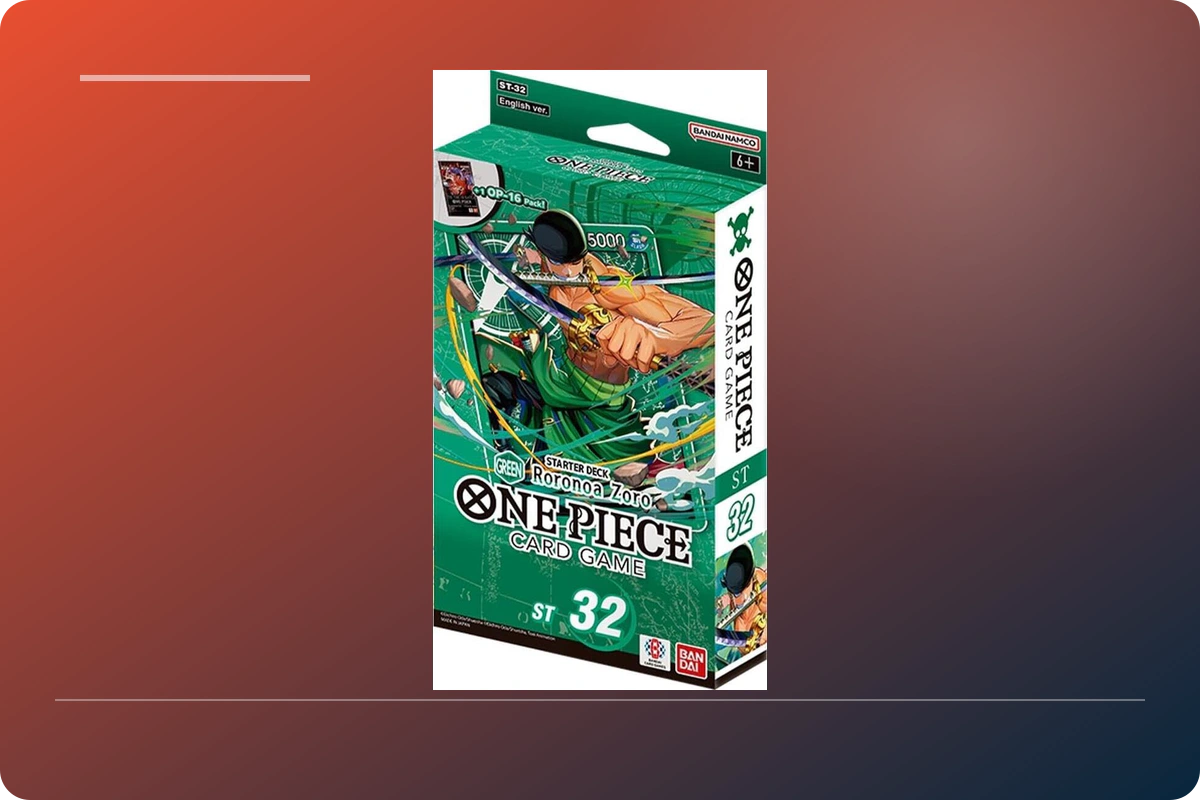
One Piece Card Game ST32 Green Roronoa Zoro Starter Deck
A more deliberate first deck than Luffy. Choose it when building a threatening board sounds better than simply racing the opponent's life total.
- Current Standard entry
- Rewards sequencing
- Exact Amazon product verified
- Less forgiving when resources are committed in the wrong order
- Needs repetition before its tempo feels natural
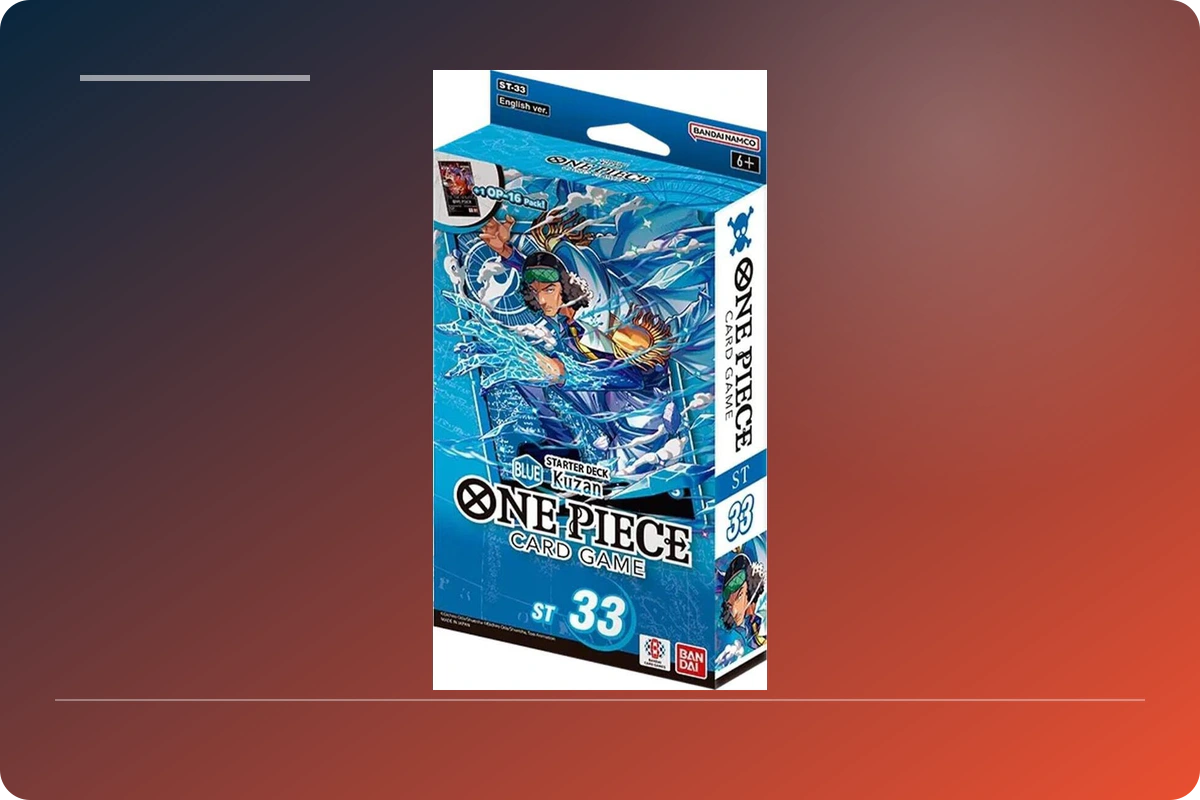
One Piece Card Game ST33 Blue Kuzan Starter Deck
The thinking player's first port. Kuzan makes card quality and timing visible, but asks more of a beginner than Luffy's clean pressure plan.
- Strong decision training
- Current starter wave
- Exact Amazon product verified
- Higher cognitive load
- Punishes casual hand management
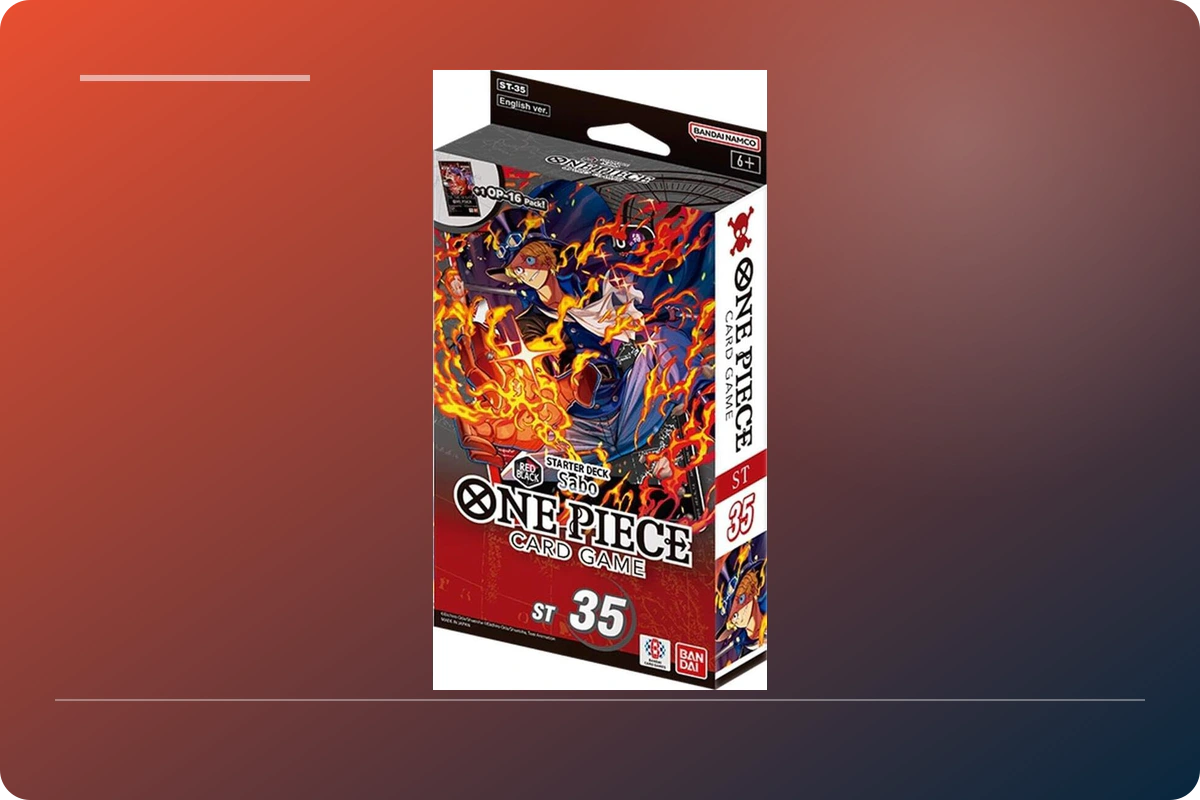
One Piece Card Game ST35 Red/Black Sabo Starter Deck
A compelling second first deck: approachable enough to learn, layered enough to reward the player who wants more decisions after the basics click.
- Two-color depth
- Current starter wave
- Exact Amazon product verified
- More interactions to remember
- Less ideal for a completely cold first teach
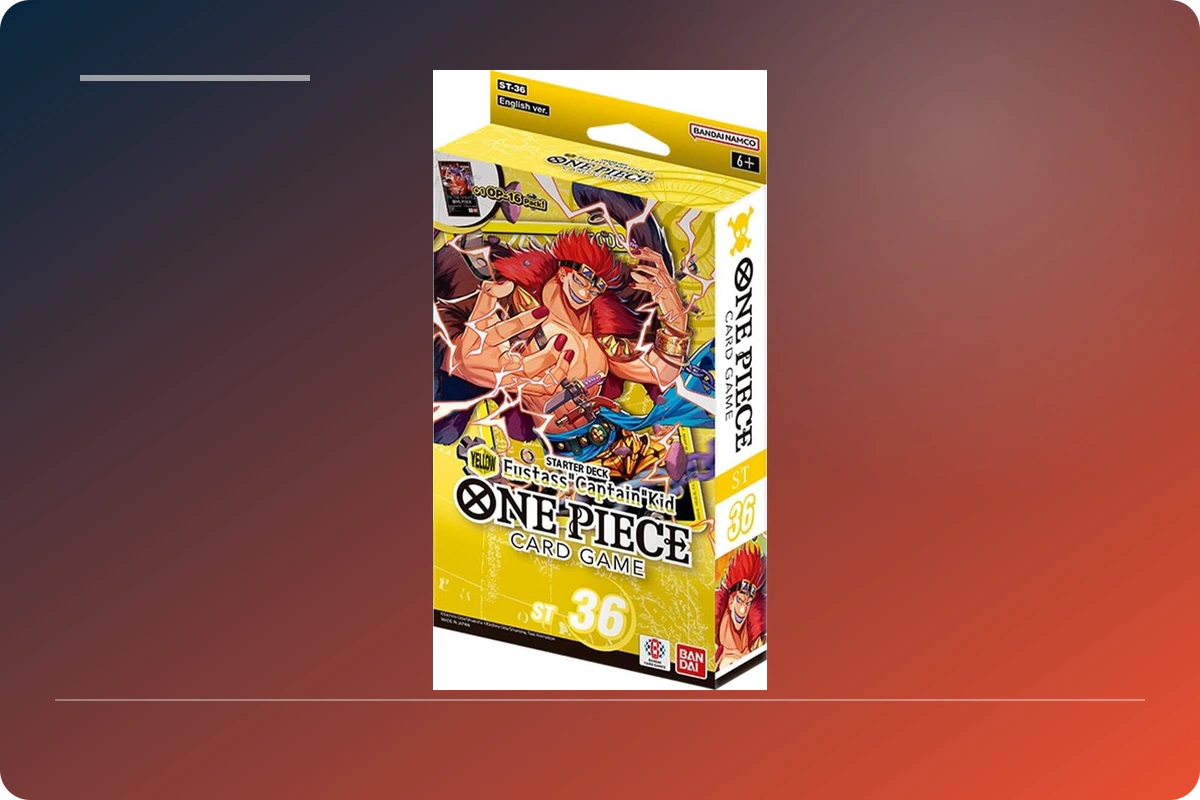
One Piece Card Game ST36 Yellow Eustass Captain Kid Starter Deck
Yellow turns the life area into a decision surface. It is exciting, thematic, and slightly less gentle than Red for a first-ever game.
- Distinctive risk-reward play
- Current starter wave
- Exact Amazon product verified
- Life manipulation adds rules load
- Can teach bad habits if every risk is treated as free
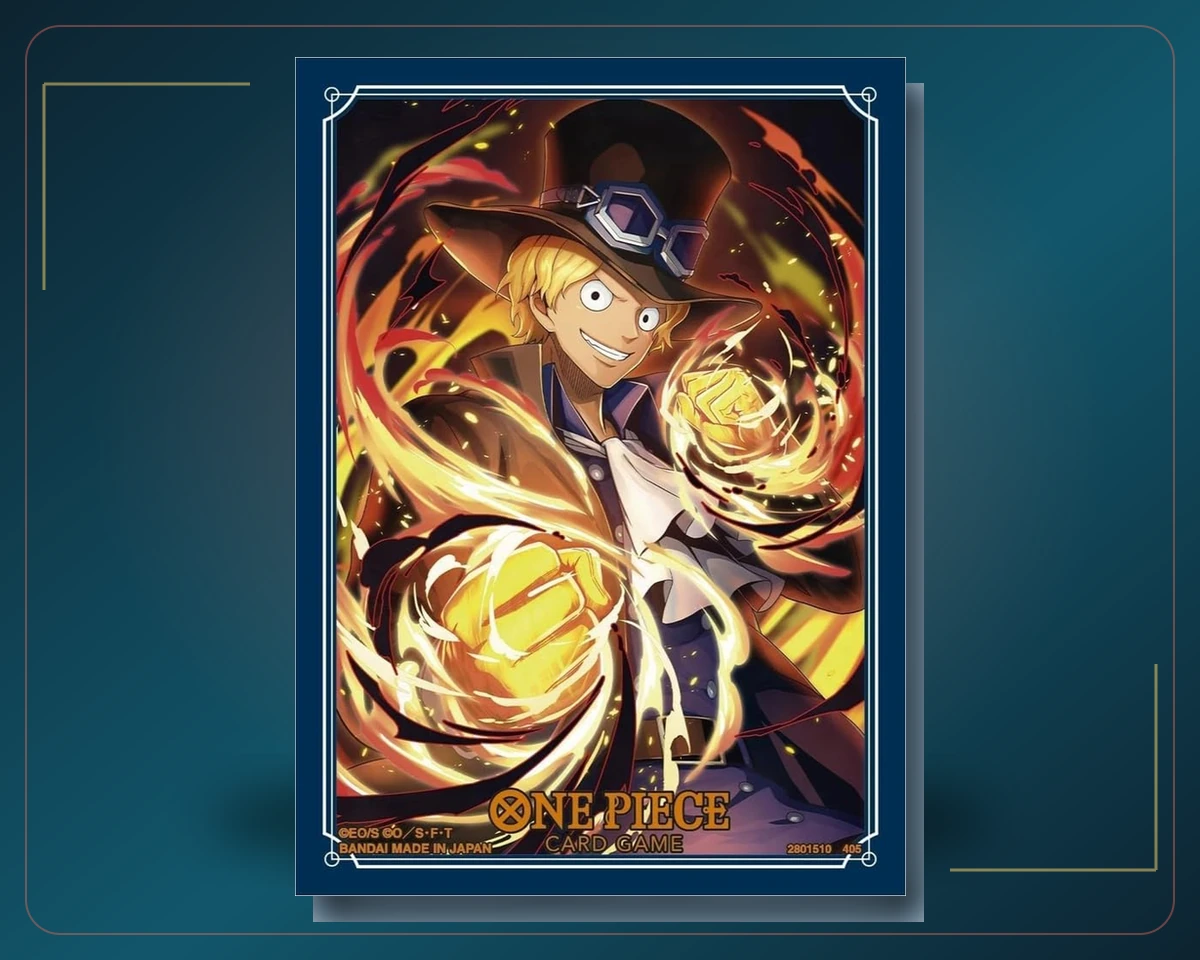
Bandai One Piece Card Game Sabo Sleeves
Official Sabo sleeves make the most technical starter route visually distinct and include enough sleeves for the main deck plus replacements.
- It protects the active cards while giving the deck a deliberate identity; keep an identical spare pack for replacements when possible.
- 5.0/5 from 5 Amazon ratings at the Keller, Texas review check
- Art sleeves can show edge wear sooner than plain workhorse sleeves and may need replacing as a complete set.
- Confirm card size, pack count, opacity, and current tournament policy before sleeving a competitive deck.
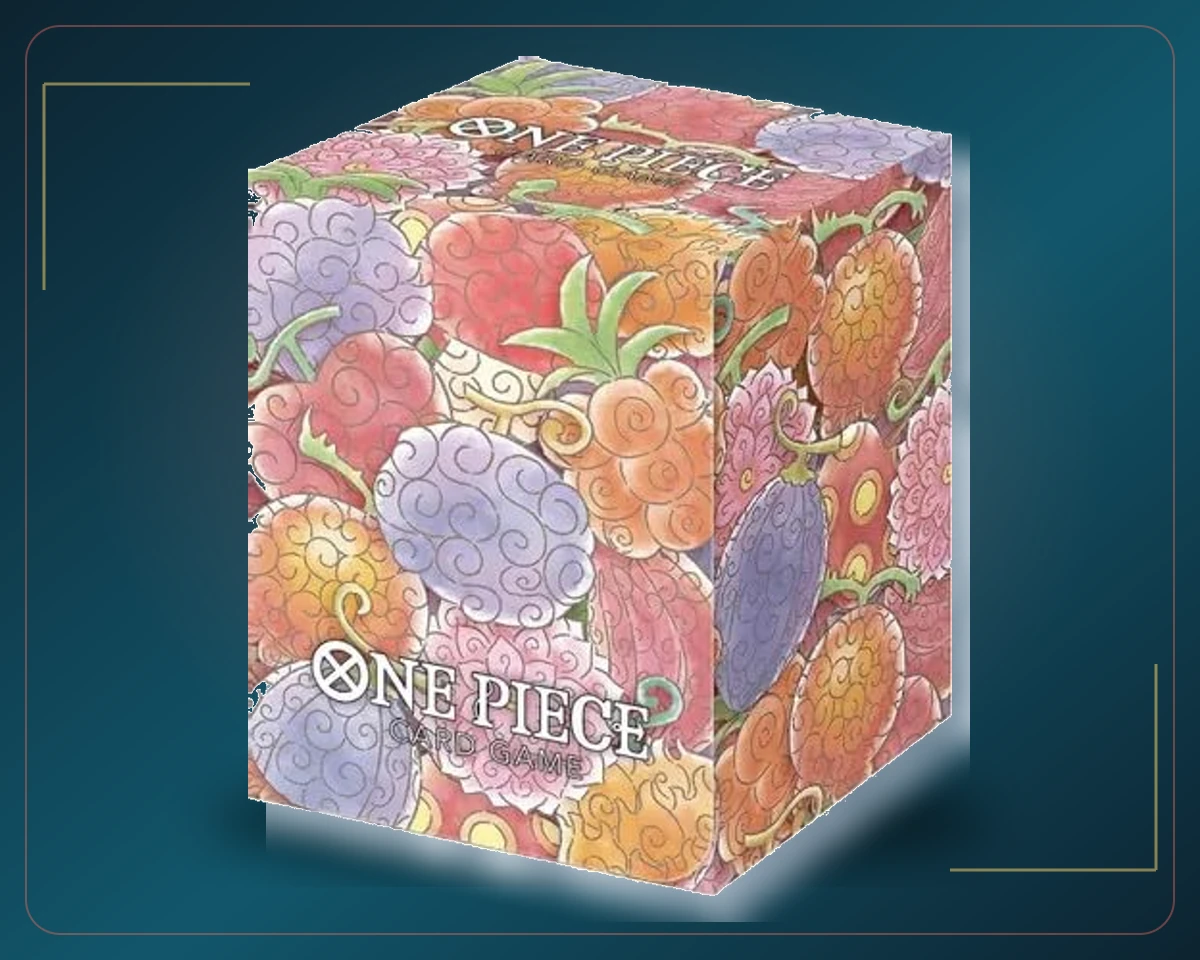
Bandai One Piece Card Game Devil Fruits Deck Box
The official Devil Fruits deck box is the characterful case this product family calls for; it keeps the active deck separate without looking interchangeable with every TCG on the site.
- The box keeps the playable kit together and is more satisfying than a generic case when the featured deck has earned permanence.
- 3.8/5 from 36 Amazon ratings at the Keller, Texas review check
- Licensed art can cost more than a plain box with stronger hinges or a more useful dice tray.
- Capacity claims are measured differently; test the real deck after inner sleeves, outer sleeves, tokens, and public cards are added.
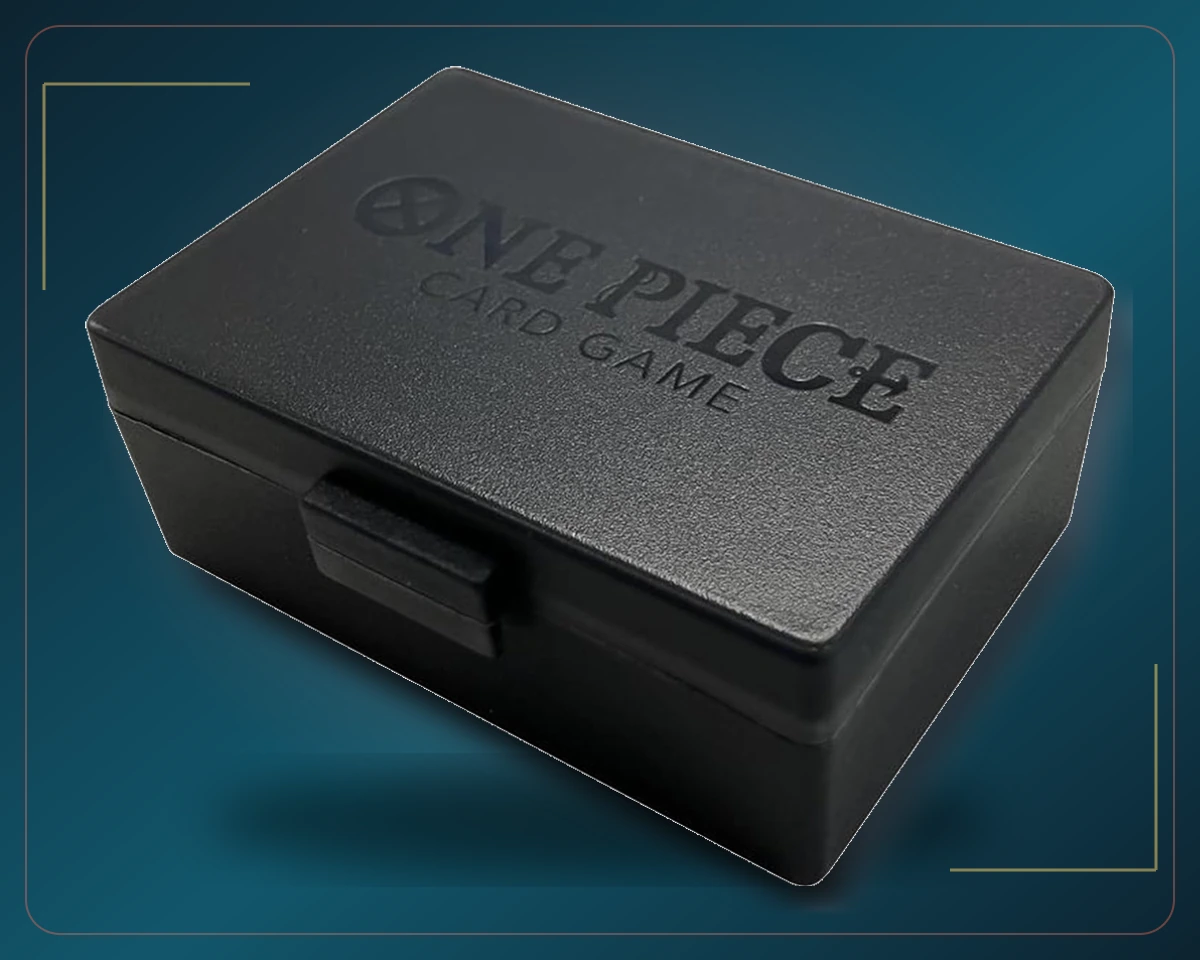
Bandai One Piece Card Game Official Dice & Case
Bandai’s official dice-and-case set keeps public counters contained and travels cleanly with a starter deck. Add it only when dice are already part of the table routine.
- It targets the counters, tokens, dice, or public pieces players touch every turn instead of decorating an unused corner.
- 4.6/5 from 14 Amazon ratings at the Keller, Texas review check
- Premium table pieces become clutter when their symbols are less legible than the cardboard they replace.
- Use the game's official components first and upgrade only after the same friction appears across several sessions.
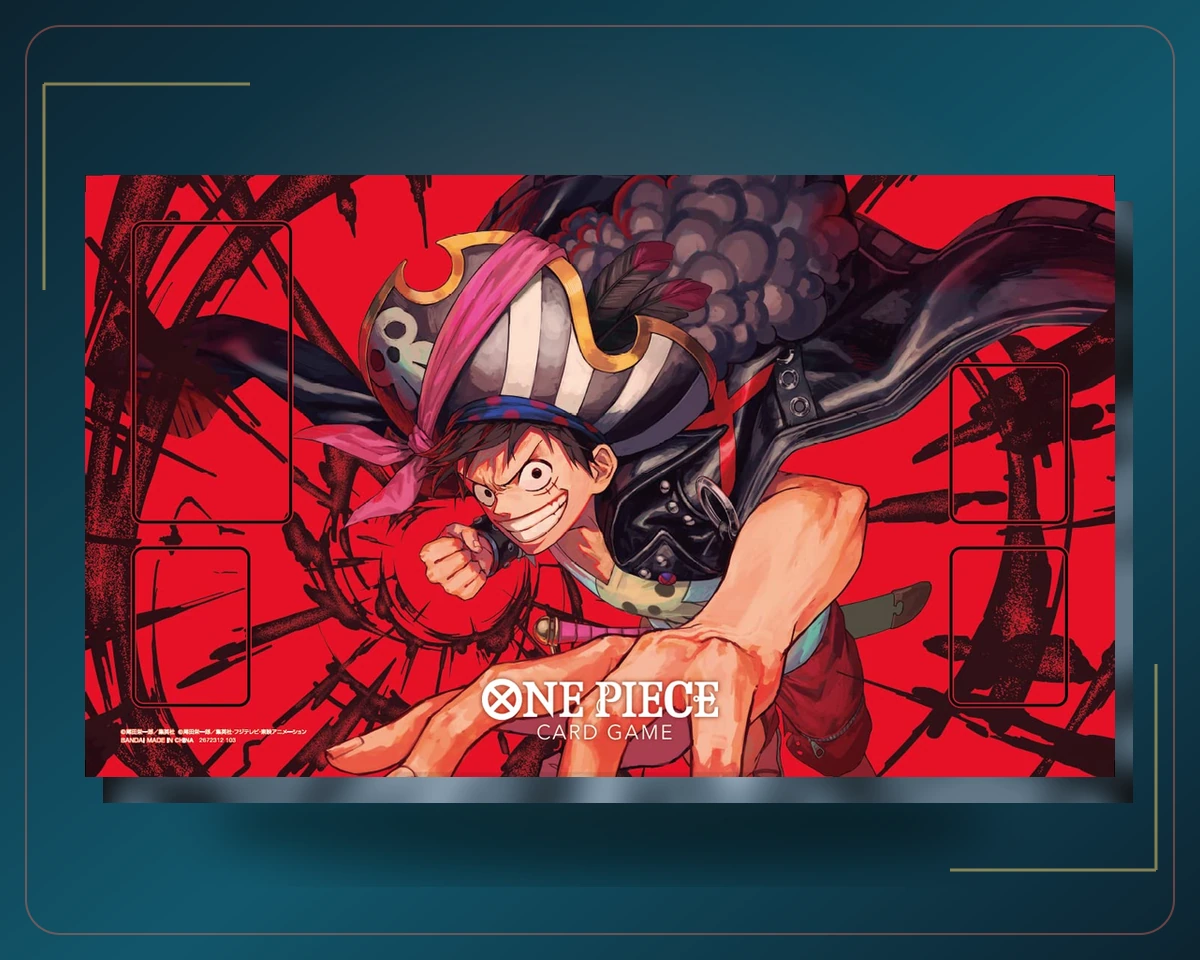
Bandai One Piece Card Game Official Playmat
The official Bandai Namco playmat gives both formats a licensed, non-generic surface and improves card pickup during repeated sequencing practice.
- The mat protects cards, quiets the table, and provides atmosphere without inventing another component to manage.
- 4.7/5 from 75 Amazon ratings at the Keller, Texas review check
- The first visible wear usually appears at stitched edges or from being stored folded instead of rolled.
- Measure the usable table and verify that printed zones match current rules before choosing a zone-forward design.
At a glance
| Question | Standard | Extra |
|---|---|---|
| Card pool | Block Icon 2 or higher from April 1, 2026 | All released cards except current bans and restrictions |
| Where it appears | Default current official event regulation | Dedicated Extra events and groups that name it |
| Best for | New players, current products, official competition | Older leaders, historical collections, broader brewing |
| Before buying | Confirm the deck's individual block icons | Confirm the current banned, restricted, and pair rules |
Free download — Standard or Extra: Read the Block Icon
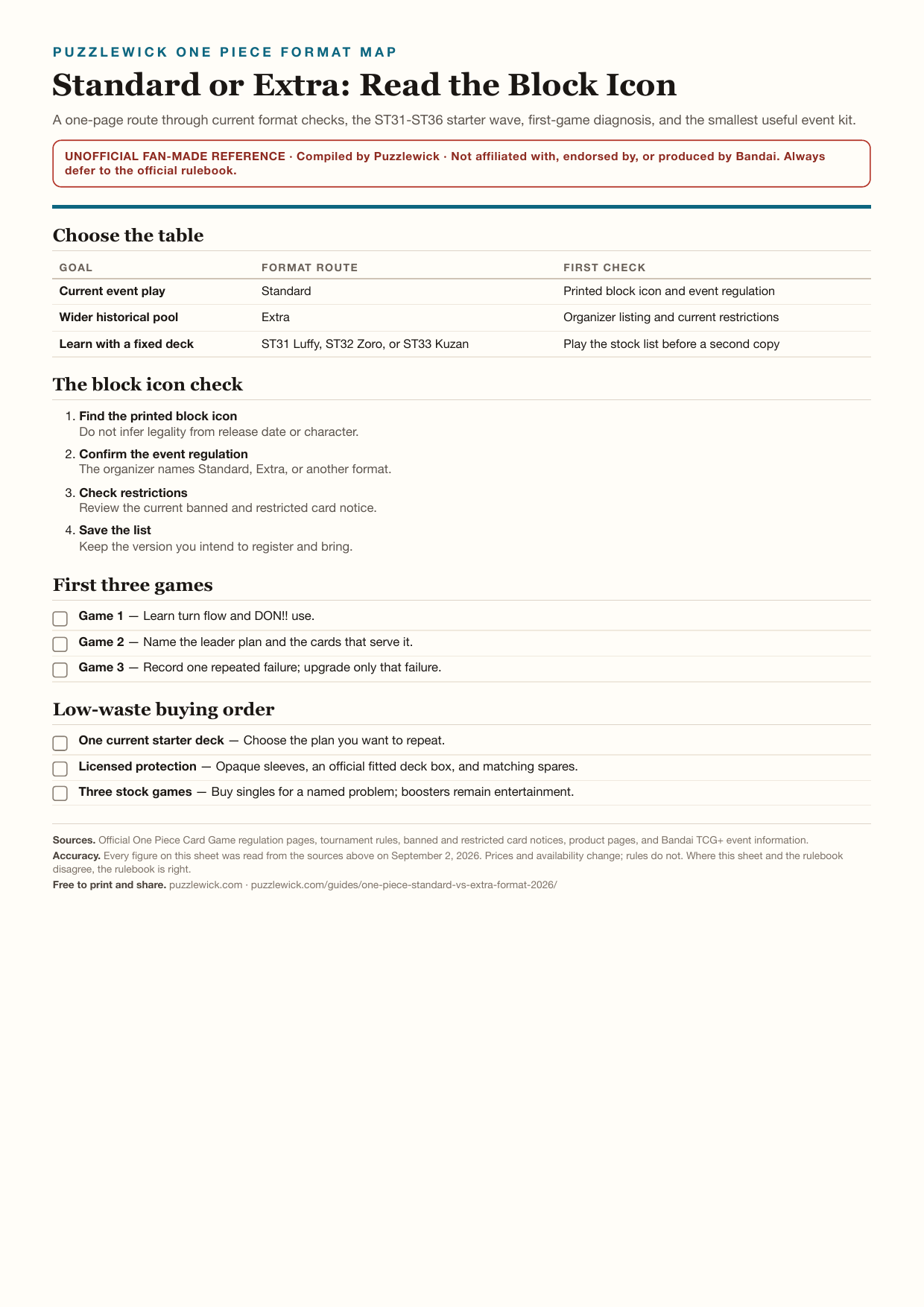
A one-page format decision, block-icon check, first-three-games loop, and low-waste buying order.
Unofficial fan-made reference. Compiled by Puzzlewick from the sources listed on the sheet. Not affiliated with or endorsed by the publisher — always defer to the official rulebook.
Questions, answered
What is One Piece Card Game Standard Regulation?
Standard is the current rotating official regulation. From April 1, 2026, cards with Block Icon 2 or higher are eligible, subject to current restrictions.
What is One Piece Card Game Extra Regulation?
Extra allows cards released to date except cards affected by the current banned, restricted, or banned-pair rules for that regulation.
Which regulation do official One Piece events use?
Championship 26-27, store tournaments, release events, and store treasure events use Standard unless the event information specifies otherwise.
What does the number on a One Piece card mean?
The Block Icon identifies the card's release block for regulation eligibility. Current Standard requires Block Icon 2 or higher.
Are Block 1 cards banned everywhere?
No. They rotate out of Standard as a group, but Extra exists to support the wider historical pool under its current restrictions.
Can a reprint of an old card be Standard legal?
Some reprints receive updated block treatment. Check the specific printed card and official card record rather than relying only on the card name.
Which One Piece starter deck is best for a beginner in 2026?
ST31 Luffy is the broadest first recommendation for direct combat learning. Zoro suits development, Kuzan control, Sabo two-color depth, and Kid risk-reward life play.
Should I buy two copies of a One Piece starter deck?
Not immediately. Play three stock games, identify which starter-exclusive cards need more copies, then buy a second deck only if it solves a specific list problem.
Are booster boxes a good way to upgrade a starter deck?
They are fun, but unreliable for targeted upgrades. Singles or a justified second starter are more efficient when you know the cards you need.
What should I bring to my first One Piece event?
Bring a legal sleeved deck, ten DON!! cards, spare matching sleeves, any requested deck list, and confirmation of the event regulation.
Dax's verdict
For almost every new player in 2026, start in Standard with one current starter deck, sleeves, and three unmodified games. Standard is the format most official events use unless they say otherwise, and a current starter minimizes legality cleanup. Extra is excellent when a known local group plays it or an older deck is the entire reason you want to join. Buy for the table you can actually reach, not the format whose card pool looks largest on paper.
Research ledger 11 sources · reviewed 2026-08-17
Specifications, rules, current product information, community experience, and contrary evidence were checked against the sources below. Commercial links are kept separate from editorial evidence.
- One Piece Card Game: Introduction of the Block Number Systemen.onepiece-cardgame.com/topics/013.php
- One Piece Card Game development team: Standard and Extra regulationsen.onepiece-cardgame.com/topics/018.php
- One Piece Card Game official rulesen.onepiece-cardgame.com/rules
- One Piece Card Game comprehensive rulesen.onepiece-cardgame.com/pdf/rule_comprehensive.pdf
- One Piece Card Game official card listen.onepiece-cardgame.com/cardlist
- One Piece Card Game banned and restricted cardsen.onepiece-cardgame.com/rules/restriction
- One Piece Card Game event informationen.onepiece-cardgame.com/events
- One Piece Card Game official productsen.onepiece-cardgame.com/products
- r/OnePieceTCG recurring beginner and rotation discussionsreddit.com/r/OnePieceTCG
- Bandai TCG+ event and deck platformbandai-tcg-plus.com
- OnePiece.gg: Standard Block Rotation Guideonepiece.gg/rotation
I'll be honest with you — flattery is boring.

Keep exploring
The next smart rabbit holes.
☠ Universe HubOne Piece Card Game: the whole buying pathThe One Piece Card Game combines Leader identity, a fifty-card main deck, ten DON!!, Life pressure, and hand-based countering into...🂠 Topic PathTrading Card Games: compare the whole shelfStart with the game and community you want, then buy the smallest product that lets you test it properly. These guides separate...GuideOne Piece ST31–ST36 Starter Decks Ranked: Best First Deck, Two-Copy Upgrades, and 2026 LegalityZoro, Luffy, Kuzan, Katakuri, Sabo, and Kid separated by stock strength, learning value, upgrade tax, and current Standard legality.