How to Play Splendor: Beginner Strategy and Which Expansions to Buy
A patient route from your first gem purchase to Cities, Trading Posts, Orient and Strongholds, with worked examples, real components and a sensible buying order.


AI-assisted research and drafting in Margo’s voice · reviewed by Robert Pruitt · how this guide was made
Last editorial refresh: 2026-09-01 Gold-standard QA: 2026-09-01 11 sources reviewed Affiliate links checked during gold-standard pass

The short answer
Splendor is a two-to-four-player race to build permanent gem discounts and earn prestige. On each turn, take three different gems, take a legal matching pair, reserve a card or buy one. Fifteen prestige triggers the end of the current round; the highest score wins. Start with the base game. Add The Silk Road for Cities and Trading Posts, or The Sun Never Sets for Orient and Strongholds, after the basic decisions feel comfortable.
Decision map
Choose in thirty seconds
The cleanest first purchase and the shared-table original
Players who want a modular expansion after mastering the base game
Experienced groups wanting another modular expansion menu
The first mistake in Splendor is assuming that a respectable pile of gems is an achievement. It is purchasing power. The achievement is spending it before somebody else buys the thing you wanted.
Margo is your Puzzlewick editorial host for this route through Marc Andre's game: first a calm teach, then useful strategy, then the current expansion family. Rules come from the publisher manuals; recommendations and examples are our analysis. No invented playtest score, guaranteed winning opening or claim of live stock is hidden in the fine print.
Start here, then go deeper
You are in the right cabinet.
 ✦ Topic PathBoard Game Buying Guides: compare the whole shelfStart with the decision, not the shelf. These guides compare the games, editions, expansions, player counts, and costs people...
 ComparisonThe Best Engine-Building Board Games of 2026, RankedA sensei's tier list of the games that taught a generation what "the engine click" feels like — from the gateway masterpiece to the...
 ComparisonThe Best 2-Player Board Games of 2026, RankedFifteen duels for two, sorted into hard tiers — the forever-game, the silent co-op, the giant-killers under twenty bucks, and the honest...
Is Splendor fun, and is it a good first strategy game?
Splendor suits people who enjoy making a small plan, watching it improve, then noticing that somebody else wants the same card. The satisfying loop is immediate: collect gems, spend them on a card, keep its discount, and afford something better. There are no hidden attack decks, lengthy character powers or rules chapters to unlock in the base game.
The catch is that a quiet game is not necessarily a gentle one. Cards and gem piles are shared. A friend can take the purchase you were preparing without ever saying anything more aggressive than "my turn." If your group wants storytelling, negotiation or spectacular dice disasters, this is a different pleasure: compact calculation with lovely chips.
Space Cowboys lists two to four players, ages ten and up, and about thirty minutes. Allow extra room for a first teach and a group that likes to calculate every possibility. The rules are approachable; recognizing when to stop collecting discounts is the longer apprenticeship.
Buy the base game first. Expansions offer different pressures, not repairs that a new player needs on day one. Our advice below is source-based analysis, not a claim that our fictional curators conducted a physical playtest.
What should you buy: Splendor, Duel or an expansion?
Standard Splendor is the flexible two-to-four-player starting point. Its current presentation uses Paul Verite's artwork, while older copies have a different visual identity. Match photographs to the edition on the listing. A packaging change does not turn an expansion into a complete game.
Splendor Duel is a separate game for exactly two. Its central gem board, pearl pieces and Privilege scrolls create a different contest. It is a strong candidate for a household that always plays as a pair and wants more direct friction. Standard Splendor also plays officially at two; Duel is an alternative, not an obligatory upgrade.
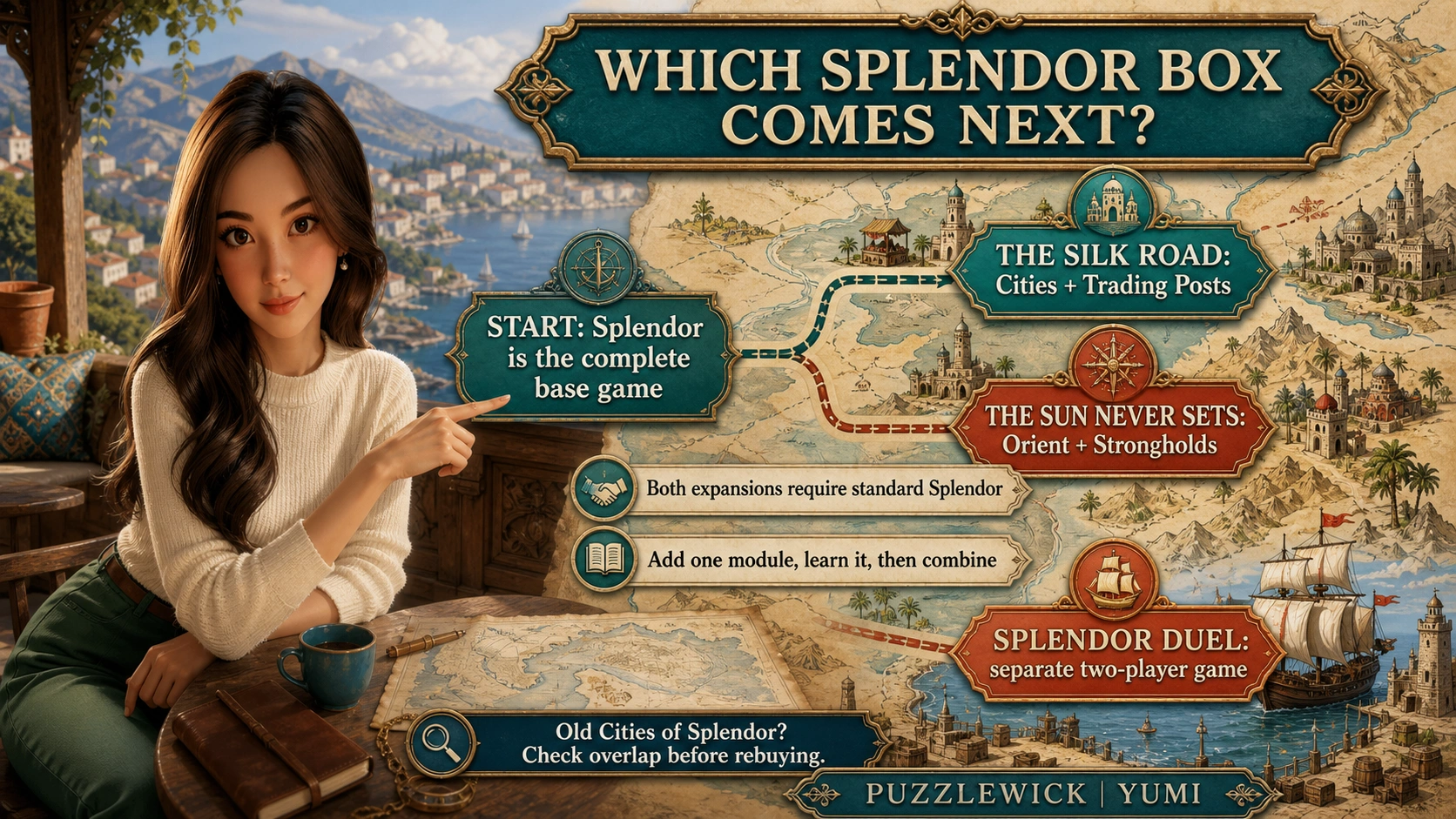
The Silk Road and The Sun Never Sets both require standard Splendor. Silk Road supplies Cities and Trading Posts. Sun Never Sets supplies Orient and Strongholds. Some retailer descriptions currently mix those module names up. The publisher's contents and manuals are the reference used here.
If you already own the older Cities of Splendor box, compare its four modules with these revised releases before buying. You may prefer the current presentation or adjustments, but familiar module names are not four entirely new ideas. Do not combine an older rule sheet and a newer component without checking which version you mean to play.
Set up your first game without learning everything at once
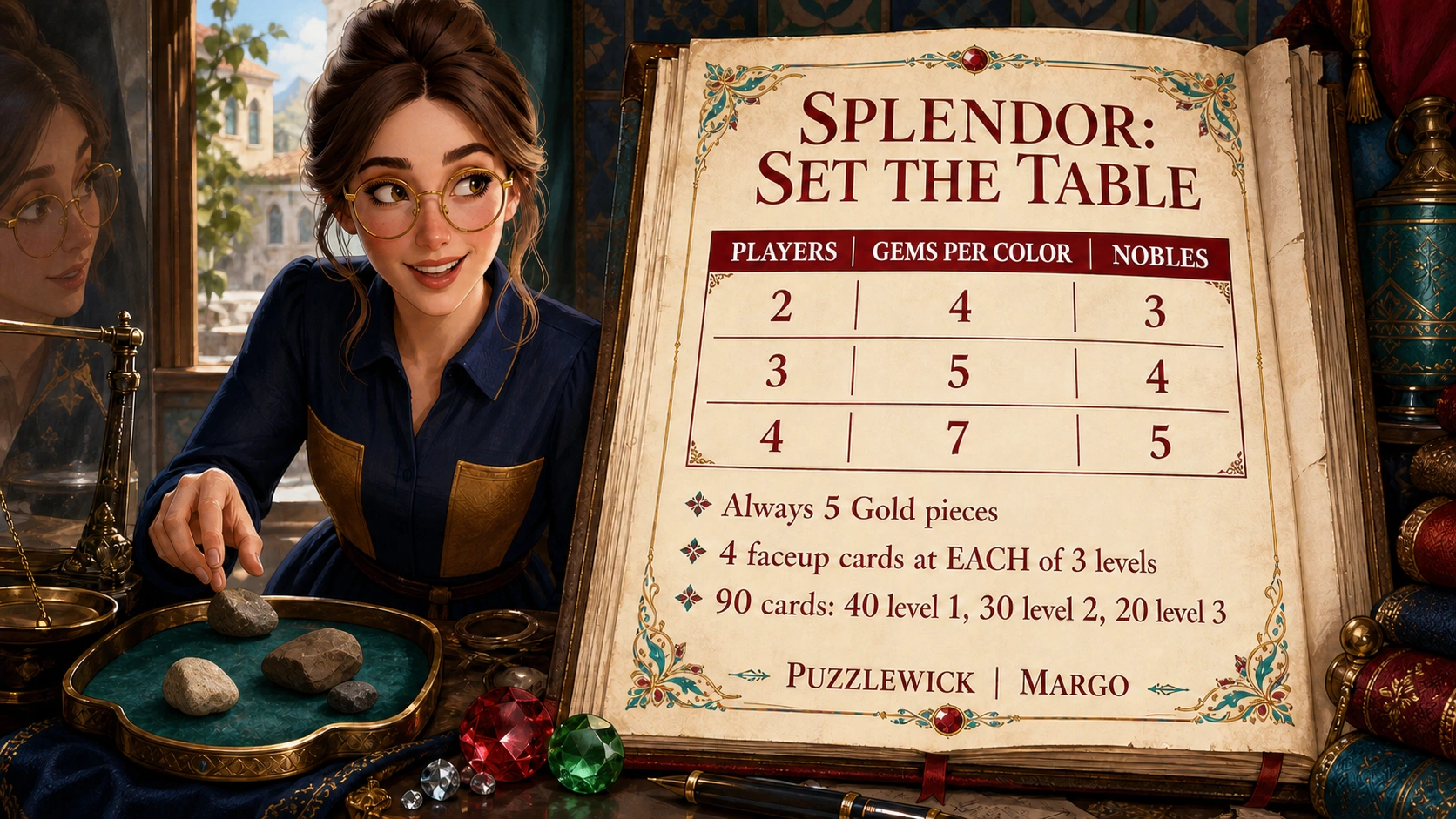
Sort the Development cards into their three levels, shuffle each level, and reveal four cards beside each deck. You now have a twelve-card market: inexpensive level-one cards, the middle tier and the more ambitious third tier. Leave the remaining cards face down in their own decks.
| Players | Pieces of each non-Gold color | Nobles in play | Gold pieces |
|---|---|---|---|
| 2 | 4 | 3 | 5 |
| 3 | 5 | 4 | 5 |
| 4 | 7 | 5 | 5 |
Choose the Nobles randomly. Return the unused pieces and Nobles to the box. The base deck has ninety Development cards: forty level one, thirty level two and twenty level three. Gold is a wildcard, not a sixth ordinary color that you take with the normal gem action.
The current rulebook gives the youngest player the first turn; play proceeds clockwise. Keep the first-player marker visible so the final round is unambiguous. Nobody starts with a hidden hand of purchased cards or a private stash of gems.
For the teach, point to one card. Explain its cost, its permanent bonus color and any prestige points. Then explain the four possible actions. Nobles can wait thirty seconds while people discover what a bonus is. A good teach follows the first decision, not the alphabetical index.
Rules reference: base-game setup, contents and first player.
The four actions: take gems, reserve or buy
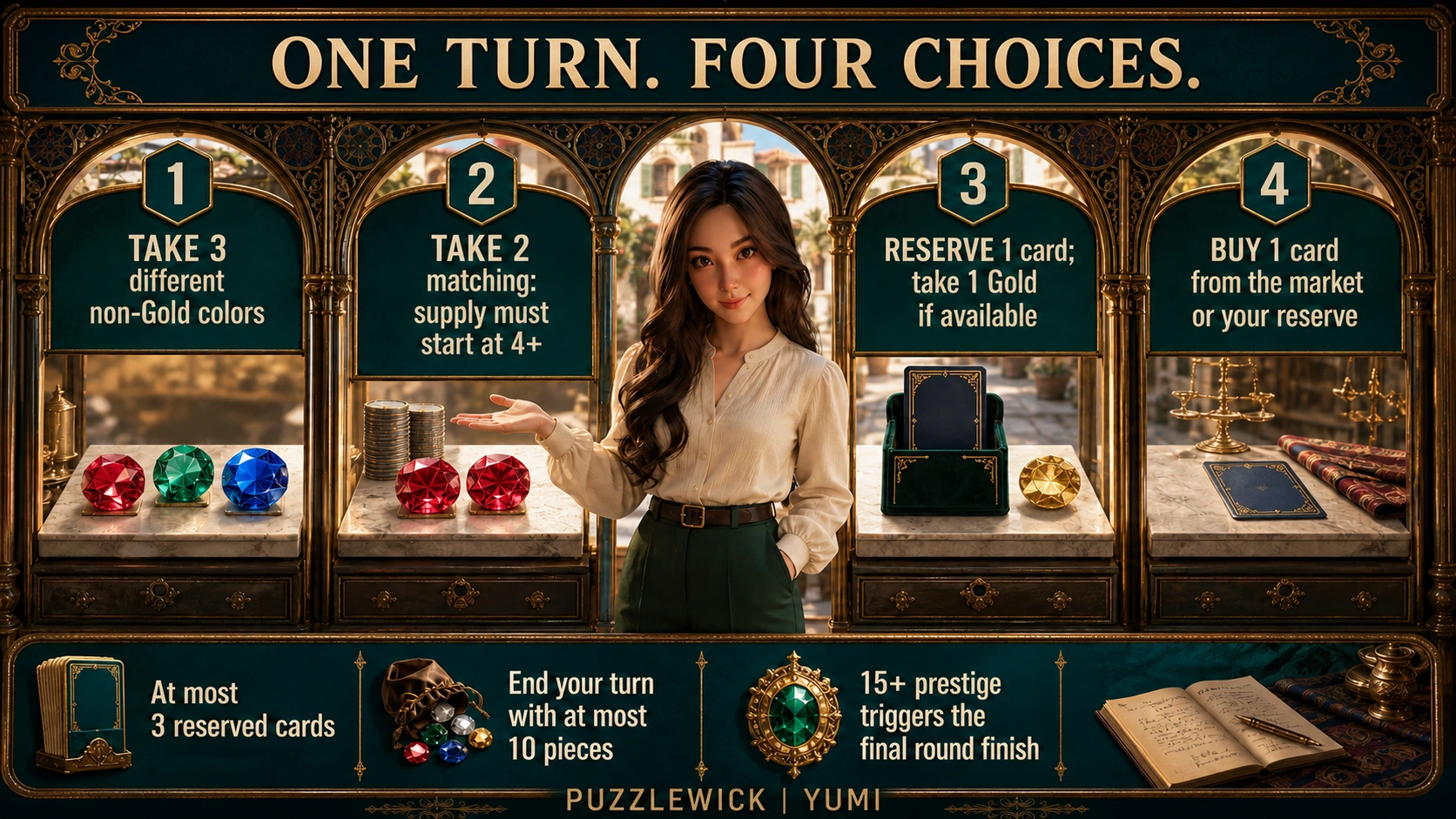
Take three different colors
Take one piece from each of three different non-Gold colors. You cannot voluntarily take just one or two when three colors are available. If fewer than three colors remain in the supply, take from the available colors.
Take two of the same color
You may take a matching pair only when that color's supply contains at least four pieces before you take them. A pile of three is not enough. This matters especially at two players, where each color begins with only four.
Reserve a card and, if available, take Gold
Take one faceup Development card into your hand, or reserve the top card of a chosen deck without showing it. Take one Gold piece if the supply has one. You may still reserve when Gold is empty, but may never hold more than three reserved cards. You cannot discard a reservation just because a prettier plan appeared.
A reservation protects a future purchase from opponents, gives flexibility through Gold and can deny a critical card. It is not free: you used your action without buying anything. There is no endgame penalty for an unbought reserved card, although the turns spent collecting it still happened.
Buy a card
Buy one faceup card or one of your own reserved cards, paying after discounts. A card you can afford for zero pieces still uses the purchase action. Place it visibly in your play area. When a market card is bought or reserved, immediately refill its space from the matching deck if cards remain.
Finish with at most ten pieces, counting Gold. You may temporarily exceed ten during your turn, but must return your choice of excess pieces before ending it. You do not get a second normal action simply because the first one was quick.
Rules reference: base-game actions, reservations and piece limit.
Read a card, pay correctly and keep your discounts
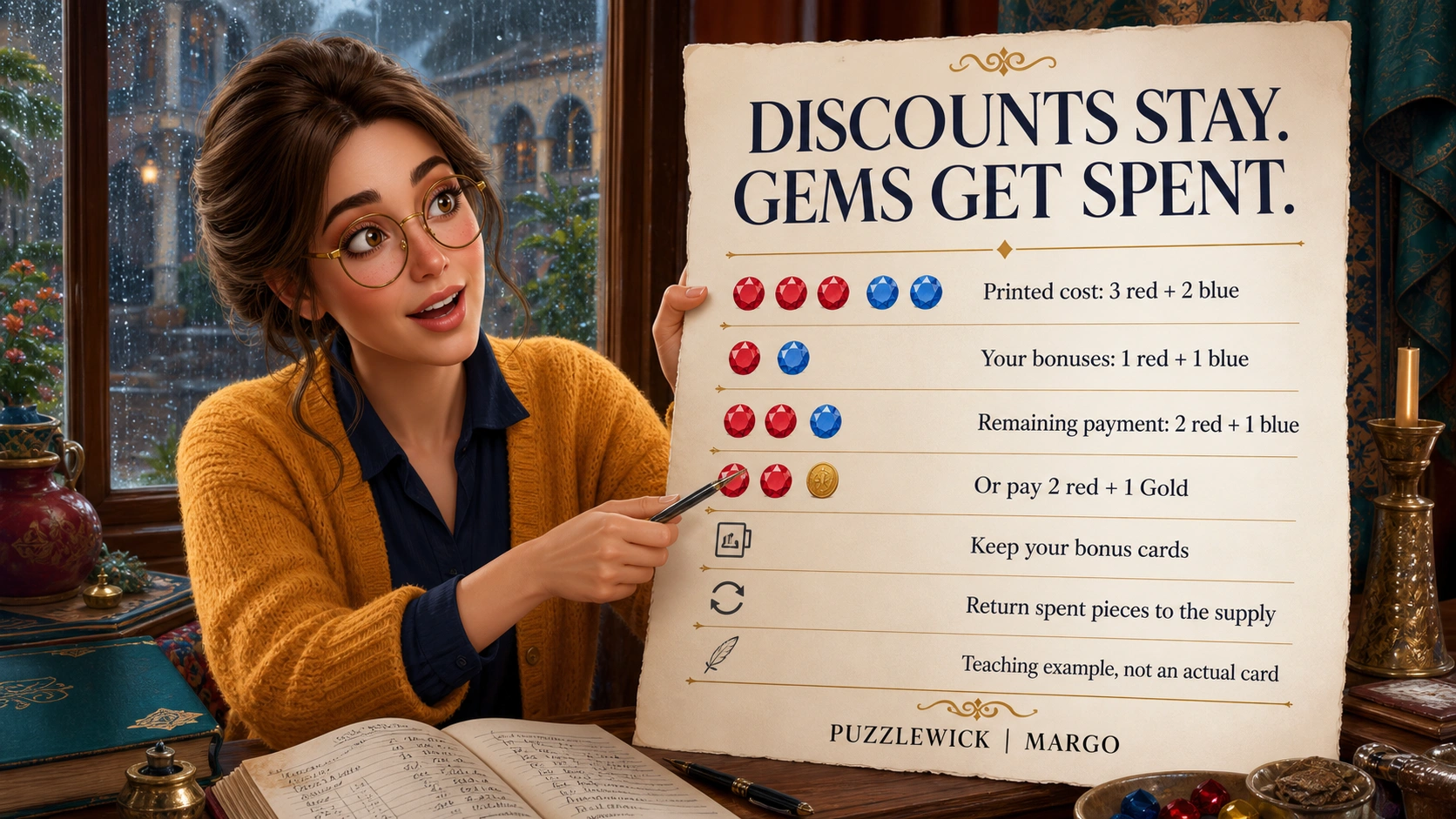
The colored gem symbol on a purchased card is a permanent bonus. Every card of that bonus color reduces future costs in that color by one. The prestige number is separate: it helps win the game but is not another payment discount.
Here is a teaching example, not a particular printed card. Suppose a purchase costs three red and two blue. Your existing cards give one red bonus and one blue bonus. Subtract those first: you owe two red and one blue. You could pay those three colored pieces, or replace the blue payment with one Gold.
Return the spent pieces to the supply. Keep the purchased cards, including the cards that gave the discounts. Bonuses are not consumed; Gold is. You can use Gold even if you hold the matching ordinary piece, but there is no change for overpayment and no way to convert an unused red discount into a blue one.
Make your first few payments aloud: "Three red, minus one red bonus, so two red pieces." That is not a sign of inexperience to apologize for. It gives everyone a shared check and prevents a confident arithmetic error from becoming the table's new rule.
Rules reference: purchasing and Development-card bonuses.
Nobles and the finish: fifteen is a trigger, not an instant trophy
Nobles care about your permanent matching bonuses, not the pieces in your hand. At the end of your turn, a Noble visits if your bonuses meet its requirements. Take the tile without spending those bonuses or using another action. If you qualify for several available Nobles, choose one; you may receive only one per turn.
Once a player reaches at least fifteen prestige at the end of their turn, finish the current round so everyone has had the same number of turns. Players who already acted in that round do not receive an extra turn. The highest total wins, even if that is not the player who first reached fifteen.
For example, at a four-player table, seat three reaches fifteen. Seat four still acts; seats one and two do not act again. If seat four ends at sixteen, seat four wins. If players tie on prestige, the one with fewer purchased Development cards wins. If still tied, they share victory. Remaining gems are not the tiebreak.
Announce a trigger clearly and keep cards and scores visible. A helpful first-night habit is to ask who still has a turn before somebody clears the table. The expansion Cities changes this ending; do not carry the fifteen-point trigger into that module automatically.
Rules reference: Noble visits and end of game.
Beginner strategy: make the next purchase easier, not your collection larger
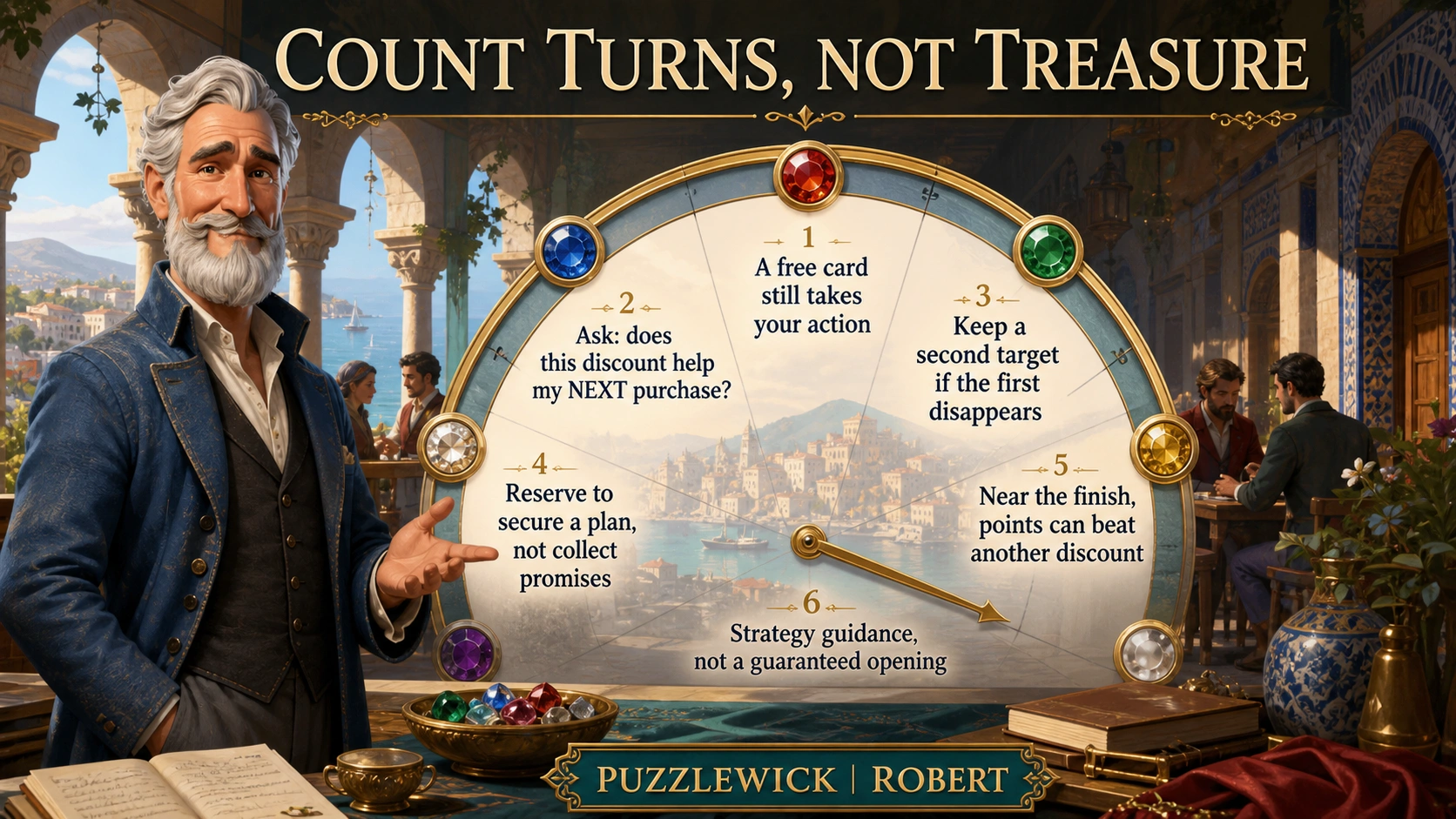
Count the actions between you and useful points. A cheap card can be excellent if its discount helps with several visible targets. It can also be a beautifully illustrated detour. Before taking it, identify at least one likely purchase that the new bonus will make easier.
When a free card costs too much
Suppose you can buy a zero-point card for no pieces, but can already buy a four-point card now. Buying the free card first takes an extra action. That can be sensible early if its bonus accelerates later purchases. With an opponent threatening to finish, postponing the points may simply lose the race. "Free" refers to gems, not time.
Keep two doors open
Choose gems that support a main target and a plausible second target. A single enormous shopping list is easy to interrupt. Reserve when securing the card is worth an action, especially when another player can buy it before your next turn. Do not reserve three expensive cards and then discover that all your flexibility is in your hand, doing nothing.
Know what a Noble is costing you
A Noble can reward the engine you were already building. Chasing one through several otherwise unhelpful purchases is a different decision. Compare those turns with buying visible prestige directly. Neither "always chase Nobles" nor "never chase Nobles" survives every market.
The Board Game Arena community strategy page also emphasizes turn efficiency, backup targets and reservation. That is attributed community advice, not a solved opening or a measured promise of success. Some of its stronger prescriptions and card rankings depend on the position; this guide deliberately does not turn them into universal laws.
Read opponents without making the table miserable
Everything needed for ordinary tactical observation is visible: bonuses, pieces, prestige, remaining market cards and supply piles. Reserved card faces are the important private exception. Look at what another player can afford next, not only what you hope to afford eventually.
The four-to-three supply threshold creates a simple denial opportunity. If a color has exactly four pieces, taking one as part of a legal three-different-colors action leaves three. The next player cannot take a pair from that pile. You have changed their options without spending your whole turn on a spiteful reservation. Do not misread this as permission to take only one piece when three colors are available.
Blocking has an opportunity cost. Reserving an opponent's winning card can be essential. Reserving their merely convenient card while a third player quietly wins is not brilliant defense. Ask whether the interruption buys you a useful turn, not whether it will produce the most satisfying sigh.
At two players, direct denial affects your only opponent. At four, a card can disappear through several other turns before you act again. That makes backup plans especially valuable. These are structural observations, not a claim that one fixed opening wins at a particular player count.
Before your first competitive event, ask the organizer about timing, tie procedures, authorized editions and notes. The publisher links a French tournament guide with event-specific rules, including a time-limit procedure. Those conditions are not the default ending for your kitchen-table game, nor proof that every event worldwide uses one format.
Rules reference: publisher-linked French tournament organizer guide; local event rules may differ.
Which Splendor expansion should you buy first?
For a newly confident base-game group, try The Silk Road first if you want new goals and ongoing powers. Cities changes the finish line; Trading Posts changes what your engine can do. Start with one module so the table can feel its effect.
Choose The Sun Never Sets when you want trickier card effects or more direct market control. Orient expands the market and creates timing exceptions. Strongholds lets you protect and contest faceup cards. This is attractive for a regular group that enjoys looking into each other's plans, less useful as a cure for a first game that already felt overwhelming.
| What your table wants | Try first | What changes |
|---|---|---|
| A different finish line | Cities, in The Silk Road | Prestige plus a specified card collection |
| Persistent personal powers | Trading Posts, in The Silk Road | Extra efficiency earned through card requirements |
| More dramatic card combinations | Orient, in The Sun Never Sets | Extra market, copied bonuses and free acquisitions |
| More direct competition | Strongholds, in The Sun Never Sets | Claims on the market and Conquest purchases |
The current manuals permit combining these modules. Permission is not a teaching recommendation: one new rule system at a time is easier to diagnose. A group that enjoys the original game indefinitely has not failed to level up.
Rules reference: Silk Road contents and combination notes.
Rules reference: Sun Never Sets contents and combination notes.
Cities: build the right business, not just a high score
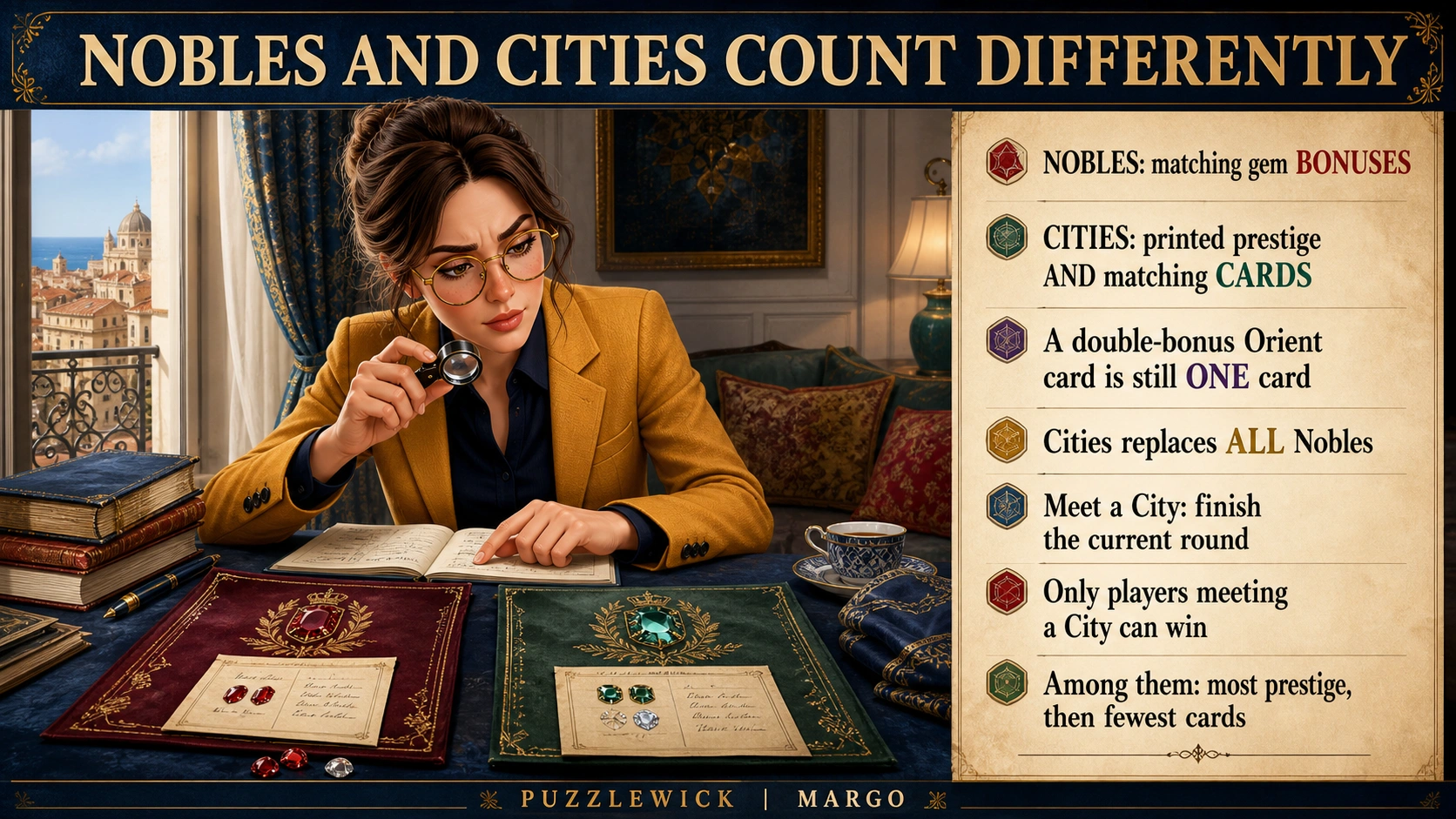
Remove all Nobles, randomly select three City tiles and reveal a random side of each. A City asks for both a minimum prestige total and a collection of specified colored cards. You must satisfy both parts. Merely reaching fifteen prestige does not trigger this ending.
A generic same-color requirement must use a color different from the other colors specified on that City. For example, a requirement for four white cards plus four cards of another color cannot use the same white cards twice. Read the actual tile; Cities have different conditions.
At the end of a turn, meeting a City triggers completion of the current round. Only players who meet a City's requirements at the end of that round are eligible to win. Among those players, compare prestige, then fewest cards; a remaining tie is shared. A spectacular score with the wrong collection does not qualify.
The current Cities rules count cards, not bonuses. A double-bonus Orient card supplies two discounts but remains one card for a City requirement. This differs from Nobles, which check bonuses. Put that distinction on the table before mixing the modules rather than discovering it during the victory speech.
Strategically, examine all three available destinations before specializing. A City that matches your early purchases may be cheaper to reach than the one with the most attractive prestige requirement. Keep checking whether another player's collection makes a sudden finish possible.
Rules reference: Cities setup, requirements and winner selection.
Trading Posts: all five powers, with the small print
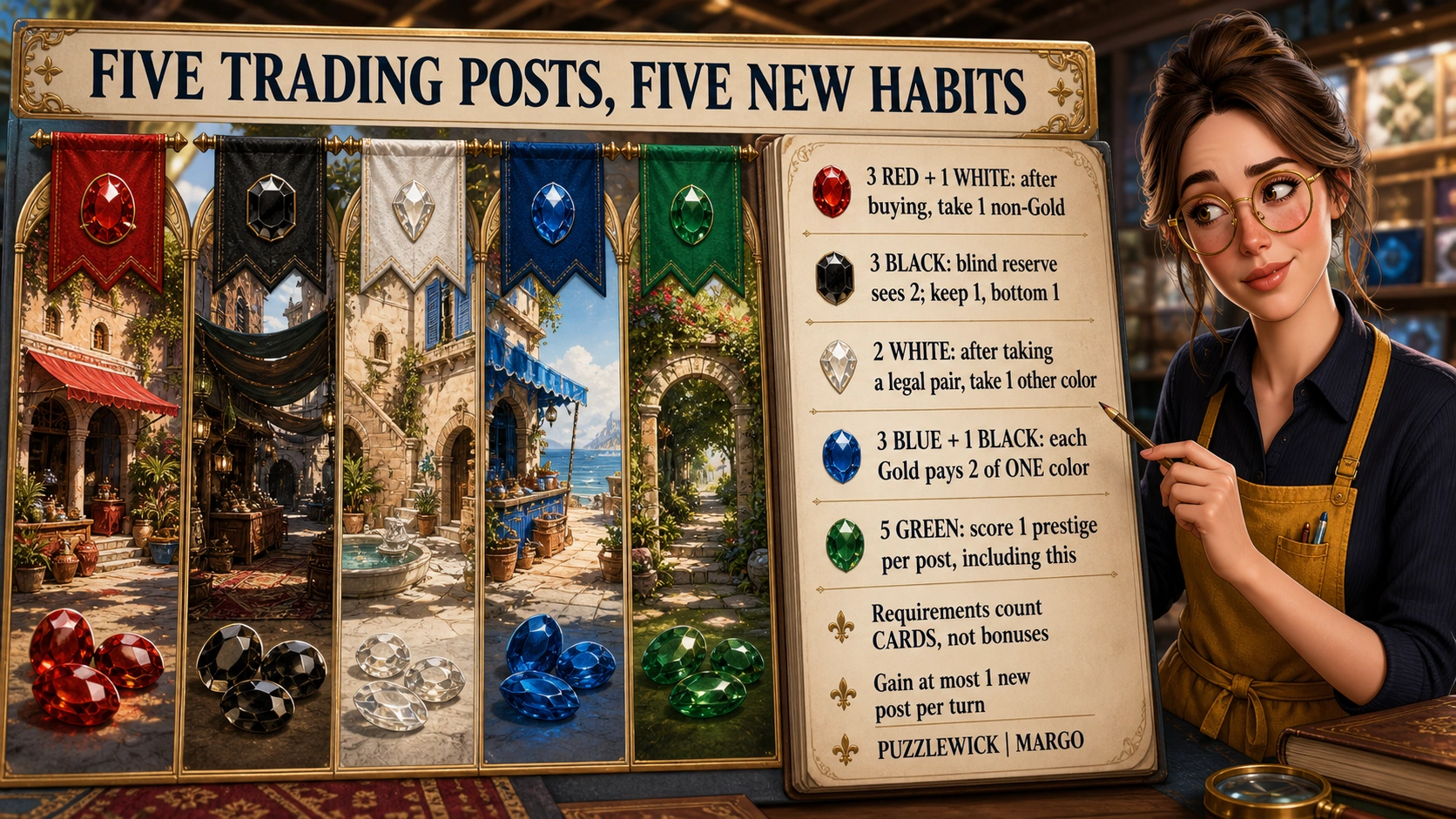
Place five stacks of Trading Post tiles nearby, one stack for each power, with as many tiles in each stack as there are players. At the end of your turn, after checking for a Noble, check whether you qualify for a new post. Gain at most one post per turn and never take the same power twice. Requirements count cards, not the larger number of bonuses an Orient card may provide.
| Card requirement | Power | Important limit |
|---|---|---|
| 3 red and 1 white | After a purchase, take one non-Gold piece before replacing the card | It may be a piece you just paid; a free Orient acquisition is not another purchase |
| 3 black | When reserving blind, see the top two cards, keep one and put the other at the bottom | This modifies blind reservation, not every visible reservation |
| 2 white | After taking a matching pair, take one other non-Gold color | The initial pair must still be legal: at least four in supply before taking it |
| 3 blue and 1 black | Each spent Gold is worth two pieces of one color | No change; it cannot pay two different colors and still counts as one held piece |
| 5 green | One prestige per Trading Post you own, including this one | This may trigger the applicable end condition |
A post gained after your action does not retroactively reward a purchase earlier that turn. Once acquired, it stays yours even if an Orient sacrifice later removes cards that met its requirement. When Cities is active, check for a Trading Post before checking the City; the points from a post can matter.
These powers are invitations, not commandments. Two white cards may unlock a useful collection rhythm, but buying two poor cards purely to obtain it can cost more tempo than the benefit returns. Compare the route with the cards actually available, not with the engine you would like the deck to provide.
Rules reference: Trading Post powers, acquisition timing and combinations.
Orient: understand the symbols before the clever turn
Shuffle the thirty Orient cards into three level decks. Reveal two at each level beside the original market. You now have eighteen faceup cards: twelve standard and six Orient. Refill a removed card from its own deck and level, not whichever deck is nearest your hand.
Copied bonuses and double bonuses
A copy card associates with an existing bonus card in your play area and adopts its color and bonus. You cannot buy it without an existing bonus card to associate with. Resolve the association before replacing the card in the market. A double-bonus card gives two discounts of its color but still counts as one card for Cities and Trading Posts.
Virtual Gold is not a handful of physical pieces
The virtual-Gold card can be discarded during a purchase for two virtual Gold pieces. Those can cover two units of one color or one of each of two colors in that purchase. Unused value is lost. You do not take physical Gold into your hand or preserve leftover virtual value for a later turn. Its interaction with the double-Gold Trading Post is specifically allowed by the current manual.
Cards that grant another card
Some Orient cards let you take a faceup card from a specified lower level without paying its cost. Follow the level printed in the rule explanation and resolve the gained card's effects. This can produce a satisfying chain. The gained card is not another purchase, even though it joins your play area. An opponent's Stronghold still protects a card: you cannot take that occupied card with an Orient free-card effect.
Sacrifice is a different purchase cost
Some level-three cards require discarding two cards of a particular color instead of paying pieces or bonuses. If you have copy cards considered to be that color, discard those before other cards of that color. The removed cards leave the game. You retain Nobles already earned, and acquired Trading Posts remain yours, even if the discarded cards helped qualify for them.
Orient rewards remembering both what a card does and what it does not do. Before your first combined game, have everyone explain the free-card versus purchase distinction once. That small pause prevents a much larger argument after somebody has already refilled three markets.
Rules reference: Orient setup and the level-one, level-two and level-three effect explanations.
Strongholds: claim a card, then earn a Conquest
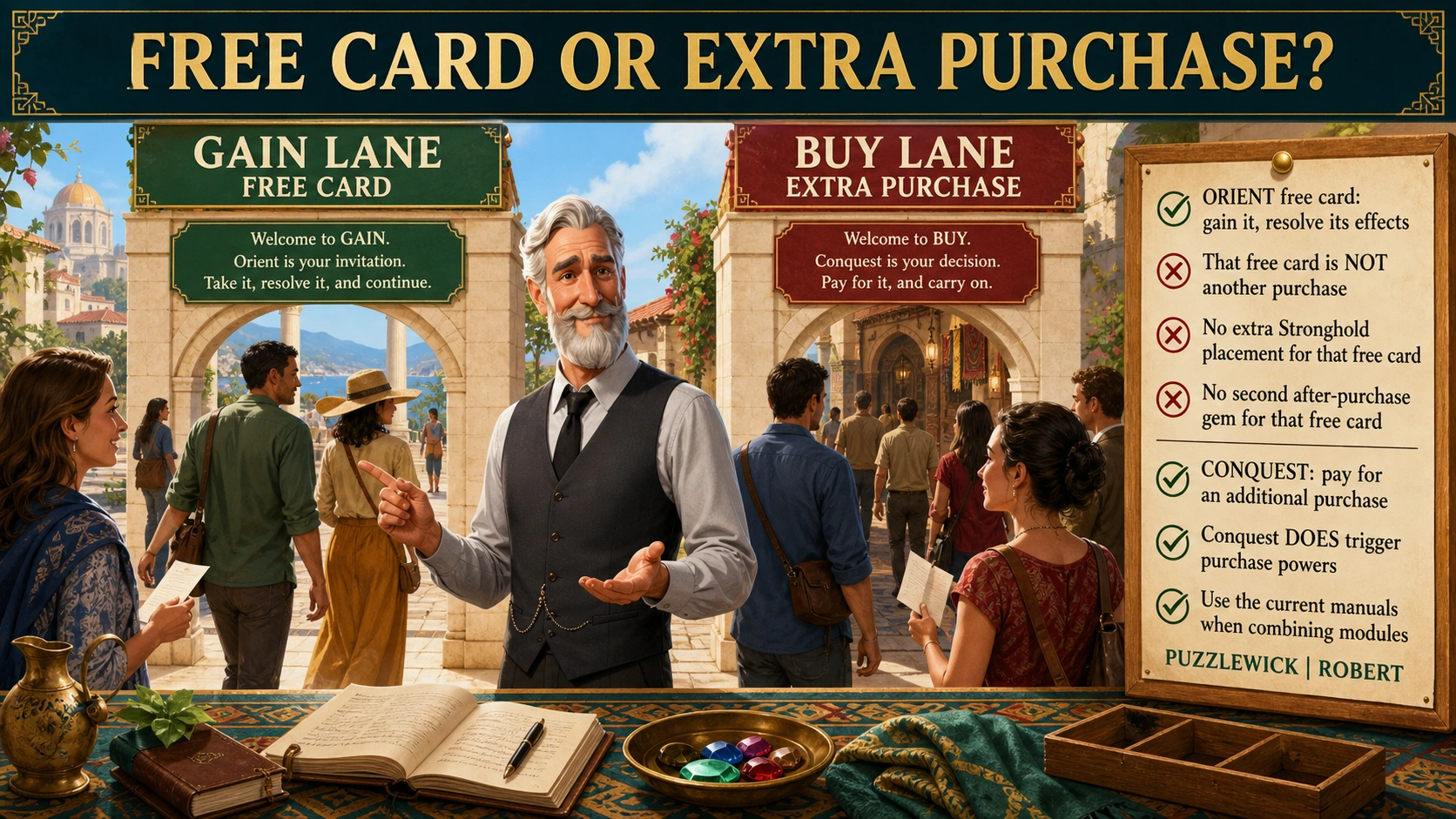
Give each player three Strongholds of one color. After purchasing a card and before replacing it, choose one of two effects: place or move one of your Strongholds onto an eligible faceup card, or remove an opponent's Stronghold from a card containing exactly one of their Strongholds. You cannot dismantle a stack of two or three with that removal option.
A card holding your Strongholds can be bought or reserved only by you. You cannot place your Stronghold on a card occupied by another player. Your own Strongholds return when you buy or reserve their card.
With all three of your Strongholds on one card, you may use Conquest: after your normal action, purchase that card as an additional purchase and pay its cost. Return the three Strongholds. The extra purchase happens before the end-of-turn piece-limit and Noble or City checks. Pieces or a bonus card gained earlier that turn can help pay for it.
Conquest is optional, not a free card. Because it really is a purchase, it can trigger the normal Stronghold effect and the appropriate after-purchase Trading Post. Conversely, the free card gained through Orient does not create another Stronghold placement or another purchase-triggered gem.
For a first Strongholds game, treat the pieces as visible promises. Are you protecting a genuine next purchase, threatening a Conquest, or leaving three little monuments on something you cannot afford? An impressive stack does not solve the payment problem.
Rules reference: Strongholds placement, removal and Conquest.
Combining all four modules without inventing extra actions
All four current modules can be combined, but teach their exceptions explicitly. Remove Nobles for Cities. Add the Orient decks and six extra faceup cards. Set out Trading Posts. Give everyone their Strongholds. Agree to use the current manuals rather than mixing remembered rules from different editions.
- Resolve the normal action and the acquired card's effects. An Orient free acquisition is not a separate purchase, although its own effects still resolve.
- Apply relevant purchase powers at their stated timing, before replacement. A normal purchase can trigger Strongholds and the appropriate Trading Post. A free gained card does not multiply those triggers.
- Resolve an eligible Conquest after the action. Pay for the additional purchase and resolve its effects and purchase triggers.
- Finish the turn. Return excess pieces to reach ten, gain at most one new eligible Trading Post, then check Cities. Without Cities, the normal Noble check precedes the Trading Post check.
Two particularly useful cross-checks: the blind-reservation Trading Post can inspect the Orient decks; the virtual-Gold card can combine with the double-Gold power. Neither permission turns a free Orient acquisition into a purchase.
If a sequence is unclear, stop before revealing replacement cards, lay out the choices and consult the relevant effect. Reconstructing a turn is much easier before the next six cards have been exposed. No unofficial shortcut in this article takes precedence over the printed rules for your edition.
Rules reference: combining expansions.
Rules reference: combining expansions and timing.
What about Splendor Duel for a two-player household?
Consider Duel because you want its different decisions, not because standard Splendor stops working at two. The board changes how you collect pieces. Pearls, Privileges and card effects change what you can do with them. Its multiple victory routes demand attention to more than a single prestige race.
The physical distinction is easy to see below: Duel has a central gem board and additional component types. The standard game taught above has no such gem board. A photograph of a standard Development card cannot explain Duel, and an insert fitted for one box should not be assumed to fit the other.
For a dedicated pair that enjoys direct interaction, Duel deserves a close look. For a household that also hosts three or four, standard Splendor gives more flexibility. Neither purchase needs the other. The standard game's Silk Road and Sun Never Sets modules are not Duel expansions.
Our Duel games versus their originals guide covers the wider choice. Keep this article as your standard Splendor reference, rather than importing Duel's board or victory conditions into it.
Publisher reference: Splendor DuelSleeves, mats and storage: protect the game you actually own
Splendor is complete before you buy an accessory. The base box supplies the cards and pieces. Add protection for frequent handling, a tray for a crowded table, or a better surface when lifting cards becomes a nuisance. None of those purchases replaces learning when to stop taking gems.
The licensed sleeve option: count the decks, not the tiles
Gamegenic makes official Splendor Premium Art Sleeves. Its 120-sleeve allocation is unusually useful: 40 for level one, 30 for level two, 20 for level three, then 10 at each level for the expansion cards. That matches the ninety base Development cards plus Orient's thirty. The sleeves have six printed designs and a matte textured finish. The listed 66 by 92 millimeters describes the sleeves, not a new measurement of the cards.
Keep each deck's sleeve backs consistent. Noble and City tiles are not Development cards and do not belong in this calculation. If choosing clear sleeves instead, one hundred covers the base cards with ten spares; base plus Orient needs at least one hundred and twenty. Test a small sleeved stack in your own insert before sleeving everything. We have not physically tested the licensed pack in every printing's box. The maker's specification is confirmed; an exact approved affiliate listing for that pack remains unverified.
Token Silo: a portable gem counter, not a replacement game box
The Gamegenic Token Silo Convertible in lime green earns a place here because its nine removable trays in three sizes let you separate the five gem colors, Gold and expansion pieces. Lay the gem trays where everyone can see the supply. Counting whether four remain should not require an archaeological dig.
The manufacturer's external dimensions are 212 by 166 by 32 millimeters. This is an independent organizer, not a fitted Splendor insert. Its stated large-tray capacity is up to forty single-sleeved or seventy-five unsleeved cards, so one large tray does not hold the entire ninety-card base game. Buy it for sorting and carrying tokens; keep the cards and flat tiles in appropriately sized storage. Skip it if your existing box and table already stay orderly.
A playmat should fit the expanded market
A soft surface makes cards easier to lift. Before choosing a printed mat, lay out the actual game: twelve faceup cards in the base game, eighteen with Orient, the draw piles, gem supply and a visible Noble or City row. A handsome twelve-slot design can become a problem when the expansion arrives. Measure that footprint on your table; a small individual TCG mat is not automatically a shared Splendor play area.
Inserts and travel: verify your edition before the purchase
A fitted insert should explicitly name your box edition, the expansions it stores and sleeved-card clearance. Keep Noble and City tiles flat, protect the carton in a measured travel bag and avoid loose pieces rubbing against card faces. If you only carry the base game between two nearby tables, the original box may still be the most sensible organizer you own.
Specifications: Gamegenic Splendor sleeve allocation and materials; Token Silo dimensions, trays and card capacity.
Your first three evenings: from learning the turn to reading the table
Evening one: finish a clean base game
Use only standard Splendor. Say payments aloud, keep bonus cards visible and confirm the final-round procedure. Success means nobody is afraid to ask what an icon means, not that the new person chooses an optimal opening.
Evening two: give every turn a job
Before taking gems, identify a target and a backup. Before buying a cheap card, identify the purchase its discount helps. Afterward, each player names one detour and one good timing decision. Keep the debrief short enough that people want the rematch.
Evening three: choose repetition or one module
If the base decisions still feel interesting, repeat them. If everyone wants variety, choose Cities for a different finish, Trading Posts for powers, Strongholds for market control or Orient for card combinations. Explain the changed rule before dealing. More components are not a certificate of expertise.
You are ready to join another table when you can take a legal action, calculate a purchase, handle a reservation and explain who gets the final turn. You do not need to memorize the deck. Ask which edition and modules are in use, give other people room to think, and do not move an opponent's components without asking.
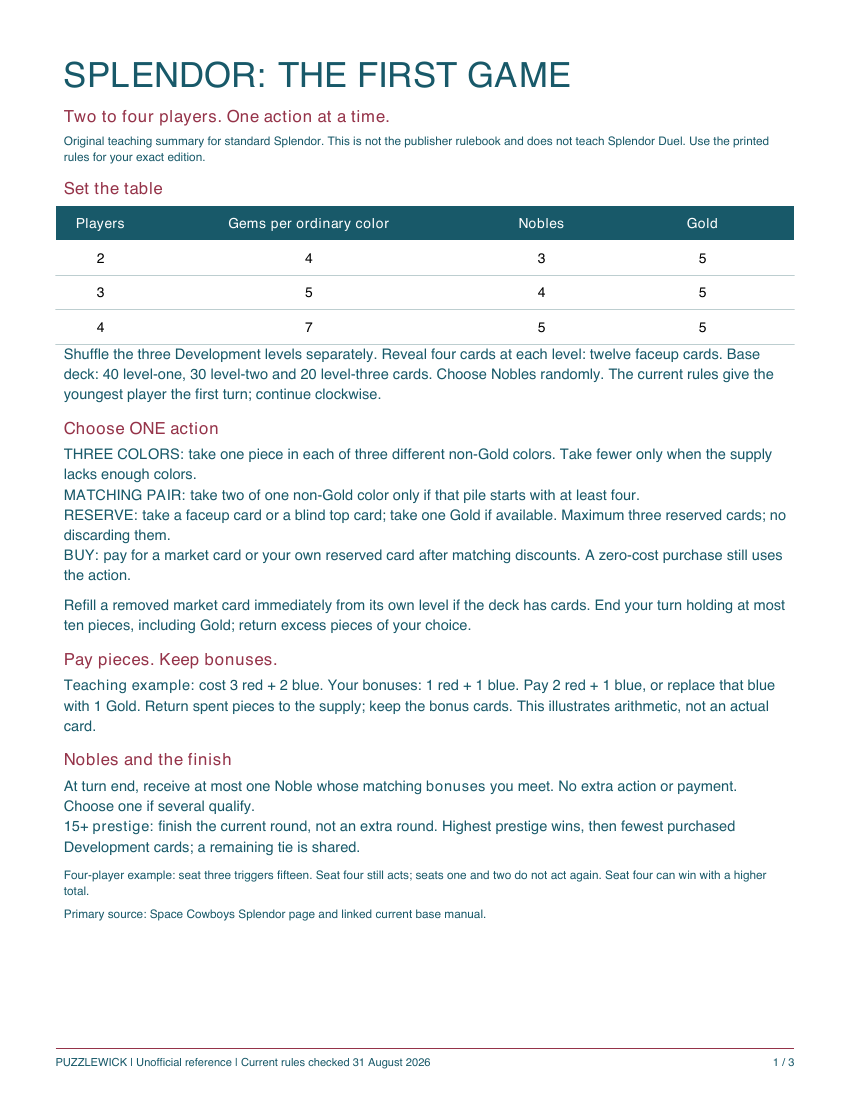
Keep the downloadable reference nearby for setup and exception checks. For digital practice, the publisher links Splendor on Board Game Arena. Account, access and subscription conditions are determined by that service; digital practice is optional.
Margo's recommendation: start with one complete box and learn why a turn helped. Buy an expansion when you can name the kind of decision you want next. There is plenty of depth here before the shopping list needs to grow.
The picks
Some links below are affiliate links — as an Amazon Associate, Puzzlewick earns from qualifying purchases, at no extra cost to you. It never changes a pick.

Splendor
The base game is still the essential engine: reserve gems, build discounts and race for prestige without expansion exceptions.
- The cleanest first purchase and the shared-table original
- At two players it is calmer and less confrontational than Splendor Duel.

Splendor: The Silk Road
Its modules alter the central race without replacing the familiar gem engine.
- Players who want a modular expansion after mastering the base game
- Requires the compatible Splendor base game and adds decisions that a first session does not need.
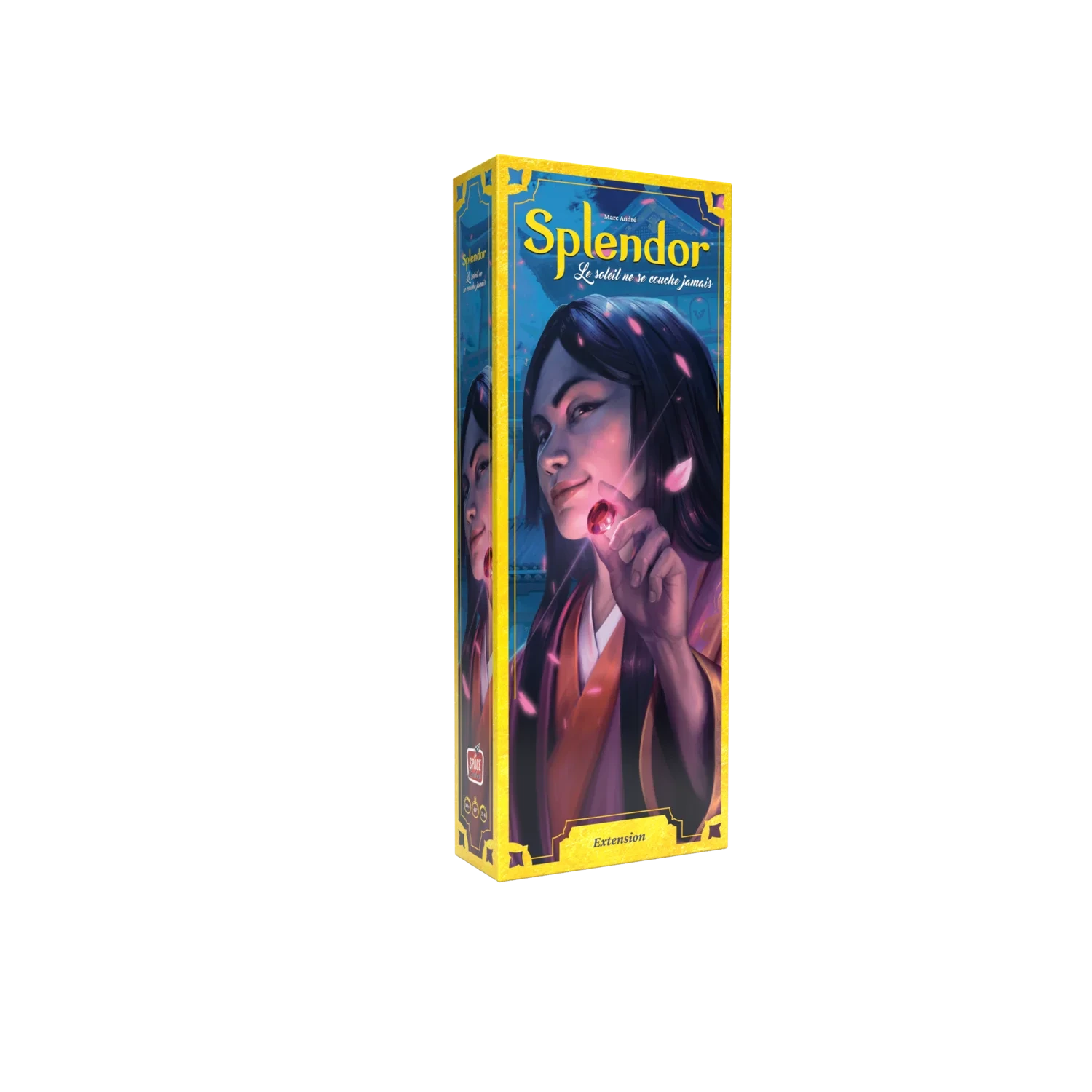
Splendor: The Sun Never Sets
A second set of modules widens the system for players who already know exactly what they enjoy about Splendor.
- Experienced groups wanting another modular expansion menu
- This is not standalone and is a poor cure for a group that dislikes the core game.
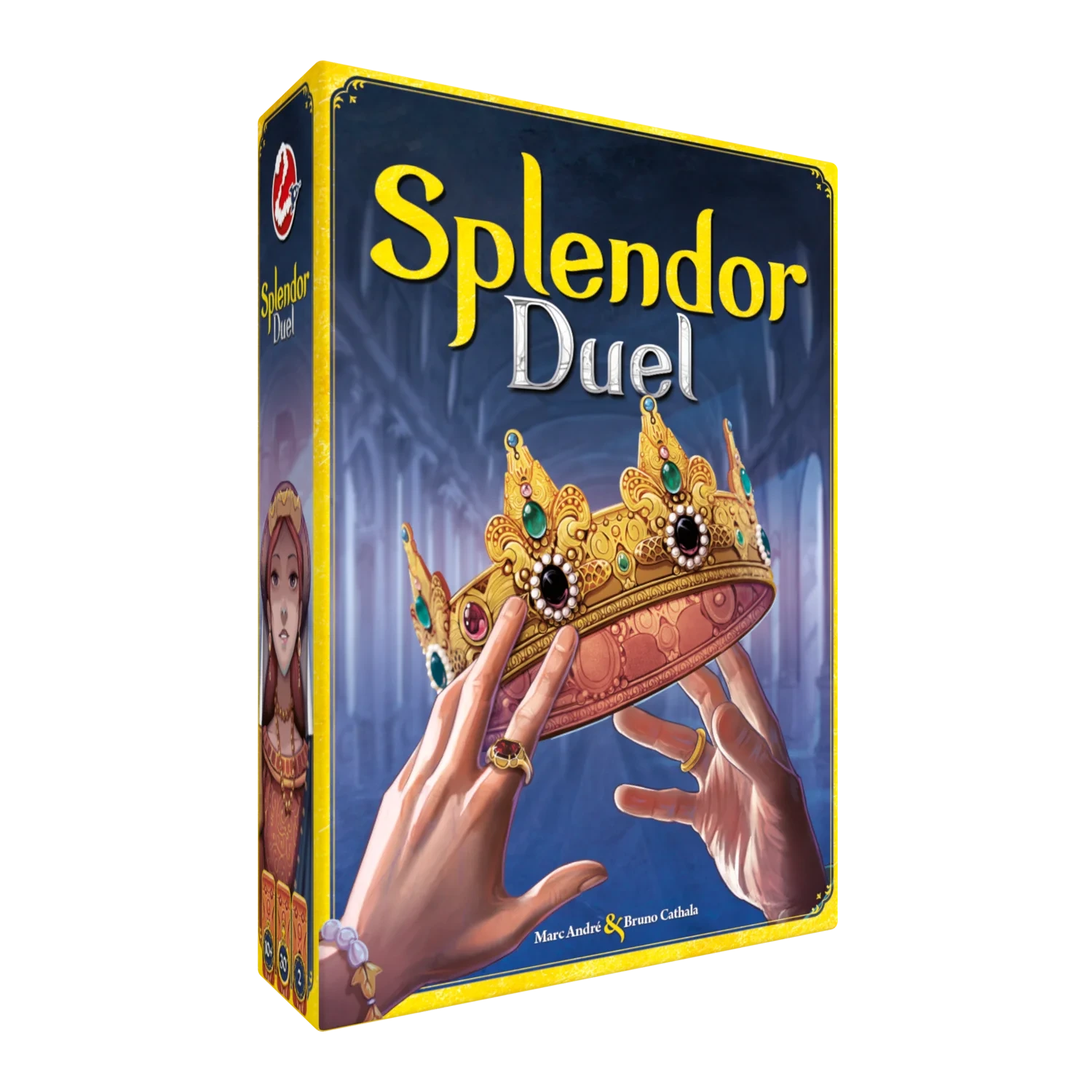
Splendor Duel
Duel is a standalone design with a tighter shared display and more direct tactical friction than two-player base Splendor.
- Two players who want sharper blocking and a purpose-built duel
- It does not expand the original game and cannot host a three- or four-player table.

Luck Lab Folding Silicone Token Trays, six pack
Six folding trays keep gem chips and expansion pieces from migrating while packing flatter than a rigid station.
- Giving each gem color a reachable, flat-packing table bowl
- They organize the table, not the retail box, and are unnecessary when neat chip stacks already work.
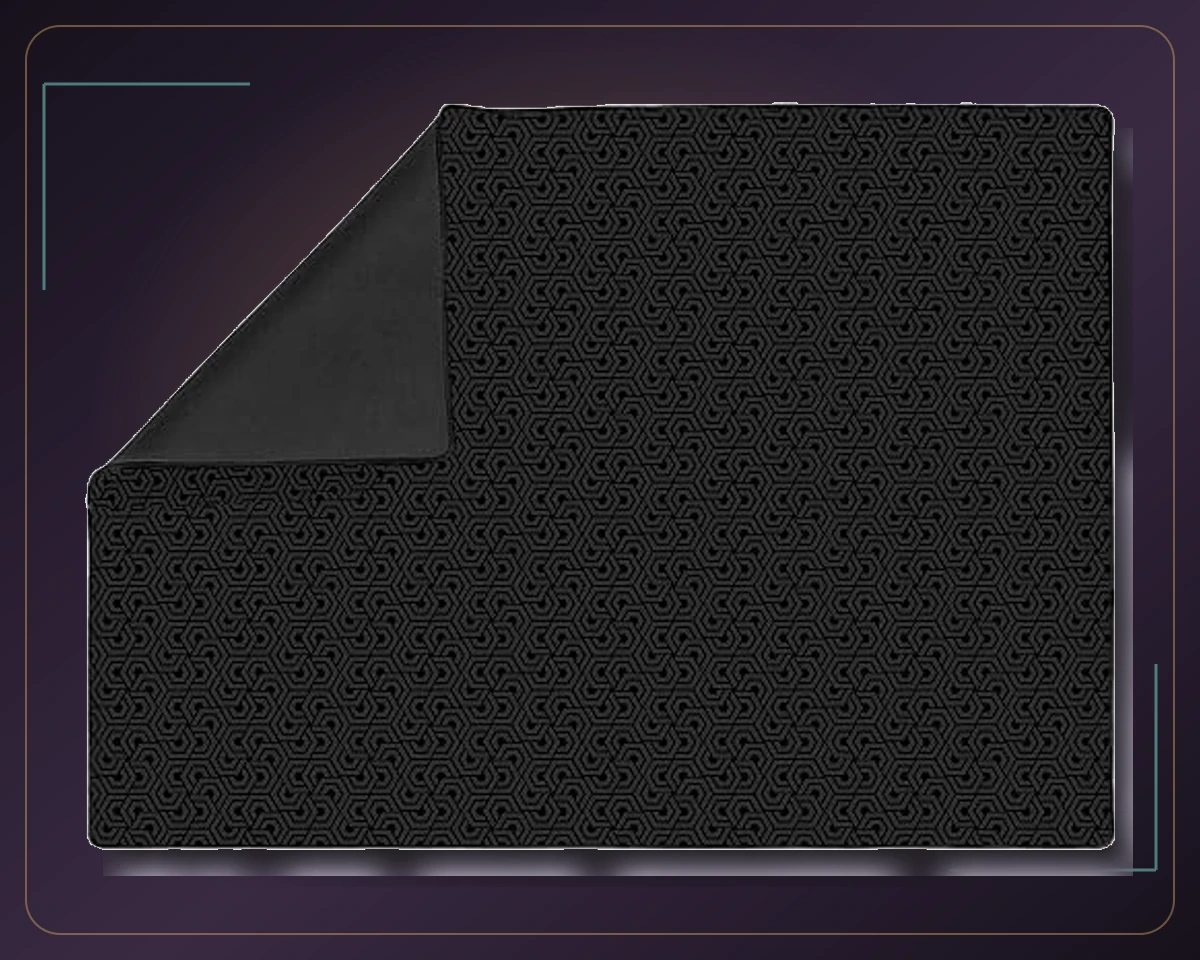
Roll-Play reversible 3 x 4 foot board game mat
The neutral neoprene surface gives the card market room to breathe and prevents hard chips from turning every purchase into a tiny cymbal crash.
- Quieter chips and easier card pickup across the full display
- It is much larger than Splendor requires alone; measure the table and buy it for a board-game library.
At a glance
| Product | Best for | What it is |
|---|---|---|
| Splendor | A flexible two-to-four-player first box | Complete base game. Begin here for the rules taught in this guide. |
| Splendor: The Silk Road | New goals and persistent powers after learning the base game | Cities and Trading Posts, usable separately or combined. Requires standard Splendor. |
| Splendor: The Sun Never Sets | Experienced groups wanting card effects or market control | Orient and Strongholds, usable separately or combined. Requires standard Splendor. |
| Splendor Duel | A pair choosing a separate, more interactive design | Complete standalone game for exactly two. Not compatible with standard Splendor expansions. |
Free download — Splendor First-Game and Expansion Reference
Three printer-friendly pages for the table: setup, actions, payment examples, strategy reminders and expansion checks. Standard Splendor, not Duel.
Unofficial fan-made reference. Compiled by Puzzlewick from the sources listed on the sheet. Not affiliated with or endorsed by the publisher — always defer to the official rulebook.
Questions, answered
Can two people play ordinary Splendor?
Yes. Standard Splendor supports two to four players. At two, use four pieces of each ordinary color, all five Gold pieces and three Nobles. Splendor Duel is a separate game for exactly two.
Can I take two matching gems from a pile of three?
No. The supply must have at least four pieces of that color before taking the matching pair. The Trading Post that adds another color does not remove this requirement.
Can I reserve a card when there is no Gold left?
Yes, if you have fewer than three reserved cards. Take Gold only when it is available. A reserved card cannot simply be discarded later.
Does a free card take my turn?
A zero-cost card bought with your normal action still takes that action. An Orient card granted for free by another effect is different: it is an acquisition, not a separate purchase.
Does the first player to fifteen win Splendor?
Not automatically. Reaching fifteen or more triggers the end of the current round. Highest prestige wins after everyone has had the same number of turns. Ties favor fewer purchased Development cards; a remaining tie is shared.
Do Nobles count the gems in my hand?
No. They check matching permanent bonuses on purchased cards. A Noble visit is free and does not spend those bonuses. Gain at most one Noble per turn.
Which Splendor expansion should a beginner buy first?
Learn the base game first. The Silk Road is our first recommendation for a group wanting changed objectives or persistent powers. The Sun Never Sets suits groups wanting Orient card effects or Stronghold interaction. Learn one module at a time.
Does The Silk Road contain Orient?
No. In the current publisher line, The Silk Road contains Cities and Trading Posts. The Sun Never Sets contains Orient and Strongholds. Some retailer descriptions mix these names up; consult the exact box and publisher manual.
Can all four current Splendor modules be combined?
Yes. The current expansion manuals explicitly allow combinations. Remove Nobles for Cities, distinguish cards from bonuses, and distinguish free Orient acquisitions from actual purchases.
Does a double-bonus Orient card count twice for a City?
No. It provides two matching discounts but remains one card for current Cities and Trading Post requirements. Nobles instead check bonuses.
Does Conquest give me a free card?
No. It permits an additional purchase of the card carrying your three Strongholds. Pay its cost. Because it is a purchase, applicable purchase powers trigger.
How many sleeves do Splendor and Orient need?
The base has ninety Development cards; Orient adds thirty. That is one hundred and twenty cards if sleeving both. Measure your printing and test insert clearance. Noble and City tiles are not included in this sleeve count.
Can I play Splendor solo?
The standard publisher game is for two to four players. This guide does not present a fan-made solo variant as an official mode.
Margo's verdict
Splendor is a strong starting point when you want clear rules and increasingly sharp decisions. Buy the base game, learn to count turns as carefully as pieces, and add a module when you know which part of the contest you want to change. A familiar box played thoughtfully beats a shelf of expansions still waiting for a teach.
Research ledger 11 sources · reviewed 2026-09-01
Specifications, rules, current product information, community experience, and contrary evidence were checked against the sources below. Commercial links are kept separate from editorial evidence.
- Space Cowboys: Splendorspacecowboys-games.com/game/splendor
- Splendor current base rulebookcdn.svc.asmodee.net/production-spacecowboys/uploads/2025/10/SCSPL01EN_SPLENDOR_RULES_LIGHT.pdf
- Space Cowboys: The Silk Roadspacecowboys-games.com/game/the-silk-road
- The Silk Road rulebookcdn.svc.asmodee.net/production-spacecowboys/uploads/2025/10/SCSPL03EN_SILKROAD_RULES_20241002_WEB.pdf
- Space Cowboys: The Sun Never Setsspacecowboys-games.com/game/the-sun-never-sets
- The Sun Never Sets rulebookcdn.svc.asmodee.net/production-spacecowboys/uploads/2025/10/SCSPL04EN_SPLENDOR_SNS_RULES_20241126.pdf
- Space Cowboys: Splendor Duelspacecowboys-games.com/game/splendor-duel
- Board Game Arena community strategy notesen.boardgamearena.com/doc/Tips_splendor
- Publisher-linked French tournament organizer guidecdn.svc.asmodee.net/production-spacecowboys/uploads/2025/10/Tournament_Guide_A4.pdf
- Gamegenic: Splendor Premium Art Sleevesgamegenic.com/product/splendor-premium-art-sleeves
- Gamegenic: Token Silo Convertiblegamegenic.com/product/token-silo-convertible

Let me check that before we say it.

Keep exploring
The next smart rabbit holes.
✦ Topic PathBoard Game Buying Guides: compare the whole shelfStart with the decision, not the shelf. These guides compare the games, editions, expansions, player counts, and costs people...ComparisonThe Best Engine-Building Board Games of 2026, RankedA sensei's tier list of the games that taught a generation what "the engine click" feels like — from the gateway masterpiece to the...ComparisonThe Best 2-Player Board Games of 2026, RankedFifteen duels for two, sorted into hard tiers — the forever-game, the silent co-op, the giant-killers under twenty bucks, and the honest...