SETI: Search for Extraterrestrial Intelligence — The Deep-Dive Review
Czech Games Edition's 2024 heavyweight turned a radio-telescope daydream into the most-awarded euro of its year. Here is what the record actually says — receipts, dates, and the myths politely corrected.

AI-assisted curator persona · research and editorial responsibility: Robert Pruitt · how this guide was made
Last editorial refresh: 2026-06-15 Gold-standard QA: 2026-08-10 16 sources reviewed Affiliate links checked during gold-standard pass

The short answer
SETI: Search for Extraterrestrial Intelligence is a heavy engine-building eurogame for 1–4 players (ages 14+, 40–160 minutes) by designer Tomáš Holek, published by Czech Games Edition in 2024. You run a research institute launching probes across a rotating solar system, scanning distant star-sectors, and crunching data to be first to discover alien life. The record says it is excellent: it won the 2025 Deutscher Spiele Preis (Gold), took Golden Geek Heavy Game of the Year and Best Thematic Game, and sits around an 8.3 average on BoardGameGeek with a ~3.7–3.8 complexity weight (verified June 2026). If you want one heavy 2024 euro with a genuine science soul, this is the one to buy — the base game is all most players will ever need.
Decision map
Choose in thirty seconds
Hobbyist euro players (especially 1–3-player and solo tables) who want one heavy, deeply thematic space engine builder — the most-awarded euro of 2024.
Let me be exact, because that is what I do. SETI is not a party game with a telescope sticker on the box. It is a five-round, multi-action, multi-use-card euro that asks you to plan three or four turns ahead while the planets literally rotate out from under your launch windows. The hook that everyone repeats — 'it's the search for alien life!' — is real and it is earned: the cards depict actual missions (the Herschel Space Observatory, Mariner 10), the designer cites Carl Sagan's Cosmos as his north star, and the whole arc bends from 'tiny probe, tiny income' toward 'I have detected something out there.' But a hook is not a verdict. Below I separate the marketing from the manual, name the five alien species you'll actually meet, show you how to not lose your first game, and tell you plainly who should skip it. Every fact carries a date and a source.
Start here, then go deeper
You are in the right cabinet.
 ✦ Topic PathBoard Game Buying Guides: compare the whole shelfStart with the decision, not the shelf. These guides compare the games, editions, expansions, player counts, and costs people...
 Deep DiveThe Spice Must Flow Again: A Deep-Dive Into Dune: Imperium – UprisingHow spies, sandworms and contracts change the game, who should buy the original, and the expansion order that makes sense.
 Best Of5 New Board Games Worth Your Next Game Night: Cozy Stories, Clever Cards, and a Proper AdventureImani matches five current tabletop releases to five kinds of evening, with the awkward bits included: permanent stickers, limited...
What is SETI, and is the real-science hook genuine or marketing?
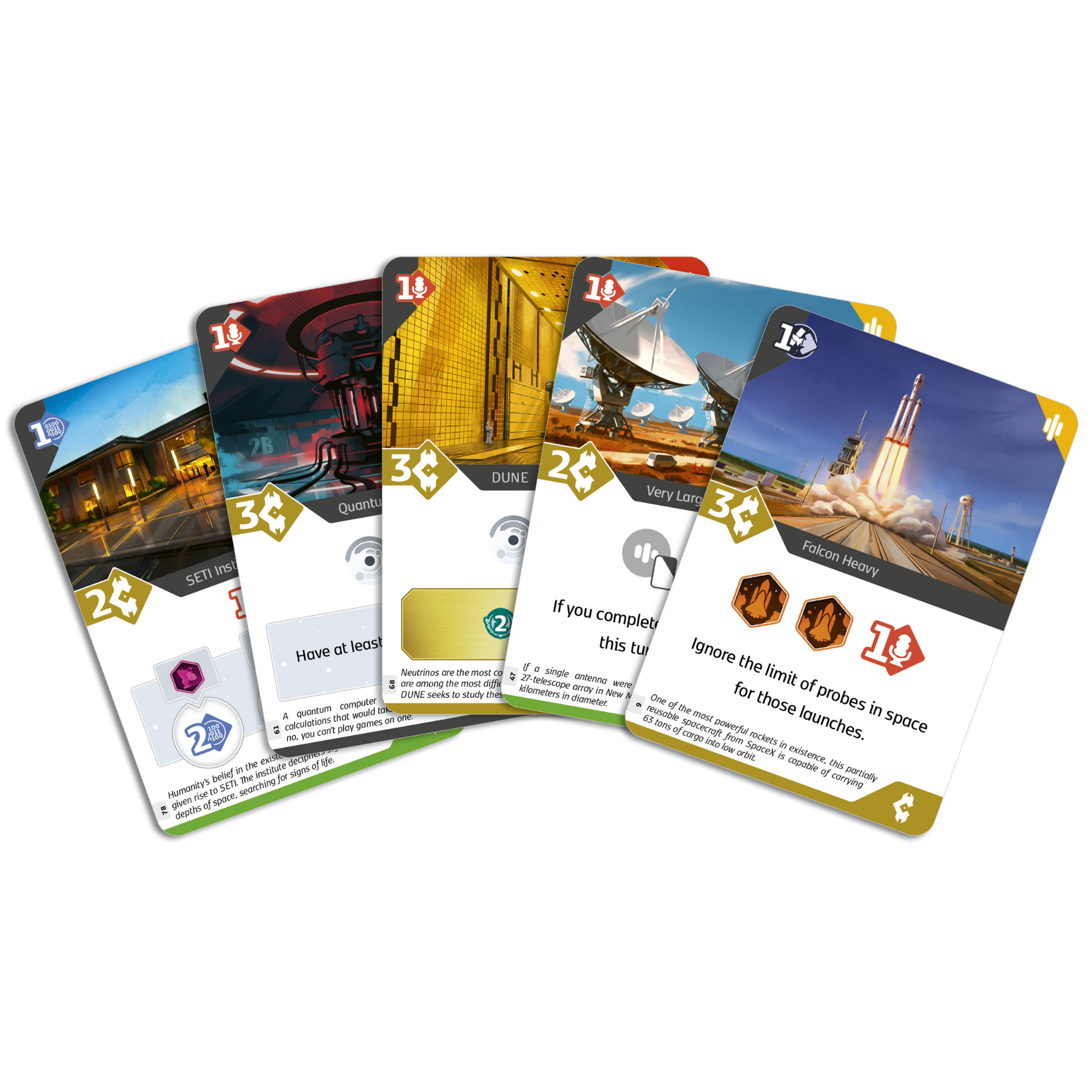
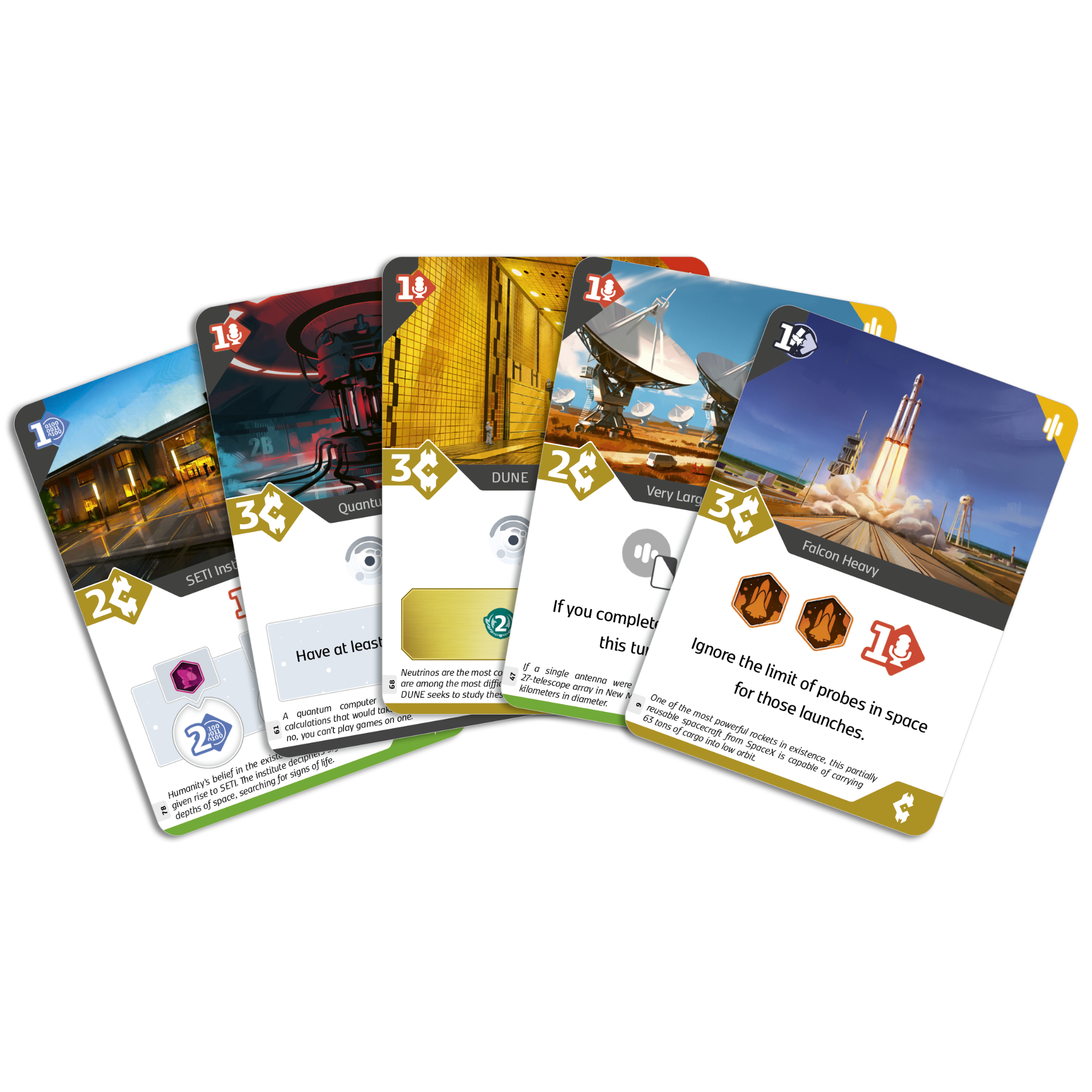
The answer first: the science homage is genuine, but it is a homage — not an official partnership with the SETI Institute. The record says designer Tomáš Holek built the game out of love for popular astronomy, citing Carl Sagan directly: he was 'heavily influenced by the popularizer of astronomy and science, Carl Sagan — particularly his books, lectures, and the TV series Cosmos,' which he says he 'must have seen at least 100 times' (CGE Designer Diary #1, 28 March 2024). The cards carry real missions and real facts — the Voyager Golden Record, the Herschel Space Observatory, Mariner 10 — and CGE's own copy promises '200+ cards that feature real technologies, projects, and discoveries.' Verified: that is true; the deck is a genuine astronomy reference shelf in card form. The myth to retire: there is no documented formal collaboration with the actual SETI Institute or a credentialed astronomer-consultant in the published materials. The science is lovingly accurate flavor and theming; it is not a peer-reviewed instrument. Treat it as the best-themed euro of its year, not a textbook — and it more than survives that framing.
The science here is a homage, not a credential — and it is the most convincing homage a euro has pulled off in years.
What is in the box, exactly?
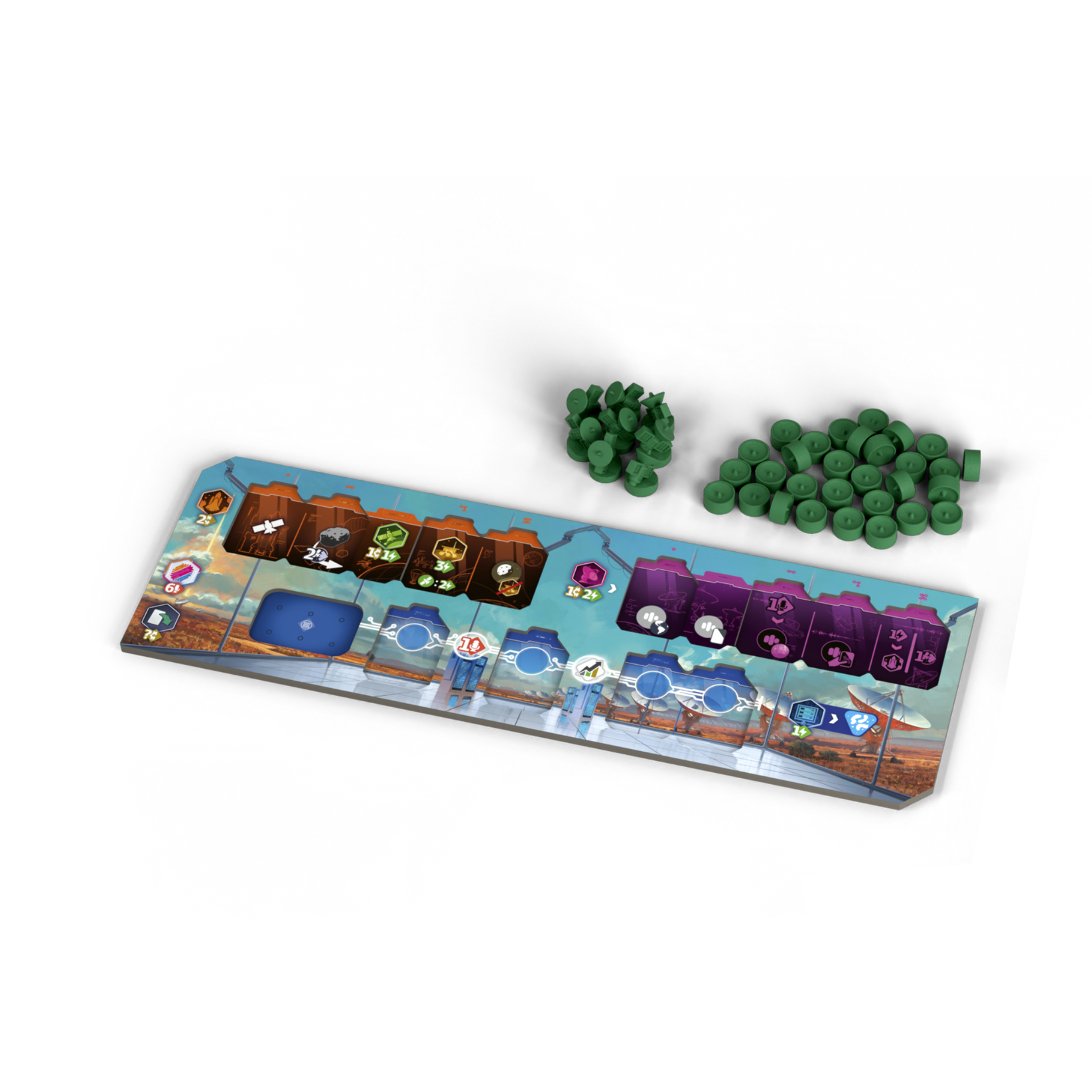
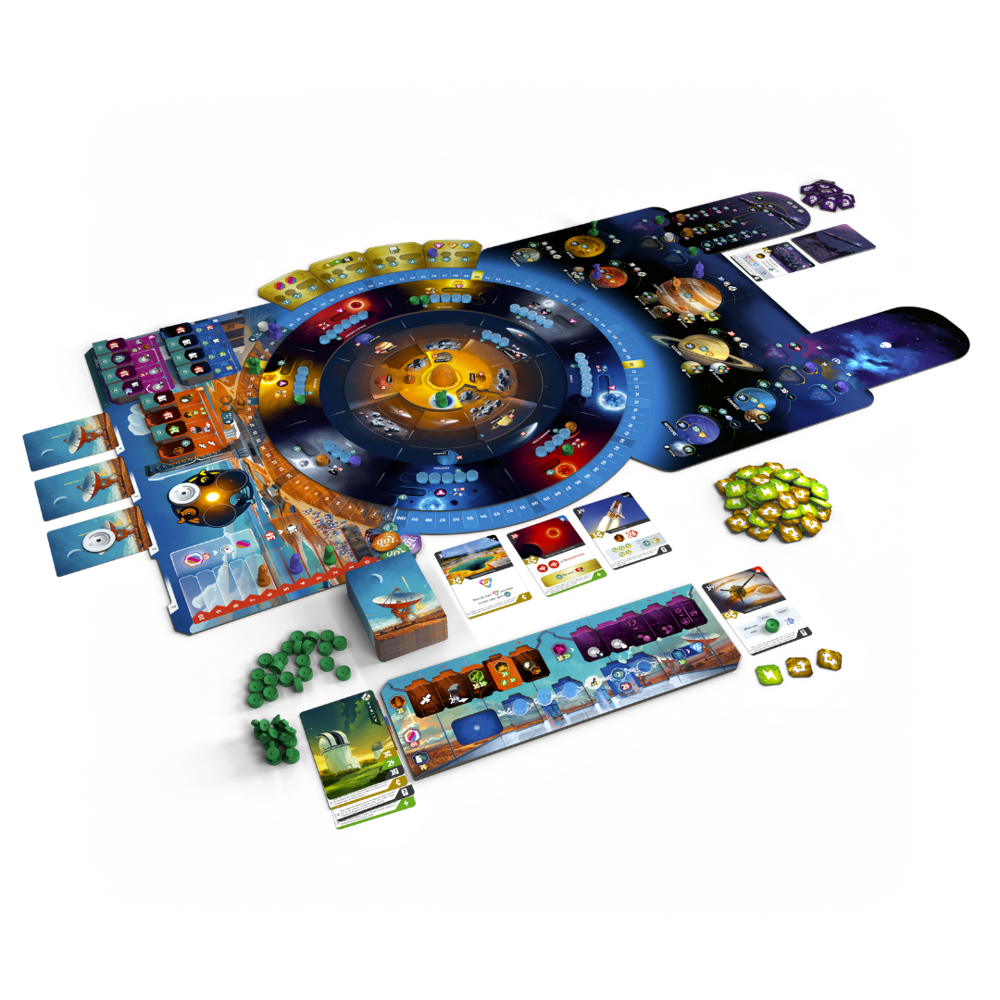
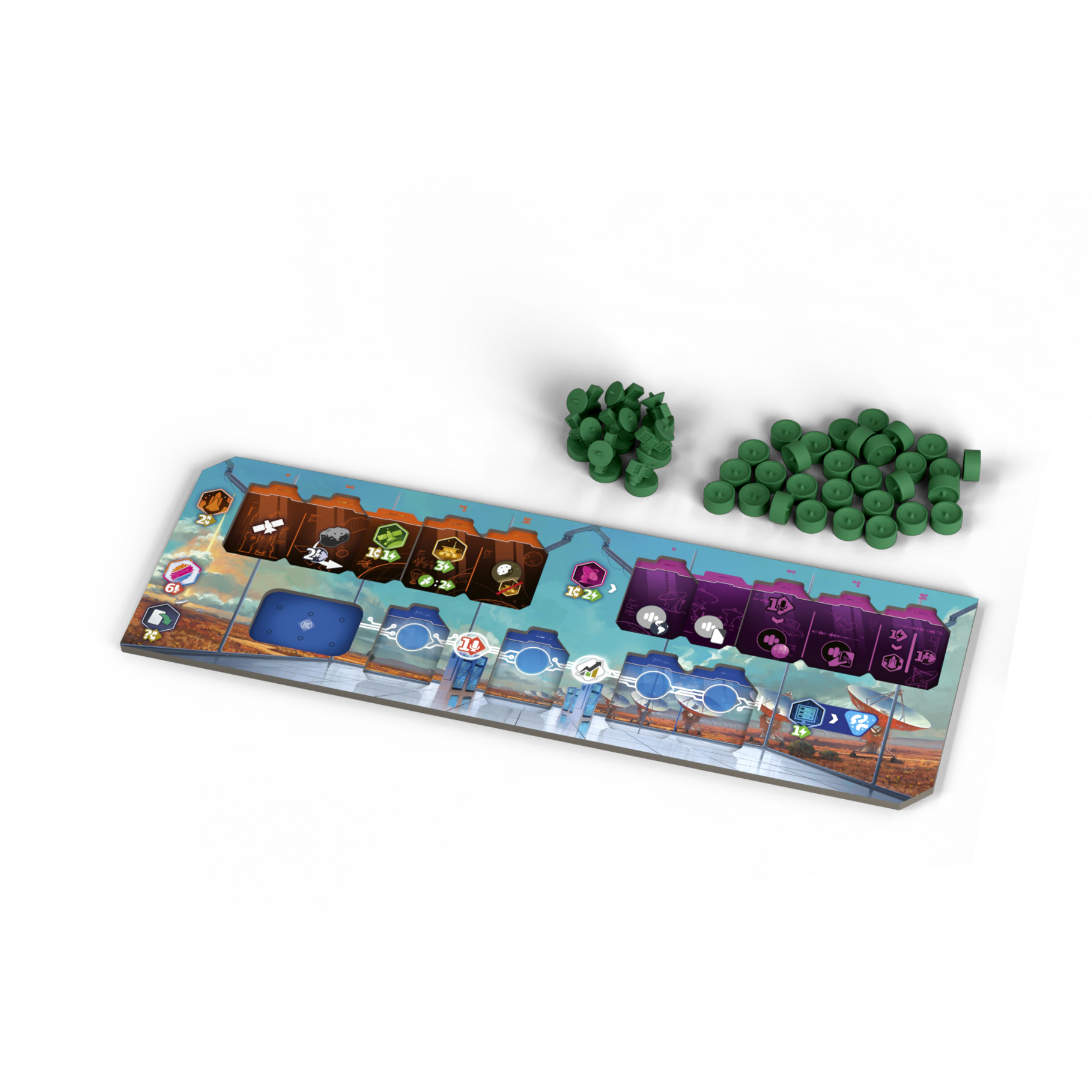
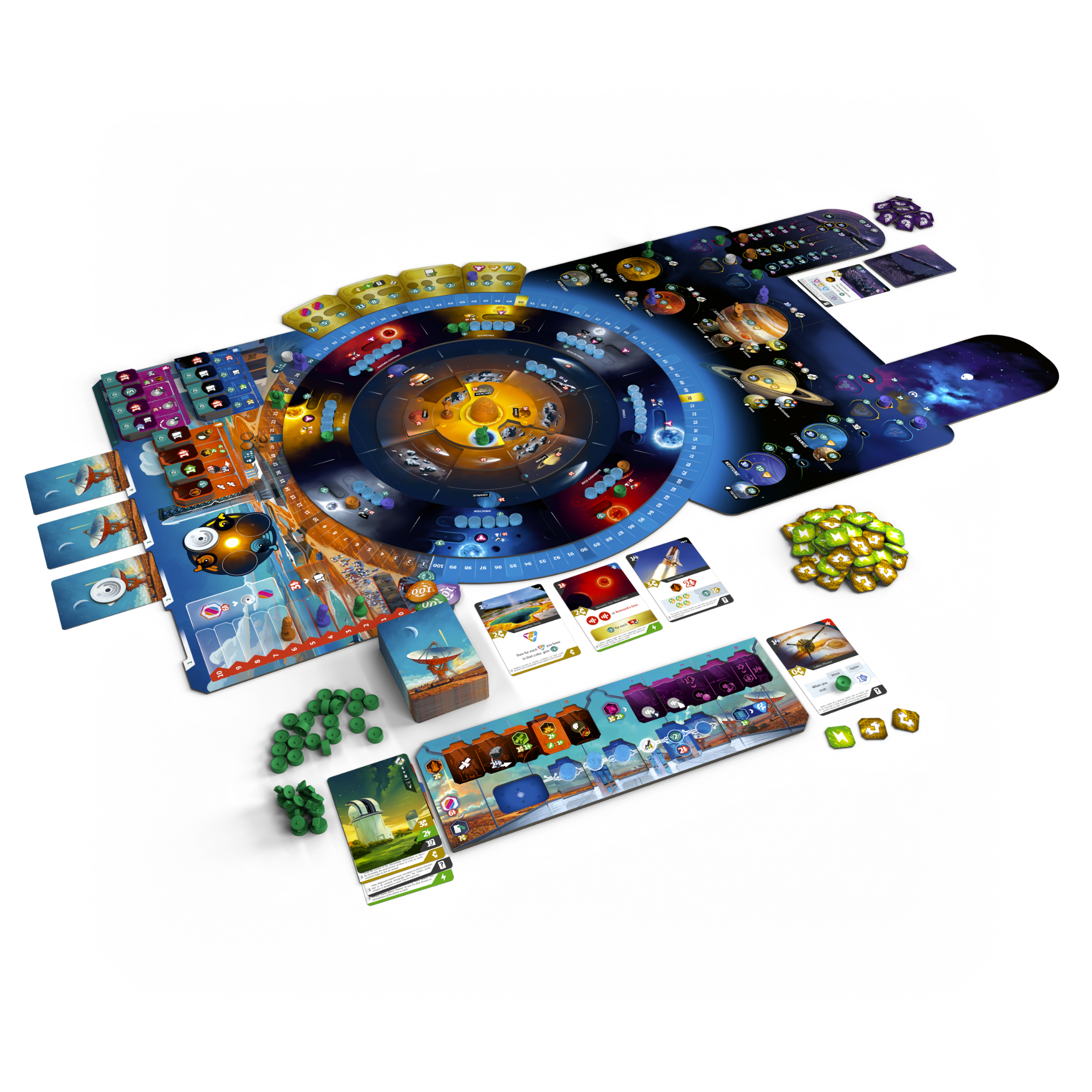
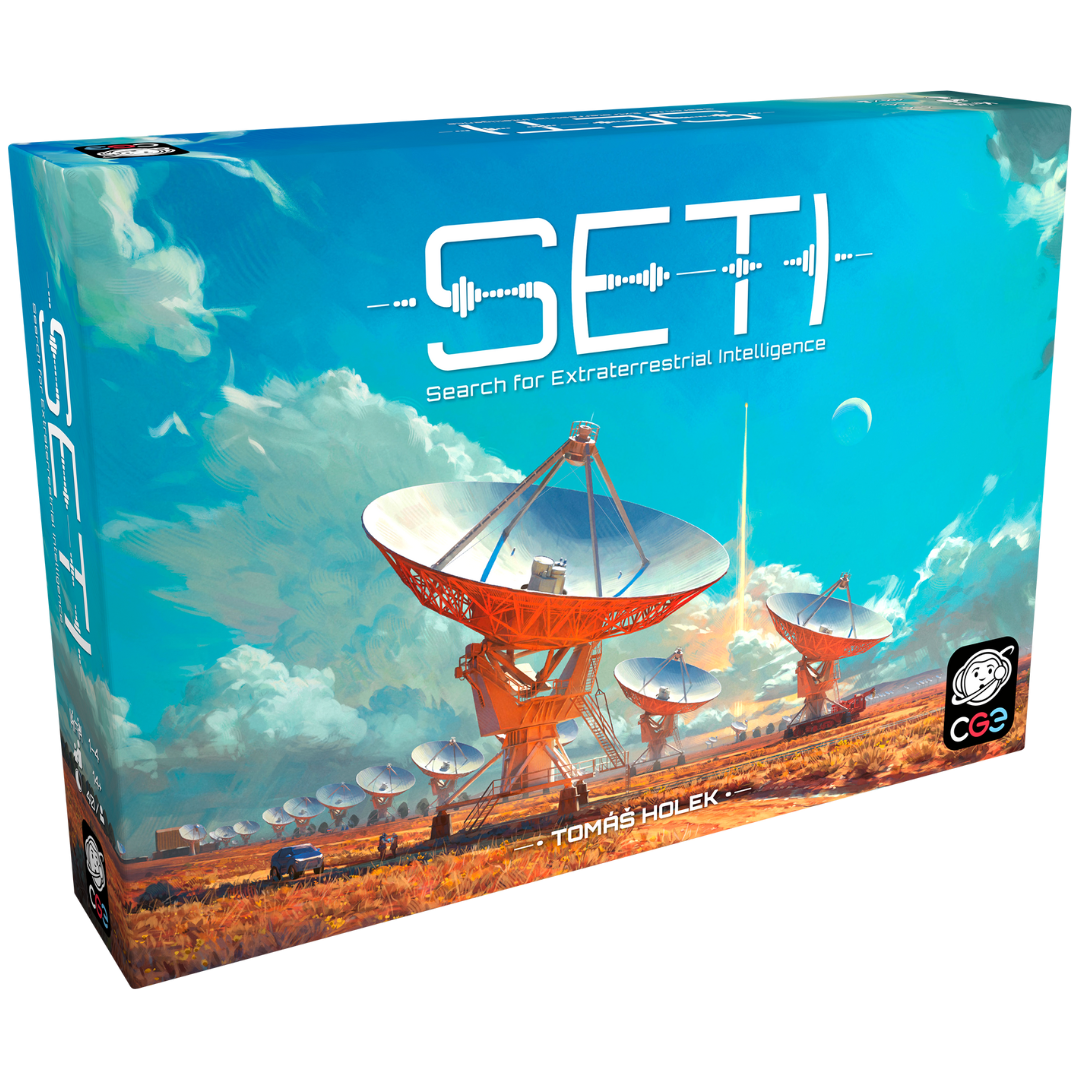
The record says: 216 cards and a great deal of cardboard and wood. Verified against Czech Games Edition's own component list — 138 project cards, 55 alien cards, 4 starting income cards, and 19 solo action cards (216 total). Boards: a solar-system board with rotating discs, a tech board, a planetary board, 4 sector boards, 4 dual-layer player boards, and 5 alien species boards. Tokens and tiles: 48 tech tiles, 4 gold scoring tiles, 60 credit/energy tokens, 33 alien tokens and tiles, and 24 solo objective tiles. Wood (160 pieces): 32 probe figures, 120 player markers, 4 publicity counters, 4 score counters. Plastic (71): a single sun piece plus 70 data tokens. Plus the rulebook and reference sheets. Two honest notes: (1) the headline 'over 200 cards' is real — the project deck alone is the engine, and the variety is the replay engine; (2) the dual-layer player boards (recessed so your markers don't slide) are the kind of production touch that explains the ~$70–80 price. This is a premium-tier box, and it shows.
216 cards, dual-layer boards, a rotating solar system, and a single satisfying plastic sun — this is a flagship-tier production.
How does the engine and exploration actually play?

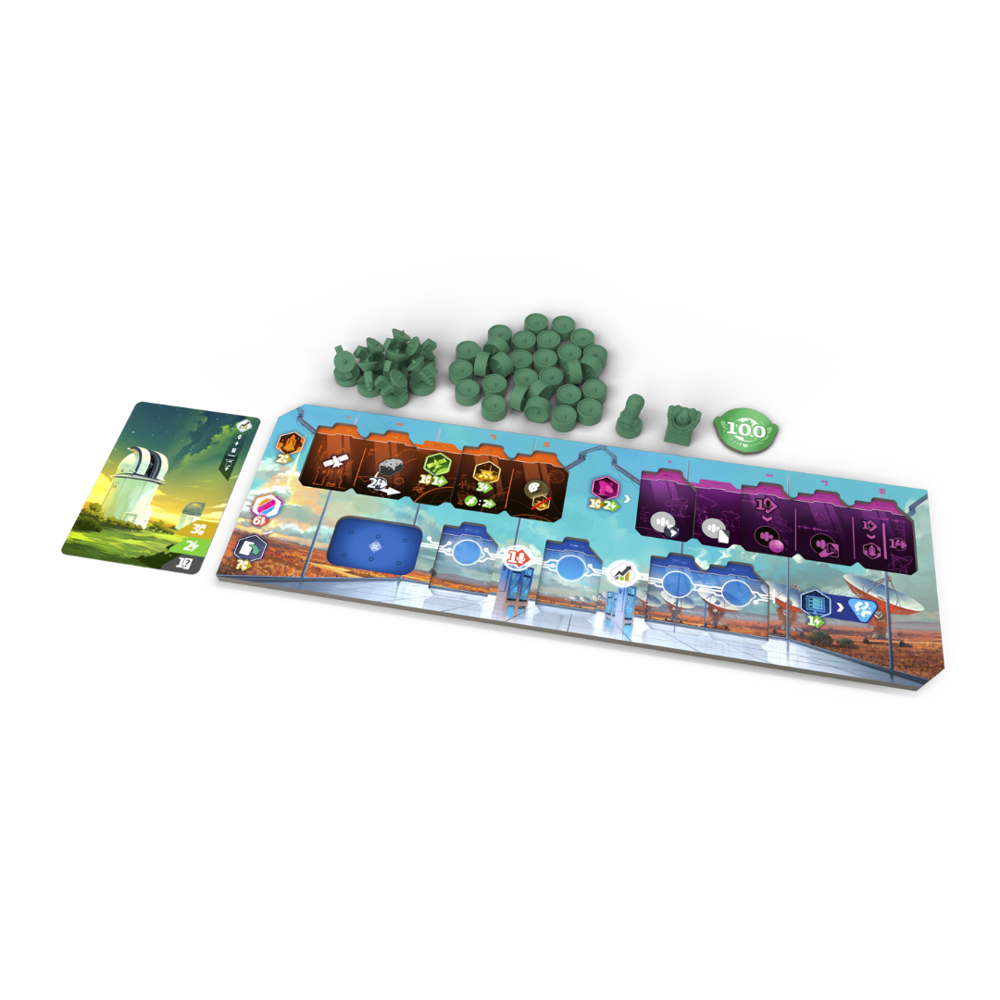
The answer first: SETI is a multi-use-card engine builder wrapped around a spatial probe-and-signal puzzle, played over five rounds. Each card can be used three ways — for its printed effect (paying credits), as ongoing income, or as a one-time bonus — so every draw is a real decision, not a hand-filler. On your turn you choose among eight main actions: play a card, launch a probe from Earth, move/orbit a probe around a planet, land a probe (to collect samples), scan a distant star-sector, analyze collected data, research a tech upgrade, or take income. The spatial twist is the part marketing undersells: the solar-system board rotates, so the cheap launch window to Mars or Jupiter you wanted this round may be gone next round. Verified by BoardGamesLand: 'The 138 cards in SETI are central to gameplay having multiple uses… This versatility makes it so that every card shows its value.' The three discovery tracks — scanning, landing, and data — feed a shared race: complete enough of each and an alien species is revealed for everyone. That mid-game reveal is the engine's second gear. As Lincoln Hoppe (The Game Bard) put it: 'You start pretty basic, just a few simple actions, but as you build up your engine, your actions get more powerful, your choices get more interesting.'
Every card is an action, an income source, or a bonus — and the planets rotate away from you while you decide. That tension is the whole game.
Is it worth it? The awards and the honest caveats
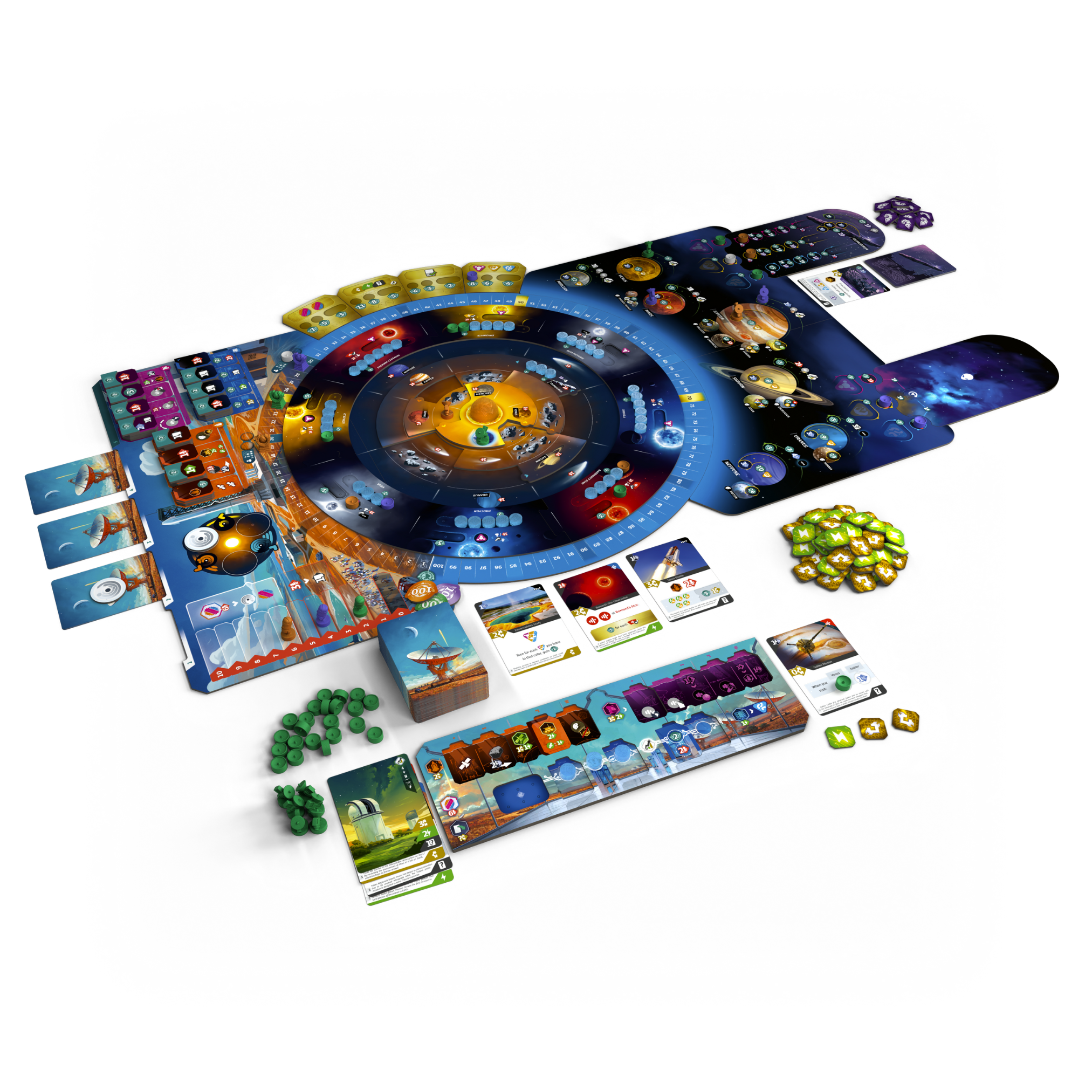
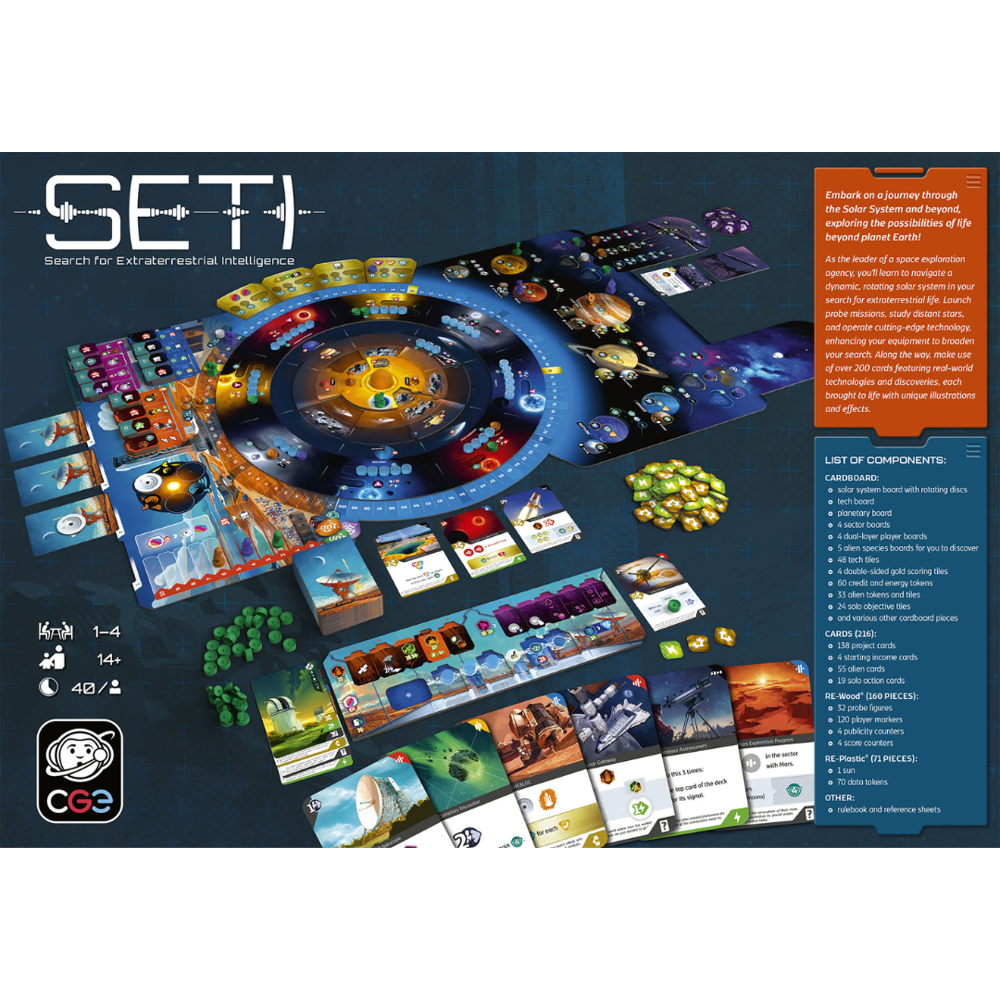
Worth it — emphatically — for the right table. The record is one of the strongest awards runs of any 2024 release. Verified: SETI won the 2025 Deutscher Spiele Preis (Gold), Germany's premier community-voted prize, beating Endeavor: Deep Sea (that year's Kennerspiel des Jahres winner) and Bomb Busters (that year's Spiel des Jahres winner) into second and third (announced 27 October 2025). It also took the Golden Geek Awards for Heavy Game of the Year and Best Thematic Game, plus Dice Tower honors including Game of the Year. On BoardGameGeek it carries roughly an 8.3 average with a ~3.7–3.8 weight (verified June 2026). Now the caveats, because a premium review owes you both sides. First, length: at four players this is a long evening, and turns balloon. Meeple Mountain is blunt — 'SETI at the max player count is a miss… Instead of waiting 60 seconds to take a turn, you might wait 5–7 minutes, this in a game that is already a multiplayer solitaire experience.' Second, analysis paralysis: WhatBoardGame notes 'the game can be prone to a little AP… as people try to figure out their turns.' If your group includes a deep over-thinker, SETI will test everyone's patience. The value math, though, is sound — BoardGamesLand: it 'offers excellent value at around $70–80, considering the component quality and replay value.'
It beat the year's Spiel des Jahres AND Kennerspiel winners to the Deutscher Spiele Preis Gold. That is the headline the record actually supports.
How do you play your first game well?
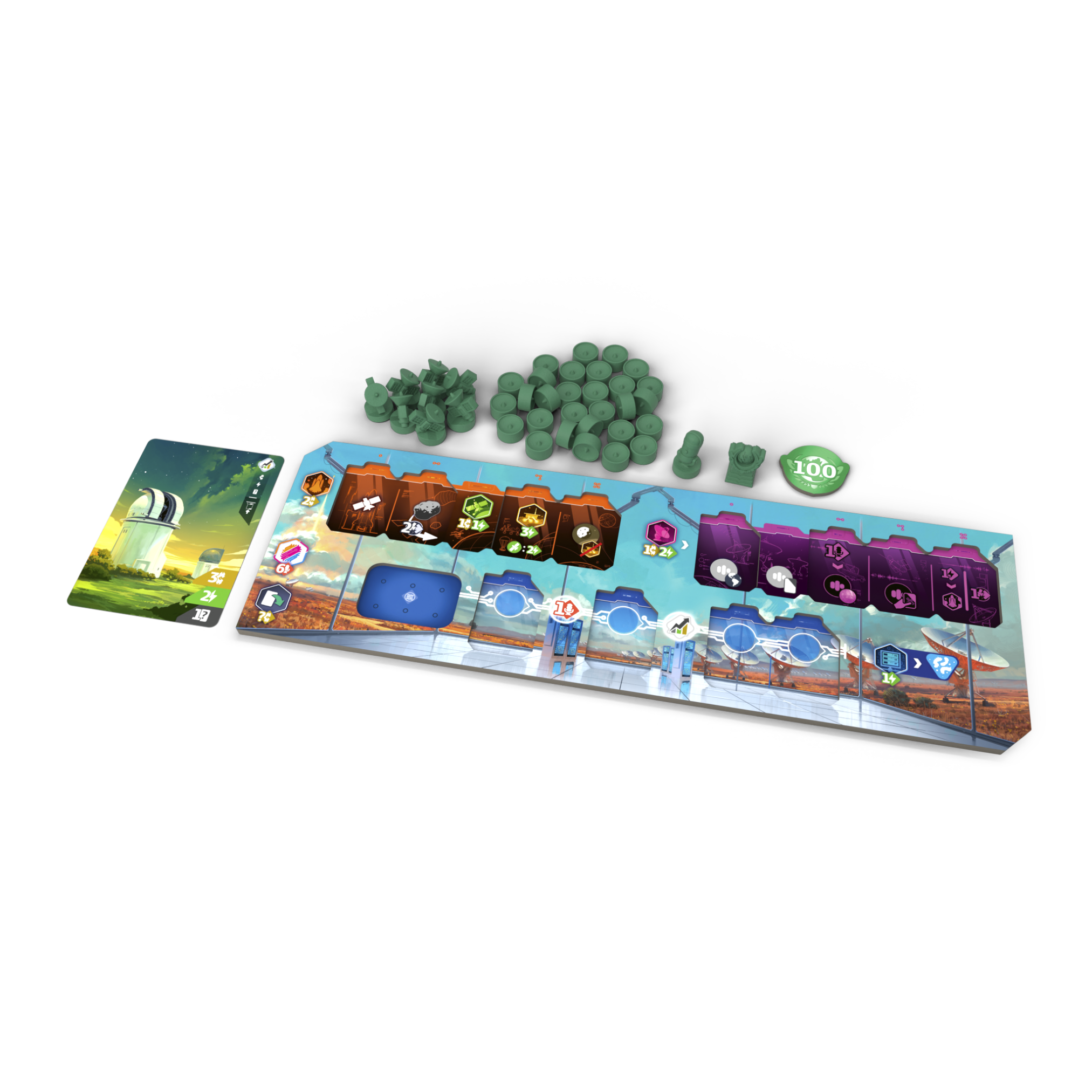
Here is the practical answer, ordered by how much it will save your first score. (1) In rounds 1–2, build income before you build ambition. Launching and moving probes costs credits and energy you won't have if you splurged early; prioritize cards that generate ongoing income and cheap scanning to fund the back half. (2) Respect the rotation. Plan launches around where planets WILL be, not where they are — a probe queued for a planet's close approach can cost a fraction of a badly timed one. (3) Lean into multi-use cards. The most common beginner mistake is playing every card for its effect; veterans bank cards as income or bonuses to smooth their economy. As the SETI Fan Hub analysis notes, the design 'heavily favors playing cards,' so a hand-management plan beats raw actions. (4) Don't ignore the alien tracks, but don't tunnel on them either. The species typically reveal around round three (Meeple Mountain: 'the aliens… always showed up in my third round'); position to benefit from the reveal rather than forcing it alone. (5) Pick one of the three discovery avenues — scanning, landing, or data — as your spine and let the other two feed it, rather than spreading thin across all three. First games feel breezy and a little aimless; that is normal. The clarity arrives on game two, which nearly every reviewer reports.
Build income before ambition, launch toward where the planets WILL be, and bank cards as income — that single habit separates a good first game from a frustrating one.
Replayability, the five aliens, and the expansion
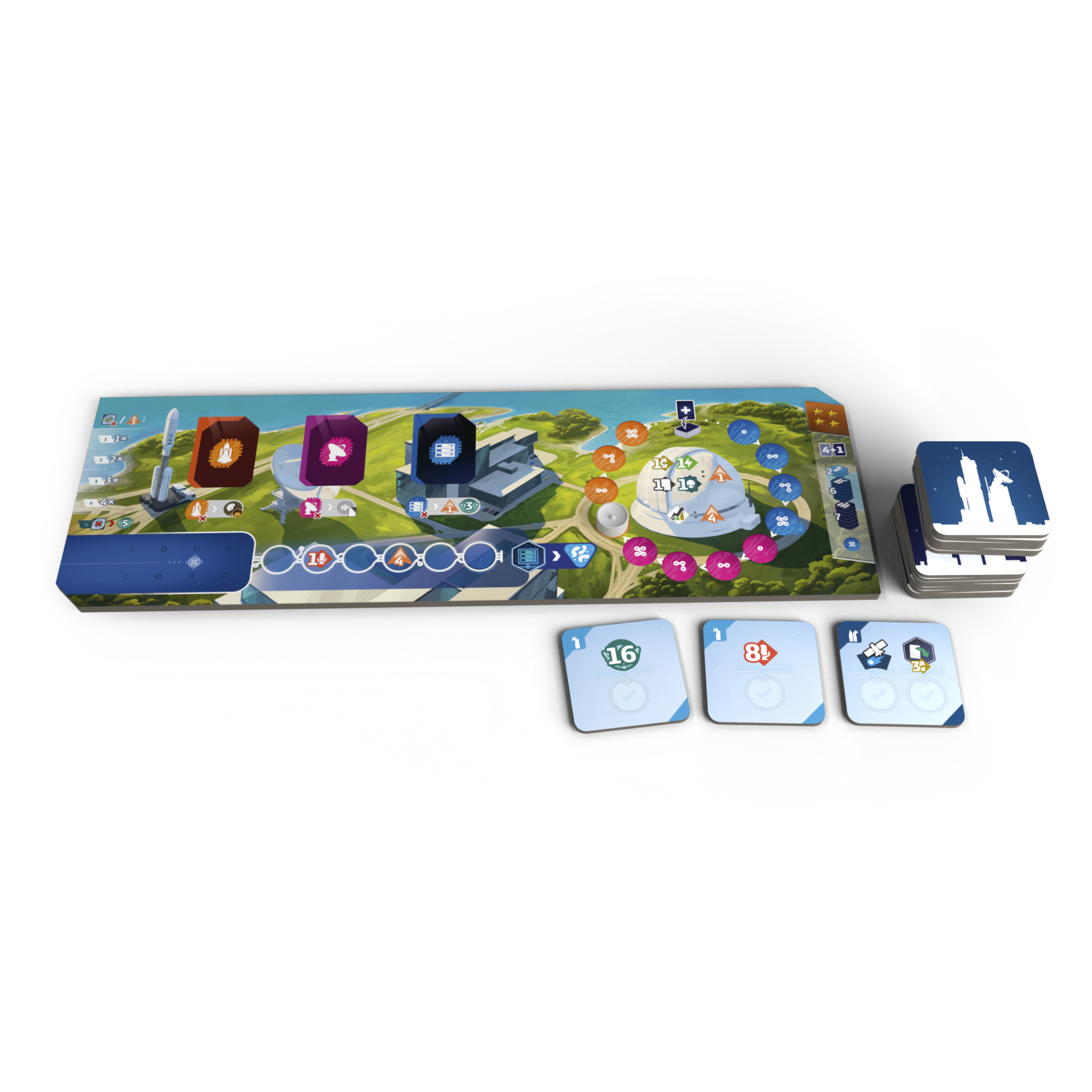
The answer first: replayability is high, and it is structural rather than bolted-on. The record says five alien species ship in the box, but only two appear in any given game, and you don't know which two until they're discovered. Verified — the five are the Anomalies, the Mascamites, 'Oumuamua, the Centaurians, and Exodus. Each rewrites a slice of the game when revealed: per community analysis, the Anomalies add a light area-majority mini-game; the insectoid Mascamites push you to land probes on Jupiter and Saturn; 'Oumuamua opens an extra place to scan; the Centaurians run a touch more powerful and energy-hungry. Pair that with variable solar-system setups and a 138-card project deck you only partially see, and Robbie Reviews' summary holds: 'With five unique alien races (only two used per game), variable solar system setups, and a massive deck of cards with distinct effects, no two games feel the same.' For most owners, the base box is a years-long game on its own. The expansion, SETI: Space Agencies (announced 30 April 2025; debuted at SPIEL in October 2025), adds asymmetric agencies with unique starting powers, three more alien species, and 40+ new project cards — a depth-and-variety add-on, not a fix for anything broken. Buy it later if SETI becomes a table staple; you do not need it to start.
Five aliens in the box, two per game, never the same pair revealed the same way — the replay engine is built into the discovery, not stapled on.
Who is SETI for — and who should pass?
Buy it if: you like heavy engine builders where the theme actually drives the mechanics, you enjoy planning several turns ahead, you play mostly at 1–3 players (the solo mode ships with 24 objective tiles and 19 dedicated solo cards and is genuinely strong), and you loved the arc of Terraforming Mars or Beyond the Sun. Tabletop Gaming nails the comparison: 'It's a great option if you liked Terraforming Mars… a similarly satisfying medium-weight space-themed euro game.' Pass — or at least demo first — if: your group is allergic to downtime, you mostly play with a full table of four including slow planners, or you want lots of direct player interaction (SETI is, by consensus, a low-conflict 'multiplayer solitaire' point-race; you compete for spaces and the alien race, not by attacking each other). It is also a poor fit for players who want a light 45-minute filler — at full weight this is an evening's main event, not a warm-up. The honest one-line filter: if the phrase 'I planned my whole next turn while you took yours' sounds like a feature, SETI is a likely all-timer for you. If it sounds like a chore, look elsewhere.
If 'I planned three turns ahead while the planets rotated away from me' sounds like a great evening, SETI is your game of the year.
What experienced tables keep reporting
Recurring owner patterns, synthesized in Puzzlewick's words. Follow each evidence trail to read the original discussion.
No game has ever changed so drastically from my first impression to my third play. Ever. EVER!
SETI at the max player count is a miss... Instead of waiting 60 seconds to take a turn, you might wait 5-7 minutes, this in a game that is already a multiplayer solitaire experience.
SETI is a beautifully crafted mid-weight euro game which nails its 'search for extraterrestrial life' theme with aplomb... This is a real must-play game.
With five unique alien races (only two used per game), variable solar system setups, and a massive deck of cards with distinct effects, no two games feel the same... a triumph of theme and strategy, and easily one of my top games of 2025.
SETI is fantastic! Without a doubt, this is a game we'll still be talking about for years.
This has now rocketed into my top ten games of all time; and I'm pretty confident in saying that this will be in my top ten of 2025.
SETI has become a modern classic in our collection... it offers excellent value at around $70-80, considering the component quality and replay value.
Every action, from launching a probe to analyzing data, feels grounded in the real-world search for extraterrestrial life.
The picks
Some links below are affiliate links — as an Amazon Associate, Puzzlewick earns from qualifying purchases, at no extra cost to you. It never changes a pick.
 4 photos
 SETI: Search for Extraterrestrial Intelligence (Base Game)
- Players
- 1-4 · best 3
- Time
- 40-160 min
- Age
- 14+
- Complexity
- 3.83 / 5
- Publisher
- Czech Games Edition · 2024
- Designer
- Tomáš Holek
- Art
- Ondřej Hrdina, Oto Kandera, Jiří Kůs, Jakub Lang, Michaela Lovecká, Jiří Mikovec, Jakub Politzer, Petra Ramešová, František Sedláček, Petr Štich, Josef Surý
The complete experience, and all the SETI most players will ever need. A 216-card, five-round engine builder where probes chase rotating planets and three discovery tracks race you toward revealing alien life. Verified pedigree: 2025 Deutscher Spiele Preis Gold, Golden Geek Heavy Game of the Year + Best Thematic, Dice Tower Game of the Year, ~8.3 on BGG (June 2026). The theme is load-bearing, the production is flagship-tier (dual-layer boards, rotating solar system), and the strong solo mode means the lone caveat — four-player downtime — may never touch you. Buy the base box; add Space Agencies only once it earns a permanent table slot.
- Theme genuinely drives the mechanics — probes, rotation, and signal-detection all feel like real exploration
- Multi-use card system gives every draw a meaningful decision
- Outstanding awards record: Deutscher Spiele Preis Gold + two Golden Geeks + Dice Tower GotY
- Excellent, fully-supported solo mode (24 objective tiles, 19 solo cards)
- High structural replayability — 5 aliens, 2 per game, variable setups, a deep project deck
- Drags at four players; turns can stretch to several minutes each
- Prone to analysis paralysis with over-thinkers at the table
- Low direct interaction — effectively a 'multiplayer solitaire' point race
- Large table footprint and a hobbyist ~3.7–3.8 weight; not a gateway or filler
At a glance
| game | publisher | year | players | play time | bgg weight | core engine | interaction | solo mode | headline award | best for |
|---|---|---|---|---|---|---|---|---|---|---|
| SETI: Search for Extraterrestrial Intelligence | Czech Games Edition | 2024 | 1-4 | 40-160 min | ~3.7-3.8 | Multi-use cards + spatial probe/signal racing | Low (shared alien race, space competition) | Excellent (dedicated) | Deutscher Spiele Preis 2025 (Gold); Golden Geek Heavy GotY | Thematic heavy-euro fans, 1-3p and solo |
| Endeavor: Deep Sea | Burnt Island Games / Grand Gamers Guild | 2024 | 1-4 | 60-90 min | ~2.8-3.0 | Worker-building + exploration track | Medium | Yes | Kennerspiel des Jahres 2025 winner | Players wanting an accessible mid-heavy with more interaction |
| Terraforming Mars | FryxGames / Stronghold Games | 2016 | 1-5 | 120+ min | ~3.2-3.3 | Card-driven tableau engine + tile placement | Low-Medium | Yes | Deutscher Spiele Preis 2017 (Gold) | The closest spiritual sibling; the classic space engine builder |
| Beyond the Sun | Rio Grande Games | 2020 | 2-4 | 60-120 min | ~3.4 | Shared tech tree + economic engine | Medium | Yes | Multiple 2021 nominations | Players who want a tighter, more competitive tech-race |
Questions, answered
How long does SETI take to play?
Czech Games Edition lists 40–160 minutes — roughly 40 minutes per player. In practice, a focused 1–2 player game runs about 60–90 minutes; a four-player game with deliberate planners can push two hours or more. Plan a full evening for a learning game at higher counts.
Is SETI good as a solo game?
Yes — it's widely regarded as a top-tier solo euro. The box includes 24 solo objective tiles and 19 dedicated solo action cards, and the engine-building arc shines without any downtime concerns. If you mostly game alone, SETI is an easy recommendation.
How many players is SETI best with?
One to three. Multiple reviewers agree it sings at lower counts and drags at four, where turns can stretch to 5–7 minutes each (Meeple Mountain). If your regular table is a full four of slow planners, demo it first.
How complex is SETI? Can beginners play it?
It carries a BoardGameGeek weight of roughly 3.7–3.8 out of 5 (verified June 2026) — a genuine hobbyist heavy euro. It is not a gateway game. Players comfortable with Terraforming Mars, Beyond the Sun, or Dune: Imperium will be at home; brand-new players should start lighter.
What are the five alien species in SETI?
The Anomalies, the Mascamites, 'Oumuamua, the Centaurians, and Exodus. Only two appear in any given game, and you don't know which until they're discovered, at which point their unique cards, tokens, and board effects enter play.
Did SETI win any major awards?
Yes. It won the 2025 Deutscher Spiele Preis (Gold, announced 27 Oct 2025), the Golden Geek Awards for Heavy Game of the Year and Best Thematic Game, and Dice Tower honors including Game of the Year. It notably beat the year's Spiel des Jahres and Kennerspiel des Jahres winners to the Deutscher Spiele Preis.
Is SETI an official SETI Institute product or based on real science?
It is a science homage, not an official SETI Institute product. The cards depict real missions and discoveries (Voyager Golden Record, Herschel Space Observatory, Mariner 10) and designer Tomáš Holek cites Carl Sagan's Cosmos as his inspiration, but there is no documented formal partnership with the SETI Institute. The science is lovingly accurate theming, not a peer-reviewed instrument.
What's in the SETI box?
216 cards (138 project, 55 alien, 4 starting income, 19 solo), a rotating solar-system board, tech and planetary boards, 4 sector boards, 4 dual-layer player boards, 5 alien species boards, 48 tech tiles, 60 credit/energy tokens, 33 alien tokens/tiles, 24 solo objective tiles, 160 wooden pieces (incl. 32 probes), a plastic sun, 70 data tokens, and the rulebook.
How much does SETI cost?
Czech Games Edition lists the game at $79.99 USD on its own store; typical retail runs around $69.95 MSRP and street prices commonly land in the $70–80 range. Always confirm the current price on the retailer's page before buying — prices fluctuate.
Is the SETI: Space Agencies expansion necessary?
No. The base game is complete and stands fully on its own. Space Agencies (SPIEL 2025) adds asymmetric agencies, three more alien species, and 40+ project cards — it deepens variety for players who have made SETI a regular. Buy it later, not first.
Does SETI have a lot of player interaction?
Not much directly. It's a low-conflict, 'multiplayer solitaire' point race — you compete for limited spaces on planets and for the shared alien-discovery race, but you don't attack or directly disrupt opponents. If you want confrontation, this isn't it.
How does SETI compare to Terraforming Mars?
They're close cousins. Both are card-driven space engine builders with low-to-medium interaction. SETI is a touch heavier (~3.7–3.8 vs ~3.2–3.3 BGG weight), adds a spatial probe/rotation puzzle and a mid-game alien reveal, and has a stronger dedicated solo mode. Tabletop Gaming explicitly calls it a great pick for Terraforming Mars fans.
Margo's verdict
Buy the base game — and unless SETI becomes a permanent fixture at your table, the base game alone is the right call. The record is unusually clear: SETI is the most-awarded heavy euro of its year (2025 Deutscher Spiele Preis Gold, Golden Geek Heavy Game of the Year + Best Thematic, Dice Tower Game of the Year), it sits around an 8.3 on BoardGameGeek at a ~3.7–3.8 weight (verified June 2026), and its science homage — Carl Sagan, the Voyager Golden Record, Herschel, Mariner 10 — is the most convincing theme integration a euro has managed in years. It is genuinely excellent. The two honest caveats are well-documented and easy to plan around: it drags at four players, and it rewards over-thinking with downtime. Neither touches solo or 1–3-player tables, where SETI is close to a flawless heavy euro. If you love planning several turns ahead while the planets rotate away from your launch window, this is your game of the year. If you want quick, confrontational, or light, look elsewhere. The myth to retire on your way out: it is not an official SETI Institute product — it is something arguably better, a love letter to the search that happens to play brilliantly.
Research ledger 16 sources · reviewed 2026-08-10
Specifications, rules, current product information, community experience, and contrary evidence were checked against the sources below. Commercial links are kept separate from editorial evidence.
- en.wikipedia.orgen.wikipedia.org/wiki/SETI:_Search_for_Extraterrestrial_Intelligence
- czechgames.comczechgames.com/games/seti-search-for-extraterrestrial-intelligence
- store.czechgames.comstore.czechgames.com/products/seti
- blog.czechgames.comblog.czechgames.com/2024/03/28/seti-designer-diary-1-the-beginnings-of-seti
- boardgamegeek.comboardgamegeek.com/boardgame/418059/seti-search-for-extraterrestrial-intelligence
- meeplemountain.commeeplemountain.com/reviews/seti-search-for-extraterrestrial-intelligence
- games.lincolnhoppe.comgames.lincolnhoppe.com/seti-board-game-review
- boardgamesland.comboardgamesland.com/seti-review
- robbiereviewsgames.wordpress.comrobbiereviewsgames.wordpress.com/2025/06/16/seti-search-for-extraterrestrial-intelligence-review
- boardgameshots.comboardgameshots.com/2025/05/24/seti-board-game-review
- whatboardgame.comwhatboardgame.com/post/seti-search-for-extraterrestrial-intelligence-board-game-review
- boardgamewire.comboardgamewire.com/index.php/2025/10/27/seti-continues-powerful-awards-run-by-beating-endeavor-deep-sea-bomb-busters-to-deutscher-spiele-preis
- tabletopgaming.co.uktabletopgaming.co.uk/reviews/seti-search-for-extraterrestrial-intelligence-board-game-review
- seti.ender-wiggin.comseti.ender-wiggin.com/posts/model
- amazon.comamazon.com/dp/B0CZBCRC3S?tag=puzzlewick-20
- Czech Games Edition official SETI product record and rulesczechgames.com/en/seti
Let me check that before we say it.

Keep exploring
The next smart rabbit holes.
✦ Topic PathBoard Game Buying Guides: compare the whole shelfStart with the decision, not the shelf. These guides compare the games, editions, expansions, player counts, and costs people...Deep DiveThe Spice Must Flow Again: A Deep-Dive Into Dune: Imperium – UprisingHow spies, sandworms and contracts change the game, who should buy the original, and the expansion order that makes sense.Best Of5 New Board Games Worth Your Next Game Night: Cozy Stories, Clever Cards, and a Proper AdventureImani matches five current tabletop releases to five kinds of evening, with the awkward bits included: permanent stickers, limited...