How to Play The Resistance: Avalon: Roles, Rules and Your First Confident Game
Yumi takes you from the first secret role to the final Merlin guess, with clear examples, classic versus Big Box advice, gentle table strategy and a printable host sheet.


AI-assisted research and drafting in Yumi’s voice · reviewed by Robert Pruitt · how this guide was made
Last editorial refresh: 2026-09-01 Gold-standard QA: 2026-09-01 10 sources reviewed Affiliate links checked during gold-standard pass

The short answer
The Resistance: Avalon is a hidden-role game for 5-10 players. A leader proposes a Quest team, everybody votes, and the approved team secretly submits Success or Fail cards. Good needs three successful Quests and must keep Merlin safe from the final Assassin guess. Start with Merlin, Assassin and ordinary characters; either classic Avalon or Avalon Big Box is a complete game.
Decision map
Choose in thirty seconds
Five to ten players trying Avalon for the first time
A regular group that wants optional variety
Somebody at this table is going to explain, very reasonably, why you should trust them. They may even be right. Avalon makes that small uncertainty the center of an evening: secret allegiances, public arguments and a wizard who knows more than it is safe to say.
We will start with the box and the first game, then work through the deductions and social habits that make the second game better. Yumi is Puzzlewick's fictional editorial host. The rules are attributed; the strategy and buying judgments are our analysis.
Start here, then go deeper
You are in the right cabinet.
 ✦ Topic PathBoard Game Buying Guides: compare the whole shelfStart with the decision, not the shelf. These guides compare the games, editions, expansions, player counts, and costs people...
 Best OfBest Social Deduction Games (2026): Beyond Werewolf & MafiaOkay but have you SEEN what the room's been saying about these? Werewolf walked so these could run — nine games that turn a living room...
 Best OfBest Party Card Games for Adults, Ranked (2026)Okay but have you SEEN what the room's been saying about Monikers, Wavelength, So Clover!, Just One — because the party-game conversation...
Is Avalon fun, and who should skip it?
Buy Avalon for a group that enjoys discussing uncertain evidence and occasionally telling a convincing lie. It is not a cooperative adventure with a traitor added halfway through. Some players are secretly working against the others from the start, and the conversation is the main event.
You propose a team, listen to objections, vote, then discover whether the mission succeeded. A single red result can turn the politest person in the room into a very focused amateur prosecutor. The tension is enjoyable when everyone understands that the accusation belongs to the game.
- A promising fit: five to ten willing players, a shared language for discussion, and enough space to hear everyone.
- A poor fit: two-player nights, solo puzzles, a quiet activity alongside television, or a group in which being doubted genuinely hurts.
- The approachable part: no deck construction, resource engine or midgame player elimination. Everybody stays involved until the ending.
- The hard part: deciding what incomplete information means while somebody confidently offers the wrong explanation.
Indie Boards and Cards lists Don Eskridge's classic game for 5-10 players, about thirty minutes and ages 14+. A first teach and discussion can run longer. Some retailer text uses a different age label; this guide follows the publisher. This is a researched teaching and buying guide, not a scored hands-on review or a claim that Puzzlewick tested a review copy.
Classic Avalon or Avalon Big Box: which should you buy?
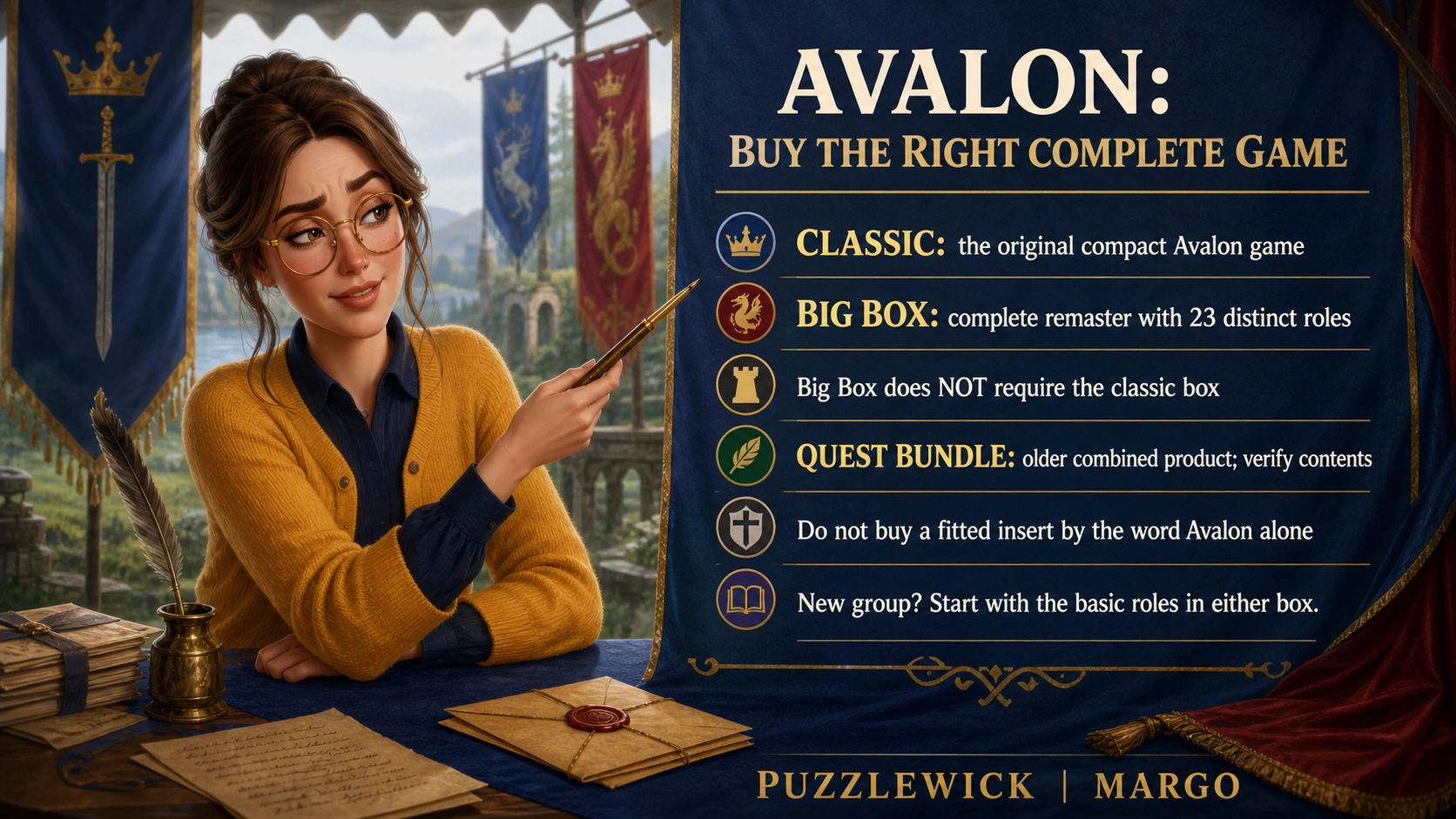
Both are complete starting games. Classic The Resistance: Avalon is the compact original. Retail Avalon Big Box is a remastered edition with a much wider menu of roles and modules. You do not need the original box to use Big Box, and you do not need to learn the extra material before playing its base game.
The publisher dates classic Avalon to 2012 and the retail Big Box release to August 2022. Its Big Box description specifies twenty-three distinct characters and optional material including Lancelots, Excalibur, Plot Cards, Sorcerers, Rogues and Messengers. That number is not the player count, and "included" does not mean "use it all tonight."
Our buying decision
Choose classic if your priority is trying this type of game in a smaller package. Choose Big Box if a regular group wants many variations in one purchase. Check the current delivered offer before deciding; neither edition needs a premium price justified by a fictional scarcity story.
There is also an older Quest: Avalon Big Box Edition combined product associated with Quest. It is not simply another name for retail Avalon Big Box. Ask what is actually in a used or imported listing, and match any organizer to the exact box. Similar words on two cartons are not measurements.
The buy buttons here use the exact Amazon products linked by the publisher. Both product pages were readable on August 31, 2026. That confirms identity, not future stock, seller quality or a promised delivery date.
What the box asks you to understand
Separate the pieces by job before explaining any character powers. Character cards secretly assign allegiance and role. Team tokens show who is proposed for a Quest. Vote tokens let everyone accept or reject that team. Quest cards are the secret Success or Fail choices made only by the approved team.
The tableau tells you team sizes and records completed Quests. The vote track counts rejected teams while the group is trying to launch the current Quest. The leader token identifies who makes the next proposal. Do not merge the two tracks: rejecting a team is not the same as failing a Quest.
The classic inventory lists fourteen character cards, ten Quest cards, five team tokens, twenty vote tokens, five score markers, three double-sided tableaus and the leader, round and vote-track markers. Optional loyalty cards and Lady of the Lake material are not needed for the basic teach. Big Box has a different, larger inventory.
Keep character faces hidden until the game is genuinely over. Do not prove a claim by showing your card or by discussing details of its artwork. The point is to reason from the permitted information, not to turn the card border into a password.
Rules reference: classic Avalon rulebook transcription: Contents; Cards and Tokens. The printed rulebook in your edition takes precedence.
Set up the correct player count
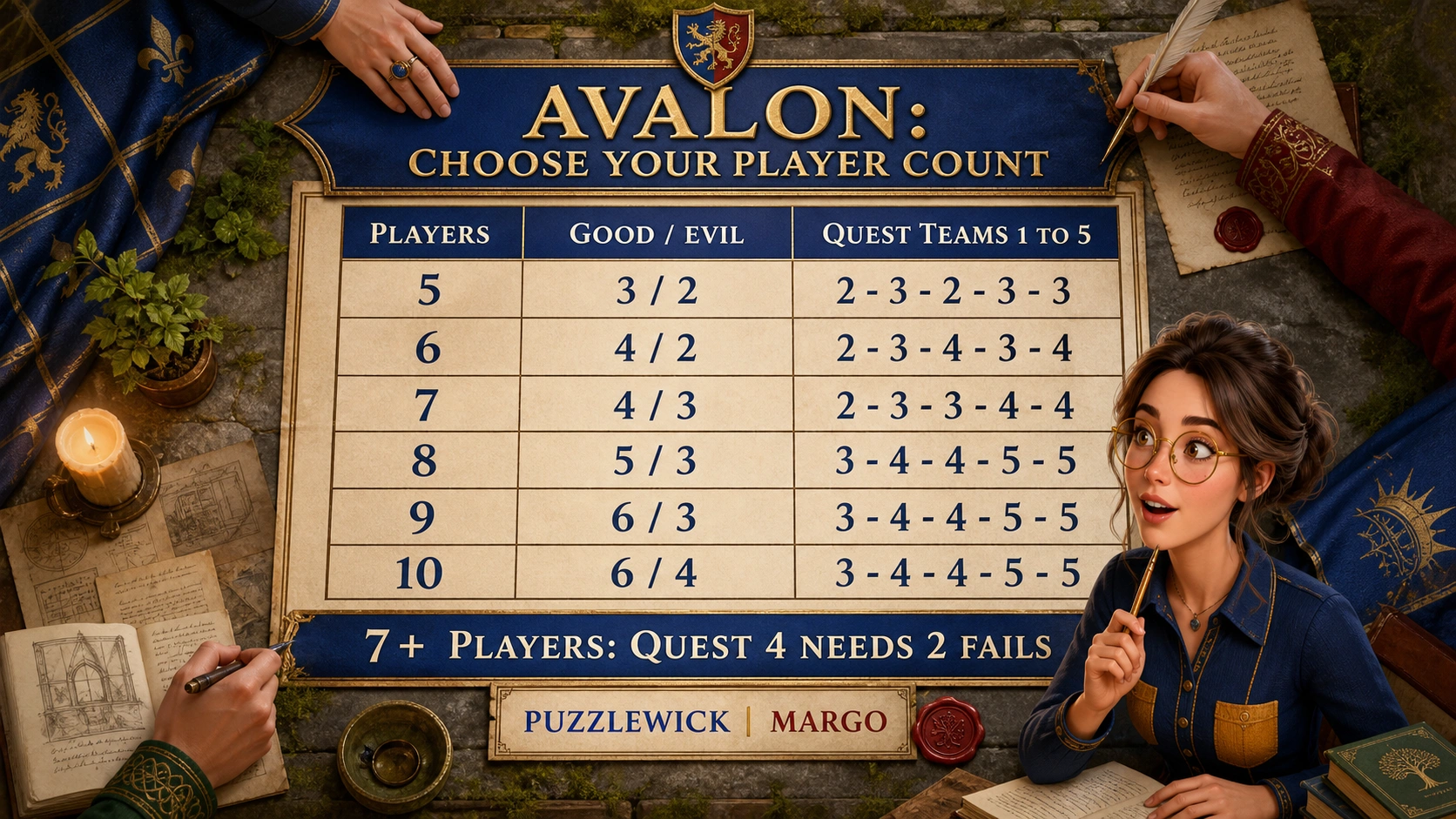
Start with Merlin, Assassin and ordinary Good and Evil characters. Choose the tableau for your exact player count. Give each person one Approve and one Reject token. Randomly select a starting leader, place the round marker at Quest 1, and prepare the Quest cards and score markers.
| Players | Good | Evil | Quest team sizes, 1-5 |
|---|---|---|---|
| 5 | 3 | 2 | 2, 3, 2, 3, 3 |
| 6 | 4 | 2 | 2, 3, 4, 3, 4 |
| 7 | 4 | 3 | 2, 3, 3, 4, 4 |
| 8 | 5 | 3 | 3, 4, 4, 5, 5 |
| 9 | 6 | 3 | 3, 4, 4, 5, 5 |
| 10 | 6 | 4 | 3, 4, 4, 5, 5 |
Good and Evil totals include the special roles. At seven players, Merlin is one of the four Good players and Assassin is one of the three Evil players. Adding Percival later means replacing an ordinary Good character, not adding an eighth person or reducing Evil's number.
Shuffle the selected characters and deal one face down to each player. Let everyone read privately. Then ask, before anybody closes their eyes, whether anyone needs a role explained. Explain all included roles to the entire table; asking only the Assassin what they need to know rather spoils the investigation.
For a first game, follow Quests in printed order. Leave Targeting, Lady of the Lake and Big Box modules aside. They are interesting after everyone understands what they change.
Rules reference: classic Avalon rulebook transcription: Set Up; Team Assignment. The printed rulebook in your edition takes precedence.
Run the opening reveal without giving the game away
The opening gives different players different private information. In the basic game, Evil players recognize one another, then Merlin learns who they are while they cannot see Merlin. Use the printed opening script that matches the roles actually dealt. A saved narration for a different role combination can quietly ruin an otherwise correct setup.
- Everybody closes their eyes. Use the same hand position for everyone.
- The Evil players identify one another, then close their eyes.
- Evil indicates its allegiance using the script's hand signal while keeping eyes closed. Merlin looks, then the signal and open eyes are safely reset.
- Only after all secret steps are finished does everyone reopen their eyes.
That is an explanation of the sequence, not a replacement for the complete role-specific script. Pause long enough for each step, speak at an even pace, and avoid remarks such as "there you are" while somebody is looking. If the reveal misfires, redeal openly and restart. Repairing it by privately whispering to one player may reveal more than the original mistake.
A player can read the script and still participate by following their own role's eye instructions. You do not need to sacrifice someone as a permanent nonplaying moderator.
Rules reference: classic Avalon rulebook transcription: Evil Reveals Itself; Optional Character Cards. The printed rulebook in your edition takes precedence.
A round: propose, vote, then run the Quest
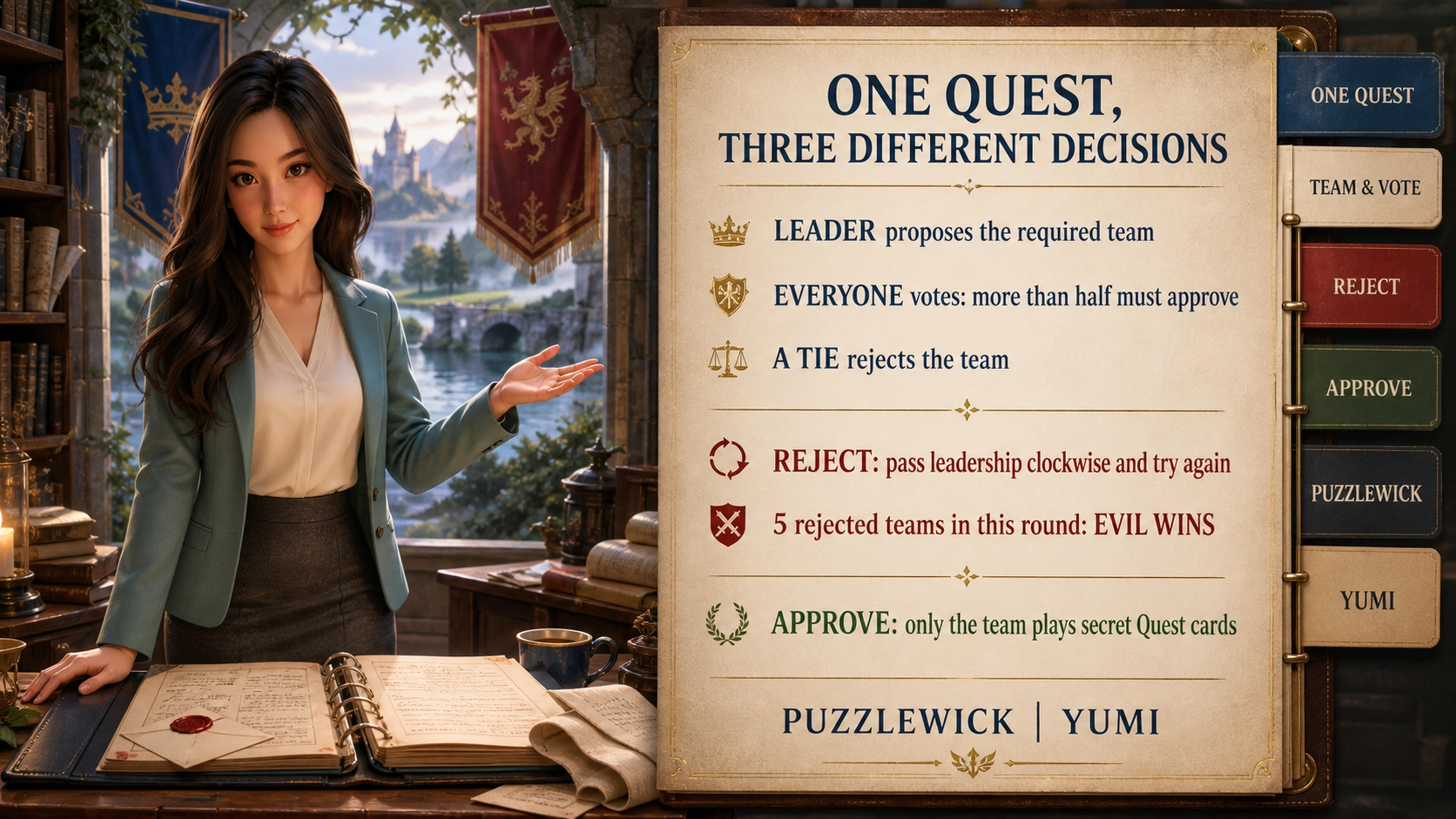
The leader proposes exactly the number of people shown for this Quest. They may include themselves, but do not have to. Hand out team tokens so nobody is guessing which list the discussion refers to. Ask for reasons and objections, then call the vote.
Every player votes, including the leader and people not on the proposed team. Select secretly and reveal together. The proposal needs more than half of all votes. At six players, three Approve and three Reject is a rejection. At seven, four approvals pass.
If rejected, advance the rejection count and pass leadership clockwise. The next leader proposes again for the same Quest. A fifth consecutive rejected team in that round gives Evil an immediate win. Four rejections are not a new round, and the fifth leader does not get to skip the vote.
Once a team is approved, only its members receive a Success and a Fail card. Each secretly submits one. Good must submit Success. Evil may submit either. Shuffle submitted cards before revealing them, and separately gather and shuffle unused cards so they cannot identify anyone's choice. Never mix the played and unused piles together.
Record the Quest result, move to the next Quest if the game continues, reset the vote track for that new round, and pass leadership clockwise. The leader changes after a completed Quest as well as after a rejected proposal.
Rules reference: classic Avalon rulebook transcription: Team Vote; Quest Phase. The printed rulebook in your edition takes precedence.
The fourth Quest exception, explained without a rules argument
In games with seven or more players, Quest 4 requires at least two Fail cards to fail. One Fail on that Quest is a successful Quest. At five or six players, one Fail is enough on every Quest. At all player counts, the other Quests normally fail with one Fail.
Seven players send four people on Quest 4. The reveal shows three Success cards and one Fail. Mark the Quest as successful. Also remember that at least one of those four players is Evil under the classic rules. The score result and the information result are different facts.
The exception belongs to the Quest 4 space, not the fourth rejected proposal, and not every late-game Quest. Read the marked tableau before anyone submits cards.
Rules reference: classic Avalon rulebook transcription: Quest Phase. The printed rulebook in your edition takes precedence.
How Avalon ends: three successes are not quite victory
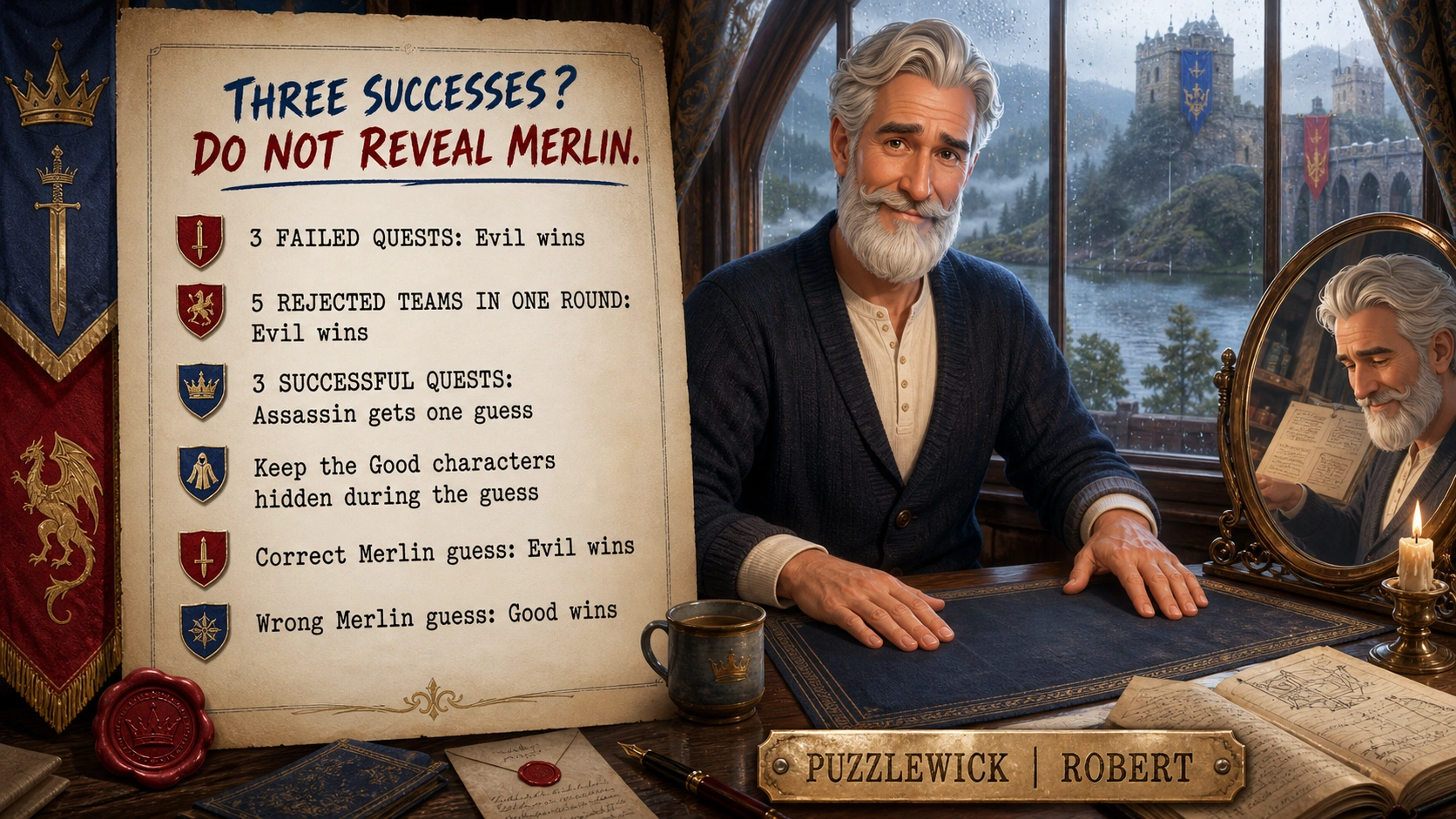
Three failed Quests give Evil the win. Five rejected teams while trying to launch one Quest also give Evil the win. There is no last-minute Good rescue after either ending.
If three Quests succeed, keep the Good character cards hidden. Evil discusses who Merlin might be, and Assassin makes one final choice. Correctly identify Merlin and Evil wins; miss and Good wins. Do not proudly flip Merlin face up while celebrating the third success. The celebration can survive another ten seconds.
Assassination is an endgame decision, not permission to remove someone during the second Quest. Players stay involved throughout ordinary play. Follow your edition's exact reveal procedure; online summaries differ about the moment Assassin reveals their own card, but none gives Good a reason to expose Merlin before the guess.
Rules reference: classic Avalon rulebook transcription: Game End; Assassinate Merlin. The printed rulebook in your edition takes precedence.
What a Quest result proves, and what it absolutely does not
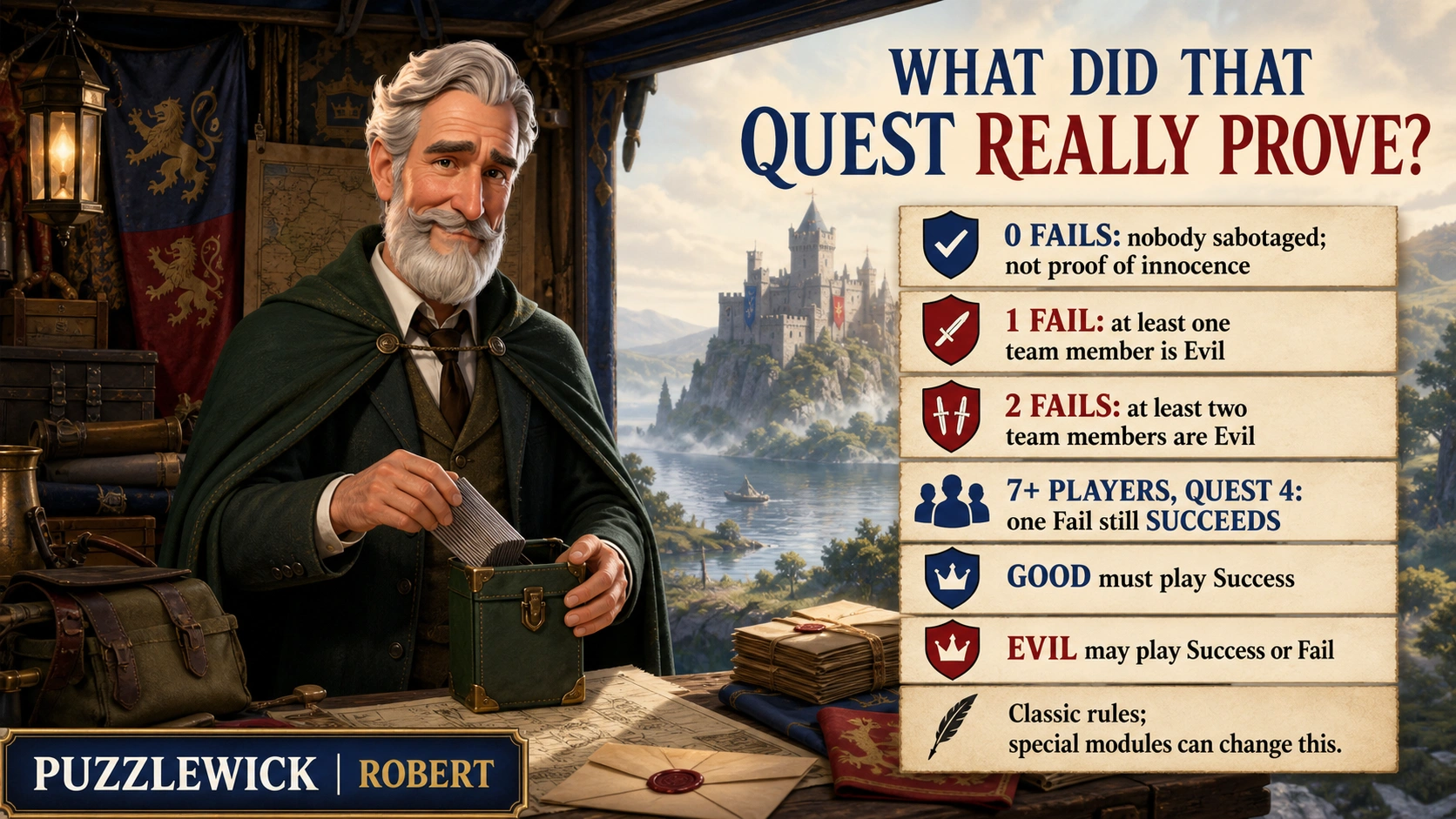
A clean Quest is evidence about what was played, not a certificate of loyalty. Evil can submit Success to earn trust, avoid exposing several teammates or influence a later team. Repeating a successful team may be reasonable; calling every member confirmed Good is not.
Conversely, under the classic rules, one Fail proves at least one Evil participant. Two Fail cards prove at least two. They do not tell you which players submitted them. The upper limit is still constrained by the number of Evil characters in the game.
A useful example
Ada and Ben complete a clean Quest. Later, Ada, Ben and Cleo produce one Fail. It is tempting to announce that Cleo caused it because she is the only addition. That explanation fits. So do Ada or Ben choosing Success earlier and Fail now. The new member is a hypothesis, not a conviction.
Before changing your team, name the alternatives: "If Cleo is Good, which earlier assumption has to be wrong?" That question makes the table reason together. "You looked suspicious" mainly makes somebody wish they had accepted the invitation to dinner instead.
Track proposed teams, the visible votes and the number of Fails. Distinguish known rule facts, plausible interpretations and claims made by players. Special Big Box modules can change allegiance, submission or resolution, so do not apply this simplified logic after adding those modules without rereading them.
Merlin, Percival, Morgana, Mordred and Oberon
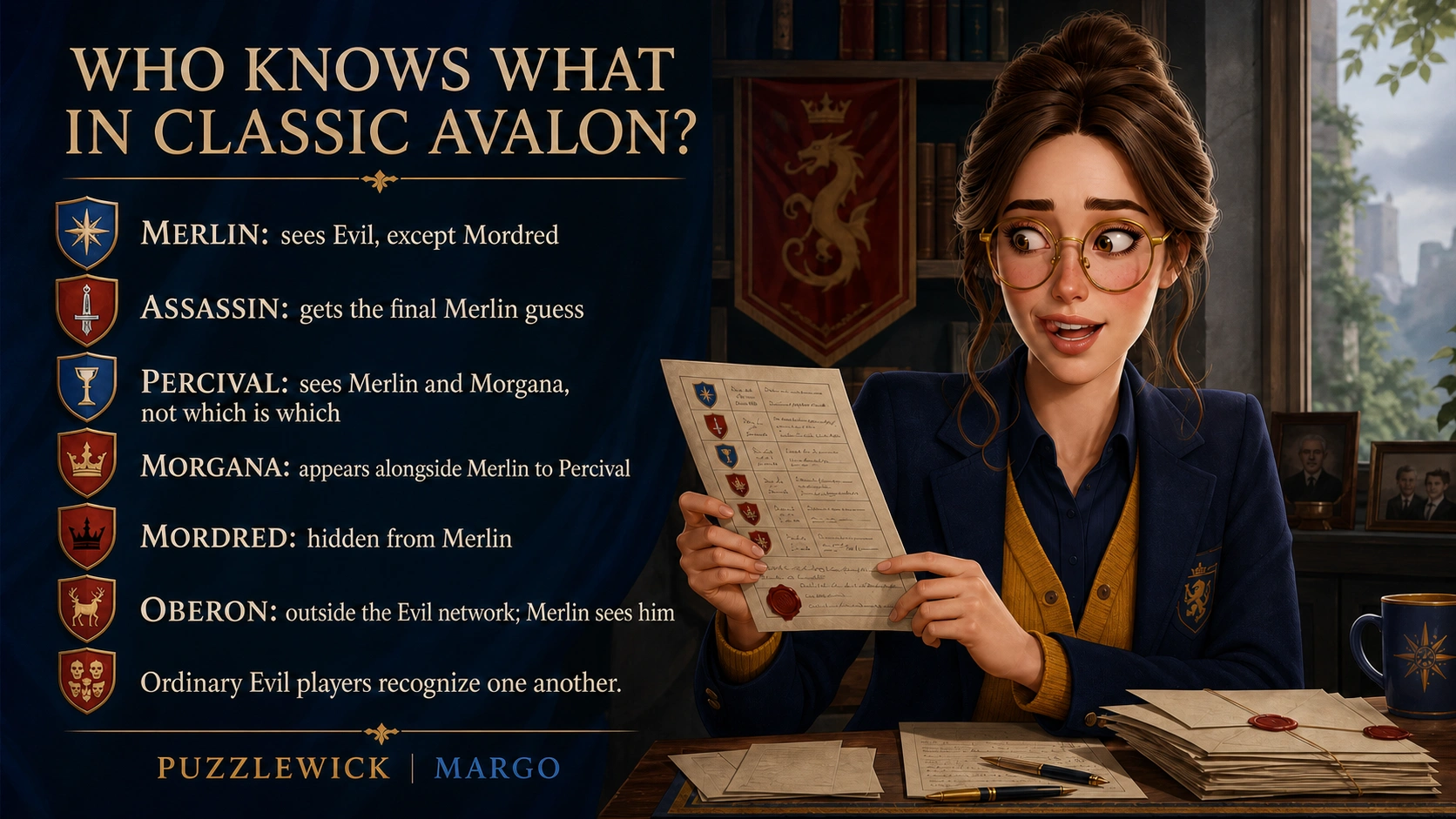
Merlin is Good and sees Evil during setup, except Mordred when Mordred is included. The strategic challenge is helping Good without making the knowledge obvious to Assassin.
Assassin is Evil and makes the final Merlin guess after three successful Quests. An ordinary Loyal Servant is Good without secret setup knowledge. An ordinary Minion is Evil and recognizes the other participating Evil characters during the reveal.
Percival is Good. Without Morgana, Percival sees Merlin. With Morgana included, Percival sees two candidates without learning which is Merlin. Morgana is Evil and creates that false Merlin signal. Percival must still interpret later behavior; the role does not come with an answer key.
Mordred is Evil and remains hidden from Merlin. He still participates in Evil's mutual recognition. Oberon is Evil but neither recognizes the other Evil players nor is recognized by them during that step. Merlin does see Oberon under the classic rules. Oberon and Mordred are not interchangeable invisibility powers.
The classic script and Big Box rulebook transcription agree on that distinction. Dized's standalone Oberon entry, inspected for this guide, conflicts with its own extended setup script; we do not use that entry as authority. This is precisely the kind of disagreement to settle from the rulebook before dealing, not after a dramatic loss.
Our teaching recommendation is to learn the base game first, then try Percival and Morgana together. Keep allegiance totals unchanged. At five players, the classic rules specifically advise including Mordred or Morgana when using Percival. Add other roles deliberately, explaining their exact information change before play.
Rules reference: classic Avalon rulebook transcription: Optional Character Cards; reveal script. The printed rulebook in your edition takes precedence.
Cross-check: Avalon Big Box rulebook transcription, Additional Characters and Reveal Stage Script.
Better strategy without bullying the newest player
If you are Good without special information
Ask what each proposal is trying to learn or achieve. Compare a player's vote with their stated reasoning, then allow them to explain a change. Early uncertainty is normal. Do not outsource every decision to the most confident voice: that voice may be Evil, or merely enjoying the acoustics.
Give Merlin room to speak through ordinary reasoning rather than demanding that anyone "prove" why they know something. If you think you recognize Merlin, consider how your public reaction might help Assassin recognize them too. Protecting a source can matter as much as finding one.
If you are Merlin
Use facts everyone can see when explaining a vote. Point out contradictions, team overlap or a risky assumption. Constantly announcing perfect teams with no public explanation may help the Quest score while making the endgame easy for Assassin. This is a balancing problem, not a rule that Merlin must speak in theatrical riddles.
If you are Evil
Failing every opportunity is not automatically best. A Success can buy credibility or avoid revealing that multiple Evil players shared a team. Ask what your choice changes for the next Quest and for the final Merlin search. Do not coordinate with forbidden signals or identify submissions by damaged sleeves.
If you are Assassin
Watch who was accurate before public results justified confidence, who redirected a bad team without much explanation, and who seems to protect someone else's judgment. Those are leads, not a reliable personality test. Review the decision history with your teammates rather than guessing whoever spoke least.
These are Puzzlewick strategic suggestions derived from the information structure. They are not measured win-rate improvements, solved openings or evidence that a nervous newcomer is lying.
A first-night plan that makes people want another game
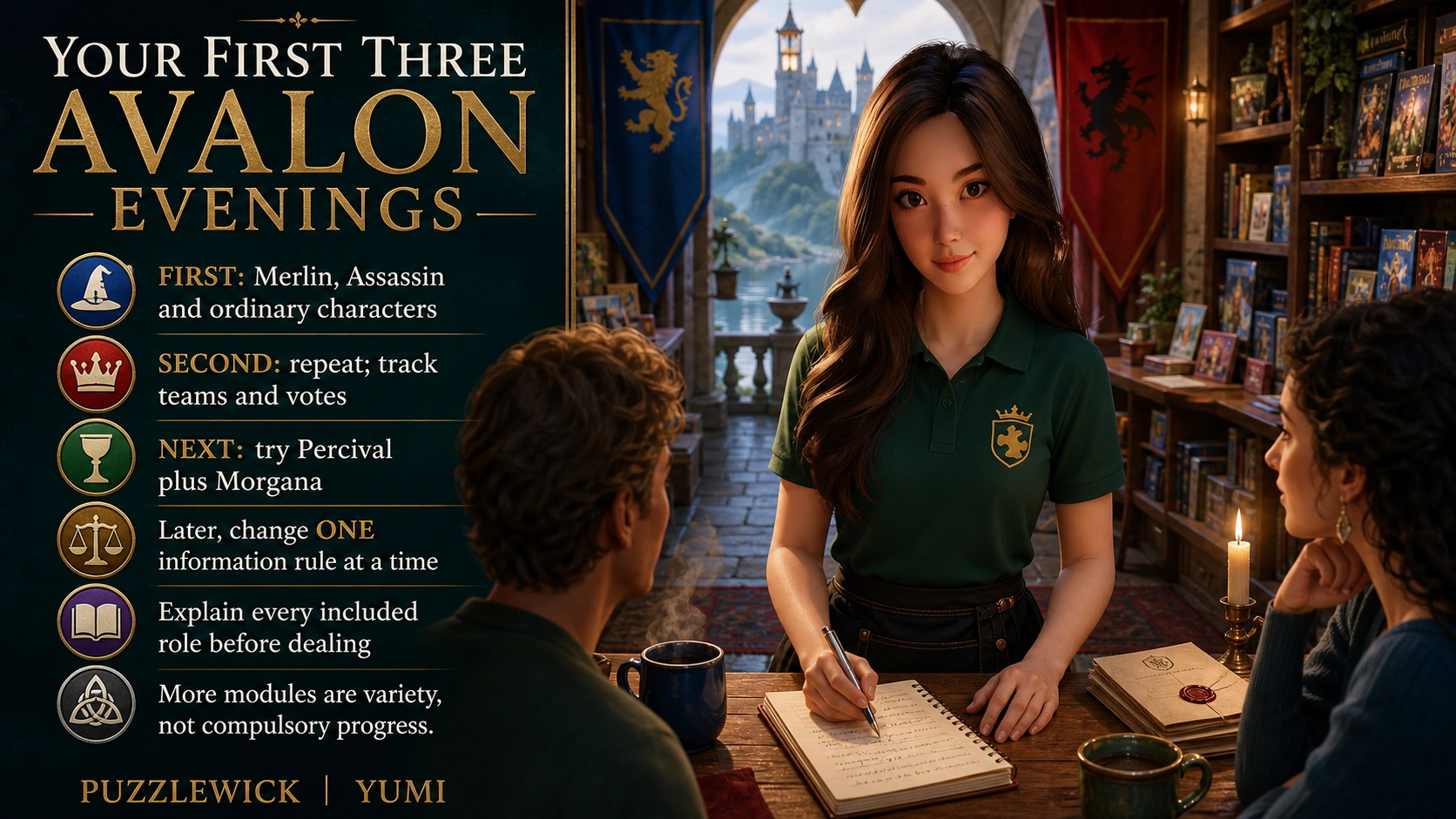
Before the deal, explain both ways the evening can end. Good needs three successful Quests and a surviving Merlin identity. Evil can win through failed Quests, a stalled round or assassination. Nobody should learn the final twist only after believing they won.
Demonstrate a public team vote and a secret Quest submission with practice cards, then reset. Show a tie, explain the fifth rejection and point to Quest 4's exception on the appropriate tableau. These few examples do more for confidence than reciting the entire optional-role chapter.
For the first game, keep the role set simple. For the second, repeat it and notice how much better the discussion becomes once everybody knows the procedure. On a later evening, add Percival and Morgana if the group wants the extra uncertainty. Advancement does not require a larger role count.
Make space for brief contributions. A neutral "What changed your vote?" is useful. Demanding eye contact, treating a stammer as evidence or importing last week's personal argument is not. Nobody owes the group a performance, and someone who dislikes accusation games is allowed to choose a different game.
After the reveal, ask which public decision was most informative and which misunderstanding needs clarifying. A short friendly debrief improves the next game. An extended explanation of why the new person should have known better improves nothing.
Accessories that protect hidden information, not just cardboard
The base box already supplies everything required to play. Avalon does not need booster packs, a deckbuilding binder or a box of miniatures. The useful accessory question is whether something helps preserve secrecy, handle cards comfortably or transport the actual edition you own.
Sleeves: identical treatment matters
Inspect character backs and Quest-card backs for identifiable wear. Sleeve each relevant group uniformly. One visibly different sleeve on Merlin is worse than no sleeves; clear sleeves also cannot hide a distinctive mark on the card back. Avoid face windows, color coding by role or sleeves with different wear patterns.
USA Chimera sleeves are a size category to investigate for Avalon, not a substitute for measuring your copy. The existing Sleeve Kings 57.5 x 89 mm four-pack has 440 sleeves and was verified by product identity. That is a collection-care quantity, not a sensible claim that classic Avalon needs hundreds. Compare the manufacturer's supported card size, test one sleeve, then check box clearance. We have not physically fit-tested this product with either edition.
Storage: buy by edition, not the title fragment
First try the original insert and a few small resealable bags. A removable tray can keep score markers and team tokens distinct, but it must not become a way to trace secret Quest submissions. A generic organizer is not a fitted Avalon insert.
Be especially careful with an insert advertised for Quest: Avalon Big Box Edition. The older combined Quest product and retail Avalon Big Box are not the same carton. Verify supported edition, external dimensions, sleeved capacity and lid closure before buying an expensive printed insert.
A mat and travel case are optional comfort
A low-glare, quiet surface can make tokens easier to lift. Keep the tableau and vote track visible from every seat; a busy illustration that hides those tracks is not an upgrade. A fitted case protects the box in a bag, but a card deck box may not accommodate its tableaus and tokens. We have not verified an official Avalon mat or a fitted current-edition travel case, so no unrelated franchise item is presented as one.
Our accessory store covers broader tabletop care. For this game, correct sizes and uniform card backs matter more than premium branding. The reviewed selection stays intentionally small until exact additional compatibility is established.
Watch a teach, keep the host sheet and choose your next table

The publisher embeds How to Play The Resistance: Avalon beside its classic product. Its Gen Con 2012 overview provides release-era context rather than a promise about a current printing. For the larger edition, the publisher links My Favourite Social Deduction Game: Avalon Big Box Overview. That title expresses the video's creator's preference, not a consensus score.
Our downloadable host reference condenses the player counts, decision sequence and common exceptions. It is original teaching support, not a replacement for the published manual or the role-specific opening script.
If your group enjoys this kind of discussion, the social-deduction game comparison helps choose a different tempo. Prefer a broader board-game evening? Browse the board-game shelves. Avalon does not need a fictional upgrade path into a completely different hobby.
Yumi's recommendation: begin with either complete box, simple roles and a kind teach. Learn to separate a result from an interpretation. The satisfying moment is not humiliating the person who lied; it is finally seeing how the table persuaded itself.
The picks
Some links below are affiliate links — as an Amazon Associate, Puzzlewick earns from qualifying purchases, at no extra cost to you. It never changes a pick.
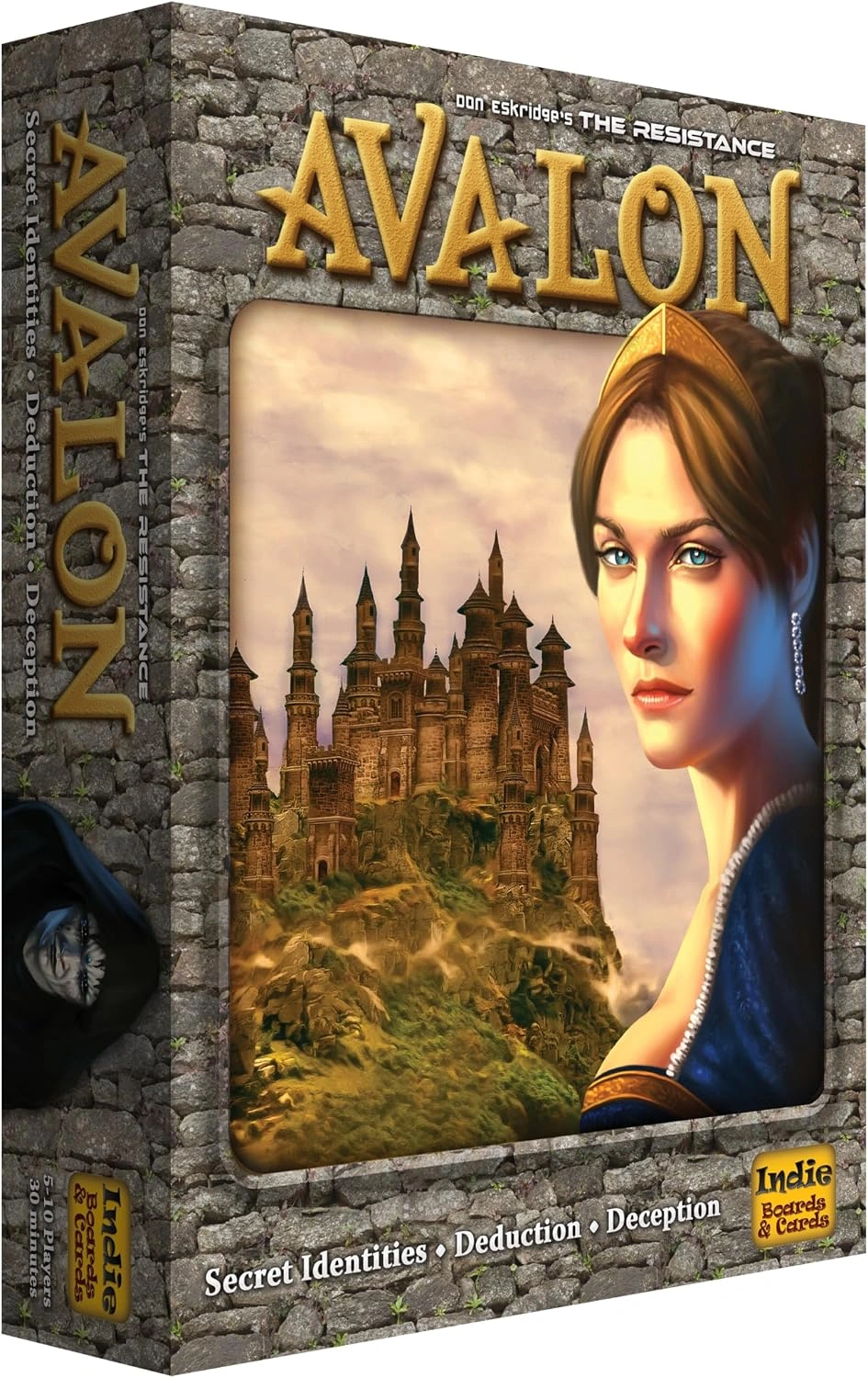
The Resistance: Avalon
The compact original for a group ready to try hidden allegiances and a memorable endgame.
- Complete standalone game
- No midgame player elimination
- Simple base roles available
- Requires at least five players
- Not suitable for every social group
- Extra roles need a careful teach
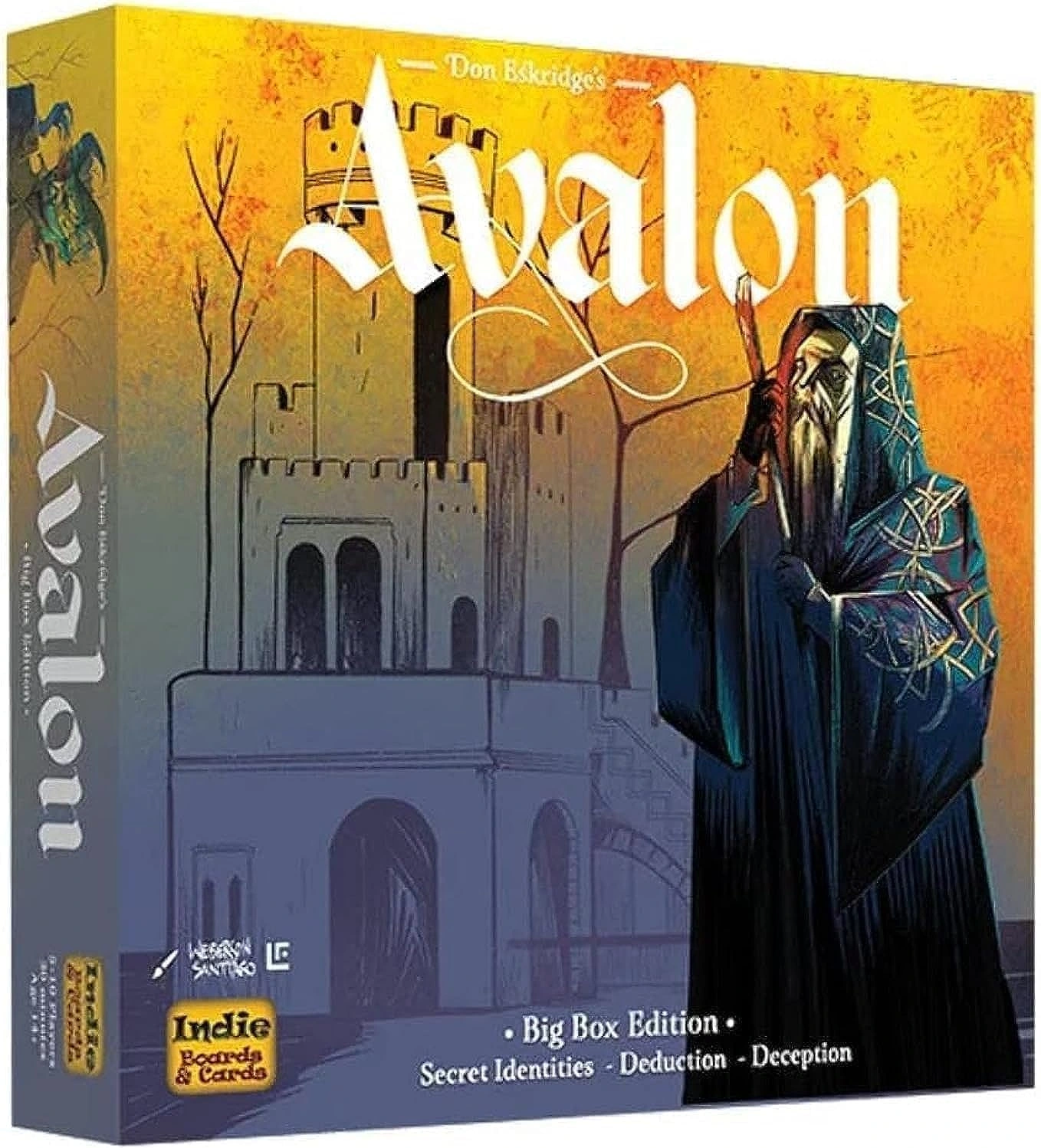
Avalon Big Box
A complete remaster with a broad role and module library. Start with its base game.
- Complete standalone game
- No midgame player elimination
- Simple base roles available
- Requires at least five players
- Not suitable for every social group
- Extra roles need a careful teach
At a glance
| Edition | Job | Start |
|---|---|---|
| The Resistance: Avalon | Compact complete original | Merlin, Assassin and ordinary roles |
| Avalon Big Box | Complete remaster with extensive optional variety | Use the base-game rules first |
| Quest: Avalon Big Box Edition | Older combined product with a different identity | Verify contents and insert compatibility |
Free download — Avalon First-Game Host Reference
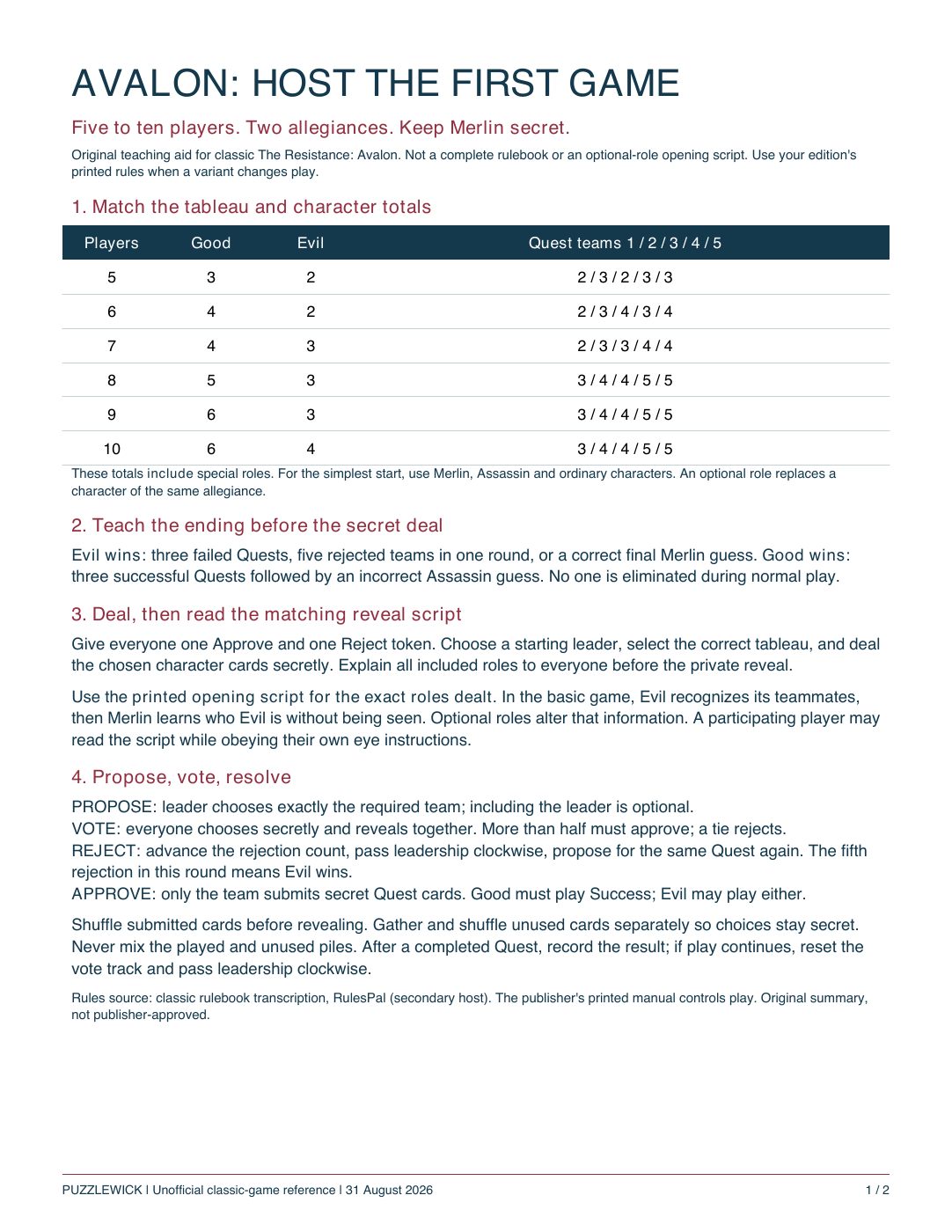
Two printer-friendly pages with player counts, the Quest sequence, role reminders and deduction examples. Keep them beside the board while teaching your first game. Classic rules, without optional modules.
Unofficial fan-made reference. Compiled by Puzzlewick from the sources listed on the sheet. Not affiliated with or endorsed by the publisher — always defer to the official rulebook.
Questions, answered
Can you play Avalon with four people?
The classic publisher specifies 5-10 players. This guide does not present a four-player house rule as an official mode. Choose another game when fewer than five can play.
Is Avalon Big Box an expansion?
No. The retail Avalon Big Box is a complete remastered Avalon game with additional roles and modules. It does not require classic Avalon.
What happens on a tied team vote?
The proposed team is rejected. Approval needs more than half of all players. Leadership passes clockwise and the rejection count advances.
Can a Good player play a Fail card?
Not under the classic base rules. Good must submit Success. Evil may choose Success or Fail. Special modules must be read separately.
When does a Quest need two Fail cards?
Only Quest 4 in classic games of seven or more players. At those counts, one Fail still produces a successful Quest, but it reveals that at least one participant is Evil.
Does a successful Quest prove everyone was Good?
No. Evil can play Success, and Quest 4 at seven or more players can succeed with one Fail. Do not confuse a successful result with confirmed allegiance.
Does Merlin see Oberon?
Yes under the classic rules. Oberon is excluded from Evil's mutual recognition; Mordred is the Evil role hidden from Merlin. Some online summaries confuse these powers.
Does Percival know which person is Merlin?
When Morgana is absent, Percival sees Merlin. When Morgana is included, Percival sees both and is not told which is which.
Why did Evil win after five rejected teams?
Five consecutive rejected proposals while trying to launch a single Quest end the game in Evil's favor. This is not five failed Quests or five rejected teams accumulated over the whole game.
When should players reveal their roles?
Keep characters secret during play and keep Good roles hidden through the final Assassin guess. Follow your edition's endgame reveal procedure.
Does Avalon need a moderator or an app?
A participating player can read the correct opening script while following their own eye instructions. Neither a permanent nonplaying moderator nor an app is required for the basic game.
What should beginners buy with Avalon?
The complete game is enough. Optional uniform sleeves require measured card and box fit. A fitted insert must match the exact edition. There are no required boosters, deck upgrades or miniatures.
Yumi's verdict
Avalon earns its place when your group enjoys debating uncertainty without making it personal. Either complete edition can teach the same central game. Start simply, protect secret information, and remember that a clean Quest is not a character reference.
Research ledger 10 sources · reviewed 2026-09-01
Specifications, rules, current product information, community experience, and contrary evidence were checked against the sources below. Commercial links are kept separate from editorial evidence.
- Indie Boards and Cards: The Resistance: Avalonindieboardsandcards.com/our-games/the-resistance-avalon
- Indie Boards and Cards: Avalon Big Boxindieboardsandcards.com/our-games/avalon-big-box
- The Resistance: Avalon printed rulebook, eight pagescdn.1j1ju.com/medias/a6/dc/c1-the-resistance-avalon-rulebook.pdf
- Dized publisher-verified official Avalon rulesrules.dized.com/game/rZluqS52QmGdpoVxcmVLtg/the-resistance-avalon
- BoardGameGeek: Avalon Big Box official rulebook scanboardgamegeek.com/filepage/306219/avalon-big-box-rulebook-english
- Avalon Big Box official rulebook scan, Tesera mirrortesera.ru/images/items/2179119/Avalon%20Big%20Box%20Edition%20Rules.pdf
- RulesPal: classic Avalon rulebook transcriptionrulespal.com/resistance-avalon/rulebook
- RulesPal: Avalon Big Box rulebook transcriptionrulespal.com/avalon-big-box/rulebook
- Amazon exact listing: The Resistance: Avalonamazon.com/dp/B009SAAV0C
- Amazon exact listing: Avalon Big Boxamazon.com/dp/B0BC8MC554

Come in, take your shoes off — let me show you something.

Keep exploring
The next smart rabbit holes.
✦ Topic PathBoard Game Buying Guides: compare the whole shelfStart with the decision, not the shelf. These guides compare the games, editions, expansions, player counts, and costs people...Best OfBest Social Deduction Games (2026): Beyond Werewolf & MafiaOkay but have you SEEN what the room's been saying about these? Werewolf walked so these could run — nine games that turn a living room...Best OfBest Party Card Games for Adults, Ranked (2026)Okay but have you SEEN what the room's been saying about Monikers, Wavelength, So Clover!, Just One — because the party-game conversation...