Endeavor: Deep Sea Beginner and Strategy Guide: How to Play, Solo, Co-op and Competitive Tips
Margo turns the award-winning ocean into a readable first dive: which scenario to start, how the six-round engine works, why passing matters, and how to compete or cooperate without buying a submarine full of accessories.

AI-assisted curator persona · research and editorial responsibility: Robert Pruitt · how this guide was made
Last editorial refresh: 2026-09-13 Gold-standard QA: 2026-09-13 10 sources reviewed Affiliate links checked during gold-standard pass

The short answer
Endeavor: Deep Sea is a medium-weight strategy game for one to four players with competitive, cooperative and solo modes across ten scenarios. Multiplayer lasts six rounds and solo lasts seven. Start with Mission 1, teach the five action verbs, raise attributes to solve named capacity problems, and make every action enable the next.
Decision map
Choose in thirty seconds
Endeavor: Deep Sea begins with a modest organization and an ocean that does not care about your résumé. That is the joke and the engine. You become capable one specialist, one disc and one carefully timed dive at a time.
This guide is grounded in the official rulebook and publisher material, the Spiel des Jahres record, current BoardGameGeek attention and independent criticism. Puzzlewick has not physically tested this copy, so the strategy is disclosed analysis, not a manufactured captain’s log.
Start here, then go deeper
You are in the right cabinet.
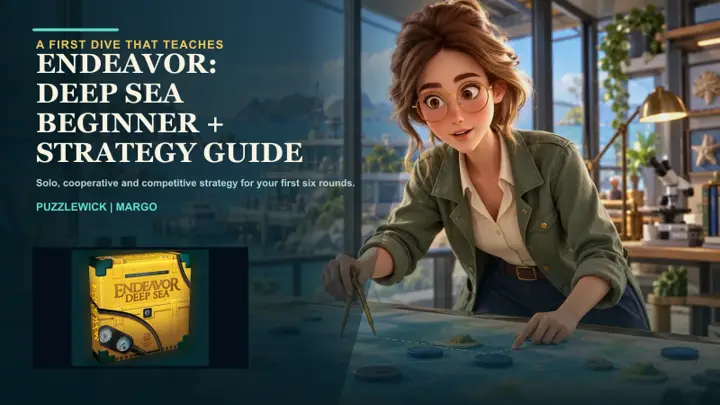 ⌁ Universe HubEndeavor: Deep Sea: the whole buying pathEndeavor: Deep Sea turns five actions and four attributes into a changing ocean map. The hub starts with the first six-round dive,...
 ✦ Topic PathBoard Game Buying Guides: compare the whole shelfStart with the decision, not the shelf. These guides compare the games, editions, expansions, player counts, and costs people...
 Deep DiveSETI: Search for Extraterrestrial Intelligence — The Deep-Dive ReviewCzech Games Edition's 2024 heavyweight turned a radio-telescope daydream into the most-awarded euro of its year. Here is what the record...
Is Endeavor Deep Sea worth buying?
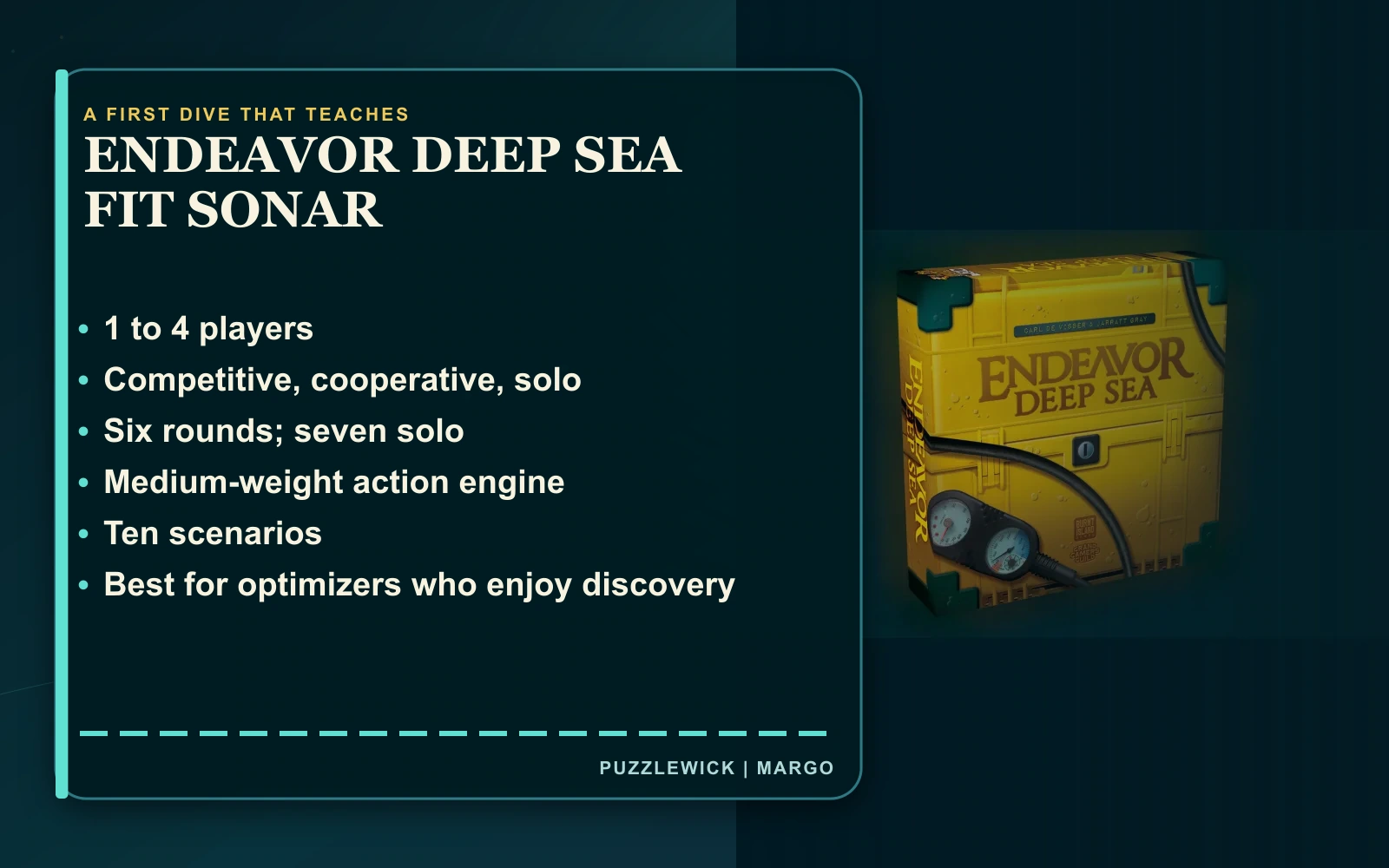
Yes, for one to four players who want a medium-weight optimization game with a changing map and credible competitive, cooperative and solo modes. It is especially strong when the group likes efficient action engines but wants discovery and conservation to matter more than direct conquest.
Skip it when the table needs loud conflict, a dramatic story campaign or immediate fireworks. Early rounds are intentionally small. The ocean opens because your organization becomes capable, not because the box throws a whale through the window.
The 2025 Kennerspiel des Jahres recognition is meaningful expert-jury evidence. It does not guarantee fit. The modes and ten scenarios do more practical work.
Start with The Call of the Ocean
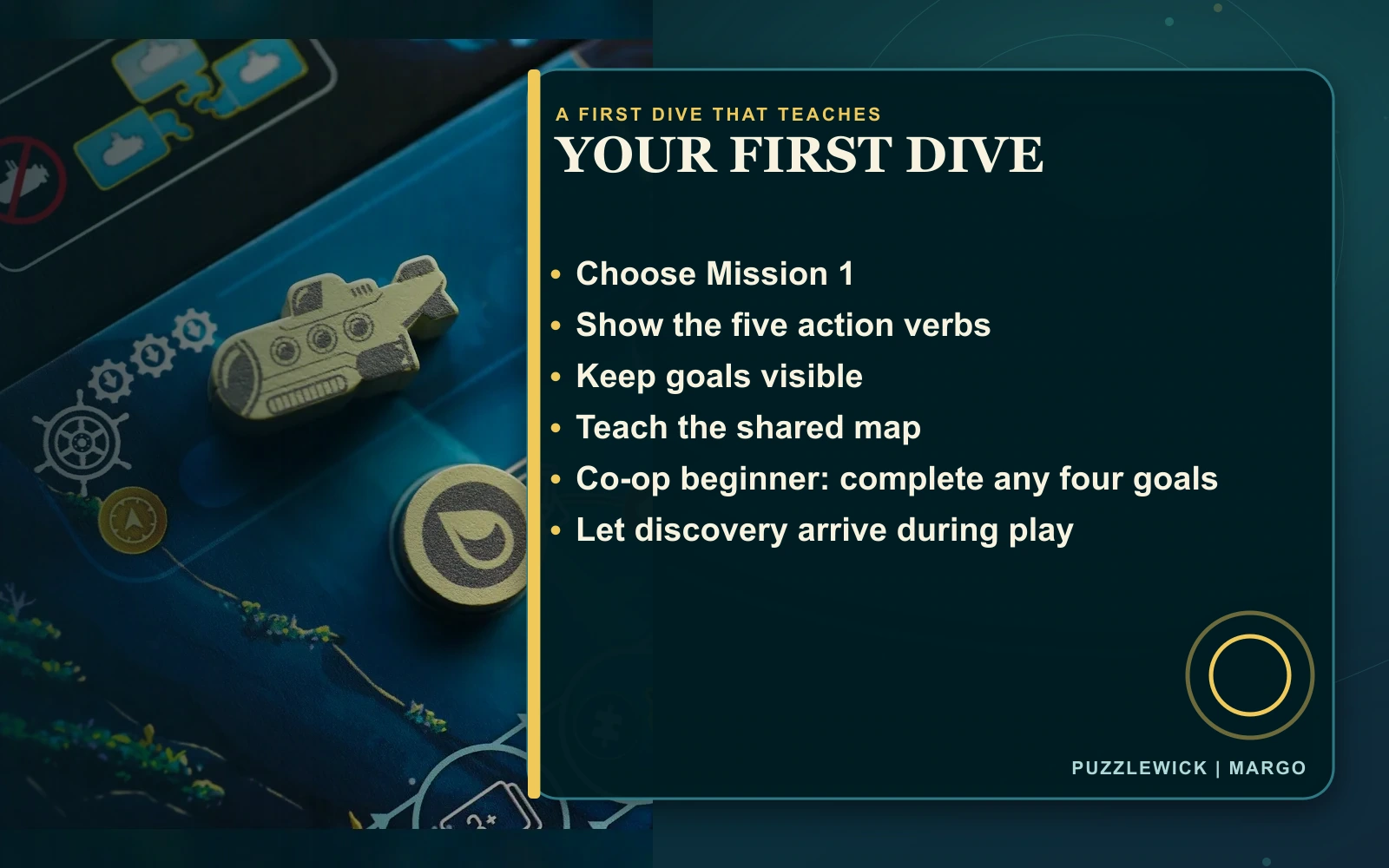
The rulebook names Mission 1, The Call of the Ocean, as the first game. Use it. Ten scenarios are a gift, not an invitation to choose by title while everyone else sets up.
Lay out the shared surface, keep the scenario goals visible, and explain that ocean boards enter the game as players travel. A first teach should name the five action verbs before describing every journal card. The map will teach geography; the scenario will teach pressure.
For cooperative play, choose the beginner target of any four goals unless the group already knows the engine. Difficulty is a contract about how many goals must be met, not a measure of anyone’s worth as a marine scientist.
The six-round engine: prepare, then activate
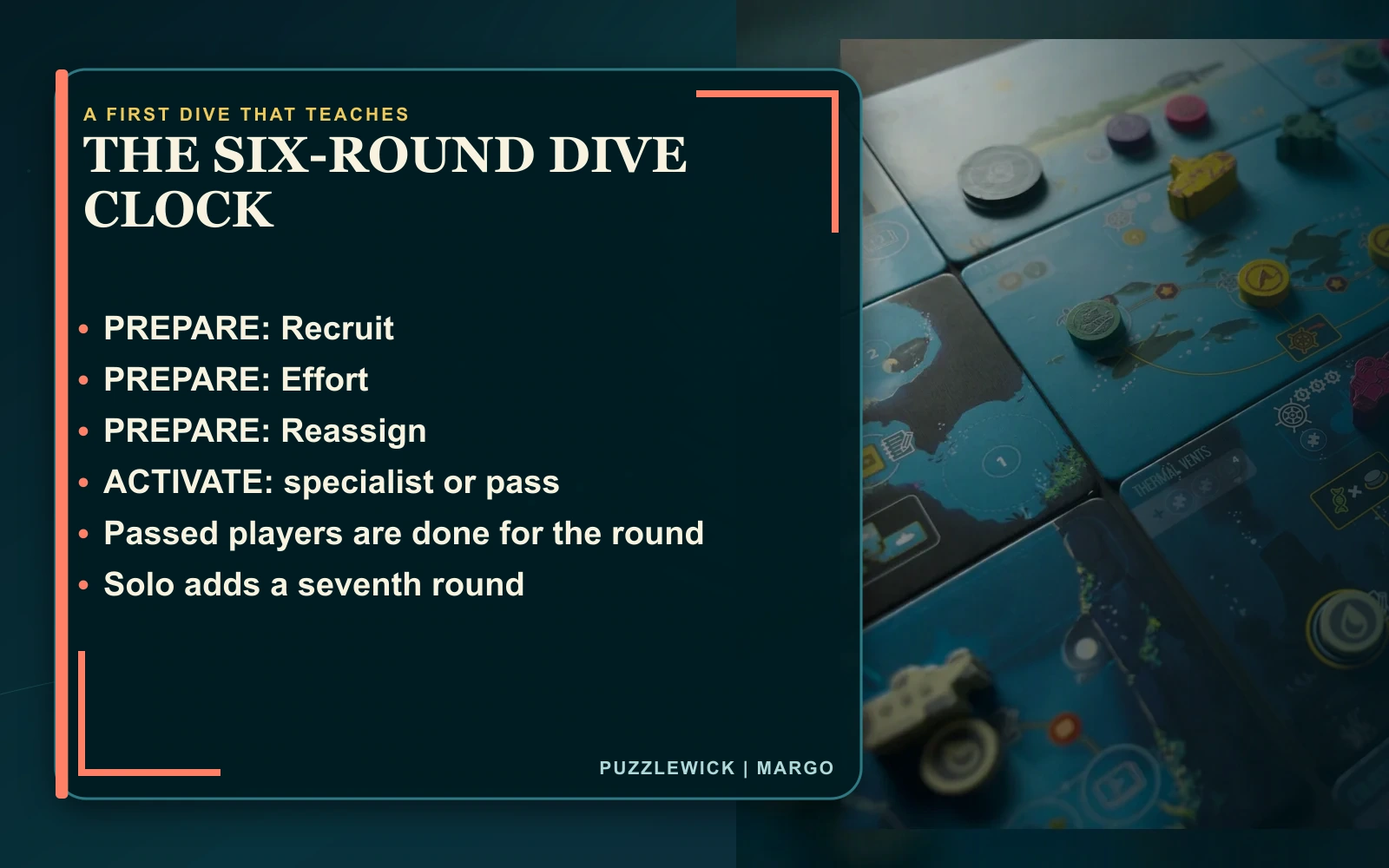
Each multiplayer game lasts six rounds; solo lasts seven. Preparation has three jobs: Recruitment brings in a specialist, Effort supplies action discs, and Reassignment returns a specialist to readiness. Activation then alternates around the table: activate one specialist or pass. Once you pass, you are out for the round.
That pass rule turns tempo into a shared resource. A player with more ready specialists can wait, watch and act after others have committed. Efficiency is not merely taking more actions; it is keeping the right action available at the right point in the round.
Before Recruitment, scan the scenario goals and one likely bottleneck. Hiring the highest-level specialist without a job is an expensive way to decorate a submarine.
Beginner checkpoint: before the first Activation, each player should name one capability they are building and one action they expect it to improve. This is not a binding promise. It is a way to turn four abstract attribute tracks into visible intent. If the table cannot explain what a new specialist or threshold enables, pause before spending the Recruitment choice. The ocean will still be there after ten seconds of thought.
Travel, Sonar, Dive, Conserve and Journal
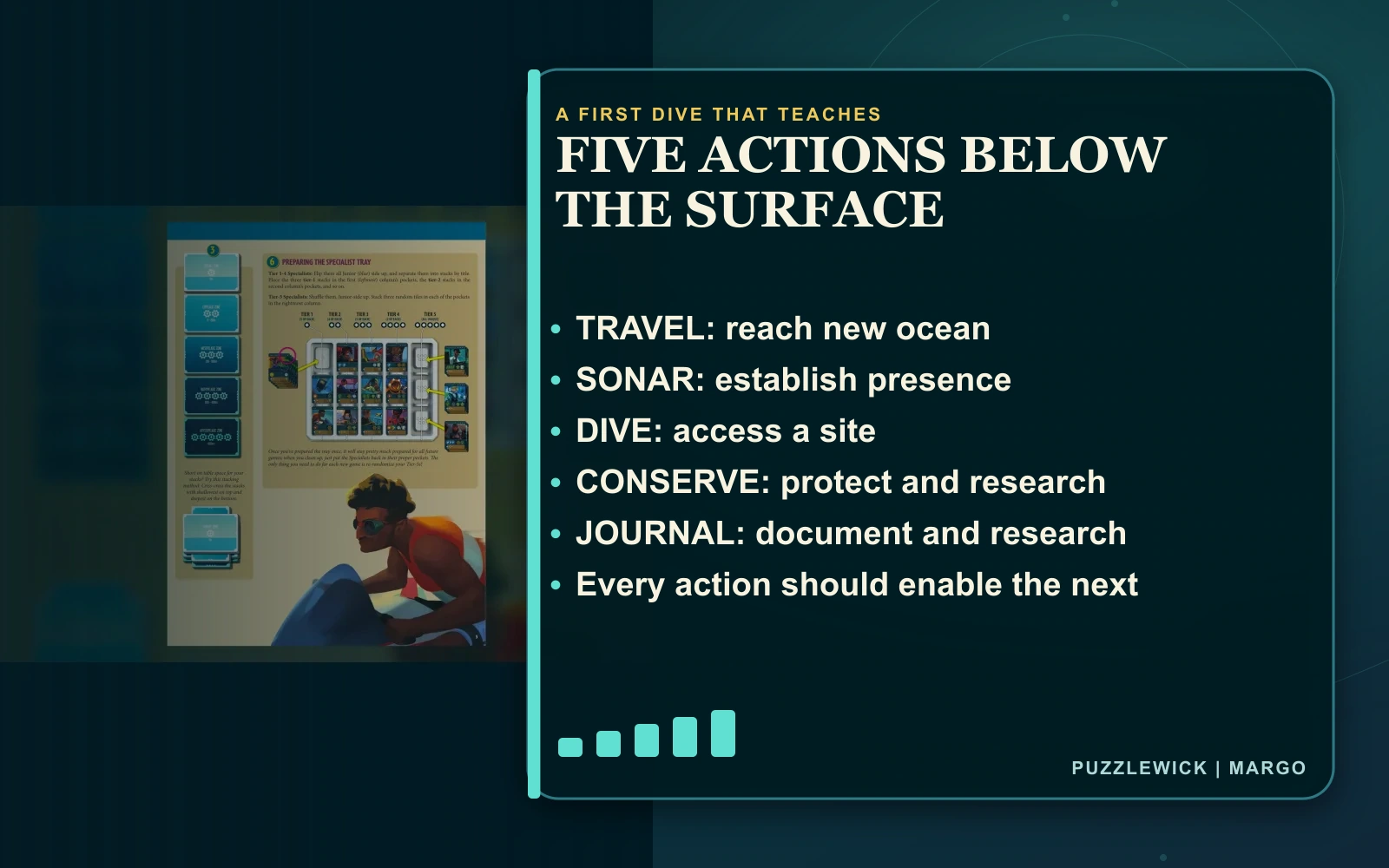
Travel expands your reach and reveals new ocean. Sonar places a second disc and helps establish presence. Dive reaches sites. Conserve places a second disc and gains Research. Journal also places a second disc and gains Research while pursuing documented discoveries.
The verbs are connected. Travel without the capacity to use the new board can gift tempo to somebody else. Sonar without a follow-up may occupy space but fail the mission. Conserve and Journal can look similar in the moment, yet the scenario and journal requirements make their long-term value different.
Use a two-action plan: name the action you want now and the action it enables next. If the first action enables nothing, ask whether it is merely pretty movement.
The four attributes are a capacity plan
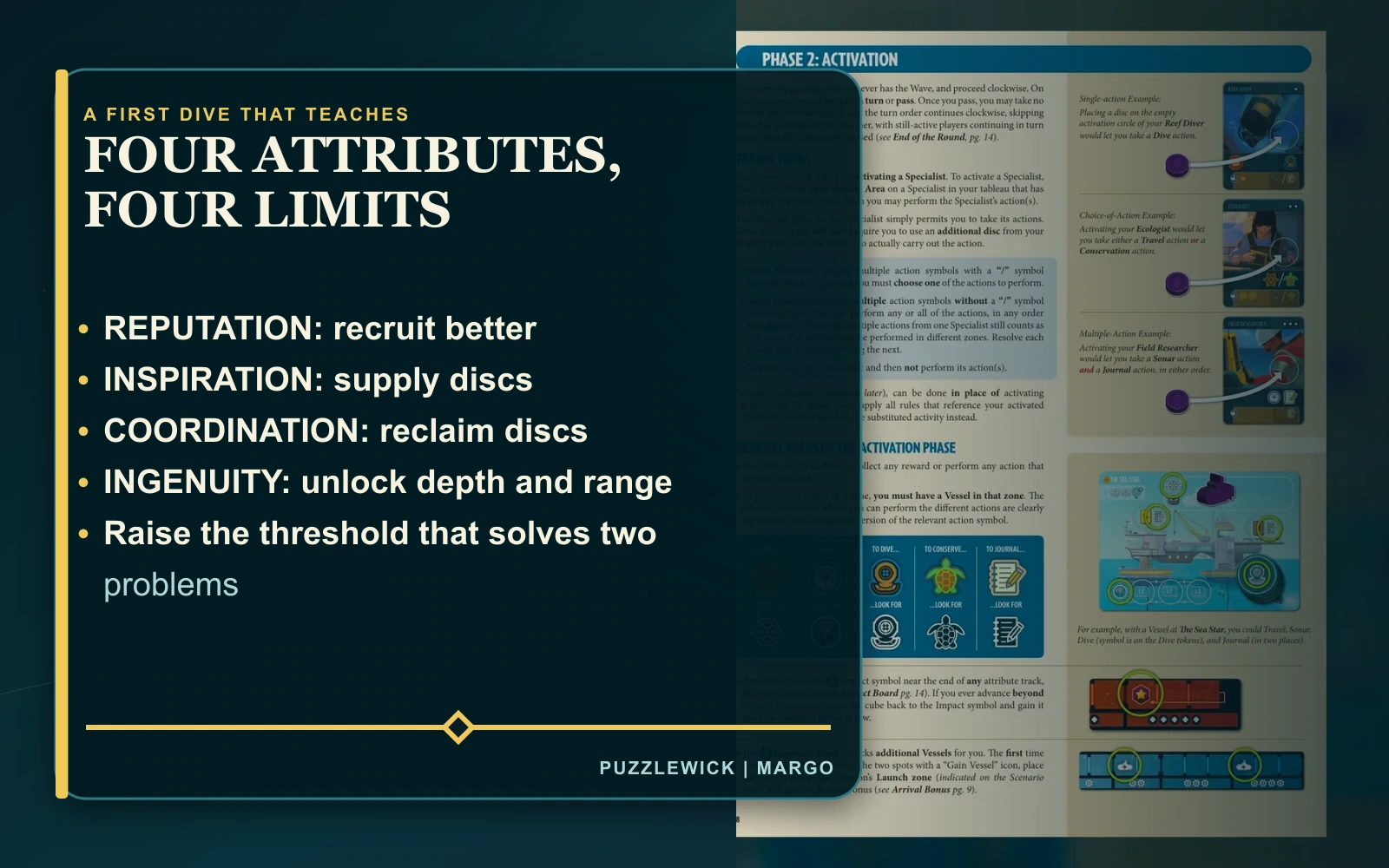
Reputation recruits stronger specialists. Inspiration supplies discs. Coordination reclaims discs. Ingenuity unlocks vessels, depth and range. These are not four equal score tracks. They are the capacity limits that decide which future actions remain possible.
Raise an attribute because the next threshold solves a named problem. Extra Inspiration with no specialist to spend discs is inventory. More Reputation with no useful hire is prestige theater. Ingenuity can be urgent when a scenario’s depth or range blocks the entire plan.
At the start of a round, ask which one threshold would make two later actions better. That is usually more valuable than nudging every track politely.
Competitive strategy: timing beats territorial vanity
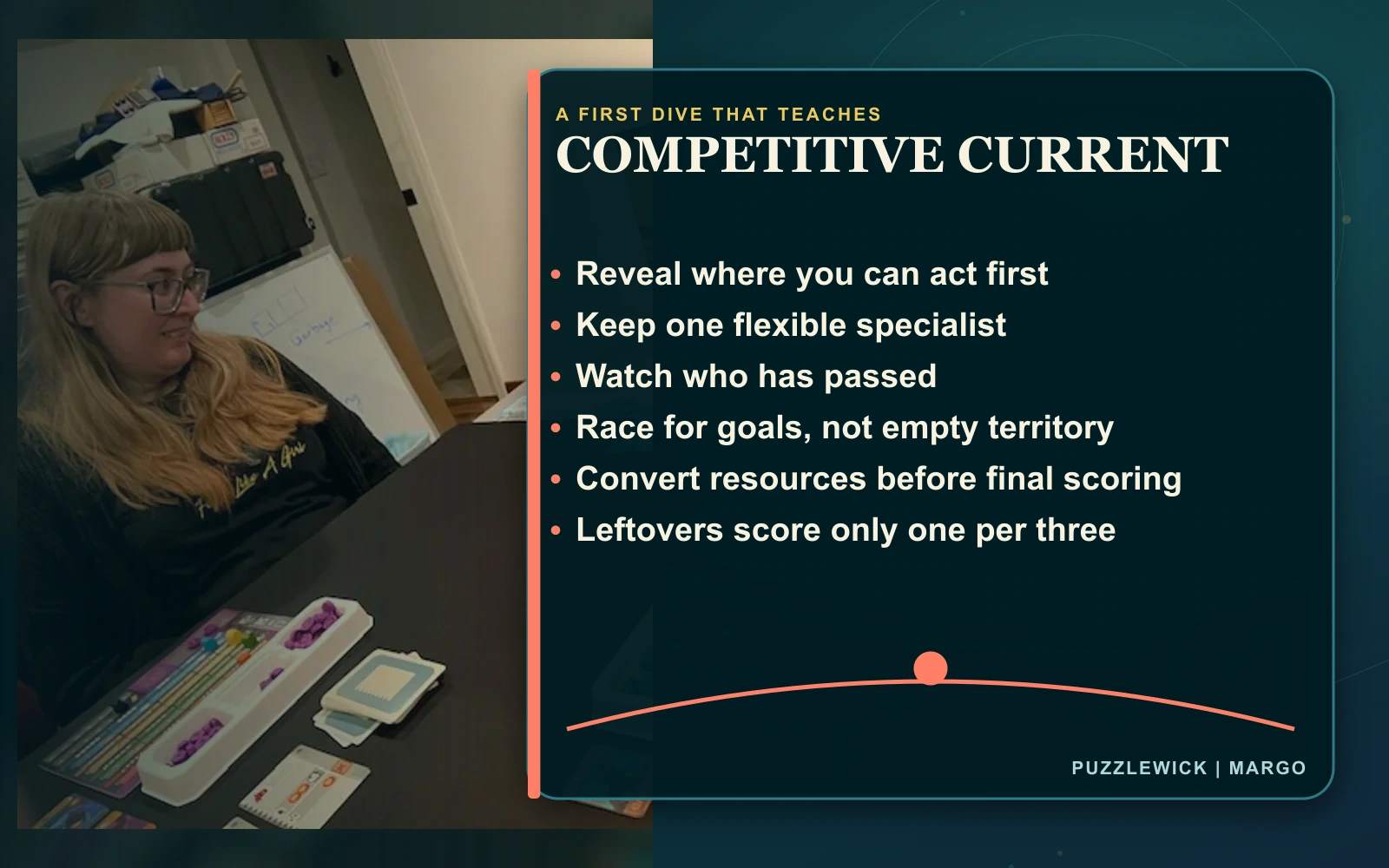
In competitive play, the shared ocean creates indirect interaction. You race for useful sites, journals, conservation opportunities and scenario goals. The strongest move may reveal a board everyone can use, so expansion should be paired with the action capacity to benefit first.
Keep one flexible specialist ready after opponents narrow their options. Watch who has passed, which discs remain staged, and whether the next threshold changes travel or depth. Do not spend two actions defending a symbolic patch of water that scores nothing.
Final scoring includes attributes, impact, journals or tier-five senior specialists, mission goals, and one point per three leftover Research plus staged discs. The last conversion matters, but hoarding three resources all game to earn one point is a very slow magic trick.
Cooperative and solo strategy
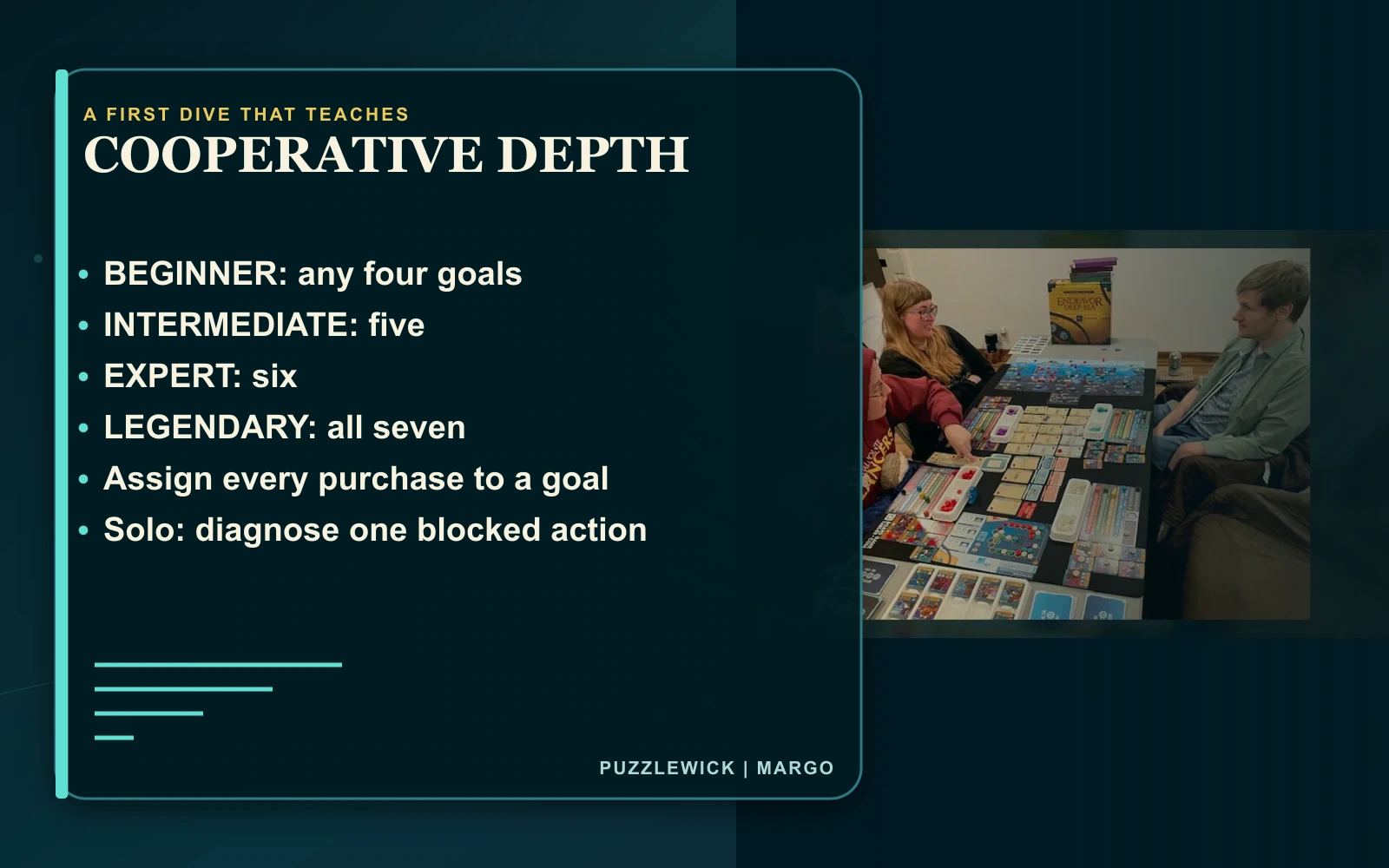
Cooperative missions add bonus goals and setbacks. The rulebook’s difficulty ladder asks for any four goals on Beginner, five on Intermediate, six on Expert and all seven on Legendary. Discuss which goal each specialist purchase serves; shared optimism is not a plan.
In solo, the seventh round buys time, not forgiveness. Track one blocked action each game. Was the problem a missing disc, weak Coordination, insufficient depth, or a specialist that returned too late? Fix the capacity that caused the block rather than chasing a higher final score by instinct.
Coopgestalt’s mode-focused coverage is useful precisely because it treats solo and cooperative play as systems worth examining, not checkboxes on the box side.
Use a one-word debrief after every blocked plan: disc, specialist, range, depth, timing or map. That label identifies the system that failed without turning the post-game conversation into a trial. In cooperative play, compare labels and repair the most common bottleneck together. In competitive play, keep yours private and notice which opponent repeatedly runs out of the same capacity. The next game becomes sharper because the lesson points to a decision, not merely a score.
The honest verdict, useful accessories and stopping point
Meeple Mountain praised the approachable teaching and mode range while finding the early game subdued and interaction limited, summarizing the experience as “fun, but it was never ‘wow’.” That is a fair warning. Endeavor’s pleasure is cumulative competence, not constant spectacle.
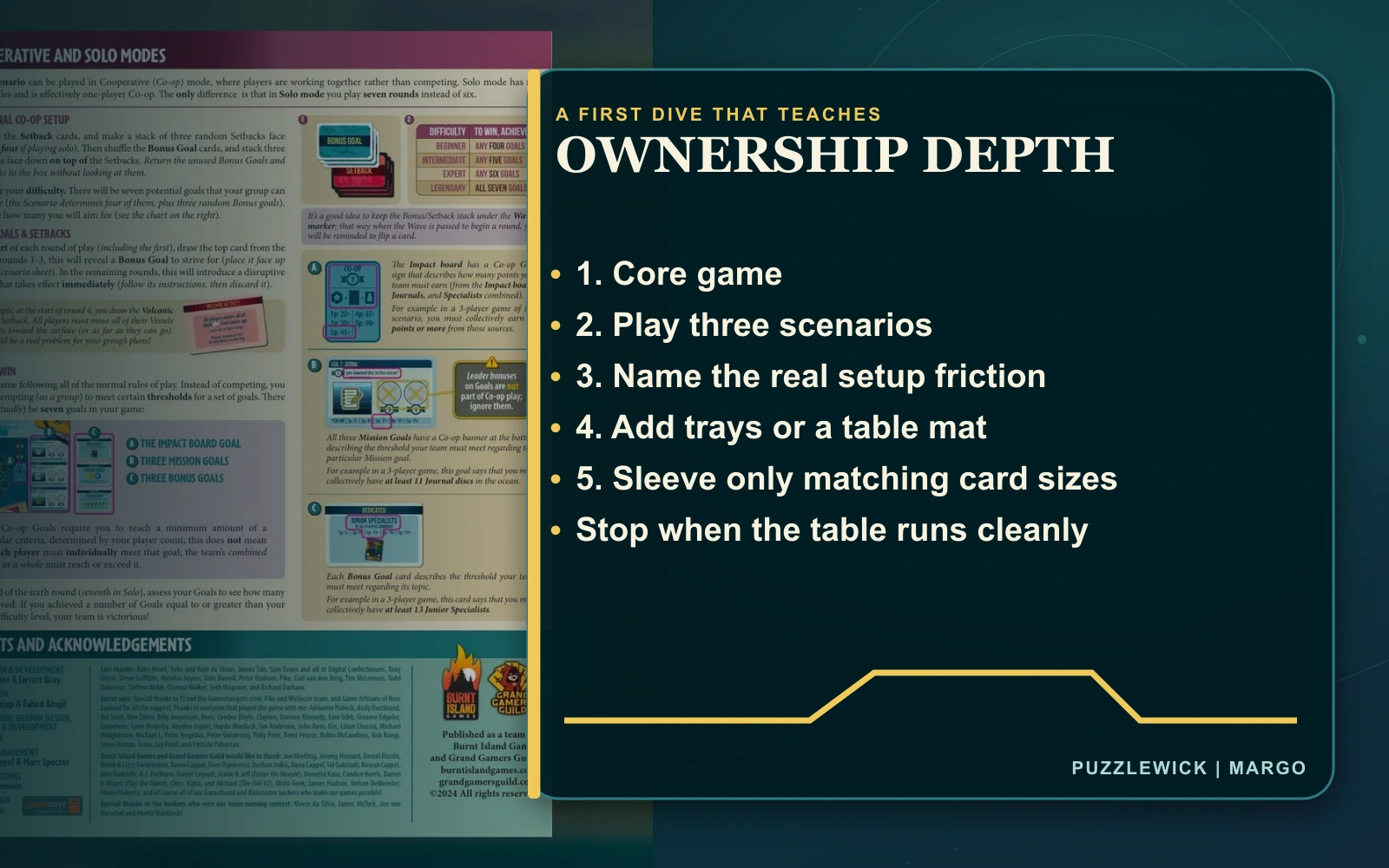
The core box comes first. A large stitched table mat can improve card and token handling. Removable token trays help when the shared pieces slow setup. Sleeve only after checking the official card inventory and exact sizes; an organizer should preserve setup order rather than merely replacing bags with more expensive shapes.
Stop after the base game until you know which friction is real. The ocean is already deep. It does not require a shopping cart to prove it.
What experienced tables keep reporting
Recurring owner patterns, synthesized in Puzzlewick's words. Follow each evidence trail to read the original discussion.
“fun, but it was never “wow”.”
The solo and cooperative systems deserve evaluation as real modes, including their goal pressure and planning demands.
The picks
Some links below are affiliate links — as an Amazon Associate, Puzzlewick earns from qualifying purchases, at no extra cost to you. It never changes a pick.
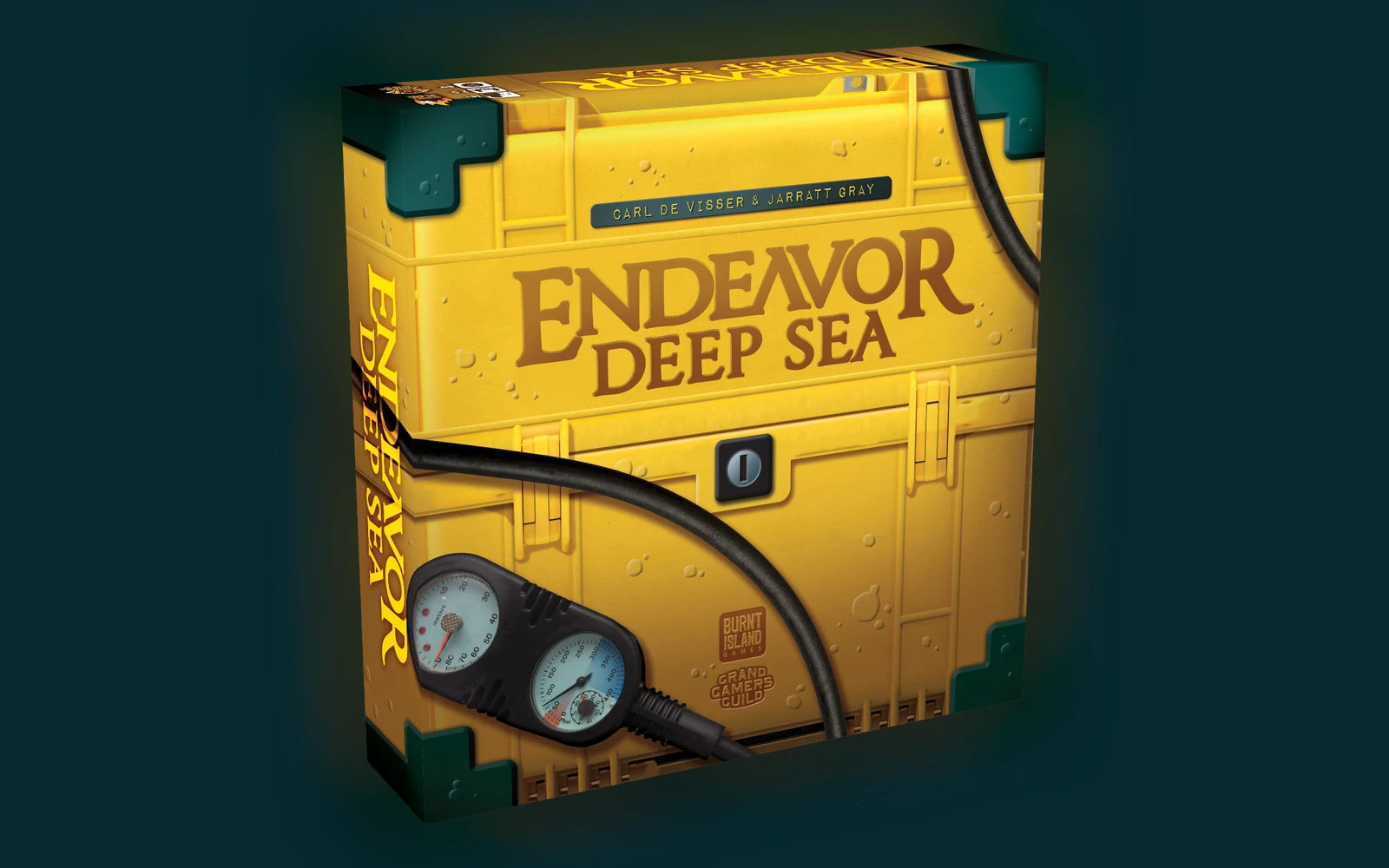
Endeavor: Deep Sea
The complete core experience and the only sensible first purchase.
- Competitive, cooperative and solo
- Ten scenario missions
- Subdued opening rounds
- Limited direct conflict
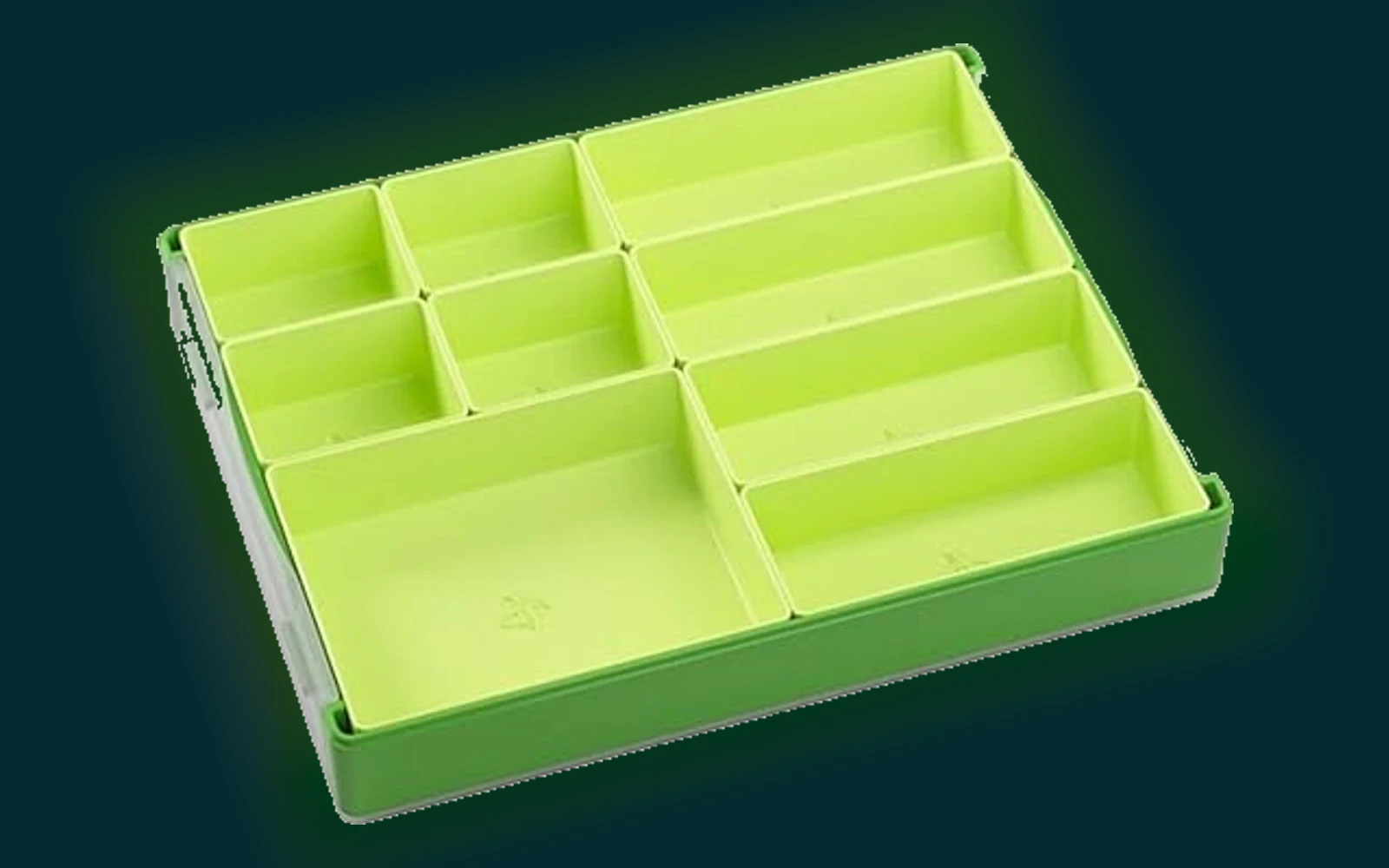
Gamegenic Token Silo Convertible
Removable trays can shorten setup and place shared resources where everyone reaches them.
- Nine removable trays
- Reusable across games
- Adds another box
- Unnecessary when the insert already feels fast

Luck Lab Folding Token Trays, six pack
Folding bowls keep discs from wandering without consuming permanent shelf volume.
- Compact storage
- Colorful separation
- Less stable than rigid trays
- Not a custom insert
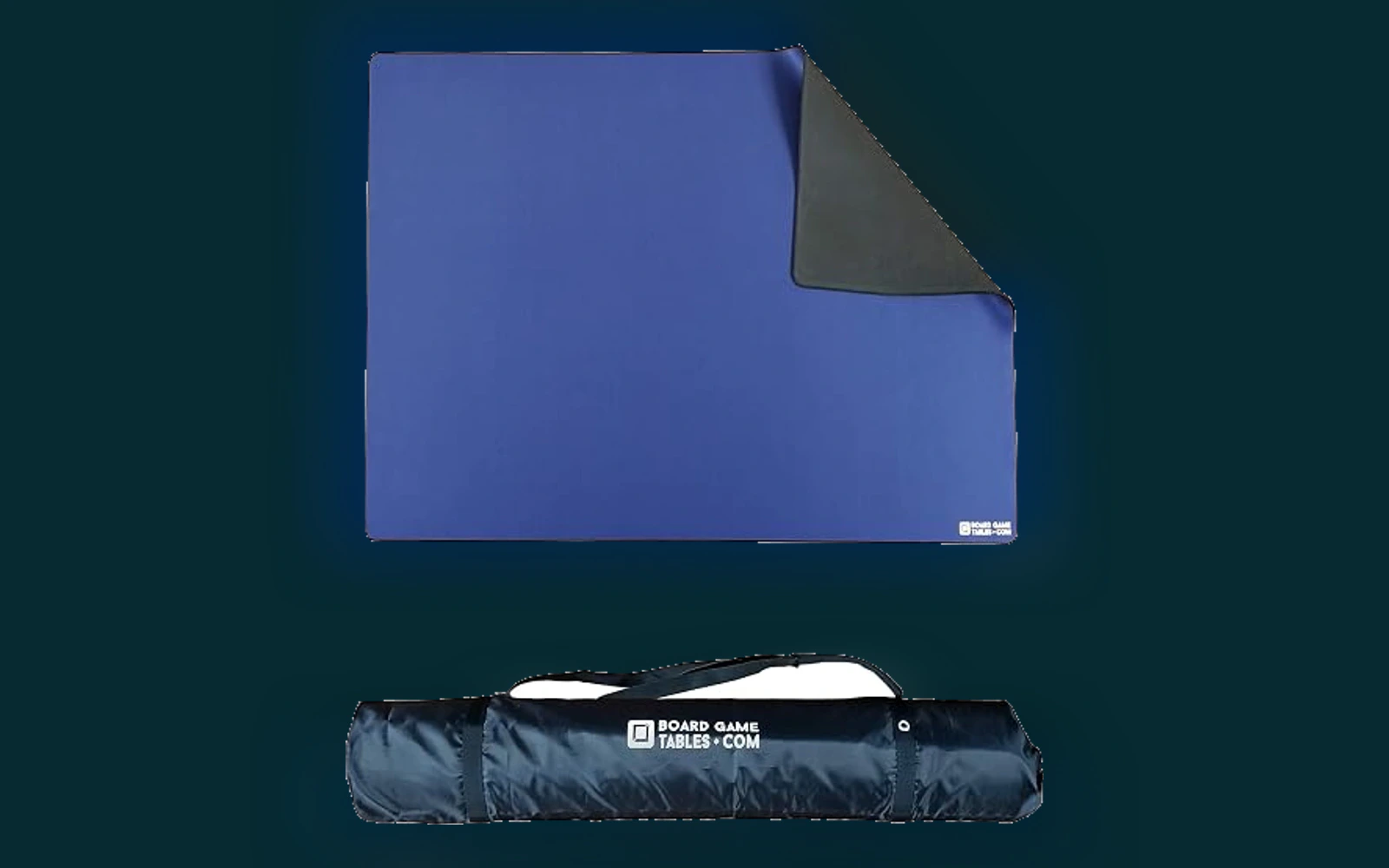
Allplay 3.5 by 5.5 Foot Board Game Playmat
A stitched cushioned surface improves pickup and protects the table, provided the real table is large enough.
- Large play area
- Water-resistant stitched surface
- Requires storage
- Measure before buying
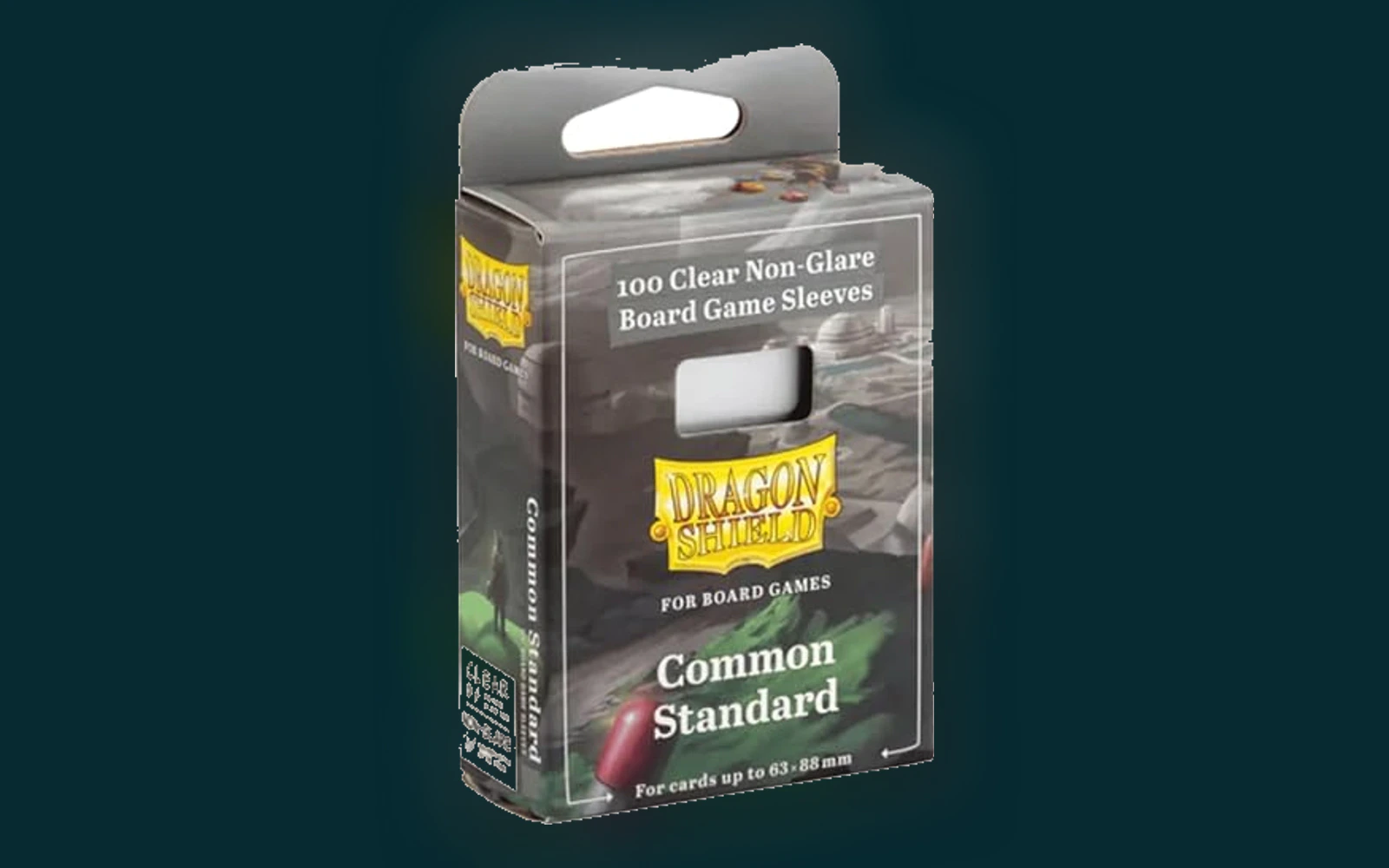
Dragon Shield Non-Glare Board Game Sleeves
A premium sleeve family for frequently handled cards. Match dimensions before quantity.
- Non-glare handling
- Established maker
- Multiple sizes may be needed
- Sleeves add box bulk
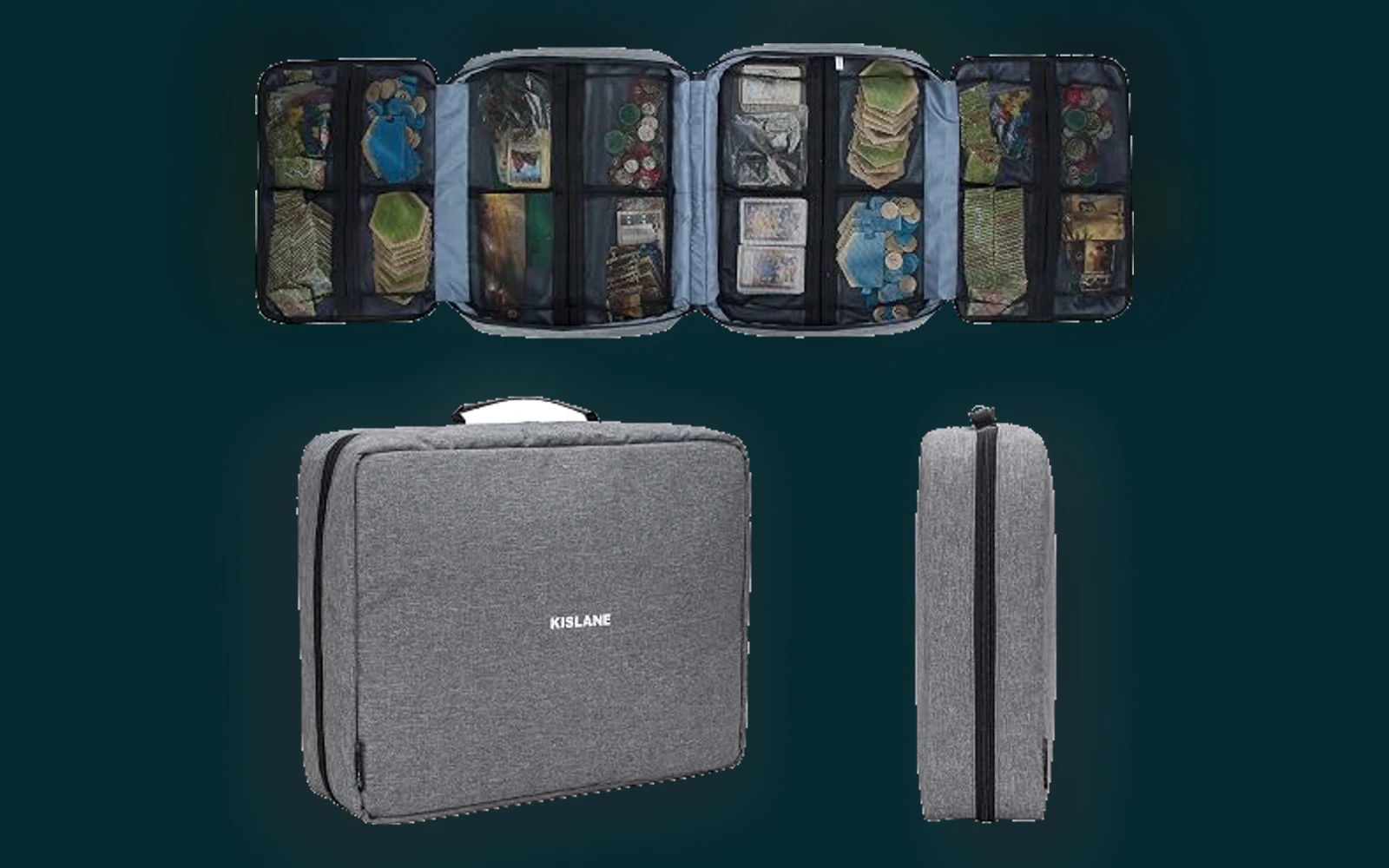
KISLANE Board Game Carrying Case
Useful only after confirming the base box and any organizer fit the bag.
- Purpose-built pockets
- Protects during transport
- Home-only copies do not need it
- Fit must be measured
At a glance
| Mode | Players | Pressure | First setting |
|---|---|---|---|
| Competitive | 2 to 4 | Shared map, sites and goals | Mission 1 |
| Cooperative | 2 to 4 | Bonus goals and setbacks | Beginner, any four goals |
| Solo | 1 | Seven-round capacity puzzle | Mission 1 |
Free download — Endeavor Deep Sea first-dive field card
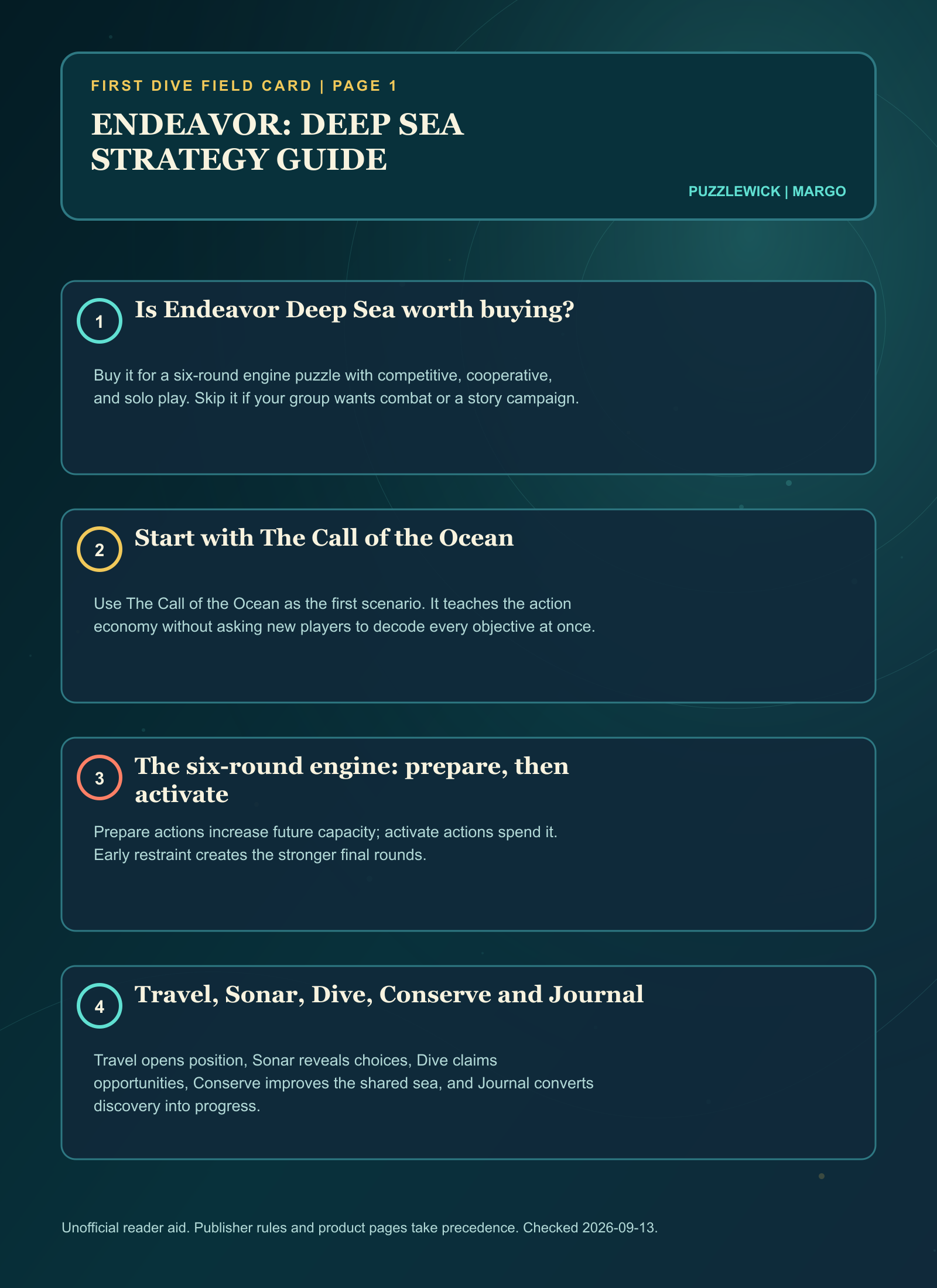
An unofficial two-page round sequence, five-action map, attribute diagnostic, mode ladder and scoring reminder. Official rules take precedence.
Unofficial fan-made reference. Compiled by Puzzlewick from the sources listed on the sheet. Not affiliated with or endorsed by the publisher — always defer to the official rulebook.
Questions, answered
How many rounds is Endeavor Deep Sea?
The official rules specify six rounds for multiplayer and seven for solo.
Can Endeavor Deep Sea be played cooperatively?
Yes. All scenarios support competitive, cooperative and solo play, with cooperative bonus goals and setbacks.
What scenario should beginners play first?
The publisher rulebook directs first-time players to Mission 1, The Call of the Ocean.
What are the five actions?
Travel, Sonar, Dive, Conserve and Journal.
Is Endeavor Deep Sea highly interactive?
Interaction is mainly positional through the shared map, sites and timing. Players seeking direct attacks may find it restrained.
Margo's verdict
Endeavor: Deep Sea is a superb fit for players who want an approachable action engine with scenario variety and flexible modes. Its opening can feel restrained and interaction is mostly positional. The reward is a clean arc from limited capacity to an organization that can finally reach the interesting water.
Buy the core game. Play three scenarios. Upgrade only the setup or handling friction you can name.
Research ledger 10 sources · reviewed 2026-09-13
Specifications, rules, current product information, community experience, and contrary evidence were checked against the sources below. Commercial links are kept separate from editorial evidence.
- Burnt Island Games: Endeavor Deep Seaburntislandgames.com/endeavordeepsea
- Endeavor Deep Sea official rulebookburntislandgames.com/_files/ugd/69e02c_0ddb009651864556b89ed5ffb6ff5000.pdf
- Spiel des Jahres: Endeavor Die Tiefseespiel-des-jahres.de/spiele/endeavor-die-tiefsee
- BoardGameGeek: Endeavor Deep Seaboardgamegeek.com/boardgame/367966/endeavor-deep-sea
- Meeple Mountain: Endeavor Deep Sea reviewmeeplemountain.com/reviews/endeavor-deep-sea
- Coopgestalt: solo and cooperative reviewcoopgestalt.com/2024/10/10/endeavor-deep-sea-a-review-of-the-solo-and-cooperative-modes
- Grand Gamers Guild: Endeavor Deep Seagrandgamersguild.com/products/endeavor-deep-sea
- TCGplayer public best-seller endpointmp-search-api.tcgplayer.com/v1/search/bestsellers?shippingCountry=US&productLineAffinity=
- BoardGameGeek Hotnessboardgamegeek.com/hotness
- Puzzlewick research methodpuzzlewick.com/methodology
Let me check that before we say it.

Keep exploring
The next smart rabbit holes.
⌁ Universe HubEndeavor: Deep Sea: the whole buying pathEndeavor: Deep Sea turns five actions and four attributes into a changing ocean map. The hub starts with the first six-round dive,...✦ Topic PathBoard Game Buying Guides: compare the whole shelfStart with the decision, not the shelf. These guides compare the games, editions, expansions, player counts, and costs people...Deep DiveSETI: Search for Extraterrestrial Intelligence — The Deep-Dive ReviewCzech Games Edition's 2024 heavyweight turned a radio-telescope daydream into the most-awarded euro of its year. Here is what the record...