Kingdom Death: Monster 1.6 Review — Is the $444 Grail Worth It in 2026?
The blunt buyer's verdict on Kingdom Death: Monster 1.6: what the $444 core box actually gives you, who should buy it, who should walk away, and which expansions deserve attention only after the dark has proven you belong.


AI-assisted research and drafting in Dax’s voice · reviewed by Robert Pruitt · how this guide was made
Last editorial refresh: 2026-06-27 Gold-standard QA: 2026-07-17 8 sources reviewed Affiliate links checked during gold-standard pass

The short answer
Kingdom Death: Monster 1.6 is worth the $444 core-game price in 2026 only if you want a long, brutal, hobby-heavy campaign and can commit to repeated sessions. The official 1.6 core box is a 21 lb cooperative nightmare campaign for 1-4 players with a 30 lantern-year arc, 8 monsters, 40+ story events, 150+ gear cards, unassembled miniatures, and the Legendary Card Pack updates folded in. It is a terrible impulse buy, a poor casual gift, and a bad fit for anyone who dislikes adult body-horror, assembly, randomness, or permanent survivor death. For the right table, though, it is a true grail: a complete, self-contained campaign cathedral whose cost-per-session becomes sane if you actually play it. Buy the core first, skip every expansion until you finish or crave a second campaign spine, and try Kingdom Death: Simulator or a Tabletop Simulator prologue before paying.
Decision map
Choose in thirty seconds
the only KDM purchase a new buyer should make first
Let us put the price on the table before the fog machine starts: Kingdom Death: Monster 1.6 is currently listed by the official Kingdom Death store at $444 USD for the core game, before taxes, VAT, import fees, and shipping. That is not a board-game purchase. That is a small appliance with teeth.
So this review is not here to whisper that every expensive thing is secretly worth it if you love the hobby enough. Some grails are monuments. Some are traps with nicer box art. KDM is both, depending on the buyer.
I wrote this for the exact person hovering over the checkout button, trying to decide whether the legend is real or whether the internet has just talked itself into a very expensive pile of grey plastic. The answer is sharper than the hype: the core game is the buy, the expansions can wait, and the only purchase that makes sense is the one attached to a real table, real time, and a real appetite for bleak campaign stories.
Start here, then go deeper
You are in the right cabinet.
 ☾ Universe HubKingdom Death: Monster: the whole buying pathKingdom Death: Monster is the hardest purchase in this hobby to get right — not because the game is obscure, but because the...
 ♛ Topic PathGrail Board Games: compare the whole shelfA grail earns its space only when the experience survives the price, setup, storage, and group commitment. These are expensive-game...
 MasterclassKingdom Death: MonsterThe complete 2026 initiation into the most beautiful, most brutal game in the hobby — from your first naked survivor on the Plain of...
The verdict first: who should actually buy Kingdom Death: Monster 1.6?

Buy KDM 1.6 if you want a campaign game that is also a miniature hobby, a horror story engine, and a long-term table ritual. The official store describes the core box as a cooperative game for up to 4 players where survivors eke out an existence in overwhelming darkness, with the story unfolding over many nights or ending quickly in bitter defeat. That is the honest product pitch. This is not a clean euro with a gothic skin. It is a campaign about bad odds, permanent scars, strange rewards, and a settlement that becomes the true protagonist.
Do not buy it because it is famous. Do not buy it because your shelf needs a crown. Do not buy it as a surprise gift unless you already know the recipient likes adult horror, assembly, minis, and punishing campaign randomness. The mature 17+ aesthetic is not a footnote; it is part of the object's identity. The unassembled plastic is not a footnote either; the hobby side is real.
My rule is simple: if you can promise ten sessions, buy the core. If you can only imagine one dramatic unboxing and a maybe-someday campaign, walk away. A $444 game you play twenty times is cheaper than a night at the movies per person. A $444 game that never leaves the box is a stylish mistake.
Promise ten sessions before you buy. If you cannot promise five, you are not buying a game — you are buying a myth for your shelf.
What do you actually get for $444?
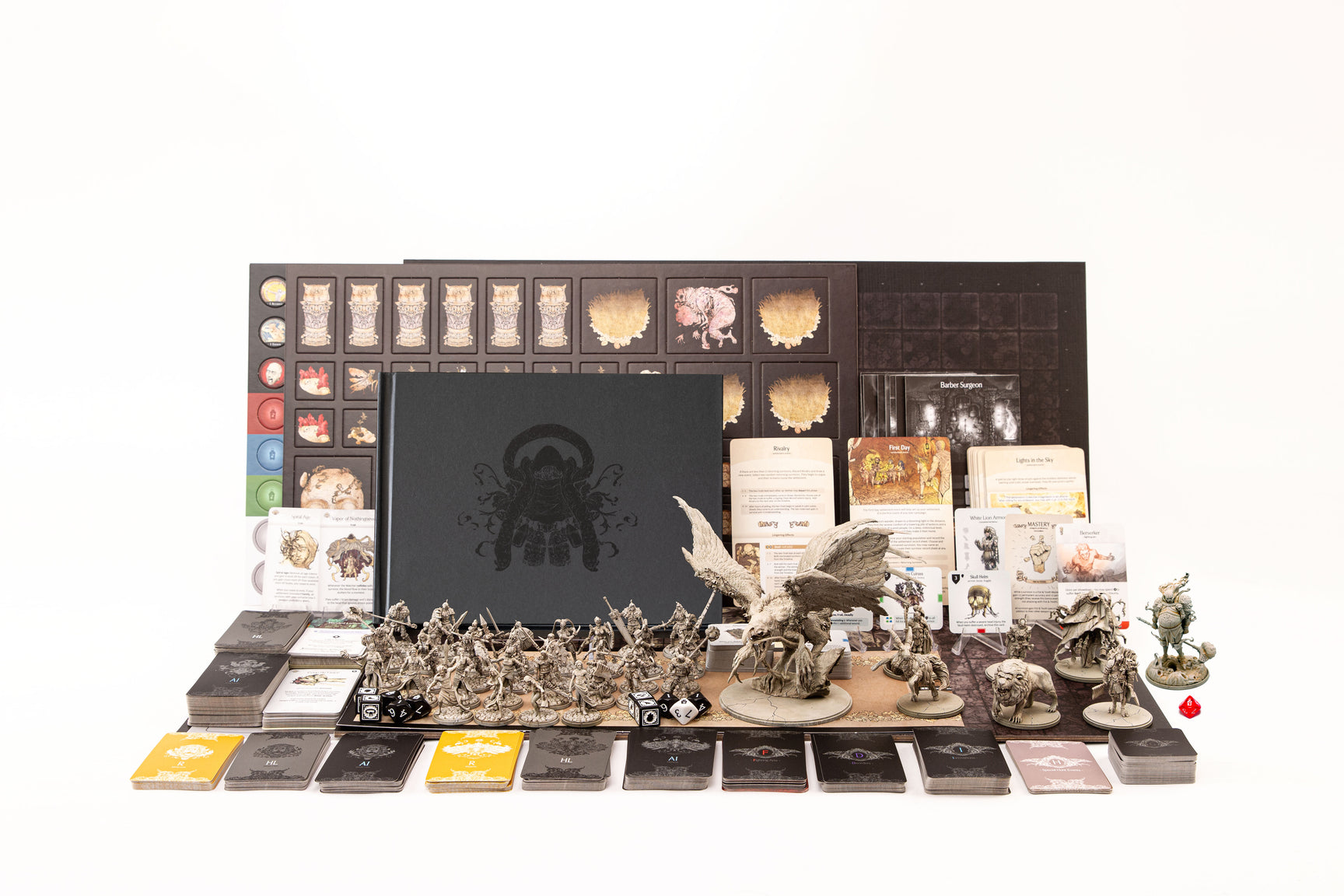


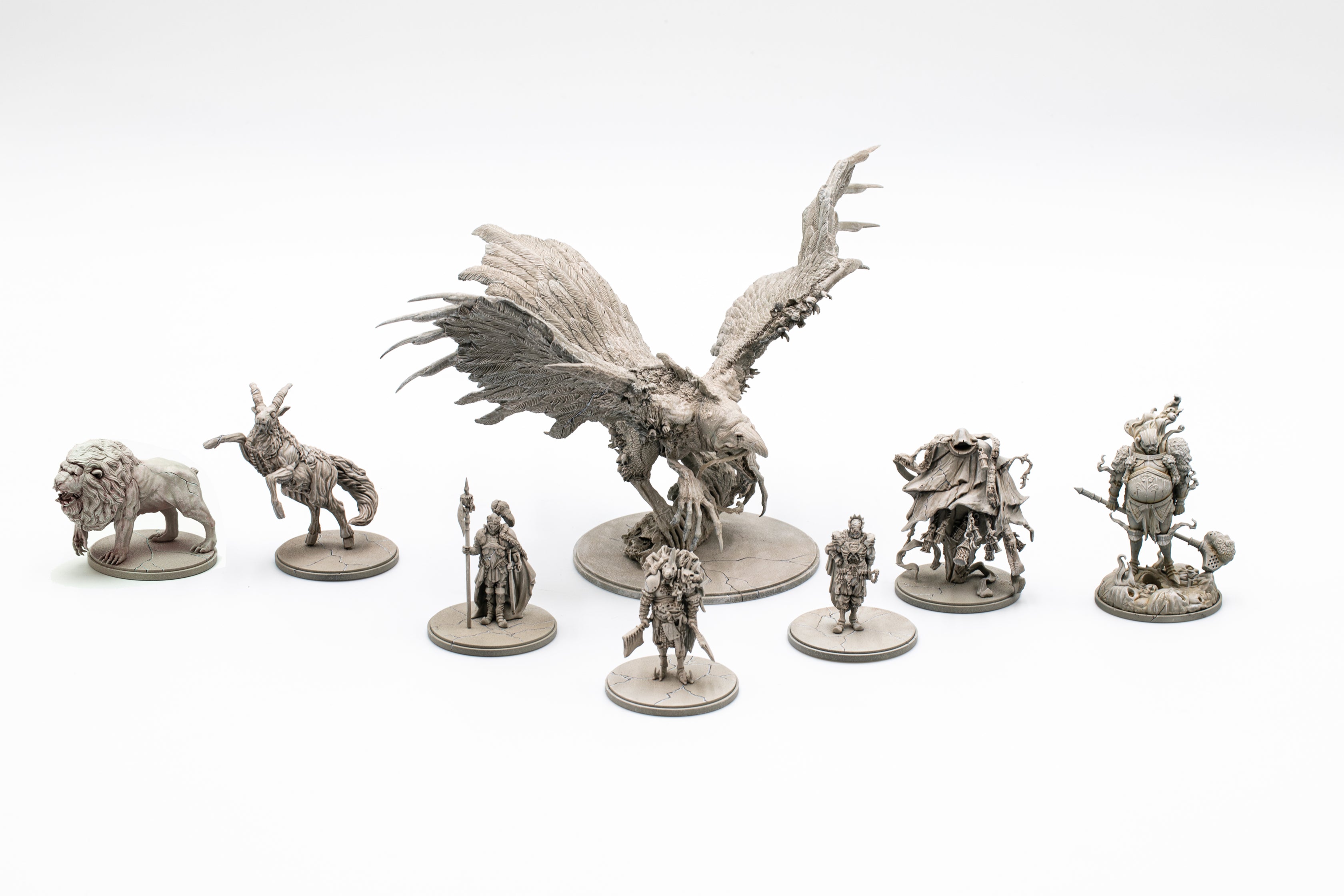
The official product data is the strongest argument for the price. The core box is described as 21 lbs of nightmare horror gaming and includes a 30 lantern-year campaign, 8 monsters with rising levels of difficulty, 40+ story events, gear-building from monster resources, and the updates from the Legendary Card Pack. In practical table terms, that means one self-contained campaign with enough narrative branches, AI decks, hit locations, settlement events, gear cards, and monster encounters to occupy a group for months.
That matters because the KDM core is not a starter in the modern monetized sense. It is not a $60 sample that quietly expects six paid expansions before the real game arrives. You can buy the 1.6 core, play the People of the Lantern campaign, learn the White Lion, Butcher, King's Man, Phoenix, and the rest of the horror ladder, and never buy another box.
The physical value is stranger. The cards and board systems are only half of it. You are also buying unassembled miniatures, a grim sculptural language, and a hobby backlog. That can be magical if you like clippers, plastic cement, and painting videos at midnight. It can be miserable if you wanted ready-to-play plastic. The box is generous, but it is not effortless.
The KDM core is not a starter. It is the cathedral. Expansions are side chapels you visit after you know you like worshipping in the dark.
How does it play, and why does it feel different from Gloomhaven or Frosthaven?
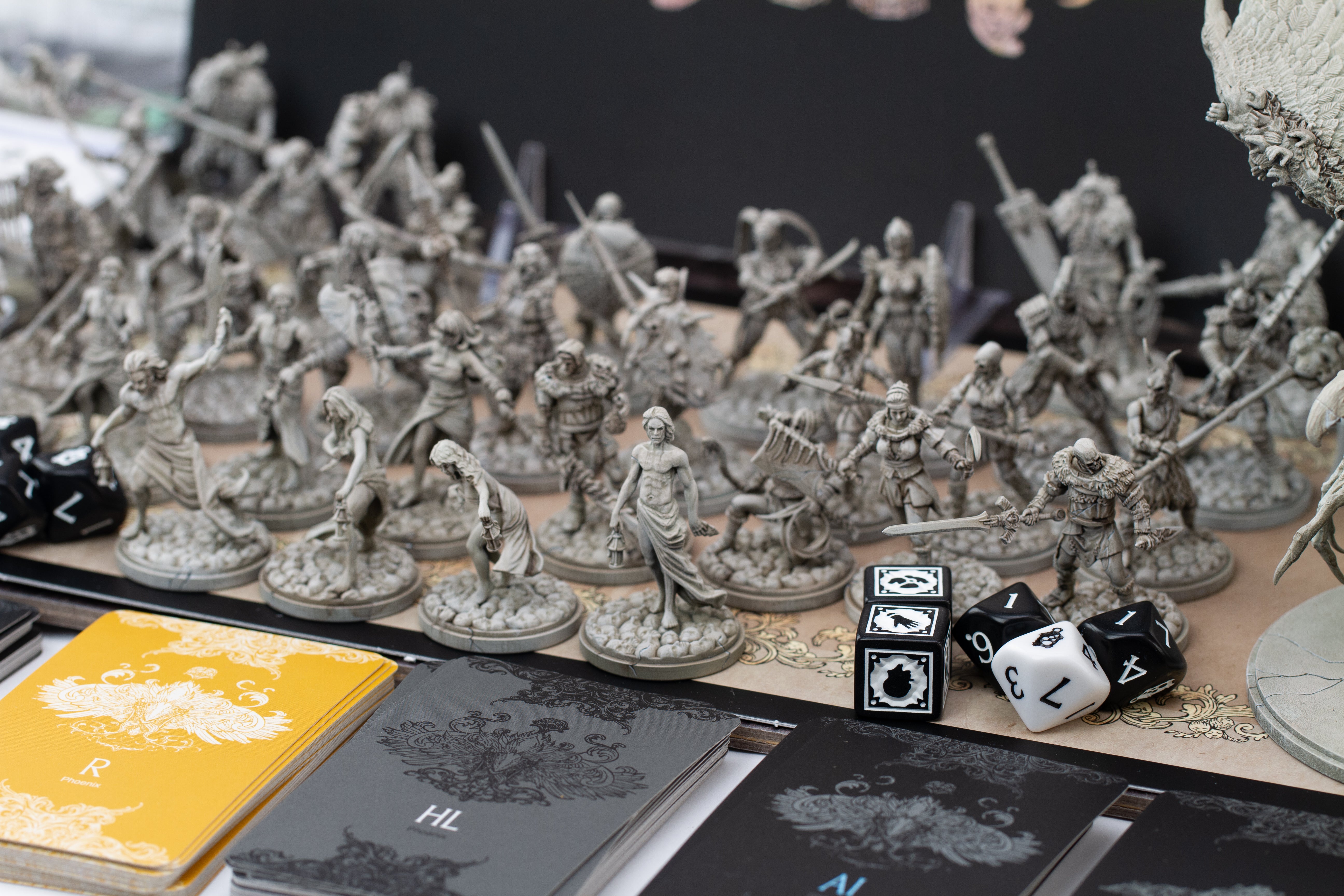
KDM is often grouped with huge campaign games, but it does not feel like Gloomhaven, Frosthaven, or Oathsworn. It is less about hand-management puzzles and more about survival procedure. A lantern year moves through settlement choices, hunt events, and a tactical showdown. The monster is not controlled by a player; its AI deck and hit-location deck make each fight a semi-readable predator puzzle.
That is the genius and the cruelty. You can learn a monster. You can position around its blind spot, infer the risk of specific reactions, and build gear grids that make your survivor suddenly dangerous. Then the deck coughs up something awful and a beloved named survivor loses an arm, a head, or the future you had imagined for them. The game is not fair in the eurogame sense. It is fair in the horror-story sense: the rules are consistent, the world is hostile, and survival was never promised.
Compared with Gloomhaven, KDM is more emergent and less scenario-scripted. Compared with Frosthaven, it is less polished as a tactical system but more singular as an experience. Compared with a boss-battler like Cthulhu: Death May Die, it is far slower and far more consequential. The closest honest description is this: a campaign roguelike settlement sim wearing boutique miniature armor.
- Play the First Story prologue before reading deep strategy.
- Name all four survivors immediately so the table cares when the dice get cruel.
- Use four survivors even when playing solo; the system expects a small party.
- Resolve rules slowly and consistently rather than rushing the first hunt.
- Photograph the settlement and gear grids at session end so you can resume cleanly.
- Treat the settlement as the main character; individual survivors are brilliant, temporary candles.
KDM is not fair in the eurogame sense. It is fair in the horror-story sense: the rules are consistent, the world is hostile, and survival was never promised.
The four buyer profiles: collector, campaign table, solo player, and casual group
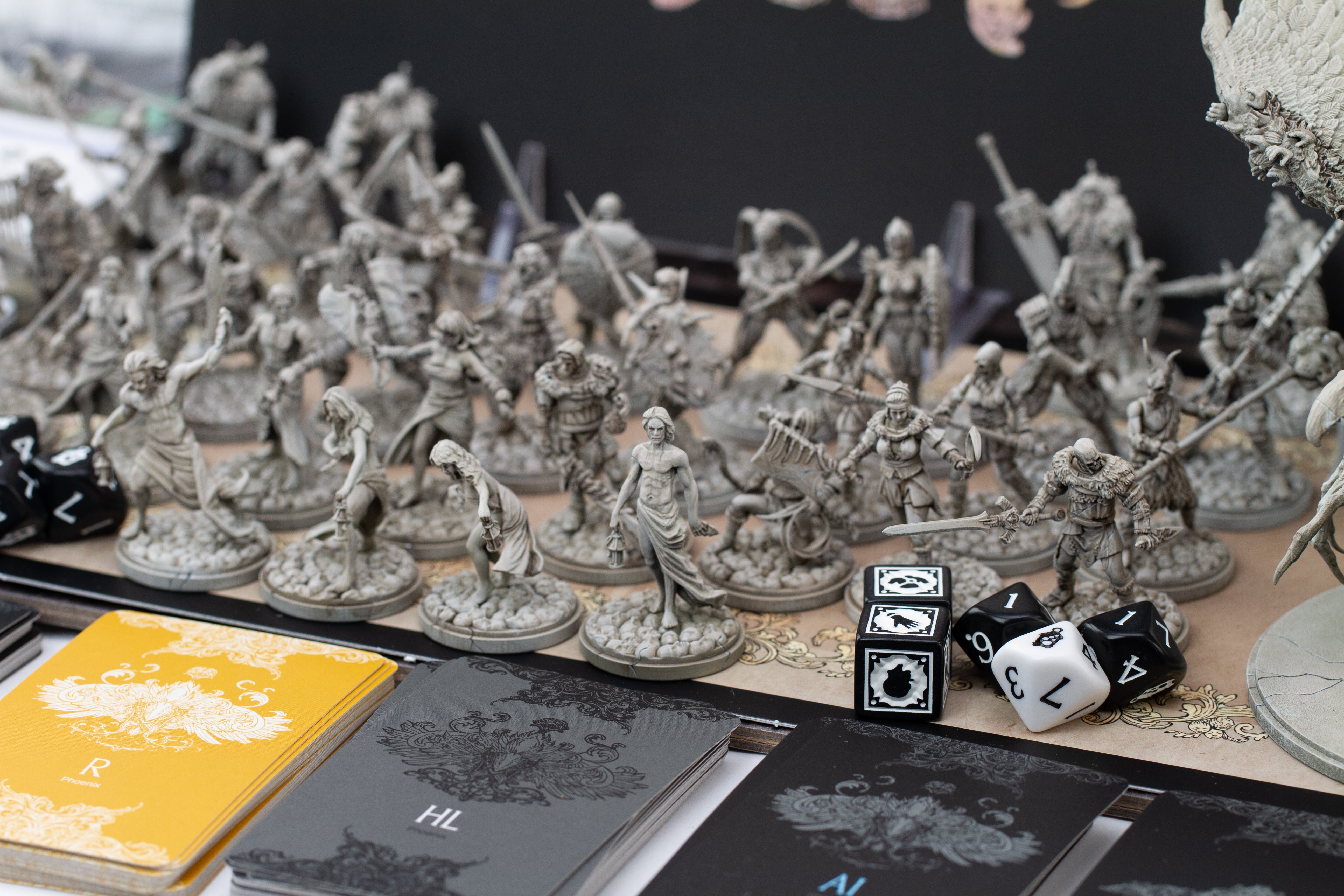


The collector should buy if the object itself matters: the huge black box, the sculptural miniatures, the adult-horror art direction, the sense of owning one of the hobby's strangest monuments. For that buyer, the price is part of the ritual. Still, buy the core first. A shelf full of expansions for a game you have not played is not collecting. It is panic with invoices.
The campaign table is the best buyer. Four people who like dark stories, can meet regularly, and enjoy shared failure will get the most value. The game creates table folklore. Someone will remember the settlement's first child, the first lucky crit, the death nobody saw coming. That is where the $444 earns back its soul.
The solo player can absolutely buy it, with one caveat: you must enjoy admin. Solo KDM is rich because you control all survivors and can savor the settlement system, but it asks you to manage the whole campaign brain yourself. If bookkeeping soothes you, welcome home. If bookkeeping drains you, use Simulator first.
The casual group should not buy it. I am being kind by being blunt. If your table wants a two-hour banger, buy Cthulhu: Death May Die. If they want campaign tactics with cleaner onboarding, buy Jaws of the Lion or Gloomhaven 2E. If they want a social event, buy Twilight Imperium and snacks. KDM is not a universal recommendation; it is a precision tool with a gorgeous blade.
A shelf full of expansions for a game you have not played is not collecting. It is panic with invoices.
Expansion buying order: Gorm, Sunstalker, Gambler's Chest, or nothing?
Here is the expansion advice that saves the most money: buy nothing extra with the core. Not one box. Not the one Reddit says is essential. Not the one with the miniature you love. The core game already has the campaign you need to decide whether KDM belongs in your life.
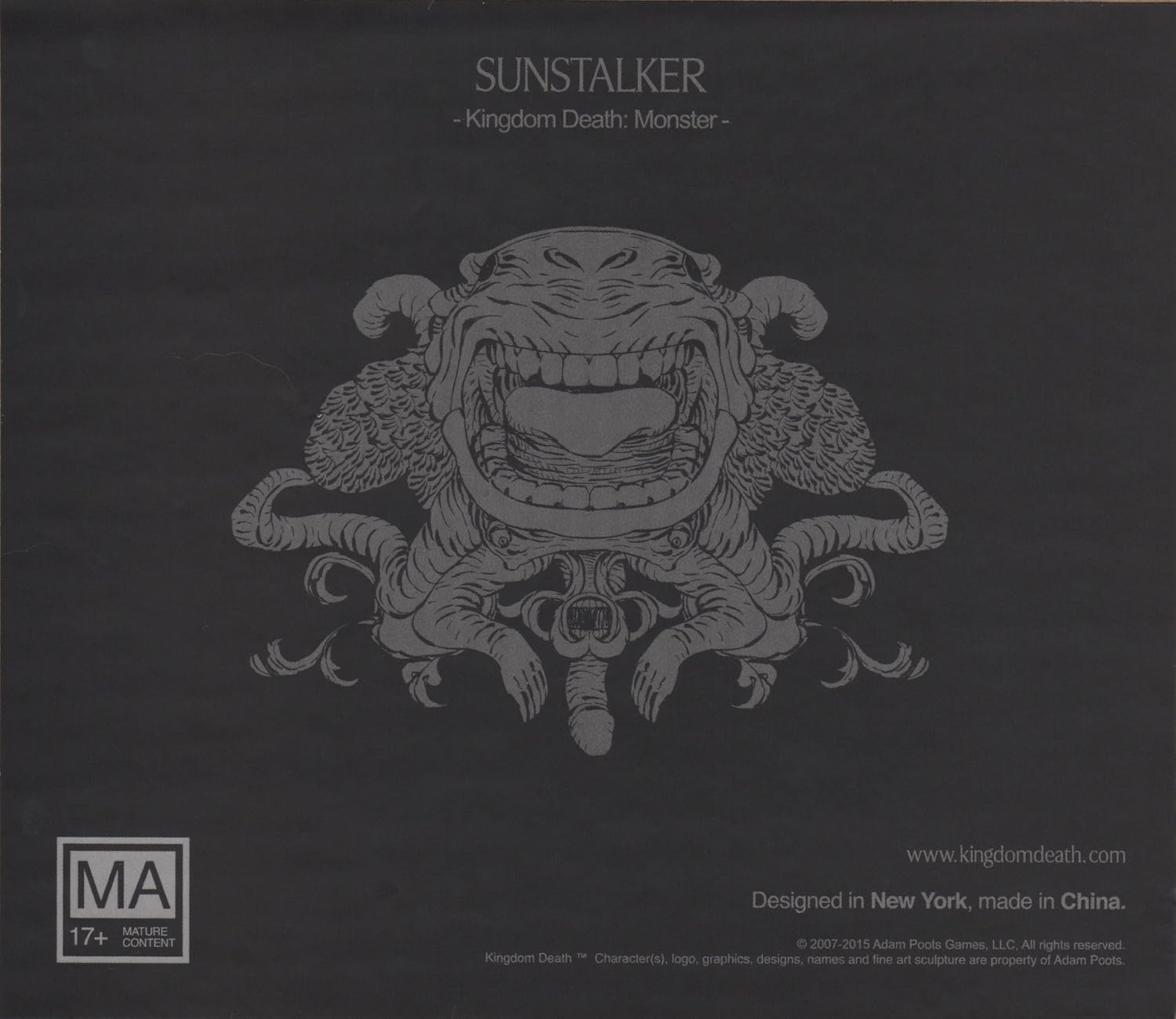
After you have real plays, the classic first expansion answer is usually Gorm because it changes the early campaign, adds a quarry that appears quickly, and gives veterans a new opening rhythm. Sunstalker is a more exotic later buy: beautiful, strange, and beloved, but not the first box I would hand to a new settlement. The Gambler's Chest is the modern mega-expansion temptation, with a huge campaign spine and a retail price that can rival another grail game entirely. It is not a beginner accessory. It is a second life for someone who already knows they want the dark to keep going.
The official store's expansion ecosystem is real, active, and frequently price-sensitive. The 2026 buyer should be patient. Buy the core, play enough to know your tolerance, then add one expansion because it solves a specific craving: fresher early game, stranger quarry, bigger campaign, more hobby sculpture. Buying expansions to cure uncertainty is backwards. Expansions are for hunger, not doubt.
Expansions are for hunger, not doubt. If you are still asking whether KDM is for you, the only correct expansion is none.
The honest flaws: mature art, randomness, setup, timelines, and table attrition

The flaws are not small, and anyone who hides them is not helping you.
First, the art direction is polarizing. KDM's body-horror and sexualized pin-up lineage are baked into the brand. Some players find it striking and cohesive; others find it exhausting or alienating. You do not argue someone into liking this aesthetic. You ask before bringing it to the table.
Second, the randomness is severe. KDM creates unforgettable moments because bad things can happen violently and permanently. That also means the game can feel cruel, swingy, and capricious. If you need tight competitive fairness, this is not your grail.
Third, the logistics bite. Assembly, storage, sleeves, campaign notes, table space, setup, teardown, rule lookups: all of it accumulates. The groups that finish are the groups that make the game easy to resume. The groups that fail often die in the box between sessions, not on the board.
Fourth, the wider product line has a reputation for long waits and elastic timelines. The core 1.6 box is retail-buyable, which is good. Future expansion dreams still deserve patience and skepticism.
That is the Dax bargain: I adore the thing, and I still want half of you to walk away. The right no is part of the review.
I adore the thing, and I still want half of you to walk away. The right no is part of the review.
Final buying plan: the smart 2026 path
If you are still here, here is the path I would give a friend.
Step one: watch a current teach or playthrough of the prologue. You need to see the settlement-hunt-showdown loop move before you spend.
Step two: try a digital taste if possible. The official store links Kingdom Death: Simulator, and a digital prologue is enough to tell you whether the combat texture intrigues or annoys you.
Step three: buy only the 1.6 core if the answer is still yes. The official store page is the cleanest source for current warehouse availability and price, but check tax/import exposure before checkout. International buyers can see a very different final number.
Step four: sleeve, organize, and schedule session two before session one. That sounds ridiculous until you have watched a campaign die after the prologue because the next date never arrived.
Step five: ignore expansions until the core has earned them. If the dark still has you after the first arc, Gorm is the practical first branch, Sunstalker is the dreamy strange branch, and Gambler's Chest is the 'I live here now' branch.
My final verdict: Kingdom Death: Monster 1.6 is a top-shelf grail, but not a universal recommendation. It is worth the money for the table that will return to it, the solo player who likes admin, and the collector who loves the object enough to play it. For everyone else, the smarter move is to admire it from the doorway and spend the $444 on a game that will actually hit the table.
- Watch a full prologue teach before buying.
- Try Kingdom Death: Simulator or a local/tabletop demo if you can.
- Buy only the 1.6 core game first.
- Add sleeves and storage immediately.
- Schedule the second session before the first one ends.
- Consider Gorm only after you know the core campaign is alive at your table.
The best KDM purchase is not the biggest one. It is the core box, opened by a table that already made plans to come back.
What experienced tables keep reporting
Recurring owner patterns, synthesized in Puzzlewick's words. Follow each evidence trail to read the original discussion.
The official store frames Monster as a cooperative game for up to 4 players whose campaign unfolds over many nights or ends quickly in bitter defeat.
BoardGameGeek's listing and forums consistently place Kingdom Death: Monster in the heavy, long-campaign, high-commitment end of the hobby.
The picks
Some links below are affiliate links — as an Amazon Associate, Puzzlewick earns from qualifying purchases, at no extra cost to you. It never changes a pick.
 5 photos
 Kingdom Death: Monster 1.6
- Players
- 1-4 · best 4
- Time
- 60-180 min
- Age
- 17+
- Complexity
- 4.2 / 5
- Publisher
- Kingdom Death · 2015
- Designer
- Adam Poots
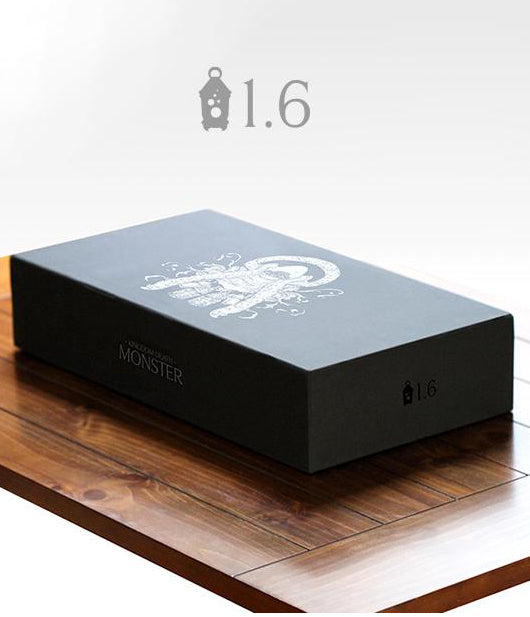
The complete core campaign and the only box to buy before you know whether the dark belongs at your table. Officially listed at $444, it is a 21 lb, 1-4 player, 30 lantern-year campaign with 8 monsters, 40+ story events, gear crafting, and Legendary Card Pack updates folded into 1.6. Expensive, brutal, adult, and self-contained.
- Complete core campaign; no expansion required
- Singular settlement + hunt + showdown loop
- Huge miniature and card presence
- Excellent cost-per-session if actually played
- $444 before tax, VAT, import duties, shipping, and storage supplies
- Mature body-horror and sexualized art are not for every table
- Assembly, storage, and campaign admin are real work
- Can feel cruel or swingy if you need tight fairness
At a glance
| Option | Approx. price | Best for | Buy now? |
|---|---|---|---|
| KDM 1.6 Core | $444 | First purchase, full campaign, true grail ownership | Yes, if you can commit to repeated sessions |
| Kingdom Death: Simulator | $20 | Trying the loop before the big spend | Yes, if uncertain |
| Gorm Expansion | $95 | Refreshing the early campaign after core plays | Only after core proves itself |
| Sunstalker Expansion | $135 | A stranger later branch for committed fans | Not as a first add-on |
| Gambler's Chest | Varies; premium mega-expansion tier | Players who already know KDM is a lifestyle game for them | No for beginners |
Questions, answered
Is Kingdom Death: Monster 1.6 worth $444?
Yes for committed campaign players, solo hobbyists who enjoy admin, and collectors who will actually play it. No for casual groups, surprise gifts, or anyone who wants short setup, family-safe tone, or predictable fairness.
Should I buy expansions with the KDM core game?
No. Buy the 1.6 core first and play enough to know you want more. Gorm is the practical first expansion after that; Sunstalker is a stranger later buy; Gambler's Chest is for confirmed fans, not beginners.
Can Kingdom Death: Monster be played solo?
Yes. Solo works because the monster runs on AI and hit-location decks, but you usually manage a full party of survivors and the settlement yourself. It is rich if you like admin and exhausting if you do not.
Is Kingdom Death: Monster appropriate for families?
Generally no. The product is marked 17+ and the brand includes graphic body-horror, mature themes, and sexualized sculptural art. Discuss tone and boundaries before bringing it to any table.
What should I buy instead of Kingdom Death: Monster?
For horror miniatures in one evening, consider Cthulhu: Death May Die. For campaign tactics with a cleaner on-ramp, start with Gloomhaven: Jaws of the Lion or Gloomhaven 2E. For a giant social event, Twilight Imperium is a better fit.
What is the current Kingdom Death: Monster 1.6 price?
The official Kingdom Death store listed the 1.6 core at $444 USD when this guide was built on June 27, 2026. Check the store before buying because stock, taxes, VAT, duties, and warehouse availability can change.
Dax's verdict
Kingdom Death: Monster 1.6 is one of the hobby's real grails, but it earns that word by being specific, not universal. The $444 core box is worth it when it becomes a recurring campaign: a 21 lb, 1-4 player nightmare settlement saga with 8 monsters, 40+ story events, gear crafting, brutal showdowns, miniatures, and enough strange table folklore to last for years. It is not worth it as a casual gift, a hype buy, a family-safe adventure, or a prestige object you secretly know you will not play. The smart 2026 path is core only, try-before-buy if possible, logistics kit immediately, expansions only after hunger replaces doubt. If your table will return to the lantern, buy it. If not, admire the myth and spend the money somewhere that will actually hit the table.
Research ledger 8 sources · reviewed 2026-07-17
Specifications, rules, current product information, community experience, and contrary evidence were checked against the sources below. Commercial links are kept separate from editorial evidence.
- shop.kingdomdeath.comshop.kingdomdeath.com/products/kingdom-death-monster-1-5
- shop.kingdomdeath.comshop.kingdomdeath.com/collections/kingdom-death-simulator/products/kingdom-death-simulator-1
- shop.kingdomdeath.comshop.kingdomdeath.com/products/gorm-expansion-1-6
- shop.kingdomdeath.comshop.kingdomdeath.com/products/sunstalker-expansion-1-6
- boardgamegeek.comboardgamegeek.com/boardgame/55690/kingdom-death-monster
- zatu.comzatu.com/blogs/reviews/kingdom-death-monster-second-opinion
- kingdomdeath.myshopify.comkingdomdeath.myshopify.com/products/kingdom-death-monster-1-5
- awakenrealms.comawakenrealms.com/games/tainted-grail-kings-of-ruin
I'll be honest with you — flattery is boring.


Keep exploring
The next smart rabbit holes.
☾ Universe HubKingdom Death: Monster: the whole buying pathKingdom Death: Monster is the hardest purchase in this hobby to get right — not because the game is obscure, but because the...♛ Topic PathGrail Board Games: compare the whole shelfA grail earns its space only when the experience survives the price, setup, storage, and group commitment. These are expensive-game...MasterclassKingdom Death: MonsterThe complete 2026 initiation into the most beautiful, most brutal game in the hobby — from your first naked survivor on the Plain of...