The Lord of the Rings: Fate of the Fellowship Guide: How to Play, Win Together and Start Confidently
Kenji explains the cooperative Middle-earth adventure from your first turn to Mount Doom: the rules that matter, the Hope you cannot waste, solo play, and equipment that fits the actual box.


AI-assisted research and drafting in Kenji’s voice · reviewed by Robert Pruitt · how this guide was made
Last editorial refresh: 2026-09-01 Gold-standard QA: 2026-09-01 10 sources reviewed Affiliate links checked during gold-standard pass

The short answer
Fate of the Fellowship is a complete cooperative board game for 1-5 players. Start with the base box and Introductory setup. In multiplayer, use four actions with one character and one with the other, then draw player cards and resolve the Shadow. Complete the objectives, preserve Hope and prepare Frodo's final Mount Doom search. Choose it for coordinated planning and repeatable tension, not for a quick filler or collectible deckbuilding.
Decision map
Choose in thirty seconds
The complete cooperative Middle-earth campaign in one box
Fast access to troops, Hope and shared tokens
Budget component control during searches and battles
Middle-earth has a military problem. Your much smaller problem is getting Frodo to the end of his journey with enough Hope left to finish it. Those are related jobs, but they are not the same job. Confusing them is how a beautifully defended map becomes a losing game.
This guide starts with whether the game belongs on your table, teaches the essential procedures, and then shows how they combine into useful decisions. Rules, strategic judgment and product compatibility are labelled separately. Read the first-game route now; return to the reference sections when a particular card raises an eyebrow.
Start here, then go deeper
You are in the right cabinet.
 ◬ Universe HubMiddle-earth: the whole buying pathMiddle-earth is a shelf of very different journeys: premium LEGO architecture, strategic war games, and collectible card worlds....
 ✦ Topic PathBoard Game Buying Guides: compare the whole shelfStart with the decision, not the shelf. These guides compare the games, editions, expansions, player counts, and costs people...ComparisonLOTR Fellowship vs Two Towers Trick-Taking: Which Box First, Solo Rules and Chapter StrategyKenji walks both cooperative campaigns in order: which box teaches better, how solo differs from group play, why Two Towers is harder,...
Is Fate of the Fellowship fun, and is it right for your group?
Choose it for a tense, shared planning puzzle in which a tiny expedition matters more than the biggest army. One player can reinforce a haven while another escorts Frodo through danger and a third sets up an objective. The pleasure is seeing those modest actions meet at the right moment. A heroic battle can be useful. A modest journey with the right companion can be decisive.
The cost of that richness is administration. You read routes, manage two characters, watch two decks and resolve dice. This is not a quick filler with familiar faces on the box. The publisher lists 1-5 players, ages 14+, and 60-150 minutes; a first teach deserves additional breathing room. My suggested first table is two or three willing planners, not five distracted people waiting for dinner.
- Excellent fit: cooperative planning, Tolkien's world, adjustable difficulty, repeatable scenarios and decisions with consequences.
- Think twice: you dislike dice, shared decision-making, long turns of discussion or managing an enemy system.
- For beginners: approachable with a patient teacher, but more involved than a basic introduction to Pandemic.
- For experienced players: the interesting problem is which threats to tolerate while completing the actual mission.
Its 2026 American Tabletop Award in Strategy Games is a meaningful external recommendation, not proof that every household will enjoy it. This is a research-led editorial guide; our virtual curators are not claiming physical playtests.
What you buy, what is included, and which Middle-earth game this is
The base box is the complete starting purchase. It includes the map, characters, enemy system, dice, tokens, objectives and a cardboard Barad-dur dice tower. You do not need a deck of collectible cards, a paid app or a second starter box. The publisher advertises 13 characters, 24 objectives and 14 events. Those are sources of replay variation, not a promise that every possible combination is equally suitable for a first game.
Read the subtitle before buying
- Fate of the Fellowship: this shared-map Pandemic System game, published by Z-Man Games.
- The Fellowship of the Ring: a separate cooperative trick-taking game. Cards and expansions are not interchangeable.
- The Lord of the Rings: The Card Game: a different deck-construction game and product ecosystem.
- Journeys in Middle-earth: another game with its own app, scenarios and fitted accessories.
- Magic's Middle-earth sets: Magic products, not additions to this box.
If a listing says insert, organizer, sleeve kit or compatible with, assume it is equipment until the description establishes otherwise. An attractive photograph of a filled organizer does not mean it includes the game. For other compact Tolkien card games, use our trick-taking guide.
The objective: finish the mission before Hope reaches zero
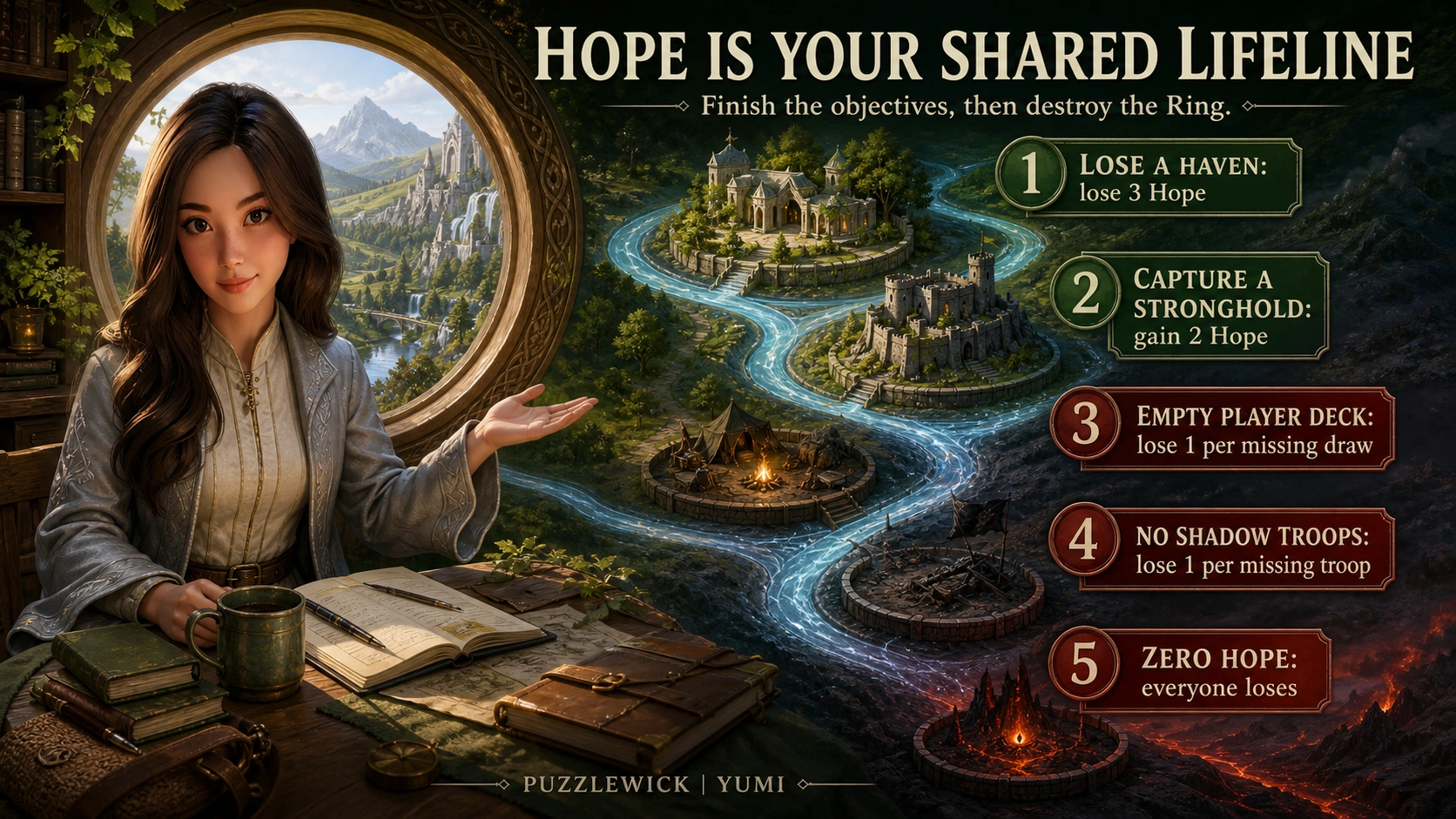
The team wins by completing its other objectives and then having Frodo destroy the One Ring at Mount Doom. The team loses immediately if Hope reaches zero. Battles, travel and resource preparation are means to that end. There is no separate military-victory prize for tidying every red troop off the board.
Hope can fall during searches, when a haven falls, when Skies Darken finds the Eye already watching Frodo, and when the game asks for player cards or Shadow troops that have run out. An empty supply is therefore dangerous, but not automatically a separate loss condition. Lose one Hope for each missing player-card draw or Shadow troop. Capturing a Shadow stronghold restores two Hope; some objectives and effects also restore it.
The first strategic question
Ask: what could cost us Hope before our next useful turn? A haven with Shadow troops and no friendly troops falls and costs three Hope. That may be more urgent than a distant army that looks alarming but cannot yet hurt you. Then ask which objective can move forward while you prevent that loss. Pure firefighting buys time; without objective progress, it merely buys an expensive funeral.
Rules: Z-Man Games rulebook, pp. 2, 19 (publisher PDF hosted by Nastol.io).
Set up your first game without accidentally choosing hard mode
Use the printed first-game setup and Introductory difficulty. Set the Hope and threat markers on their marked starting spaces, place the fixed troops and enemies exactly as shown, and use the setup draws to introduce the variable Shadow troops. Do not replace the printed map setup with a cinematic arrangement of your own. Sauron already has a very adequate planning department.
For the introductory game, use four Skies Darken cards and four objectives including Destroy the One Ring. Follow the rulebook's initial objective selection and character pairs. At two players, that pairs Frodo & Sam with Legolas for one player, and Merry & Pippin with Eowyn for the other. Each named pair printed on one card is one character, not two separate activations.
- Separate the decks. Region, Event and selected Skies Darken cards form the player deck; Shadow cards form their own deck.
- Use the player-count setup. Event selection and opening-hand size change. At two players, use six events and deal four player cards to each player before inserting Skies Darken into the prescribed piles.
- Do not shuffle all included Skies Darken cards into play. Difficulty specifies how many to use.
- Read every selected objective's setup instruction. It may change what begins on the map or in the supply.
- Lay out the four symbol types. Match their shapes and names before play, not only their colours.
- Keep both player references visible. One person can read Shadow resolution aloud while the active player moves the pieces.
The opening teach only needs the goal, the four-plus-one turn, Travel, Prepare and one search. Add battle detail when a battle is imminent. Nobody needs a lecture on all thirteen character abilities before taking one step.
Rules: Z-Man Games rulebook, pp. 4-8, 21 (publisher PDF hosted by Nastol.io).
How a turn works: four actions, one action, then the Shadow
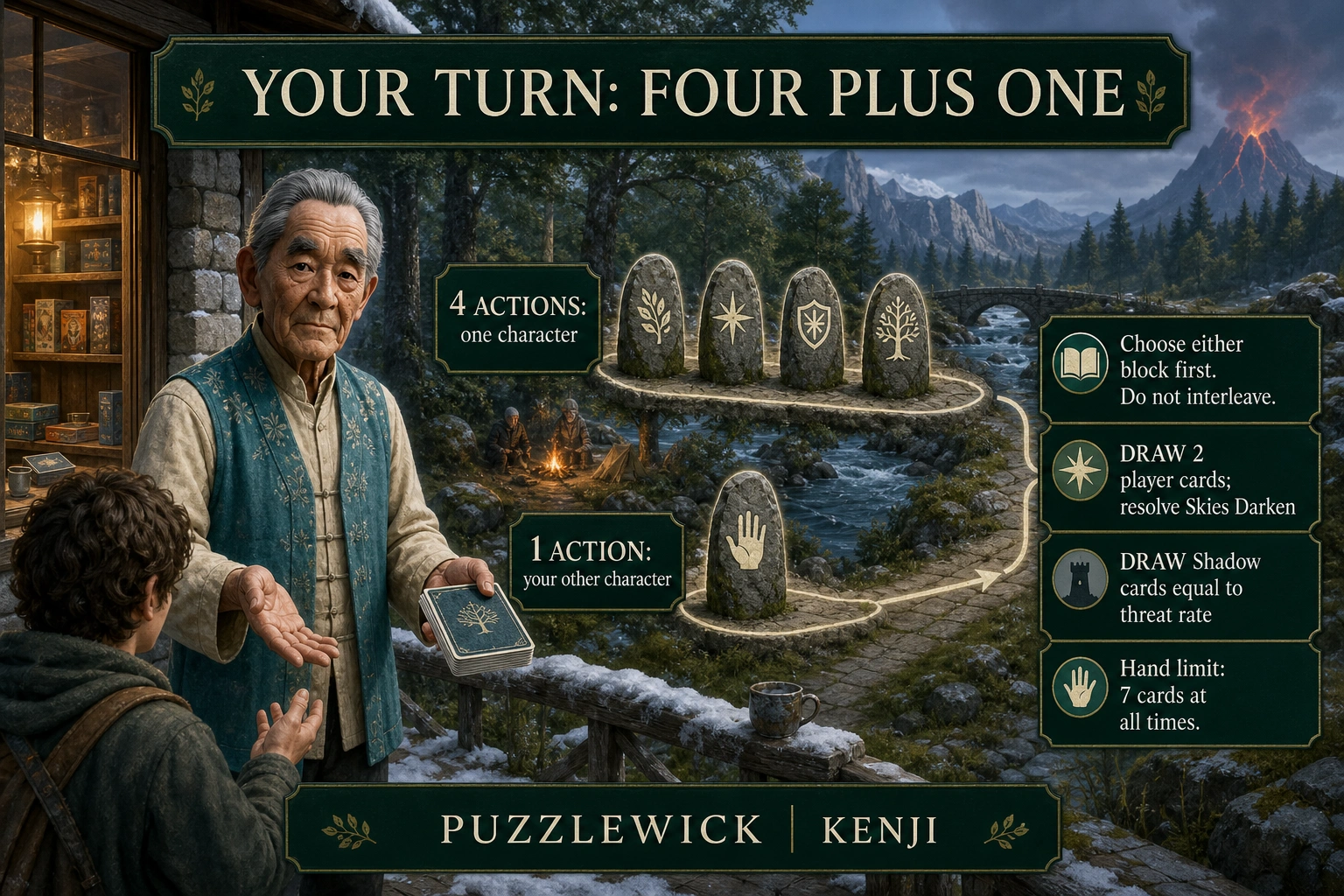
In multiplayer, take four actions with one of your characters and one with the other. You may take the single action before or after the four-action block. You may not put it in the middle. You can choose which character gets which block each turn; the solo game is different.
Then draw two player cards together. Resolve each Skies Darken completely before handling the other drawn cards or enforcing the hand limit. Finally, draw and resolve the number of Shadow cards shown by the current threat rate. Your hand limit is seven cards at all times, subject to the specified Skies Darken resolution timing. Keep cards face up: secrecy is not part of this cooperative puzzle.
A small sequencing example
Suppose your supporting character needs to join Frodo before a useful journey. Taking that character's single action first might establish the meeting. Frodo can then use the four-action block. Alternatively, the main character might prepare resources before the other character performs its one important action. The arrangement matters; the total of five is not five freely interchangeable actions.
On your first turns, place four ordinary counters beside the active character as a reminder and remove one per action, keeping the bonus action separate. This is an optional memory aid, not additional game equipment you need to purchase.
Rules: Z-Man Games rulebook, pp. 10, 15 (publisher PDF hosted by Nastol.io).
Travel, escorts and the difference between a location and a region
A Travel action moves the acting character to a connected location. Normal paths, special paths and battle lines can connect locations; characters may travel along battle lines in either direction. Special paths have their own symbol costs. A location is one named stop. A region is the larger area around several stops. That distinction controls searches.
A travelling character can bring friendly troops and other characters from the starting location, with the relevant players' consent. Troops do not wander around on their own. Shared journeys are an important way to save actions, but check who is present before moving everyone. You cannot pick up a companion from the next village by narrating enthusiastically.
Frodo pays for the danger even when somebody else gives him a lift
Whenever Frodo travels or is taken along, the current player must spend one Stealth or roll a search at Frodo's destination. This is additional to a special path's cost. Count one search die for each Nazgul in the region and each Shadow troop in the location, capped at seven. No threats means no dice for an ordinary search.
Example: two Nazgul in the destination region and one Shadow troop at the destination location mean three search dice. A Shadow troop somewhere else in that region does not add a die. Saving one Stealth for this journey avoids the search; spending it earlier on a harmless route may leave you paying with Hope later.
Rules: Z-Man Games rulebook, pp. 10-11 (publisher PDF hosted by Nastol.io).
Searches, Resistance and the Ring: how to manage risk
Search results can leave you unharmed, cost Hope or recall a Nazgul to Mordor. Weary loses one Hope. Exposed loses one Hope except when Frodo is at a haven, where that result is ignored. Recall returns a Nazgul from Frodo's region to Mordor unless Frodo is already in Mordor. Read the actual symbols on the reference card until their shapes are familiar.
Characters present at the search may spend Resistance to reroll dice, one Resistance per die. You may reroll a die again by spending again. Frodo & Sam also have their printed special abilities. Sam's Aid spends one Friendship for each Weary or Exposed result you ignore; that can make a symbol you thought was only for mustering valuable at the finish.
Putting on the Ring is a trade, not invisibility with no invoice
Before a search, Frodo can use the printed Ring ability to ignore local Shadow troops for that search. It costs one Hope and shifts the Eye to Frodo's region. It does not erase the Nazgul there. Compare the certain cost, the dice avoided and the danger of the Eye's new position. Never spend your last Hope expecting to rescue the situation after the roll.
There is no honest universal instruction to reroll every bad die. At high Hope, a small loss may be tolerable; close to defeat, a reroll or an eligible ability may be essential. Preserve resources for the actual risk ahead, not for an imaginary perfect final turn.
Rules: Z-Man Games rulebook, pp. 11 (publisher PDF hosted by Nastol.io).
Cards, tokens and Fellowship: make your hand work harder
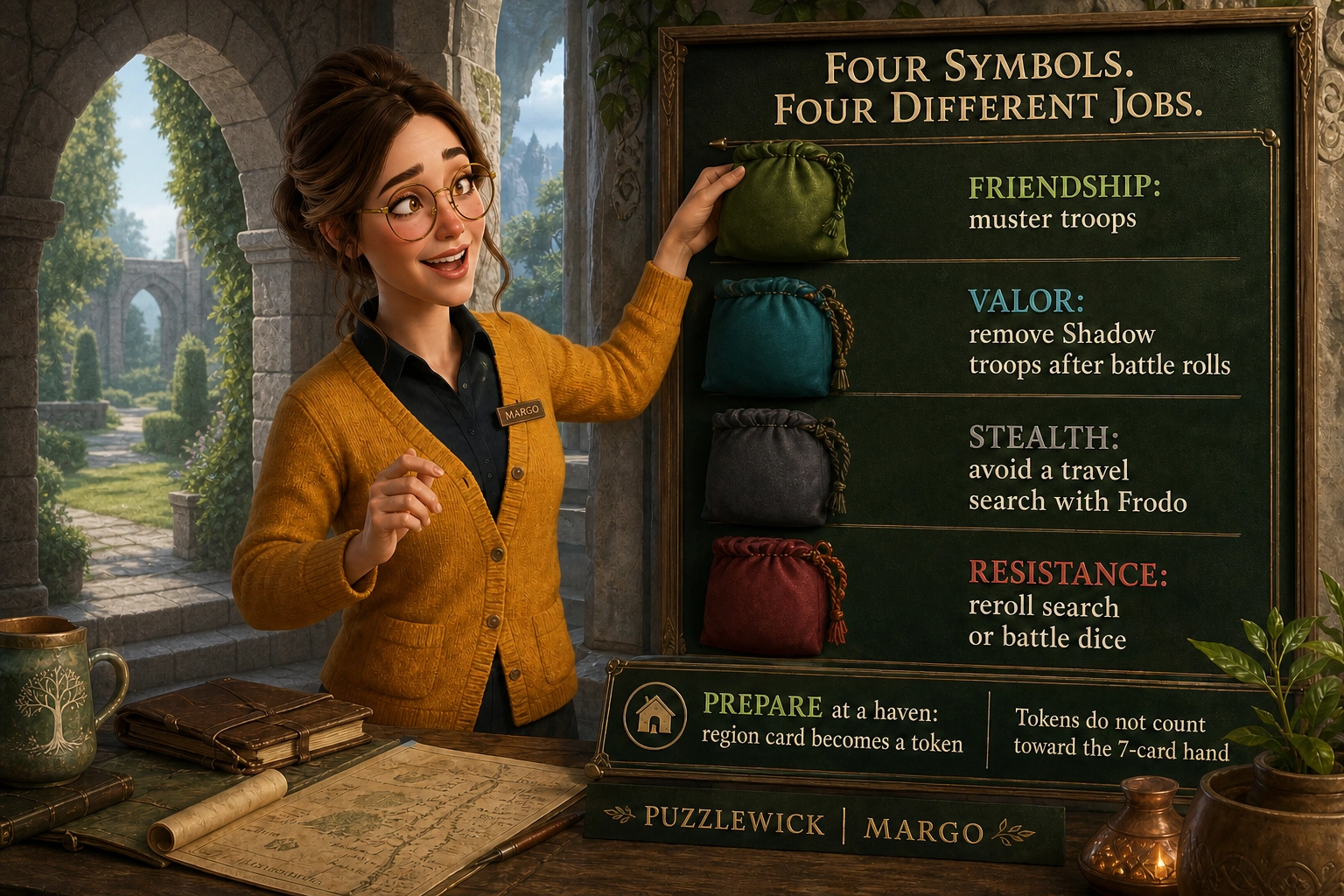
Region cards carry a symbol you can spend. The printed region is not a universal requirement that every card be spent there. Geography matters when an action or ability explicitly says it matters, especially Fellowship and the solo version of Prepare.
- Friendship
- Commonly pays to Muster a friendly troop. It also has character-specific uses such as Sam's Aid.
- Valor
- Can remove Shadow troops after a battle roll. Capture costs three Valor.
- Stealth
- Can avoid Frodo's travel search and pay relevant route or card costs.
- Resistance
- Can reroll search or battle dice and pays the five-symbol cost for Frodo's final attempt.
Prepare at a haven converts a discarded region card into its matching symbol token if one is available. Tokens do not count toward the seven-card hand. This is a way to store a useful resource, not generate one for free. In normal multiplayer, the card need not match the haven's region. Solo adds that restriction.
Fellowship lets co-located characters belonging to different players give or take a region card that matches their current region, with agreement. Tokens cannot be handed over through Fellowship. Before converting a card into a token, ask whether another player needs the transferable card. Tidying your hand can accidentally lock the right resource with the wrong owner.
A useful first combination: Elrond's Support and Sam's Aid
Frodo & Sam's card gives you an unusually clear resource lesson. Once per turn, when Frodo uses Prepare at a haven with a card matching that region, Elrond's Support also grants one available Friendship token. Sam's Aid can later spend Friendship to ignore Weary or Exposed search results, one Friendship per result. A quiet preparation turn can therefore protect a dangerous journey. The region match belongs to this ability; do not accidentally impose it on every multiplayer Prepare action.
Rules: Z-Man Games rulebook, pp. 9, 12 (publisher PDF hosted by Nastol.io).
Muster, Attack and Capture: three different decisions
Muster spends one Friendship at a suitable faction-marked location to add one troop of that location's faction. Your character does not need to belong to that people: Eowyn can recruit Elven help in Lorien. You cannot Muster at white or red locations, and you cannot take a troop from an empty supply.
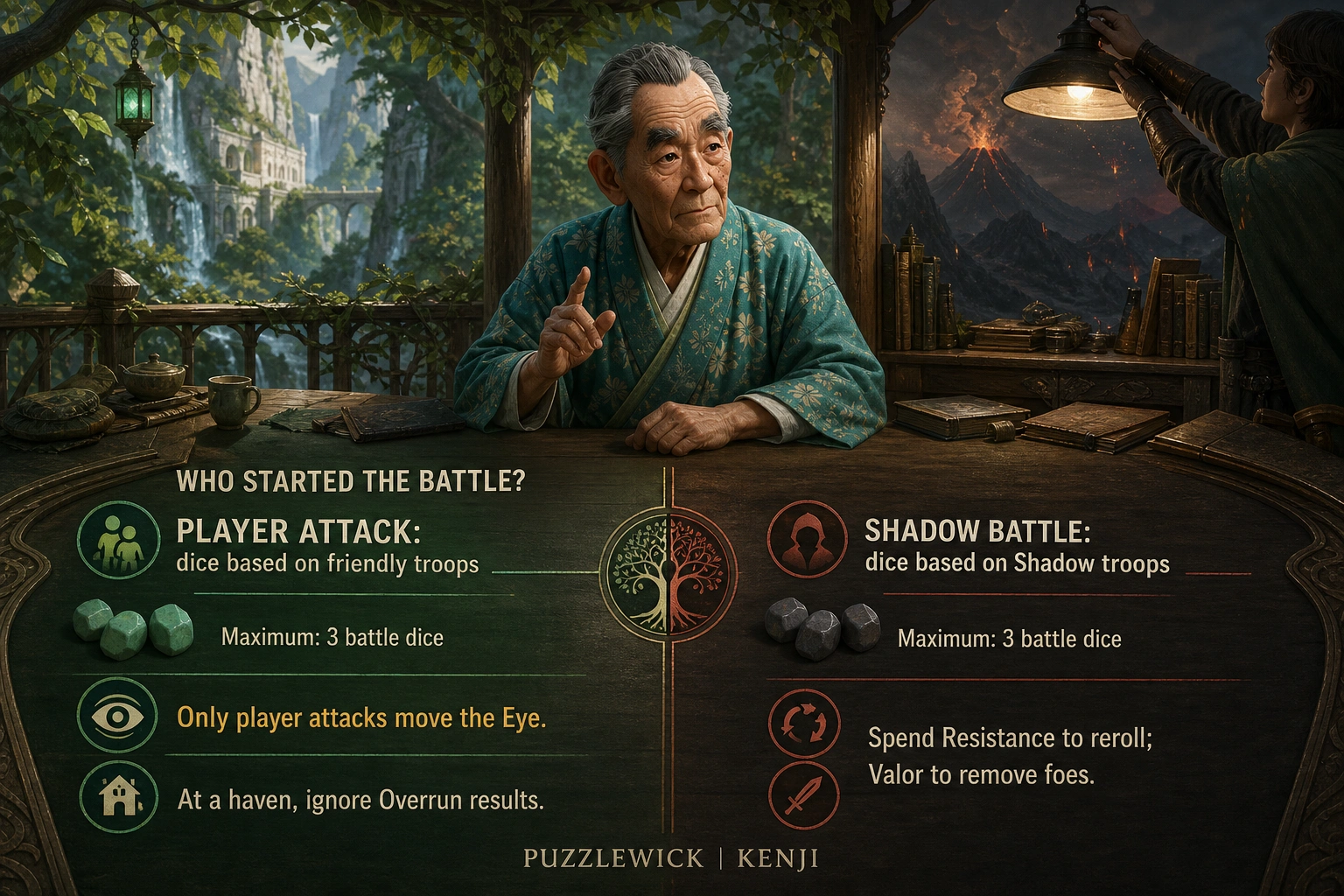
Attack requires your character, friendly troops and Shadow troops in the same location. First move the Eye to the attack's region. Then choose the number of battle dice, from one up to the number of friendly troops, with a maximum of three. More dice can remove more enemies but can also expose your army to more losses.
Enemy battles count the other side
When Shadow movement or reinforcement causes a battle, roll for the number of Shadow troops, capped at three. Those battles do not move the Eye. Confusing the two procedures changes the difficulty substantially.
- Rout: remove one Shadow troop.
- Exchange: remove one troop from each side.
- Overrun: remove one friendly troop; ignore this result at a haven.
- Nazgul result: remove two friendly troops if a Nazgul is in the region; otherwise it does nothing.
Characters present may use Resistance for rerolls and Valor to remove Shadow troops after the roll. A battle does not necessarily continue until one side is wiped out. Resolve the procedure; survivors can coexist.
Capture is a separate action at a Shadow stronghold with your character, at least one friendly troop and no Shadow troops. Spend three Valor, convert it into a haven, move the Eye to its region and regain two Hope. That is why merely removing the last enemy does not automatically complete the whole job.
Rules: Z-Man Games rulebook, pp. 13-15 (publisher PDF hosted by Nastol.io).
The Shadow deck: stop resolving the wrong half of the card
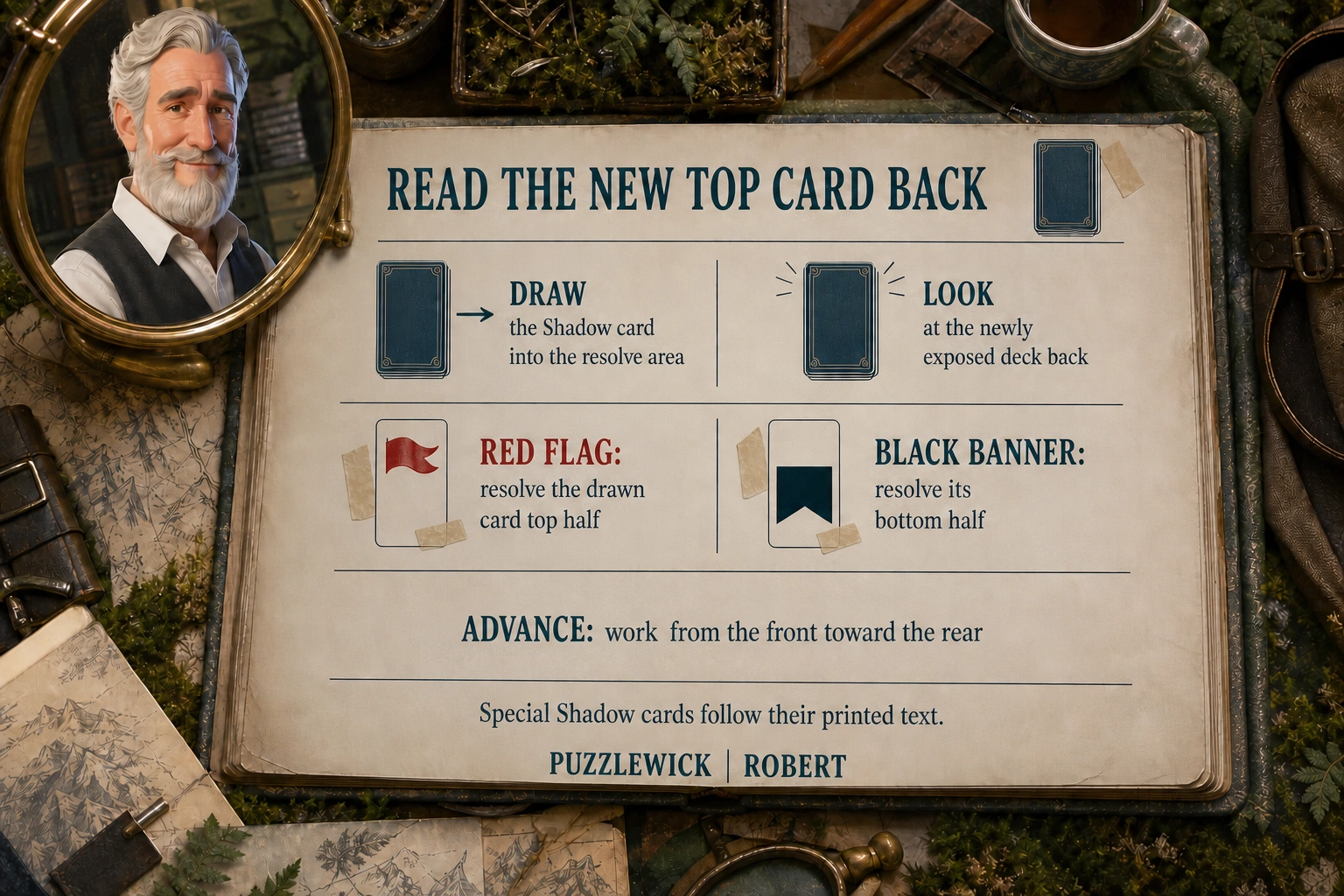
Draw a Shadow card into the resolve area, then look at the newly exposed back on top of the remaining deck. A red flag selects the drawn card's top, Advance half. A black banner selects its bottom, Reinforce half. This is not an instruction to look at the back that was visible before you drew.
Advance
Move the Shadow troops along the named battle line one connection forward. Work from the front of the line toward the rear so a moved troop is not moved again. Troops at the final location stay there. Resolve the ensuing battles in the specified order. Enemy troops can advance even if they were sharing their old location with friendly troops.
Reinforce
Add a Shadow troop at the named location, resolve a battle if needed, and follow the printed order. Capturing Moria, Isengard, Dol Guldur or Umbar stops the normal reinforcement there; it does not erase the Shadow card's other order. Keep reading after the part that gave you good news.
Eye orders can move the Eye to Frodo or force a search if it is already there. Nazgul orders can move riders toward Frodo or deploy them toward the Eye, using their own tie and supply rules. Drums of War and Wheels of Saruman are special cards: follow their text rather than forcing them into the normal two-half procedure.
Discard the resolved Shadow cards after the phase. Watching the discard pile helps you assess what might return after the next reshuffle, but it does not reveal the next random draw. Good forecasting is not clairvoyance.
Rules: Z-Man Games rulebook, pp. 16-19 (publisher PDF hosted by Nastol.io).
Skies Darken: resolve all four steps before carrying on
Draw the two player cards together. If either is Skies Darken, resolve it before handling the other cards or enforcing the hand limit: increase threat; check whether the Eye is already in Frodo's region; add the indicated three Shadow troops; then shuffle the Shadow discard pile and place it on top of the Shadow deck. If the Eye was already with Frodo, lose two Hope. Otherwise move it there.
Resolve any required battle when those troops arrive. If the supply cannot provide a troop, lose one Hope for each missing troop. Do not take it from somewhere else on the board to make the component count look tidy.
If both drawn cards are Skies Darken, resolve each completely. They are not normal cards you keep, and you do not draw replacements. The intensified Shadow deck is the tactical warning: recently seen trouble can return quickly. An unattended haven that survived once is not necessarily safe for the next round.
A useful habit: one player reads the four steps aloud, another moves the markers. Afterward, say the new threat rate out loud. Forgetting that rate makes a losing position feel inexplicably easy, which is a rather hollow sort of courage.
Rules: Z-Man Games rulebook, pp. 15 (publisher PDF hosted by Nastol.io).
A strategy that wins together: danger, objective, handoff
There is no personal score to maximise here. Being the player who removes the most troops is not the victory condition. I would organise each conversation around three questions:
- Danger: what could lose us Hope before help arrives?
- Objective: what concrete condition can this turn complete or prepare?
- Handoff: what location, companion or resource should the next player inherit?
Combine jobs on the same journey
A Travel action that moves a character, escorts Frodo and transports useful troops can be more efficient than three separate plans. An attack away from Frodo can both deal with enemies and distract the Eye. A capture can restore Hope and turn a dangerous stronghold into a place to Prepare. These are opportunities, not automatic instructions: each costs actions, resources and positioning.
Choose the loss you can survive
You cannot reliably maintain a pristine board. Compare a preventable haven loss with a distant troop accumulation; compare one safe objective action with another round of speculative fighting. If a haven is doomed, spending the entire team to delay its loss might be worse than completing an objective and preparing the final journey. Do the Hope arithmetic before calling either choice heroic.
Plan around your actual characters
Read the two abilities in front of you and look for one useful combination. Resist ranking a character by combat alone. Movement, resource handling, search mitigation and objective positioning all matter. The strongest-looking character does little while stranded two turns from the relevant problem.
These are Puzzlewick strategic recommendations derived from the rules, not a claimed tournament metagame. The productive competition is your team against the chosen difficulty, not a veteran against the newest person at the table.
The final Mount Doom attempt: budget more than the entry fee
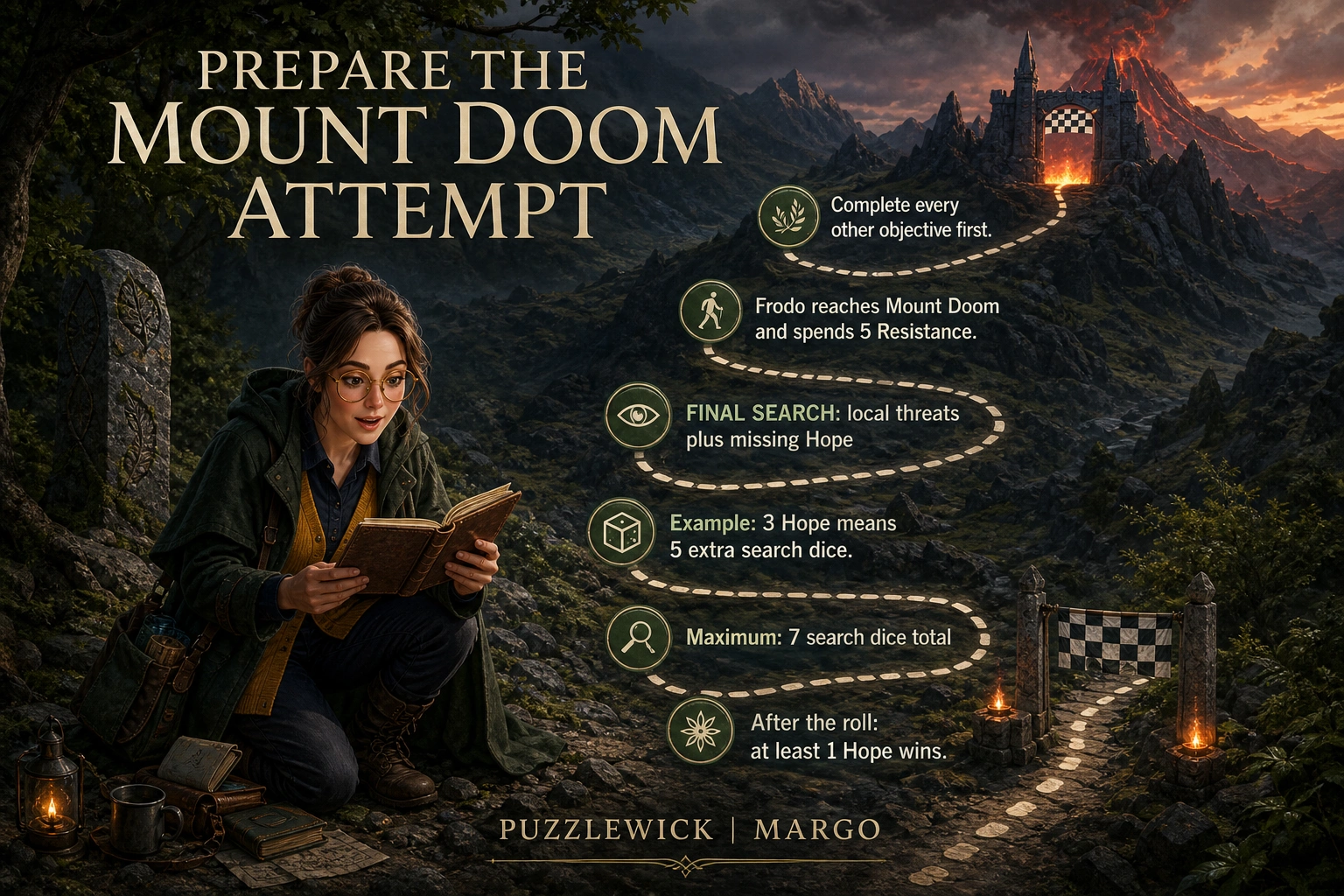
After every other objective is complete, Frodo can spend five Resistance at Mount Doom to attempt to destroy the Ring. That payment gets you the attempt. It does not automatically win the game.
Make the final search with the normal local threats, plus one die for each missing Hope, still capped at seven dice total. If at least one Hope remains after the roll, you win. At three Hope, five Hope is missing, so add five dice before applying the cap. Merely clearing enemies does not remove that missing-Hope penalty.
Worked example
Suppose Frodo reaches Mount Doom with six Hope, two Nazgul in the region and one Shadow troop in the location. Two missing Hope plus those three threats means five search dice before abilities alter anything. Frodo needs the five Resistance to pay for the attempt; any Resistance you want for rerolls must be available in addition to the payment, from the appropriate characters under the rules.
Bring relevant companions and reserve eligible abilities. Sam's Aid and extra Resistance can be more useful than one last unnecessary attack elsewhere. Conversely, waiting for a theoretically perfect finish can give the Shadow another damaging round. Compare the risk of trying now with the risk of waiting, not with an imaginary risk-free option.
Rules: Z-Man Games rulebook, pp. 11-12 (publisher PDF hosted by Nastol.io).
Solo play is a designed mode, not simply two-handed multiplayer
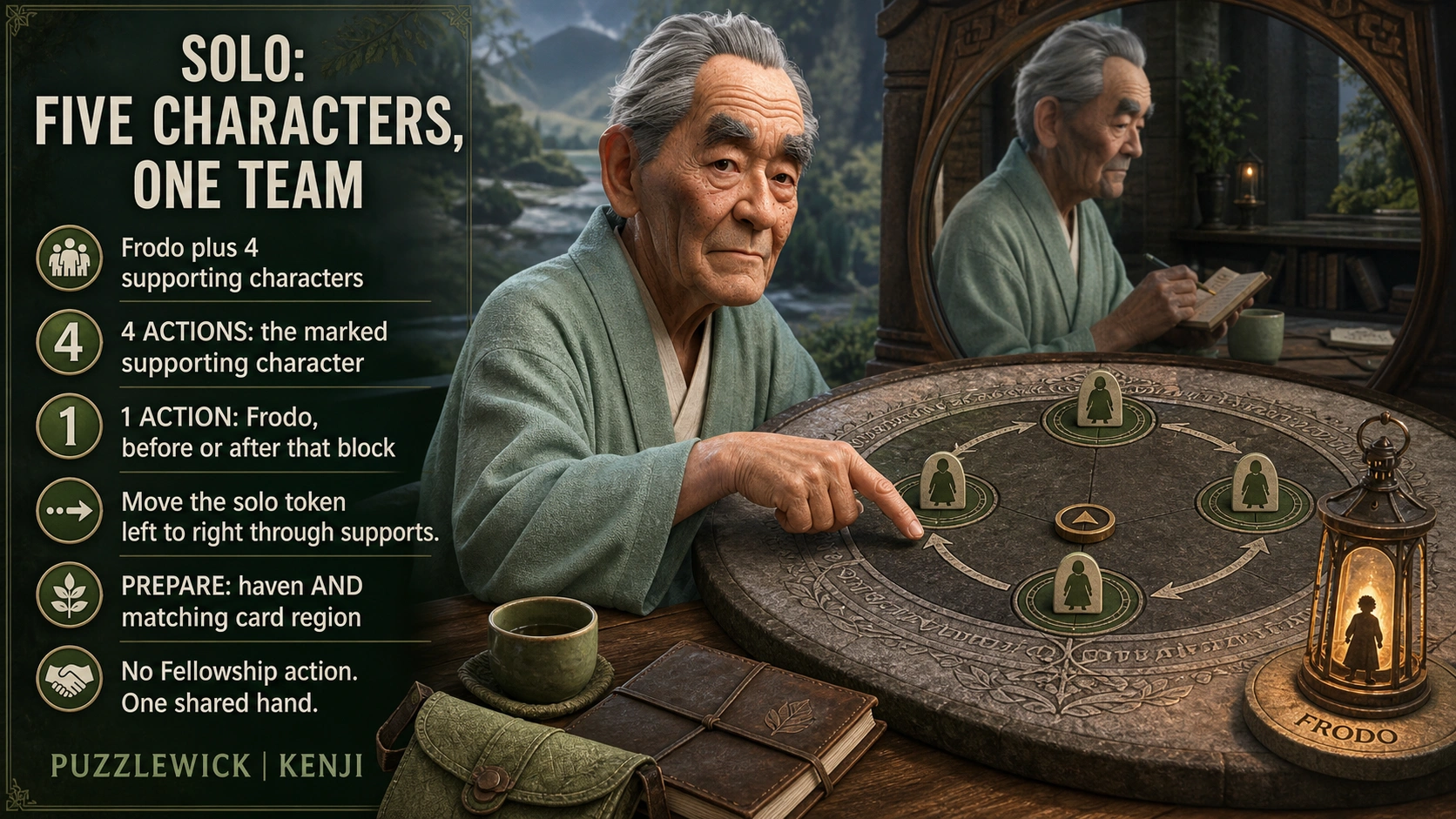
Official solo play uses Frodo & Sam and four supporting characters, with one shared hand and symbol supply. The solo token selects which supporting character takes the four-action block. Frodo takes the single action, either before or after it. Move the token through the supporting characters in the printed left-to-right sequence.
Frodo never takes the four-action block in this mode. Efficient transport by supporting characters is therefore important. Taking Frodo along still triggers his Travel rule; being a passenger does not make the danger free.
There is no Fellowship action, since there is only one player hand. Prepare also changes: your character must be at a haven in the region named on the discarded region card. Do not bring multiplayer's more permissive Prepare rule into solo accidentally.
I recommend starting with the printed suggested solo group and difficulty. Use the token physically, keep each supporting character's card aligned with its figure, and plan one full support cycle rather than treating each turn as a fresh surprise. Solo rewards a calm overview, but five characters means there is still substantial information to hold.
Rules: Z-Man Games rulebook, pp. 22 (publisher PDF hosted by Nastol.io).
Teach it without taking over: a three-game path
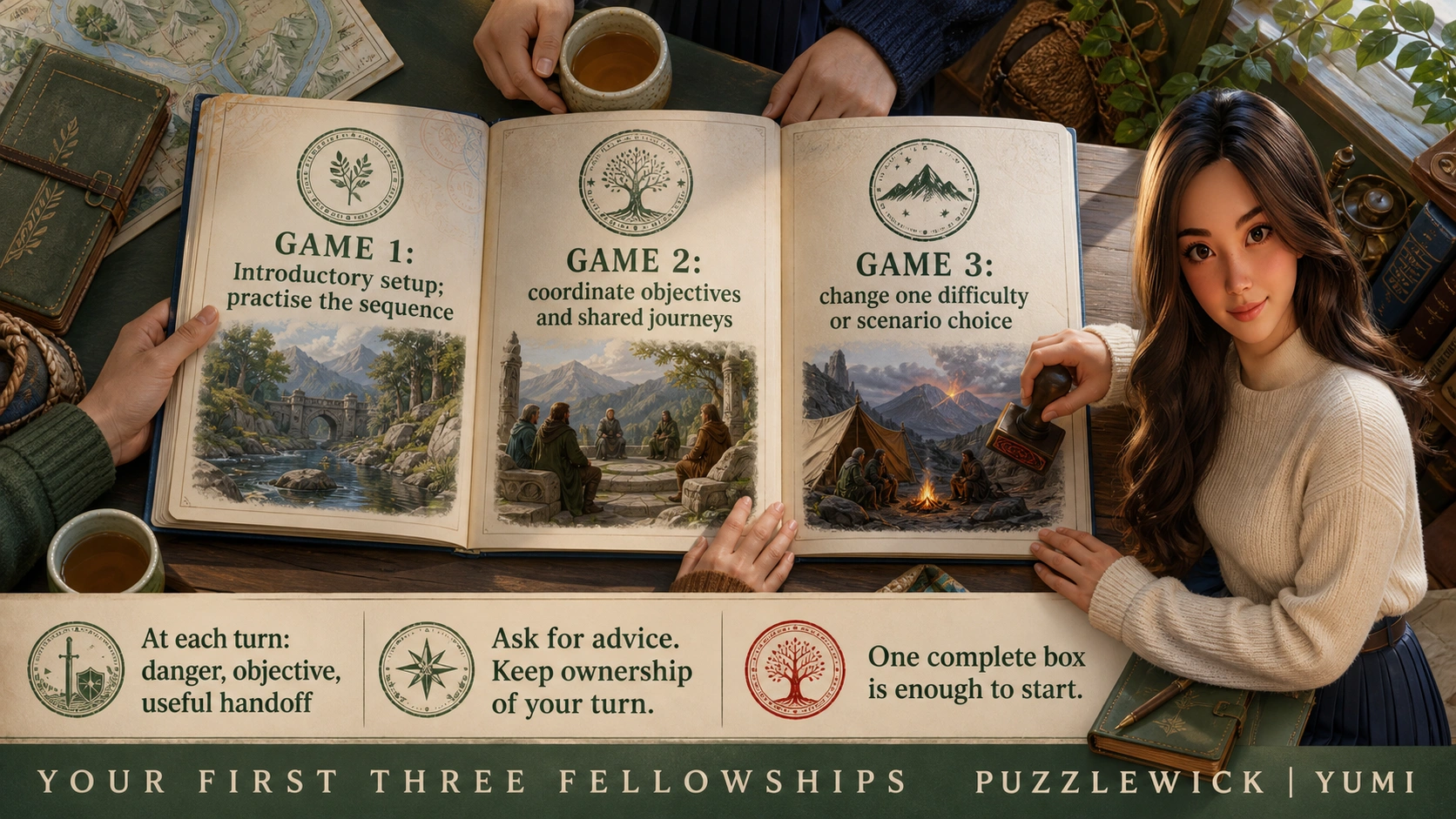
Before starting, say: "We win together. Tell us your idea first; we will help with the rules and consequences." A cooperative game can become one experienced player operating several human card holders. Avoid that by letting the active player make the decision, inviting rather than imposing advice, and treating a mistake as information for the next attempt.
- Game one: use Introductory setup and learn the whole sequence. If a major rule error appears, correct it clearly rather than quietly compensating somewhere else.
- Game two: keep a familiar setup and improve shared journeys, handoffs and objective timing. A repeat is useful practice, not wasted variety.
- Game three: change one difficulty or scenario choice. Notice what that change asks the team to do differently.
The printed difficulty table progresses from Introductory, with four Skies Darken and four objectives, to Standard at five and four, Heroic at five and five, Epic at six and five, and Legendary at six and six. Objective counts include the Ring. Do not add every extra complication at once merely because the word "Introductory" wounded somebody's pride.
Ready to join an experienced group?
You are ready when you can explain the shared goal, execute four-plus-one without interleaving, distinguish location from region, and ask for help resolving an unfamiliar card. You do not need to memorise all objectives. Tell the host you are learning and ask which difficulty they plan to use.
Rules: Z-Man Games rulebook, pp. 21 (publisher PDF hosted by Nastol.io).
Sleeves, inserts and table comfort: buy for this box
Play once with the supplied components before upgrading. Then identify the actual friction: bent cards, slow sorting, an awkward table surface or transport. A product should fix one of those problems. A second dice tower does not fix the first game's rules teach.
Two card sizes, not one generic sleeve pack
The Ryker game-specific kit specifies 74 cards at 64 x 89 mm and 97 at 79 x 120 mm, plus spare sleeves. That is a manufacturer compatibility claim for its kit, not a claim that we measured your copy. The publisher's product page lists 72 player cards while the publisher's rulebook on page 2 and sleeve supplier list 74. Check your actual printing and count before buying generic packs. Oversized character, objective and Shadow cards do not fit ordinary trading-card sleeves.
Organizers must match the exact game and sleeve thickness
The Game Tamer Fate of the Fellowship insert describes eleven removable trays and support for sleeves up to 100 microns. It is third-party equipment, not the game. Check the maker's current fit description, box printing and sleeve thickness; double sleeving is not automatically covered by a single-sleeve claim.
A surface and a safe journey
A full-table mat can make cards easier to lift and soften dice noise, but measure the opened board and the surrounding character and deck areas before choosing one. A narrow Magic playmat is not a complete surface for this game. For transport, protect the box corners and keep the tower parts from carrying the weight of other components. A general board-game bag needs internal dimensions and padding, not just a flattering photograph.
These maker links document compatibility; they are not claims that Puzzlewick belongs to those affiliate programs. Our purchase buttons name the actual approved merchant. When a suitable product cannot be verified, we describe the requirement rather than substituting an unrelated item.
One useful organizer, not three compulsory purchases
For a modest sorting upgrade, Gamegenic's Token Silo Convertible has nine removable trays in three sizes. Put the pieces you reach for most in separate trays and return them as units after play. For a premium multi-game accessory, the Tokens' Lair has four removable magnetic drawers and a cover that becomes a dice tray. That is a handling upgrade, not a required replacement for the included tower. The simpler Token Holder is a compact click-lock box for a small component group. None is a fitted Fate of the Fellowship insert, and we have not established that the entire component set or oversized cards fit inside. Choose one only if it solves your sorting problem.
Manufacturer specifications: Token Silo Convertible, Tokens' Lair, Token Holder. Current product-page descriptions checked 30 August 2026; no personal fit test or live-stock claim.
Why the design feels like Tolkien rather than a pasted-on map
In his June 2025 design journal, Matt Leacock explains how the design evolved from military and character-combat experiments toward objectives and the struggle between Hope and despair. Complex wounds, alternative Ring-bearers and numerous location effects were cut or folded into simpler systems. The result places the emotional burden on the journey rather than on winning every encounter.
The design also compresses several possible disasters into one shared Hope track. That creates room for setbacks and recovery instead of a collection of abrupt separate loss conditions. Losing a haven hurts badly; it does not automatically end an otherwise viable expedition. Mechanically, that keeps the team considering trade-offs. Thematically, it asks how much discouragement the journey can withstand.
That is the central buying argument for me: not merely a familiar map, but a cooperative system organised around the importance of a small mission within a much larger war. The artwork is credited to Cory Godbey, with map work by Jared Blando. This guide's documentary images show the real product; Puzzlewick's imaginative curator scenes are separately labelled.
For a different sort of planning puzzle, compare our Terraforming Mars guide. For more cooperative and strategy choices, explore the board-game library. Those are alternatives, not expansions for Fate of the Fellowship.
The glossary you can actually use during a turn
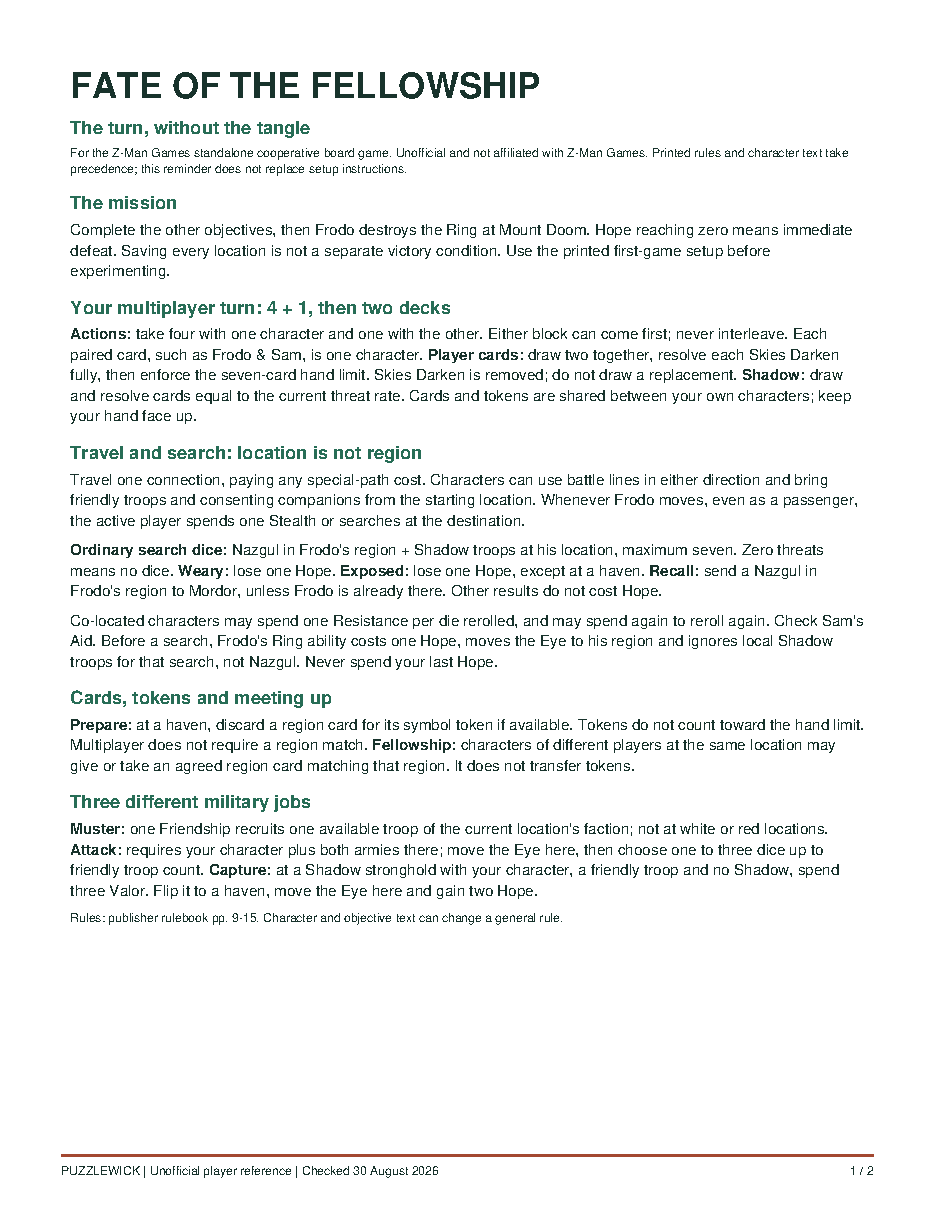
<dl><dt>Pandemic System</dt><dd>A cooperative design family in which limited player actions confront an escalating automated threat. This game has its own rules.</dd><dt>Hope</dt><dd>The team's shared survival track. Zero means immediate defeat.</dd><dt>Threat rate</dt><dd>The number of Shadow cards drawn during the Shadow phase.</dd><dt>Location</dt><dd>A named stop on the map, where characters and troops meet.</dd><dt>Region</dt><dd>A larger map area used by Nazgul, the Eye and region-dependent actions.</dd><dt>Haven</dt><dd>A refuge that supports Prepare and changes particular dice results. It can fall.</dd><dt>Shadow stronghold</dt><dd>A location the team may Capture by meeting the requirements and paying three Valor.</dd><dt>Search</dt><dd>A danger check for Frodo, using black search dice and its own mitigation rules.</dd><dt>Attack</dt><dd>A player action that moves the Eye and starts a battle using friendly troop count.</dd><dt>Quarterbacking</dt><dd>One player making everybody else's decisions. Give advice without confiscating another person's turn.</dd><dt>Action efficiency</dt><dd>Getting several useful results from limited actions, such as escorting a character and troops on the same journey.</dd></dl>
The picks
Some links below are affiliate links — as an Amazon Associate, Puzzlewick earns from qualifying purchases, at no extra cost to you. It never changes a pick.
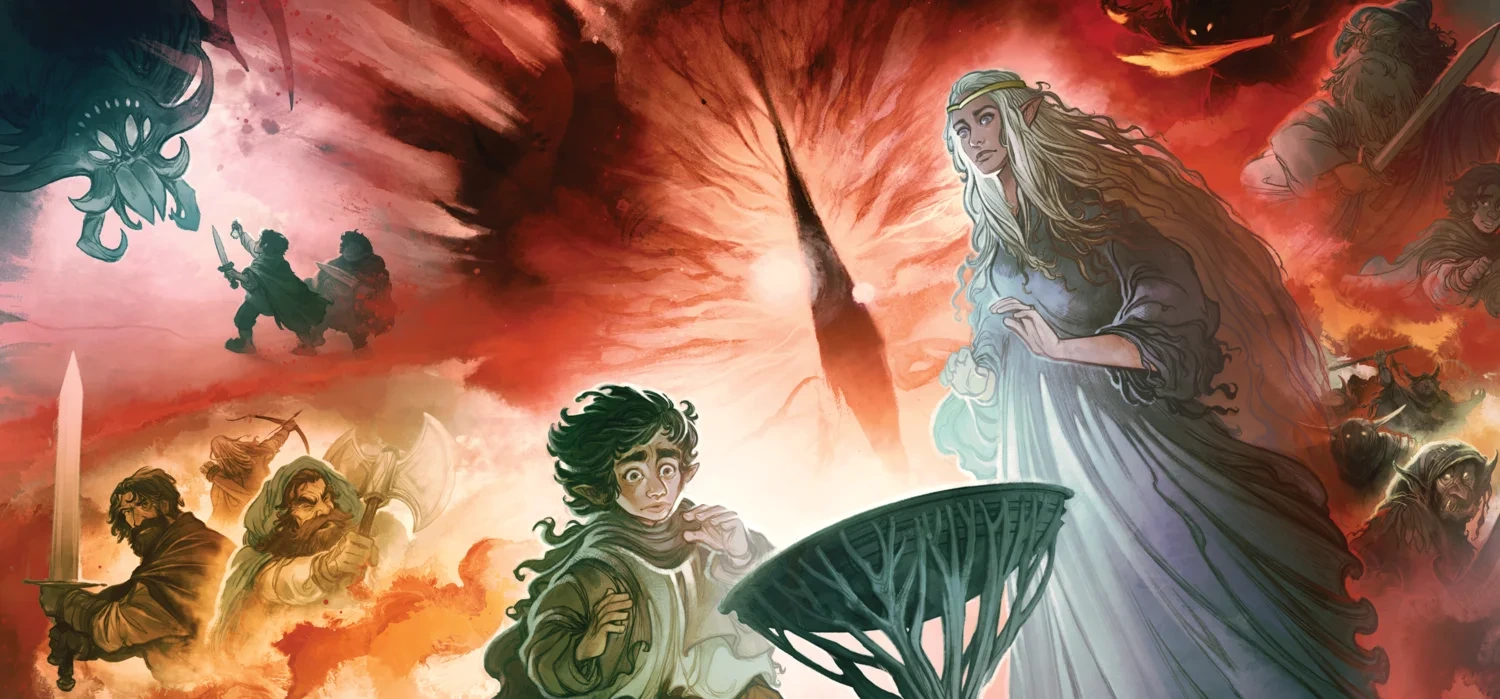
The Lord of the Rings: Fate of the Fellowship
This is the exact Z-Man Games Pandemic System release covered by the guide, with solo and cooperative play built into the official rules.
- Complete standalone starting point
- Official solo mode and adjustable difficulty
- Objective and character variety
- Substantial setup, rules and shared discussion
- Dice can undo a plan; mitigation costs resources
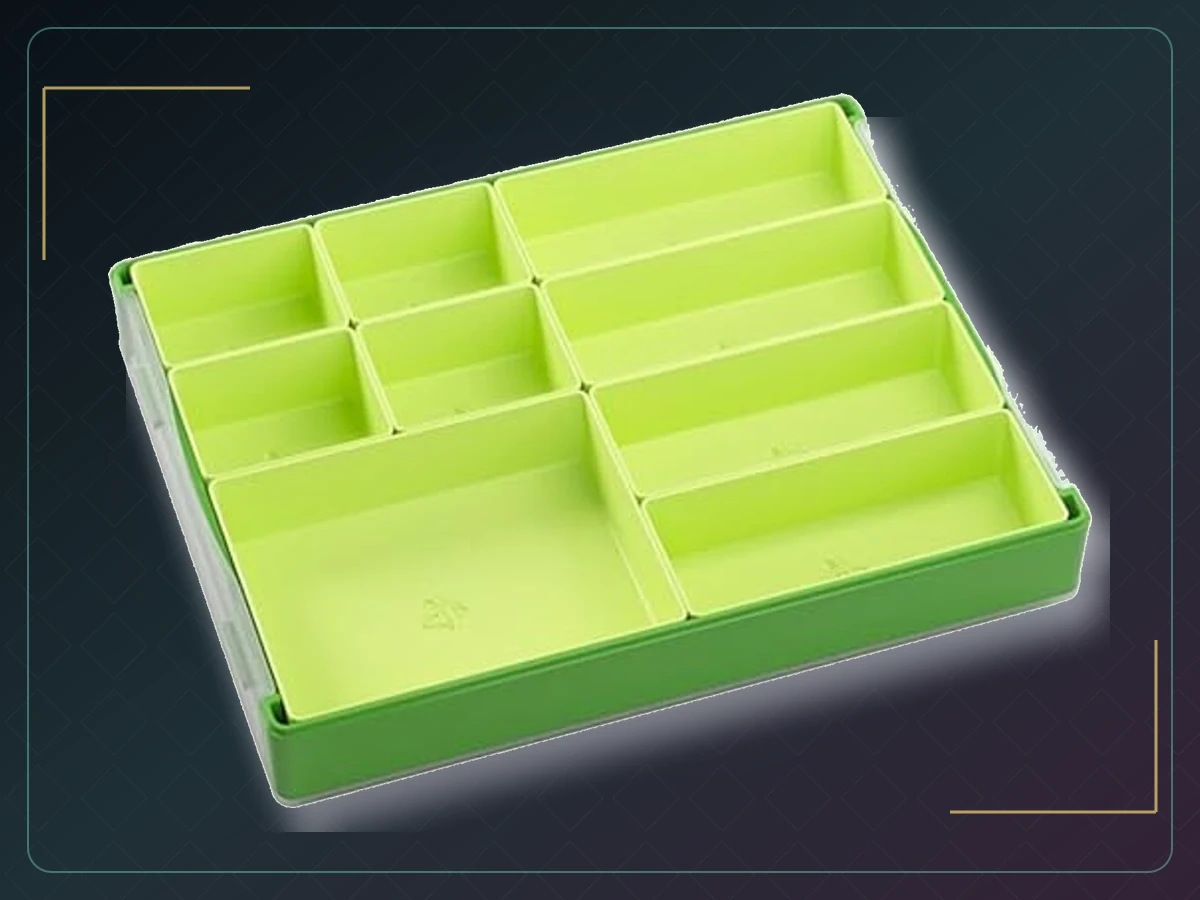
Gamegenic Token Silo Convertible
Removable trays turn the component bank into table stations, which matters when four players are coordinating several fronts.
- Fast access to troops, Hope and shared tokens
- This is not a fitted Fate of the Fellowship insert and may not live inside the retail box.

Luck Lab Folding Silicone Token Trays, six pack
Six folding bowls keep small pieces visible and let the group clear the table quickly after the final Shadow card.
- Budget component control during searches and battles
- They do not replace a fitted insert or protect cards in storage.
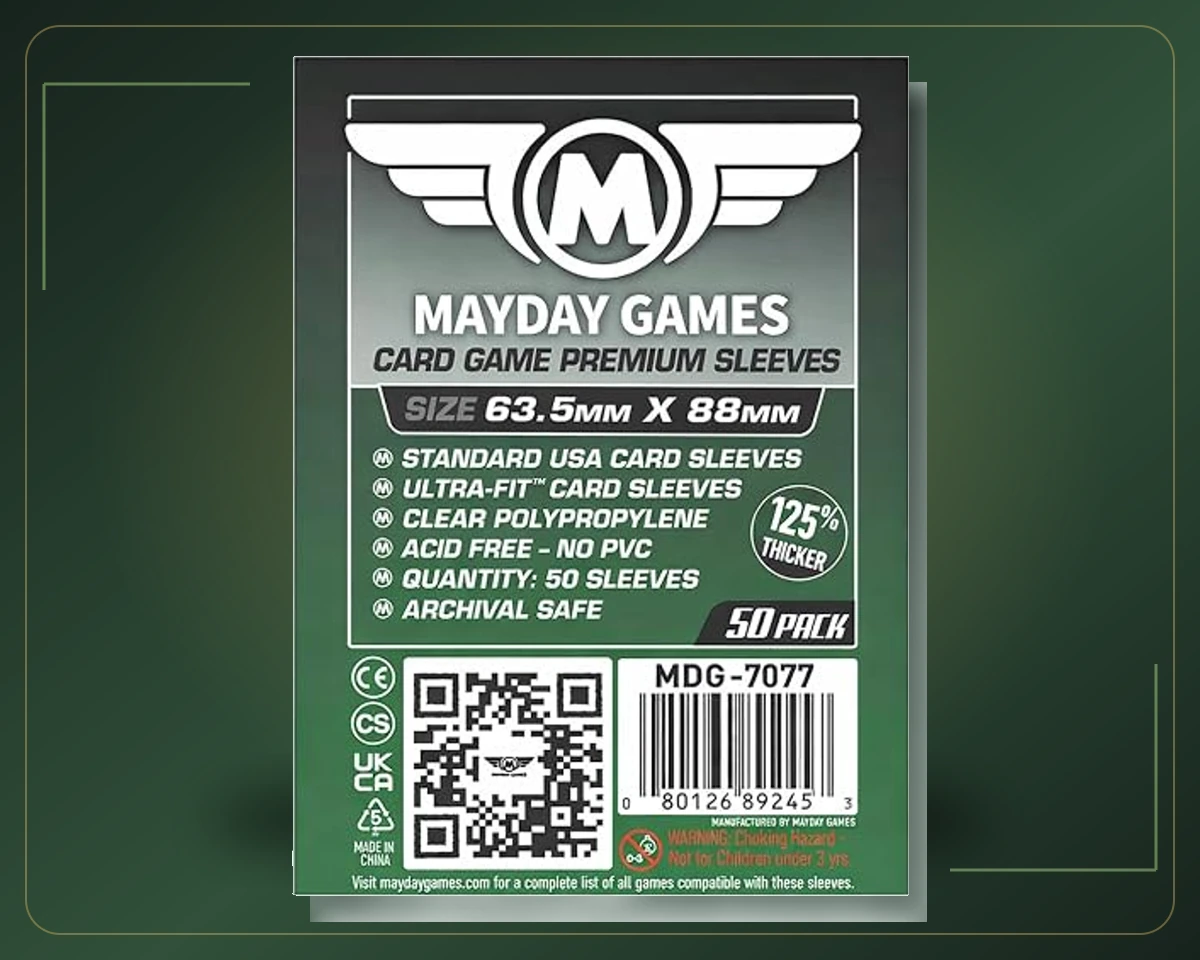
Mayday Premium 63.5 x 88 mm board game sleeves, 200 count
A clear premium sleeve can protect frequently handled standard cards without hiding the official artwork.
- Protecting only the standard-size cards after measuring
- Fate of the Fellowship uses more than one component format. Verify every card dimension; this is not represented as a complete exact-game kit.
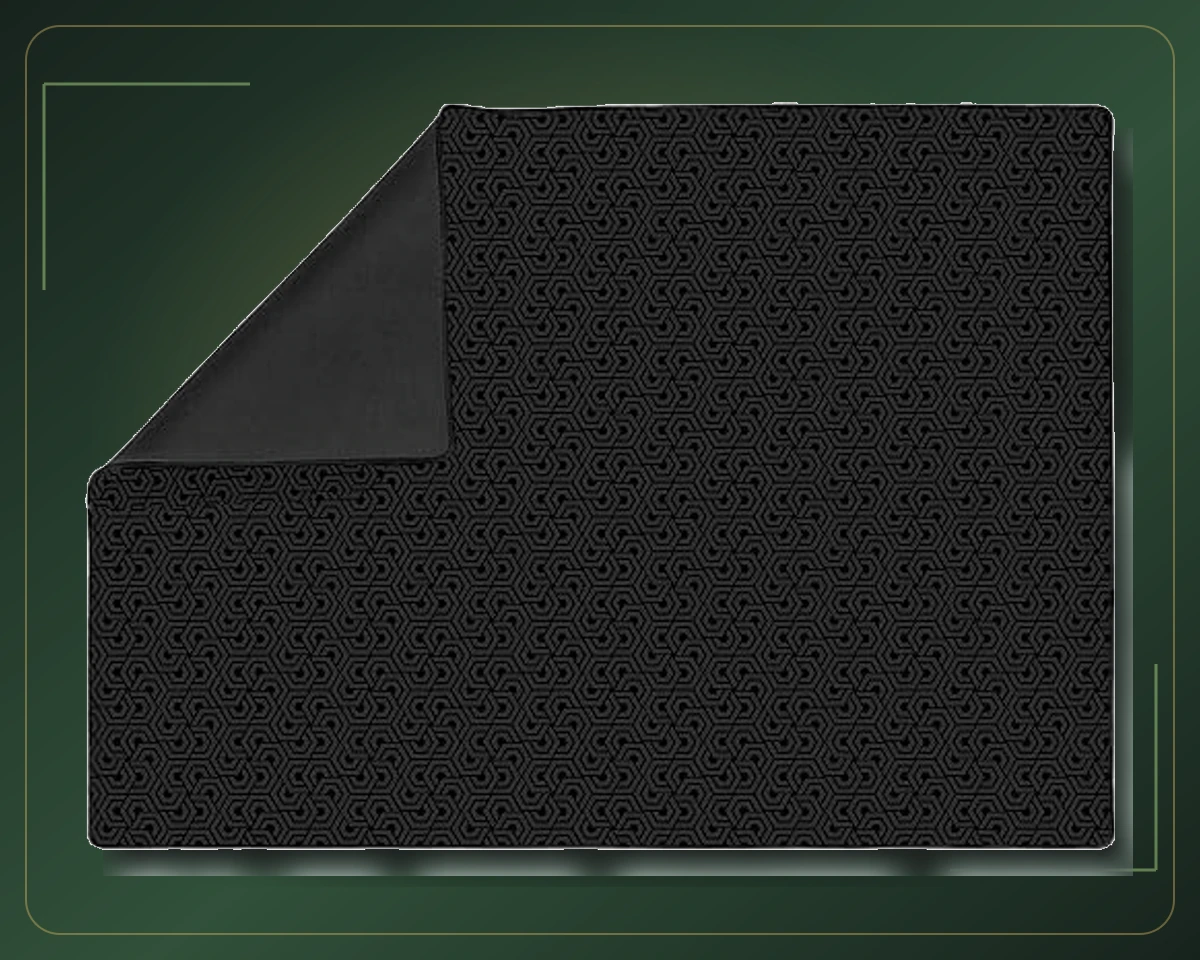
Roll-Play reversible 3 x 4 foot board game mat
A large neutral mat helps the map and loose cards stay put without counterfeiting Middle-earth artwork.
- A protected campaign surface with easier card pickup
- Measure the table first; the footprint is larger than many dining tables comfortably allow.
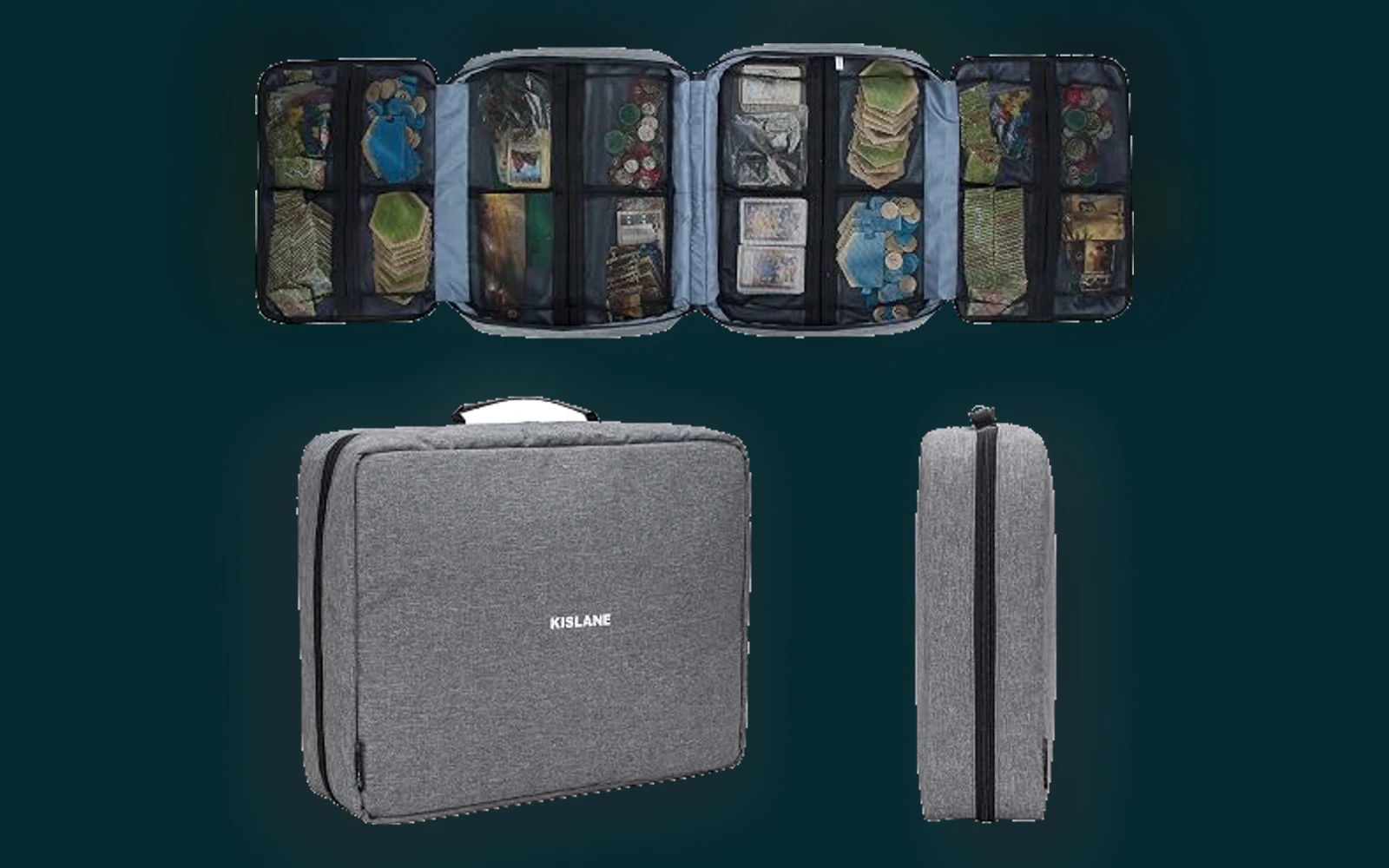
KISLANE expandable board game carrying case
The padded carrier and exterior pockets give the box, player aids and small table gear a more coherent trip to game night.
- Moving the large game to a regular cooperative group
- Verify the box fit and keep the original insert supporting components; this is not shipping armor.
At a glance
| Decision | Recommendation | Reason |
|---|---|---|
| First purchase | Complete base game | No expansion or additional deck is needed |
| First difficulty | Introductory | Learn the sequence before increasing pressure |
| Primary strategy | Protect Hope while completing objectives | Removing every enemy is not the victory condition |
| Solo | Printed five-character solo mode | Four actions rotate among supporting characters; Frodo gets one |
| First upgrade | Solve your actual storage or handling problem | Measure both card sizes and check exact insert compatibility |
Free download — Fate of the Fellowship: the turn, without the tangle
A two-page printable reminder for turns, searches, battles, solo play and the final Mount Doom attempt. Unofficial; printed rules and character text take precedence.
Unofficial fan-made reference. Compiled by Puzzlewick from the sources listed on the sheet. Not affiliated with or endorsed by the publisher — always defer to the official rulebook.
Questions, answered
Is Fate of the Fellowship a complete standalone game?
Yes. The Z-Man Games base box contains the cooperative game, dice, objectives, characters and cardboard dice tower. Other Lord of the Rings games and accessories are not required.
How many players can play Fate of the Fellowship?
The publisher lists 1-5 players, ages 14+, and 60-150 minutes. Solo uses dedicated rules; allow extra time for a first teach.
Can the bonus action happen before the four actions?
Yes. In normal multiplayer the other character's single action can happen before or after the four-action block. It cannot interrupt that block.
Does Frodo search when another character carries him?
Frodo's travel rule still applies when he takes part in somebody else's Travel action. The current player spends one Stealth or rolls a search at the destination, in addition to any special-path cost.
What is the difference between Attack and a Shadow battle?
A player Attack moves the Eye and uses friendly troop count to choose one to three battle dice. A Shadow-triggered battle uses Shadow troop count, capped at three, and does not move the Eye.
Which Shadow card back decides the action?
After drawing a Shadow card, read the newly exposed top card back on the remaining deck. Red flag selects the drawn card's Advance half; black banner selects its Reinforce half. Special cards use their own text.
Does capturing a stronghold cancel its whole Shadow card?
No. It stops the normal reinforcement at the captured location, but the card's other order still resolves.
How do you destroy the Ring?
Complete the other objectives, bring Frodo to Mount Doom and spend five Resistance. Resolve a final search including an extra die for each missing Hope, capped at seven dice. At least one Hope must remain to win.
Does running out of player cards end the game immediately?
Not as a separate loss condition. Lose one Hope for every card you are required to draw but cannot. The game ends in defeat if Hope reaches zero.
Can you trade symbol tokens through Fellowship?
No. Fellowship transfers an eligible region card between different players with co-located characters. It does not transfer symbol tokens.
What changes in solo Prepare?
In solo, the character must be at a haven in the region named on the discarded card. Normal multiplayer Prepare does not require that region match.
Do ordinary trading-card sleeves fit everything?
No. The game has two card sizes. Ryker's dedicated kit specifies 74 cards at 64 x 89 mm and 97 at 79 x 120 mm. Check your printing, actual counts and sleeve specifications before buying generic packs.
Kenji's verdict
Kenji's verdict: this is a compelling fit for a group that wants to solve a difficult journey together. Start with one complete box and a modest difficulty. Learn the difference between saving the board and finishing the mission; spend resources on the threats that matter; leave space for every player to contribute. The most impressive turn may be the one that makes somebody else's next turn possible.
Research ledger 10 sources · reviewed 2026-09-01
Specifications, rules, current product information, community experience, and contrary evidence were checked against the sources below. Commercial links are kept separate from editorial evidence.
- Z-Man Games product page and componentszmangames.com/game/the-lord-of-the-rings-fate-of-the-fellowship
- Asmodee English-language product listing, ZMGPSM0101ENstore.asmodee.com/products/the-lord-of-the-rings-fate-of-the-fellowship
- Z-Man Games English rulebook, 24 pages (Nastol.io mirror)nastol.io/storage/games/files/the_lord_of_the_rings_fate_of_the_fellowship/941149/ZMGPSM0101_Rulebook_English_WEB.pdf
- RulesPal rulebook transcriptionrulespal.com/fate-of-the-fellowship/rulebook
- Designer-linked original rulebook on BoardGameGeekboardgamegeek.com/filepage/296739/the-lord-of-the-rings-fate-of-the-fellowship-rule
- Matt Leacock: Fate of the Fellowship design journal, June 2025leacock.com/blog/2025/2/28/the-lord-of-the-rings-fate-of-the-fellowship-design-journal
- Matt Leacock: update with official rules and video linksmattleacock.substack.com/p/fate-of-the-fellowship-update
- 2026 American Tabletop Awards: Strategy winneramericantabletopawards.com/the-lord-of-the-rings-fate-of-the-fellowship
- Ryker game-specific sleeve kit specificationsrykergames.com/products/the-lord-of-the-rings-fate-of-the-fellowship-card-sleeve-kit
- Game Tamer exact-game insert specificationsgametamerinserts.com/product-page/the-lord-of-the-rings-fate-of-the-fellowship-organizer-insert

Every object has a lineage. Let me tell you its story.


Keep exploring
The next smart rabbit holes.
◬ Universe HubMiddle-earth: the whole buying pathMiddle-earth is a shelf of very different journeys: premium LEGO architecture, strategic war games, and collectible card worlds....✦ Topic PathBoard Game Buying Guides: compare the whole shelfStart with the decision, not the shelf. These guides compare the games, editions, expansions, player counts, and costs people...ComparisonLOTR Fellowship vs Two Towers Trick-Taking: Which Box First, Solo Rules and Chapter StrategyKenji walks both cooperative campaigns in order: which box teaches better, how solo differs from group play, why Two Towers is harder,...