Star Trek: Captain’s Chair Complete Guide: Base Game, To Boldly Go, Second Contact, Solo and Strategy
Dax separates two standalone command boxes from the true expansion, then teaches the three-action turn, reserve cycle, solo system, scoring multipliers and the strategy that keeps a busy bridge from becoming a pointless one.

AI-assisted curator persona · research and editorial responsibility: Robert Pruitt · how this guide was made
Last editorial refresh: 2026-09-13 Gold-standard QA: 2026-09-13 10 sources reviewed Affiliate links checked during gold-standard pass

The short answer
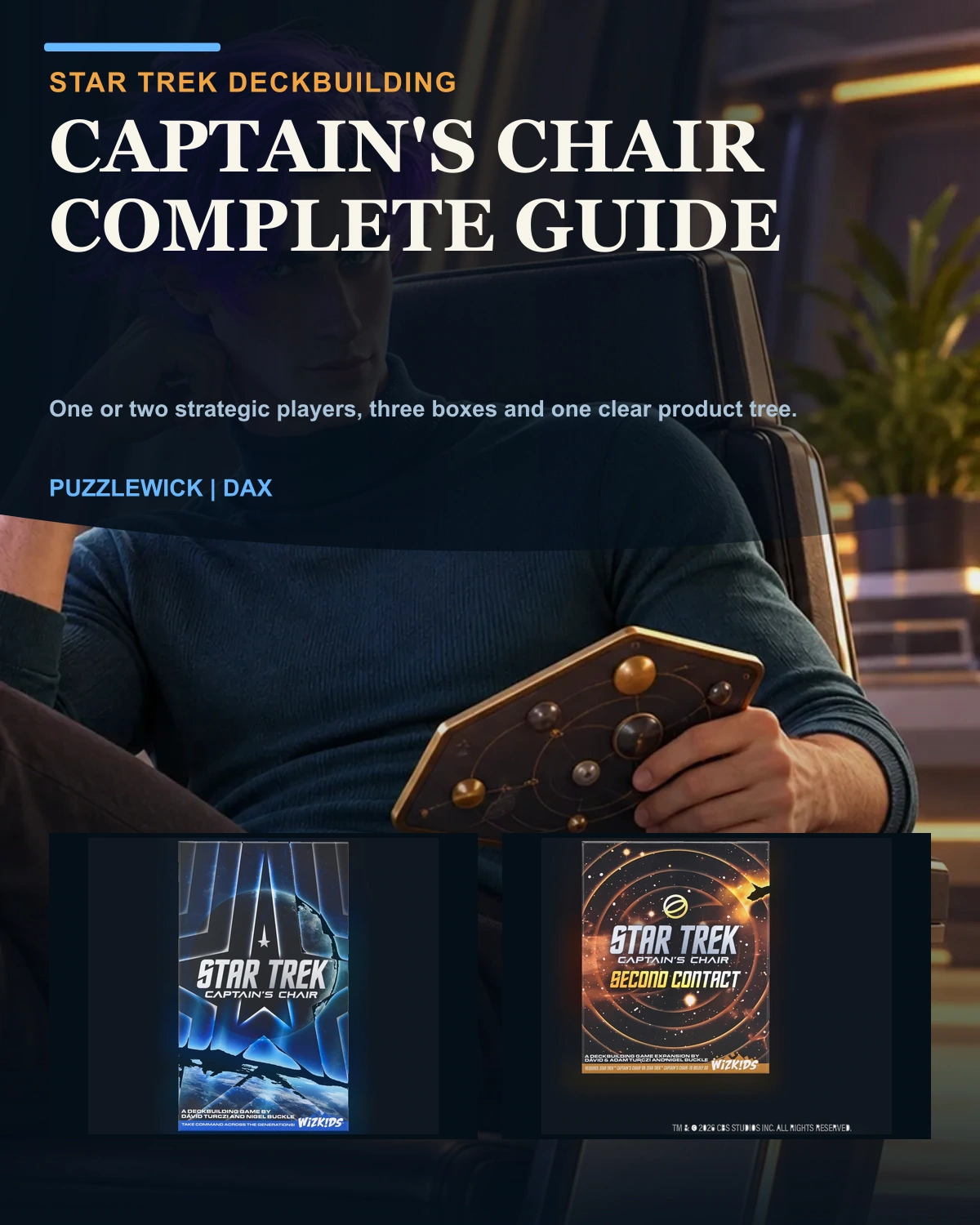
Start with the original Captain’s Chair for Picard, Sisko, Burnham, Koloth, Sela and Shran, or choose the fully standalone To Boldly Go for its different six-leader roster. Second Contact is not standalone; it requires either box and adds three captains. The game is best for one or two players who enjoy substantial asymmetric card engines, not for a light party table.
Decision map
Choose in thirty seconds
Captain’s Chair is the rare licensed game confident enough to ask what command actually feels like: limited actions, too many good cards, an opponent with a completely different machine, and a Stardate that will not slow down because your engine has excellent intentions.
This guide uses WizKids product pages, the published rulebook, dated BoardGameGeek attention snapshots and independent criticism. Puzzlewick has not physically tested this copy, so strategy is source-grounded analysis rather than a disguised play diary.
Start here, then go deeper
You are in the right cabinet.
 ✦ Universe HubStar Trek Games: the whole buying pathStart with the experience, not the uniform. Magic | Star Trek spans teaching, Commander, Limited and premium collecting; Captain’s...
 ✦ Topic PathBoard Game Buying Guides: compare the whole shelfStart with the decision, not the shelf. These guides compare the games, editions, expansions, player counts, and costs people...
 Campfire TaleStar Trek: The Customizable Card Game — The Game That Wouldn’t Die (2026 Homage & How to Play)A 30-year-old, out-of-print Star Trek card game that its own players refused to let die — and how, in 2026, a band of volunteers keeps it...
Base game, To Boldly Go or Second Contact?
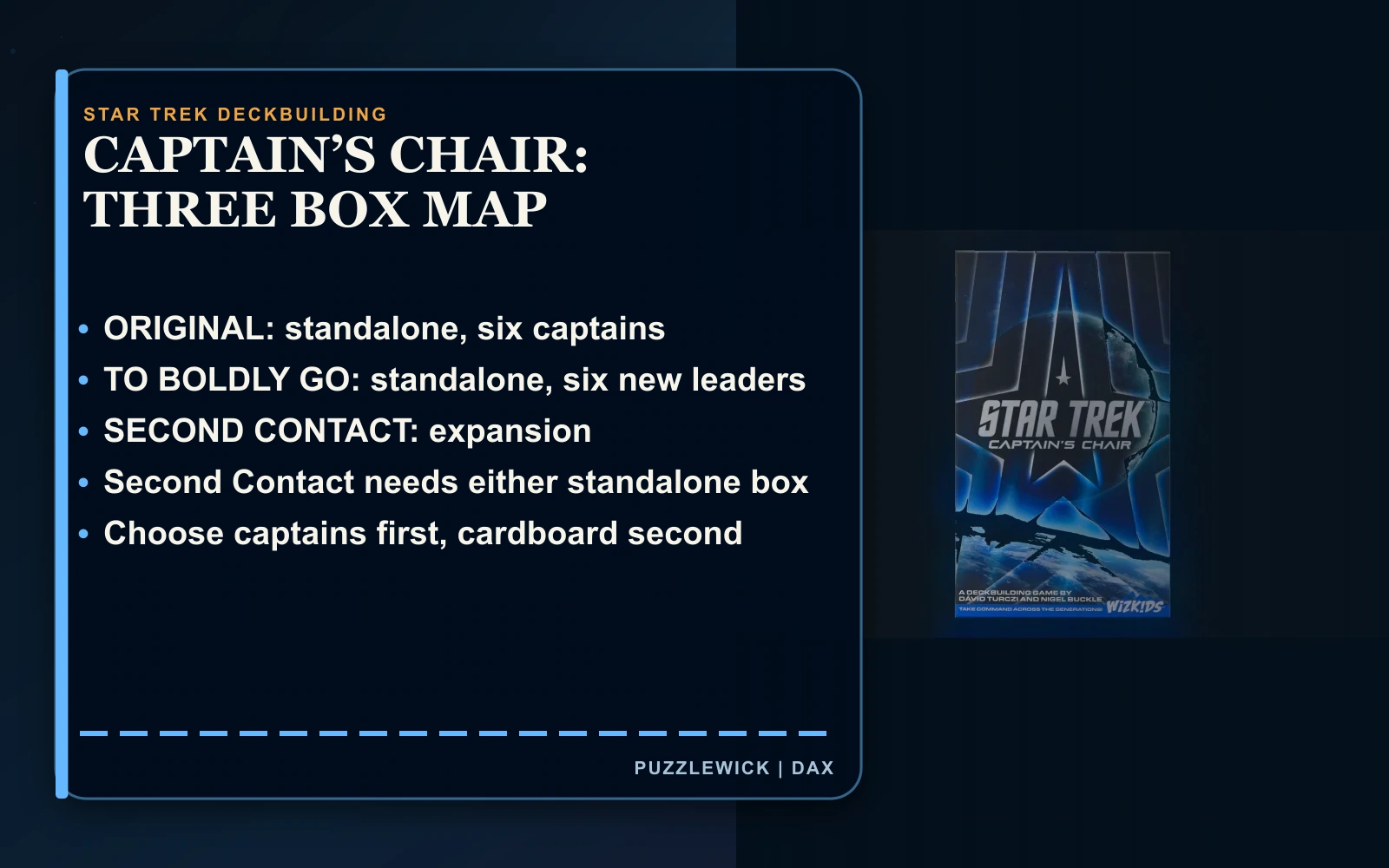
Start with the original Captain’s Chair if Picard, Sisko, Burnham, Koloth, Sela or Shran is the captain you want. Choose To Boldly Go instead when its six leaders are more appealing; it is fully standalone and can later combine with the original. Buy Second Contact only after you own either standalone box because it is a true expansion.
This distinction solves the largest buying mistake. Two boxes are doors. One is another room. Second Contact cannot hold up the ceiling by itself.
The repeated BoardGameGeek Hotness attention in September 2026 is a discovery signal, not sales evidence. The reason to cover the game is the new product relationship and the questions it creates.
How a turn and round actually work
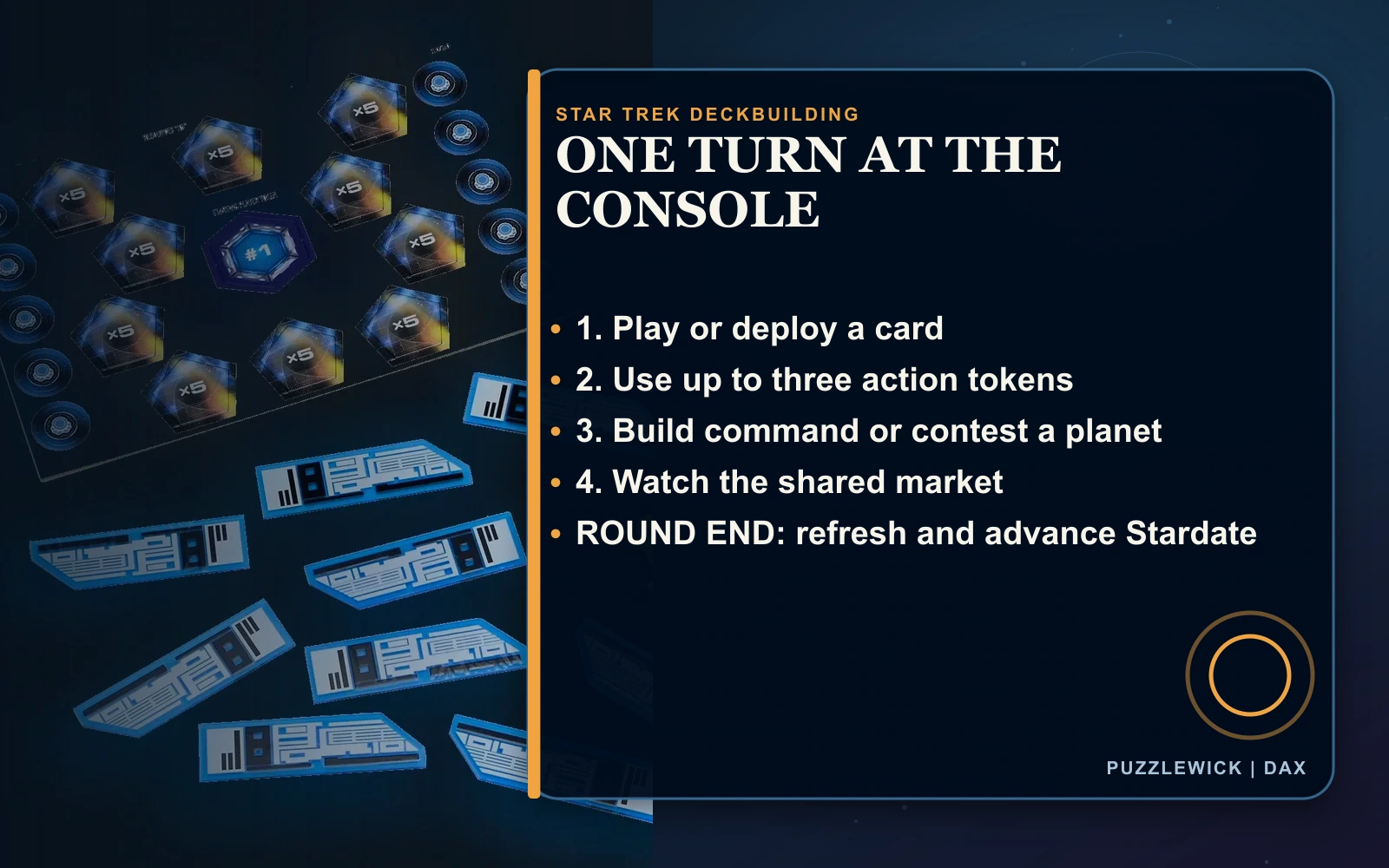
Captain’s Chair is an asymmetric card engine, not a light character draft. On a turn, play a card for its effect or deploy it to use its blue power, then spend up to three action tokens. Cards, crew, locations and ships build the command you can execute now and the scoring machine you hope will matter later.
Neutral planets create shared pressure. A round ends with cleanup, refresh, the Stardate advancing and new cards entering the market. That structure makes timing visible: a brilliant engine that arrives one Stardate too late is a museum exhibit.
Teach the first round with open hands and no strategic commentary beyond the current card. The asymmetry becomes exciting after the common verbs feel ordinary.
Teaching tool: narrate costs before effects for the first Stardate. Name the card, token or deployed power that authorizes the move, then resolve it. This keeps asymmetry from feeling like private magic and lets the other player follow the shared grammar even when the two captains produce very different turns. Once both players can predict the cleanup and refresh sequence, stop narrating and let the duel breathe.
Why the six captains feel genuinely different
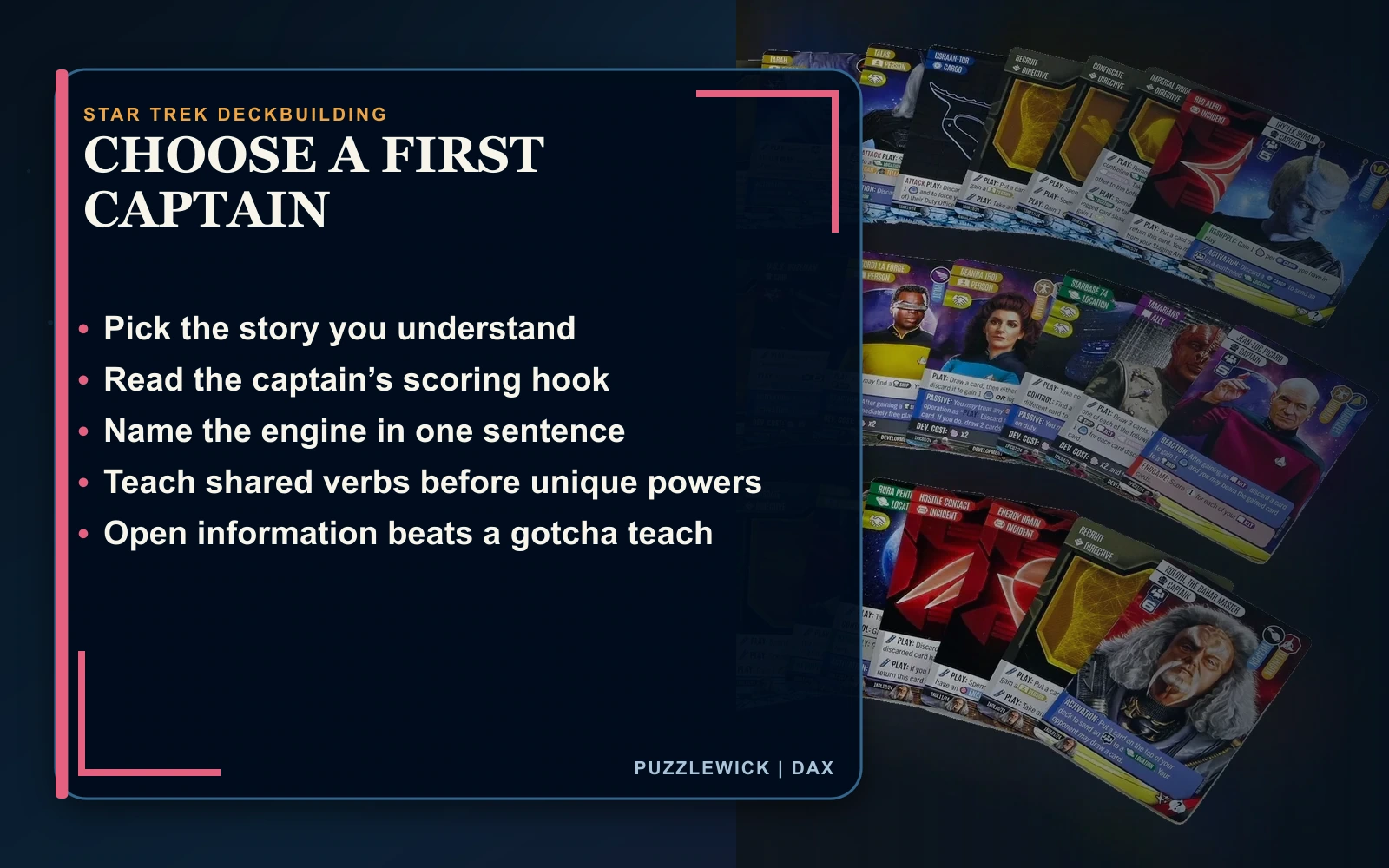
The original box includes Picard, Sisko, Burnham, Koloth, Sela and Shran. Their decks, ships and scoring incentives bend the same shared grammar in different directions. That is the game’s replay engine and its teaching hazard.
For a first match, choose captains with a theme you understand and read both player aids before setup. Do not hide a captain’s central scoring trick as if this were a bluffing game. Interesting asymmetry comes from planning around known differences, not from surprising a learner with an appendix.
Independent reviewer Tony Mastrangeli called it “A chunky Star Trek themed game with tons of replay value and rewarding gameplay.” His praise comes with a useful warning: this is not light, and the first teach has a curve.
Is Captain’s Chair good solo?
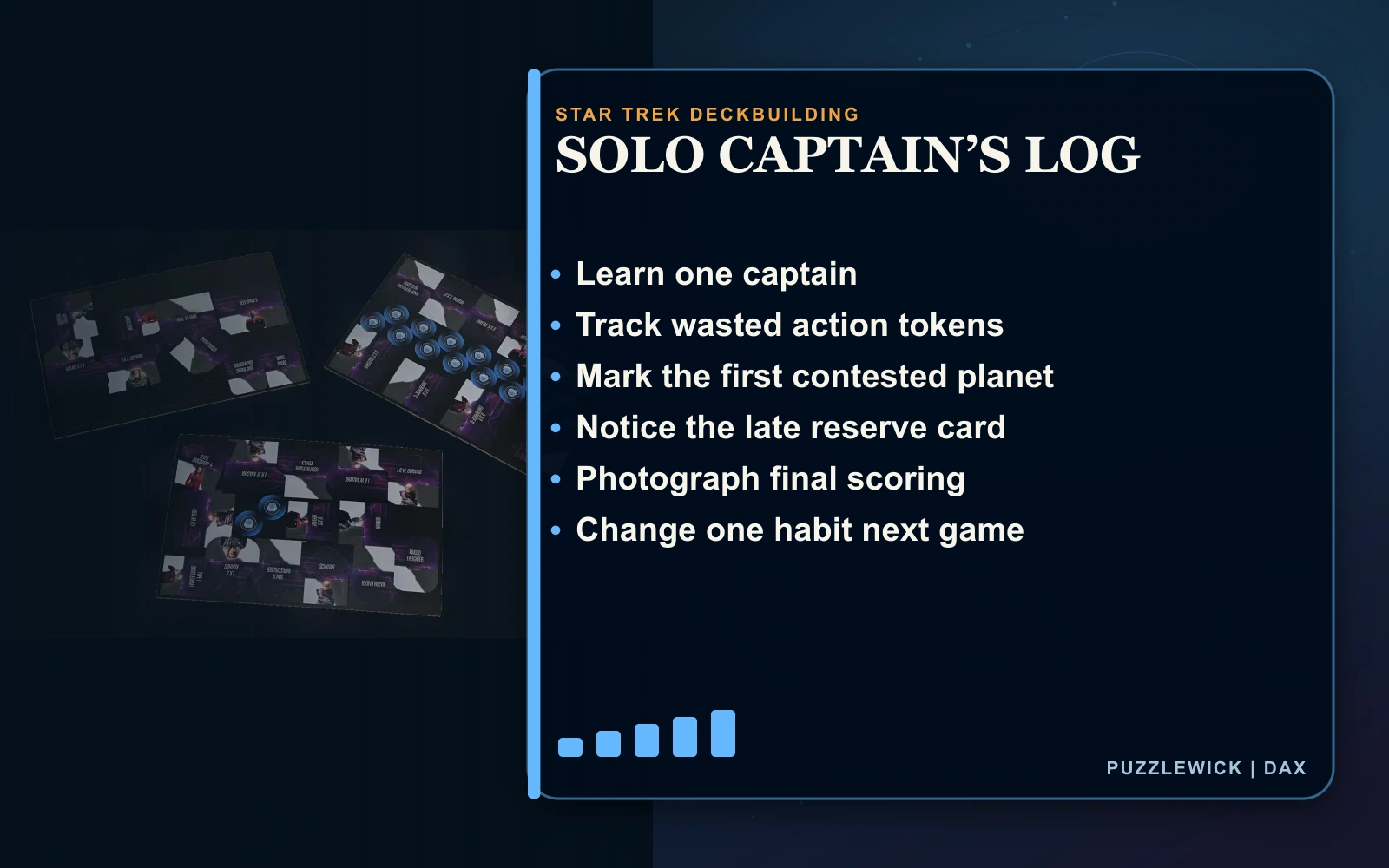
Yes, if you want to learn and optimize an asymmetric captain against an automated opponent. The box includes automated command cards, and the market, planets and Stardate still create pressure. Solo is also the cleanest laboratory for learning one captain without asking another person to wait through every card.
It is less suitable when you want a narrative campaign or a conversational bot. The solo system gives a strategic opponent, not a television episode with dialogue choices.
Run the first solo game as reconnaissance. Pause to read; photograph the final board; write down which reserve card arrived too late. The score matters less than locating the turn where the engine stopped converting effort into points.
The reserve deck is your real campaign arc
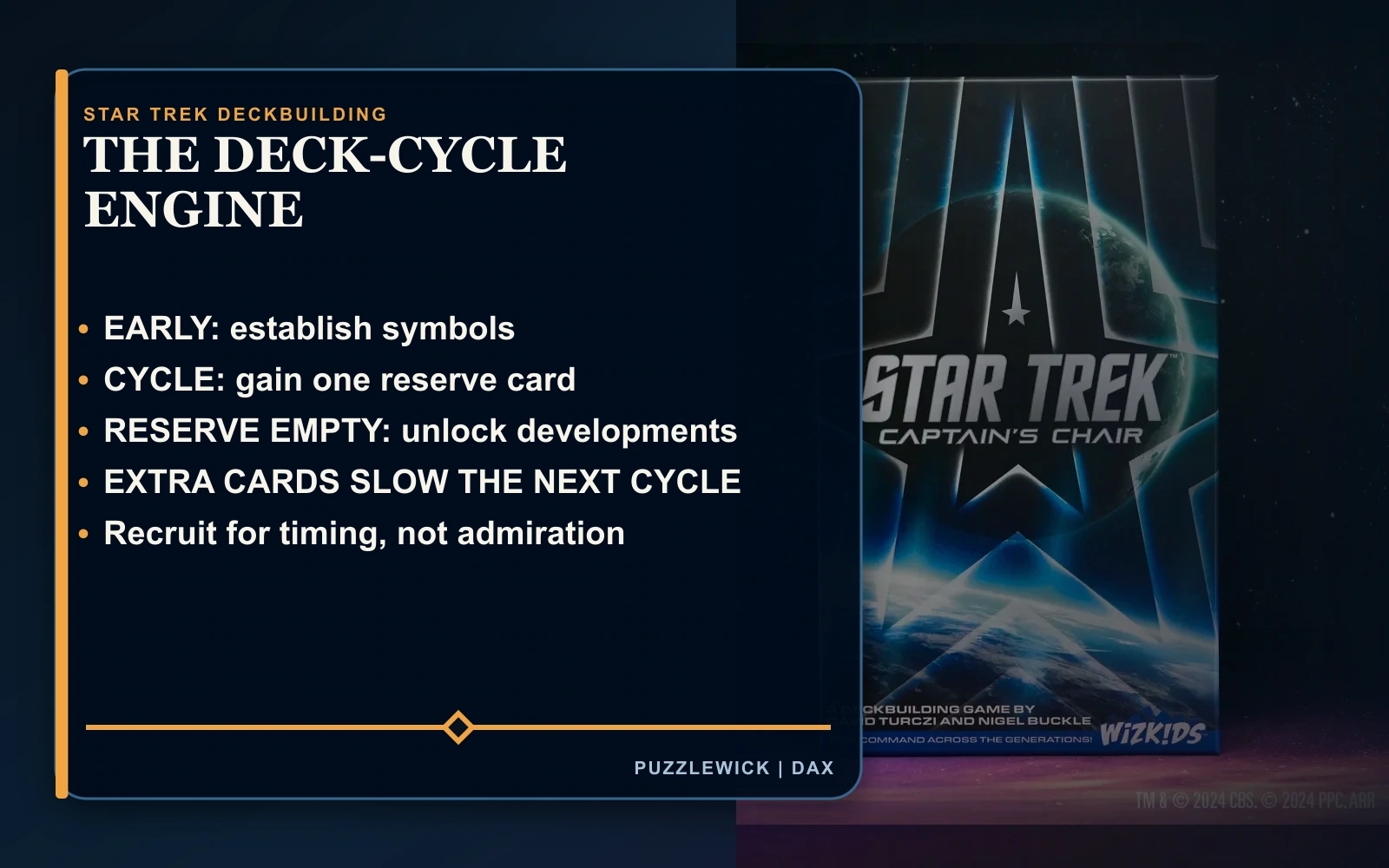
When your deck cycles, a reserve card joins it. After the reserve empties, powerful development cards become available. That creates a long arc inside one game: early turns establish the engine; later cycles reward the captain who prepared to exploit stronger tools.
Do not add every attractive market card. A larger deck delays the next cycle and the next reserve card. Buy or recruit when the card advances a scoring multiplier, repairs a missing symbol, or improves the next two turns. “It is good” is not enough. It must be good before the Stardate moves past it.
Hot take: deck-building games often pretend more cards mean more progress. Captain’s Chair is happiest when you learn to say no with authority.
After each game, keep a three-line captain log: the repeatable action that worked, the bottleneck that stole the most tempo, and the reserve card that arrived too early or too late. Change one decision in the rematch. Swapping captains immediately is tempting, but replaying the same matchup once exposes whether the loss came from the roster, the market, or your own deck bloat. Usually it was the deck bloat. The replicator cannot make that sentence taste better.
How to score without trying to do everything
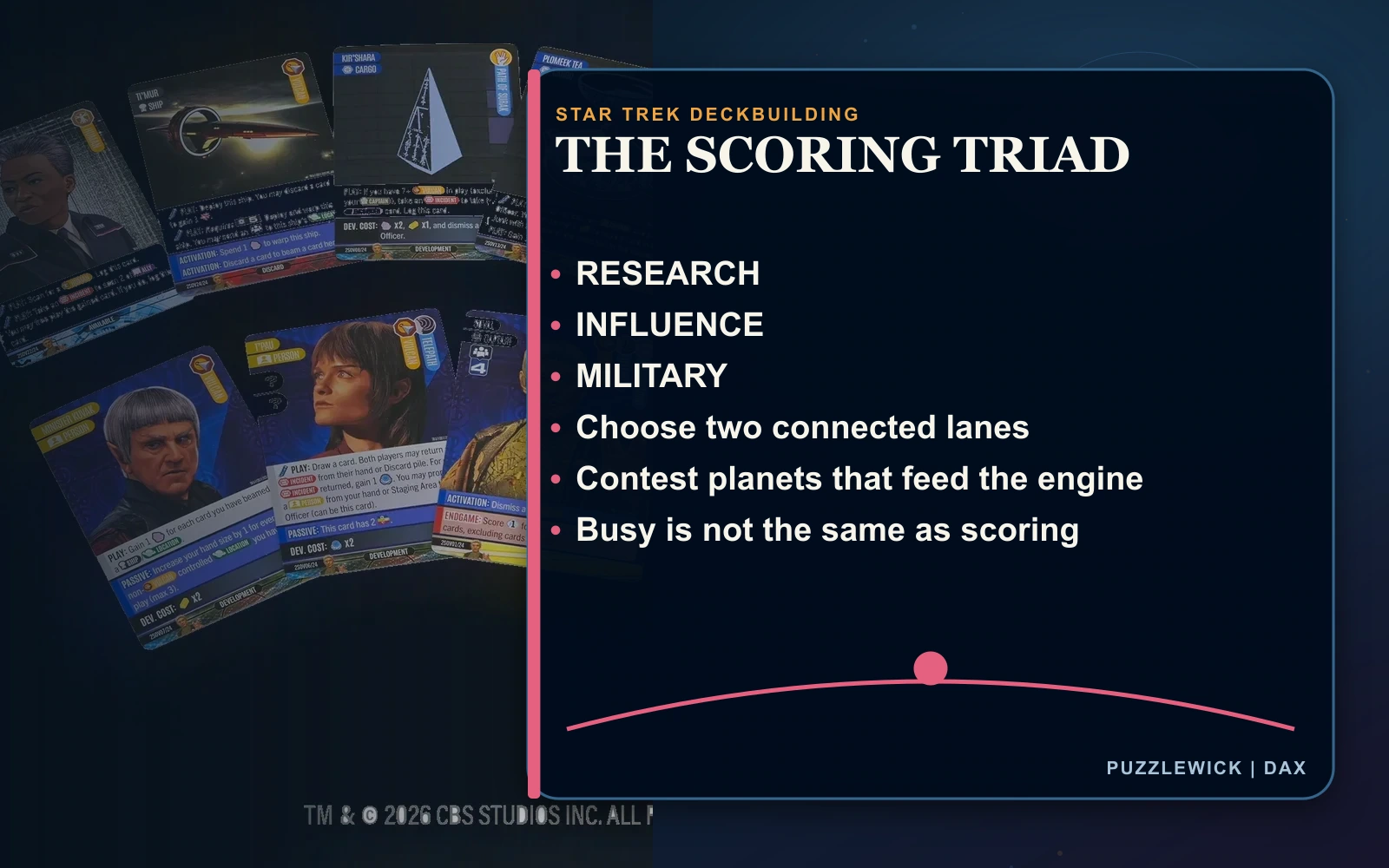
Research, influence and military strength can become multipliers rather than simple tracks to maximize equally. Read your captain, identify two connected scoring channels, and use the third only when the board or opponent makes it efficient.
Controlling neutral planets can unlock leverage and deny it to the opponent. Contest where the reward supports your engine. Fighting over every planet is a reliable way to become impressively busy and strategically homeless.
At the start of each Stardate, state one scoring objective and one tempo objective. At the end, ask whether the action tokens moved either. This tiny ritual catches the turns that feel active but score nothing.
What Second Contact adds
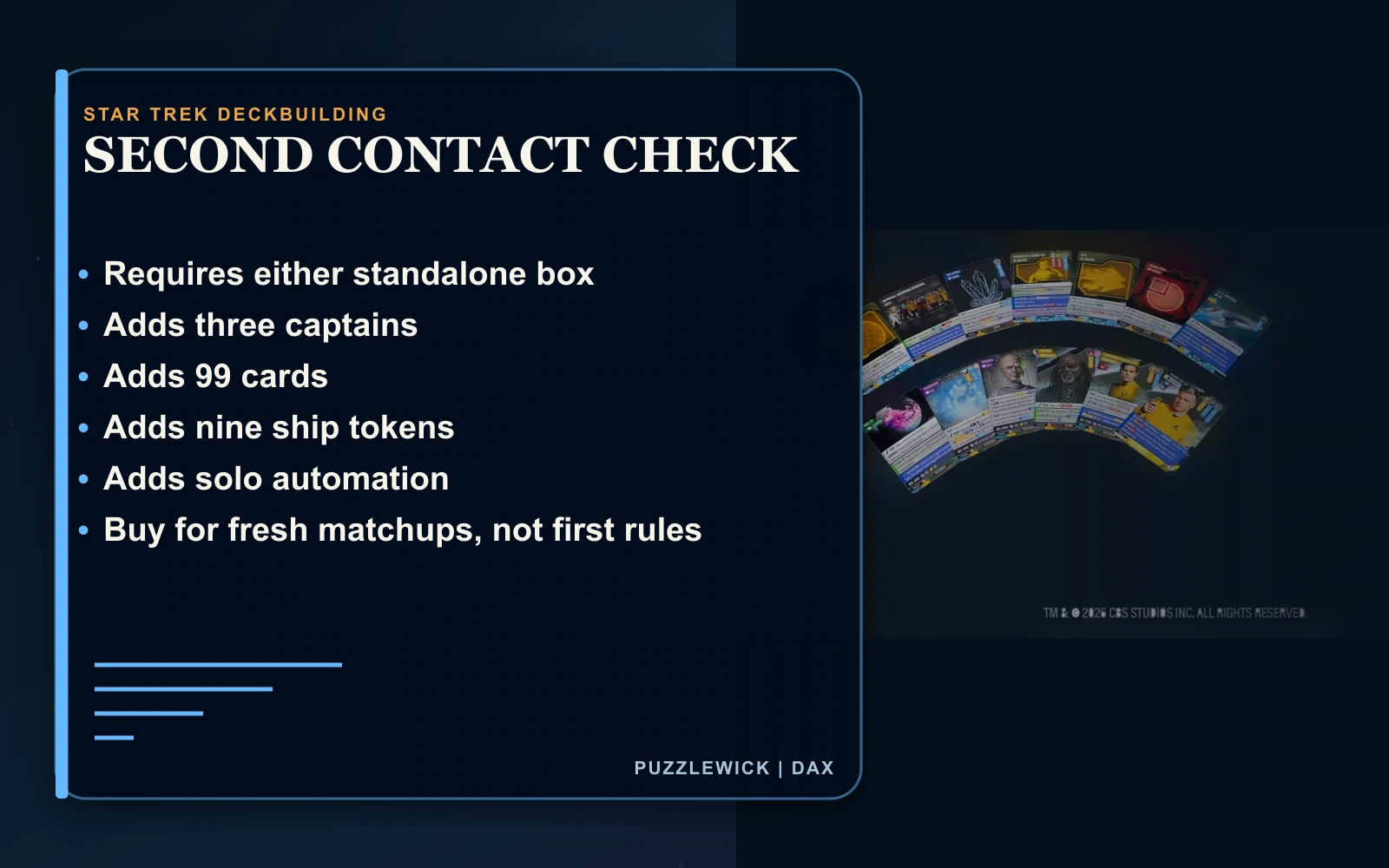
Second Contact adds three captains, including Carol Freeman and Christopher Pike, with 99 cards, nine ship tokens, six automated command cards and three crew boards. Its purpose is fresh asymmetry after a standalone box has taught the system.
Buy it when you can name the captain or matchup you want next. Skip it when the original six are still mostly unexplored. More captains increase replay breadth, not rules fluency.
Because it works with either standalone game, it is the family’s bridge product. That flexibility is useful, but the dependency remains absolute: it is not a discounted base game.
Is it worth buying, and what accessories help?
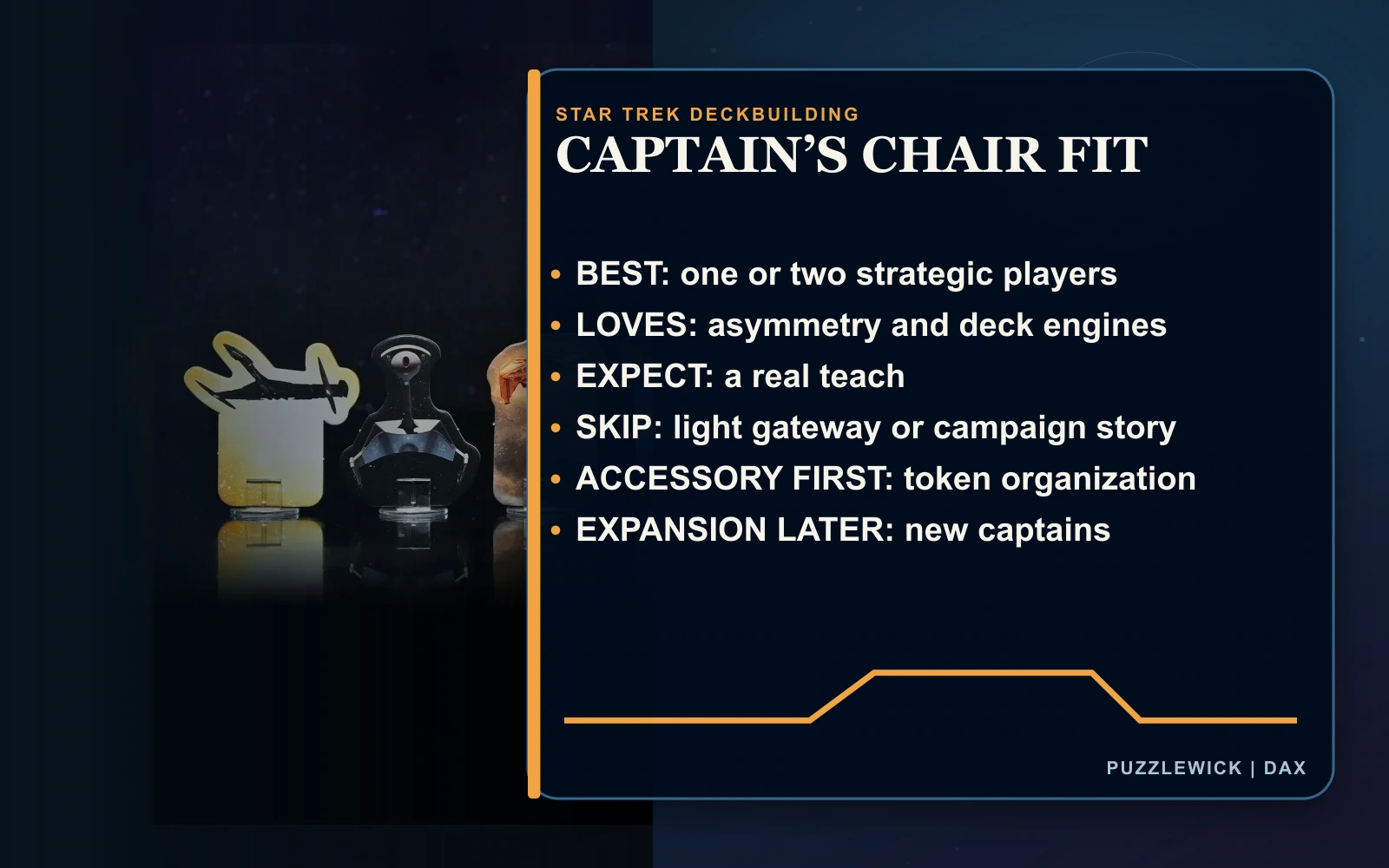
Captain’s Chair is worth buying for one or two players who want dense card-engine decisions, strong asymmetry and repeatable matchups. It is a poor fit for a group seeking a light Trek gateway, broad player counts or a story campaign.
Start with the exact base game or To Boldly Go, then add a token tray if setup friction bothers you. Sleeve only after checking card dimensions and deciding whether shuffling frequency justifies the bulk. A full-table mat improves card handling; a large carrying case helps only if the box leaves home.
The premium move is not buying every accessory. It is making the command area readable enough that both players can see why they lost.
What experienced tables keep reporting
Recurring owner patterns, synthesized in Puzzlewick's words. Follow each evidence trail to read the original discussion.
“A chunky Star Trek themed game with tons of replay value and rewarding gameplay.”
Current questions cluster around rules, organization, solo flow and the relationship among the three boxes.
The picks
Some links below are affiliate links — as an Amazon Associate, Puzzlewick earns from qualifying purchases, at no extra cost to you. It never changes a pick.
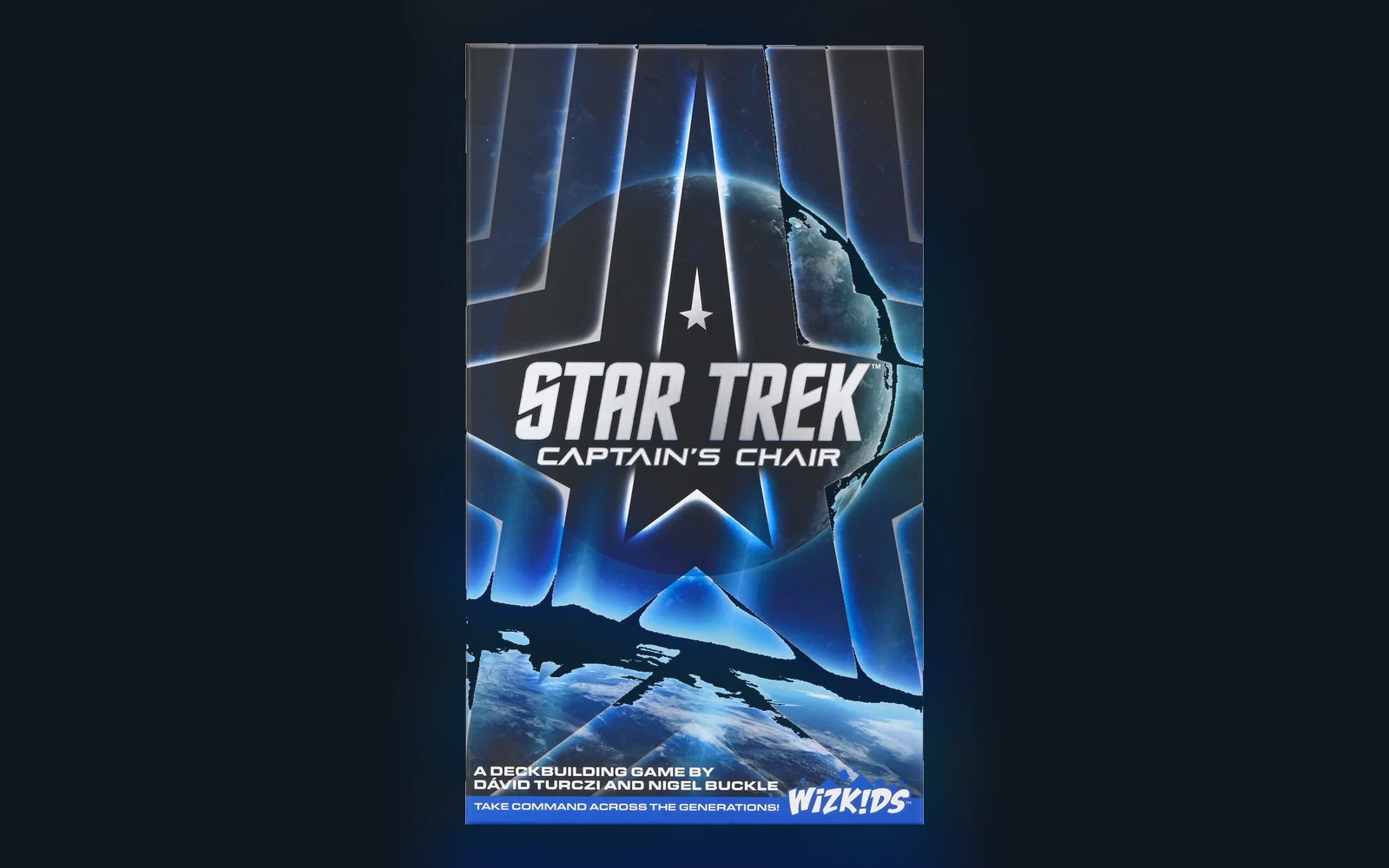
Star Trek: Captain’s Chair
The original standalone command box with six asymmetric captains and the clearest entry into this exact roster.
- Standalone
- Six captains plus solo system
- Substantial teach
- Only one or two players

Star Trek: Captain’s Chair Second Contact
A real expansion with fresh matchups. It requires the original or To Boldly Go.
- Works with either standalone box
- Adds solo automation
- Not playable alone
- Premature before the first roster is explored
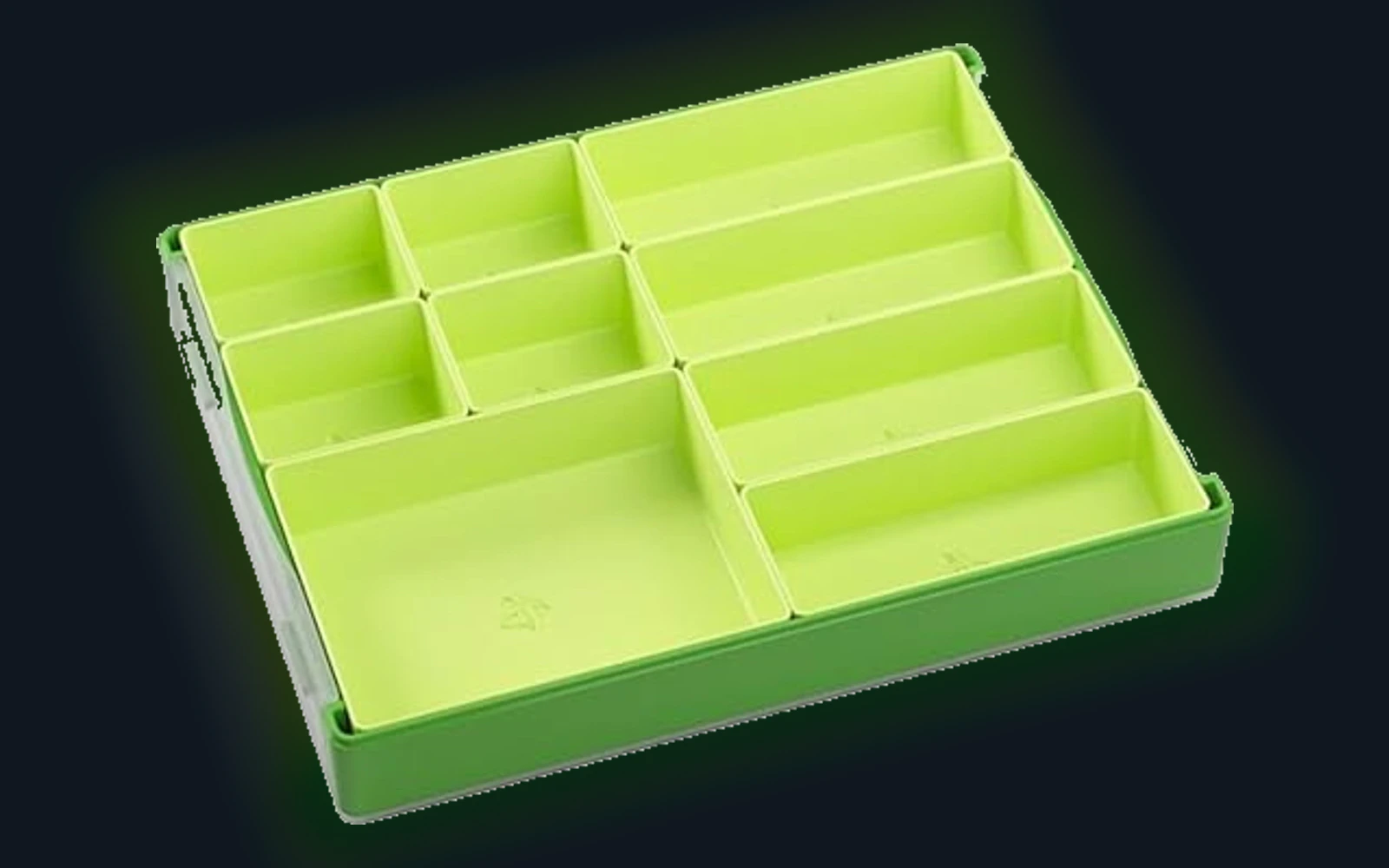
Gamegenic Token Silo Convertible
Nine removable trays can reduce setup and make shared pieces easier to read.
- Removable table trays
- Useful across games
- Too much for players who tolerate baggies
- Not an insert

Luck Lab Folding Token Trays, six pack
Folding bowls separate the busy table without claiming permanent shelf space.
- Compact
- Color separation
- Less polished than rigid trays
- Must be folded each session
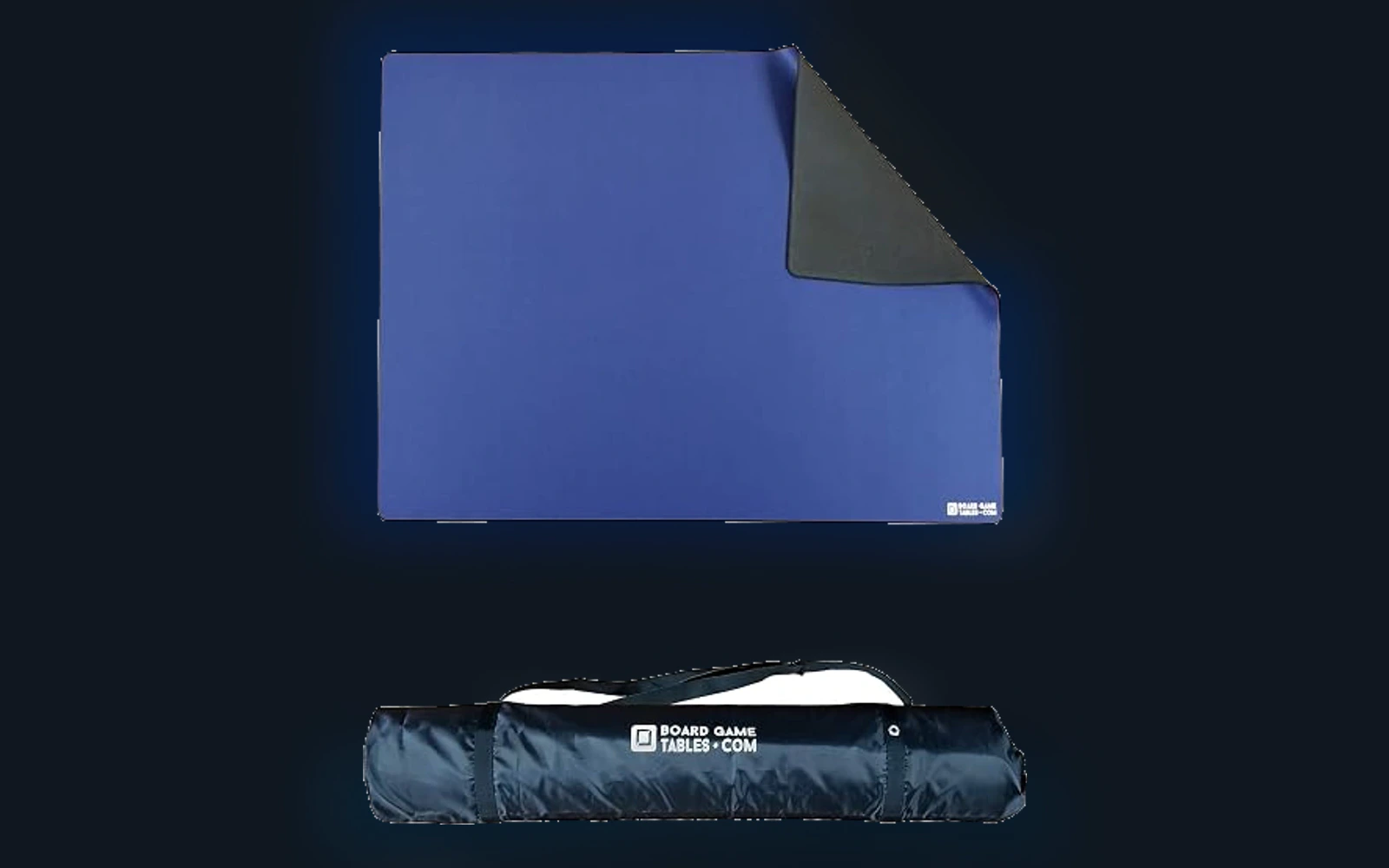
Allplay 3 by 5 Foot Board Game Playmat
A large stitched mat improves card pickup and keeps the command area visually coherent.
- Broad usable surface
- Cushioned card handling
- Needs storage space
- Measure the table first
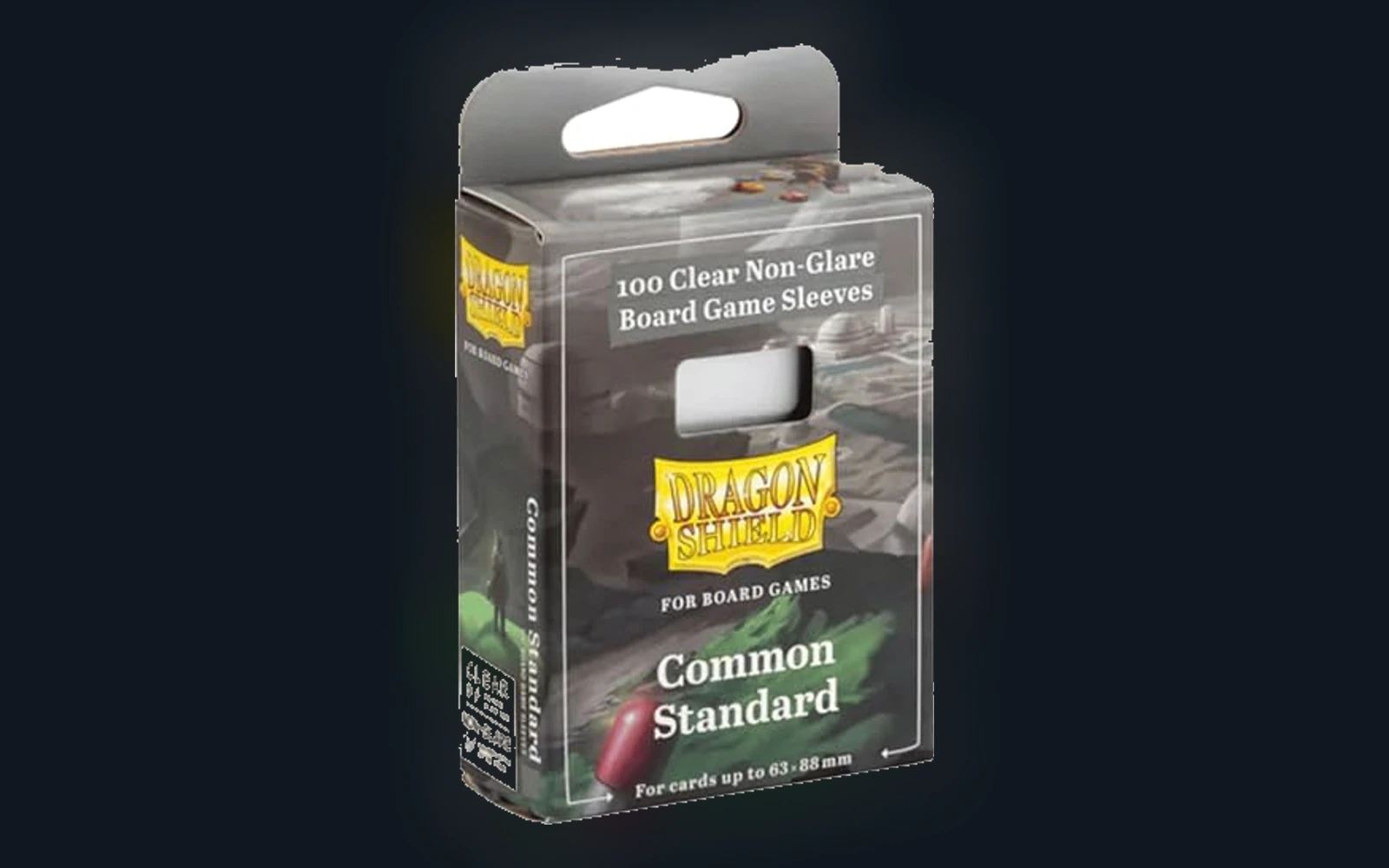
Dragon Shield Non-Glare Board Game Sleeves
A premium sleeve family, but size must be matched to the actual cards before ordering.
- Non-glare finish
- Established sleeve maker
- Not a universal size
- Adds bulk and setup time
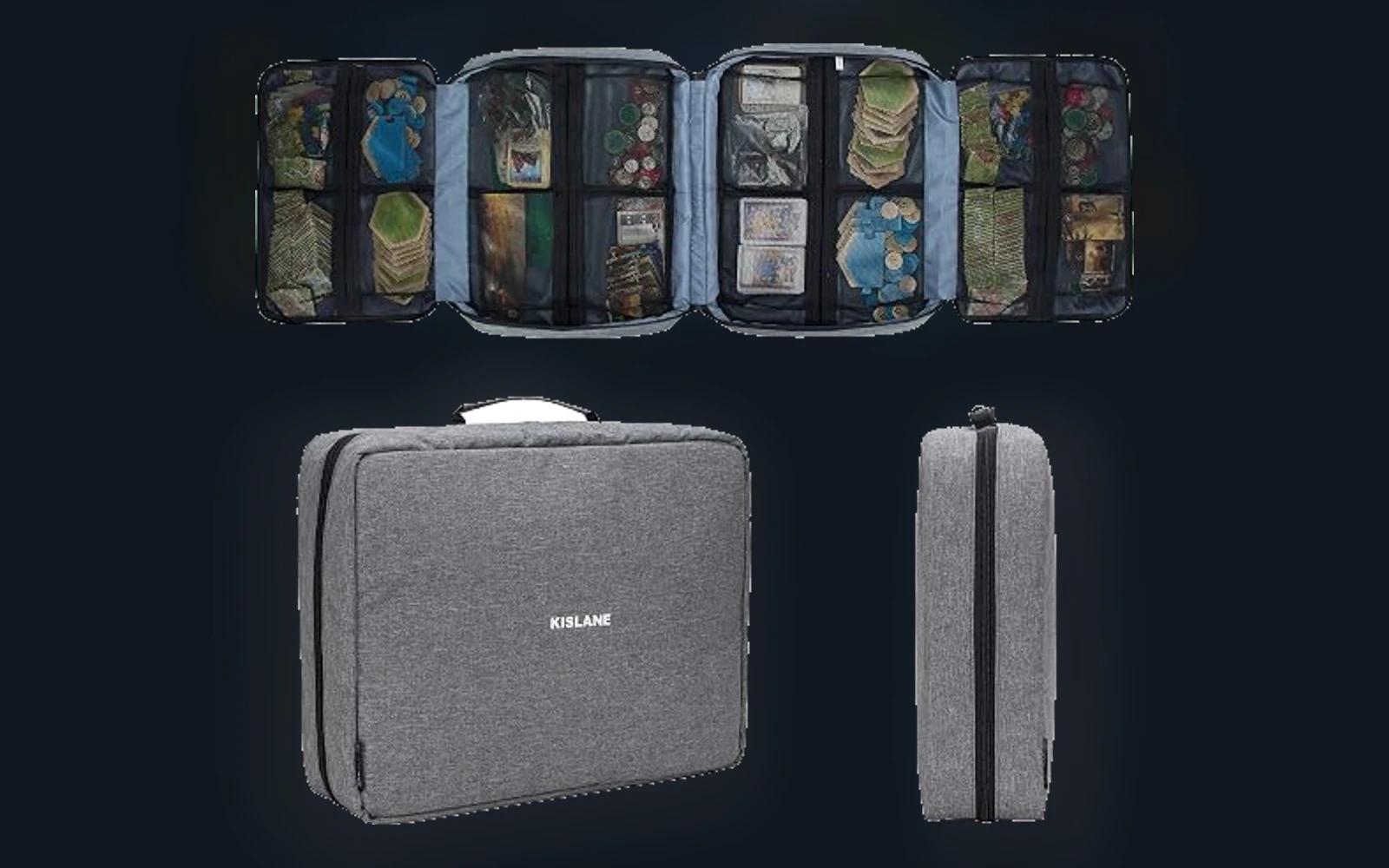
KISLANE Board Game Carrying Case
A transport option only after the exact box dimensions and route are measured.
- Multiple pockets
- Purpose-built carry
- Excessive for home-only play
- Fit must be checked
At a glance
| Product | Status | Leaders | Best for |
|---|---|---|---|
| Captain’s Chair | Standalone | Six | Original roster and first box |
| To Boldly Go | Standalone and combinable | Six new leaders | Alternate first roster |
| Second Contact | Expansion | Three | Owners seeking fresh matchups |
Free download — Captain’s Chair command console
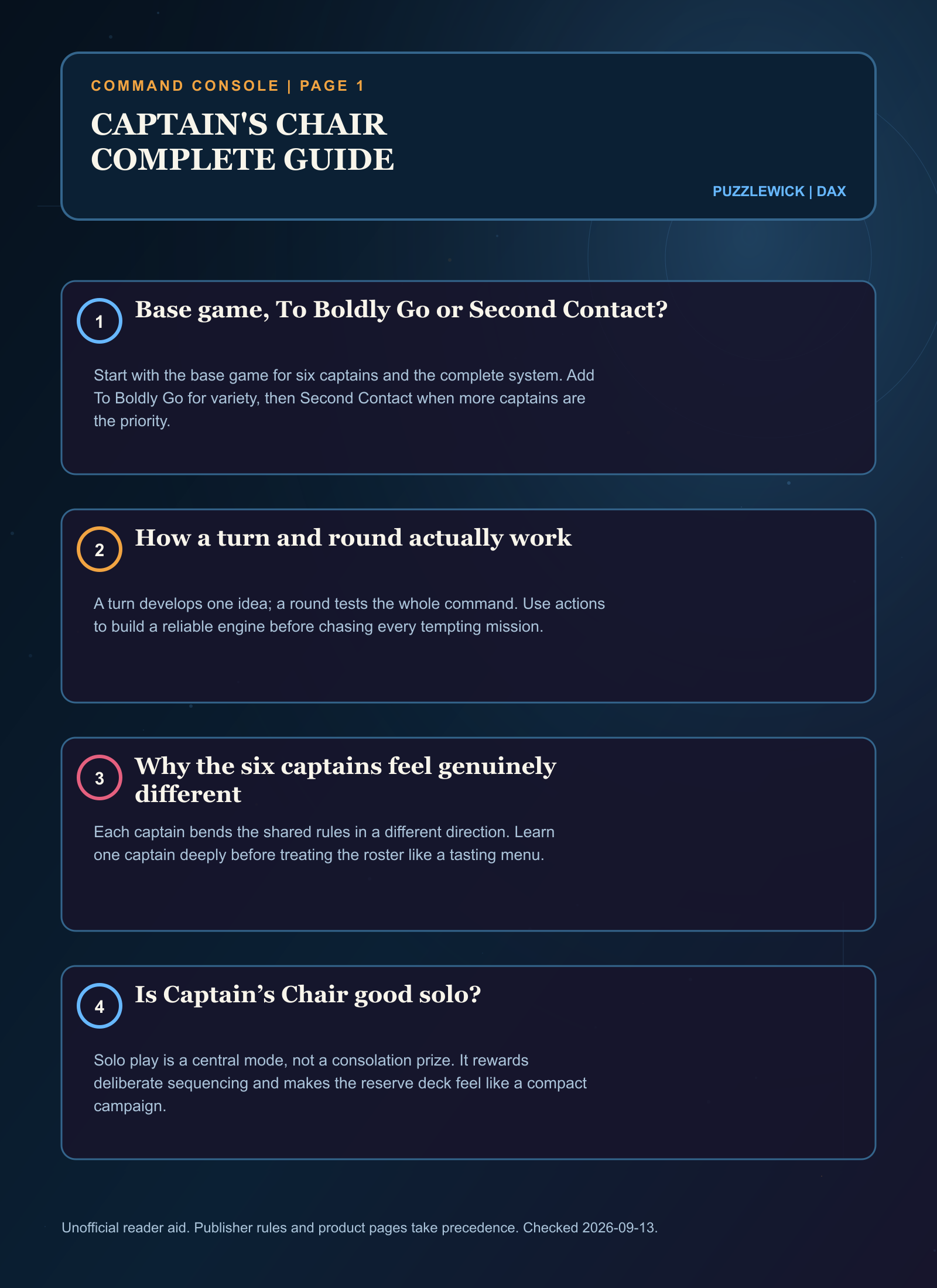
An unofficial two-page product tree, first-turn sequence, deck-cycle log and scoring focus card. Official WizKids rules take precedence.
Unofficial fan-made reference. Compiled by Puzzlewick from the sources listed on the sheet. Not affiliated with or endorsed by the publisher — always defer to the official rulebook.
Questions, answered
Is To Boldly Go an expansion?
No. WizKids describes it as a fully standalone game that can combine with Captain’s Chair.
Can I play Second Contact by itself?
No. It requires the original Captain’s Chair or To Boldly Go.
How many players does Captain’s Chair support?
The publisher lists one or two players.
Is Captain’s Chair a light game?
No. The shared turn verbs are teachable, but the asymmetric decks, market timing and scoring engines create a substantial learning curve.
How should a beginner improve?
Learn one captain solo, track wasted action tokens and late reserve cards, then focus each game on two connected scoring lanes.
Dax's verdict
Buy Captain’s Chair if one or two people want a demanding, repeatable Star Trek card engine with meaningful asymmetry. Choose one standalone box by captain roster. Add Second Contact after the original matchups have become familiar.
Skip it for a light Trek introduction or a campaign narrative. This is command as optimization, not a guided tour of the bridge.
Research ledger 10 sources · reviewed 2026-09-13
Specifications, rules, current product information, community experience, and contrary evidence were checked against the sources below. Commercial links are kept separate from editorial evidence.
- WizKids: Star Trek Captain’s Chairshop.wizkids.com/products/star-trek-captains-chair
- WizKids: Captain’s Chair To Boldly Goshop.wizkids.com/products/star-trek-captains-chair-to-boldly-go
- WizKids: Captain’s Chair Second Contactshop.wizkids.com/products/star-trek-captains-chair-second-contact
- Captain’s Chair rulebookboardgamegeek.com/filepage/281410/star-trek-captains-chair-rulebook
- BoardGameGeek: Star Trek Captain’s Chairboardgamegeek.com/boardgame/422541/star-trek-captains-chair
- BoardGameQuest Captain’s Chair reviewboardgamequest.com/star-trek-captains-chair-review
- WizKids shop product JSONshop.wizkids.com/products/star-trek-captains-chair.js
- WizKids Second Contact product JSONshop.wizkids.com/products/star-trek-captains-chair-second-contact.js
- TCGplayer current editorial surfacetcgplayer.com/content
- Puzzlewick research methodpuzzlewick.com/methodology
I'll be honest with you — flattery is boring.



Keep exploring
The next smart rabbit holes.
✦ Universe HubStar Trek Games: the whole buying pathStart with the experience, not the uniform. Magic | Star Trek spans teaching, Commander, Limited and premium collecting; Captain’s...✦ Topic PathBoard Game Buying Guides: compare the whole shelfStart with the decision, not the shelf. These guides compare the games, editions, expansions, player counts, and costs people...Campfire TaleStar Trek: The Customizable Card Game — The Game That Wouldn’t Die (2026 Homage & How to Play)A 30-year-old, out-of-print Star Trek card game that its own players refused to let die — and how, in 2026, a band of volunteers keeps it...