Star Trek: The Customizable Card Game — The Game That Wouldn’t Die (2026 Homage & How to Play)
A 30-year-old, out-of-print Star Trek card game that its own players refused to let die — and how, in 2026, a band of volunteers keeps it alive for free, world championships and all.


Written and reviewed by Robert Pruitt · how this guide was made
Last editorial refresh: 2026-06-24 Gold-standard QA: 2026-07-17 10 sources reviewed Affiliate links checked during gold-standard pass

The short answer
Star Trek: The Customizable Card Game is a 1990s deck-building game (Decipher, 1994–2007) where you complete missions and overcome dilemmas with away teams to score 100 points — and it's still actively played in 2026 because the fan-run Continuing Committee keeps both editions alive with free, printable cards and an annual World Championship.
Decision map
Choose in thirty seconds
The nostalgist who wants the original 1994 photo-cards in hand — the 'seed phase' purist's edition
I'll be honest — I walked past this one three times. A battered white box of photo-faced cards in a bin at a Saturday show, edges soft, somebody's old Federation deck still rubber-banded inside. Out of print since 2007. No publisher. No new product on any shelf, anywhere, for the better part of two decades. Every reason in the world to keep walking, and I did, twice, before I sat down with it.
The catch was — and this is the part that turned me around — this game isn't dead. It only looks dead from the outside. Decipher stopped printing it in 2007, sure. But the players didn't stop playing. They formed a committee, named themselves after the Romulan one from Deep Space Nine, and just... took it over. Free cards you print at home. Living rules updated last year. A World Championship that ran in Germany in 2025. I've held worse for worse reasons; I almost left a living thing in a bin because it didn't come with a price sticker from a store that still exists.
So this one stays — and this entry is less a buyer's guide than a love letter. To the cards, with their grainy 1990s screen-stills and their affiliation-colored borders. To the slow, strange ritual of sending an away team down to a planet and watching a face-down dilemma stop them cold. And most of all to the people who decided a good game shouldn't die just because the company that made it walked away. Let me show you what I found, and how you can play it tonight without spending a dime.
Start here, then go deeper
You are in the right cabinet.
 ✦ Topic PathBoard Game Buying Guides: compare the whole shelfStart with the decision, not the shelf. These guides compare the games, editions, expansions, player counts, and costs people...
 GuideWhich TCG Should You Start in 2026? Pokémon vs One Piece vs Lorcana vs Magic vs Yu-Gi-Oh! vs RiftboundDax ranks the real 2026 field by the table you can find, the rules you want to repeat, the first product that actually teaches, and the...
 ComparisonBest Deck-Building Card Games 2026: Dominion, Aeon's End, Marvel ChampionsDominion, Aeon's End, Clank!, and Marvel Champions solve deckbuilding in radically different ways. Here is the best first box, the real...
So what exactly is the Star Trek CCG — and why do those cards look like that?
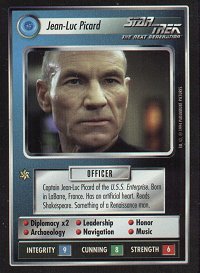

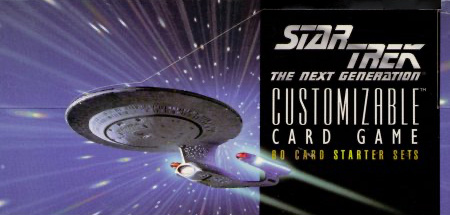
At its heart it's a customizable card game in the 1990s tradition: you build your own deck, sit across from someone who built theirs, and race to complete missions before they do. Decipher, a game company out of Norfolk, Virginia, launched it in 1994 — originally under the mouthful name Star Trek: The Next Generation Customizable Card Game — and the very first set, Premiere, was 363 black-bordered cards drawn from across the seasons of TNG.
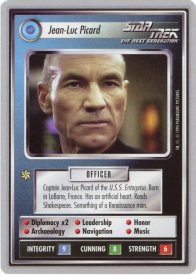
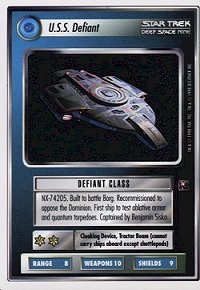
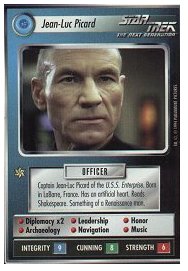
The look is the thing people remember first. Every card is a grainy photographic still lifted straight from the show — a screen-capture of Picard mid-order, a transporter room, a planet set. Personnel and Ships belong to affiliations (Federation, Klingon, Romulan and Non-Aligned at the start, later expanded to around sixteen, including Borg, Cardassian, Dominion, Ferengi and Bajoran), each with its own border color and a little affiliation icon tucked in the corner.
I find that aesthetic genuinely lovely now in a way it maybe wasn't meant to be. It's the texture of 90s television frozen onto cardboard — not slick illustration, but the actual show, pixels and all. You don't get that anymore. This one earned a shelf partly just for how honestly it wears its decade.
It's the texture of 90s television frozen onto cardboard — not slick illustration, but the actual show, pixels and all.
How did a hit game end up out of print?
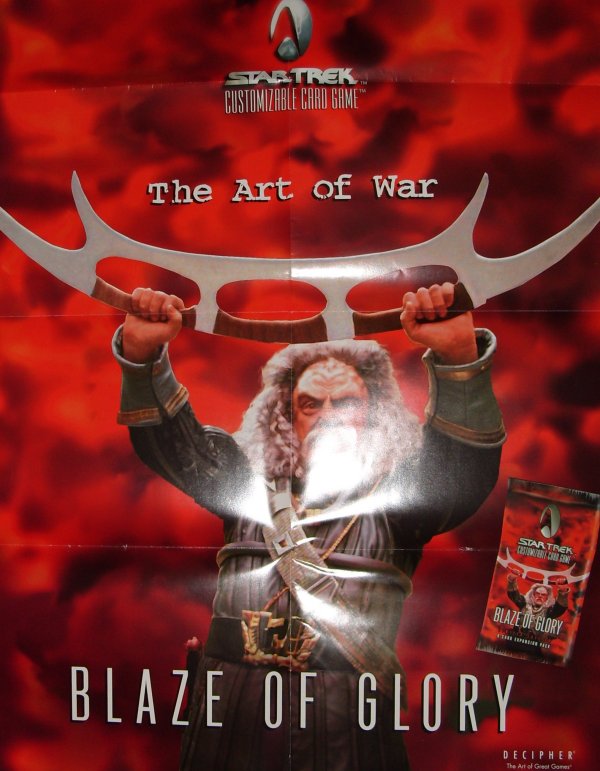
It wasn't for lack of love. With a run of more than thirteen years across two editions, the Star Trek CCG was both very popular and genuinely profitable for Decipher — this was a real player in the trading-card-game boom, not a footnote. Second Edition arrived in December 2002, a 415-card rebuild designed to clean up roughly seven years of accumulated First Edition complexity.
And that complexity was real. First Edition had no balanced 'cost' system for cards, so stopgap rules kept getting bolted on; card types grew from nine to seventeen-plus, and the rulebook swelled from around nine pages to over two hundred by the late 1990s. It made for a deep, beloved, occasionally unwieldy game with a famously steep learning curve.
Then, on December 5, 2007, Decipher announced it would stop releasing new sets and officially end support. The final official expansion, fittingly titled What You Leave Behind, shipped December 14, 2007. That's the moment most games quietly die. The catch — the thing I almost missed standing over that bin — is that this one didn't.
That's the moment most games quietly die. This one didn't.
Who saved it? (This is the part that made me love it.)
The same month Decipher walked away — December 2007 — the players formed a group to keep going. They called it The Continuing Committee, after the shadowy Romulan body from Deep Space Nine, and they meant the name literally. It's an all-volunteer, not-for-profit organization, registered in Washington State, run by a board of seven directors. Not licensed by Paramount. Not a company. Just fans who decided a good game shouldn't be allowed to end.
Here's the astonishing part. Rather than reselling old stock, the Committee makes new cards — free, downloadable, print-and-play 'virtual' expansions you print at home. They've now released more sets of cards than Decipher ever did. They maintain living rules and errata (the First Edition Dilemma Resolution Guide carries an update date of late 2024). They support three of the old Decipher games at once: First Edition, Second Edition, and Tribbles. And they run organized play right up to an annual World Championship — 'Worlds' 2025 was held in mid-August near Munich, Germany, with exclusive promos for each edition.
And they're still building. The Committee published a 2nd Edition Project Status Update for 2025/2026, with new sets in production. Nearly two decades after the company quit, the game is demonstrably, provably alive. As the Committee itself puts it, the Star Trek CCG never really died — when Decipher lost the license, the players just took over. That's the whole reason this one stays on my shelf. I've never seen a clearer case of a community refusing to let a thing they love go cold.
How do you actually play it?
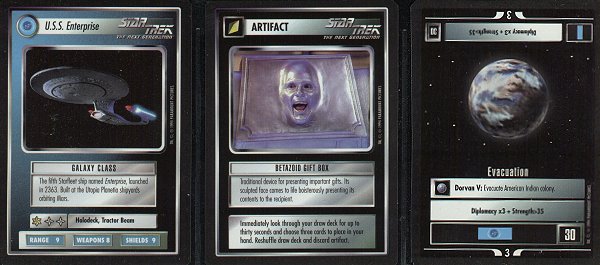
Strip away the deck-building and the strategy and the core loop is beautifully Trek: you go out, you encounter the unknown, you solve the problem with the right people. Both editions share the same goal — score 100 points, primarily by completing missions. (In First Edition you also have to complete at least one planet mission and one space mission.)
Each player brings exactly six missions and the two of you lay them out alternately to build a shared 'spaceline' — a row of locations, each worth points, each with a span (the travel distance to reach it). Some are planet missions, some are space missions. Then you start bringing your resources into play: Personnel, Ships, Equipment. Personnel are your engine — each one carries three numeric attributes (Integrity, Cunning, Strength), a classification (Officer, Engineer, Medical, Science, Security, V.I.P., Civilian or Animal), and one or more skills like Physics, Diplomacy, or Security.
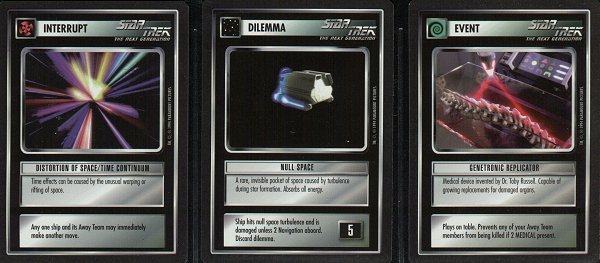
To score a mission you send an away team (or a ship's crew, in space) to attempt it. But missions are guarded by dilemmas — face-down hazards stacked underneath them. You encounter them one at a time, and depending on who you brought, a dilemma might stop your team cold, slow them, or do nothing at all. Clear the dilemmas, and if the survivors collectively have the skills and attribute totals the mission requires, you solve it and bank the points. Ships move your people along the spaceline and must be properly staffed to fly, with their own Range, Weapons and Shields. First to 100 wins. That's the game — Star Trek rendered as a puzzle of preparation and nerve.
You go out, you encounter the unknown, you solve the problem with the right people. That's the game — and that's Star Trek.
First Edition or Second Edition — what's the real difference?
This is the great friendly schism of the fandom, and it's worth understanding before you pick a door. Both editions win at 100 points by completing missions. What differs is how you get there.
First Edition (1994) opens with a setup ritual called the seed phase — a multi-step sequence (doorway, mission, dilemma, facility) where, before a single normal turn, players secretly place dilemmas, artifacts and outposts face-down under and around the missions. You're pre-building puzzle-traps for your opponent. It can run upwards of fifteen minutes, and the people who love 1E love it precisely because of that ritual; it tries to literally re-create moments from the Trek universe.
Second Edition (2002) threw out the long setup. It added a counter/cost economy — you get seven counters a turn and spend them to play cards (costs are printed in the top-left corner; only interrupts are free) — and replaced seeding with an on-the-fly method where you draw dilemma combinations from a side pile during play as your opponent attempts missions. It also broadened scoring slightly (you can earn points in battle), but kept the same mission-solving soul. The BoardGameGeek summary is the fairest framing I've found: 1E re-creates the theme, 2E trades a little theme for cleaner, more consistent play. Neither is wrong. Which one calls to you says a lot about why you're here.
What's it like to hold — and why does the nostalgia hit so hard?
There's a specific feeling to a deck of these. The cards are a little smaller in your memory than they are in your hand. The photos are soft, sometimes too dark, the way television looked before everything was 4K — and that softness is exactly what makes them feel like 1994 and not a reproduction of it. Sort a stack by affiliation and you get this quiet rainbow of border colors, Federation blue beside Klingon red beside Romulan green, each with its little corner icon.
I'll say the honest thing curators don't always say: a lot of the cards I love most are worn. Soft corners, a crease, somebody's pencil-checkmark on the back of an old starter. I love them more for it, not less. Every mark is a game somebody played, an away team somebody sent down, twenty-odd years ago, before the company quit and the fans took over.
One practical, loving caution, because it matters: the card art is Paramount/CBS and Decipher copyright, and it is not freely licensed. Even Memory Alpha's material is non-commercial-only. So if you fall for this game and want to write about it, link out to the official Continuing Committee galleries or Memory Alpha — don't re-host the scans. Love it out loud; just don't borrow the imagery.
Every mark is a game somebody played, twenty-odd years ago, before the company quit and the fans took over.
Three honest ways to start playing today
You don't need to track down a grail or spend real money to fall into this game. Here are the three doors, cheapest first.
1. Free print-and-play (the front door). Go to The Continuing Committee at trekcc.org, read the basic rulebook, and download the four 'Coming of Age' starter decks (Federation, Klingon, Romulan, Ferengi) — they're balanced against each other and stripped of confusing cards so you can actually learn. Print them, sleeve them over backer cards, and you're tournament-legal for the price of ink. The Committee's own FAQ confirms home-printed cards are legal in sanctioned play. This is the way in 2026.
2. A cheap First Edition lot (the nostalgist's door). Hunt eBay for a used Premiere / First Edition starter-and-booster lot. These were printed in enormous numbers during the 90s CCG boom, so they're cheap — buy 'played' condition, expect played condition, and don't let anyone charge you grail money for something that isn't rare. You'll get the original 1994 photo-cards in hand and the full seed-phase experience.
3. A Second Edition starter (the easy-on-ramp door). If you'd rather learn the streamlined game, grab a secondhand Second Edition (2002) starter — they turn up cheap too — and pair it with the free 2E rulebook from trekcc.org. Faster setup, gentler rules, same Trek soul. And if you want to play opponents online, there are community apps (including iPad play) that let you 'plug the cards in' and find a game.
Whichever door you pick, the destination is the same: a thirty-year-old game that a community decided to keep alive, waiting for one more away team to beam down.
Where to play it free — and find your crew
You don’t need anyone’s permission — or a single dollar — to start. Everything here is live and free.
▶ Play it free. The Continuing Committee hosts every card as a high-resolution printable PDF. Begin with their new-player guide, “So, you want to play Star Trek CCG?”, pull the printable cards from the First Edition or Second Edition hubs, and skim the FAQ & print policy — home-printed cards are tournament-legal when sleeved over a backer.
▶ Find your people. The Continuing Committee forums (rules, deck designs, organized play, tournament reports), the r/StarTrekCCG subreddit, and the long-running Trek BBS thread. For the record, BoardGameGeek keeps both editions: First Edition and Second Edition.
▶ Tournaments & the World Championship run through the Committee’s organized-play program — schedules, results, and tournament reports all live on their forums. Show up, and you’ll meet the people who kept this game alive.
About the images on this page
The card, box, and marketing images here are reproduced for commentary and reporting. Star Trek and all related artwork are © Paramount/CBS; the game and its card designs are © Decipher, Inc. Card and box scans appear courtesy of the long-running fan archives at jklm.net and wixiban.com; the wide atmosphere images are original art made for this piece. Most of all, our thanks to The Continuing Committee — the volunteers who keep this game alive and freely playable. If this piece made you curious, support and join them. The sealed Premiere starter-box thumbnail is a retailer product photo via CategoryOneGames. We do not re-host the Committee’s own tournament or event photos — those belong to the people who took them; follow the links above to see them at the source.
What experienced tables keep reporting
Recurring owner patterns, synthesized in Puzzlewick's words. Follow each evidence trail to read the original discussion.
The Star Trek CCG never really died — when Decipher lost the license in 2007, the players just took over. The Continuing Committee is an all-volunteer, not-for-profit group that keeps three games (1E, 2E and Tribbles) alive with free, printable 'virtual' card sets and runs real tournaments, including a yearly World Championship. That fan-run revival is the single biggest reason the game still has a pulse in 2026.
The Continuing Committee (trekcc.org) — mission/about
You may print copies of any and all cards on your home printer, and printed cards are legal in tournament play if they are sleeved and backed by a physical card. Every virtual set has an associated high-resolution PDF you can print for personal use — so the modern way into the game is genuinely free.
trekcc.org STCCG FAQ / Printing-cards forum
Best way to start as a new player: read the basic Rulebook and download the four 'Coming of Age' starter decks (Federation, Klingon, Romulan, Ferengi). They're balanced against each other, come with a quick-start guide, and were deliberately built with no Alternate-Universe cards and no confusing shared missions so newcomers can actually learn the game.
trekcc.org forum — "Best way to start for a new player?"
Yes, people still play it. It's been over a decade since the last physical expansion, but the game lives on under the Continuing Committee — and you can play both 1st and 2nd Edition on the computer through apps that let you plug the cards in, including an iPad app for playing other people online.
The Trek BBS — "Does anyone still play the Star Trek CCG?"
First Edition is the one a lot of the longtime faithful love best — there's a vocal contingent who describe themselves as exclusively 1E players and prefer the original 'seed phase' mission-and-dilemma feel to the streamlined later edition. The flip side: even devoted groups admit finding live opponents can be hard, so friends often get together just once or twice a year for a couple of games.
The Trek BBS — "Anyone still play Star Trek CCG (1E)?"
The classic 1E vs 2E debate: First Edition tries to literally re-create moments from the Star Trek universe, while Second Edition (2002) added a counter/cost system and an 'on-the-fly' dilemma method to replace 1E's lengthy seed phase that could run 15+ minutes — trading some theme for cleaner, more consistent gameplay. Which you love says a lot about why you're here.
BoardGameGeek — "Comparing 1st & 2nd Edition STNG CCG"
With a run of over thirteen years across two editions, the Star Trek CCG proved to be both very popular and profitable for Decipher — players complete missions at discrete locations while stopping their opponent from doing the same. That depth of deck-building and the genuine Trek theme is why veterans still rate it among the best franchise card games ever made.
BoardGameGeek — Star Trek Customizable Card Game listing
The picks
Some links below are affiliate links — as an Amazon Associate, Puzzlewick earns from qualifying purchases, at no extra cost to you. It never changes a pick.
 7 photos
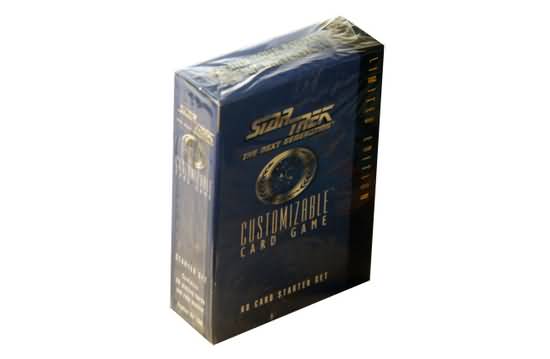
 Star Trek: The Next Generation Premiere Starter Deck (60 cards, random)
This sealed 60-card Premiere starter is the cleanest exact Amazon route we verified into First Edition, not a promised starter-and-booster lot. First Edition is the original 1994 game, built around the elaborate seed phase where both players hide dilemmas beneath missions before normal turns begin. The ritual is distinctive and gloriously period-specific, but one random starter is a historical sampler rather than a guaranteed balanced pair of decks. Buy it for the artifact and the learning project; use community deck lists or a second known deck before expecting a fair weekly matchup.
- The original 1994 cards — true 90s photo-on-card nostalgia in hand
- The 'seed phase' is a genuinely distinct, strategic, theme-rich ritual
- Cheap on the secondary market — printed in huge quantities
- Still actively supported with new free virtual cards by the CC
- Finding regular live 1E opponents can be genuinely hard
- Rules ballooned over the 90s — steeper learning curve than 2E
- Condition on cheap eBay lots is a gamble; buy 'played,' expect played
At a glance
| feature | first edition | second edition |
|---|---|---|
| Released | 1994 (Decipher) — Premiere, 363 cards | December 2002 (Decipher) — 415-card relaunch |
| Setup / dilemmas | Multi-step 'seed phase' — pre-place dilemmas before play (can run 15+ min) | 'On-the-fly' — draw dilemma combos from a side pile during play |
| Resource system | No unified cost system (rules grew patchwork over time) | Counter/cost economy — 7 counters per turn, spend to play cards |
| Complexity / learning curve | Deep but heavy; rulebook grew to 200+ pages, steep for beginners | Deliberately streamlined; far easier to learn |
| Card look | 1994 black-bordered photo-stills, affiliation-colored borders | Same photo-on-card aesthetic, refreshed layout with printed costs |
| Win condition | Score 100 points (must solve ≥1 planet AND ≥1 space mission) | Score 100 points; scoring slightly broadened (e.g., battle) |
| Best for | Purists who love theme and the seed-phase ritual | New players and groups wanting fast, consistent games |
| Still supported in 2026? | Yes — free virtual sets + tournaments from The Continuing Committee | Yes — new sets in production for 2025/2026 from the CC |
Questions, answered
Is the Star Trek CCG still playable in 2026?
Yes. Although Decipher stopped official support in December 2007, the all-volunteer, non-profit Continuing Committee (trekcc.org) keeps both First Edition and Second Edition alive in 2026 with free printable cards, living rules, and tournaments — including new sets in production for 2025/2026.
How much does it cost to start playing?
It can cost nothing. The Continuing Committee hosts every card as free high-resolution PDFs you print at home, and home-printed cards are tournament-legal when sleeved and backed by a physical card. Your only outlay is ink, sleeves, and backer cards. Cheap secondhand original starters are also widely available on eBay.
What's the difference between First and Second Edition?
First Edition (1994) uses a setup 'seed phase' where you pre-place dilemmas before play and is theme-maximalist but rules-heavy. Second Edition (2002) added a counter/cost economy and an 'on-the-fly' dilemma method, making it faster to start and easier to learn. Both win at 100 points by completing missions, but they are separate, non-cross-compatible games.
Which edition should a beginner start with?
Most newcomers find Second Edition easier thanks to its streamlined counter system and on-the-fly dilemmas. Either way, the recommended first step is free: download the Continuing Committee's 'Coming of Age' starter decks (Federation, Klingon, Romulan, Ferengi), which are built balanced and beginner-friendly with no confusing cards.
What is the goal of the game?
Score 100 points, primarily by completing missions. You build a deck, lay out six missions to form a shared 'spaceline,' then send away teams of personnel (or ship crews in space) to attempt missions — overcoming face-down 'dilemmas' that block your path. Clear the dilemmas and meet the mission's skill and attribute requirements, and you bank its points. First to 100 wins.
What is The Continuing Committee?
The Continuing Committee (trekcc.org) is the all-volunteer, not-for-profit fan organization that took over the game when Decipher ended support in December 2007. Registered in Washington State and run by a board of seven directors, it produces free 'virtual' card expansions, maintains the rules, and runs organized play including an annual World Championship across First Edition, Second Edition, and Tribbles.
Can I legally print and play the cards?
Yes — per the Continuing Committee's own FAQ, you may print copies of any and all cards on your home printer, and printed cards are legal in tournament play if they are sleeved and backed by a physical card. Note this applies to playing the game; the card art itself is Paramount/CBS and Decipher copyright and should not be re-hosted commercially.
Are original cards rare or valuable?
Generally no. The original sets — especially Premiere / First Edition — were printed in huge quantities during the 1990s CCG boom, so used starter-and-booster lots are inexpensive on the secondary market. Buy in 'played' condition and don't overpay; common cards from this game are not rare.
Can I play online or against other people remotely?
Yes. Community-made apps let you play both First and Second Edition on the computer by 'plugging the cards in,' including an iPad app for online play against others. The Continuing Committee's organized play also includes in-person events up to a global World Championship held annually.
Keeper's verdict
I almost left this one in a bin because it didn't come from a store that still exists. That would have been a mistake — not a collector's mistake, a human one. The Star Trek CCG is a beautiful, slightly unwieldy, deeply Trek game wrapped in the soft grain of 1990s television, and the reason it earned a shelf isn't its photo-cards or its missions or its seed phase. It's the people. A volunteer committee looked at a game their favorite company had abandoned and simply decided no. They print new cards for free. They write the rules. They fly to Germany to crown a champion. Start with the free 'Coming of Age' starters at trekcc.org tonight — you have no excuse not to — and if you fall for it, chase a cheap Premiere lot or a 2E starter for the cards in hand. I paid almost nothing for mine and I'd have happily paid more, but the real value here was never the price. It's a piece I'd be sad to lose, kept alive by people who refused to lose it. This one stays — and so, it turns out, does the game.
Research ledger 10 sources · reviewed 2026-07-17
Specifications, rules, current product information, community experience, and contrary evidence were checked against the sources below. Commercial links are kept separate from editorial evidence.
- trekcc.orgtrekcc.org/op/1e_rulebook/index.html
- trekcc.orgtrekcc.org/1e/rules.php
- trekcc.orgtrekcc.org/2e
- trekcc.orgtrekcc.org/faq.php
- trekcc.orgtrekcc.org/articles/?articleID=2801
- trekcc.orgtrekcc.org/op/rulebook.pdf?v=2015-04-06
- boardgamegeek.comboardgamegeek.com/boardgame/4038/star-trek-customizable-card-game
- memory-alpha.fandom.commemory-alpha.fandom.com/wiki/Star_Trek_Customizable_Card_Game
- garak.itgarak.it
- en.wikipedia.orgen.wikipedia.org/wiki/Star_Trek_Customizable_Card_Game
If it didn't earn a shelf, it isn't here.
Keep exploring
The next smart rabbit holes.
✦ Topic PathBoard Game Buying Guides: compare the whole shelfStart with the decision, not the shelf. These guides compare the games, editions, expansions, player counts, and costs people...GuideWhich TCG Should You Start in 2026? Pokémon vs One Piece vs Lorcana vs Magic vs Yu-Gi-Oh! vs RiftboundDax ranks the real 2026 field by the table you can find, the rules you want to repeat, the first product that actually teaches, and the...ComparisonBest Deck-Building Card Games 2026: Dominion, Aeon's End, Marvel ChampionsDominion, Aeon's End, Clank!, and Marvel Champions solve deckbuilding in radically different ways. Here is the best first box, the real...