The Light in the Mist Review 2026: Beautiful Tarot Mystery or Too Abstract?
Yumi opens PostCurious’s tarot puzzle without spoiling a single solution: difficulty, hints, player count, playtime, resetability, story, and the honest Amazon answer.

AI-assisted curator persona · research and editorial responsibility: Robert Pruitt · how this guide was made
Last editorial refresh: 2026-08-12 Gold-standard QA: 2026-08-11 9 sources reviewed Affiliate links checked during gold-standard pass

The short answer
The Light in the Mist is worth it for experienced puzzle solvers, literary mystery fans, and patient solo players or pairs. Its nonlinear tarot deck is beautiful and unusually inventive, but it is harder and more abstract than an EXIT starter box, it works best at one or two players despite the 1–4 player range, and its value comes from one long, memorable solve rather than replay competition. As of August 11, 2026, Puzzlewick could not verify an exact Amazon US listing for the game, so this guide does not attach a misleading Amazon button to it.
Decision map
Choose in thirty seconds
New puzzle-game groups that want a gentler first box and a clear hint ladder.
Groups that want resettable cards, app-supported hints, and multiple adventures in one box.
A missing friend. A deck that behaves like a story, an art object, and a box of lateral-thinking problems at the same time. The Light in the Mist has the kind of premise that makes a purchase feel inevitable. The useful review begins after the enchantment works: can your table actually solve it, how many people should sit down, when should you ask for a hint, and what does “one-and-done” really mean here?
We checked the current PostCurious product page and catalog, the designer’s development notes, BoardGameGeek discussion, spoiler-free escape-game reviews, and recent player reports. The conclusion is deliberately sharper than a star score. This is a remarkable puzzle object for the right brain and a frustrating first puzzle box for the wrong night.
Start here, then go deeper
You are in the right cabinet.
 ✦ Topic PathBoard Game Buying Guides: compare the whole shelfStart with the decision, not the shelf. These guides compare the games, editions, expansions, player counts, and costs people...
 Buying GuideEXIT: The Game Complete Buying Guide—Where to Start, Difficulty, Hints, and the Best BoxesYumi builds a spoiler-free route through EXIT: The Game, from beginner boxes to intermediate adventures, with hint etiquette, hosting,...
 ComparisonEXIT vs Unlock! vs Deckscape: Which Escape-Game Series Should You Buy? (2026)Okay so — three card-sized escape rooms, three completely different philosophies about what a room IS, and the room has been *saying*...
Is The Light in the Mist worth it?
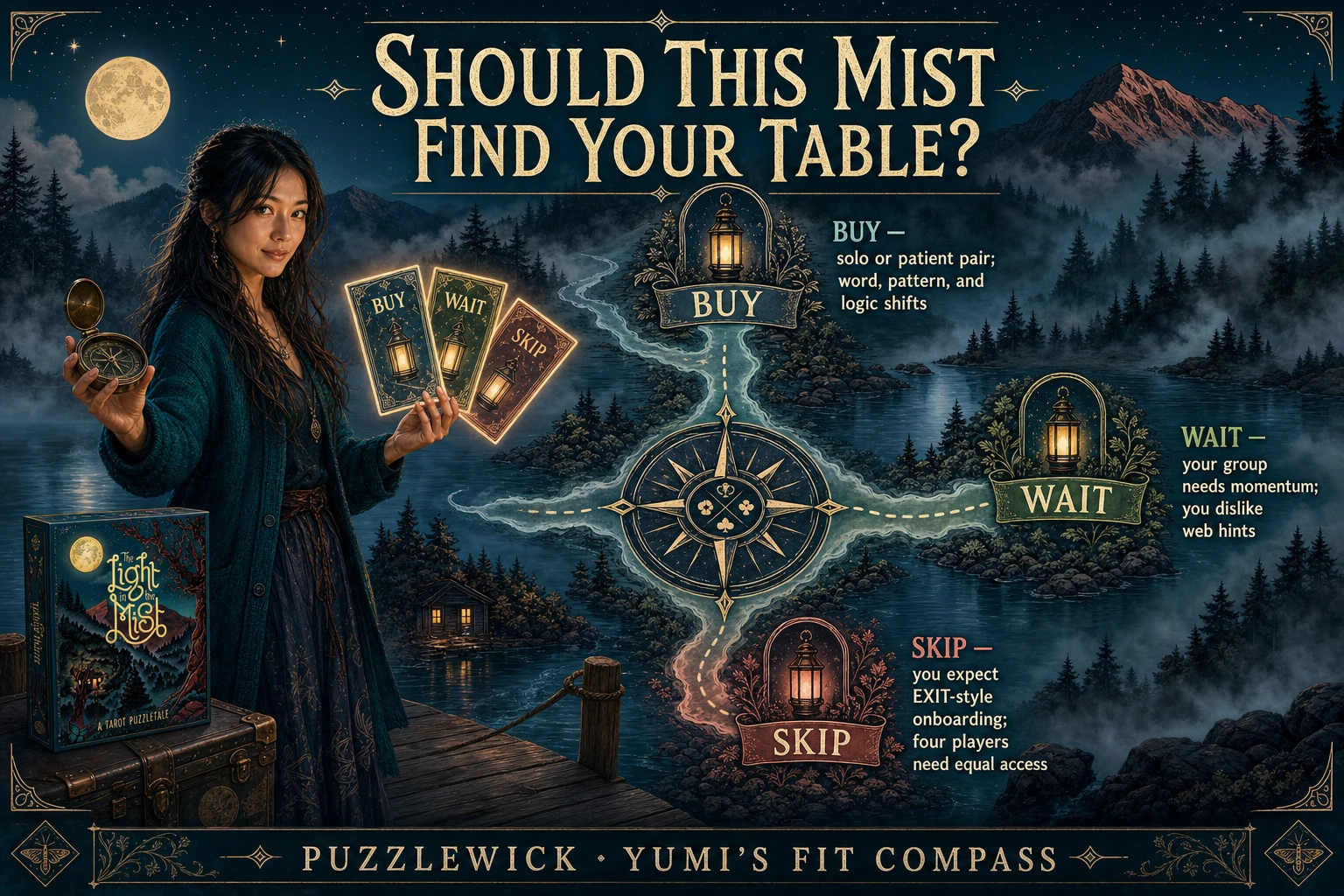
Buy it when your favorite puzzle moment is the quiet click after twenty minutes of looking at the same object differently. Wait when your group is new to boxed escape games. Skip it when four people need equal access to every clue or when a puzzle night must finish in ninety minutes.
PostCurious describes a nonlinear narrative puzzle told through a tarot deck. That format is the triumph: each card can be image, object, index, and story fragment without turning the table into a pile of envelopes. It is also the source of the difficulty. The game often asks you to infer the language of a puzzle before you can solve it. Experienced puzzle-hunt players praise that originality. Several newcomers report that the same leaps feel abstract even after opening hints.
Yumi’s verdict is 8.7/10 for experienced solvers, 6.5/10 as a first puzzle game. The artwork, physical cohesion, and variety are exceptional. The onboarding assumes more patience than the cover’s warmth suggests.
What do you actually do in The Light in the Mist, without spoilers?

You inspect illustrated cards, combine visual and written information, test patterns, solve word and logic problems, and use answers to open more of the story. The major arcana give the experience a nonlinear spine: when one line of thought goes cold, another card can become tonight’s case.
There is no need to memorize tarot meanings before starting. Familiarity may make the imagery feel richer, but the game must teach the information required for its own solutions. Bring paper and a pencil anyway. The most useful notes are not transcripts. Write what changed, which symbols recur, and the theory you are currently testing. That creates a clean restart after a break.
The game’s physical restraint is part of its intelligence. Rather than burying the player under disposable packets, it asks a relatively small object to keep changing jobs.
How hard is The Light in the Mist, and when should you use hints?
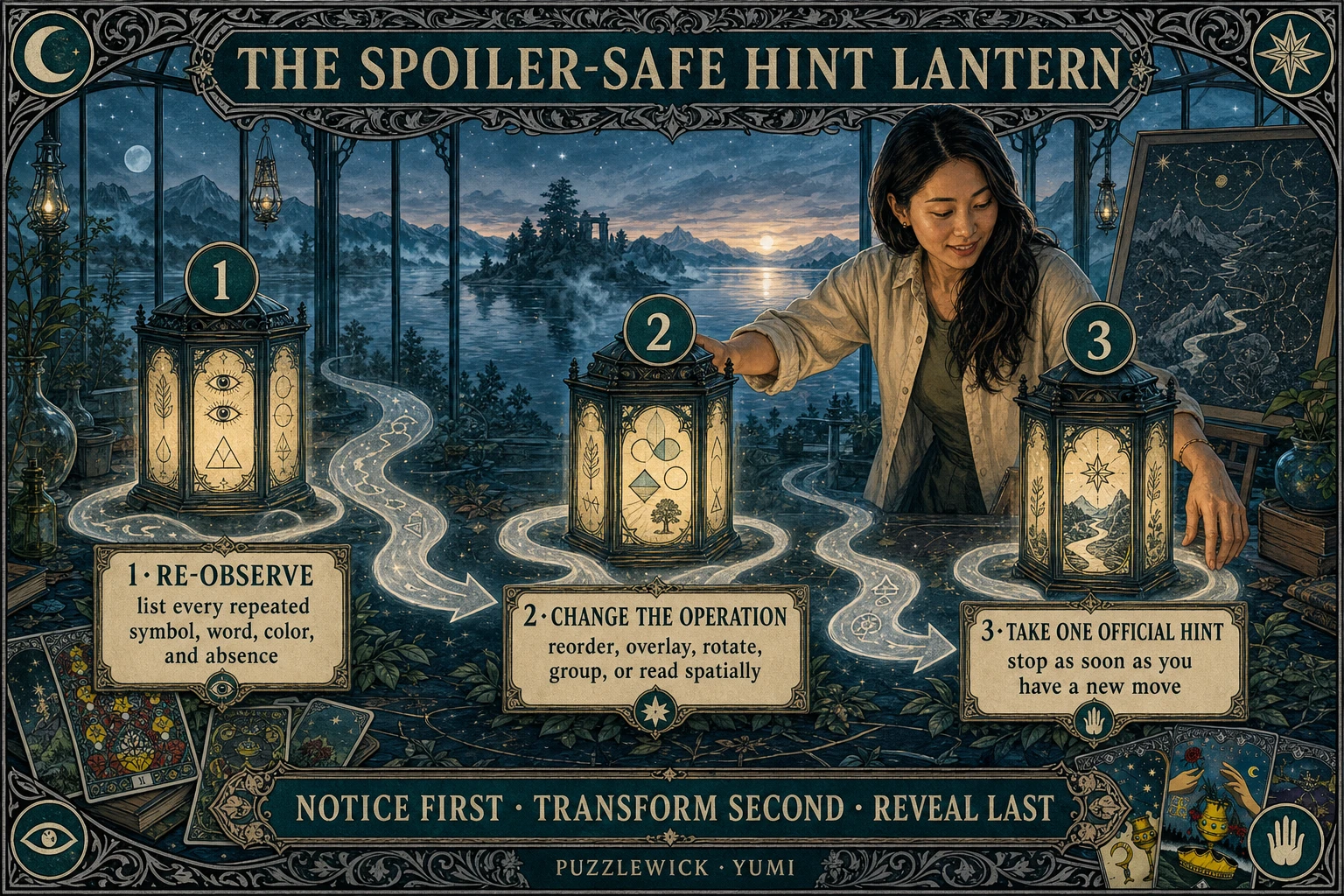
Treat it as intermediate-to-hard, not as a beginner box. The challenge is not a uniform climb. One puzzle may reward wordplay, another spatial inspection, another pattern recognition. That variety lets a pair trade leadership, but it also means a group can move from effortless to baffled without warning.
Use the official hint system as a ladder. First identify the card or object family you believe is active. Then open only the smallest nudge. Spend another focused ten minutes before taking the next step. The goal is not to finish hint-free; it is to preserve the moment when the table makes the decisive connection itself.
A practical stop rule: if nobody has produced a new observation, new test, or new relationship in ten minutes, the puzzle is no longer generating play. Take one hint. Pride is not a scoring category.
Is The Light in the Mist best solo, with two players, or with a group?

One or two players is the honest sweet spot. Solo gives every clue your full attention and lets the game become a long private correspondence. Two players is our best overall recommendation because different pattern vocabularies create real collaboration without turning each card into a scarce viewing surface.
Three can work when everyone is patient and the host deliberately rotates the active object. Four is technically supported but structurally awkward: some cards need close inspection, and only so many faces can occupy the same focal distance. If four people insist, split jobs into observer, recorder, pattern tester, and skeptic, then rotate after every solved thread.
Do not let the fastest solver become the permanent narrator. Ask each person for one observation before anyone announces a theory.
How long does it take, and can you play it over several nights?
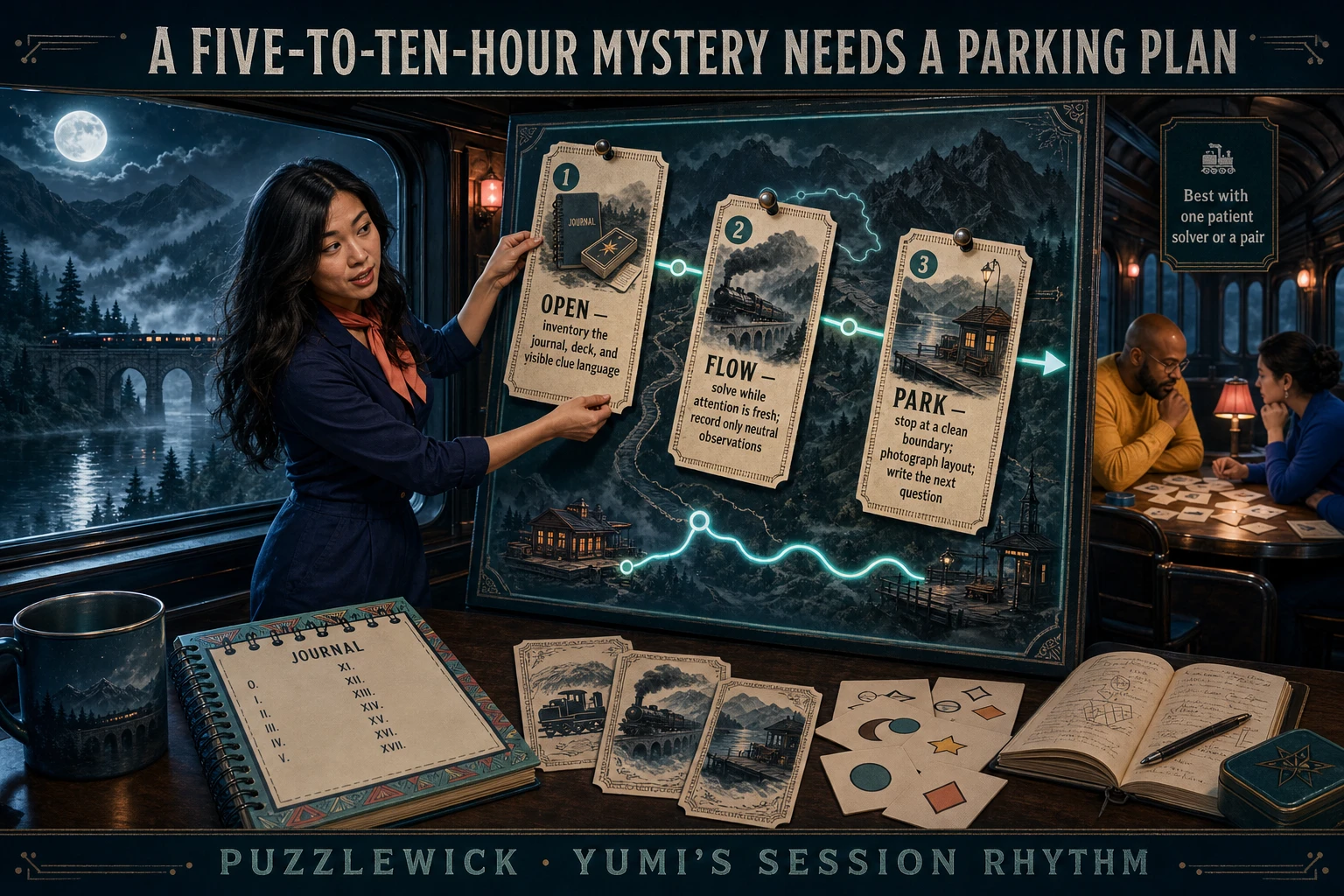
The official material gives a broad five-to-ten-hour range. Recent couples report finishes around five or six hours, often spread across several weeks; other groups need longer because difficulty varies by puzzle vocabulary and hint discipline. Plan for three to five sessions rather than promising a single epic night.
At the end of each session, photograph the complete table, return active cards to one deliberate pile, and write a three-line handoff: what we know, what we suspect, what we will test first. This takes two minutes and saves twenty minutes of archaeological reconstruction next time.
The nonlinear structure makes pausing unusually graceful. End while the next question still feels magnetic, not after fatigue makes every symbol look hostile.
Can you reset, replay, or pass The Light in the Mist to someone else?

You will not meaningfully replay the same mystery once you remember its answers. That does not make the object disposable. Players report that careful groups can avoid writing on most components, restore the deck, and pass the experience onward; the current game also anticipates the final physical interaction with replacement material. Follow the included instructions rather than improvising a reset.
Think of replayability as transferability. Keep a separate notebook, do not annotate cards, preserve component order, and place a sealed note in the box explaining what the next group may safely reset. If you love the object, keep it as an art deck and memory. If shelf space matters, give it a second life while the story is still fresh enough to recommend well.
This is better value than a ninety-minute one-shot and less repeatable than a competitive card game. Both statements can be true.
The Light in the Mist vs EXIT vs Unlock: which should a beginner buy?

Start with EXIT: The House of Riddles when your group needs a gentler physical puzzle language. Choose Unlock when a resettable, app-guided trilogy is more useful. Graduate to The Light in the Mist when nonlinear literary puzzles sound better than a countdown.
EXIT gives a clear decoder-and-hint grammar and allows tactile surprises because the components may be altered. Unlock uses an app for timing, hints, machines, and answer checking; the cards are generally resettable and easy to lend. The Light in the Mist is slower, more intimate, less procedural, and more willing to let you wonder what kind of problem you are looking at.
The products below are not substitutes disguised as listings for The Light in the Mist. They are exact Amazon alternatives for readers whose purchase must happen there. Puzzlewick will add a direct tagged listing for the PostCurious title only when the exact game exists and can be verified.
The picks
Some links below are affiliate links — as an Amazon Associate, Puzzlewick earns from qualifying purchases, at no extra cost to you. It never changes a pick.

EXIT: The House of Riddles
A beginner-rated introduction to EXIT’s decoder disc, physical clues, and staged hints. Buy this before The Light in the Mist when abstract inference has frustrated the group before.
- Gentler onboarding
- Strong tactile discoveries
- Exact Amazon product
- Primarily one playthrough
- Components may be altered
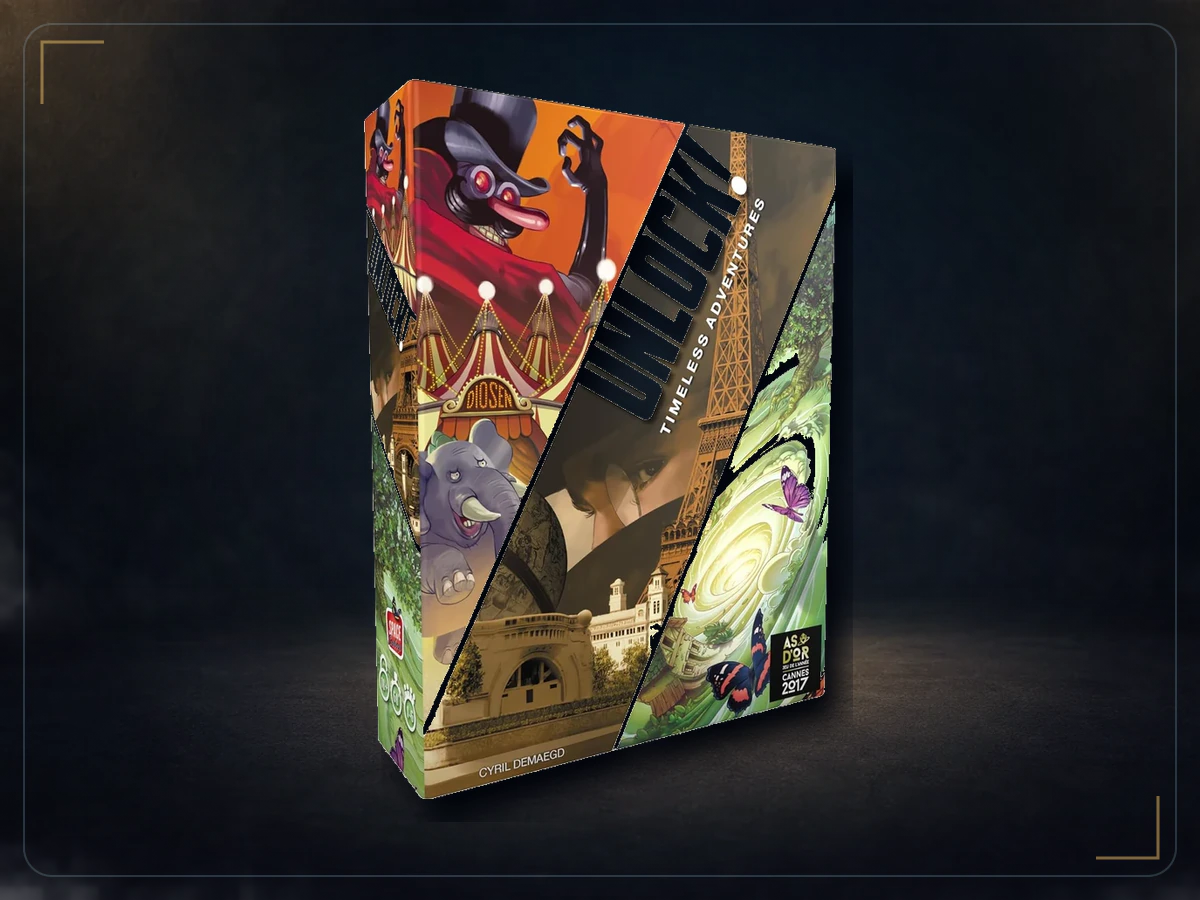
Unlock! Timeless Adventures
A clean alternative when the table wants clearer pacing and easy lending. It is less literary than The Light in the Mist and much easier to schedule.
- Three adventures
- Resettable
- Exact Amazon product
- Requires a phone or tablet
- Hidden-number searches can divide players
At a glance
| Question | The Light in the Mist | EXIT House of Riddles | Unlock Timeless |
|---|---|---|---|
| Best overall audience | Experienced solo solver or patient pair | Beginner small group | App-friendly group wanting several cases |
| Structure | Nonlinear tarot mystery | Linear tactile escape box | Three app-assisted adventures |
| Typical commitment | 5–10 hours across sessions | One shorter evening | Three separate sessions |
| Reset reality | Passable when carefully preserved | Often altered during play | Resettable and lendable |
| Puzzle feel | Literary, abstract, pattern-rich | Tactile and guided | Cinematic and app-mediated |
Free download — Yumi’s Spoiler-Safe Session Card
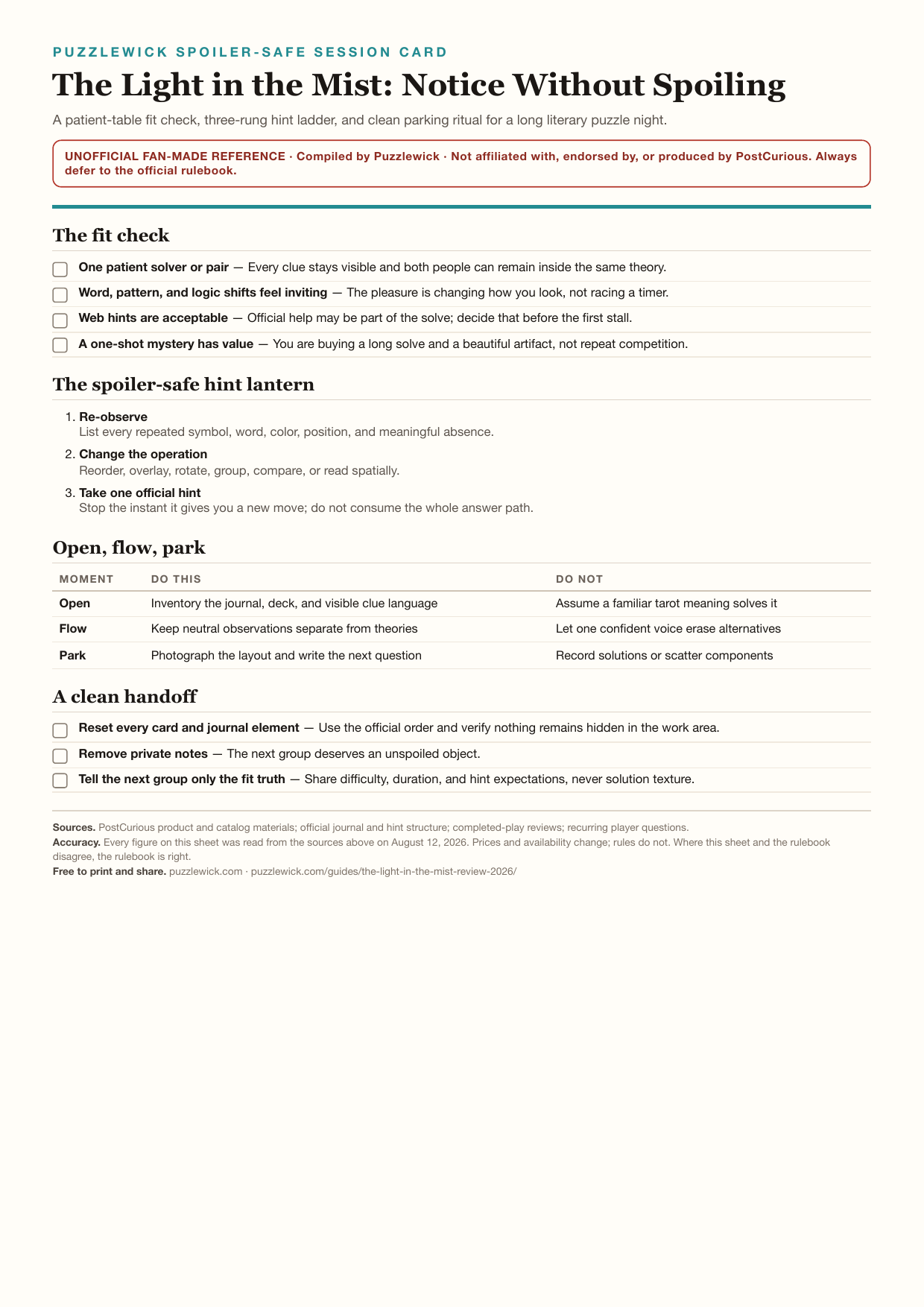
A one-page fit check, hint ladder, session parking ritual, and handoff note for a long-form mystery.
Unofficial fan-made reference. Compiled by Puzzlewick from the sources listed on the sheet. Not affiliated with or endorsed by the publisher — always defer to the official rulebook.
Questions, answered
Is The Light in the Mist an escape-room game?
It shares code breaking, observation, and hints with escape-room boxes, but its nonlinear tarot structure and literary pacing make it closer to a narrative puzzle artifact than a timed room simulation.
How difficult is The Light in the Mist?
Treat it as intermediate-to-hard. Experienced puzzle solvers often praise its originality, while newcomers frequently report abstract leaps and heavier hint use.
How many players are best?
One or two. Three can work with deliberate role rotation. Four is supported but small-card inspection creates an attention bottleneck.
How long does it take?
Official material gives a five-to-ten-hour range. Plan for several sessions and photograph the table plus write a short theory handoff before each pause.
Can you replay The Light in the Mist?
Not meaningfully once you remember the solutions. Careful players can preserve and reset the object so another household can experience it.
Do you need to know tarot?
No. Tarot familiarity can enrich the atmosphere, but the game must provide the information required for its own puzzles.
Should a beginner start with it?
Usually no. EXIT: The House of Riddles or an easier Unlock adventure teaches boxed-puzzle habits more gently.
Is The Light in the Mist sold on Amazon?
Puzzlewick could not verify an exact Amazon US product-detail listing on August 11, 2026. We do not send readers to similarly titled books or unrelated search results.
Does the article spoil any solutions?
No. The images and advice explain format, hosting, hint discipline, player count, and value without identifying a puzzle answer or story resolution.
What should I bring to the table?
Pencils, a separate notebook, a phone for the official hint site, good light, and one container for the currently active card group.
Yumi's verdict
The Light in the Mist is an exceptional second or third puzzle-game purchase for one thoughtful solver or a patient pair. Buy it for nonlinear discovery, visual variety, and a story-shaped artifact. Do not buy it as a beginner EXIT substitute, a four-player party game, or a competitive title with repeat matches. If Amazon is mandatory, choose the exact EXIT or Unlock alternatives below until an exact PostCurious listing can be verified.
Research ledger 9 sources · reviewed 2026-08-11
Specifications, rules, current product information, community experience, and contrary evidence were checked against the sources below. Commercial links are kept separate from editorial evidence.
- getpostcurious.comgetpostcurious.com/thelightinthemist
- getpostcurious.comgetpostcurious.com/_files/ugd/d9bb7d_d94a2735cfd4445283e6dabae78b588e.pdf
- getpostcurious.comgetpostcurious.com/post/design-diary-4-tarot-series-on-collaboration
- boardgamegeek.comboardgamegeek.com/boardgame/341519/the-light-in-the-mist
- boardgamegeek.comboardgamegeek.com/thread/3514105/re-the-light-in-the-mist
- reddit.comreddit.com/r/boardgames/comments/1macsbq/the_light_in_the_mist_what_is_this_puzzle
- reddit.comreddit.com/r/boardgames/comments/1qvgu1f/the_emerald_flame
- roomescapeartist.comroomescapeartist.com/2021/09/21/postcurious-light-mist-review
- theescaperoomer.comtheescaperoomer.com/postcurious-light-in-the-mist-review

Come in, take your shoes off — let me show you something.

Keep exploring
The next smart rabbit holes.
✦ Topic PathBoard Game Buying Guides: compare the whole shelfStart with the decision, not the shelf. These guides compare the games, editions, expansions, player counts, and costs people...Buying GuideEXIT: The Game Complete Buying Guide—Where to Start, Difficulty, Hints, and the Best BoxesYumi builds a spoiler-free route through EXIT: The Game, from beginner boxes to intermediate adventures, with hint etiquette, hosting,...ComparisonEXIT vs Unlock! vs Deckscape: Which Escape-Game Series Should You Buy? (2026)Okay so — three card-sized escape rooms, three completely different philosophies about what a room IS, and the room has been *saying*...