Brass: Birmingham — The Deluxe Was Always Just Nicer Money. The One Upgrade That Changes the Game Is a Board.
Crisp answer: the world's #1 ranked board game has three tiers, and until now every premium tier was cosmetic — by the publisher's own comparison table. Exactly four items separated Retail from the retired Deluxe, and not one of them touched the rules. Receipts throughout.

AI-assisted curator persona · research and editorial responsibility: Robert Pruitt · how this guide was made
Last editorial refresh: 2026-08-04 Gold-standard QA: 2026-08-02 14 sources reviewed Affiliate links checked during gold-standard pass

The short answer
Buy the Retail edition — $79.98 direct from Roxley, product code ROX402 — and buy Iron Clays separately if you want the nice money. That is the community's near-unanimous answer and the publisher's own spec agrees with it. What everyone says: the Deluxe is the "real" version. What Roxley's own comparison table actually says: the Deluxe differs by exactly four items — 78 Iron Clays, a gold-embossed box, a custom vac-tray insert, and a free 22-chip upgrade sleeve — and both rows state "Includes ALL Gameplay Content." Receipt: roxley.com/products/brass-birmingham, read 2 August 2026. The Deluxe is also retired: Roxley's page says it "will not be reprinted." And here is the part nobody ranking for this question mentions — the new Collector's Edition is the first tier in the game's history to change how it plays, because it puts a dedicated 2-player map on the reverse of its board. That board is sold on its own for $30. The upgrade that actually changes the game is a board, not a $150 box.
Crisp answer first, then the receipts.
Brass: Birmingham is the number one ranked board game on BoardGameGeek — rank #1 overall and #1 in strategy, a Bayesian rating of 8.39 and a raw average of 8.56 from 59,445 ratings, with 85,492 copies owned. Receipt: BGG's own data endpoint, read 2 August 2026. When a game sits at the top of that list, the buying question stops being "is it good" and becomes "which one do I get," and that is where the internet has quietly been wrong for years.
There have been three tiers. Retail. The Deluxe, which is now retired. And, new, a Collector's Edition.
What everyone says: the Deluxe is the definitive version and the Retail is the compromise.
What the publisher's own comparison table says: the difference is four items, all of them cosmetic, and both editions are labelled "Includes ALL Gameplay Content."
I want to be careful here, because there is a great deal of confidently wrong information about this game's editions, and I have had to discard several claims while writing this — including two I was asked to check. There are no metal coins in the Deluxe. There is no neoprene mat in any Roxley edition. The black-dyed tiles people still describe were discontinued in 2023, and Roxley footnotes it themselves. I will date every fact I give you, and if I cannot date it I will say so.
So: what actually separates the tiers, which one belongs on your table, and the one thirty-dollar purchase that does more for your game than the hundred-and-fifty-dollar one.
Start here, then go deeper
You are in the right cabinet.
 undefined Universe HubBrass: the whole buying path✦ Topic PathBoard Game Buying Guides: compare the whole shelfStart with the decision, not the shelf. These guides compare the games, editions, expansions, player counts, and costs people...
 Buying GuideKingdom Death: Monster Buyer's Guide (2026): Which Expansions Add to Your Campaign — and Which Quietly Replace ItTHE VERDICT: buy the core box and nothing else. THE FLAW: the storefront will not tell you that most expansions delete a monster you were...
Does any edition actually play differently — or are you only buying a nicer box?
Until 2026, no. Not once.
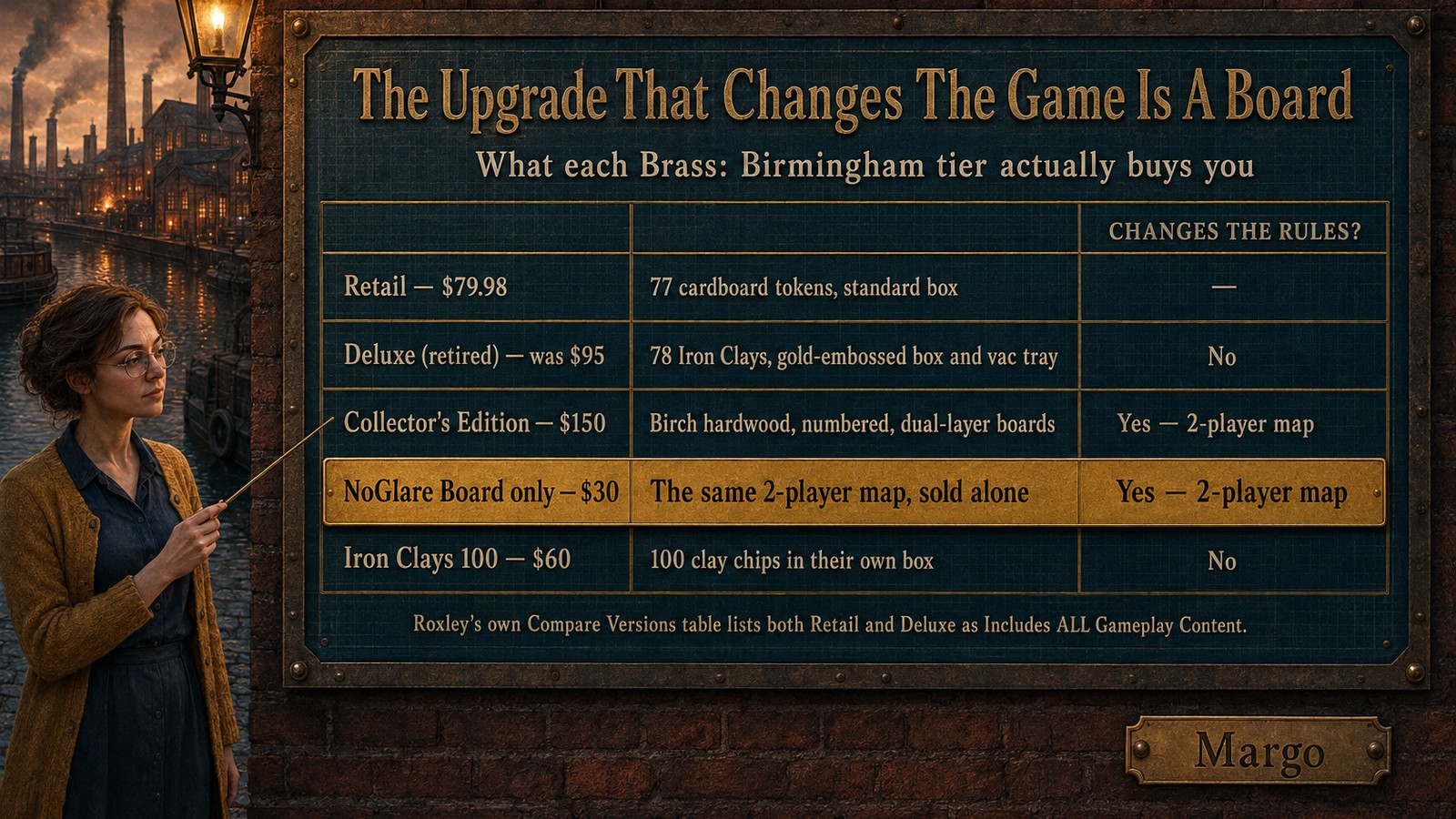
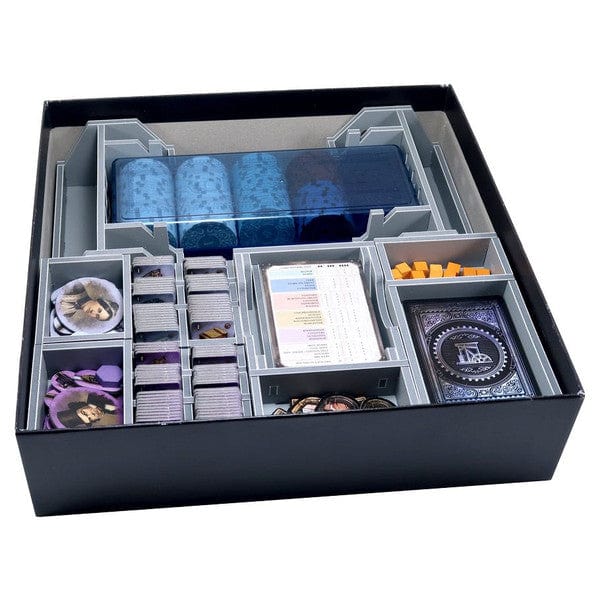
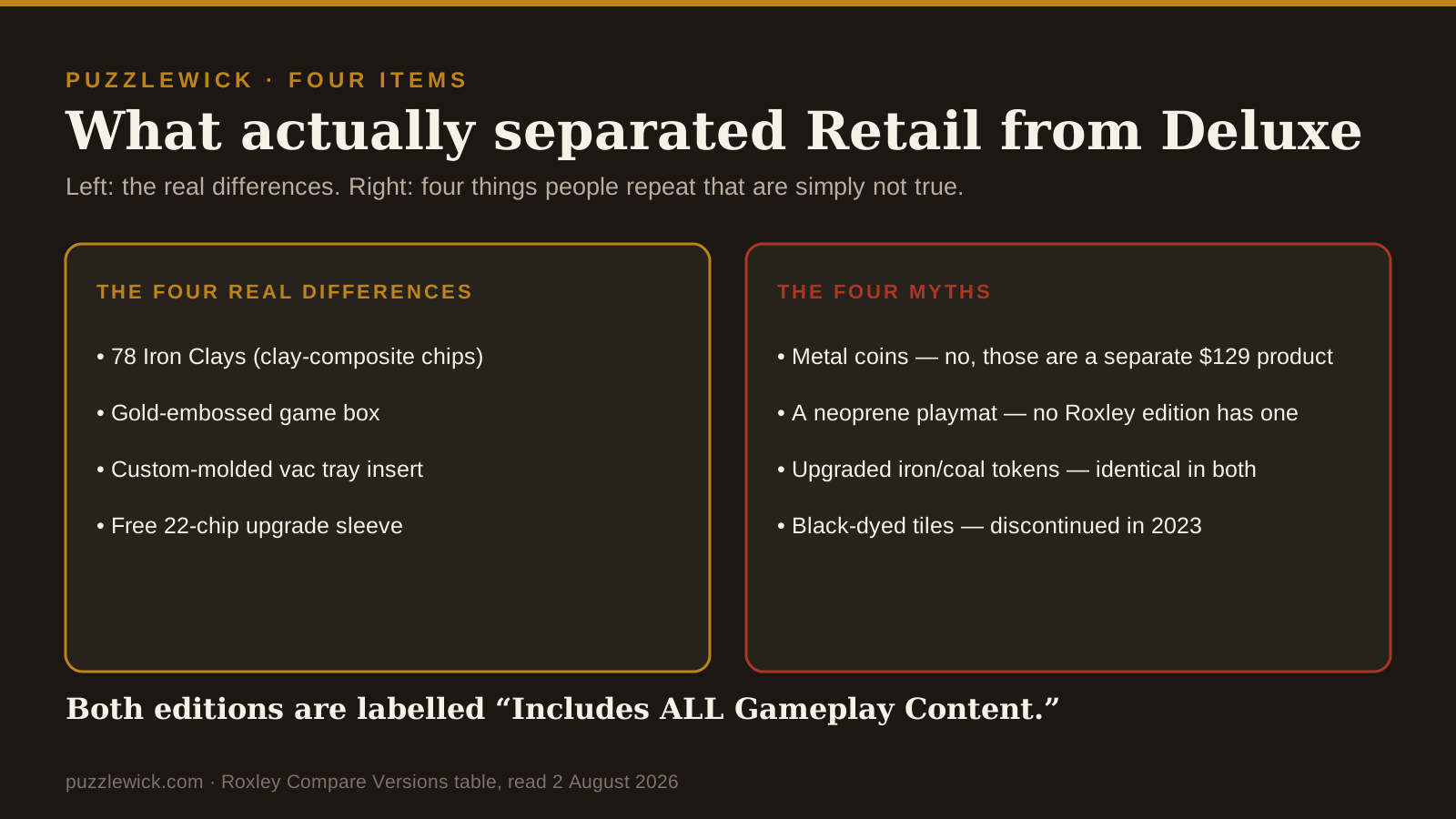
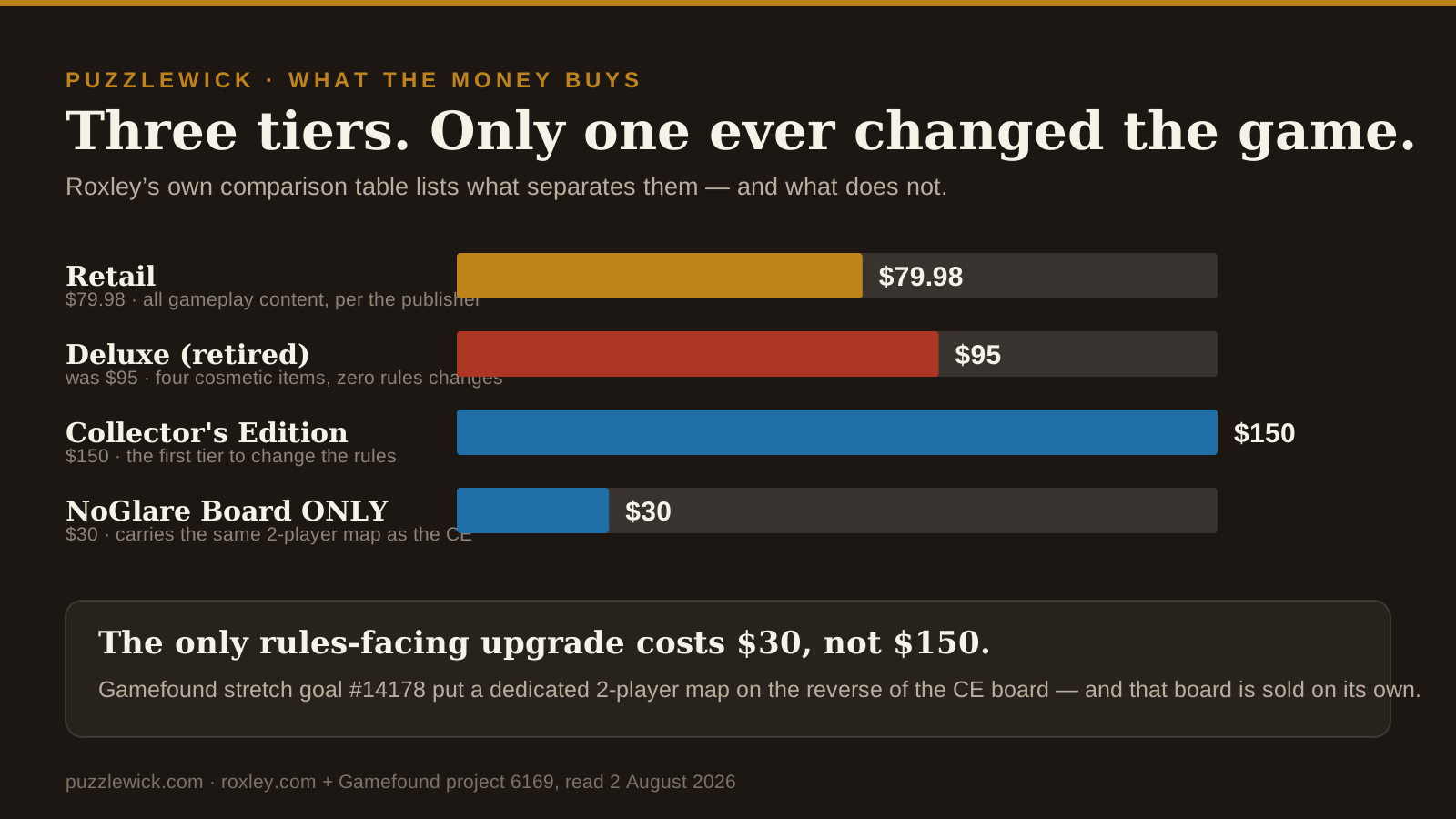
Roxley publishes a Compare Versions table on its own product page, and it is unusually candid. The Deluxe row lists: 78 Iron Clays, a gold-embossed game box, a custom-molded vac tray insert, and a free Iron Clays 22-Chip Brass Upgrade Sleeve. The Retail row lists 77 cardboard money tokens and a standard box. Both rows carry the same sentence: "Includes ALL Gameplay Content." Receipt: roxley.com/products/brass-birmingham, read 2 August 2026.
That is the whole difference. Four items. Money, a box, an insert, and more money.
Then the Collector's Edition arrived and broke the pattern. Gamefound stretch goal #14178 — "Birmingham gets a 2-Player Map" — unlocked on 3 April 2026 and puts a dedicated two-player map on the reverse of the CE board. That is a rules-facing change: a different map is a different game state. It is the first time in this game's history that paying more has bought you something other than presentation.
And the same board is sold separately. The Gamefound add-on catalogue lists Birmingham NoGlare Board Only at $30 list, $25 effective. Receipt: Gamefound project 6169 add-on feed, read 2 August 2026.
So the honest hierarchy is not Retail → Deluxe → Collector's. It is: the game, then thirty dollars of board, then a hundred and twenty dollars of presentation.
What exactly separated Retail from the retired Deluxe — all four items, no more, no less
Let me kill the folklore item by item, because each of these is repeated constantly and each is wrong.
Iron and coal tokens. Not a difference. Roxley's retail component list includes 30 black coal cubes, 18 orange iron cubes and 15 beer barrels — identical wooden resources in both editions, and they appear nowhere in the Compare Versions table.
Metal coins. Not in the Deluxe, and never were. Iron Clays are iron-cored clay-composite poker chips, in the publisher's own words. Actual metal coins are a separate product — Iron Coins 100, $129 list — described as something that "can be used to upgrade the standard money in one of your Brass games."
A neoprene playmat. Does not exist in any Roxley edition. No mat appears in either component list, the comparison table, or the add-on catalogue. The playmat people cite is a third-party accessory.
Black-dyed tiles. Discontinued. Roxley footnotes it on the Lancashire page: "As of 2023, the deluxe edition no longer comes with black-dyed tiles." Descriptions still listing this are stale by three years.
What is left is: 78 clay poker chips, a gold-embossed box, a vac-tray insert, and a bonus chip sleeve.
The community reached the right conclusion long ago, for three reasons that recur in every thread: the Deluxe adds no gameplay, its box is substantially larger purely to house the chips, and if you want Iron Clays for your other heavy euros you are better off keeping them in their own box anyway. Buy Retail plus a separate box of Iron Clays — that is the consensus and the arithmetic agrees.
One practical note, since it changes what "buy the Deluxe" even means: it is out of print. Roxley's page states plainly that it "has been retired and will not be reprinted," and Noble Knight lists the Kickstarter Deluxe as Out of Print at a used price with no stock. Anything you find is secondary market.
Birmingham or Lancashire — which Brass do you buy first?
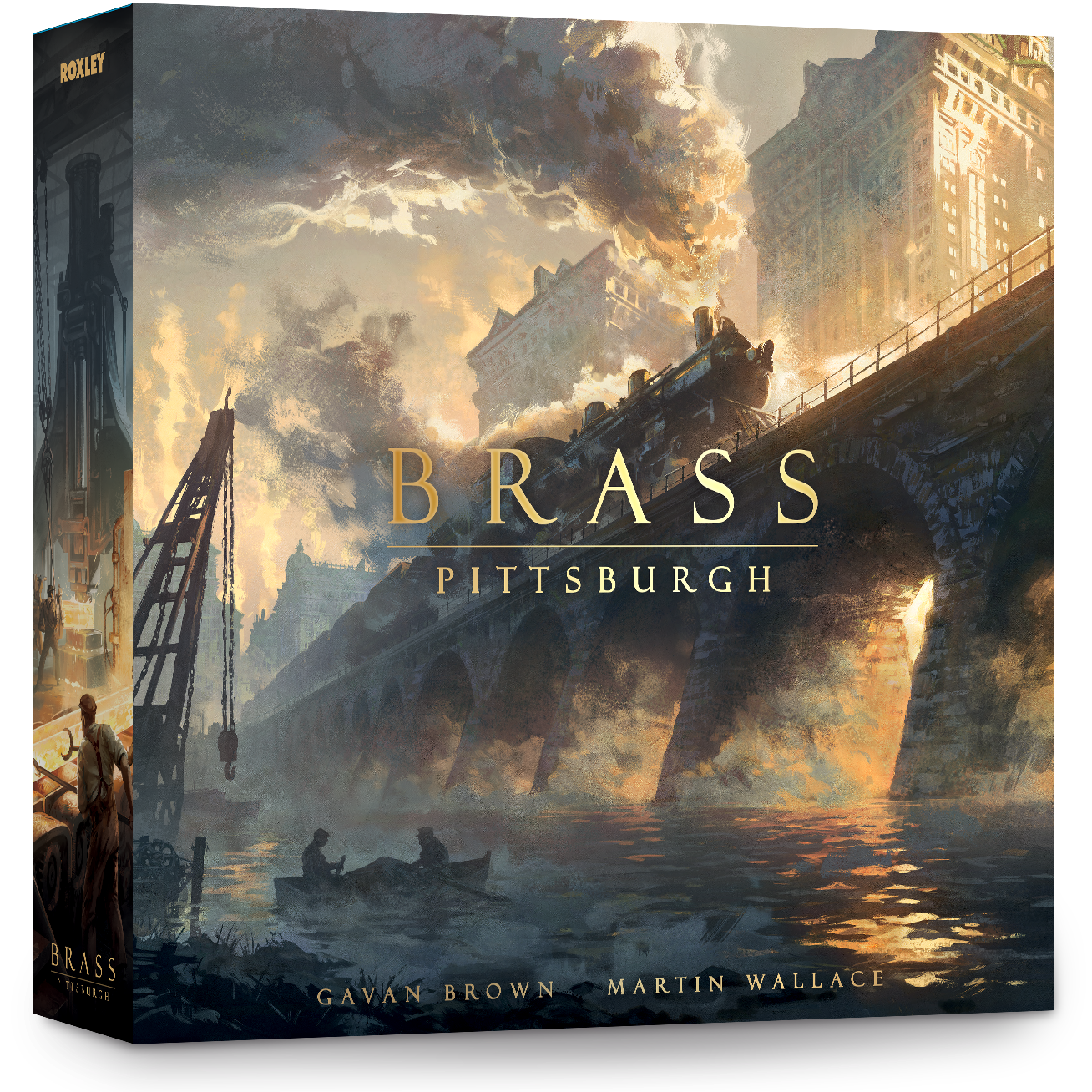
This is the most-asked Brass question, and the honest answer has a caveat most articles omit.
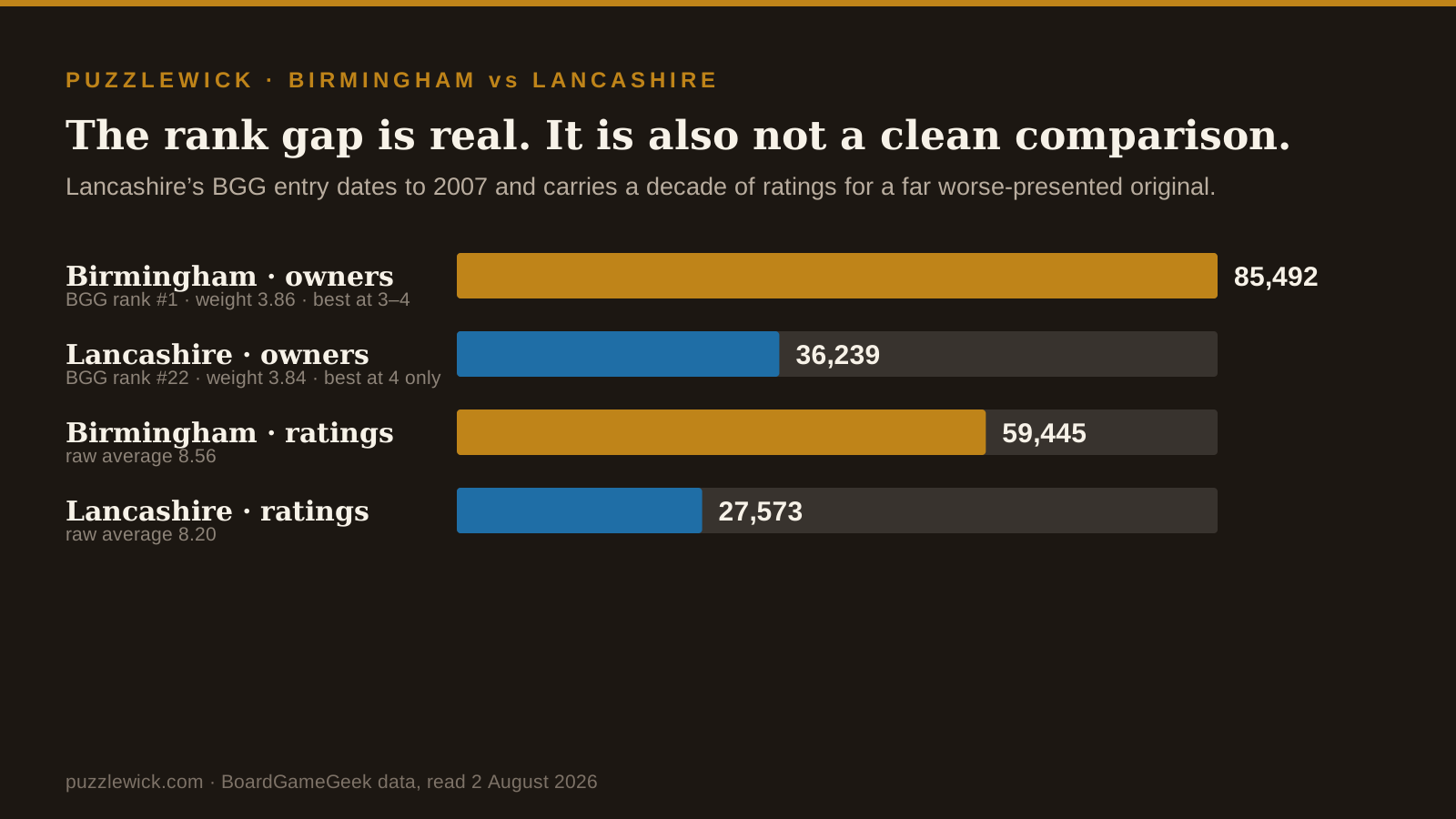
The numbers. Birmingham is BGG rank #1 with 85,492 owners and 59,445 ratings. Lancashire is rank #22 with 36,239 owners and 27,573 ratings. Receipt: BGG data, 2 August 2026.
The caveat, which Lancashire's defenders are right about. Lancashire's BGG entry is id 28720, year published 2007 — the 2018 Roxley edition was merged into the original Brass listing, so it carries a decade of ratings from a far worse-presented original. Birmingham's entry (id 224517, 2018) is clean. That does not make Lancashire the better game, but anyone waving the rank gap around as proof is comparing two differently-shaped datasets.
The myth I want to correct. People say Birmingham is the lighter, friendlier entry point. On rules load it is not: BGG weights them at 3.86 versus 3.84 — statistically identical — and Birmingham objectively has more rules. Six actions instead of five. Three extra industry types. An entire beer sub-economy. Merchant bonuses.
What people mean is forgiveness, and there the difference is real. Birmingham adds a sixth action — Scout — letting you dump a dead hand for a wild location and a wild industry card. Lancashire has no Scout and no wilds at all. A dead hand in Lancashire is simply a bad turn you have to take.
The mechanical swap. Lancashire sells through Ports and a push-your-luck Distant Cotton Market. Birmingham deletes both and routes selling through beer and merchant tiles. That one substitution is the whole personality difference — and it quietly fixes Lancashire's dominant strategy, because Birmingham's double-rail action now costs a beer, which killed the rail-spam that ruled high-level Lancashire play.
My call: Birmingham first, for the Scout action and because it plays better at three. But if your group is reliably four players and likes a knife fight, Lancashire is not a downgrade — BGG's poll rates Lancashire best at 4 only, while Birmingham is best at 3–4.
Does it work at two players?
Yes — with a documented asterisk, and the Collector's Edition may have just moved it.
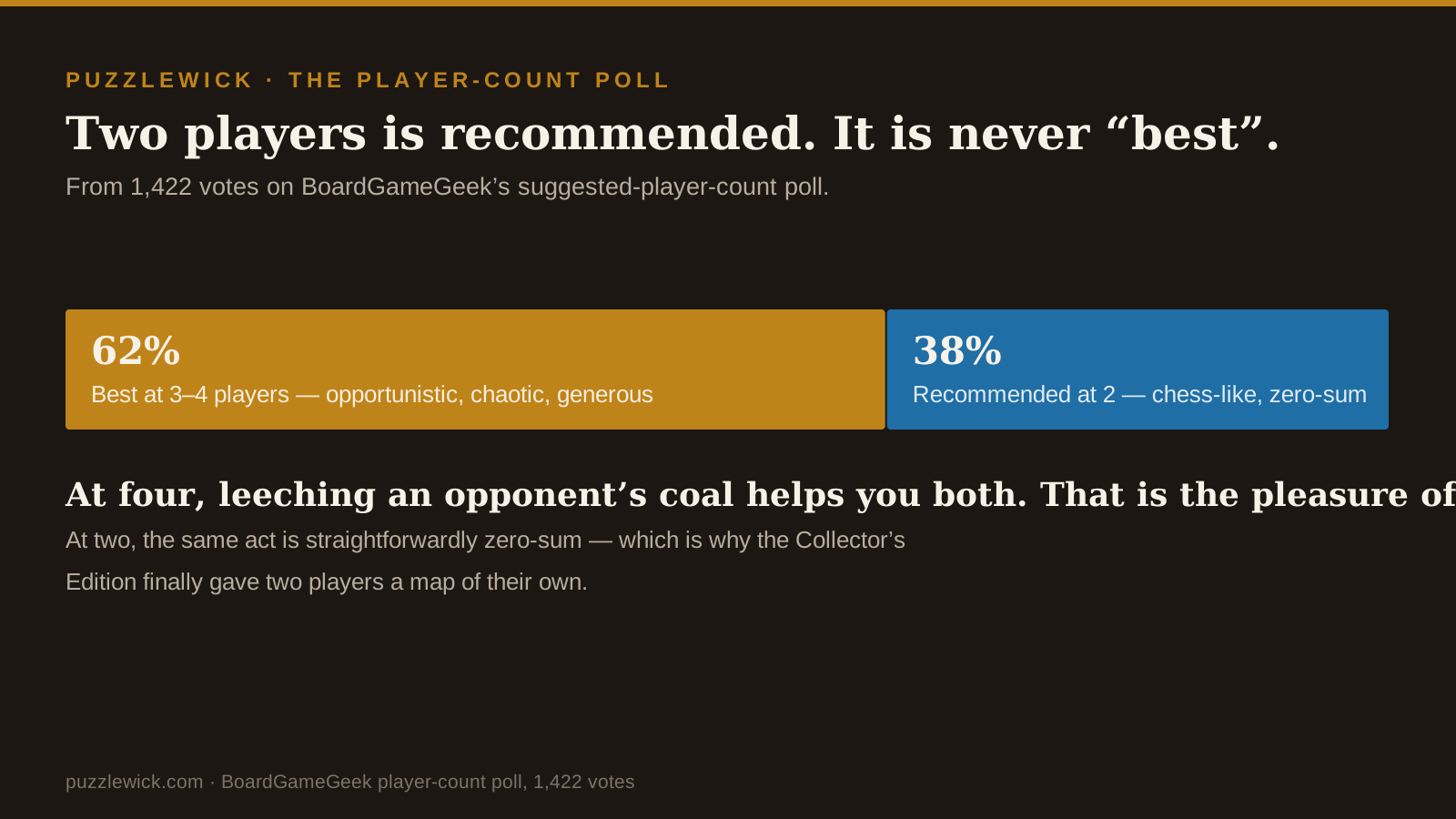
BGG's player-count poll, from 1,422 votes, rates Brass: Birmingham best at 3–4 players and recommended at 2–4. Two players is explicitly recommended and explicitly not best. Receipt: BGG poll data, 2 August 2026.
The community's explanation of why is more useful than the poll itself. At four, the game is opportunistic and slightly chaotic — you are constantly reacting to infrastructure other people built. At two it becomes chess-like and highly plannable, and the signature pleasure of Brass changes character: leeching an opponent's coal normally helps you both, which is what makes the game feel generous. At two players that same act becomes straightforwardly zero-sum.
The new CE two-player map is the first official acknowledgement that two deserves its own geometry. Whether it fixes the zero-sum feel is not something I can tell you yet — I have seen no completed-campaign reports at two on the new map, and I am not going to pretend otherwise.
The rules everyone gets wrong on their first play
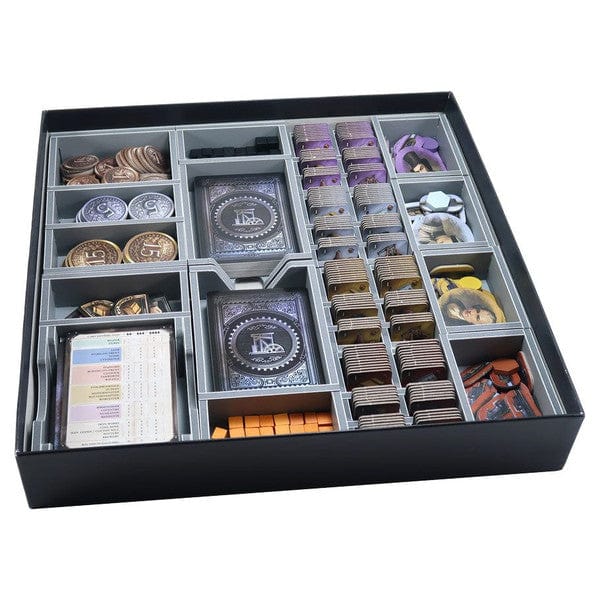
This is the most repeated thread genre in the game's forums, and the list is remarkably stable. If your first game felt flat, it is almost certainly on here.
Developing costs one iron per tile removed. The single most-missed rule in the game, and it is not printed on the player aid.
You draw back up to eight cards after every turn — not once your hand empties.
You discard a card for every action, not only when you Build.
Victory points score at the end of each era, not when a tile flips.
And the one that ruins first games: if you did not Develop, every Level-1 tile you own is swept off the board at the end of the Canal Era, and it feels like the game reset you to zero. It did not. You were supposed to burn those tiles yourself.
Two more sources of genuine confusion, both worth reading before you sit down.
The three resources deliberately behave differently. Coal must be connected by links, must be taken from the nearest source, and may only be bought from the market if no connected coal exists. Iron requires no connection at all — take any iron on the board. Beer has its own rule again: your own unflipped breweries need no connection, but an opponent's brewery must be connected.
"In your network" and "connected" are two different things and the rulebook uses near-identical words for them. Your network governs where you may build. Connected governs how resources move. Conflating them is the most common rules argument in the game.
Read the rulebook before you buy, if you like. Roxley publishes the complete Brass: Birmingham rulebook as a free PDF, along with German, French, Spanish and Italian editions. For an eighty-dollar box with a reputation for unintuitive exceptions, an evening with the actual rules is the cheapest due diligence there is.
Where to buy it, and what to refuse to pay for
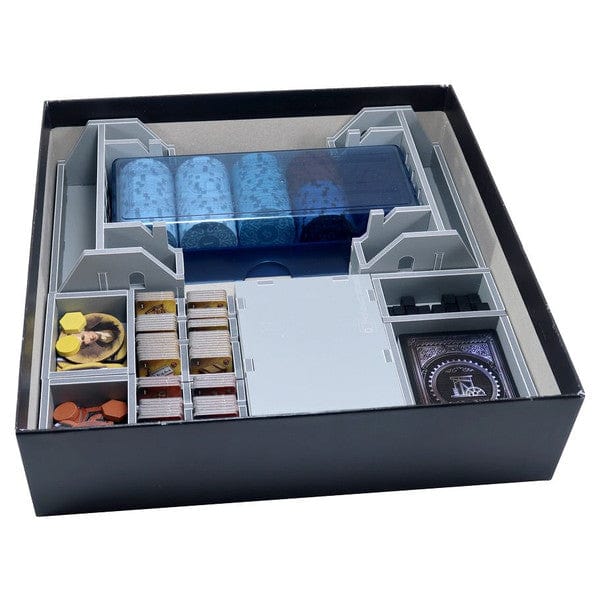
All figures read live on 2 August 2026. Prices move; the method does not.
Publisher direct. Roxley sells the Retail edition at $79.98 (ROX402, UPC 9781988884042), flagged limited stock. That is the honest benchmark for every other price you see.
United States. GameNerdz was the strongest confirmed in-stock option at $79.99 with eleven units on hand. Miniature Market lists $79.99 but reads out of stock — and note that the widely-cached "$56.99 on sale" figure is stale and contradicted by the live page. Noble Knight's listings are used-condition and out of stock, not first-party new stock.
United Kingdom. Zatu at £61.89, in stock, SKU ZBG-ROX402 wrapping Roxley's own code. Gathering Games shows a lower £59.99 but is sold out, so that headline price is not purchasable.
What to refuse. A secondary-market Deluxe at a premium, when the four things you are paying for are chips, a box, an insert and more chips. If you want the chips, buy Iron Clays directly — Roxley sells them at $60 for 100, $90 for 200, $150 for 400 — and keep them in their own box where they will serve every heavy euro you own.
And a note on how we make money here, since it is relevant. Roxley runs no affiliate program — twelve candidate paths all return 404 and their complete sitemap contains no affiliate page. Their only partner programme is wholesale, for brick-and-mortar shops in North America. So the best link on this page pays us nothing. We are giving it to you anyway, because sending you to the publisher at the right price is the entire job.
So which one do you buy?
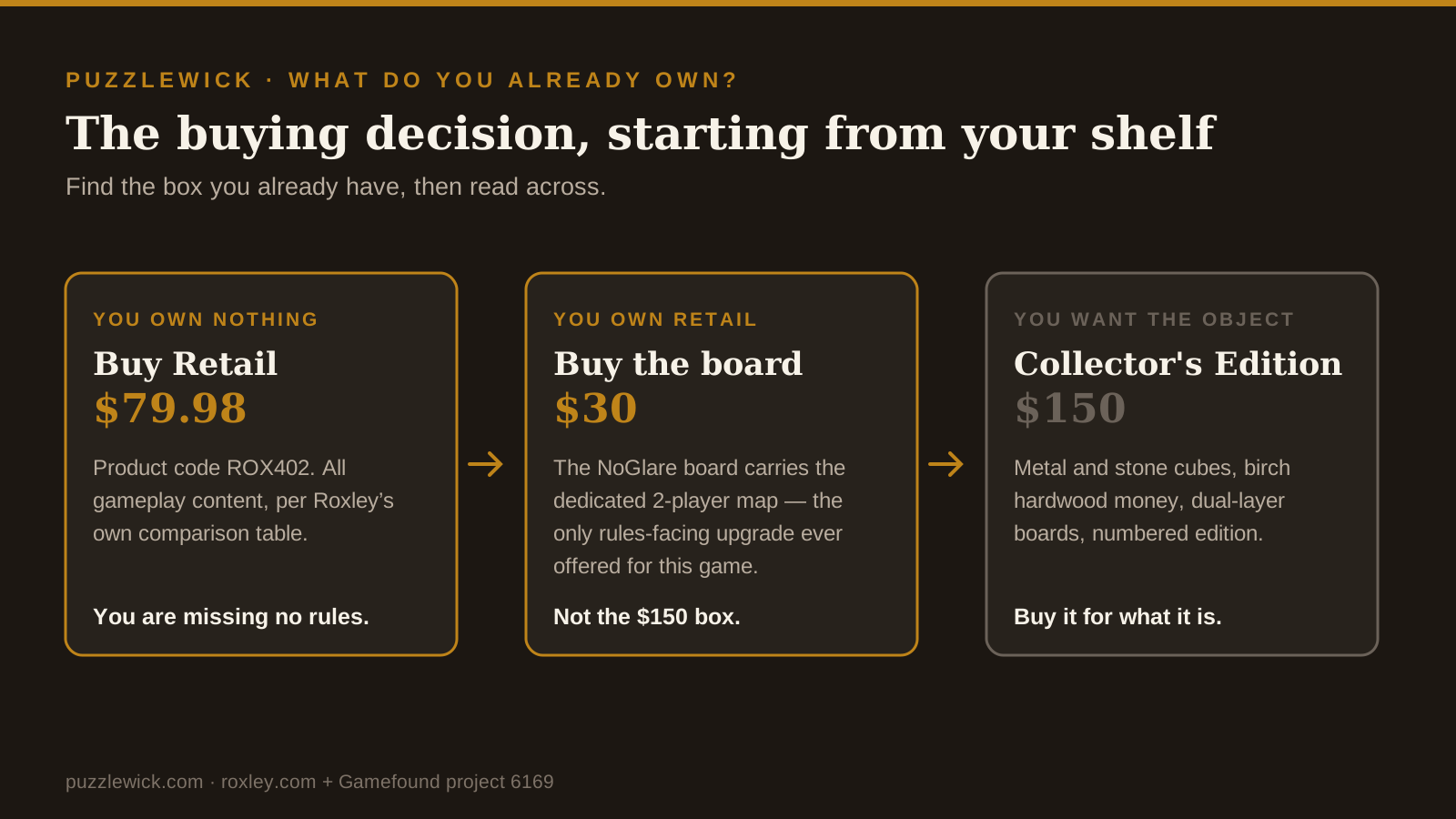
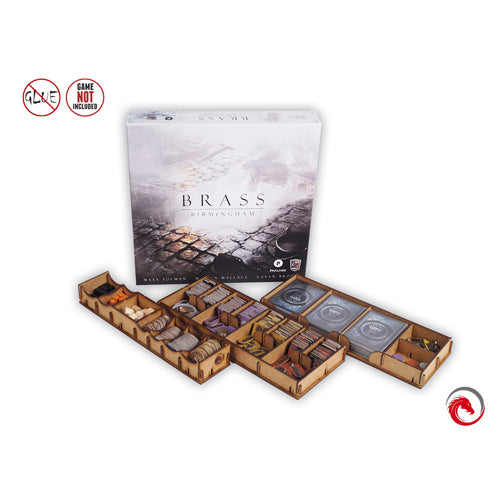
You own nothing. Retail, $79.98. Add Iron Clays later if the cardboard money bothers you. You are not missing a single rule.
You own Retail and want more. Buy the $30 NoGlare board, not the $150 Collector's Edition — unless you specifically want the presentation, in which case buy it for that reason and not because you think you are buying a better game.
You own the Deluxe. You own a complete game with nice money. Nothing has been taken from you, and the CE's only rules-facing addition is a board you can buy on its own.
You mostly play at two. This is the one case where the Collector's Edition has a real argument, because of the dedicated two-player map — and I would still want to see finished-campaign reports on that map before spending a hundred and fifty dollars on the strength of it.
You are choosing between Birmingham and Lancashire. Birmingham, for the Scout action and the three-player support. Then Lancashire later, if the beer economy turns out to be the thing you love — because Lancashire is the same skeleton wearing a harsher coat.
What experienced tables keep reporting
Recurring owner patterns, synthesized in Puzzlewick's words. Follow each evidence trail to read the original discussion.
"Birmingham Deluxe has been retired and will not be reprinted."
Roxley Games, on its own Brass: Birmingham product page (read 2026-08-02)
Both the Retail and Deluxe rows of Roxley's Compare Versions table state: "Includes ALL Gameplay Content."
roxley.com/products/brass-birmingham (read 2026-08-02)
BGG rank #1 overall and #1 strategy; Bayesian 8.39, raw average 8.56 from 59,445 ratings; 85,492 owners; complexity 3.86 from 2,914 votes; best at 3–4 players from 1,422 poll votes.
BoardGameGeek data endpoint (read 2026-08-02)
Gamefound stretch goal #14178 — "Birmingham gets a 2-Player Map" — unlocked 2026-04-03. The same board is sold alone as the Birmingham NoGlare Board Only add-on at $30 list / $25 effective.
Gamefound project 6169 (read 2026-08-02)
At a glance
| Edition | Price | Money | Box & insert | Changes the rules? | Margo's call |
|---|---|---|---|---|---|
| Retail | $79.98 | 77 cardboard tokens | Standard | — | Buy this |
| Deluxe (retired) | was $95 | 78 Iron Clays | Gold-embossed + vac tray | No | Do not chase |
| Collector's Edition | $150 / $130 | Birch hardwood | Numbered, dual-layer boards | Yes — 2-player map | For the object |
| NoGlare Board only | $30 / $25 | — | — | Yes — 2-player map | The smart upgrade |
| Iron Clays 100 | $60 | 100 clay chips | Own box | No | Buy separately |
| Brass: Lancashire | varies | n/a | n/a | Different game | Second, not first |
Free download — Edition Decoder & The Rules Everyone Misses
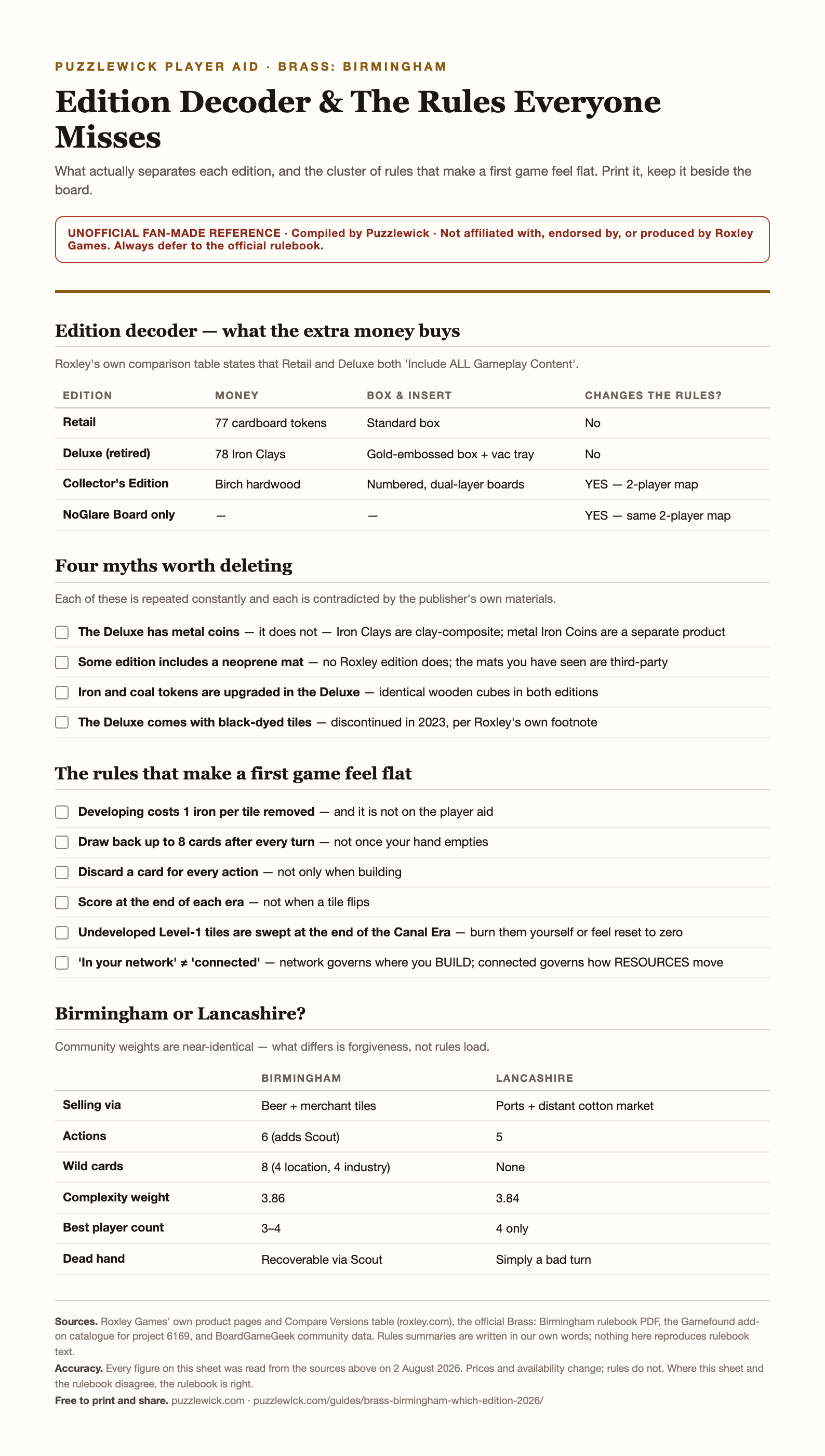
The edition decoder on one page — what each tier actually adds, the four myths worth deleting, the rules that make a first game feel flat, and Birmingham versus Lancashire on the differences that matter.
Unofficial fan-made reference. Compiled by Puzzlewick from the sources listed on the sheet. Not affiliated with or endorsed by the publisher — always defer to the official rulebook.
Questions, answered
Is the Brass: Birmingham Deluxe edition worth it over Retail?
No, and the publisher's own comparison table is why. The Deluxe differs by exactly four items — 78 Iron Clays, a gold-embossed box, a vac-tray insert and a bonus chip sleeve — and both editions are labelled 'Includes ALL Gameplay Content.' It is also retired and will not be reprinted. Buy Retail and buy Iron Clays separately.
What is the difference between Retail, Deluxe and the Collector's Edition?
Retail and Deluxe differ only cosmetically. The Collector's Edition is the first tier that changes gameplay, because it carries a dedicated 2-player map on the reverse of its board — Gamefound stretch goal #14178, unlocked 3 April 2026. That board is also sold on its own for $30.
Does the Deluxe have metal coins?
No. Iron Clays are iron-cored clay-composite poker chips, in Roxley's own words. Actual metal coins are a separate product called Iron Coins 100, $129, described as an upgrade you can buy for one of your Brass games. This is one of the most repeated errors about the edition.
Does any Brass edition come with a neoprene playmat?
No. No mat appears in either component list, the comparison table, or the Gamefound add-on catalogue. The playmats people cite are third-party accessories.
Does the Deluxe come with black-dyed tiles?
Not since 2023. Roxley footnotes it directly: 'As of 2023, the deluxe edition no longer comes with black-dyed tiles.' Descriptions still listing this are out of date.
Should I buy Brass: Birmingham or Brass: Lancashire first?
Birmingham, for two reasons: it adds the Scout action so a dead hand is recoverable, and BGG's poll rates it best at 3–4 players against Lancashire's 4-only. Lancashire is not a downgrade for a reliable four-player group — it is harsher and less forgiving.
Is Birmingham lighter or easier than Lancashire?
No, and this is a persistent myth. BGG weights them at 3.86 and 3.84 — statistically identical — and Birmingham objectively has more rules: six actions instead of five, three extra industry types, and a whole beer economy. What people mean is that Birmingham is more forgiving, which is true, and that is the Scout action.
Is the BGG rank gap between them meaningful?
Partly. Birmingham is #1 and Lancashire #22, but Lancashire's BGG entry is id 28720 with a 2007 publication year — the 2018 Roxley edition was merged into the original Brass listing, so it carries a decade of ratings for a far worse-presented game. The gap is real but it is not a clean comparison.
Does Brass: Birmingham work at two players?
Yes, with a caveat. BGG's poll of 1,422 votes rates it best at 3–4 and recommended at 2–4 — two is explicitly recommended and explicitly not best. At two it becomes chess-like and plannable, and leeching an opponent's resources turns from mutually useful into straightforwardly zero-sum.
What is the most commonly missed rule?
Developing costs one iron per tile removed, and it is not printed on the player aid. Close behind: you draw back up to eight cards after every turn, you discard a card for every action rather than only when building, and victory points score at the end of each era rather than when a tile flips.
Why did our first game feel flat, like we got reset?
Almost certainly because you did not Develop. Every Level-1 tile you still own is swept off the board at the end of the Canal Era — you were meant to burn those tiles yourself. The other usual causes are politely refusing to use opponents' resources, taking loans too late, and spreading across every industry instead of committing to two or three.
Why do coal, iron and beer all work differently?
Deliberately. Coal must be connected by links and taken from the nearest source. Iron needs no connection at all — take any iron on the board. Beer splits the difference: your own unflipped breweries need no connection, but an opponent's must be connected. It is the number one mechanical confusion for new players.
What is the difference between 'in your network' and 'connected'?
Your network is any city where you have a tile, plus any city adjacent to a link you own — it governs where you may build. Connected means any unbroken chain of links owned by anyone between your network and a location — it governs how resources move. The rulebook uses two near-identical words for two different concepts, which is why this is the game's most common argument.
Where is the cheapest place to buy it?
Publisher-direct is $79.98 (ROX402). GameNerdz had it at $79.99 in stock; Zatu in the UK at £61.89 in stock. Ignore the cached '$56.99 on sale' figure for Miniature Market — the live page contradicts it and reads out of stock.
Margo's verdict
Brass: Birmingham has spent years at the top of BoardGameGeek while its buyers argued about an upgrade that never touched the game. Roxley printed the truth in a comparison table on their own website: four items separate Retail from the retired Deluxe, and both boxes include all gameplay content. Buy the Retail edition, and if the cardboard money offends you, buy Iron Clays on their own and let them serve every heavy euro on your shelf. The genuinely interesting development is newer and much cheaper than the discourse suggests — the Collector's Edition finally added something rules-facing in the shape of a dedicated two-player map, and Roxley sells that board by itself for thirty dollars. If you play mostly at two, that is the most interesting thirty dollars in this hobby right now. If you want the numbered box with the birch hardwood and the metal cubes, buy it, and buy it for what it is: a beautiful object wrapped around a game you already own.
Research ledger 14 sources · reviewed 2026-08-02
Specifications, rules, current product information, community experience, and contrary evidence were checked against the sources below. Commercial links are kept separate from editorial evidence.
- cdn.shopify.comcdn.shopify.com/s/files/1/0246/2190/8043/files/Brass-Birmingham-Rulebook.pdf
- roxley.comroxley.com/pages/support-contact
- roxley.comroxley.com/products/brass-birmingham
- roxley.comroxley.com/products/brass-birmingham.js
- roxley.comroxley.com/products/brass-lancashire
- roxley.comroxley.com/pages/retail
- gamefound.comgamefound.com/en/projects/roxley/brass-pittsburgh
- gamefound.comgamefound.com/api/projectContents/getAddons?projectID=6169
- boardgamegeek.comboardgamegeek.com/boardgame/224517/brass-birmingham
- boardgamegeek.comboardgamegeek.com/boardgame/28720/brass-lancashire
- gamenerdz.comgamenerdz.com/brass-birmingham
- miniaturemarket.comminiaturemarket.com/rox402.html
- nobleknight.comnobleknight.com/P/2147805488/Brass---Birmingham-Kickstarter-Deluxe
- zatu.comzatu.com/en-us/products/brass-birmingham

Let me check that before we say it.

Keep exploring
The next smart rabbit holes.
undefined Universe HubBrass: the whole buying path✦ Topic PathBoard Game Buying Guides: compare the whole shelfStart with the decision, not the shelf. These guides compare the games, editions, expansions, player counts, and costs people...Buying GuideKingdom Death: Monster Buyer's Guide (2026): Which Expansions Add to Your Campaign — and Which Quietly Replace ItTHE VERDICT: buy the core box and nothing else. THE FLAW: the storefront will not tell you that most expansions delete a monster you were...