Your First Local Card Store Night: The Beginner-Safe Guide to Magic, Pokemon, Lorcana, One Piece, and Yu-Gi-Oh!
What to bring, what to say, which event to choose, and how to leave your first public card-game night wanting a second one.


AI-assisted research and drafting in Imani’s voice · reviewed by Robert Pruitt · how this guide was made
Last editorial refresh: 2026-08-16 Gold-standard QA: 2026-08-16 11 sources reviewed Affiliate links checked during gold-standard pass

The short answer
Bring one legal, sleeved deck you have already played; the tokens, dice, and side material that deck actually uses; a deck list if the event requests one; water; and one honest sentence: 'I'm new, this is my first store event, and this is an unchanged starter deck. Which table or event is the best fit?' Choose a demo, League, Academy, prerelease, casual night, or beginner event before a high-stakes tournament. Your first-night objective is not a record. It is to complete games, learn the room, and find one person you would happily play again.
A local card store can look like a room where everyone received a rulebook except you. They did not. Veteran language is compressed experience, and experienced players forget how much context is hiding inside a sentence such as 'the pod is casual, but upgraded.' The cure is not memorizing the entire hobby in the parking lot. It is choosing the correct event, carrying one orderly kit, and telling the room exactly where you are. Imani's field manual turns the intimidating first visit into six small actions. Nothing here requires pretending. Confidence arrives faster when it has nothing to conceal.
Start here, then go deeper
You are in the right cabinet.
 ✶ Universe HubMagic: The Gathering: the whole buying pathMagic: The Gathering is the deepest construction sandbox in the Big Three: a two-player duel, four-player Commander ritual, draft...
 🂠 Topic PathTrading Card Games: compare the whole shelfStart with the game and community you want, then buy the smallest product that lets you test it properly. These guides separate...
 ComparisonThe Best Card Game Starter Box for Two Beginners in 2026: Magic, Pokemon, Lorcana, One Piece, Yu-Gi-Oh!, or Arkham Horror?Seven real on-ramps, one honest question: which box gets two nervous beginners through a complete first night with the least rules...
Which first event should a beginner choose?
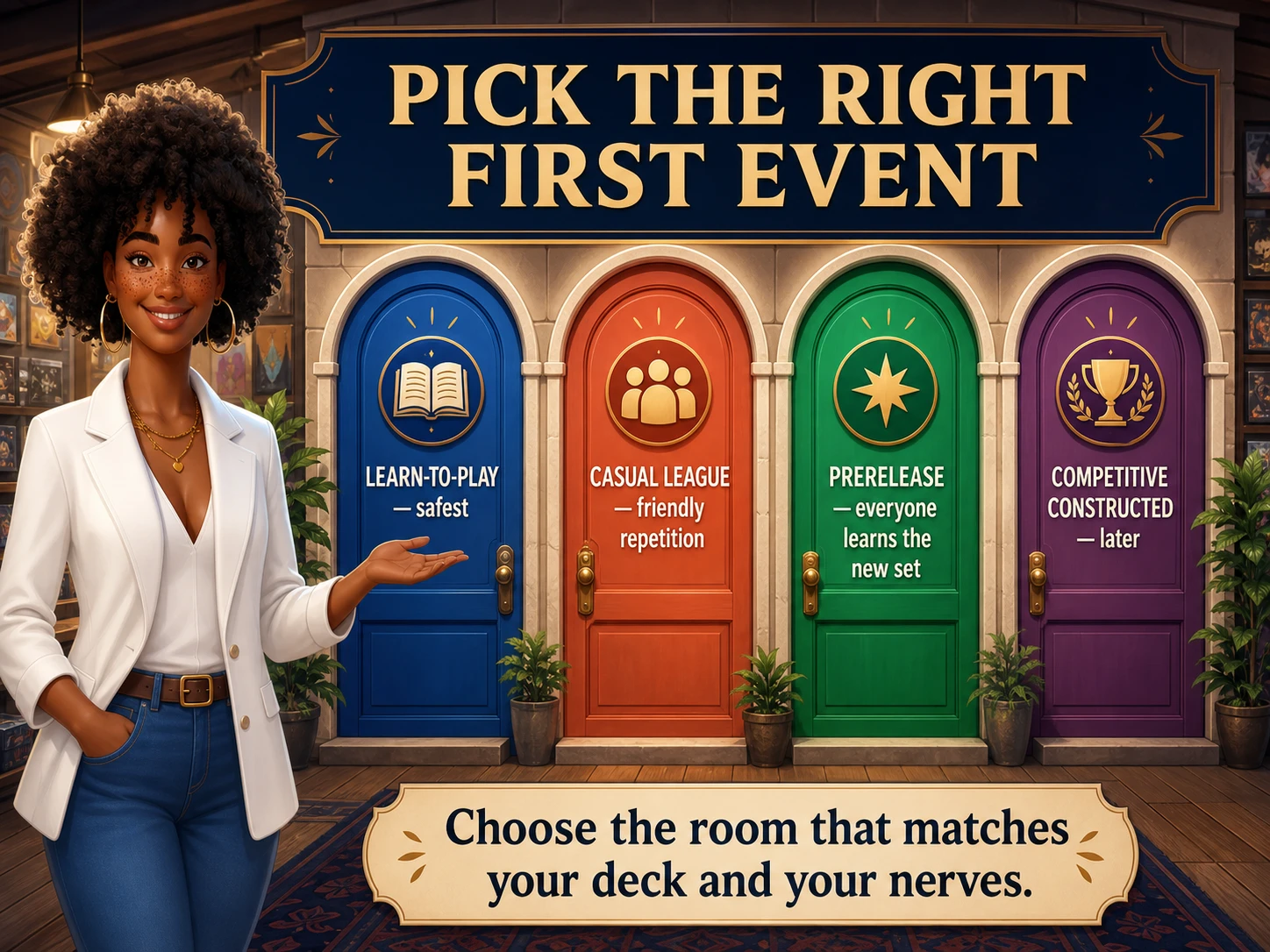
The calendar label matters more than the logo on your deck box. A demo, Academy, League learn-to-play session, prerelease, casual starter night, or buddy event expects questions. A competitive weekly event may legally allow beginners while socially assuming that everyone can manage timing, sideboards, deck registration, and round clocks without help. That is a different promise.
Call or message the store before travelling. Ask three things: Is this event beginner-friendly? Can I use an unchanged starter or preconstructed deck? What do I need to register? The answers reveal whether the evening is instruction, casual play, or competition. If the response is vague, ask what the most beginner-friendly event in the next two weeks is. A good store will be relieved that you asked.
Prereleases are unusually useful bridges because everyone is opening unfamiliar cards, judges expect rules questions, and the product is part of the event. They are still timed deck-building environments, so a completely new player should learn turn structure at home first. Beginner-friendly does not mean consequence-free chaos; it means the room has made space for learning.
What sentence opens the right door?
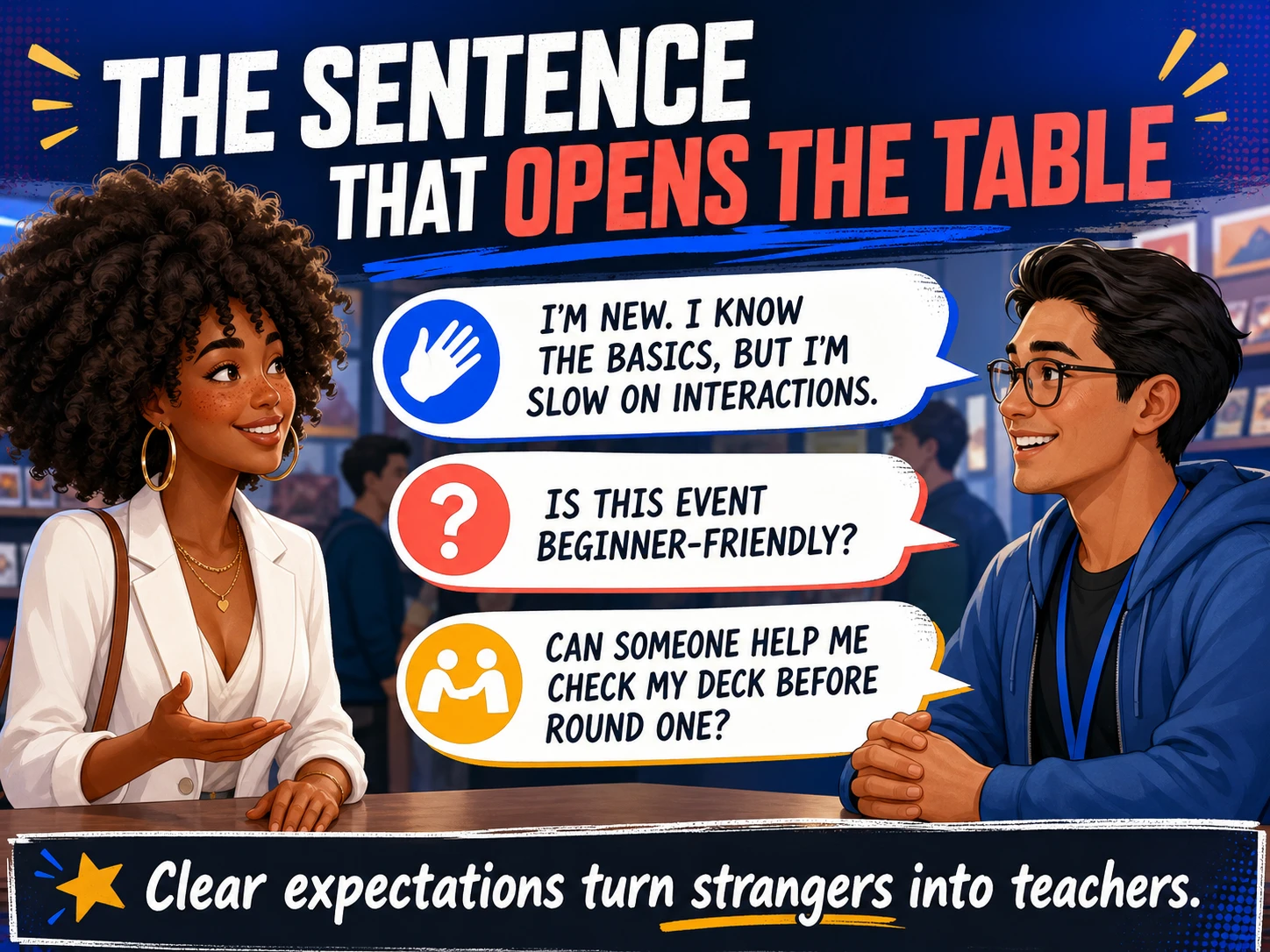
At the counter, say: 'I'm new, this is my first store event, and this is an unchanged starter deck. Which table or event is the best fit?' Replace 'unchanged starter deck' with the truthful version: Battle Academy deck, League Battle Deck, Commander precon, Lorcana two-player starter, One Piece LD-01 deck, or Yu-Gi-Oh! 2-Player Starter deck.
This sentence carries four useful facts. You understand that events differ. You are not disguising your deck's power. You want help before pairings begin. And you are prepared to play rather than asking the store to construct your entire evening. That combination makes staff and veteran players much more useful.
If someone answers with jargon, ask for the table action: 'What does that mean I need to bring or do?' 'Standard legal' becomes a card-pool check. 'Best of three' becomes sideboarding between games. 'Swiss rounds' becomes playing every scheduled round instead of being eliminated after one loss. Vocabulary is not a gate; it is a compressed instruction waiting to be expanded.
What belongs in your first card-store bag?
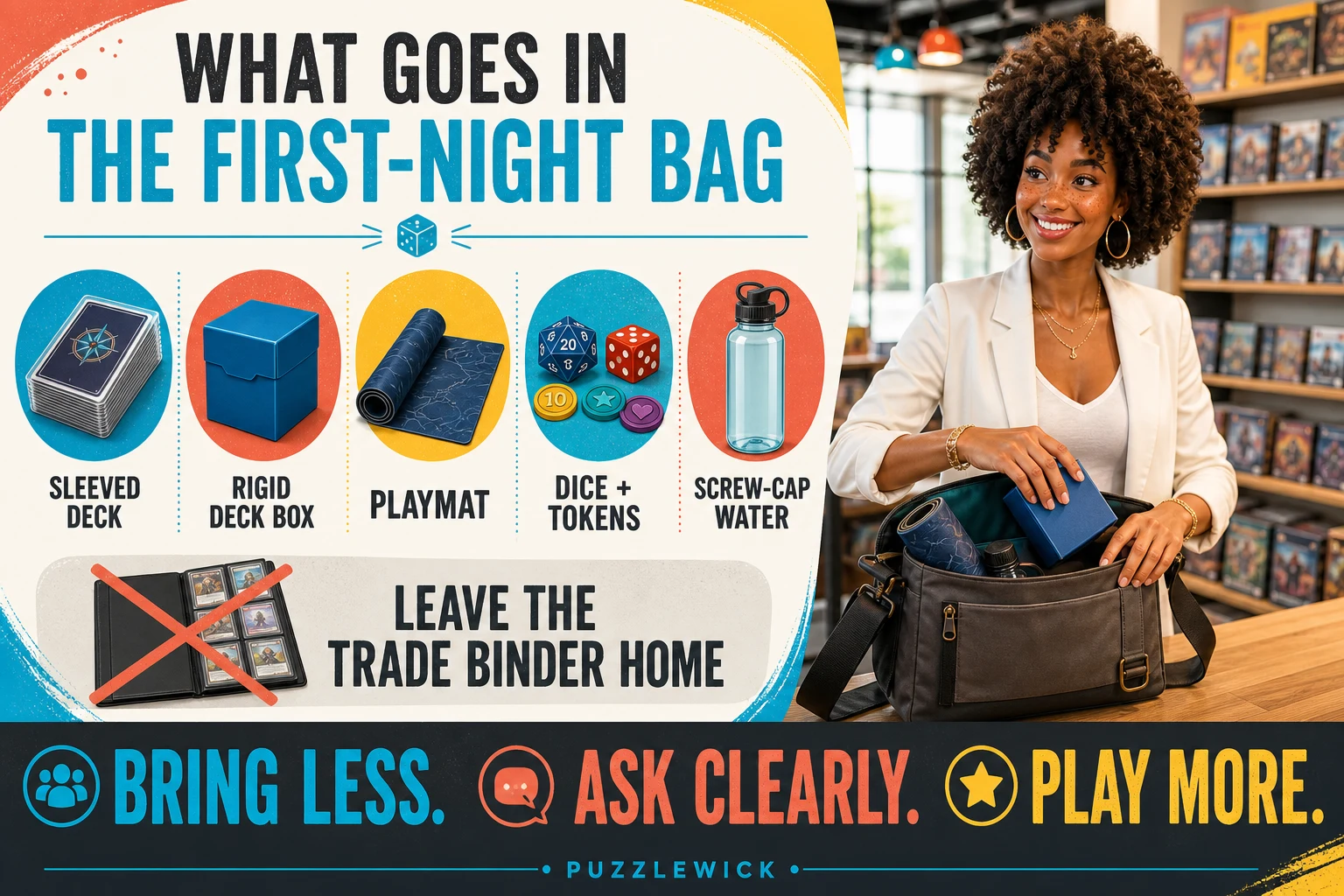
Bring one sleeved deck, not your entire collection. Bring the exact side material it uses: tokens, counters, dice, a Leader and DON!! deck for One Piece, an Extra Deck and Side Deck for Yu-Gi-Oh!, damage counters and a coin or legal randomizer for Pokemon, or scenario and investigator cards for Arkham. Put every group in a clearly separate compartment.
Opaque sleeves protect cards and prevent marked backs. A rigid deck box protects corners and keeps the deck from becoming a backpack weather system. A neutral playmat creates a clean work surface. Bring identical spare sleeves because one split sleeve can make a tournament deck temporarily unusable. Add water, a small snack if the venue permits it, a pen, and the store's event app or account already logged in.
A binder is optional. Bring it only if trading is part of your objective and every card is organized enough to price calmly. Never hand a stranger an unsorted stack of valuable cards, and never allow a trade conversation to delay a round. The first-night bag should make play easier. If an object does not serve tonight's deck, leave it home.
How do you become the beginner everyone wants back?
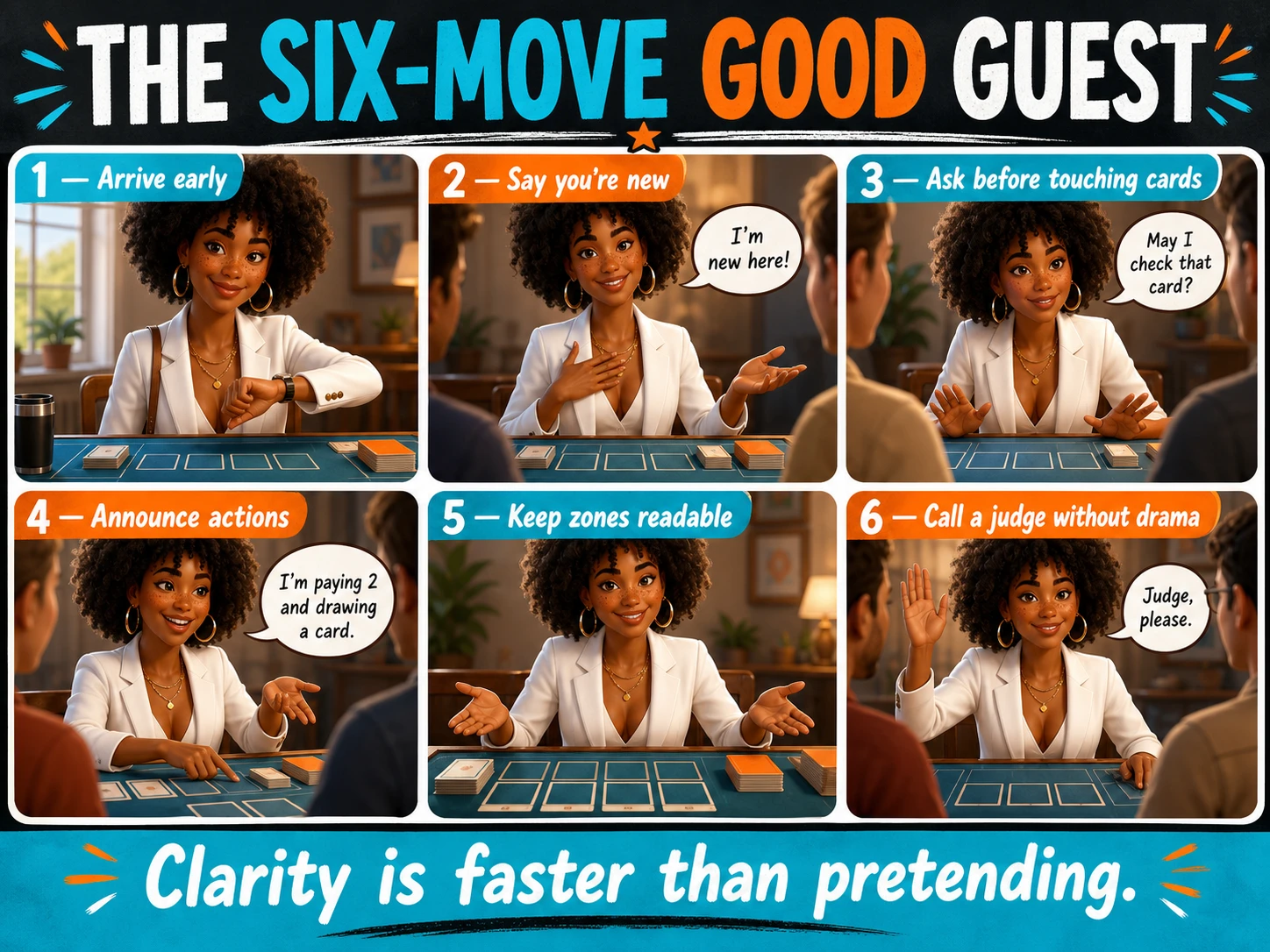
Introduce yourself. Ask before touching. Announce consequential actions. Keep zones readable. Call a judge without accusation. Finish with thanks. Those six moves matter more than playing quickly. Speed comes later; clarity can begin immediately.
When you make a mistake, say what happened and ask for the cleanest legal fix. In casual play, your opponent may permit a rewind. In an event, a judge decides. Calling a judge is not hostile and does not imply cheating; it protects both players from inventing a ruling under pressure. Accept the decision, note the lesson, and continue.
Do not coach an opponent without permission, narrate their possible mistakes, celebrate a lucky draw as personal genius, or apologize for being new after every action. One clear disclosure at the beginning is enough. When you lose, ask one specific question: 'What was the decision that changed the game?' When you win, thank the opponent and resist the urge to explain their deck to them. Grace has a lower learning curve than any rules engine.
Which public table is safest for each card game?
Magic: Academy and prerelease are strong official bridges. For Commander, ask for an unchanged-precon or low-power pod and have a short Rule Zero conversation about deck strength and game length. Do not sit at a competitive Standard event with a Starter Kit deck merely because both contain 60 cards.
Pokemon: Pokemon League explicitly welcomes beginners, and some locations have loaner decks or professors who teach. Battle Academy is a home lesson; a League Battle Deck is the cleaner public-play bridge after turns feel automatic.
Lorcana: League or casual nights are kinder when you identify the deck as the unchanged Wilds Unknown two-player starter. Know how to ink, play a character, quest, challenge, exert, ready, and count lore. Stock starters teach the game; they are not promises of competitive parity.
One Piece: Welcome & Set Sail events were built around LD-01 buddy learning. For normal locals, know the play sheet, Leader area, character area, Stage area, Cost area, deck, trash, Life, and DON!! deck. Ask whether the store expects tournament-legal sleeves and a deck list.
Yu-Gi-Oh!: ask for a demo or casual beginner table before an official local tournament. The scripted 2-Player Starter duel teaches procedure, while contemporary decks can create long effect chains. Bring the Main, Extra, and Side Deck clearly separated.
Arkham Horror: public play is cooperative. Confirm which scenario, investigator rules, taboo list, campaign state, and card pool the group uses. Bring the deck list and scenario materials requested. Easy difficulty is a legitimate learning setting, not a confession.
What should you buy after the first event?
Before buying anything, write three notes: what the deck tried to do, where it failed, and which rule or procedure remained confusing. If the deck's plan was enjoyable but inconsistent, exact singles may help. If the game itself felt wrong, accessories will not repair the evening. If transport was annoying, buy the box or bag that solves that problem. Purchases should answer evidence from play.
Return once with the same deck. Familiar tools free attention for timing, opponents, and the social room. Only after that second public night should most beginners consider a new archetype, a booster display, a premium binder, or tournament upgrades. The hobby will continue selling things tomorrow. You lose nothing by learning what you like first.
Your success metric is not wins. It is this: you finished the scheduled experience, treated opponents and staff well, learned one decision, and know whether you want to return. That is how a stranger becomes a regular without performing expertise on the way in.
What experienced tables keep reporting
Recurring owner patterns, synthesized in Puzzlewick's words. Follow each evidence trail to read the original discussion.
Tell the organizer you are new before pairings, not after the first mismatch.
A clear board state and calm question make a better first impression than rushed play.
Buying a stronger deck before understanding the first one changes the cards without reducing the confusion.
The picks
Some links below are affiliate links — as an Amazon Associate, Puzzlewick earns from qualifying purchases, at no extra cost to you. It never changes a pick.
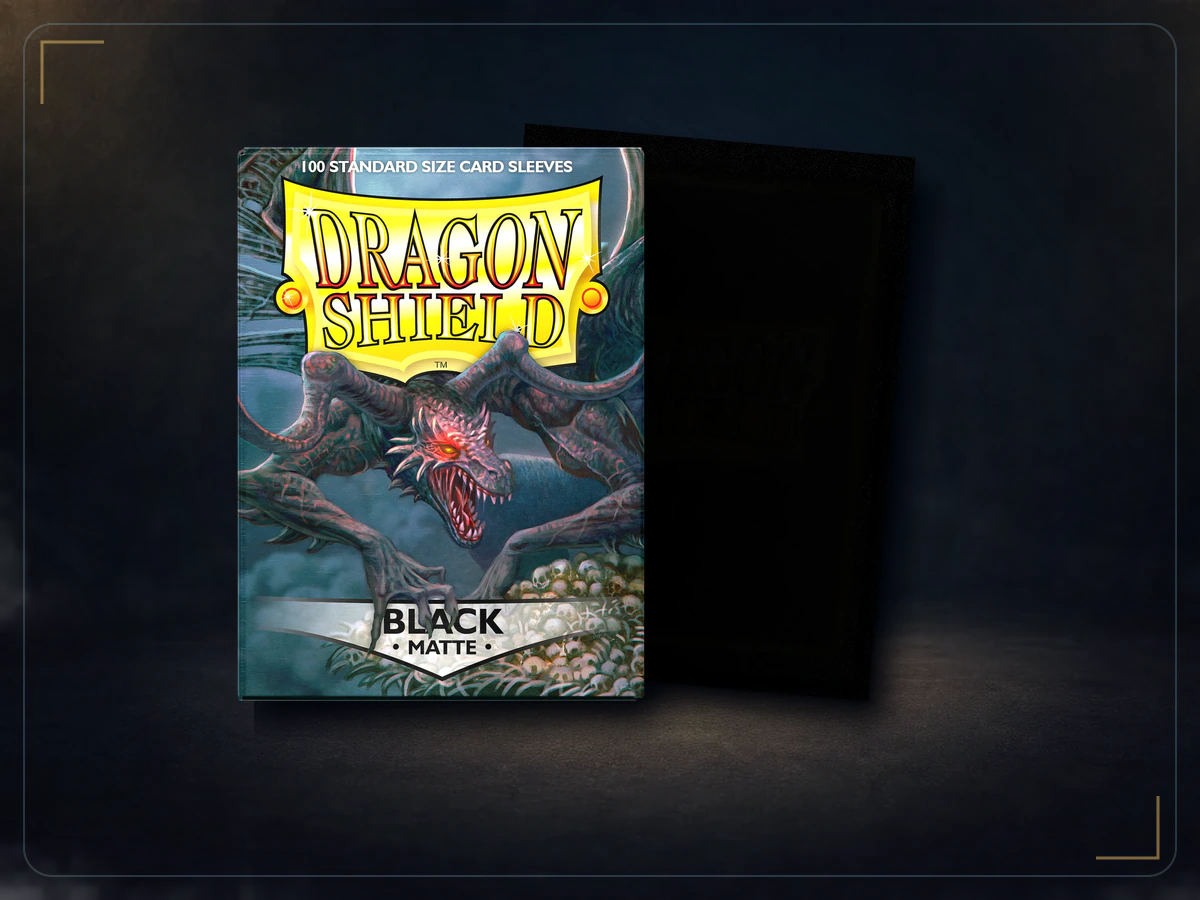
Dragon Shield Matte Black Standard Size Sleeves, 100 Count
Opaque, replaceable protection with enough spares for a normal constructed deck.
- Opaque backs
- 100 count
- Widely available
- Not Yu-Gi-Oh size
- Shuffle feel is personal
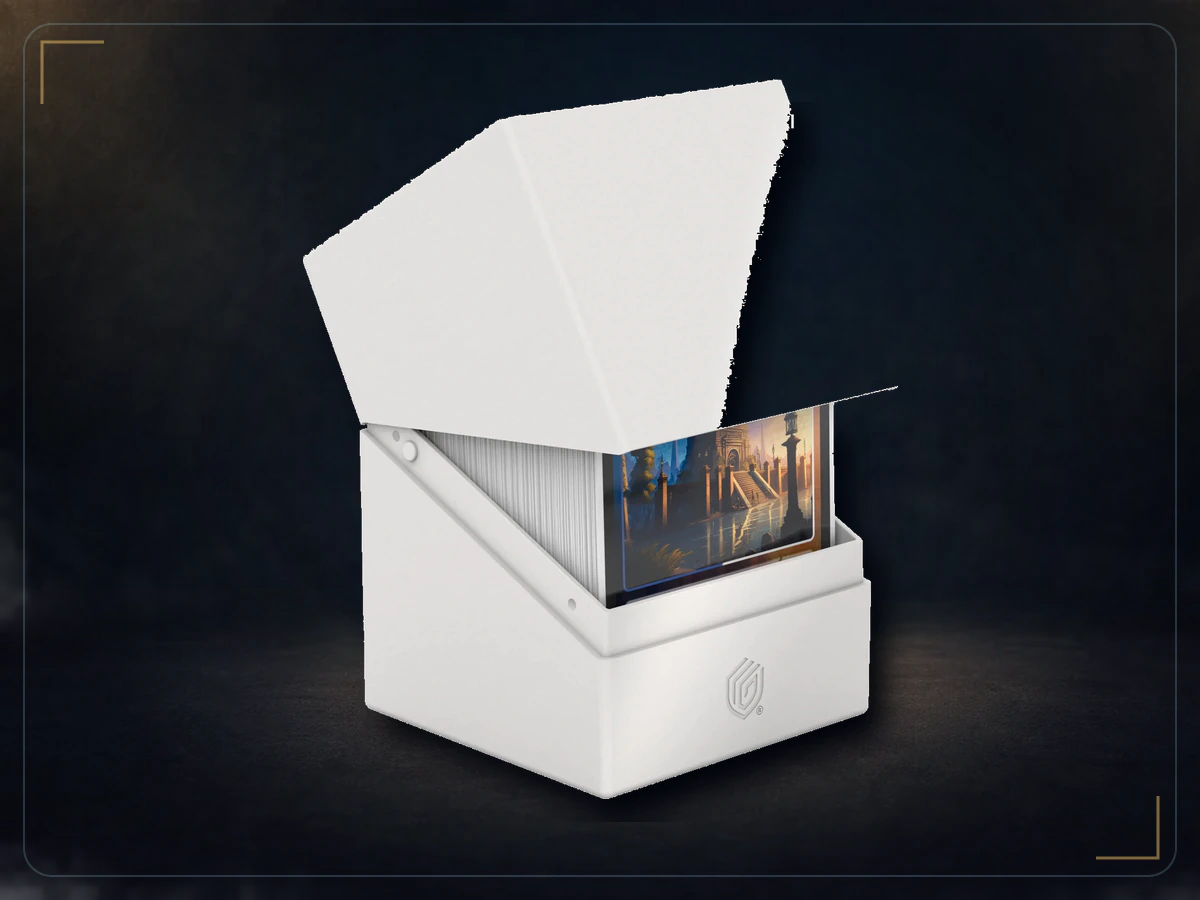
Ultimate Guard Boulder 100+ Deck Case
Compact, durable storage that remains useful after the beginner deck evolves.
- Rigid shell
- Compact
- Useful capacity
- No token drawer
- Double sleeves reduce capacity

Ultra PRO Solid Black Standard Gaming Playmat
Portable card protection without a franchise commitment or visually noisy zones.
- Cross-game
- Readable surface
- Portable
- No printed zones
- Plain by design
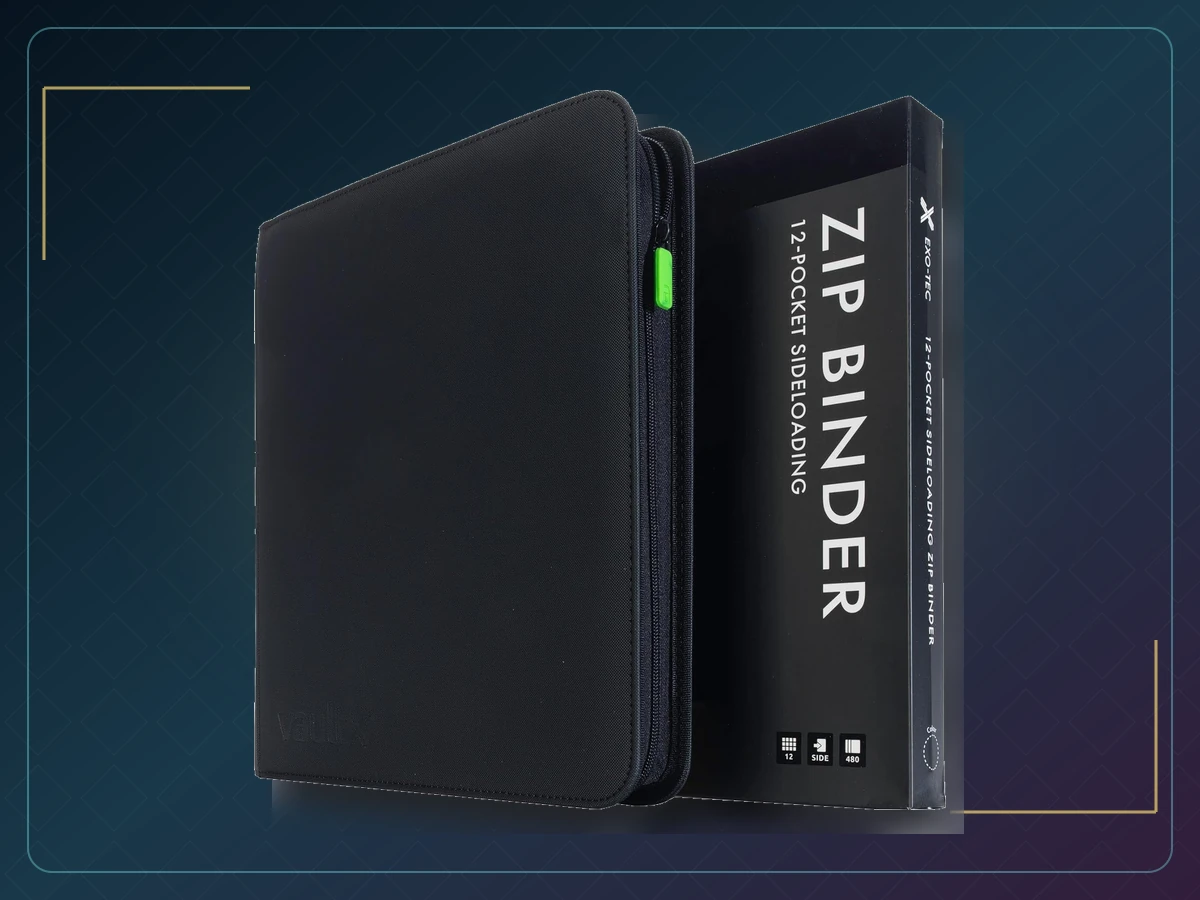
Vault X 9-Pocket Exo-Tec Zip Binder
Side-loading pages and a zipper make sense once a real collection exists.
- Side loading
- Zipper
- 360-card capacity
- Unnecessary for deck-only beginners
- Can encourage overpacking
Questions, answered
Imani's verdict
Choose a teaching event, say that you are new before pairings, bring one complete and protected deck, and use visible table procedure. Return once with the same deck before buying broadly. The local store is not a final exam; it is where private vocabulary becomes a shared hobby.
Research ledger 11 sources · reviewed 2026-08-16
Specifications, rules, current product information, community experience, and contrary evidence were checked against the sources below. Commercial links are kept separate from editorial evidence.
- Magic: The Gathering events and store locatormagic.wizards.com/en/play-events
- Magic Academy featuring The Hobbitmagic.wizards.com/en/news/announcements/magic-academy-featuring-the-hobbit
- Pokemon League beginner informationpokemon.com/us/play-pokemon/pokemon-events/pokemon-leagues
- Disney Lorcana organized playdisneylorcana.com/en-US/locator
- One Piece Welcome and Set Sail eventen.onepiece-cardgame.com/events/2026/welcome_set_sail
- One Piece comprehensive rules and play sheeten.onepiece-cardgame.com/rules
- Yu-Gi-Oh! tournament policy documentsyugioh-card.com/en/events/organizedplay
- Arkham Horror: The Card Game rulesfantasyflightgames.com/en/products/arkham-horror-the-card-game
- TCGplayer beginner and market coveragetcgplayer.com/content
- BoardGameGeek trading card game forumsboardgamegeek.com/forums/family/3/trading-card-games
- Reddit TCG communityreddit.com/r/TCG
Okay but have you seen what everyone’s saying about this?


Keep exploring
The next smart rabbit holes.
✶ Universe HubMagic: The Gathering: the whole buying pathMagic: The Gathering is the deepest construction sandbox in the Big Three: a two-player duel, four-player Commander ritual, draft...🂠 Topic PathTrading Card Games: compare the whole shelfStart with the game and community you want, then buy the smallest product that lets you test it properly. These guides separate...ComparisonThe Best Card Game Starter Box for Two Beginners in 2026: Magic, Pokemon, Lorcana, One Piece, Yu-Gi-Oh!, or Arkham Horror?Seven real on-ramps, one honest question: which box gets two nervous beginners through a complete first night with the least rules...