MTG Arena Standard Best-of-One: Read the Engine, Kill the Right Card, Win More Games
Robert teaches the missing skill between knowing card types and understanding a game: identify fuel, engine, multiplier, protection and payoff, then spend removal on the permanent that makes the next turn worse.


Written and reviewed by Robert Pruitt · how this guide was made
Last editorial refresh: 2026-09-08 Gold-standard QA: 2026-09-08 11 sources reviewed Affiliate links checked during gold-standard pass

The short answer
In Best-of-One, remove the card that creates repeatable resources or multiplies future actions, not automatically the largest creature. Read the board as fuel, engine, multiplier, protection and payoff. Ask what repeats without another card, what grows if it survives one turn, and whether the visible finisher can still be answered later. This framework improves decisions without pretending one static kill list fits every matchup.
Decision map
Choose in thirty seconds
Many Arena losses feel as if one enormous card appeared and ended the game. Replays usually tell a ruder story. The lethal creature was only the receipt. The purchase happened two turns earlier, when a modest permanent began producing mana, bodies, cards or damage and nobody interrupted the machine.
This guide gives that machine names. It uses current rules, a dated post-ban field and Robert’s own 60-card Rakdos experiment as a transparent case study. The deck is not sold as a tier list. It is useful because its moving parts are visible enough to dissect.
Start here, then go deeper
You are in the right cabinet.
 ✶ Universe HubMagic: The Gathering: the whole buying pathMagic: The Gathering is the deepest construction sandbox in the Big Three: a two-player duel, four-player Commander ritual, draft...
 🂠 Topic PathTrading Card Games: compare the whole shelfStart with the game and community you want, then buy the smallest product that lets you test it properly. These guides separate...
 Buying GuideWhat Should You Craft in MTG Arena Standard? A Post-Ban Best-of-One Field GuideMargo separates current field evidence from tier-list theater, compares Mono-Red Aggro, Boros Auras and Mono-Black Midrange by decision...
Best-of-One punishes the wrong answer more than the missing answer
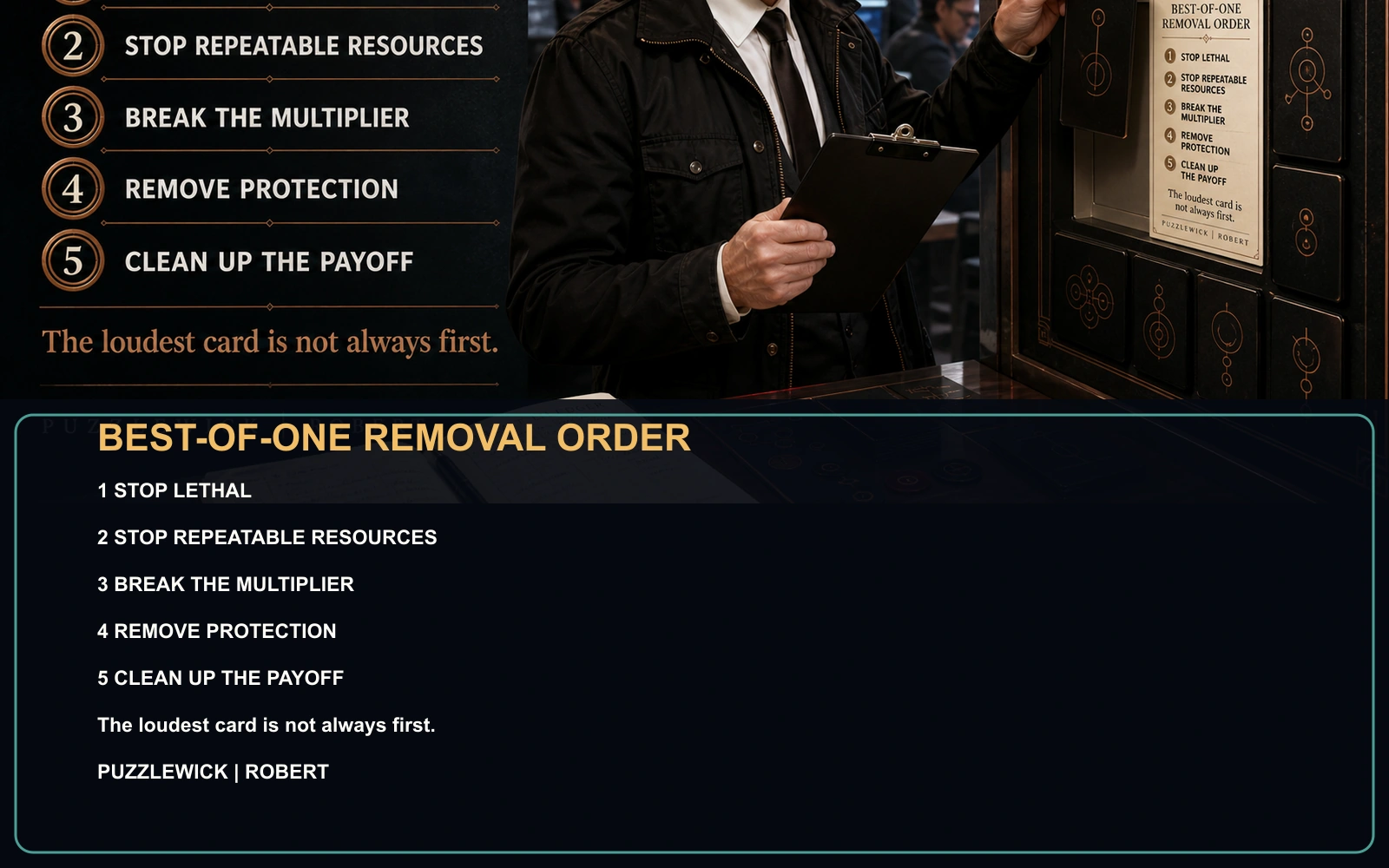
Best-of-One compresses adaptation. There is no second game in the match where narrow cards leave and specialized answers enter. Your opening hand, flexible interaction and first reading of the opponent’s plan carry more weight.
That does not mean every deck should become a pile of removal. It means each answer needs a job description. Cheap removal buys tempo. Exile handles recursion. Sweepers punish width. Countermagic prevents enter-the-battlefield value. A card can be excellent and still answer the wrong layer.
Begin with immediate lethal, then look for compounding value. If nothing kills you now, the card that improves every future draw often outranks the creature currently shouting in combat.
Best-of-One also rewards answers that overlap. A spell that handles both an early creature and a later engine keeps more opening hands functional than a narrow answer with a higher ceiling. Record the situations where a card sits unused. Dead cards are not merely unlucky draws; over ten matches they reveal which assumptions about the field were wrong.
Write one engine sentence before touching removal
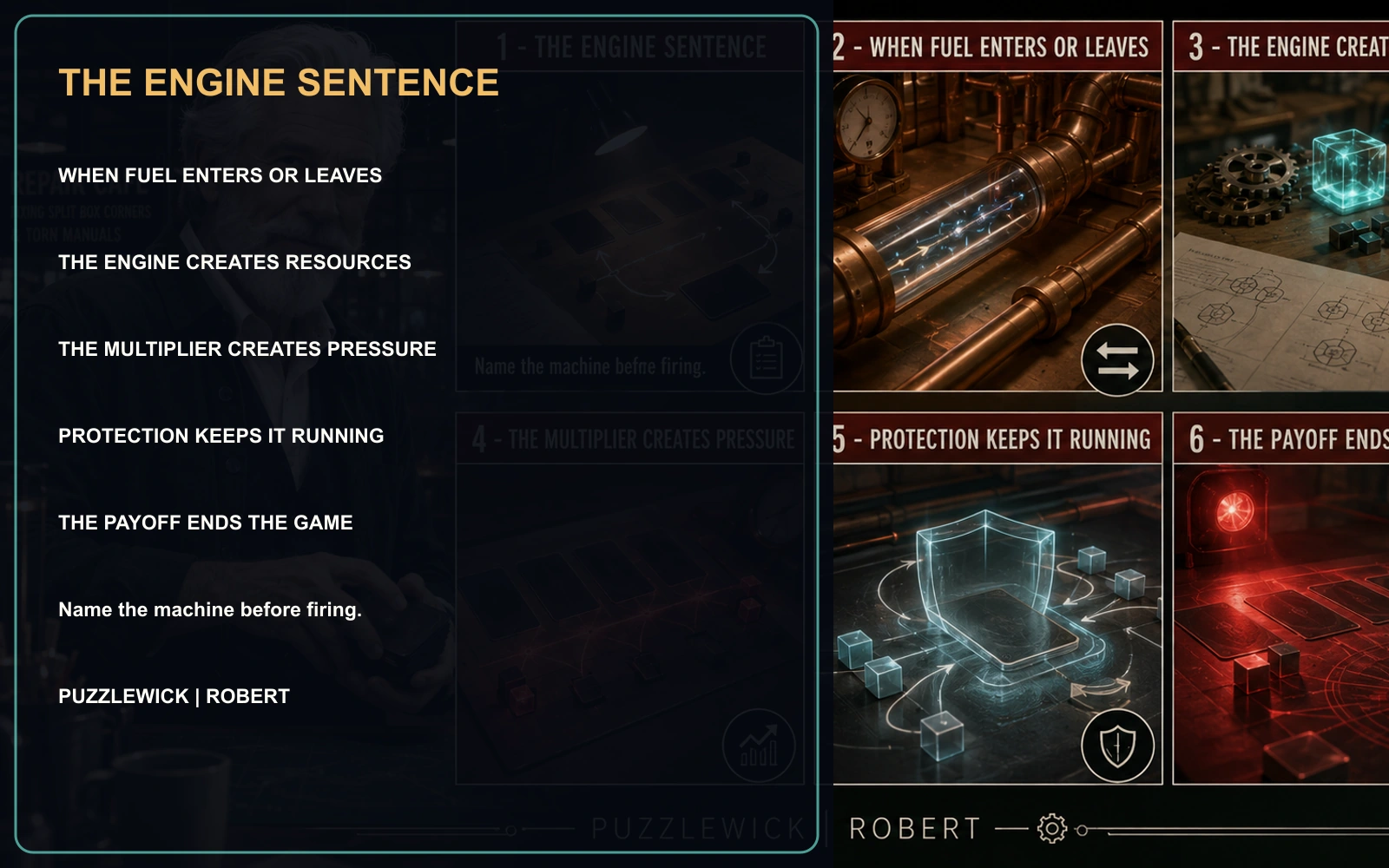
The Puzzlewick engine sentence is deliberately plain: when fuel enters or leaves, this engine creates or discounts resources; this multiplier turns those resources into pressure; this protection or interruption preserves the sequence; this payoff ends the game.
You do not need every clause. A Mono-Red deck may be threat, pump, protection, lethal. A black sacrifice shell may be body, death trigger, recursion, drain. A midrange deck may be efficient threat, two-for-one value, removal, larger threat. The sentence exposes the point where one card begins doing the work of several.
If you cannot finish the sentence, do not click faster. Inspect graveyards, available mana, cards in hand and triggers waiting to happen.
The engine sentence should describe causation, not card order. “I cast three creatures, then attacked” is a timeline. “Each cheap creature creates a token, the token feeds a sacrifice outlet, and the death trigger drains life” identifies the mechanism. Once the sentence works, remove one noun in your head. The noun whose absence collapses the most clauses is often the best target.
The five-question inspection finds the quiet threat
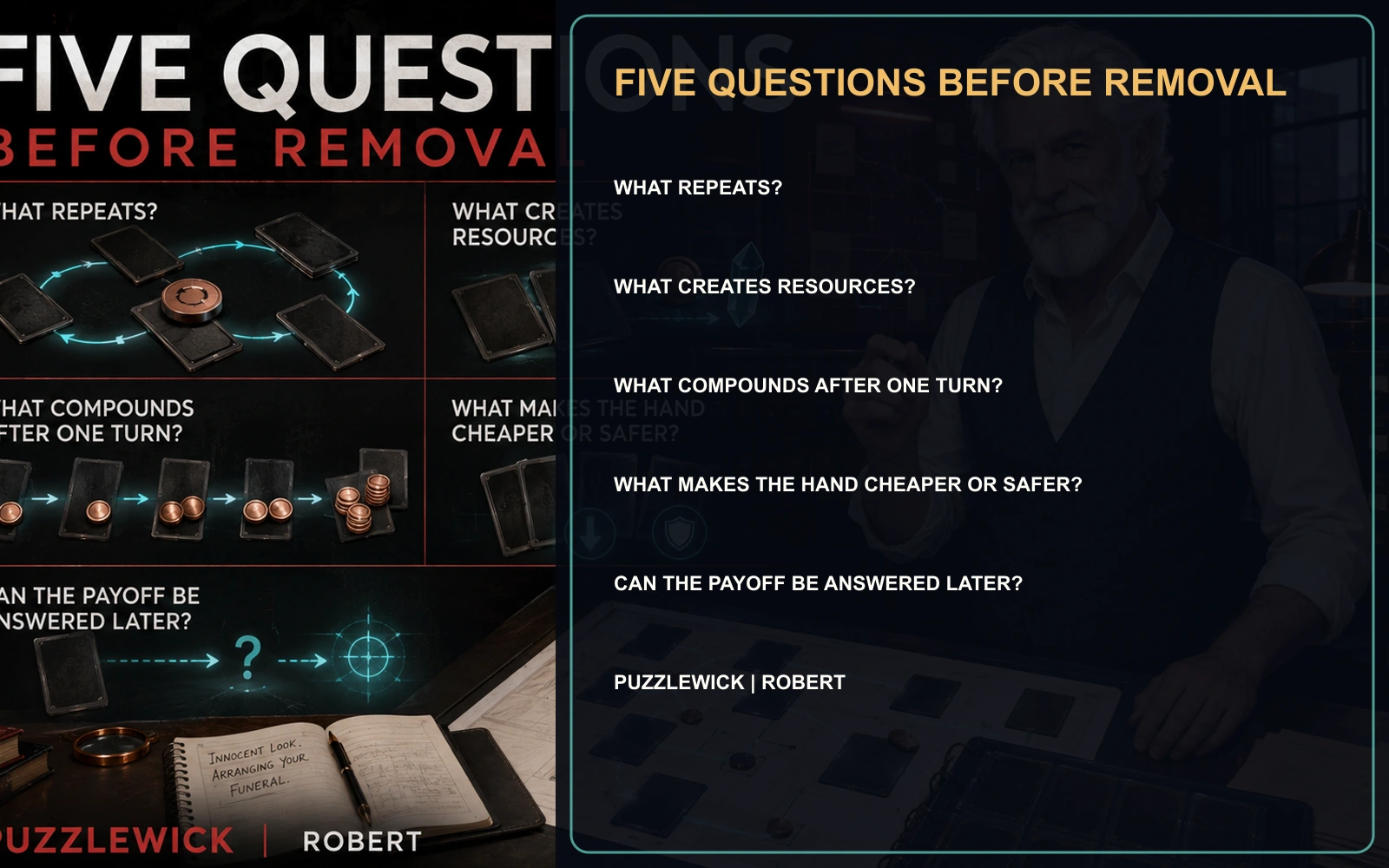
Ask five questions. What repeats without another card? What creates mana, cards, bodies or damage? What gets worse if it survives one turn? What makes the rest of the hand cheaper or safer? Can the payoff be answered later?
The questions are ordered to reveal acceleration. A creature that attacks for three may be replaceable. A two-mana permanent that produces another resource every turn can make the next three cards arrive early or arrive twice.
Wizards described the now-banned Badgermole Cub as a “cheap threat that demands an immediate answer.” The useful lesson survives the ban: inexpensive engine cards can distort a game before their combat stats look impressive.
Repeatability has several disguises. A permanent can repeat every turn, every spell, every creature entry, or every death. A cost reducer may never draw a card and still generate the equivalent of several mana. A protection piece may look passive while converting every removal spell into a poor exchange. Count the future actions it changes, not only the words printed in bold.
Kill order changes when the payoff is already lethal
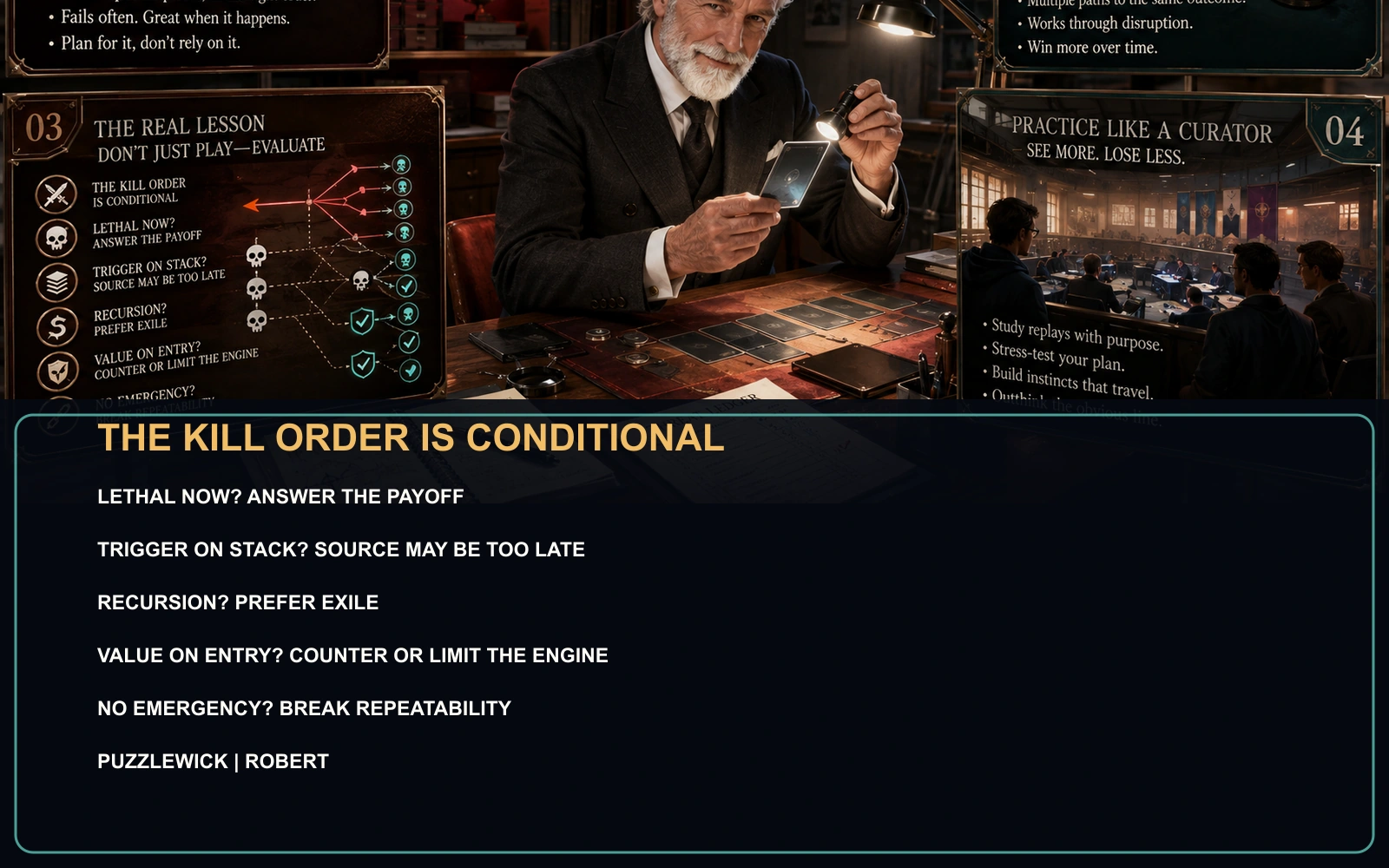
Engine-first is a heuristic, not a religion. If the visible attacker represents lethal damage, answer it. If a triggered ability is already on the stack, destroying its source may not remove the trigger. If an enter-the-battlefield ability created value, a normal destroy spell may be trading down.
Build a quick decision tree. Check lethal. Check the stack. Check whether the threat returns from the graveyard. Check whether exile, bounce, damage or a counterspell changes the result. Then decide whether the machine or its current output is the true emergency.
Strong players are not always seeing more cards. They are classifying the same cards by function and time horizon.
Timing changes target priority. Before combat, a multiplier may turn several ordinary attackers into lethal pressure. After blockers, the visible combat trick can become the emergency. During an end step, removing a draw engine before it untaps may be worth more than saving mana for a larger body. The framework ranks jobs; the current window decides urgency.
No Friend Protocol is a case study, not a trophy
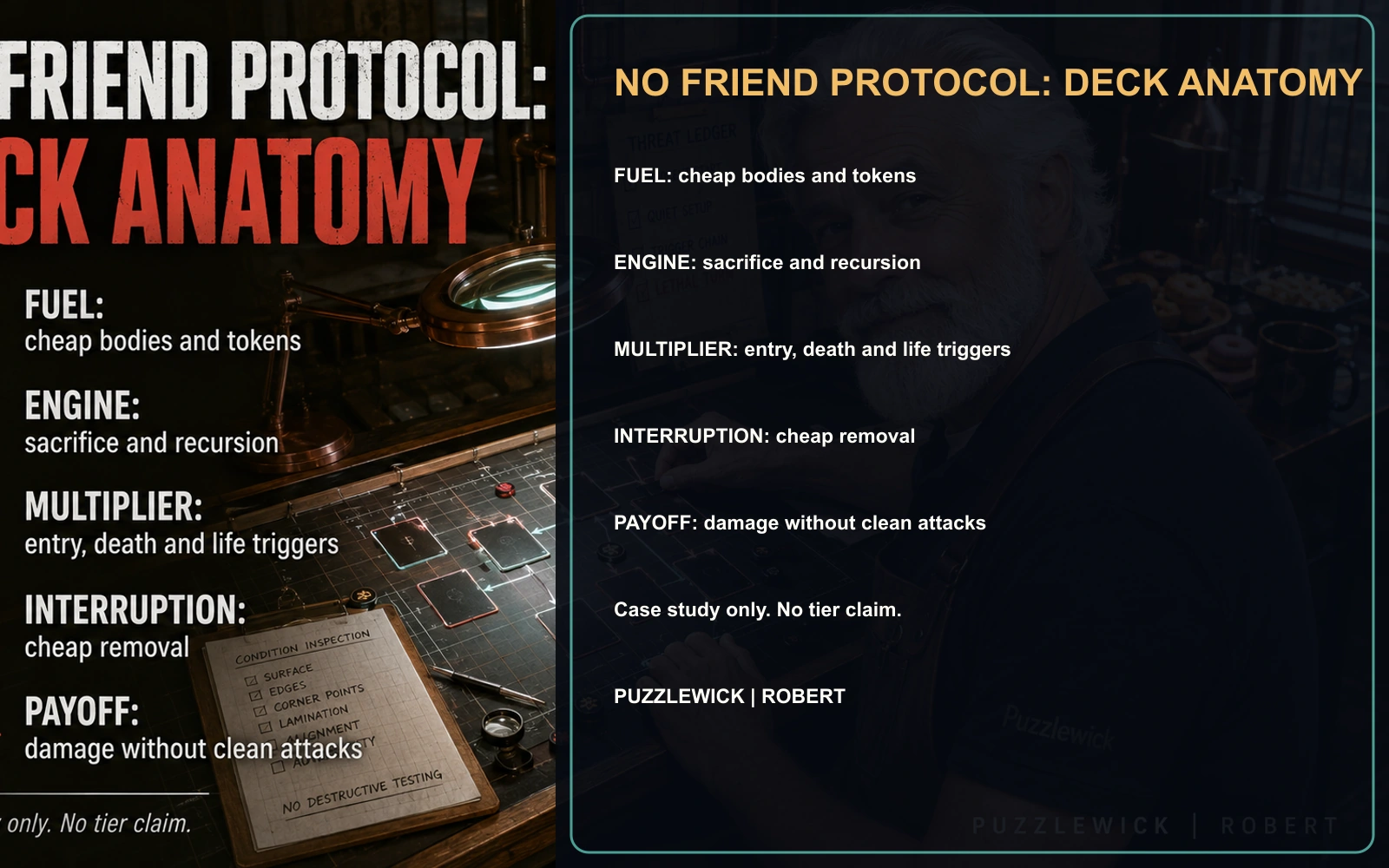
Robert’s No Friend Protocol is a disclosed 60-card Rakdos experiment built from his audited Arena collection. Its creatures and spells show a readable family of relationships: cheap bodies, death payoffs, sacrifice outlets, token generation, recursion and damage that does not require a clean attack.
Impact Tremors turns creatures entering into damage. Vengeful Bloodwitch and Marauding Blight-Priest reward different life and death events. Eaten Alive can convert a small body into removal. Reassembling Skeleton is persistent fuel when mana permits. No single card proves the deck competitive.
The lesson is diagnostic. If the opponent removes only the largest creature while leaving the repeatable trigger source, every small body keeps carrying hidden text. If they exile the recursive fuel or break the multiplier, the same draws become ordinary.
Robert's disclosed Rakdos list is useful precisely because it is imperfect. Reassembling Skeleton can be fuel, but only when the mana and timing permit. Impact Tremors can be a multiplier, but it does not protect itself. A sacrifice outlet without bodies is furniture. Labeling roles makes weak draws legible and prevents a clever interaction from being mistaken for a complete competitive plan.
Combat math begins before attackers are declared
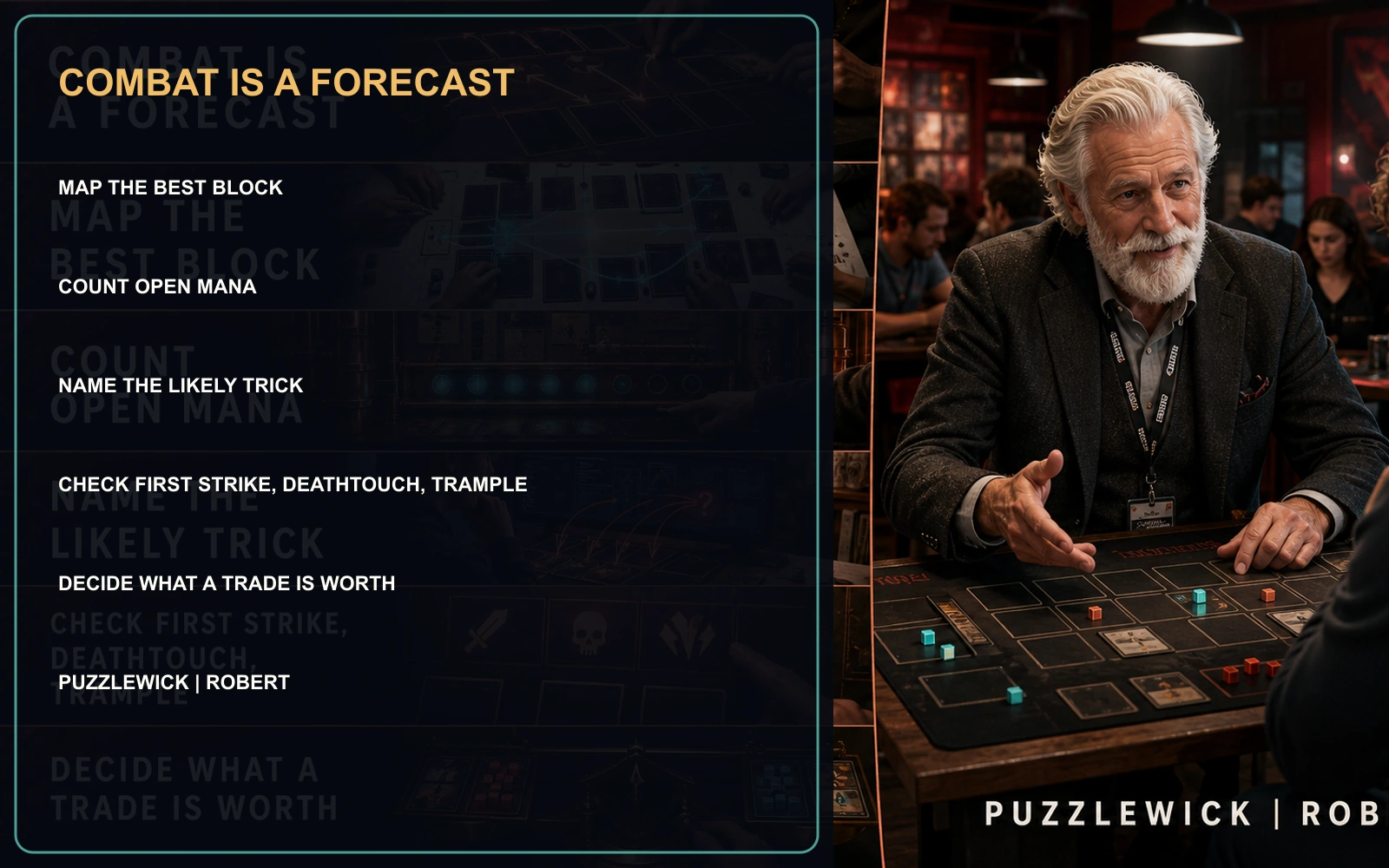
Threat assessment includes combat texture. A 1/1 with deathtouch can trade with a much larger creature in ordinary combat damage. First strike can change whether the return damage happens. Trample asks how much damage must be assigned to blockers before excess reaches the player.
Combat tricks turn open mana into uncertainty. Before attacking, compare the best block, the opponent’s untapped colors, known tricks and the value of waiting. Before blocking, ask whether your trade still works if power changes or protection appears.
Arena can preview damage, but the preview is not planning. Say the blocks and likely trick before committing. The habit exposes attacks that are only good when the opponent cooperates.
Combat forecasting should include the game after combat. A trade that looks equal may open an engine to attack next turn, remove the only sacrifice fuel, or place a useful card in a graveyard that can recur it. Before confirming blocks, say which resource each side loses and which trigger each loss creates. Power and toughness are only the invoice total.
Removal is a family of verbs
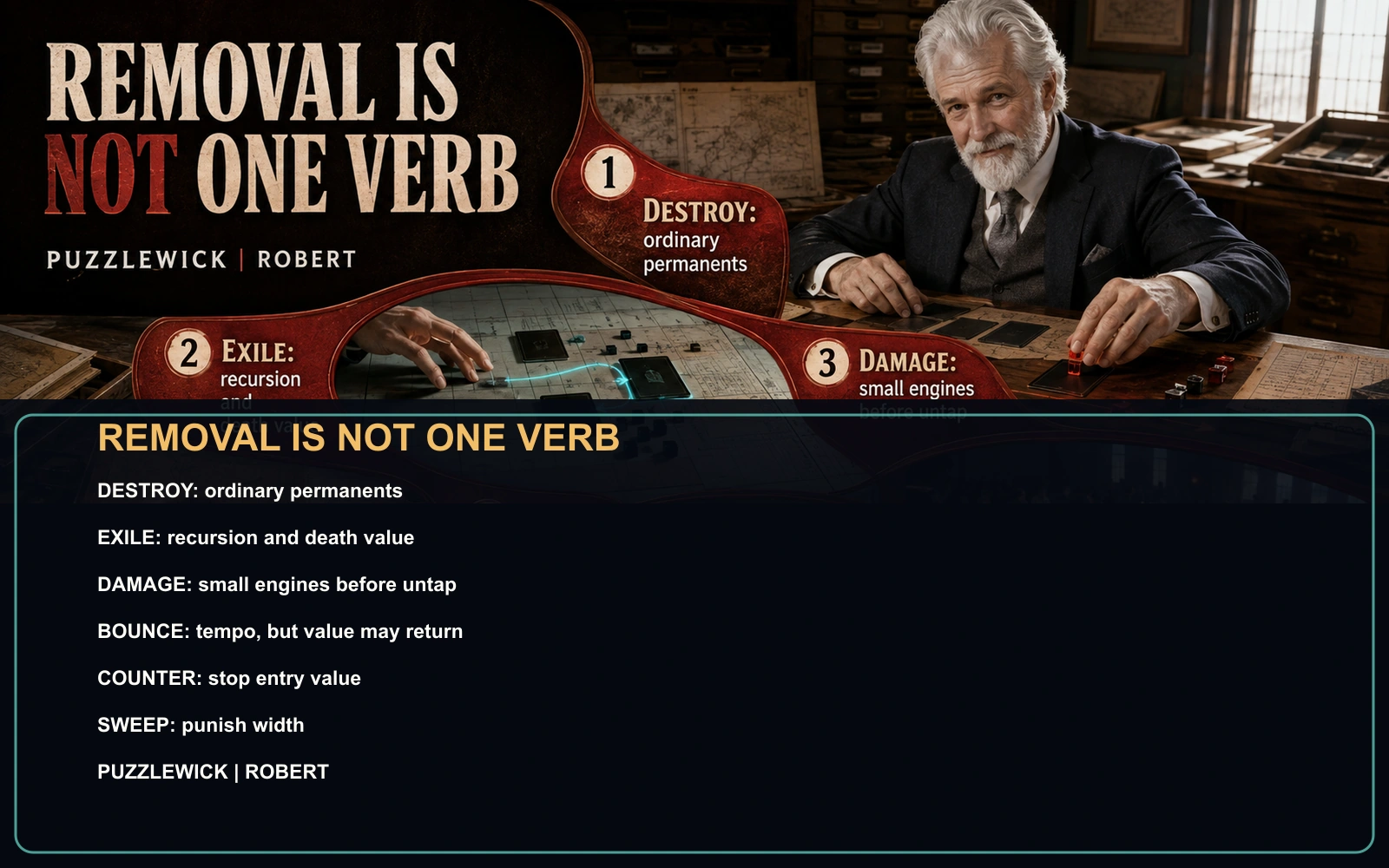
Destroy, exile, damage, bounce, counter, sacrifice and shrink are not interchangeable. Destroy can fail against indestructible or recursion. Damage cares about toughness and prevention. Bounce gains tempo but may replay an enter-the-battlefield ability. Countermagic acts before a permanent resolves. Sacrifice effects can reach creatures that cannot be targeted, but the opponent often chooses what leaves.
Match the verb to the engine. Exile persistent fuel. Counter expensive value on entry. Sweep a board whose strength comes from width. Use cheap damage on a creature whose engine requires one untap.
When reviewing a loss, do not write “needed removal.” Write the verb, mana value and timing window that would have changed the game. That turns frustration into a deck-building requirement.
Write answer verbs in the deck notes. “Two mana, instant, exiles a creature” is a usable requirement. “More removal” is not. If the repeated loss involves an enchantment, a graveyard, or a wide board, creature destruction will keep failing with impressive consistency. The review should alter the answer suite by problem class, never by the emotional size of the last defeat.
The ten-match engine laboratory
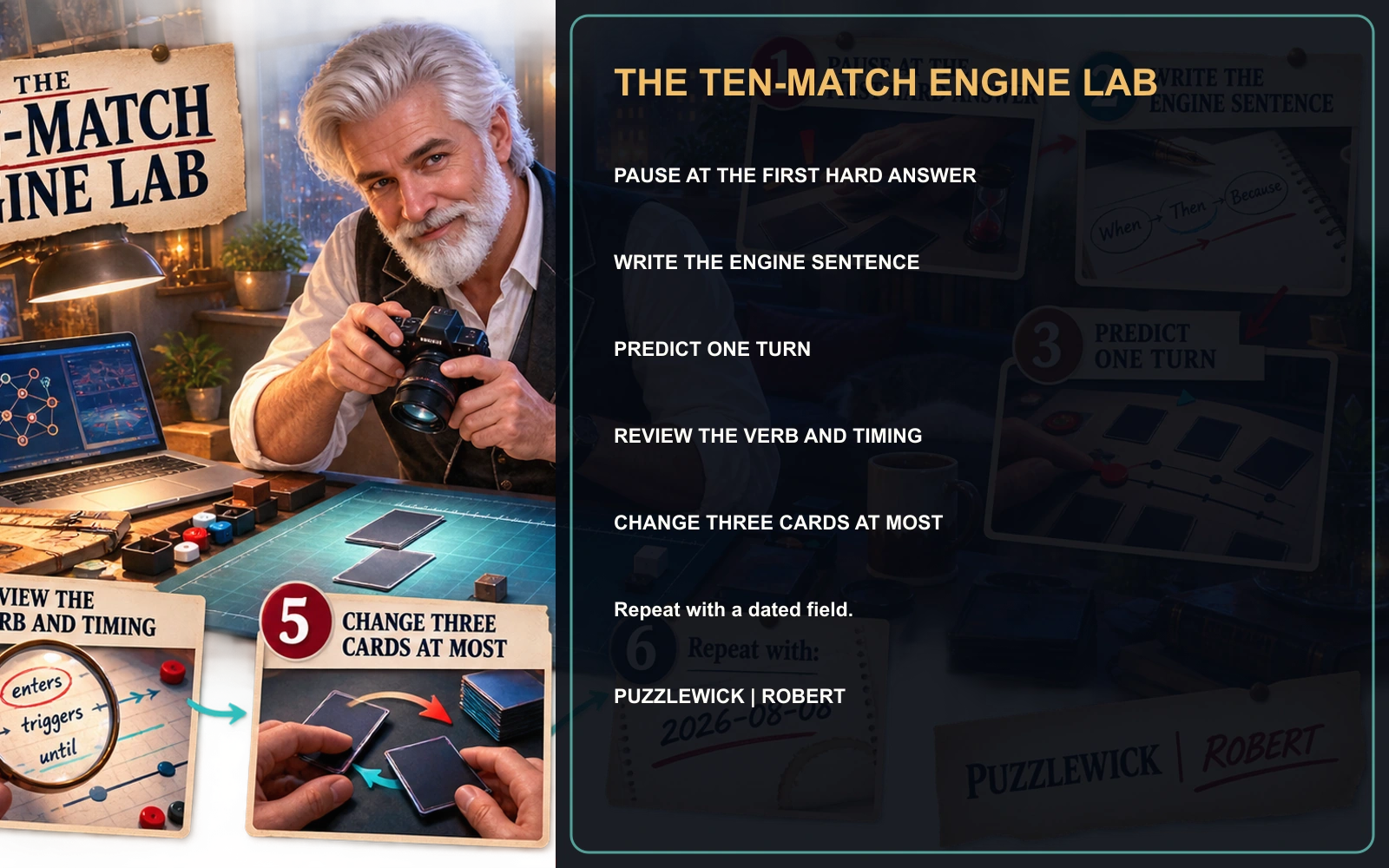
For ten matches, pause at the first difficult removal decision. Write the engine sentence, record your target and predict what the opponent’s next turn becomes. After the match, review whether the answer stopped lethal, reduced future resources or merely changed the artwork of the threat.
Track decisions, not only wins. A correct line can lose to draw order. A bad line can survive because the opponent draws lands. Results matter over time; one match is a witness with a poor memory.
At match ten, revise three cards at most. Add the removal verb you repeatedly needed or improve the mana that prevented you from casting it. Then run another ten. This is how a deck becomes yours without pretending the ladder owes you certainty.
At the end of the laboratory, separate execution errors from construction errors. Missing an available line asks for practice. Failing to draw a type of answer across a large enough sample may ask for deck changes. Drawing the answer but lacking the right color may ask for mana work. Three different diagnoses should not all be treated with three new rare cards.
The picks
Some links below are affiliate links — as an Amazon Associate, Puzzlewick earns from qualifying purchases, at no extra cost to you. It never changes a pick.
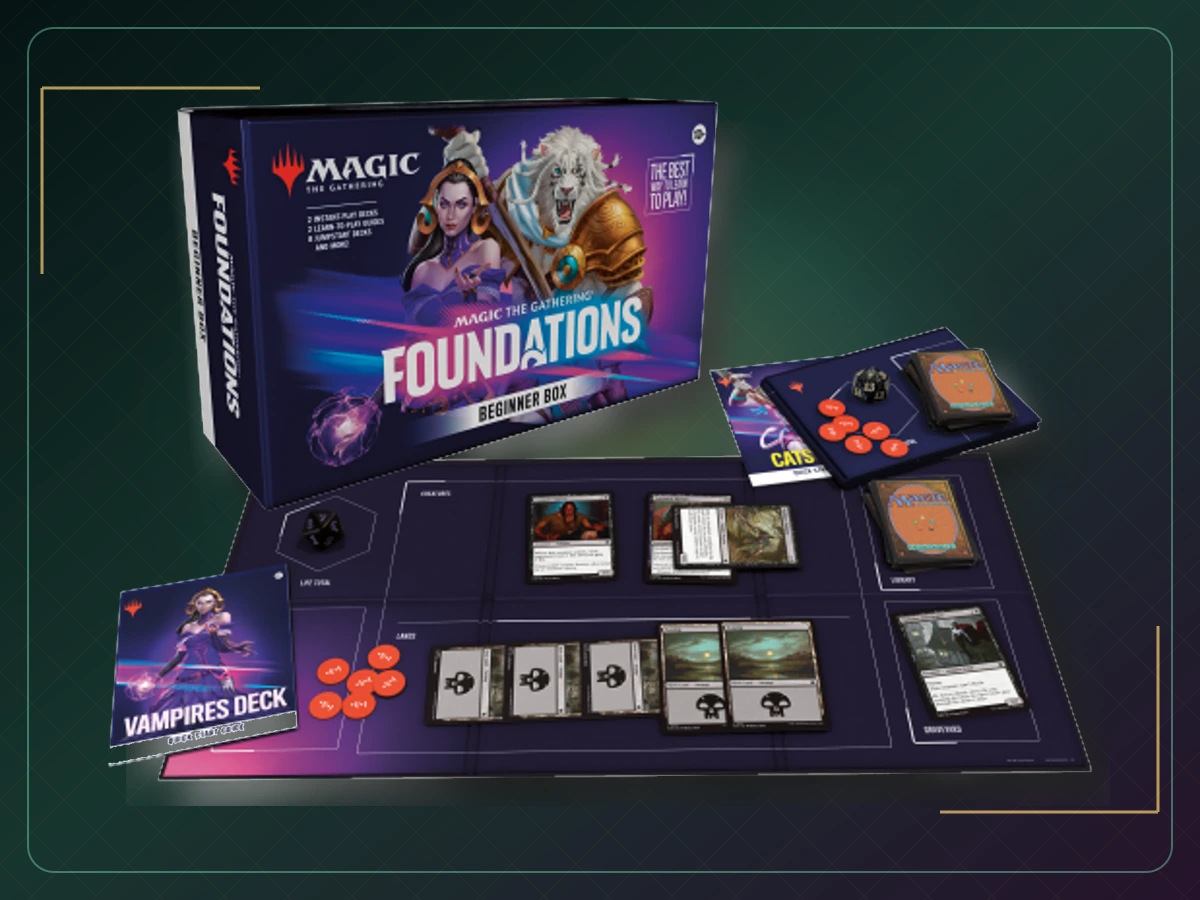
Magic: The Gathering Foundations Beginner Box
A guided card pool lets two players repeat board-reading drills before adding the entire format.
- Controlled learning field
- Paper practice
- Not a Standard tier deck
- Limited long-term variety

2025 Land Station (400 Basic Land Cards)
A shared land library supports real deck experiments without pretending that another randomized box will repair the mana.
- Known basic-land supply
- Reusable across lessons
- Not a playable deck
- Excessive for one fixed list
At a glance
| Role | Question | Typical answer |
|---|---|---|
| Fuel | What enters, dies, attacks or is discarded? | Cheap creature, token, landfall, spell |
| Engine | What repeats without another full card? | Mana, cards, bodies, counters |
| Multiplier | What makes every unit worth more? | Trigger, anthem, cost reduction |
| Protection | What keeps the sequence alive? | Recursion, ward, instant interaction |
| Payoff | What converts the stockpile into a win? | Drain, combat, burn, overwhelming board |
Free download — The engine sentence and five-question removal card
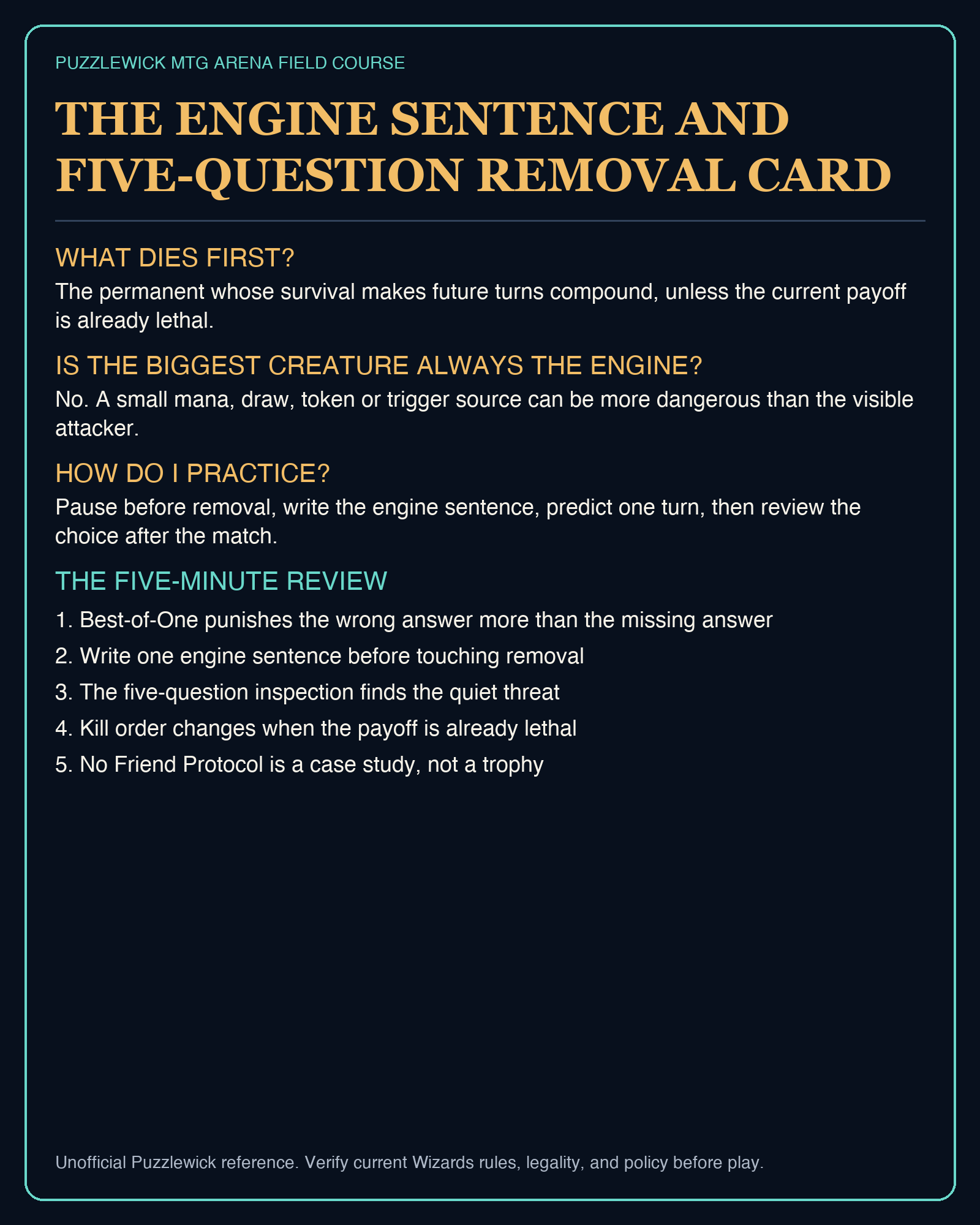
A concise printable Puzzlewick companion. Unofficial; current Wizards rules and policy always take precedence.
Unofficial fan-made reference. Compiled by Puzzlewick from the sources listed on the sheet. Not affiliated with or endorsed by the publisher — always defer to the official rulebook.
Questions, answered
What is an engine in Magic?
A repeatable interaction that turns one resource or event into additional mana, cards, bodies, counters, damage or selection.
How do I know which creature to destroy?
Check immediate lethal first. Otherwise prioritize repeatable resource creation, multiplication, protection and cards that become much worse after one untap.
Should I save removal for a finisher?
Only when the finisher can be answered later. If the engine will produce enough advantage to overwhelm that answer, interrupt the engine now.
Why is Best-of-One different?
There is no post-game sideboard correction in the match. Flexible interaction and fast recognition carry more weight in the first game.
Is the No Friend Protocol a tier deck?
No. It is Robert’s disclosed Rakdos case study used to show fuel, sacrifice, token and drain relationships. No win rate is claimed.
Keeper's verdict
Your removal plan should begin with repeatability. A one-time threat may be spectacular. An engine that survives turns every ordinary draw into a better draw. Learn to write the engine sentence, and the battlefield becomes a system rather than a collection of alarming nouns.
Research ledger 11 sources · reviewed 2026-09-08
Specifications, rules, current product information, community experience, and contrary evidence were checked against the sources below. Commercial links are kept separate from editorial evidence.
- Wizards of the Coast: Standard formatmagic.wizards.com/en/formats/standard
- Wizards of the Coast: August 10, 2026 banned and restricted announcementmagic.wizards.com/en/news/announcements/banned-and-restricted-august-10-2026
- Wizards of the Coast: Magic rules librarymagic.wizards.com/en/rules
- Wizards of the Coast: How to Play Magicmagic.wizards.com/en/how-to-play
- MTG Arena Zone: Standard Best-of-One metagame tier listmtgazone.com/standard-bo1-metagame-tier-list
- TCGplayer content indextcgplayer.com/content
- BoardGameGeek: Magic: The Gatheringboardgamegeek.com/boardgame/463/magic-the-gathering
- Scryfall: current Standard card recordsscryfall.com/search?q=f%3Astandard
- Robert Pruitt: No Friend Protocol Arena import/research/mtg-arena-standard-bo1-cornerstone-series-2026-09-08
- Wizards of the Coast: MTG Arenamagic.wizards.com/en/mtgarena
- Wizards of the Coast: Getting Started in MTG Arenamagic.wizards.com/en/mtgarena/getting-started
If it didn't earn a shelf, it isn't here.



Keep exploring
The next smart rabbit holes.
✶ Universe HubMagic: The Gathering: the whole buying pathMagic: The Gathering is the deepest construction sandbox in the Big Three: a two-player duel, four-player Commander ritual, draft...🂠 Topic PathTrading Card Games: compare the whole shelfStart with the game and community you want, then buy the smallest product that lets you test it properly. These guides separate...Buying GuideWhat Should You Craft in MTG Arena Standard? A Post-Ban Best-of-One Field GuideMargo separates current field evidence from tier-list theater, compares Mono-Red Aggro, Boros Auras and Mono-Black Midrange by decision...