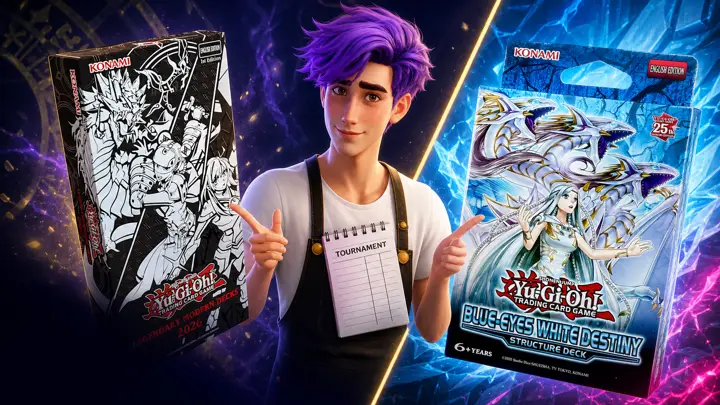
Yu-Gi-Oh! Magnificent Monsters vs Rarity Collection 5 vs Glorious Gallery: Which 2026 Box Should You Buy?
Magnificent Monsters contains 18 cards: three five-card Ultra Rare packs plus three separate Secret Rares, with possible Starlight upgrades. Choose it for anime nostalgia and a planned collector opening, Rarity Collection 5 for its broad reprint pool, or Glorious Gallery for particular support and artwork. None is a ready-to-play deck. For a named card, compare the exact single instead of opening until it appears.


AI-assisted research and drafting in Yumi’s voice · reviewed by Robert Pruitt · how this guide was made
Last editorial refresh: 2026-09-23 Gold-standard QA: 2026-09-23 15 sources reviewed Affiliate links checked during gold-standard pass

Decision map
Choose in thirty seconds
Eighteen reimagined anime subjects, three treatments, and a separately finite numbered treatment.
The widest utility-and-variant conversation of the three.
Read the official list first; specificity is its reason to exist.
A sealed box cannot promise the named card or treatment.
You remember a magician, a dragon, perhaps a remarkably confident teenager. The modern card game remembers them too, then asks you to read three more paragraphs of card text. Magnificent Monsters turns that recognition into eighteen new remixes across six anime eras. It is an appealing invitation, provided nobody mistakes the invitation for a finished deck.
This is a source-based buying and learning guide, not a hands-on opening review. Magnificent Monsters released in North America on September 4, 2026. In this September 23 refresh, we check the published contents and current buying options, distinguish this set from the two other collector boxes, and show how to move from liking a character to making a useful first decision.
Start here, then go deeper
You are in the right cabinet.
 ◈ Universe HubYu-Gi-Oh!: the whole buying pathYu-Gi-Oh! remains a top-four marketplace game with a deep competitive identity and a collector rebound around new extended-art...
 🂠 Topic PathTrading Card Games: compare the whole shelfStart with the game and community you want, then buy the smallest product that lets you test it properly. These guides separate...
 GuideMaster Duel to Paper Yu-Gi-Oh! in 2026: Your First Local Without the Rules ShockDax translates automation into table skill: paper legality, NEURON, zones, chains, side decking, tournament materials and the social...
Which 2026 Yu-Gi-Oh box should you buy in one minute?
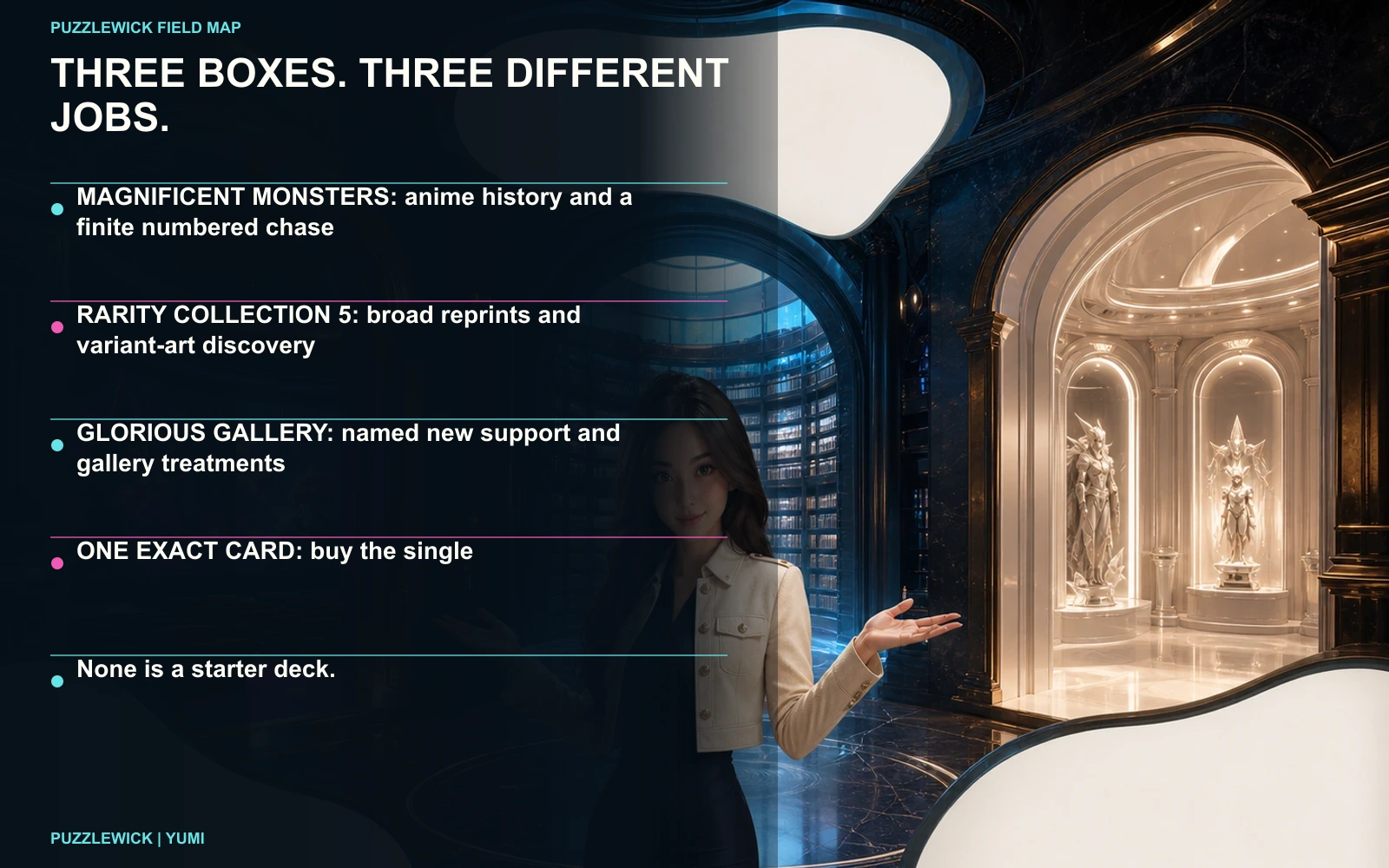
Magnificent Monsters is now the released anime-history collector opening. Konami dates the public and tournament-legal launch to September 4, 2026, advertises a 126-card set, and makes eighteen reimagined anime subjects its distinctive lane. Those subjects can appear as regular Ultra, extended-art Ultra, extended-art Starlight, or the separately finite Grand Master treatment.
Rarity Collection 5 is the broad reprint opening. Its pack structure deliberately gives four main-pool cards and one variant-art card. Glorious Gallery is the card-list opening. Its new support, extended art, and chibi variants matter only if the named subjects matter to you.
If you can name the exact card or treatment, buy the single. Randomness is entertainment; it is a poor search function.
What is actually inside Magnificent Monsters?
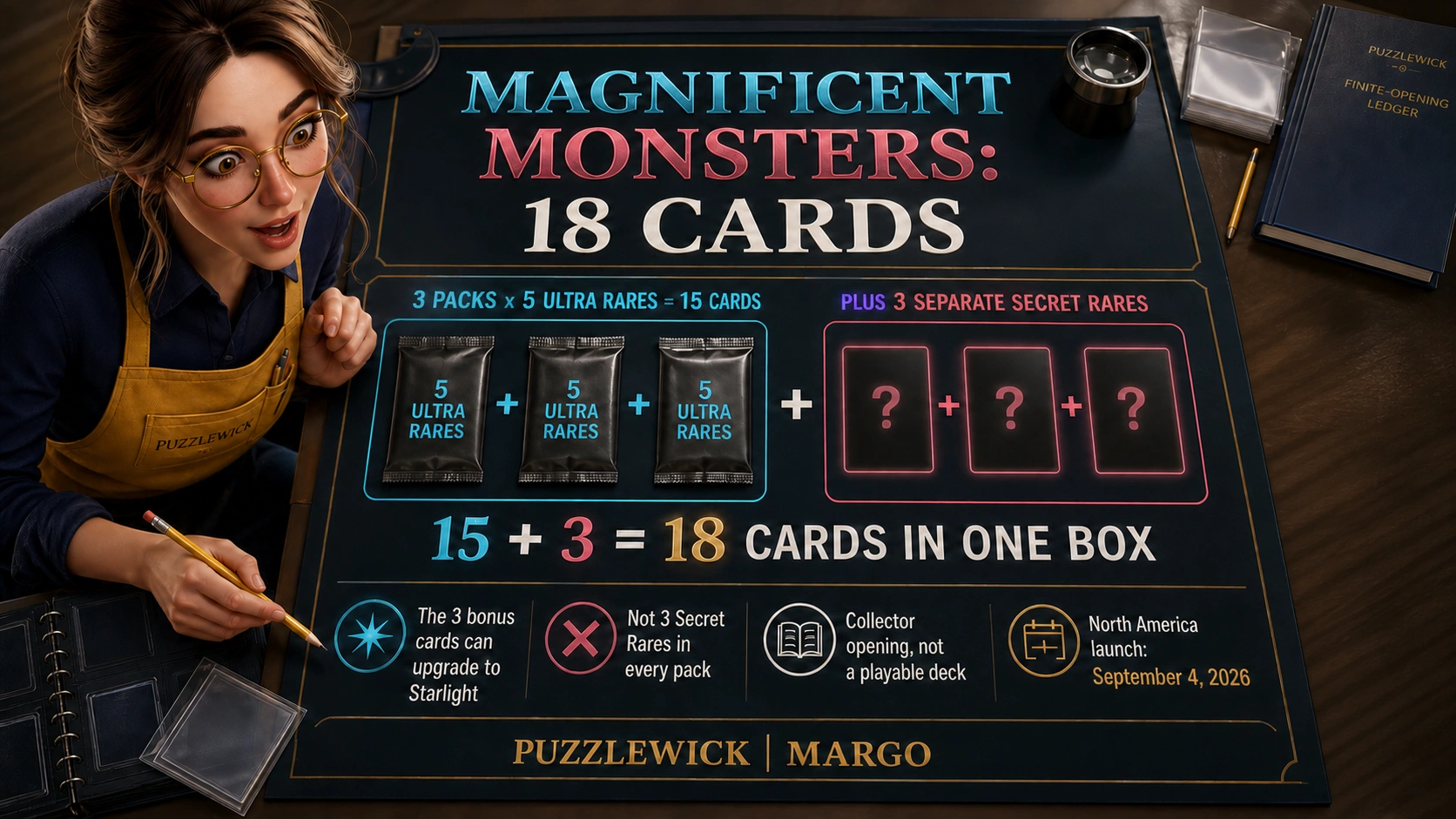
One Magnificent Monsters box contains eighteen cards. There are three packs with five Ultra Rare cards each, plus three separate bonus cards that are Secret Rare with a chance to upgrade to Starlight. The calculation is 3 x 5 + 3 = 18. The three bonus cards belong to the box, not to each pack.
That is a short, concentrated opening. It is not a twenty-four-pack booster display and certainly not a ready-made forty-card deck. Treat the premium finish as the experience you are buying, not as extra gameplay contents that have somehow escaped the small box.
Konami advertises a 126-card set and describes protagonist remixes, new boss monsters, other new or variant-art cards, first-time foil upgrades and reprints. Its product page describes the set rather than supplying your personal collection checklist. Use the official card database and exact printed names before declaring a binder complete.
The packs use assigned slots with restricted card pools. That shapes what can appear in each position; it does not mean every card is equally likely or that a particular hero's three cards arrive together.
Source: Konami: Magnificent Monsters box contents and pack pools.
One box and a ten-box display are different purchases. The single box is the compact eighteen-card opening described here. The sealed display contains ten of those boxes: thirty five-card packs plus thirty separate bonus cards, or 180 cards in total. Duplicates remain possible, and a larger display does not guarantee a numbered card or a complete set. Start with one box unless you already have a clear plan for the larger opening.
How rare is a Grand Master Rare?
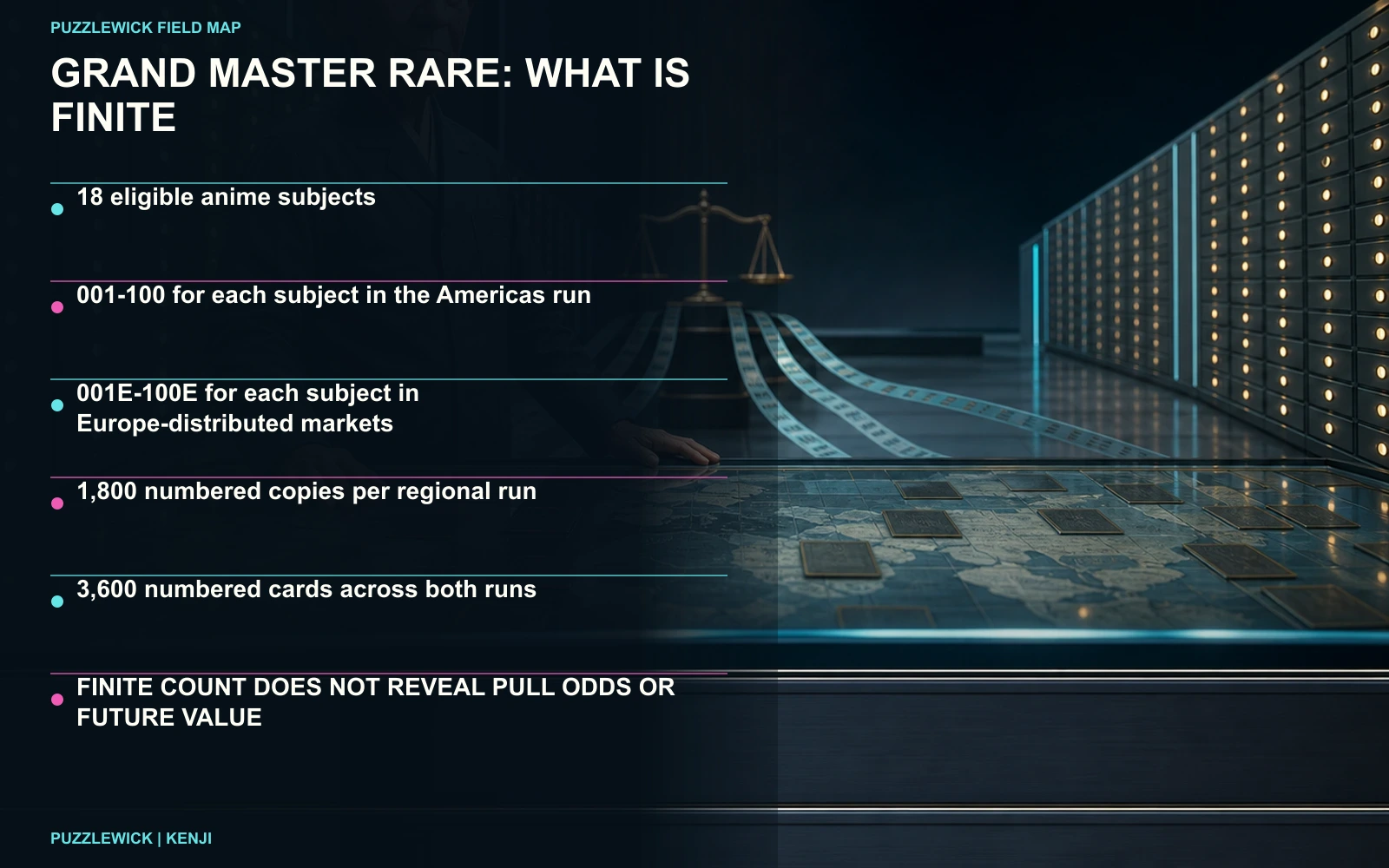
Grand Master Rare is a numbered treatment, not a known chance of winning a valuable card. Konami limits it to the eighteen protagonist remixes. For each subject, its page describes one hundred numbered copies for the Americas and another one hundred for Europe-distributed markets. The latter numbers end in E. All Grand Master Rares are English-language cards, including those found in other-language packs.
The arithmetic is eighteen times one hundred, or eighteen hundred per stated distribution group. Combining those two statements gives thirty-six hundred. That is our arithmetic from Konami's regional description, not a separately published worldwide production total or a pull-rate announcement.
To calculate a reliable chance per box, we would also need the relevant box population and distribution details. Konami does not supply those. Serial number 001 looks wonderful in a photograph; it is not permission to reverse-engineer odds from a handful of creator openings.
Decide which card and treatment you actually want. A standard Ultra Rare of a remix performs the same job as its premium treatment when the card identity is the same. Rarity buys a different object for a collector, not a stronger effect for a Duelist.
The eighteen anime remixes: start with the hero you recognize
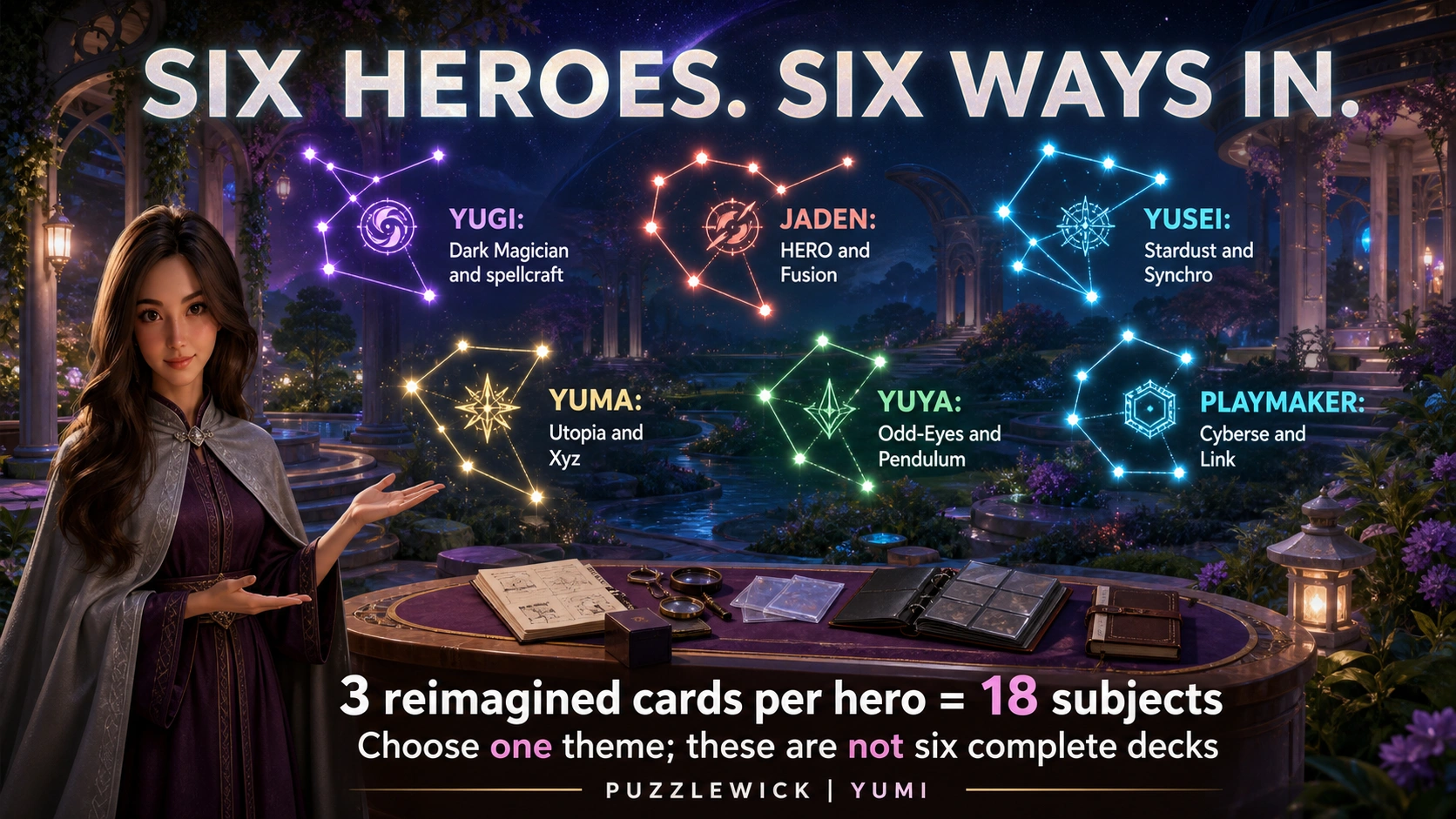
The eighteen headline cards form six groups of three, not one coherent deck. Konami connects each group to a protagonist from the first six television series. Use that familiarity to choose what to investigate. You do not need six shows' worth of homework before your first Duel.
| Hero and series | Announced MAMO cards | Useful first question |
|---|---|---|
| Yugi, original Yu-Gi-Oh! | Dark Magician, the Pharaoh's Servant Kuriboh - Multiply! Dark Magical Curtain | Which Dark Magician plan does this card actually support? |
| Jaden, GX | Favorite HERO Shining Flare Wingman Favorite HERO Flame Wingman Winged Kuriboh Sabatiel LV10 | Which Fusion materials and summoning effect will I need? |
| Yusei, 5D's | Stardust Dragon - Victim Sanctuary Starjunk Synchron Synchro Emergency | How do I produce the required Tuner and other materials? |
| Yuma, ZEXAL | Number 39: Utopia, Emissary of Light Gagaga Magician - Gagaga Magic Gagaga Girl - Cell Phone Subtraction | Which Levels and material requirements make this Xyz line work? |
| Yuya, ARC-V | Odd-Eyes Pendulum Dragon, Four Heavenly Dragons Horoscope Sorcerer, the Stargazer Magician Astrograph Sorcerer, the Starfrost Magician | What do the Scales and both effect boxes allow? |
| Playmaker, VRAINS | Decode Talker Integration Cyberse Code Magician Cyberse Contract Witch | Which materials, Link Rating and zones does my sequence require? |
These are the names on Konami's North American product page, checked September 23. Compare the full printed identity with the official card database before planning an interaction. A familiar illustration does not make a remix the same rules object as an older card. Search the complete name rather than assuming that an old combo or ban-list entry transfers across.
For the collector, one hero is a sensible three-card goal. For the player, the hero is a starting point for deck research, not a reason to buy every shiny card bearing a related name. An attractive boss that your deck cannot summon has applied for the wrong job.
New to Yu-Gi-Oh? Learn one deck before six summoning systems
Begin with a complete teaching product or an agreed beginner deck, not a MAMO opening. The ordinary physical game is a two-player Duel. Each player starts with 8,000 Life Points. A Main Deck contains 40-60 cards; an Extra Deck and Side Deck may each contain 0-15. The usual limit is three copies of the same card across those decks combined, with further restrictions from the event's format and current list.
For the first practice game, learn where the cards go, what your opening hand is trying to do, and how you win. Learn one basic line from your chosen deck, then one way to recover when that line is interrupted. Leave the rest of the encyclopedia available for reference instead of loading it into your head before you sit down.
- First session: use the rulebook or official teaching videos; play a slow open-hand practice Duel if both players agree. This is a learning exercise, not a tournament procedure.
- Second session: use the same deck, announce effects clearly, and practice asking what an unfamiliar card does before deciding your response.
- Third session: try a normal hidden-hand match with a patient partner. Check your deck list and local event format before booking a tournament.
A useful introduction is: "I'm learning this deck. Are you happy to play a slower practice game and explain the main interruptions?" It sets expectations without apologizing for being new. At an event, ask a judge about a ruling; do not expect your opponent to coach your choices.
Start with our Yu-Gi-Oh playing guide, compare Blue-Eyes and Fallen & Virtuous, then use the first-locals checklist. MAMO can wait until you know which cards you want it to contribute.
Source: official rulebook, getting started and Duel structure.
The six summoning families, without the intimidation
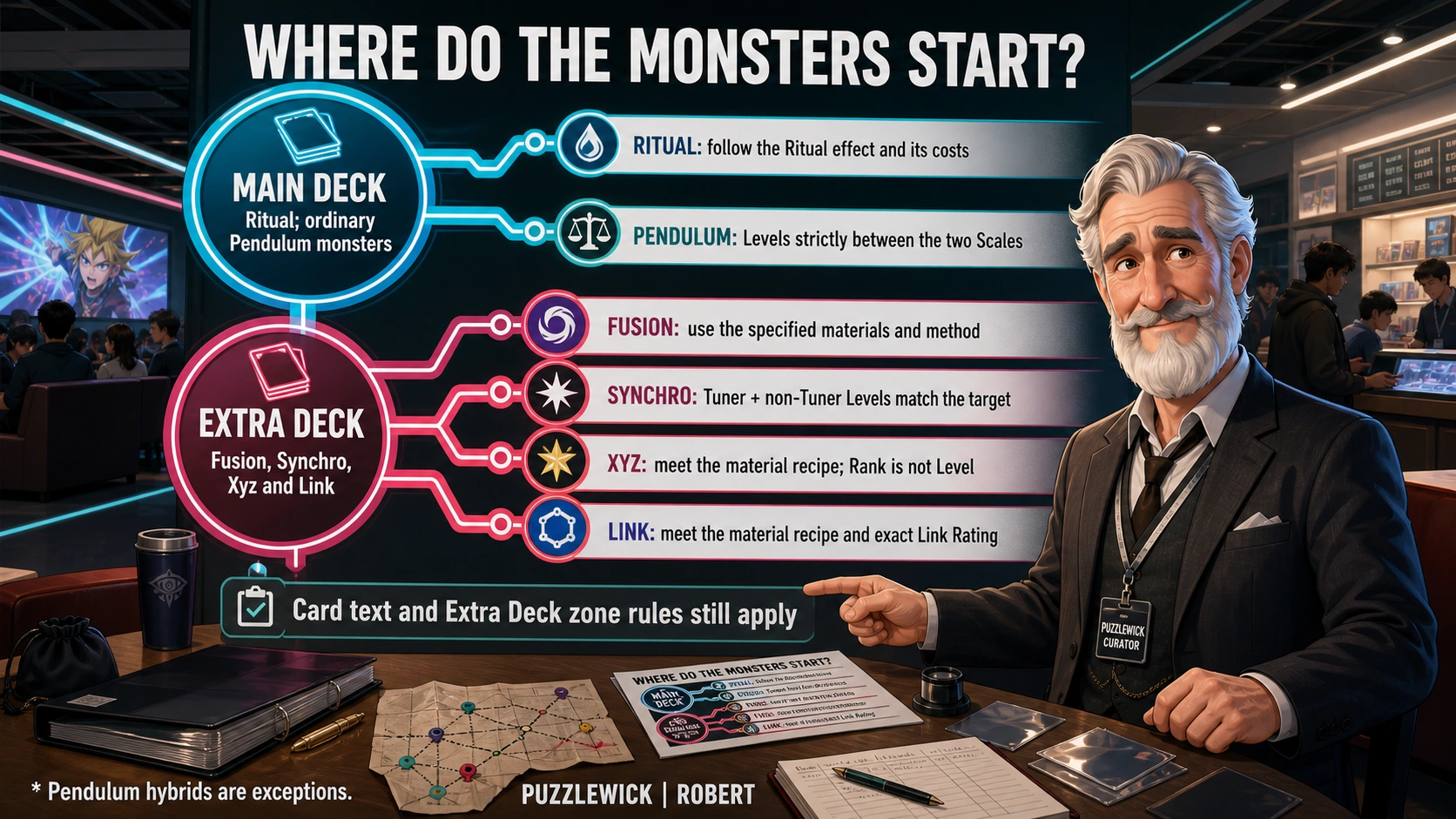
Konami describes six new MAMO bosses, one associated with each major Special Summoning method. You do not need to master all six to enjoy one deck. These are orientation notes; a monster's written material requirements and summoning procedure always matter.
Ritual and Pendulum: do not put every special monster in the Extra Deck
Ritual: the ordinary Ritual Monster starts in your Main Deck. Follow the Ritual effect's instructions about the monster, permitted resources and required Levels. Do not assume that every Ritual effect uses exactly the same procedure.
Pendulum: an ordinary Pendulum Monster also starts in the Main Deck. You can play one in a Pendulum Zone as a Spell, using its separate Pendulum effect. With two Scales, a Pendulum Summon normally summons eligible monsters with Levels strictly between those numbers. Scales one and eight permit Levels two through seven, not one or eight.
Pendulum cards sent from the field toward the Graveyard normally go faceup to the Extra Deck instead. There are also Fusion, Synchro and Xyz Pendulum hybrids that begin in the Extra Deck. "Pendulum" therefore does not mean "always starts here." Read the entire card type.
Fusion, Synchro, Xyz and Link: learn the recipe
Fusion: the target begins in the Extra Deck. Use its specified materials and an appropriate summoning method. Owning the listed monsters does not by itself allow an ordinary Fusion Summon.
Synchro: typically combine a Tuner with one or more non-Tuners whose Levels total the target's Level, while meeting its material text. Level three plus Level four totals seven; the arithmetic still cannot overrule a specific requirement.
Xyz: use the target's written material recipe, often monsters of the same Level, and place those materials beneath it. An Xyz Monster has a Rank rather than a Level. Materials beneath it are not extra monsters occupying your field.
Link: meet both the written material requirements and exact Link Rating. A Link Monster used as material can normally count as one or as its own Link Rating, not any convenient number between. Link Monsters have no DEF and cannot be placed in Defense Position.
The zone rule older tutorials can get wrong
Fusion, Synchro and Xyz Monsters summoned from the Extra Deck may use any of your Main Monster Zones under Konami's current published update. Link Monsters and Pendulum Monsters summoned from the faceup Extra Deck still need an Extra Monster Zone or a Main Monster Zone a Link Monster points to. A diagram that funnels all six methods through one Extra Deck station would teach the wrong starting point.
Source: official rulebook, monster types and summoning.
Source: Konami 2021 update, which supersedes older Extra Deck zone diagrams.
Make a useful upgrade: test access, cost and recovery
A new card earns its place by improving a repeatable sequence, not by having the most impressive attack number. Before buying a MAMO single, write down which existing card it replaces and what problem the change solves. Does it help start your plan, extend it, interrupt the opponent or recover afterward?
Try three concrete checks with the final official card text. First, what other cards must you already have for it to work? Second, what costs and restrictions apply, including locks on later summons? Third, what resources remain if the opponent stops the important effect? A hand that does nothing until three particular cards arrive is not rescued by a gorgeous finish.
Use a simple practice log: starting hand, intended line, first interruption, remaining options. Five or ten practice hands are a learning exercise, not a measured win rate. When testing a change, keep the rest of the deck stable so you can notice what the new card actually did.
Read costs and effect text separately. Something paid to activate an effect does not normally return merely because that effect is negated. Ask which activation your opponent is responding to, and resolve a Chain in reverse order. Specific card interactions still need the current database or a judge; a general strategy paragraph cannot settle every ruling.
This guide does not label any MAMO engine the best competitive deck. Tournament results, the final card text and the live Forbidden & Limited List must support that claim before it deserves your money.
Build a collection you can actually finish
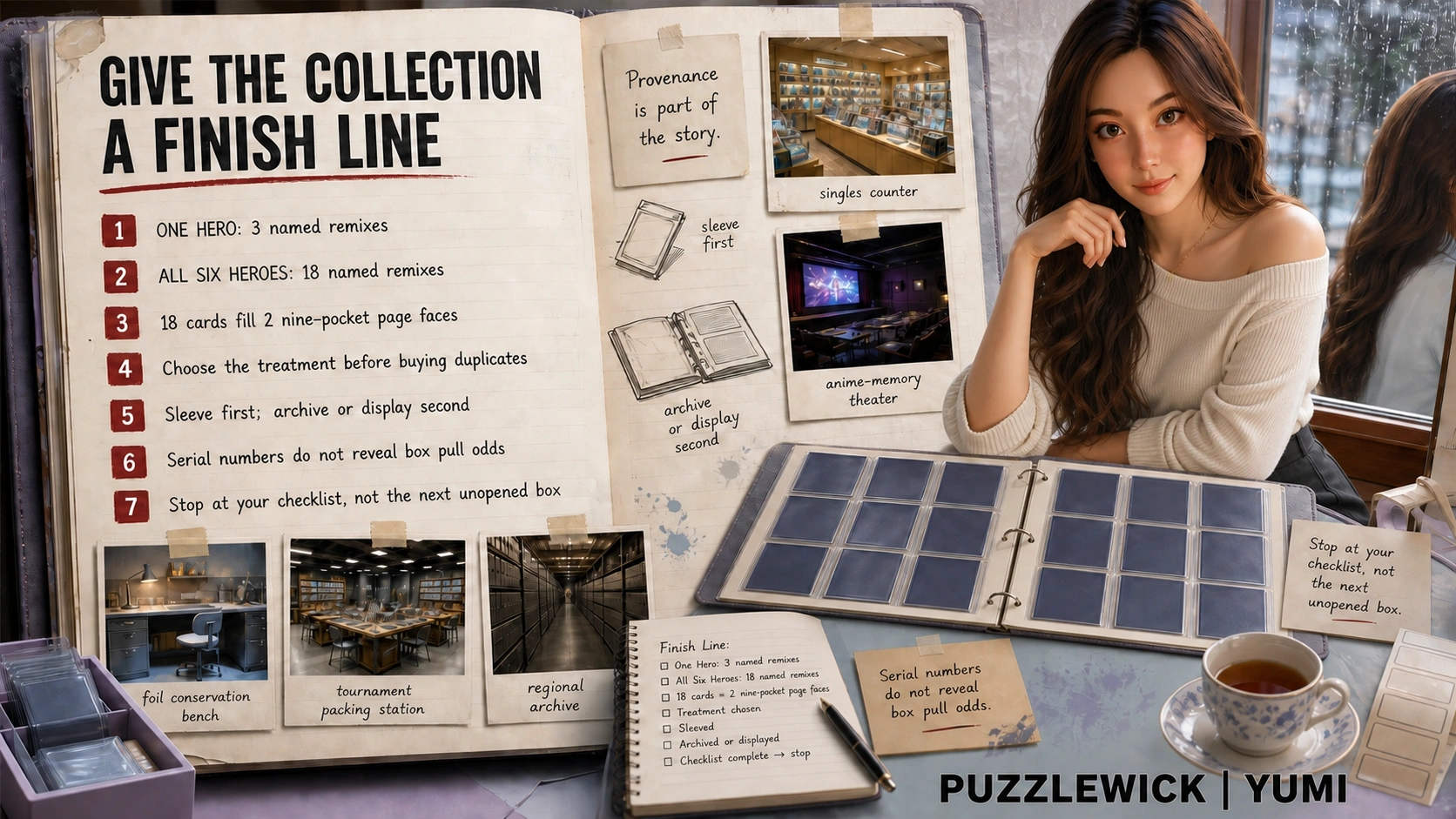
Choose the subjects and finish before you open. One hero's three remixes is a small project with a visible ending. All eighteen protagonist remixes is a broader project that still has boundaries. Decide whether you want standard Ultra Rare, extended art, or a particular premium treatment. A duplicate subject in another finish is a new collecting choice, not automatically a missing essential.
Eighteen sleeved cards need eighteen suitable pockets. That is two nine-pocket page faces, not necessarily two physical binder leaves: some pages hold cards on both sides. Check your binder's construction and pocket fit. Leave cards visible, avoid forcing a thick stack into one pocket, and keep a short checklist of exact names and treatments.
Before opening, clear drinks and food, clean and dry your hands, and place sleeves within reach. Handle cards by their edges. Put a favourite pull into a soft sleeve before adding compatible rigid protection. Do not wipe, polish, bend or perform a destructive authenticity test on it.
For unusually valuable cards, photograph the front, back and any serial number while handling as little as possible. Keep the receipt and relevant packaging. A serial number is useful identification, not a complete authenticity or condition assessment. Grading is optional, costs money, and does not guarantee a profitable sale.
Most collectors need one active binder or a small protected archive, not a bulk warehouse. A display stand is for a protected holder; it is not card protection by itself. If you already own a suitable binder and sleeves, the best accessory recommendation may be to use them.
A foil reprint can still be forbidden
Reprinted does not mean tournament legal. Konami's current linked Advanced Format list, effective September 21, 2026 and checked September 23, marks both Delinquent Duo and Sixth Sense Forbidden. The MAMO announcement includes them as reprints or foil upgrades. They can be collector objects without belonging in an Advanced tournament deck.
Both are Limited in Traditional Format. Always ask which format your event runs. Product release legality and individual card restrictions are separate checks; the September 4 product date does not cancel a Forbidden entry.
Also distinguish an old card from its newly named remix. Astrograph Sorcerer and Astrograph Sorcerer, the Starfrost Magician are not interchangeable names. Search the full official identity and current text. A familiar character does not automatically inherit another card's status, and prettier artwork does not remove an existing restriction.
Source: Konami September 21, 2026 Forbidden & Limited List; recheck before an event.
Watch the effective date of individual changes. This list delays the move of Mind Master and Elder Entity Norden from Forbidden to Unlimited until September 28. They remain Forbidden on the September 23 review date. Recheck the current list before registering a deck.
Magnificent Maestros: a sequel, not required homework
Magnificent Maestros is a separate collector release, not an expansion required to use MAMO. Konami schedules its North American public launch for November 13, 2026. Its eighteen remixes shift toward rivals and antiheroes including Kaiba, Zane, Jack Atlas, Kite, the ARC-V counterparts and Varis.
It also adds twenty-one new cards for Toon, Witchcrafter and Unchained decks. That is a reason for those players to inspect the eventual list, not a reason every MAMO buyer needs a second box. If your collecting goal is Yugi's three remixes, Kaiba can wait patiently outside the budget.
Magnificent Mavens is the older product whose slot-based opening Konami names as an influence. Similar names do not make these the same purchase. Check the complete product title and release year, especially in marketplace results where an older box may appear beside a preorder.
Source: Konami: Magnificent Maestros announcement and contents.
What job does each card pool perform?
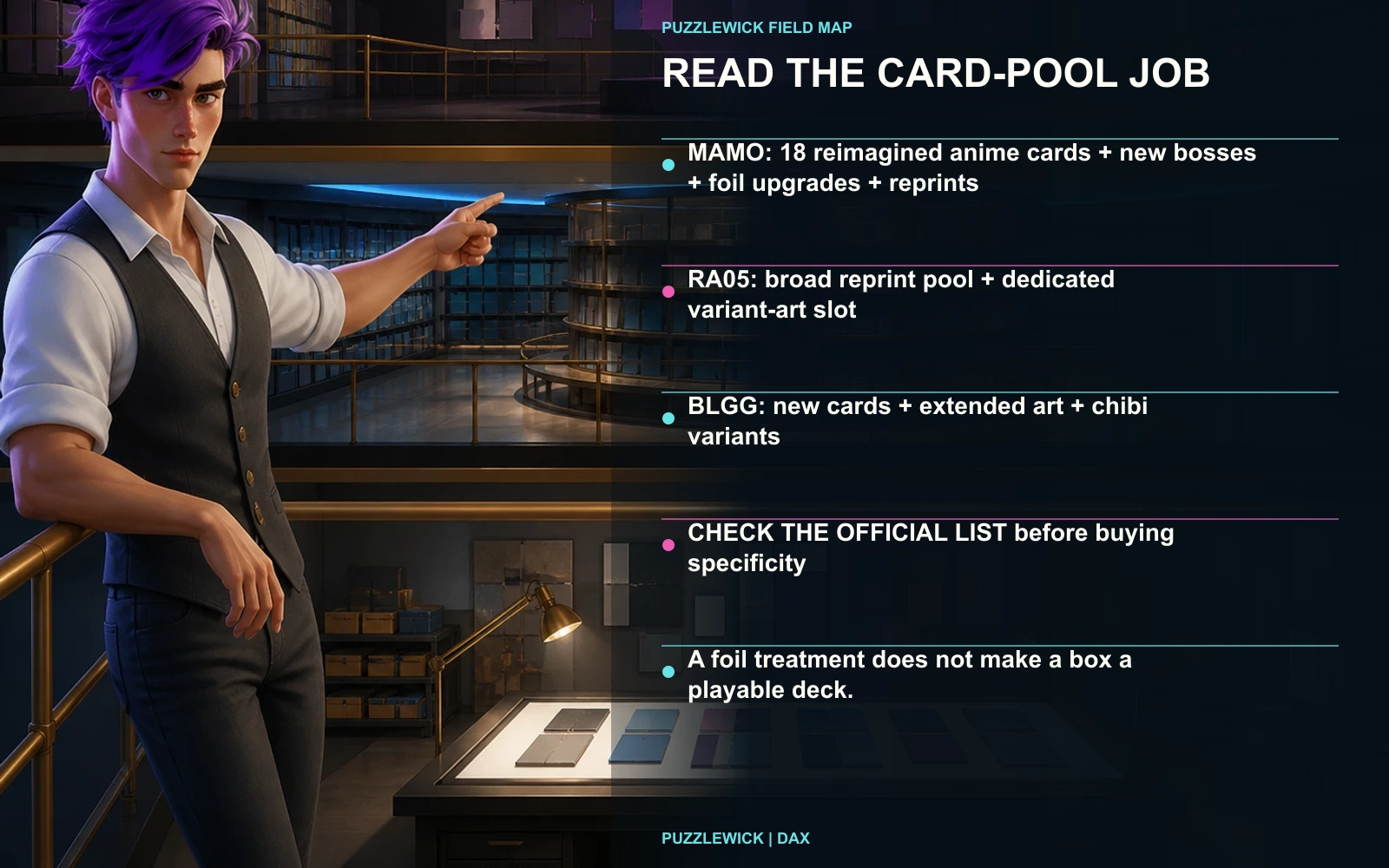
Magnificent Monsters: anime-memory subjects, new bosses, foil upgrades, and reprints inside a tiny premium opening. Rarity Collection 5: broad reprint usefulness plus a dedicated variant-art slot. Glorious Gallery: a more selective set of new support and art treatments.
That distinction is more useful than asking which box is “best.” A player hunting staples wants a different object from a collector chasing one numbered anime subject. A gift buyer should know which kind of delight the recipient actually enjoys.
What is the Rarity Collection 5 opening, and when should you buy a box?
Rarity Collection 5’s official pack explanation is unusually useful. Four cards come from an approximately eighty-card main pool; a fifth comes from a sixty-eight-card variant-art pool that includes ten extended-art cards. That makes the box a broad treatment-and-reprint party.
It does not make one box a complete set or a reliable way to obtain one exact card. Buy it when opening across a useful pool is the fun. When the missing card has a name, stop asking a sealed product to behave like a search bar.
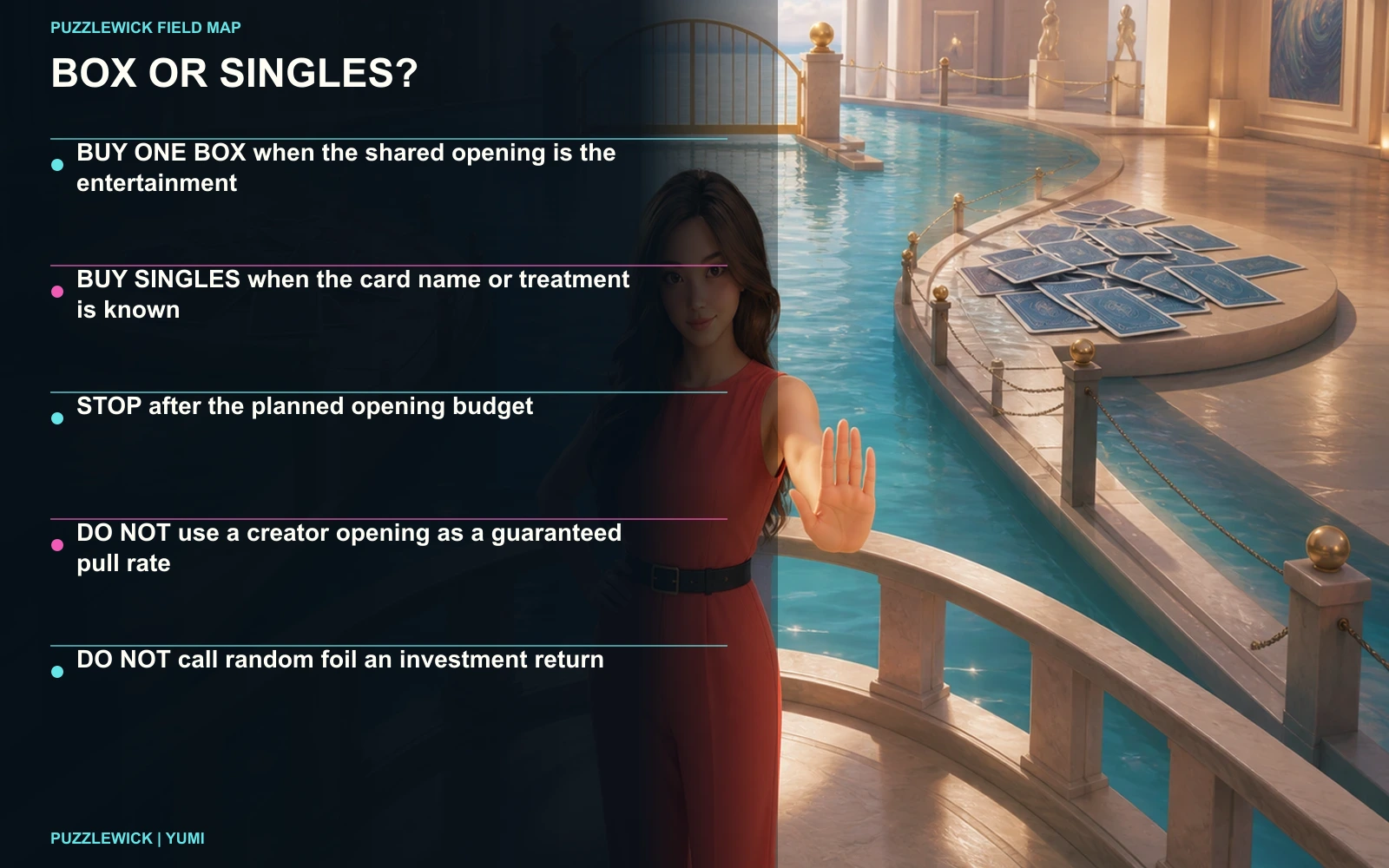
Buy a box when the opening ritual is part of the value: friends at a table, several welcome cards, and a pre-agreed spending limit. Buy singles when the goal is a named deck upgrade, artwork, rarity, or binder slot.
A useful two-budget rule is to write down a sealed-opening budget and a singles budget separately. Once the first is spent, the second does not quietly become “one more box.” The collection gets to keep its story without turning every miss into a demand for another sample.
What does Glorious Gallery do differently?
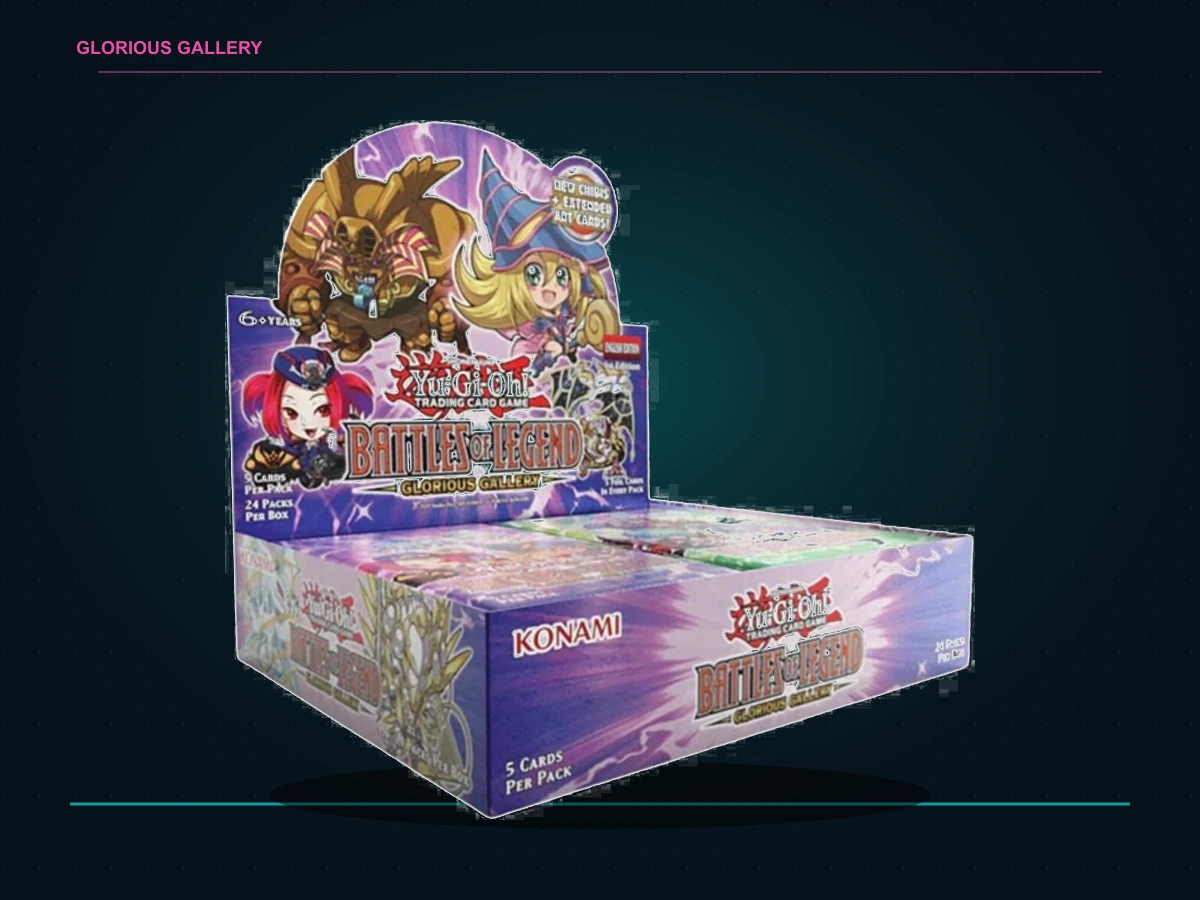
Glorious Gallery uses a four-Ultra-plus-one-Secret pack shape and emphasizes a named mix of new cards, ten additional extended-art cards, and ten chibi variants. That specificity is its strength and its warning label.
Open the official card list before the shopping page. If the exact support or artwork that excites you is not present, the product cannot become right through enthusiasm alone. If several named cards are appealing, a shared box opening can be a perfectly coherent choice.
What can community openings tell you?
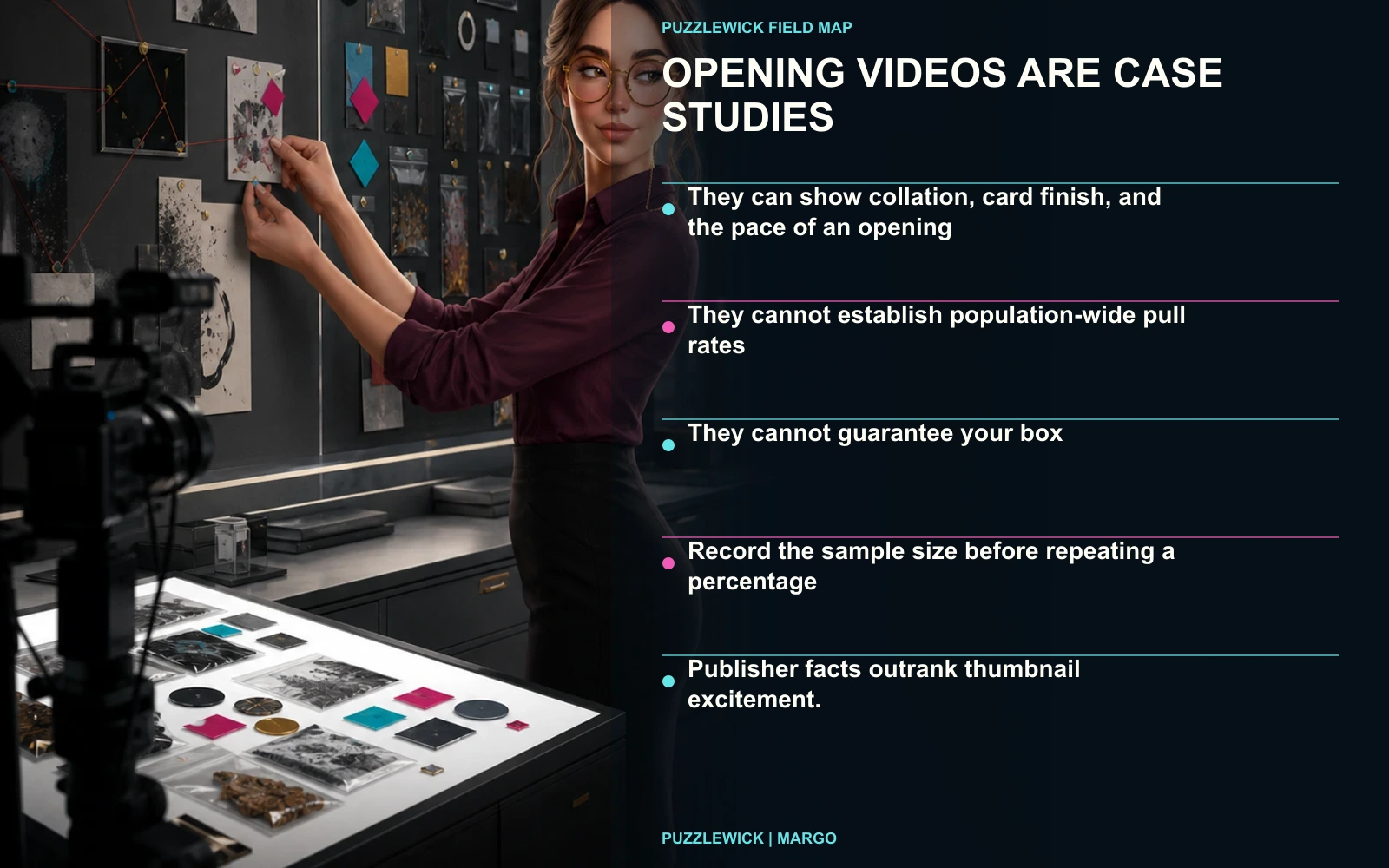
An opening video can show finish, collation, pack cadence, and the emotional shape of a product. It can also reveal practical questions that official copy does not foreground: are the cards easy to sort, does a particular treatment read clearly on camera, and how quickly does a three-pack box end?
It cannot establish a guaranteed pull rate unless the sample, sampling method, product population, and reporting period support that claim. “I watched three boxes” is useful observation and terrible actuarial science.
How should you sleeve, bind, and travel with Yu-Gi-Oh cards?
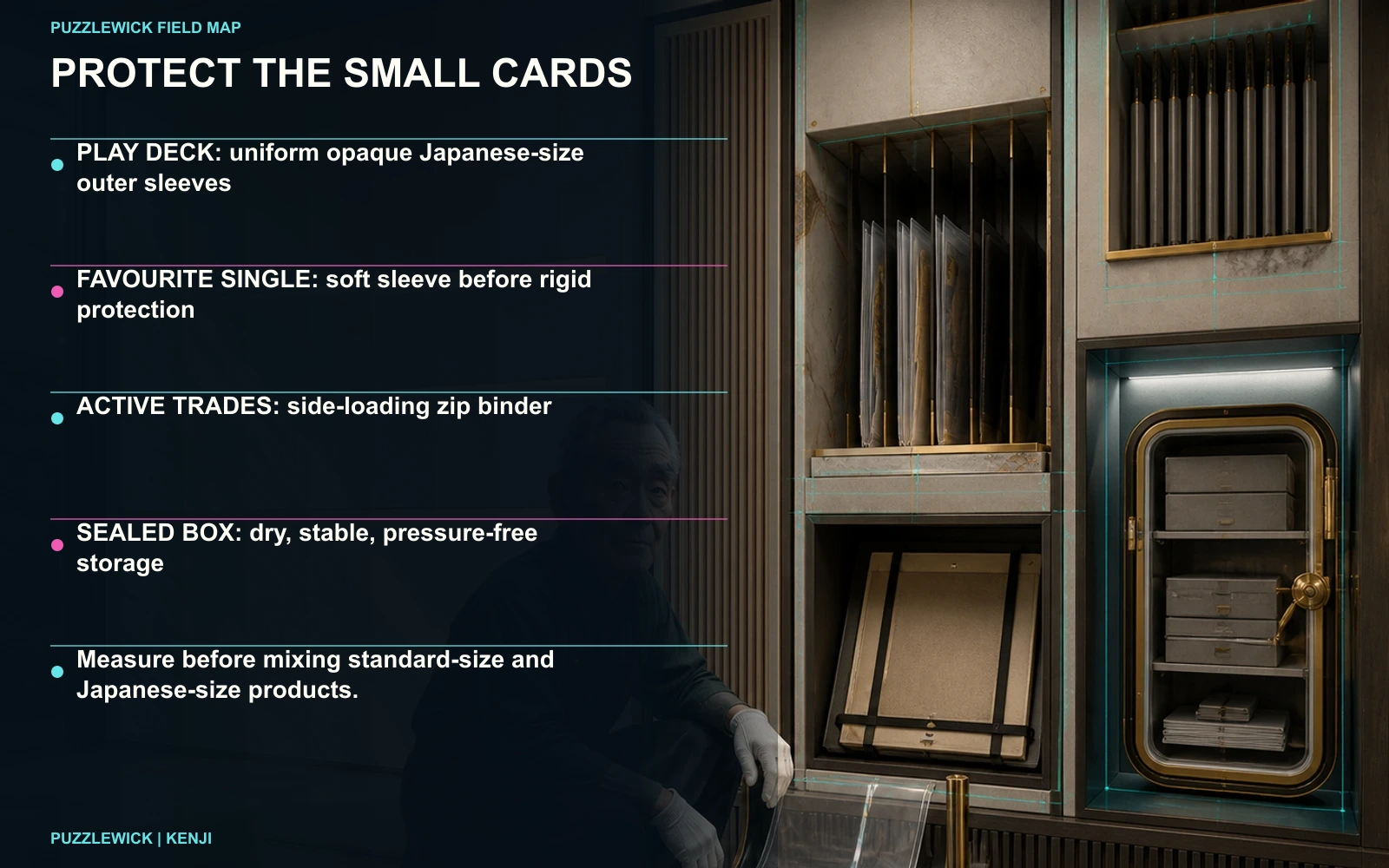
Yu-Gi-Oh! cards use the smaller Japanese-size sleeve lane. For a play deck, use uniform opaque sleeves in good condition and keep replacements from the same product nearby. For a favourite single, place the card in a soft sleeve before a rigid holder. For active trades, use a side-loading zip binder rather than stacking cards in a deck box.
Choose transport after counting what leaves home. A compact case fits one active deck; a backpack is justified only when several decks, a binder, and table kit routinely travel together. Capacity printed on a box is not permission to compress cards until the lid negotiates.
Choose the accessory for the job
Play: Japanese-size outer sleeves, one comfortable deck box and a themed mat if you enjoy it. Count the Main, Extra and Side Deck separately before choosing sleeve quantities. A fifty-sleeve pack does not cover every possible seventy-five-card tournament setup.
Collect: a side-loading binder and suitable soft sleeves. An oversized standard-card penny sleeve may be useful inside an archival holder, but it is not a snug Japanese-size play sleeve. Clear sleeves are not our default tournament recommendation; uniform opaque backs avoid exposing distinguishable card backs.
Travel: buy a multi-deck carrier only if several decks actually travel. Large Gamegenic storage and a backpack are alternatives for different loads, not two compulsory steps. Measure the sleeved deck and closed binder before choosing the container.
Our Yu-Gi-Oh store aisle and accessory guide provide the wider options. The choices below are alternatives. No accessory turns an unfocused pile of cards into a good deck.
Which buyer should choose each product, and are the cards tournament legal?
Magnificent Monsters has now passed both launch gates: Official Tournament Stores on September 2, followed by public release and tournament legality on September 4, 2026. Individual cards still need to satisfy the current format and Forbidden & Limited List. A fresh package cannot pardon an old prohibition.
Choose Magnificent Monsters for its six-series anime memory, its eighteen reimagined subjects, or its named new cards. Choose Rarity Collection 5 for broad reprint discovery. Choose Glorious Gallery only after its exact card list names the support or art lane you want. None of the three is a Starter Deck, and none teaches a beginner better than one complete deck played repeatedly.
The September 23 check found Magnificent Monsters listings, but none of the checked offers met our identity and shopper-feedback checks. The official box remains a clearly labelled publisher reference. Choose the quantity deliberately if you shop elsewhere: a ten-box display means ten openings, not a different card pool or a promise of better pulls.
The checkout checklist that keeps the shine useful
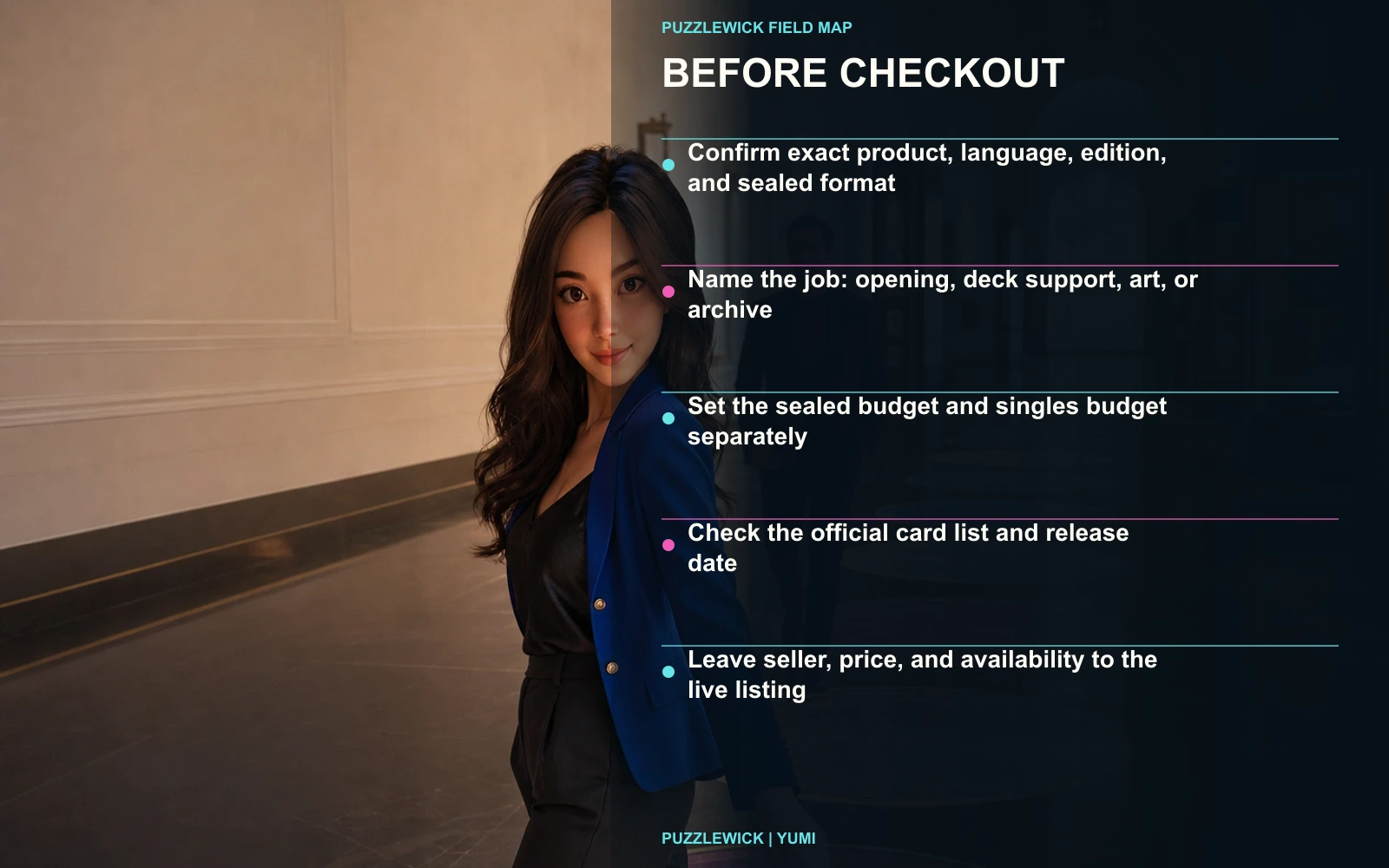
Confirm the exact set, language, edition and box-versus-pack format. Name the purchase job in one sentence. Check the official card list and current format. Put protection on the table before opening, and decide when the sealed-opening budget ends.
No checked Magnificent Monsters offer qualified for our buying shelf on September 23. Use the official Konami page for contents and the exact TCGplayer box page (non-affiliate) as a comparison reference. Confirm language, quantity and seller before buying elsewhere; Magnificent Mavens and Magnificent Maestros are different products.
What experienced tables keep reporting
Recurring owner patterns, synthesized in Puzzlewick's words. Follow each evidence trail to read the original discussion.
Broad reprint availability matters most when the cards enter real decks; exact singles remain the clean finish.
Treatment love is highly specific. The narrower the wanted art list, the stronger the case for singles.
Both products can create an excellent shared opening, but creator boxes are demonstrations, not universal pull charts.
The picks
Some links below are affiliate links — as an Amazon Associate, Puzzlewick earns from qualifying purchases, at no extra cost to you. It never changes a pick.
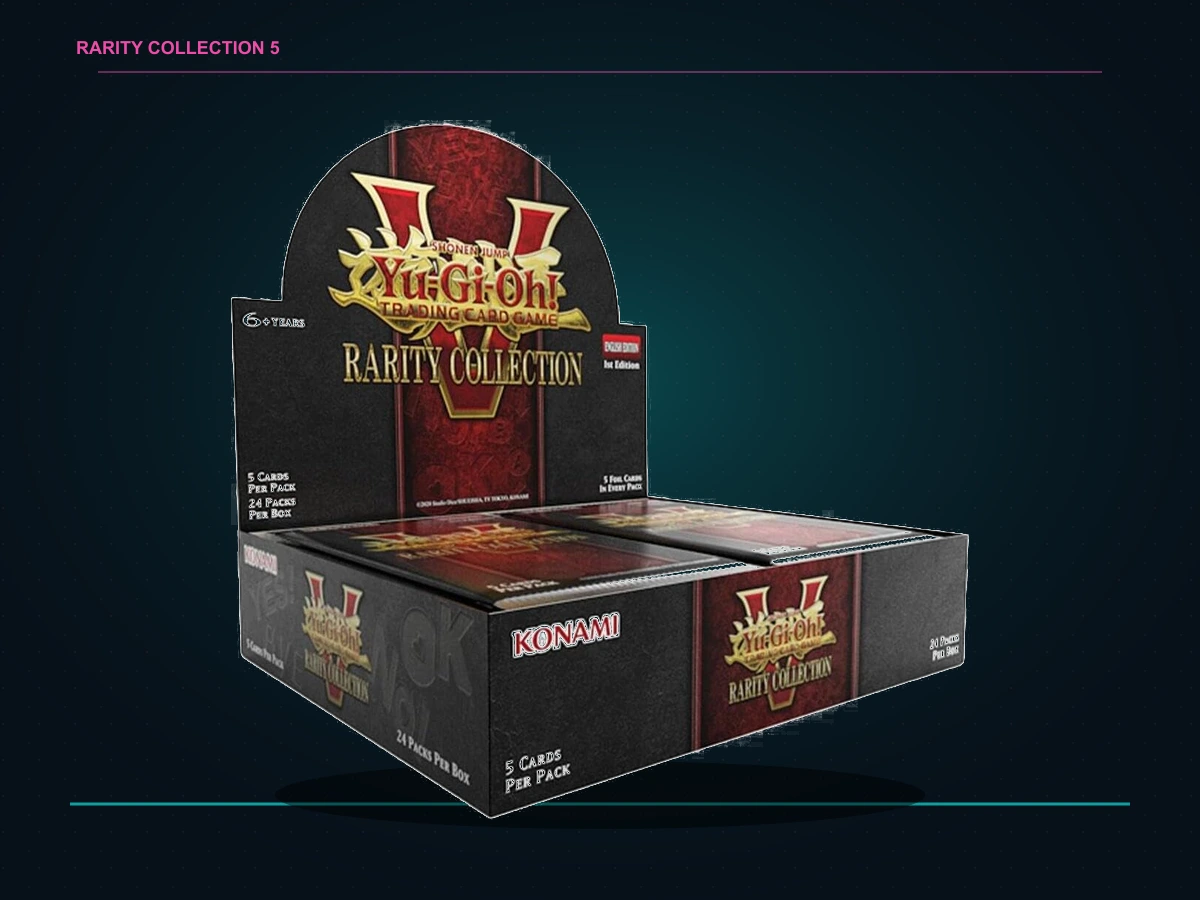
Yu-Gi-Oh! Rarity Collection 5 Booster Box
The better sealed celebration for breadth. Buy one for discovery or a shared opening, then finish known needs as singles.
- Broad reprint pool
- One variant-art slot per pack
- All-foil opening
- Random distribution
- Not a complete deck
Yu-Gi-Oh! Battles of Legend: Glorious Gallery Booster Box
A focused sequel with forty new cards, ten extended-art cards, and ten chibi variants. Read the list before committing.
- New cards
- Specific art lanes
- Four Ultra Rares plus one Secret Rare per pack
- Narrow goals favor singles
- Not every supported deck fits every player
Dragon Shield Japanese-Size White Matte Sleeves (60)
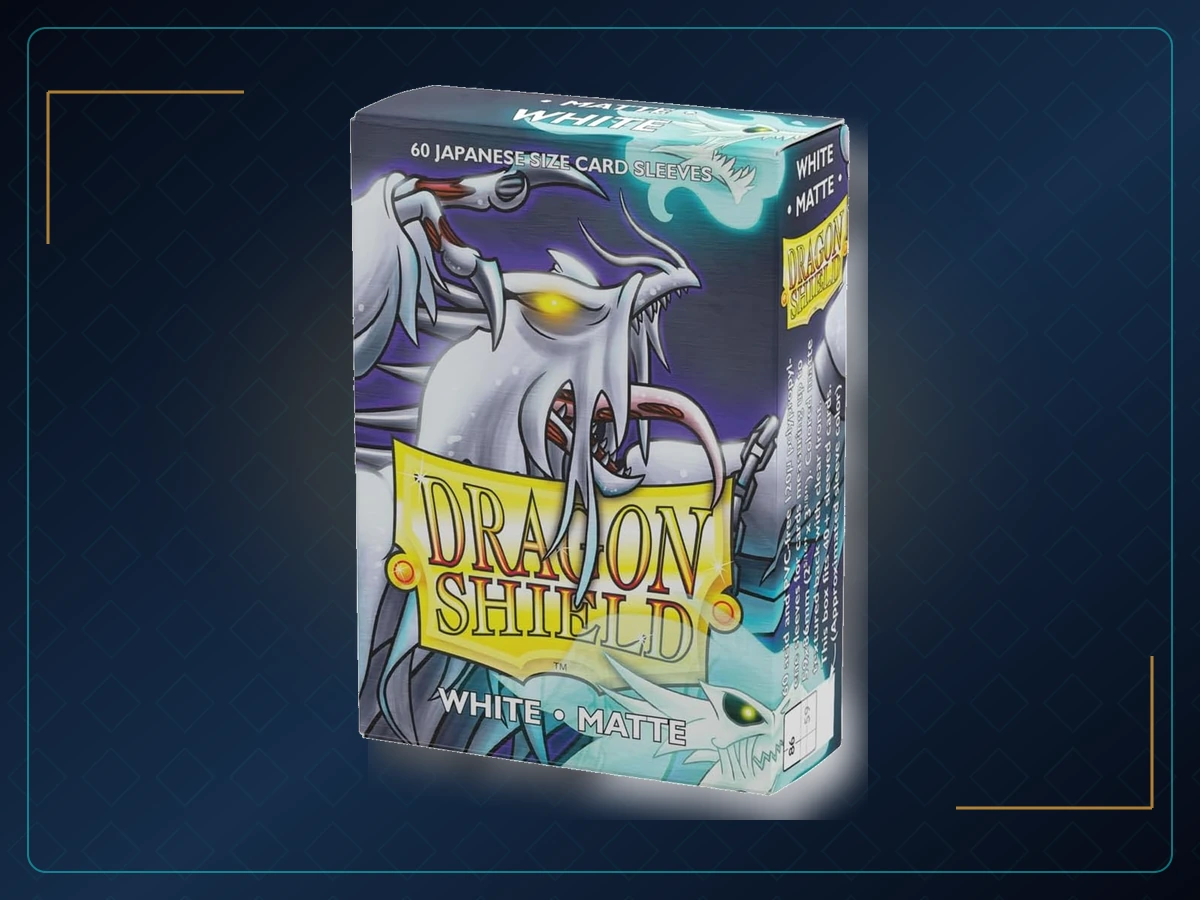
Correct small-format sleeves are the first accessory, before a premium binder or second box.
- Japanese-size fit
- Opaque matte back
- Known tournament-table brand
- Color must stay consistent
- Carry matching spares
Gamegenic Sidekick 100+ XL Convertible Deck Box, Purple
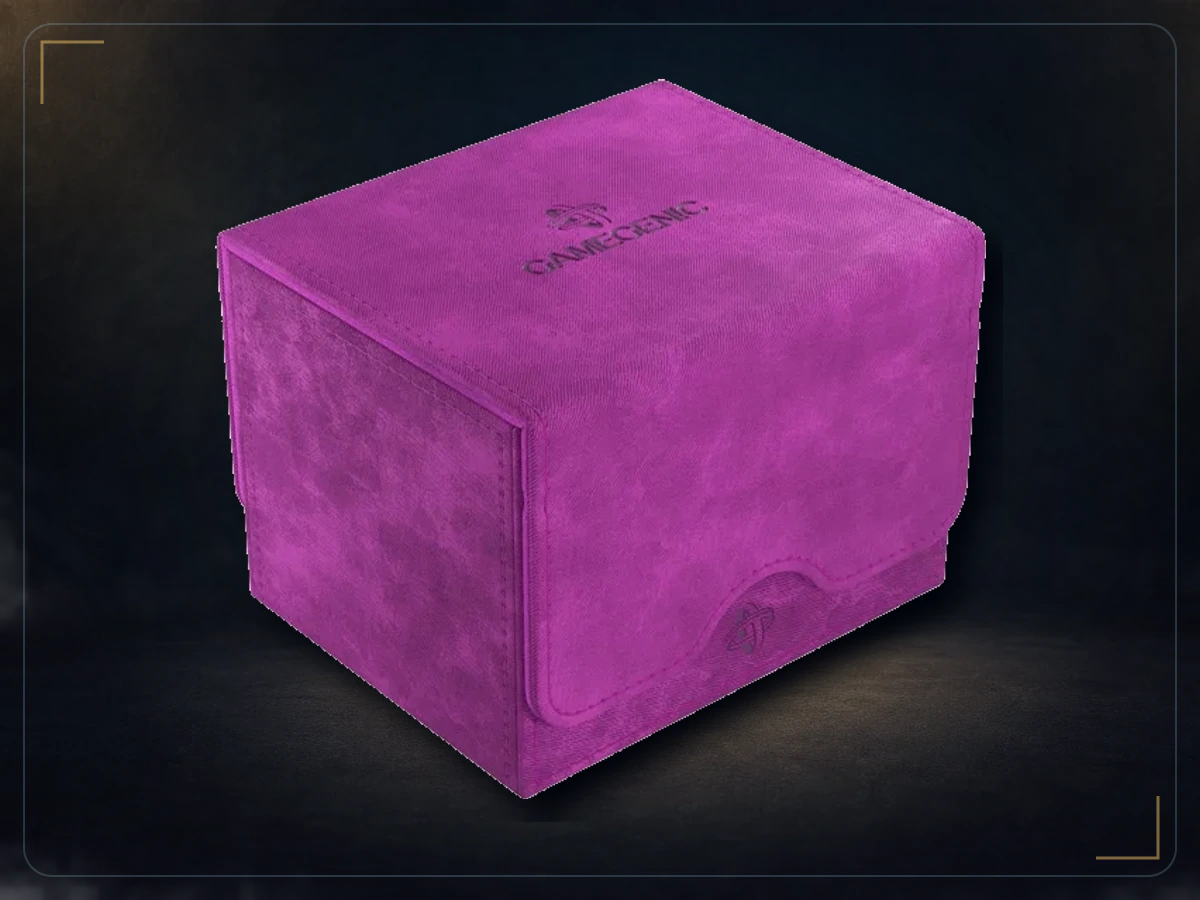
A premium side-opening case is useful after the sleeve system is fixed and the deck actually travels.
- Rigid shell
- Convertible lid
- Room for sleeved cards
- Larger than a minimal Yu-Gi-Oh! case
- Measure double-sleeved loadout
Vault X 12-Pocket Exo-Tec Zip Binder, Black (480 cards)
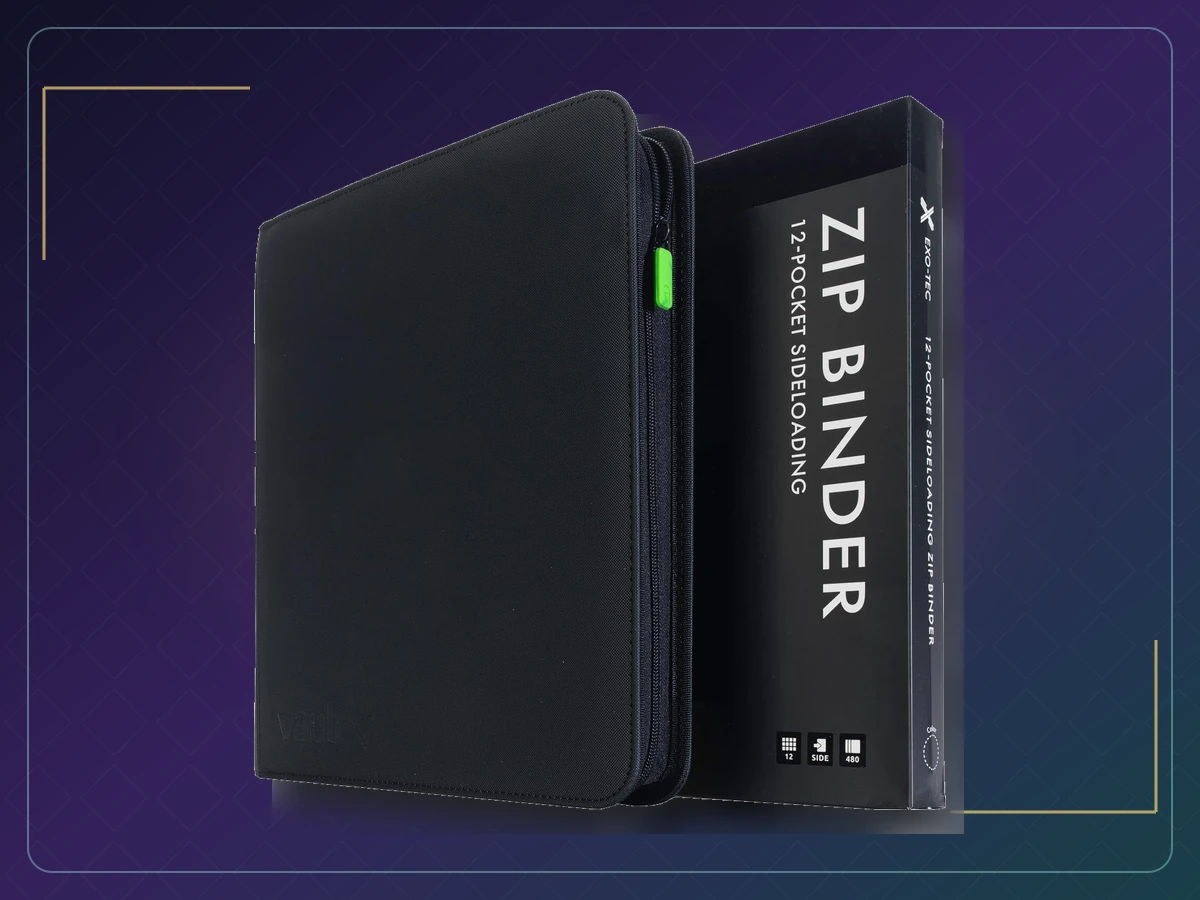
Twelve pockets per face make this the larger 480-card archive. The 18-card hero checklist does not require this capacity; choose the smaller nine-pocket alternative if that is all you plan to collect.
- Zipper closure
- Side-loading pages
- No metal rings
- Can encourage over-collecting
- Choose a finish line first
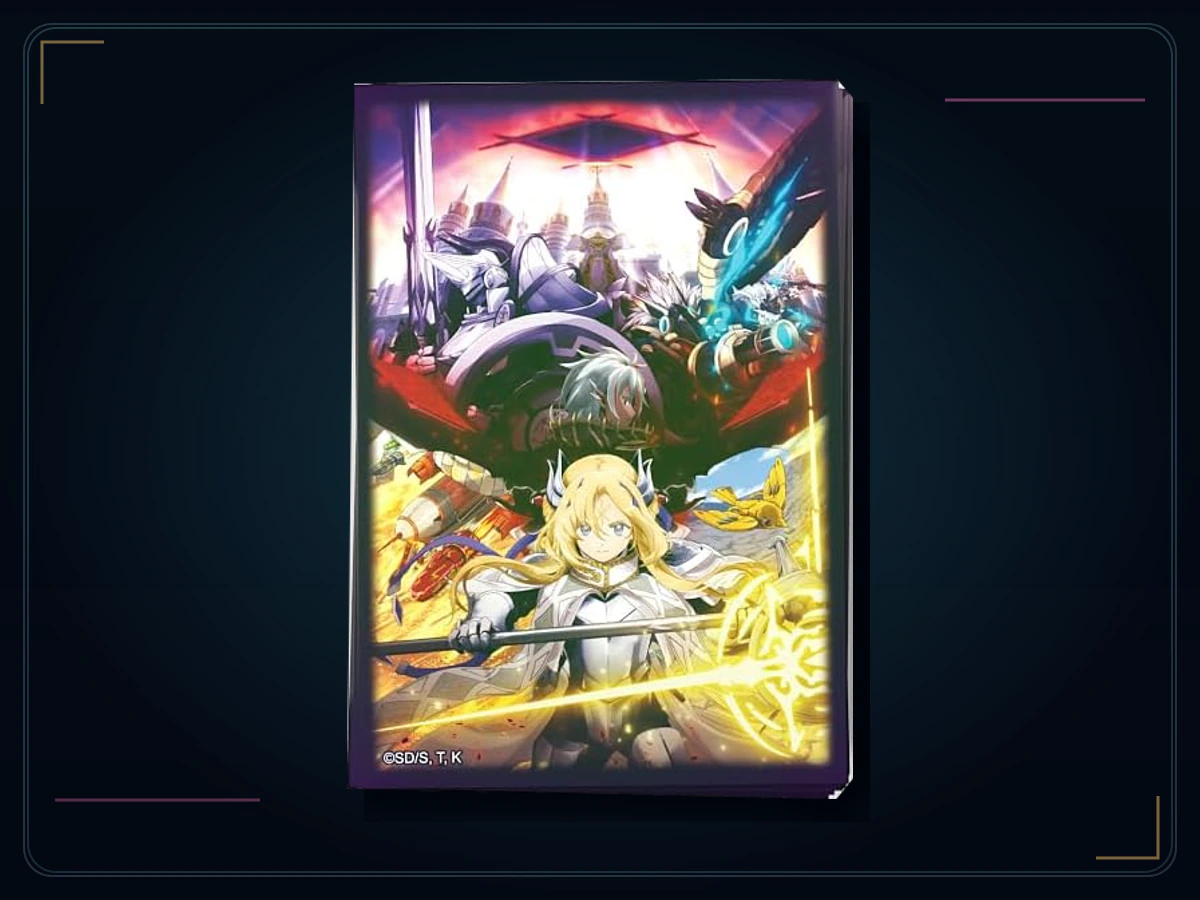
Yu-Gi-Oh! The Fallen & The Virtuous Card Sleeves (50)
Official art creates a strong universe fit, but tournament usefulness still depends on opacity, condition, and matching spares.
- Official artwork
- Correct card size
- Strong franchise identity
- Printed backs show wear
- Replacement matching may be harder
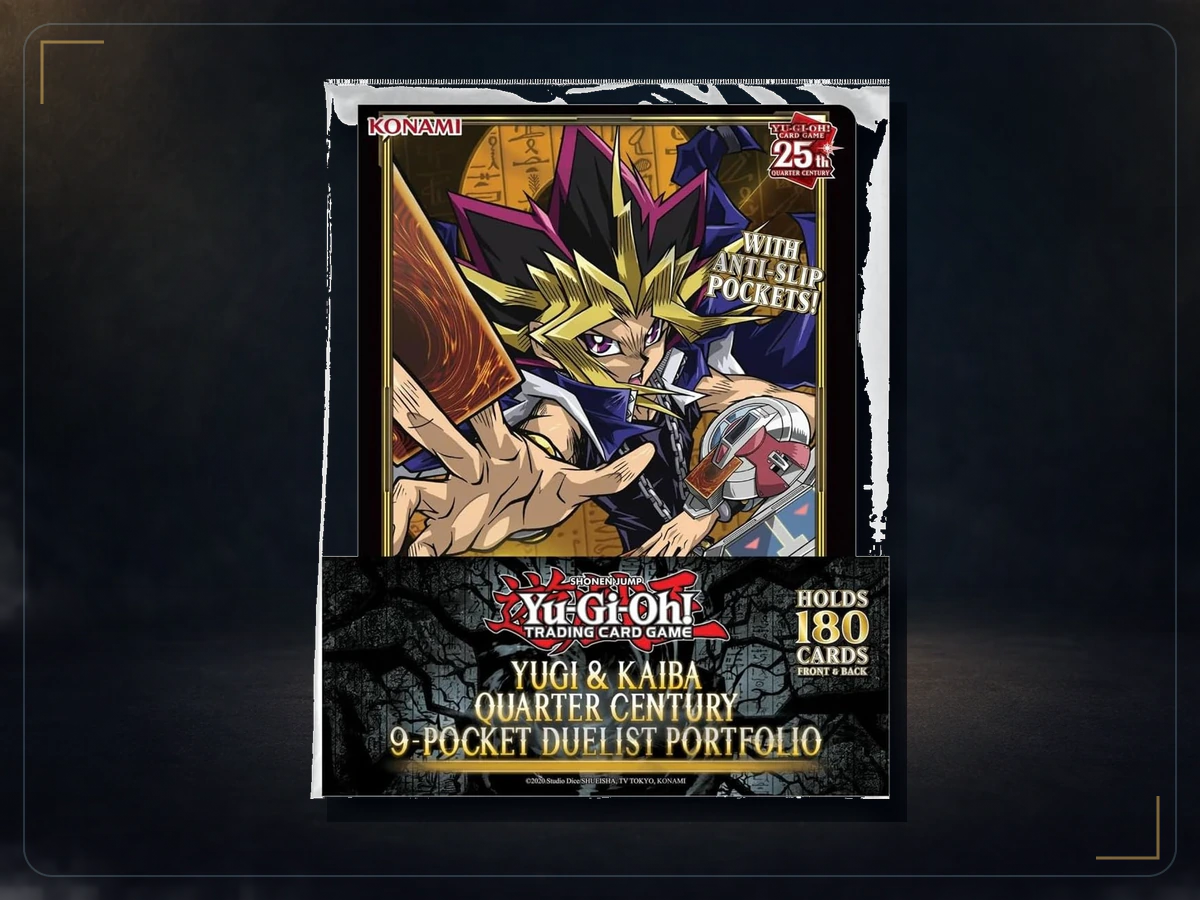
Yu-Gi-Oh! Yugi and Kaiba Quarter Century 9-Pocket Portfolio
The official portfolio is a lighter themed option; use the zip binder for higher-value archival storage.
- Official art
- Portable
- Simple set page
- Less protective than a zip binder
- Fixed page count
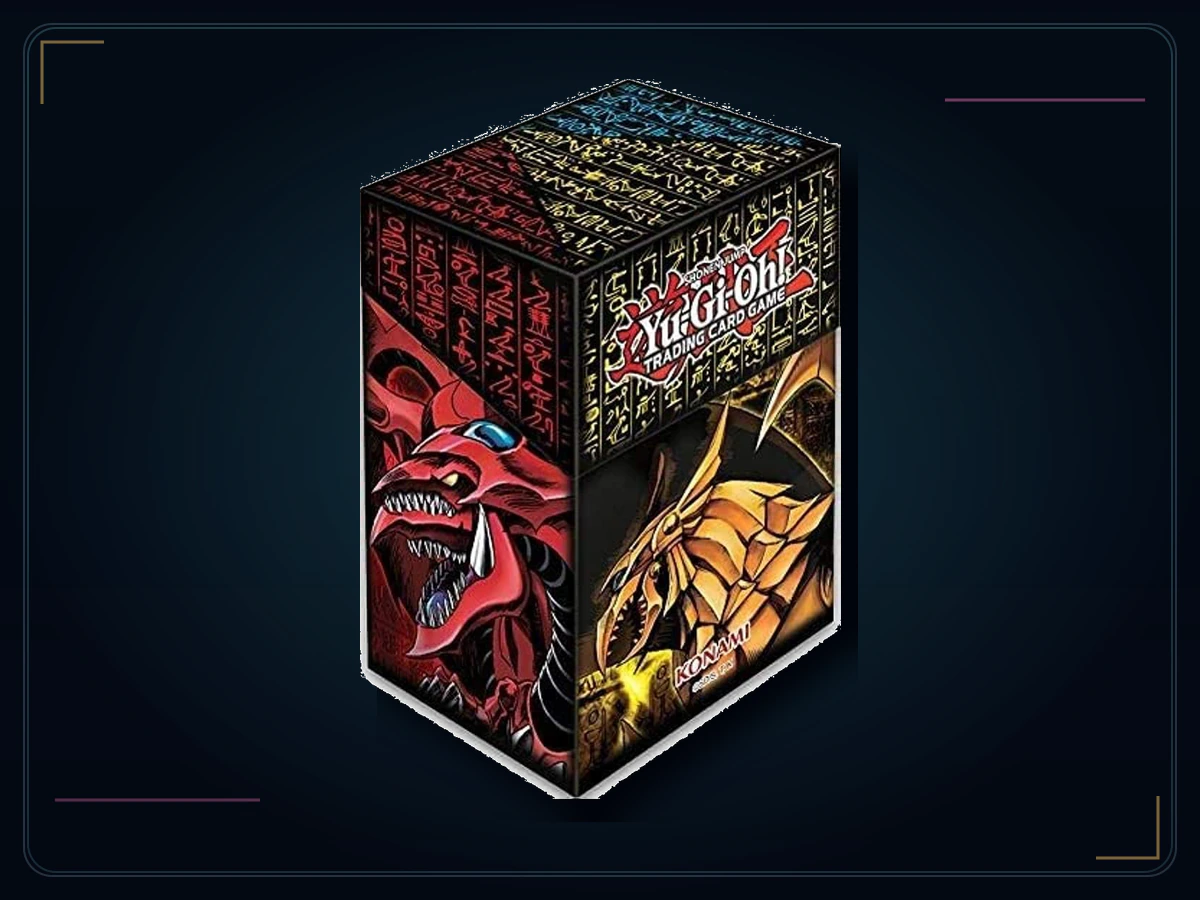
Yu-Gi-Oh! Slifer, Obelisk and Ra Card Case
A simple official case works when the goal is one local-ready deck rather than a full collection transport system.
- Official theme
- Compact
- Budget-friendly form
- Less impact protection
- Limited accessory room
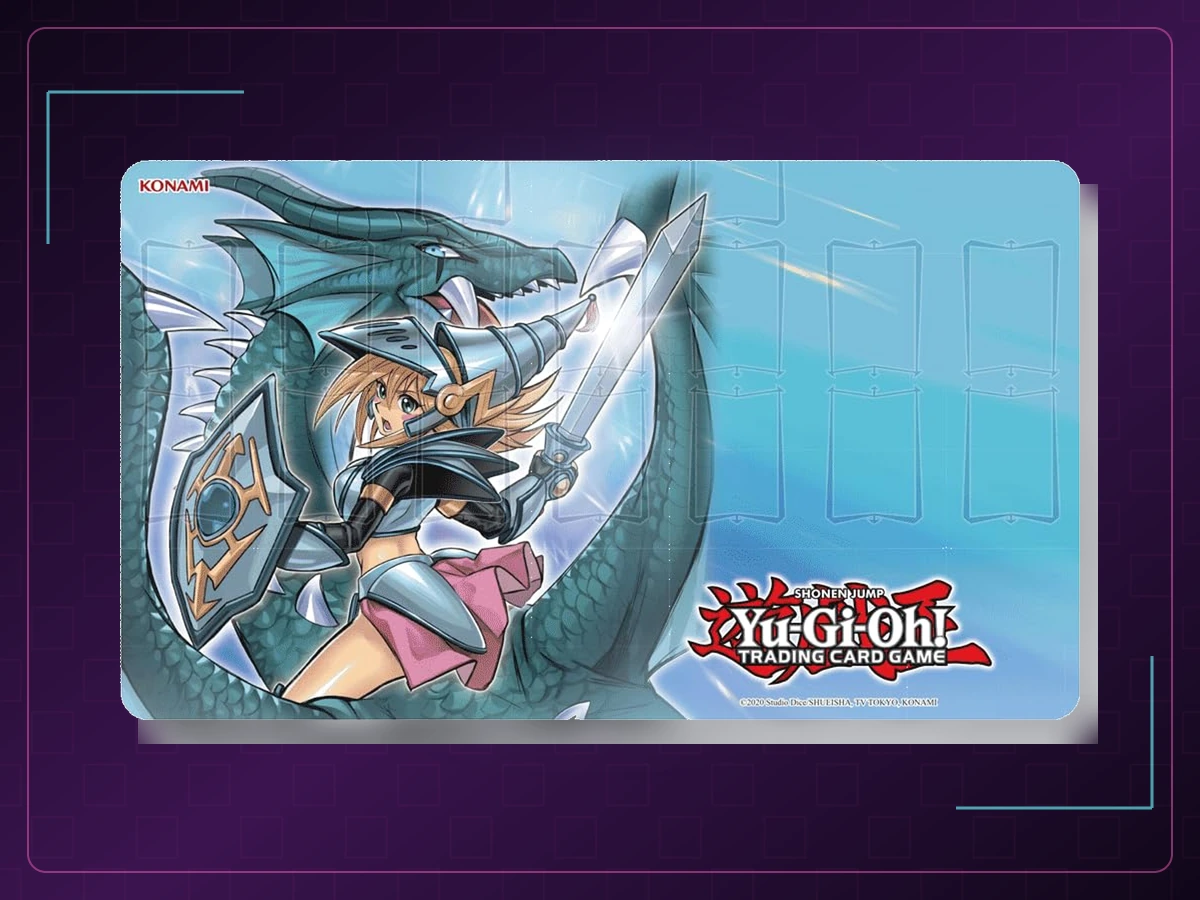
Yu-Gi-Oh! Dark Magician Girl the Dragon Knight Game Mat
The official Dragon Knight illustration makes the table feel like the game you came to play. This is a one-player mat, not the complete two-player field.
- Official character artwork
- Useful soft table surface
- Distinctive cyan and silver theme
- One player only
- Printed zones do not replace the rules
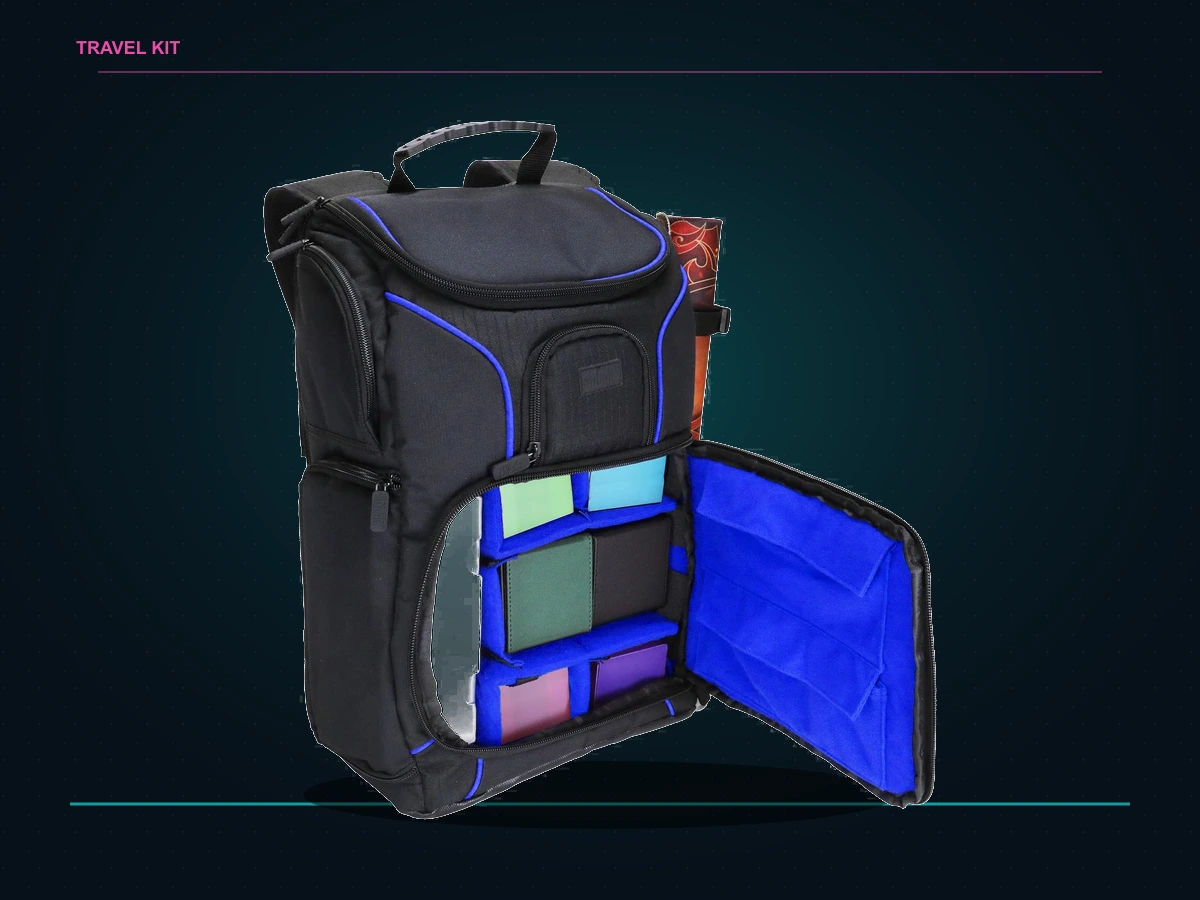
USA Gear Trading Card Backpack, Blue
A dedicated bag becomes useful when one rigid deck box, one binder, and a rolled mat actually leave the house.
- Organized compartments
- Hands-free travel
- Protects multiple accessories
- Unnecessary for one deck
- Do not leave cards in heat
At a glance
| label | a | b |
|---|---|---|
| Best for | Magnificent Monsters: anime-history collector opening | Rarity Collection 5: broad reprints; Glorious Gallery: named support and art |
| Pack shape | MAMO box: 3 x 5-card packs + 3 separate bonus cards = 18 cards | RA05: 4 main + 1 variant; BLGG: 4 Ultra + 1 Secret |
| Singles trigger | Any named Grand Master, Starlight, anime subject, or deck piece | Any known reprint, support card, or artwork |
| Not a promise | No published box-level Grand Master odds | No sealed box guarantees one named card |
Free download — Magnificent Monsters Opening and Learning Reference
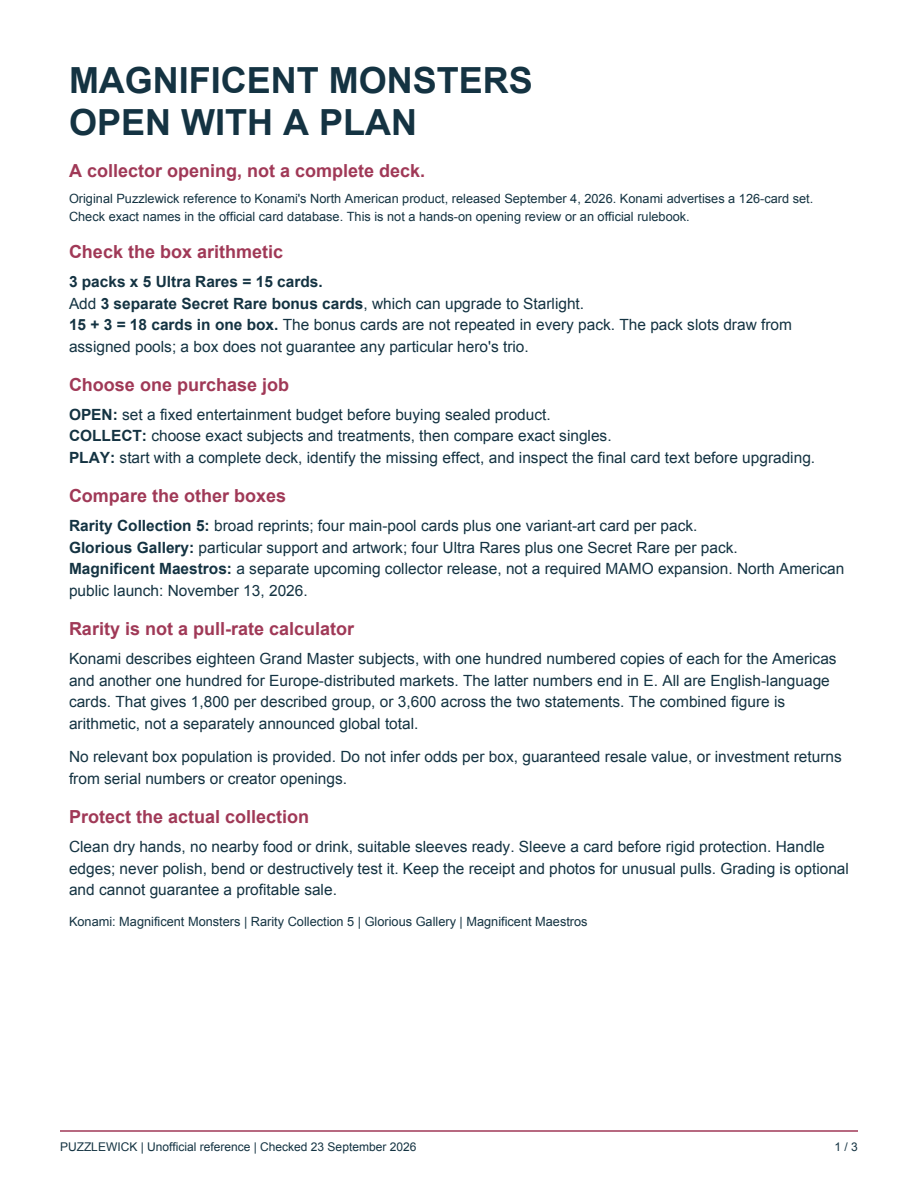
Three printable pages: the 18-card box check, eighteen-card hero checklist and beginner table route.
Unofficial fan-made reference. Compiled by Puzzlewick from the sources listed on the sheet. Not affiliated with or endorsed by the publisher — always defer to the official rulebook.
Questions, answered
What is inside a Magnificent Monsters box?
One box contains three five-card Ultra Rare packs plus three separate Secret Rare bonus cards, with a chance to upgrade to Starlight. That is 18 cards total, not 24. It is not a playable deck. Konami advertises a 126-card set.
How many Grand Master Rare cards exist?
Konami describes eighteen subjects with 100 numbered copies per subject for the Americas and another 100 for Europe-distributed markets. That is 1,800 per described group, or 3,600 across the two statements. The combined number is our arithmetic, not a separately published global total or a box pull rate.
Is Magnificent Monsters tournament legal immediately?
Konami lists September 4, 2026 as the public launch and tournament-legal date, after a September 2 OTS launch. Current format restrictions still apply to each named card.
Should I buy Rarity Collection 5 or Magnificent Monsters?
Choose Rarity Collection 5 for broad reprints and a dedicated variant-art slot. Choose Magnificent Monsters for a shorter anime-history collector opening and its finite numbered rarity lane.
Should I buy Glorious Gallery or singles?
Read the official card list. If you want several cards and the opening is part of the fun, one box can make sense. If you want one named card or treatment, buy the single.
What sleeve size fits Yu-Gi-Oh cards?
Choose Japanese-size or small-size sleeves made for Yu-Gi-Oh cards; standard-size sleeves are larger. Keep each relevant deck uniform and sleeves unmarked, and check current tournament sleeve requirements. Count the Main, Extra and Side Deck plus spares before buying.
Does a Magnificent Monsters box guarantee a Grand Master Rare?
No published box guarantee was found. Konami documents the numbered Grand Master treatment and the pack contents, but it does not publish a one-per-box promise or box-level pull odds. Buy a named Grand Master as a single if that exact card is the goal.
Can cards from these three products go in the same deck?
Product family does not determine deck legality. A card can be used when its current text, format eligibility, and Forbidden & Limited status allow it. Check the official card database and current list before an event.
Is Magnificent Monsters good for a complete beginner?
It can be an enjoyable collector opening for an anime fan, but it does not teach the game or supply a complete deck. Start with a teaching product or an agreed beginner deck, learn its basic line, then choose exact MAMO upgrades after checking final card text.
How many cards are in the eighteen-card protagonist collection?
There are three reimagined cards for each of six protagonists, giving eighteen named subjects. Eighteen cards fit two nine-pocket page faces. Different treatments are separate collection choices; a box does not guarantee all eighteen subjects.
Do Ritual and Pendulum monsters start in the Extra Deck?
Ordinary Ritual and Pendulum monsters start in the Main Deck. Fusion, Synchro, Xyz and Link monsters start in the Extra Deck. Pendulum hybrids can start there, and ordinary Pendulum cards can later move faceup there. Card type, text and current zone rules matter.
Do I need Magnificent Maestros as well?
No. Maestros is a separate collector release scheduled for November 13, 2026 in North America, not a required MAMO expansion. Choose it only if its rival-character remixes or named deck support match your own goal.
What is the difference between a Magnificent Monsters box and a display?
A single box contains eighteen cards. The verified display listing contains ten boxes, for 180 cards in total: thirty five-card packs and thirty separate bonus cards. A display can contain duplicates and does not guarantee a complete set or Grand Master Rare.
Yumi's verdict
Yumi's verdict: Magnificent Monsters is a lovely reason to learn who those monsters are, and a poor substitute for choosing a deck. Decide whether tonight is about opening, collecting or playing. Give each a different plan.
Research ledger 15 sources · reviewed 2026-09-23
Specifications, rules, current product information, community experience, and contrary evidence were checked against the sources below. Commercial links are kept separate from editorial evidence.
- Magnificent Monstersyugioh-card.com/en/products/mamo
- Rarity Collection 5yugioh-card.com/en/products/ra05
- Battles of Legend: Glorious Galleryyugioh-card.com/en/products/blgg
- Yu-Gi-Oh! Card Databasedb.yugioh-card.com/yugiohdb
- Official Yu-Gi-Oh! Rulebookyugioh-card.com/en/rulebook
- Exact TCGplayer Magnificent Monsters product identitytcgplayer.com/product/694828
- TCGplayer current Best Sellers moduletcgplayer.com
- BoardGameGeek: Yu-Gi-Oh! Trading Card Gameboardgamegeek.com/boardgame/2937/yu-gi-oh-trading-card-game
- Joshua Schmidt Rarity Collection 5 openingyoutube.com/watch?v=Bov19gJuYO8
- HeroVoltsy Glorious Gallery openingyoutube.com/watch?v=fnJVenpfIBQ
- Official Yu-Gi-Oh rulebook PDFyugioh-card.com/en/downloads/rulebook/SD_RuleBook_EN_10.pdf
- 2021 rules updateyugioh-card.com/en/play/2021_rules_update
- September 21, 2026 Forbidden & Limited Listyugioh-card.com/en/limited/list_2026-09-21
- Magnificent Maestrosyugioh-card.com/en/products/mams
- Exact Dark Magician Girl the Dragon Knight mat listingamazon.com/dp/B08H1JBYTC

Come in, take your shoes off — let me show you something.

Keep exploring
The next smart rabbit holes.
◈ Universe HubYu-Gi-Oh!: the whole buying pathYu-Gi-Oh! remains a top-four marketplace game with a deep competitive identity and a collector rebound around new extended-art...🂠 Topic PathTrading Card Games: compare the whole shelfStart with the game and community you want, then buy the smallest product that lets you test it properly. These guides separate...GuideMaster Duel to Paper Yu-Gi-Oh! in 2026: Your First Local Without the Rules ShockDax translates automation into table skill: paper legality, NEURON, zones, chains, side decking, tournament materials and the social...