Dune: War for Arrakis in 2026: Is the $155 Grail Worth It, and Which Expansions Should You Buy?
The core box is a complete, tense two-player war game. Kenji explains the real play time, asymmetric victory conditions, setup tax, solo mode, faction learning curve, and whether Desert War or The Spacing Guild deserves a place in your second order.


AI-assisted research and drafting in Kenji’s voice · reviewed by Robert Pruitt · how this guide was made
Last editorial refresh: 2026-07-18 Gold-standard QA: 2026-08-10 12 sources reviewed Affiliate links checked during gold-standard pass

The short answer
Buy Dune: War for Arrakis if two players want a heavy, story-rich asymmetric duel that usually finishes faster than War of the Ring and if one of you genuinely wants to inhabit the Harkonnen machine while the other learns Atreides survival, prescience, and revolt. Buy the core box alone first. Add Desert War after three to five plays if both players want more tactical troops. Add The Spacing Guild only after the base balance feels familiar and both players want a wider reinforcement economy. Skip it for casual four-player nights, short weeknights, or anyone who dislikes long setup and faction-specific rules.
Decision map
Choose in thirty seconds
A repeat two-player table that wants a complete heavy asymmetric duel
Experienced pairs that want more tactical surface warfare
Veteran pairs ready to add off-world politics and reinforcements
A great Dune game should not feel like two armies with different paint. War for Arrakis understands that. Harkonnen pressure is industrial and public: occupy strongholds, keep spice moving, and reach 10 Supremacy points. Atreides resistance is elusive and prophetic: preserve forces, exploit the desert, and satisfy a hidden Prescience objective across three markers. The tension comes from watching one side make a visible machine while the other side tries to become the future that machine cannot prevent.
That asymmetry is also the warning label. This is not a frictionless miniatures spectacle. The first teach is substantial, the setup is real, the factions do not learn in the same way, and a nominal two-hour play can become a three-hour evening while both players read their possibilities. Kenji worked from CMON's current rules and FAQ, Asmodee's retail contents, 2026 professional review coverage, and current owner discussions about balance, expansion order, solo play, and whether the game genuinely functions as a shorter path toward War of the Ring. The result is a buying map, not a spice-scented sales pitch.
Start here, then go deeper
You are in the right cabinet.
 ◉ Universe HubDune: the whole buying pathDune games ask the same question at different scales: can you turn limited information, temporary power, and a dangerous resource...
 ♛ Topic PathGrail Board Games: compare the whole shelfA grail earns its space only when the experience survives the price, setup, storage, and group commitment. These are expensive-game...
 Deep DiveWar of the Ring (Second Edition): A Patient Reckoning With Tolkien's Whole WarTwo players. Two ways to win. A single Ring carried east through a continent at war. The definitive grand-strategy duel of Middle-earth,...
Should you buy Dune: War for Arrakis in 2026?
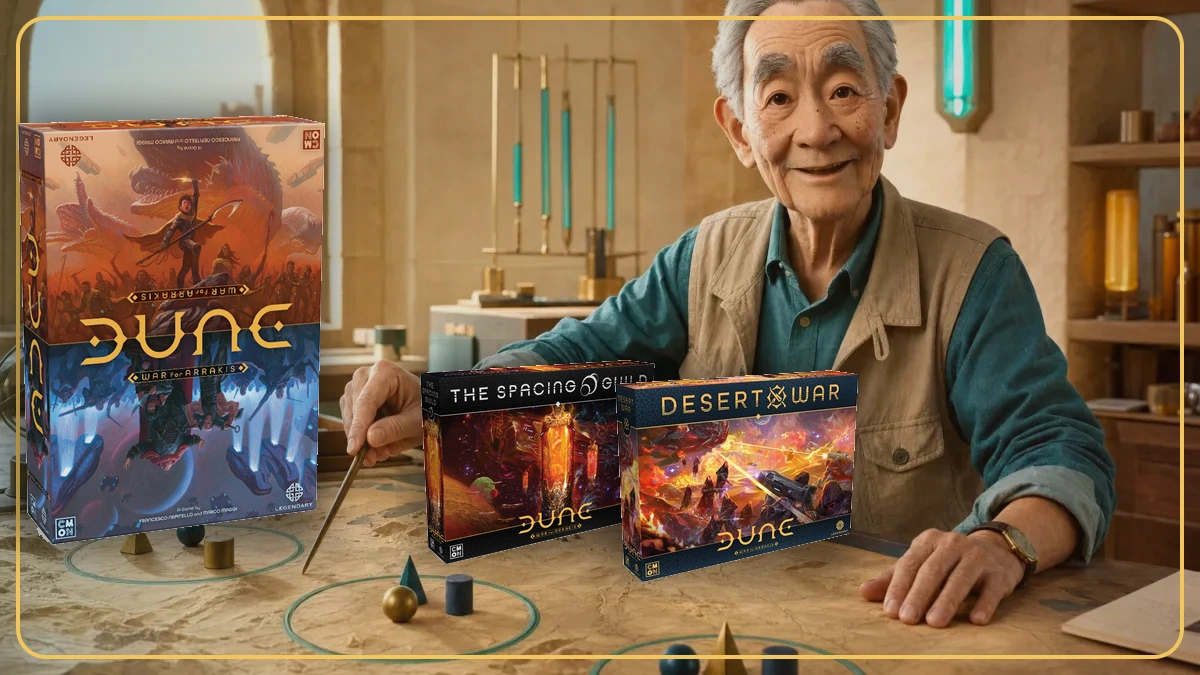
Yes, if your table is really a committed two-player table. War for Arrakis is one of the strongest current Amazon-available grails for players who want a complete strategic story in one sitting without signing up for a campaign. Its official box supports one to four players and includes a Mahdi solo mode, but the clearest expression is still one Harkonnen player against one Atreides player. At two, every threat, feint, leader, action die, and reinforcement belongs to one mind.
The best buyer is a pair who will repeat the matchup. Your first game teaches procedures; your second teaches the fear each faction creates; your third is where the planning cards begin to look like intentions instead of paragraphs. The wrong buyer is a group seeking a flexible four-player event. Team play exists, but divided command adds communication friction to a design whose pleasure comes from owning a faction's whole problem.
Asmodee lists a two-hour average. Experienced players can live near that number, but first games should reserve three hours after setup. Add another 30 to 45 minutes if both people are learning from scratch. That is not a flaw when the evening is planned around Arrakis. It is a disaster when the box comes out at 9:30 on a work night.
The first purchase is not a collection. It is a rivalry.
How does a round work, and how does each faction actually win?
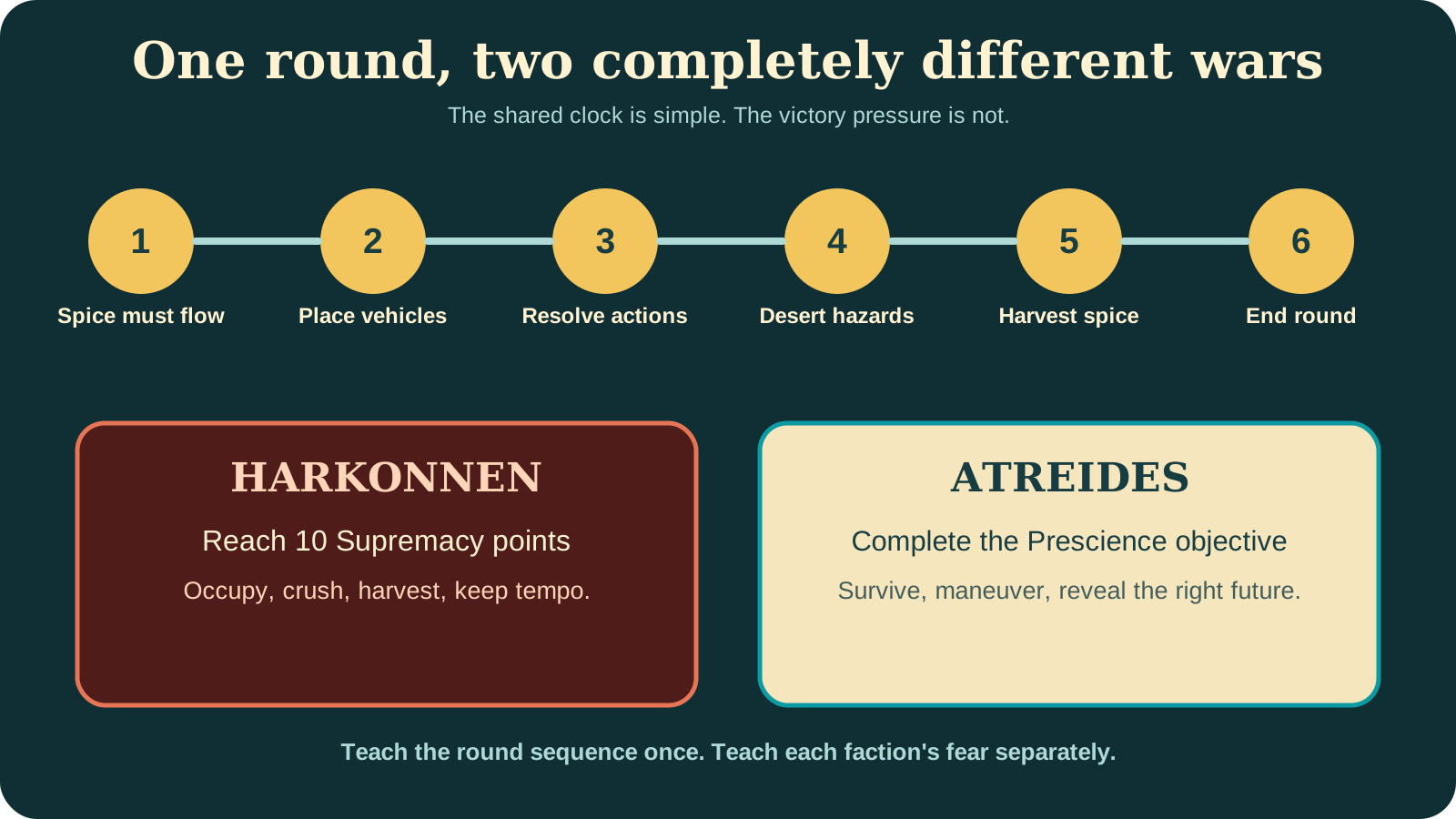
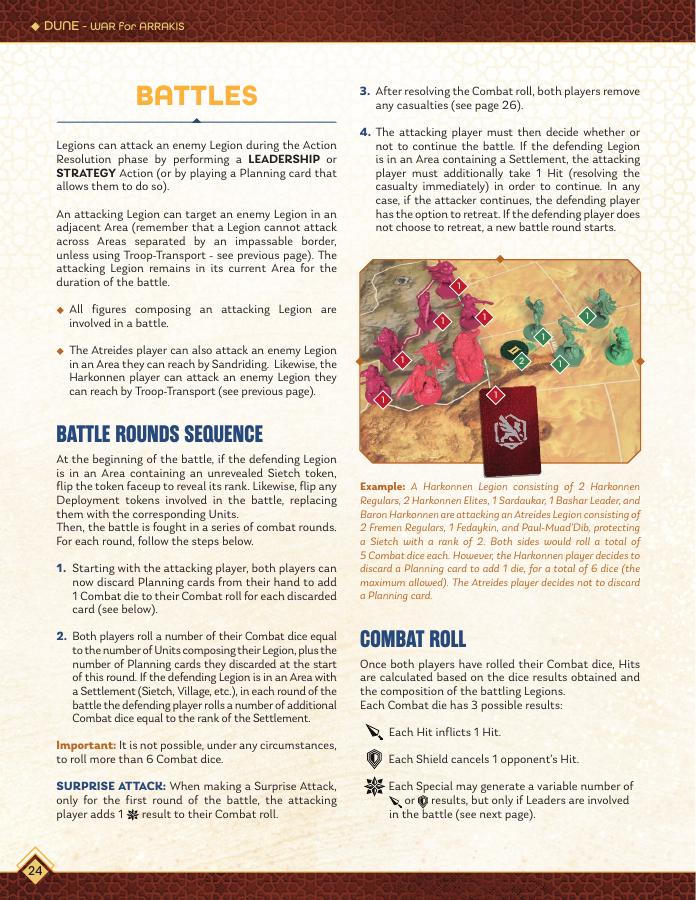
The shared round has six clean beats: Spice Must Flow, Vehicle Placement, Action Resolution, Desert Hazards, Spice Harvesting, and End of Round. During action resolution, both sides use their faction dice and planning cards to move, recruit, attack, deploy vehicles, and trigger leaders. The common clock is teachable. The difficulty is that each side is spending those actions toward a different definition of success.
Harkonnen wants 10 Supremacy points. Stronghold control, destruction, and spice pressure turn the board into a visible score machine. The faction rewards tempo and punishes hesitation, but reckless dispersal gives the desert places to bite. Atreides uses three Prescience markers and a secret objective. The faction must preserve options, create favorable battles, and manipulate a less obvious route through the war. Its progress can look unimpressive until several conditions align.
Teach those fears separately. Tell Harkonnen, 'Your clock is public; do not let efficiency become predictability.' Tell Atreides, 'Your win is hidden; do not mistake survival for progress.' New players grasp the game faster when they understand what the opponent is afraid of before memorizing every icon.
Harkonnen builds a clock. Atreides builds a reveal.
What is actually in the core box?
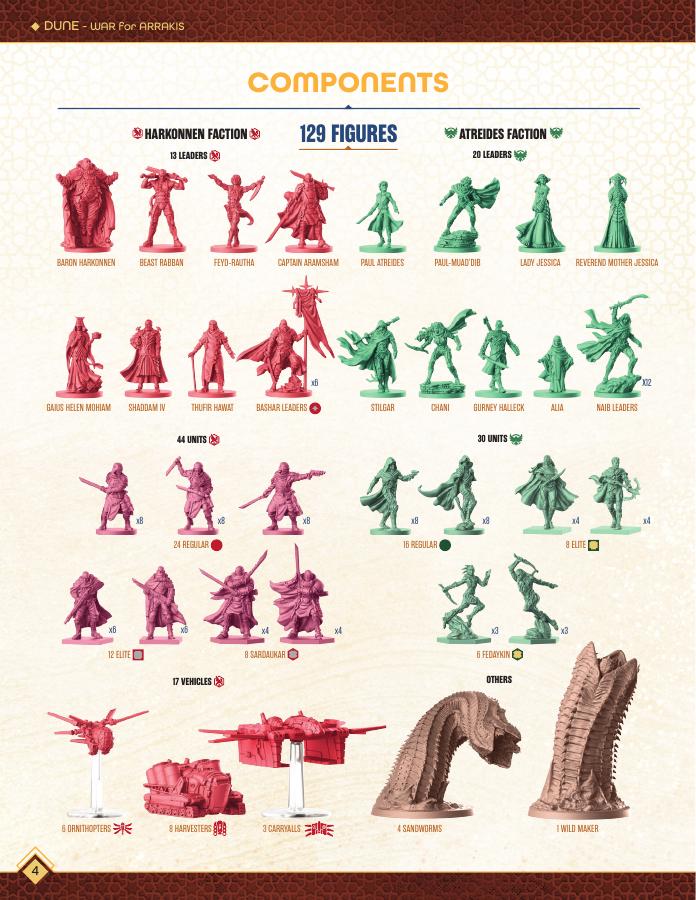
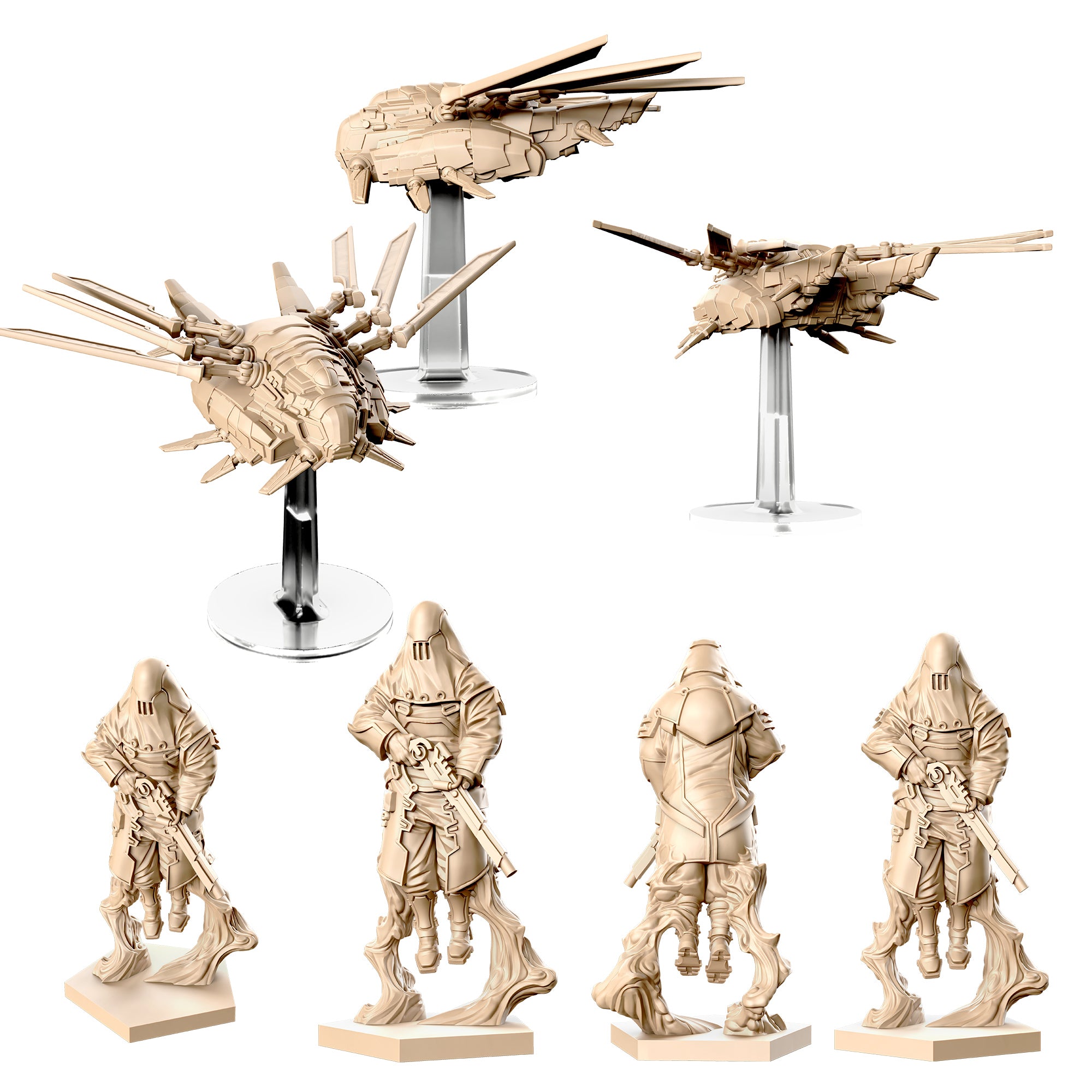
The core is not a teaser. Asmodee's current retail box includes the large Arrakis map, faction dashboards, action and combat dice, planning and Prescience cards, tokens, plastic strongholds, vehicles, leaders, troops, and the sandworms that turn Atreides movement into spectacle. The official component spreads matter because this is a game where setup burden is partly the physical abundance you are paying for.
Harkonnen's vehicles are not decoration. Ornithopters and carryalls help the occupier cross and survive terrain that the Fremen understand differently. Atreides can ride sandworms, exploit hidden deployment, and make the desert itself part of the military problem. Leaders and planning cards give each side specific timing tricks rather than generic combat bonuses.
Before the first play, punch and sort by faction, not by component type. Give each player one lidded tray containing their leaders, regular units, dice, faction tokens, and planning deck. Keep shared battle material and desert hazards in a third tray. That single decision turns the official setup diagram from a scavenger hunt into a repeatable ritual.
How hard is setup, the teach, and the first game?
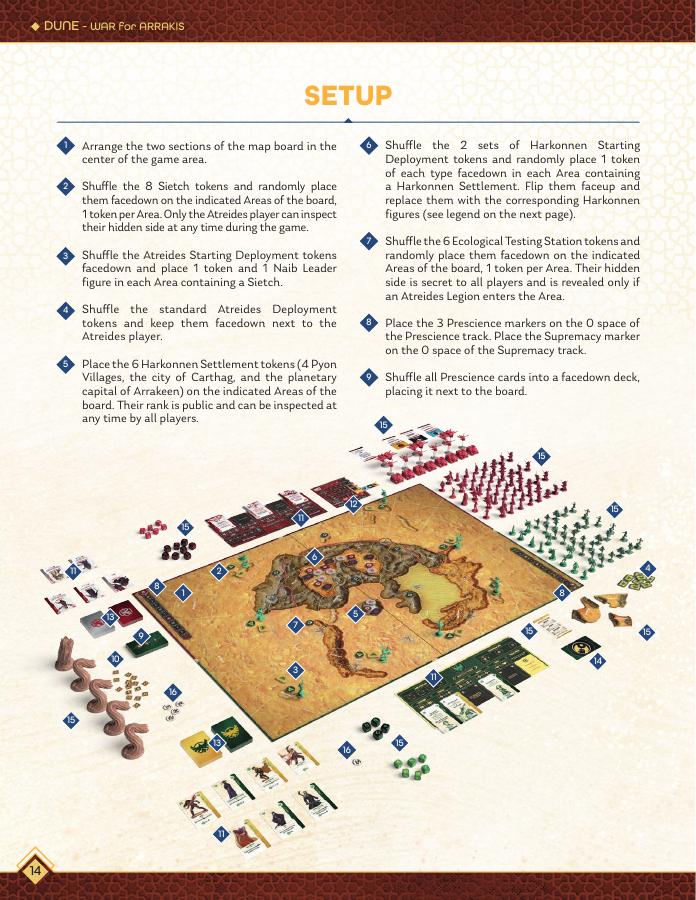
The setup page looks intimidating because the asymmetry begins before turn one. Units, leaders, strongholds, spice, vehicles, cards, and markers are not mirrored. Budget 30 minutes for an unorganized first setup and closer to 15 once faction trays and a printed checklist exist. Do not teach while searching bags. Build the board completely, put each dashboard in front of its owner, then explain the round from left to right.
Use a three-layer teach. First, state both victory conditions. Second, walk through the six phases without exceptions. Third, give each player a private five-minute faction brief: Harkonnen vehicles, supremacy and spice pressure on one side; Atreides deployment, desert mobility and Prescience on the other. Leave edge-case combat timing to the first battle. The current CMON FAQ is worth keeping on a phone because the questions that stall play are usually precise interactions, not the core loop.
For the first game, expose intentions. Let each player say what an action is meant to accomplish before committing it. This is not tournament secrecy; it is accelerated learning. When a move fails, name whether the mistake was timing, positioning, action economy, or misunderstanding a faction power. That vocabulary makes the rematch immediately better.
Which side is easier for a beginner: Harkonnen or Atreides?
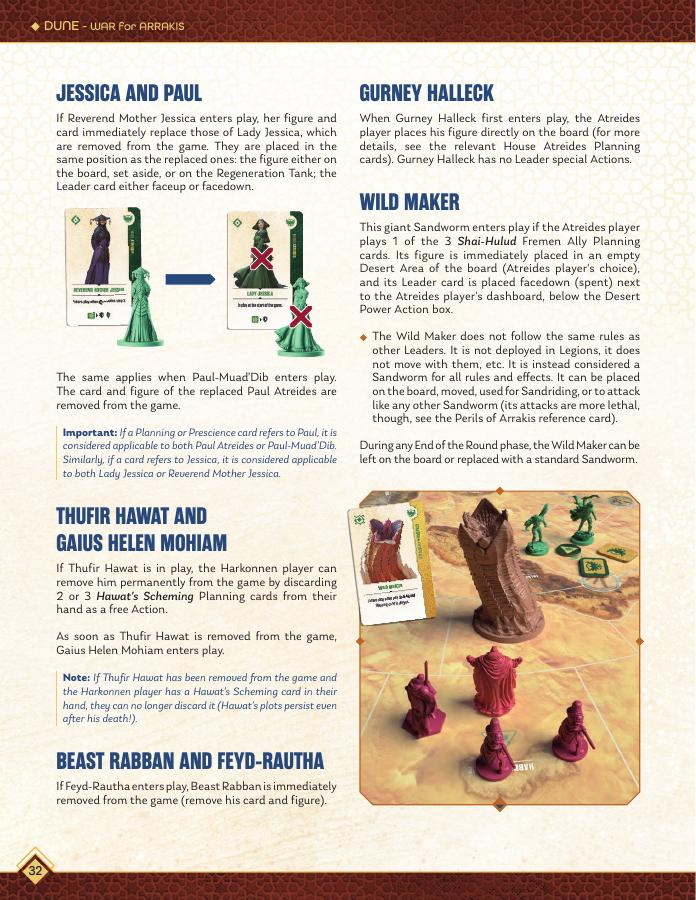

Give the more process-oriented player Harkonnen and the more adaptive player Atreides. Harkonnen's visible Supremacy track makes the strategic direction easier to read, but the faction still has a demanding logistics problem: it must place vehicles, protect spice flow, pressure strongholds, and avoid offering isolated targets. Atreides has a less obvious scoreboard and therefore a more conceptual first game, yet its hidden information and desert mobility can feel intuitive to someone who enjoys timing and improvisation.
If experience is uneven, let the stronger gamer take Atreides for the first play. That is not a universal balance patch; it simply gives the newer player a public target and a more legible operating system. Swap factions for game two. Current owner discussions repeatedly show that perceived imbalance changes once players understand both sides, which is why judging the game after one faction assignment is unreliable.
After each play, conduct a five-minute postmortem. Harkonnen should identify the turn its public clock slowed. Atreides should identify the Prescience requirement it protected too late. Then swap one piece of advice, not ten. A rivalry grows from one corrected mistake per rematch.
Do not balance the first game with rules. Balance it with faction assignment and a promised rematch.
Is Desert War the first expansion to buy?
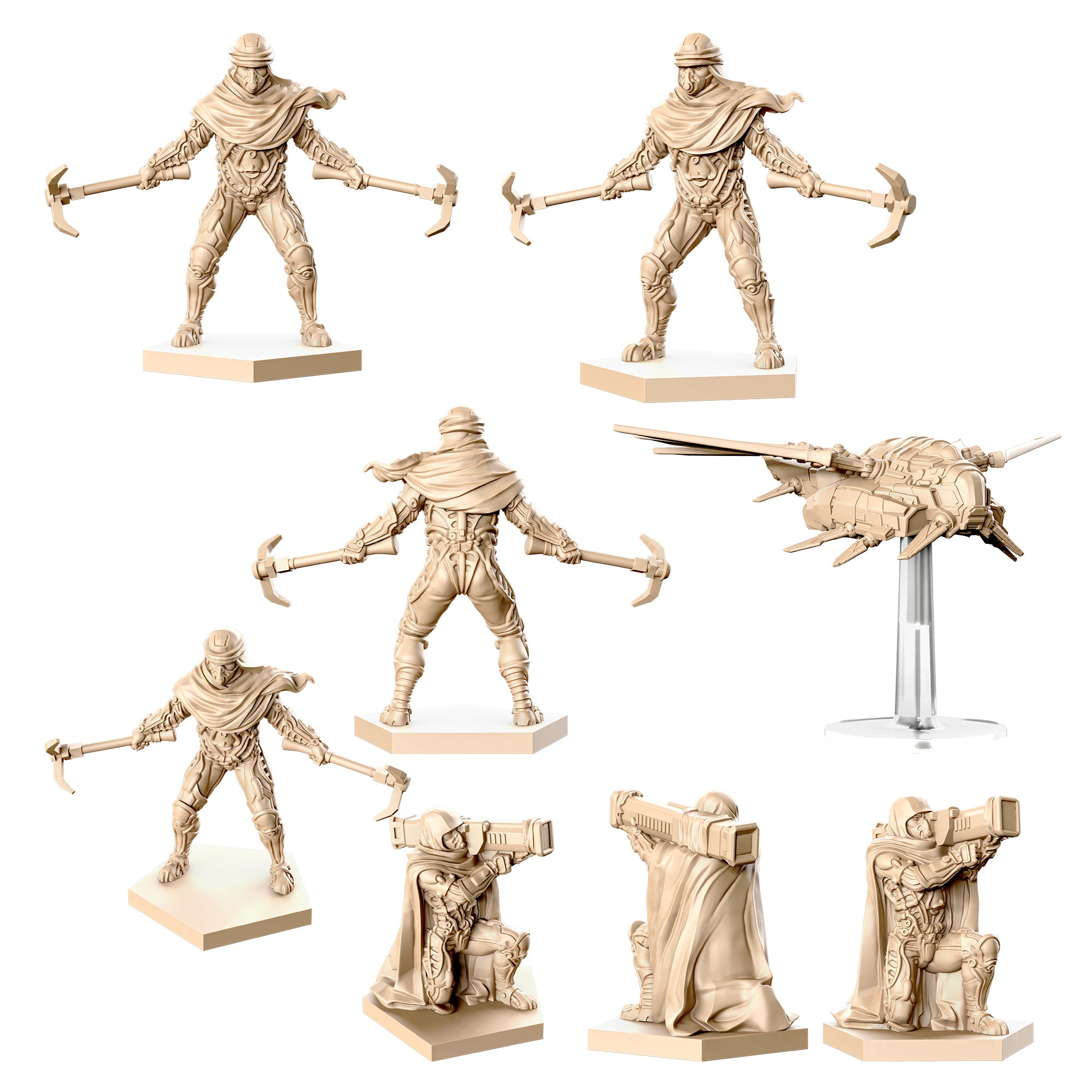

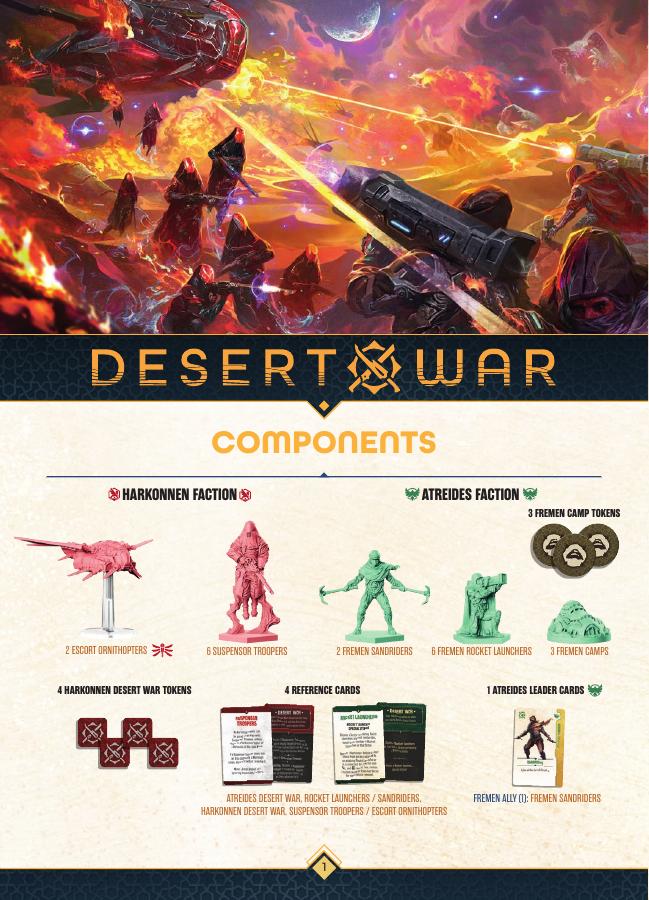
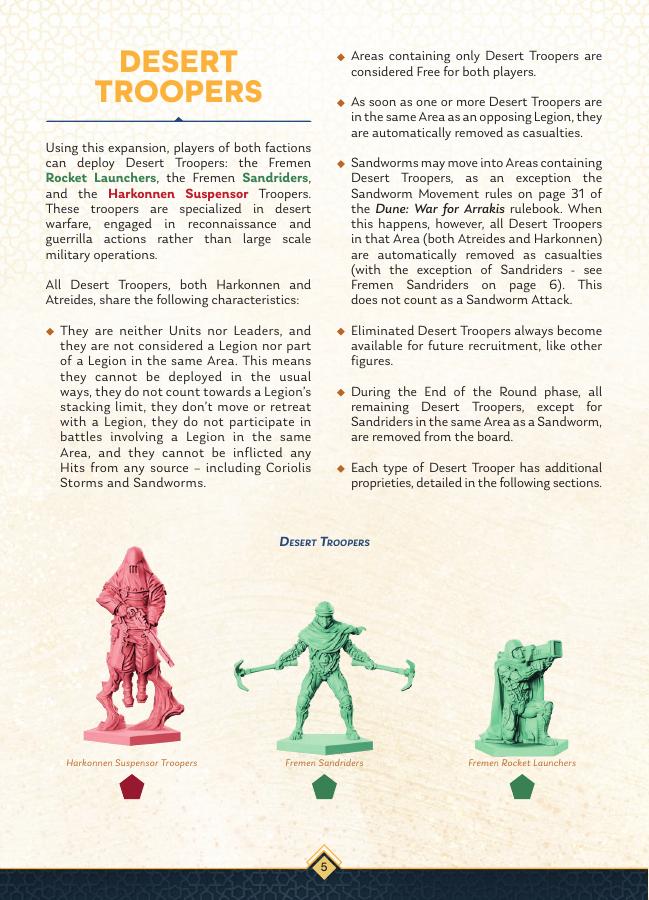
Yes, but not on day one. Desert War adds 16 figures, new Harkonnen Escort Ornithopters, Suspensor Troopers, Fremen Rocket Launchers, Fremen Sandriders, cards, tokens, camps, and a Desert War action layer. It makes the surface conflict more tactical without adding a completely separate off-world economy. For a pair already comfortable with the core, that is the cleaner first expansion.
The important caveat is official and easy to miss: Desert War is not compatible with the Mahdi solo mode. Solo-first buyers should not treat it as an automatic upgrade. Competitive pairs should wait until the base game has produced at least three useful postmortems. If you cannot yet explain why Harkonnen lost spice tempo or why Atreides missed a Prescience line, additional troops will decorate confusion rather than deepen play.
The best trigger is boredom with familiar unit roles, not fear of missing content. Add Desert War when both players want new battlefield questions and can set up the core without reopening the rulebook. Its official MSRP is $54.99; check the exact Amazon listing for live price and stock before buying.
Should you buy The Spacing Guild expansion?
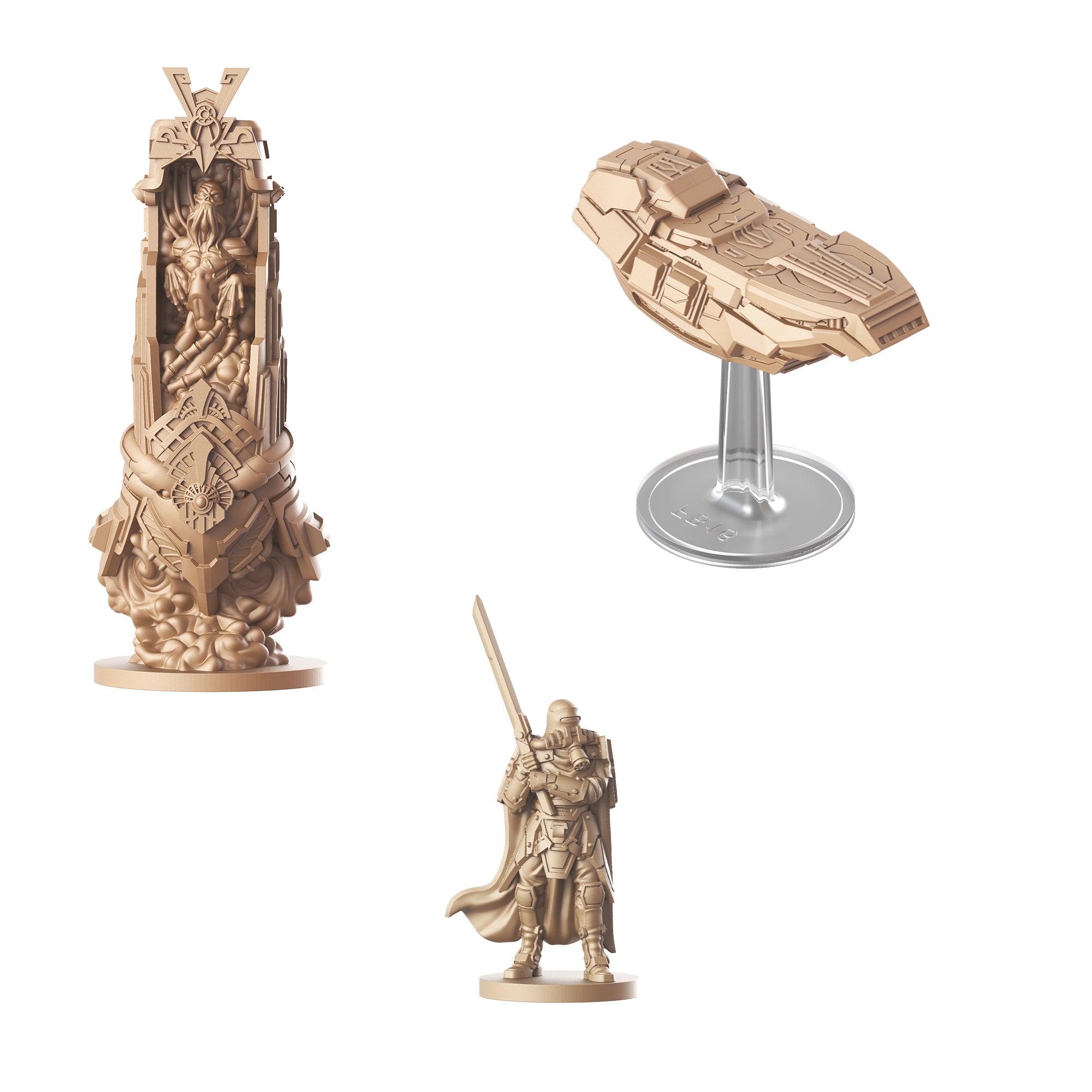

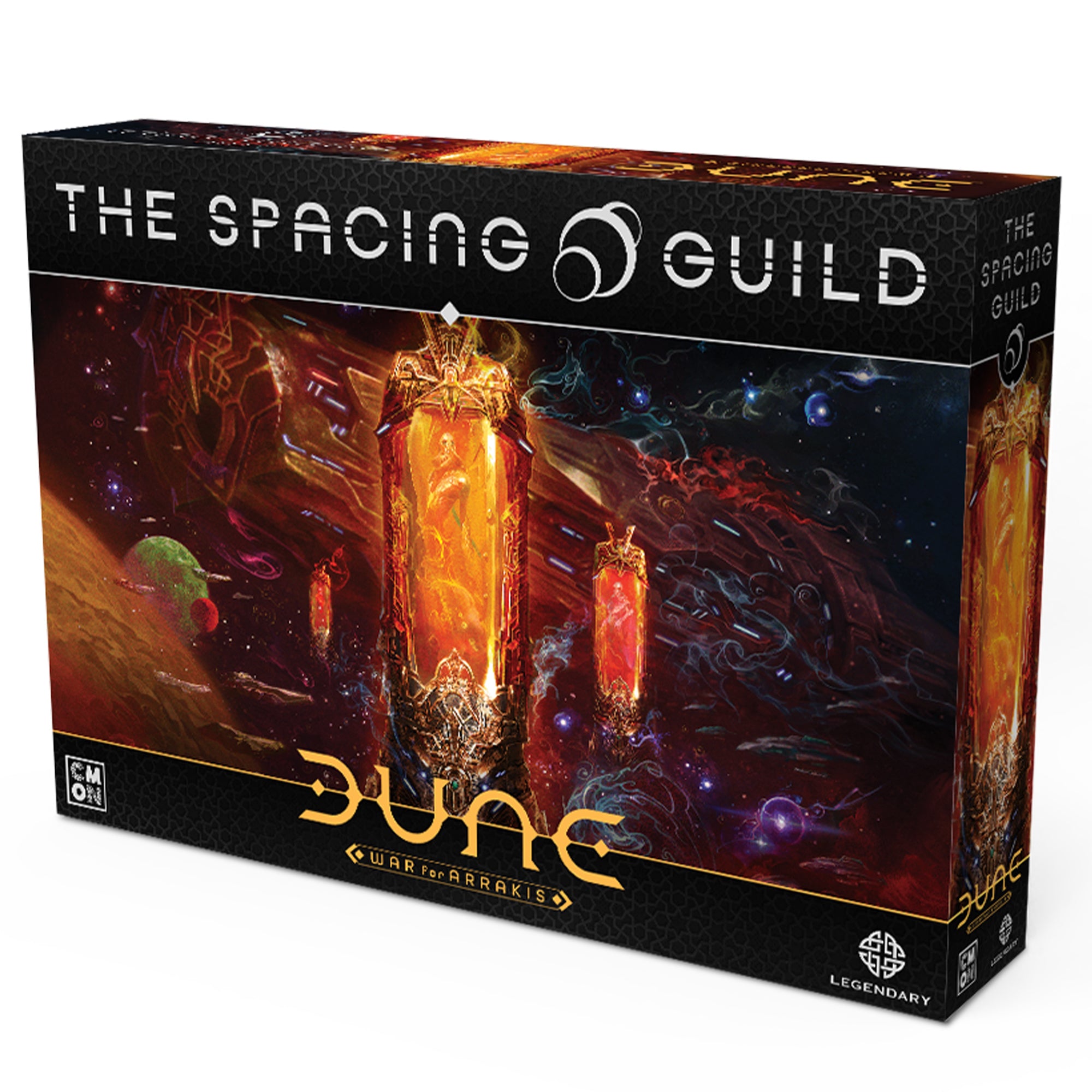
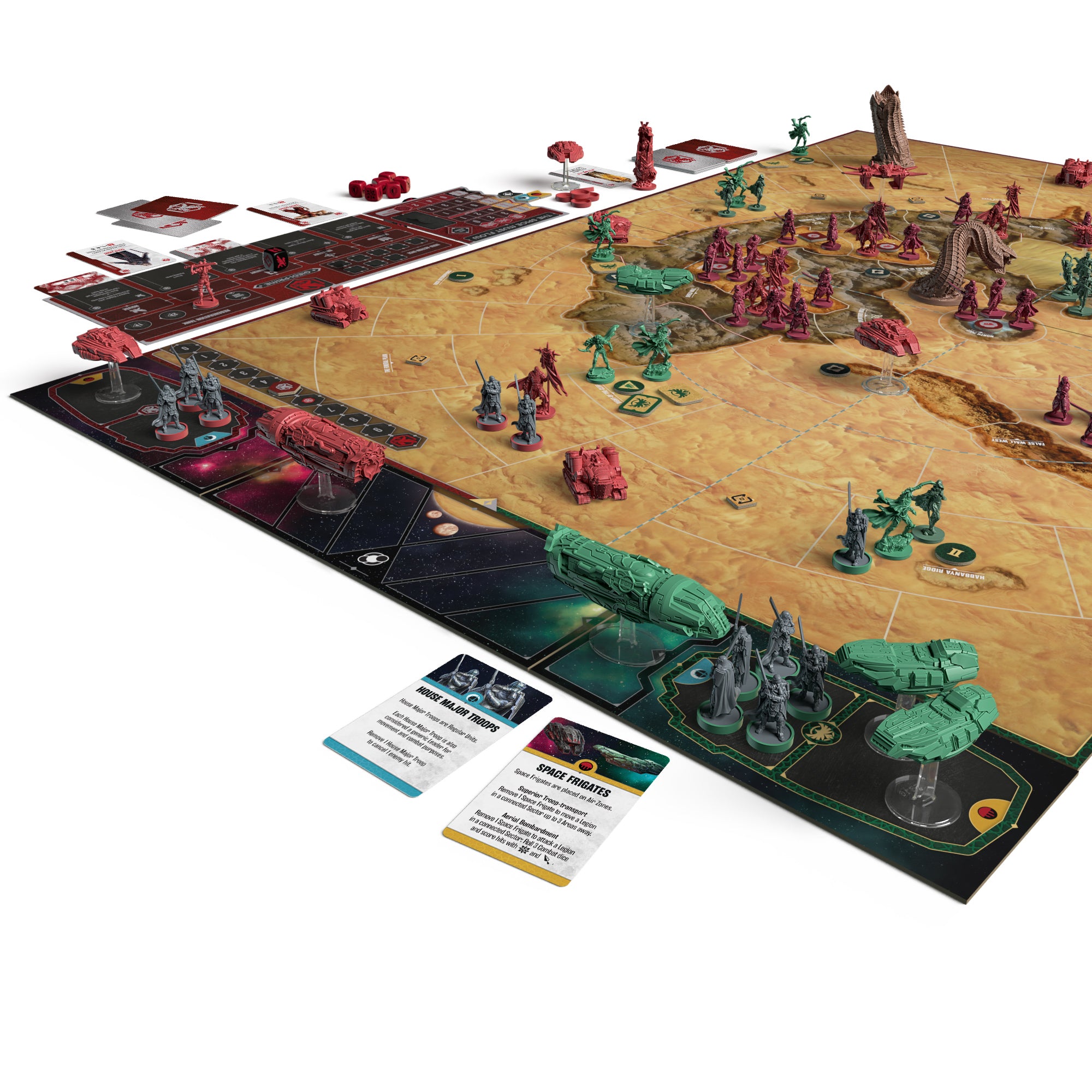
Buy The Spacing Guild last. It adds a Space Board involving the Guild, CHOAM, and the Landsraad, plus Heighliners, Space Frigates, Houses Major troops, cards, and a new reinforcement economy. The expansion broadens the conflict away from the desert and gives both factions additional ways to influence outside powers. That sounds essential because Dune's political universe is essential. Mechanically, it is a new strategic layer laid over an already asymmetric war.
Current owner discussions are not unanimous about how it affects balance. A recurring pattern is that adding the Guild alone can strengthen Harkonnen pressure before the Atreides player understands the new counters; other groups prefer particular expansion combinations after repeated play. Treat that as a community warning, not a solved equation. Add the box by mutual consent, keep a record of faction wins, and do not stack every module into the first expanded game.
The Spacing Guild is for the pair saying, 'We know why the core works; now we want the Imperium leaning over the board.' It is not for the buyer asking whether the base box contains enough. It does.
Desert War changes the fight. The Spacing Guild changes the horizon.
Is War for Arrakis a shorter War of the Ring or a stepping stone?
It is a shorter cousin, not a tutorial. Francesco Nepitello and Marco Maggi bring a recognizable grand-duel sensibility: asymmetric powers, event timing, leaders, military geography, and a visible war pressing against a less conventional victory path. War for Arrakis usually asks for less time and covers one concentrated conflict. That makes it easier to schedule, not automatically easier to master.
Choose by fiction and pressure. War of the Ring is a continental pursuit where the Fellowship's hidden journey competes with armies and political activation. War for Arrakis is a desert revolt where industrial occupation competes with prescience, mobility, and survival. A player who loves Dune and dislikes Tolkien should not buy one as training for the other. A pair that enjoys repeated asymmetric duels may eventually want both because they create different stories with related strategic grammar.
The strongest current Reddit advice on the 'stepping stone' question is simple: buy the game you most want to replay. Familiarity, not sequence, is what makes either design sing.
What is the final buying order?
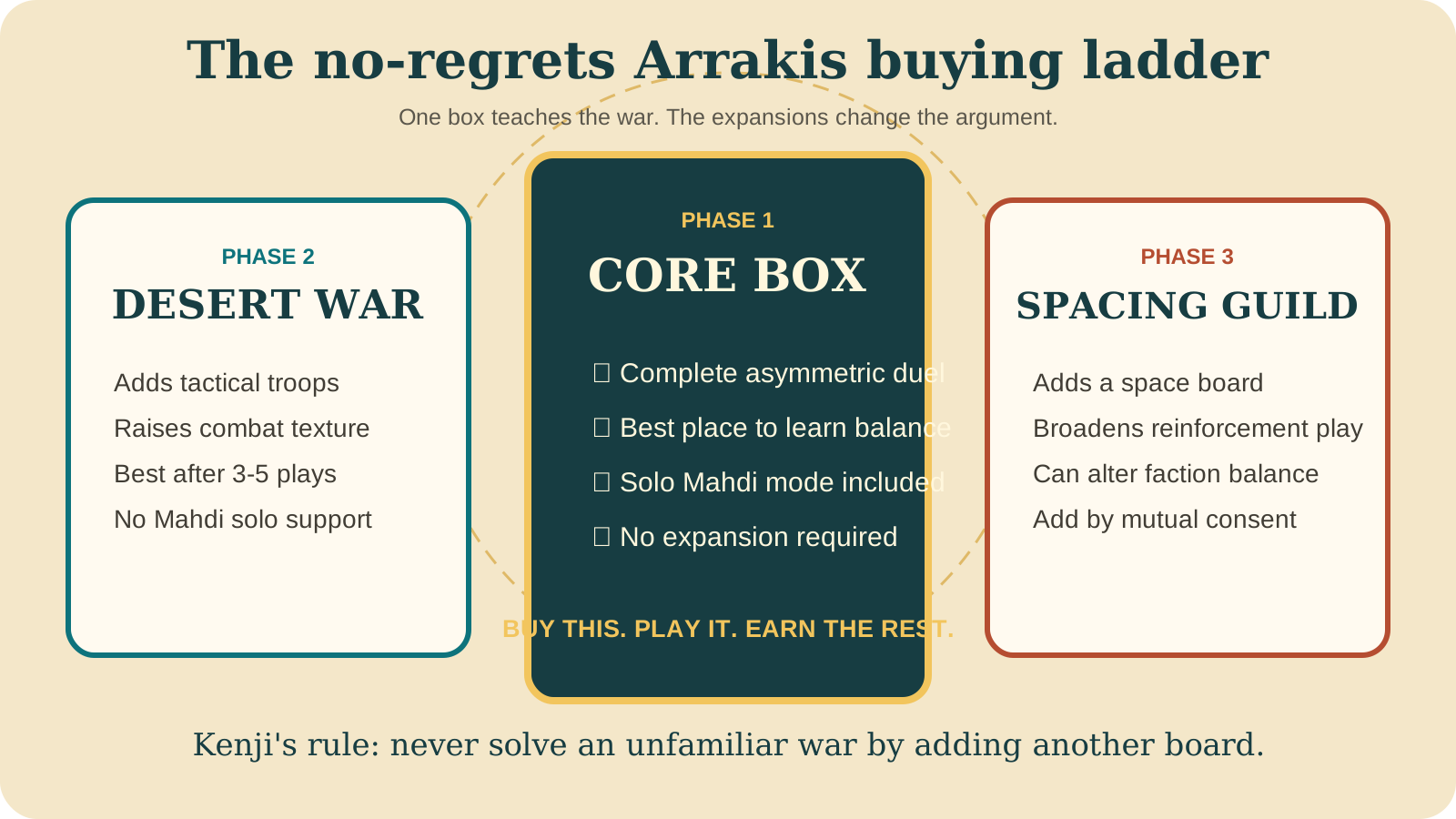
Phase 1: buy the core box and nothing else. Organize it, play both factions, and complete at least three games. Phase 2: add Desert War when the pair wants more battlefield texture and neither player depends on Mahdi solo compatibility. Phase 3: add The Spacing Guild when the core balance is understood and both people want the off-world reinforcement layer. Smugglers material exists from the crowdfunding ecosystem, but normal retail availability is inconsistent; do not let secondary-market scarcity turn it into a requirement.
Skip premium organizers until the faction-bag method has failed you. Skip cosmetic upgrades until the figures have actually been used enough to make painting feel joyful rather than obligatory. The best first accessory is three shallow lidded trays and a printed setup checklist. The best second accessory is a regular opponent.
Kenji's hard verdict: the core is a buy for a repeat two-player strategy table, Desert War is the best eventual first expansion, and The Spacing Guild is an informed third purchase. The complete experience is not every box. It is the moment both players look at the same board and understand why the other side is afraid.
Buy the war first. Earn the expansions through play.
The picks
Some links below are affiliate links — as an Amazon Associate, Puzzlewick earns from qualifying purchases, at no extra cost to you. It never changes a pick.
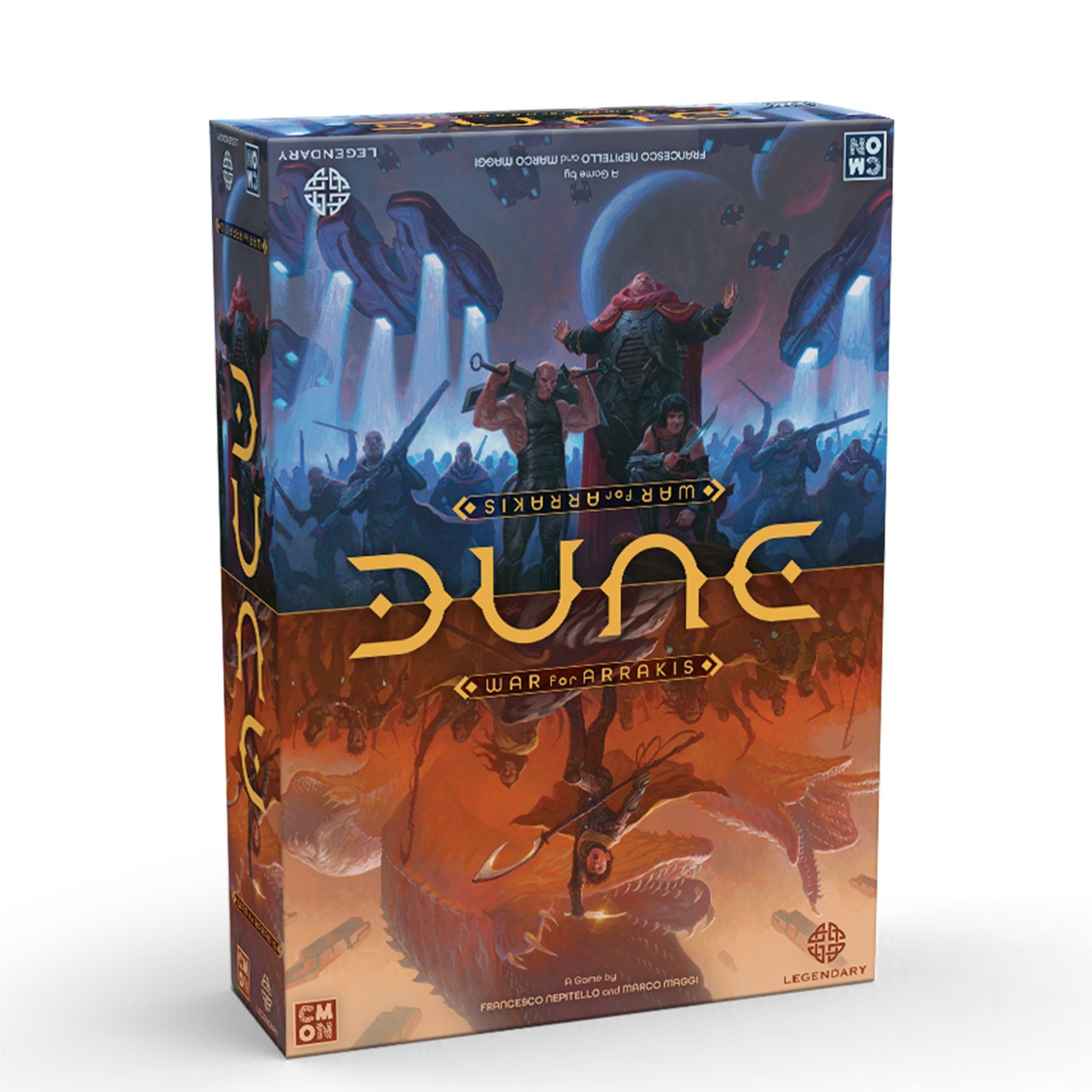
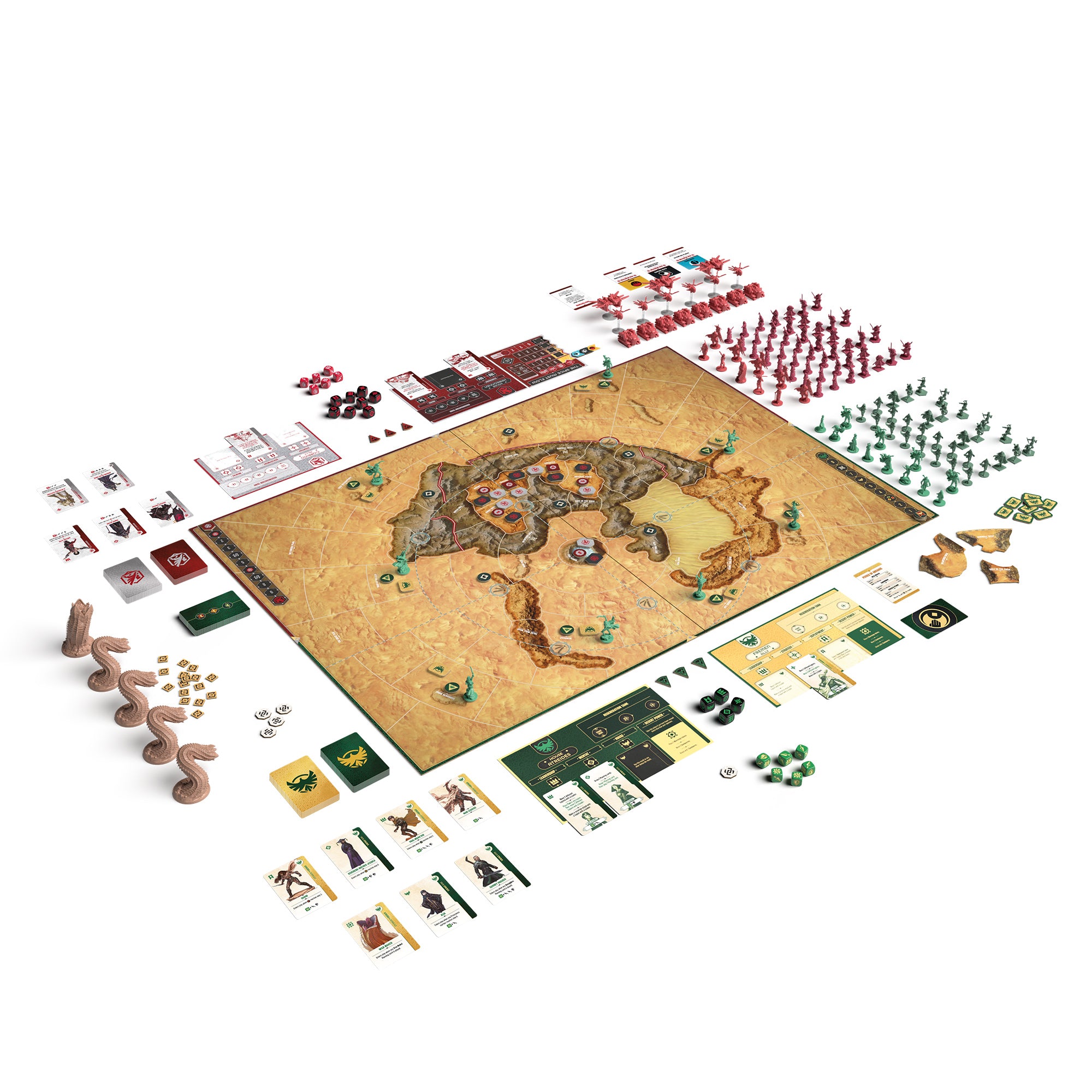
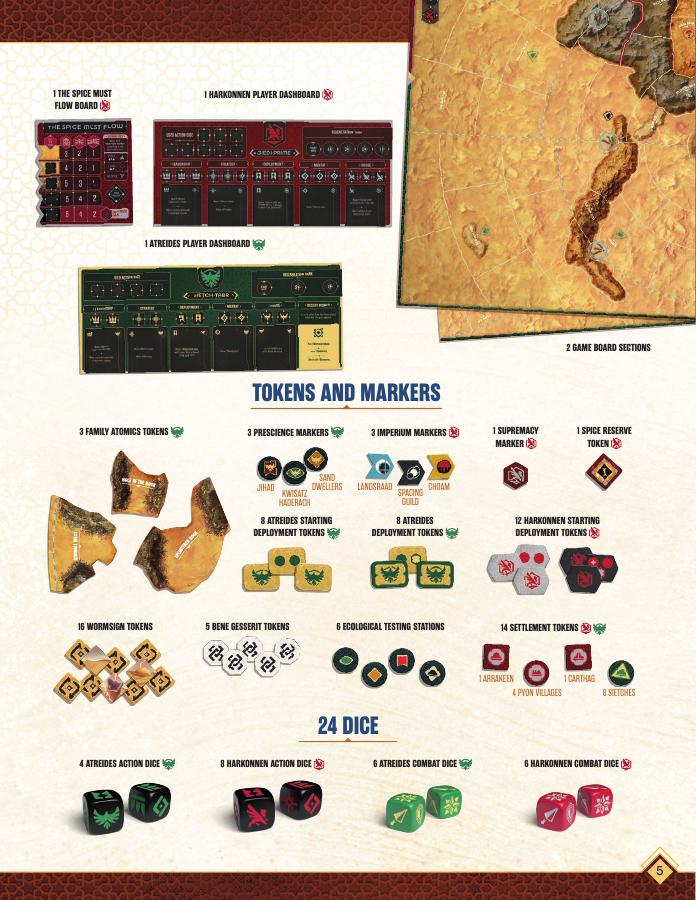 4 photos
 CMON Dune: War for Arrakis Core Box
The only required purchase. The core delivers the whole war, both victory systems, detailed miniatures, and Mahdi solo mode.
- Complete game without expansions
- Factions create genuinely different pressures
- More schedulable than many grand duels
- Substantial first teach and setup
- Best with the same opponent repeatedly
- Four-player team mode is not the main attraction
 4 photos
 Dune: Desert War Expansion
The cleaner first expansion adds meaningful troops and desert actions while keeping the focus on Arrakis.
- New units with clear battlefield roles
- Adds texture without a separate space economy
- Strong miniature and painting value
- Not compatible with Mahdi solo mode
- Unnecessary before core strategy is understood
- Adds another rules layer
 3 photos
 Dune: War for Arrakis - The Spacing Guild Expansion
A substantial strategic module that broadens the war, changes balance conversations, and belongs after both players know the core.
- Adds the Space Board and Imperium institutions
- Creates new reinforcement timing
- Expands long-term replay
- Heavier than a simple content pack
- Community balance impressions vary
- Easy to add too early
At a glance
| Box | What it changes | Best time to add | Solo | Verdict |
|---|---|---|---|---|
| War for Arrakis core | The complete asymmetric war | First purchase | Mahdi mode included | Buy |
| Desert War | New tactical troops, vehicles, camps, and desert actions | After 3-5 core plays | Not compatible with Mahdi mode | Best first expansion |
| The Spacing Guild | Space Board and off-world reinforcement economy | After both factions feel familiar | Check module rules | Buy last |
| Smugglers material | Additional asymmetric options from the crowdfunding ecosystem | Only after retail modules | Varies | Do not chase scarcity |
Questions, answered
Is Dune: War for Arrakis worth buying in 2026?
Yes for a repeat two-player table that enjoys heavy asymmetric strategy, miniatures, and a two-to-three-hour event. It is a weaker buy for casual groups seeking flexible player counts or a short weeknight game.
Can you play Dune: War for Arrakis solo?
Yes. The core includes Mahdi solo mode, with the player controlling Atreides against a game-controlled Harkonnen force. The Desert War expansion is officially not compatible with Mahdi solo mode.
What is the best Dune: War for Arrakis expansion?
Desert War is the best first expansion for an experienced competitive pair because it deepens battlefield tactics without adding The Spacing Guild's separate off-world economy. The base game should still be played several times first.
Should I buy The Spacing Guild expansion?
Buy it after both players understand the core factions and want a wider strategic layer involving the Guild, CHOAM, Landsraad, Heighliners, and new reinforcements. Do not add it to the first game.
How long does Dune: War for Arrakis take?
The official average is about two hours. A first game should reserve roughly three hours after setup, while experienced pairs can move closer to the official time.
Is Dune: War for Arrakis good at four players?
The game supports up to four through team play, but its cleanest and most recommended form is one player controlling each faction. Team command adds coordination to an already asymmetric rules load.
Is Dune: War for Arrakis easier than War of the Ring?
It is usually shorter and more concentrated, but it is not a tutorial. Both are heavy asymmetric duels with different strategic pressures. Choose the fictional conflict and play length your pair wants to repeat.
Which faction should a beginner play?
Harkonnen has a more visible victory track and can be easier to orient around, while Atreides has a more hidden and adaptive problem. For an uneven pair, give Harkonnen to the newer player for game one, then swap.
Do I need an organizer?
No. Start with three shallow lidded trays: one per faction and one for shared material. Buy a premium insert only after you know which part of setup is actually slowing your table.
What should I buy first?
Buy only the Dune: War for Arrakis core box. Add Desert War after three to five plays, then consider The Spacing Guild after both factions and the base balance feel familiar.
Kenji's verdict
Buy the Dune: War for Arrakis core for a committed two-player rivalry. Play it at least three times, add Desert War first, and treat The Spacing Guild as an informed veteran module rather than missing content.
Research ledger 12 sources · reviewed 2026-08-10
Specifications, rules, current product information, community experience, and contrary evidence were checked against the sources below. Commercial links are kept separate from editorial evidence.
- store.asmodee.comstore.asmodee.com/products/dune-war-for-arrakis
- store.asmodee.comstore.asmodee.com/products/dune-desert-war
- store.asmodee.comstore.asmodee.com/products/dune-war-for-arrakis-the-spacing-guild
- cmon.comcmon.com/wp-content/uploads/2024/01/Dune_Rulebook_web.pdf
- resources.cmon.comresources.cmon.com/Dune_Desert_War_Rulebook_web.pdf
- cmon.comcmon.com/wp-content/uploads/2024/01/Dune-FAQ-3_1.pdf
- zatu.comzatu.com/en-us/blogs/reviews/dune-war-for-arrakis-review
- orderofgamers.comorderofgamers.com/games/dune-war-for-arrakis
- reddit.comreddit.com/r/DuneWarForArrakis/comments/1qxo68e/how_do_the_expansions_affect_balance_which_ones
- reddit.comreddit.com/r/boardgames/comments/1uuthq2/dune_war_of_arrakis_or_the_battle_of_five_armies
- reddit.comreddit.com/r/boardgames/comments/1rpeg7h/should_i_buy_dune_war_for_arrakis_as_a_stepping
- reddit.comreddit.com/r/boardgames/comments/1ll9wla/now_that_its_been_out_a_while_what_are_peoples

Every object has a lineage. Let me tell you its story.


Keep exploring
The next smart rabbit holes.
◉ Universe HubDune: the whole buying pathDune games ask the same question at different scales: can you turn limited information, temporary power, and a dangerous resource...♛ Topic PathGrail Board Games: compare the whole shelfA grail earns its space only when the experience survives the price, setup, storage, and group commitment. These are expensive-game...Deep DiveWar of the Ring (Second Edition): A Patient Reckoning With Tolkien's Whole WarTwo players. Two ways to win. A single Ring carried east through a continent at war. The definitive grand-strategy duel of Middle-earth,...