The Night Cage Review 2026: Is It Worth It, and When Should You Add Shrieking Hollow?
Margo enters the candle maze with the current rules, the best first-night teach, advanced survival tactics, an honest replayability verdict, and a precise Shrieking Hollow buying decision.


AI-assisted research and drafting in Margo’s voice · reviewed by Robert Pruitt · how this guide was made
Last editorial refresh: 2026-08-12 Gold-standard QA: 2026-08-11 21 sources reviewed Affiliate links checked during gold-standard pass

The short answer
The Night Cage is worth buying if your group wants a tense, accessible cooperative horror game that teaches quickly and becomes far better when the room, soundtrack, and communication rules support its premise. Buy the base game first and play it two to four times before adding Shrieking Hollow. Skip it if your table needs deep individual powers, low randomness, or long-term campaign progression: its drama comes from disappearing paths, shared spatial problems, and the fear that one unlucky draw can ruin a good plan.
A candle does not reveal the maze. It creates a temporary argument about what the maze might be. Move one tile and the corridor behind you goes dark; when it leaves the light, it leaves the table. Somewhere in that shrinking possibility space are keys, a gate, and creatures that become dangerous precisely when the group feels organized.
That is why The Night Cage earns stronger reactions than its small rules load suggests. Some groups find a nearly perfect atmospheric cooperative puzzle. Others find a clever production wrapped around decisions that feel obvious or luck-heavy. We checked the current manufacturer listing, official rulebook, Dized clarifications, the Shrieking Hollow catalog and how-to, BoardGameGeek records, video reviews, and recurring owner discussions to identify which table gets which version of the game.
Margo's case is simple: do not judge this box by whether it can fill a game night. Judge it by whether your people will help the darkness do its job.
Start here, then go deeper
You are in the right cabinet.
 ✦ Topic PathBoard Game Buying Guides: compare the whole shelfStart with the decision, not the shelf. These guides compare the games, editions, expansions, player counts, and costs people...
 Buying GuideShrieking Hollow Expansion Review 2026: Is The Night Cage Upgrade Worth It?Margo maps The Other, Shrieks, pits, events, Night Terrors, the staged tile stack, and the exact moment this expansion becomes the right...
 Best OfBest Escape-Room Board Games, Ranked (2026)EXIT, Unlock!, Deckscape and six more escape-room games compared by resetability, app use, difficulty and group fit.
Is The Night Cage worth buying in 2026?
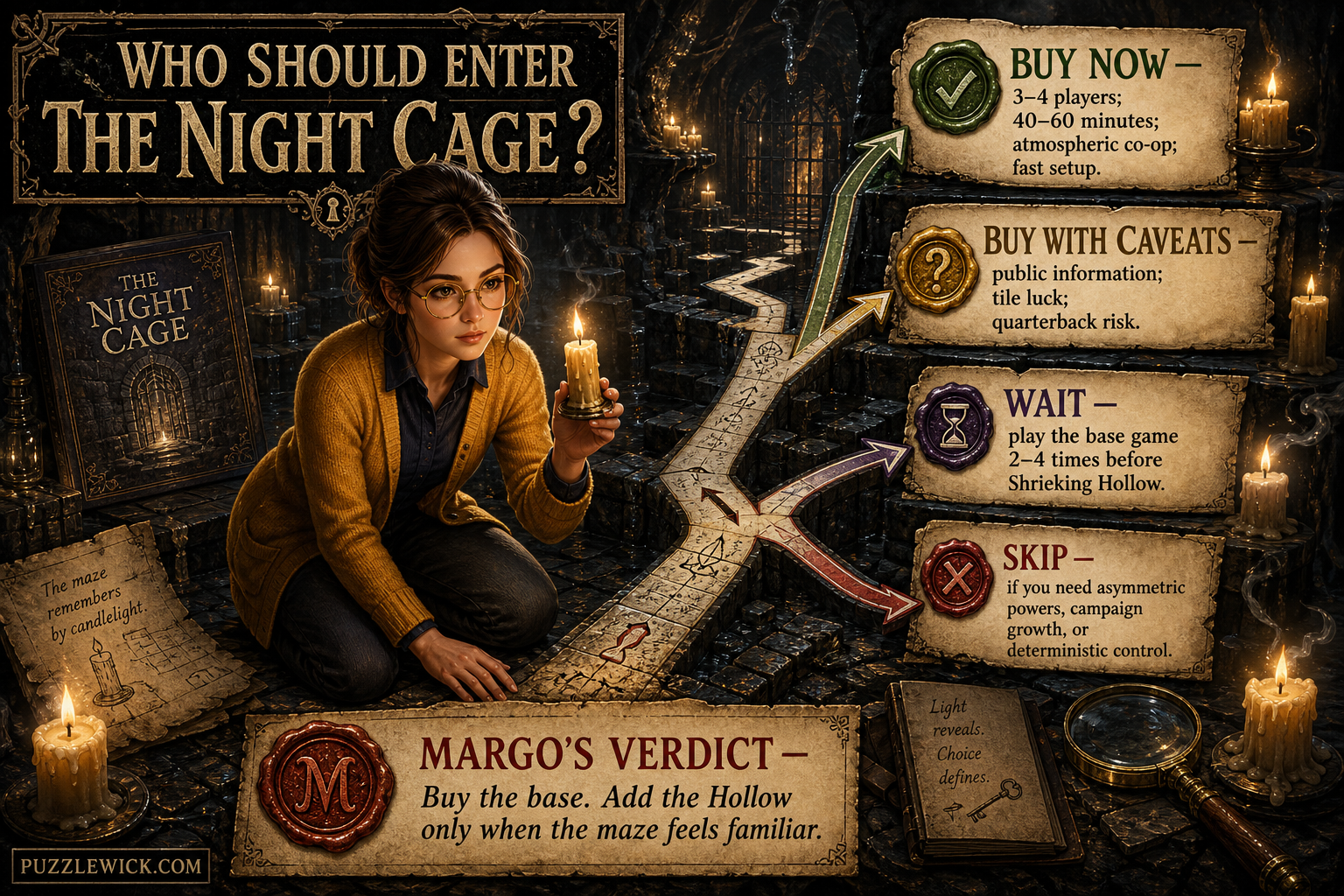
Buy it now when your group wants a cooperative horror game with a short teach, a forty-to-sixty-minute arc, and enough table theater to make a simple tile draw feel dangerous. Buy with caveats when your players dislike randomness but enjoy solving a shared spatial emergency. Wait on Shrieking Hollow until the base game has become legible; when that moment arrives, open Puzzlewick's complete Shrieking Hollow expansion review before adding the second board. Skip the line entirely when character powers, campaign growth, or deterministic planning are the reason you play.
The current Smirk & Dagger listing identifies a one-to-five-player game for ages fourteen and up, with a roughly fifty-minute play time. The useful part is not the specification; it is how little machinery stands between setup and the central fear. Prisoners move through a maze that exists only in candlelight. New tiles appear in front of them. Tiles outside every candle's light are discarded. Four keys and one gate must remain reachable long enough for the entire group to escape.
Margo rates it 8.8/10 as a hosted atmospheric experience and 7.2/10 as a bare mechanical puzzle. That spread is the whole review. Put it under bright kitchen lights while everyone narrates perfect information and it can feel procedural. Give it a dark cloth, the official score, one clear rules teacher, and a group willing to leave some uncertainty in the room, and the same system becomes wonderfully cruel.
How do you set up and play The Night Cage without missing the important rule?
For one to four players, use the six-by-six side and control four prisoners total. A solo player controls all four; two players control two each; three players share the fourth prisoner; four players control one each. At five players, use the seven-by-seven side, give every player a prisoner, and follow the five-player key and Wax Eater counts in the current Dized rules. This scaling matters because the publisher's downloadable 2019 prototype rulebook describes an older three-to-six-player configuration while the current retail detail block and Dized rules support one to five. Use the rules packed with your retail copy or the current Dized reference when they conflict with that archival PDF.
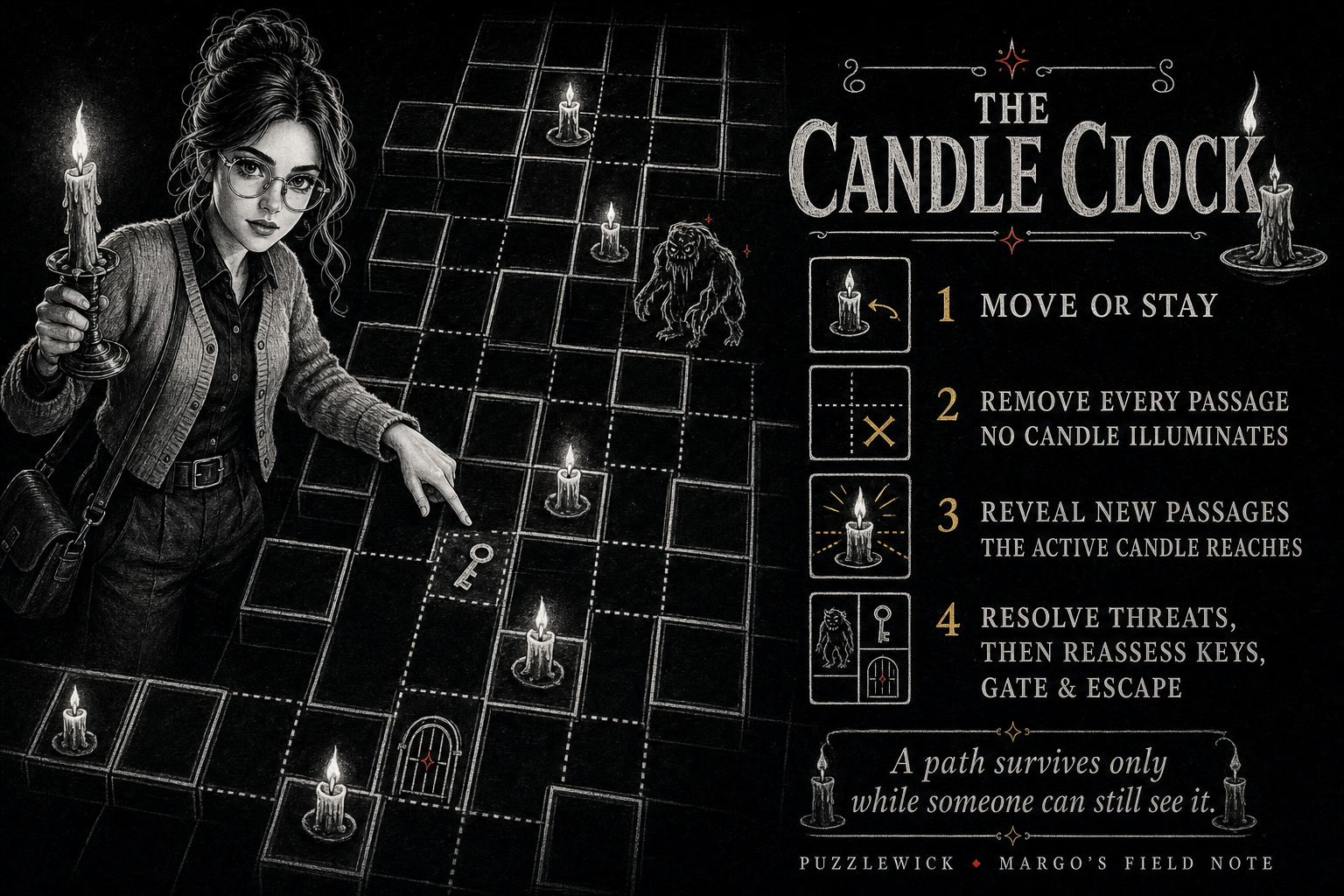
On a base-game turn, a prisoner either moves to an orthogonally adjacent passage or stays. After movement, resolve darkness first: remove passages no prisoner's candle illuminates. Then illuminate the active prisoner's open connected passages by drawing and placing new tiles. That order is the heartbeat of the game and the most common teaching failure: a route is not permanent because somebody discovered it. It survives only while at least one candle still reaches it. Shrieking Hollow inserts additional pit, falling, threat, and event timing, so use its current turn-flow reference rather than assuming the base sequence is the whole expansion turn.
Each prisoner must collect one key, and every prisoner must gather with those keys on a single gate tile before the draw stack and remaining map collapse. Keys may be passed as a free action when adjacent prisoners are connected by a passage. Board edges wrap, so a route that appears to die at one border may connect across the opposite side. Teach wrapping before the first dangerous draw. Otherwise the table can spend half a game solving the wrong geometry.
What are the best beginner and advanced strategies?
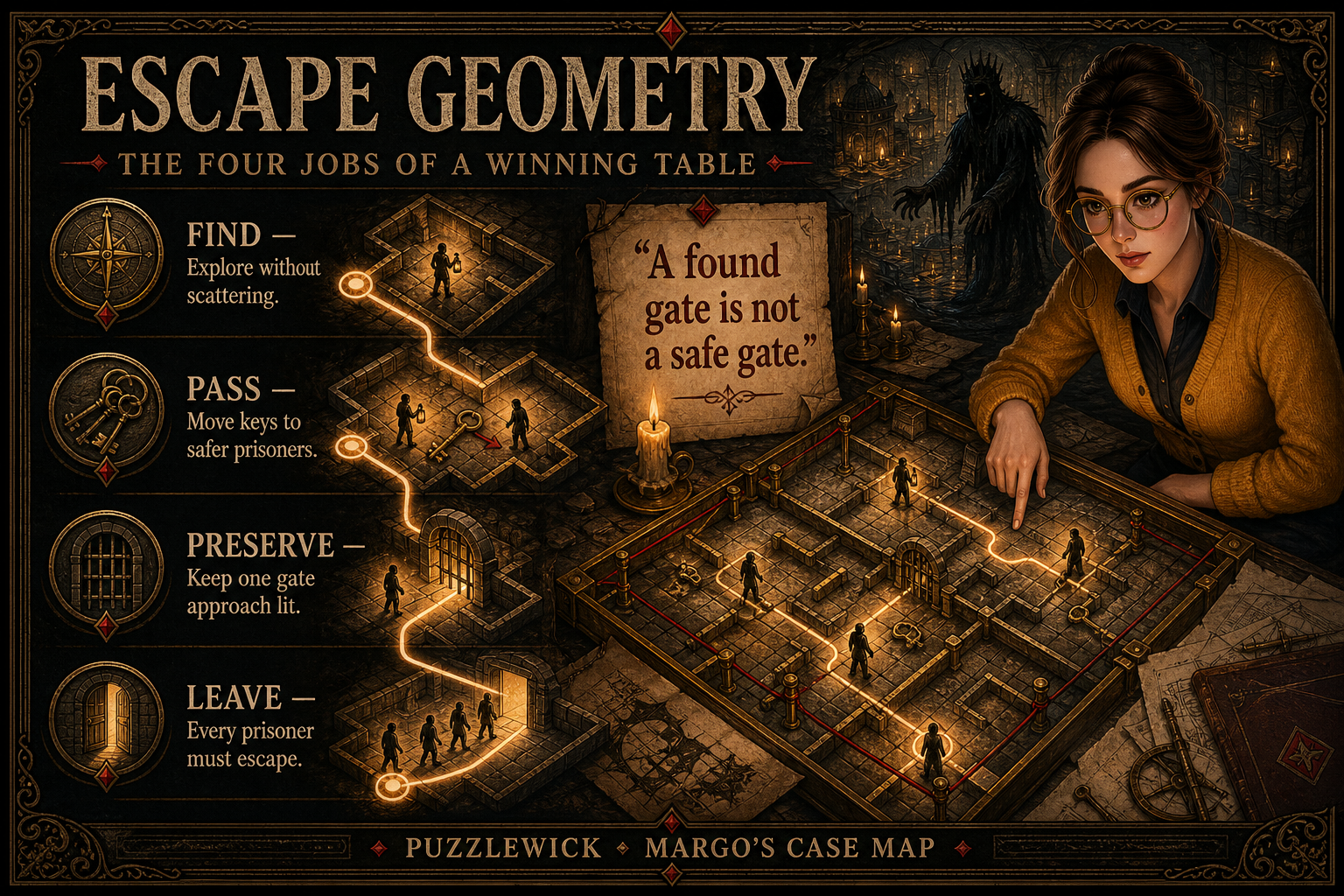
The beginner mistake is treating every new corridor as progress. Progress is a route that the group can keep illuminated long enough to use. Before moving, ask three questions: Which passage disappears? Who loses access? What new failure line does this tile create? A beautiful branch that strands a keyholder is not exploration; it is decoration paid for with survival odds.
Preserve a gate route before the group celebrates finding the gate. A key is useful only when the prisoner carrying it can still meet that route. Transfer keys when the current carrier is about to become the team's mobility bottleneck. Publicly track any discarded key or gate tile; the game provides recovery logic, but a table that forgets what vanished cannot make an informed plan.
Use Stay as a tactical action. Staying can keep a junction alive, let another prisoner cross through shared light, or prevent an over-eager draw from introducing a monster at the worst moment. Advanced groups should designate one player as the route skeptic each round. Their job is not to command moves; it is to name the passage that disappears if the proposal succeeds.
Against Wax Eaters, think in lines, not pieces. A single monster can turn a useful straightaway into a commitment trap. Do not spend two turns constructing a corridor you cannot safely vacate. The best move often looks conservative because the game's dramatic reveal happens after the group has already paid for it.
Is The Night Cage good solo, and what is the best player count?
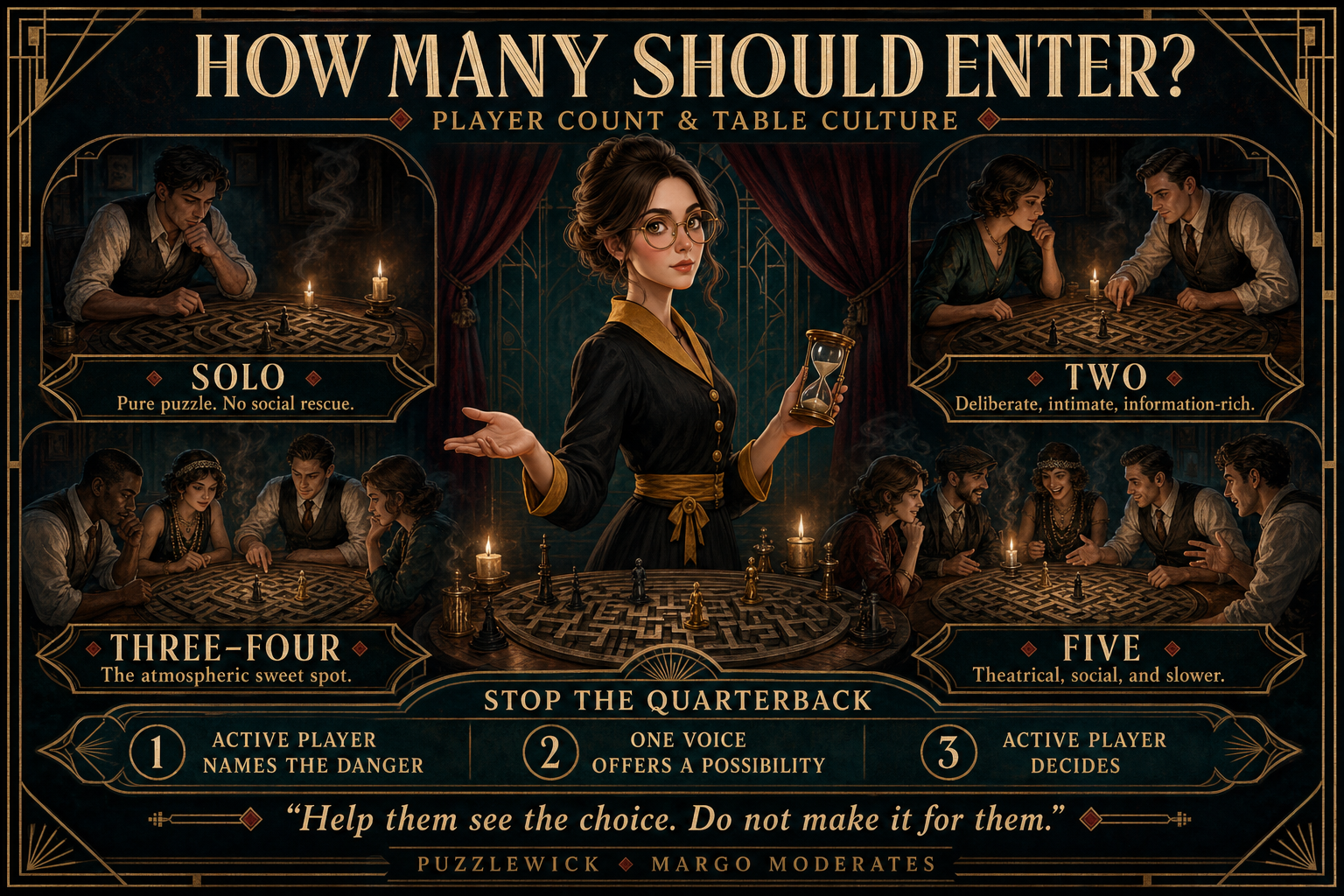
Solo is fully functional because one player simply controls the four prisoners used on the smaller board. It becomes a clean spatial optimization puzzle with no quarterbacking and no communication friction. It also loses the most distinctive part of the design: another person can see a danger you missed, but helping too explicitly can drain the uncertainty that makes the maze frightening.
Three or four is Puzzlewick's best overall count. There are enough viewpoints for surprise and disagreement without the pauses of a five-person consensus. Two is faster and more deliberate, especially for a couple comfortable narrating plans without solving for each other. Five creates the busiest, most theatrical table and uses the larger board, but every proposed route has more stakeholders.
At any count, do not let the most experienced player translate every tile into an instruction. Ask for observations before recommendations. A useful protocol is: active player states the danger, one other player names a possibility, then the active player decides. That preserves cooperation without converting the game into a committee-controlled pawn exercise.
How do you host The Night Cage without making it unsafe or corny?
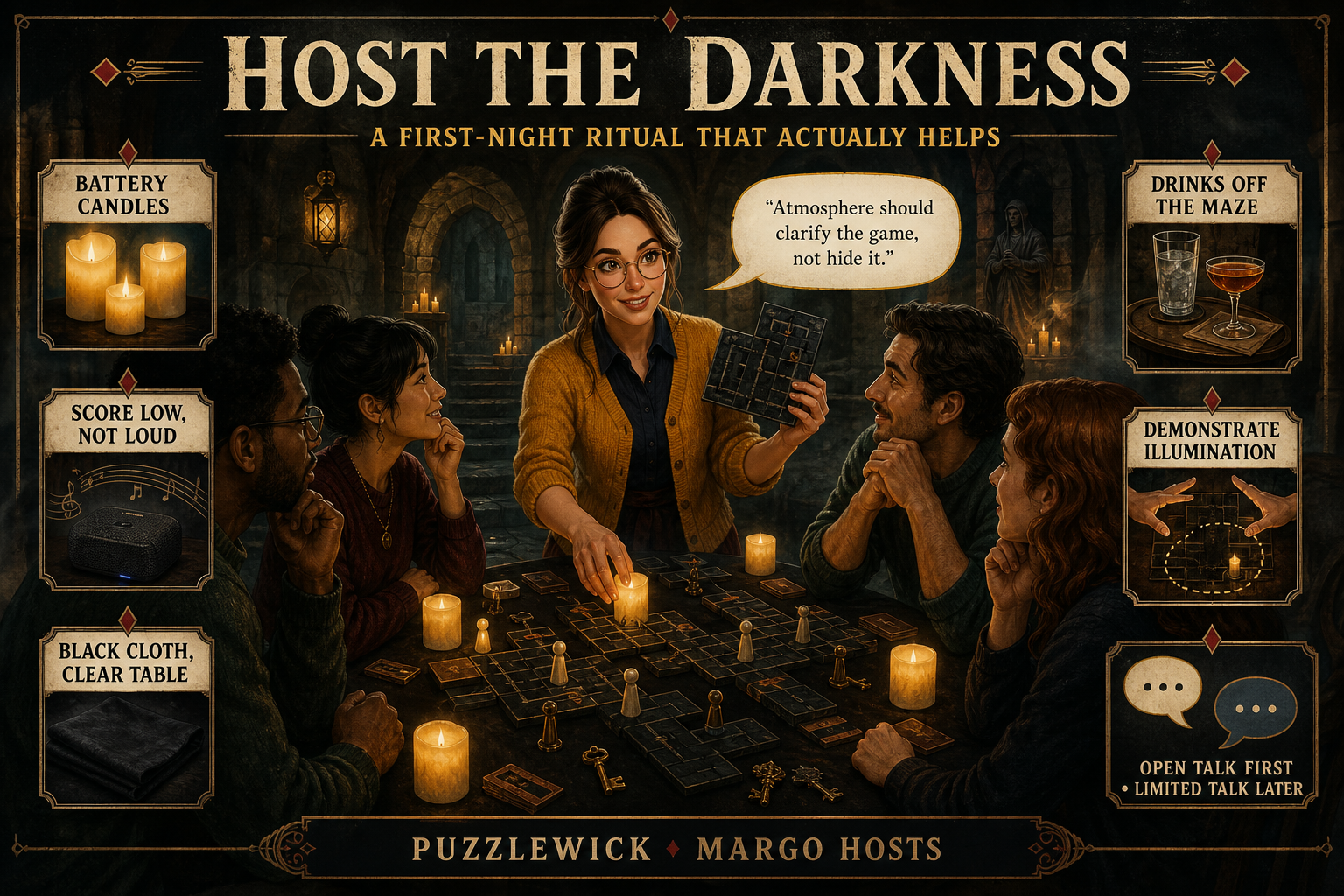
Dim the room; do not make the components unreadable. Use warm lamps or battery candles, never open flame over cardboard. Put the tile stack where every player can verify its state, place the discard board beyond the maze, and keep drinks on a separate surface. Black cloth improves contrast more than another prop.
The official score is the easiest atmosphere upgrade because it does not compete with rules communication. Start it before the teach so the first tile is drawn into an established room, not a silence somebody awkwardly fills. The Dice Tower video places its rules overview around 1:03 and final thoughts around 4:56; use it as a pre-game orientation for a visual learner, not as a replacement for physically demonstrating illumination and discard.
After the first win, try the official limited-communication material or a house discipline that prevents table control: plans may name a destination or risk, but not dictate another player's exact route. The point is not to role-play confusion. It is to preserve ownership of each move. If somebody is learning, suspend the restriction and teach generously. Atmosphere should sharpen access, never compete with it.
Does The Night Cage have enough replayability?
The maze is procedural, so route geometry changes every game. That is real replayability, but it is not infinite strategic depth. Once a group internalizes safe spacing, gate preservation, key transfer, wrapping, and Wax Eater lines, the base game can become more about managing draw risk than discovering a new system. Some owners find that elegant and replay it as a compact ritual. Others feel the puzzle has been solved before the tile bag has.
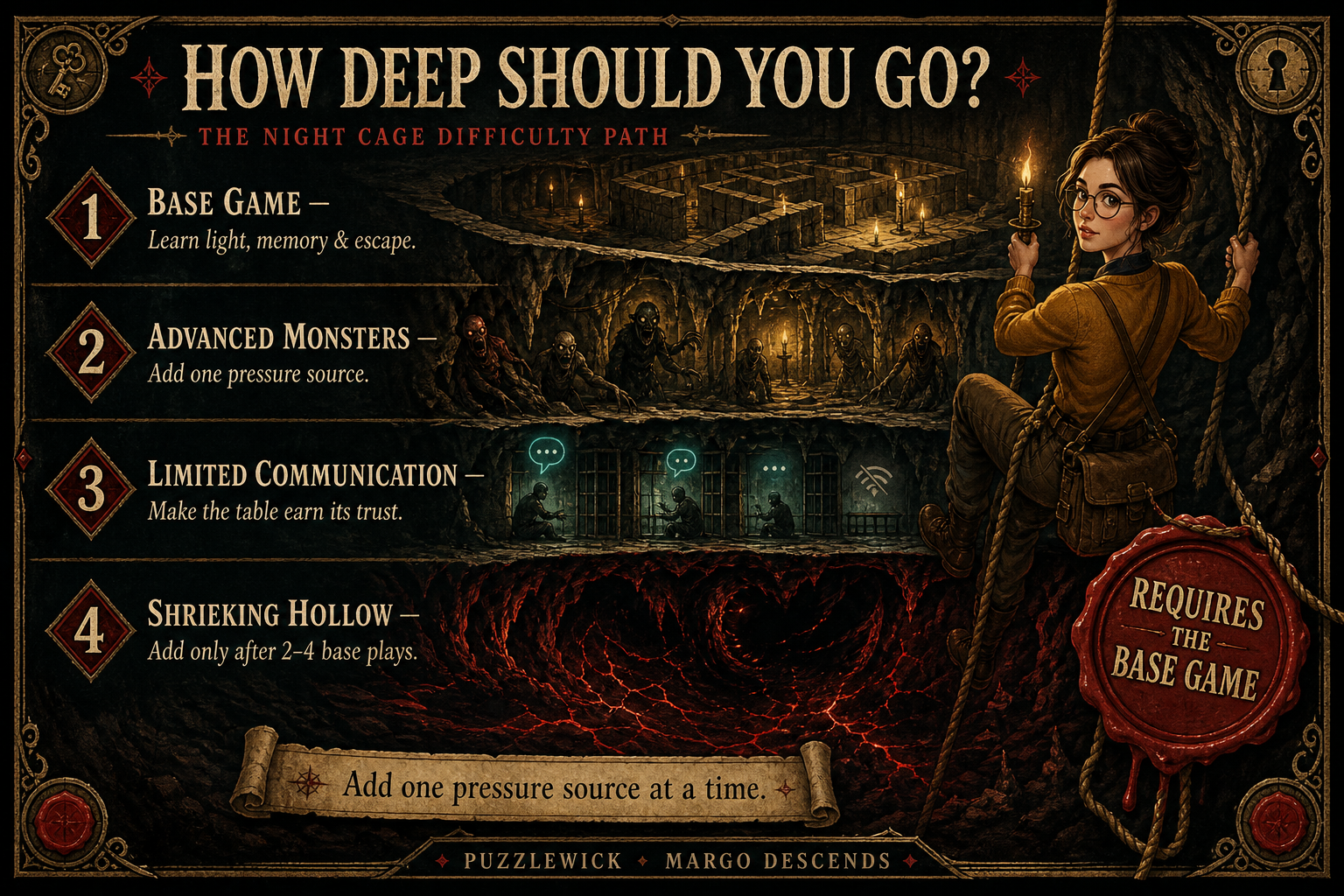
Use the difficulty ladder already in the box before buying more. First play with the clean base structure. Next introduce the advanced monsters or tougher official variants one at a time. Then try limited communication. Only after the group can articulate why the base is becoming predictable should Shrieking Hollow enter the case. The full expansion guide explains the safest three-session learning order for The Other, Shrieks, events, and Night Terrors.
This sequence protects the expansion's value. If five new systems arrive before players can recognize what each one changes, complexity becomes static. If they arrive after the group has developed habits, every pit, event, and shriek attacks something the table thought it understood.
Is Shrieking Hollow worth it, and what exactly does it add?
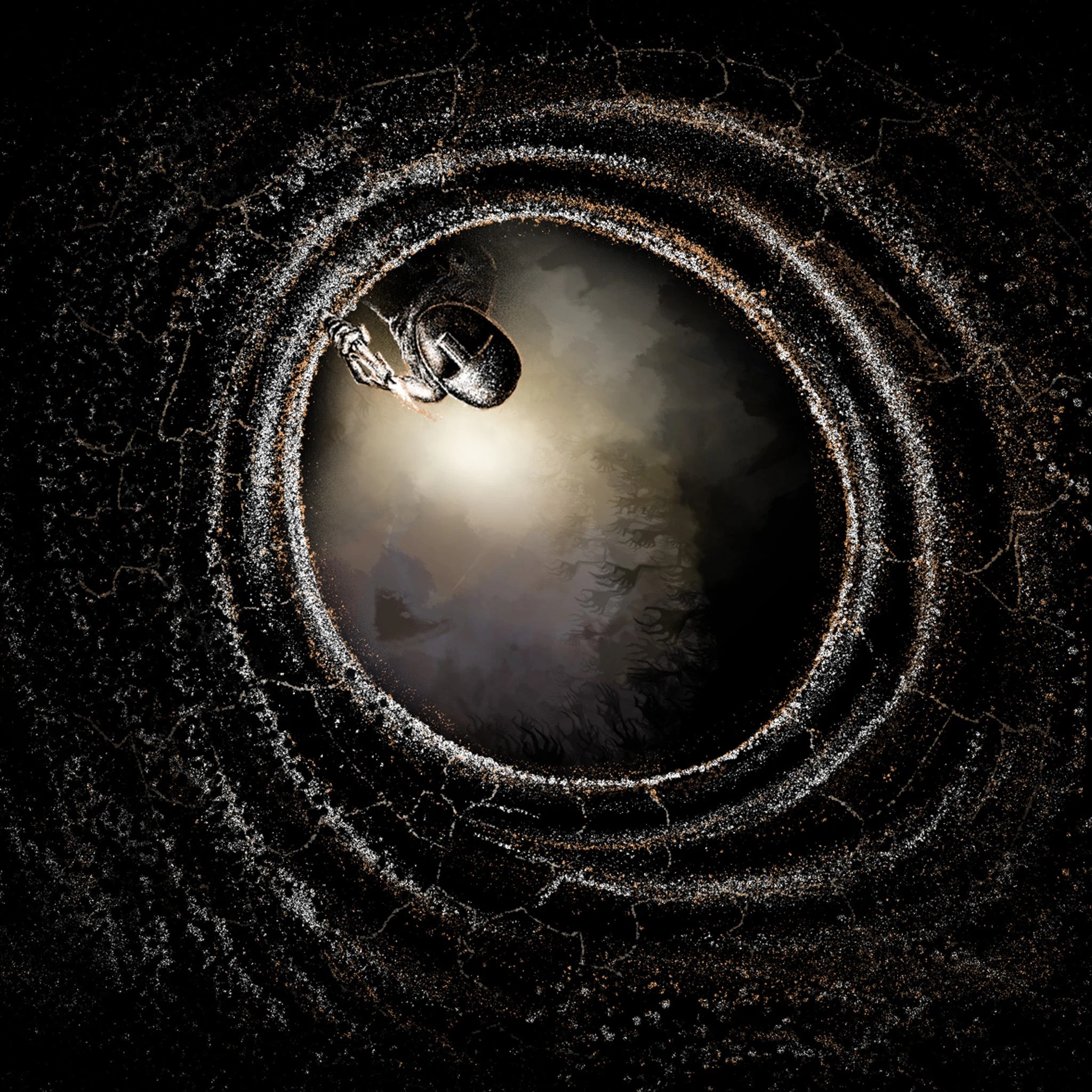
Shrieking Hollow is worth it after two to four base-game sessions when the group wants a second board and new timing problems, not merely more difficulty. It requires The Night Cage base game. The official catalog lists a Hollow board, The Other, six Shrieks, thirteen passages, eight keys, eight advanced monsters, three event tiles, thirteen event cards, seven Night Terror cards, a discard board, and reference material.
The Hollow creates a connected lower space rather than another ordinary maze lane. Pits alter how prisoners enter danger. Shrieks make sound and timing part of route management. Events and Night Terrors interrupt established rhythms. The Other is not simply a harder Wax Eater; it changes what the group watches and when. The expansion is best understood as a disruption kit for experienced prisoners.
Do not add every module at once. Start with the Hollow and its core passage logic. Add Shrieks after the group can explain the side board without looking up every transition. Introduce advanced monsters and event pressure last. Smirk & Dagger's official how-to video is the right visual companion because it shows the new subsystem in motion. Puzzlewick's complete Shrieking Hollow review and staged setup guide goes deeper on each module, player count, solo bookkeeping, hosting, and the first three descents.
Puzzlewick has now verified the exact Amazon US expansion listing at ASIN B0D851D4TZ. The Shrieking Hollow product card below uses that direct tagged listing; the base game remains a separate required purchase.
What do people dislike about The Night Cage, and who should skip it?
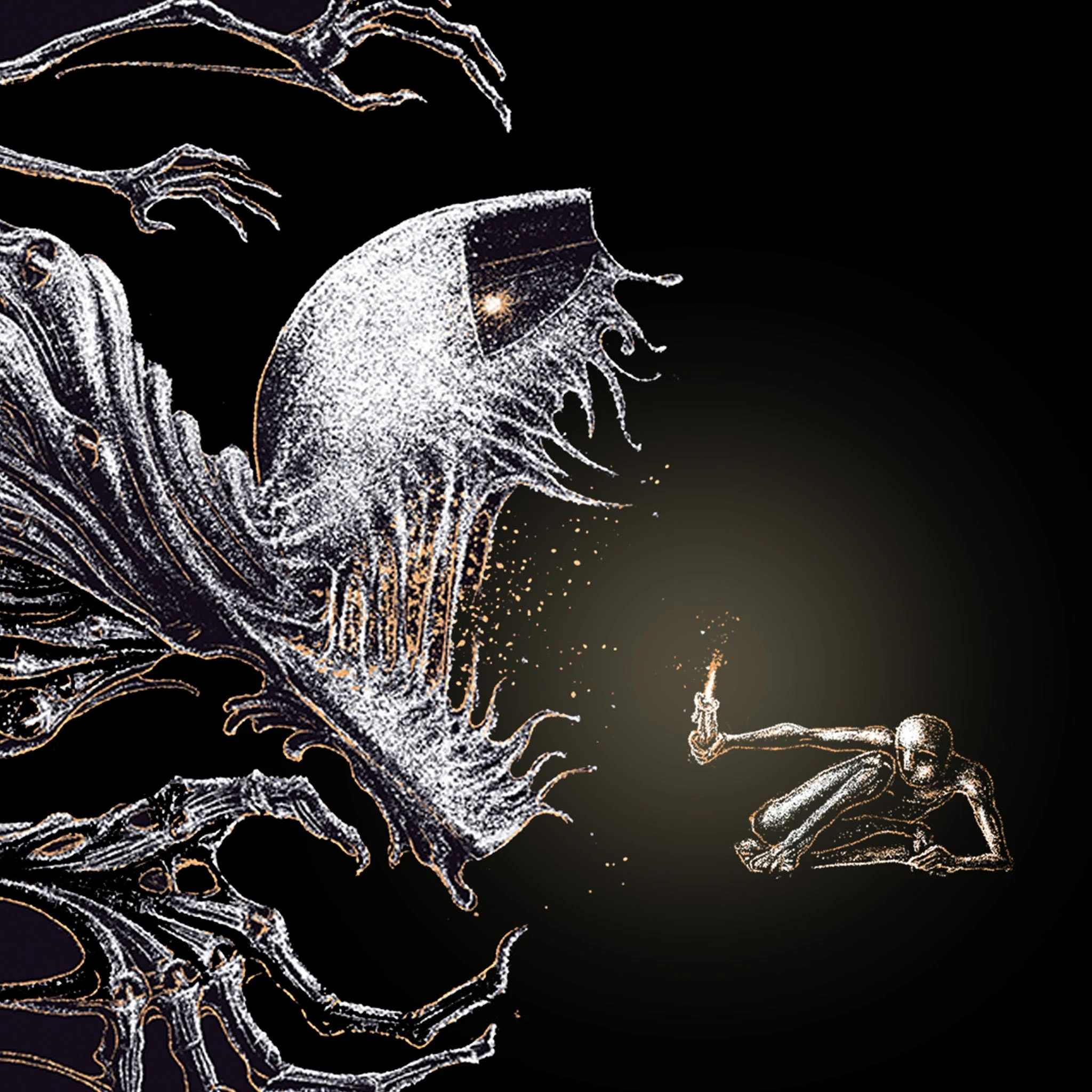
The strongest criticism is not that the game is difficult. It is that the best move can feel visible and the outcome can still turn on a tile draw. If your group expects a cooperative puzzle to reward deeper calculation with steadily increasing control, The Night Cage may feel like atmosphere laid over risk management. The sparse player identity also means nobody develops a personal engine or signature power.
The second objection is quarterbacking. Because information is public, one confident player can calculate a route and begin issuing movement orders. This is not unique to The Night Cage, but the simple action space makes the problem especially visible. Use the observation-before-advice protocol, limited communication after the first play, or a rotating route skeptic. If the same person still moves everybody's candle verbally, choose a cooperative game with hidden information or simultaneous decisions.
The positive owner pattern is equally consistent: short setup, a clean teach, escalating table tension, and a presentation that non-horror hobbyists can enter without a campaign binder. The negative and positive readings describe the same design. It is lean. The right group experiences focus; the wrong group experiences absence. If the base game still delights but no longer surprises, continue with the full Shrieking Hollow buyer and strategy guide.
Margo's final advice: buy it to create a specific kind of night, not to fill an abstract hole labeled 'co-op.' If that sentence sounds exciting, the cage probably has your key.
What experienced tables keep reporting
Recurring owner patterns, synthesized in Puzzlewick's words. Follow each evidence trail to read the original discussion.
Players who dim the room, use the score, and avoid over-explaining consistently describe a more memorable game than groups that treat the maze as an abstract optimization grid.
Read the evidence: Recurring owner reports and review synthesis
Some experienced groups find the strongest move too visible and the outcome too dependent on the next tile. That is a fit warning, not a rules misunderstanding.
Communication restrictions and observation-first discussion are recurring fixes for quarterbacking, but first-time players benefit from a fully open teach before any thematic limitation.
Solo players appreciate the compact spatial puzzle, while multiplayer reports more often praise the tension created by shared light, imperfect attention, and another person's risky choice.
The picks
Some links below are affiliate links — as an Amazon Associate, Puzzlewick earns from qualifying purchases, at no extra cost to you. It never changes a pick.
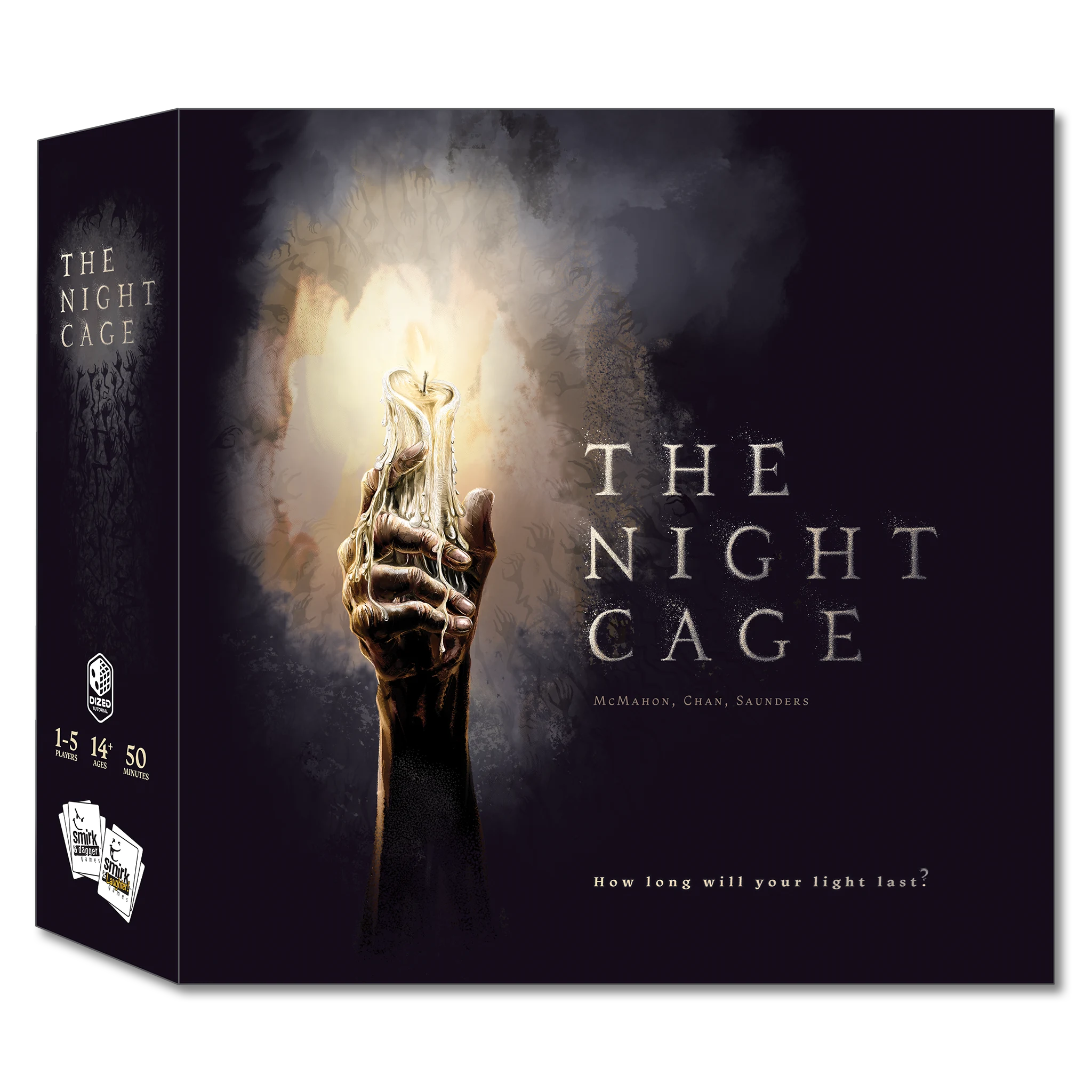
The Night Cage
The direct Amazon button buys the verified base game only. It is the complete first purchase and includes enough difficulty options to prove whether your group needs Shrieking Hollow later.
- Fast setup and clean teach
- Excellent spatial tension
- Strong at 3–4 players
- Official variants extend the base
- Meaningful tile luck
- Public information invites quarterbacking
- Little player asymmetry
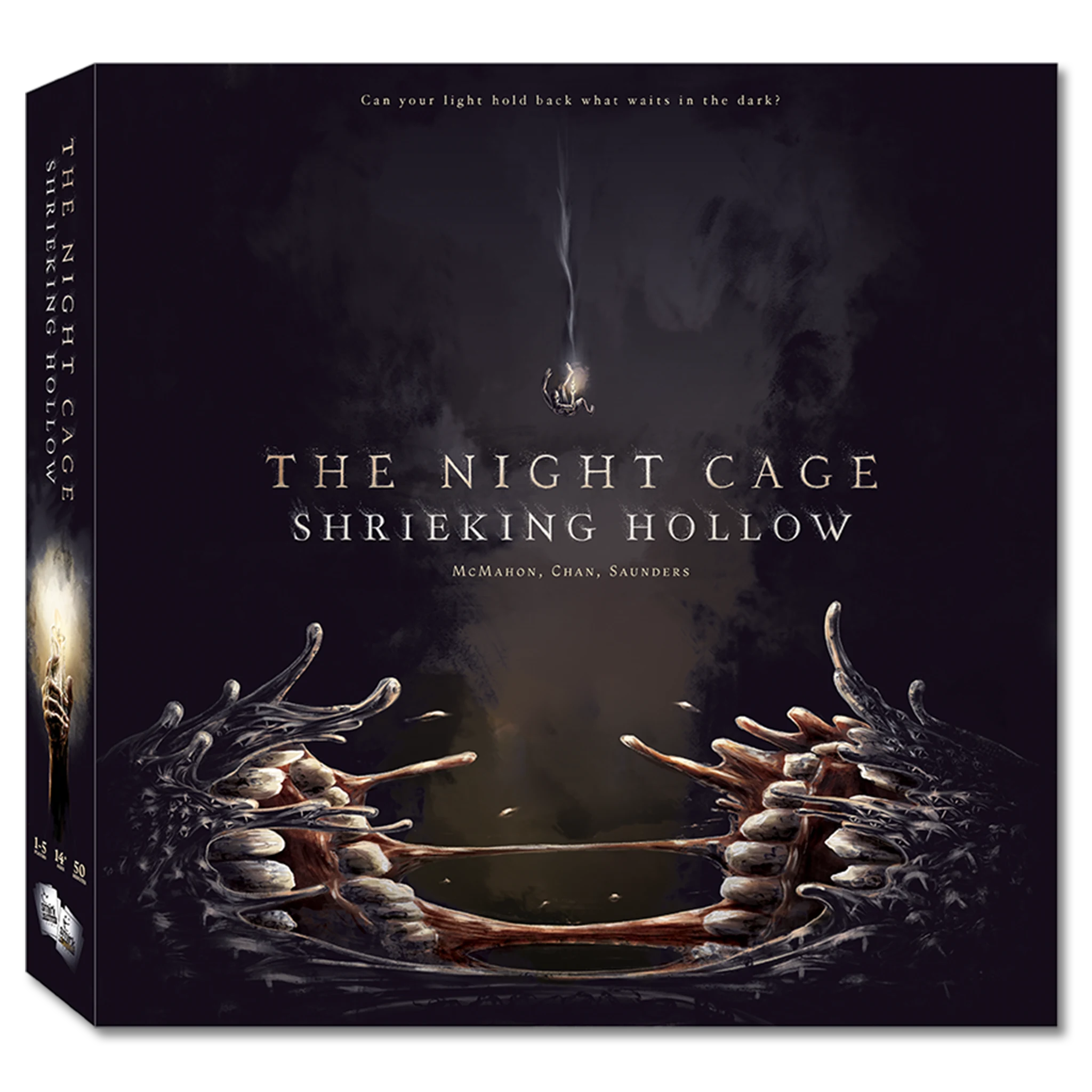
The Night Cage: Shrieking Hollow Expansion
This direct Amazon button buys the verified Shrieking Hollow expansion. The Night Cage base game is required. Read the full expansion guide before combining every module.
- Meaningfully changes route priorities
- Adds a connected lower board
- Modules support staged learning
- Excellent table presence
- Not a standalone game
- Adds timing and solo bookkeeping
- Best after several base-game sessions
At a glance
| Question | Base game | Shrieking Hollow |
|---|---|---|
| Best first purchase | Yes — complete rules, core maze, variants, and advanced pressure | No — requires the base game |
| Best time to add | First night | After 2–4 plays, when base routes feel predictable |
| What it teaches | Illumination, disappearing paths, keys, gate, Wax Eaters | Side-board movement, pits, sound pressure, events, new threats |
| Best audience | Accessible co-op and atmospheric-horror groups | Repeat groups asking for changed timing and geometry |
| Puzzlewick call | Buy for the right group | Buy later, not automatically |
Free download — The Night Cage First-Escape Reference
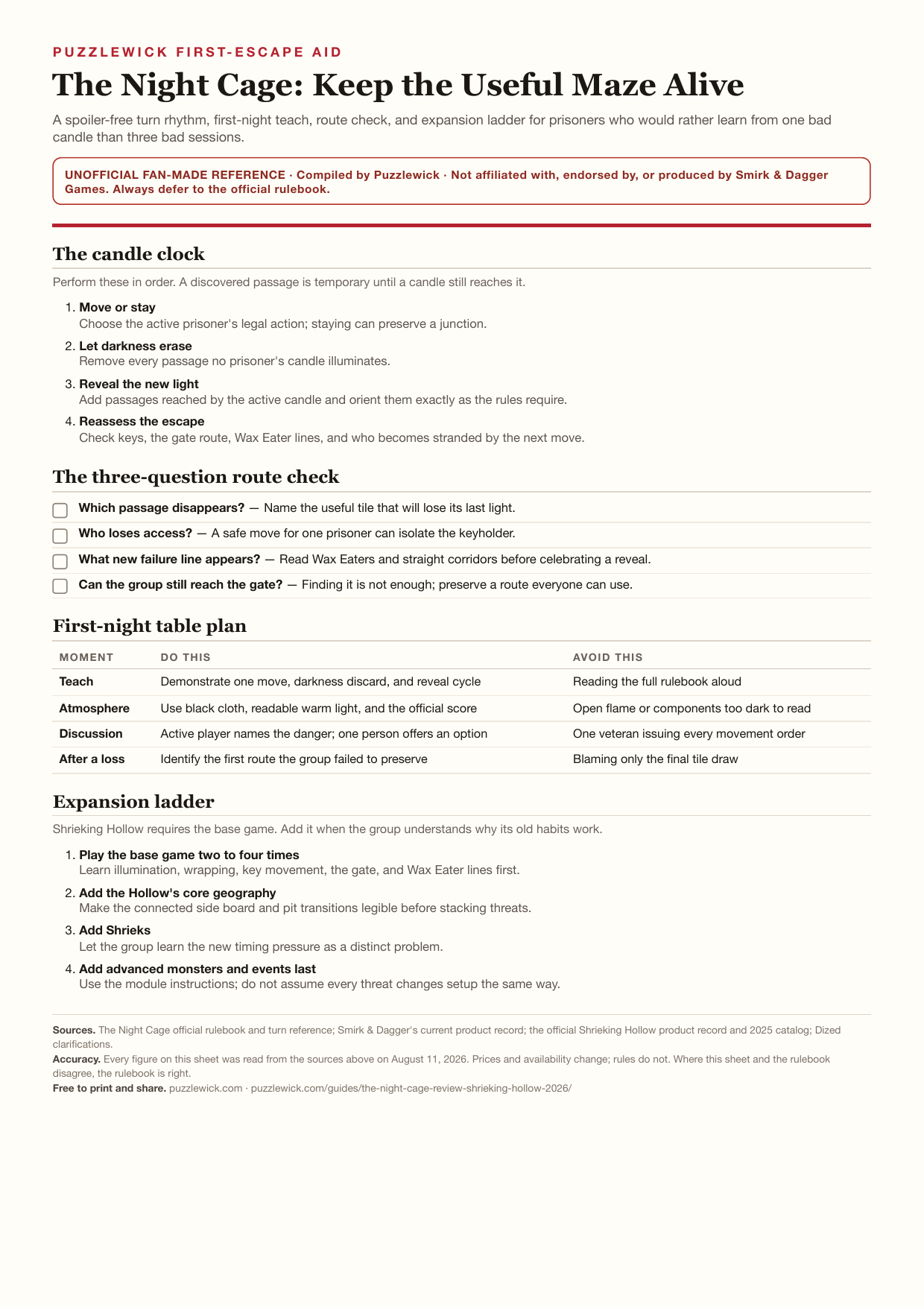
A one-page turn rhythm, route check, first-night hosting plan, and Shrieking Hollow expansion ladder written in Puzzlewick's own words.
Unofficial fan-made reference. Compiled by Puzzlewick from the sources listed on the sheet. Not affiliated with or endorsed by the publisher — always defer to the official rulebook.
Questions, answered
Is The Night Cage worth it?
Yes for groups that want an accessible, atmospheric cooperative spatial puzzle. Buy with caveats if tile luck or public-information quarterbacking frustrates your table. Skip it if you need asymmetric powers, campaign growth, or deterministic control.
How many players can play The Night Cage?
The current retail detail block and Dized rules support one to five players. One to four players use the smaller board and control four prisoners total; five players use the larger side with one prisoner each. The publisher's downloadable 2019 prototype rulebook describes an older configuration, so use the rules packed with your retail copy or current Dized reference when they differ.
What is the best player count for The Night Cage?
Three or four is Puzzlewick's best overall recommendation. Two is faster and more deliberate. Solo works as a pure spatial puzzle. Five is theatrical but creates more consensus overhead.
Can The Night Cage be played solo?
Yes. A solo player controls all four prisoners on the smaller board. It preserves the complete puzzle but loses the social tension and anti-quarterbacking challenge that distinguish multiplayer play.
How long does The Night Cage take?
The manufacturer lists roughly fifty minutes, and the useful planning range is about forty to sixty minutes after the teach. A first game may run longer while the group learns illumination and discard timing.
What does Stay do in The Night Cage?
Staying is a legal tactical choice. It can preserve a lit junction, let another prisoner use shared light, or avoid revealing a dangerous tile before the team is ready.
Is Shrieking Hollow worth it?
Yes for a repeat group that finds the base maze predictable. It adds a connected Hollow board, pits, Shrieks, The Other, events, Night Terrors, passages, keys, and advanced monsters. It is not a first purchase. Puzzlewick's complete Shrieking Hollow expansion guide explains its modules and staged learning order.
Does Shrieking Hollow require The Night Cage base game?
Yes. The official product record states that the base game is required.
Why do some sources list a different player count?
The publisher's downloadable PDF is a 2019 prototype rulebook with an older three-to-six-player configuration. The live retail detail block and current Dized rules support one to five players, including solo control of four prisoners and a separate five-player setup.
How do you prevent quarterbacking in The Night Cage?
Have the active player state the danger, let one other player name a possibility, and leave the final decision with the active player. Add limited communication only after everyone understands the base rules.
Should you use real candles while playing The Night Cage?
No. Use battery candles or warm dimmable lamps. Keep every component readable and never place open flame over cardboard, sleeves, clothing, or a crowded game table.
Is Shrieking Hollow available through the Amazon link in this guide?
Yes. The expansion product card links directly to the verified Shrieking Hollow Amazon US listing at ASIN B0D851D4TZ. The separate base-game card uses ASIN B08ZSK752P, and the base game is required.
Margo's verdict
Buy The Night Cage for three or four people who enjoy cooperative spatial puzzles and will commit to the presentation. Teach the base rules cleanly, use the soundtrack, keep the table dim but safely readable, and introduce advanced monsters or limited communication only after the first escape. Shrieking Hollow is a strong later purchase for a group that has begun predicting the base maze; it is not onboarding content and it requires the base game. The design is elegant rather than deep, atmospheric rather than deterministic, and much better at creating one unforgettable hour than at rewarding a hundred studied plays.
Research ledger 21 sources · reviewed 2026-08-11
Specifications, rules, current product information, community experience, and contrary evidence were checked against the sources below. Commercial links are kept separate from editorial evidence.
- thenightcage.comthenightcage.com
- smirkanddagger.comsmirkanddagger.com/products/the-night-cage-a-cooperative-horror-themed-tile-laying-game-super-atmospheric
- thenightcage.comthenightcage.com/s/Night-Cage-Rulebook-2019-06-27-Web.pdf
- rules.dized.comrules.dized.com/game/q9XiaNOwTECchKRb8oszag/faq
- rules.dized.comrules.dized.com/game/q9XiaNOwTECchKRb8oszag/Tvtm0LH1THeTNGXW84KhkA/player-count
- rules.dized.comrules.dized.com/game/q9XiaNOwTECchKRb8oszag/eRe8PL4QQoivvKLC-4GPyg/moving
- rules.dized.comrules.dized.com/game/q9XiaNOwTECchKRb8oszag/HRXq5MulSSGj8RXN8-OC5A/can-i-give-my-key-to-another-player
- smirkanddagger.comsmirkanddagger.com/products/the-night-cage-shrieking-hollow-expansion-continue-the-cooperative-horror
- smirkanddagger.comsmirkanddagger.com/_files/ugd/693f33_57c38125192549dcb833ebe4c88bfb52.pdf
- boardgamegeek.comboardgamegeek.com/boardgame/306709/the-night-cage
- boardgamegeek.comboardgamegeek.com/boardgamecompilation/400357/the-night-cage-shrieking-hollow
- reddit.comreddit.com/r/boardgames/comments/1av1l7m/the_night_cage
- reddit.comreddit.com/r/boardgames/comments/194oz68/the_night_cage
- reddit.comreddit.com/r/boardgames/comments/1707dby/the_night_cage
- reddit.comreddit.com/r/soloboardgaming/comments/11vqnln
- tabletopbellhop.comtabletopbellhop.com/game-reviews/the-night-cage
- meeplemountain.commeeplemountain.com/reviews/the-night-cage
- dicetower.comdicetower.com/video/night-cage-review-tom-vasel
- youtube.comyoutube.com/watch?v=5P9XGxHSCoU
- youtube.comyoutube.com/watch?v=78o7uZHyyJg
- music.apple.commusic.apple.com/us/album/the-night-cage-original-score/1592812157

Let me check that before we say it.

Keep exploring
The next smart rabbit holes.
✦ Topic PathBoard Game Buying Guides: compare the whole shelfStart with the decision, not the shelf. These guides compare the games, editions, expansions, player counts, and costs people...Buying GuideShrieking Hollow Expansion Review 2026: Is The Night Cage Upgrade Worth It?Margo maps The Other, Shrieks, pits, events, Night Terrors, the staged tile stack, and the exact moment this expansion becomes the right...Best OfBest Escape-Room Board Games, Ranked (2026)EXIT, Unlock!, Deckscape and six more escape-room games compared by resetability, app use, difficulty and group fit.