Best Brain Teaser Puzzles for Adults (2026)
Most brain-teaser lists are written by people who've never lost to a puzzle. Here's the one written by someone who has — sorted by what your brain actually does, not the lies on the box, from a $14 entry to a $290 year-long obsession.

AI-assisted curator persona · research and editorial responsibility: Robert Pruitt · how this guide was made
Last editorial refresh: 2026-06-18 Gold-standard QA: 2026-07-17 18 sources reviewed Affiliate links checked during gold-standard pass

The short answer
The best brain teaser puzzle for most adults is a Hanayama Cast metal puzzle — the Cast Marble (Level 4) or Cast News (Level 6) deliver real disentanglement difficulty for under $16. If you want the single most satisfying object in the hobby, it's a sequential-discovery puzzle like Wil Strijbos's Revenge Lock (~$292), where every step you solve hands you a new tool and a new problem. Serious 'mechanical' satisfaction splits five ways: disentanglement (Hanayama), sequential discovery (Strijbos, Juno), interlocking burrs (Cubicdissection, Pelikan), packing puzzles (Volker Latussek), and dexterity/mazes (Inside3). Buy by which of those itches you want scratched — difficulty rating alone is the least reliable number on the box.
Decision map
Choose in thirty seconds
The best first 'real' disentanglement puzzle — designer pedigree, pocket price
The single most satisfying object in the hobby — sequential-discovery masterpiece
The most beautiful cheap disentanglement puzzle — antique-compass looks
Look, I'm going to be brutal about this because you deserve better than the usual listicle. Most 'brain teaser' guides are written by people who have never had a puzzle defeat them. They sort by Amazon stars, copy the difficulty number straight off the box without questioning it, and somehow manage to put a $9 mass-market trinket and a $290 hand-machined aluminum lock in the same category. Spoiler: they're not. They're not even the same hobby.
Here's what actually matters — the TYPE of thinking the puzzle demands. Disentanglement is spatial reasoning, pure visual untangling. Sequential discovery is investigative: each step you solve hands you a physical tool for the next. Burrs are about 3D structure and order-of-operations. Packing looks trivial until you realize your intuition is actively working against you. Dexterity and mazes route the whole problem through your hands instead. Pick the wrong family for your brain and a $200 'masterpiece' will just frustrate you into a drawer.
Second brutal truth: the difficulty number is marketing fiction. Hanayama rates the Cast News a 6/6 'Grandmaster' — veteran solvers crack it in 20 minutes and laugh. Meanwhile a $109 Volker Latussek packing puzzle with no rating at all will wreck someone with an actual Mensa card. So I've ranked these by real, earned difficulty and more importantly by what the puzzle returns when you finally see the solution. Every price below is current and verified at a real retailer as of mid-2026; when a maker's run sells out I tell you that too, because a sold-out puzzle isn't a recommendation, it's a taunt.
Start here, then go deeper
You are in the right cabinet.
 ❖ Topic PathMechanical Puzzles: compare the whole shelfThe right mechanical puzzle matches the solver's patience, not simply the maker's difficulty number. These guides translate...
 Best OfBest Jigsaw Puzzles for Adults, Ranked (2026)A three-decade reference desk curator's ledger of the cardboard worth a fortnight of evenings and the wooden heirlooms worth passing down...
 Best OfBest Sequential Discovery Puzzles, Ranked (2026)The genre that keeps lying about itself — and why the ones that don't are worth the chase and the price.
What actually counts as a 'brain teaser' for an adult?
Forget the words 'brain teaser' for a second — it's a toy-aisle term that staples together things with nothing in common. The grown-up hobby calls these mechanical puzzles, and they split into a handful of honest families:
- Disentanglement — separate two interlocked metal or wire shapes, then put them back. Hanayama owns this category at the consumer level.
- Sequential discovery (SD) — solving one step physically hands you a tool you need for the next. The genre's holy grail.
- Interlocking / burr — notched pieces lock into a 3D solid; the puzzle is the order you assemble or remove them.
- Packing — fit N pieces into a box. Sounds easy. Is not. The obvious packing always leaves one piece homeless.
- Dexterity / maze — the logic runs partly through your hands: roll a hidden ball, thread a piece through a tight path.
A good adult puzzle has what I call a clean lock: a definite solved state, a definite unsolved state, and a path between them that's non-obvious but, once seen, feels inevitable. That 'oh, of COURSE' is the entire product. Anything that yields to brute force, random fiddling, or a YouTube spoiler is selling you frustration, not a puzzle. The difficulty number on the box is the least reliable number in this hobby — buy the type of thinking, not the digit.
One thing the listicles never tell you: this hobby runs an anti-spoiler ethic as strict as any escape-room community. Veteran reviewers like Allard Walker and Kevin Sadler will write three thousand words about a puzzle and never once reveal a move — the discovery is the gift, and ruining it is the cardinal sin. Keep that in mind when you go looking for 'help.' The good sources hint; they don't solve. If a page hands you the answer in step-by-step screenshots, you've found a tourist, not a puzzler.
Which Hanayama Cast metal puzzle is actually worth buying?

Hanayama is the entry drug, and that's a compliment. These are mass-produced in Japan, cost $13–20, fit in a pocket, and a good one has a genuinely elegant solution. The company has made toys since 1933 and metal puzzles since 1983 — but here's the part the box won't tell you: the modern Cast line was curated and partly designed by Nob Yoshigahara, arguably the most important puzzle figure of the 20th century. The annual design competition that crowns the world's best puzzles is literally named after him. He personally designed the Cast News. So when I say 'buy by design pedigree,' that pedigree is real and it's hiding in plain sight on a $15 trinket.
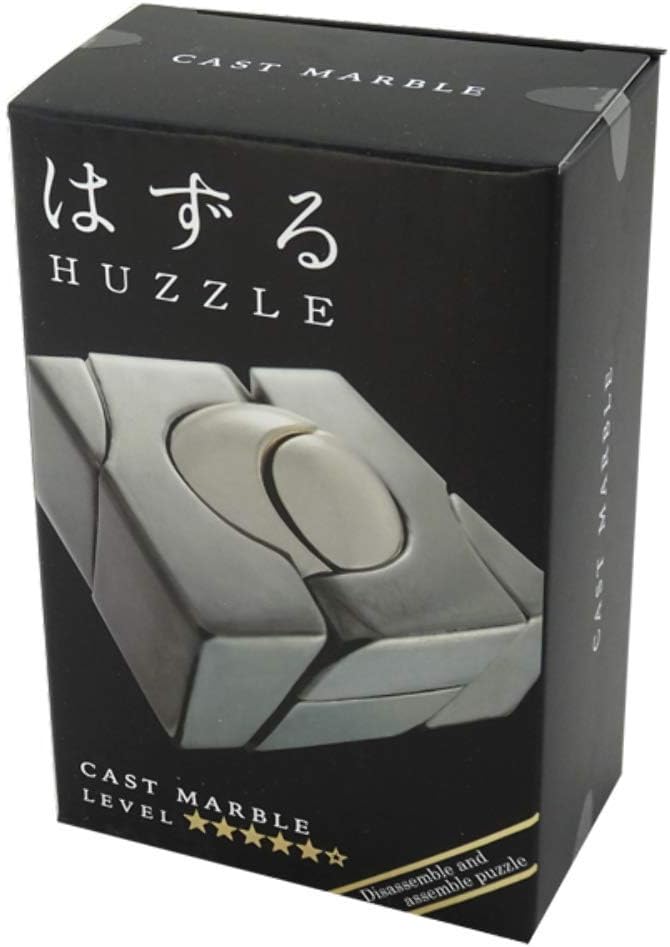
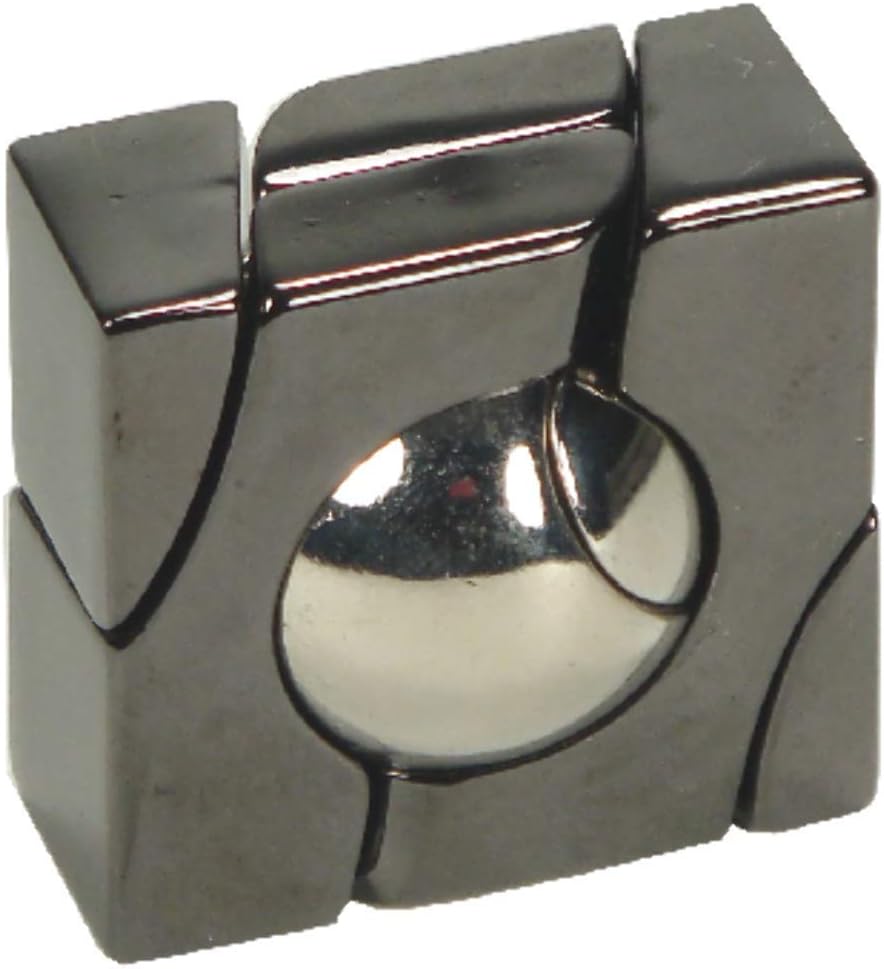
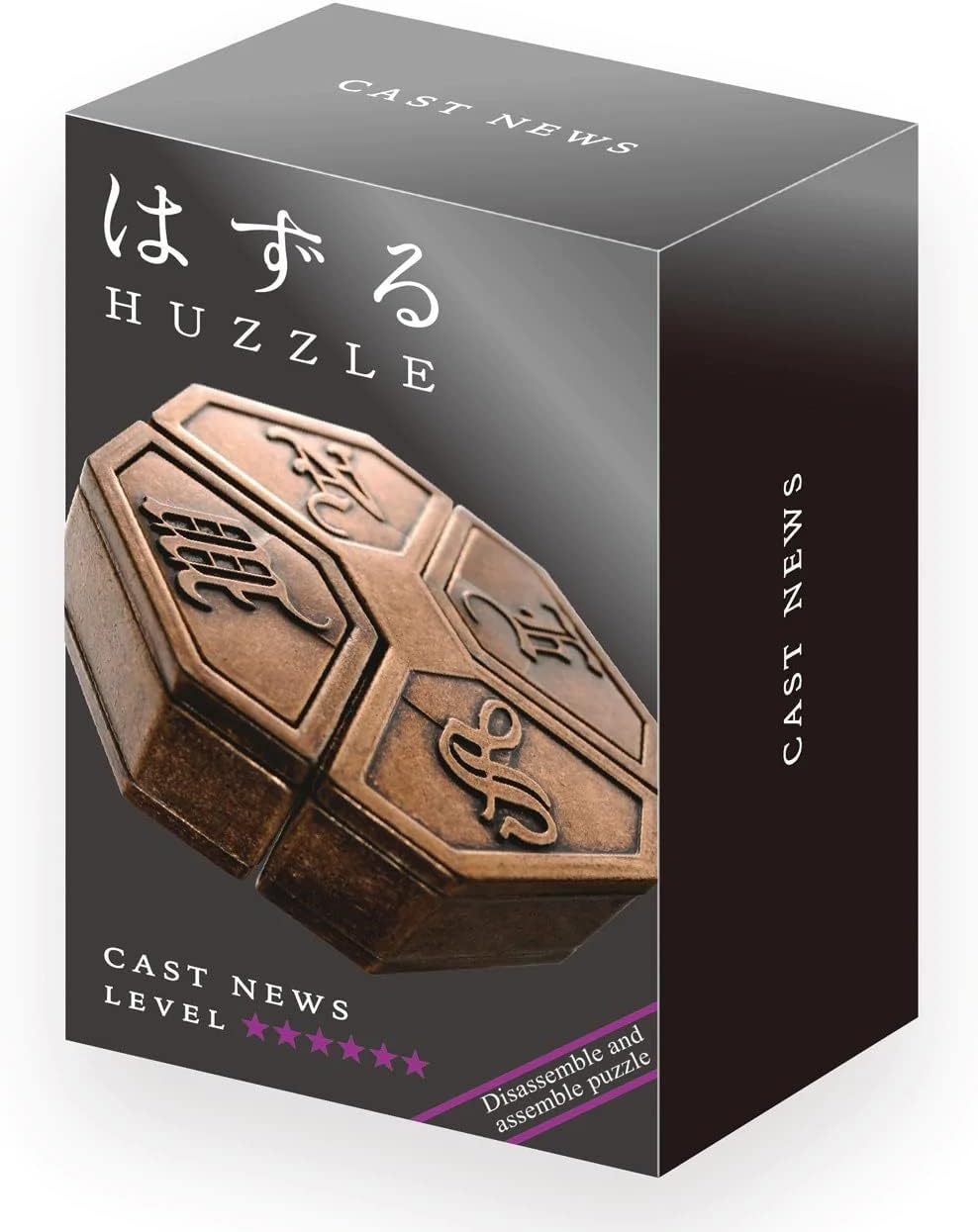
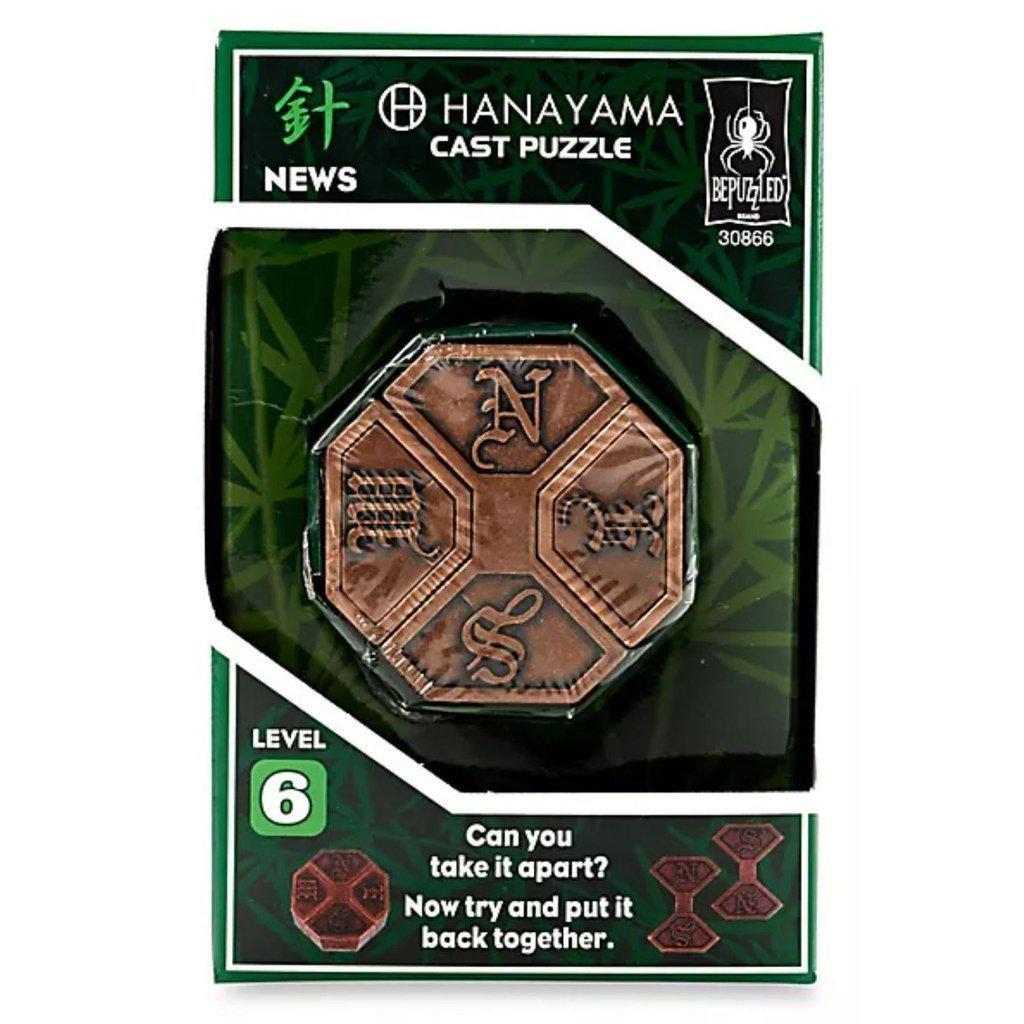
The ones worth your money come from real designers. Cast Marble (Level 4) was co-designed by Bram Cohen — yes, the man who invented BitTorrent — with Oskar van Deventer. It's a four-piece puzzle: two halves form a ball, two form the cage, and the trick is a left-handed thread on a hermaphroditic screw — your hands instinctively twist the wrong way. It's the rare Hanayama that's harder to reassemble than to take apart, exactly the property you want. The Cast Marble was co-designed by the inventor of BitTorrent, and it twists the wrong way on purpose. Cast News (Level 6, Yoshigahara) is two identical interlocking pieces with an antique-compass motif and a satisfying coordinated separation.
What to skip: licensed-IP movie tie-ins and anything where reviews say 'fell apart on its own.' A disentanglement puzzle that solves by accident has no clean lock. Buy the designer credit, not the franchise logo.
What is a 'sequential discovery' puzzle, and why is it the genre's holy grail?
If you learn one term from this guide, learn this one. A sequential-discovery puzzle rewards each solved step with a physical tool — a pin, a key, a rod, a magnet — that you then use on the next, previously-impossible step. It is the closest a single handheld object gets to being an escape room.
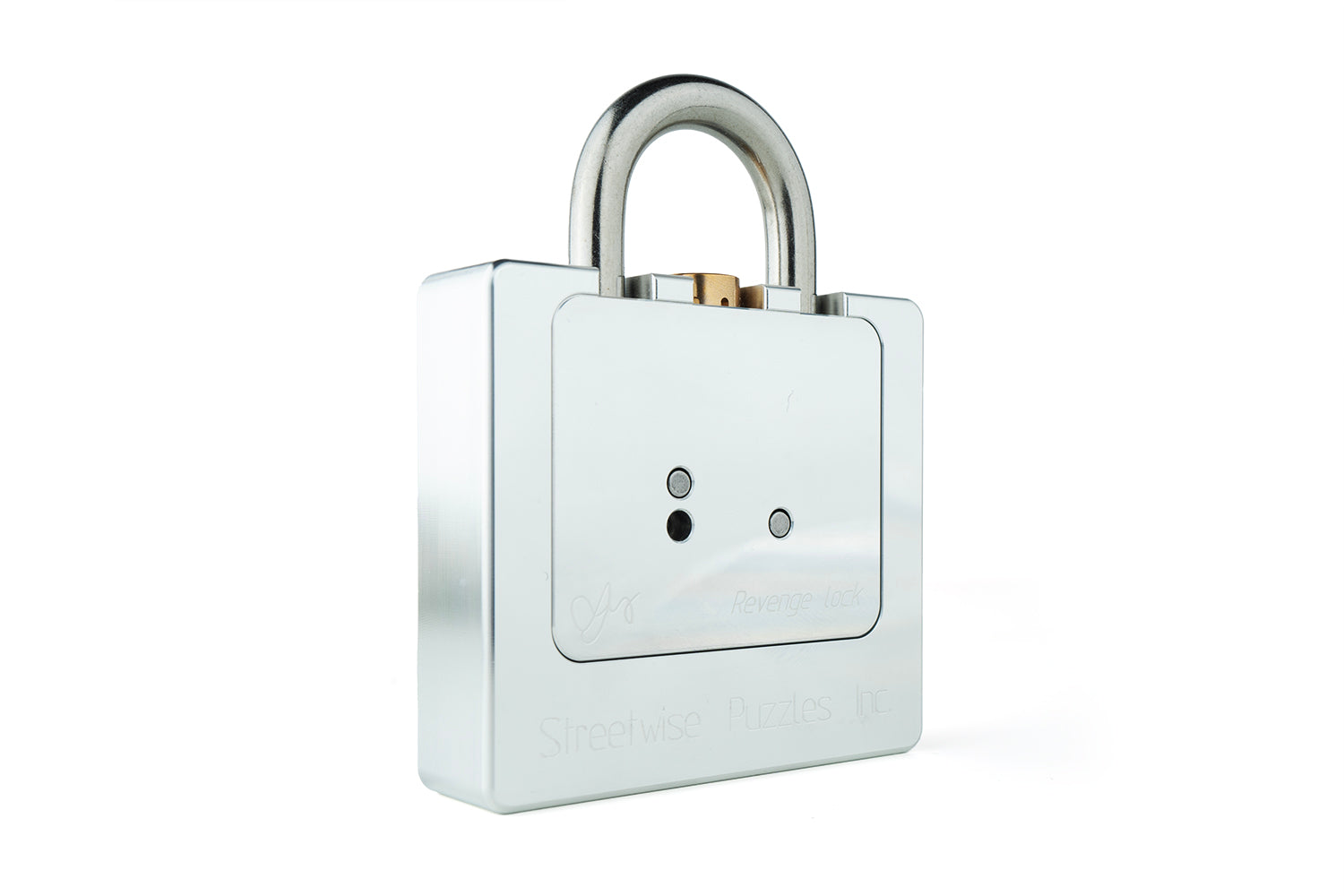
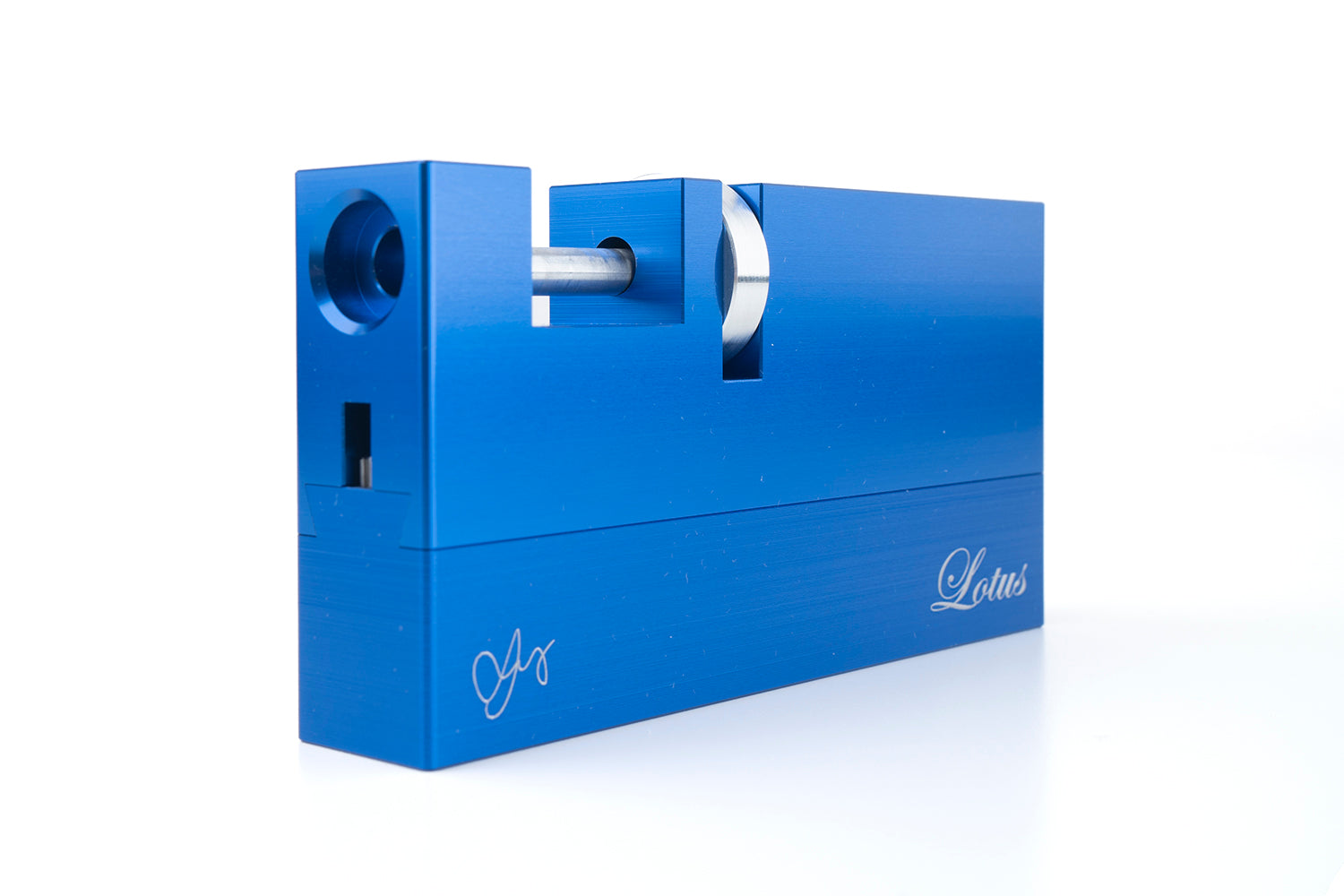
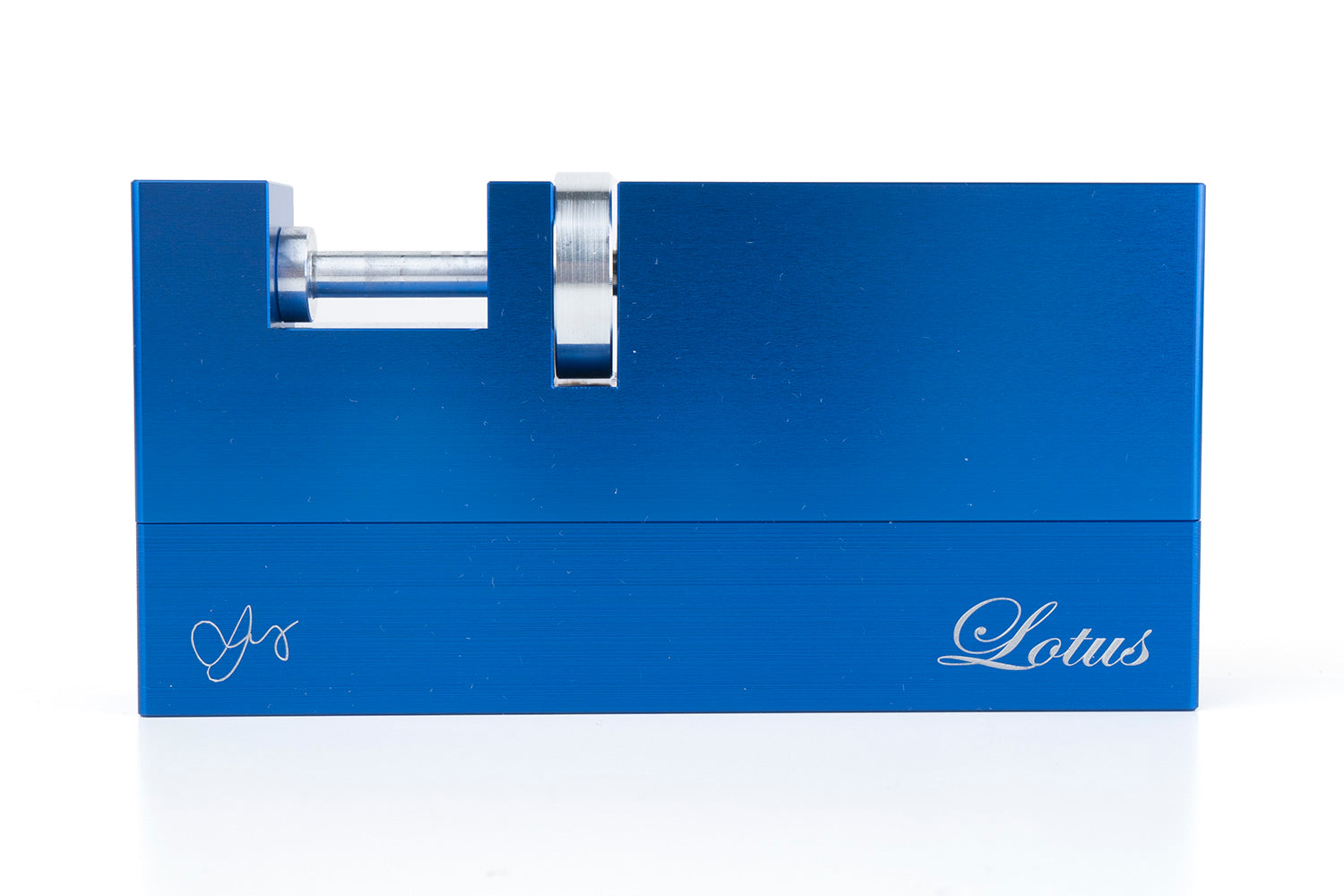
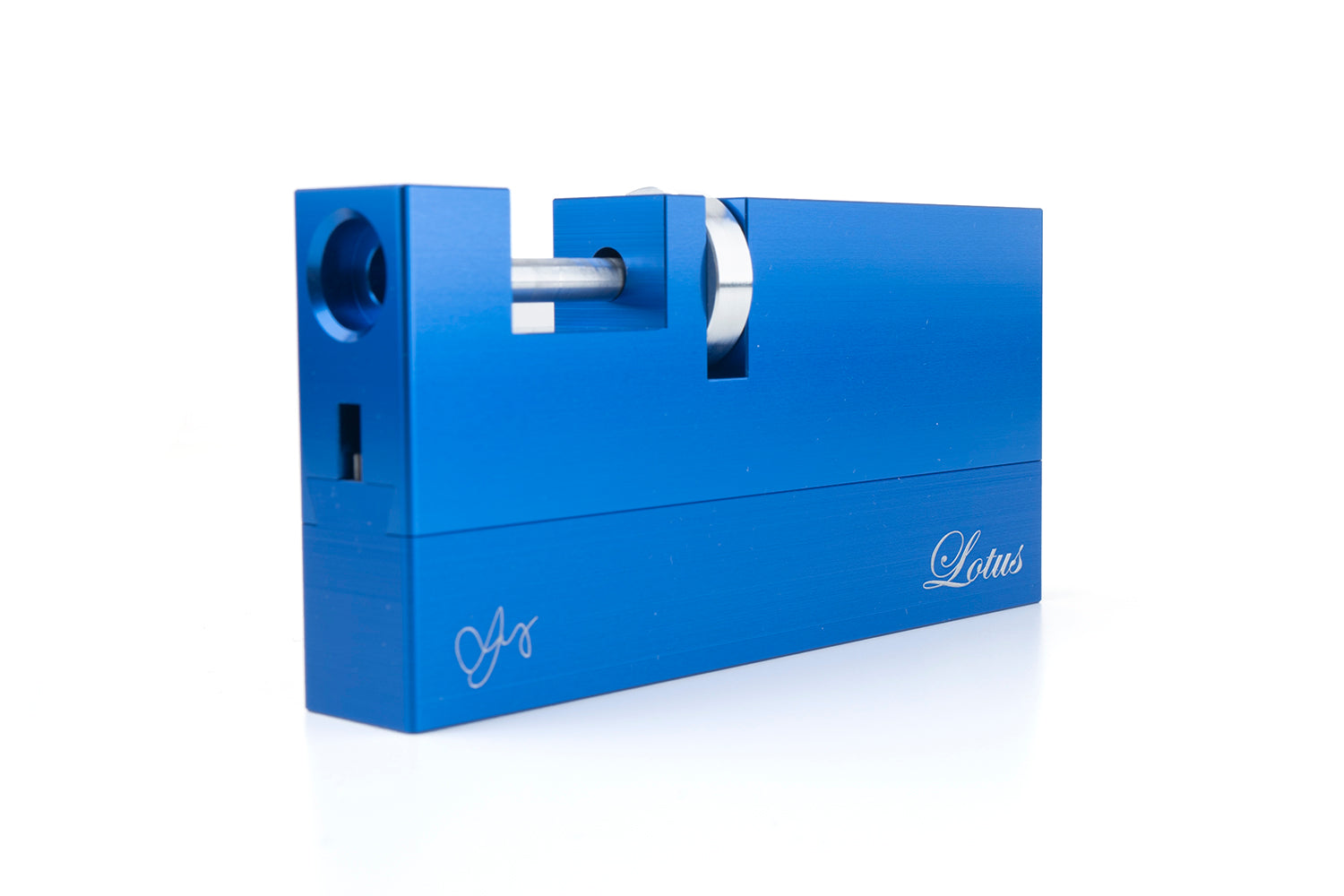
The undisputed landmark is Wil Strijbos's Revenge Lock (aka 'The Wanderer'). It looks like an ordinary barn-door padlock in a frame. It is not. It's machined aluminum with brass and steel accents, and the solution cascades through multiple discoveries — quoted solve time runs, only half-jokingly, from 'one hour to one year.' At ~$292 it isn't cheap, and it shouldn't be: this is hand-finished metal with a mechanism a master designer perfected over years. His First Cylinder (~$128) and Lotus Flower (~$212) are gentler on-ramps in the same aluminum house style.
Here's the lore the listicles miss: Strijbos has no website. A man whose puzzles veterans rank among the best objects in the hobby sells almost entirely through a weekly email list he runs by hand from the Netherlands — you ask to be added, and most weeks he sends what's available, his own designs and rare finds alike. One of the best designers alive sells through a weekly email he writes by hand; that's not eccentricity, it's the texture of a hobby still run by craftspeople, not catalogs. The wooden cousins are Junichi Yananose's (Juno) SD boxes under the Pluredro label — his Sequential Discovery Burred Box looks like a plain six-piece burr and hides ~10 hidden steps, solved 'by gentle operation without bashing or centrifugal force.' Juno's runs are tiny and frequently archived, so you buy these when they drop or you buy them secondhand.

Are wooden burr and interlocking puzzles still worth it in 2026?
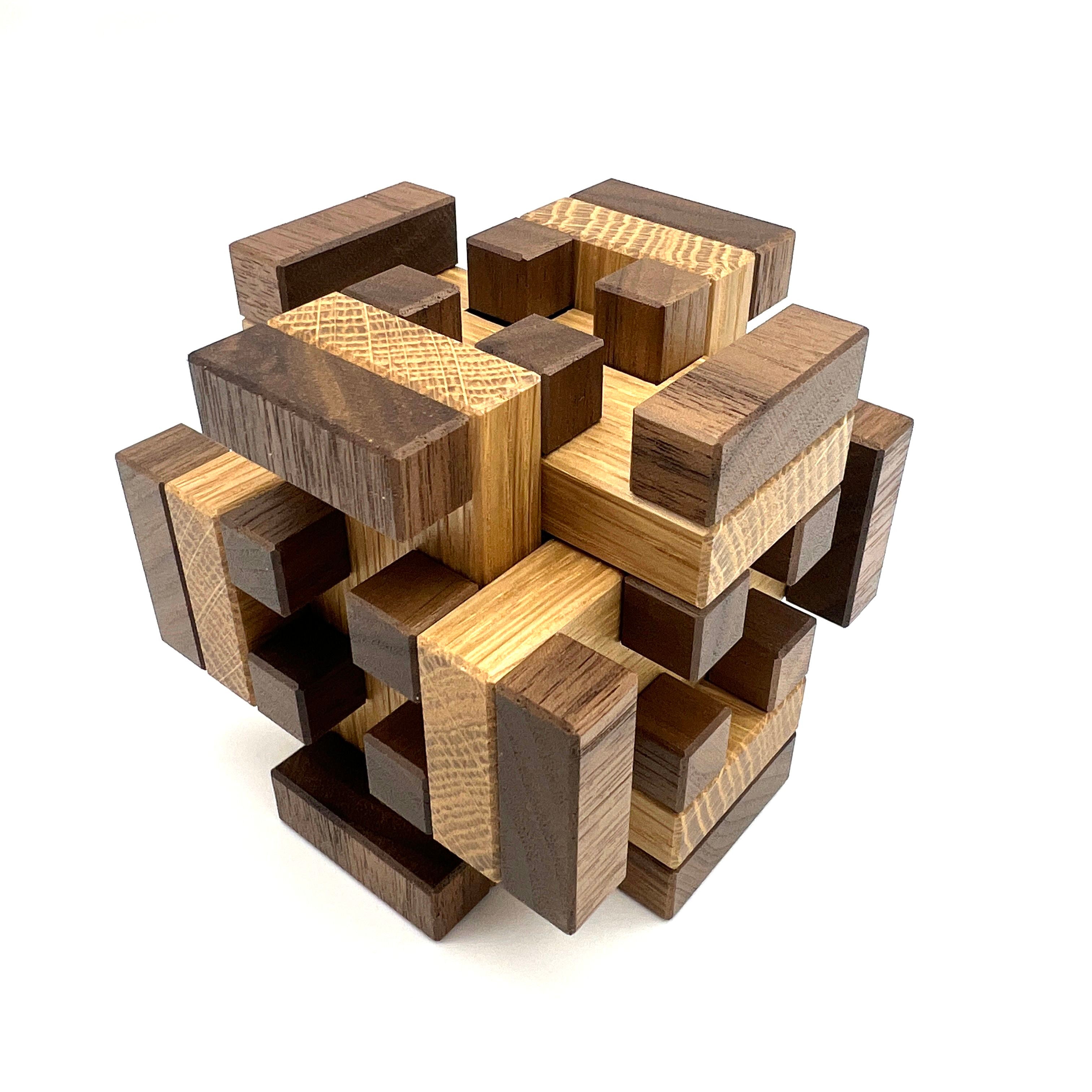
Yes — and they're where the hobby's best craftsmanship lives. A burr is a set of notched sticks that interlock into a solid block; the puzzle is the order to take it apart, and the much harder problem of putting it back. The classic six-piece burr is the genre's hello-world; the interesting ones go far past it.
Now the part that demystifies the cryptic numbers. Burrs are rated by 'level' notation, and it comes from a real piece of computer science: in the early 1990s, Bill Cutler ran an exhaustive computer analysis of every six-piece burr. 'Level' is the minimum number of moves to remove the first piece — and a string like '8.1.2' means 8 moves to free the first piece, 1 for the second, 2 for the third. The deepest unique six-piece burr Cutler found tops out around level 10–12. A burr's 'level' is real computer science: the minimum moves to free the first piece — so read the move-count, ignore the parts-count. When Cubicdissection lists a burr at 'level 8.1.2,' that first 8 is the whole fight.
The maker to know is Cubicdissection (Eric Fuller), who machines designer burrs in exotic hardwoods to furniture tolerance. His +Burr by Stephan Baumegger (~$95, ~65 copies made) is a fair, beautiful entry. The European workshop Pelikan plays the same game at tighter prices. Honest warning: this corner runs on small batches and a secondary market. A design drops, a few dozen to a couple hundred sell out, and it lives on the maker's marketplace at a markup. If you fall for one, buy it the week it drops — 'I'll get it later' is how you pay double on a resale listing.
Why do six-piece packing puzzles humble Mensa members?
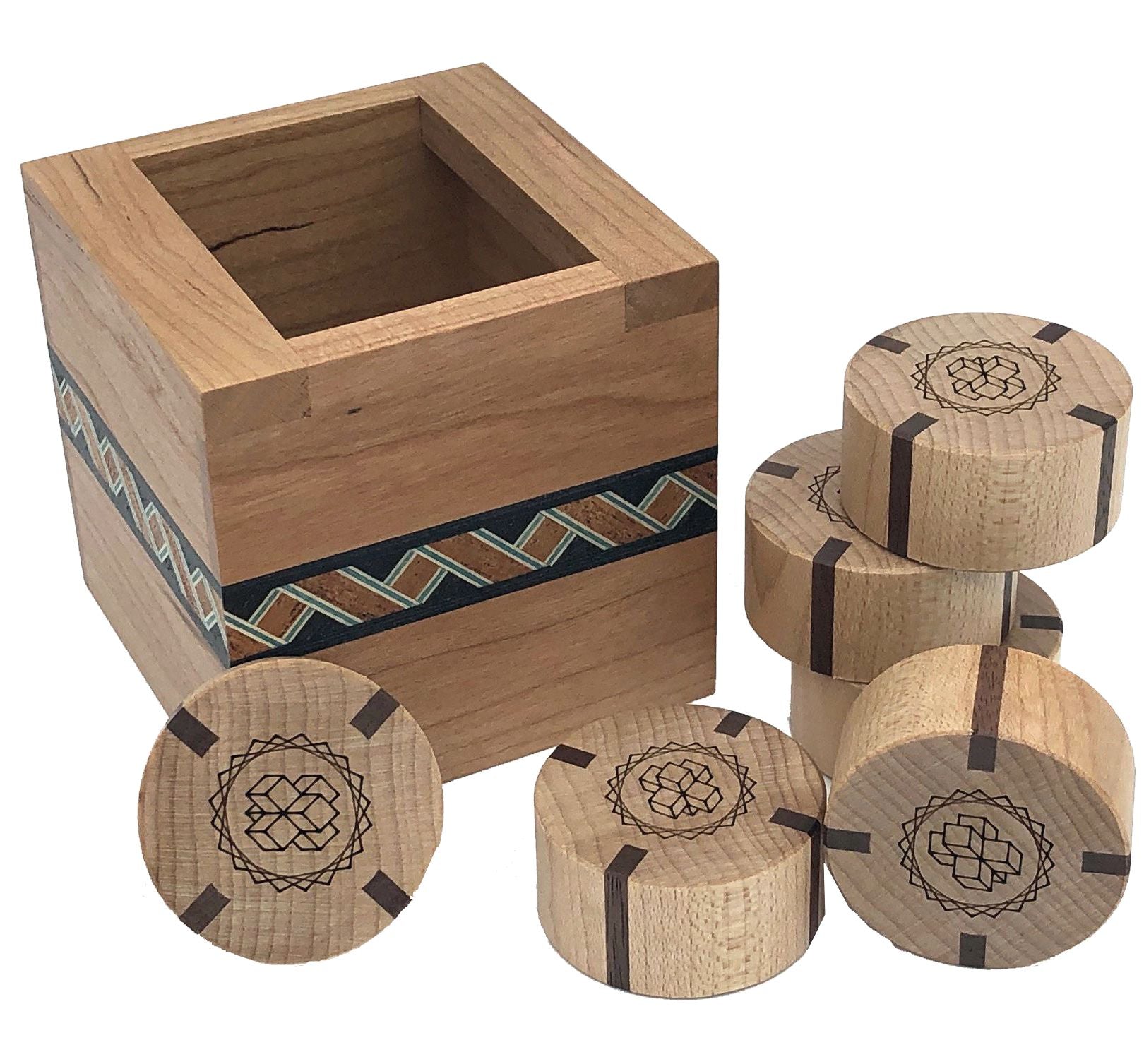
This is my favorite cruel joke in the hobby. You hand someone a small wooden box and six identical chunky pieces and say 'put them in.' They smile. Forty-five minutes later they are not smiling.
Packing puzzles have the widest gap between looks easy and is hard, and the master of the form is Dr. Volker Latussek. His Casino — six 'chips' into an open-topped box — didn't just place at the International Puzzle Party; at IPP 2018 in San Diego it won both the jury's 'Puzzle of the Year' and the Puzzlers' Award voted by attendees as the best and most beautiful puzzle of the event. Casino swept IPP 2018 — winning one prize is rare, winning both is the puzzle-world equivalent of sweeping the Oscars. The trick is that the obvious flat packing is a deliberate trap; the solution demands an orientation your intuition flatly refuses to consider.
The premium Cubicdissection edition (Cherry/Maple/Walnut, ~$109) sells out fast and was sold out at last check; the Pelikan and Rombol editions keep Casino in handsome wood at friendlier prices, and his Tetra Flop / Soma Flop Pelikan series scratches the same itch with soma-style parts. What makes these special: there's no mechanism to discover and nothing to disentangle — the entire difficulty is spatial insight, and your intuition is the enemy. You cannot fiddle your way in. You have to see the idea. When it clicks, it's the purest 'how did I not see that' payoff in the genre, which is exactly why packing has the most devoted cult following among serious solvers.

What makes a Karakuri Japanese puzzle box worth $140 — and how do you actually get one?
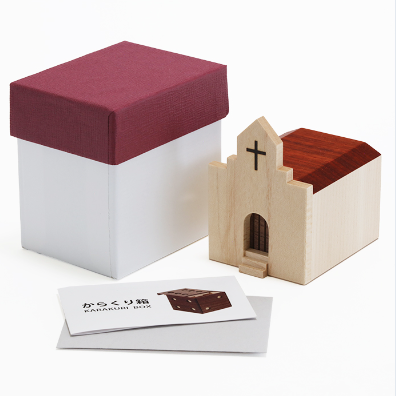
This is the heirloom corner, and it's worth understanding before you spend. A Karakuri box opens through a hidden sequence of sliding wooden panels — the form descends from the himitsu-bako ('secret boxes') of Hakone, in Japan's Edo-era mountains, where merchants used trick compartments to hide valuables on dangerous passes. Master artisan Akio Kamei revived the dying craft in the early 1980s and founded the Karakuri Creation Group in 2000 to keep it alive. Today it's roughly ten craftsmen and women plus a handful of 'friends' — including Kagen Sound, the lone non-Japanese maker in the group.
Difficulty in these is measured in panel slides, and the New Secret Box series is the perfect ladder: Box I opens in 6 moves, II in 12, III in 18, IV in 32 — and each closes with the same count in reverse. That's your honesty check against any retailer's hand-wavy 'challenging.'
Now the insider part — acquisition. The best Karakuri boxes aren't sold on a shelf; they're distributed through the Karakuri Club, an annual membership (~$120/year plus a one-time ~$60 initiation) that grants holiday mystery boxes, free fast worldwide shipping, and — critically — entry to the lotteries for new releases a few times a year. As collectors put it bluntly: 'many will never be made again.' That's the real reason secondary-market prices on a Cosmo or a sought-after Kamei climb. You're not overpaying for wood; you're paying for a thing that was made in a run of dozens, by hand, once.

Where do dexterity and maze puzzles fit — and who actually made the Inside3?
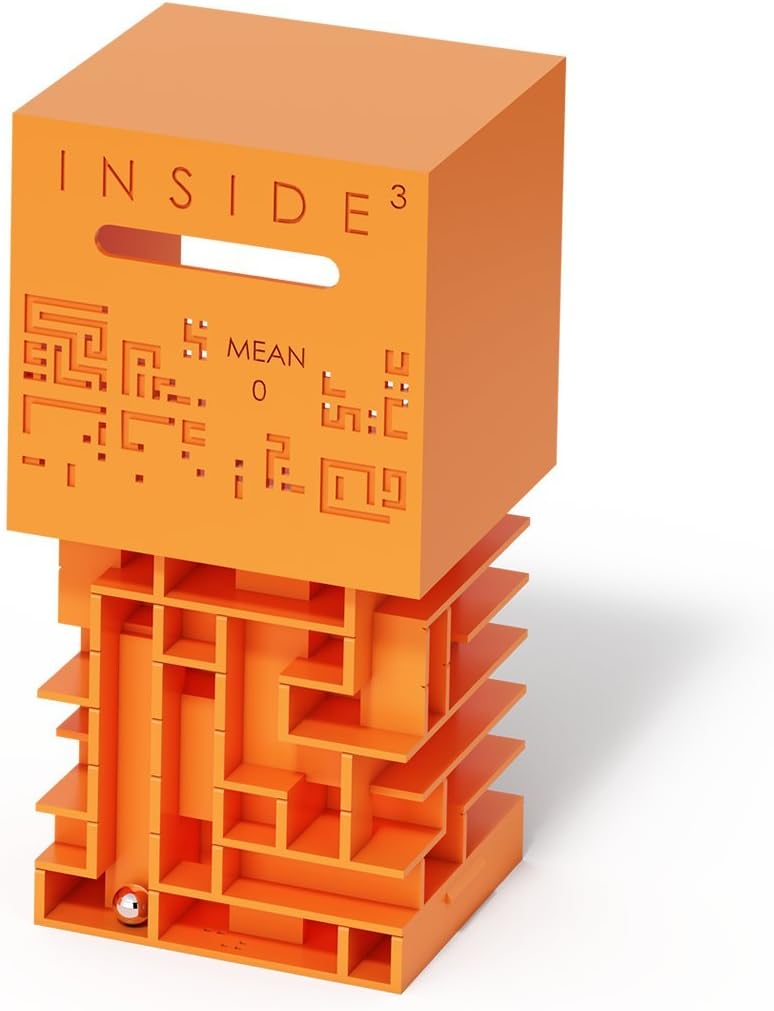

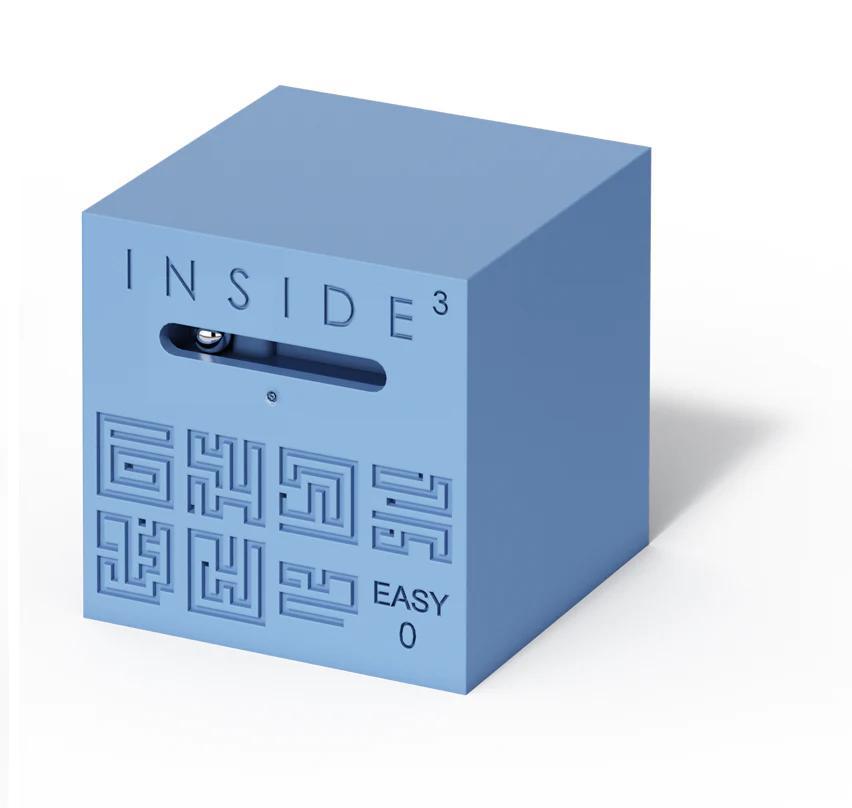
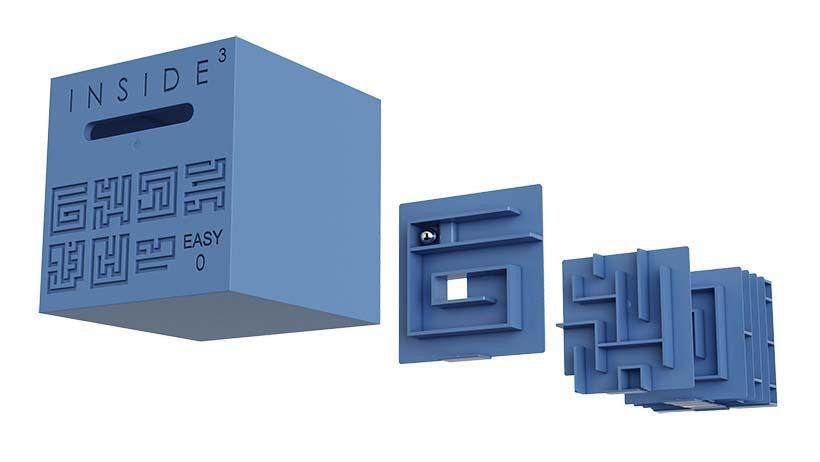
Every family above routes the problem through your head. The dexterity-and-maze family routes it through your hands, and that's a genuinely different muscle worth owning at least one of. The standout at the consumer level is the Inside3 labyrinth cube — a sealed cube hiding a 3D marble maze you cannot see into.
Quick correction to a credit that floats around the internet, including the maker line on this very pick: the Inside3 is a Romain-Guirec Piotte design — seven hidden maze layers, navigated by feel and sound — and it was not created by Doug Engel. It was invented by the French designer Romain-Guirec Piotte and is produced by Doug Factory ('Doug' being the brand, not a person). Worth knowing, because the attribution error gets copy-pasted everywhere.
Here's how it actually works, which most listings botch: the cube is opaque with a small window slot on two opposite faces. You drop a steel ball in one window and have to roll it — by tilt, feel, and sound — through seven stacked internal maze layers to the exit window. The two opposite faces are engraved with the seven 2D maps, one per layer, as your only guide. There are twelve models spanning a kid-friendly 'Novice' all the way to an all-black, no-map 'Awful'/'Cthulhu' tier where you're navigating purely blind. It's self-contained, basically indestructible, and the best travel puzzle on this list. The honest catch: once you've memorized a path it's far less replayable than a reset-able metal or wood puzzle — so dial the difficulty up, because an easy one is a one-evening object.
How do you pick by budget — $14 gateway to $290 heirloom?

Money maps cleanly onto this hobby once you know what each tier buys. It is NOT 'more money = harder puzzle.' It's 'more money = better materials, finer tolerance, scarcer craftsmanship.' A $14 puzzle can defeat you for a week; a $290 puzzle's value is in the metal and the mechanism, not in being 20× more confusing.
- $14–20 (gateway): Hanayama Cast metal (Marble, News, Quartet) and Inside3 maze cubes. Mass-produced, pocket-sized, genuinely good. Everyone starts here, full stop.
- $20–50 (committed beginner): Better dexterity puzzles, entry Japanese trick boxes (2-step Karakuri ~$56), Jean-Claude Constantin metal-and-wood designs. You're buying designs now, not just objects.
- $90–130 (serious): A real Cubicdissection or Pelikan burr (~$95), or Strijbos's First Cylinder (~$128). Exotic wood, machined metal, designer credits. The quality jump is large and obvious in the hand.
- $200–300+ (heirloom): Strijbos's Revenge Lock (~$292), Lotus Flower (~$212), and hand-built Karakuri boxes (Cosmo ~$240, Church ~$140). Display objects that happen to be puzzles. Buy one a year, keep it forever.
My blunt advice: buy ONE great $90–130 piece before ten $15 ones. Carpet-bomb the cheap tier and you end up with a drawer of solved trinkets; save for one Cubicdissection burr and you remember it. And here's the resale truth almost no gift guide mentions — the heirloom tier is the only tier that holds value. Limited Strijbos, Cubicdissection, and Karakuri pieces hold or gain because the runs are tiny and demand outlives supply. The community's recurring lament is never 'I overspent on the nice one' — it's 'I waited, and the run sold out.' Hesitation is the expensive mistake in this hobby.
What experienced tables keep reporting
Recurring owner patterns, synthesized in Puzzlewick's words. Follow each evidence trail to read the original discussion.
On the Cast News's contested 6/6 rating: reviewers note it 'comes with a 6 out of 6 star difficulty rating which is Grandmaster. However, the rating is fairly contentious as some feel it should be much lower, perhaps a 3 star' — a clean example of why the box number misleads.
Veteran solver Allard Walker has written at length about the Revenge Lock (aka The Wanderer), placing it among the standout sequential-discovery objects precisely for the way each solved step opens a new challenge.
Read the evidence: Allard's Puzzling Times — Wil Strijbos' Revenge Lock, aka The Wanderer
Designer Juno (Junichi Yananose) describes his Sequential Discovery Burred Box as looking 'like an ordinary six-piece burr' but hiding a mechanism that 'requires about ten steps to reach the goal' and is solved 'by gentle operation without bashing or centrifugal force.'
Read the evidence: Pluredro — Sequential Discovery Burred Box product page
Kevin Sadler's long-running PuzzleMad blog catalogs the Hanayama Cast line in depth, including hands-on accounts of the Quartet and Marble — a trusted reference for separating the designer-credit puzzles from the filler.
Read the evidence: PuzzleMad (Kevin Sadler) — Hanayama Cast Quartet
On the Karakuri Creation Group: 'their skilled work has been passed through generations from the Edo era,' producing boxes 'made with beautifully contrasting woods in a quality that is hallmark for Karakuri' — context for why the heirloom tier costs what it does.
Read the evidence: Puzzle Ramblings (fivesinatras) — guide to the Karakuri Creation Group
The picks
Some links below are affiliate links — as an Amazon Associate, Puzzlewick earns from qualifying purchases, at no extra cost to you. It never changes a pick.
2 photos Hanayama Cast Marble (Level 4)
Two genuine puzzle-designer names behind a $15 object, and the rare Hanayama that's harder to reassemble than to disassemble. The slippery finish quietly turns reassembly into a dexterity sub-puzzle. If you buy one cast-metal puzzle to find out whether this hobby is for you, buy this one.
- Designed by Bram Cohen and Oskar van Deventer — real pedigree, not a franchise logo
- Reassembly is genuinely harder than disassembly (the property you want)
- Pocket-sized, well-machined, under $16
- The slippery finish frustrates people with less hand dexterity
- Experienced solvers may crack it in 20–30 minutes
Wil Strijbos Revenge Lock (The Wanderer)
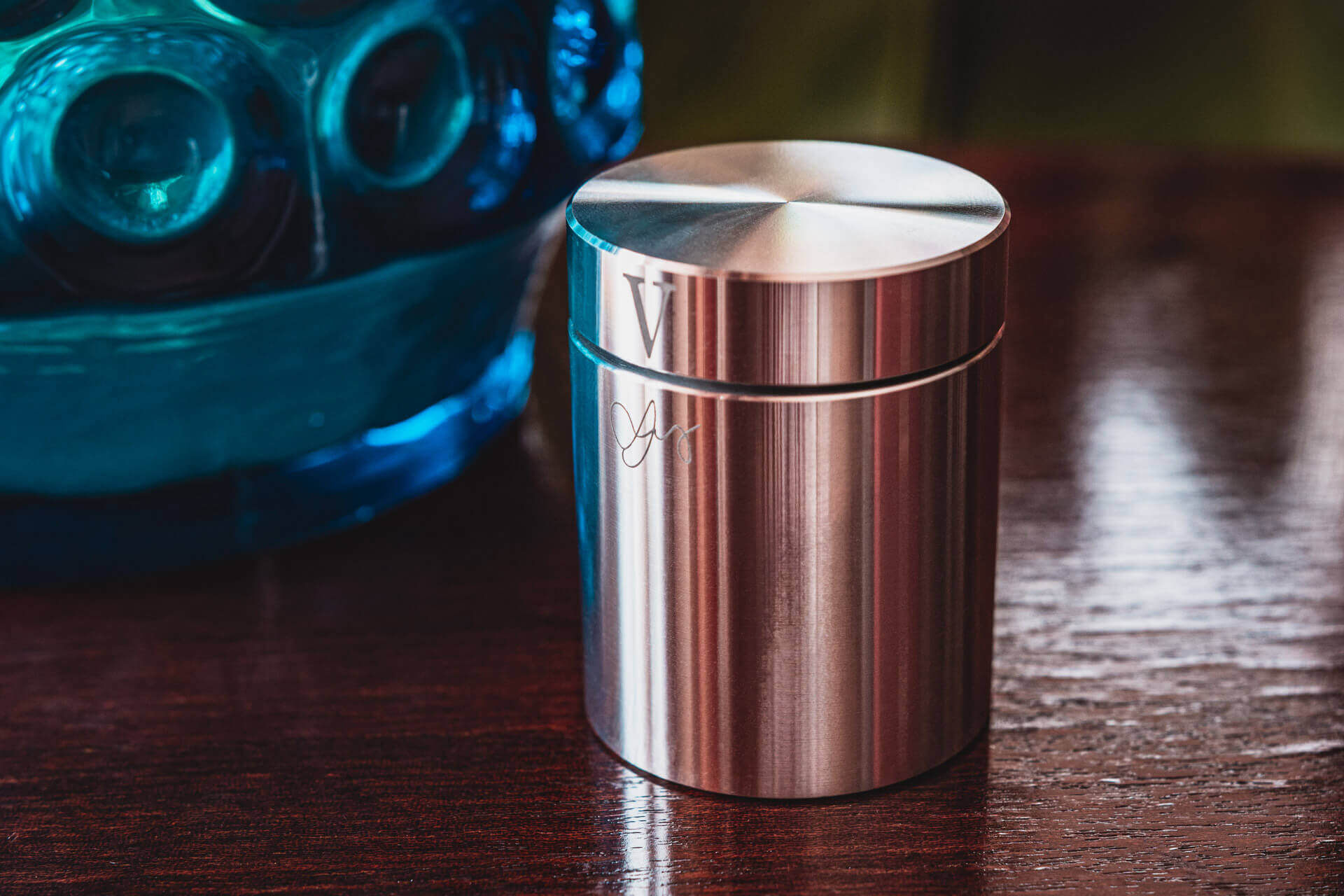
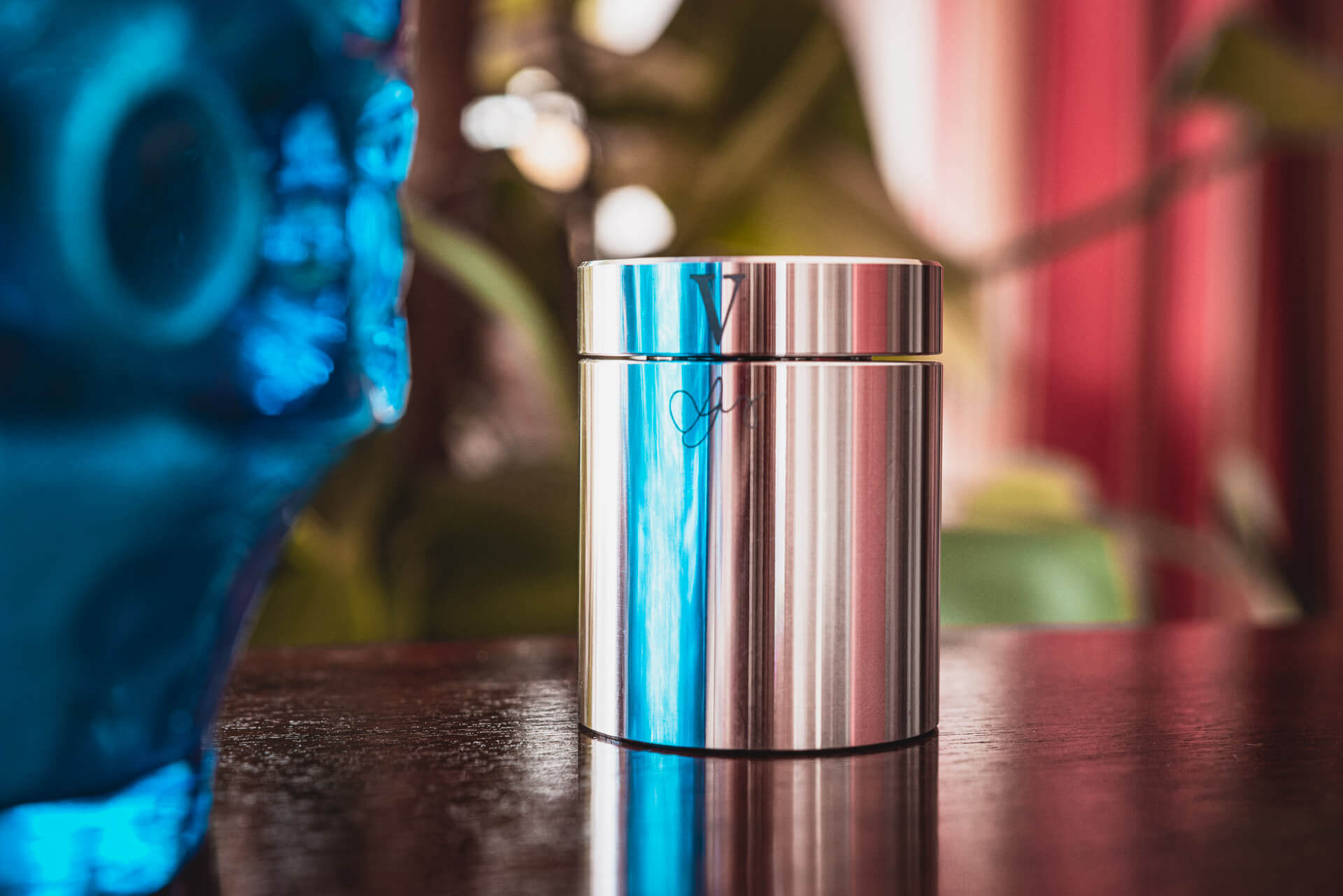
Looks like a barn padlock, behaves like an escape room. Machined aluminum with brass and steel accents, and a cascade of discoveries where each solved step hands you the tool for the next. Quoted solve time runs from an hour to a year, and that's not hyperbole. The price is the metal and the mechanism — worth every dollar if SD is your thing.
- Benchmark of the entire sequential-discovery genre
- Hand-finished aluminum/brass/steel — a true heirloom object
- Multi-stage 'each step reveals a new challenge' structure
- Expensive (~$292) and supply is limited
- Genuinely brutal — can frustrate solvers who want a one-evening win
 2 photos
 Hanayama Cast News (Level 6)
Two identical interlocking pieces with an N-E-S-W compass motif and a genuinely lovely antique finish. The official 6/6 'Grandmaster' rating is contested — many crack it in 20 minutes — but the object itself is a pleasure to handle and the coordinated separation move is satisfying. Buy it for the aesthetics as much as the challenge.
- Striking 8-sided antique design — looks great on a desk
- Satisfying coordinated-motion solution
- Under $16
- Difficulty is wildly overrated at 6/6 — it's more like a 3
- Two-identical-pieces design feels slight to some solvers
 3 photos
 Wil Strijbos First Cylinder
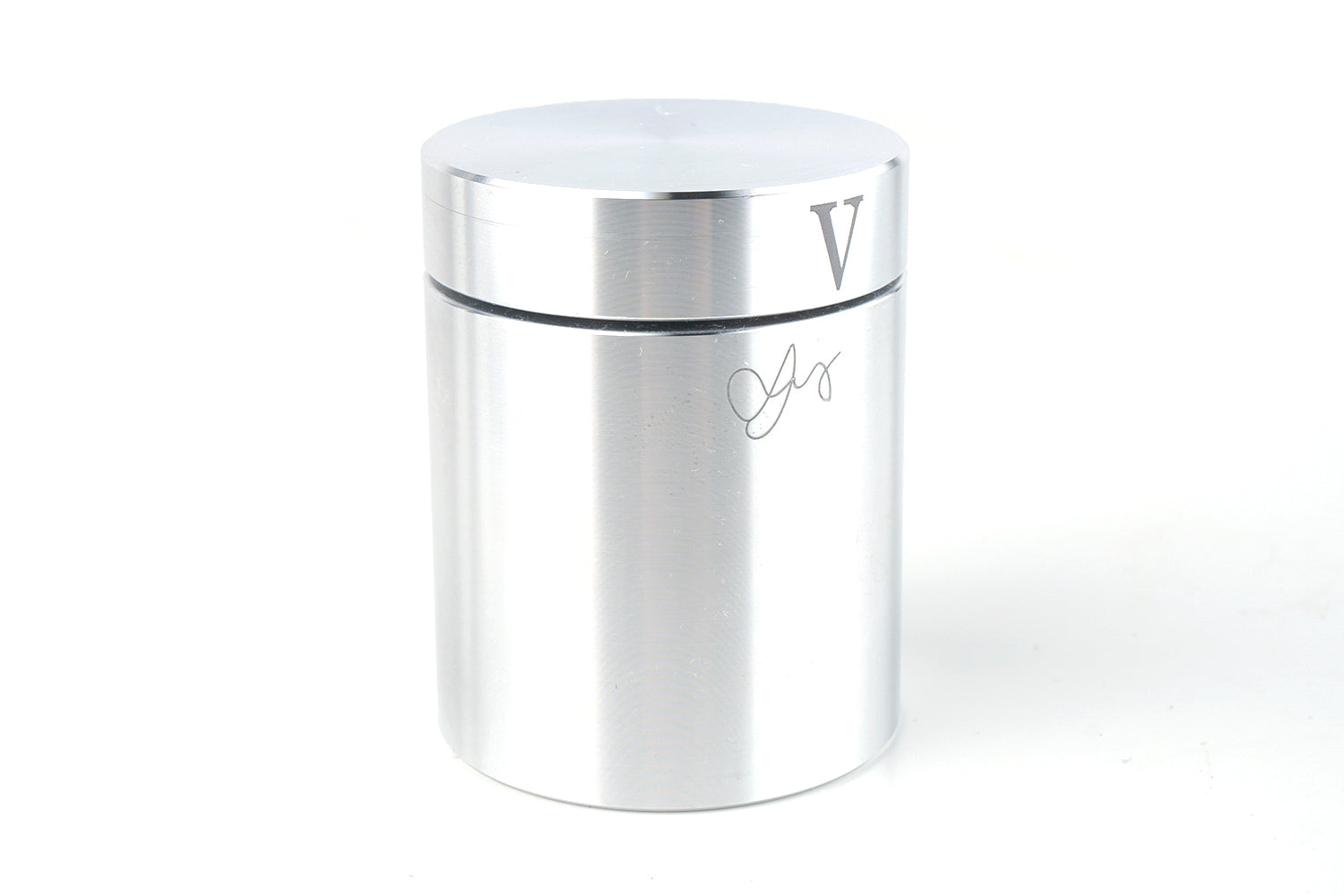
High-quality aluminum and the same house style as the Revenge Lock, at a less punishing price and difficulty. A great way to learn how Strijbos thinks — the discovery cascade is present but more forgiving — before you commit to the Wanderer. The build quality alone justifies the ticket.
- Machined aluminum quality at ~$128 (vs ~$292 for Revenge Lock)
- Authentic sequential-discovery experience, gentler curve
- Holds value as a limited Strijbos piece
- Still a three-figure puzzle — not a casual buy
- Aluminum cylinders can scuff if mishandled
 3 photos
 Inside3 Labyrinth 3D Maze Cube
A sealed cube containing a hidden 3D labyrinth; you tilt and rotate to roll a ball through seven stacked maze layers you can't fully see. Themed difficulty tiers (Regular up through 'Awful'/'Cthulhu') let you dial the challenge. It's the one family on this list where patience-of-hand matters as much as logic, and it's a refreshing change of muscle.
- Genuinely different skill — spatial + dexterity, not pure logic
- Difficulty tiers let you escalate (~$17–23)
- Self-contained and indestructible; great for travel
- The 'can't see the maze' factor frustrates some solvers
- Less replayable once memorized than a reset-able metal/wood puzzle
 2 photos
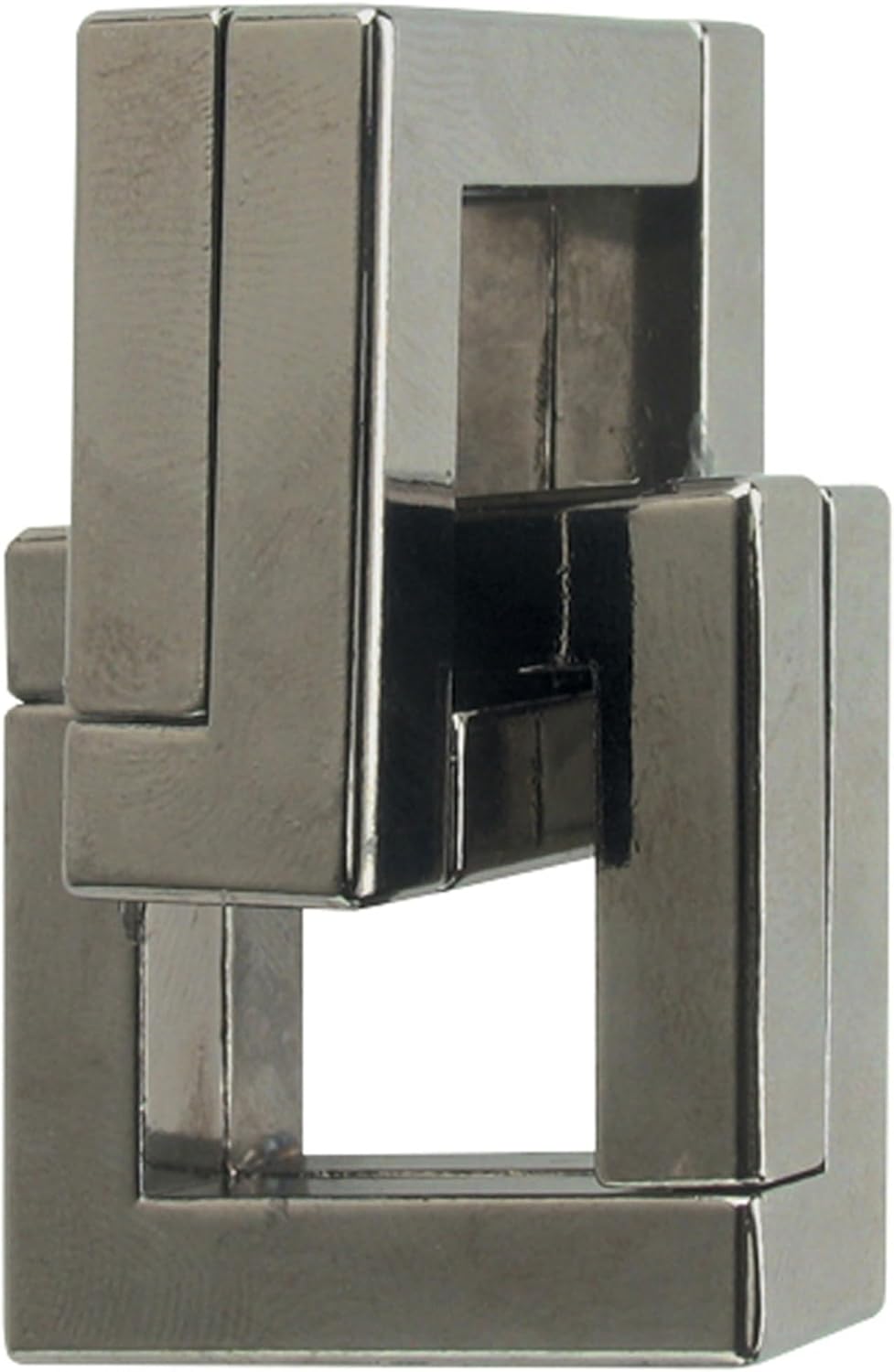
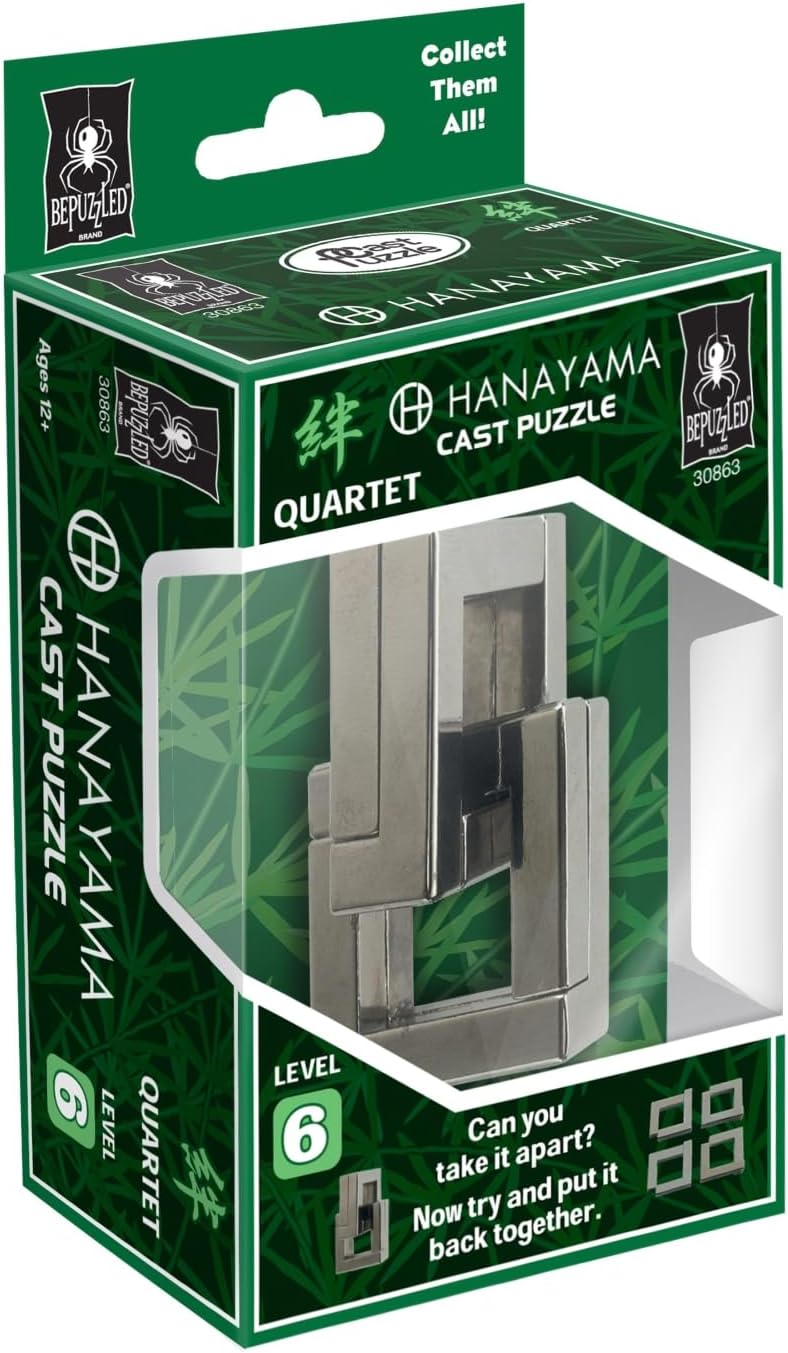
 Hanayama Cast Quartet (Level 6)
Four L-shaped pieces with intricate curved cuts that genuinely earn the 6/6 rating — unlike some of its line-mates, this one is hard for the right reasons. It's the Hanayama I'd hand someone who claims the brand is 'too easy.' Excellent value at ~$20 and a real test of order-of-operations thinking.
- Difficulty rating is honest here — actually challenging
- Four-piece interlock teaches order-of-operations, a burr skill
- Under $20
- Reassembly can be genuinely fiddly and frustrating
- Pieces can mark each other with heavy handling
 3 photos
 Wil Strijbos Lotus Flower
The goal — extract a circular aluminum disc and rod — sounds simple and is anything but. More visually sculptural than the Revenge Lock and a touch more approachable, it's a strong pick if you want a Strijbos that looks as good sitting solved on a shelf as it does defeating you. Premium aluminum, limited supply.
- Beautiful, sculptural aluminum object
- Authentic Strijbos discovery experience at ~$212
- Bundles into his Premium Metal set if you want all three
- Three-figure price for a deliberately hard puzzle
- Limited availability — buy when in stock
At a glance
| puzzle | maker | price | type | best for |
|---|---|---|---|---|
| Cast Marble (Lvl 4) | Hanayama / Cohen-van Deventer | $14.99 | Disentanglement | Best first real puzzle |
| Revenge Lock (Wanderer) | Wil Strijbos | $292 | Sequential discovery | Holy-grail SD masterpiece |
| +Burr | Cubicdissection / Baumegger | $95 | Interlocking / burr | Furniture-grade designer burr |
| Casino | Volker Latussek (Pelikan/Rombol) | ~$109 | Packing | Award-winning spatial humbler |
| Cast News (Lvl 6) | Hanayama | $14.95 | Disentanglement | Prettiest cheap pick |
| First Cylinder | Wil Strijbos | $128 | Sequential discovery | Strijbos on-ramp |
| Inside3 Labyrinth | Inside3 | ~$21 | Dexterity / maze | Hands-and-logic change of pace |
| Karakuri Box (Church) | Karakuri Creation Group | $139.95 | Trick box / heirloom | Craftsmanship keepsake |
| Cast Quartet (Lvl 6) | Hanayama | $19.99 | Interlocking (metal) | Honest budget difficulty |
| Lotus Flower | Wil Strijbos | $212 | Sequential discovery | Sculptural display SD |
Questions, answered
What is the single best brain teaser puzzle for an adult?
For value and accessibility, a Hanayama Cast metal puzzle — the Cast Marble (Level 4) — is the best starting point under $16. For the most satisfying object in the hobby regardless of price, it's a sequential-discovery puzzle like Wil Strijbos's Revenge Lock (~$292). The 'best' depends on which type of thinking you enjoy: spatial (disentanglement/packing), investigative (sequential discovery), or structural (burrs).
What is a sequential-discovery puzzle?
It's a puzzle where solving one step physically gives you a tool — a pin, key, or rod — that you need for the next, previously-impossible step. It's the closest a handheld object gets to an escape room. Wil Strijbos's Revenge Lock and Junichi Yananose's (Juno) wooden boxes are the genre's landmarks.
Are Hanayama difficulty ratings (1 to 6) accurate?
Only loosely. The 1–6 scale is a rough genre signal, not a calibrated measure. The Cast News is rated 6/6 'Grandmaster' yet many experienced solvers crack it in about 20 minutes, while a six-piece Volker Latussek packing puzzle with no rating at all can defeat people for an hour. Buy by puzzle type and designer pedigree, not the number on the box.
How much should I spend on my first brain teaser puzzle?
Start at $14–20 with a Hanayama Cast (Marble, News, or Quartet) or an Inside3 maze cube. That tier is genuinely good and tells you whether the hobby fits you. Only step up to the $90–130 designer tier (Cubicdissection burrs, Strijbos First Cylinder) once you know you love it.
Why are wooden puzzles from makers like Cubicdissection so expensive and hard to find?
They're machined from exotic hardwoods to furniture-grade tolerance in small batches — often only a few dozen to a couple hundred copies per design. When a run sells out it moves to a secondary marketplace at a markup. The price reflects materials and precision craftsmanship, and the scarcity is by design. If you want a specific design, buy it the week it's released.
What's the hardest type of brain teaser puzzle?
It depends on your brain, but the two families that most reliably defeat smart people are sequential-discovery puzzles (because the difficulty is hidden inside and unfolds over many steps) and Volker Latussek-style packing puzzles (because the solution requires a spatial insight your intuition actively resists). Difficulty in burrs comes from internal voids and first-piece-removal moves, not piece count.
Are these puzzles good gifts for someone who isn't a 'puzzle person'?
Yes, if you match the type to the person. Give a tactile, fidgety person a Hanayama Cast Marble or an Inside3 maze; give a tinkerer or escape-room fan a sequential-discovery puzzle; give someone who loves beautiful objects a Karakuri Japanese box. Avoid handing a true beginner a $200 Revenge Lock — it's likelier to frustrate than delight as a first puzzle.
Can I reassemble these puzzles, or are they one-and-done?
Most metal and wooden mechanical puzzles are fully reset-able — reassembly is usually the harder half and the main reason to own them. The exception is dexterity/maze cubes like Inside3, which are less replayable once you've memorized the path. For burrs and disentanglement puzzles, always photograph the solved state before disassembly so reassembly stays a puzzle, not a guessing game.
Which brain teaser puzzles hold their value over time?
The $200+ heirloom tier: limited-run Wil Strijbos aluminum puzzles, Cubicdissection wooden designs, and hand-built Karakuri Creation Group boxes. Small runs plus lasting demand mean they hold or gain value on the secondary market. Mass-market $15 puzzles are worth essentially nothing used — they're for solving, not collecting.
Dax's verdict
If you're new: buy a Hanayama Cast Marble, lose an evening, and find out whether you're a puzzle person. If you already know you are: stop carpet-bombing the $15 shelf and save for one piece that matters — a Cubicdissection +Burr (~$95) for craftsmanship, or a Volker Latussek Casino (~$109) for the purest 'how did I not see that' in the genre. And if you want the experience that turns a casual solver into an obsessive, it's a sequential-discovery puzzle: Strijbos's Revenge Lock (~$292) is the masterpiece, the First Cylinder (~$128) is the honest on-ramp. Ignore the difficulty digits, buy the TYPE of thinking you enjoy, and when a small-run wood or metal piece you love drops, buy it that week — hesitation, not overspending, is the real mistake in this hobby.
Research ledger 18 sources · reviewed 2026-07-17
Specifications, rules, current product information, community experience, and contrary evidence were checked against the sources below. Commercial links are kept separate from editorial evidence.
- amazon.comamazon.com/dp/B002VPIXOW?tag=puzzlewick-20
- amazon.comamazon.com/dp/B018RC3AZO?tag=puzzlewick-20
- amazon.comamazon.com/dp/B000LICL76?tag=puzzlewick-20
- amazon.comamazon.com/dp/B0038BHZS8?tag=puzzlewick-20
- kubiyagames.comkubiyagames.com/products/the-impossible-revenge-lock-puzzle-aka-the-wanderer
- kubiyagames.comkubiyagames.com/collections/william-strijbos-puzzles
- jpgamesltd.co.ukjpgamesltd.co.uk/buy-puzzles/RevengeLock-Puzzle
- cubicdissection.comcubicdissection.com/products/plus-burr-interlocking-puzzle
- cubicdissection.comcubicdissection.com/products/casino
- pelikanpuzzles.eupelikanpuzzles.eu/detail/casino
- shop.pluredro.comshop.pluredro.com/products/sequential-discovery-burred-box
- brilliantpuzzles.combrilliantpuzzles.com/Inside3-Labyrinth-Regular.html
- walmart.comwalmart.com/ip/Inside3-Phantom-Labyrinth-3D-Puzzle-Maze-Cube-Mean/141702695
- puzzleboxworld.compuzzleboxworld.com/collections/karakuri-trick-boxes
- fivesinatras.comfivesinatras.com/2020/09/11/karakuri-creation-group
- cruxpuzzles.co.ukcruxpuzzles.co.uk/blogs/latest-news/hanayama-cast-news-review
- allardspuzzlingtimes.blogspot.comallardspuzzlingtimes.blogspot.com/2017/06/wil-strijbos-revenge-lock-aka-wanderer.html
- puzzlemad.co.ukpuzzlemad.co.uk/2011/09/hanayama-cast-quartet.html

I'll be honest with you — flattery is boring.

Keep exploring
The next smart rabbit holes.
❖ Topic PathMechanical Puzzles: compare the whole shelfThe right mechanical puzzle matches the solver's patience, not simply the maker's difficulty number. These guides translate...Best OfBest Jigsaw Puzzles for Adults, Ranked (2026)A three-decade reference desk curator's ledger of the cardboard worth a fortnight of evenings and the wooden heirlooms worth passing down...Best OfBest Sequential Discovery Puzzles, Ranked (2026)The genre that keeps lying about itself — and why the ones that don't are worth the chase and the price.