Best Flesh and Blood Accessories 2026: Armory Sleeves, Deck Boxes & Playmat
Kenji’s tournament-clean system for the deck, hero, weapons, equipment, public zones, mat, and first Armory night.


AI-assisted research and drafting in Kenji’s voice · reviewed by Robert Pruitt · how this guide was made
Last editorial refresh: 2026-08-16 Gold-standard QA: 2026-08-16 11 sources reviewed Affiliate links checked during gold-standard pass

The short answer
Buy opaque standard-size sleeves with matching spares, a rigid box sized for the deck plus hero and equipment, and a plain mat that keeps the public equipment zones readable. Flesh and Blood’s hero, weapons, arms, chest, head, and legs begin in public zones, so the best kit separates and presents those cards instead of treating everything as one deck.
Decision map
Choose in thirty seconds
The deck is handled constantly and marked sleeves matter.
Keep hero and equipment visible and separate from the deck.
Public equipment zones need room and contrast.
Deck, equipment, tokens, spares, water—nothing theatrical.
Flesh and Blood accessories should behave like combat equipment: every object has a reason to be there, and anything without a job stays home. The game begins with a hero, weapons, and equipment already visible. That changes the storage problem.
Kenji’s system keeps the deck protected, the public loadout separate, the arsenal readable, and the first Armory night calm enough that the player can think about combat chains instead of rummaging for a chest piece.
Start here, then go deeper
You are in the right cabinet.
 ♢ Universe HubFlesh and Blood: the whole buying pathFlesh and Blood is a hero-centered dueling card game where equipment, pitch values, combat chains, and defense decisions matter...
 🂠 Topic PathTrading Card Games: compare the whole shelfStart with the game and community you want, then buy the smallest product that lets you test it properly. These guides separate...Buying GuideFlesh and Blood Silver Age vs Armory Decks in 2026: The Best First DeckFlesh and Blood starter decks, explained with exact box identity, expansion order, beginner-to-expert strategy, hosting and solo reality,...
What accessories do you need for Flesh and Blood?
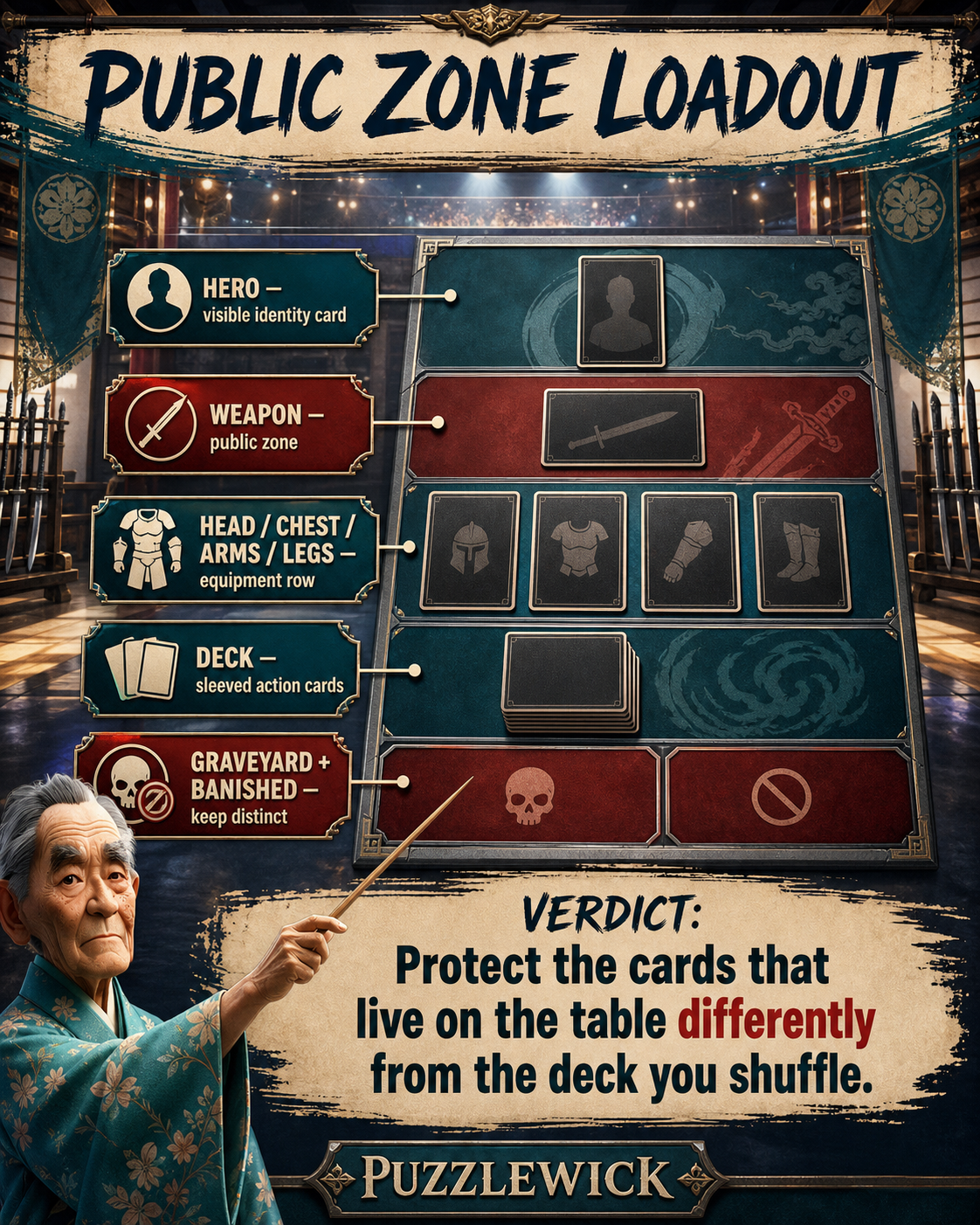
The player begins with public hero, weapon, arms, chest, head, and legs zones, then manages the deck, hand, pitch, graveyard, banished zone, and arsenal. Official competitive and professional tournament procedures use a defined zone layout. Your accessories should make that state obvious.
Put the playable deck in opaque sleeves, keep hero and equipment behind a divider or in a separate visible packet, store dice or counters away from card edges, and use a mat large enough that the public zones are not stacked into a little cardboard traffic accident.
Practice the layout before the first Armory night. Place the hero, weapons, and equipment in their public line, then locate deck, arsenal, graveyard, pitch, and banished zones without moving another object. If any two zones collapse into one pile during a mock combat chain, solve the geography at home. Clarity is not decoration here; it protects both players’ understanding of the game state.
Which Flesh and Blood cards should you sleeve first?

The deck is shuffled and pitched constantly, so it receives durable opaque sleeves first. Equipment and hero cards may deserve inner sleeves or rigid transport because they remain visible and can be valuable, but they do not need to live in the same shuffled stack.
Carry matching spare sleeves. Replace a split or visibly worn sleeve before it can become a marked-card concern. If a card is expensive enough to change how you handle it, test the full sleeve-and-box system at home rather than discovering its thickness at the Armory table.
Touch rate is the useful hierarchy. The shuffled deck receives consistent backs and clean handling. Public equipment needs visibility and safe transport. High-value cold foils may justify an inner sleeve or a separate rigid holder between events, but transfer them into a tournament-appropriate presentation before play. Protection that obscures information or distorts the stack has stopped serving the game.
Which deck box fits a complete Flesh and Blood loadout?
A 100+ rigid case gives useful room for a sleeved deck, hero, weapons, equipment, sideboard or inventory cards, and a divider. The exact fit changes with sleeve thickness. Keep dice and metal counters in their own soft pouch or tray rather than allowing them to polish the deck edges during transit.
The best divider is labeled and boring. It should let a new player pull the public loadout, place it, and find the deck without sorting.
Load the final legal configuration before judging fit. A Blitz list, a Classic Constructed list, and a deck with heavily sleeved equipment do not occupy identical space. Close the case gently, turn it through normal bag angles, and inspect the corners. The case should prevent movement without bowing cards, and the divider should remain tall enough to identify the equipment packet at a glance.
Do you need a playmat for Flesh and Blood?
Official tournament procedure defines the table’s major zones. A plain mat does not print them for you, but it gives the hero and equipment line a stable boundary and makes the arsenal, deck, graveyard, and banished area easier to distinguish.
Use a mat wide enough for the public loadout without overlapping your opponent’s space. Store it rolled. A gorgeous hero mat is worth buying after the hero has survived enough games to become yours.
Set the arsenal position consistently and keep it physically distinct from hand, deck, and graveyard. Place dice where life totals can be confirmed without reaching across the combat chain. A zone mat can accelerate the first few sessions, but an unprinted mat works when the player rehearses a stable layout. The habit is the real tool; the art is the reward.
What should you pack for your first Flesh and Blood Armory?
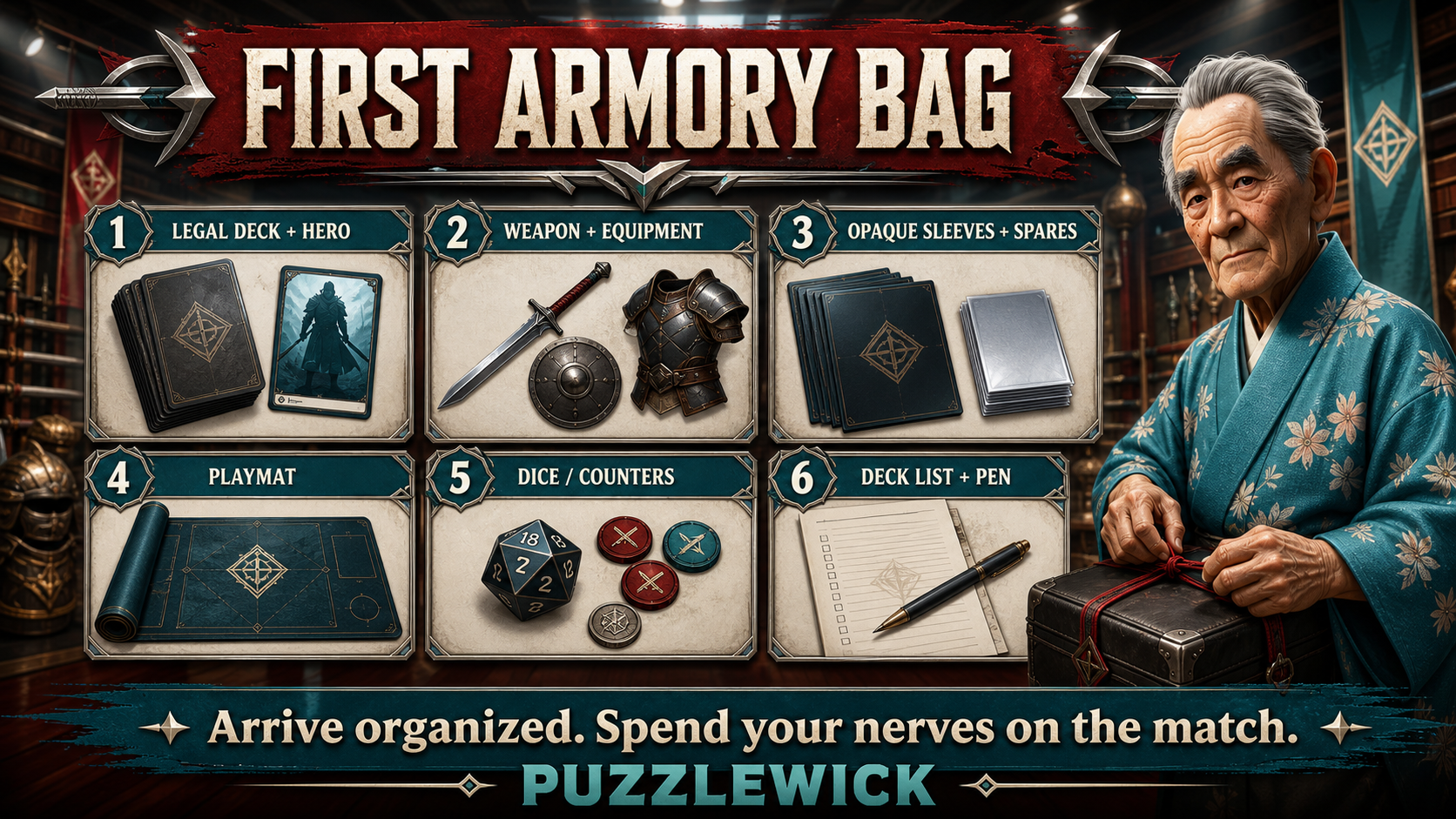
Pack the deck, public loadout, inventory cards, matching sleeve spares, dice or counters, mat, identification, event details, and water. Leave bulk trades and unused decks home unless the evening requires them.
Place the public loadout first, then the deck, then the counters. Rehearse that order once. Tournament confidence is often a series of small uncertainties removed before the first attack action card appears.
Photograph the complete open bag and repeat the same packing order after each match. Keep the official event information and any required deck registration accessible rather than beneath the mat tube. The beginner goal is not to look experienced. It is to remove enough logistics that asking a rules question, tracking priority, and reading a combat chain remain mentally affordable.
Which Flesh and Blood accessories can wait?
Wait on premium hero-branded luggage, multi-deck cases, custom metal tokens, and display storage until a repeated habit identifies the job. A second deck box is sensible when a second deck exists. It is not a motivational poster.
Upgrade the first point of friction: sleeve splits, unclear counters, cramped zones, or a box that cannot separate equipment. This is how an Armory kit becomes personal without becoming a costume department.
The picks
Some links below are affiliate links — as an Amazon Associate, Puzzlewick earns from qualifying purchases, at no extra cost to you. It never changes a pick.
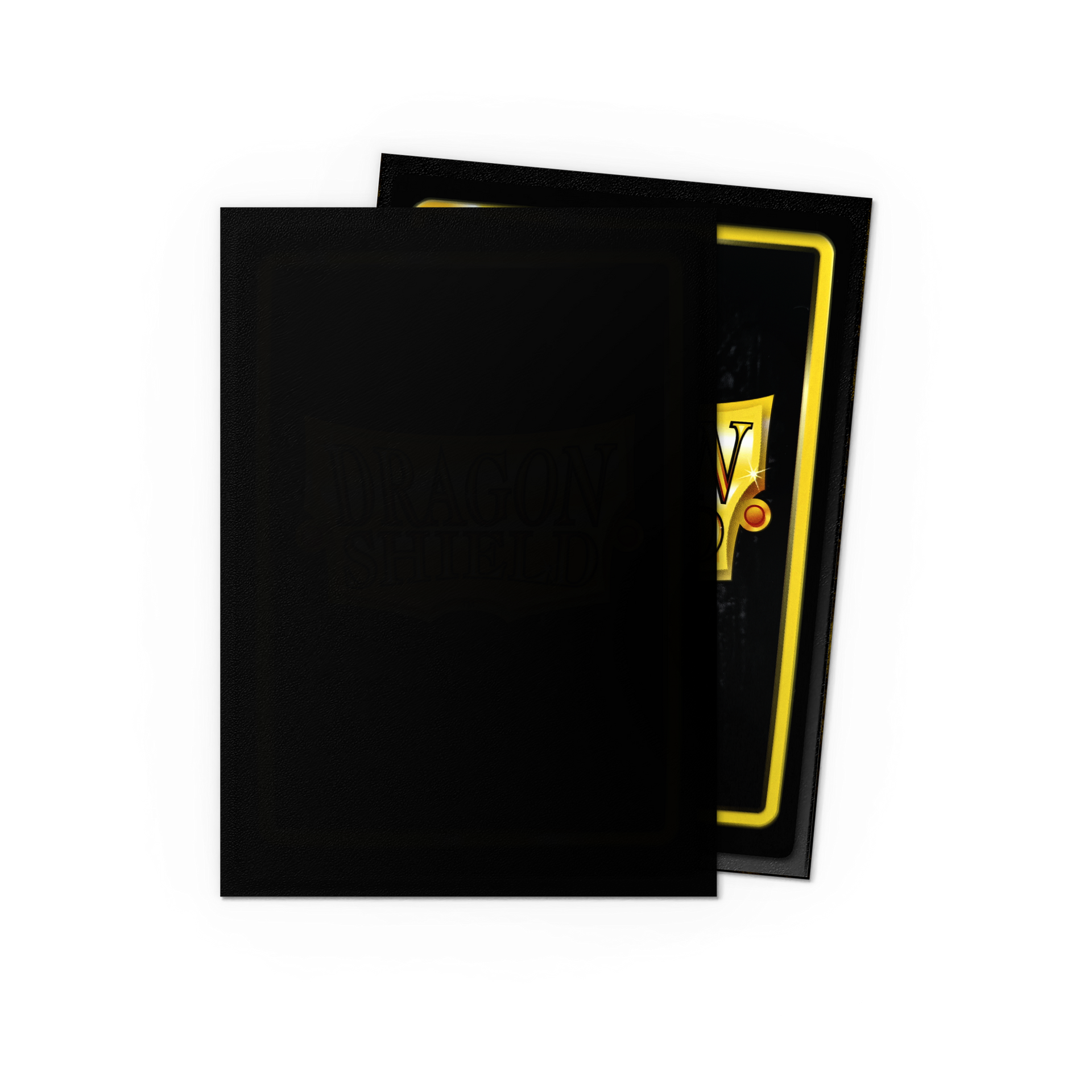
Dragon Shield Matte Blood Red Sleeves
Opaque durable sleeves with a strong shuffle feel and enough extras for replacements.
- Opaque
- Durable
- Matching spares
- Premium price
- Adds bulk

Ultimate Guard Boulder 100+ Deck Case
A compact rigid shell that rewards one labeled divider and disciplined packing.
- Rigid
- Compact
- Useful capacity
- Keep hard counters separate
- Fit varies with sleeve thickness

Ultra PRO Solid Black Gaming Playmat
A quiet surface that gives the public loadout and arsenal a reliable boundary.
- High contrast
- Portable
- Multi-game
- Needs rolled storage
- No hero art
At a glance
| Priority | Product | Job | Buy when | Watch out |
|---|---|---|---|---|
| 1 | Opaque sleeves + spares | Protect the shuffled deck | With the active deck | Replace visible wear |
| 2 | Rigid 100+ box + divider | Separate deck from public loadout | When the deck travels | Keep dice away from edges |
| 3 | Plain full-size mat | Clarify public zones and arsenal | Before regular Armory play | Store rolled and dry |
| 4 | Compact counter tray | Track game state | When loose dice wander | Prioritize legibility over weight |
Questions, answered
What accessories do I need for Flesh and Blood?
Opaque standard-size sleeves, matching spares, a deck box with room to separate hero and equipment, counters or dice, and preferably a playmat.
Why should hero and equipment cards be separated?
They begin in public zones rather than in the shuffled deck. A divider or separate packet makes setup faster and reduces sorting mistakes.
What sleeve size fits Flesh and Blood cards?
Use standard-size trading-card sleeves, not Japanese-size Yu-Gi-Oh sleeves.
Do I need a Flesh and Blood playmat?
No, but a mat gives the hero, equipment, arsenal, deck, and graveyard consistent readable space.
How large should a FAB deck box be?
Choose by the actual sleeved deck plus hero, weapons, equipment, inventory, and divider. A 100+ rigid case is a practical starting point, but sleeve thickness changes the fit.
What should I bring to my first Armory event?
Legal deck and public loadout, matching spare sleeves, counters or dice, mat, event details, identification, and water.
Should expensive equipment cards use rigid holders?
Use rigid transport when card value or travel risk justifies it, but confirm the holder is permitted and practical for the event format.
What accessory should I upgrade first?
Upgrade the repeated point of friction: sleeve wear, unclear counters, cramped zones, or a box that cannot separate the public loadout.
How should hero and equipment cards be stored for an Armory event?
Keep the public loadout together behind a labeled divider or in a separate visible packet inside the same rigid case. It should deploy before the shuffled deck without sorting. Valuable treatments can receive additional transport protection between events, but the final presentation must remain readable and appropriate for organized play.
Do I need a zone-printed Flesh and Blood playmat?
No. Official procedure defines the zones, and a plain mat works when the layout is consistent. A printed mat is a useful beginner rail if it makes hero, equipment, arsenal, deck, pitch, graveyard, and banished areas clearer. Choose readability over dramatic art that hides the combat state.
What should stay out of a first Flesh and Blood event bag?
Leave bulk trades, unused decks, loose metal counters beside cards, oversized display protection, and speculative accessories at home unless the event requires them. Carry the legal deck, public loadout, inventory, matching sleeve spares, readable counters, mat, event details, identification, and water.
Kenji's verdict
Build one disciplined Armory loadout: sleeves and spares for the deck, a rigid divided box for deck plus equipment, and a quiet mat for the public zones. Upgrade only the friction that ten games reveal.
Research ledger 11 sources · reviewed 2026-08-16
Specifications, rules, current product information, community experience, and contrary evidence were checked against the sources below. Commercial links are kept separate from editorial evidence.
- Flesh and Blood comprehensive rules: zonesrules.fabtcg.com/en/cr/03-zones
- Flesh and Blood tournament rules: gameplay logisticsrules.fabtcg.com/en/trp/05-gameplay-logistics
- Flesh and Blood comprehensive rules PDFrules.fabtcg.com/pdf/en-fab-cr.pdf
- Flesh and Blood official digital assetslegacy.fabtcg.com/en/resources/digital-assets
- Dragon Shield standard-size sleeve catalogdragonshield.com/en-us/card-sleeves/shop-by-game/standard-size-sleeves
- Ultimate Guard Boulder deck-box specificationsultimateguard.com/en/Deck-Boxes/Boulder/UGD010657
- Flesh and Blood players compare deck-box space for decks, equipment, and tokensreddit.com/r/FleshandBloodTCG/comments/1l244do/what_deckbox_do_you_use_for_each_deck
- Flesh and Blood players discuss separate protection for arena cardsreddit.com/r/FleshandBloodTCG/comments/1rq7azm/where_do_you_keep_your_arena_cards
- Dragon Shield Blood Red exact Amazon listingamazon.com/dp/B0B337ZY41?tag=puzzlewick-20
- Ultimate Guard Boulder exact Amazon listingamazon.com/dp/B06XGMBR6S?tag=puzzlewick-20
- Ultra PRO playmat exact Amazon listingamazon.com/dp/B00D8K2J30?tag=puzzlewick-20

Every object has a lineage. Let me tell you its story.


Keep exploring
The next smart rabbit holes.
♢ Universe HubFlesh and Blood: the whole buying pathFlesh and Blood is a hero-centered dueling card game where equipment, pitch values, combat chains, and defense decisions matter...🂠 Topic PathTrading Card Games: compare the whole shelfStart with the game and community you want, then buy the smallest product that lets you test it properly. These guides separate...Buying GuideFlesh and Blood Silver Age vs Armory Decks in 2026: The Best First DeckFlesh and Blood starter decks, explained with exact box identity, expansion order, beginner-to-expert strategy, hosting and solo reality,...