Masterclass
Disney Lorcana
The gentlest door into trading cards swings wide in 2026 — Pixar finally arrived, the starter sets are friendlier than ever, and you're about to be summoned. This is your initiation from first hand to your first championship, walked out loud by the whole fellowship.
Disney Lorcana is a beginner-friendly two-player trading card game from Ravensburger and Disney where you play an "Illumineer" who channels ink to summon "glimmers" of Disney and Pixar characters and races the opponent to 20 lore. The fastest start is one ready-to-play product — a 2-Player Starter Set ($29.99) or two single Starter Decks — and you learn the whole core loop (ink one card, quest for lore, challenge to fight) in a single game. You win by questing to 20, not by killing your opponent: it's a lore race, not a fight, and that gentleness is the entire point of the game.

AI-assisted curator persona · researched & reviewed by founder Robert Pruitt, a 20-year enthusiast · our method
- The DojoWhite belt
- The MonasteryGreen belt
- The Mountain RetreatBrown belt
- The Grand HallRed belt
- The Campfire of MastersBlack belt

What Disney Lorcana Is — and Why 2026 Is the Year You Walk In

Welcome in, Illumineer — and yes, that's what you are now, not just someone who bought the cards. Pull up a chair; nobody here cares that you're new, because every single one of us was lost six months ago too. The only rule at the threshold is the one you unlearn from every other game: you're not trying to kill me — you're racing me to twenty lore. It's the friendly one. That's the whole point.
Here's the soft truth at the door: Disney Lorcana was built, on purpose, to be the gentle way into trading cards. It's a two-player game from Ravensburger and Disney, launched in 2023, where you play an Illumineer — a magic-user who channels ink to summon glimmers, shimmering versions of Disney and Pixar characters you grew up loving. Not creatures, not monsters like the other games. Glimmers. The softer word is deliberate, and we love it for that.
Your whole goal is to race to 20 lore — and you bank lore by questing, sending glimmers out on adventures, never by killing the other player. "It's a lore race, not a fight" is the first thing a veteran will teach you, and it's the truest. A deck is at least 60 cards, up to 4 copies of any one card, built from one or two of the six ink colors — Amber, Amethyst, Emerald, Ruby, Sapphire, Steel. Each has a personality, and picking yours is really picking who you are at the table.
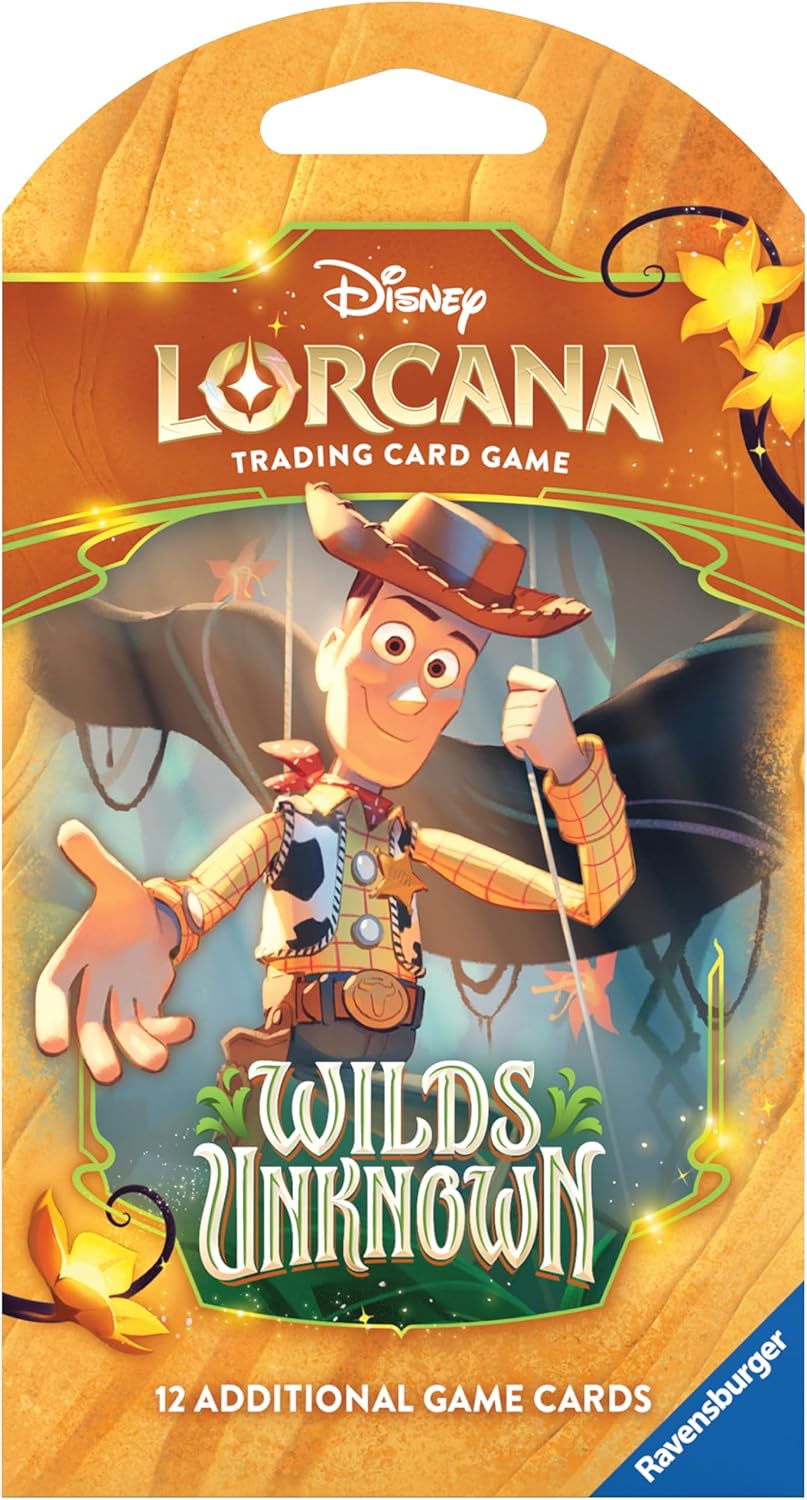
And 2026? This is the year. Pixar finally arrived. The 12th set, Wilds Unknown (May 15), brought the first glimmers from Toy Story, Brave, and The Incredibles — something fans begged for since day one. It followed the wintry Winterspell, with a Monsters, Inc.-leaning Attack of the Vine! and a Coco set on the roadmap. Ravensburger is leaning hard into welcome, too: a $29.99 Stitch Collection Starter, a Scrooge McDuck Gift Box, and a fresh 2-Player Starter Set pairing card-draw against aggression. There's never been more in the box, or more places to play. So pick what you love. That's the only homework today.

It's a lore race, not a fight — you win by questing, not by killing. Unlearn that one and the door is already open.
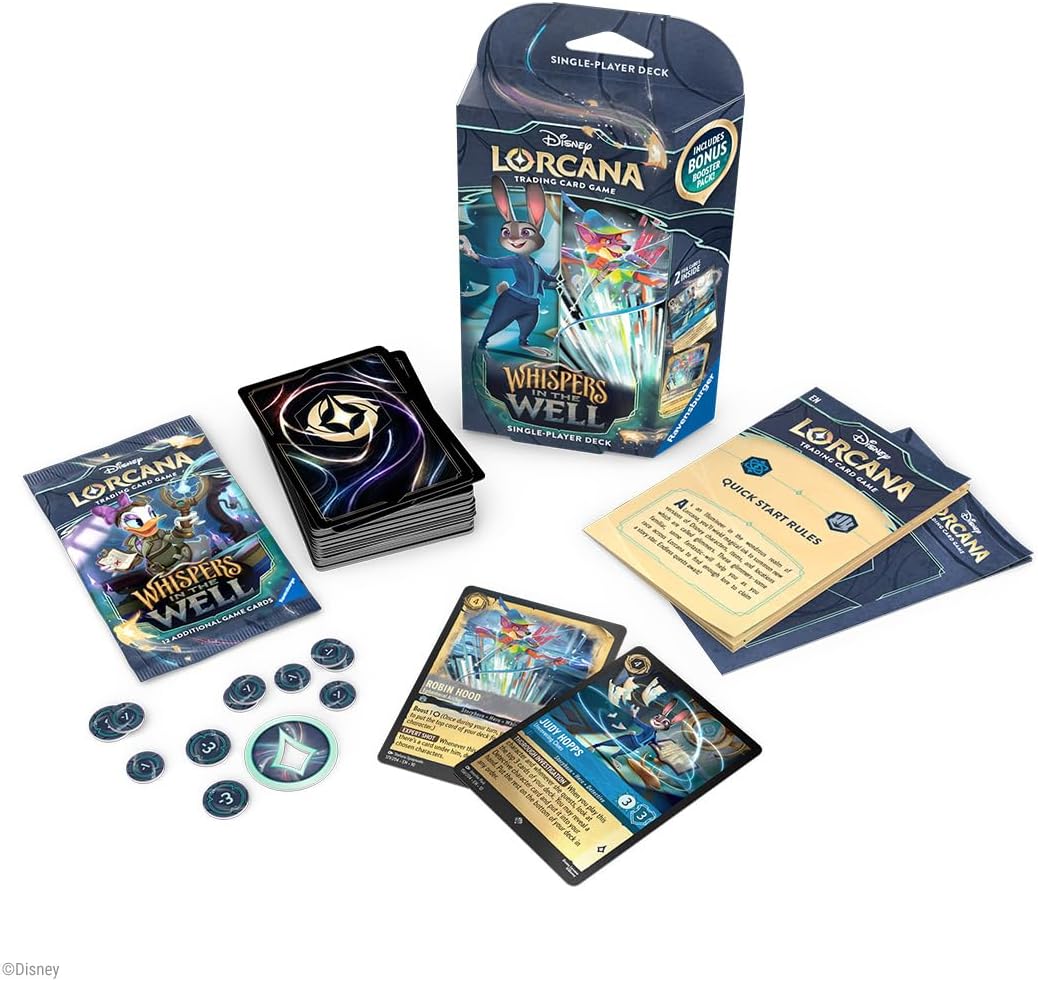
- Decide your entry: buy ONE ready-to-play product so you can play tonight — a 2-Player Starter Set (two full decks in one box) is the easiest.
- Read the six ink personalities and notice which one tugs at you — Amber heals, Steel removes, Ruby pressures, Amethyst draws, Emerald evades, Sapphire ramps.
- Pick the deck with characters you genuinely love; 'oh I LOVE that one' is a perfectly good reason to choose at the threshold.
- Punch out the lore-tracker dials and damage tokens so you can see your march to 20.
- Find one person to learn with — a partner, a kid, a friend — and agree the first game is just for the rhythm, not for winning.
- Start calling yourself an Illumineer. It sounds silly until it doesn't.
First Words at the Door
Illumineer — what you ARE now, not just what you play; a creative person 'summoned' to wield ink. Glimmers — the characters you summon, soft magical echoes of Disney figures (never 'monsters'). Lore (the race to 20) — your win condition and the game's whole soul; you race to 20, never kill. Questing — exerting a ready glimmer to gain lore; 'when in doubt, quest.' The Inkwell — your face-down resource pile you build one card at a time.
You Learn It In One Game
r/Lorcana says it over and over: people who bounced off Magic or Yu-Gi-Oh find the once-per-turn inkwell and the simple race-to-20 click in a single game. It's widely called one of the most beginner-friendly modern TCGs. Don't let the 60-card decks scare you — the starters play out of the box, balanced against each other.
Why the Colors Matter More Than You Think
Your two-ink pairing is a self-portrait. Amber/Emerald is card-draw and evasion; Amethyst/Ruby is aggressive and recursive — the 2026 2-Player Set pits exactly those two against each other so the playstyles feel distinct. Pick the pair whose vibe matches how you'd want to win, not the one that looks strongest.
There's No 'You Can't Sit With Us'
This scene was designed to be less male-dominated and more welcoming than most card games — families beside grinders, lapsed gamers beside kids. The unwritten law: someone was patient with you, so you'll be patient with the next newcomer. You're not buying into a fight; you're being adopted into a table.

Building Your First Deck: The Inkable Ratio, the Curve, and the Deck That's Really You

Quiet your hands a moment, initiate — the craft begins here. Your deck will brick until you fix one number: keep it around eleven to thirteen uninkable cards, the rest inkable, and you'll stop drawing hands you can't pay for. But the deeper work is this — build a sixty around the glimmers YOU love, hit your curve, and the whole thing starts to sing. The deck is a self-portrait; 'what do you run?' is really 'tell me who you are.'
The craft of Lorcana splits two ways, and most of us live in both. There's the deckbuilding side — the meditative math of the inkable ratio and the curve — and the collecting side, the binder as a memory shelf. You don't have to choose. But you do have to learn one sacred number first.
A 60-card deck lives or dies on having roughly 45–47 inkable cards — meaning only about 11–13 uninkables. Go heavier on uninkables and you'll brick: draw a hand you can't pay for, the saddest two words at any table. "I bricked" is said with a rueful laugh because it happens to everyone. Get that one number right and you've cleared the first real bar of competence.
The second bar is the curve — a 1-drop you can play turn one, a 2-drop turn two, a 3-drop turn three. "Curving out" is the dream opening; "my curve was clunky" is the post-game sigh. The classic beginner sin is a rainbow deck: 60 different singles, too many inks, a hand full of 6- and 7-cost bombs that strand you. Run multiples, stick to 1–2 inks, keep the curve low. That's the whole secret, and it's enough.
Here's the gentle permission, though: the lowest acceptable ready bar is just playing the starter. You don't owe anyone a custom build to belong. Netdeck a championship list to learn the engine, then brew your own jank and beat someone with it — both are respected here, the second one's just sweeter. And the collector's path is equally honored: some Illumineers would buy these cards even if they never played, because every glimmer is somebody's childhood. The deck is your favorite characters and your favorite line of play, made into an object. Build the one that's you.
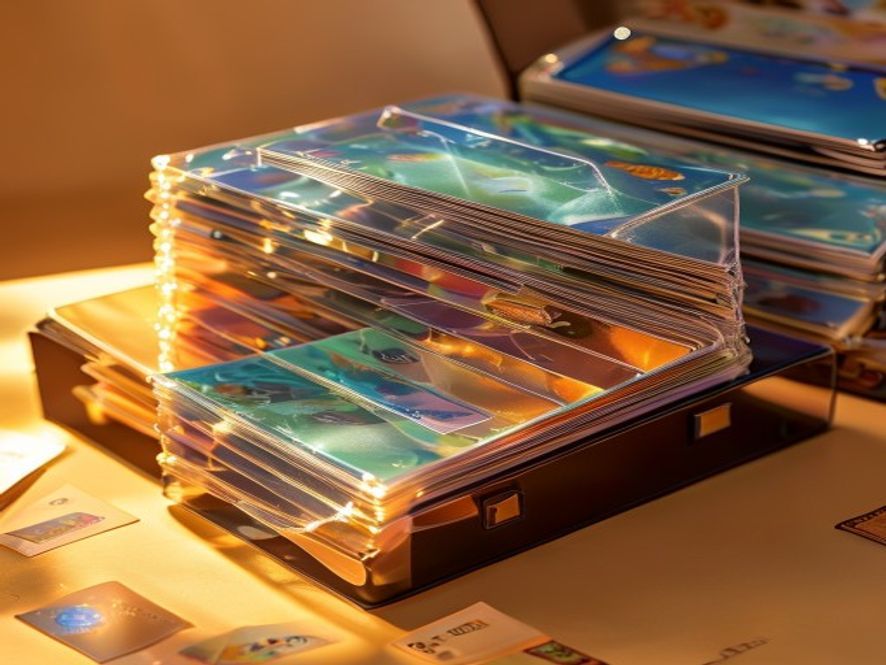
The deck is a self-portrait, and the binder is a memory shelf — so 'what do you run?' is really 'tell me who you are.'
- Stay on your starter deck for several full games before you build anything — it teaches the rhythm faster than any rulebook.
- When you do build, lock your inkable ratio first: aim for ~45–47 inkable cards (only ~11–13 uninkables) in a 60.
- Pick ONE or TWO inks and run 3–4 copies of your key cards — never 60 different singles.
- Draw a quick curve: make sure you have meaningful plays on turns 1, 2, and 3, not just expensive bombs.
- Sleeve your deck uniformly with matte-back, clear-front sleeves — required for sanctioned events and a sign of respect anywhere.
- Netdeck a known list to feel a tuned engine, then brew a personal version around characters you love.
The Builder's Vocabulary
Inkable / Uninkable — whether a card has the inkwell symbol around its cost; the locked wisdom is ~11–13 uninkables in a 60. Bricking — a no-ink hand you can't pay for; the universal nightmare. The curve / N-drop — your cost ladder; 'curving out' is the dream opening. Floodborn — both a dark-ink card subtype from Set 2 and reverent slang for when Lorcana 'got a story.' Enchanted — borderless rainbow Inkwash-Foil chase cards, ~1 per case; the grail.
Your First Real 60
Building your first 60-card deck — instead of playing a starter — is the crossing from 'I bought the game' to 'I play the game.' Hitting the right inkable ratio so you finally STOP bricking is the first earned competence every Illumineer remembers. Don't rush it; savor the moment your hand starts paying for itself.
Ink Identities Are Tribal Shorthand
Lean into your colors' jobs and pair them to cover weaknesses: Amber heals/protects, Steel removes and brings big bodies, Ruby pressures, Amethyst draws and recurs, Emerald evades/disrupts, Sapphire ramps. Pairings like Amber/Steel or Ruby/Amethyst bounce-control have become whole identities. Your pairing should answer 'what's my plan?' before turn one.
Protect the Loved Objects
Sleeve your deck (packs of ~65 sleeves, including official Lorcana-art ones) and grab a deck box that holds ~80 sleeved cards. A card portfolio (200–300 capacity) turns pulls into show-and-tell; an Illumineer's Trove or storage box holds 400+ sleeved cards once you're past a single deck. These cards are loved objects — treat them like it.
How a Turn Actually Works: Ink, Quest, Challenge, and the Honesty Baked Into the Rules

Now we climb, initiate, and the mountain rewards honesty. The ink has to dry — a glimmer cannot quest or challenge the turn you play it, and the player on the play skips their first draw; memorize that, it trips up everybody once. Every turn you'll face the same gut-check: ink this card for resources, or hold it to play it — that decision IS the game. Announce your actions out loud, offer your deck to cut, and call a judge if the inkwell ever gets confusing — that's not snitching, it protects us both.
A turn is a rhythm, and once it's in your hands it's almost meditative. You run Ready (return all your exerted, sideways cards upright) → Set (resolve start-of-turn triggers) → Draw one card — and here's the rule that bites every newcomer: the player who goes first SKIPS their draw on the very first turn. Then comes your Main Phase, where you do everything in any order.
The single most important habit on the whole mountain: once per turn, take one card with the ink-swirl symbol around its cost and place it face-down in your inkwell. It's gone from your deck forever — but it becomes a permanent generic resource, and any ink pays for any card. "Ink it or play it?" is the question you answer every single turn, and the community agrees: that decision IS the game.
Then the loop. Quest: exert a ready glimmer to immediately gain lore equal to the number in its top-left corner — usually 1 to 4. This wins most games. Challenge (combat): exert one of your glimmers to fight an opponent's exerted character — you can never hit a ready, upright one. Both deal damage equal to their Strength simultaneously; a glimmer is banished when its damage reaches its Willpower. And remember — damage stays. A glimmer that took 2 last turn still carries it.
The beautiful thing is how much etiquette is baked right into the mechanics. "The ink has to dry" — a glimmer played this turn can't quest, challenge, or exert until next turn unless it has Rush; people literally say the ink needs to dry. You announce your actions, you offer your deck to cut, you call a judge when the inkwell gets murky. Lorcana people play open-handed-honest. The win condition is non-confrontational by design, so your attitude matches it: when in doubt, just quest, take your lore, and figure out the fancy stuff later.
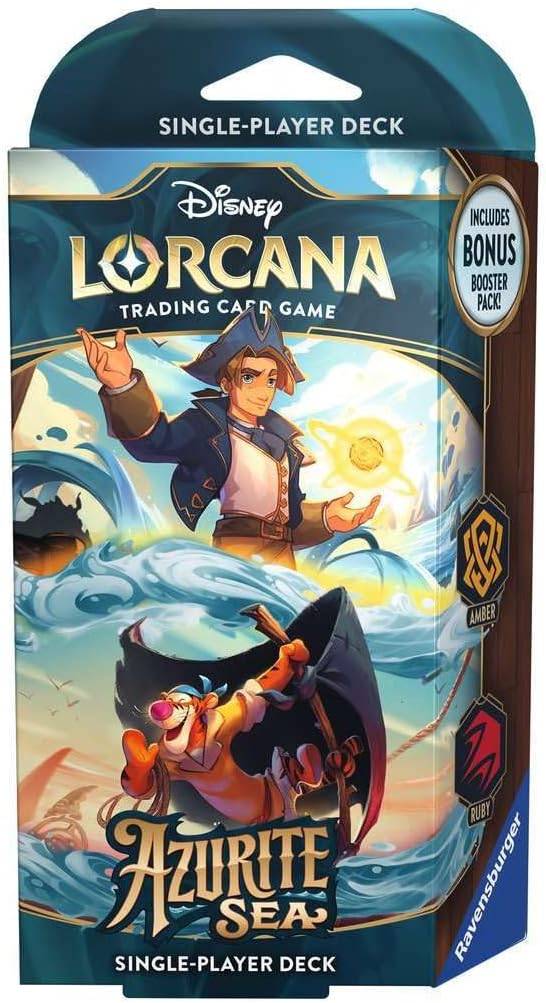
Ink it or play it? — the question you'll answer every single turn. That decision IS the game.
- Run the turn out loud every time: Ready → Set → Draw → Main. Saying it cements it.
- If you go first, SKIP your turn-one draw — point at the rule until it's reflex.
- Ink exactly one card per turn before you do anything else; make it a habit, not a choice you forget.
- Send a ready glimmer to quest (turn it sideways) and announce the lore: 'questing for two, that puts me at nine.'
- Only challenge EXERTED enemy glimmers — usually the ones that just quested and are sitting sideways.
- Track damage as permanent — leave tokens on survivors and plan next turn's challenges around the leftover damage.
The Rhythm Words
Inking / 'ink it or play it' — placing one inkable card per turn as resource; the agonizing micro-decision veterans call the real skill test. 'The ink has to dry' — summoning sickness; no questing or challenging the turn a glimmer is played, unless it has Rush. Singer / 'just sing it' — exert a character to play a Song card for free instead of paying its cost. Ink-flooding — top-decking nothing but inkable filler while your big plays hide.
Honesty Is the Mechanic
Offer your deck to be cut, never bend a corner, and announce every action — clear intent over silent gotchas. Sleeve uniformly, because mismatched sleeves read as marked cards and break the trust the format runs on. Call a judge the instant something's unclear, especially anything about what's in someone's inkwell. It serves both players; it isn't snitching.
Don't Just Quest Into a Wall
Questing exerts your glimmer and exposes it to a challenge. If your opponent has a big READY attacker waiting, sometimes you hold back or challenge first instead of questing everything. The beginner trap is questing with your whole board every turn — then watching your tapped glimmers get challenged for free. Read the board before you race.
The Mulligan Is Your Reset
After your 7-card opening hand, each player once may put any number of cards on the bottom and draw back up to 7. Use it to ditch a hand with no low-cost or no inkable cards — exactly the hands that brick. It's free; take it whenever your opener can't pay for itself early.
Hanging With the Grinders: Inkwell Mastery, the 2026 Meta, and the Line You Never Cross

Welcome to the hall, initiate — this is where you learn to hang with the grinders. Netdeck a championship list to learn the engine cold, then tune it, sideboard it, and read the meta like a map; inkwell management is the real skill gap, not knowing every card. But hear the bright line clear: the edge is sharp sequencing and honest reads, never bragging about your Enchanteds or sneering at someone's jank. The fastest way to be the player nobody wants to sit across from is to win ugly. Don't be that.
Up in the hall, the skill gap reveals itself — and it isn't memorizing every card. Creators from The Lorcana Lair to Lorcana Academy agree: inkwell management — what you choose to ink versus keep — is what separates strong players from new ones. Every inkwell choice is a mini-decision: ink the cards that are dead weight in THIS matchup or too expensive for the next two or three turns, and keep the cards that execute your plan. Master that and you're playing a different game.
The next layer is knowing your clock. An aggro deck wants to quest hard and end fast; a control deck trades, removes threats, and wins late. Know which one you're piloting before turn one — it decides every ink and every challenge. Then read the 2026 meta: it's healthy and varied, with no single oppressive 'best deck.' Evasive matters enormously — Evasive glimmers can only be challenged by other Evasive, so they quest almost unopposed unless you pack answers. Bodyguard protects your fragile lore engines, forcing opponents to deal with the wall first. Shift is the signature big-turn flex: play an upgraded character on top of a cheaper one for a discount and race past 20 in a swing the whole table feels.
The mental game is netdeck-versus-brew, held as friendly tension — copy a championship list to learn, then brew your own and beat someone with it. Both are respected; the second is just sweeter.
And now the bright line you never cross. Enchanted values are real, but bragging about pulls or sneering at someone's jank deck is the fastest way to become the player people don't want to sit across from. Don't be the price-talker at a casual table. Take the friendly concession graciously. Lose with a good game and a smile — the community polices that vibe socially, not with rules. You can be sharp as a razor and still kind. That's the edge worth having.

At the highest level the community still welcomes everybody — it's never 'you can't sit with us.' That's the edge worth keeping.
- Treat every ink drop as a matchup decision: ink what's dead weight here, keep what executes your plan.
- Name your clock before turn one — are you the aggro deck racing, or the control deck grinding?
- Pack answers to Evasive, since Evasive-based decks can quest almost unopposed otherwise.
- Use Bodyguard to shield your high-lore questers and buy your engine time.
- Practice one clean Shift line until you can land the discounted upgrade for a game-ending swing.
- Carry a full store kit — deck box, playmat, sleeves, a die, tokens — and graduate from Weekly Play to a Set Championship season.
The Real Skill Is Inkwell Management
Content creators say it flatly: inking decisions, not card knowledge, separate good from new. Ink the cards weak in THIS matchup or too pricey for the next 2–3 turns; keep the executors. And mind your inkable ratio so you don't brick — ~45–47 inkable in a 60. The grinder's whole edge lives in this one repeated micro-decision.
The Edge Vocabulary
Shift — playing an upgraded character on a cheaper one for a discount; the big-turn flex the table notices. Bodyguard / Evasive — the wall that must be challenged first / can only be challenged by other Evasive; 'got an answer to Evasive?' is a real deckbuilding worry. The curve — your cost ladder; 'curving out' wins games. Netdecking vs. brewing — copying a championship list vs. building your own jank; both respected, brewing sweeter.
The Line You Never Cross
The 'win-at-all-costs jerk' is the one who brags about Enchanted pulls, sneers at someone's jank, and price-talks a casual table. That's the archetype the community quietly exiles. You can grind, sideboard, and sequence ruthlessly — but you lose with a smile and a 'good game,' and you never make winning feel like losing for the other person.
Read the Meta, Don't Fear It
June 2026 meta reports show Evasive Amethyst/Sapphire, Amber/Emerald aggro, and Emerald/Sapphire control all holding real metashare — no single forced 'best deck.' That means you can bring what you love and tune it, rather than copying the one oppressive list. Pick a clock, cover your weaknesses, and the open meta rewards you.
The Code, the Rites, and the Found Family: You're One of Us Now

Sit with us at the fire, initiate — the initiation's nearly done. There's a whole story under these cards: you're an Illumineer summoned by the Great Illuminary to gather scattered Lore, a poet or a musician made worthy of magic, and that premise is why this place feels different. Come to a store night or a Set Championship and I'm dead serious — you'll leave with friends, not just a record. And once you've got it, teach somebody. That's the real graduation around here: handing the magic to the next person.
Here's the soul of it, around the fire. Lorcana's premise is that storytelling itself is sacred and that ordinary, creative people are worthy of magic. The lore frames you as an Illumineer — a poet, a coder, a musician summoned by the Great Illuminary to re-gather scattered Lore with an Inkcaster wand. That creation-not-destruction idea bleeds into everything: you don't kill, you race to 20; you don't summon monsters, you call glimmers of characters people grew up loving. The community wears this gentleness like a badge — quietly, almost defiantly proud that theirs is the kind one.
There's real reverence for the world, too — fans pore over the sets: Martin awakening the dark ink, the Floodborn corruption, Ursula's Return, the Hexwell Crown. And it sits right beside affectionate irony: the in-jokes are mostly about the cards — gleefully singing 'Be Prepared' or 'Friends on the Other Side' for free, the eternal pain of bricking, the holy quest for an Enchanted. Every glimmer is a memory, so the table is half strategy and half 'oh I LOVE that one.'
The unwritten code is simple and it's the whole membership: lose with a smile, never bend a corner, and teach the next person. Because the game is young, almost everyone was a beginner recently — the room is full of people who remember being lost and pay it forward. The shared origin scar is the 2023 shortage — $400 boxes, empty shelves; surviving it (or just knowing the legend) is a quiet membership card. Couples have met and married through this game; parents and kids share it across 76,000-plus organized-play events.
The truth you're being handed: you're not buying into a fight — you're being adopted into a table. Bring your favorite characters. Lose with a smile. Teach the next newcomer. And you're one of us. Welcome to the fold, Illumineer.
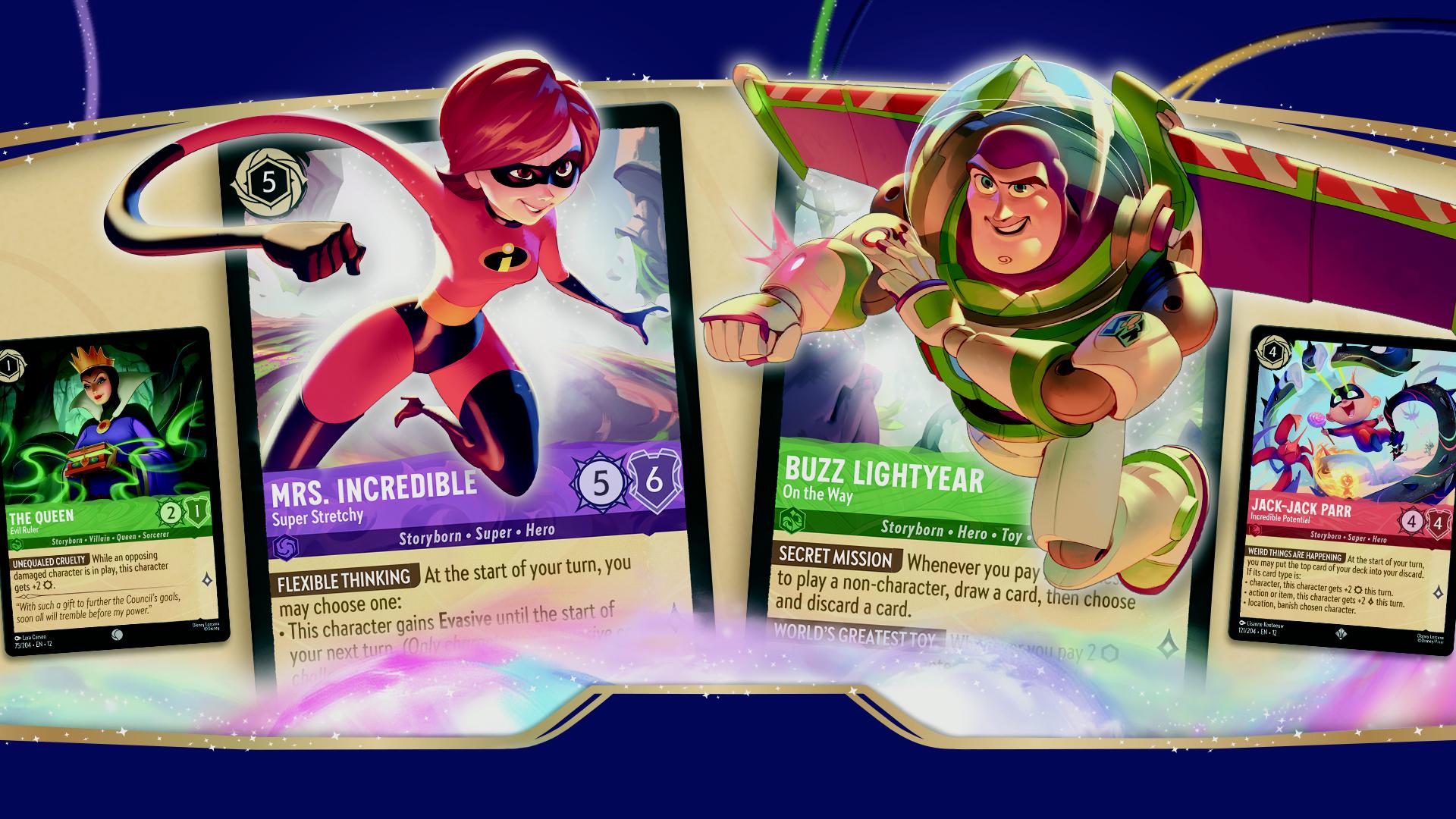
You are not buying into a fight; you're being adopted into a table. Bring your favorite characters, lose with a smile, teach the next newcomer — and you're one of us.
- Find your locals — a Discord, a league night, a store's Weekly Play — because this game is better as a table of people than a stack of cards.
- Go to one Set Championship or store event as a stranger; the scene is famously beginner-warm, win or lose.
- Try an Illumineer's Quest co-op against Ursula for the low-stakes PvE rite, and chase that first hard-mode clear.
- Host a night: pair starters against each other, run the lore tracker where both can see it, and let guests crack a pack for the joy of it.
- When you pull your first Enchanted, post the photo — the fellowship will genuinely cheer.
- Teach someone to play. That's the true graduation, and it's how the whole community grows.
The Ethos Under the Cards
You're an Illumineer summoned by the Great Illuminary to re-gather scattered Lore — the premise that ordinary creative people are worthy of magic. The community is quietly, defiantly proud to be the kind corner of the hobby: non-confrontational by design, less gatekept, welcoming to people who'd never touch a card game. 'The magic is in the cards' — and in who's holding them. They take the magic seriously and take themselves lightly.
The Unwritten Code
Lose with a 'good game' and a smile — the vibe is the product, kept nice on purpose. Offer your deck to cut, never bend a corner, sleeve uniformly so trust holds. Proxies are fine for casual testing, never in sanctioned events, never sold as real. Call a judge when the inkwell's unclear — it serves both players. And teach the new person: you pay forward the patience someone gave you.
The Rites of Passage
Your first self-built 60 (you stop bricking). Curving out perfectly — 1-drop, 2-drop, 3-drop — the engine purrs. A clean Shift swing for the win, your first 'made the table gasp.' Pulling your first Enchanted (~1 per case): you remember exactly where you stood. And the true graduation — teaching someone else to play. Old-guard who survived the 2023 shortage carry the deepest scar-badge of all.
Hosting the Fire
Be the welcoming face. Hand the newcomer a starter, play the matching one, and walk the first game out loud — teach ink, then questing, then challenging, introducing a keyword only when its card appears. Play 'open hand' the first game or two to coach the ink-tension. A full game runs ~20–30 minutes, so a night fits a quick league. Set up a 'crack a pack' moment — the Disney IP makes opening cards genuinely joyful and pulls non-gamers in.
Theme the Table
Lean into the joy: Mickey-shaped pretzels as a centerpiece, 'ink-swirl' butterfly-pea lemonade that swirls like the inkwell, six snack bowls sorted by ink color, Olaf 'warm hugs' cocoa for a Winterspell night, or Pixar 'Pizza Planet' mini-pizzas for a Toy Story session. 'Try the gray stuff — it's delicious.' The theme is half the magic.
The Armory — what to buy first
Everything you need to begin, ranked. Honest picks; affiliate links support the cabinet.
1 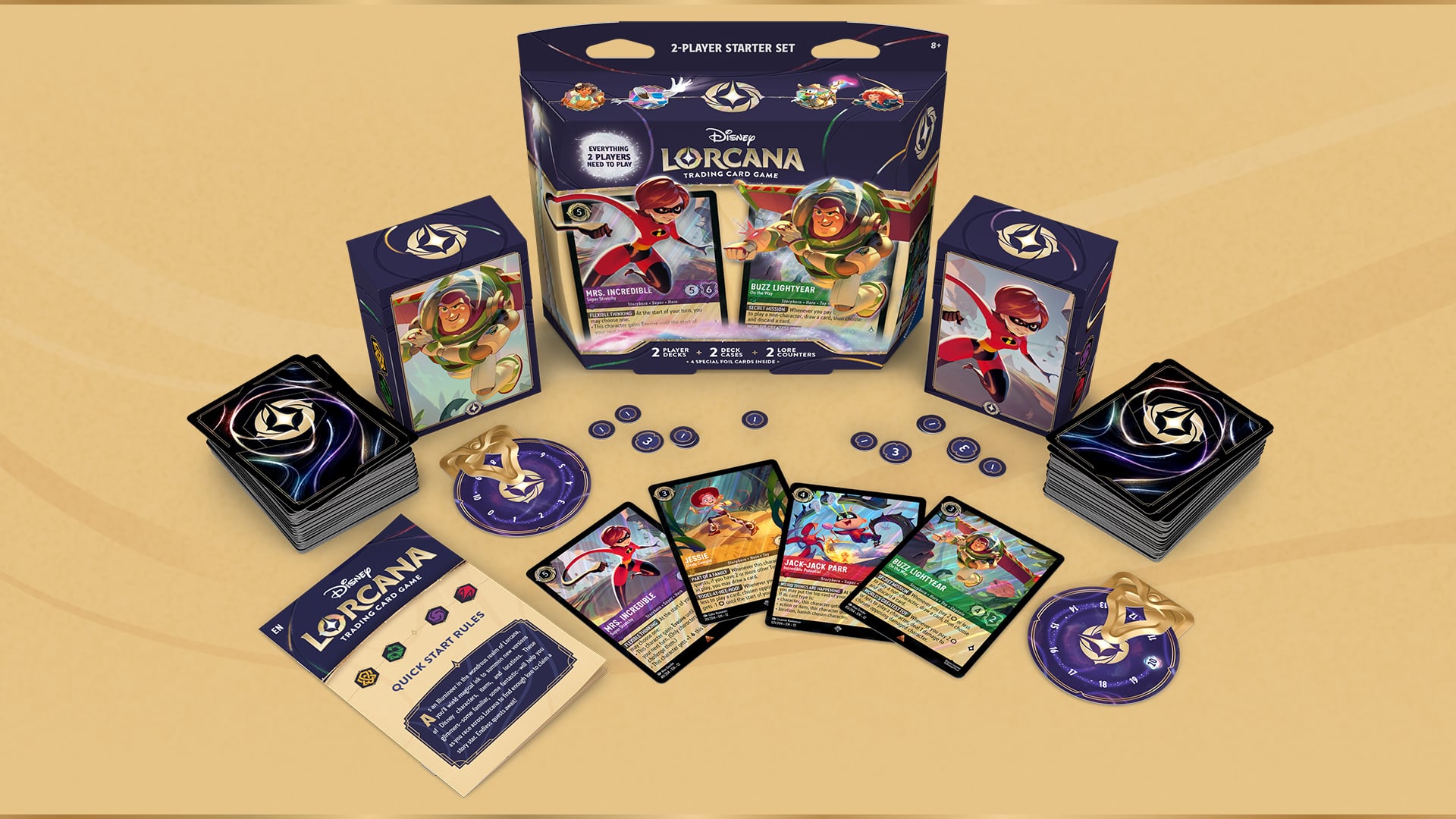
Ravensburger · Two people who want to play out of the box tonight, no deckbuilding
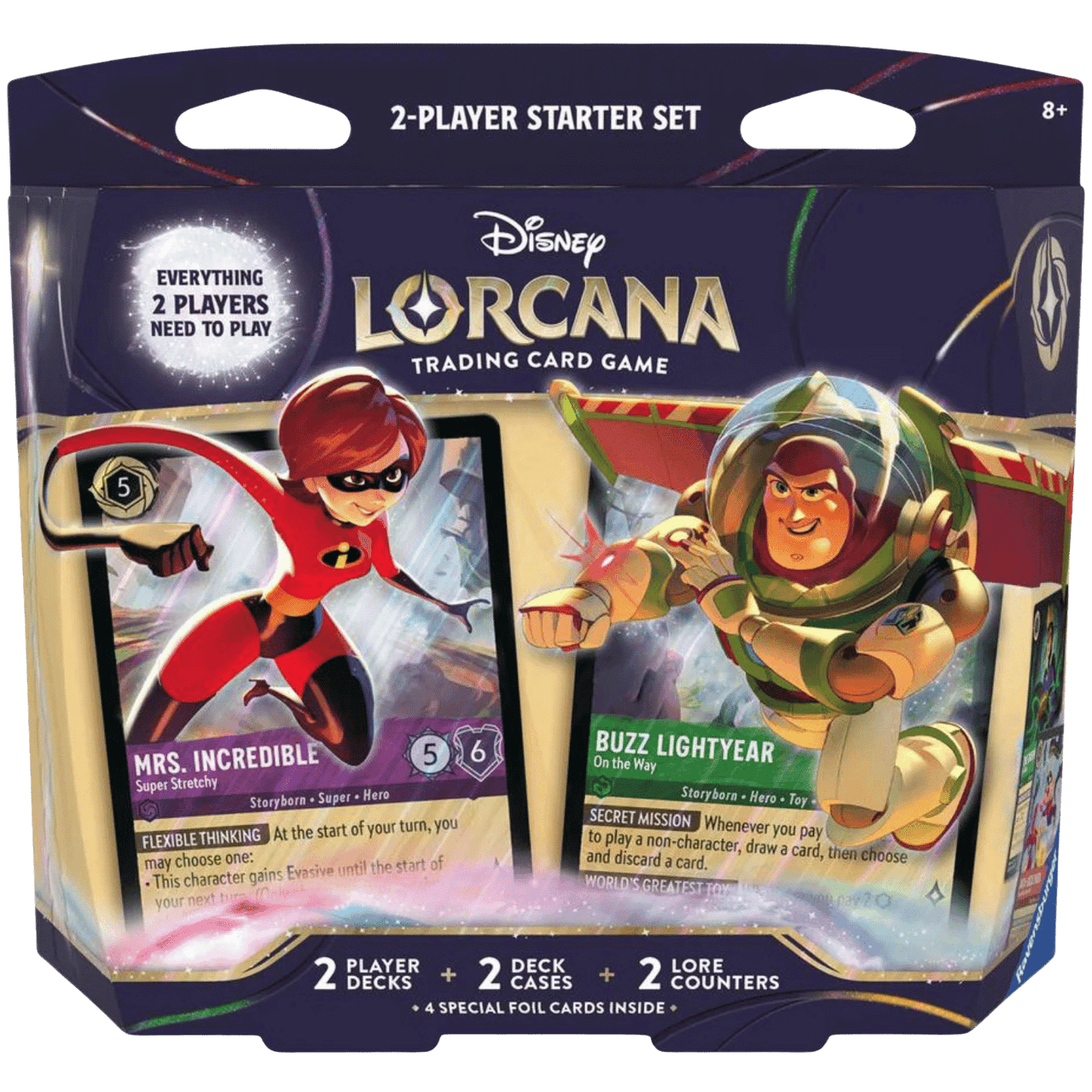
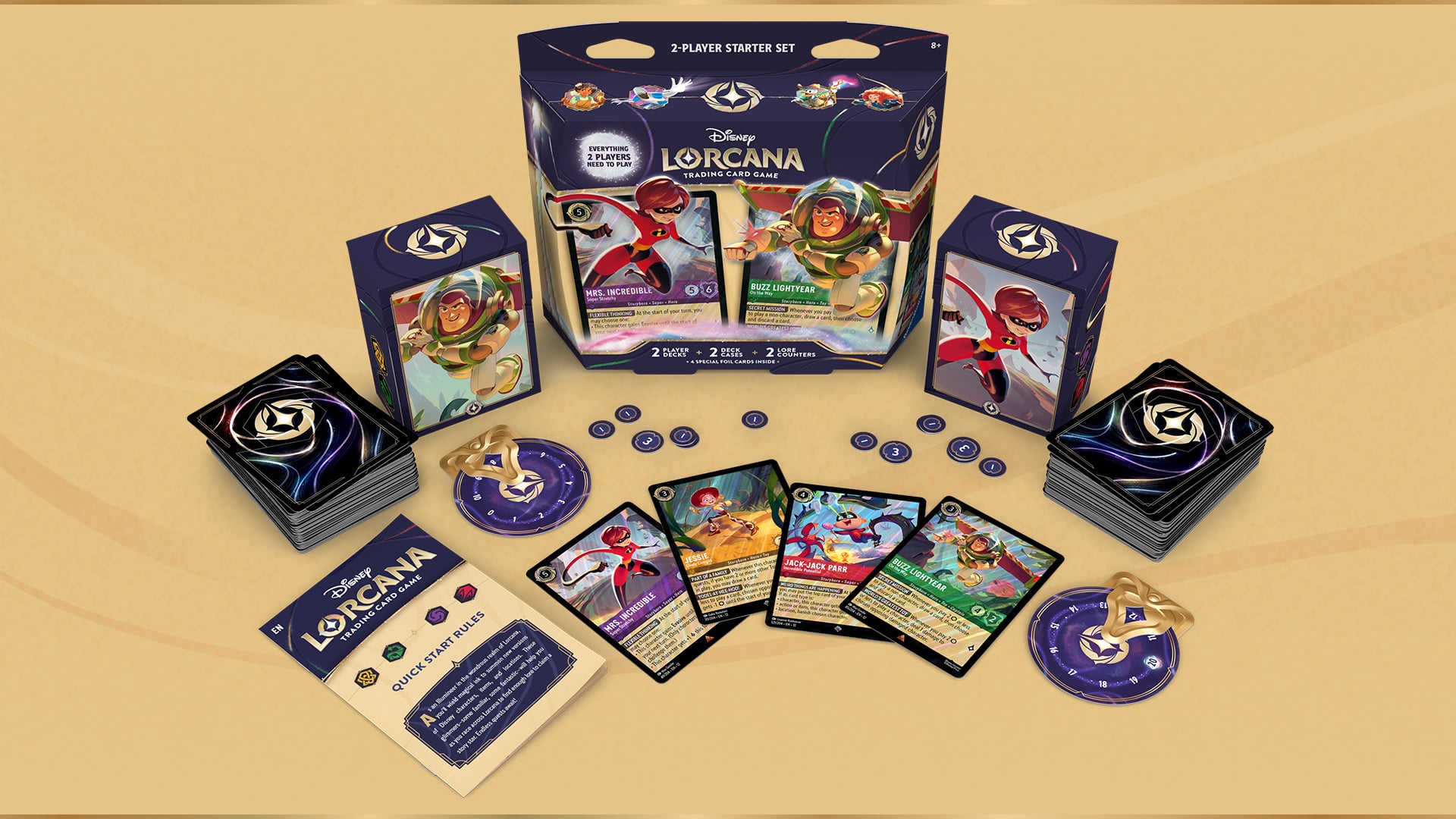
Disney Lorcana 2-Player Starter Set (2026, Amber/Emerald vs. Amethyst/Ruby)
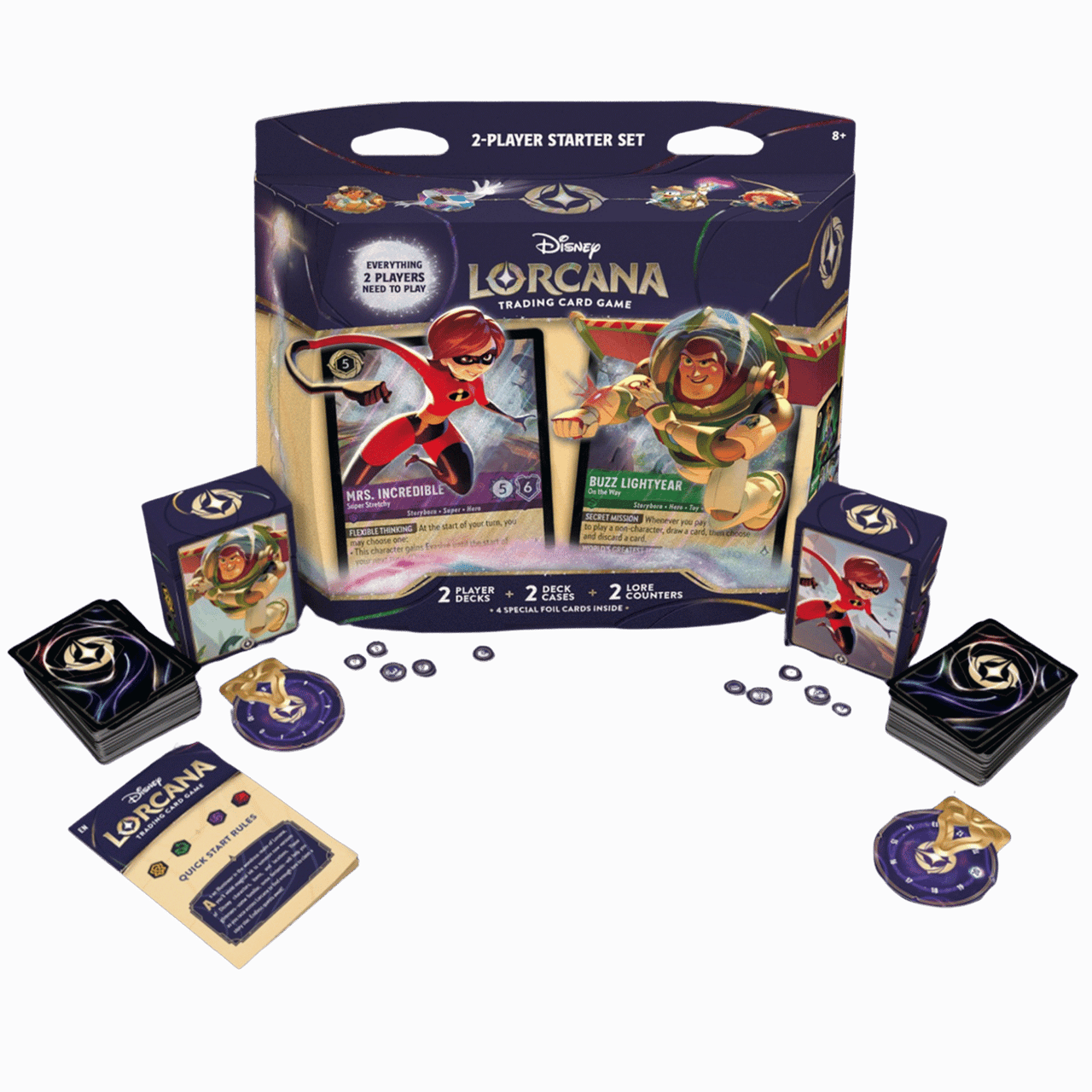
The single best entry point, full stop. One box, two complete preconstructed 60-card decks, lore trackers, and damage tokens — two people sit down and play with zero extra purchases. The 2026 version is deliberately matched: a card-draw deck (Amber/Emerald) against an aggressive one (Amethyst/Ruby), so the two playstyles feel distinct and you learn the ink-tension by watching it across the table. This is the box veterans hand to newcomers.
Yumi: If you buy one thing, buy this. It's the warmest possible welcome and it pays for a whole game night.
- Two full ready-to-play decks in one box
- Balanced against each other so beginners never get blown out
- Teaches two distinct playstyles immediately
- Only two preset decks — deckbuilding comes later
- Not the path if you only need a single deck for yourself
The catch: It's an on-ramp, not an endgame — you'll outgrow the preset lists once you start brewing.
 2
2 Ravensburger · One person who wants the cheapest legal, playable deck
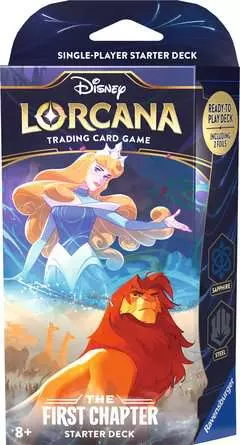
Disney Lorcana Starter Deck (any single 2-ink deck)
The cheapest way for one person to get a complete, legal, beginner-friendly 60-card deck — two ink colors, tokens, and a rules insert in the box. The community's loudest, most-repeated advice is to start with starter decks, not random boosters: starters give you a coherent, balanced deck to actually learn with, while packs are for chasing cards later. Buy two different ones and you've built yourself a full 2-player setup.
Yumi: The frugal, flexible choice — grab two flavors you love and you've covered both seats.
- Cheapest single-person entry to a real, playable deck
- Built to be beginner-friendly and coherent
- Two different decks = an instant 2-player setup
- One deck alone needs a second deck (or a friend's) to play
- Exact price varies by retailer and set
The catch: Price left unlisted here because it genuinely varies by retailer and set; check before you buy.
 3
3 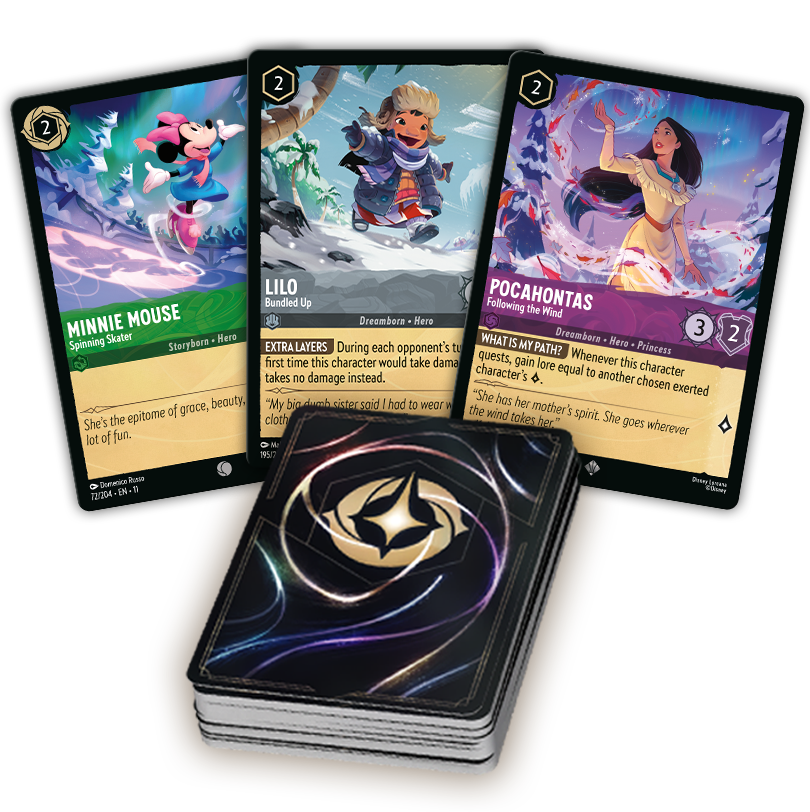
Ravensburger · Stitch fans and collectors who want a low-pressure on-ramp with storage
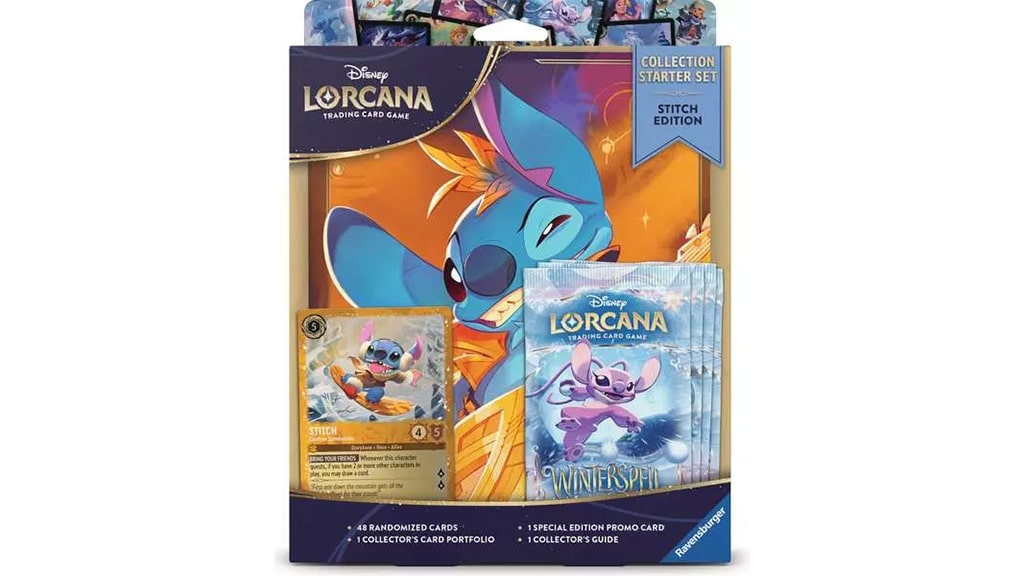
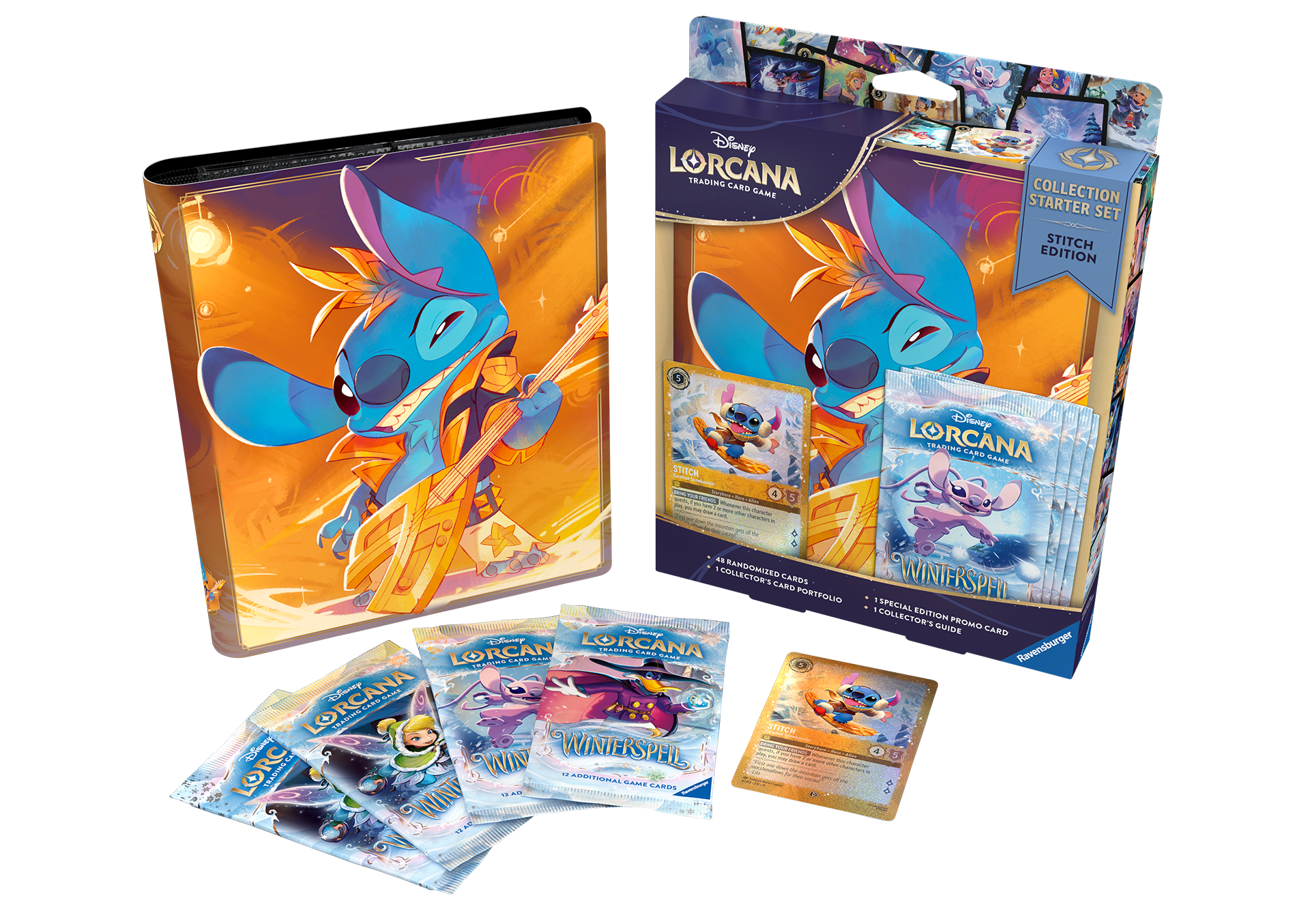
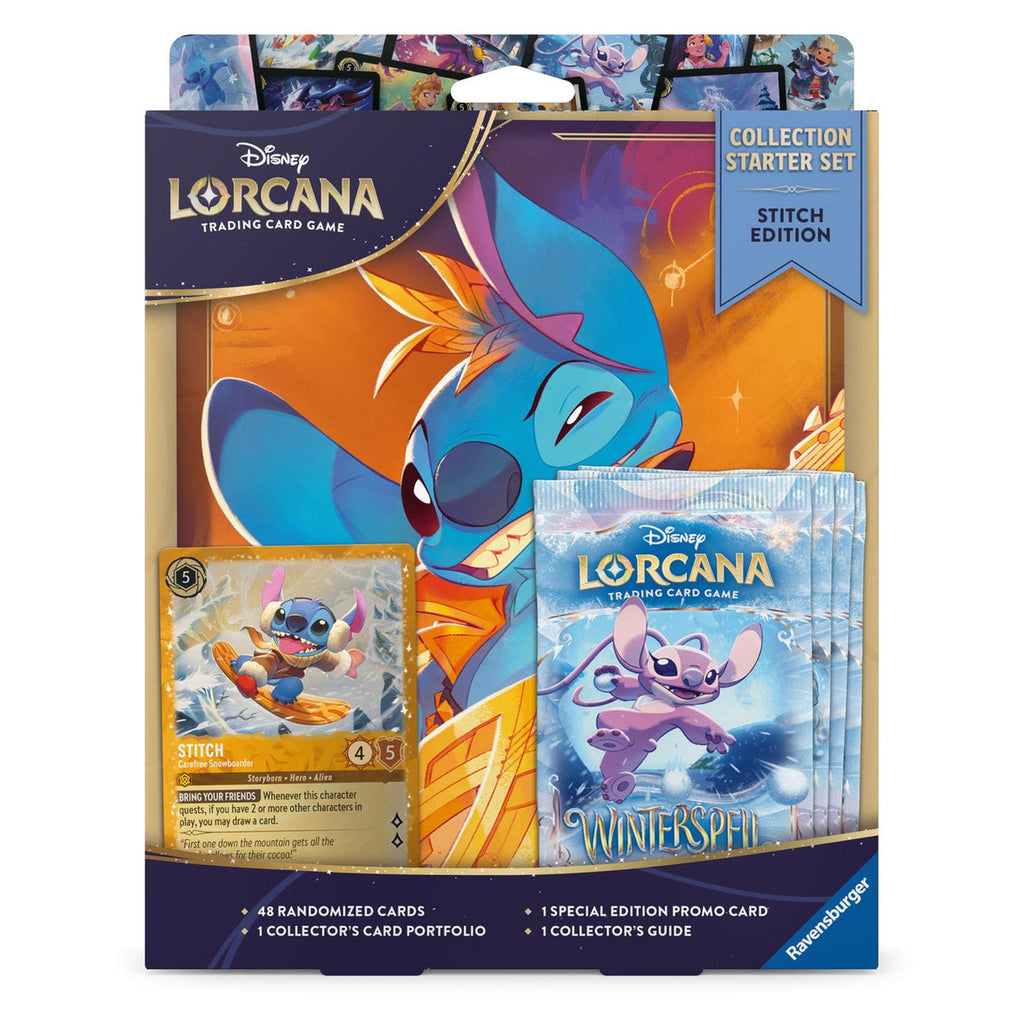
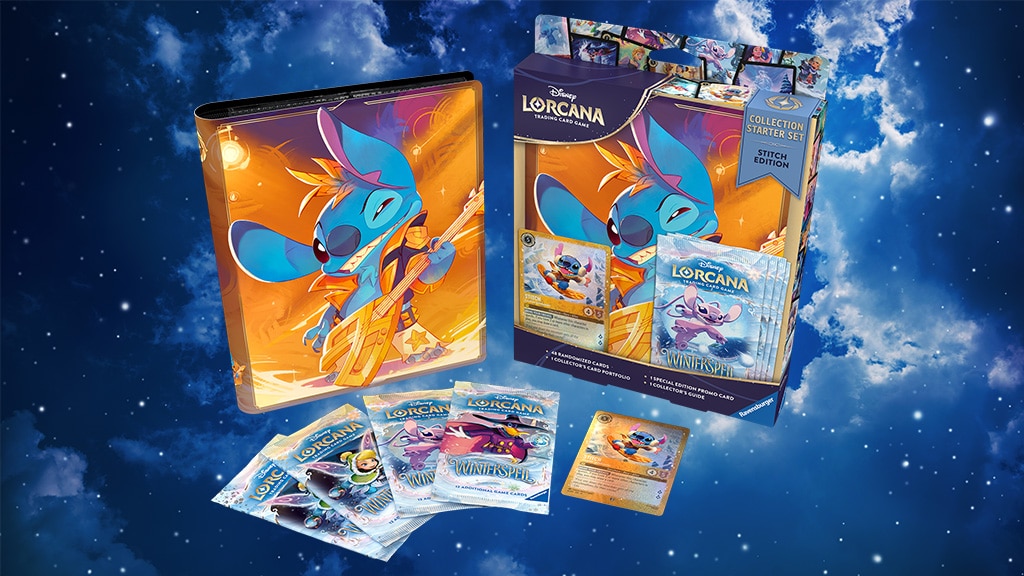
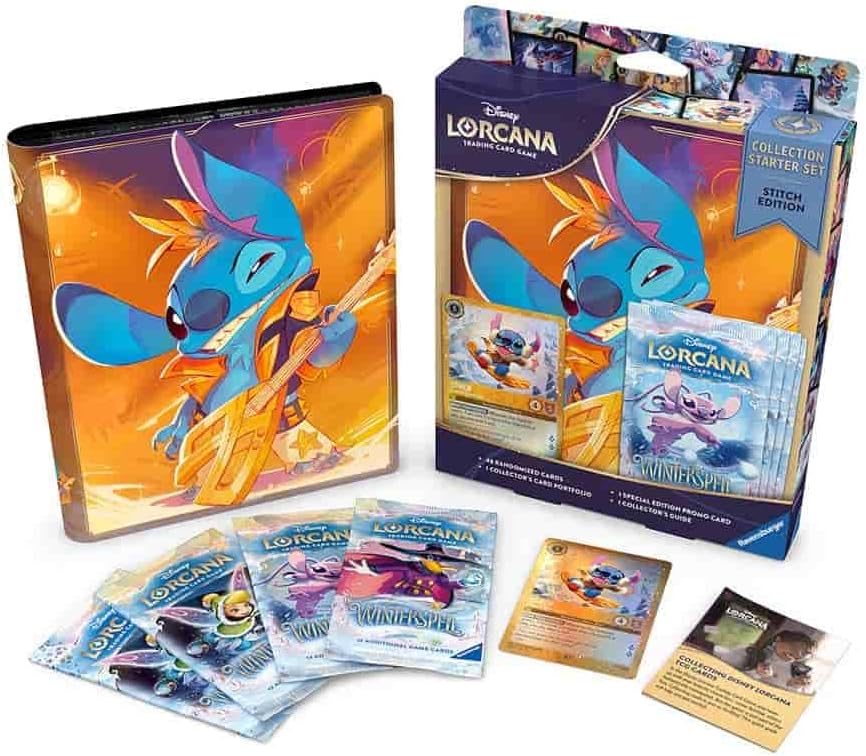
Collection Starter Set – Stitch Edition (2026)
A gentle collector's on-ramp: 48 randomized cards plus a portfolio and an exclusive Stitch – Carefree Snowboarder promo glimmer, all in one $29.99 purchase. It hands you cards and storage together, which is lovely for a Stitch fan dipping a toe in. Just know what it is — a collection/sampler, not a balanced ready-to-duel deck the way a Starter Deck is.
Yumi: A sweet gift for the Disney-first fan — but pair it with a Starter Deck if they want to duel.
- Cards and storage portfolio in one buy
- Exclusive Stitch promo glimmer
- Low-pressure, collector-friendly entry
- Randomized cards — not a balanced, ready-to-play deck
- You'll still want a Starter Deck to actually learn the game
The catch: It's a sampler, not a duel-ready deck — don't expect to play a balanced game straight from this box.
 4
4 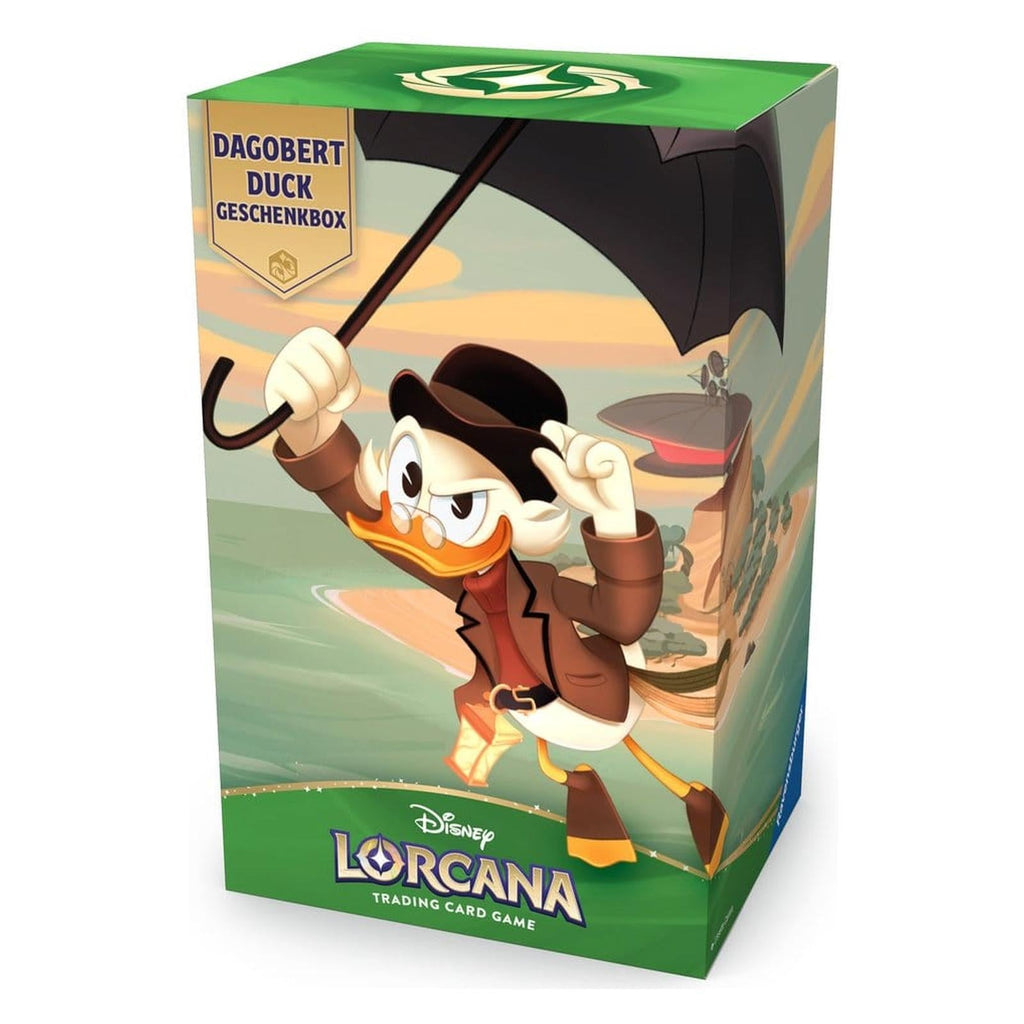


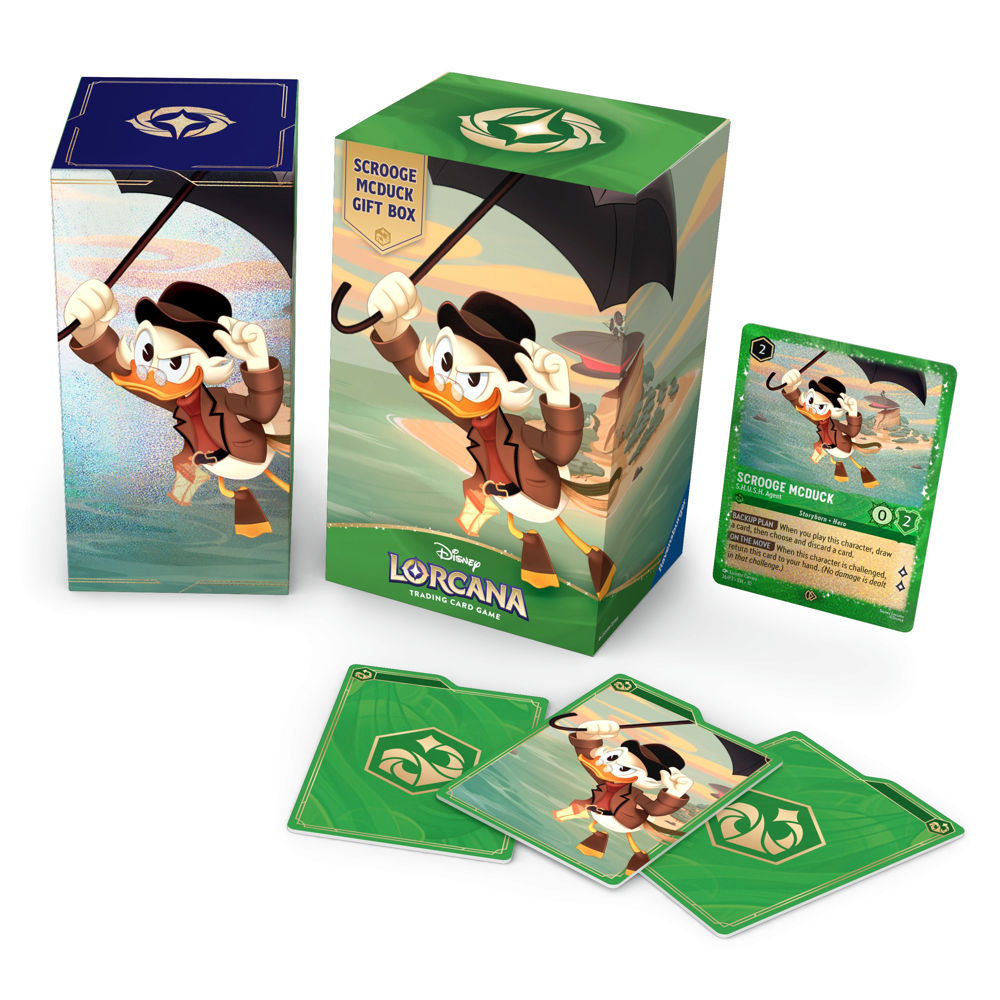
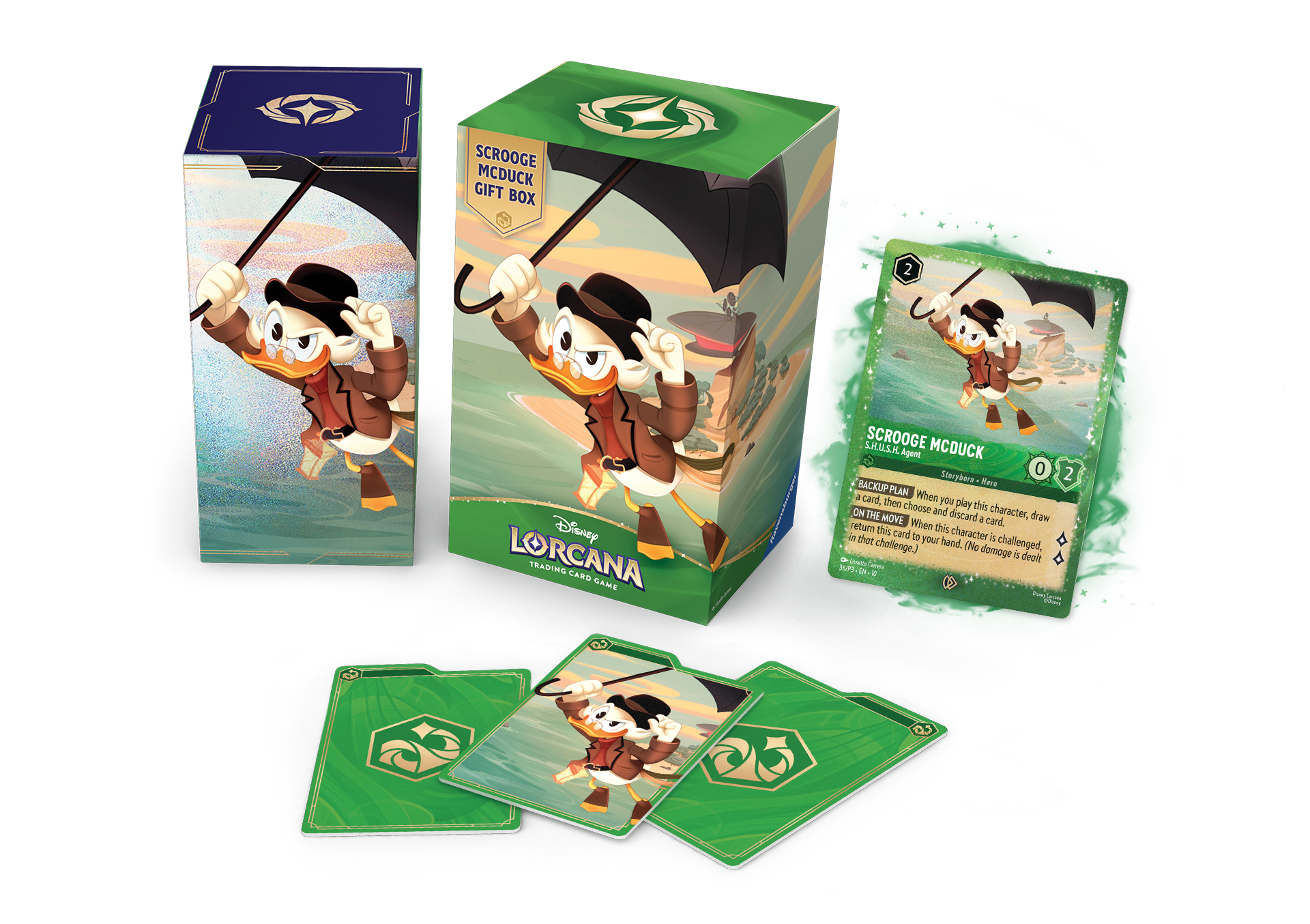
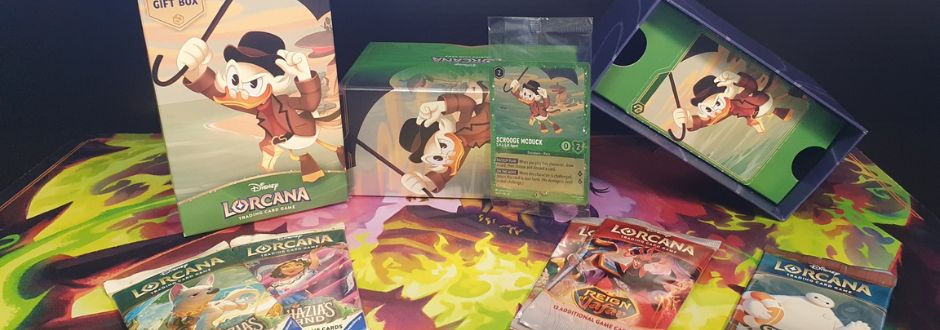
Ravensburger · A DuckTales fan who wants a giftable themed bundle with storage
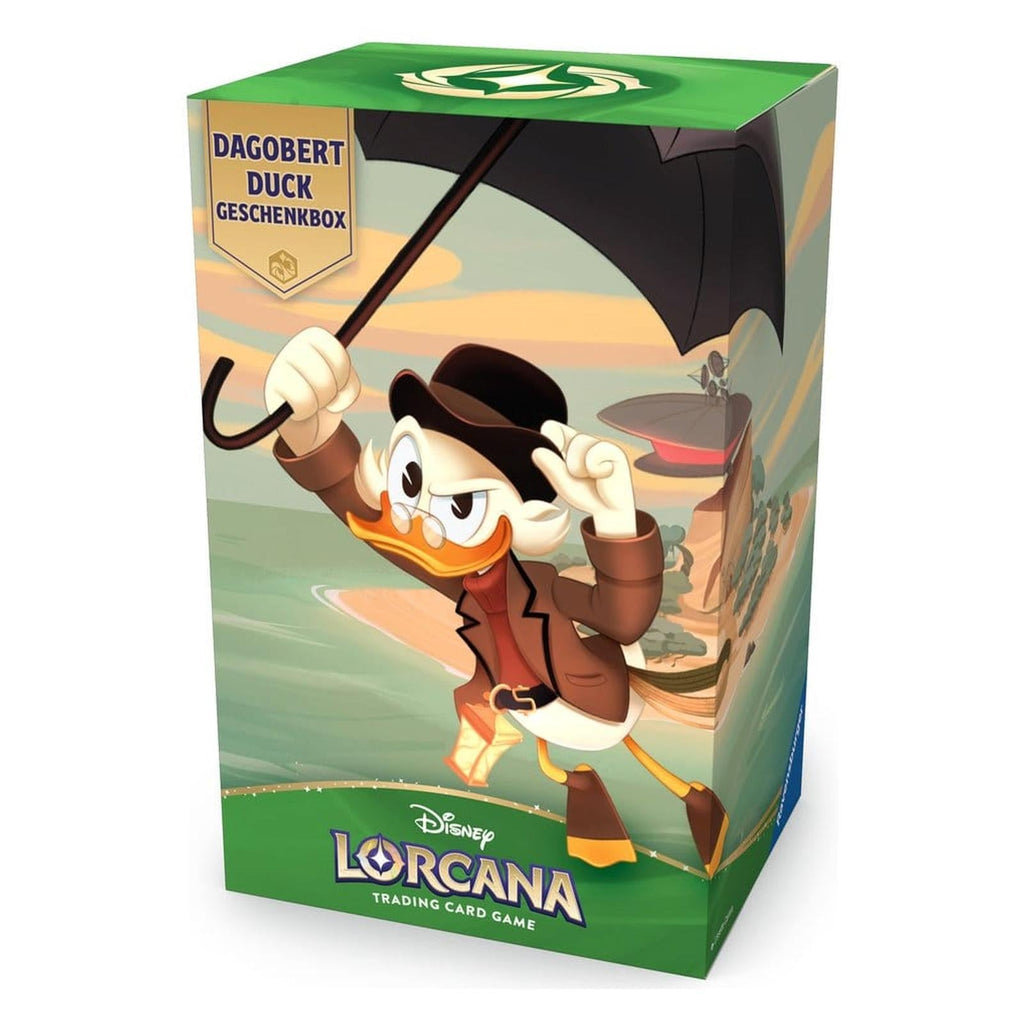
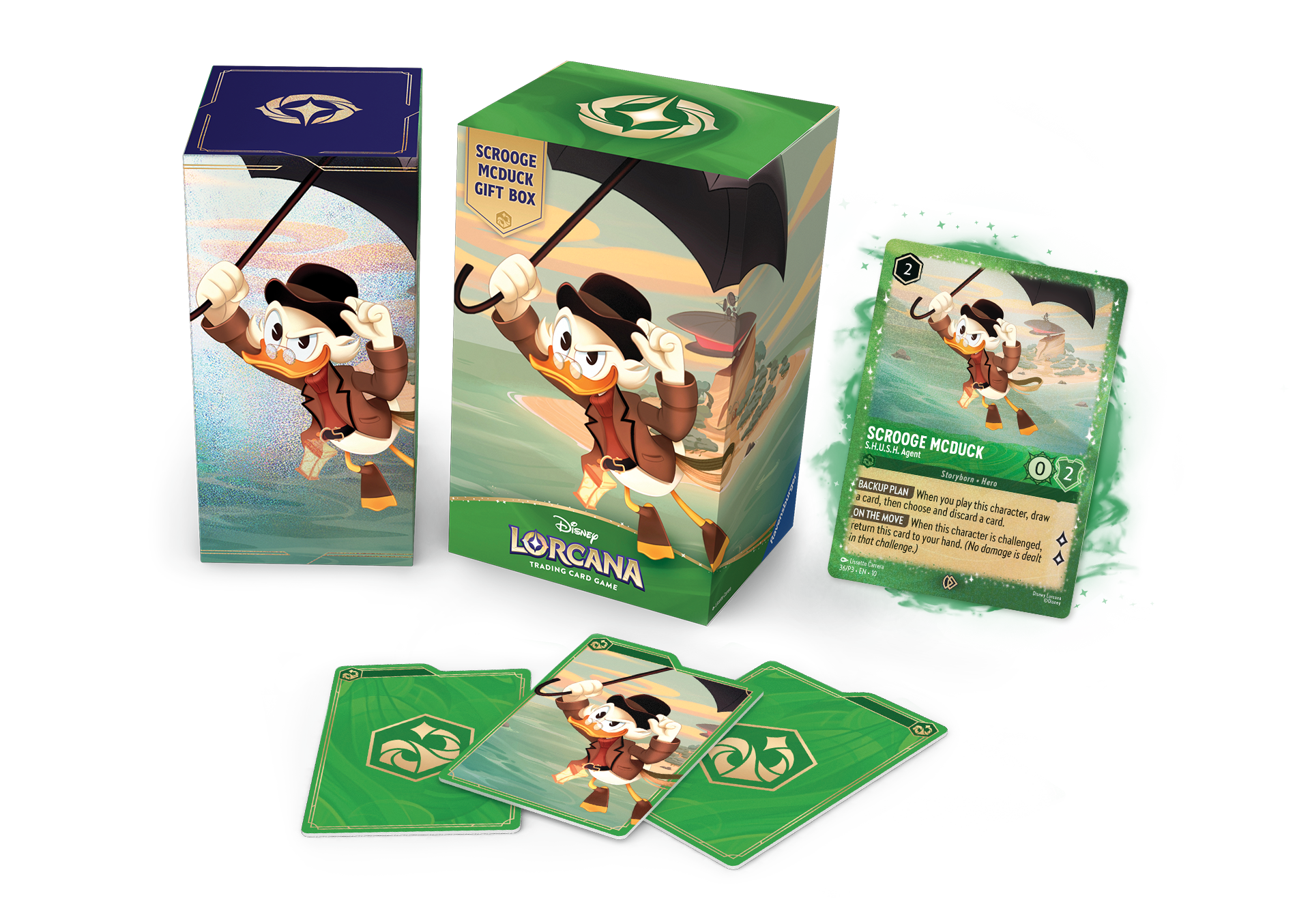
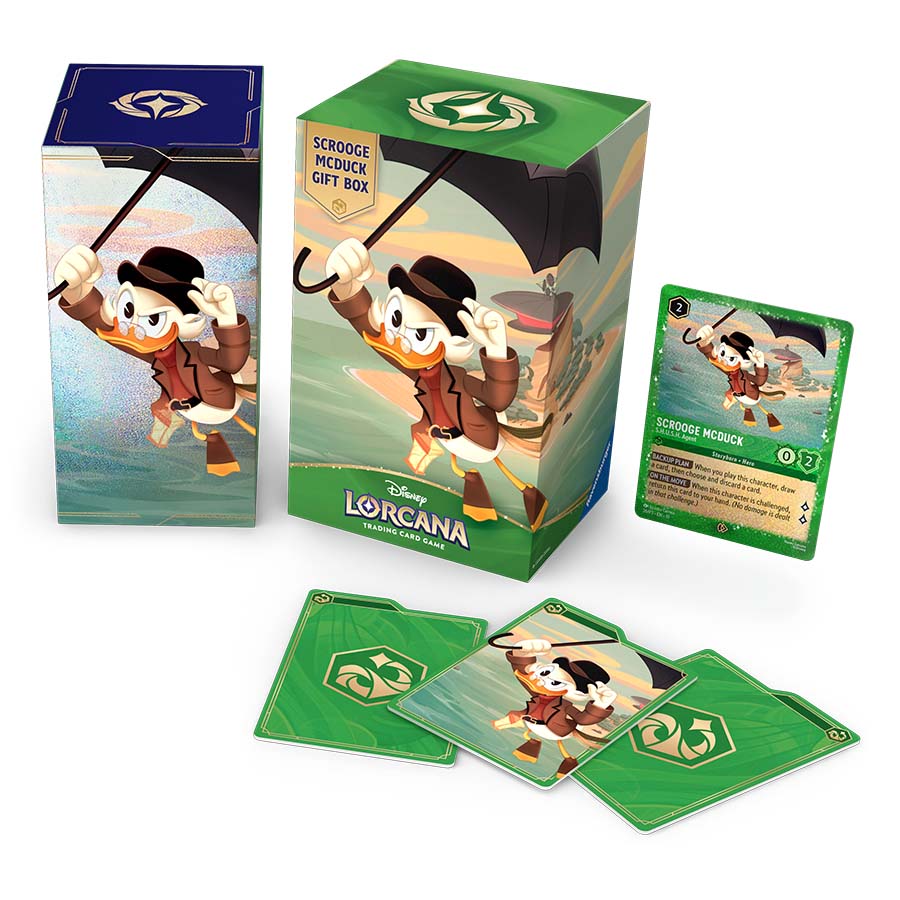
Scrooge McDuck Gift Box (2026)
A fun, giftable themed bundle: 60 cards, a storage box, and an exclusive Scrooge McDuck – S.H.U.S.H. Agent promo glimmer for $29.99. It's the kind of charming, theme-forward package that lands well as a present for a DuckTales fan who also wants somewhere to keep their growing collection.
Yumi: The present that feels personal — wrap it for the DuckTales devotee in your life.
- Exclusive Scrooge McDuck promo glimmer
- Includes a storage box
- Great themed gift at a friendly price
- More gift bundle than competitive on-ramp
- DuckTales theme is niche if that's not their fandom
The catch: Lean toward the 2-Player Set first if the goal is learning to play rather than gifting.
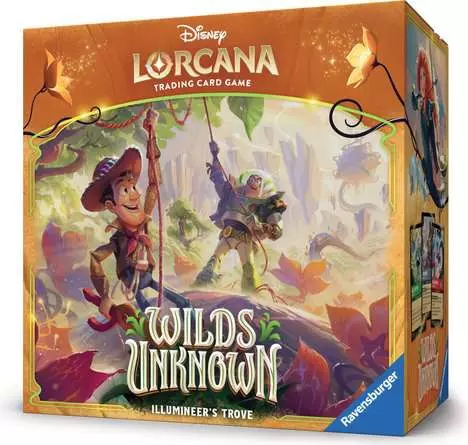 5
5 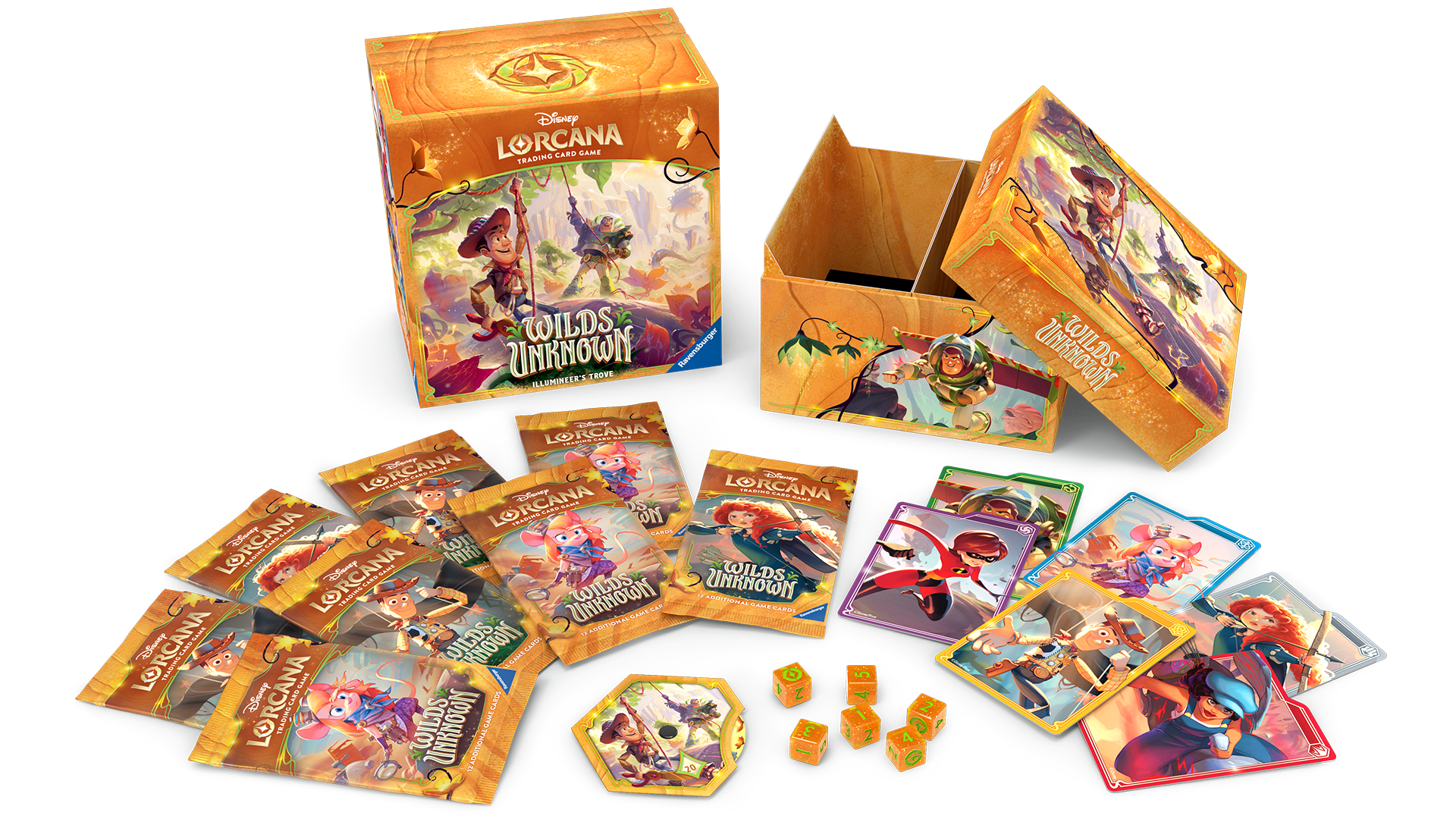
Ravensburger · Someone who wants storage AND fresh packs from the newest set in one buy
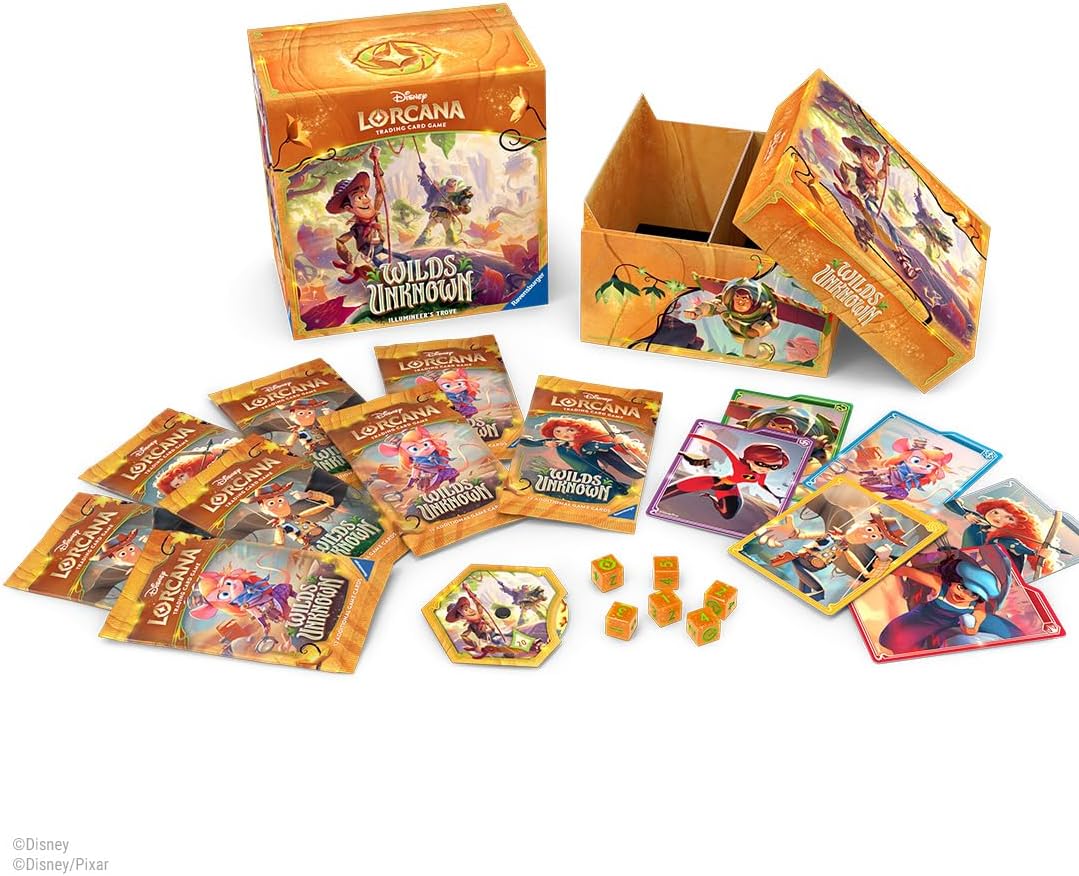
Illumineer's Trove (current set)
The natural 'one box for everything' once you're past a single deck: a sturdy storage box plus several booster packs, a foil card, and reference materials for the newest set. It's the ideal single purchase when you want both a home for your collection (holds 400+ sleeved cards in trays) and fresh packs to crack from the latest expansion.
Yumi: Buy this once you're hooked and need a home for everything — it's the collection's first real shelf.
- Storage box plus boosters and a foil in one purchase
- Holds 400+ sleeved cards as your collection grows
- Tied to the newest set for current cards
- Packs are random — not a coherent deck to learn with
- Price varies by set and retailer
The catch: Not a learning purchase — get a Starter Deck first, then let the Trove store what you build.
 6
6 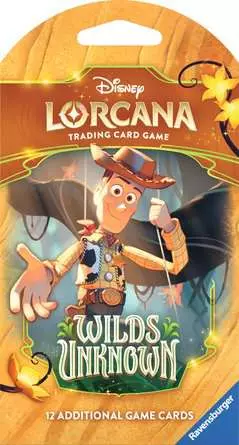
Ravensburger · Upgrading an existing deck and chasing specific rares (and Enchanteds)
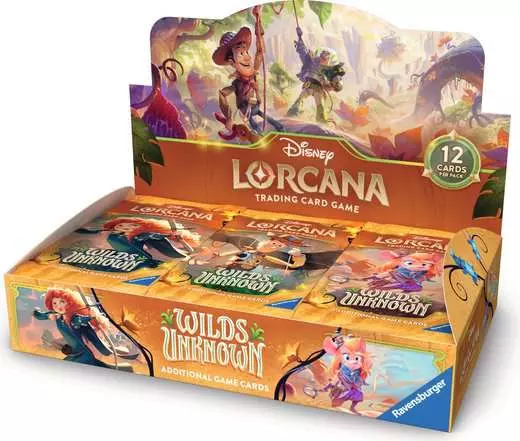
Booster Pack / Booster Box (current set, e.g. Wilds Unknown)
Sealed random packs from the newest set — the chase. This is how you hunt specific cards, rares, and the holy-grail Enchanted alternates (roughly one per case). Buy these AFTER you have a starter deck, never before: random packs won't hand you a coherent, playable deck, so they're for upgrading and the joy of the box break, not for learning the game.
Yumi: Save these for after you're hooked — cracking packs with friends is half the fun, but it's dessert, not dinner.
- The path to specific rares and chase Enchanteds
- Box breaks are genuine communal theater
- Wilds Unknown brings the first Pixar glimmers
- Random — will not give you a playable deck on its own
- Easy money-sink if bought before you understand deckbuilding
The catch: Never your first purchase: packs are for chasing and upgrading, not for learning to play.
Questions from the road
How do you win Disney Lorcana?
You win by being the first player to collect 20 lore. You earn lore mainly by questing — exerting (turning sideways) a ready character to gain the lore value printed in its top-left corner. Some locations and card effects grant lore too. Remember the mantra: it's a lore race, not a fight — you win by questing, never by killing your opponent.
What is ink and the inkwell?
Ink is your resource for playing cards. Once per turn you may place one card that has the ink-swirl symbol around its cost face-down into your inkwell. It's gone from your deck for the game but becomes a permanent generic resource — exert one ink to pay one cost, and any ink pays for any card. Deciding 'ink it or play it?' every turn is the real skill of the game.
Why can't my character do anything the turn I play it?
That's summoning sickness — fans say the ink needs to dry. A character can't quest, challenge, or use exert abilities until your next turn, unless it has the Rush keyword (which lets it challenge immediately). It trips up everybody once; nobody shames you for relearning it.
Can I attack any of my opponent's characters?
No — you can only challenge characters that are exerted (turned sideways), usually because they just quested. Ready, upright characters can't be challenged. Bodyguard characters must be challenged before others if able, which is how they protect your fragile lore engines.
How does combat work?
Exert your character and choose an exerted enemy character. Both deal damage equal to their Strength simultaneously. A character is banished when its total damage reaches or exceeds its Willpower. Crucially, damage stays on surviving characters across turns — plan your challenges around lingering damage rather than treating every turn as fresh.
Do I need to buy booster packs to start?
No. The best start is a 2-Player Starter Set or two single Starter Decks — they're complete, balanced, ready-to-play 60-card decks. Booster packs are random and are for upgrading decks later, not for learning. The community's most-repeated advice is: start with starters, not packs.
How many cards is a deck and how many copies can I run?
A deck is a minimum of 60 cards, you may include up to 4 copies of any single card name, and a deck uses only one or two of the six ink colors. A healthy build runs ~45–47 inkable cards (only ~11–13 uninkables) so you don't brick.
What's the newest set in 2026 and what's coming?
Wilds Unknown (the 12th set, May 15, 2026) is newest and added the first Pixar glimmers — Toy Story, Brave, and The Incredibles. It followed Winterspell (Feb 2026); coming later are Attack of the Vine! (summer, leaning on Monsters, Inc. and Turning Red) and an unnamed Coco set in Q4. New sets arrive roughly every three months.
What does the mulligan do, and what is 'bricking'?
After drawing your 7-card opening hand, each player once may put any number of those cards on the bottom of their deck and draw that many new cards back up to 7. Use it to ditch a bad hand — especially one with no low-cost or no inkable cards — since those are exactly the hands that brick (a no-ink hand you can't pay for, said at the table with a rueful 'I bricked').
Is Lorcana hard to learn?
It's considered one of the easiest modern TCGs to pick up — most people grasp the core loop (ink, quest, challenge, race to 20) in a single game. People who bounced off Magic or Yu-Gi-Oh often find it clicks instantly. The long-term depth lives in inkwell management: knowing what to ink versus what to keep.
✿ The graduation And that's the whole initiation, Illumineer — ink one card, quest to twenty, challenge honestly, and lose with a smile. You came in nervous and you're leaving as one of us, because the truth at the heart of this game is that you were never buying into a fight; you were being adopted into a table that's quietly, defiantly proud to be the kind corner of the hobby. So go pick the colors you love, build the deck that's secretly a self-portrait, and find your locals — and when the day comes that you hand the cards to someone else who's nervous and new, you'll feel the magic complete itself. The chair's yours now. Welcome to the fold, and remember: when in doubt, just quest.
— Yumi, Come back when your hands need something new. ✿
The Hostess · invites you inCome in, take your shoes off — let me show you something.
Found your footing? Send this to someone starting out.
Sources & further reading
- lorcanaplayer.com/how-to-play-disney-lorcana-rules
- www.wargamer.com/disney-lorcana/rules
- www.wargamer.com/disney-lorcana/sets
- www.wargamer.com/disney-lorcana/keywords
- www.wargamer.com/disney-lorcana/starter-decks
- screenrant.com/disney-lorcana-all-2026-sets-release-dates-schedule
- screenrant.com/disney-lorcana-reveals-release-wilds-unknown-onward-coco-monsters-inc
- www.fantasylandnews.com/2026/04/14/disney-lorcana-wilds-unknown-set-release-date-pixar-characters
- www.disneylorcana.com/en-US/news/2025/12/2025-12-december-product-announcement
- www.antsylabs.com/blogs/the-ant-hill/the-ultimate-disney-lorcana-terms-glossary-lingo-jargon-tcg
- cardgamer.com/games/tcgs/lorcana/keywords-in-disney-lorcana
- www.disneylorcana.com/en-US/story
- www.thegamer.com/the-disney-lorcana-story-so-far-explained