Modular Terrain Systems for Wargaming: Dwarven Forge, Mantic & Battle Systems
Three proven modular terrain systems compete on durability, assembly, and cost — know where each earns its place at your table.


Written and reviewed by Robert Pruitt · how this guide was made
Last editorial refresh: 2026-06-18 Gold-standard QA: 2026-07-17 8 sources reviewed Affiliate links checked during gold-standard pass

The short answer
Dwarven Forge wins on hand-painted quality and durability for premium wargaming; Mantic Terrain Crate dominates on affordability and flexibility; Battle Systems splits the difference with pre-printed card terrain that requires no painting and minimal assembly.
Decision map
Choose in thirty seconds
Wargamers who want versatility and variety on a tight budget
Wargamers who want a complete, ready-to-play table with zero assembly friction
Scene-focused wargamers and narrative campaigners who want a signature centerpiece for skirmish games
A good battlefield is half the game. The three modular terrain systems here—Dwarven Forge, Mantic Terrain Crate, and Battle Systems—each take a different bet on what a wargamer values: durability and paint quality, cost per piece and infinite modularity, or speed to table with zero finishing work. All three are in active production and worth considering. The choice depends on your budget, assembly tolerance, and whether you want terrain that plays a role in the narrative or furniture that stays out of the way.
Start here, then go deeper
You are in the right cabinet.
 ✠ Universe HubWarhammer: the whole buying pathWarhammer is Games Workshop's tabletop colossus — the grimdark far future of Warhammer 40,000 and the high fantasy of Age of...
 ⚙ Topic PathMiniatures and Wargames: compare the whole shelfThe cheapest box is not always the cheapest way in. These guides connect rules format, faction fit, terrain, tools, paint, and the...
 Buying GuideAre Gaming Tables Worth It? Board Game Tables Compared (2026)A purpose-built gaming table is furniture that asks you to spend like an heirloom and use it like a workbench—an old instinct finally...
How much terrain do you actually need to buy?
Before you compare systems, answer the question that decides your budget: how much table do you have to cover? The long-standing wargaming rule of thumb is that roughly a quarter to a third of the playing surface should carry terrain — enough to give cover, block line of sight, and create the choke points that make a game tactical, but not so much that armies can't maneuver. On a standard 6×4 table that's about six 12×12 inch zones of meaningful scenery, not a wall-to-wall diorama.
This matters because it reframes the price tags below. You are not buying enough Dwarven Forge to tile an entire battlefield — that would cost four figures and nobody does it. You're buying enough to hit the quarter-coverage mark with pieces that earn their place. That's why the smart layered approach almost always wins: a cheap base layer (Mantic or Battle Systems) that fills the bulk of the table, with a few premium hero pieces (Dwarven Forge resin, a WizKids centerpiece) placed where the camera and the action both land.
So the honest first move is to measure your table, mentally divide it into 12-inch squares, and decide how many of those squares need to be 'busy.' Buy to that number. Most new wargamers wildly over-buy on their first order, then discover half of it never leaves the box. Hit coverage first, upgrade pieces second.

Why hand-painted resin over cardboard or plastic?
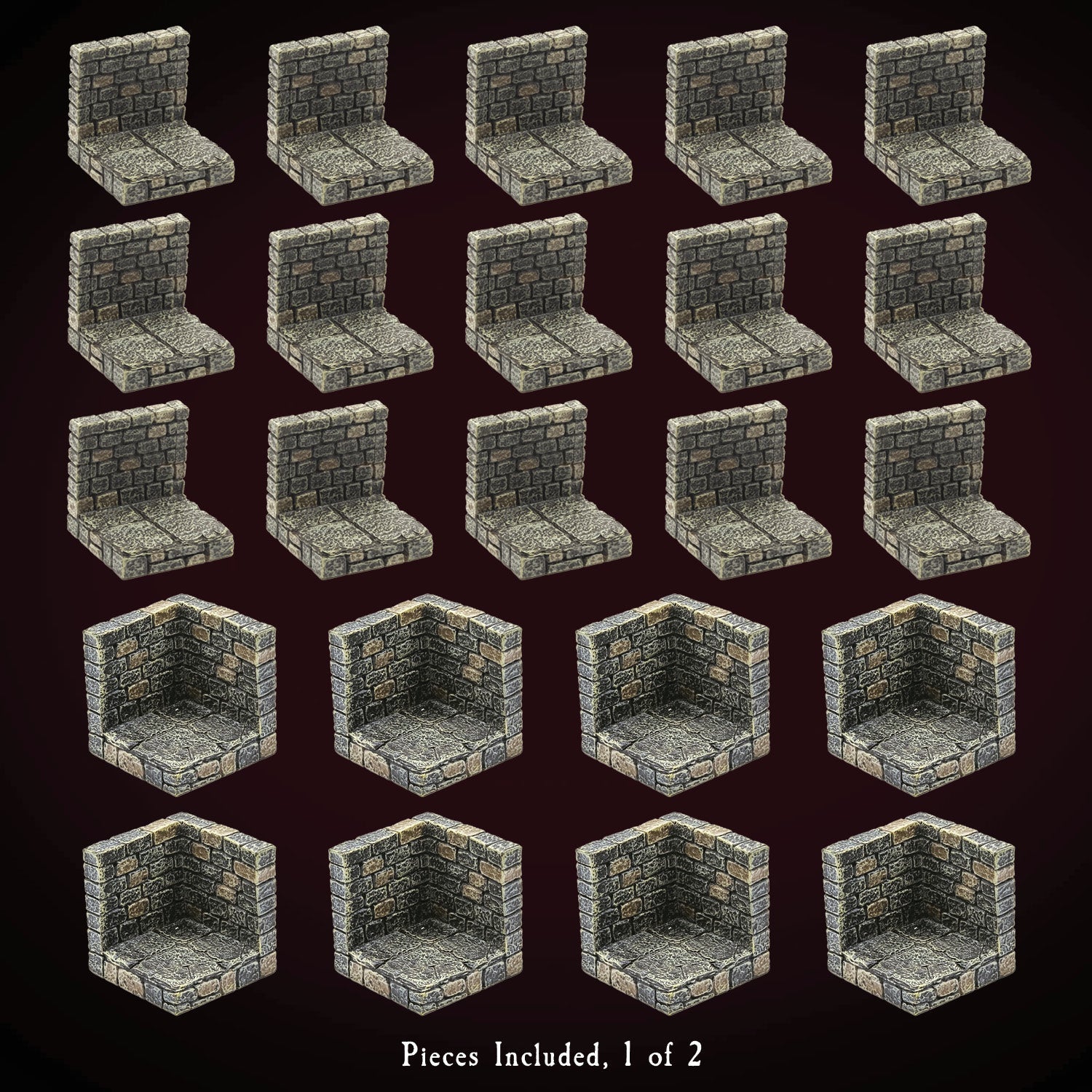
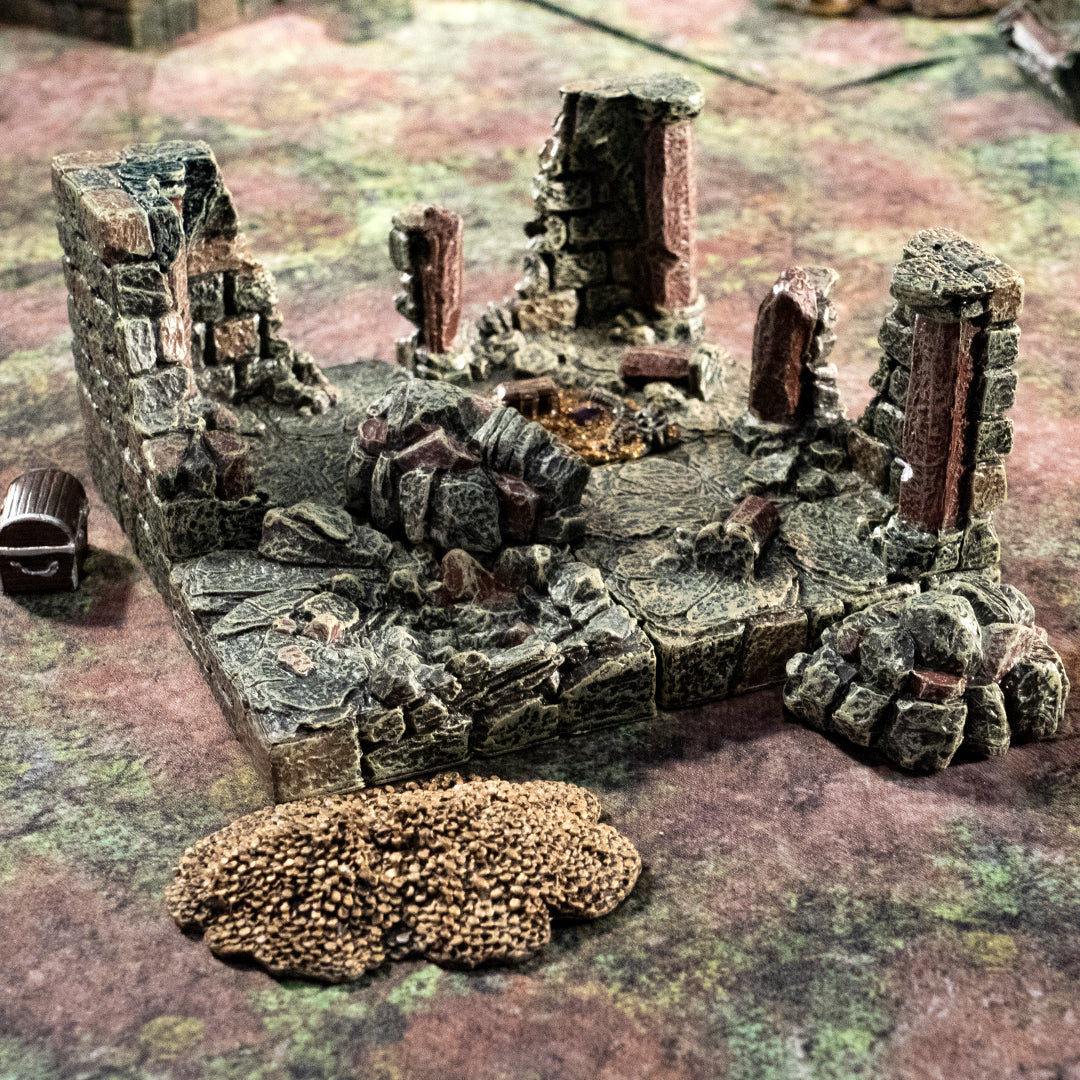
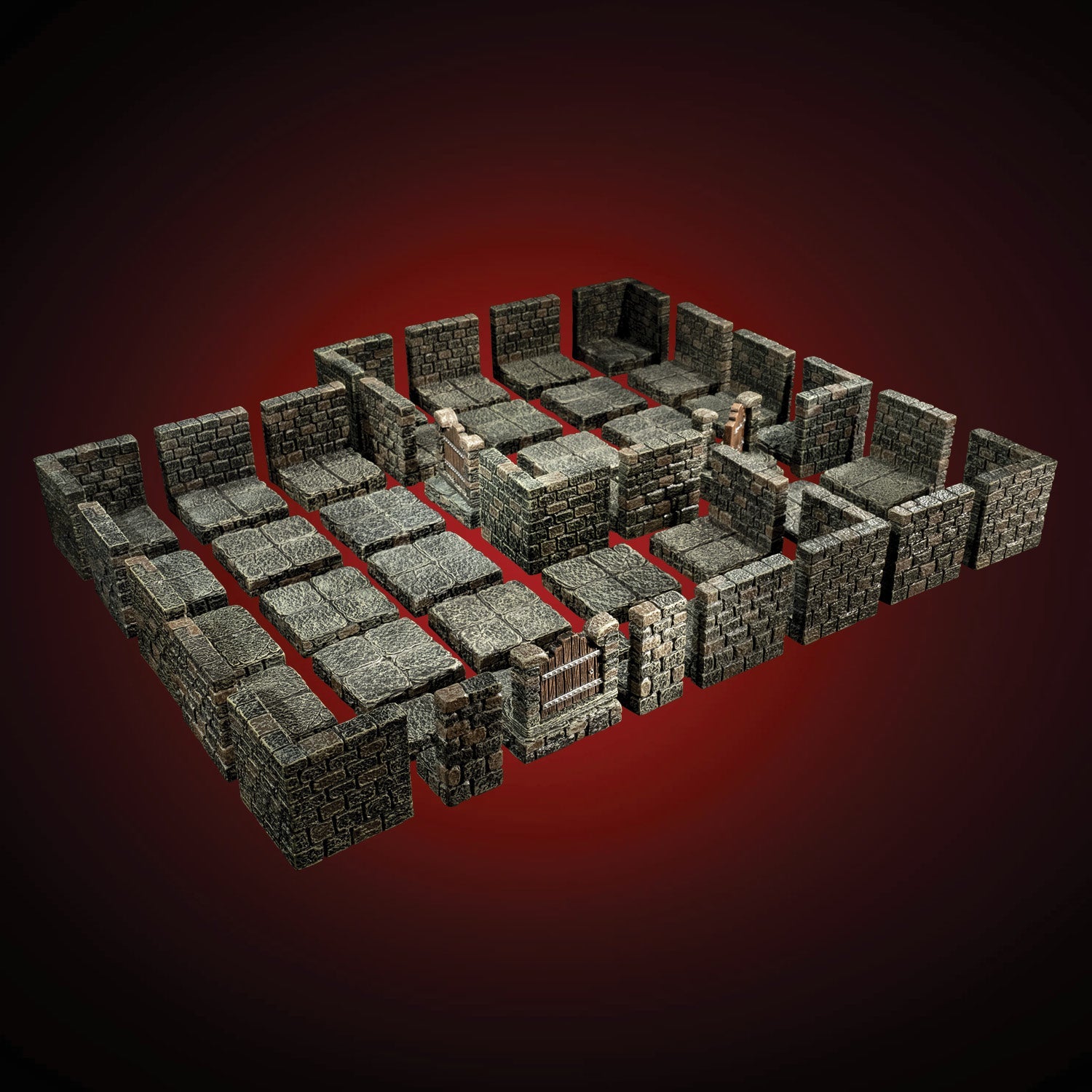
Dwarven Forge pieces are cast in Dwarvenite, a proprietary dense PVC that holds crisp sculpted detail and shrugs off the abuse a real game table dishes out — drops, transport, sleeves, dice rolling across it for years. They arrive hand-painted and table-ready, and they quietly set the visual standard at the table: cheaper scatter around them suddenly reads as 'part of the same world.' The tradeoff is cost. A single core set runs roughly $48–$131 unpainted or $67–$167 painted, and you are buying force multipliers, not a whole battlefield.
Here's the insider truth most buyers learn the hard way: the unpainted route is a real hobby commitment, not a shortcut. Dwarvenite is fussy about paint — many hobby acrylics dry tacky on it. The company's own line, Pokorny Artist Colours, was formulated specifically for the material and needs no primer; if you prime anyway, Army Painter spray is the one most painters report working cleanly. Natural-hair brushes beat synthetics on the dense surface. If you don't want that project, buy painted and never look back.
The other quiet advantage is resale. Dwarven Forge rotates sets in and out of production and retires lines permanently. Retired and Kickstarter-exclusive sets hold value and often trade hands on the secondary market years later — a complete collection is closer to an asset than a sunk cost. Few terrain systems can say that.
When does a tile-and-connector system make sense?

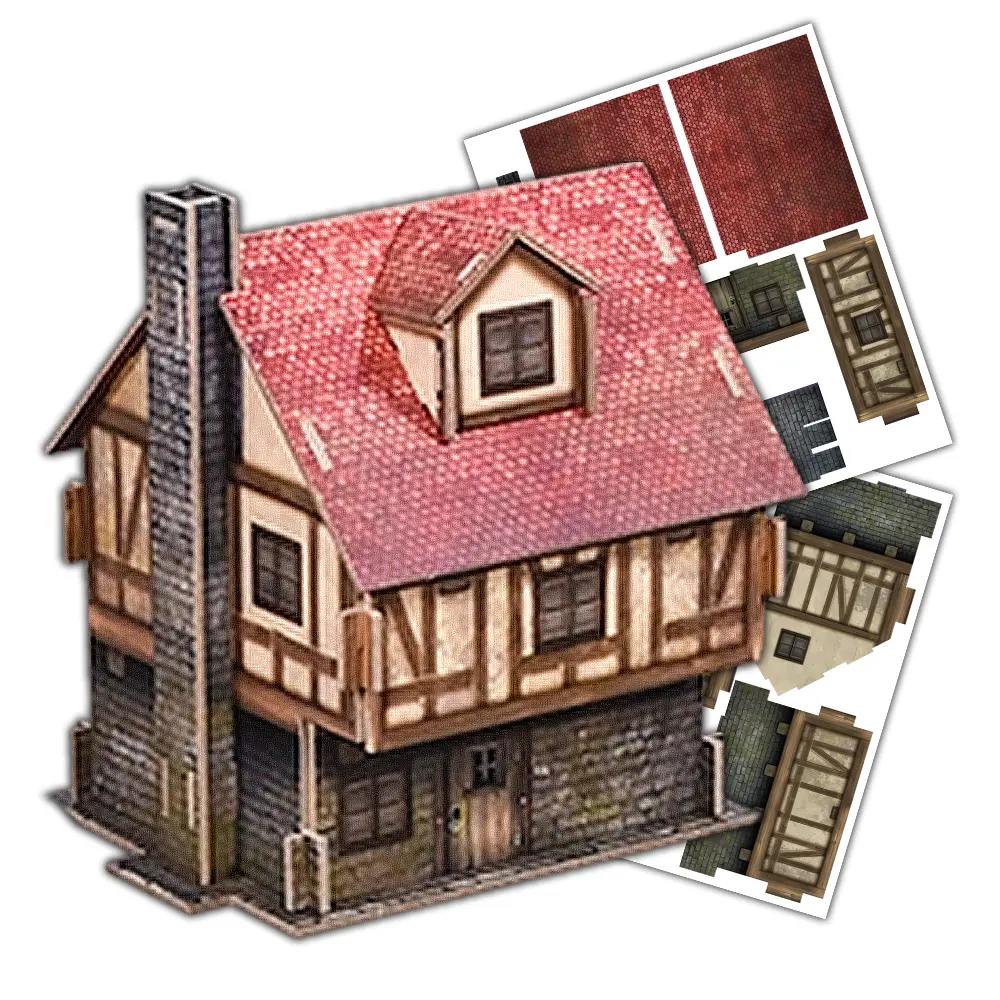
Mantic's Terrain Crate uses pre-colored push-fit cardboard buildings joined by small plastic connector clips — straight clips for flat joins, corner clips that tuck inside the corners so they don't show. No glue. A single Fantasy set runs about £18–£80 (roughly $22–$100), and the whole premise is reconfiguration: two identical sets become a village one week and a ruined compound the next, then clip apart for storage.
The system rewards a few habits the box won't tell you. First, clean the connectors off the sprue and shave any nub before first use — they seat far more snugly and stop looking 'gamey' once the ports sit flush. Second, expect some panels to arrive slightly warped; if the bottom corners of a wall or door aren't anchored to a floor panel or a neighbor, they'll bow and refuse to line up. Build from a secured base outward and the warp disappears. Third, you can deliberately use a tight connector as a friction point to make a removable section — a roof you lift, a wall you knock down mid-game.
Mantic is the right call if you want a full table's worth of terrain under $200, if you change layouts game-to-game, or if you're outfitting a club table where pieces get rearranged constantly. The cardboard won't outlast resin across a decade of heavy weekly play, but for variety-per-dollar nothing here touches it.
What does pre-printed flat-pack card actually buy you?
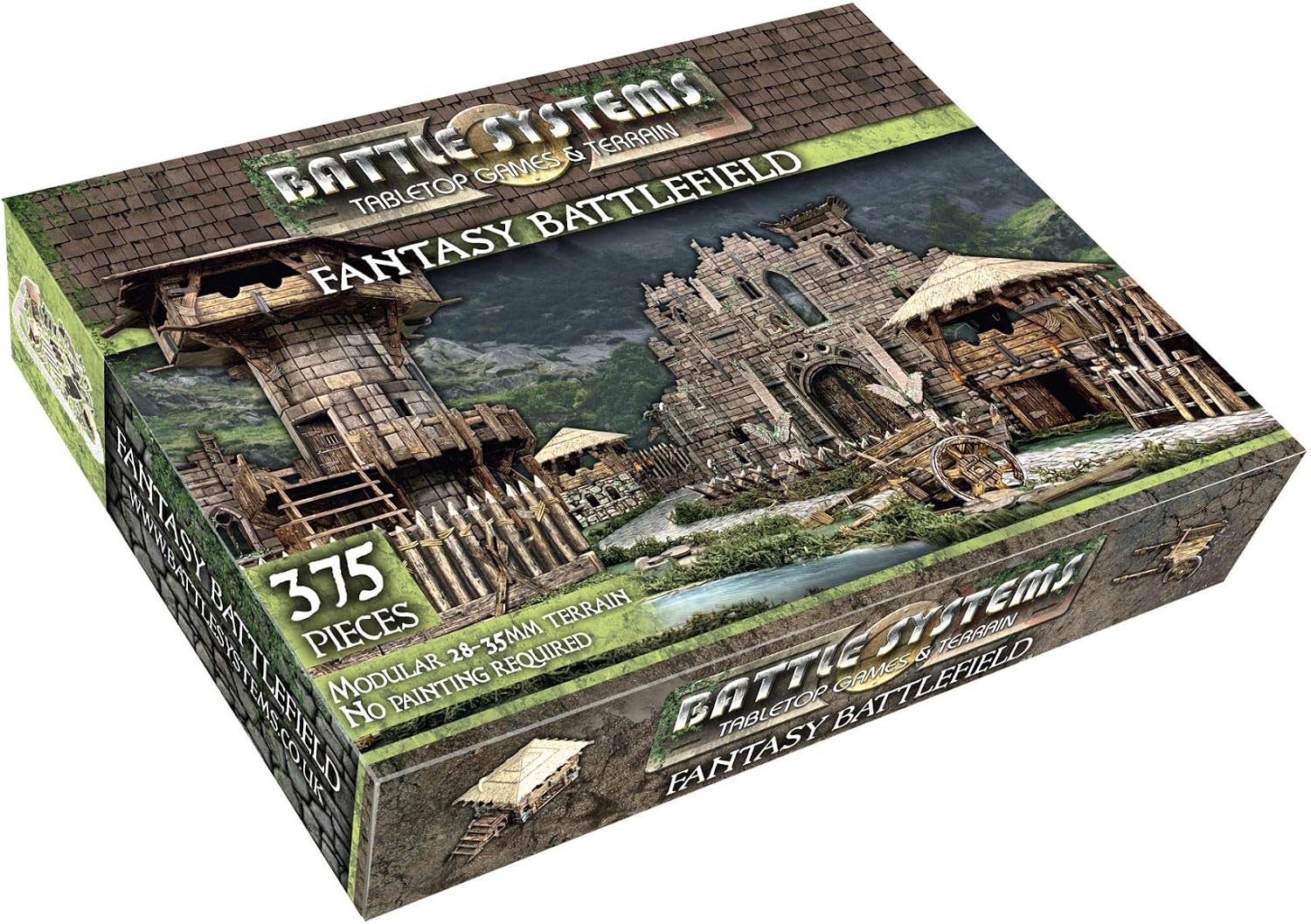
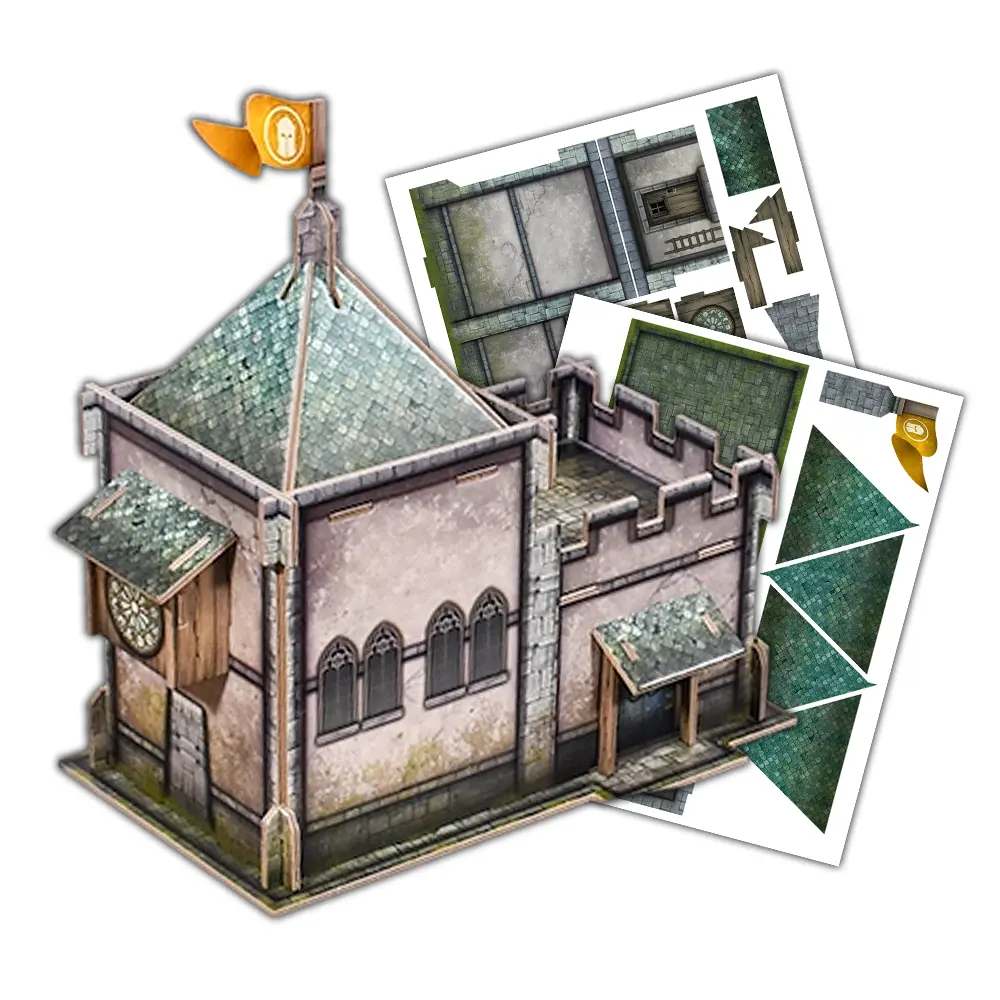
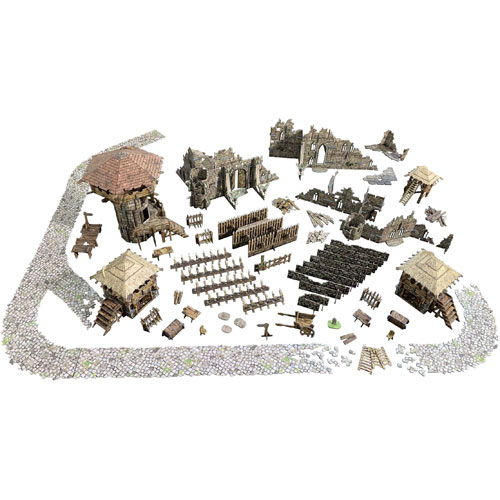
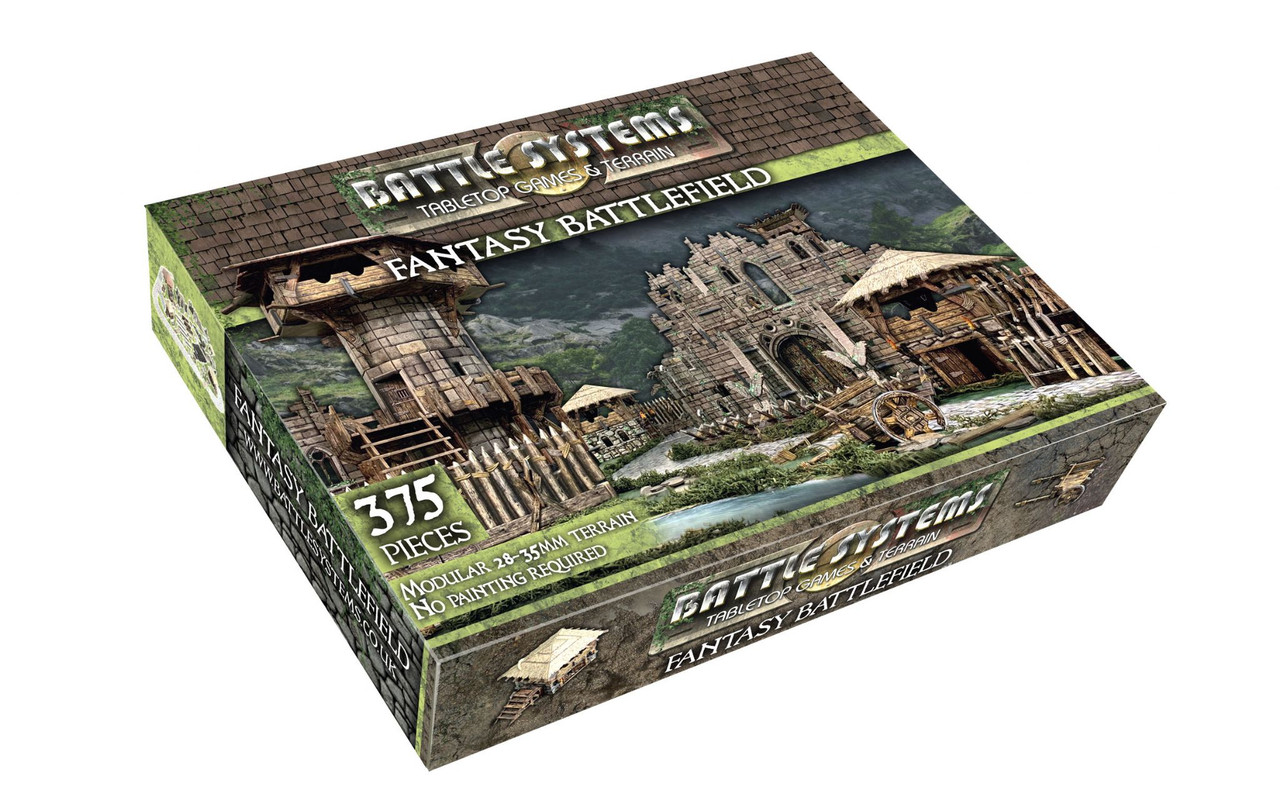
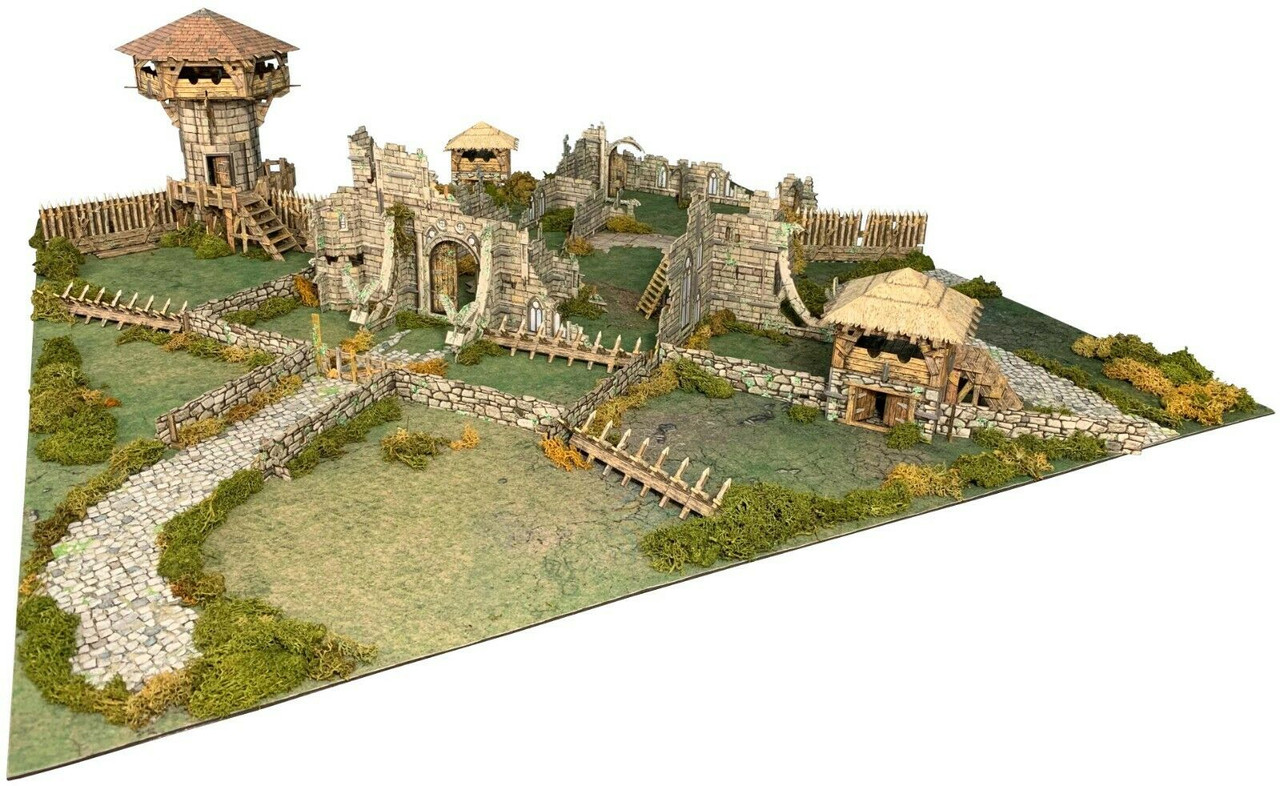
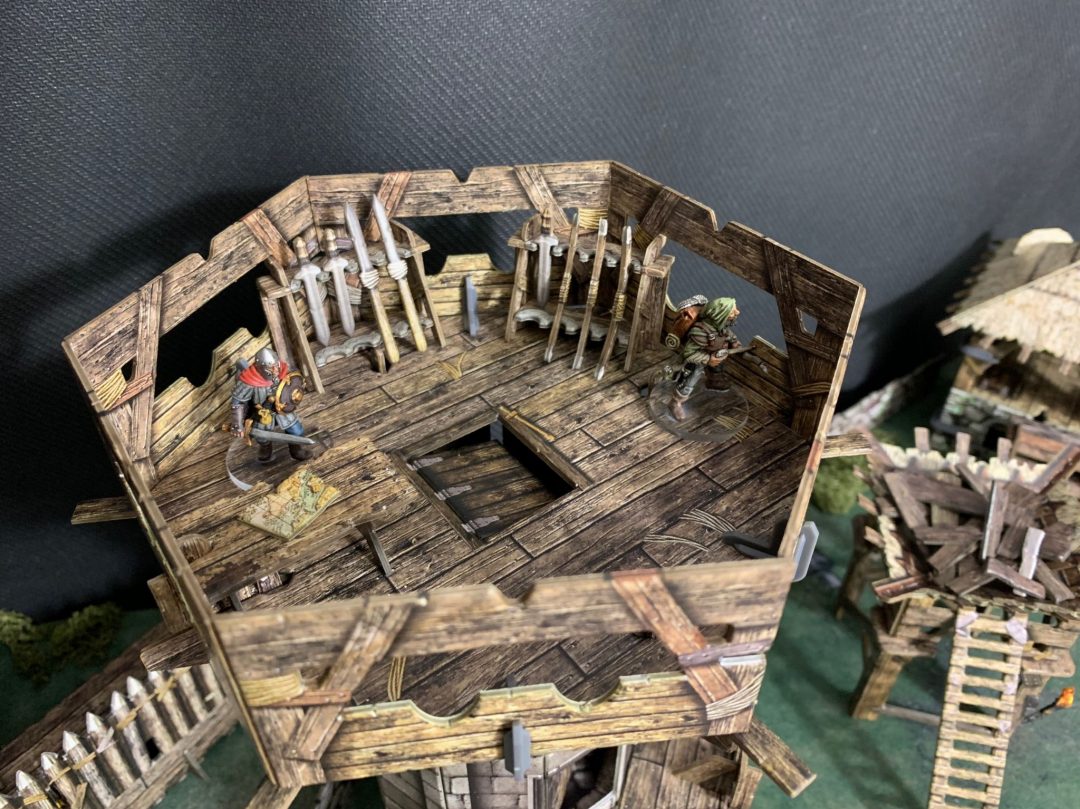
Battle Systems ships terrain flat-packed on medium-thick, full-color-on-both-sides card. You punch the pieces from the board, clip and lightly glue where needed, and you're playing — buildings have removable roofs and printed interiors, so a watchtower isn't a solid block, it's a room you can fight inside. A core set runs about $98–$110 and covers a 6×4 table on its own. No priming, no painting, no magnetizing, no hobby hours.
The trick that separates a Battle Systems table that looks great in year three from one that frays in month two is edge treatment, and almost nobody does it out of the box. The white core shows on every punched edge; run a coloring pen along those edges — brown or grey to match, never black, which reads as a hard cartoon outline — and the cardboard illusion all but vanishes. For high-wear pieces, brush a thin line of liquid superglue along the edges: it cures into a hard plastic-like shell that stops fraying and delamination cold. When punching pieces out, hold the card on both sides of the cut and keep an exacto knife handy for the stubborn tabs, so you never tear a corner.
Do that twenty-minute prep and Battle Systems stops being 'the cardboard option' and becomes a clean, durable, genuinely good-looking table for a fraction of resin money. Skip it, and the edges will tell on you.

How much modularity do you really need?

Modularity sounds like a pure good until you realize it's a tradeoff against coherence. Dwarven Forge pieces share compatible geometry and attach magnetically to each other and to Terrain Trays — you can blend dungeons, cities, caverns, and mountains into one continuous, believable world, and a pro move is to build vertically, propping floor tiles on corner pieces to stack two or three levels for impact a flat map never gets. The constraint is theme: it's coherent because it's curated.
Mantic sits at the opposite pole — near-infinite reconfiguration of any two compatible panels, which is exactly why club and variety players love it. Battle Systems lands in the middle: pieces connect logically (wall to wall, building to building) and each core set is really a fixed scene you arrange by geography rather than a tile kit you remix endlessly, though à-la-carte expansions widen it.
The decision is really one question: do you want one perfect table, or ten different ones? If you run a long narrative campaign on a permanent table, thematic coherence (Dwarven Forge, or a WizKids centerpiece) beats raw flexibility. If you're a tournament or club player rebuilding every week, Mantic's reconfiguration is worth more than any paint job. A practical hedge most veterans land on: a Mantic or Battle Systems base for coverage and reconfiguration, plus two or three Dwarven Forge hero pieces that anchor the eye and travel between every layout.

Storage, transport, and the decade test

Terrain you can't store or carry is terrain you stop using — this is the quiet factor that decides what survives in your collection. Battle Systems wins on storage outright: it flat-packs back into its own box, so an entire 6×4 table's worth collapses to a couple of inches on a shelf. If space is your binding constraint — apartment, shared table, no hobby room — that advantage is hard to overstate.
For transport and endurance, Dwarven Forge's Dwarvenite density is the premium you're actually paying for. It rides to the game store or convention and back without chipping, and the optional magnetic Terrain Trays lock pieces down so a setup survives a bumpy car trip intact. Heavy, yes — and that weight is the one real downside, because shipping a large order is dense and can add meaningfully to the total (verify it before you check out).
Mantic sits in between. The cardboard is light and easy to carry, but the connector clips can loosen or crack under heavy repeated use; the upside is replacements are cheap and available, so a worn club set is a $5 fix, not a write-off. The honest summary: if you haul terrain weekly, Dwarven Forge's durability earns its keep; if you store more than you transport, Battle Systems' flat-pack is the smarter buy; Mantic is the flexible middle that asks for a little upkeep.
The cost calculation — and the layering strategy nobody tells beginners
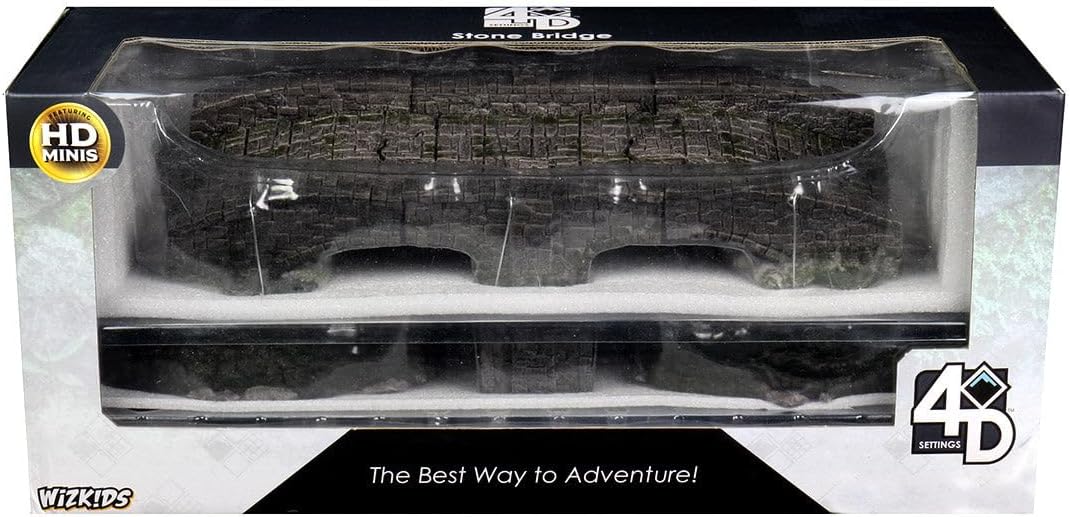
Run the real numbers. A Dwarven Forge wargaming setup — one or two core sets plus scatter — totals about $200–$400. Mantic fills a 6×4 table with multiple sets and connector packs for roughly $200–$300. Battle Systems' Fantasy Battlefield Core Set ($98–$110) covers a whole table alone, with à-la-carte pieces to extend it. WizKids 4D Settings centerpieces land around $50–$150 each. On pure speed-to-a-playable-table, Battle Systems and Mantic clear the bar fastest.
But the move that saves new wargamers the most money is not picking one system — it's layering them. Buy your bulk coverage cheap (Battle Systems or Mantic) to hit that quarter-of-the-table density, then spend on two or three premium hero pieces where it counts: a Dwarven Forge ruin or a WizKids bridge at the table's focal point. The eye reads the expensive piece, the cheap base does the heavy lifting, and you've spent a third of an all-resin table for ninety percent of the impact.
One more buyer's note on Dwarven Forge specifically: its lowest prices historically come through Kickstarter campaigns, not the retail store, and the company has built that funding model since its $2M debut campaign — backers routinely pay well under eventual retail. If a DF set you want is mid-campaign, that's the moment to buy. If terrain is a decade-long investment you'll revisit, the resin justifies the step up; if you're still learning what you actually use week to week, start cheap and upgrade the pieces you reach for most.
The picks
Some links below are affiliate links — as an Amazon Associate, Puzzlewick earns from qualifying purchases, at no extra cost to you. It never changes a pick.
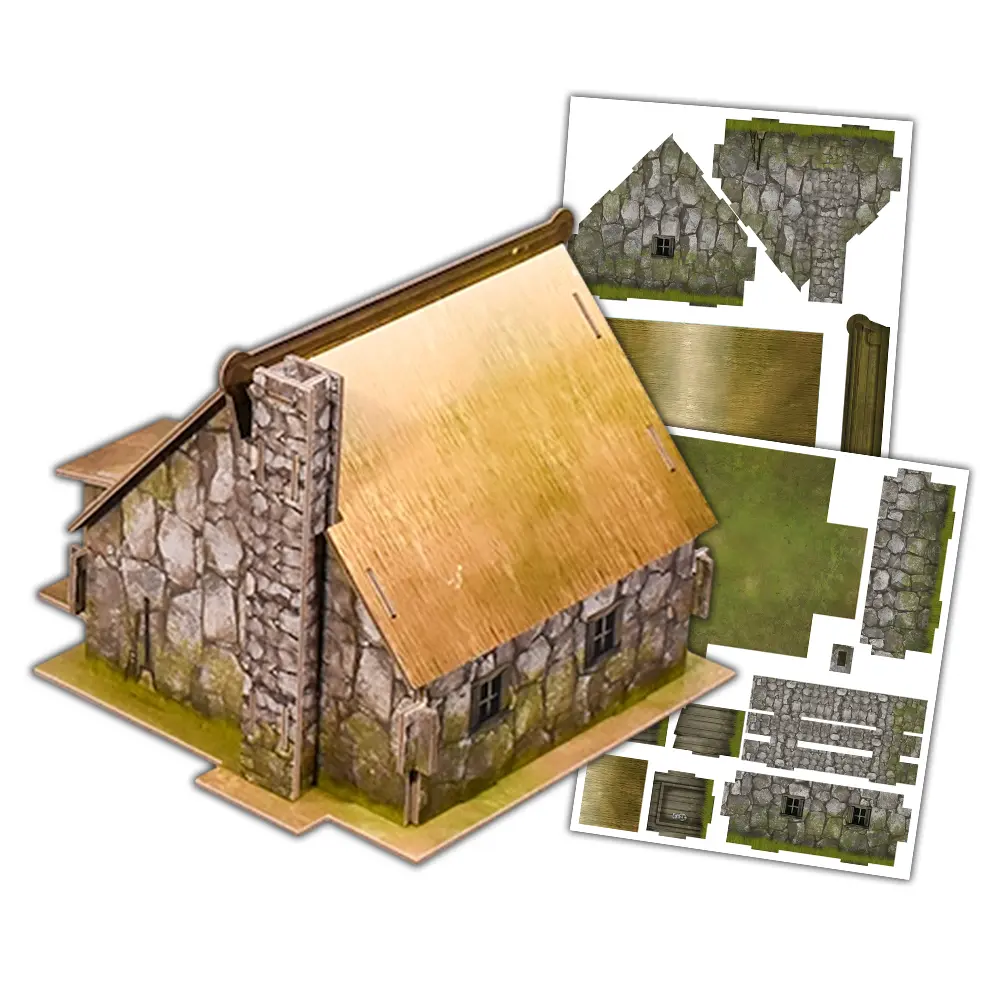
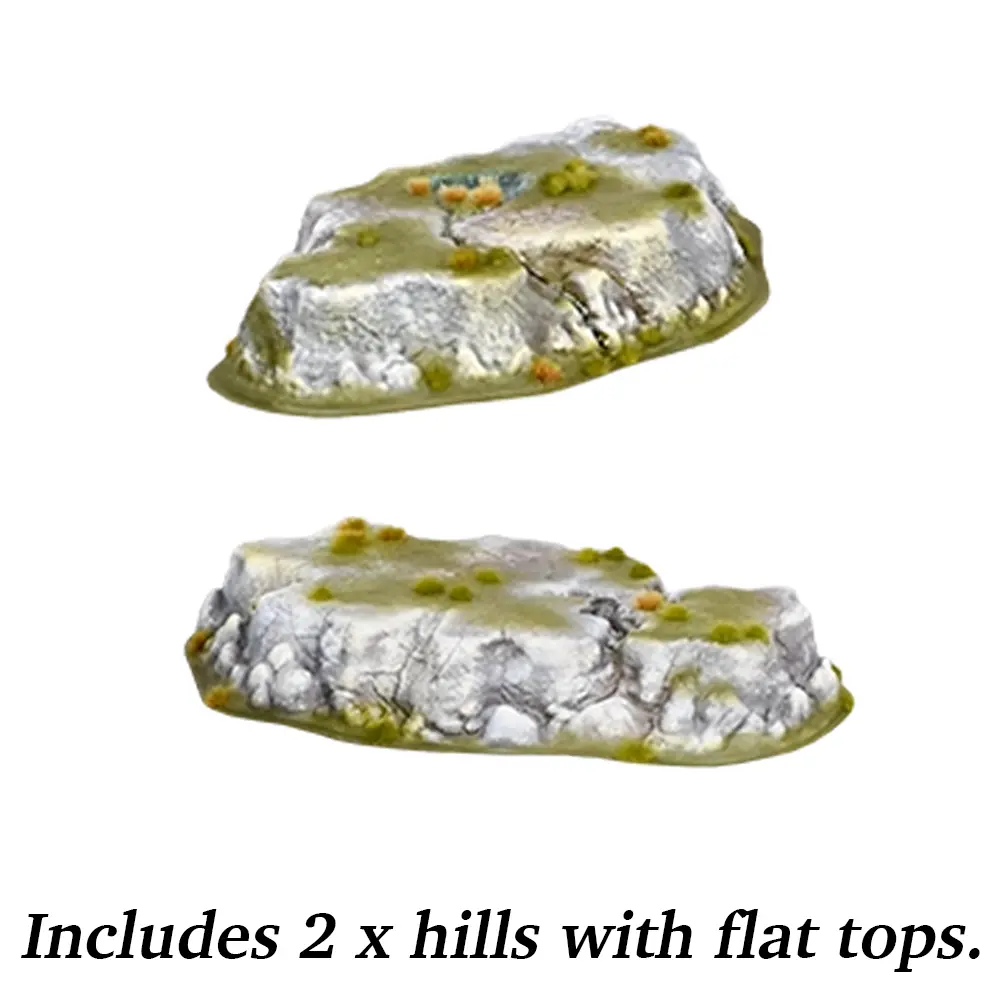
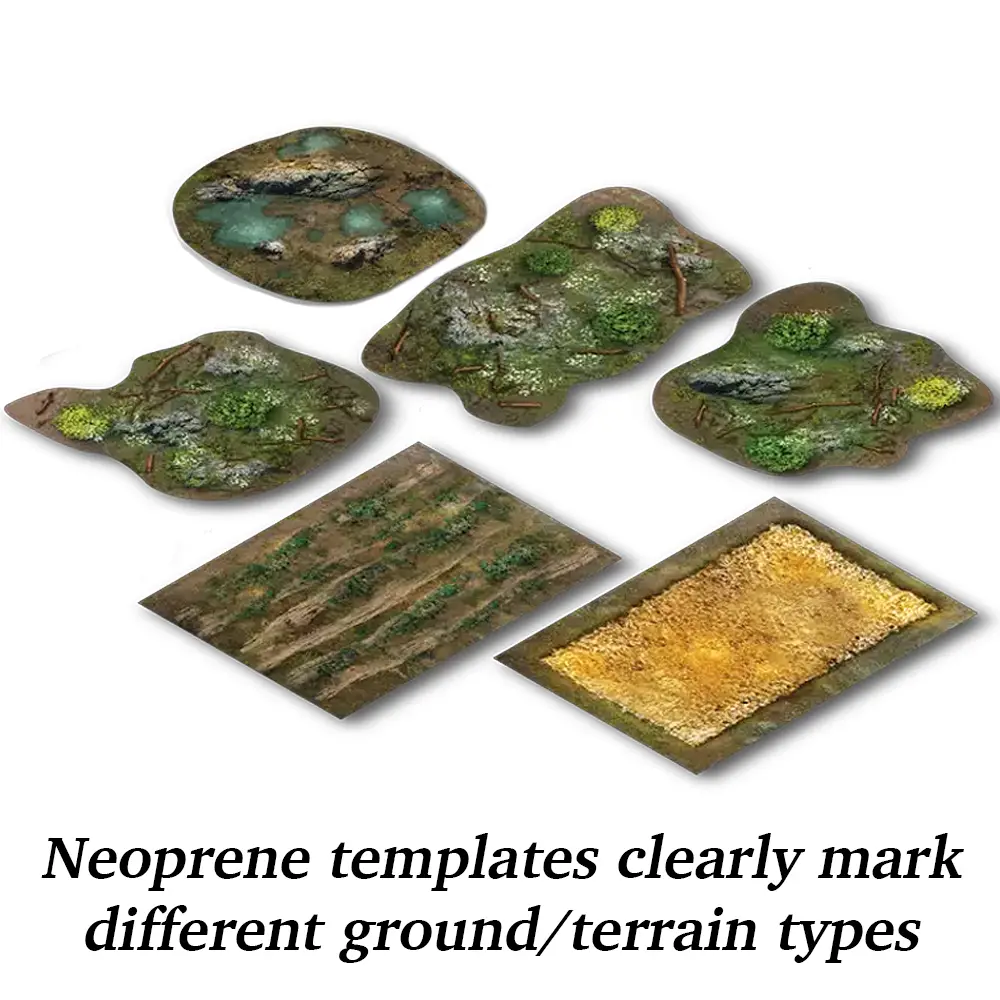


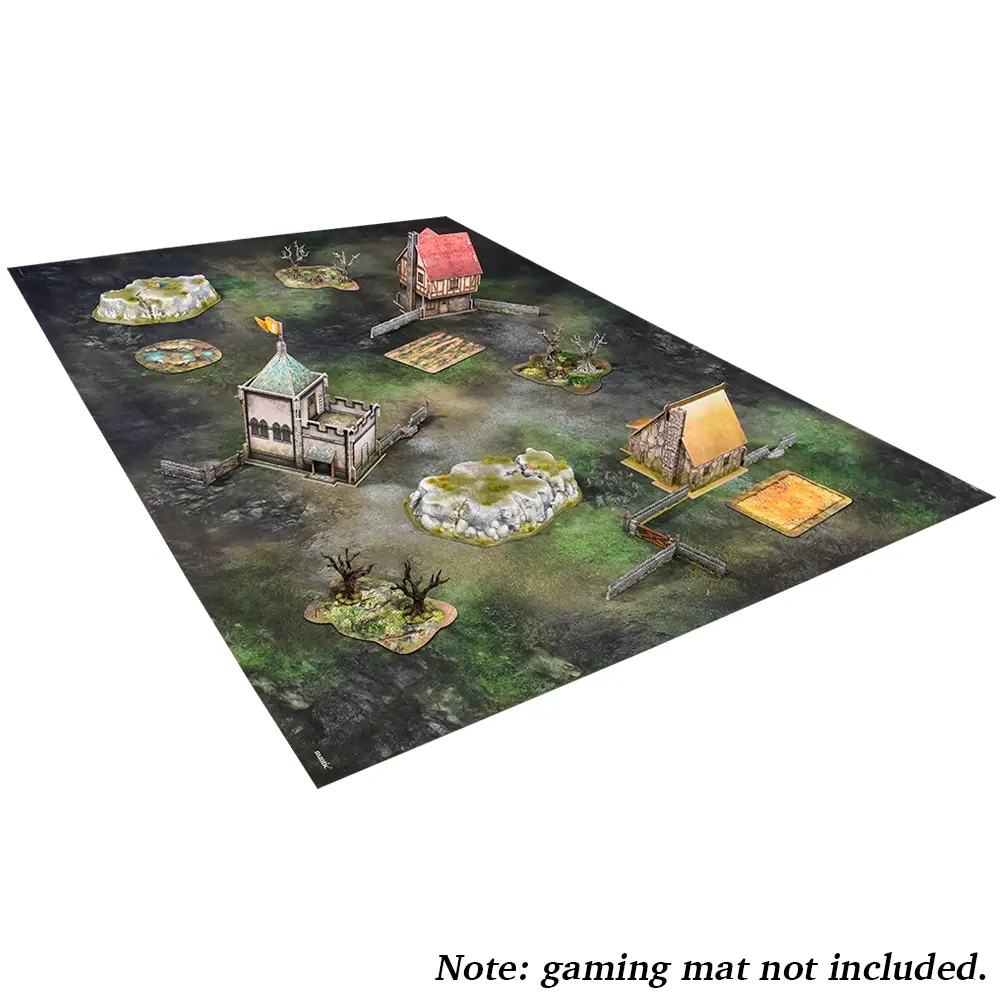 8 photos
 Mantic Games Fantasy Terrain Crate Battlefield Pack
Pre-colored cardboard buildings and scatter terrain with plastic connectors. Single set handles a 6×4 table; buy two and reconfigure endlessly. No glue required, no painting required—clip together and play.
- Lowest cost per square foot of table coverage (~$100–$115 per full table)
- Connector system allows near-infinite reconfiguration
- Available in fantasy, sci-fi, modern, and apocalyptic themes
- Pre-colored so no hobby skill barrier
- Visible connector ports can look gamey if you don't hide them
- Cardboard degrades faster than resin after years of heavy use
 10 photos
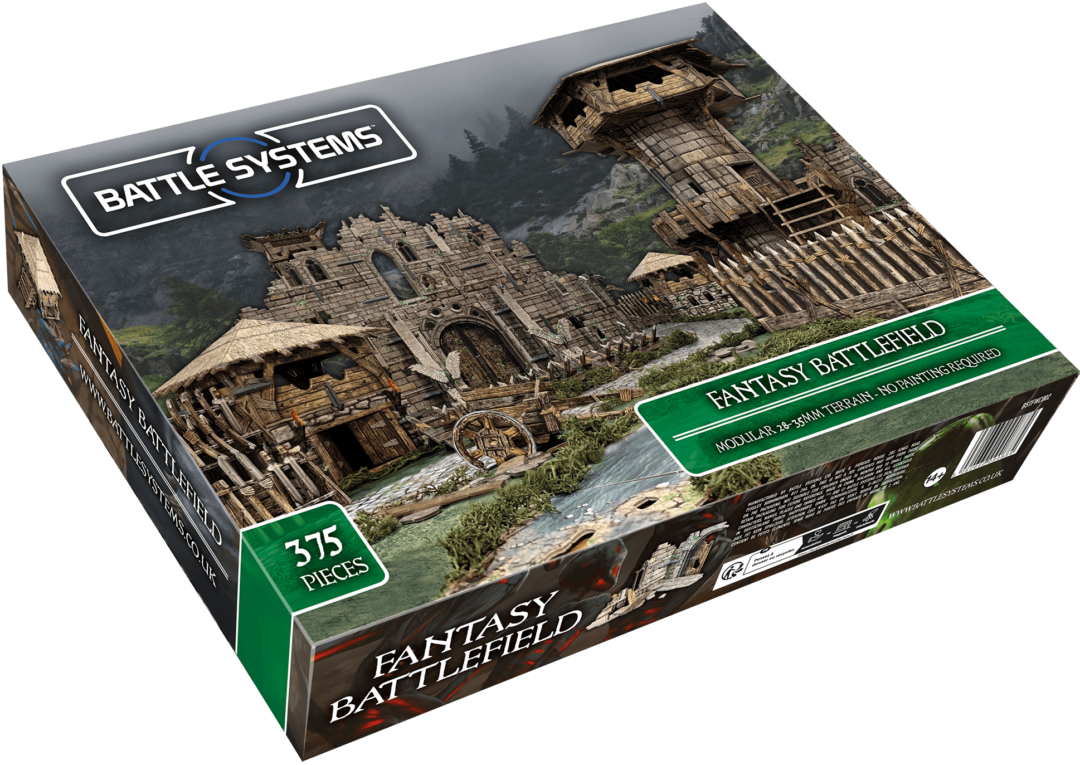
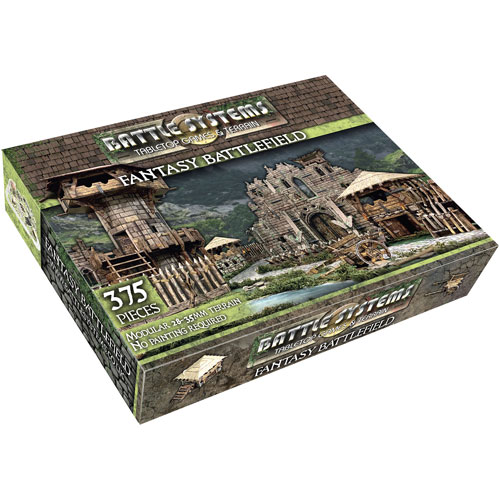
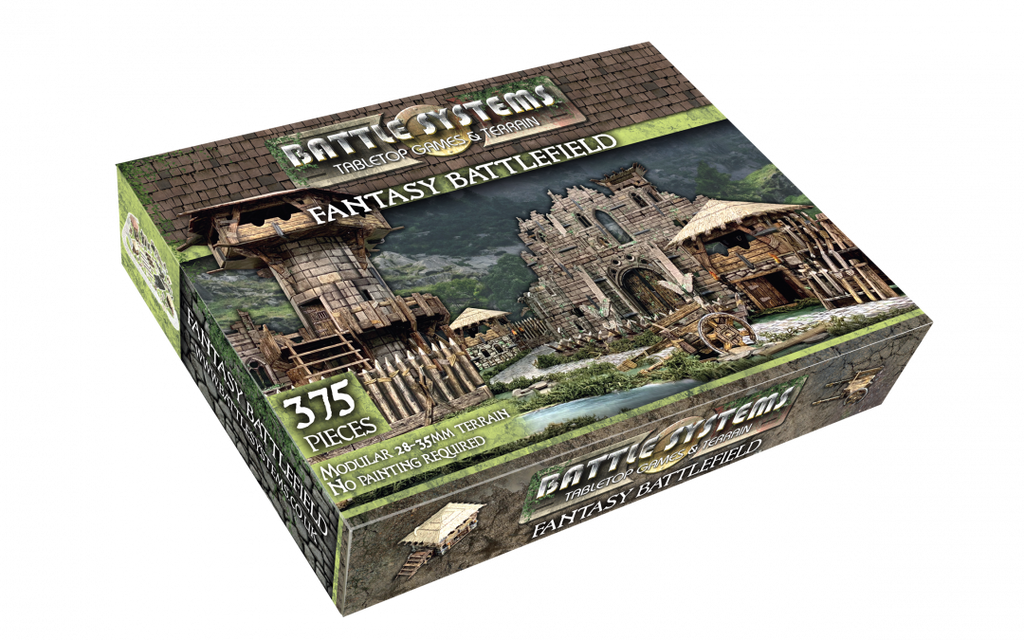
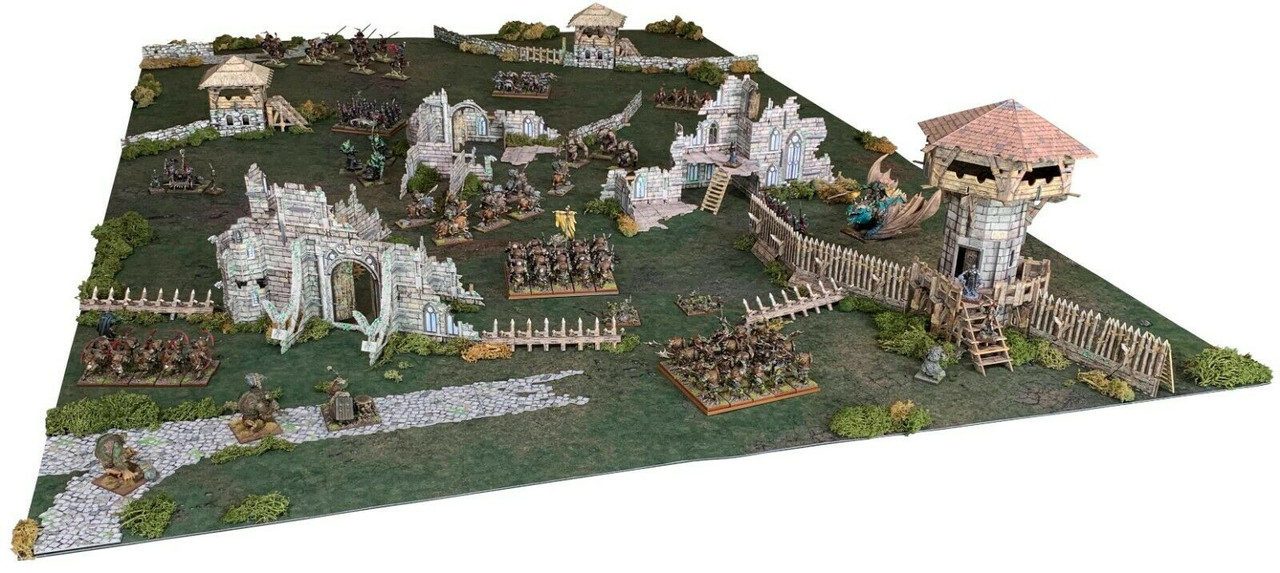
 Battle Systems Fantasy Terrain Battlefield Core Set
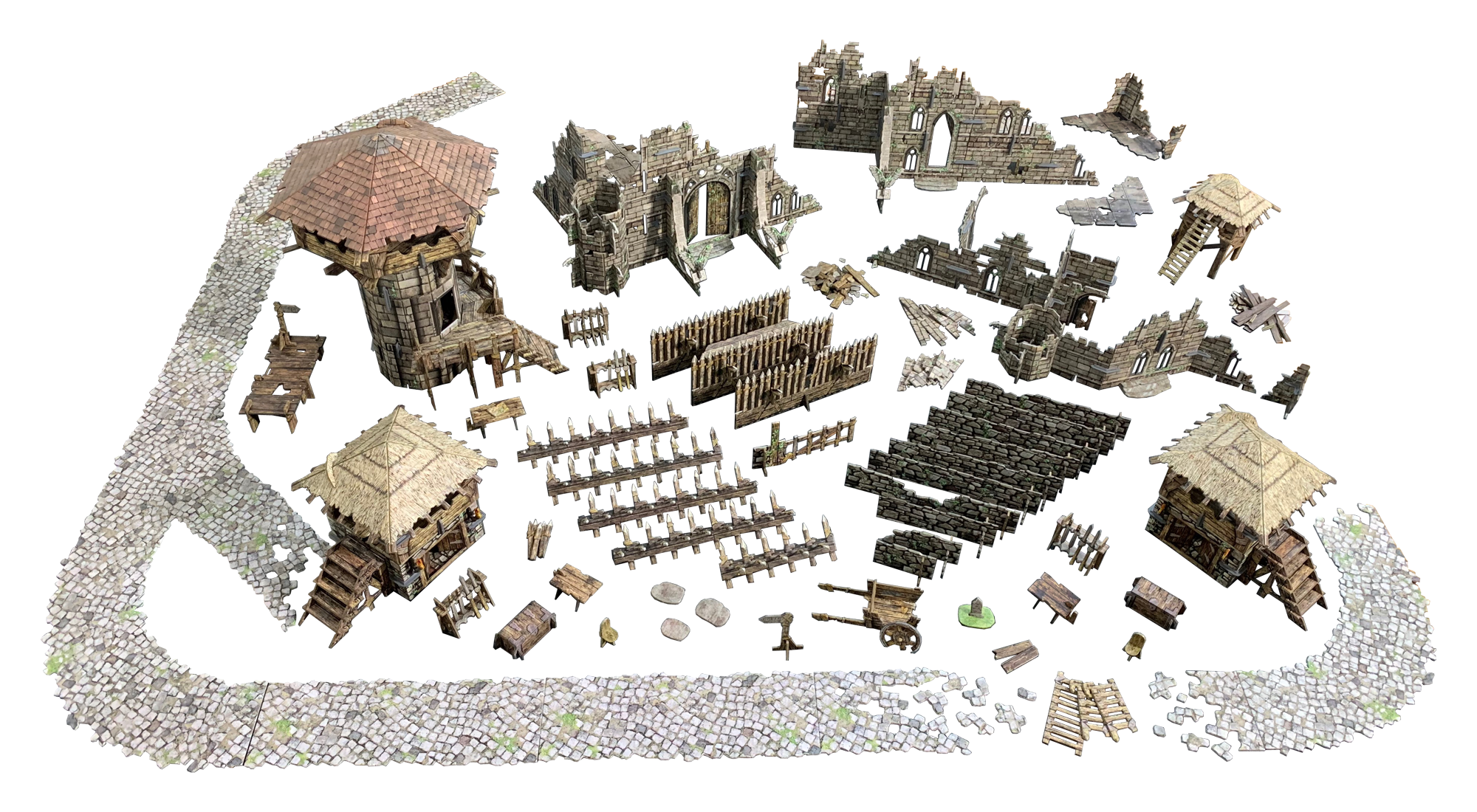
Flat-packed high-density card terrain printed in full color both sides. Complete battlefield setup with ruined monastery, watchtower, guard posts, walls, roads, and 120+ scatter pieces. Assemble in 1–2 hours with light glue. No painting, no priming, no magnetizing. Covers a 6×4 table completely.
- Complete battlefield setup in one box
- Full-color printing eliminates painting and priming
- Card design allows interior detail and lifting roofs
- Flat-packs back into box for compact storage
- Less flexible than Mantic—each core set is a fixed layout unless you buy additional pieces
- Cardboard durability lower than resin; not ideal for heavy tournament rotation
 7 photos
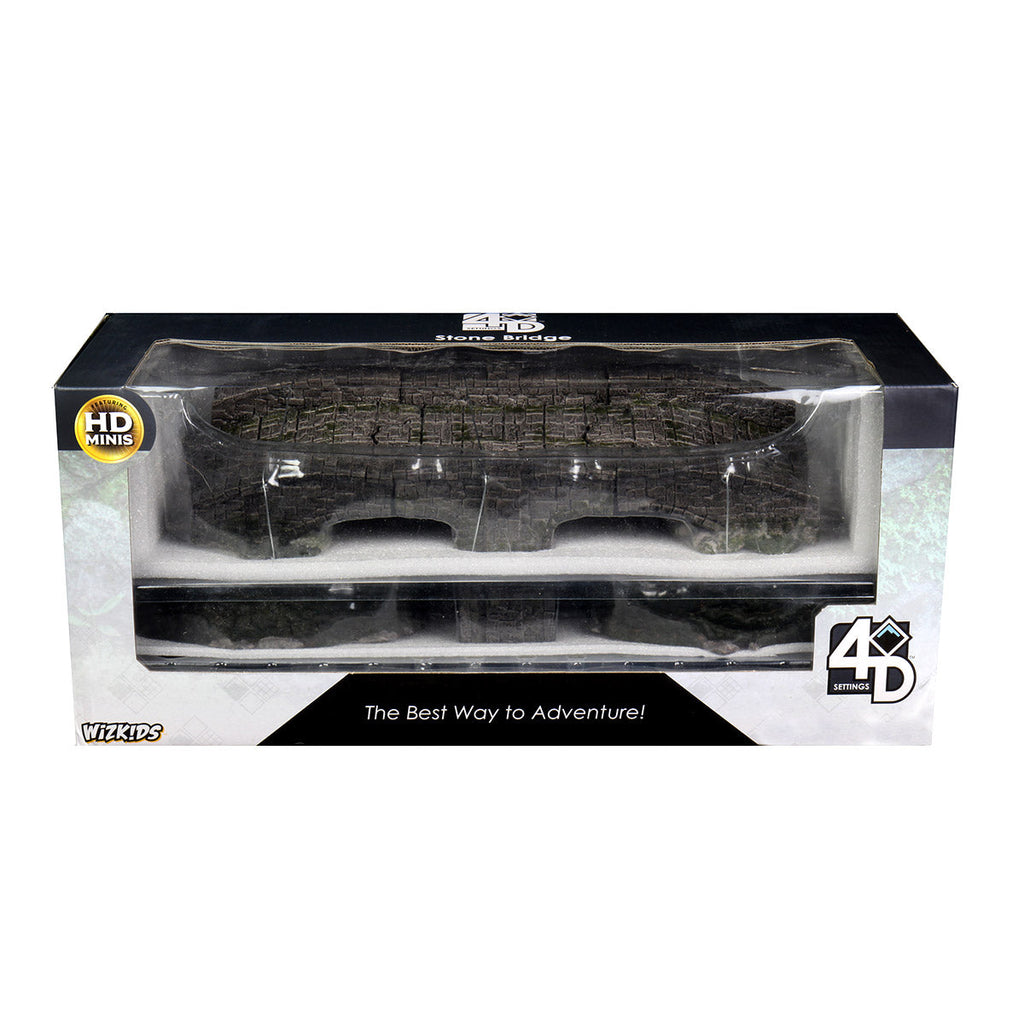
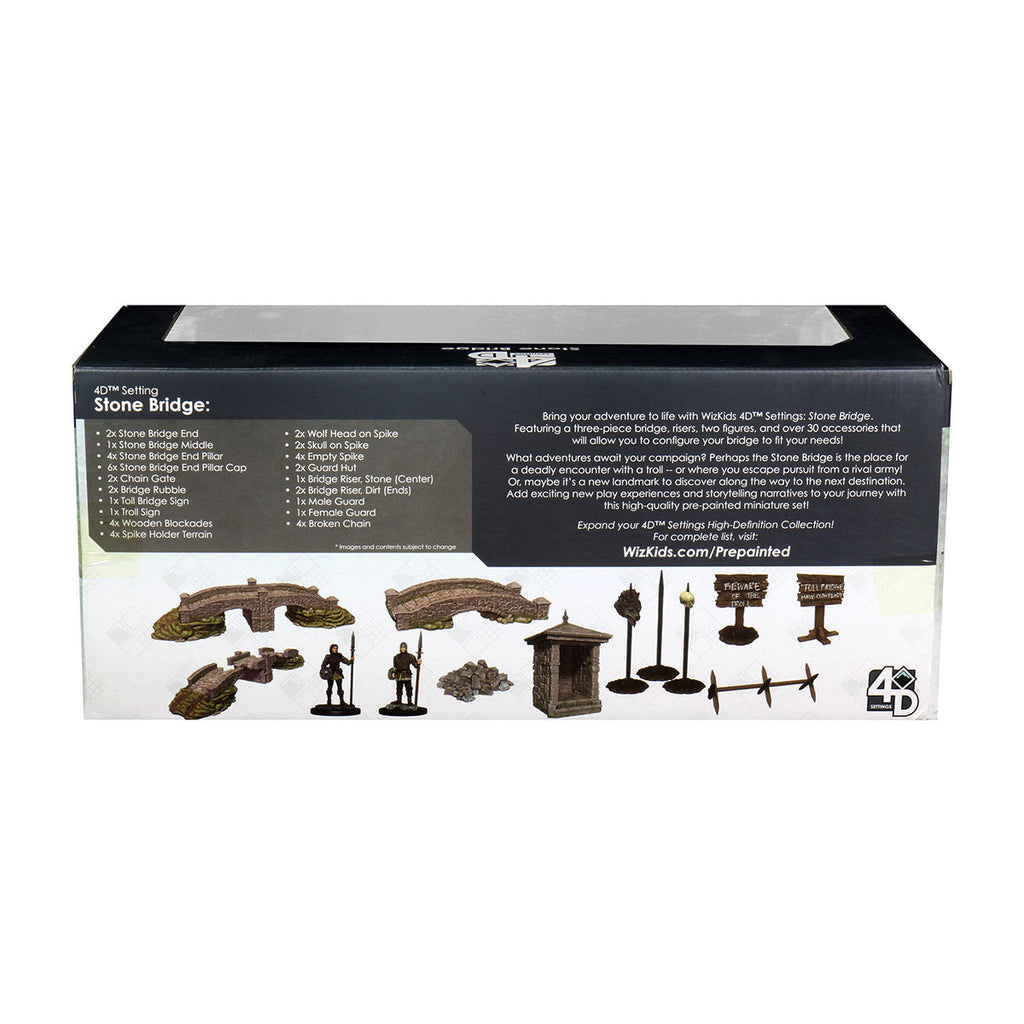
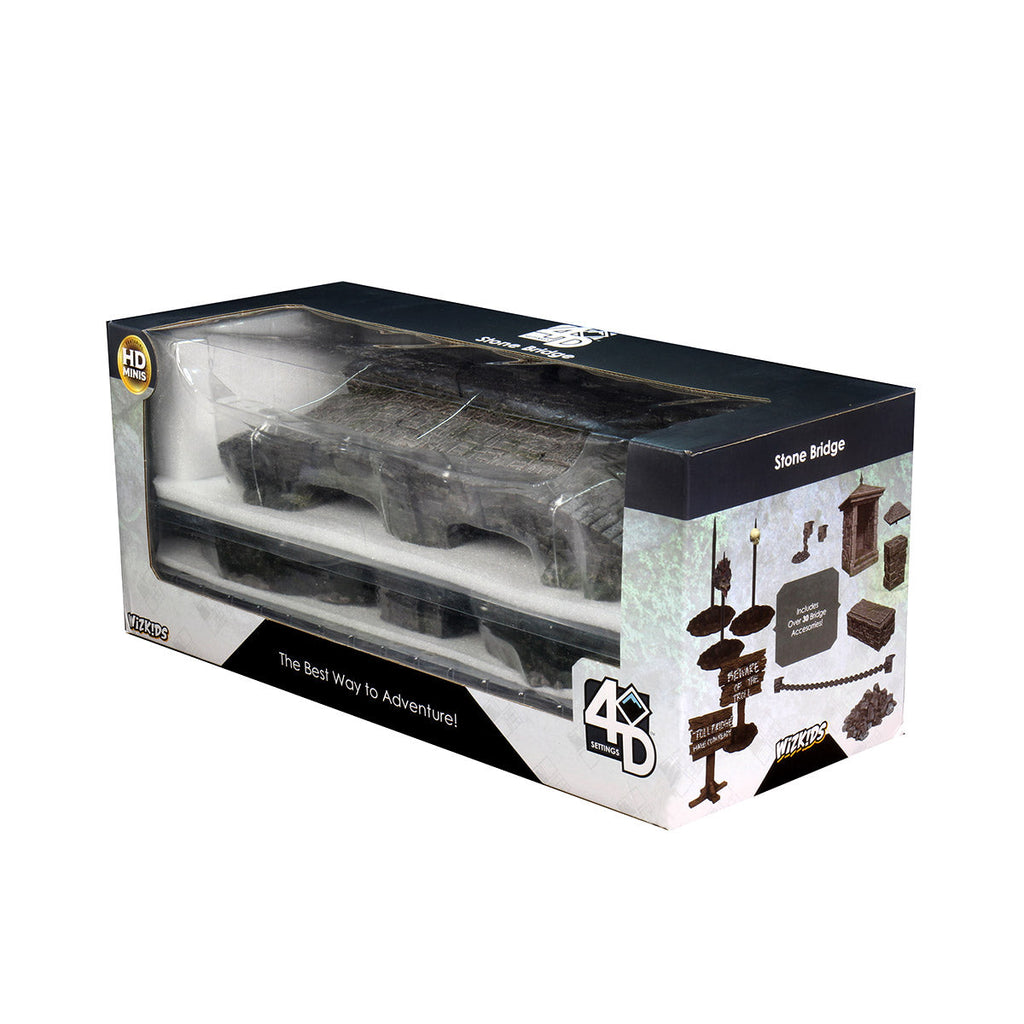
 WizKids 4D Settings Stone Bridge
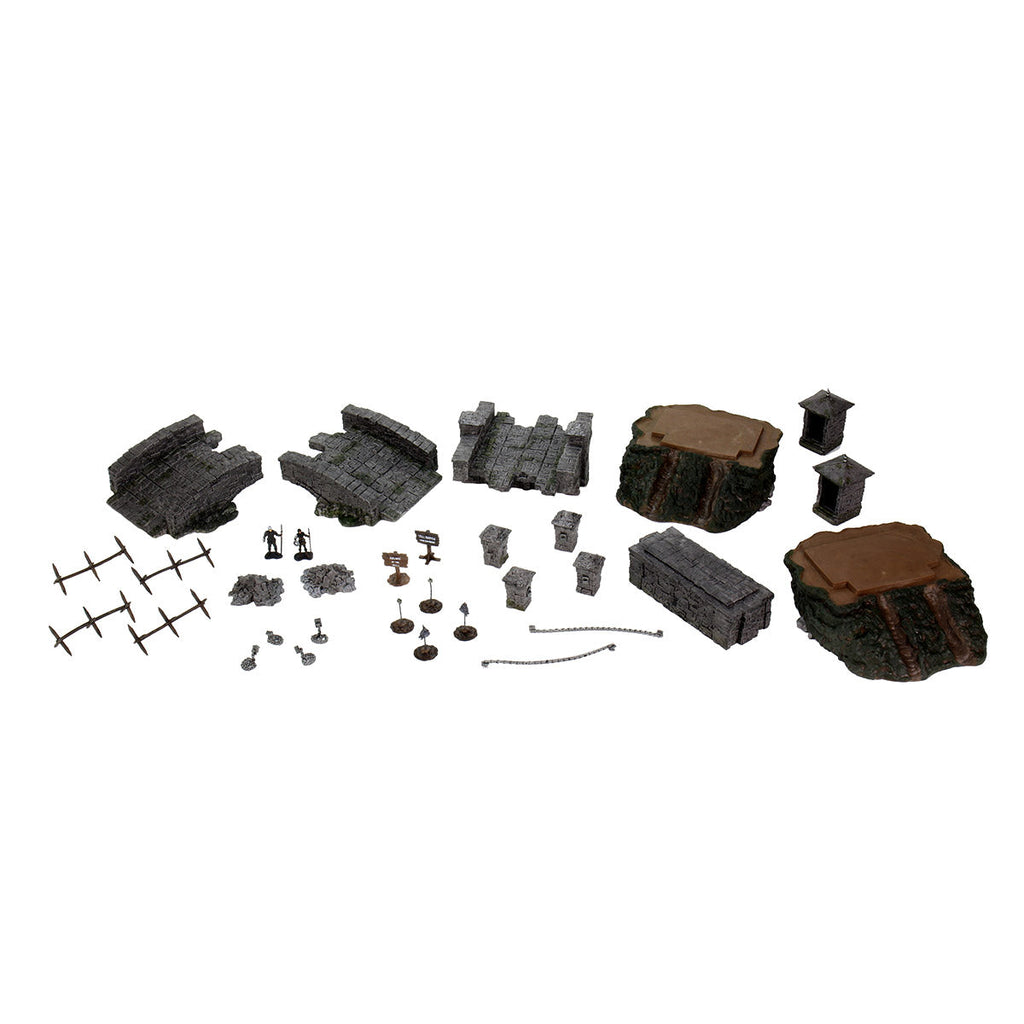
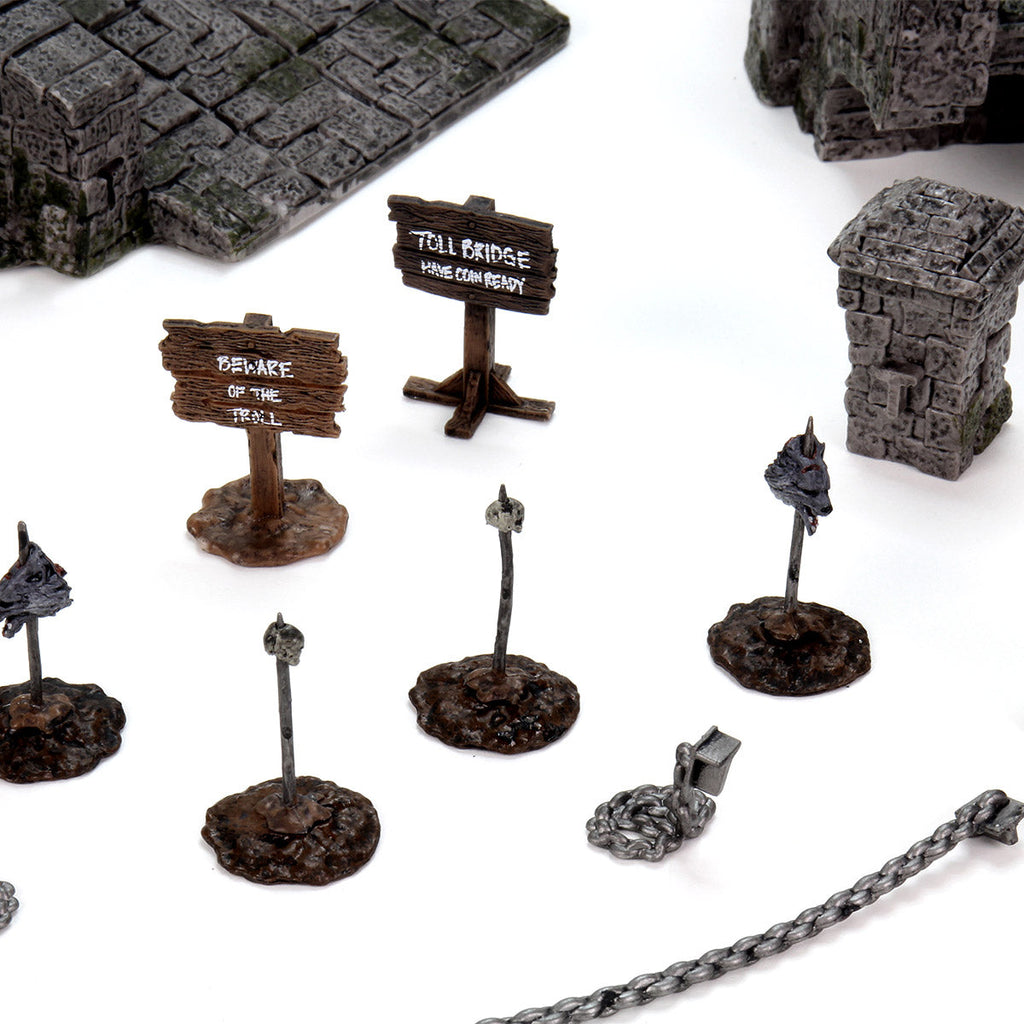
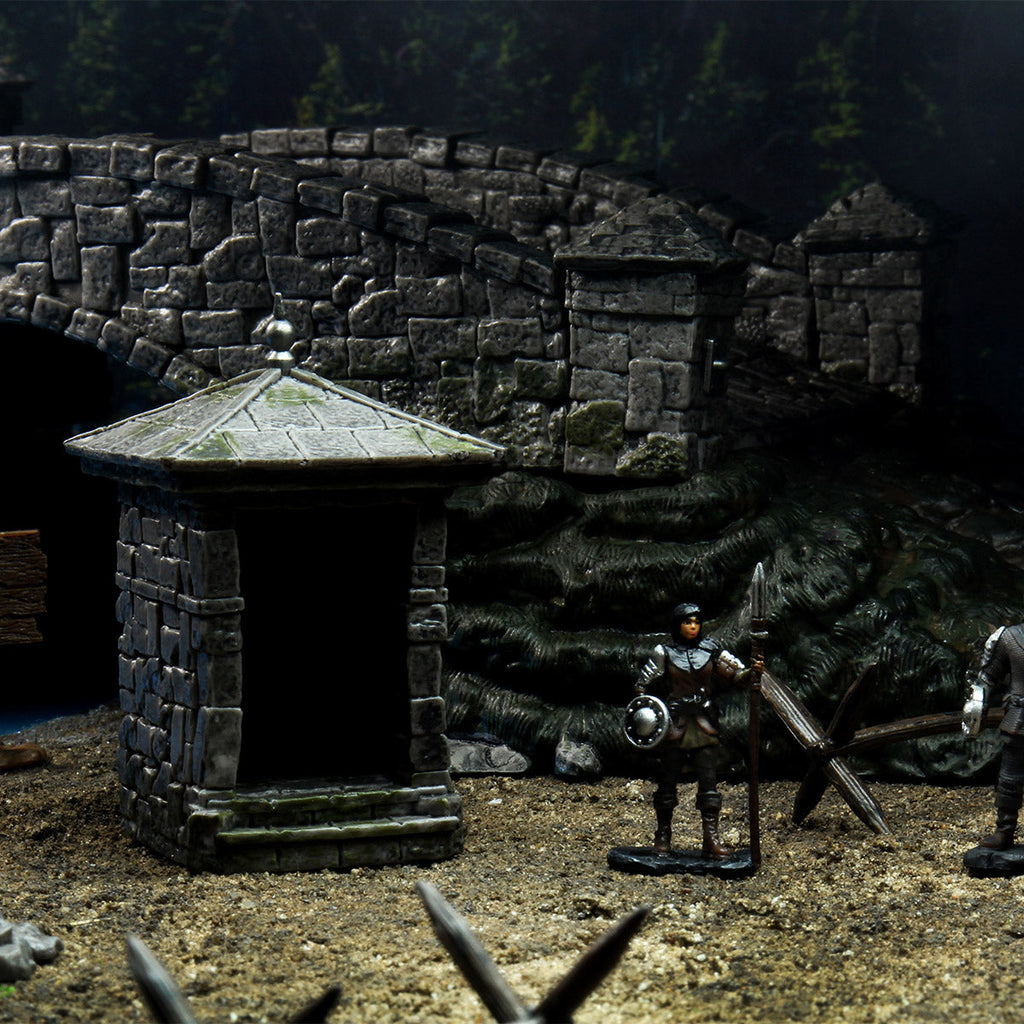
Pre-painted, pre-assembled modular bridge with guard huts, gates, chains, and rubble. Ready to drop on the table—no glue, no paint, no magnets. Designed as a complete scene, not a tile system.
- Pre-painted and pre-assembled; unbox and place
- Visually impressive centerpiece suitable for skirmish and narrative play
- Includes guard figures and scatter elements
- Price ($150) is steep for a single centerpiece
- Not modular in the Mantic or Dwarven Forge sense—it's a fixed installation
At a glance
| System | Cost per Core Set | Material | Assembly | Modularity | Best for |
|---|---|---|---|---|---|
| Dwarven Forge | $67–$167 | Hand-painted resin (Dwarvenite) | None—table-ready | High (magnetic attachment) | Premium durability & paint quality |
| Mantic Terrain Crate | $22–$100 USD | Pre-colored cardboard + plastic connectors | Minimal (clip connectors) | Highest (infinite reconfiguration) | Budget & variety on one table |
| Battle Systems | $98–$110 | Printed cardboard (both sides) | 1–2 hours with light glue | Moderate (fixed scenes + expansions) | Zero-painting speed to table |
| WizKids 4D Settings | $50–$150 | Pre-painted plastic miniatures | None—pre-assembled scenes | Low (designed as complete sets) | Narrative focus & centerpieces |
Questions, answered
Do I need magnets or trays to use Dwarven Forge terrain?
No. Dwarven Forge pieces work on any surface. The magnets and Terrain Trays are optional accessories that make transport and storage neater—they lock pieces in place during play. Many players use Dwarven Forge on standard tables without any additional hardware.
Can I mix Mantic Terrain Crate sets from different themes—fantasy, sci-fi, modern?
Technically yes; the connector system is universal across themes. In practice, you'll get a visual mash-up unless you're comfortable with a deliberately grimdark or post-apocalyptic aesthetic. Most players keep themes separate or use one as dominant and others as accent scatter.
Will Battle Systems terrain hold up to tournament play?
Yes, but with caveats. The cardboard is durable for typical weekly gaming, but if your terrain is transported or stored roughly every week for a year, creasing and delamination become visible. It's tougher than home-printed terrain but not in Dwarven Forge's durability class. For occasional casual play or a permanent table, it's ideal.
How many Mantic Terrain Crate sets do I need for a 6×4 wargaming table?
One large set (like the Battlefield Pack or a Sci-Fi equivalent) covers a 6×4 table as-is. If you want more variety or thematic density, buy a second complementary set. Two sets give you enough pieces to reconfigure the entire table between games or to build smaller skirmish boards with richer detail.
Is there a learning curve with any of these systems?
Dwarven Forge: no curve—place pieces, they stay. Mantic: minimal curve—connectors are intuitive, though some players need a game or two to feel confident snapping and unsnapping under time pressure. Battle Systems: light assembly curve if you haven't built cardboard terrain before, but the instructions are clear and the system is forgiving. None require hobby experience.
Can I paint over pre-colored Mantic or Battle Systems terrain?
Yes. Mantic cardboard can be primed and painted, though the connectors get in the way. Battle Systems terrain is trickier—the full-color printing is the appeal, and overpainting defeats it. Many players treat Mantic and Battle Systems as finished products and use Dwarven Forge as the foundation where they add detail painting if desired.
Keeper's verdict
All three systems earn their place. Dwarven Forge is the steadfast choice if your table is permanent, your budget allows, and you want terrain that looks better every time you look at it. Mantic Terrain Crate is the right call if you're filling a table quickly or want to rebuild layouts game-to-game without fatigue. Battle Systems splits the difference: faster to table than Dwarven Forge, more cohesive than Mantic, and cheaper than either if you buy just one core set. WizKids 4D Settings works best as a centerpiece within a larger system, not as the foundation. The honest truth: if you're new to wargaming, start with Mantic or Battle Systems and see what you actually use week-to-week. Once you know, upgrade key pieces to Dwarven Forge. Terrain is not an all-or-nothing choice.
Research ledger 8 sources · reviewed 2026-07-17
Specifications, rules, current product information, community experience, and contrary evidence were checked against the sources below. Commercial links are kept separate from editorial evidence.
- dwarvenforge.comdwarvenforge.com/collections/all-products
- manticgames.commanticgames.com/terrain-crate/fantasy
- battlesystems.co.ukbattlesystems.co.uk/product-category/tabletop-terrain/fantasy
- shop.wizkids.comshop.wizkids.com/collections/4d-settings/set_terrain-and-scenery
- wargamer.comwargamer.com/warhammer-the-old-world/terrain-crate-scenery-set
- techraptor.nettechraptor.net/tabletop/reviews/dwarven-forge-review-ttrpg-terrain-to-enhance-but-not-to-fully-replace
- warhammer40000.comwarhammer40000.com
- ageofsigmar.comageofsigmar.com
If it didn't earn a shelf, it isn't here.


Keep exploring
The next smart rabbit holes.
✠ Universe HubWarhammer: the whole buying pathWarhammer is Games Workshop's tabletop colossus — the grimdark far future of Warhammer 40,000 and the high fantasy of Age of...⚙ Topic PathMiniatures and Wargames: compare the whole shelfThe cheapest box is not always the cheapest way in. These guides connect rules format, faction fit, terrain, tools, paint, and the...Buying GuideAre Gaming Tables Worth It? Board Game Tables Compared (2026)A purpose-built gaming table is furniture that asks you to spend like an heirloom and use it like a workbench—an old instinct finally...