Best Heirloom Wooden Games, Ranked (2026)
Real wood that survives refinishing, hand-carved pieces, joinery that outlasts you — not a marketing label slapped on particle board pretending to be legacy.

AI-assisted curator persona · research and editorial responsibility: Robert Pruitt · how this guide was made
Last editorial refresh: 2026-06-13 Gold-standard QA: 2026-07-17 25 sources reviewed Affiliate links checked during gold-standard pass

The short answer
An heirloom wooden game is one built to be repaired, refinished, and handed down — which in practice means solid hardwood (walnut, maple, oak, cherry, ebony, boxwood) joined with real woodworking, not a printed laminate skin glued over MDF and called 'heritage.' The single best all-around heirloom is an Amish-made solid maple-and-walnut chess/checkers board (Wengerd Wood, via AmishToyBox, ~$327) — solid stock you can sand and re-oil for fifty years. For chess specifically, a genuine ebony-and-boxwood Staunton set with hand-carved knights (House of Staunton / The Chess Store, ~$400–600+) is the real thing; ebonized boxwood is the honest budget step-down. Best backgammon is a Manopoulos solid-walnut set with olive-wood checkers, handmade in Greece — but avoid their 'walnut replica' (~$47) and 'walnut effect' (~$127) lines, which are printed surfaces, not wood. Best cribbage is a solid-walnut board from Heartwood Creations (~$44) or WE Games (Made-in-USA solid walnut). Best value is the Heartwood cribbage board; best splurge is a custom House of Staunton signature board ($1,000–4,000). Skip 'heirloom edition' compendiums that disclose veneers — handsome, but not built to outlive you.
Decision map
Choose in thirty seconds
Best overall heirloom — two classic games, solid stock, refinishes forever
Best chess — genuine ebony, the peak of heirloom piece-craft
Best backgammon — solid walnut + olive root, handmade since 1970
Let me start by naming the con: marketing departments have looted the word 'heirloom' and left it hollow. An heirloom is not a thing that photographs well on a shelf or costs enough to feel like an investment. It's a thing that gets dropped, scratched, spilled on, and survives — that your grandchild can sand back to life without finding cardboard underneath. That entire test lives or dies on one choice: solid wood, or a cosmetic veneer over fiberboard.
Here's the tell that matters. Solid hardwood — walnut, maple, oak, cherry, ebony, boxwood — can be sanded and re-oiled essentially forever. You go below the scratched surface and the material is unchanged. A veneer is a sheet of real wood, often thinner than a human hair, glued to MDF or particleboard; sand it twice and you're into the brown chalk underneath. Veneer is not a scam — fine instruments and pianos use it deliberately, and it makes gorgeous pieces. But it lasts a generation, maybe two, and then it's landfill. By the refinishing test, it's not heirloom, and any box that claims otherwise is selling you a costume.
So I went looking for the games that earn the word honestly — and the ones using it as camouflage. I read the maker spec lines because the transparent ones tell you (Manopoulos sells 'replica wood' right next to real walnut; WS Game Company admits their veneers without flinching). I checked against the woodworkers on r/boardgames and the collectors who've kept their sets across their own kids, who stress-tested them without breaking a piece. I separated the cold specs from the marketing theater.
What follows is ten real makers across the classics — chess, backgammon, cribbage, and the rest of the canon — ranked for which ones build craft and which ones build hype. Every price, every material, every claim gets tested against the one question that actually matters: will it refinish? One disclosure up front: Puzzlewick may earn from qualifying Amazon purchases where a tagged Amazon link appears; maker and source links are editorial unless plainly labeled otherwise. That relationship does not alter the refinishing test or the ranking."
Start here, then go deeper
You are in the right cabinet.
 ✦ Topic PathBoard Game Buying Guides: compare the whole shelfStart with the decision, not the shelf. These guides compare the games, editions, expansions, player counts, and costs people...
 Buying GuideBest Heirloom Chess Sets, Ranked (2026)The wooden sets worth your grandkid's future — what actually makes a set heirloom, which woods survive fifty years of love, and ten real...
 Best OfBuild-Your-Own Automata Kits Ranked: Best Wooden Mechanical Models (2026)Stop buying wooden puzzle kits branded as automata that just sit there—here's the honest ranking of kits that actually move.
What actually makes a wooden game an heirloom — and what's just costume?
Strip away the brochure language and an heirloom game comes down to four hard criteria, in descending order of importance.
1. Solid hardwood, not veneer over MDF. This is non-negotiable and it's where most of the fakes get caught. Solid walnut, maple, oak, cherry, ebony, or boxwood can be sanded and refinished many times across decades — go below the scratched surface and the material is unchanged. A veneer is a slice of real wood, frequently thinner than a millimeter, laminated to a medium-density-fiberboard or particleboard core. The furniture world is candid about the tradeoff: solid wood routinely becomes a family heirloom passed down through generations, while veneer typically lasts 10–20 years, cannot be meaningfully refinished, and is more vulnerable to moisture. Heavy sanding breaks through the veneer and exposes the substrate. A game board you cannot refinish is, by definition, not built to be handed down — it's built to be replaced. The reason this matters for games more than furniture: games get handled. Every move drags a piece across the surface. Decades of that wears a finish, and only solid stock lets you bring it back.
2. Real joinery and construction. Skilled traditional joinery — dovetails, floating panels, breadboard ends, balanced glue-ups — is what lets solid wood move with the seasons without cracking, and it's labor-intensive in a way that can't be rushed. On a quality board you can often see it: a dovetailed peg drawer, a mitered frame with tight corners, an inlaid track set flush into the surface. Pressed seams, visible staples, and a suspiciously perfect 'wood grain' that repeats are the opposite tells.
3. Playing pieces that match the board's ambition. A solid-wood board with hollow plastic pieces is a split decision. The gold standard is pieces in the same league as the surface: weighted hand-carved chessmen with billiard-cloth bases, olive-wood backgammon checkers, glass or hardwood marbles. Resin and plastic aren't disqualifying on a budget pick, but they cap how far a set can climb.
4. A finish that can be maintained, not a sealed shell. Hand-rubbed oil finishes (tung, linseed, Danish oil) and wax soak into the wood and can be reapplied forever — exactly what you want on a generational object. A thick polyurethane or lacquer shell looks great on day one and is far harder to repair when it eventually chips or clouds. Many of the best independent makers explicitly use oil for this reason.
Everything else — the engraving, the felt-lined storage, the brass corners — is finish-carpentry that's nice to have but tells you nothing about whether the thing survives your grandchildren. Judge the bones first.
A game board you cannot refinish is, by definition, not built to be handed down — it's built to be replaced.
Solid wood vs. veneer vs. 'replica wood': how do you actually tell the difference?
This is the section that will save you the most money and heartbreak, so let me get concrete, because makers use three distinct things and only one of them is heirloom-grade.
Solid wood is boards of the actual species, milled and joined. On a game board that means the play surface, the frame, and ideally the pieces are all real hardwood you could plane down to bare stock. This is the only construction that satisfies the refinishing test. Independent makers who use it tend to say so plainly and proudly: 'solid Walnut hardwood with pale Maple tracks' (Heartwood Creations), 'Hard Maple and Black Walnut wood squares' (the Amish shops via AmishToyBox), 'solid Oak' (Wengerd Wood's Chinese checkers).
Veneer is a thin slice of real wood — genuine walnut or maple, but often under a millimeter — glued to an MDF or plywood core. Critically, veneer is not a scam. It's a legitimate, often superior choice for large flat panels because a veneer bonded to a stable core resists the seasonal warping that wide solid panels are prone to. Fine instruments and high-end furniture use it deliberately. The catch for heirloom purposes is singular and decisive: you can't refinish it. It can be very lightly sanded once or twice at most before you break through to the substrate. WS Game Company's compendiums use 'Rosewood and Tiger Maple veneers' on a solid walnut cabinet — and to their genuine credit, they print that word right on the listing. It's a beautiful object that will not survive being sanded back in 40 years.
'Replica wood' / 'wood effect' is the one to actually watch, because it's the most dressed-up. This is a printed wood-grain surface — a photographic laminate of walnut, not a slice of walnut. Manopoulos, an otherwise excellent Greek maker, sells this transparently as 'Replica walnut wood' (a backgammon set around $47) and 'Walnut Effect' (around $127), right alongside their genuinely handcrafted solid sets that cost considerably more. There is nothing wrong with buying a $47 printed-surface backgammon set if you know that's what it is — it's a perfectly good playing set. But it is the furthest thing from an heirloom, and the words 'replica' and 'effect' are doing a lot of quiet work in those product names.
How to tell them apart in the wild: Check the edges and corners first — solid wood wraps continuous grain around the corner; veneer reveals a thin layer over a different-looking core; printed 'replica' often has a grain pattern that repeats or that doesn't line up at the seams the way grown wood would. Sand-and-refinish capability is the ultimate test but you can't do that in a store, so weight, edge grain, and the maker's own spec language are your tools. And here's the meta-tell: honest makers tell you. If a listing won't say 'solid,' assume it isn't.
If a listing won't say the word 'solid,' assume it isn't — and the words 'replica' and 'effect' are doing a lot of quiet work.
What's the best heirloom wooden game overall — and the best chess set?
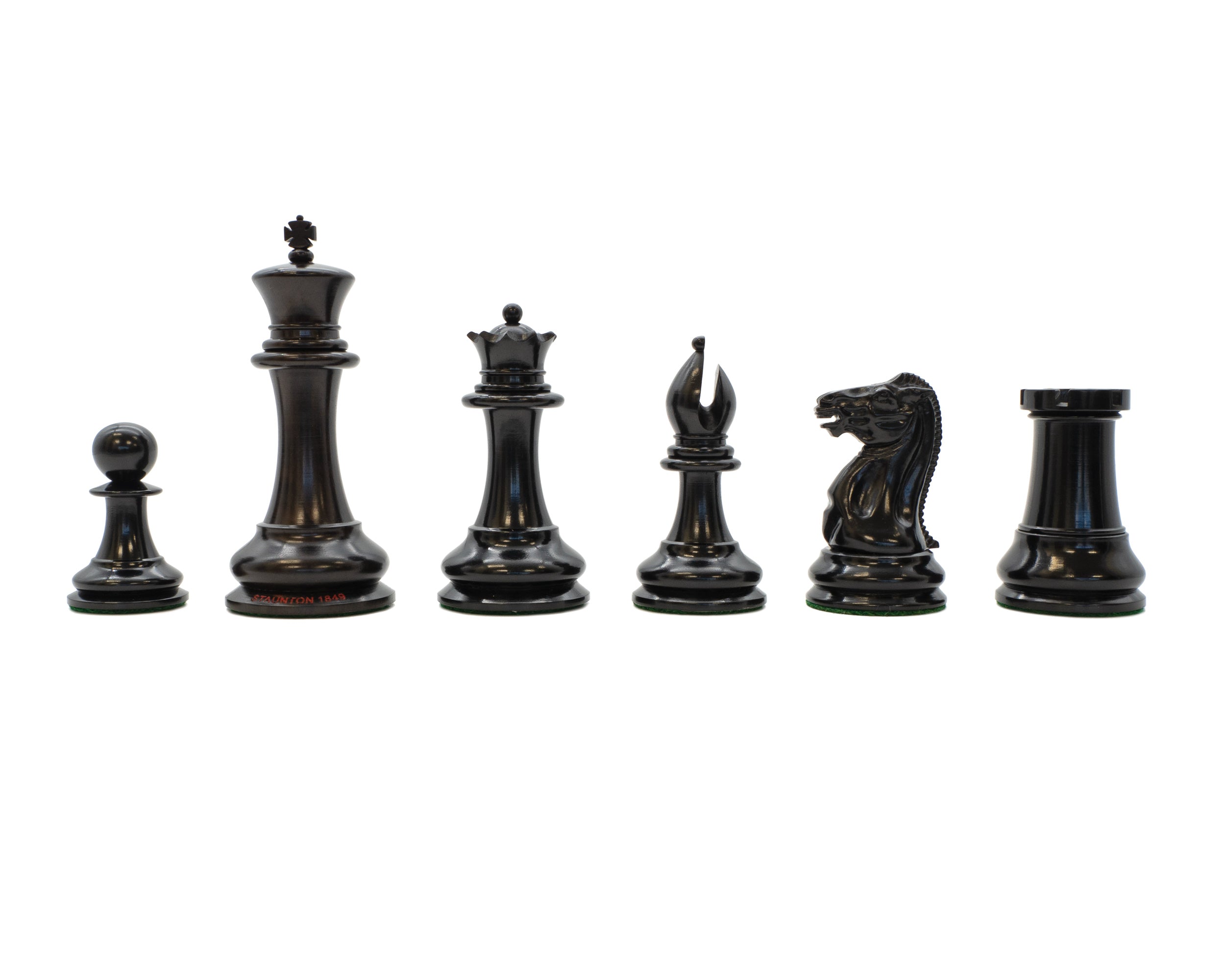
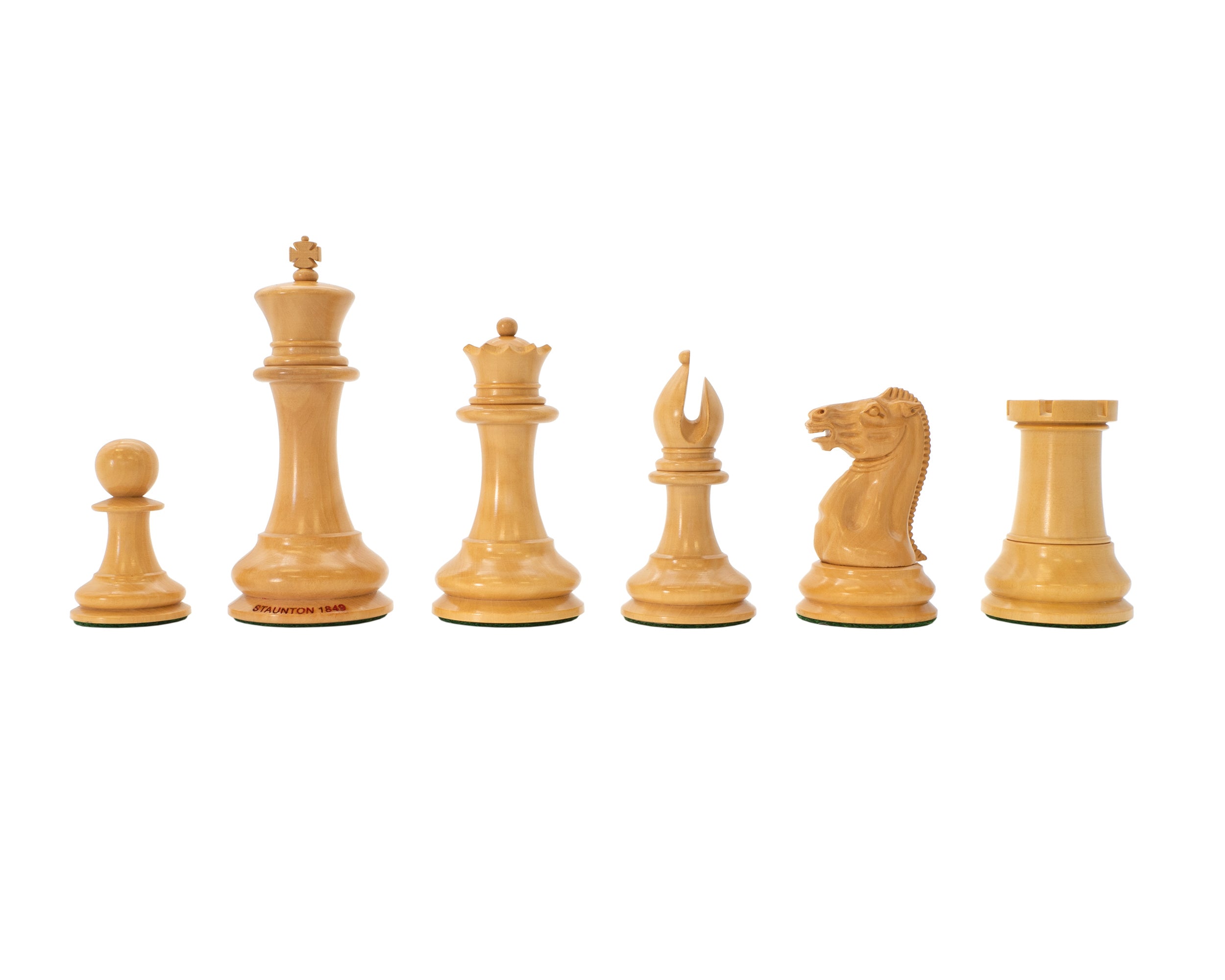
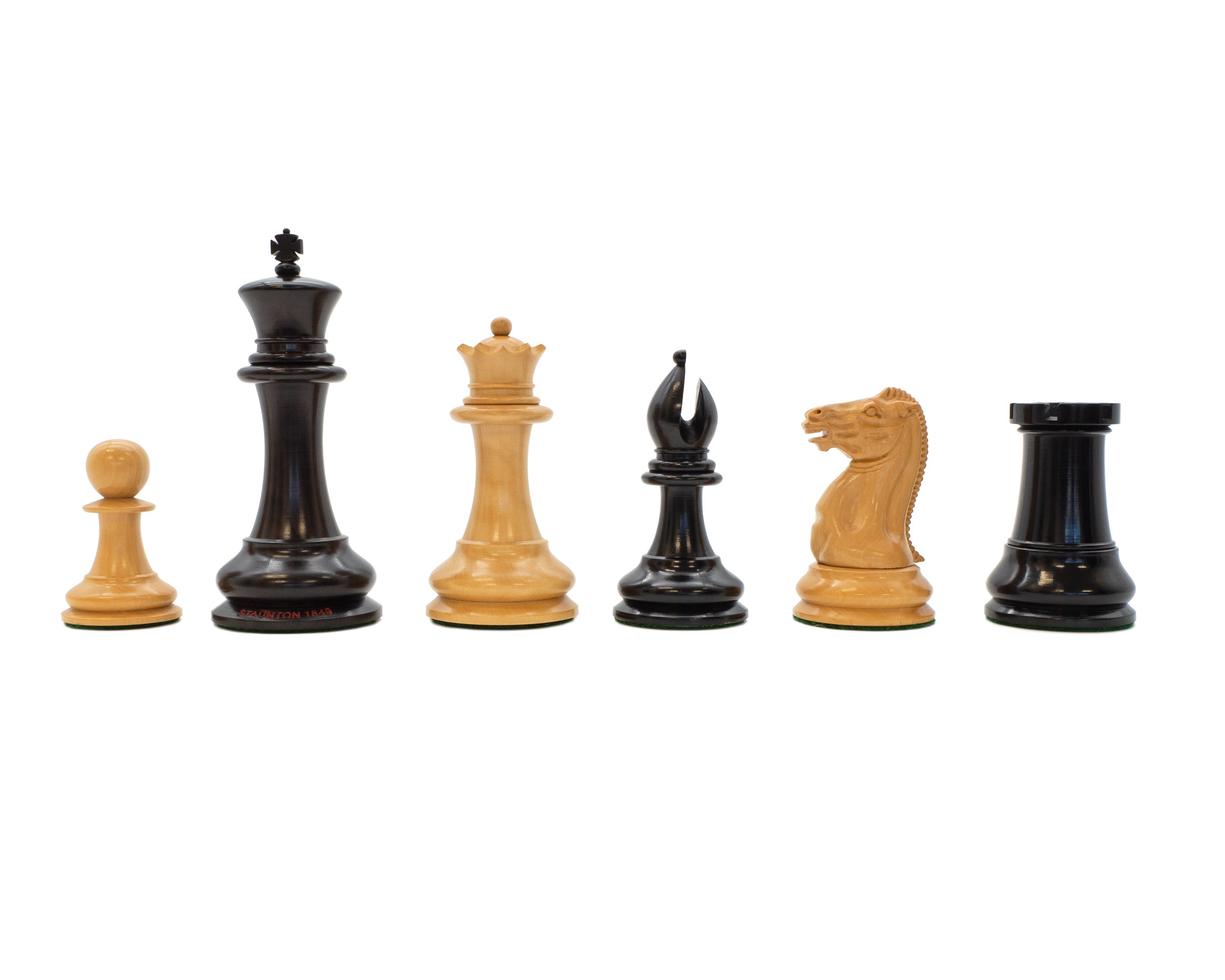
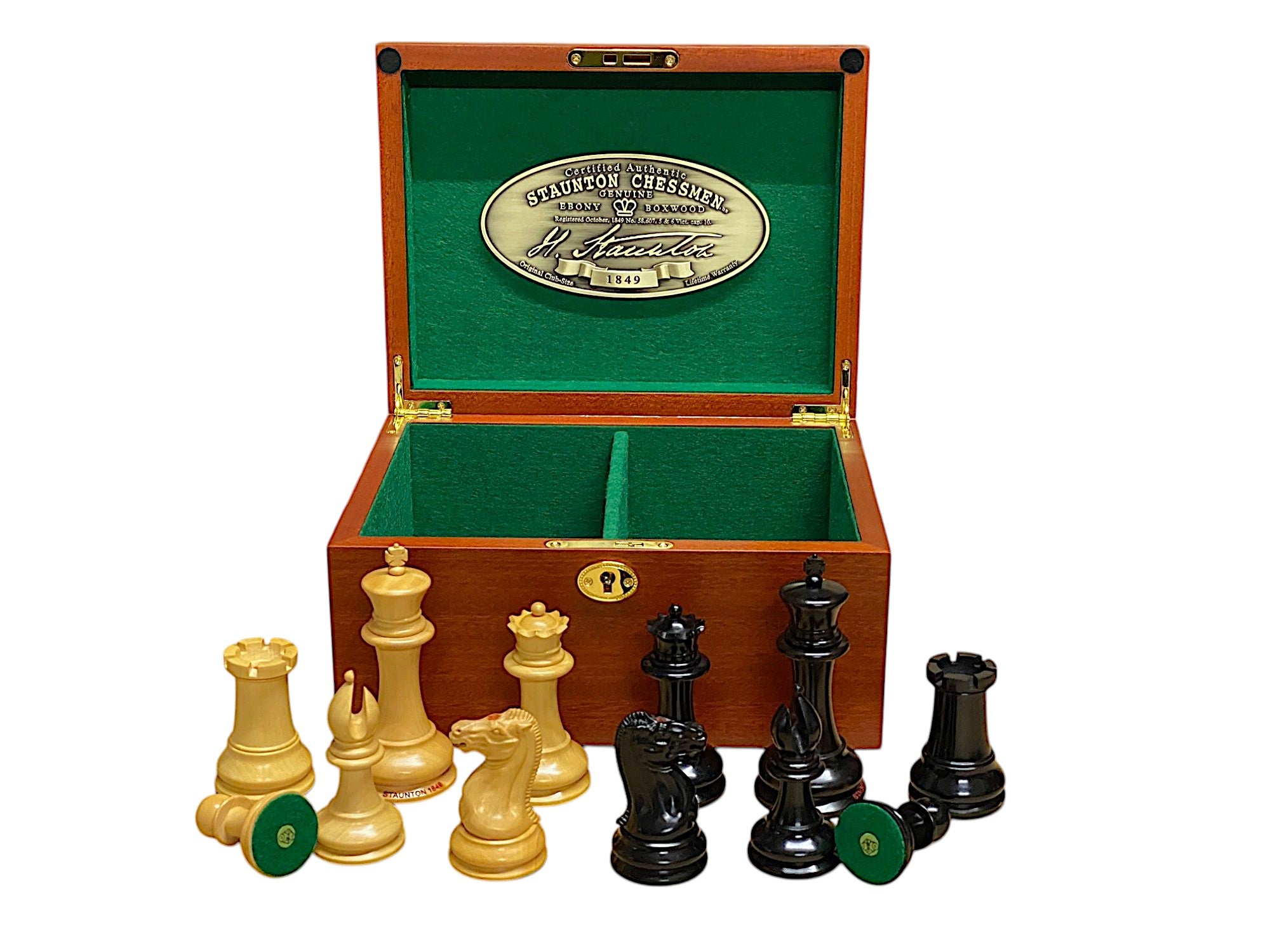
 1849 Heirloom Staunton Chess Set — Ebony & Antiqued Boxwood (Hand-Carved Knights) See it on Amazon ↗
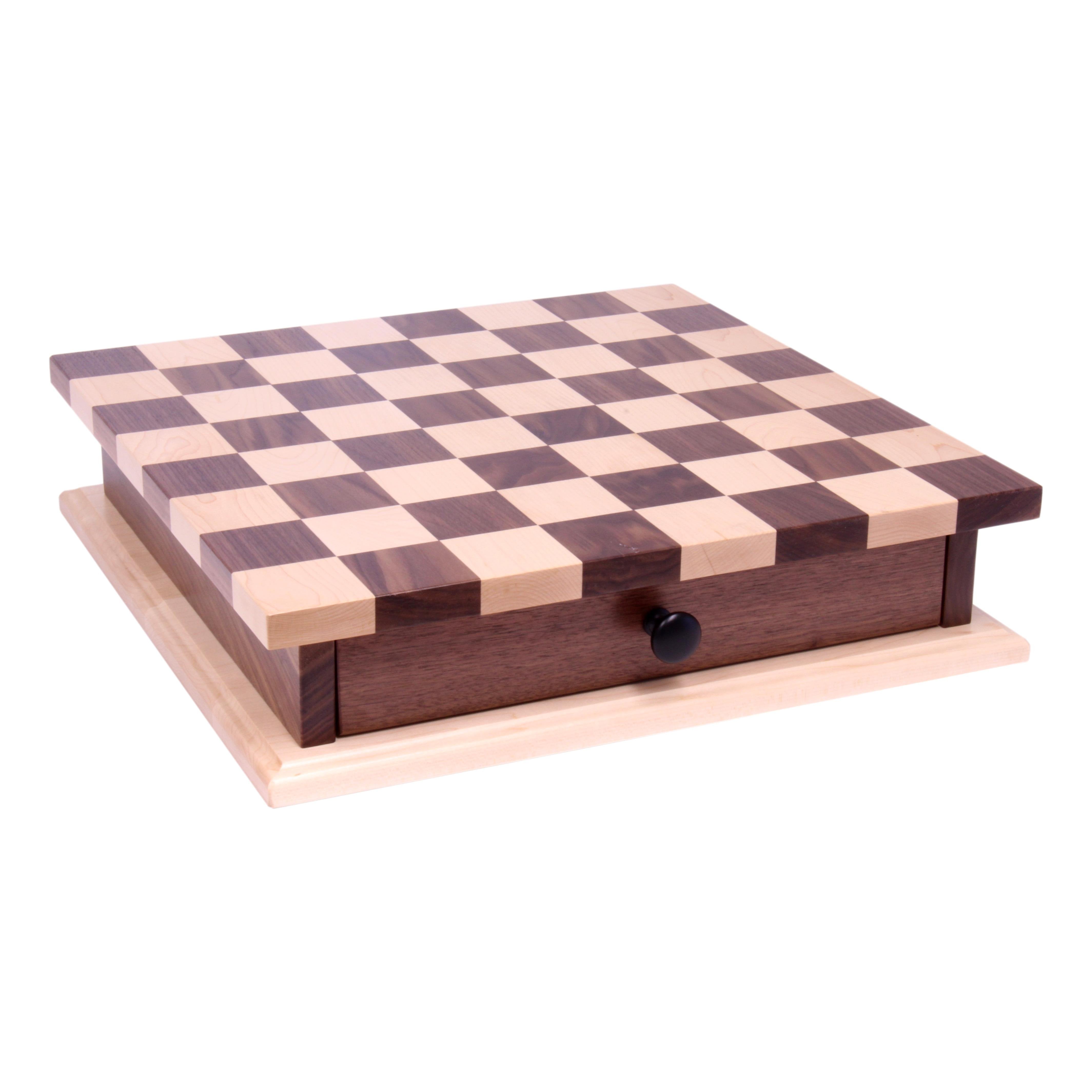
Best overall: a solid maple-and-walnut chess/checkers board from an Amish or Mennonite shop. If I get one pick that has to do everything — play two of the most-played games on Earth, survive children, and refinish forever — it's a solid hardwood board from the Holmes County, Ohio / Shipshewana, Indiana woodworking tradition, sold through AmishToyBox (Wengerd Wood and neighbors). The deluxe 18-inch board is built from solid hard maple and black walnut squares with a dovetailed pull-out drawer for the pieces (~$327). There is no veneer anywhere in the description; it is solid stock with traditional joinery, and that's precisely why it wins. It's not the flashiest object here — a luxury cabinet compendium photographs better — but it is the one most likely to be on a grandchild's table in 2080, sanded and re-oiled and good as new. That is the entire definition of the category, met cleanly.
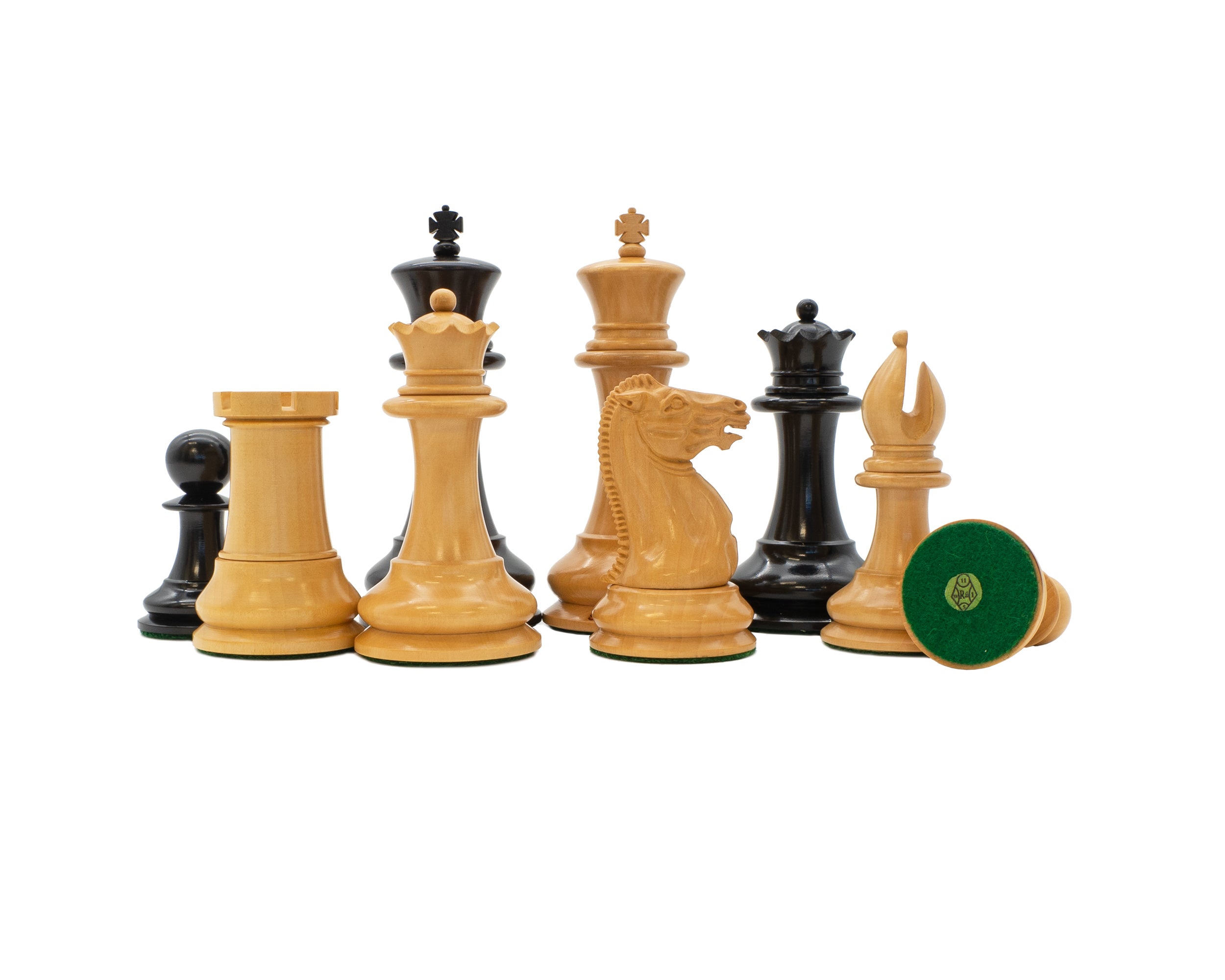
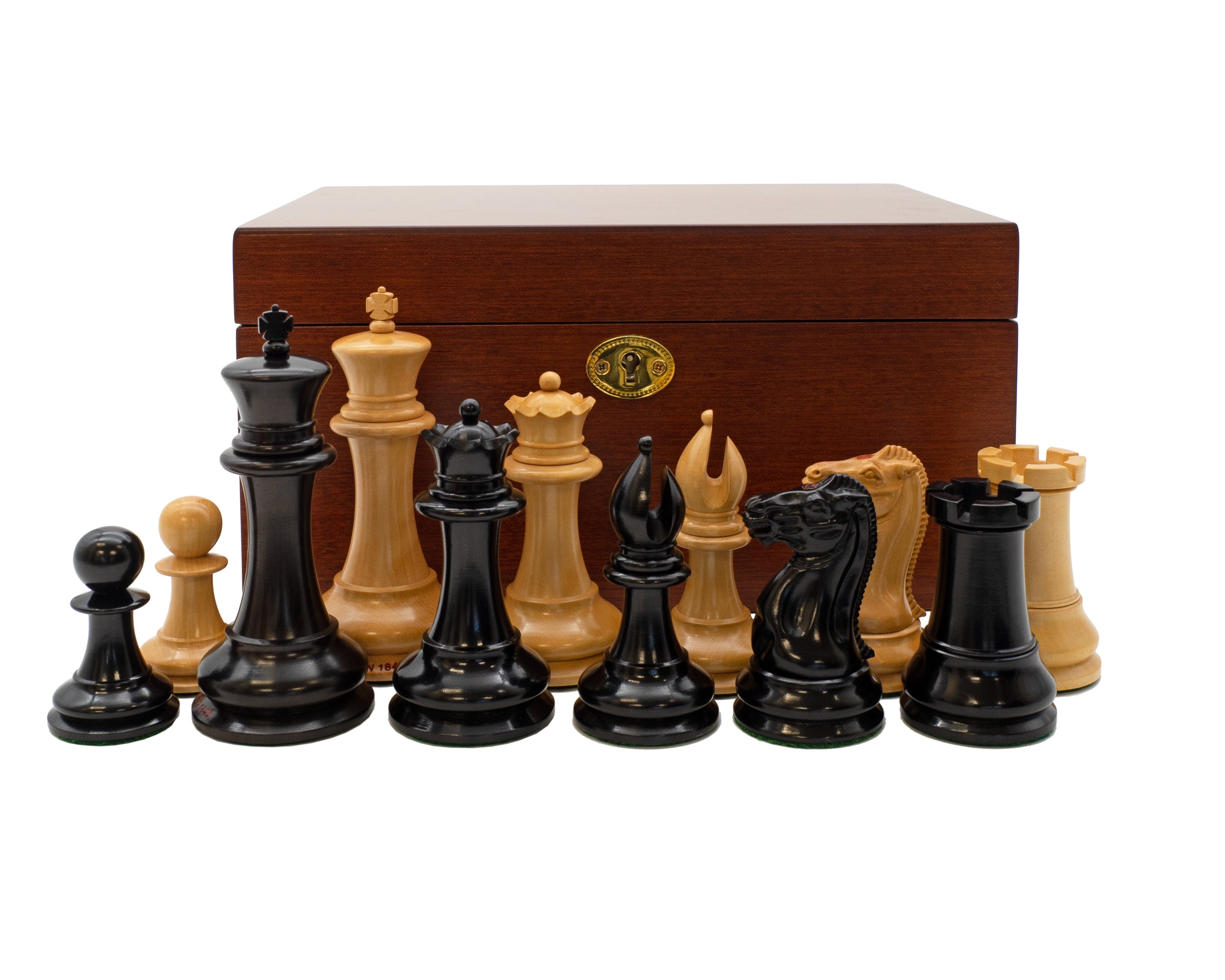
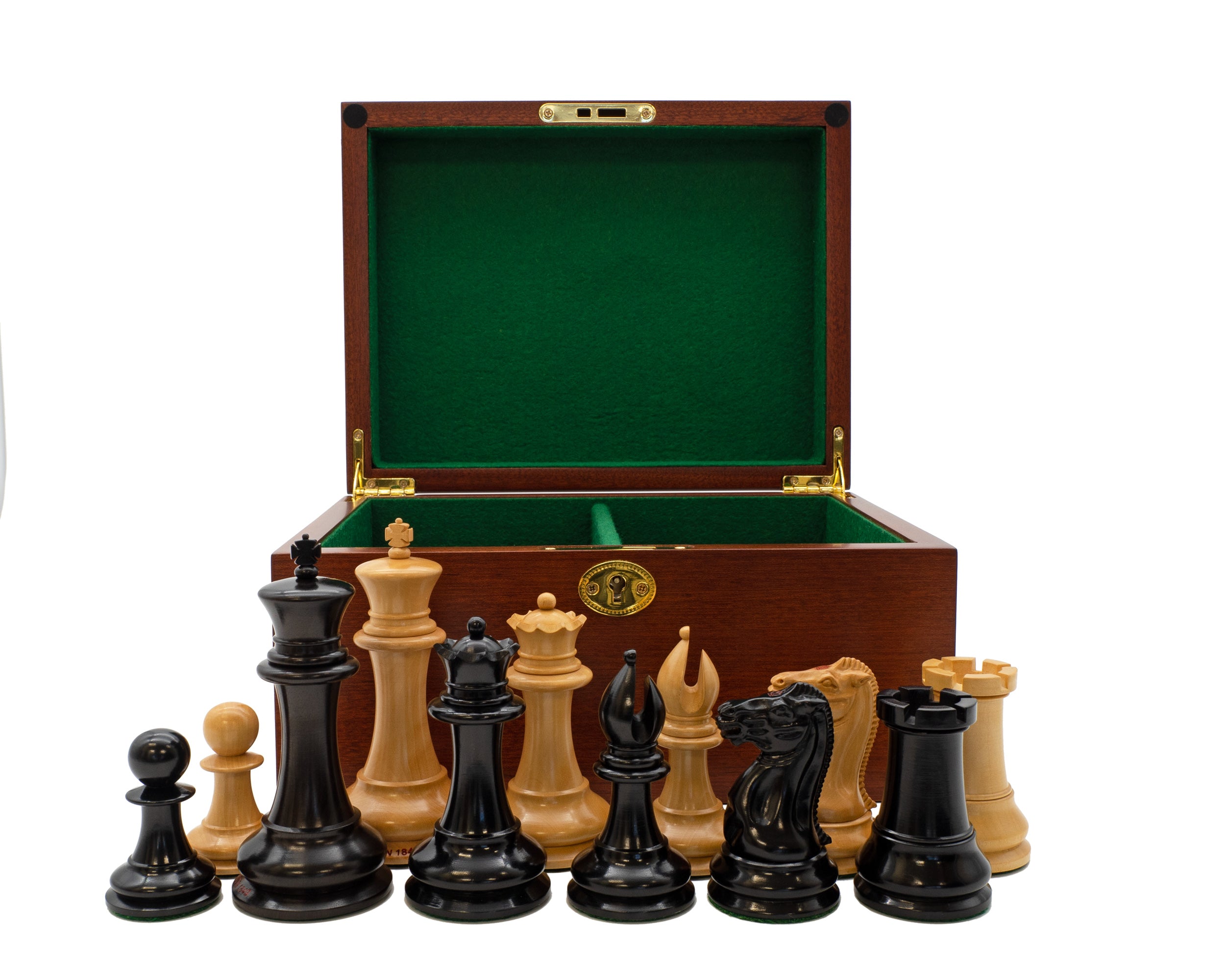
Best chess: a genuine ebony-and-boxwood Staunton set with hand-carved knights. Chess is where heirloom craft reaches its peak, and where the veneer-vs-solid question gets joined by a second one: real ebony versus ebonized (stained) boxwood. The genuine article is a set like The Chess Store's 1849 Heirloom Staunton — ebony and antiqued boxwood, an exact replica of the original Jaques London chessmen, each piece lathe-turned one at a time and the knights hand-carved by skilled craftsmen. House of Staunton's luxury and signature lines run the same caliber (their Dubrovnik in Tasmanian blackwood runs around $550 shipped per collectors; custom signature boards go $1,000–4,000). These are the sets chess forum veterans report owning for 25-plus years across their kids and their kids' friends with no cracks or breakage. The honest step-down is ebonized boxwood: boxwood stained black to mimic ebony at a far lower price — still solid wood, still hand-carvable, just not the rare timber. Chess House's Heirloom Championship set (~$489) pairs ebonized/clear boxwood pieces, heavily weighted with a billiard-cloth base, on a USA-handcrafted walnut-and-maple board. That's a legitimate heirloom. What you want to avoid in chess isn't ebonized boxwood — it's hollow, unweighted pieces and a board that won't name its construction.
The distinction I'd burn into your memory: 'ebonized' is an honest, well-priced finish on solid wood. 'Veneer' is a construction that caps the object's lifespan. The first is fine for an heirloom; the second isn't.
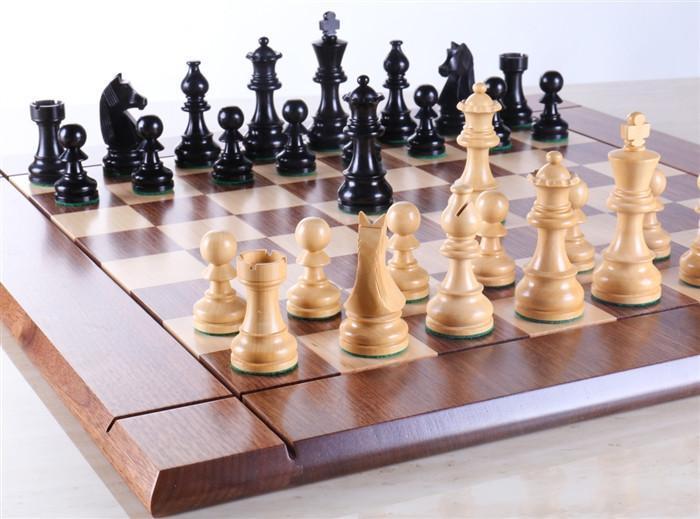
The flashiest object rarely wins this category. The one that's still on a grandchild's table in 2080 does.
What's the best heirloom backgammon set, and the best cribbage board?
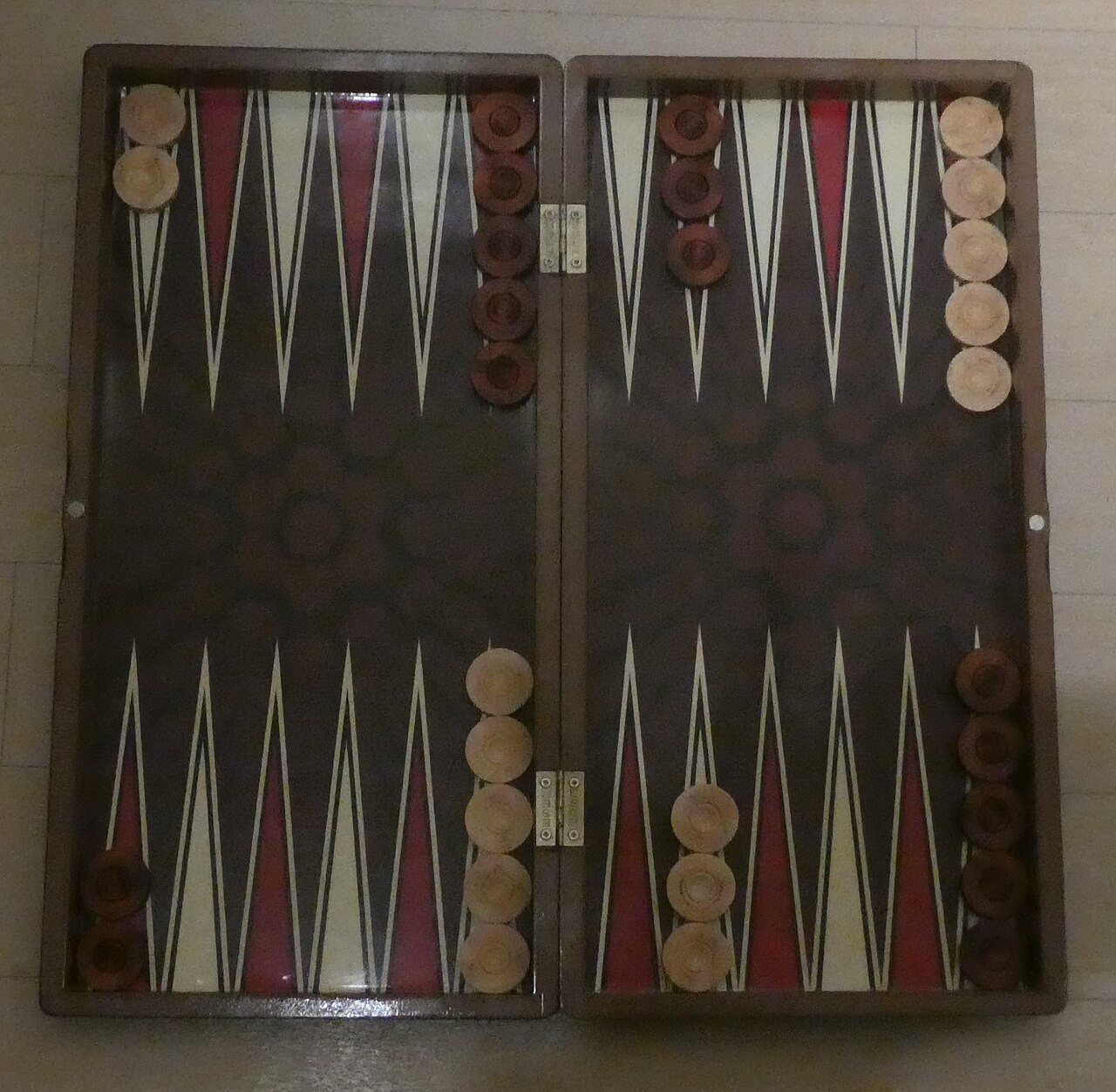

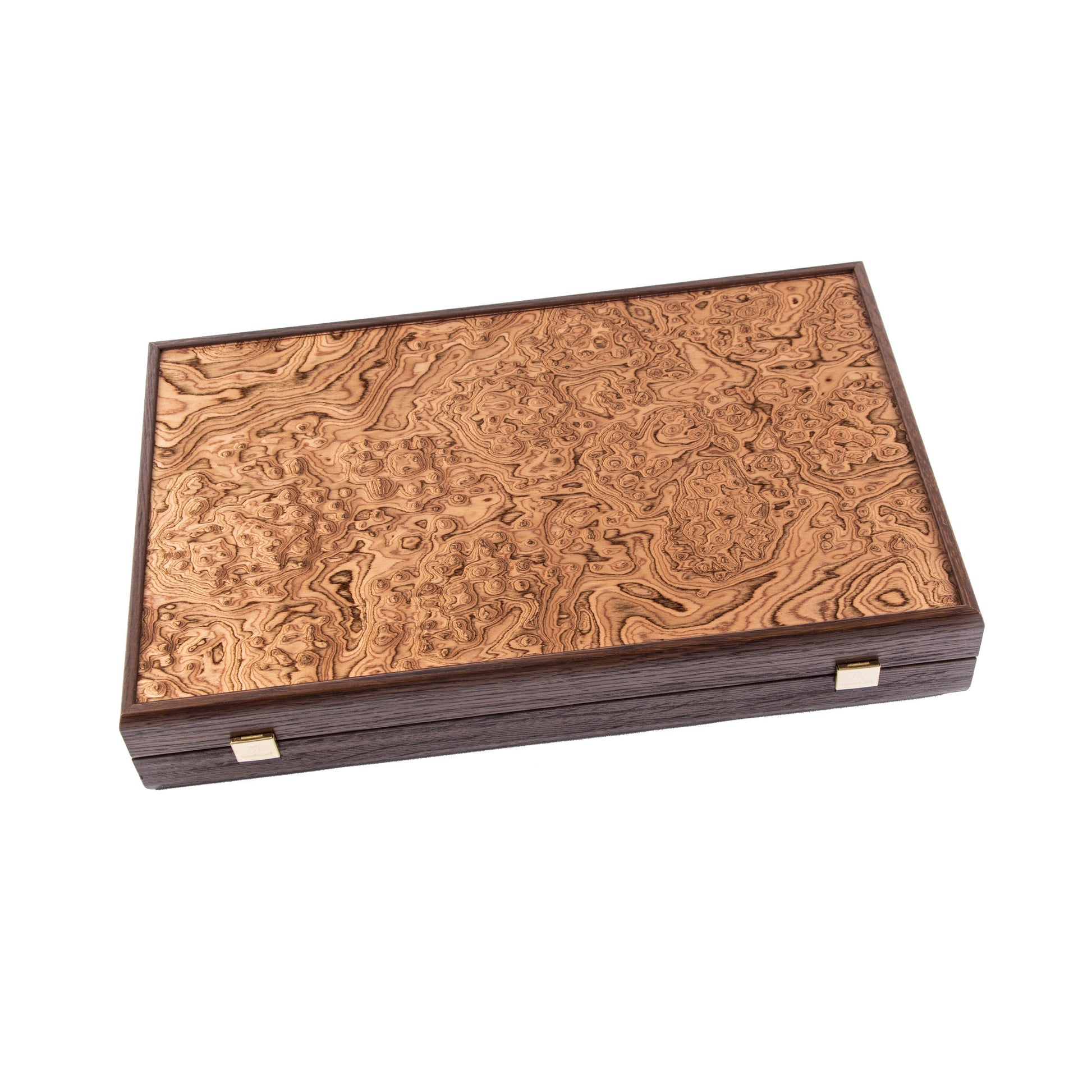
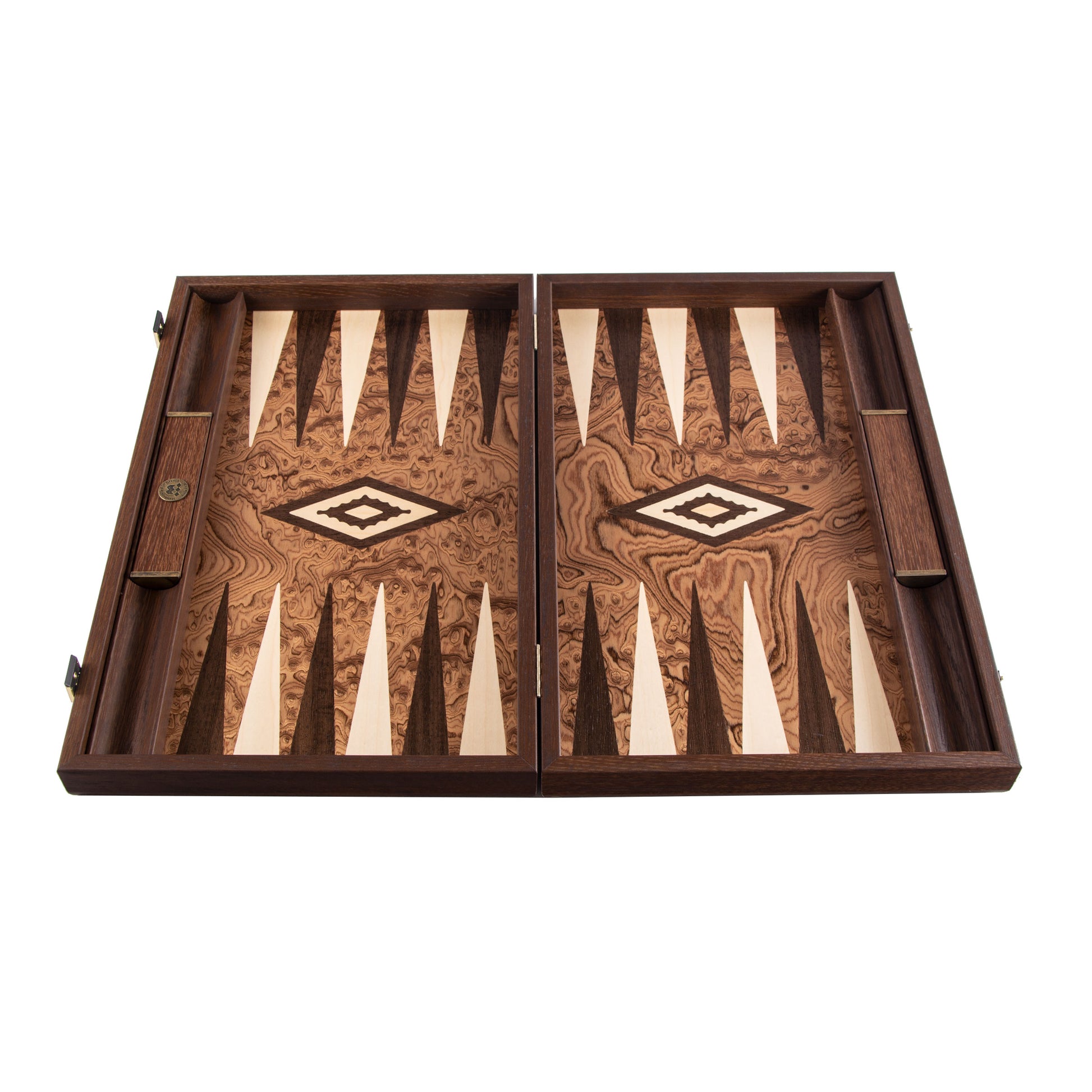
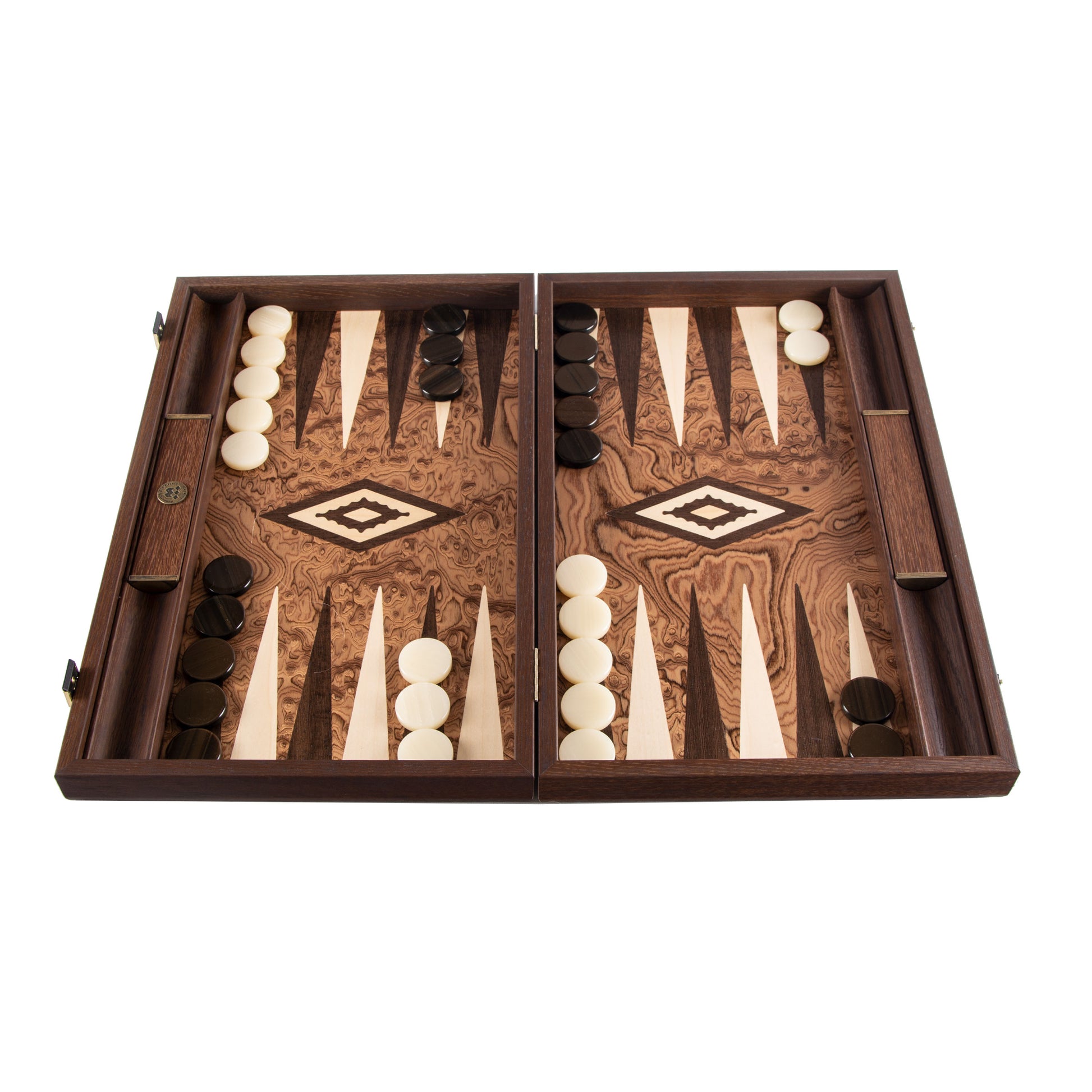
Best backgammon: a solid-walnut Manopoulos set with olive-wood checkers, handmade in Greece — with one large asterisk. Manopoulos has been handcrafting in Greece since 1970, and their genuine solid sets are gorgeous: walnut (and wenge, oak, mahogany) boards with checkers turned from Greek olive root, each one's grain unique. A 19-inch solid set with olive-wood chips is a true generational object — olive root is dense, beautifully figured, and ages well. The asterisk, and read it twice: Manopoulos also sells, under nearly identical names, a 'Walnut Replica Wood' set (printed surface, ~$47) and a 'Walnut Effect' set (~$127). Those are not solid wood — 'replica' means a photographic laminate, 'effect' means the same idea dressed up. They're fine playing sets and Manopoulos is admirably honest in the spec text, but if you want the heirloom, you must buy the one that says solid walnut with olive-wood checkers, not 'replica' or 'effect.' Bello Games New York is the other serious name here — their luxury Italian sets use briar, elm, mahogany, and burl with genuine leather and suede interiors — beautiful, though burl is frequently presented as a veneered face, so confirm before you call it solid. For a pure-play heirloom on a budget, a Wood Expressions / WE Games solid-wood folding board is the dependable middle.
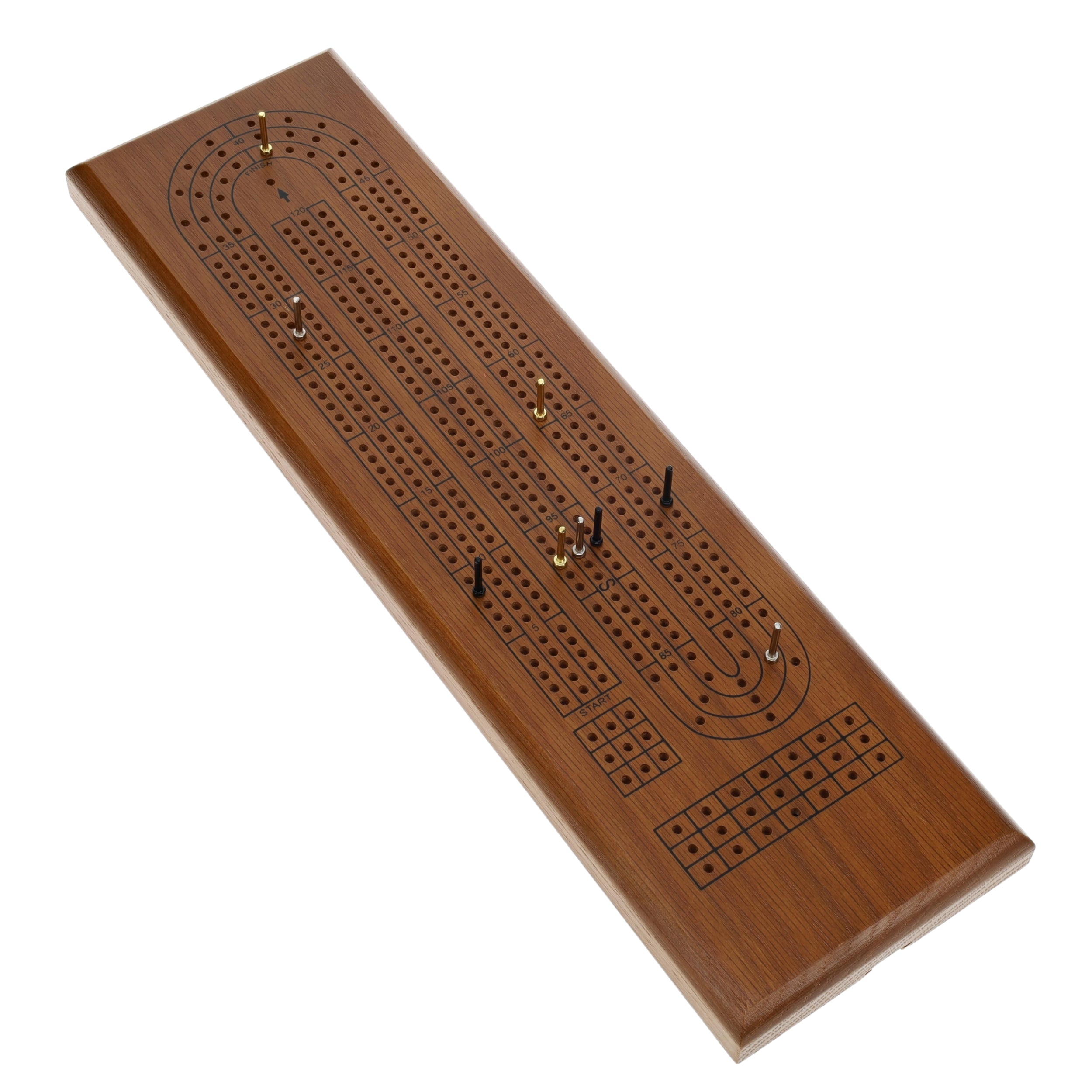
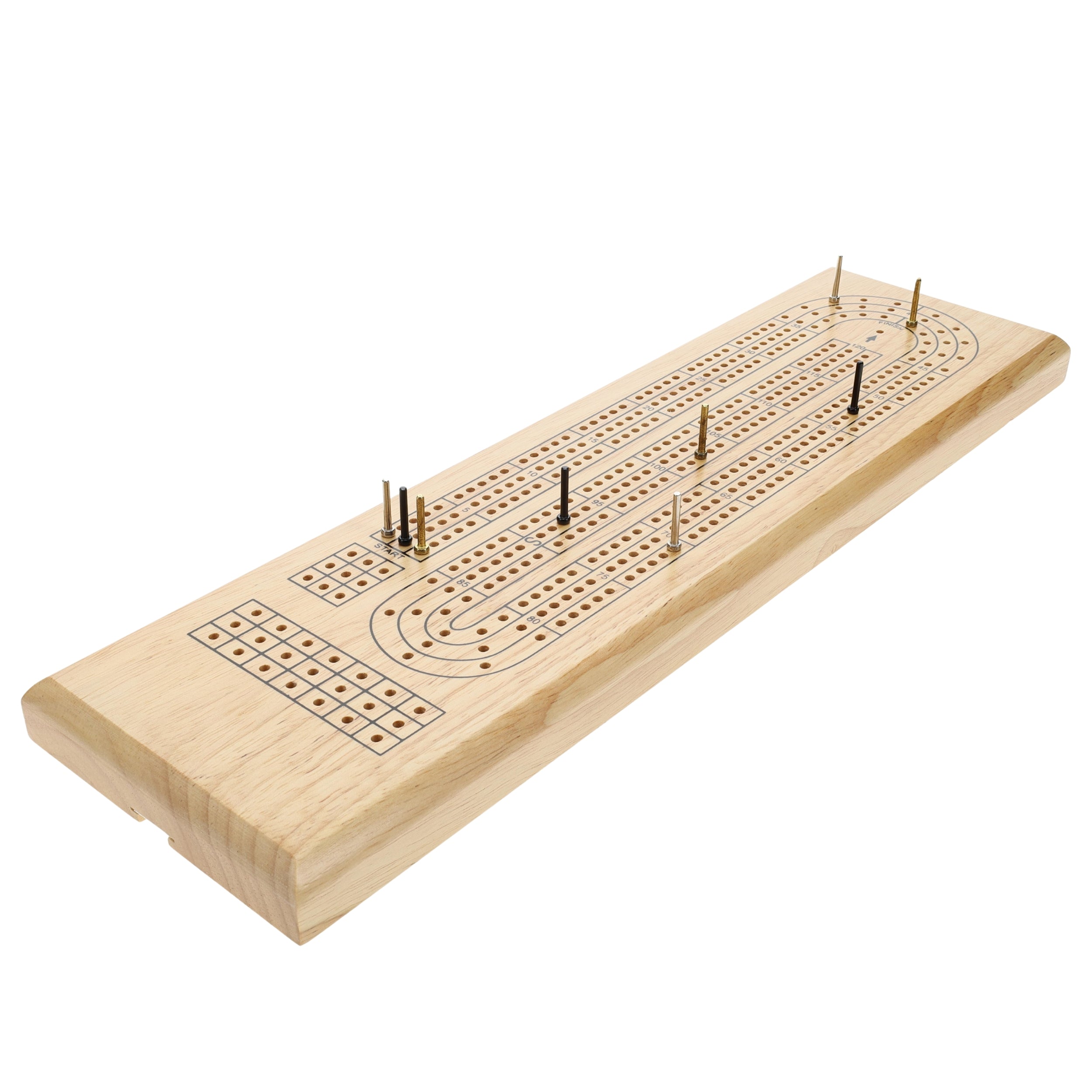
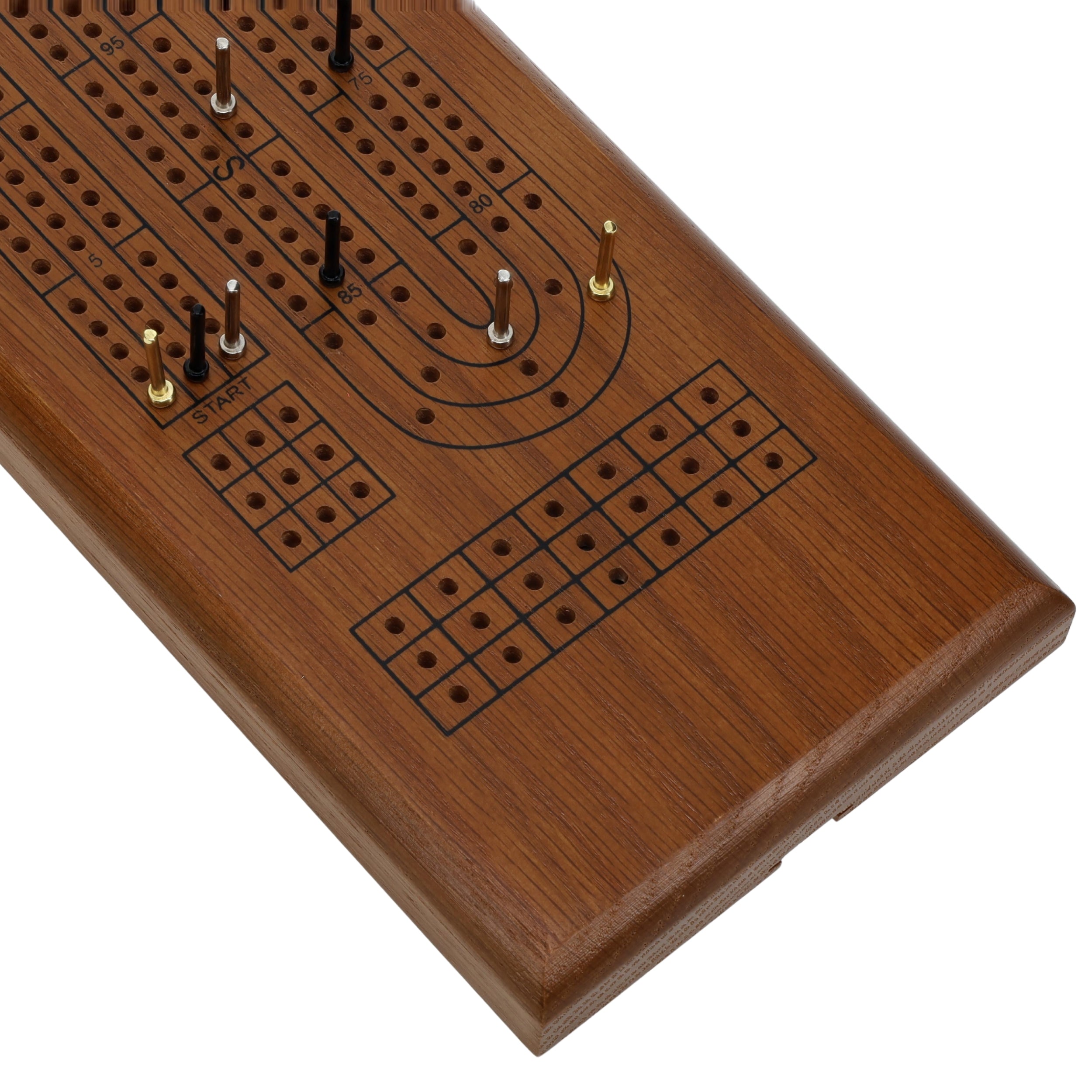
Best cribbage: a solid-walnut board from a named American shop. Cribbage is the sweet spot of this entire category — small enough that solid hardwood is cheap, simple enough that the craft shows. Heartwood Creations in Rockford, Illinois (run by Mike Fisher since 1978) makes the one I'd hand down: the Walnut S-Curve board is solid walnut hardwood with pale maple tracks and a bloodwood inlay, a magnetic dovetail-lidded peg compartment in the base, and it's all made in their Illinois shop — for about $44. That is heirloom craftsmanship at an almost unreasonable price. Wood Expressions / WE Games make a Classic Cribbage set 'in the USA of solid walnut wood' from SFI-certified American hardwood with metal pegs and a sliding-cover storage well — another honest, refinishable, made-here board. And the independent woodworkers on Etsy (Heartwood aside, shops like Mercer & Sons, Roots to Table, EBONWOOD) will build you a personalized solid maple-or-walnut board with free engraving that becomes a one-of-a-kind family piece. Cribbage is where 'heirloom' costs the least and delivers the most — there's almost no excuse to buy a printed or plastic one.
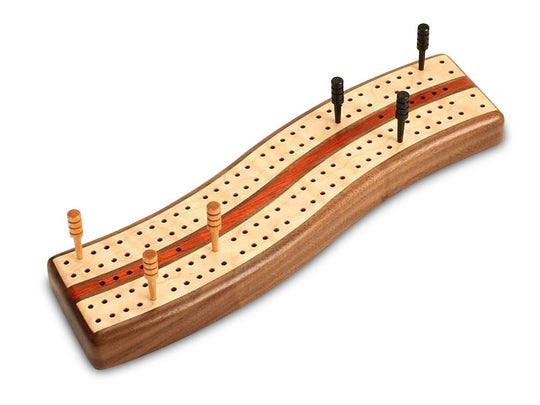
Cribbage is where 'heirloom' costs the least and delivers the most — a solid-walnut, made-in-USA board runs about forty dollars.
Mancala, dominoes, Chinese checkers, carrom, Nine Men's Morris: what about the rest of the canon?
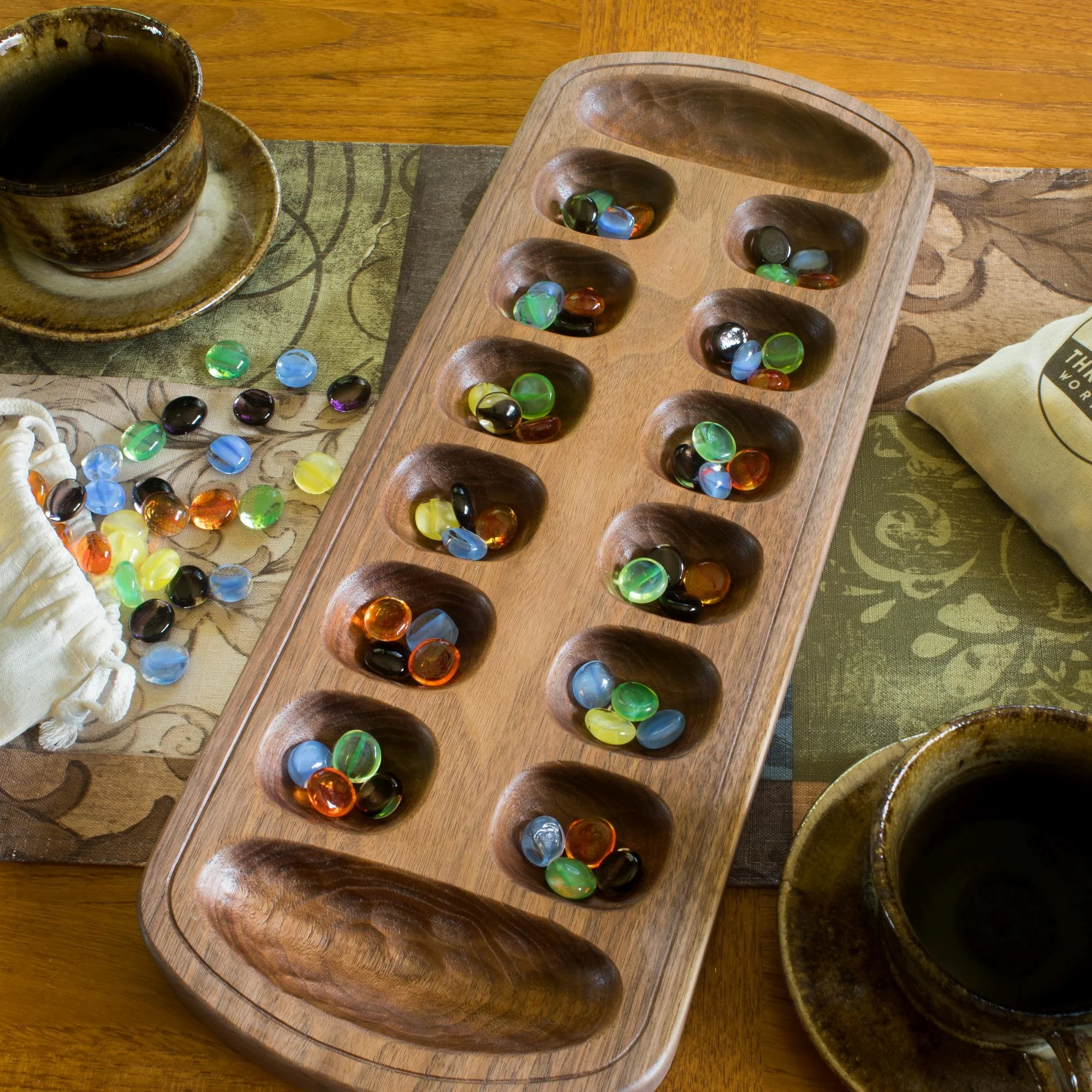
The classics beyond chess and backgammon are where the independent woodworker quietly out-crafts the big brands — and where a couple of famous names get exposed.
Mancala. This is an Etsy/independent-maker win, full stop. Solid walnut or cherry boards with hand-rubbed oil finishes from shops like Hearth & Pine (Ontario) and small US family workshops run heirloom-grade and personalize beautifully. Glass stones are traditional and fine. The mass-market contrast is instructive: Melissa & Doug's Wooden Mancala (~$29) is real wood and genuinely well-made for the money — a perfectly good first set and budget gift — but it's a painted children's-toy build, not a refinishable hand-down. For mancala specifically, the gap between a $29 toy and a ~$60–120 solid-walnut artisan board is enormous in feel and almost trivial in dollars.
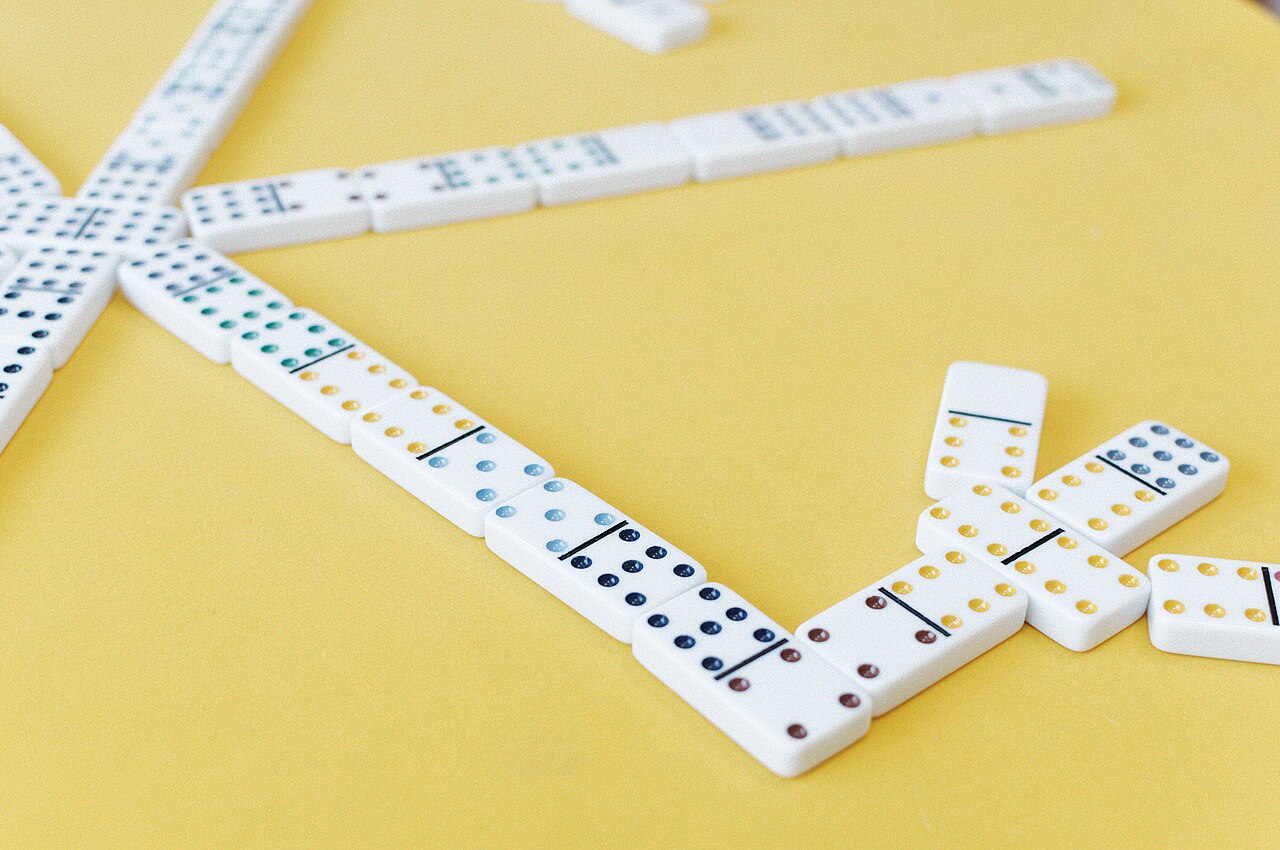
Dominoes. Here's a callout the brands won't volunteer: a 'wooden domino set' usually means the case is wood and the tiles are plastic or resin. WE Games' popular sets are explicit — 'heavy-duty plastic dominoes... in a sturdy wooden case.' That's a handsome storage box, not an heirloom tile set. For the real thing you want wooden tiles, and Creative Crafthouse handcrafts solid-wood double-12 domino sets in a wooden box — that's the heirloom build. Read carefully: the wood you're paying for should be the tiles, not just the lid.
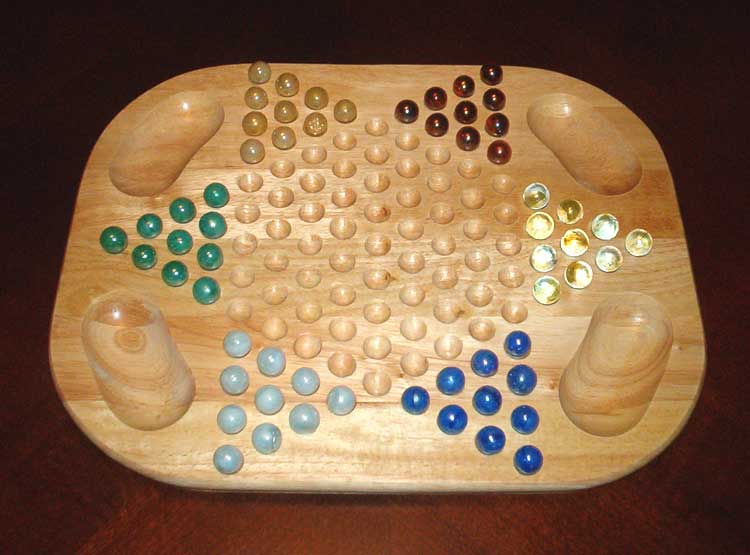
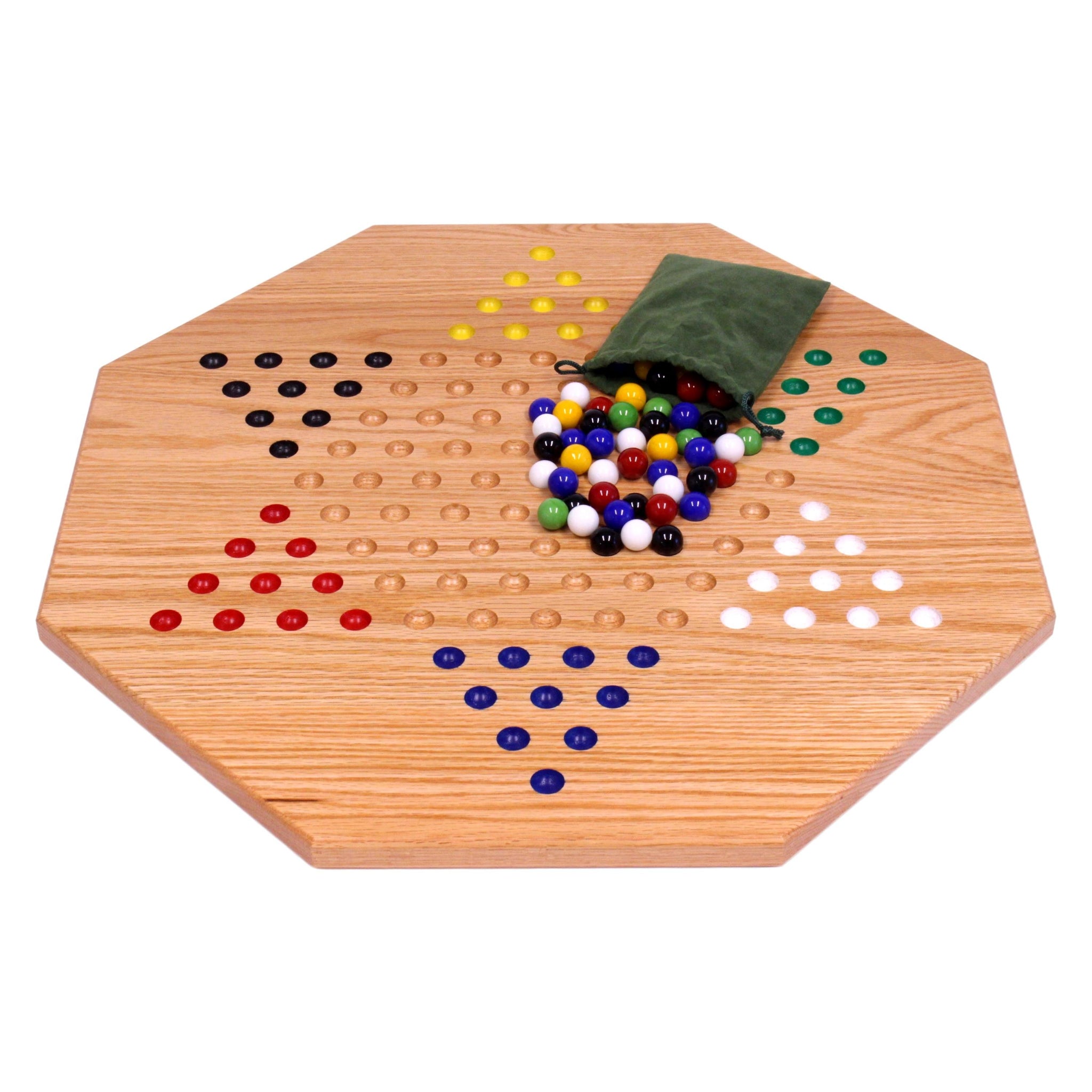
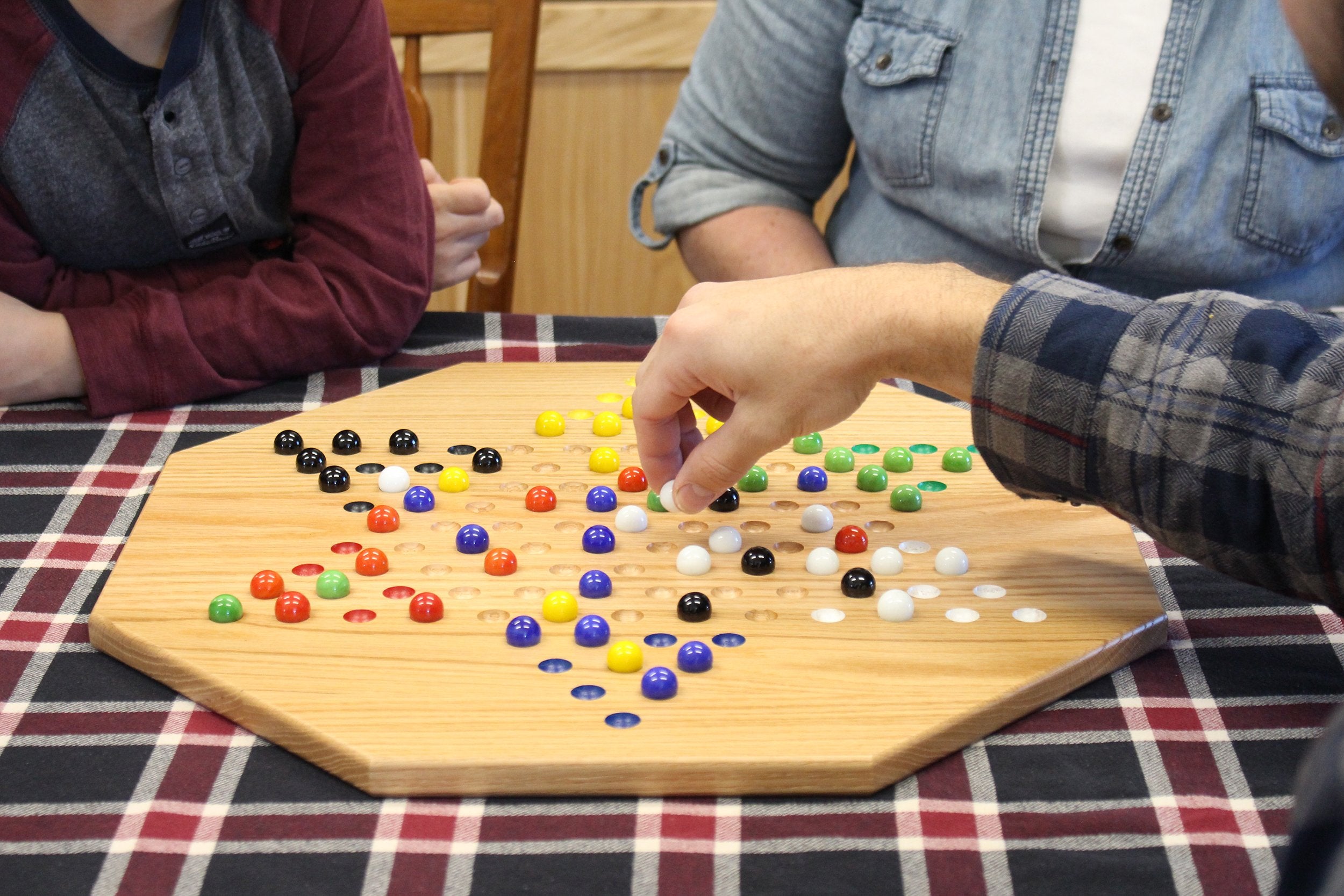
Chinese checkers & Aggravation/Wahoo. The Amish/Mennonite marble-game tradition owns this outright. Wengerd Wood (Holmes County, Ohio), via AmishToyBox, makes solid-oak Chinese checkers boards (~$97.50, with 60 glass marbles) and double-sided solid oak-or-maple Aggravation/Wahoo boards with real glass marbles — hand-painted, precision-drilled, designed to last generations of play. These are showpiece heirlooms at mid-two-figure-to-low-three-figure prices and they shame any plastic equivalent. Drueke's vintage wooden Chinese checkers (1-inch solid stock) are a lovely secondhand hunt if you prefer the patina of an actual old American game.
Carrom. As noted, the correct heirloom carrom board is a plywood/Baltic-birch playing surface in a solid hardwood frame — a wide solid panel would cup and kill the glide. Surco (made in India) is the canonical name; their better boards pair an 8–20mm ply surface with a solid hardwood frame. Don't penalize ply here — it's the right engineering.
Nine Men's Morris. Pure independent-woodworker territory, and a delight for it. Etsy makers build solid-oak, ash, figured maple, and walnut boards with hardwood or maple-ball pieces, oil-and-wax finished, often live-edge. Low production volume, high craft, very heirloom — and because the board is small and the geometry simple, solid hardwood is affordable.
The pattern across all of these: for the lesser-known classics, a named independent maker who says 'solid' beats a famous brand that says 'wooden case' or stays quiet about the tiles.
A 'wooden domino set' usually means a wooden box around plastic tiles. The wood you're paying for should be the tiles, not just the lid.
Are heirloom wooden games worth it — and how do you keep them alive?
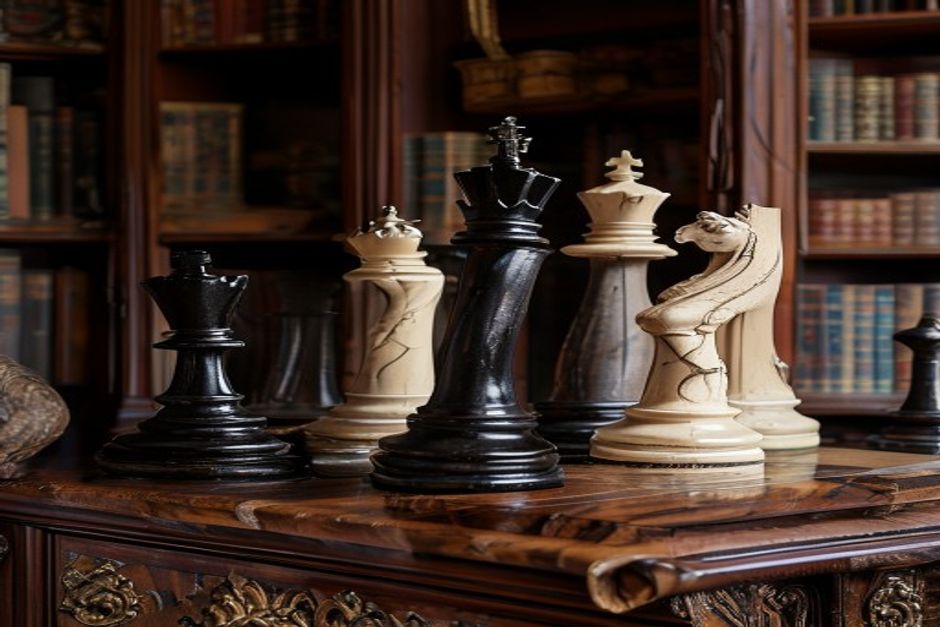 1849 Heirloom Staunton Chess Set — Ebony & Antiqued Boxwood (Hand-Carved Knights) See it on Amazon ↗
Worth it? Honestly, it depends on what you're buying for. If you want a game to play and don't care about handing it down, a printed-surface Manopoulos (~$47) or a Melissa & Doug mancala (~$29) plays identically to its solid-wood sibling and saves you real money — buy it without guilt. The heirloom premium is not about gameplay. It's about two things: the object (a solid-walnut board is a genuinely better thing to live with, handle, and display than a laminate) and the handoff (only solid wood can be refinished into a second and third life). Note the one thing it is not: an investment. Collectors are clear-eyed that even fine wood sets won't appreciate meaningfully — you buy them to keep and use, not to flip. If your goal is decor-plus-play-plus-legacy, the premium is easily worth it, especially in cribbage and the smaller classics where 'heirloom' costs almost nothing extra. If your goal is purely play, it isn't, and anyone who tells you otherwise is selling.
Keeping it alive is genuinely simple, and it's the part that makes the solid-wood premium pay off:
- Dust dry, never wet. Wipe with a soft dry microfiber cloth. Excess moisture seeps into the grain and causes warping or cracking — a damp cloth is the single most common way people quietly ruin a board.
- Condition a few times a year. A little natural oil (lemon oil, or a board-appropriate tung/Danish oil) or beeswax restores the wood and prevents cracking. Avoid polishes with silicone or alcohol — they can wreck the finish.
- Control the environment. Keep it at roughly 40–60% humidity, away from radiators, A/C vents, and fireplaces. Rapid temperature and humidity swings are what crack wooden pieces straight down the middle — placement matters more than people think.
- Store it flat. Leaning a board upright invites warping over time. Lay it down.
- Refinish when it's earned. This is the heirloom superpower: when the surface finally dulls or scratches after years of play, a solid board sands back and re-oils to better-than-new. A veneer or 'replica' board can't take this step — which is exactly why it isn't an heirloom.
Do this and a solid-hardwood game genuinely will outlive you. That's not sentiment; it's just material science plus a microfiber cloth.
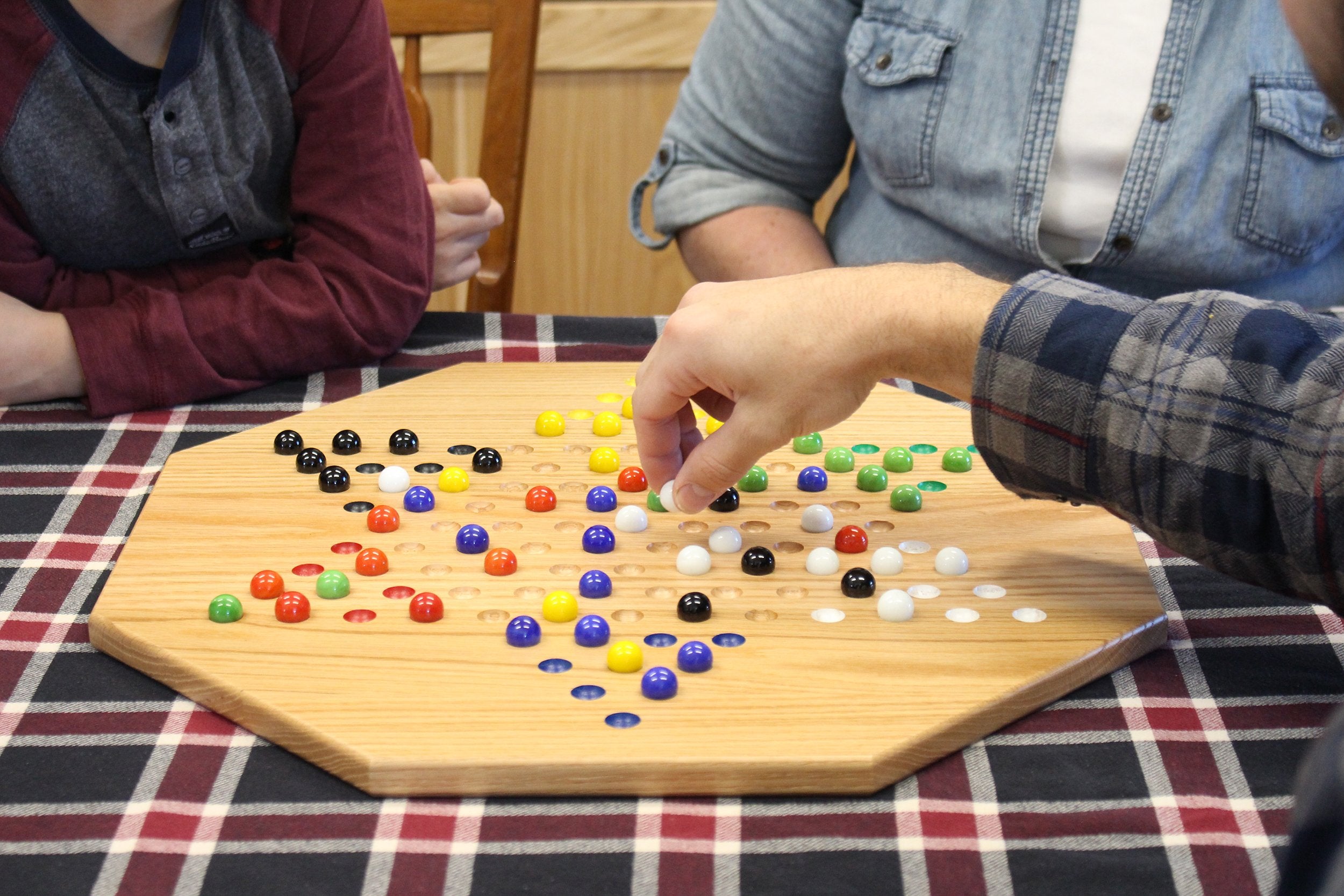
The heirloom premium buys two things: a better object to live with, and the ability to refinish it into a second life. It does not buy an investment.
What experienced tables keep reporting
Recurring owner patterns, synthesized in Puzzlewick's words. Follow each evidence trail to read the original discussion.
Good wood sets you purchase are heirlooms your grandchildren will want to keep, though they will likely not go up in value to any appreciable extent.
Read the evidence: Chess.com forum — chess equipment discussion on heirloom sets
I've had a weighted wooden set for over 25 years, used by me and my sons and their friends — no cracks, no broken pieces.
Read the evidence: Chess.com forum — 'Looking For A Durable Wood Set'
Sturdy, smooth, beautiful wood.
Read the evidence: Customer review of the solid-oak Chinese Checkers board, AmishToyBox.com
'Heirloom' games — made of wood, nice enough that you'd want to pass them down to the next generation, and good enough to display as decor on a desk or coffee table.
Read the evidence: BoardGameGeek geeklist 329029, 'Not just wood — but showpiece game'
All of our wood products are made in our shop in Rockford, Illinois — the base is solid walnut hardwood with pale maple tracks and a brilliant piece of bloodwood inlaid into the top.
Read the evidence: Heartwood Creations (Mike Fisher), Walnut S-Curve Cribbage Board
The reversible gameboard is crafted with rich Rosewood and Tiger Maple veneers... the backgammon/checkers pieces are made of smooth resin.
The picks
Some links below are affiliate links — as an Amazon Associate, Puzzlewick earns from qualifying purchases, at no extra cost to you. It never changes a pick.

 3 photos
 Amish-Made Deluxe Solid Maple & Walnut Chess/Checkers Board (with Drawer)
Solid hard maple and black walnut squares, a dovetailed pull-out drawer for the pieces, handcrafted by Amish artisans in Shipshewana, Indiana — no veneer anywhere in the spec. The 18-inch board (~$327; 13-inch ~$242) plays the two most-played games on Earth and is the single set here most likely to be sanded back to new on a grandchild's table decades from now. It's not the flashiest object in the lineup, but it is the cleanest expression of the category's whole point. Genuine solid-hardwood construction at a fair, non-luxury price. The one I'd hand down if I could keep only one.
- Solid hard maple + black walnut throughout — fully refinishable
- Real joinery: dovetailed peg drawer, tight mitered frame
- Plays both chess and checkers; pieces included
- Made in USA by a named workshop tradition
- Pieces are solid but utilitarian — not hand-carved Staunton caliber
- Plainer-looking than a luxury veneer cabinet
- Glass/marble upgrades and engraving cost extra
 7 photos
 1849 Heirloom Staunton Chess Set — Ebony & Antiqued Boxwood (Hand-Carved Knights)
A precise replica of the original 1849 Jaques London chessmen: genuine ebony and antiqued boxwood, each piece lathe-turned one at a time, knights hand-carved by skilled craftsmen, weighted with billiard-cloth bases. This is real-timber, real-craft chess — the tier collectors report keeping 25-plus years across their kids with zero breakage. Prices run roughly $400–600+ depending on king size and board; genuine ebony commands a premium over ebonized. If chess is the heirloom you care about most, this is the honest top of the market short of full custom. Pair with a solid-wood board, never a veneered one.
- Genuine ebony + boxwood — the real materials, not stained
- Hand-carved knights, lathe-turned pieces, weighted with felt bases
- Faithful 1849 Jaques pattern beloved by collectors
- Proven multi-decade durability in real households
- Price climbs fast; genuine ebony is a real premium over ebonized
- Board usually sold separately — budget for a solid one
- Ebony needs humidity discipline to avoid checking
 3 photos
 Handcrafted Solid Walnut Backgammon Set with Olive-Wood Checkers (19")
Manopoulos has handcrafted in Greece since 1970, and their genuine solid sets are the heirloom backgammon benchmark: solid walnut boards with checkers turned from dense, swirl-grained Greek olive root that ages better than the day you buy it. Each board's grain is unique. Prices for true solid sets run well into the low-to-mid hundreds depending on size and wood. The critical caveat: buy the listing that says 'solid walnut with olive-wood checkers,' NOT their 'Walnut Replica' (~$47, printed) or 'Walnut Effect' (~$127) lines, which are laminate-surface sets wearing nearly identical names.
- Solid walnut + genuine olive-root checkers — true heirloom build
- Handmade in Greece; each board's grain is one-of-a-kind
- Olive wood ages beautifully and is extremely dense
- Maker discloses materials honestly in the spec text
- Easy to buy the wrong tier — 'replica'/'effect' look near-identical by name
- Genuine solid sets cost several times the laminate versions
- Large folding boards need careful flat storage to stay true
 3 photos
 Hand-Painted Solid Oak Chinese Checkers Board, 19" (60 Glass Marbles)
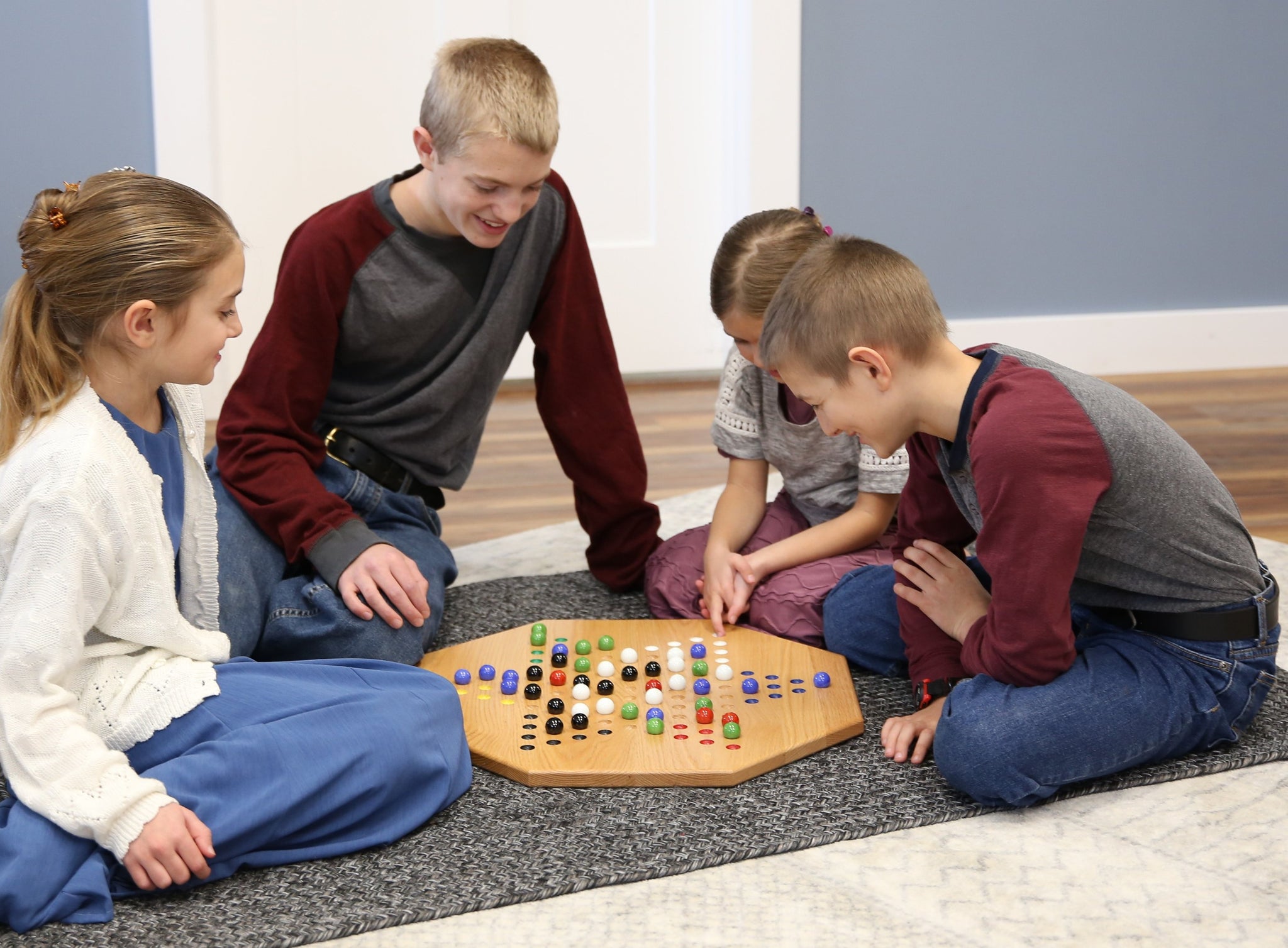
Solid oak, precision-drilled and hand-painted holes, 60 glass marbles in a drawstring pouch, handcrafted in the Holmes County, Ohio Mennonite woodworking tradition — about $97.50. A buyer's review sums it up: 'Sturdy, smooth, beautiful wood.' This is the genuine showpiece-heirloom article at a non-luxury price, and it shames any plastic Chinese-checkers equivalent. The same shop's double-sided solid oak/maple Aggravation (Wahoo) marble boards are equally worth it. If you want a wooden game the whole family gathers around that's also built to last generations, start here.
- Solid oak with real glass marbles — refinishable, generational
- Hand-painted, precision-drilled by a named workshop tradition
- Includes 60 glass marbles in a pouch
- Excellent solid-wood value under $100
- Painted holes will eventually need touch-up with heavy use
- Single-game board (Aggravation/Wahoo sold as separate boards)
- Oak is heavy — it's a stay-on-the-table piece
 3 photos
 Classic Cribbage Set — Solid Walnut, Continuous 3-Track, Metal Pegs (Made in USA)
Wood Expressions has manufactured games for 40 years and added a Made-in-USA line of North American maple, oak, and walnut hardwoods. This 3-track board is 'finely crafted in the USA of solid walnut wood' from SFI-certified American hardwood, with nine metal pegs in a sliding-cover storage well. It's the dependable, easy-to-find solid-wood cribbage board — not as artisanal as Heartwood, but honestly solid, refinishable, and made here. A safe, no-drama heirloom-grade pick when you want a known brand with stock on hand. Roughly $25–45 depending on retailer and the inlay/cabinet variant.
- Solid walnut, made in USA from SFI-certified hardwood
- Metal pegs with built-in sliding-cover storage
- Widely available; multiple track/cabinet variants
- Honest 'solid' spec language from the maker
- Less distinctive than independent-maker boards
- WE Games' domino/other sets often pair wood cases with PLASTIC tiles — check each product
- No cards in the base cribbage set
 3 photos
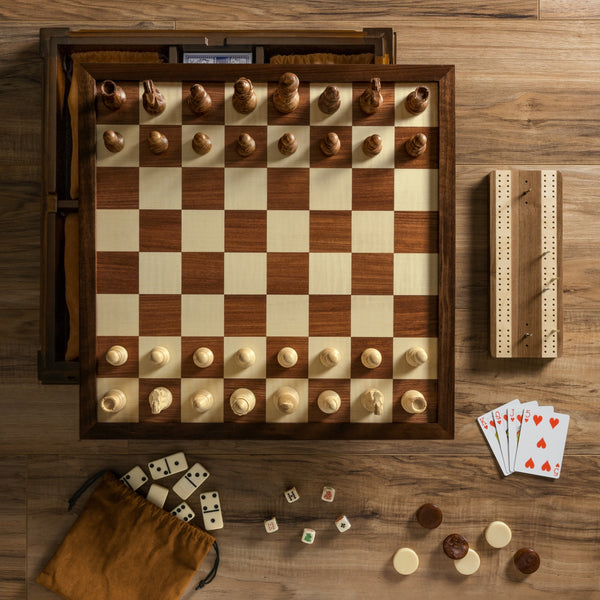
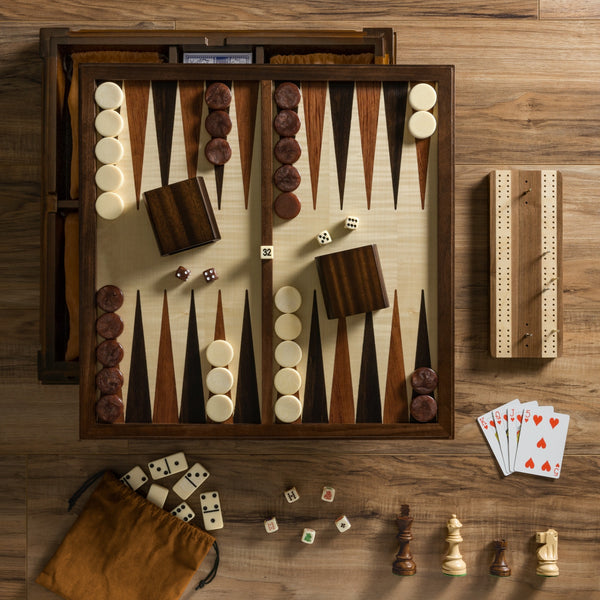
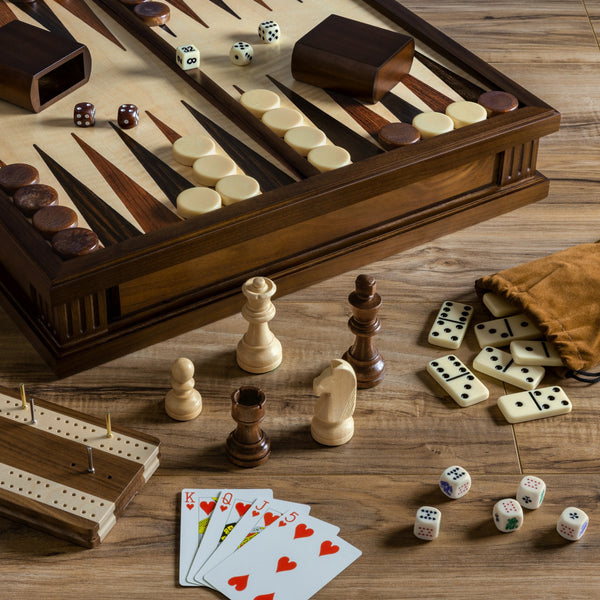
 Chess 7-in-1 Heirloom Edition — Solid Walnut Cabinet, Rosewood/Tiger-Maple VENEER Board
Included with a clear-eyed warning, because this is exactly the 'heirloom branding over veneer' case to understand. It's a genuinely beautiful 7-in-1 (chess, checkers, backgammon, cribbage, dominoes, poker dice, cards) in a solid stained-walnut cabinet (~$352). To WS Game Company's real credit, they disclose it plainly: the reversible board is 'Rosewood and Tiger Maple VENEERS,' and the backgammon/checkers pieces are 'smooth resin' (the chess pieces are hand-carved solid wood). The cabinet is solid; the playing surface is not, and a veneer can't be sanded back in 40 years. As an object and a gift it's lovely. As a literal hand-down heirloom by the refinishing test, it's a notch below the solid-stock boards above. Buy it for the looks and the variety with open eyes — not because the box says 'heirloom.'
- Stunning solid-walnut cabinet; seven games in one
- Hand-carved solid-wood chess pieces included
- Maker honestly discloses 'veneers' and 'resin' on the spec
- Strong gift presentation and built-in storage
- Playing board is VENEER over core — not refinishable like solid wood
- Backgammon/checkers pieces are resin, not wood
- 'Heirloom Edition' name oversells the construction by the hand-down test
At a glance
| game | maker | material | price | best for |
|---|---|---|---|---|
| Chess + Checkers board | Wengerd Wood / AmishToyBox | Solid hard maple + black walnut | ~$327 (18") | Best overall heirloom |
| Chess set (pieces) | House of Staunton / The Chess Store | Genuine ebony + boxwood, hand-carved | ~$400–600+ | Best chess (genuine ebony) |
| Chess set (pieces + board) | Chess House | Ebonized boxwood; solid walnut/maple board | ~$489 | Best chess value |
| Backgammon | Manopoulos (Greece) | Solid walnut + olive-wood checkers | ~$200–400+ (solid line) | Best backgammon |
| Cribbage | Heartwood Creations (IL) | Solid walnut, maple tracks, bloodwood inlay | ~$44 | Best value |
| Chinese Checkers | Wengerd Wood / AmishToyBox | Solid oak + 60 glass marbles | ~$97.50 | Best family showpiece |
| Cribbage (mainstream) | Wood Expressions / WE Games | Solid walnut, made in USA | ~$25–45 | Best widely-available cribbage |
| Mancala | Hearth & Pine / Etsy makers | Solid walnut or cherry, oil finish | ~$50–120 | Best mancala (artisan) |
| Nine Men's Morris | Independent Etsy woodworkers | Solid oak/ash/maple/walnut, oil-wax | ~$40–90 | Best historical classic |
| 7-in-1 compendium | WS Game Company | Solid walnut cabinet; VENEER board; resin pieces | ~$352 | Best-looking (veneer caveat) |
| Mancala (budget contrast) | Melissa & Doug | Real wood, painted toy-grade build | ~$29 | Best budget / first set |
| Carrom | Surco (India) | Ply/Baltic-birch surface + solid hardwood frame | ~$80–200 | Correct carrom build (ply is right here) |
Questions, answered
What makes a wooden game an heirloom?
Solid hardwood construction joined with real woodworking, plus a maintainable finish — that combination lets the game be refinished and handed down across generations. Solid walnut, maple, oak, cherry, ebony, or boxwood can be sanded and re-oiled essentially forever; the surface goes back to new. A printed or veneered board can't take that step, so by definition it isn't built to be a hand-down. Pieces matter too: weighted hardwood or hand-carved chessmen and olive-wood/glass game pieces complete the picture. In short, an heirloom game is one you can repair, not just replace.
Solid wood vs. veneer — how do I tell the difference, and does it matter?
It matters decisively for heirloom purposes. Solid wood is boards of the actual species, refinishable for decades. Veneer is a thin slice of real wood (often under a millimeter) glued to an MDF or plywood core — beautiful and stable, but it can only be lightly sanded once or twice before you break through to the substrate, so it can't be handed down the same way. To tell them apart: check the edges and corners (solid wood wraps continuous grain around; veneer shows a thin top layer over a different core), heft it (solid is heavier), and read the maker's spec — honest makers say 'solid' or disclose 'veneer.' A grain pattern that repeats is printed 'replica' wood, not real.
What's the best heirloom wooden game overall?
A solid maple-and-walnut chess/checkers board from the Amish/Mennonite woodworking tradition — Wengerd Wood, sold via AmishToyBox (~$327 for the 18-inch with drawer). It's solid hardwood throughout with real joinery (a dovetailed peg drawer), plays the two most-played games on Earth, and refinishes forever. It isn't the flashiest object available, but it's the one most likely to be on a grandchild's table decades from now — which is the entire definition of the category.
What's the best wooden chess set to pass down?
A genuine ebony-and-boxwood Staunton set with hand-carved knights, from House of Staunton or The Chess Store (~$400–600+). These are weighted, billiard-cloth-based, faithful to the 1849 Jaques pattern, and chess forum veterans report keeping them 25-plus years across their kids with no breakage. If genuine ebony is out of budget, ebonized (stained) boxwood — like Chess House's Heirloom Championship set (~$489) — is an honest, refinishable step-down that still qualifies as a real heirloom. Avoid hollow, unweighted pieces and any board that won't state its construction.
What's the best heirloom backgammon set?
A solid-walnut Manopoulos set with Greek olive-wood checkers, handmade in Greece (true solid line typically ~$200–400+). The walnut board and dense, swirl-grained olive-root checkers age beautifully and are fully refinishable. Crucial caveat: Manopoulos also sells 'Walnut Replica' (~$47, a printed surface) and 'Walnut Effect' (~$127) under nearly identical names — those are laminate, not solid. Buy only the listing that says 'solid walnut with olive-wood checkers.' Bello Games New York is the other premium name, though confirm whether burl pieces are solid or veneered.
What's the best heirloom cribbage board?
Heartwood Creations' Walnut S-Curve board (~$44) — solid walnut with maple tracks, a bloodwood inlay, and a magnetic dovetail-lidded peg compartment, all made in Rockford, Illinois. It's the best dollar-to-heirloom ratio in the whole category. Wood Expressions/WE Games makes a Made-in-USA solid walnut 3-track board (~$25–45) as a widely-available alternative, and independent Etsy woodworkers will personalize a solid maple-or-walnut board with free engraving. Cribbage is where 'heirloom' costs the least, so there's little reason to buy plastic.
Are heirloom wooden games actually worth it?
For play alone, no — a printed-surface or budget wooden set plays identically and saves real money, so buy it without guilt if you just want to play. The premium buys two other things: a genuinely better object to handle and display, and the ability to refinish it into a second and third life. It is not an investment — even fine wood sets rarely appreciate meaningfully. If your goal is decor-plus-play-plus-legacy, it's well worth it, especially for cribbage and the smaller classics where solid wood costs almost nothing extra. If your goal is purely gameplay, it isn't.
What's the best heirloom wooden game to give as a gift?
For impact, a hand-painted solid-oak Chinese Checkers or Aggravation/Wahoo marble board from the Amish/Mennonite makers (Wengerd Wood via AmishToyBox, ~$97.50 with 60 glass marbles) — it's a showpiece the whole family gathers around and it's built to last generations. For a personalized gift, a solid-walnut cribbage or mancala board with free engraving from an independent woodworker makes a one-of-a-kind family piece. If presentation is everything and refinishability isn't the priority, the WS Game Company compendium photographs beautifully (just know its board is veneer).
What's the best value heirloom wooden game?
Heartwood Creations' solid-walnut S-Curve cribbage board at about $44 — genuine made-in-USA solid-hardwood craftsmanship for the price of a casual dinner out. Runner-up value picks: a solid-oak Amish Chinese checkers board (~$97.50) and a solid-walnut/cherry artisan mancala (~$50–120). The pattern holds across the small classics: cribbage, mancala, and Nine Men's Morris give you true refinishable solid wood for very little money, because the boards are small and the craft is straightforward.
How do you care for and maintain wooden games?
Dust with a soft dry microfiber cloth — never a wet one, since moisture seeps into the grain and causes warping or cracking. Condition the wood a few times a year with a natural oil (lemon, or a board-appropriate tung/Danish oil) or beeswax to prevent cracking, and avoid polishes containing silicone or alcohol. Keep the set at roughly 40–60% humidity, away from radiators, A/C vents, and fireplaces — rapid humidity swings, not rough play, are what crack pieces down the middle. Store boards flat, not leaning upright. And when the finish finally dulls after years, a solid-wood board sands back and re-oils to better-than-new — the heirloom superpower a veneer can't match.
What's the best splurge heirloom wooden game?
A custom signature chess board from House of Staunton — their Signature Contemporary boards are custom-made to order, $1,000–4,000, with bird's-eye or curly maple light squares and amboyna, East Indian rosewood, or padauk dark squares. Pair it with a genuine ebony Staunton set (the Dubrovnik in Tasmanian blackwood runs around $550 shipped per collectors) and you have a true grail-tier heirloom. For backgammon, a luxury Bello Games New York Italian set in briar/burl with leather-and-suede interior is the splurge equivalent.
Where can I buy heirloom wooden games?
For chess: House of Staunton (houseofstaunton.com), The Chess Store, and Chess House. For backgammon: Manopoulos (manopoulos.com — buy the solid line, not 'replica/effect') and Bello Games New York. For solid-hardwood classics (Chinese checkers, Aggravation, chess/checkers boards): AmishToyBox.com (Wengerd Wood and other Amish/Mennonite shops). For cribbage: Heartwood Creations (heartwood.com) and Wood Expressions (woodexpressions.com). For mancala, Nine Men's Morris, and personalized boards: independent woodworkers on Etsy (vet the shop and confirm 'solid hardwood'). Puzzlewick sells none of these and takes no cut — we just point you at the makers.
Dax's verdict
Buy the bones, not the box. The word 'heirloom' is now stamped on objects that can't survive being refinished — so ignore the product name and read the material line. Solid hardwood you can sand and re-oil for fifty years is the real thing; a veneer or 'replica wood' surface, however pretty, is a one-generation object wearing a costume. My ranking rewards exactly that: the solid maple-and-walnut Amish board, the genuine ebony Staunton, the solid-walnut Manopoulos with olive-wood checkers, the forty-four-dollar Heartwood cribbage board that quietly out-crafts cabinets ten times its price. The honest makers tell you what you're getting — Manopoulos labels its laminate 'replica,' WS Game Company prints 'veneers' right on the listing — so the information is there if you look. Spend on solid where it's cheap (cribbage, mancala, Nine Men's Morris) and be relaxed about a printed board for casual play; just don't pay luxury money for veneer and call it a legacy. One last disclosure, because it's how Puzzlewick operates: Puzzlewick is the editorial guide, not the seller. Puzzlewick may earn from qualifying Amazon purchases where a tagged Amazon link appears; maker and source links are editorial unless plainly labeled otherwise. Compensation never changes the material test or the ranking. Buy once, oil it twice a year, store it flat — and let your grandkids fight over it.
Research ledger 25 sources · reviewed 2026-07-17
Specifications, rules, current product information, community experience, and contrary evidence were checked against the sources below. Commercial links are kept separate from editorial evidence.
- amishtoybox.comamishtoybox.com/products/amish-made-deluxe-maple-walnut-hardwood-18-chess-and-checkers-wooden-game-board
- amishtoybox.comamishtoybox.com/products/hand-painted-oak-wooden-chinese-checkers-board-game-19-wide
- amishtoybox.comamishtoybox.com/collections/board-games
- thechessstore.comthechessstore.com/1849-heirloom-staunton-chess-set-ebony-antiqued-boxwood-with-black-ash-burl-board-4-4-king
- thechessstore.comthechessstore.com/ebonized-chess-pieces
- thechessstore.comthechessstore.com/blog/how-to-clean-and-care-for-your-chess-board-and-pieces
- chesshouse.comchesshouse.com/products/heirloom-championship-chess-set
- houseofstaunton.comhouseofstaunton.com/chess-boards/luxury-wood-chess-boards/signature-contemporary-luxury-chess-boards-1
- houseofstaunton.comhouseofstaunton.com/collections/luxury-wood-chess-sets
- manopoulos.commanopoulos.com
- manopoulos.commanopoulos.com/products/handcrafted-basic-backgammon-walnut-replica-wood
- manopoulos.commanopoulos.com/pages/product-care
- heartwood.comheartwood.com/products/cribbage-sets-gm3111
- woodexpressions.comwoodexpressions.com/product/classic-cribbage-set-made-in-usa-solid-walnut-wood-continuous-3-track-board-with-metal-pegs
- woodexpressions.comwoodexpressions.com
- gamenerdz.comgamenerdz.com/chess-7-in-1-heirloom-edition
- amazon.comamazon.com/dp/B07WF2BKZS?tag=puzzlewick-20
- boardgamegeek.comboardgamegeek.com/geeklist/329029/not-just-wood-but-showpiece-game-heirloom-wooden-g
- chess.comchess.com/forum/view/chess-equipment/looking-for-a-durable-wood-set
- chess.comchess.com/forum/view/chess-equipment/my-heirloom-chess-set
- cutr.comcutr.com/articles/wood-veneer-vs-solid-wood-pros-cons-differences
- creativecrafthouse.comcreativecrafthouse.com/dominoes-set-double-12-wood-handcrafted-in-box.html
- etsy.cometsy.com/listing/1260879152/nine-mens-morris-wooden-tabletop-game
- amazon.comamazon.com/dp/B07VXCFSFH?tag=puzzlewick-20
- billiboard.combilliboard.com/compare_our_boards

I'll be honest with you — flattery is boring.

Keep exploring
The next smart rabbit holes.
✦ Topic PathBoard Game Buying Guides: compare the whole shelfStart with the decision, not the shelf. These guides compare the games, editions, expansions, player counts, and costs people...Buying GuideBest Heirloom Chess Sets, Ranked (2026)The wooden sets worth your grandkid's future — what actually makes a set heirloom, which woods survive fifty years of love, and ten real...Best OfBuild-Your-Own Automata Kits Ranked: Best Wooden Mechanical Models (2026)Stop buying wooden puzzle kits branded as automata that just sit there—here's the honest ranking of kits that actually move.