Arkham Horror LCG Complete Setup and Start Playing Guide: Build a Legal Deck, Set the Table, and Survive Round One
Margo turns the public rulebooks into one calm first night: exactly what to sort, how to build a legal investigator deck, how to set up The Gathering, what every table zone means, and which rules mistakes to stop before they enter the campaign log.


AI-assisted research and drafting in Margo’s voice · reviewed by Robert Pruitt · how this guide was made
Last editorial refresh: 2026-07-19 Gold-standard QA: 2026-08-13 11 sources reviewed Affiliate links checked during gold-standard pass

The short answer
For your first Arkham Horror LCG game, use the official starter decks, choose Easy, and play The Gathering with one or two investigators. Follow the scenario setup card literally, build the chaos bag from the campaign guide, give each investigator five resources and a five-card opening hand, remove and replace any weaknesses, then mulligan aggressively for one affordable tool that performs your job. Skip the Mythos phase in round one. Each investigator then takes three actions in any player order. Build a custom deck only after the first scenario: obey the investigator card back, choose one primary role, keep the asset curve affordable, and use skills rather than filling all thirty chosen slots with expensive permanents.
Decision map
Choose in thirty seconds
One to four new investigators who want the complete Chapter One learning box, starter decks, tokens, and Night of the Zealot.
Arkham’s first enemy is not a ghoul. It is the feeling that twelve small piles must be understood before anyone is allowed to begin. They do not. The table needs one reliable sequence, two focused jobs, and permission to learn the consequences in motion.
This guide was checked against Fantasy Flight’s public Revised Core Learn to Play book, the current Chapter Two rulebook and Grimoire, the official starter-deck pages, and recurring beginner questions in the Arkham Horror LCG community. Every manual image below is a readable, uncropped excerpt from the public rulebooks. Product, card, and play photos are real evidence; Margo’s scenes are clearly editorial. If you learn better by doing, keep Robert’s interactive setup trainer open beside the physical table.
Start here, then go deeper
You are in the right cabinet.
 ✒ Universe HubArkham Horror Universe: the whole buying pathStart with the interactive buyer intake: separate the 2026 Chapter Two Core from Chapter One legacy boxes and the entirely...
 ☾ Topic PathCooperative Horror Games: compare the whole shelfCooperative horror works when the rules pressure the story without burying the table. This cluster maps what to buy, how campaigns...
 Buying GuideArkham Horror LCG Deconfusion Guide 2026: Chapter Two vs Revised Core and Every Expansion ExplainedChapter Two or Revised Core? Campaign or Investigator Expansion? Scenario Pack or Small Campaign? Yumi translates every box, the old...
What do you need for a first Arkham Horror LCG game?
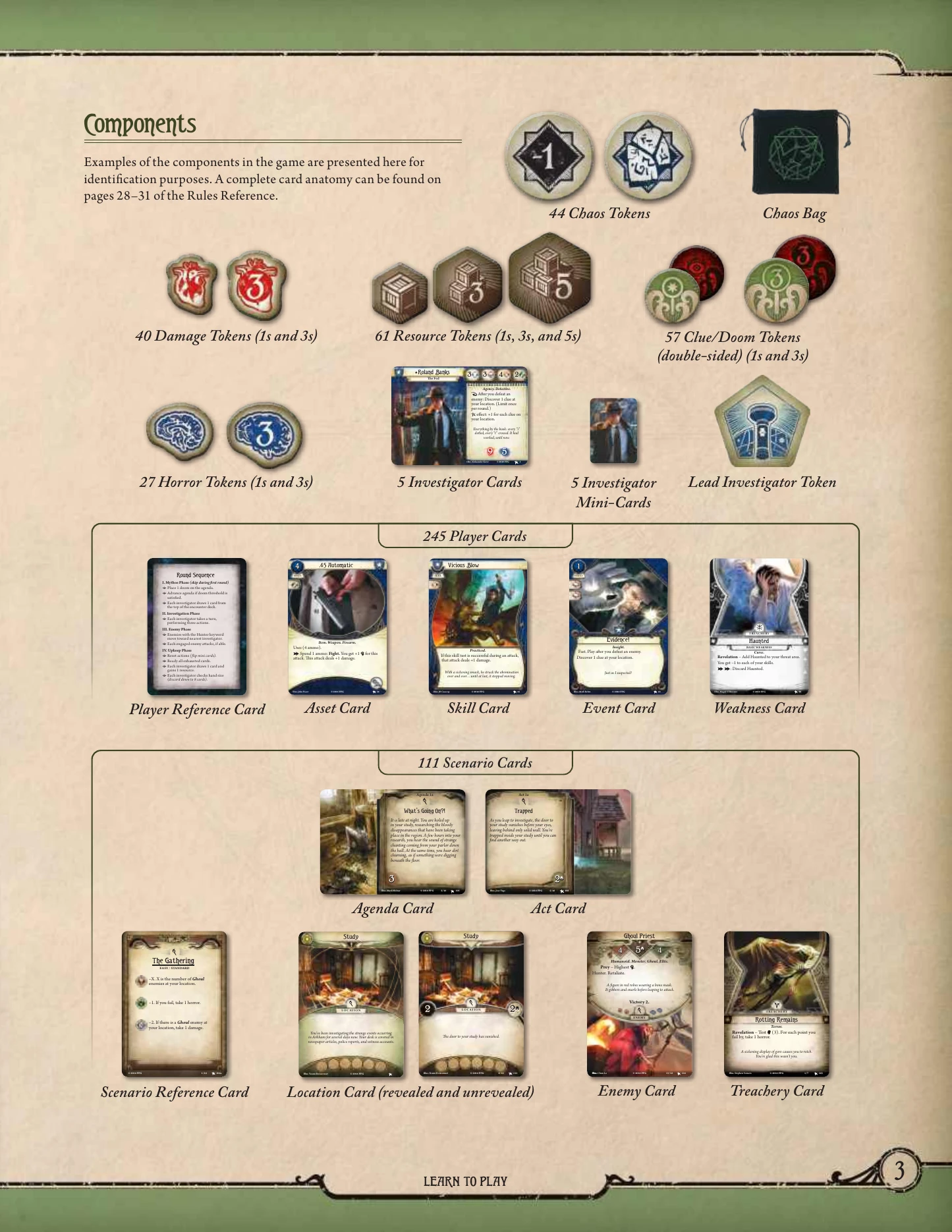
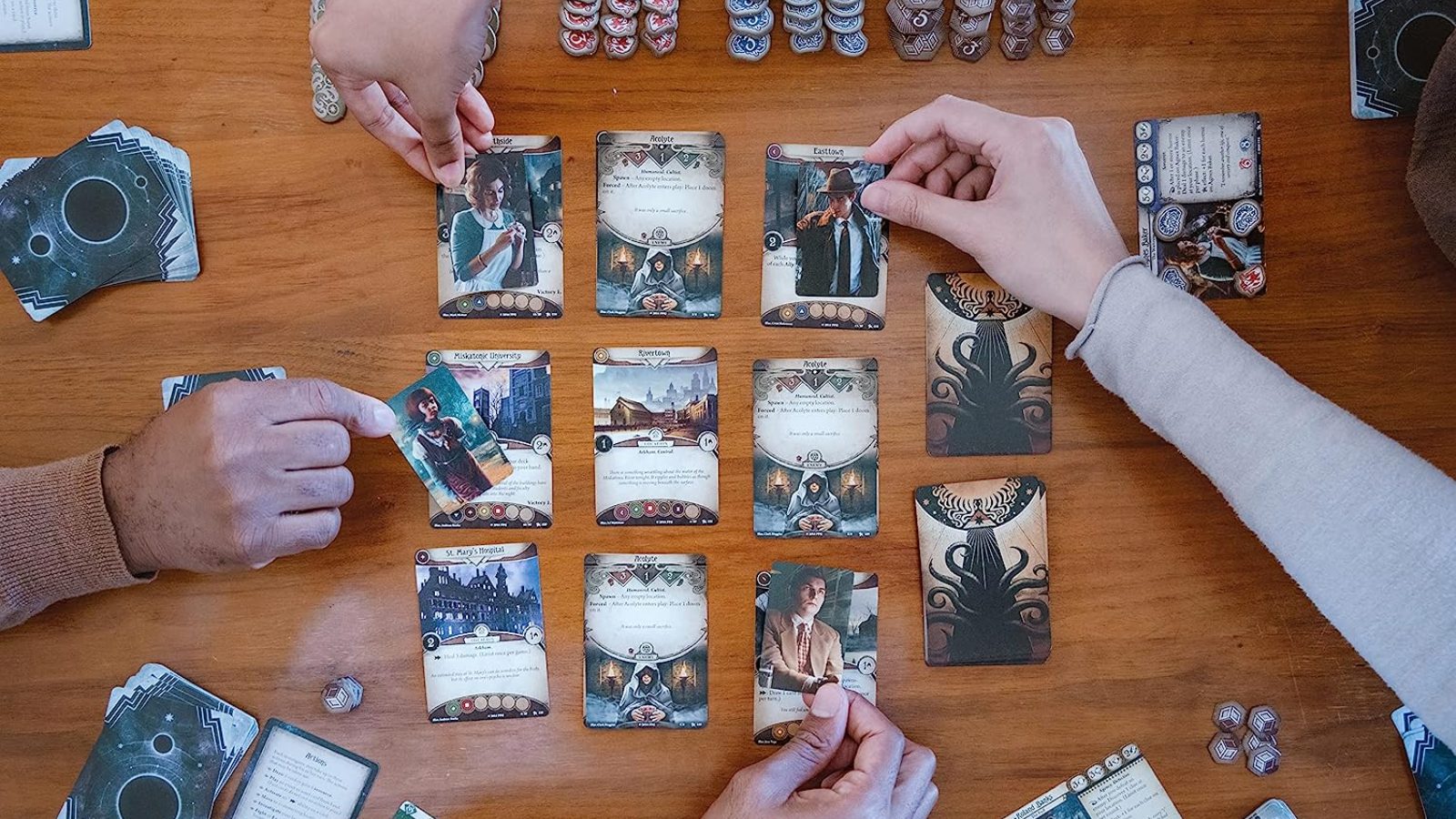

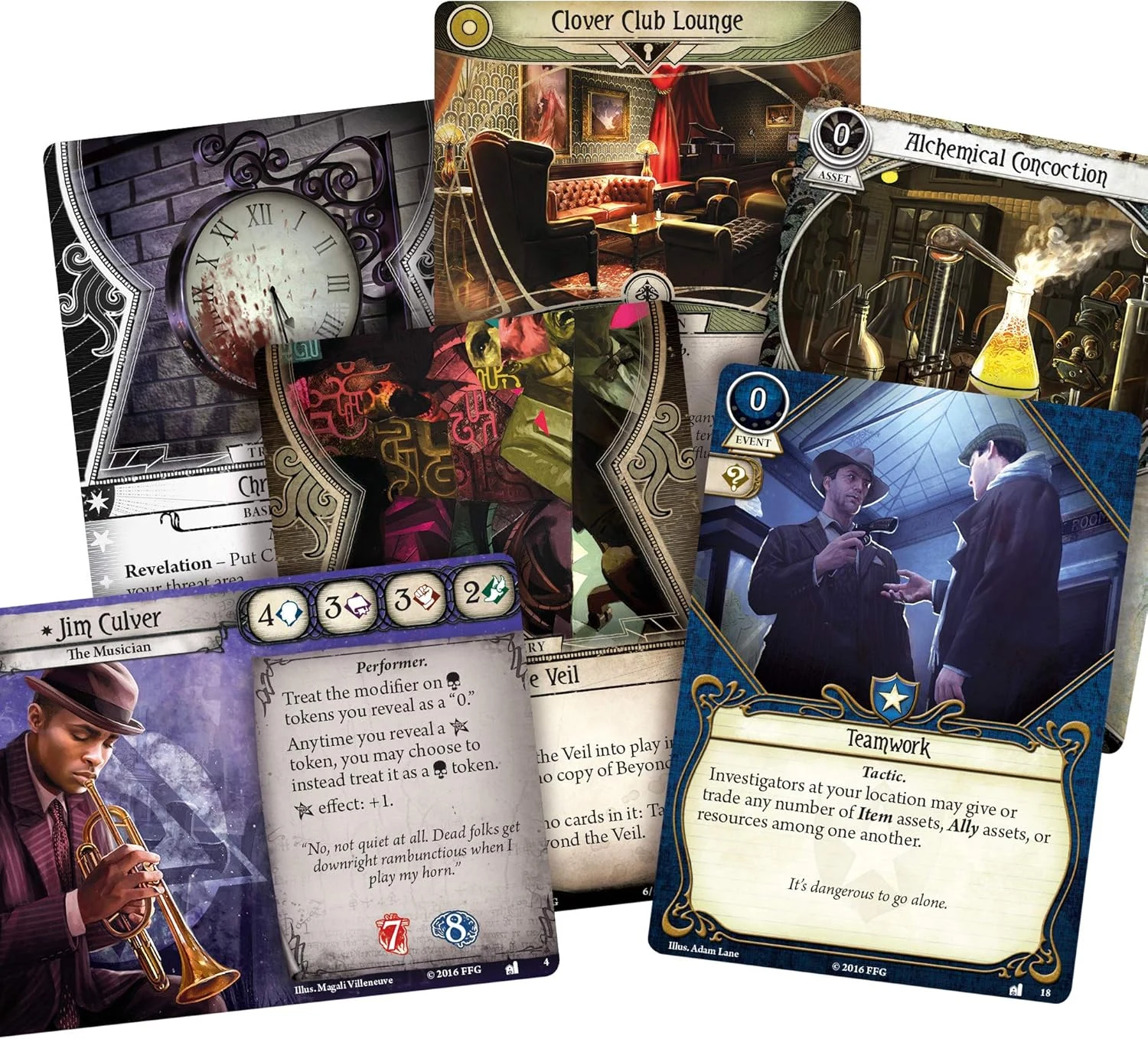
You need one coherent Core Set, its campaign guide or Learn to Play book, the chaos tokens and bag, the Night of the Zealot scenario cards, two legal investigator decks at most, and enough table space to keep player areas separate from the scenario. The Revised Core Set contains everything needed for one to four players on the Chapter One rules path. If you already own it, do not buy another box to make setup easier. Sort it.
For the cleanest first teach, choose Roland Banks and Wendy Adams, or Roland and Daisy if the second player prefers a pure clue role. Roland handles enemies and collects clues as a reward for defeating them. Wendy survives bad tests and evades trouble. Daisy investigates efficiently. Use Easy. Easy is not an apology; the chaos bag still creates tension, and The Devourer Below is intentionally severe.
True solo works, but one investigator must cover clues, enemies, movement, economy, and survival alone. Two investigators make the game’s teamwork visible and reduce the chance that one unlucky weakness defines the lesson. One person can pilot both decks if playing alone.
How should you sort the Revised Core before setup?
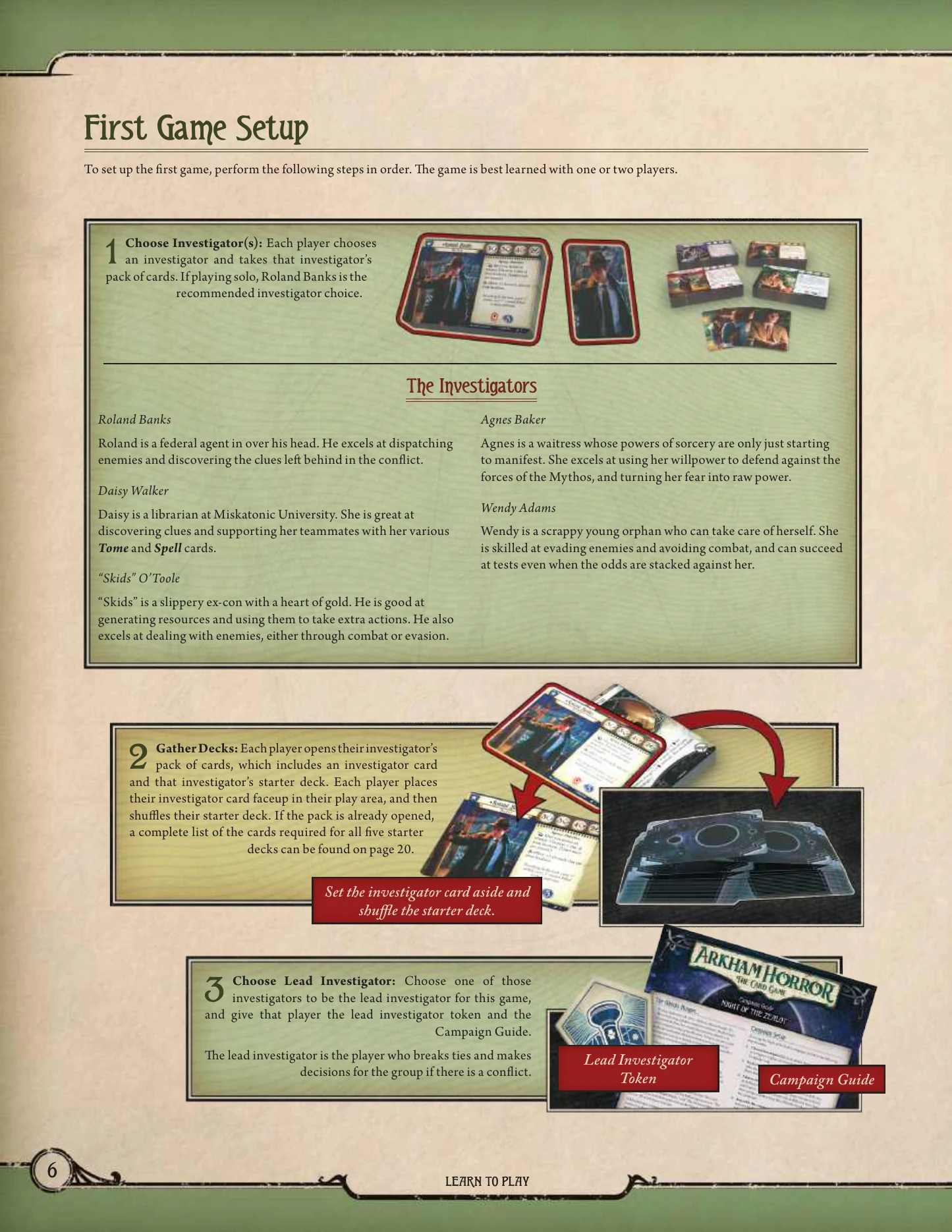
Separate cards by the symbol and information they carry. Investigator cards and mini cards stay together. Player cards sort by class color and level pips. Basic weaknesses form their own facedown pool. Scenario cards sort by encounter-set icon, not by the artwork or title you remember. The Gathering uses specific encounter sets named on its setup card; the rest remain in the box.
Keep the act deck, agenda deck, locations, encounter deck, and scenario reference card distinct. The act says what investigators are trying to accomplish. The agenda is the scenario’s clock and response. Locations form the map. The encounter deck produces Mythos problems. The scenario reference card sets chaos-token effects and difficulty.
Use bowls or shallow trays for resources, clues/doom, damage, and horror. The same clue/doom token means different things depending on where it sits. A stable tray prevents the most expensive beginner mistake in the game: moving a token without remembering which system it belonged to.
How do you choose an investigator and role?
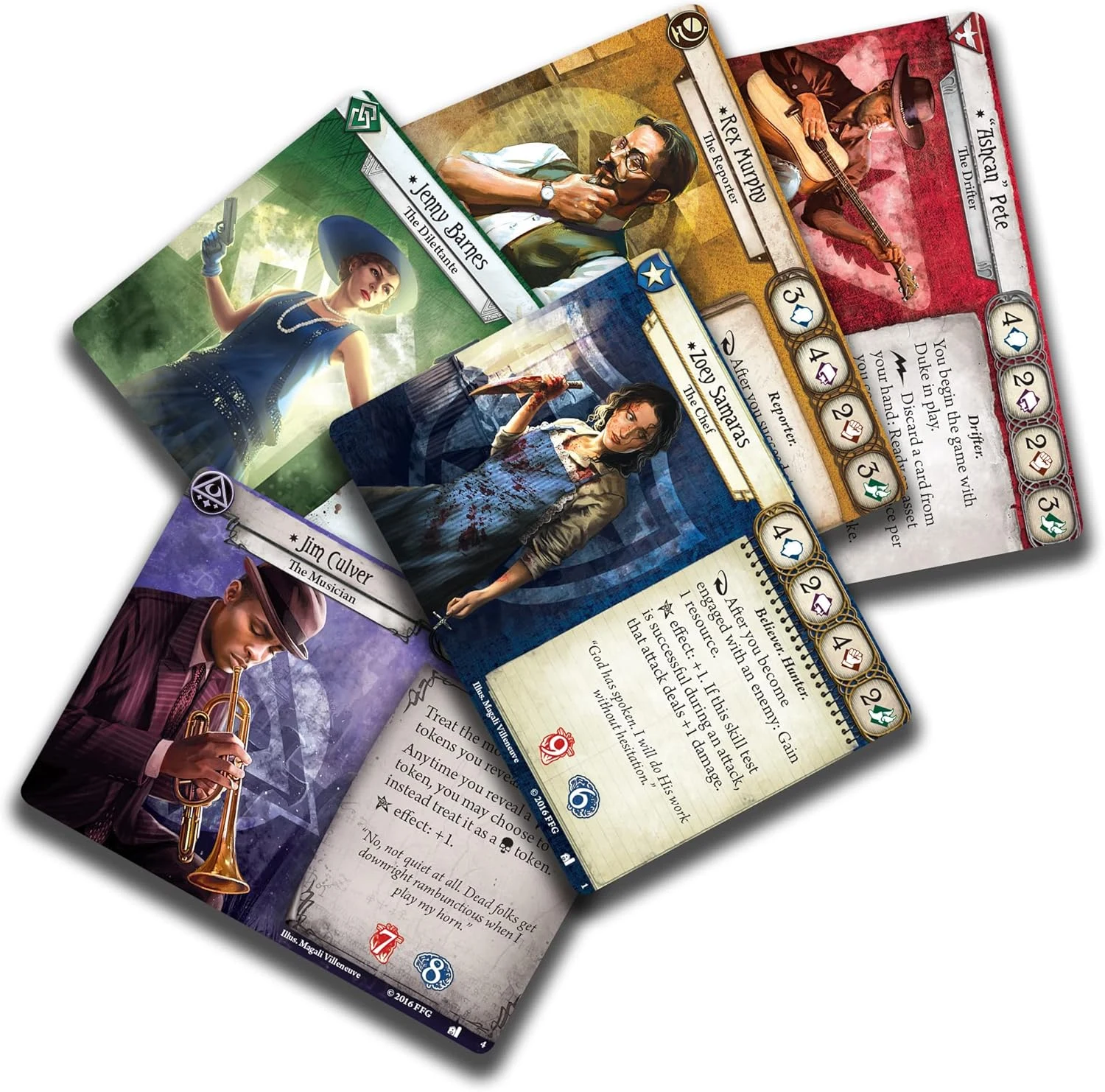
Read the investigator’s front, then the deckbuilding requirements on the back. The front tells you health, sanity, stats, ability, and elder-sign effect. The back tells you which classes and levels are legal, the exact chosen deck size, required signature cards, and any special restrictions. That back is the law even when a deck list online looks persuasive.
Name one primary job before selecting a card: find clues, manage enemies, or flex between both. Then name one emergency contribution. A clue specialist can carry one escape or enemy answer. A fighter can carry one clue event or commit icons to a teammate. A flex investigator accepts that reliability matters more than theoretical coverage.
For a first group, one enemy lead and one clue lead are clearer than two clever generalists. Roles are promises, not cages. Any investigator can take a needed test, move first, commit a card, or rescue a bad round. The role simply tells the group which deck is designed to spend the fewest actions on that job.
How do you build a legal investigator deck?
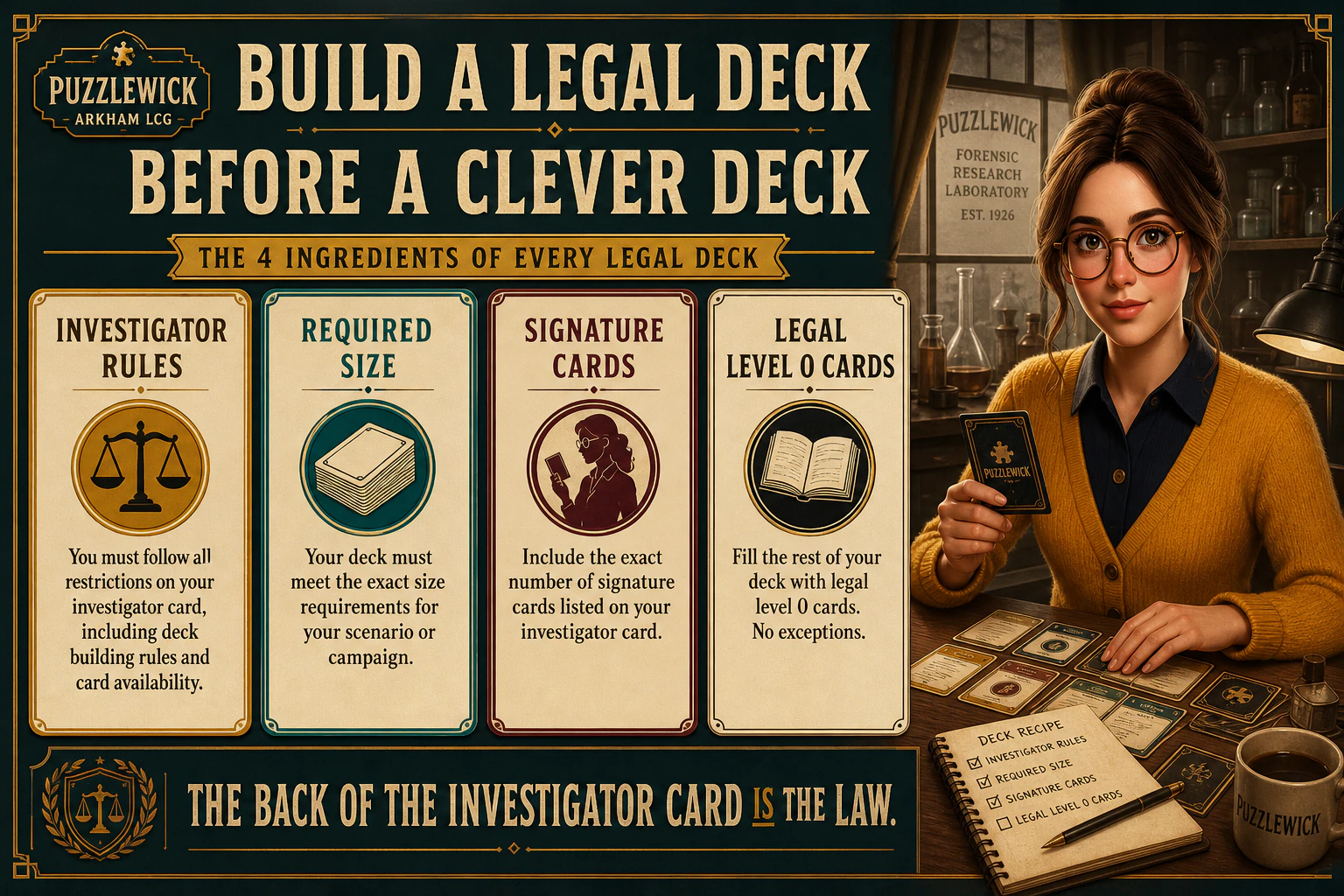
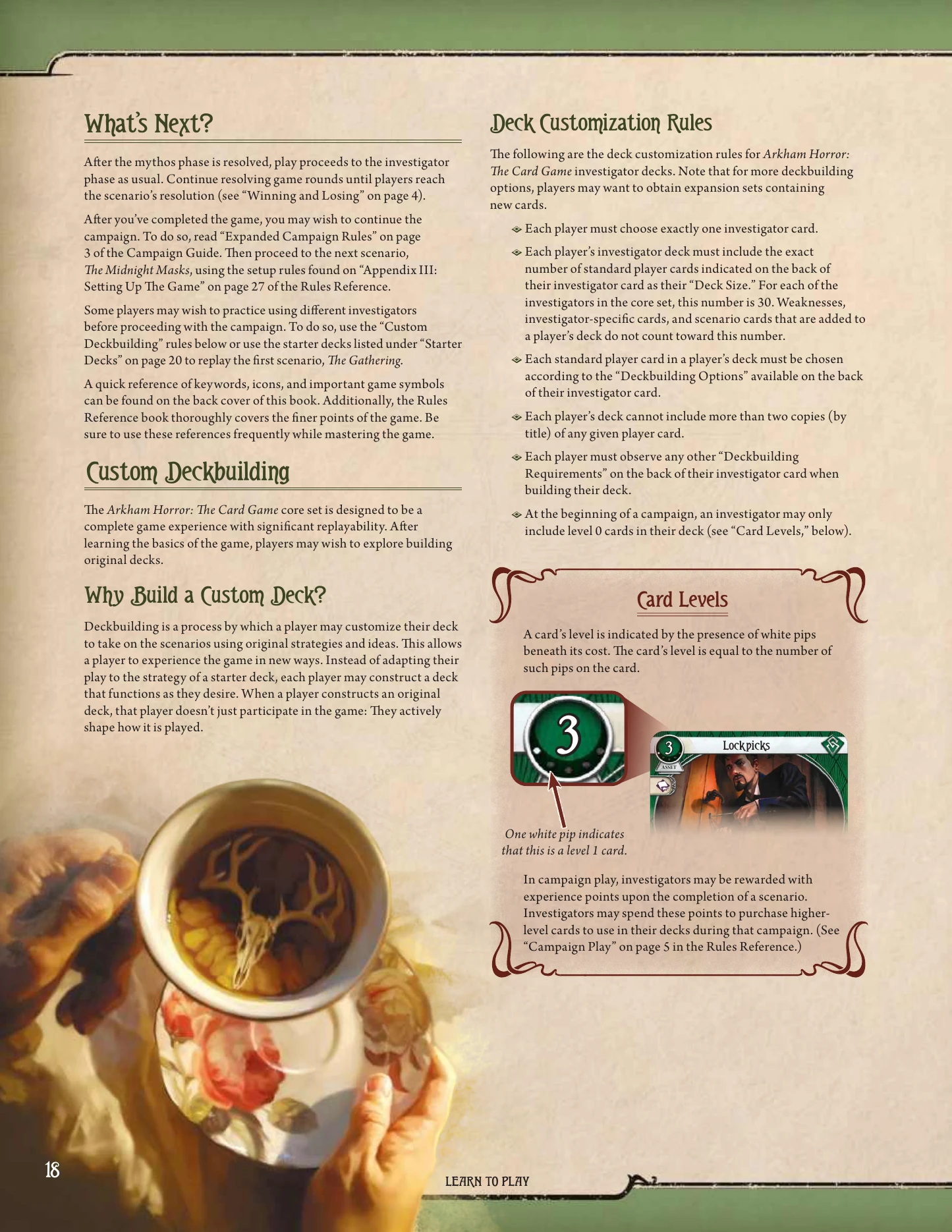
First, copy the exact deckbuilding options from the investigator back. Most Revised Core investigators ask you to choose thirty legal cards, then add their required signature cards, required weakness, and one random basic weakness as instructed. Required cards and weaknesses generally sit outside the printed number of chosen slots; follow the exact wording when an investigator creates an exception. Unless a card says otherwise, a deck may contain no more than two copies of a card by title.
For the first scenario, use the official starter list. It removes legality questions and gives each class a functional sample. After that, rebuild around a role. A useful thirty-card target is roughly ten to twelve assets, eight to ten events, and eight to ten skills. That is a recipe, not a rule. The real test is whether the deck can establish one important tool without spending the whole opening hand and whether its remaining cards still help when committed to tests.
Use two copies of the cards you want to see early. Keep six to ten cards at zero or one resource so a bad opening hand can still act. Limit expensive assets that occupy the same slot. A second hand-slot weapon may be useful; five hand-slot assets create a traffic jam. Skills are not filler. They boost the exact test that matters and many replace themselves by drawing a card.
How do you set up The Gathering correctly?
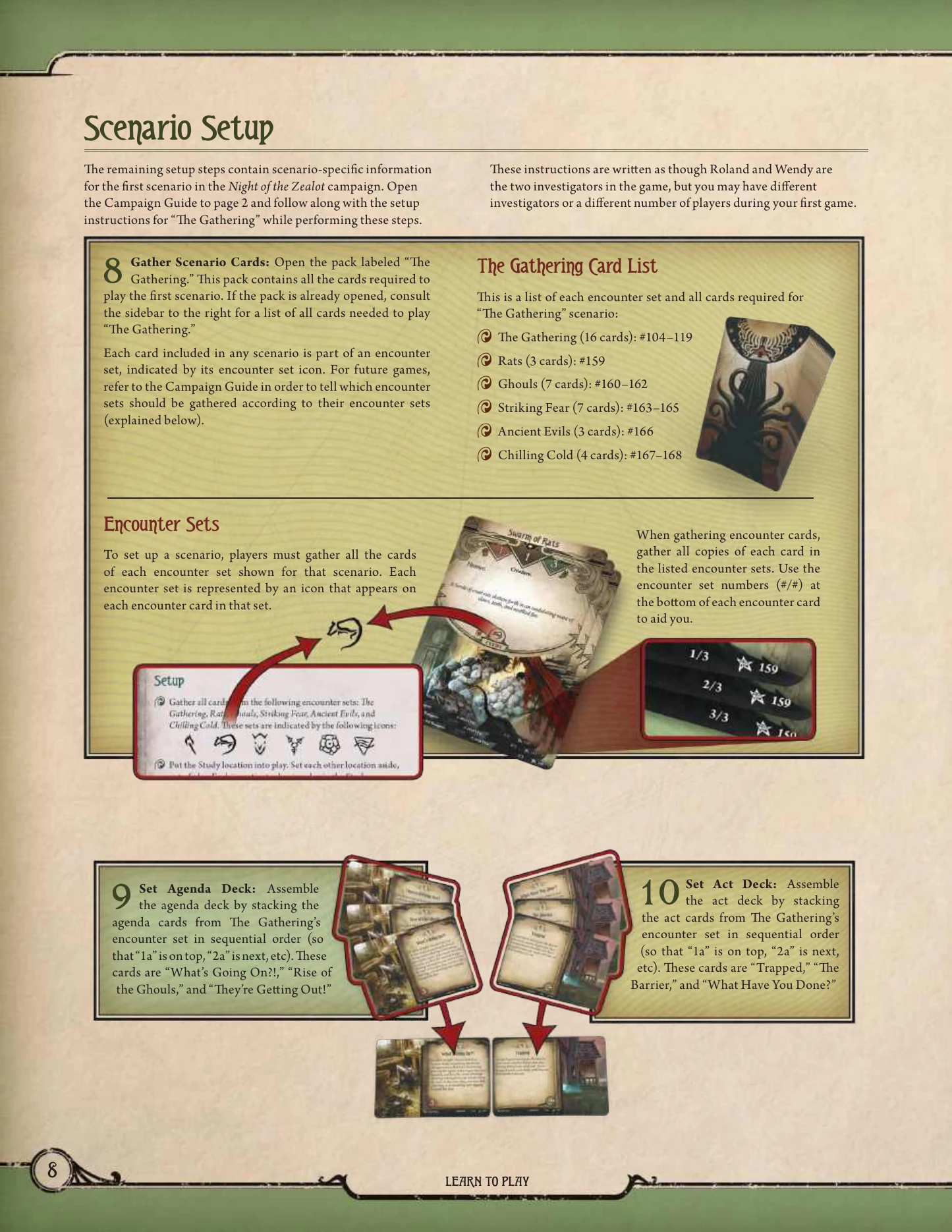
Open the Night of the Zealot campaign guide and read the campaign introduction. Record investigator names and the difficulty in the campaign log. Build the chaos bag with the exact tokens listed for Easy. Then read The Gathering setup instructions line by line. Gather only the encounter sets named there. Set the Study aside or put it into play exactly as instructed, assemble the agenda and act decks in numerical order with card 1a on top, and create the encounter deck from the cards the setup text names.
Choose a lead investigator. This player resolves “the lead investigator decides” moments; it is not a permanent team captain. Put each investigator’s mini card at the starting location. Place clues, doom, and set-aside cards only where setup instructs. Do not shuffle act, agenda, or location cards into the encounter deck.
When later scenarios show a location diagram, match adjacency exactly. Symbols beside location titles determine connections after a location is revealed. Physical closeness on the table does not create a path. Photograph unusual maps before teardown so the next teach has visual memory without relying on rules memory.
How do you build the chaos bag and starting hands?
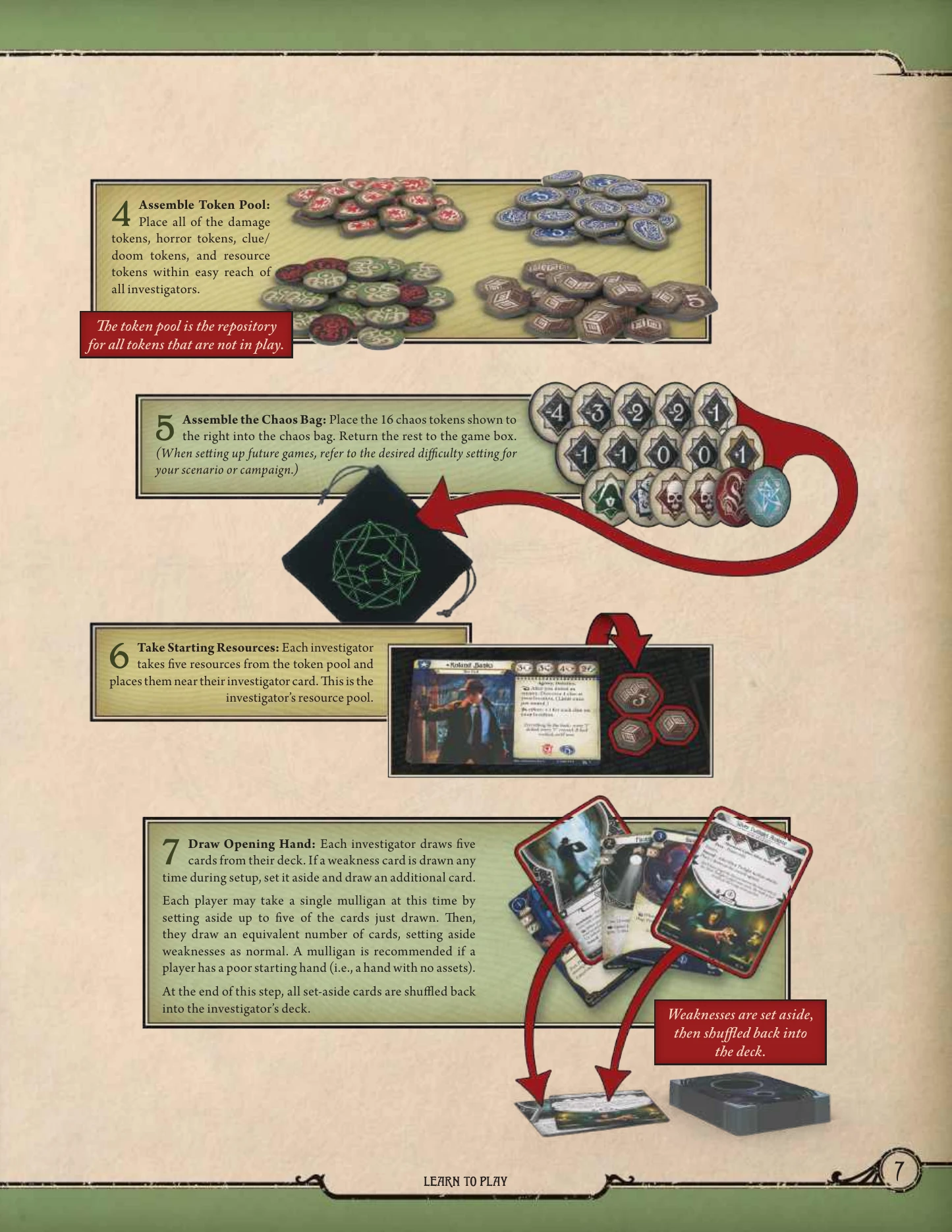
Use the campaign guide’s difficulty row to build the chaos bag. The skull, cultist, tablet, elder thing, auto-fail, and elder-sign tokens do not have fixed global values. Their meaning comes from the active scenario reference card or investigator. Put that reference card beside the act and agenda where everyone can read it.
Each investigator begins with five resources and draws five cards. If a weakness enters the opening hand, set it aside, draw a replacement, and shuffle the weakness back into the deck after the opening hand is complete. Then each player may mulligan any number of non-weakness cards at once: set them aside, draw the same number, and shuffle the set-aside cards back.
Mulligan for one affordable asset that performs your primary job, plus enough economy or icons to use it. Roland wants a weapon. Daisy wants a clue tool or efficient tome plan. Wendy wants a useful low-cost engine and cards she can afford to discard to her ability. Do not keep three expensive assets because each is powerful in isolation.
What should the Arkham Horror LCG table layout look like?
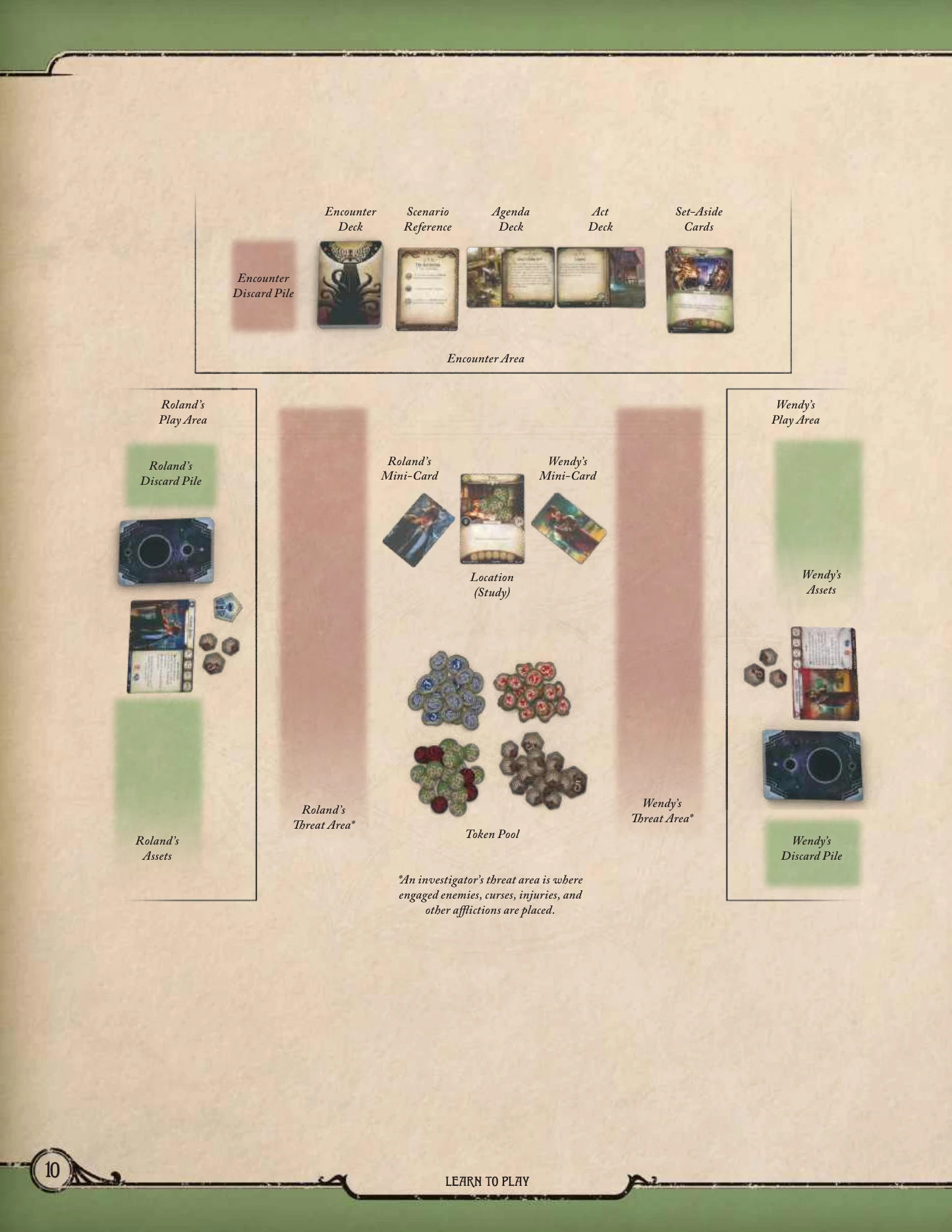
Put locations in the center. Place the act and agenda together above them, with the scenario reference card visible. Put the encounter deck and encounter discard near the agenda. Each player keeps an investigator card, deck, discard, resources, health/sanity tokens, and play area on their side. Enemies at a location sit near that location; enemies engaged with an investigator move into that investigator’s threat area.
Cards in your play area are not automatically at your location, and cards in your threat area are not ordinary assets. Exhausted cards turn ninety degrees. Ready cards stand upright. Keep damage on health, horror on sanity, clues on investigator cards, and doom on the exact card that carries it.
Leave the campaign log and scenario book off the active play surface once setup is complete. They should be reachable, not vulnerable to drinks. The table should show the current state without needing to remember which tray, book, or bag contains a live rule.
How does a round work, and what happens on the first turn?
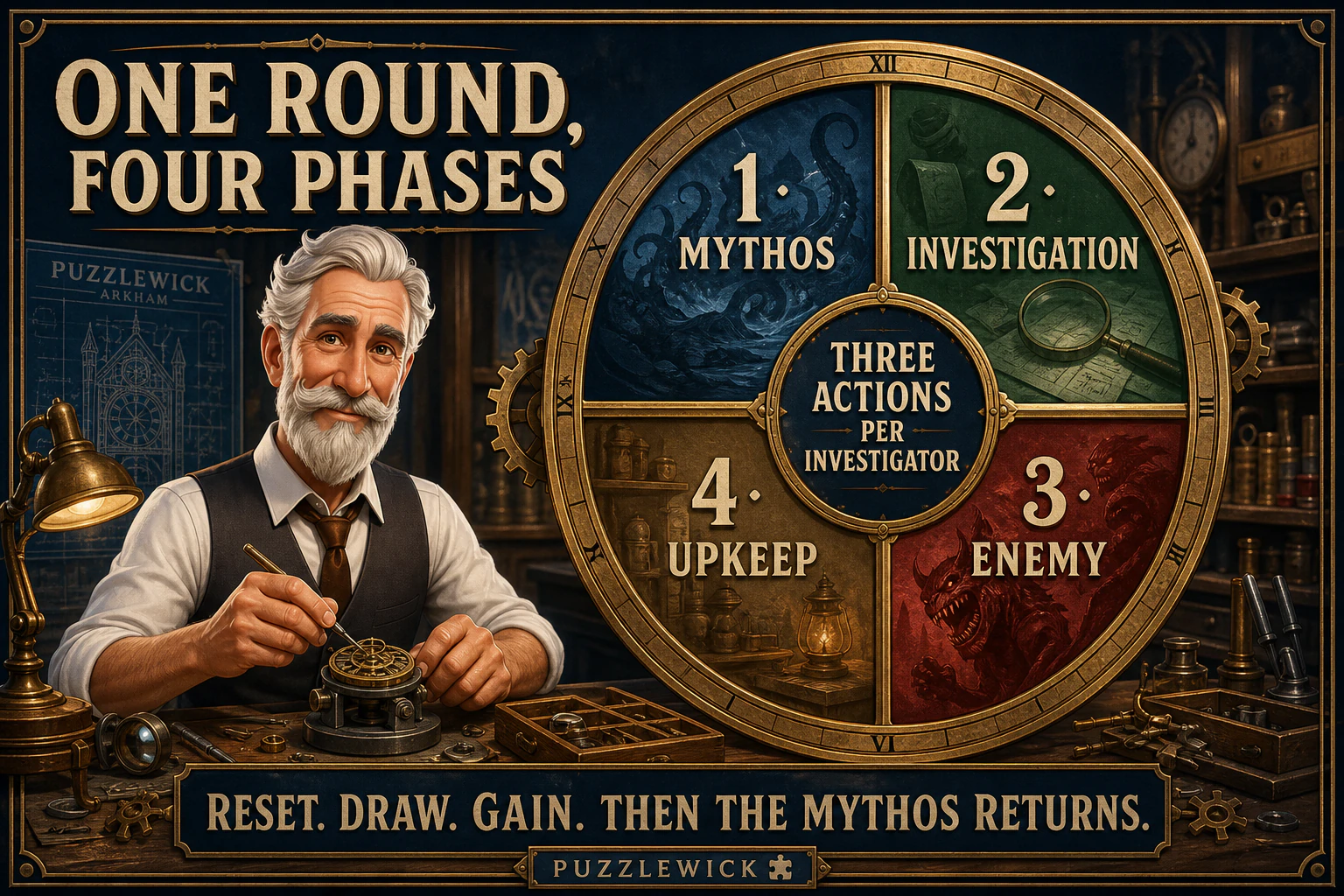
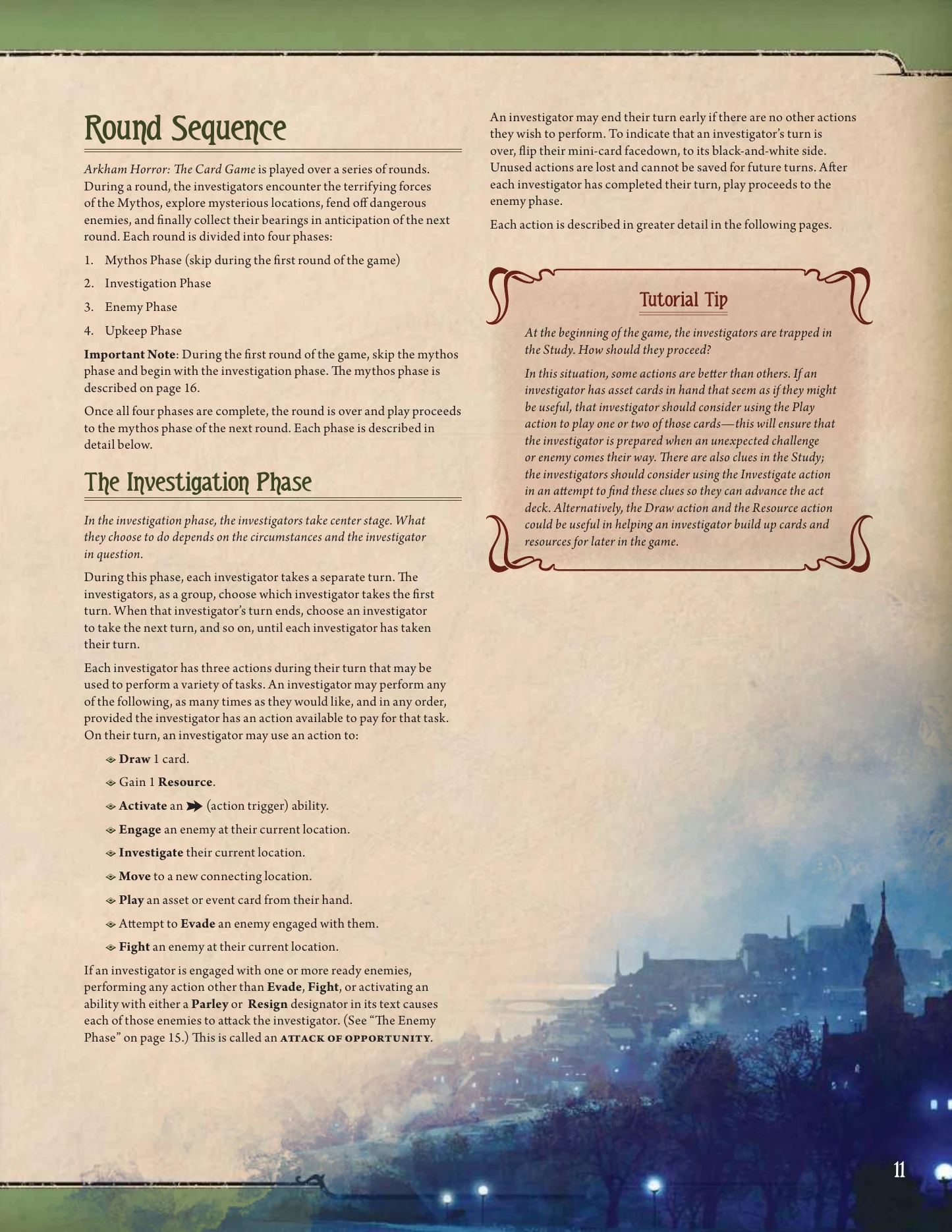
A normal round has Mythos, Investigation, Enemy, and Upkeep phases. Skip the Mythos phase in the first round. During Investigation, investigators take turns in any order, and each takes three actions. An action can draw, gain a resource, play a card, activate an action ability, move, investigate, fight, evade, or perform a scenario action. The group can change player order every round.
The first turn should establish one necessary tool and make real progress. Play a weapon or clue tool if the deck needs it. Move or investigate toward the act. End in a position where the enemy specialist can protect the clue specialist. Three setup actions are sometimes correct; installing every attractive asset while the agenda advances is not.
In the Enemy phase, Hunter enemies move, unengaged ready enemies engage investigators at their location, and engaged ready enemies attack. In Upkeep, ready exhausted cards, draw one card, gain one resource, and check the eight-card hand limit. Upkeep does not refill a hand to five.
How do skill tests, commits, and attacks of opportunity work?
Choose the test, determine the tested skill, commit eligible cards with matching icons, reveal one chaos token, apply its modifier, and compare the final value with the difficulty. Skill values cannot fall below zero. The investigator performing the test may commit eligible cards from hand; each other investigator at the same location may commit at most one card unless an effect changes the rule. Committed cards are discarded after the test unless they say otherwise.
Cards with a lightning-bolt free-trigger ability do not cost an action. Reaction abilities wait for their trigger. An action arrow costs one action each time it is used. Read “at your location,” “your location,” and “an investigator at your location” literally; Arkham’s teamwork is spatial.
A ready enemy engaged with you makes an attack of opportunity when you spend an action on something other than fight, evade, parley, or resign. The enemy exhausts only after its normal Enemy-phase attack, not after an attack of opportunity. If a card’s play action provokes, the attack occurs before the card resolves, which can matter if damage or horror defeats the investigator.
When does doom advance the agenda?
During the Mythos phase, place one doom on the current agenda, then check whether the total doom in play meets or exceeds its threshold. Doom on enemies, locations, assets, and the agenda all counts unless a card says otherwise. Do not check continuously after every doom token appears. Check when the rules or a card explicitly instructs you to check.
When the agenda advances, resolve its reverse side and remove all doom in play unless the advancing instructions say otherwise. A common beginner error leaves doom on cultists after the agenda advances, causing the next agenda to collapse early. Another common error advances immediately when an encounter places doom during encounter resolution. The phase sequence is the cure.
The act advances differently. Investigators usually spend the required clues as a group while at the proper location or timing window. Read the act text. Some acts advance automatically; some require a free-trigger ability; some care who spends the clues.
What should you record after the scenario?
Read the resolution that matches the game state. Arkham campaigns continue after many losses. Do not replay automatically because the ending was ugly. Record every named instruction in the campaign log: experience, trauma, story choices, earned assets, chaos-bag changes, and defeated or surviving characters. Each investigator earns experience from victory-point cards in the victory display plus any resolution award.
Spend experience by replacing level-zero cards with legal upgrades or buying legal new cards. Keep the deck at its required chosen size unless an effect changes it. Upgrade the failure you observed: more reliable weapons when enemies consumed the round, clue compression when locations stalled, economy when assets stayed trapped in hand, or movement when actions vanished into travel.
Return every scenario encounter set to its labeled home. Keep investigator decks assembled with their trauma and experience state. Photograph unusual card additions. Write the next scenario name and date. A campaign is most likely to survive when teardown produces the next setup rather than a single mystery stack.
Which beginner mistakes matter most?
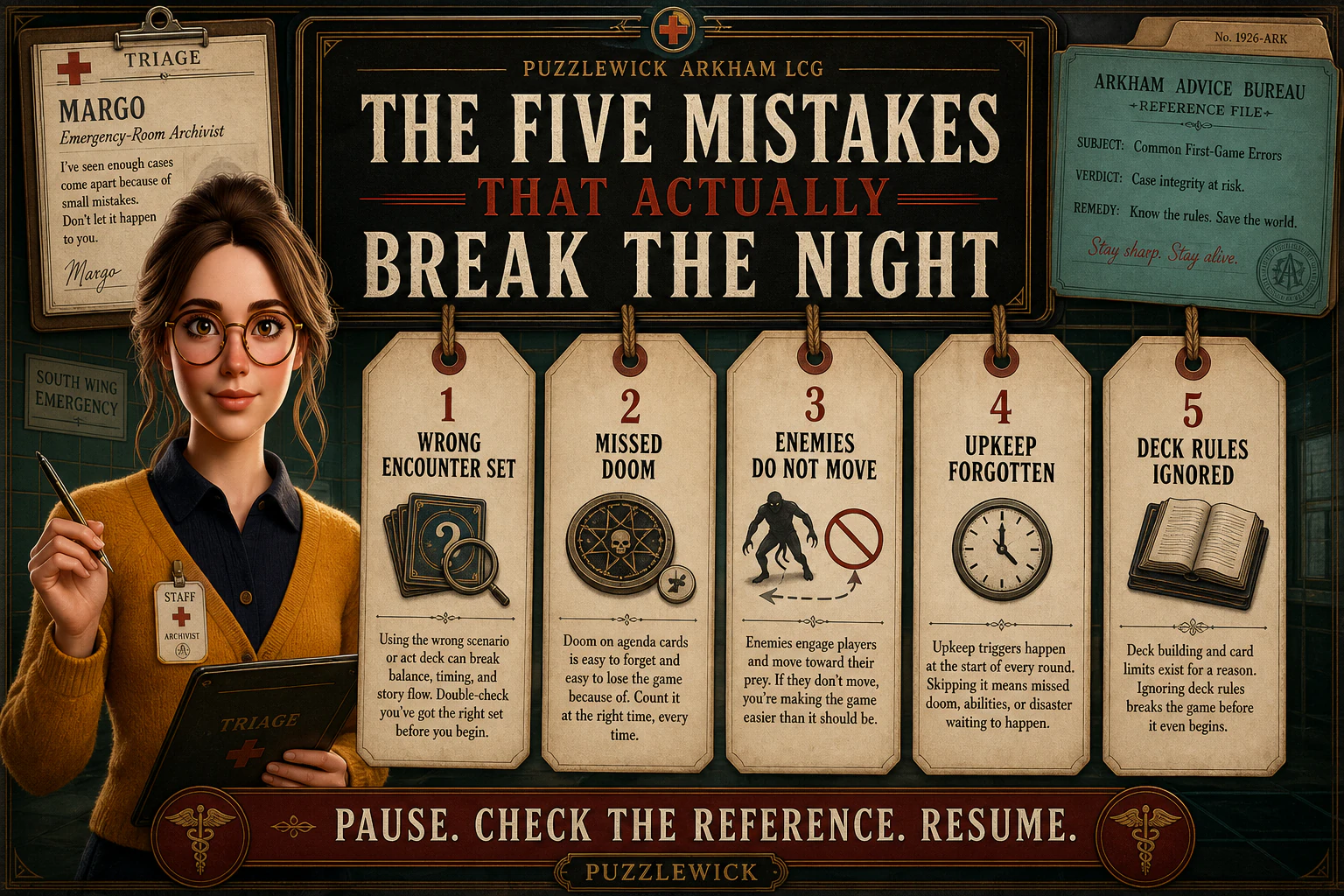
Do not draw an encounter in round one. Skip the first Mythos phase. Do not check doom continuously. Check during the specified Mythos step or when instructed. Do not keep doom after the agenda advances. Remove it from play unless told otherwise. Do not refill the hand to five. Upkeep draws one and gains one resource.
Do not treat failure as campaign failure. Resigning can preserve investigators, earned experience, and the story. Do not over-install. The agenda punishes action-neutral beauty. Do not build from a public deck without checking the investigator back and owned-card list. A popular deck can be illegal for your collection or incomprehensible to a first player.
Finally, do not interpret Night of the Zealot’s finale as the difficulty profile of every campaign. The Core campaign is compact, uneven, and intentionally sharp. If the rules loop, table talk, and consequence system worked for your group, the next step is the Revised Core buying path, not a verdict based only on whether Arkham survived the night.
What experienced tables keep reporting
Recurring owner patterns, synthesized in Puzzlewick's words. Follow each evidence trail to read the original discussion.
r/arkhamhorrorlcg beginner deckbuilding discussions
r/arkhamhorrorlcg first-game rules threads
Experienced solo-player discussions
The picks
Some links below are affiliate links — as an Amazon Associate, Puzzlewick earns from qualifying purchases, at no extra cost to you. It never changes a pick.
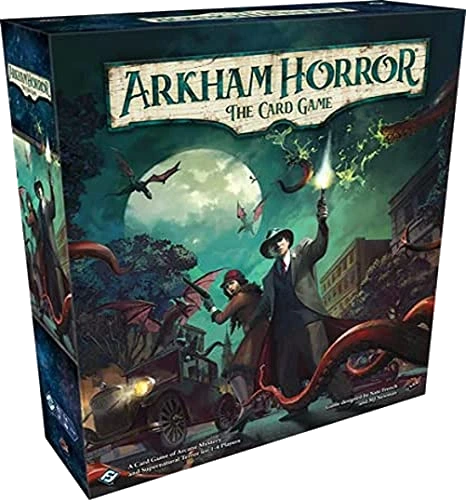
Arkham Horror: The Card Game Revised Core Set
The Revised Core remains a complete and coherent way to learn the Chapter One rules. It supplies the encounter sets, five investigators, a broad starter card pool, chaos tokens, scenario cards, and a compact three-scenario campaign. The 2026 Chapter Two line is a separate current path, but it does not make an owned Revised Core invalid.
- Complete first-game component set
- Five starter investigators
- Official starter decks and full setup manual
- Night of the Zealot is harsher than a typical tutorial
- Deck construction becomes richer after one investigator expansion
At a glance
| Step | Do this | Avoid |
|---|---|---|
| Choose | One enemy lead and one clue lead | Two unfocused thirty-card piles |
| Build | Use the printed investigator back and starter list | Copying an illegal full-collection deck |
| Set up | Follow the scenario card in order | Building encounter sets from memory |
| Open | Five resources, five cards, mulligan for one job tool | Keeping three expensive assets |
| Round 1 | Skip Mythos; establish and progress | Drawing an encounter immediately |
| Campaign | Record resolution, XP, trauma, and next date | Resetting every imperfect result |
Questions, answered
What is the best investigator for a first Arkham Horror LCG game?
Roland Banks is the clearest enemy-management starter because his ability rewards defeating enemies with clues. Pair him with Wendy or Daisy so the second deck has a distinct clue or survival role.
Should a beginner play Arkham Horror LCG on Easy?
Yes. Easy keeps the chaos bag tense while giving a new group more room to learn action economy, tests, and campaign consequences.
How many cards are in an Arkham investigator deck?
Use the exact deck size and restrictions printed on the investigator card back. Most Revised Core investigators choose thirty legal cards, then add required signature cards and weaknesses as instructed.
How many actions does an investigator get?
Each investigator takes three actions during the Investigation phase. Investigators may take their turns in any order, and the order may change each round.
Do you draw an encounter card in the first round?
No. Skip the entire Mythos phase during the first round. Begin with the Investigation phase.
How does the opening hand work?
Gain five resources and draw five cards. Set aside any weakness and replace it, then shuffle it back. Mulligan any number of non-weakness cards simultaneously.
When does doom advance the agenda?
Normally, after placing one doom on the agenda during the Mythos phase, check the total doom in play. Do not check continuously unless a card specifically instructs you to.
What happens during Upkeep?
Ready exhausted cards, draw one card, gain one resource, and discard down to the eight-card hand limit if necessary.
Can one person play two investigators?
Yes. Two-handed solo is common and often easier to learn strategically because one deck can specialize in clues and the other in enemies.
Where can I practice the setup interactively?
Use Robert’s free Arkham Horror LCG Setup Trainer on Puzzlewick. It rehearses physical zones, setup order, and rules checks beside the real game.
Margo's verdict
Use the starter decks, Easy difficulty, and The Gathering. Sort by card job, obey the scenario setup card, skip first-round Mythos, install one useful tool, and let the campaign record an imperfect night. Afterward, rebuild one focused deck at a time. That is not a reduced version of Arkham. It is the correct door.
Research ledger 11 sources · reviewed 2026-08-13
Specifications, rules, current product information, community experience, and contrary evidence were checked against the sources below. Commercial links are kept separate from editorial evidence.
- images-cdn.fantasyflightgames.comimages-cdn.fantasyflightgames.com/filer_public/50/8b/508bb12f-0673-4541-8310-1fbab01cbcaa/ahc60_learn_to_play_eng-compressed.pdf
- images-cdn.fantasyflightgames.comimages-cdn.fantasyflightgames.com/filer_public/0e/d0/0ed09507-1705-47ed-a630-cd15885cabb0/ahc100_rulebook-web.pdf
- fantasyflightgames.comfantasyflightgames.com/en/products/arkham-horror-the-card-game
- reddit.comreddit.com/r/arkhamhorrorlcg/comments/1uifl3p/teaching_a_new_player_deckbuilding
- reddit.comreddit.com/r/arkhamhorrorlcg/comments/1s8j188/how_are_the_new_core_precons
- reddit.comreddit.com/r/arkhamhorrorlcg/comments/1r0lf52/how_to_approach_deck_building
- reddit.comreddit.com/r/arkhamhorrorlcg/comments/1hv1bnx
- reddit.comreddit.com/r/arkhamhorrorlcg/comments/w04p4q
- reddit.comreddit.com/r/arkhamhorrorlcg/comments/13sd05f
- arkhamdb.comarkhamdb.com/decklist/view/33937/better-starter-decks-roland-banks-1.0
- boardgamegeek.comboardgamegeek.com/wiki/page/thing%3A205637%3Amoreinfo

Let me check that before we say it.


Keep exploring
The next smart rabbit holes.
✒ Universe HubArkham Horror Universe: the whole buying pathStart with the interactive buyer intake: separate the 2026 Chapter Two Core from Chapter One legacy boxes and the entirely...☾ Topic PathCooperative Horror Games: compare the whole shelfCooperative horror works when the rules pressure the story without burying the table. This cluster maps what to buy, how campaigns...Buying GuideArkham Horror LCG Deconfusion Guide 2026: Chapter Two vs Revised Core and Every Expansion ExplainedChapter Two or Revised Core? Campaign or Investigator Expansion? Scenario Pack or Small Campaign? Yumi translates every box, the old...