Build-Your-Own Automata Kits Ranked: Best Wooden Mechanical Models (2026)
Stop buying wooden puzzle kits branded as automata that just sit there—here's the honest ranking of kits that actually move.

AI-assisted curator persona · research and editorial responsibility: Robert Pruitt · how this guide was made
Last editorial refresh: 2026-06-13 Gold-standard QA: 2026-08-10 21 sources reviewed Affiliate links checked during gold-standard pass

The short answer
The best build-your-own wooden automata and mechanical-model kits in 2026 are UGears for precision and motion, ROKR for value and showpiece spectacle, Timberkits for traditional cam-driven automata, and Cabaret Mechanical Theatre for genuine artisan craft. For a first build that actually moves, start with the UGears Theater (~$33) or a Timberkits beginner model (~$25). For the best engineering-to-dollar, UGears mid-range kits ($70-85) like the Hurdy-Gurdy and Steam Locomotive deliver tighter gear trains and more spare parts than anything else at the price. ROKR wins on jaw-drop showpieces — the EG01 Pinball Machine (482 pieces, ~$160) is the most fun static-to-kinetic build on the shelf — but its laser-cut tolerances run looser than UGears, so expect to sand and re-seat a few gears.
Decision map
Choose in thirty seconds
Best first automaton — small, kinetic, genuinely performs
Best mechanism-IS-the-function build — a playable crank instrument
Best showpiece — a playable wooden pinball table
Let me start with the lie most sellers lean on: half the 3D wooden puzzles marketed as automata are static sculptures with a token gear you crank twice and abandon. An automaton—a real one—is a machine that performs. It converts your hand-crank into choreographed motion through cams, linkages, gear trains, and escapements. That distinction is everything, and it's why half the bestseller lists you'll find are useless to anyone who actually cares whether the thing moves or just looks clever holding still.
I build these. I've jammed gear teeth against stationary frames because a laser cut ran 0.3mm proud. I've watched a rubber-band motor strip itself because the kit shipped one band and no spare. So I'm grading on what matters to a maker: how the parts fit, whether the instructions respect your intelligence, how long the build honestly takes, and—above all—whether the finished thing moves well or just looks good static. Flattery is boring. I'll name each kit's worst flaw first, then tell you why it might still earn your bench.
Four makers own this category, and they're not interchangeable. UGears is the precision house—tighter cuts, cleaner gear mesh, parts that just work. ROKR is the value-and-spectacle house—playable pinballs, light-up marble runs, cheaper but looser tolerances you'll occasionally need to sand. Timberkits is the traditional-automata house—cams and characters, mantelpiece stuff that actually performs a choreographed routine. Cabaret Mechanical Theatre is the artisan house, where you're buying mechanism education from the people who curate the world's best kinetic art. I've laddered real, currently-purchasable kits from about $20 to north of $200 so you can buy by mechanism and skill, not by box-art.
Start here, then go deeper
You are in the right cabinet.
 ✦ Topic PathBoard Game Buying Guides: compare the whole shelfStart with the decision, not the shelf. These guides compare the games, editions, expansions, player counts, and costs people...
 Buying GuideBest 3D Wooden Puzzle Kits, Ranked (2026)Flat-pack wood machines that actually move — but not all of them deserve the hype. Here's which ones survive skepticism.
 Buying GuideROKR Mechanical Wooden Building Kits: Difficulty Guide (2026)Pick your difficulty, claim your hours—build the automaton that matches your hunger.
What actually makes a wooden mechanical kit good — and how I ranked them?
Four things, weighted in this order.
1. Does it MOVE, and does it move WELL? This is the whole game. A kit earns its rank on motion quality — smooth gear mesh, a crank that doesn't bind, a mechanism that repeats reliably instead of stripping after ten cycles. A gorgeous static model with one decorative gear is a sculpture, and I rank it as one.
2. Laser-cut fit and tolerance. Plywood kits live or die on how tightly the parts seat. UGears holds the tightest tolerances in the category — parts are smaller and more precise, and gears mesh with minimal play. ROKR fits correctly but with noticeable slop on some axes; you'll occasionally get a gear tooth catching a stationary edge, and you fix it with a few seconds of fine sanding. That's not a dealbreaker at ROKR's price, but you should know it's coming.
3. Instruction quality. Picture-only instructions are standard. UGears' are dense but complete. ROKR's are generally clear but lean enough that builders routinely pull up online tutorials for the fiddly assemblies. Timberkits ships clearly photographed picture steps — but bring your brain, because the mechanical logic isn't always spelled out.
4. Spare parts and honesty about build time. UGears is genuinely generous — most critical components ship with extras because a snapped plywood pin is the #1 way these builds die. ROKR is sparse; only a few rare pieces are duplicated. On time: ignore the box. A "3-hour" kit is 3 hours if you've built five of these. Your first one takes longer, and that's fine.
Glue matters too. UGears, ROKR, and Wood Trick are press-fit, no glue — parts click together via interlocking joints. Timberkits requires glue and rewards dry-fitting every linkage before commitment. Neither approach is better; they're different disciplines.
A gorgeous static model with one decorative gear is a sculpture. I rank it as one.
ROKR vs UGears: which one should you actually buy?
This is the only brand question most people ask, so here's the blunt version. UGears is the better machine. ROKR is the better deal — and the better showpiece.
UGears wins on everything mechanical. Parts are cut tighter, gears mesh cleaner, and the kits are designed by people who clearly love the motion. In direct head-to-heads, builders report the UGears mechanism running smoothly while the comparable ROKR locks up — one widely-cited comparison had a UGears truck operational while the ROKR locomotive got stuck. UGears also ships spare parts like it expects you to break one (you will), where ROKR duplicates almost nothing.
So why does ROKR exist on this list? Two reasons. Value: ROKR's accurate-enough laser cutting, clear-enough instructions, and reliable-enough fit land at a real price advantage — you get a satisfying build for noticeably less. Spectacle: ROKR makes the showpieces UGears doesn't — the EG01 Pinball Machine, the big marble runs with light-up scoring, the music boxes. Nobody's UGears shelf has a playable pinball table on it.
The honest tradeoff: with ROKR you're signing up for a little fettling. Some axes have too much play, some have gaps, and you'll occasionally re-seat a gear or sand an edge to stop a jam. If that sentence makes you tense, buy UGears and pay more. If it makes you reach for sandpaper with a grin, ROKR gives you more model for the money.
My rule: first build or gift → UGears (it'll just work, and working is what hooks people). Showpiece you want to brag about → ROKR. You're a tinkerer on a budget → ROKR, and enjoy the fettling.
UGears is the better machine. ROKR is the better deal — and the better showpiece. Buy accordingly.
What's the best automata kit for a complete beginner?
Beginners get steered wrong constantly — pushed toward a 400-piece showpiece because it looks impressive in the photo, then drowned at hour four. Don't. Your first kit's job is to teach you how plywood joints seat, how gears mesh, and how to read picture-only instructions, while delivering a finished moving thing before your patience runs out. Small and kinetic beats big and static every time.
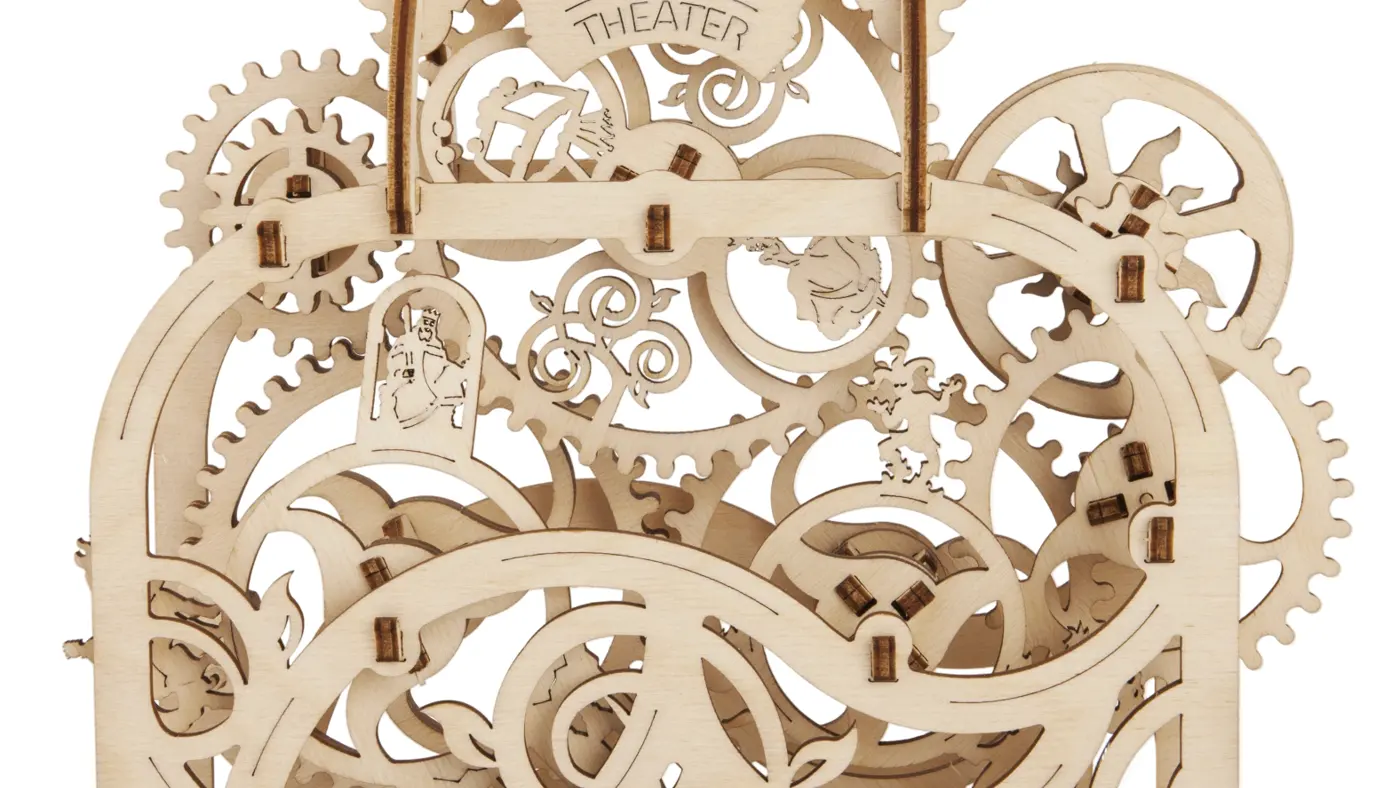
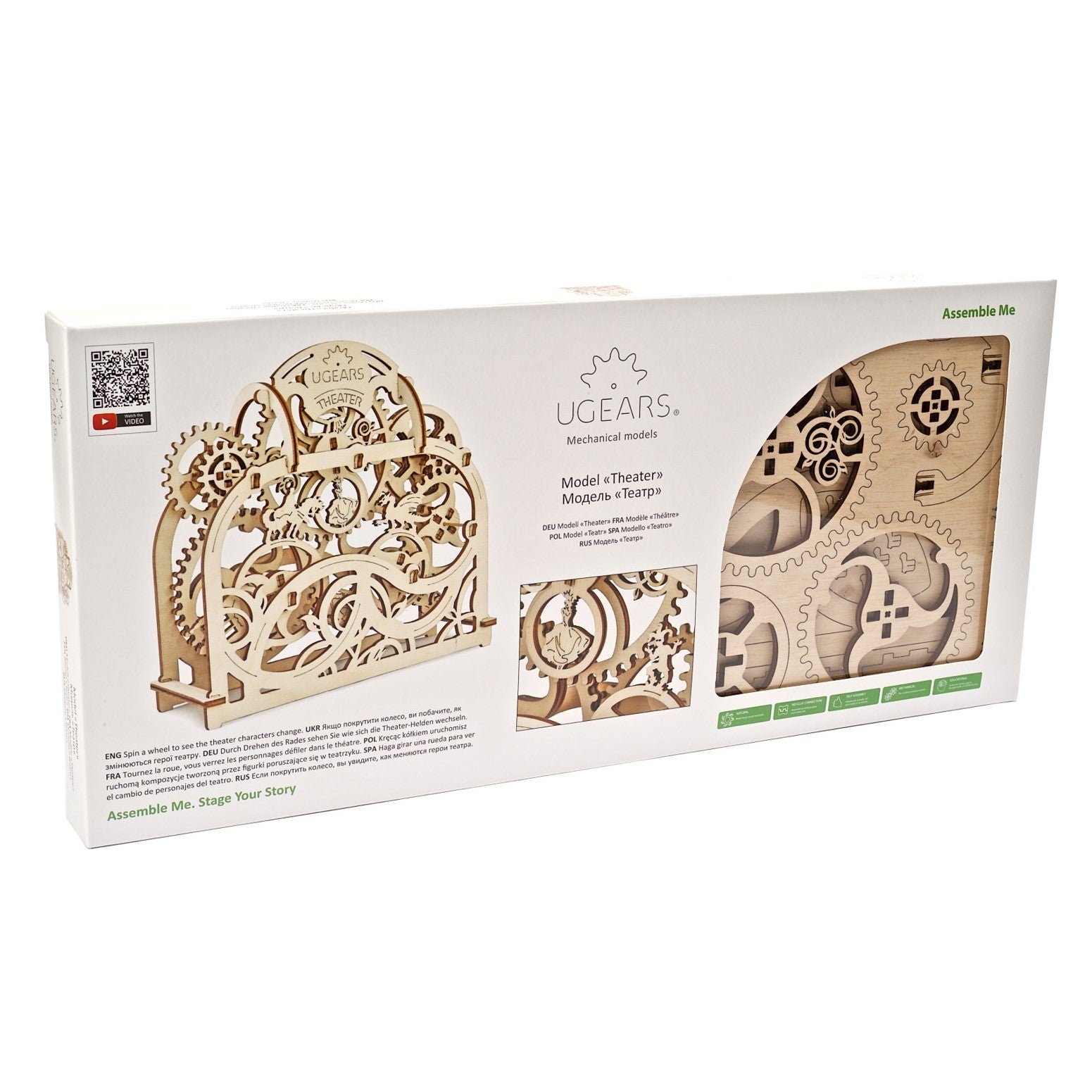
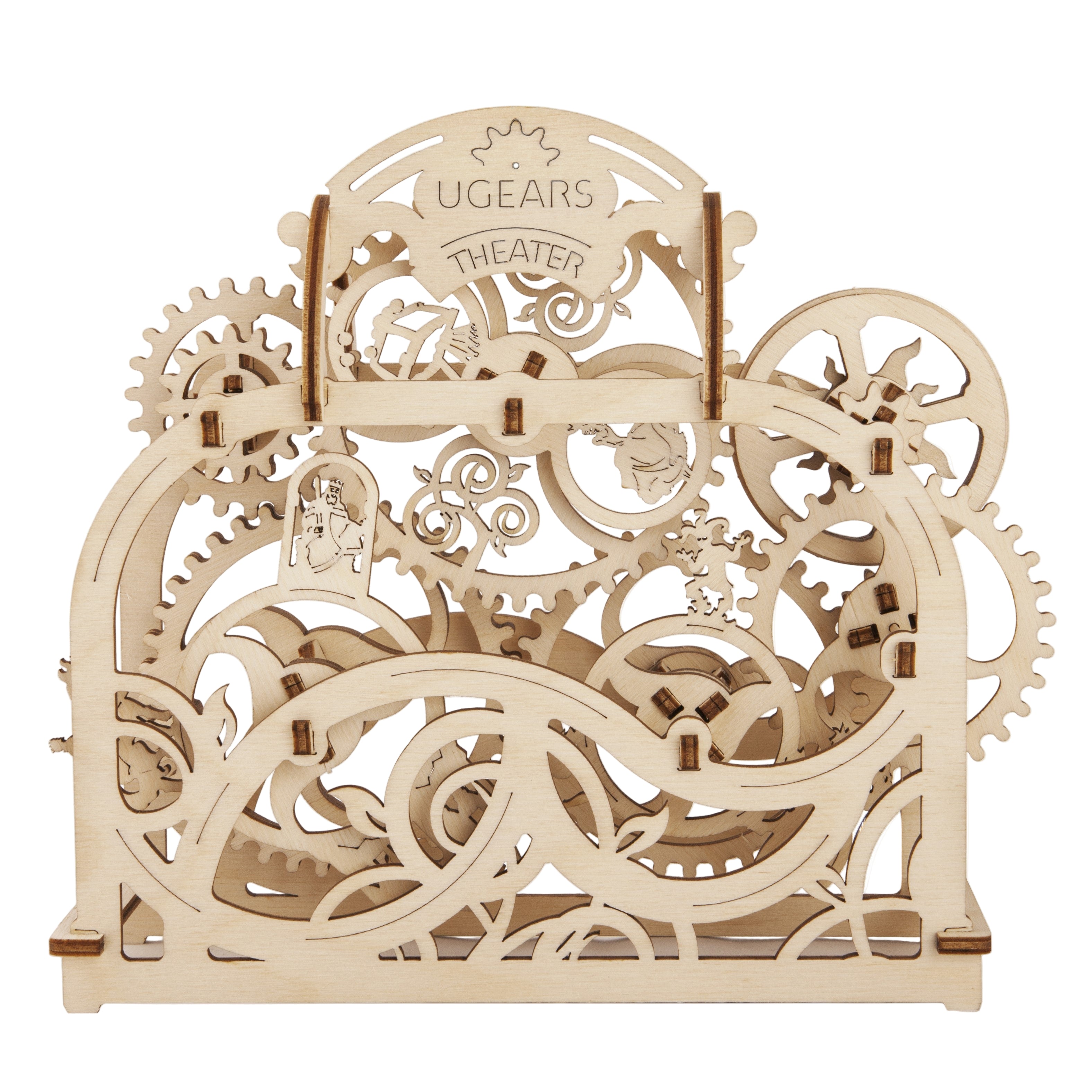
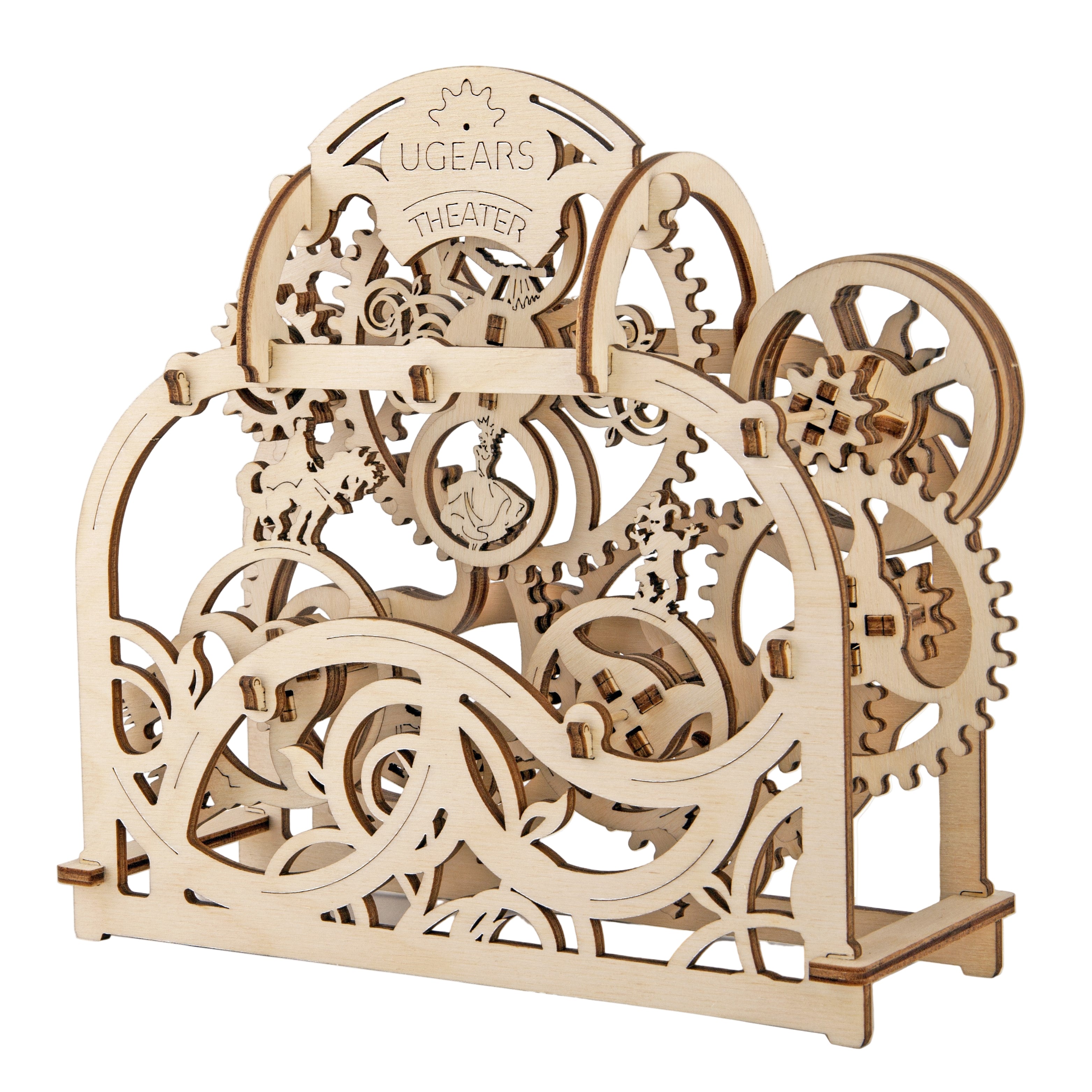
The single best first automaton is the UGears Theater (~$33, 70 parts, 1-2 hours). It's an actual automaton, not a puzzle — you crank a wheel and characters (Prince, Dragon, King, Princess, Witch, Jester) rotate onto a stage to tell a different little story each time. Seventy parts is forgiving, the press-fit teaches you the technique, and the payoff is genuine performance, not a static diorama. That's the hook that makes you buy a second kit.
If you want the traditional cam-automaton experience, a Timberkits Beginner model (the Drummer is the classic, ~$25-35) teaches you the other half of the craft — cams converting rotary crank into the up-down peck of a drummer's arms. Note the discipline difference: Timberkits use glue, so you'll dry-fit each linkage, check the motion, then commit. That's a real skill and worth learning early.
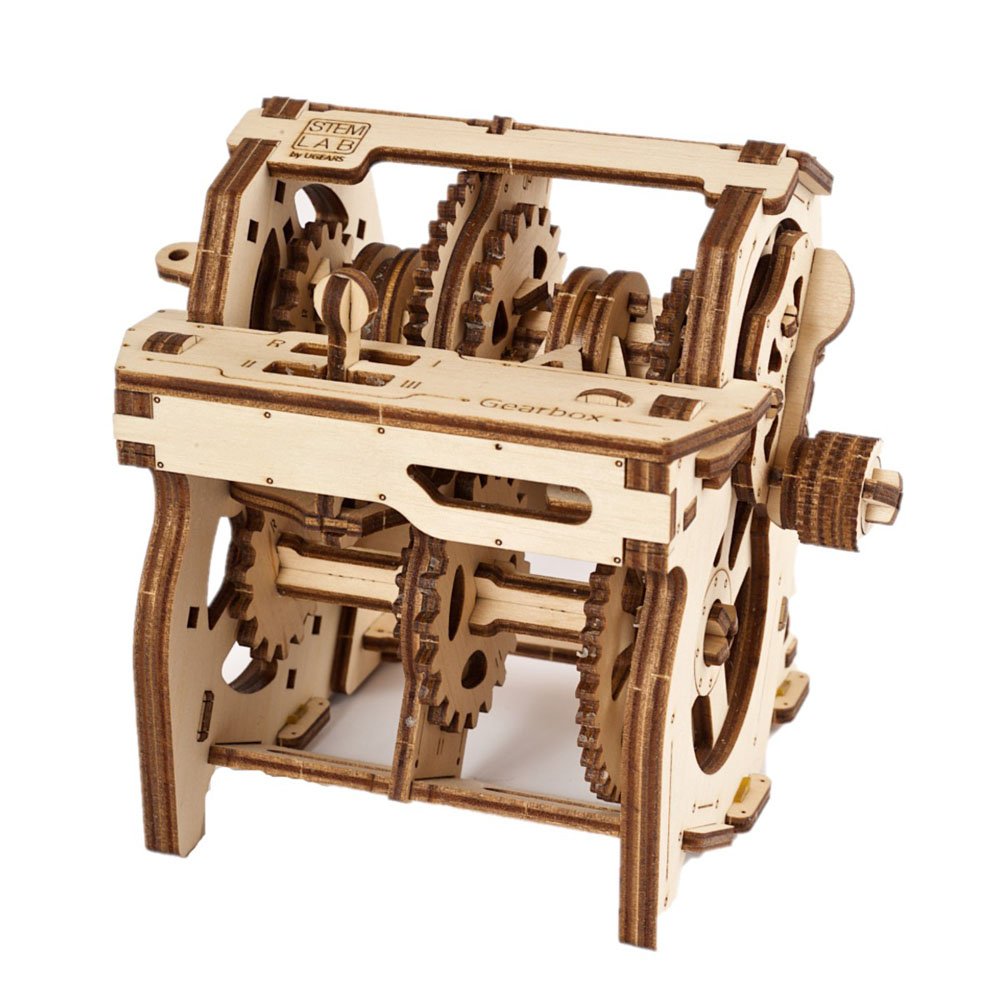
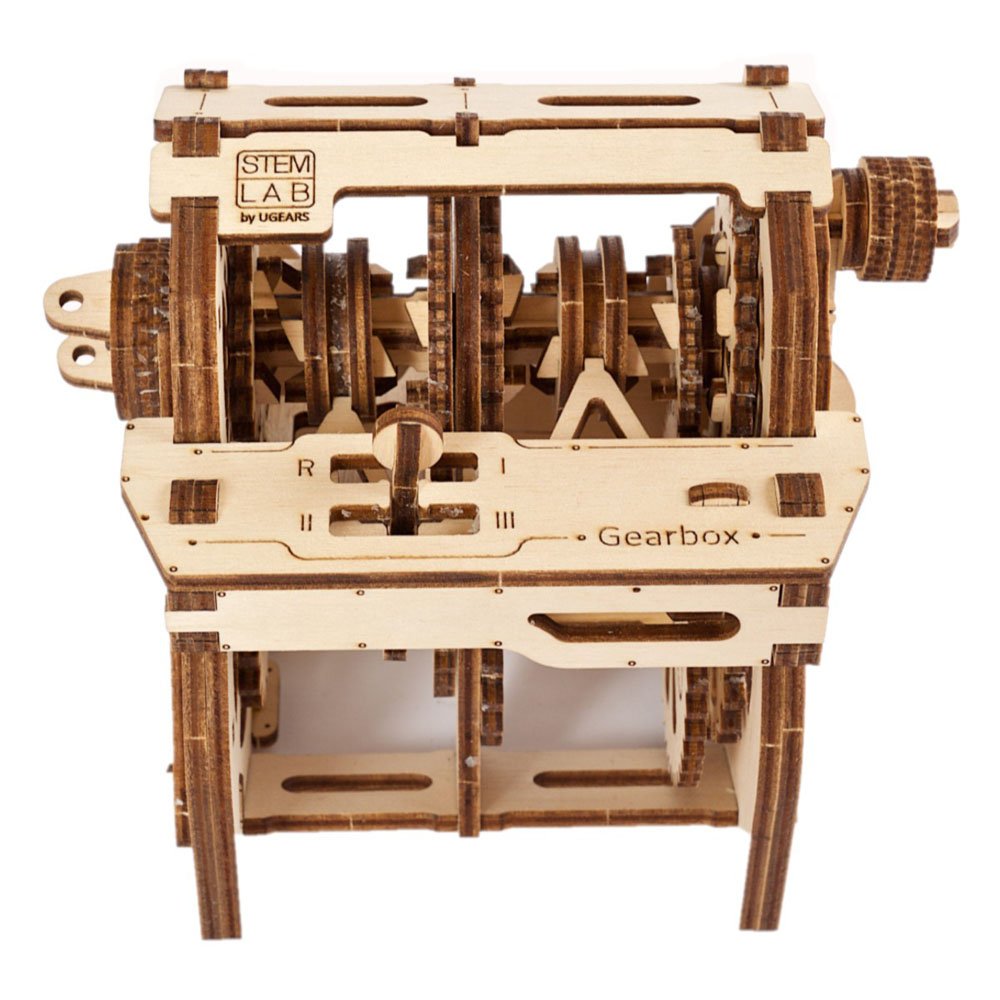
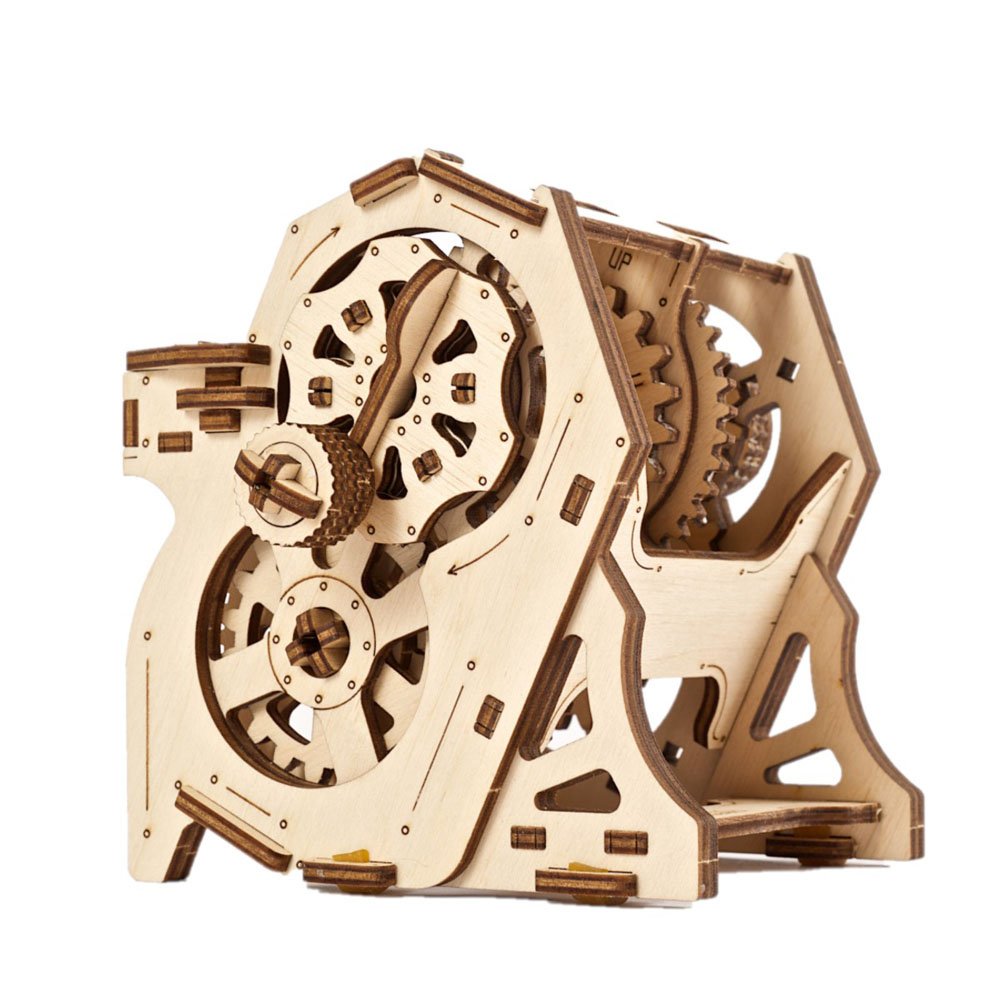
On a tighter budget, the UGears Gearbox or Differential STEM kits (~$20-25) aren't 'automata' in the storytelling sense, but they're the cheapest honest way to feel a real gear train and a working differential in your hands — and they ship with an AR app that animates the mechanism. Cheap, fast, genuinely educational.
What I'd steer a beginner away from: the big marble runs and the Pinball as a first build. They're brilliant, but they're long, fiddly, and a loose joint anywhere can stop the whole machine — frustrating before you've built the instinct to diagnose it.
Your first kit's job is to deliver a finished moving thing before your patience runs out. Small and kinetic beats big and static.
Which showpiece kit gives the biggest payoff (and is it worth $150+)?


Here's where the budget ladder tops out, and where you decide whether you want a model that performs or one that simply dominates a shelf.
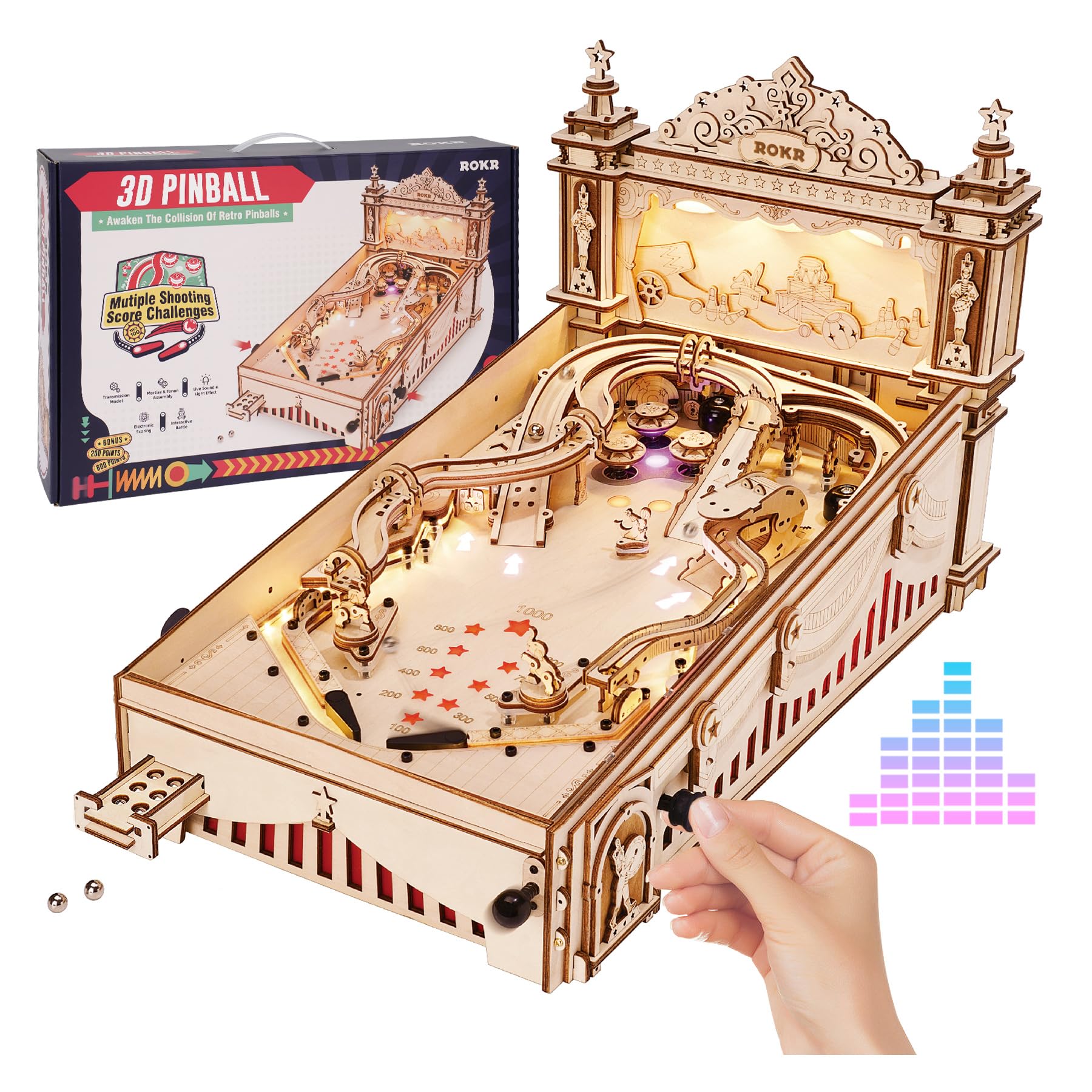
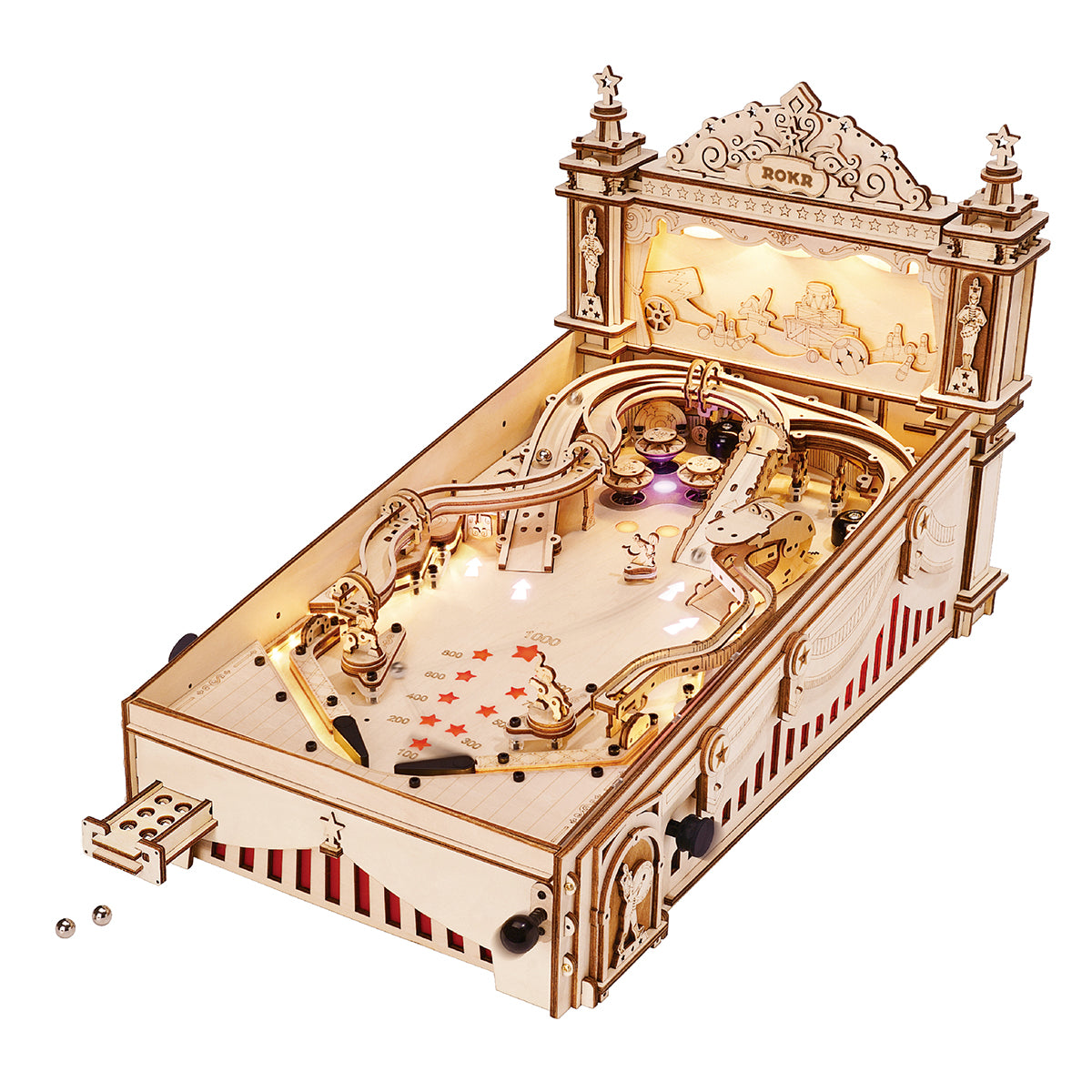
The ROKR EG01 Pinball Machine (~$160, often discounted from $200; 482 parts; budget ~12 hours) is the most fun showpiece in the category, full stop. It's a genuinely playable pinball table: spring plunger, bumpers, a marble, and a light-up scoring system with an illuminated star. It's not a static trophy — you build a game and then you play it. The catch is the catch with all ROKR: 482 parts at ROKR's tolerances means you'll hit a few fiddly sub-assemblies where the instructions go thin and a joint needs re-seating. Budget patience, keep a sanding stick handy, and don't rush the scoring mechanism. Worth $160 if you'll actually play it; overkill if it's going straight behind glass.
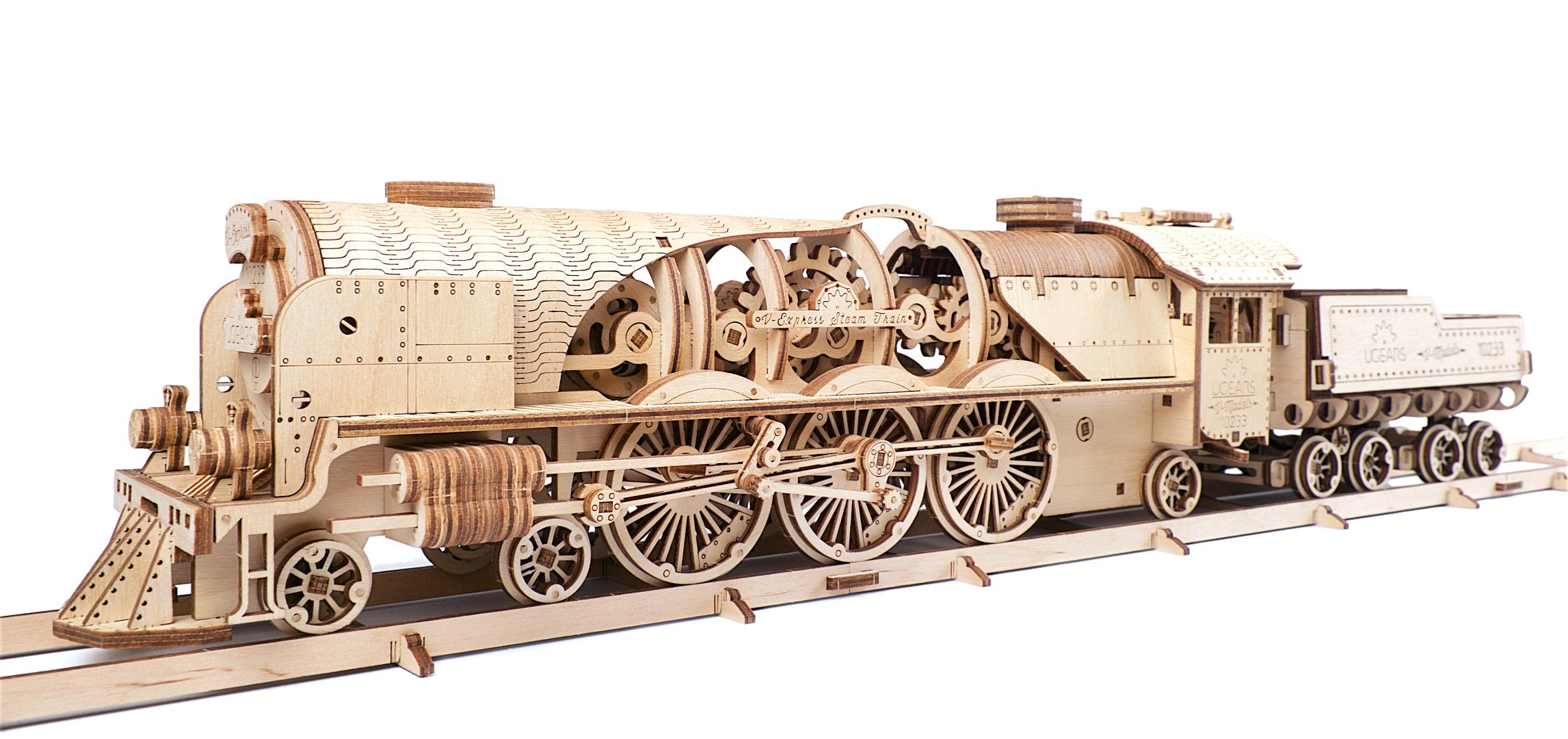
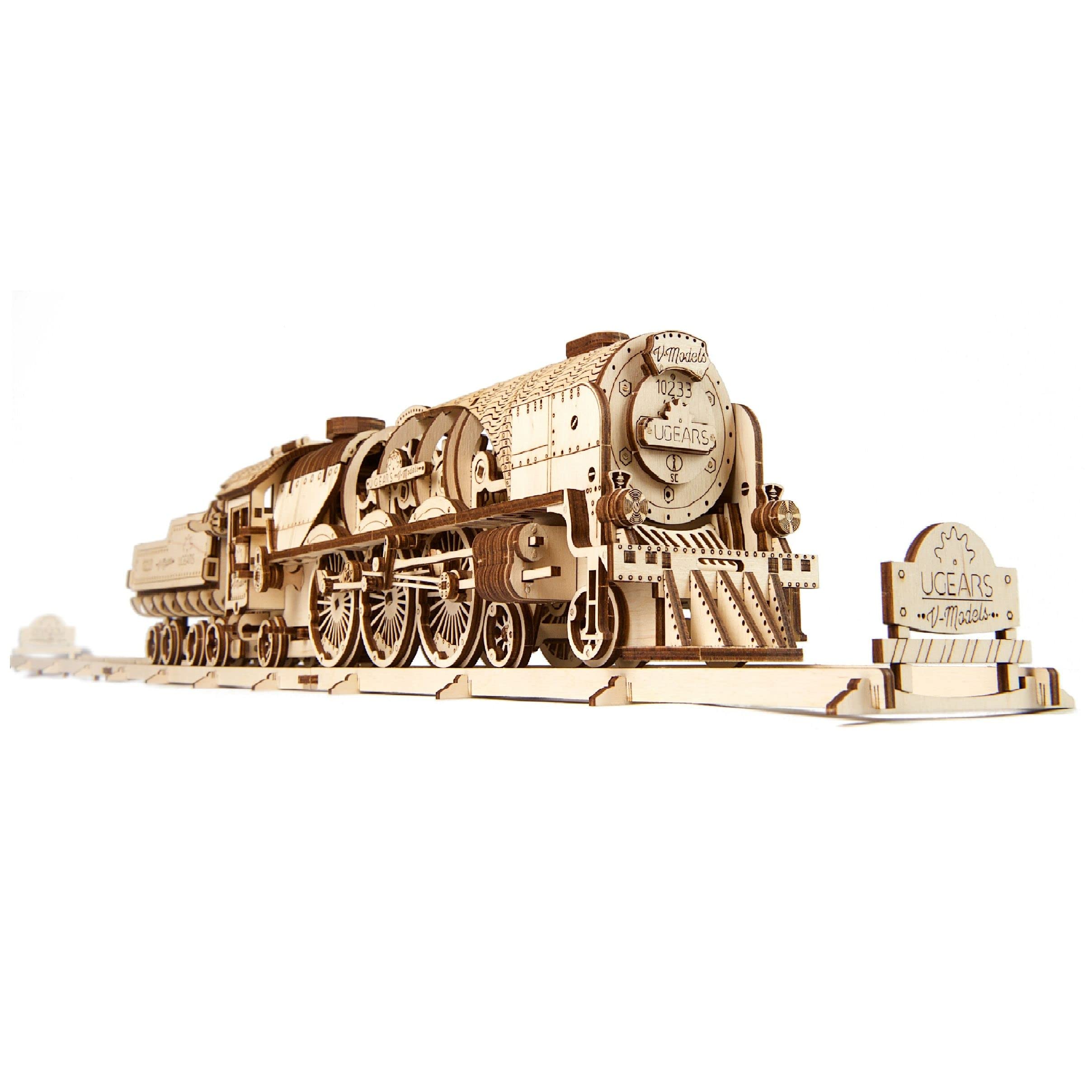
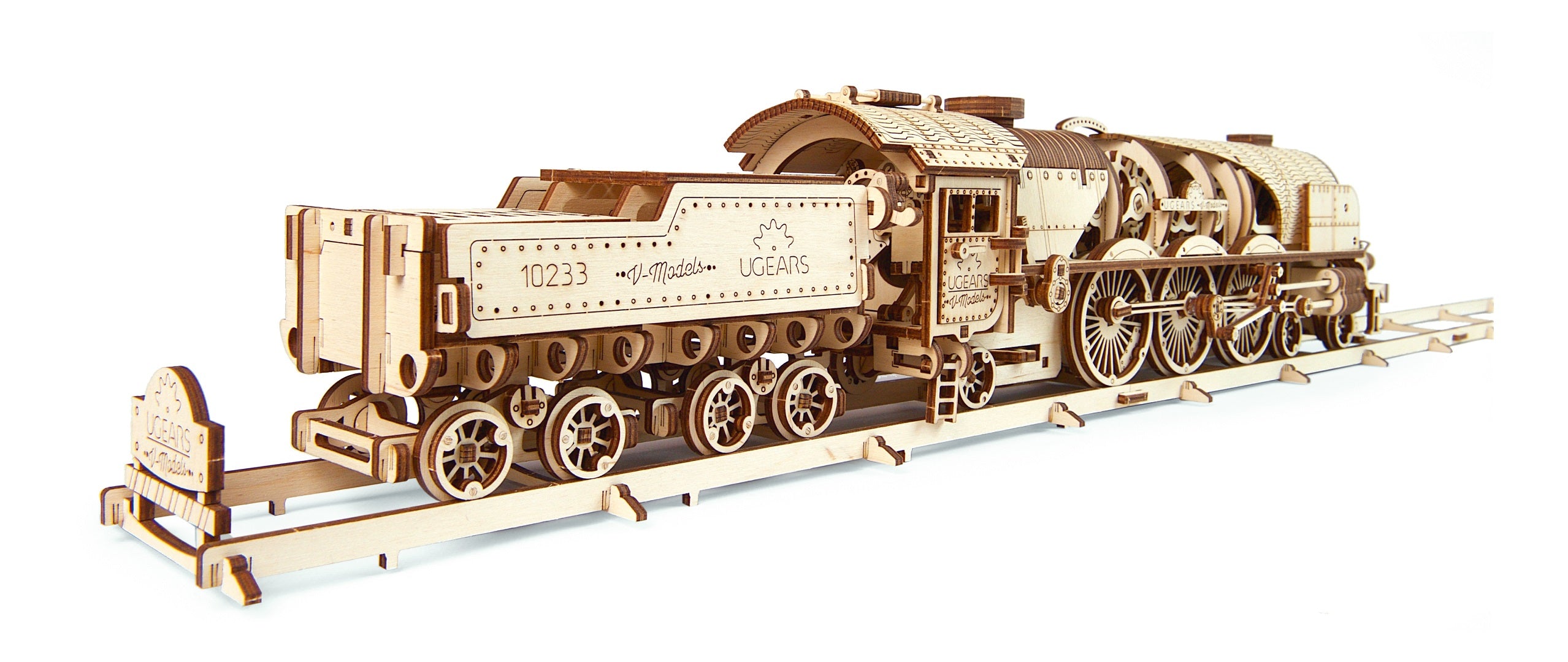
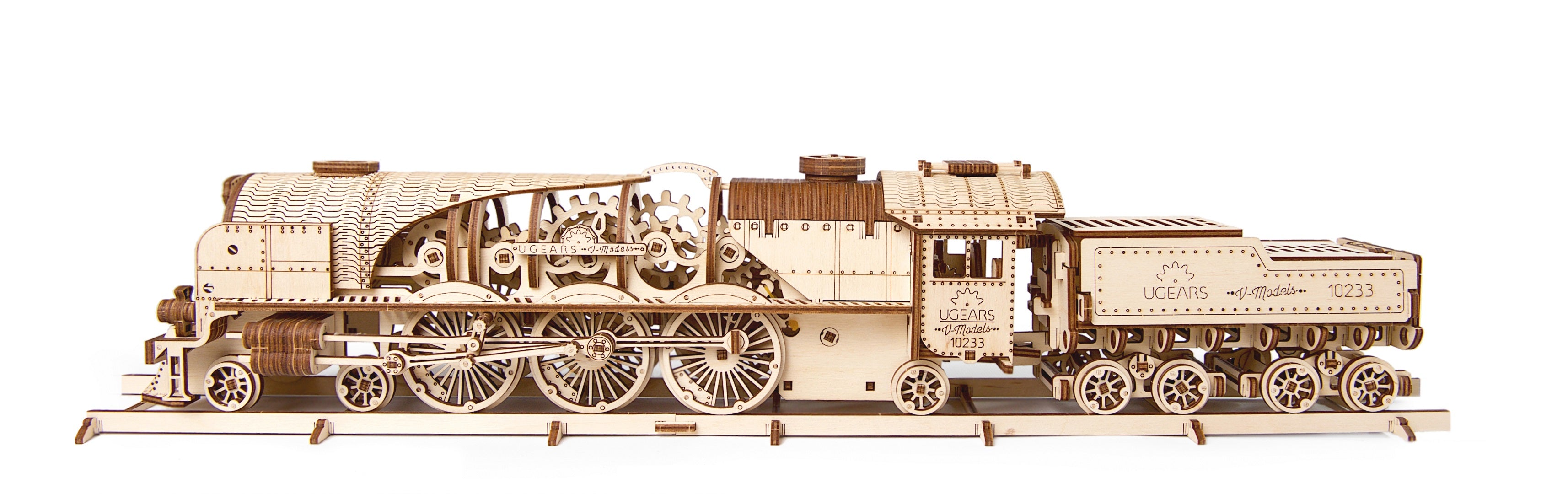
If you want motion as spectacle rather than a game, the UGears Steam Locomotive (~$84, 443 parts) or the bigger V-Express Steam Train with Tender (~$84, 538 parts) are the connoisseur's pick. Tighter tolerances than the ROKR, a self-propelled mechanism, and that signature UGears smoothness. These are the kits that convert a skeptic — the motion is clean.
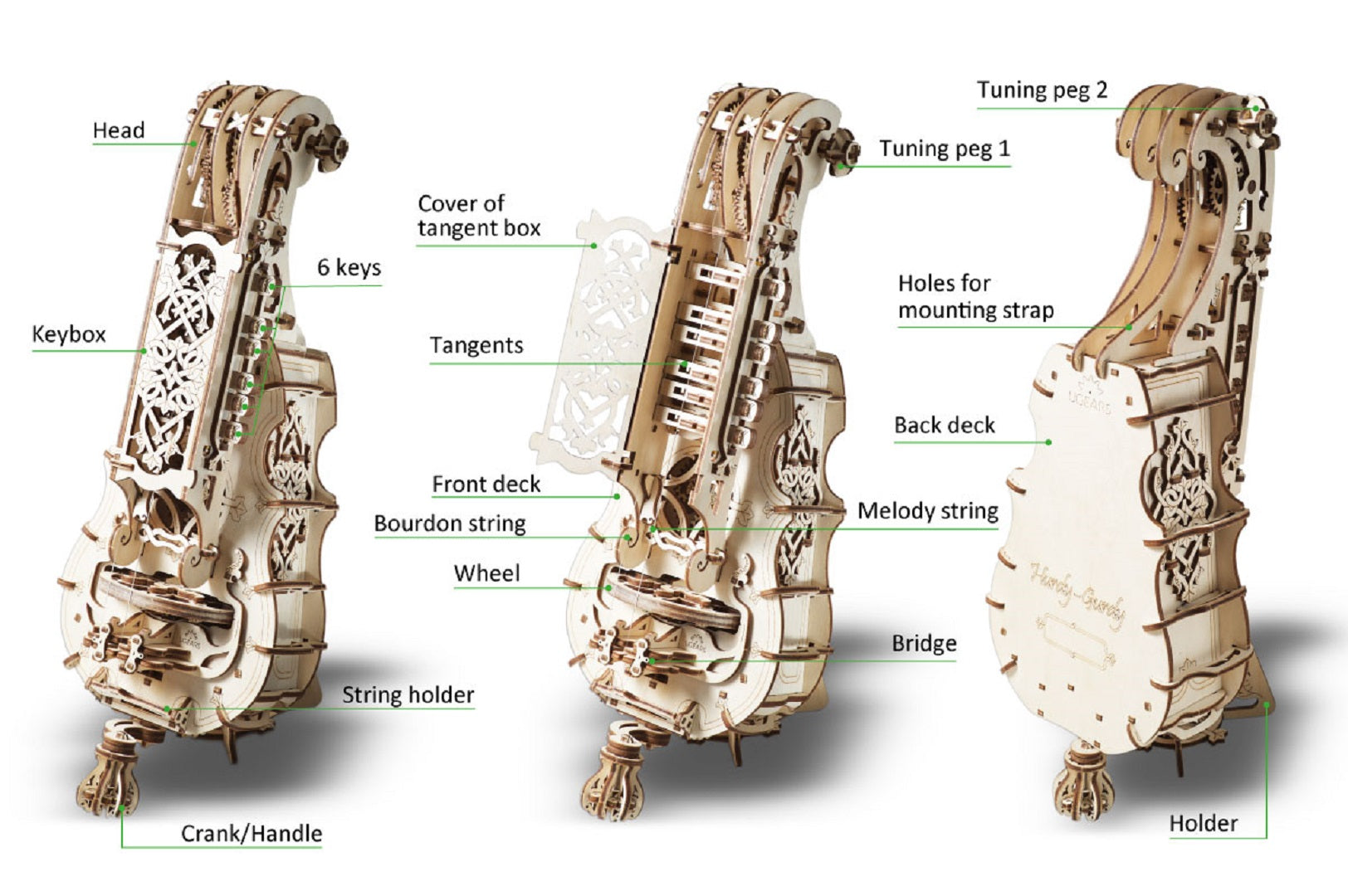
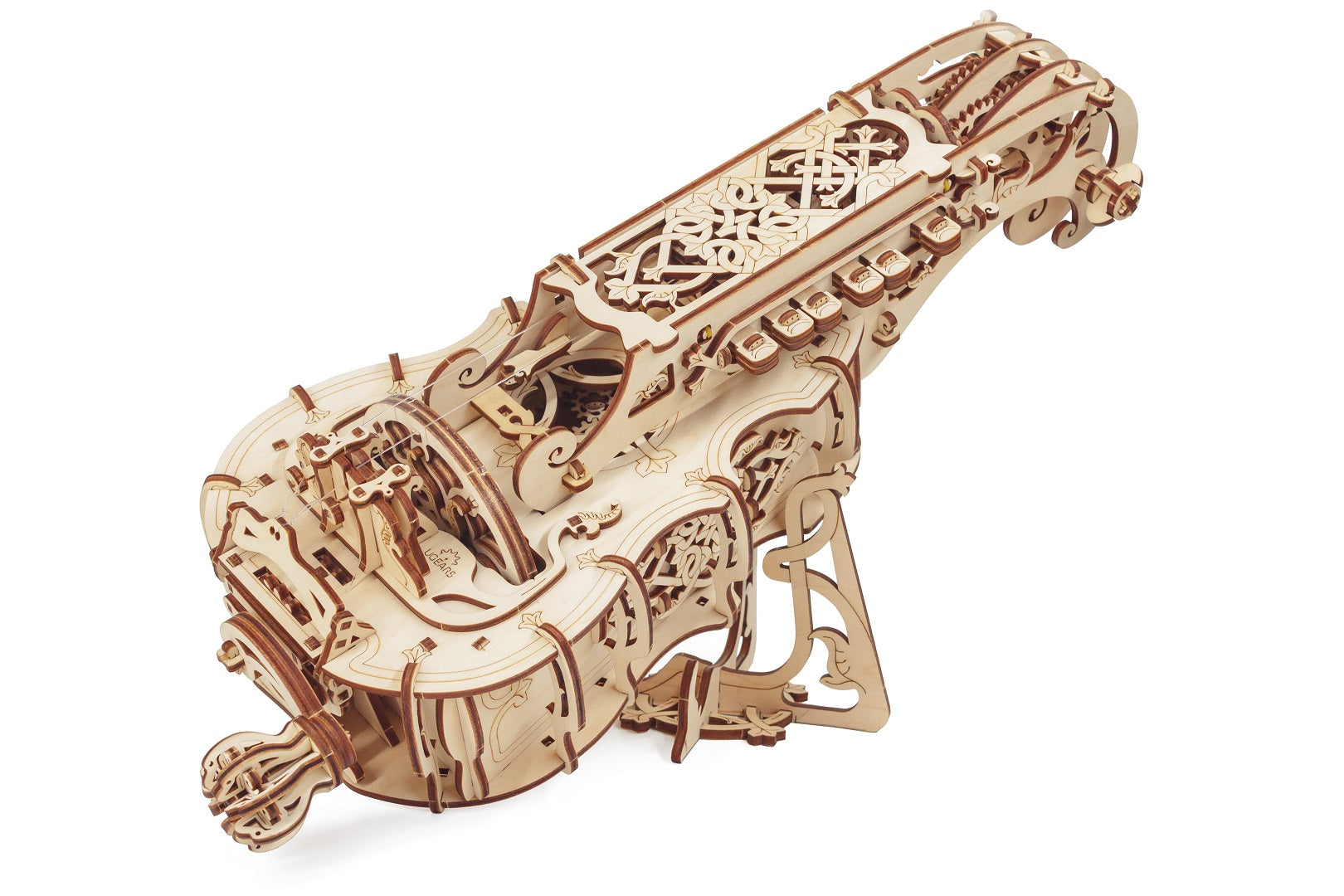
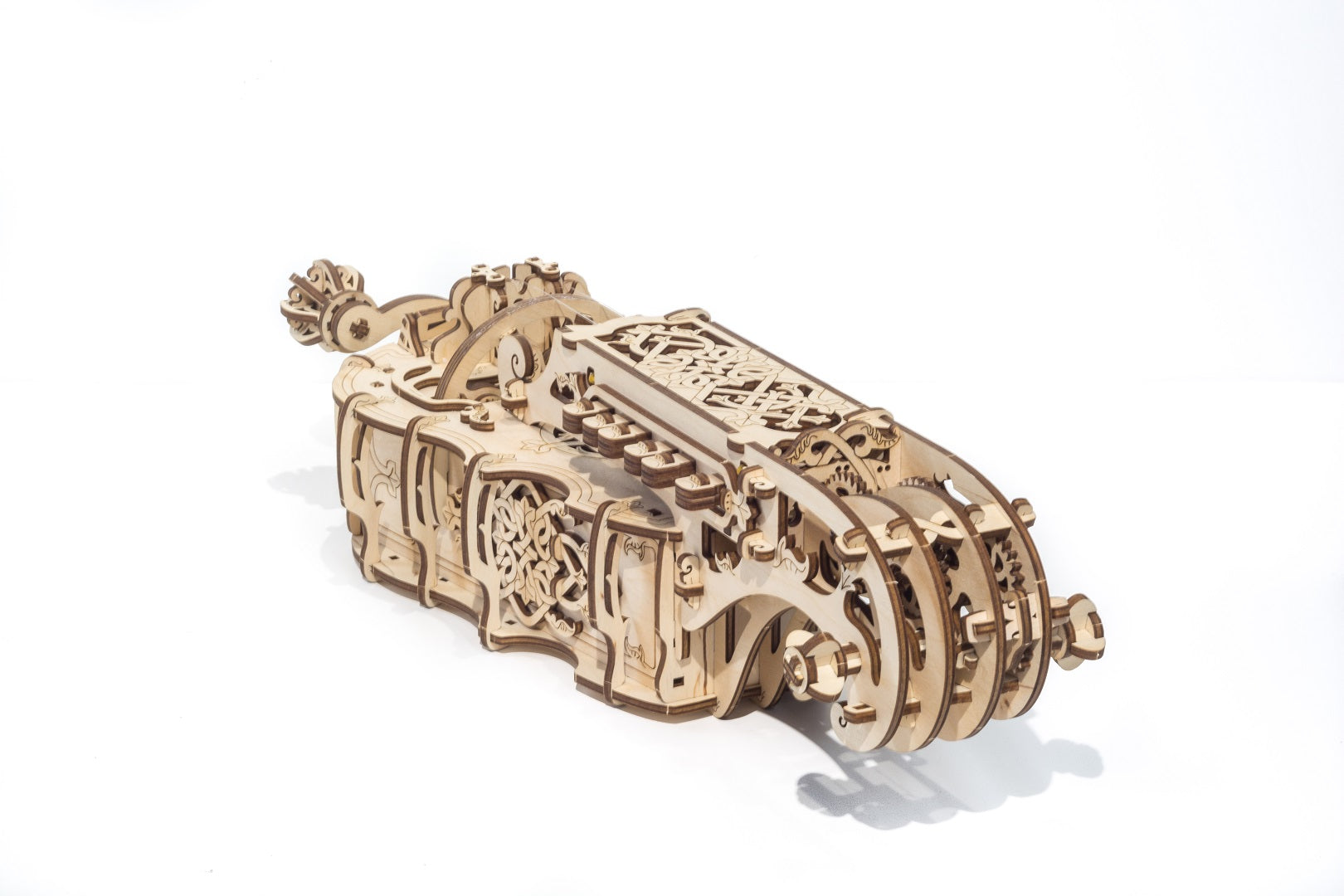
For a showpiece that's secretly a musical instrument, the UGears Hurdy-Gurdy (~$70-104 depending on retailer; 292 parts; 4-5 hours) is the gem of their line — you build a working 16th-century crank-driven string instrument that actually plays. It's the rare kit where the mechanism is the function.
And the big motorized marble runs — ROKR's Marble Night City (294 parts, ~$57) and the motor-driven Marble Parallel World / city series (~$65) — are pure kinetic theater once running. Fair warning the maker community has flagged: some of these marble lifts are underpowered, and the manual cranks can struggle if any joint runs tight. Build clean, keep the track friction down, and they're mesmerizing. Build sloppy and you'll fight the lift forever.
You build a game and then you play it. That's the difference between a showpiece and a trophy.
Cams, gear trains, and escapements — which mechanism should you build first?

If you're choosing by what you want to learn — and you should be — pick the mechanism, then pick the kit that teaches it cleanly.
Cams and followers are the soul of traditional automata. A rotating cam (an off-center or shaped disc) pushes a follower up and down, converting your steady crank into the peck, wave, or bob of a character. This is Timberkits' home turf — the Drummer, the Magician, the animal kits all teach cam-driven character motion. Start here if you want the mantelpiece-automaton aesthetic: a little figure that does a thing when you turn the handle.
Gear trains teach ratio, torque, and mesh — the engineering backbone. UGears owns this. Their Gearbox and Differential STEM kits exist purely to put a working transmission and differential in your hands, and their vehicles (Tractor, trucks, locomotives) are rolling gear-train lessons driven by a rubber-band motor with selectable 'gears.' If you want to understand why the wheels turn, build a UGears drivetrain.
Escapements — the tick-tock regulator that meters a clock's energy release one controlled step at a time — are the advanced black belt. UGears makes pendulum and tower-clock kits built around a real escapement; they're the most demanding mechanism in the category because timing depends on tolerances you can feel but barely see. Don't make this your first build. Make it your fifth, after your hands know how a clean gear mesh feels.
My honest sequencing: cam automaton (Timberkits beginner) → gear-train vehicle (UGears Tractor/Theater) → musical or marble showpiece (Hurdy-Gurdy / marble run) → escapement clock. Each one teaches a primitive the next one assumes you already understand. Skip a rung and you'll blame the kit for a gap in your own technique.
Pick the mechanism, then pick the kit that teaches it cleanly. Skip a rung and you'll blame the kit for a gap in your own technique.
Where do artisan automata kits fit — is Cabaret Mechanical Theatre worth it?
Above the mass-market plywood houses sits a different category entirely: artisan automata, where you're not buying a model of a thing — you're buying mechanism literacy from the people who curate the world's best kinetic sculpture.
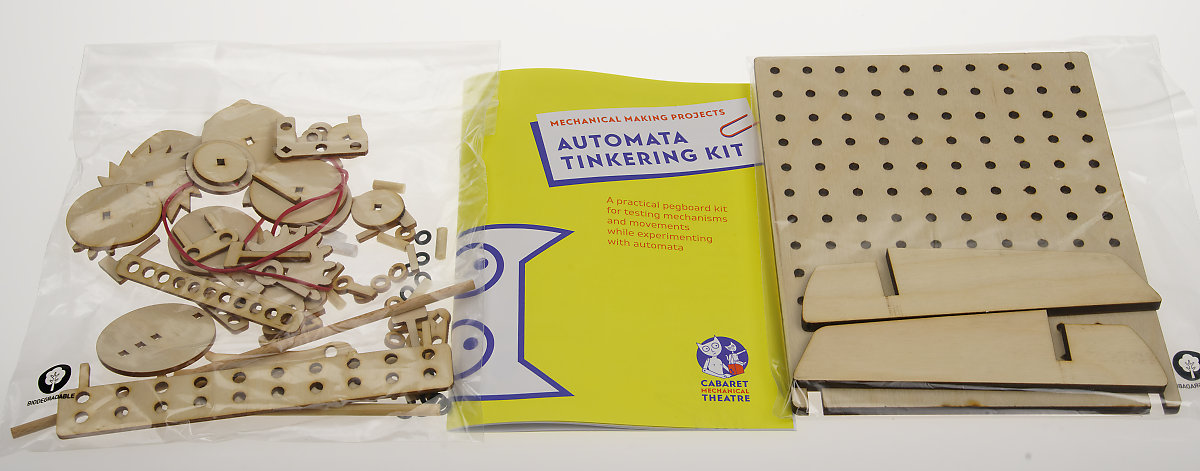
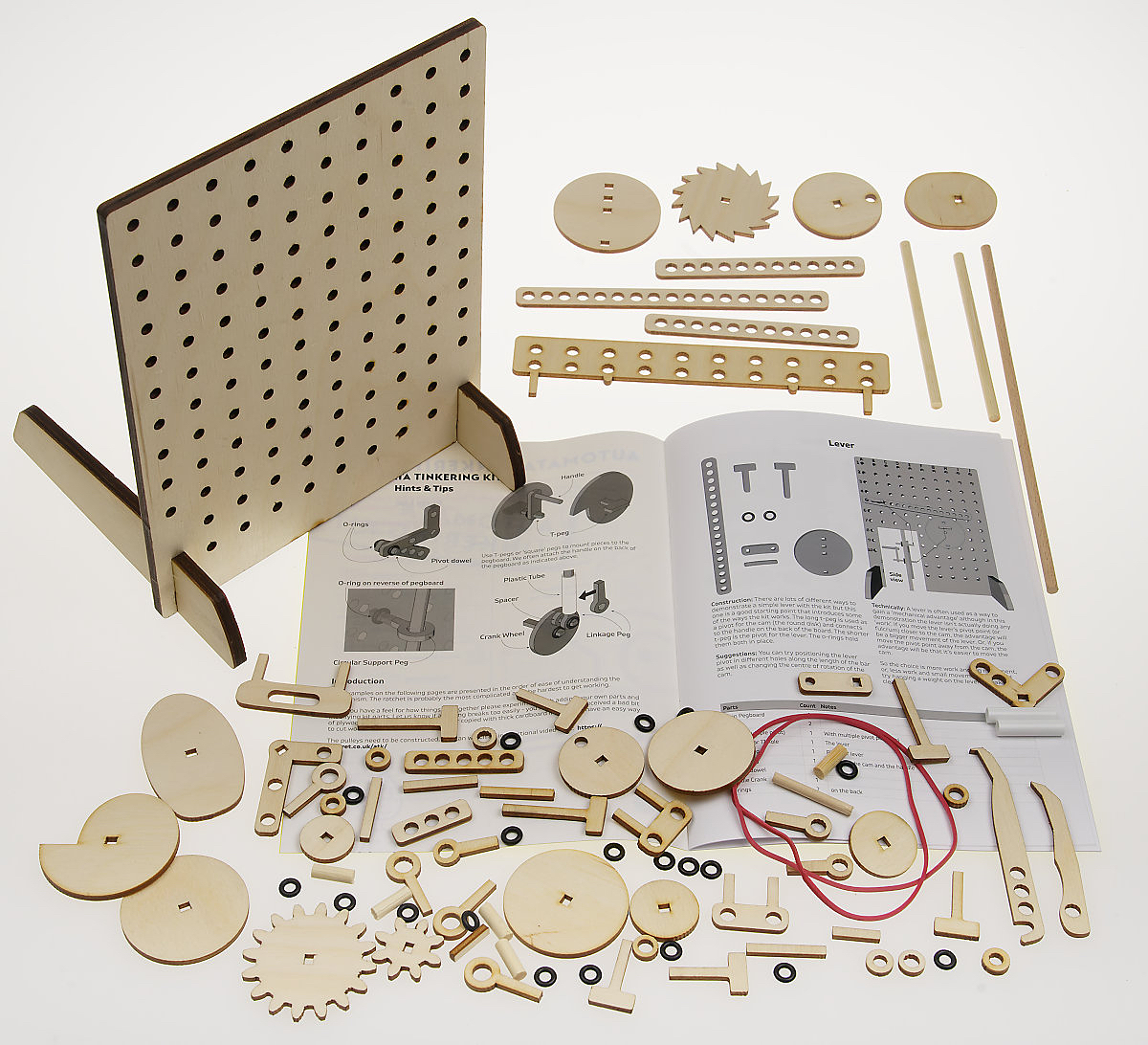
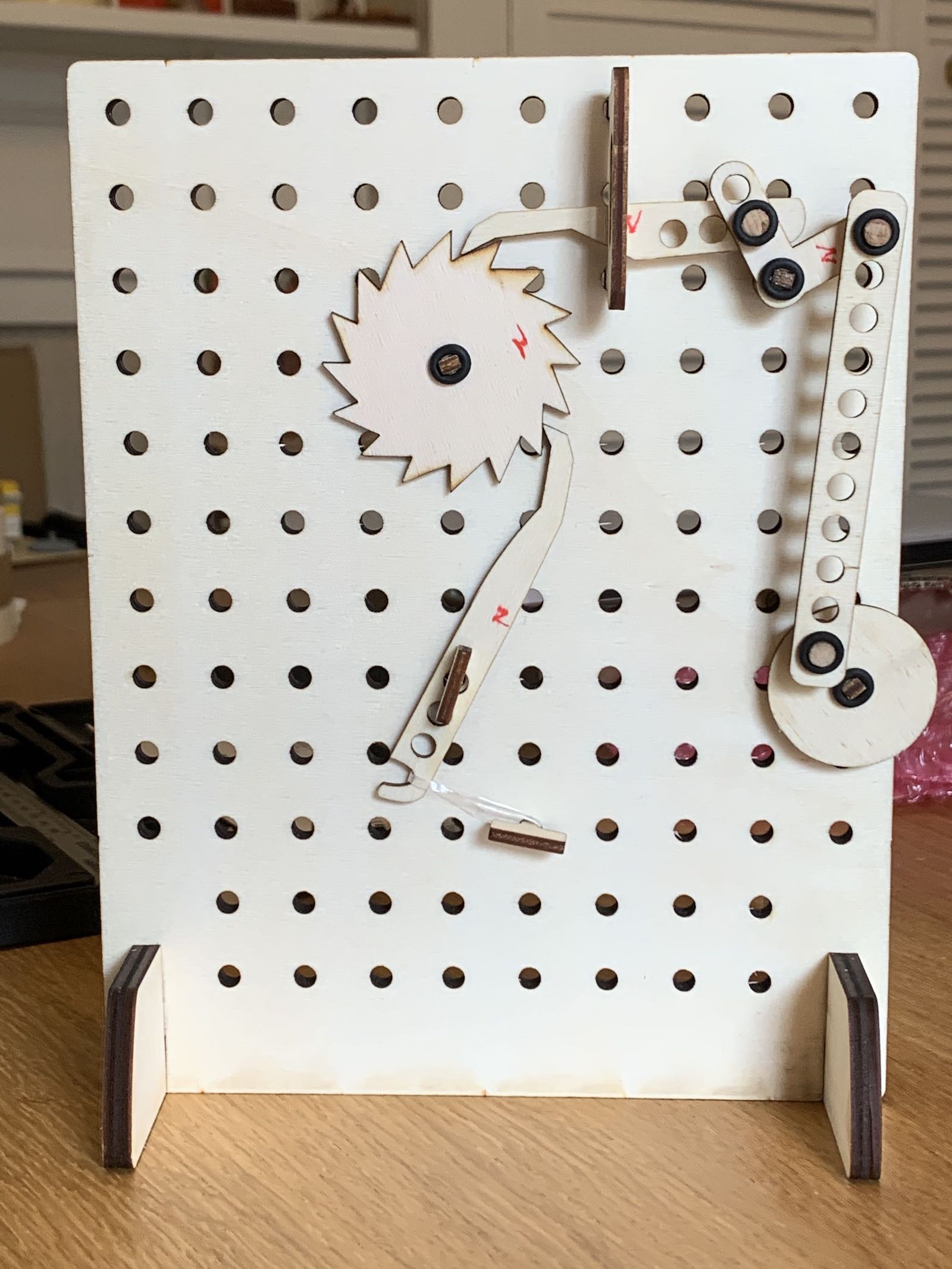
Cabaret Mechanical Theatre is the name that matters here. They're the English organization that has mounted contemporary-automata exhibitions worldwide for decades, and their kits are designed to teach you to build your own automata rather than assemble a predetermined one. The Automata Tinkering Kit (~£70-75) is a pegboard system — cams, cranks, followers, and linkages you arrange yourself to invent original mechanisms. That's a fundamentally different proposition from a UGears kit: instead of one finished model, you get a toolkit for designing motion. Cranky Contraptions (~£20) is the gateway — a crank-powered automaton kit that teaches the core primitive cheaply.
Is it worth it? Depends what you're after. If you want a finished showpiece on a shelf this weekend, no — buy UGears or ROKR. But if you've built a few kits and you're starting to wonder how would I design my own?, Cabaret is the best money in this entire guide. You're buying the education that lets you stop following instructions and start inventing mechanisms. The tradeoff: these are less 'snap-together perfect plywood' and more 'craft materials and ideas,' so expect more hands-on shaping and less guaranteed precision.
Fair, honest caveat for the budget-laddered shopper: a chunk of Cabaret's catalog is card/paper automata, not wood — brilliant for learning mechanism on the cheap, but if you specifically want a wooden mechanical model, read the kit description before you buy. The Tinkering and designing kits are the wood-and-mechanism core; the £10-20 character kits are often card.
You're not buying a model of a thing — you're buying the education that lets you stop following instructions and start inventing mechanisms.
What experienced tables keep reporting
Recurring owner patterns, synthesized in Puzzlewick's words. Follow each evidence trail to read the original discussion.
In a direct head-to-head, the UGears truck ran while the comparable ROKR locomotive got stuck — a clean illustration that UGears' smaller, more precise parts translate into mechanisms that actually work, where ROKR's looser tolerances can leave gear teeth catching stationary parts.
Read the evidence: Speedcube.nl — 'What are the best brands for wooden construction kits?'
Reviewers comparing the two brands' puzzle boxes note UGears 'excels mechanically — the mechanical aspects function smoothly, offering the dual pleasure of both assembling and using the box,' while ROKR's strength leans toward the security/storage feature rather than the motion. ROKR's instructions 'are generally clear, though sometimes you might need a bit of extra help from online tutorials or forums.'
Read the evidence: 3D Puzzle Craze — Comparing ROKR and UGears 3D Wooden Puzzle Boxes
Builders of the ROKR Marble Night City report it 'was not as straightforward as other ROKR models — it has many tiny pieces and spaces' and 'takes quite a lot of building skills to get it all working,' adding that 'most errors are due to a loose joint.' Translation: the kit is fine; your assembly precision is the variable.
Timberkits builders consistently describe the picture-form instructions as 'adequate, but you'll want to bring your brain along for the ride,' and stress that 'careful attention to detail and sometimes dry fitting during assembly is important for smooth operation' on these glue-based cam automata.
Read the evidence: Timberkits customer reviews / What's Good To Do (Trebuchet review)
Reviewing the UGears Differential educational kit, The Gadgeteer praised it as a glue-free, tool-free way to genuinely understand a working differential by hand — backing the case that UGears' cheap STEM kits are the best low-cost on-ramp to feeling a real mechanism before committing to a big build.
Read the evidence: The Gadgeteer — UGears Differential Educational Mechanical Model Kit review
The picks
Some links below are affiliate links — as an Amazon Associate, Puzzlewick earns from qualifying purchases, at no extra cost to you. It never changes a pick.
 3 photos
 UGears Theater
The flaw first: at 70 parts it's small, so showpiece hunters will want more. But that's exactly why it's the best entry point. You crank a wheel and characters rotate onto a stage to tell a different story each spin — this is a REAL automaton, not a static puzzle dressed up as one. Press-fit, 1-2 hours, UGears' clean tolerances. The payoff is performance, which is the hook that turns a curious buyer into a builder. Nothing else under $35 teaches the craft and rewards it this well.
- Actual storytelling automaton, not a static diorama
- Tight UGears laser-cut fit; press-fit, no glue
- 1-2 hour build — finishes before patience runs out
- Cheapest genuine 'it moves and tells a story' kit
- Only 70 parts — too small for shelf-spectacle seekers
- Single mechanism; less replay than a marble run or pinball
 3 photos
 UGears Hurdy-Gurdy
Price swings hard by retailer (seen ~$70 at UGears US, ~$104 at Woodcraft), so shop it. What you get for the money is the gem of the UGears line: a working 16th-century-style hurdy-gurdy you build and then actually PLAY. 292 parts, 4-5 hours, and the rare kit where the mechanism isn't decoration — the crank-driven wheel bowing the strings IS the instrument. Tight fit, generous spares. The one kit here that does something no other category can claim: it makes music.
- Builds into a genuinely playable musical instrument
- Mechanism is the function, not ornamental
- UGears precision and spare-part generosity
- 292 parts / 4-5 hrs — meaty but not punishing
- Price varies wildly by retailer ($70-$104) — shop around
- Playing it well takes practice; it's a real instrument, not a toy
 3 photos
 ROKR EG01 Pinball Machine
The flaw: 482 parts at ROKR's looser tolerances means a few fiddly sub-assemblies where the instructions thin out and a joint needs re-seating — budget ~12 hours and keep a sanding stick handy. Earn-your-trust part: it's a genuinely PLAYABLE pinball machine. Spring plunger, bumpers, a marble, light-up scoring with an illuminated star. You don't build a trophy, you build a game and then play it. Most fun-per-build in the category if you'll actually use it. Lists ~$200, frequently ~$159.
- Fully playable pinball — plunger, bumpers, scoring
- Light-up scoring system with illuminated star indicator
- Genuine showpiece spectacle nobody's UGears shelf has
- Strong value when on its frequent discount (~$159)
- ROKR tolerances — expect to re-seat/sand a few gears
- Instructions go thin on the fiddly scoring sub-assembly
- Long ~12-hour build; not a beginner project
 4 photos
 UGears V-Express Steam Train with Tender
The catch: 538 parts is a commitment, and there's no shortcut through it. But this is the kit that converts skeptics. Tighter tolerances than any ROKR, a self-propelled mechanism, and that signature UGears smoothness when the drivetrain finally rolls. The motion is CLEAN — no fighting a loose gear, no jam-and-sand cycle. If you want a big showpiece that moves beautifully rather than a game you play, this or the smaller 443-part Steam Locomotive (same ~$84) is the connoisseur's pick.
- UGears' cleanest-in-class gear mesh and motion
- Self-propelled; rolls smoothly when built
- Generous spare parts for the inevitable snapped pin
- Genuine shelf-dominating showpiece scale (538 parts)
- 538 parts — a real time commitment
- No 'play' feature; it rolls, that's the trick
- Big footprint once assembled
 2 photos
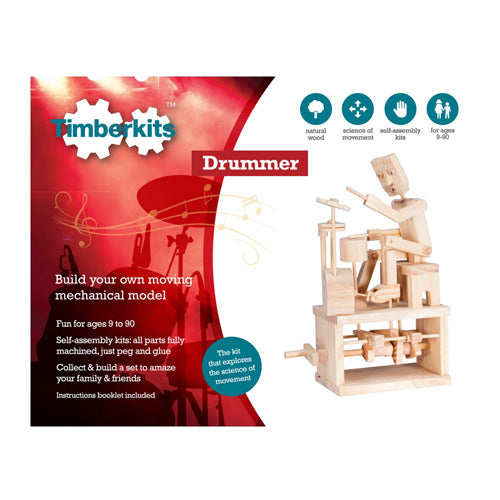
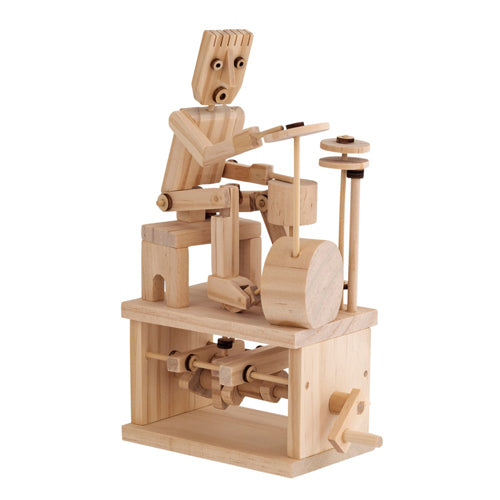
 Timberkits Drummer (Beginner Automaton)
Priced ~£23 in the UK (roughly $30-35 imported), so US buyers pay a shipping premium. Worth it for the genuine article: a cam-driven automaton where turning the crank makes a little drummer actually drum. This is the OTHER half of the craft from UGears — New Zealand pine and bamboo, glue-required, and you'll dry-fit every linkage before committing. Instructions are clear photos but 'bring your brain.' The traditional automaton aesthetic UGears and ROKR don't make. Build it dry, watch the cam, then glue.
- True cam-driven character automaton (it drums!)
- Teaches the glue-and-linkage discipline, not just press-fit
- Sustainable NZ pine + bamboo; quality wood
- Beginner difficulty rating; classic mantelpiece charm
- UK-based — US buyers pay import/shipping premium
- Requires glue; mistakes are harder to undo than press-fit
- Picture-only instructions assume mechanical intuition
 3 photos
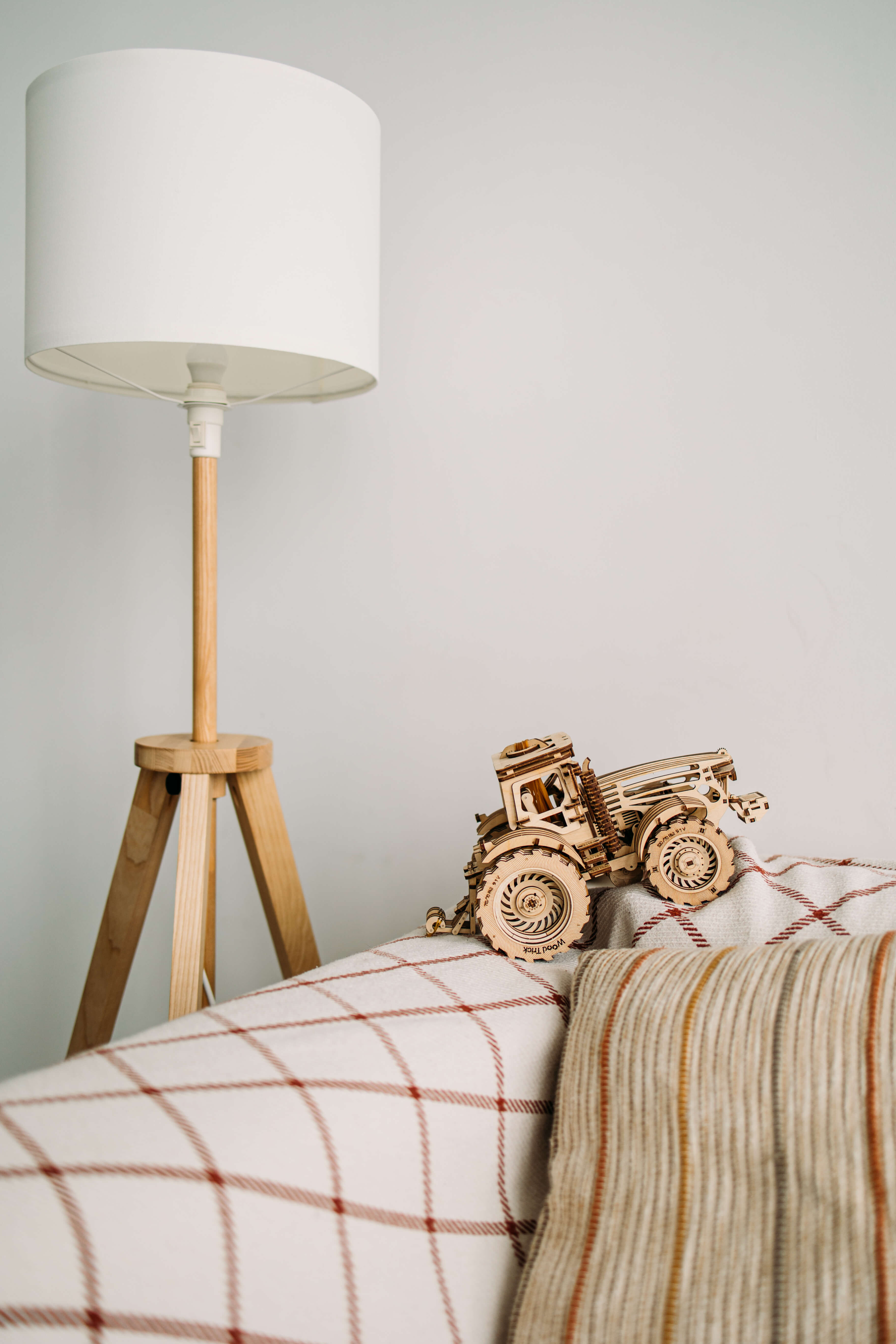
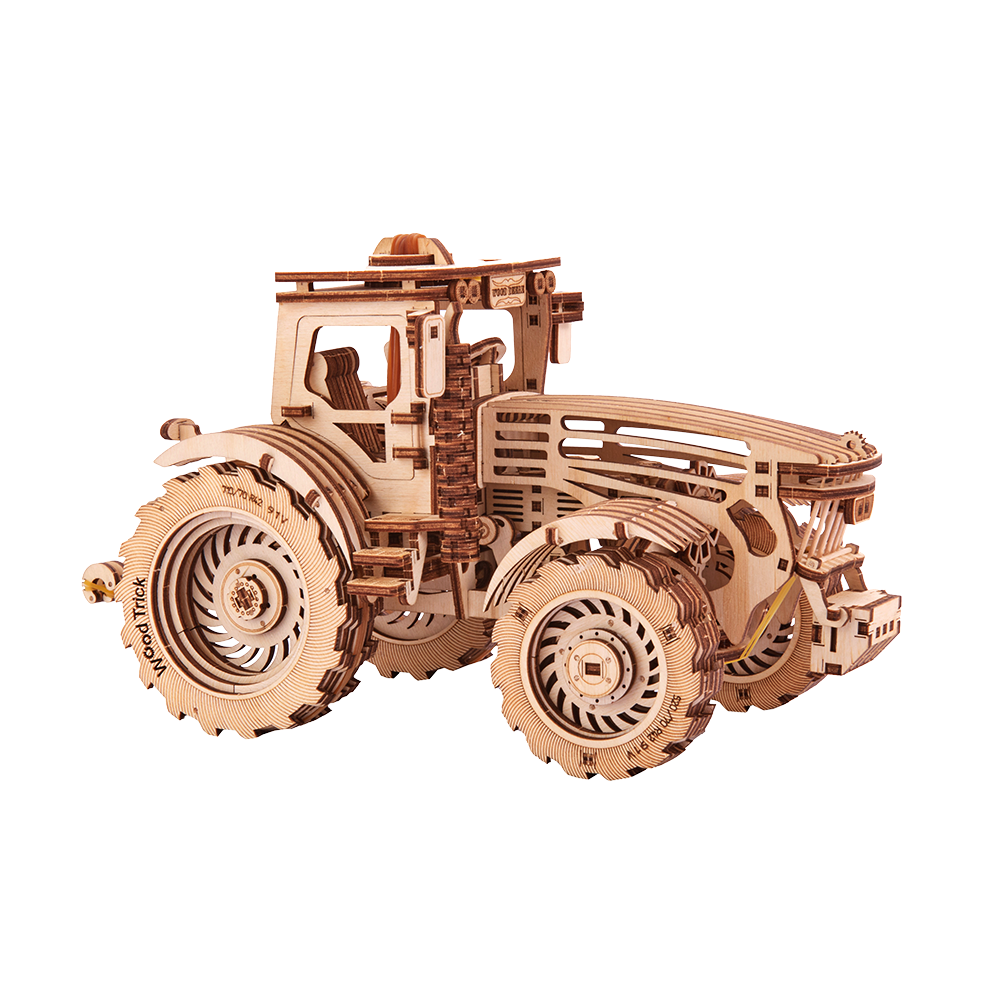
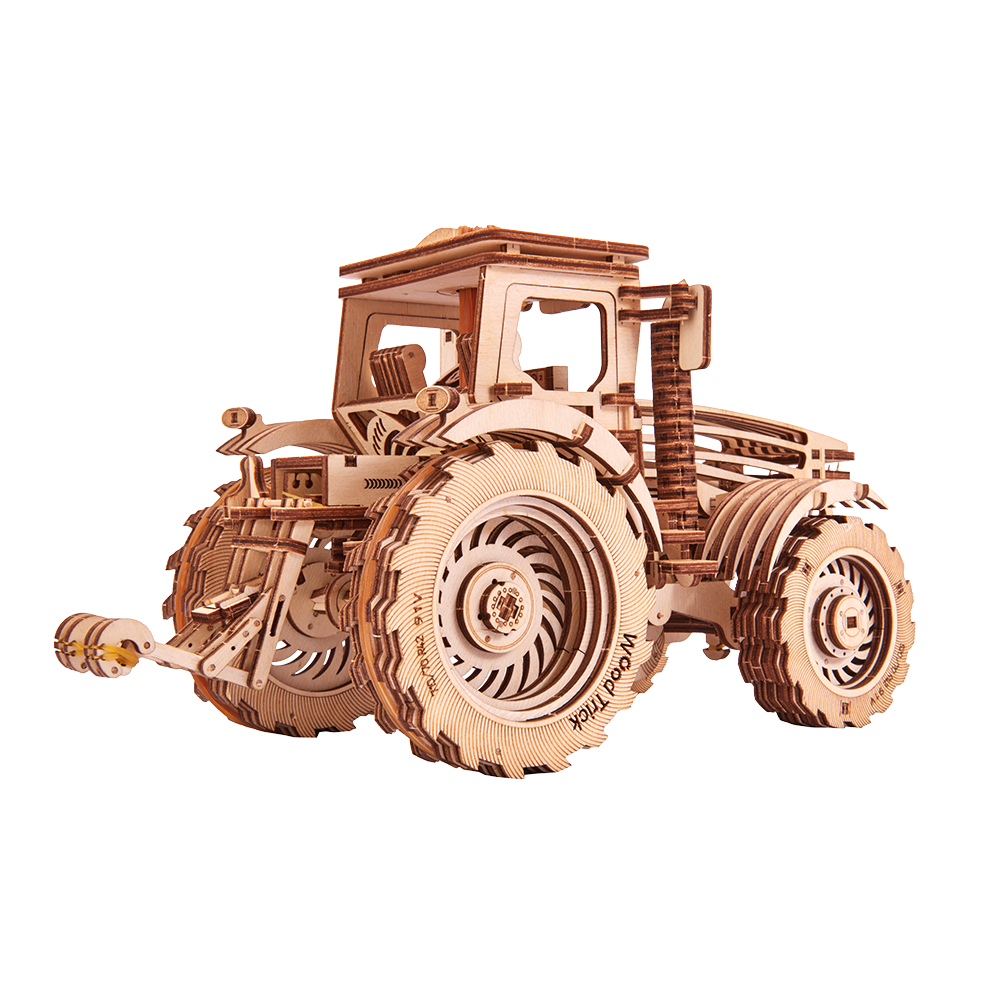
 Wood Trick Tractor
The honest note: ~8 hours and 401 parts, and Wood Trick's tolerances sit between UGears-tight and ROKR-loose. What you get is a satisfying, sturdy drivetrain with a rubber-band motor, a real 2-speed selector, and massive wheels that roll the thing several feet. No glue. It's a rolling gear-train lesson with more heft than the UGears equivalent. Solid mid-ladder pick if you want a vehicle that moves under its own power and feels substantial in the hand.
- Rubber-band motor with genuine 2-speed selection
- Sturdy, chunky build that rolls several feet
- No glue; satisfying press-fit drivetrain
- 401 parts of real mechanism, not filler
- ~8 hours; tolerances looser than UGears
- Rubber-band motor is a perishable consumable
- Smaller spare-parts cushion than UGears
 3 photos
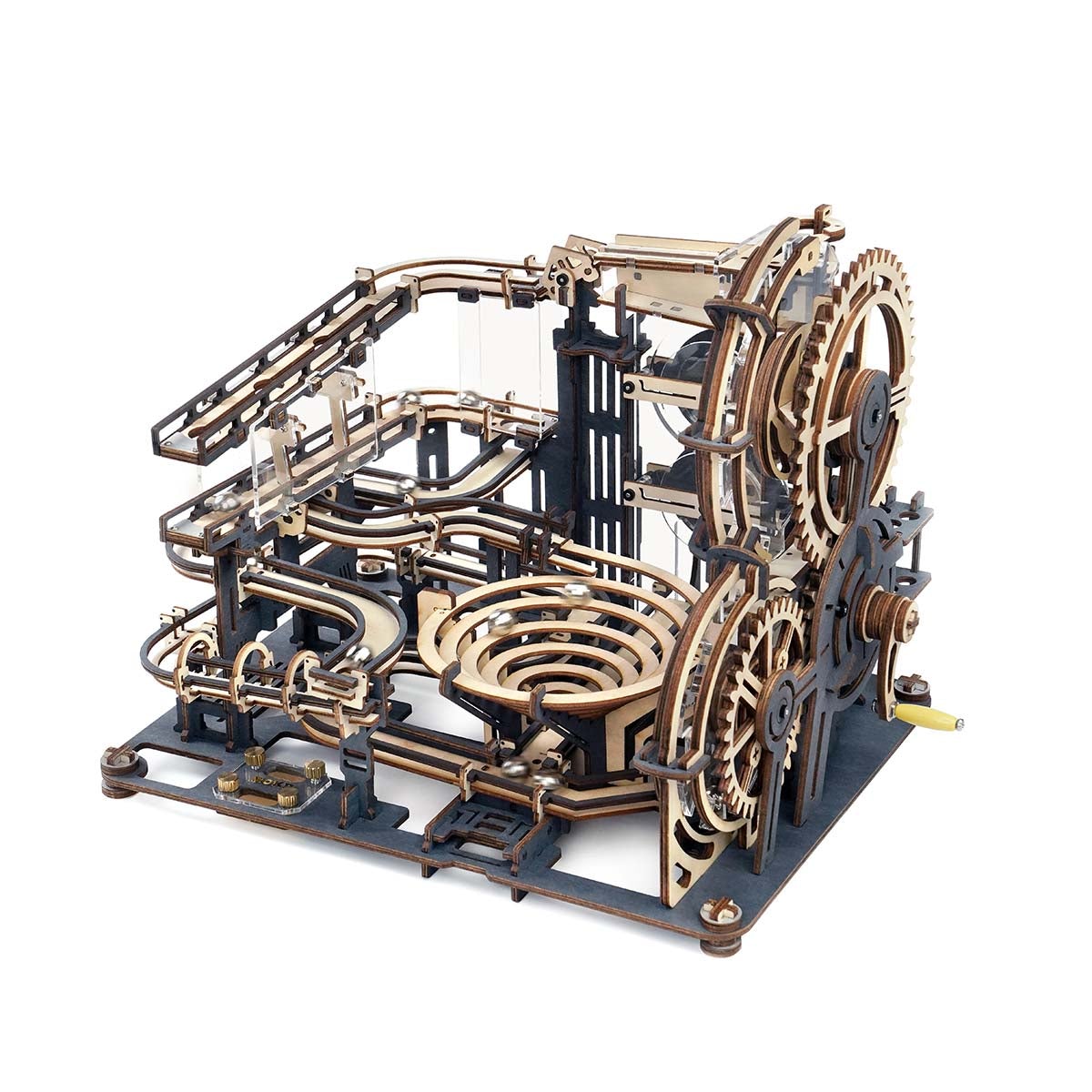
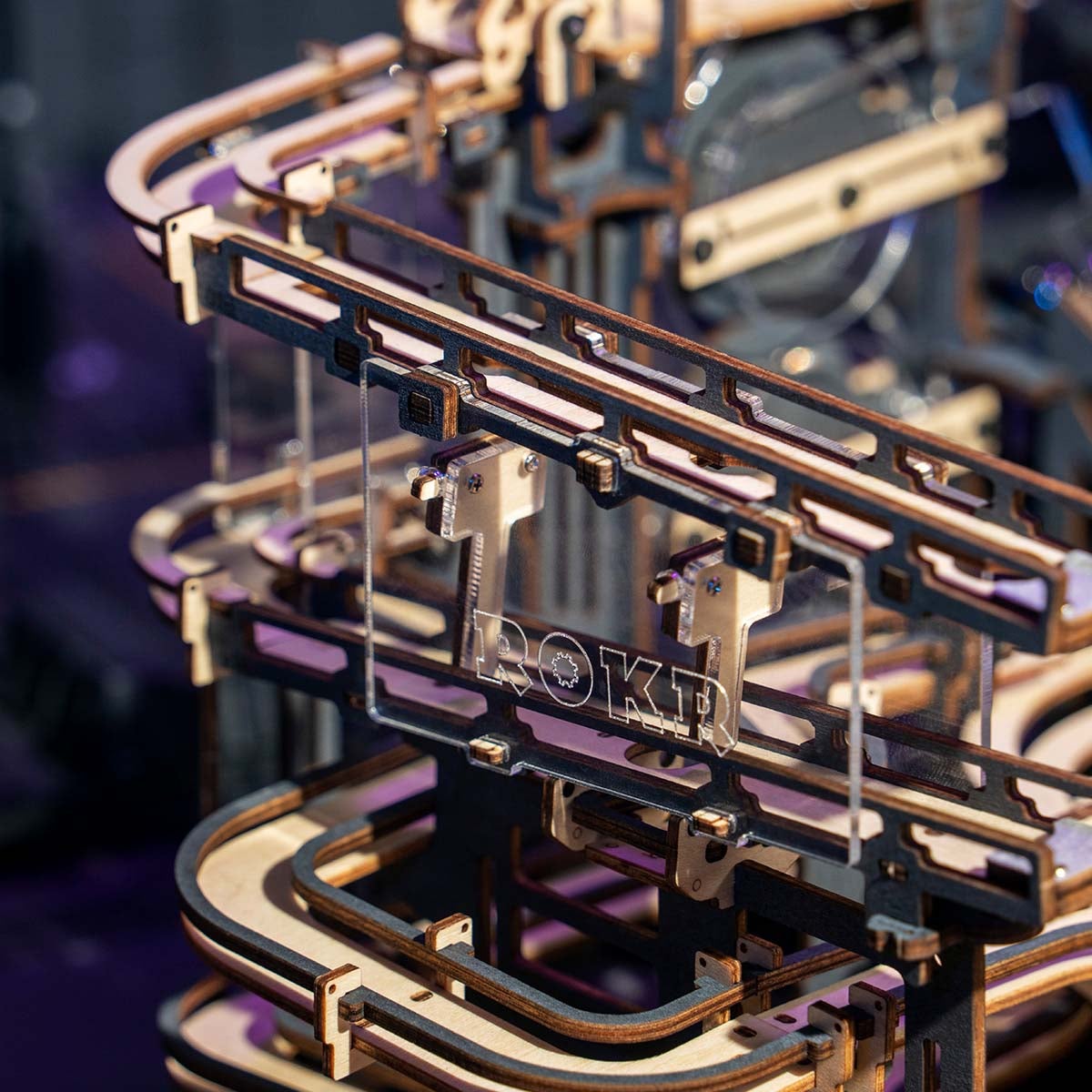
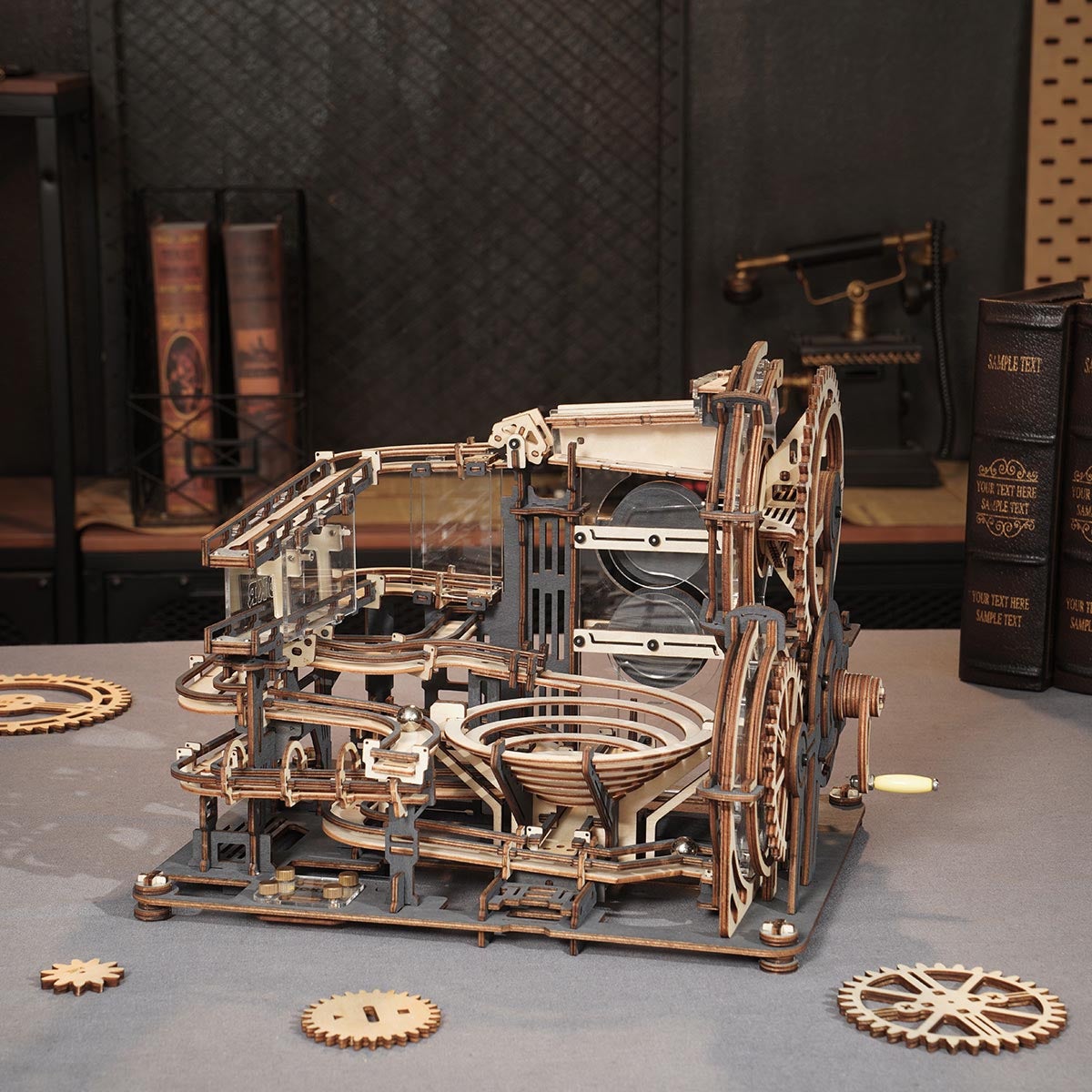
 ROKR Marble Night City (LGA01)
The warning up front: 294 small parts, hand-crank (no motor despite some listings implying otherwise), and it's fussier than ROKR's easier kits — tiny pieces, tight spaces, and any loose joint stalls the whole run. Build it clean, though, and it's mesmerizing kinetic theater. The fix for the recurring 'feels underpowered' complaint is in YOUR build: minimize track friction, seat every joint, wax the contact points. Reward-to-effort is high if you respect the assembly. Frustrating if you rush it.
- Mesmerizing marble-run motion when built clean
- Strong mid-budget spectacle (~$57)
- Excellent laser cutting on the parts themselves
- Compact footprint for a marble run
- Hand-crank only; many tiny fiddly pieces
- Any loose joint stalls the entire run
- Community flags the lift/crank as easy to underpower
 4 photos
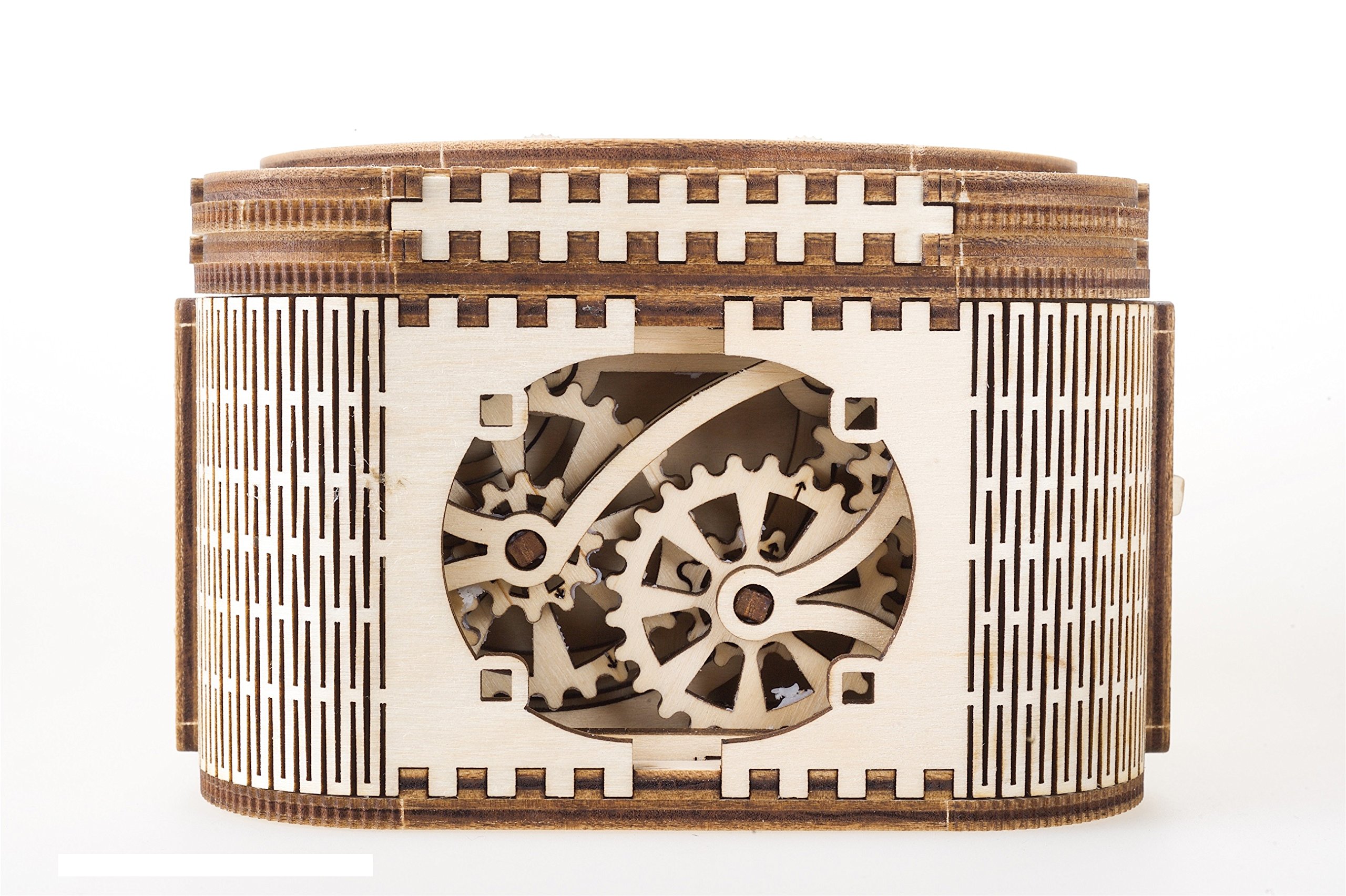
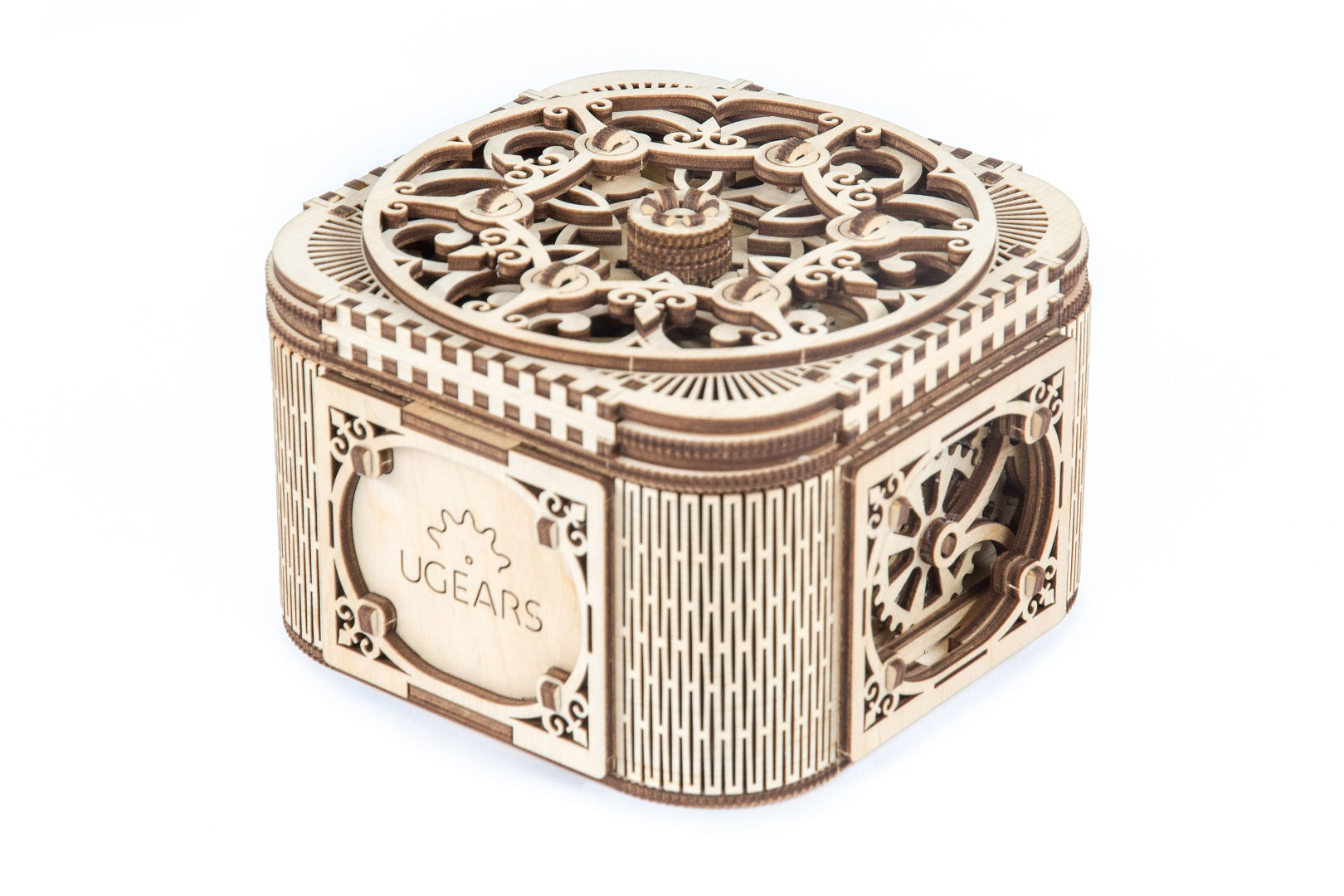
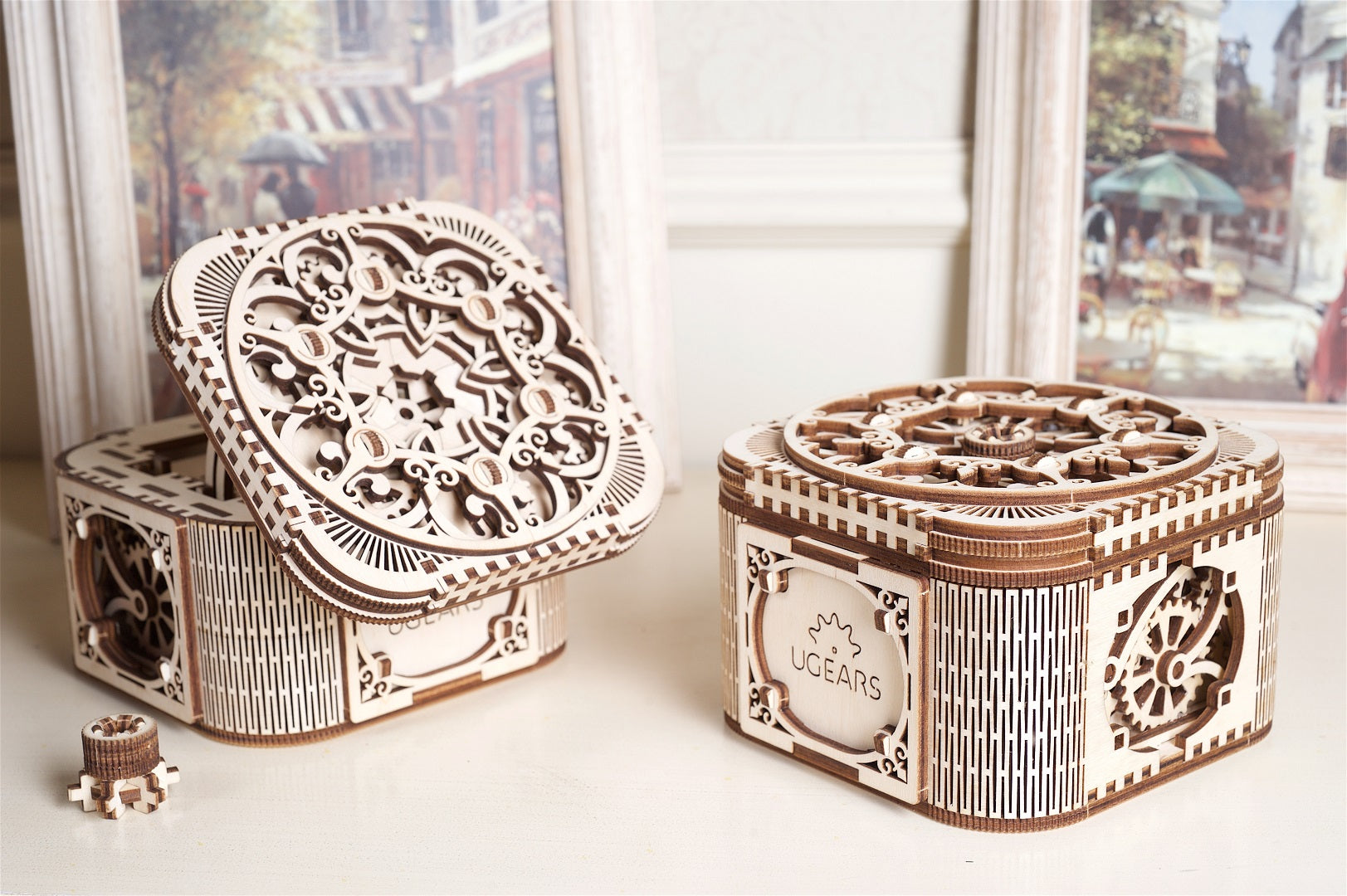
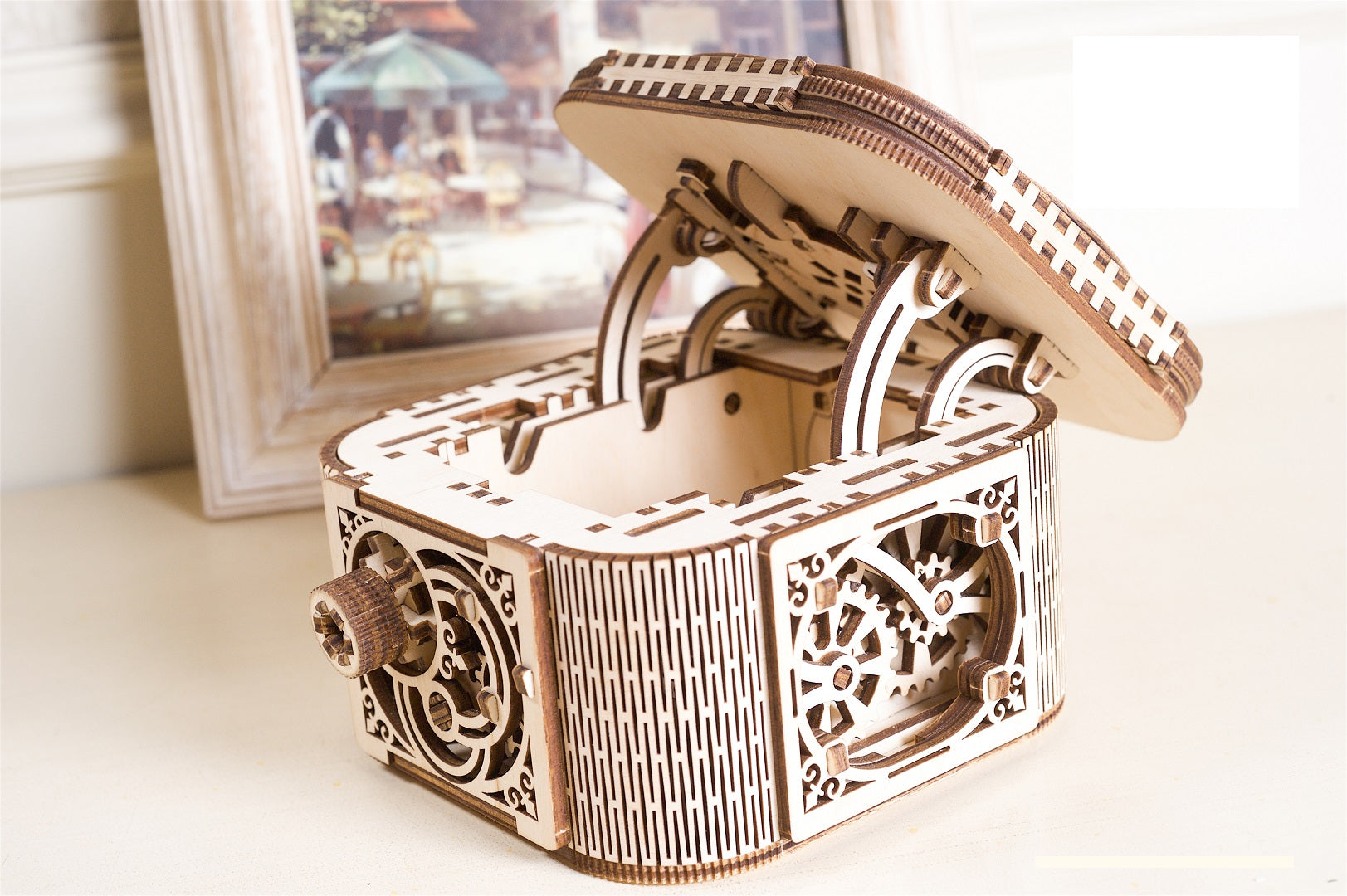
 UGears Treasure Box
Not an 'automaton' in the storytelling sense, so purists can skip — but it earns its slot as a working mechanism you'll actually USE. Through-carved woodwork, exposed gears, and a key that turns the gears to lift the lid and reveal a compartment. UGears precision means the mechanism runs smooth, not gritty. A great proof that 'mechanical kit' doesn't have to mean 'static display' — this one does a job every day. Mid-ladder, press-fit, no glue.
- Working keyed mechanism you genuinely use
- Beautiful through-carved exposed gearwork
- UGears-smooth mechanism, press-fit no glue
- Functional object, not just a display piece
- Not a moving 'automaton' in the performance sense
- Mechanism is simple vs a gear-train vehicle
- Decorative-leaning; less to learn than a drivetrain
 3 photos
 UGears Gearbox / Differential STEM Kit
Lowest rung on the ladder and proud of it. These aren't automata — they're engineering primitives: a working 4-speed gearbox or a true automotive differential, built to be cranked and understood, with an AR app that animates what your hands are doing. The flaw: zero showpiece value, it's a teaching rig. The point: ~$20-25 to genuinely understand gear ratio, torque, and how a differential lets two wheels turn at different speeds. Best money in the guide for a pure mechanism lesson before you commit to a big build.
- Real working gearbox/differential in your hands
- Cheapest genuine mechanism education (~$20-25)
- AR app animates the internals as you build
- Perfect 'rung 1' before a big gear-train kit
- Not an automaton; zero shelf-showpiece value
- It's a teaching rig, not a finished 'model'
- Single concept — you build it, learn it, move on
At a glance
| kit | maker | price | pieces | best for |
|---|---|---|---|---|
| Theater | UGears | $32.99 | 70 | Best first automaton (it performs) |
| Hurdy-Gurdy | UGears | ~$70-104 | 292 | Playable musical instrument |
| EG01 Pinball Machine | ROKR | ~$159 (lists $200) | 482 | Playable showpiece |
| V-Express Steam Train | UGears | $83.99 | 538 | Clean self-propelled motion |
| Steam Locomotive (460) | UGears | ~$84 | 443 | Smaller self-propelled train |
| Drummer (Beginner) | Timberkits | ~£23 / $30-35 | ~50 (glue kit) | Traditional cam automaton |
| Tractor | Wood Trick | $72.95 | 401 | Chunky 2-speed drivetrain |
| Automata Tinkering Kit | Cabaret Mechanical Theatre | ~£70-75 | Pegboard system | Designing your own mechanisms |
| Marble Night City (LGA01) | ROKR | $56.99 | 294 | Mid-budget marble run |
| Treasure Box | UGears | $44.00 | ~190 | Working keyed box |
| Gearbox / Differential STEM | UGears | ~$20-25 | ~50-90 | Pure gear-train lesson |
Questions, answered
ROKR vs UGears — which is better?
UGears is the better machine; ROKR is the better deal and the better showpiece. UGears holds tighter laser-cut tolerances, meshes gears more cleanly, and ships generous spare parts — in head-to-heads its mechanisms run while comparable ROKR kits jam. ROKR wins on price and on spectacle (playable pinball, big light-up marble runs) that UGears doesn't make, at the cost of looser tolerances that occasionally need a gear re-seated or sanded. First build or gift: UGears. Budget showpiece you'll tinker with: ROKR.
What's the best automata kit for a beginner?
The UGears Theater (~$33, 70 parts, 1-2 hours) — it's a real automaton that performs a story each crank, small enough to finish before frustration sets in, and press-fit so no glue mistakes. For traditional cam automata, a Timberkits beginner model like the Drummer (~$25-35) teaches the glue-and-linkage craft. Avoid starting with a 400+ piece marble run or the pinball; they're long and one loose joint stalls everything.
Do these kits actually move, or just look good static?
It depends entirely on the kit, which is why this matters. True automata (UGears Theater, Timberkits characters), self-propelled vehicles (UGears trains/Tractor, Wood Trick), marble runs, and the ROKR pinball all genuinely move or play. Many 'wooden puzzle' kits, though, are static dioramas with one token gear. Judge by the mechanism described, not the piece count — buy the verb, not the noun.
Do I need glue, and do I need tools?
UGears, ROKR, and Wood Trick are press-fit — no glue, parts click together via interlocking joints, and they're designed for no specialist tools (though sandpaper and candle wax help). Timberkits REQUIRES glue and rewards dry-fitting each linkage before you commit. Neither approach is better; glue kits teach a different, more permanent discipline. Always have fine sandpaper on hand regardless of brand.
How long do these kits take to build?
Honestly, longer than the box says for your first one. Small automata like the UGears Theater run 1-2 hours; mid kits like the Hurdy-Gurdy 4-5 hours; big showpieces like the ROKR Pinball around 12 hours and UGears trains a full evening or two. The stated times assume experience — add a generous margin for your first few builds while your hands learn how joints seat.
Why does my gear keep jamming or binding?
Nine times out of ten it's laser char or a fractionally proud cut, not your assembly — especially on looser-tolerance kits like ROKR. Pop the offending gear, lightly sand the tooth faces and bore with 400-grit, clear the dust, wax the axle with a candle stub, and re-seat. The other common cause is a joint elsewhere not fully seated, which throws the whole train out of true. Build slow, seat everything fully.
Are the big motorized marble runs worth it?
They're spectacular kinetic theater when built clean, but the recurring honest complaint is the lift mechanism running underpowered, and tight joints make it worse. The fix is in your build: minimize track friction, seat every joint completely, and wax the moving contact points. Build it carefully and it's mesmerizing; rush it and you'll fight the lift forever. Worth it for builders, frustrating for the impatient.
What's the difference between a 'wooden puzzle' and a real automaton?
A real automaton converts rotary crank input into choreographed, repeating motion through cams, linkages, and gear trains — it performs. A 'wooden puzzle' is often just a static model you assemble, sometimes with one decorative gear. The makers blur the terms in marketing, so read for the mechanism: does turning the handle make something happen reliably and repeatedly? If yes, it's an automaton. If it just sits there, it's a sculpture.
Is the premium Cabaret Mechanical Theatre kit worth it over UGears/ROKR?
For a finished showpiece this weekend, no — buy UGears or ROKR. But if you've built a few kits and want to design your OWN mechanisms, Cabaret's Automata Tinkering Kit (~£70-75) is the best money in the hobby: a reconfigurable pegboard of cams, cranks, and linkages from the world's foremost automata curators. You're buying mechanism literacy, not a model. Just check materials — some Cabaret kits are card/paper, not wood.
Dax's verdict
Buy by mechanism and skill, not box-art. If you build only one kit, make it the UGears Theater (~$33) — it's a real automaton that performs, fits cleanly, and finishes in an evening, which is the exact experience that turns a curious buyer into a maker. Climb the ladder from there: a Timberkits cam automaton to learn glued linkages, a UGears Hurdy-Gurdy or Steam Train for clean mid-range motion, the ROKR EG01 Pinball when you want a showpiece you actually play, and the Cabaret Tinkering Kit once you're ready to stop following instructions and design your own mechanisms. The brand rule in one line: UGears for the best machine and tightest fit, ROKR for value and spectacle (bring a sanding stick), Timberkits for traditional mantelpiece automata, Cabaret for the craft itself. Flattery is boring — every kit here has a real flaw, and every one is still worth your bench if you buy it for the right reason.
Research ledger 21 sources · reviewed 2026-08-10
Specifications, rules, current product information, community experience, and contrary evidence were checked against the sources below. Commercial links are kept separate from editorial evidence.
- rokr.robotime.comrokr.robotime.com/mechanical-models-series
- robotimeonline.comrobotimeonline.com/collections/marble-run
- rokronline.comrokronline.com/products/rokr-3d-pinball-machine-3d-wooden-puzzle-eg01
- rokr.robotime.comrokr.robotime.com/product/rokr-marble-night-city-lga01
- robotimeonline.comrobotimeonline.com/blogs/all-blogs/rokr-marble-spaceport-marble-run-building-review
- ugears.usugears.us/products/theater
- ugears.usugears.us/products/ugears-hurdy-gurdy
- woodcraft.comwoodcraft.com/products/ugears-hurdy-gurdy-model-kit
- ugears.usugears.us/products/ugears-v-express-steam-train-with-tender
- ugearsmodels.usugearsmodels.us/blog/460-steam-locomotive-and-v-express-steam-train
- ugears.usugears.us/products/ugears-treasure-box
- ugears.usugears.us/collections/all
- the-gadgeteer.comthe-gadgeteer.com/2020/08/13/ugears-differential-educational-mechanical-model-kit-review
- timberkits.comtimberkits.com/shop/16-All-Products
- whatsgoodtodo.comwhatsgoodtodo.com/timberkits-the-trebuchet-review
- woodtrick.comwoodtrick.com/products/tractor-woodtrick-3d-wooden-model-kit
- cabaret.co.ukcabaret.co.uk/automata-tinkering-kit
- cabaret.co.ukcabaret.co.uk/product-category/automata-kits
- 3dpuzzlecraze.com3dpuzzlecraze.com/comparing-rokr-and-ugears-3d-wooden-puzzle-boxes
- speedcube.nlspeedcube.nl/en/what-are-the-best-brands-for-wooden-building-kits
- Community research index: r/modelmakers discussions about Build-Your-Own Automata Kits Ranked: Best Wooden Mechanical Modelsreddit.com/r/modelmakers/search/?q=Build-Your-Own%20Automata%20Kits%20Ranked%3A%20Best%20Wooden%20Mechanical%20Models&restrict_sr=1&sort=top

I'll be honest with you — flattery is boring.

Keep exploring
The next smart rabbit holes.
✦ Topic PathBoard Game Buying Guides: compare the whole shelfStart with the decision, not the shelf. These guides compare the games, editions, expansions, player counts, and costs people...Buying GuideBest 3D Wooden Puzzle Kits, Ranked (2026)Flat-pack wood machines that actually move — but not all of them deserve the hype. Here's which ones survive skepticism.Buying GuideROKR Mechanical Wooden Building Kits: Difficulty Guide (2026)Pick your difficulty, claim your hours—build the automaton that matches your hunger.