Root Expansions Ranked by Player Count in 2026: Marauder, Underworld, Riverfolk, or Homeland?
Root Expansions Ranked by Player Count, explained with exact box identity, expansion order, beginner-to-expert strategy, hosting and solo reality, community warnings, and direct Amazon purchase paths.

AI-assisted curator persona · research and editorial responsibility: Robert Pruitt · how this guide was made
Last editorial refresh: 2026-07-27 Gold-standard QA: 2026-07-27 10 sources reviewed Affiliate links checked during gold-standard pass

The short answer
For a regular two- or three-player Root group, Marauder is the best first faction expansion because its two militant factions and Hirelings improve low-count maps. At four players, Underworld is the broadest next step when an authentic reprint is available. Riverfolk is best for groups that already enjoy negotiation and unstable table economies. Homeland is an advanced branch, not a beginner purchase.
Decision map
Choose in thirty seconds
Play every base faction and use the walkthrough.
Militant factions and Hirelings stabilize smaller tables.
Two factions plus mountain/lake maps when official stock is trustworthy.
Buy for negotiation, services, and deliberately weird economies.
The product line looks simpler from ten feet away. Up close, there are standalone boxes, required cores, expansions that solve different player-count problems, and products that are excellent but wrong for a first purchase.
This one draws on publisher rules and product pages, the exact Amazon listings, BGG discussion, and the questions players are asking right now. Community experience is paraphrased into original advice; curator scenes carry the mood; exact boxes and components remain in the documentary photographs.
Start here, then go deeper
You are in the right cabinet.
 ♜ Universe HubRoot: the whole buying pathRoot is an asymmetric woodland war game where every faction follows a different economy and route to victory. Puzzlewick organizes...✦ Topic PathBoard Game Buying Guides: compare the whole shelfStart with the decision, not the shelf. These guides compare the games, editions, expansions, player counts, and costs people...
 ComparisonThe Elder Scrolls: Betrayal of the Second Era vs Too Many Bones in 2026: Which Chip Theory RPG?Three-session sandbox campaign or one-night tyrant run? The real differences in table space, character building, solo flow, expansions,...
The short answer: which root expansions ranked by player count should you buy?
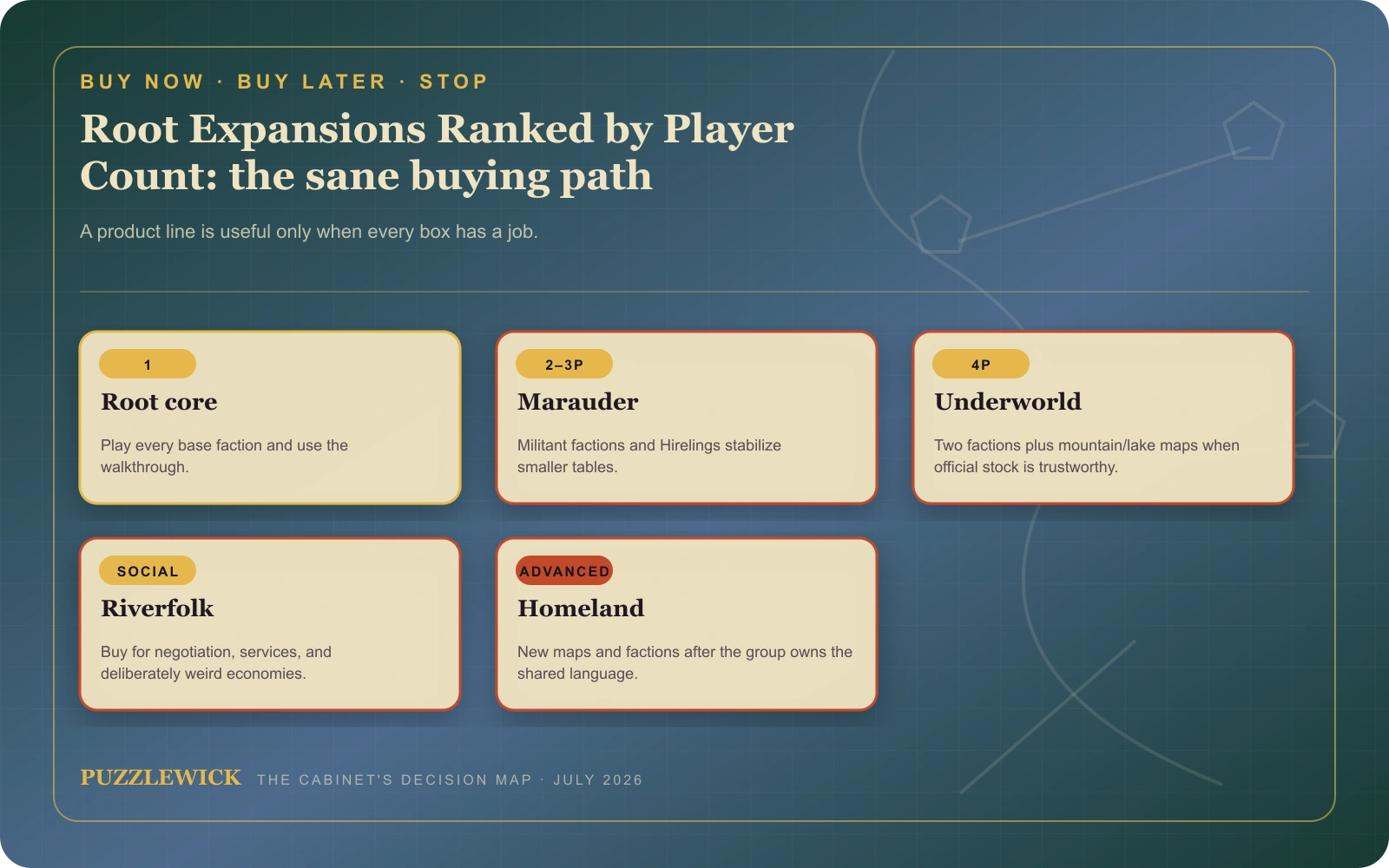

For a regular two- or three-player Root group, Marauder is the best first faction expansion because its two militant factions and Hirelings improve low-count maps. At four players, Underworld is the broadest next step when an authentic reprint is available. Riverfolk is best for groups that already enjoy negotiation and unstable table economies. Homeland is an advanced branch, not a beginner purchase.
The verified purchase path in this guide is Root on Amazon, Root: The Marauder Expansion on Amazon.
The decision is not “which box contains the most cardboard?” It is which box gives your actual player count, session length, teaching appetite, and appetite for repeat play the right first ten sessions.
How does Root Expansions Ranked by Player Count actually play?
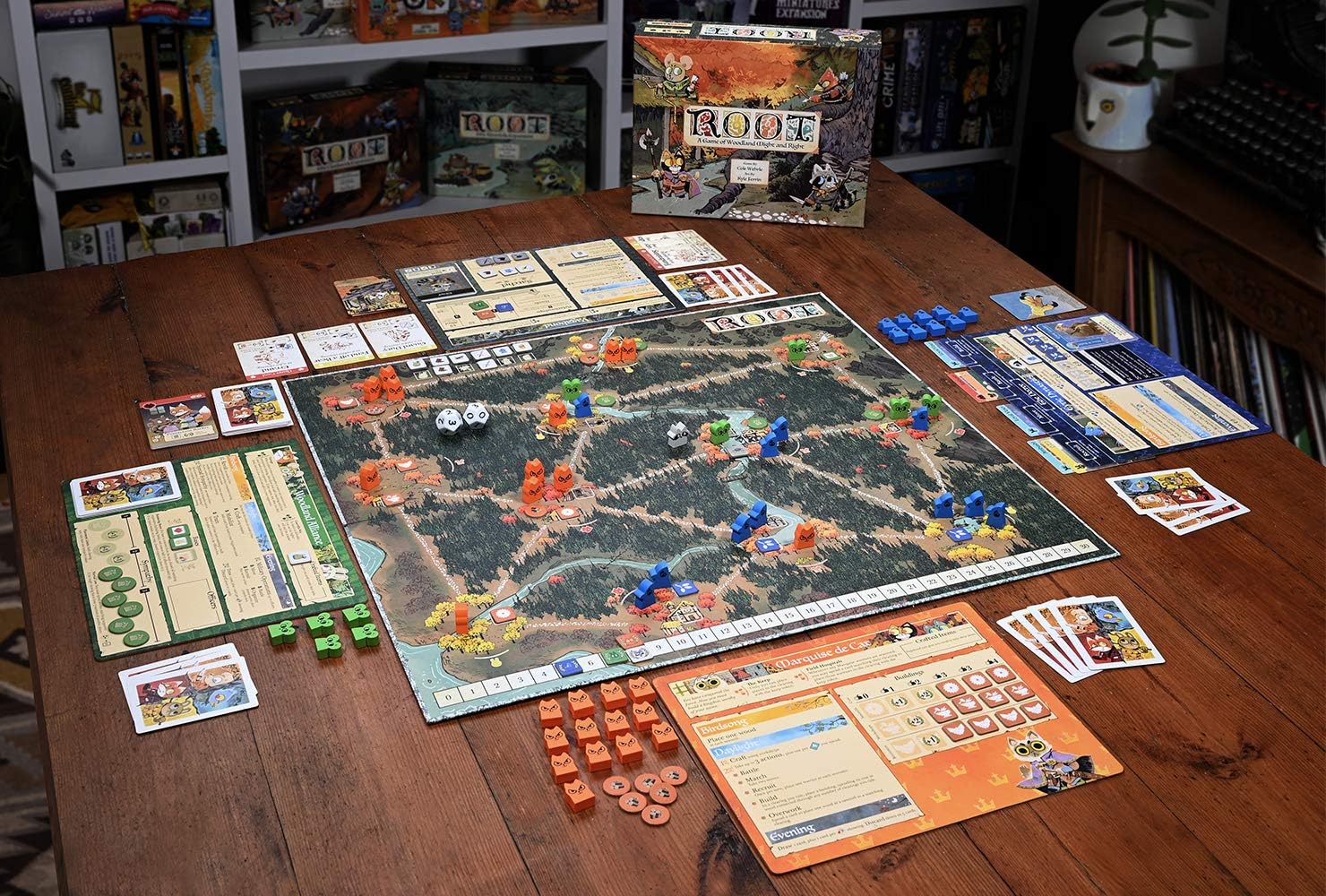

Root is an asymmetric war game: every faction follows the shared map rules but earns points, recruits, crafts, and fights through a different internal system.
Expansion value depends on player count and faction reach, not the number of meeples in the box. A faction can be brilliant and still make the wrong three-player composition.
The teach is communal. Everyone needs a rough model of every faction’s scoring clock, even when they only know their own procedure in detail.
What makes the system fun is not a component count. It is the repeatable decision loop: the moment when a beginner stops moving pieces because the rules permit it and starts making a plan the rest of the table can read.
What do players compare it to, and where does the comparison break?
Compared with Arcs, Root has more faction-specific procedure and a more stable territorial map. Compared with asymmetric adventure games, it asks players to understand opponents more deeply. Its expansion problem is composition design, not merely “more content.”
Across BGG and current forum discussions, the most useful comparisons describe table behavior rather than declaring one title universally “better.” Complexity, downtime, hidden information, player interaction, and the host’s teaching burden are the variables that survive beyond launch-week excitement.
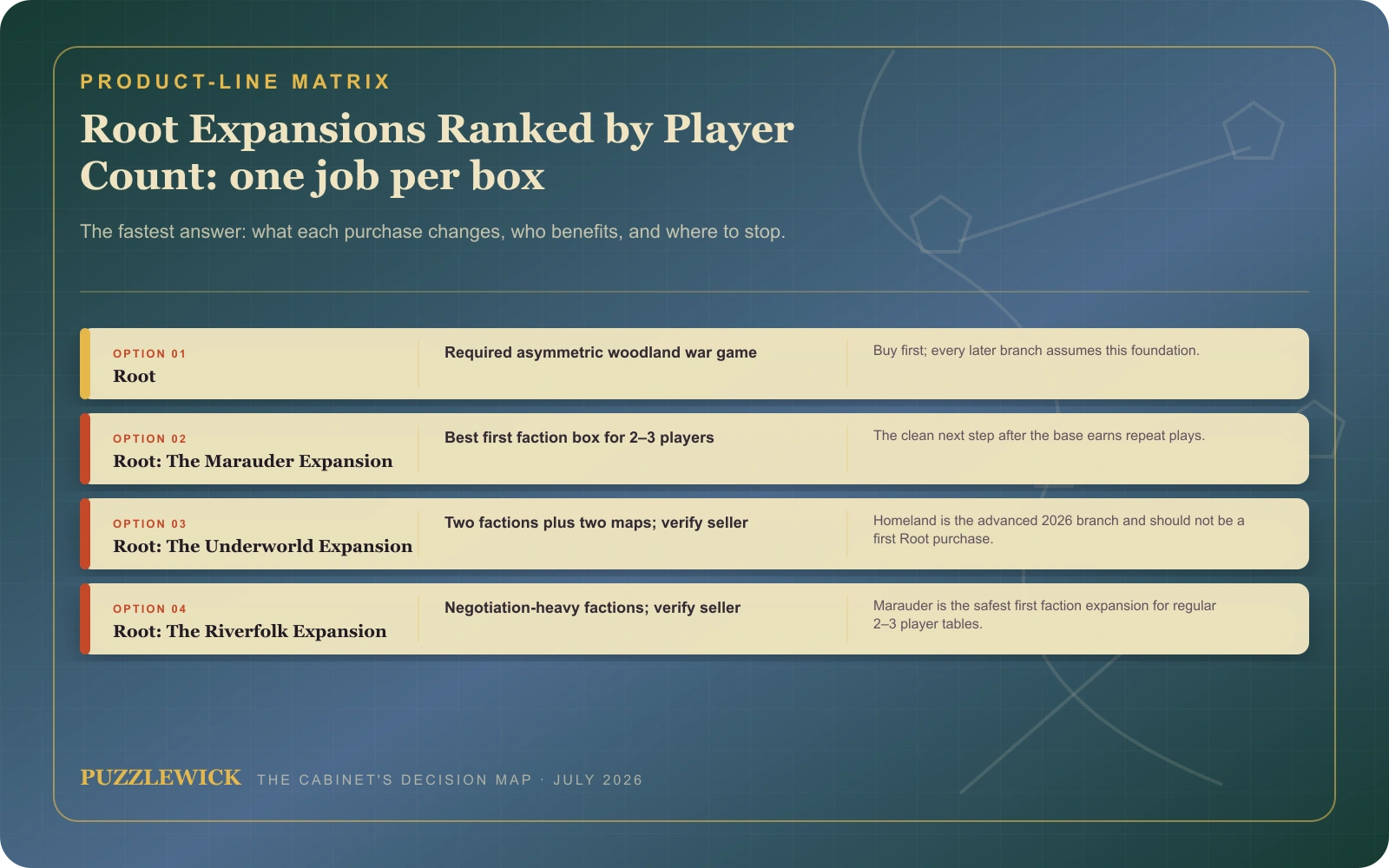
Use the matrix below to choose a job for the game. Theme can recruit a first play; the job determines whether the box earns a shelf.
What should you buy first, second, and not yet?
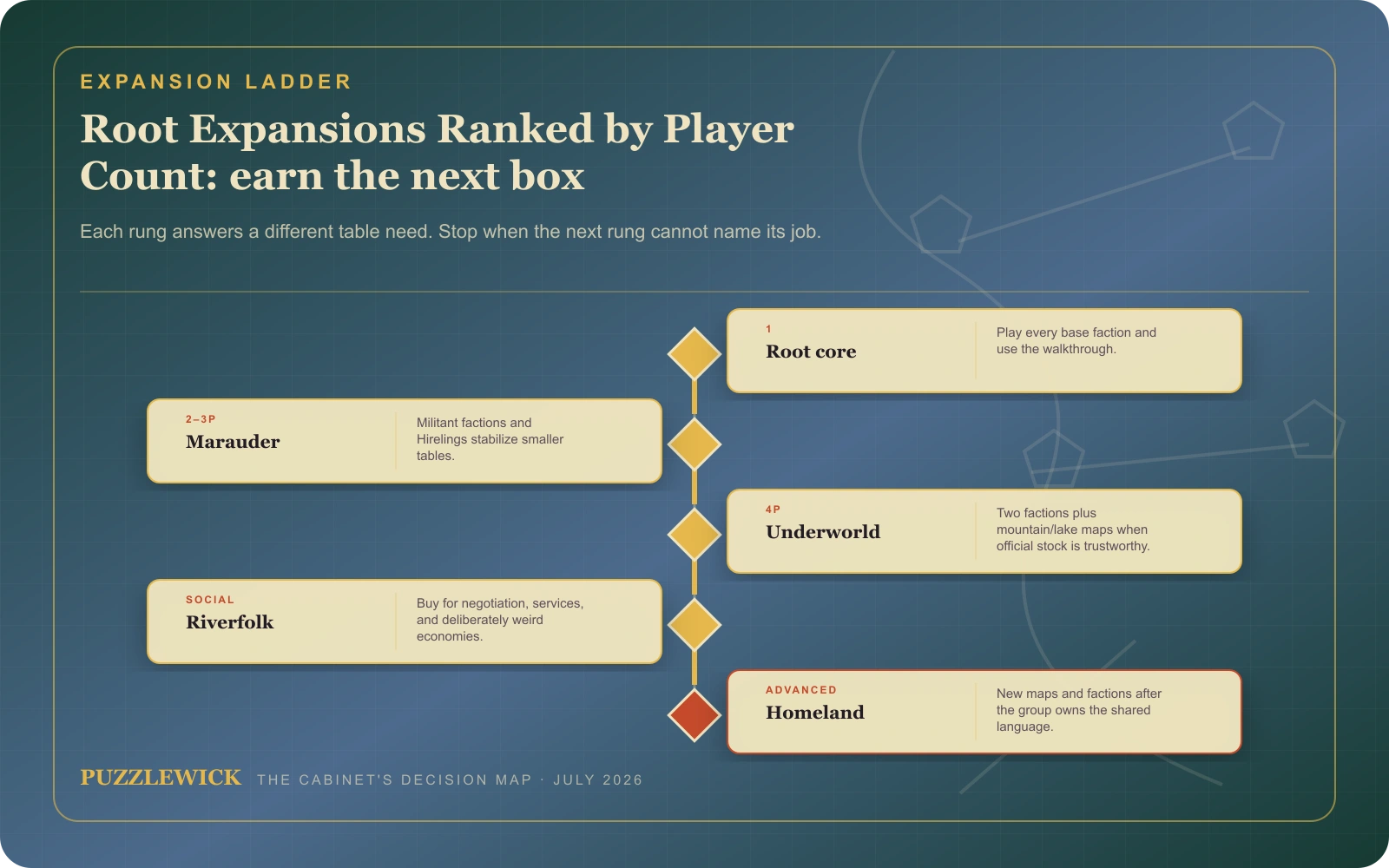

1 · Root core: Play every base faction and use the walkthrough.
2–3P · Marauder: Militant factions and Hirelings stabilize smaller tables.
4P · Underworld: Two factions plus mountain/lake maps when official stock is trustworthy.
SOCIAL · Riverfolk: Buy for negotiation, services, and deliberately weird economies.
ADVANCED · Homeland: New maps and factions after the group owns the shared language.
The stopping rule matters. Riverfolk and Underworld periodically leave print; verify seller and component quality on Amazon. Homeland is the advanced 2026 branch and should not be a first Root purchase.
Amazon availability is not treated as a verdict. A product can be easy to buy and still be the wrong next box; it can also be worth waiting for when the only current listing has an ambiguous edition, seller, language, or product identity.
Beginner, regular, advanced, and expert strategy
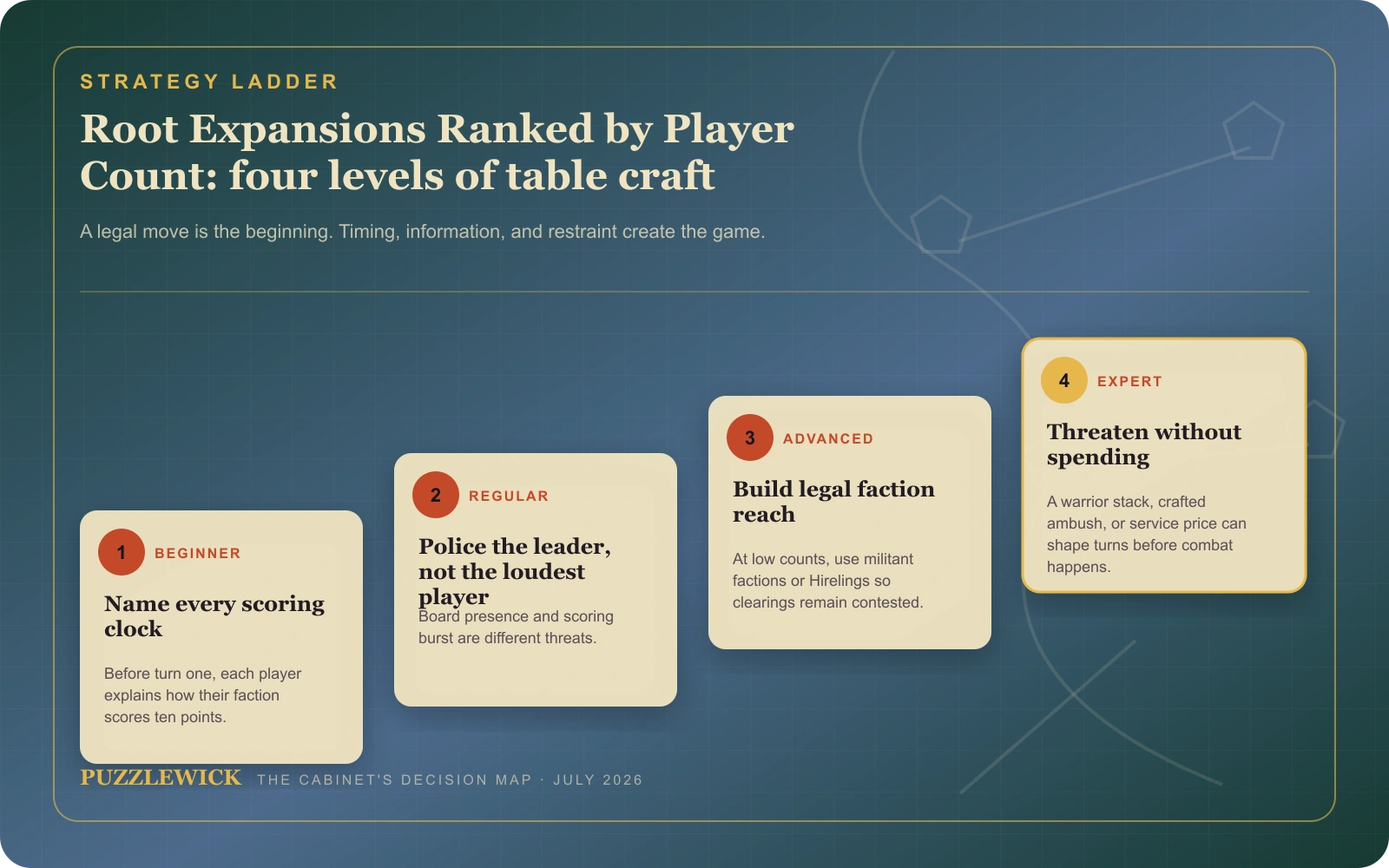
Beginner — Name every scoring clock. Before turn one, each player explains how their faction scores ten points.
Regular — Police the leader, not the loudest player. Board presence and scoring burst are different threats.
Advanced — Build legal faction reach. At low counts, use militant factions or Hirelings so clearings remain contested.
Expert — Threaten without spending. A warrior stack, crafted ambush, or service price can shape turns before combat happens.
Do the debrief. After the game, name one decision that worked and one rule or timing window that stayed muddy. That five-minute conversation is more valuable than buying an expansion to create novelty.
The strategy advice here combines the official rules structure with repeated owner questions.
What is the real table, hosting, and solo commitment?
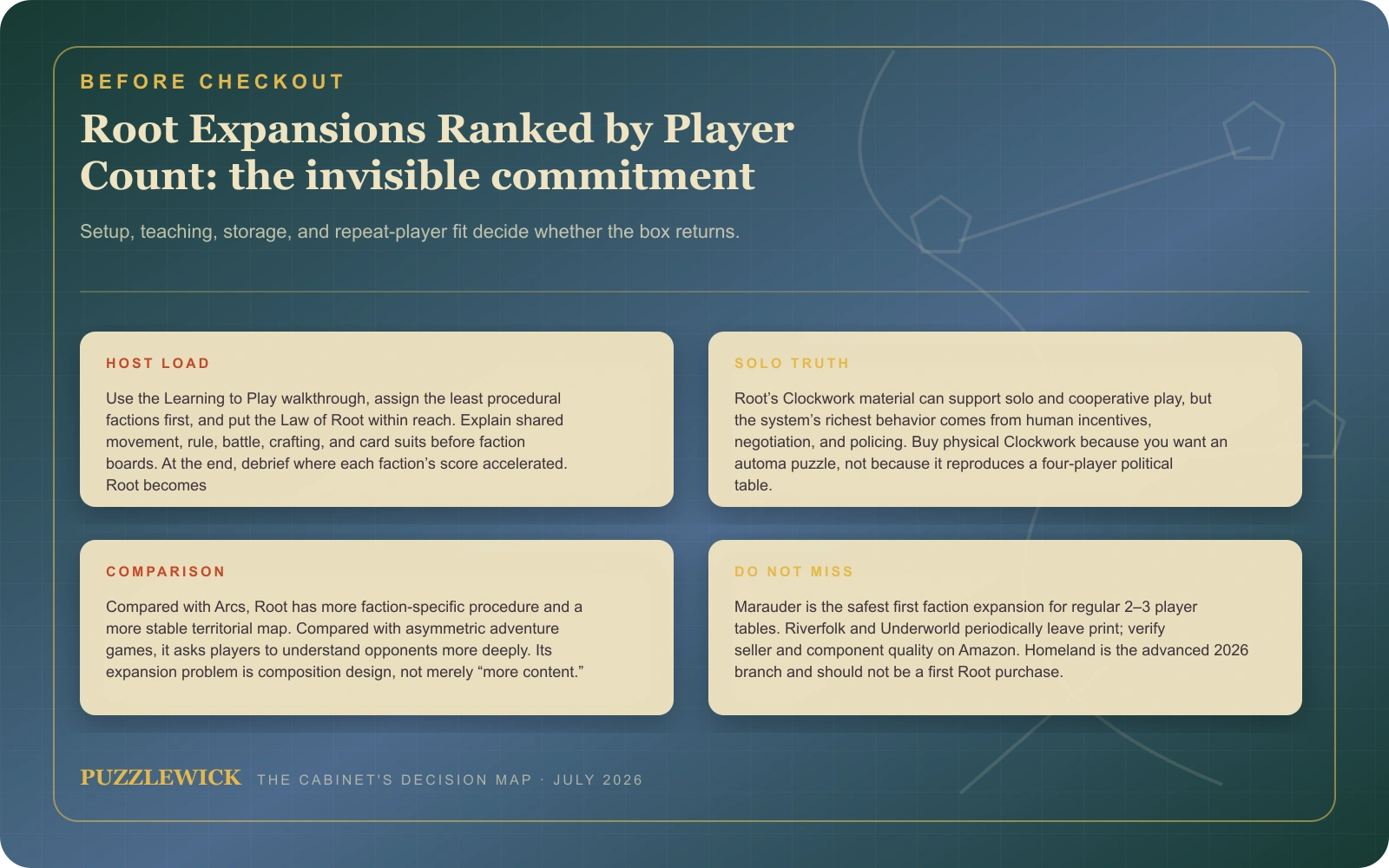

Hosting: Use the Learning to Play walkthrough, assign the least procedural factions first, and put the Law of Root within reach. Explain shared movement, rule, battle, crafting, and card suits before faction boards. At the end, debrief where each faction’s score accelerated. Root becomes friendly when the room learns together.
Solo: Root’s Clockwork material can support solo and cooperative play, but the system’s richest behavior comes from human incentives, negotiation, and policing. Buy physical Clockwork because you want an automa puzzle, not because it reproduces a four-player political table.
Before purchase, budget the invisible parts: setup surface, sorting, teaching, save-state needs, cleanup, and whether one person must own the rules. These costs decide replay more reliably than the excitement of an unboxing.
What do lower-star reviews and long-term owners warn about?
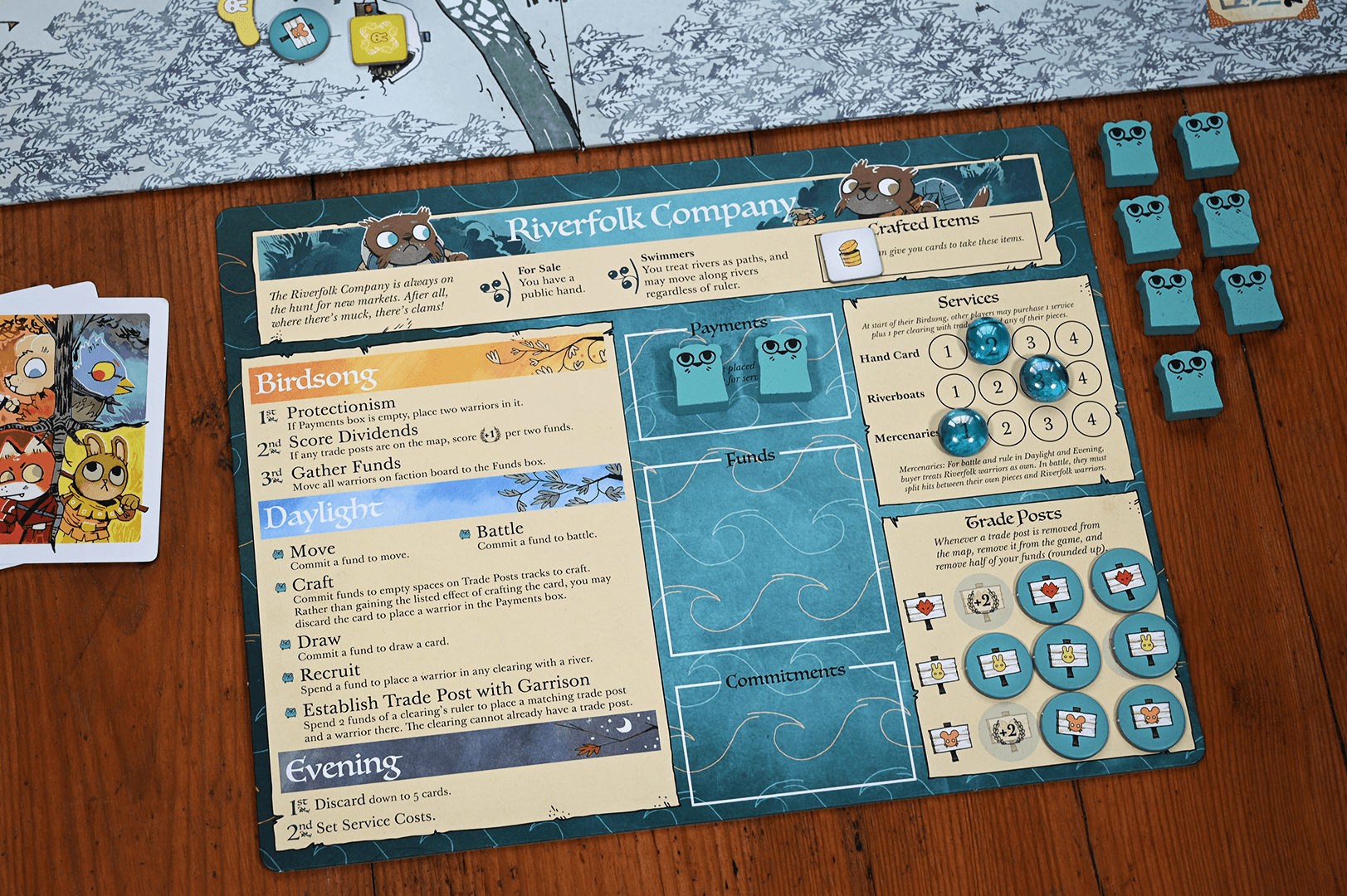

The durable warnings are fit warnings. Marauder is the safest first faction expansion for regular 2–3 player tables. Riverfolk and Underworld periodically leave print; verify seller and component quality on Amazon. Homeland is the advanced 2026 branch and should not be a first Root purchase.
Amazon review patterns were used only as a secondary check for recurring packaging, component, complexity, and expectation issues. Star ratings and individual quotations are intentionally not frozen here because listings merge, editions change, and ratings move.
A credible warning changes the buy decision. A complaint that merely describes the intended genre belongs in the “who should skip it” box instead.
Common misconceptions, corrected before checkout
- Marauder is not simply the “newest old expansion”; it solves specific low-player-count problems.
- Riverfolk is not the automatic first expansion despite its fame.
- A direct Amazon page is not proof of authenticity; verify title, seller, printing, and component quality.
The record date is July 27, 2026. Product identities and availability can change.
The Puzzlewick shelf plan for Root Expansions Ranked by Player Count
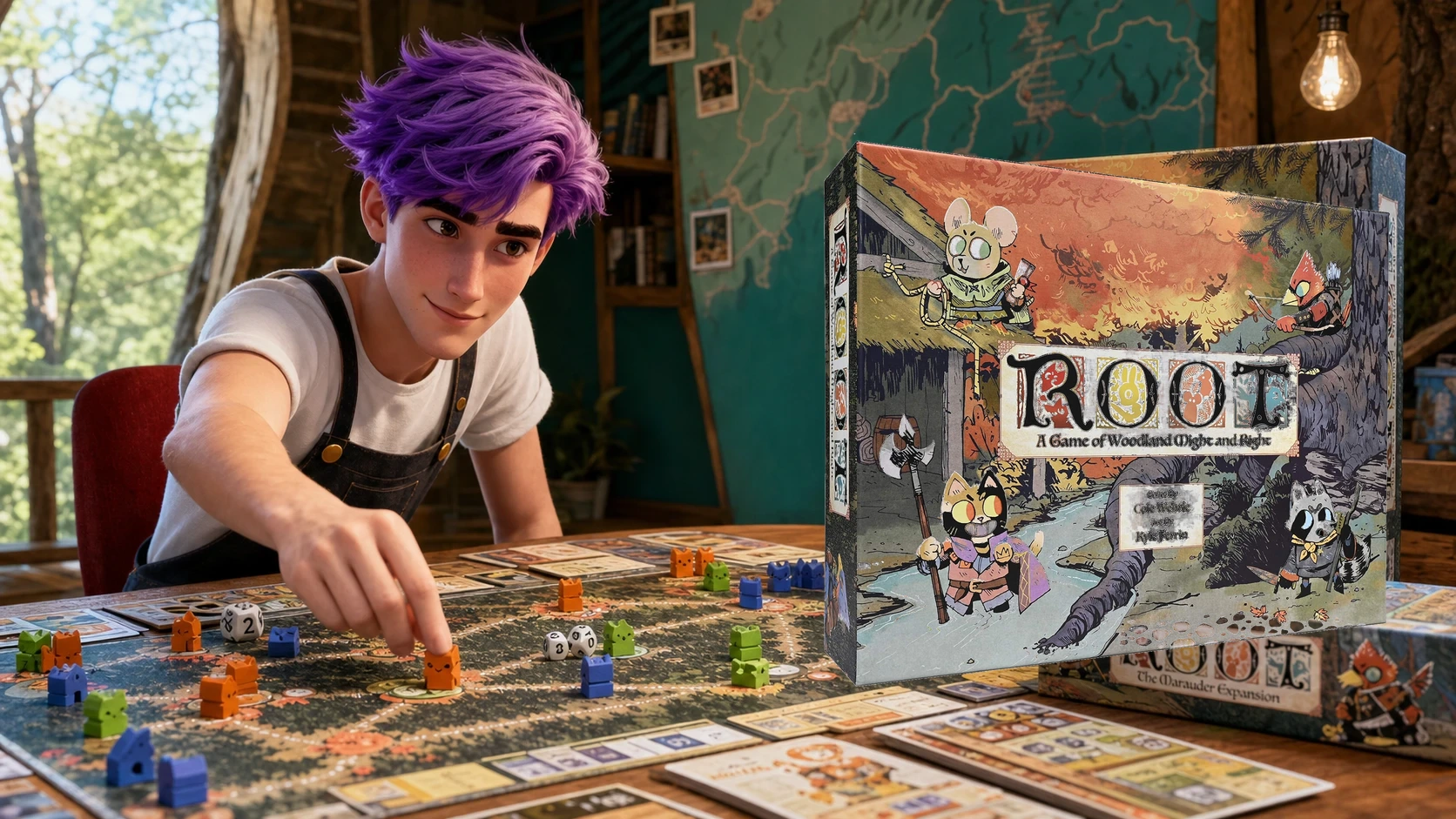
Buy Root, learn every base faction, then buy Marauder if your table is usually two or three. At four, wait for a verified Underworld reprint rather than gambling on an ambiguous Amazon listing. Buy Riverfolk only when the group wants table talk and strange economies. Homeland belongs after the group can teach Root without reopening the Law every other turn.
Buy the first verified box that solves your present table. Play it enough to explain why the second box would improve a repeated experience. If that sentence is still vague, the right move is to wait.
Current verified Amazon options: Root on Amazon, Root: The Marauder Expansion on Amazon.
The picks
Some links below are affiliate links — as an Amazon Associate, Puzzlewick earns from qualifying purchases, at no extra cost to you. It never changes a pick.
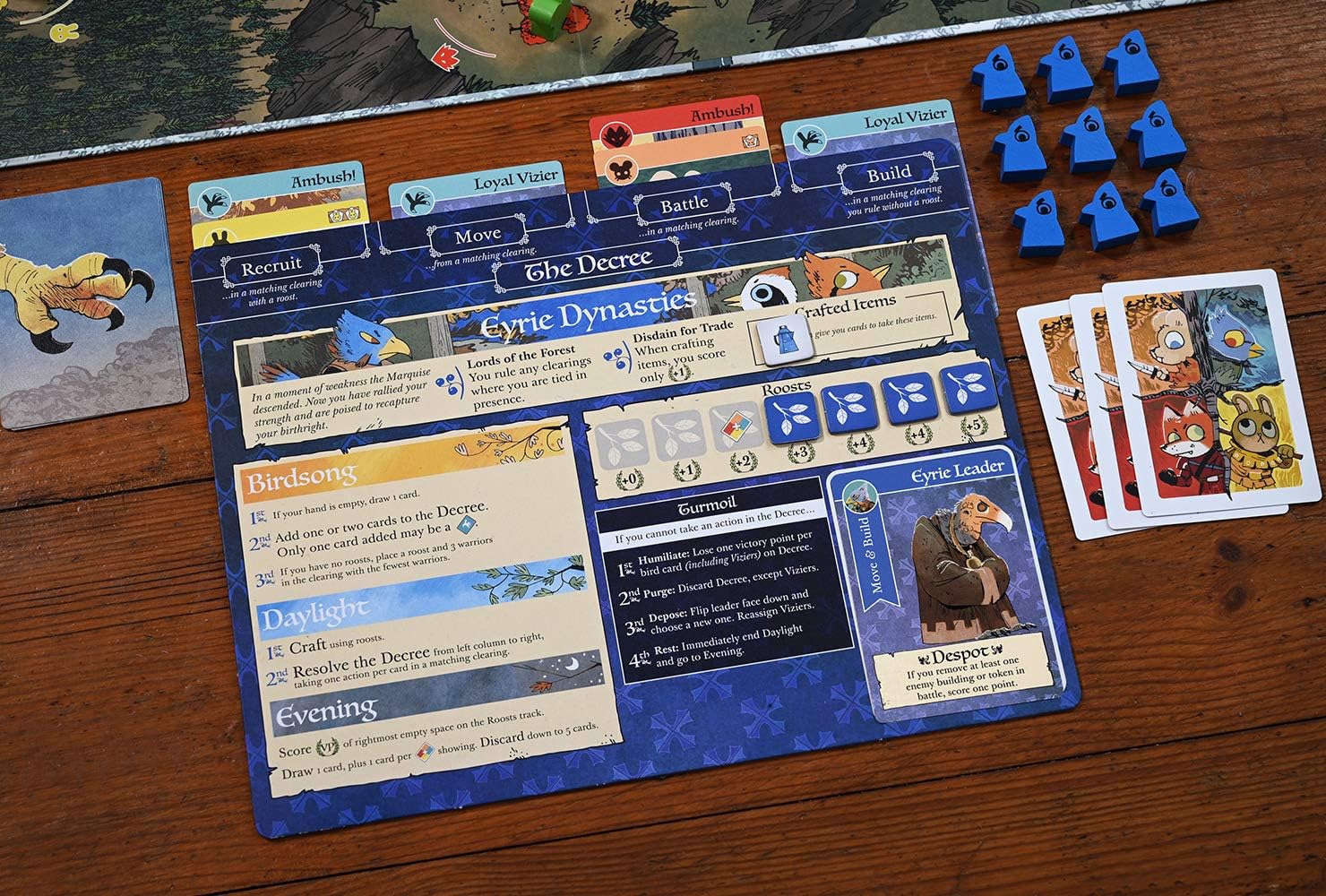
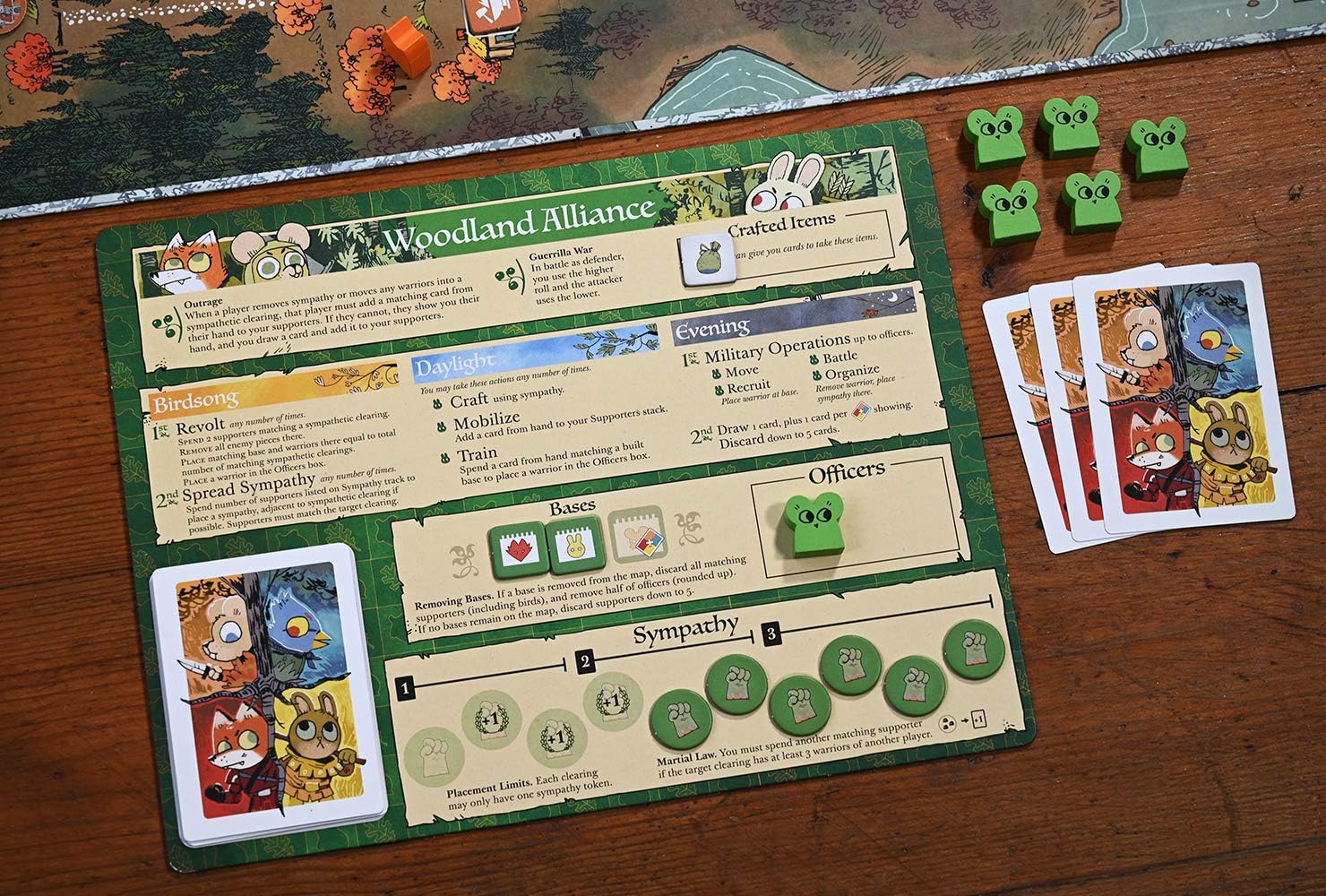
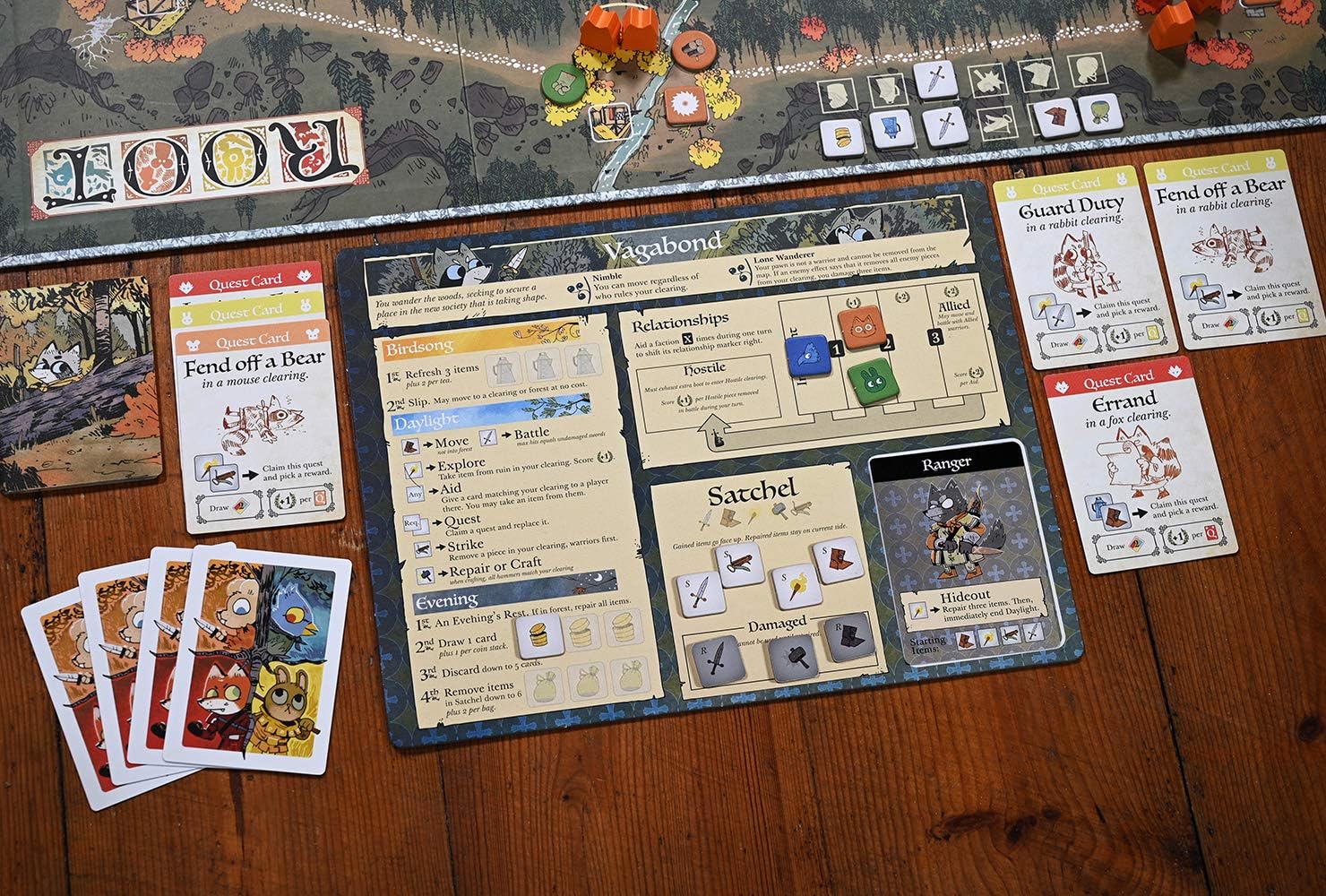
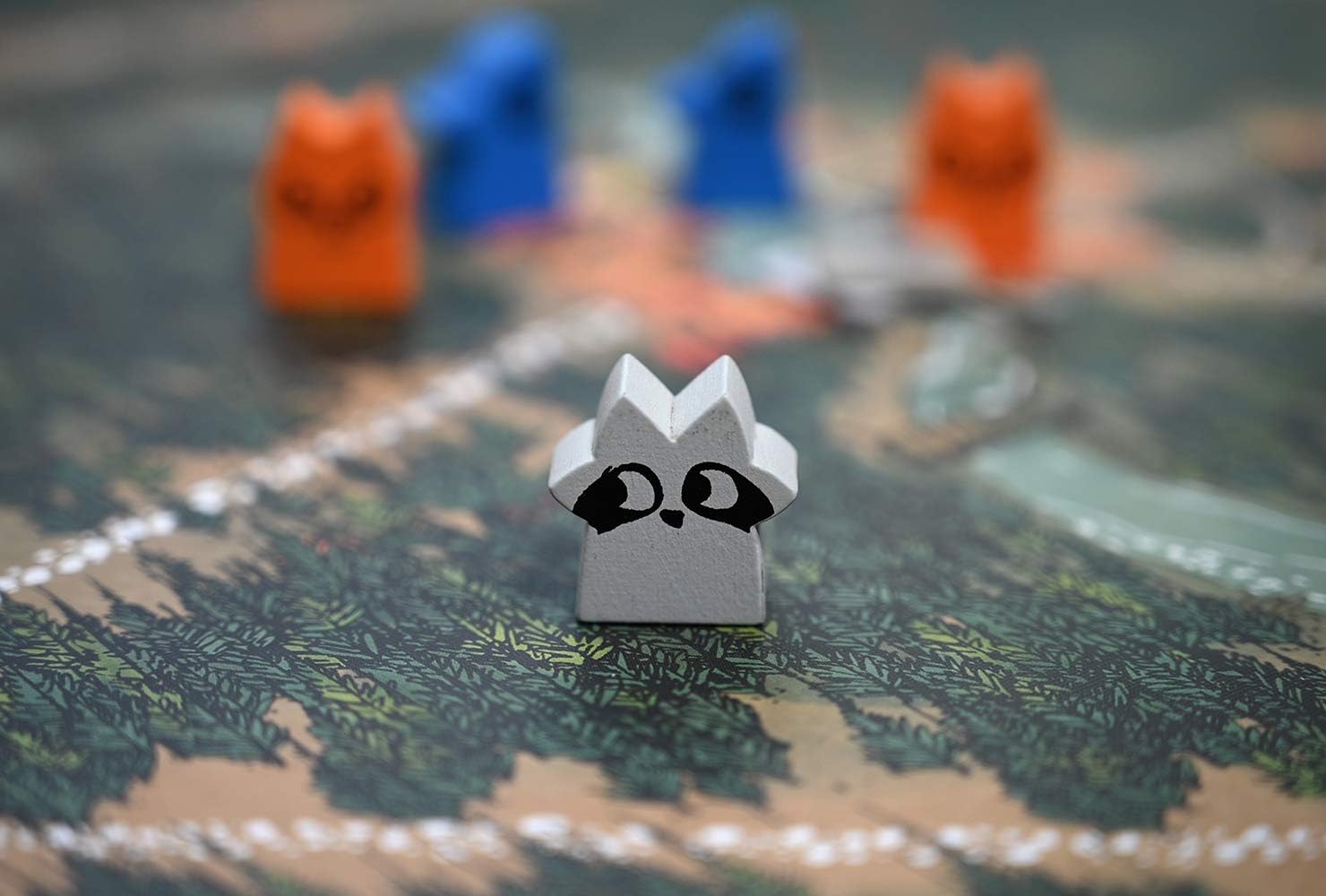
 10 photos
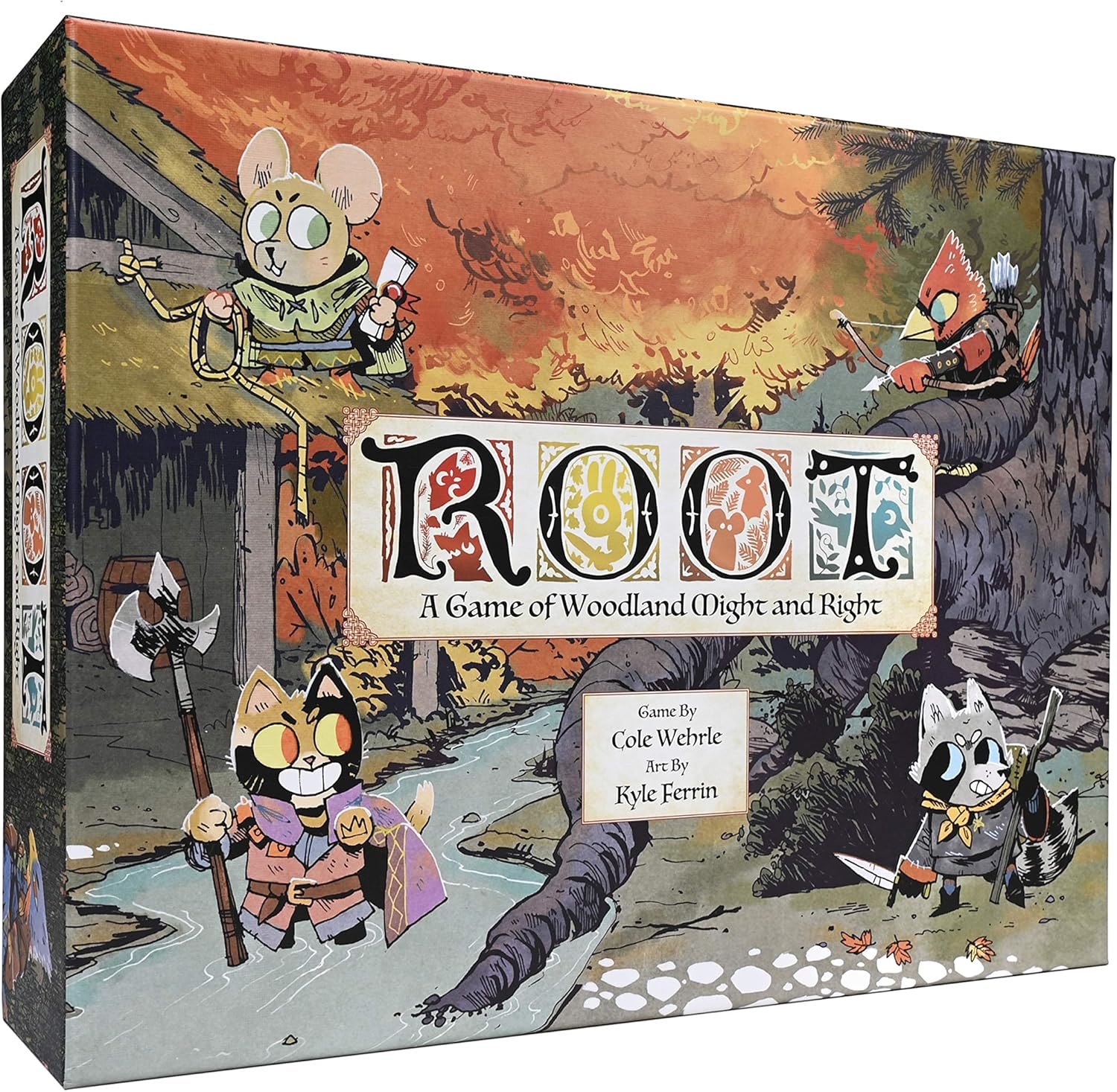
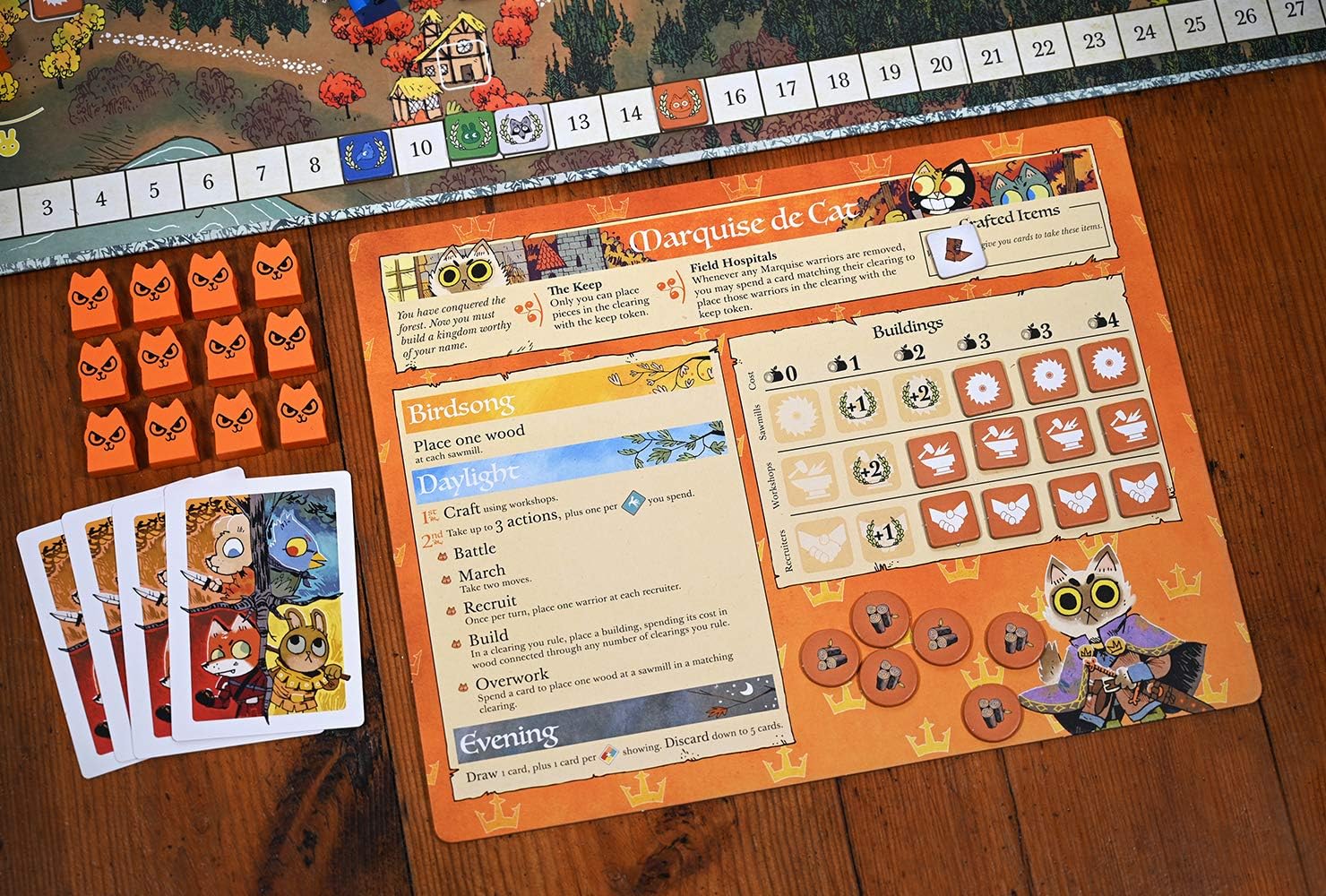
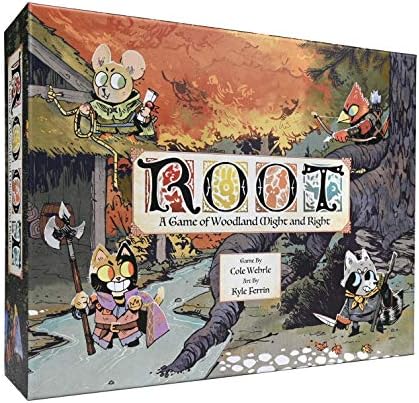
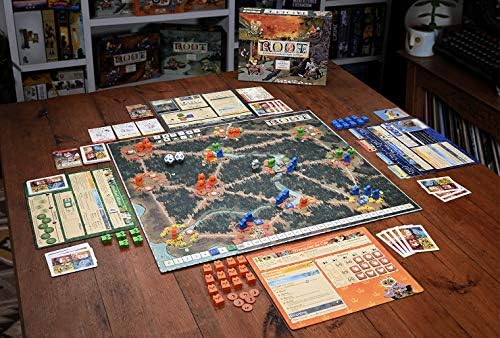
 Root
Required asymmetric woodland war game. Listing and edition verified July 27, 2026.
- Verified listing — the exact product, not a lookalike
- Has a clear job in the buying order
- Checked against the official rules and product pages
- Stock and seller can change without notice
- Not every table needs this one
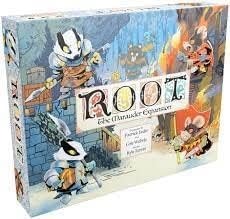
Root: The Marauder Expansion
Best first faction box for 2–3 players. Listing and edition verified July 27, 2026.
- Verified listing — the exact product, not a lookalike
- Has a clear job in the buying order
- Checked against the official rules and product pages
- Stock and seller can change without notice
- Not every table needs this one
At a glance
| Stage | Product | Buy when | Curator ruling |
|---|---|---|---|
| 1 | Root core | Play every base faction and use the walkthrough. | Start here |
| 2–3P | Marauder | Militant factions and Hirelings stabilize smaller tables. | Only after repeat play |
| 4P | Underworld | Two factions plus mountain/lake maps when official stock is trustworthy. | Only after repeat play |
| SOCIAL | Riverfolk | Buy for negotiation, services, and deliberately weird economies. | Specialist / later |
Questions, answered
What is the best first Root expansion?
Marauder is the safest first expansion for regular two- and three-player groups. Four-player groups may prefer Underworld when authentic stock is available.
Which Root expansion is best for two players?
Marauder, because its militant factions and Hirelings improve map pressure at low counts.
Is Riverfolk a good first expansion?
Only for a group that already likes Root and wants negotiation-heavy, unusual factions. It is not the most forgiving first add-on.
What does Underworld add?
Two factions plus two maps, giving established four-player groups substantial composition and board variety.
Should a beginner buy Homeland?
No. Homeland is an advanced branch for groups already fluent in Root’s shared and faction rules.
How do I avoid counterfeit Root products?
Use exact titles, inspect seller information, compare printing/component details with Leder Games, and return suspicious copies.
Dax's verdict
Buy Root, learn every base faction, then buy Marauder if your table is usually two or three. At four, wait for a verified Underworld reprint rather than gambling on an ambiguous Amazon listing. Buy Riverfolk only when the group wants table talk and strange economies. Homeland belongs after the group can teach Root without reopening the Law every other turn.
Research ledger 10 sources · reviewed 2026-07-27
Specifications, rules, current product information, community experience, and contrary evidence were checked against the sources below. Commercial links are kept separate from editorial evidence.
- Leder Games Root expansion catalogledergames.com/collections/root-expansions
- Official Root rulesrules.ledergames.com/?locale=en-US&printing=p1&product=root
- Official Root card librarycards.ledergames.com/products
- Leder Root FAQretail.ledergames.com/pages/frequently-asked-questions
- 2026 present-buying expansion questionreddit.com/r/rootgame/comments/1ugdlot/expansion_to_buy_as_a_present_for_someone_who
- 2026 expansion comparisonreddit.com/r/rootgame/comments/1t81dnu/best_roots_expansion
- Current expansion availability discussionreddit.com/r/rootgame/comments/1v754y7/underworld_expansion_availability
- Amazon counterfeit warning discussionreddit.com/r/rootgame/comments/16m2r90/riverfolk_expansion
- Wargamer Root expansion comparisonwargamer.com/root/expansions
- GamesRadar Root review and expansion contextgamesradar.com/root-board-game-review

I'll be honest with you — flattery is boring.


Keep exploring
The next smart rabbit holes.
♜ Universe HubRoot: the whole buying pathRoot is an asymmetric woodland war game where every faction follows a different economy and route to victory. Puzzlewick organizes...✦ Topic PathBoard Game Buying Guides: compare the whole shelfStart with the decision, not the shelf. These guides compare the games, editions, expansions, player counts, and costs people...ComparisonThe Elder Scrolls: Betrayal of the Second Era vs Too Many Bones in 2026: Which Chip Theory RPG?Three-session sandbox campaign or one-night tyrant run? The real differences in table space, character building, solo flow, expansions,...