Coup Complete Strategy Guide: Bluffing, Challenging, Reformation, and the Duke Problem
Dax turns five roles and two face-down cards into a practical bluffing school: challenge math, table incentives, endgame lines, why nobody challenges Duke, and when Reformation or G54 is worth adding.


AI-assisted research and drafting in Dax’s voice · reviewed by Robert Pruitt · how this guide was made
Last editorial refresh: 2026-07-14 Gold-standard QA: 2026-08-10 10 sources reviewed Affiliate links checked during gold-standard pass

The short answer
Buy standard Coup first. Add Reformation when four or more regular players want teams, allegiance changes, and a larger table; it is weak at two or three. Choose Coup: Rebellion G54 only if your group wants changing role sets and is willing to learn each configuration over several games. The strongest strategy is not “always claim Duke”—it is preserving several believable identities while challenging when the table’s incentives and remaining cards make the claim expensive to maintain.
Decision map
Choose in thirty seconds
Best first purchase.
Best for four-plus regular players.
Best for heavy repeat groups wanting role variety.
Coup compresses a political thriller into fifteen minutes and fifteen cards. Its rules are tiny; its table incentives are not. Dax cross-checked the official Reformation description with current owner debates about Duke passivity, player count, and Rebellion G54, then built a guide around the probability, performance, and social timing that actually decide games.
Start here, then go deeper
You are in the right cabinet.
 ⚔ Topic PathTwo-Player Board Games: compare the whole shelfThe best two-player game is designed around the duel rather than merely tolerating two people. This path separates sharp...
 Best OfBest Social Deduction Games (2026): Beyond Werewolf & MafiaOkay but have you SEEN what the room's been saying about these? Werewolf walked so these could run — nine games that turn a living room...
 Best OfBest Party Card Games for Adults, Ranked (2026)Okay but have you SEEN what the room's been saying about Monikers, Wavelength, So Clover!, Just One — because the party-game conversation...
How do you play Coup?
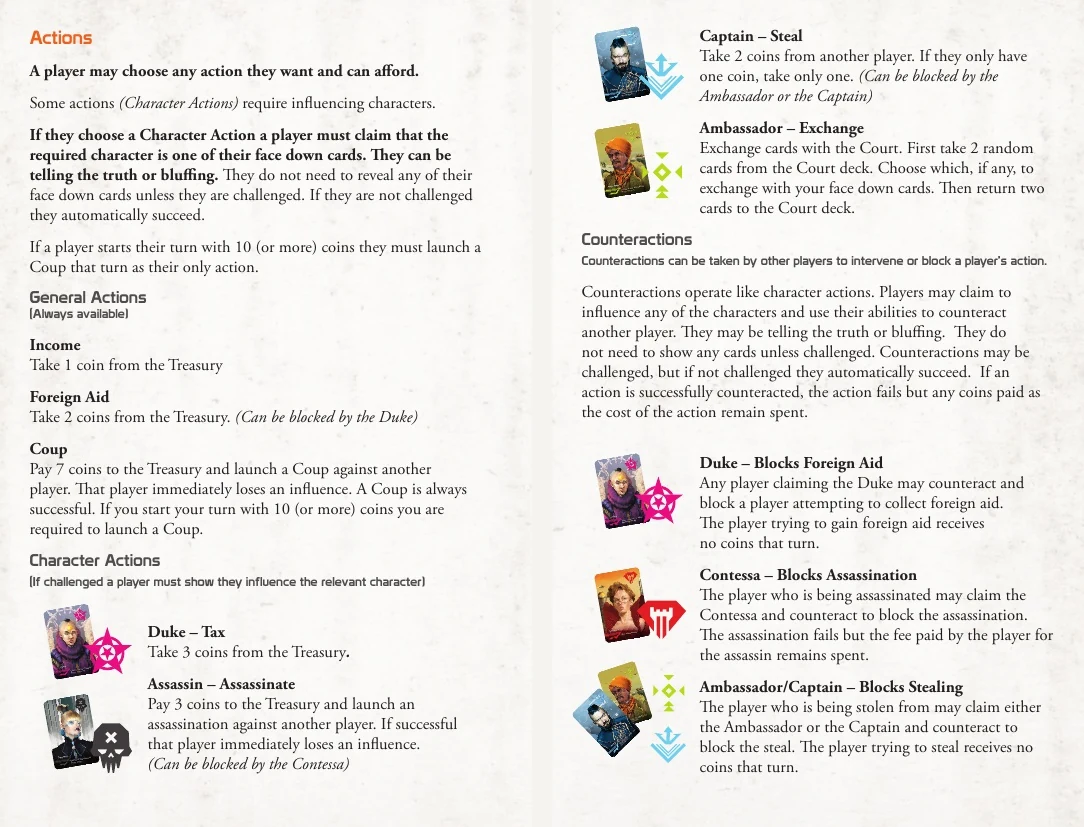

Each player begins with two face-down influence cards and two coins. On your turn take Income for one coin, Foreign Aid for two, launch a Coup for seven, or claim a character action whether or not you hold that character. At ten coins, you must Coup.
Any eligible player may challenge a character claim. If the claimant reveals the named character, the challenger loses one influence and the proven card is shuffled back and replaced; if the claim was false, the claimant loses influence. Blocks are character claims too and can be challenged. Lose both influence and you are eliminated; last player standing wins. That claim/challenge/block triangle is the whole machine.
Each player begins with two face-down influence cards and two coins.
Why does everybody claim Duke?
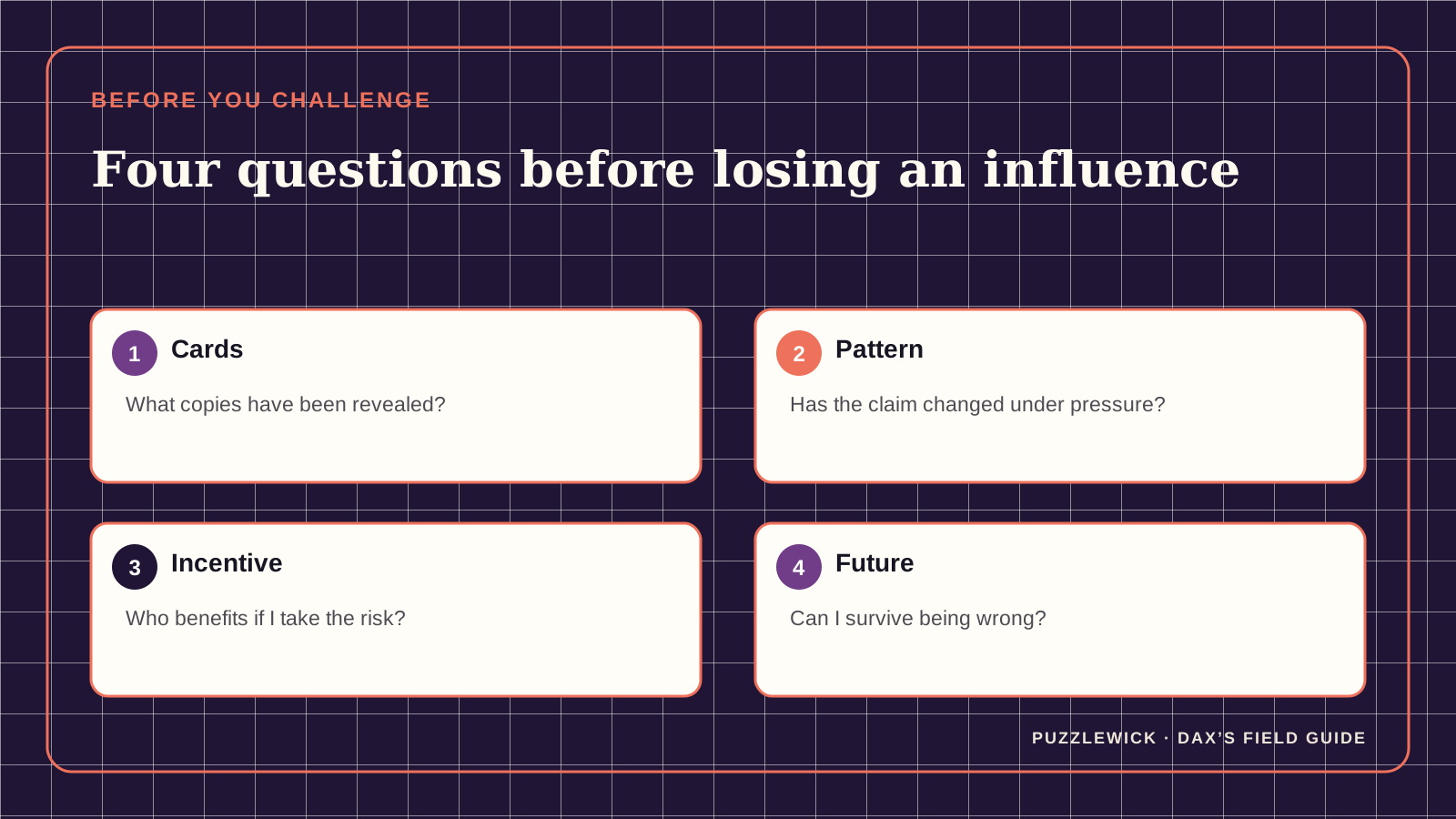

Duke is safe-looking because taking three coins creates obvious progress and many tables collectively avoid the risk of challenging early. That passivity makes the claim self-reinforcing. The answer is not to challenge every first-turn Duke. Track how many Dukes are revealed, who continues claiming under pressure, and whether other players are free-riding on your risk.
If three people claim Duke and no Duke has appeared, the claims can all be true. Probability alone is not proof. A challenge becomes attractive when a revealed Duke reduces copies, a claimant’s earlier behavior contradicts the role, or letting the economy continue will force you to absorb the next Coup anyway.
Duke is safe-looking because taking three coins creates obvious progress and many tables collectively avoid the risk of challenging early.
What is the best opening strategy?
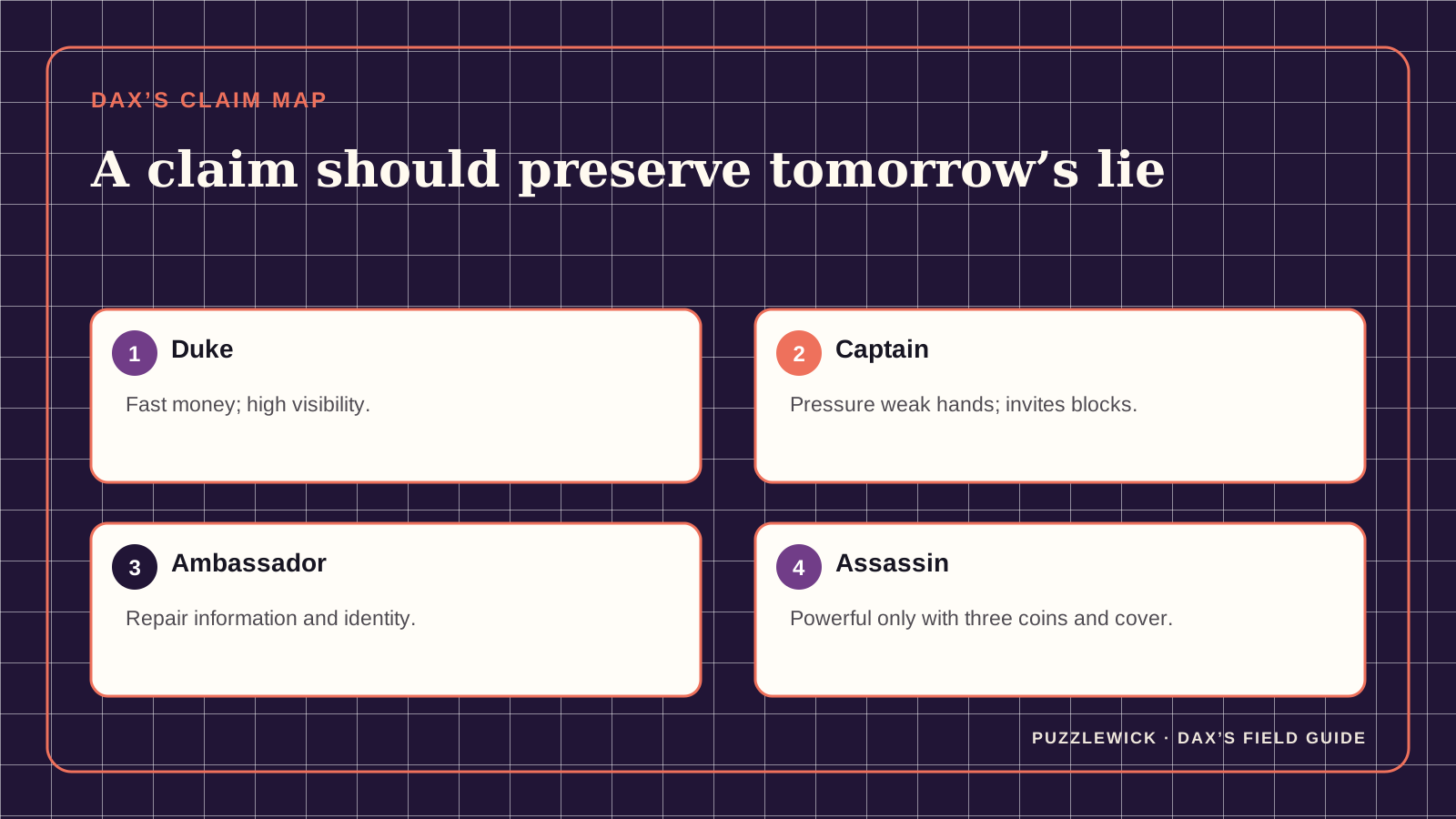

Open with an action that supports multiple future stories. Duke is powerful but paints a target. Ambassador gains information and can repair an awkward hand while making later claims harder to read. Captain can pressure a player who appears unable to block. Foreign Aid tests whether someone will claim Duke without risking influence.
Avoid unnecessary assassination in the opening. Paying three coins to invite a Contessa block and two possible challenges can transfer the table’s attention to you. Build coins, observe block patterns, and preserve at least one credible defensive identity. Your first turn should create options, not prove you can speak loudly.
Open with an action that supports multiple future stories.
How do you bluff without becoming predictable?

Tell lies that agree with the table’s memory. If you repeatedly blocked stealing as Captain, suddenly claiming Contessa under assassination is possible but expensive to believe. Change pace as well as role: a player who instantly names every claim signals preparation; a short pause can look like fabrication whether truthful or not. Do not overact. The cleanest bluff sounds like administration.
More importantly, leave yourself exits. A false Duke claim can be abandoned. A false Contessa claim under assassination cannot; the challenge is attached to survival. Bluff aggressively where failure costs tempo and conservatively where failure costs the game.
Tell lies that agree with the table’s memory.
What is the pro-level challenge strategy?

A challenge is a bet with public consequences. Count revealed roles, but also identify incentive ownership. If another player is about to be assassinated, making them challenge their attacker may be better than volunteering your own influence. If a dominant player’s claim funds a forced Coup against you, the risk belongs to you now.
Watch exchange actions. A successful Ambassador claim returns cards to the deck and changes what can be known. After a truthful challenged claim, the revealed role is also shuffled back, so certainty resets. Strong players challenge stories at their weakest link, not roles at their most annoying moment.
A challenge is a bet with public consequences.
Is Coup: Reformation worth it?

Reformation is worth it for groups of five or more that already know Coup. It adds Allegiance: players belong to factions, and hostile actions are generally directed across factions until a conversion changes the map. The Inquisitor can replace the Ambassador, adding peeking and card-exchange pressure. The Treasury creates another shared target for manipulation.
Do not add it to a first game. Base Coup’s virtue is that five roles become a common language. Reformation is best when that language is already automatic and the table wants shifting teams, larger counts, and more reasons to read alliances.
Reformation is excellent for four or more players who already enjoy base Coup.
Reformation or Rebellion G54?

Reformation deepens the familiar five-role game. Rebellion G54 offers a large pool of roles and uses selected sets, creating enormous variety but a higher learning cost and less instantly shared language. Current player advice is sensible: if you choose G54, keep the same role set for several games before randomizing again. Otherwise each round becomes rules discovery instead of bluff development.
For most households: base, then Reformation. Choose G54 for a group that replays Coup heavily and actively wants a configurable system. It is not the premium edition every fan is obliged to graduate into.
Reformation deepens the familiar five-role game.
How do you host a better Coup table?
Play the first round open-handed and allow truthful claims only. That teaches action, counteraction, challenge, and card replacement without performance anxiety. In the real game, require claims and blocks to be spoken clearly before anyone reacts. Resolve one window at a time: action, counteraction, challenge. Do not let the loudest player rewind timing after seeing responses.
Keep lost influence face up and coins visible. Run several rounds and rotate first player. Coup’s soul appears through repeated encounters—when a cautious player finally lies, when a habitual Duke is truthful, and when Dax smiles because the table challenged the wrong sentence.
Play the first round open-handed and allow truthful claims only.
How should you play the final three-player and heads-up stages?

At three players, policing becomes unstable because challenging the leader can hand the untouched player the game. Count coins and forced-Coup distance every turn. Sometimes the correct move is Foreign Aid rather than a flashy character claim because it tests a block and preserves your influence. Do not assassinate a weak player automatically if their survival keeps pressure on the leader.
Heads-up Coup is a tempo duel. One lost influence sharply narrows credible defenses, and seven coins create an unavoidable clock. Captain pressure grows when the opponent cannot safely claim a block; Ambassador can refresh a compromised identity; Duke races. Track which roles are face up and remember that truthful challenge resolution returns a role to the deck. Dax’s endgame rule: stop performing for the eliminated audience. Choose the line that forces the opponent to make the last uncertain claim.
At three players, policing becomes unstable because challenging the leader can hand the untouched player the game.
What information survives after an influence is lost?

A revealed card is certainty and therefore changes every challenge price. If a Duke lies face up and two players continue claiming Duke, fewer truthful worlds remain. But exchanges and successful truthful challenges return roles to the deck, so the table’s certainty can loosen again. Announce every shuffle and replacement clearly.
Also remember what a player chose to reveal. Losing a Contessa may make future assassinations attractive; losing a Captain may invite steals; revealing the only role that supported earlier claims can expose the surviving card’s likely identity. Skilled players use that public history without declaring it infallible. The hidden card is still hidden, and Coup punishes the person who turns a good inference into a certainty one sentence too early.
A revealed card is certainty and therefore changes every challenge price.
The picks
Some links below are affiliate links — as an Amazon Associate, Puzzlewick earns from qualifying purchases, at no extra cost to you. It never changes a pick.
 2 photos
 Coup
Five roles, two cards, and a remarkably deep bluffing loop in a pocketable box.
- Best first purchase.
- Five roles, two cards, and a remarkably deep bluffing loop in a pocketable box.
- Play several rounds before expanding.
2 photos Coup: Reformation
Fluid allegiances and the Inquisitor make larger tables more political.
- Best for four-plus regular players.
- Fluid allegiances and the Inquisitor make larger tables more political.
- Weak value at two or three.
2 photos Coup: Rebellion G54
A configurable role system with far more combinations and learning overhead.
- Best for heavy repeat groups wanting role variety.
- A configurable role system with far more combinations and learning overhead.
- Keep one set for multiple games before changing it.
At a glance
| Table | Best box | Reason |
|---|---|---|
| New to Coup | Base | Clean shared role language |
| 4–10 regular players | Reformation | Allegiances structure table politics |
| Highly experienced variety seekers | G54 | Configurable role sets |
| Mostly 2–3 players | Base | Reformation adds little at low count |
Questions, answered
Should you always claim Duke?
No. Duke is strong, but repeated visible income paints a target and narrows your believable role story.
When should I challenge?
When revealed cards, behavior, and your own survival incentive make the risk worthwhile—not simply because a claim is annoying.
Is Reformation good with three players?
It is playable, but its allegiance system is far better with four or more.
Is G54 better than Coup?
It is broader, not universally better. Standard Coup has cleaner shared knowledge and faster repeated play.
Is Coup good with two players?
It works, but three to five creates the table-policing and shifting incentives that make the bluffing system sing.
When should you add Reformation?
Add it after the base roles are fluent and primarily when playing four or more; factions are valuable when the table can exploit them.
Dax's verdict
Coup becomes excellent when the table stops treating claims as isolated coin buttons and starts treating them as a public biography. Buy the base game, learn how each role protects a future lie, then add Reformation for a larger political circle. Challenge when the risk actually belongs to you, bluff where you retain an exit, and never confuse a confident Duke with a confirmed one.
Research ledger 10 sources · reviewed 2026-08-10
Specifications, rules, current product information, community experience, and contrary evidence were checked against the sources below. Commercial links are kept separate from editorial evidence.
- indieboardsandcards.comindieboardsandcards.com/our-games/coup-reformation
- boardgamegeek.comboardgamegeek.com/boardgame/131357/coup
- reddit.comreddit.com/r/boardgames/comments/1ps1wu2/coup_reformation_thoughts
- reddit.comreddit.com/r/boardgames/comments/1r3e5qh/which_to_get_coup_rebellion_or_coup_reformation
- reddit.comreddit.com/r/boardgames/comments/1mvs4mf/why_nobody_challenges_dukes_in_coup_a
- ultraboardgames.comultraboardgames.com/coup/game-rules.php
- boardgamegeek.comboardgamegeek.com/boardgame/148931/coup-reformation
- reddit.comreddit.com/r/boardgames/search/?q=coup%20strategy
- indieboardsandcards.comindieboardsandcards.com/index.php/our-games/coup
- qugs.orgqugs.org/rules/r131357.pdf

I'll be honest with you — flattery is boring.

Keep exploring
The next smart rabbit holes.
⚔ Topic PathTwo-Player Board Games: compare the whole shelfThe best two-player game is designed around the duel rather than merely tolerating two people. This path separates sharp...Best OfBest Social Deduction Games (2026): Beyond Werewolf & MafiaOkay but have you SEEN what the room's been saying about these? Werewolf walked so these could run — nine games that turn a living room...Best OfBest Party Card Games for Adults, Ranked (2026)Okay but have you SEEN what the room's been saying about Monikers, Wavelength, So Clover!, Just One — because the party-game conversation...